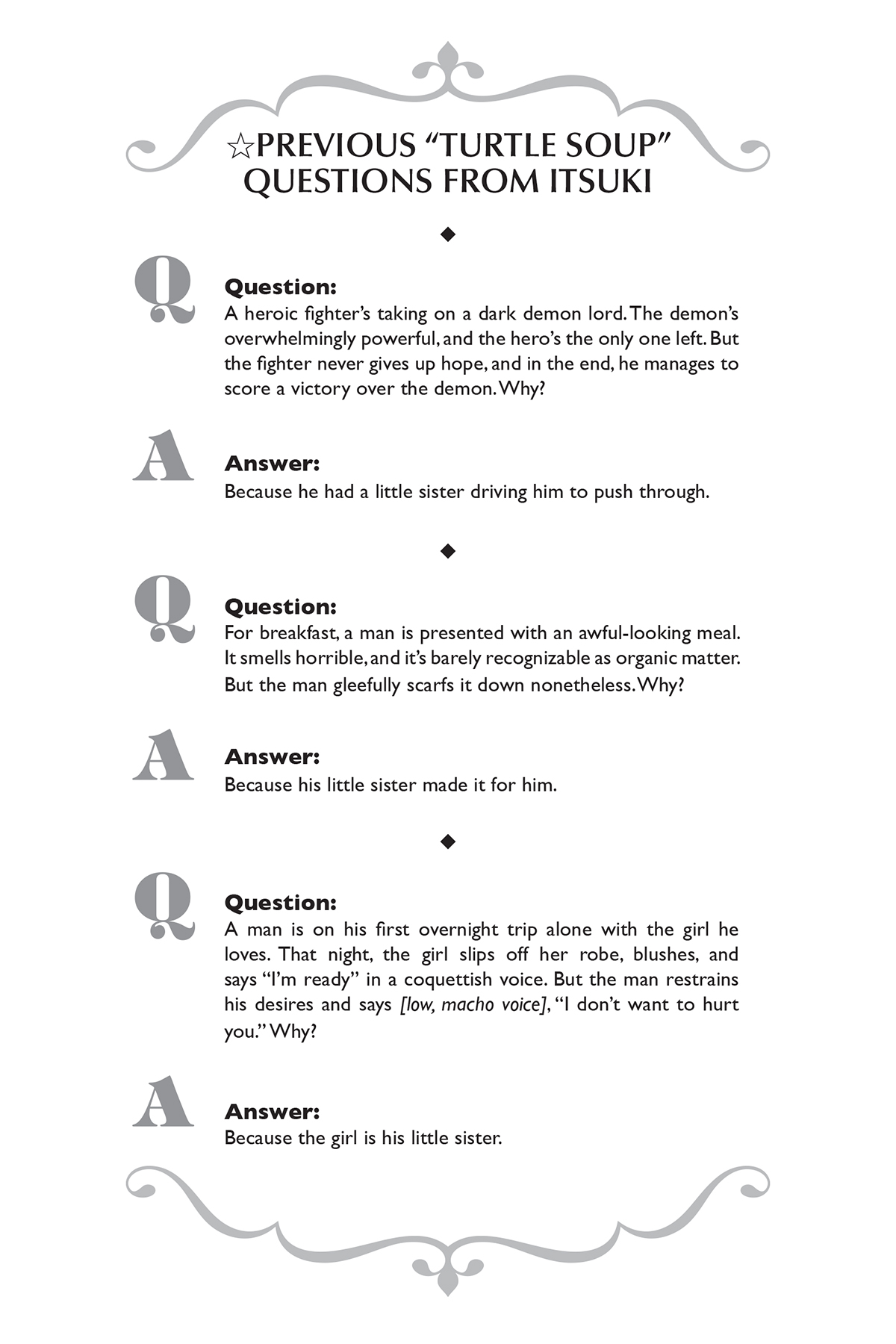
Turtle Soup
Turtle Soup
Several days had passed since Itsuki Hashima had trashed his idea for Demon Hunter in Scarlet (final title TBD). He had mostly spent it lazing around his kotatsu, playing mobile games and reading books.
It may have looked like simple goofing off to some, but this was all a vital part of the novel-writing process. Itsuki was in the midst of refining his well of raw ideas into something new, something solid enough to replace Demon Hunter in Scarlet (final title TBD). Ideas aren’t something that simply appears when you sit in front of the PC, ready to do work, and say, “Okay, brain, do your stuff!” Often they come at times like these—when you’re relaxing and not focused on work tasks. In the case of Itsuki, he tended to bump into them while gaming, reading, sitting in the bath, or taking a crap.
For a novelist, goofing off and playing around are important work tasks. Seriously. Believe me.
The rest of Itsuki’s kotatsu was currently occupied by Haruto Fuwa and Nayuta Kani. Haruto, just back from an editorial session, was organizing his notes from the day’s meeting on his tablet. Nayuta, who had stopped by for no reason in particular, was currently seething at Haruto, giving him her best “Itsuki won’t bump uglies with me if you’re here, so scram” look.
“Okay, done!” Haruto said, putting his tablet on the table.
“Oh, you’re all set? Mind going home, then, Prince Manwhore?”
“Could you stop calling me that, Barfalina?” he countered, the handsome smile still on his face.
A while ago, they had all played a card game called Moteneba, or “Gotta Be Popular.” The basic idea was to try to become as popular a kid in school as possible so you could attract the attention of girls—a game theme all but guaranteed to ruin friendships. Haruto won by a landslide, of course, destroying the rest of the pack, and that’s when Nayuta first busted out the “Prince Manwhore” nickname. “Barfalina,” meanwhile, came about because Haruto happened to be around to see Nayuta puke her guts out all over Itsuki’s clothing.
“So how’s it going with you?” a dissatisfied-looking Haruto asked Itsuki, who was currently focused on the PSP in his hands.
“…It’s not. I can’t get anyone to drop Muramasa. I’m starting to wanna murder the developers.”
“I wasn’t talking about Elminage; I was talking about new story ideas.”
Itsuki frowned. “Even worse.”
“Yeah?” Haruto said, grinning at the terse reply.
“You know,” Nayuta suggested, “I could help take your mind off things, right on that bed over—”
“No thanks.” Itsuki nipped that in the bud.
“Okay, well, how about something else, then?” Haruto offered.
With a sigh, Itsuki picked himself up off the floor and placed his PSP on the table, apparently interested in the idea.
“…So you’re willing to listen to Prince Manwhore but not me?” the peeved-looking Nayuta whined.
Haruto thought for a moment. “Hmm… Well, how about a little mental exercise with Turtle Soup?”
““…!””
Itsuki’s and Nayuta’s faces wrinkled nervously.
“Dude… Are you serious…?”
“Wow, Prince Manwhore, you like turtles that much?”
“Mm? Well, if you think you can’t take me, we could always do something else.”
They both took the bait.
“Hell no! Don’t tell me you’ve forgotten that I’ve never lost this game!”
“You better not get too cocky around me, Prince Manwhore!”
“Great, then. Also, I think you’re remembering wrong, Itsuki.”
“Turtle Soup” is a game that falls into the realm of lateral-thinking puzzles. This particular name is largely a Japanese invention, but the basic idea is akin to Twenty Questions—players ask a series of yes/no questions in an attempt to find the answer to a scenario posed by another player.
The classic Turtle Soup scenario goes along these lines: A man goes into a restaurant and orders turtle soup. After eating it, he calls for the chef and asks, “Is this really turtle soup?” “It is, sir,” the cook replies. Then the man leaves the restaurant and kills himself. Why did he do that? Players can then pose questions like “Did the man have any allergies?” or “Did the chef lie when he answered the question?” to try to reach the correct answer. If they do, they win the round.
It was a game commonly played by writers during parties and the like, since it required no tools to play. The Internet was packed with sample questions, and there were even a few published question-and-answer compilations. Itsuki and Haruto preferred to come up with original scenarios, putting limits on the number of yes/no questions to add to the competitive aspect.
A dishonest emcee could easily throw the game by posing a scenario that was impossible by design to figure out. Lodging these “bad stories” with unconvincing explanations, however, would expose the question poser to criticism like “Talk about amateur” or “Go back to the newbie contests” or “Your twisted sexual perversions are seeping into your scenarios” or “They should examine your brain to see why you had no shame about giving us such a shitty question.” All this character assassination could lead to a victorious round at the end but also a broken heart.
As a result, question posers were asked to strike a delicate balance—come up with a scenario that was impossible for the opponents to solve before they hit the question limit, but just barely so, and that also had a convincing backstory to it. It made Turtle Soup, in some ways, a trial by fire, where creators were forced to stake their good name for little in return.
“Okay,” Haruto said, “we’ll start with whoever thinks up a problem first. Fifteen questions per round. Ready…go!”
The three of them began to devise questions. Three minutes passed before Itsuki raised his hand first.
“Right, I think I came up with something.”
“You can come anytime you like, Itsuki…”
“Shut up, Nayuta!” Itsuki retorted before posing his question. “Okay, so a man gets married to this woman who’s, like, the sublime quintessence of trash, body and soul. She’s ugly, her personality’s awful, and there’s just nothing positive you can say about her at all. But the man lives with her his whole life without a single complaint. Why?”
“Is it because she’s his little sister?” “She’s his sister, isn’t she?”
Nayuta’s and Haruto’s replies came in stereo. This made Itsuki rear back in surprise.
“N-no way… You got it in one shot without any questions…? Are you guys reading my mind or something?!”
“…Well, it was a pretty shitty question to start with, but that phrase ‘sublime quintessence of trash’ sounded kinda inspired to me, so I’ll spare you too much humiliation.”
“Yeah, Itsuki’s scenarios are always garbage anyway.”
“Mm-hmm. Okay, I’ll go next.” Haruto took a deep breath. “A novelist is on deadline. He completely blows it apart. But the editor doesn’t lodge a single complaint—in fact, everyone in editorial thanks the author, from the bottom of their hearts. Why?”
“They thanked him?!”
Itsuki’s and Nayuta’s eyes opened wide. Both were no stranger to ignoring previously promised deadlines, and the rage from the editorial department each time was terrifying. Gratitude was unthinkable.
“…Are you sure this isn’t just some hallucination of yours, Prince Manwhore?”
“Does that count as a question, Nayu?”
Nayuta shook her head. “No, lemme try again: Are we talking about modern Japan?” Previous games had occasionally involved scenarios that unfolded in outer space or the Jomon period of Japan (circa 14,000 to 300 BC), so pinning down the setting was an integral strategy.
“Yes,” Haruto replied.
“No it’s not! Japan’s corrupt publishing industry keeps pushing to ‘stick to your deadlines, stick to your deadlines’ without giving a single crap about my problems! You’re dreaming, Haruto! You should know—you work for the same guys!”
“Well, I’ve never broken a deadline, so…”
“You haven’t? You listen to them? You traitor!”
“Why do you act so goody-goody around ’em like that, Prince Manwhore?”
“Why am I the bad guy here?” Haruto said, perplexed at their irrational outburst.
“Heh-heh-heh… What’s it gonna be? Either you stop respecting your deadlines, or you stop being our friend.”
“Pretty shitty friendship, if that’s how it is!”
“You’ve broken all those cherries, and you’ve never broken a deadline?”
“I’m not actually Prince Manwhore, you know!”
“C’mon, man, the more deadlines you fail to keep, the more the regret makes you a kinder, stronger person.”
“Oh, like you ever regretted blowing a schedule!”
“How are you supposed to break out of your shell if you can’t break out of the shackles of your deadlines?”
“The shackles…?!”
Despite how rash and thoughtless she was being, there was a mysteriously convincing aspect of Nayuta’s expertly woven argument. It threw Haruto for just a moment before he shook it off.
“Guys, stop trying to lure me down the path to Asshole Land! You’re supposed to be asking me questions!”
“Oh, right,” Itsuki growled. “Next question! …Um, is this author someone’s little sister?”
“They might have some siblings, but let’s go with no. The writer’s background isn’t important.”
“No way… So it’s nobody’s sister, and the editors are still heaping praise on the guy for blowing a deadline…?”
“Could you stop wasting our questions, please?” Nayuta asked, staring right at Itsuki.
“…Sorry,” he apologized honestly. “…But if the background isn’t important… It doesn’t matter if the author’s popular or on the brink of getting fired or whatever…? So maybe we should be focusing on the editors here.”
“Ooh, good idea!” Nayuta exclaimed.
“Maybe I gave out too much of a hint?” Haruto said, a bit concerned.
“Okay, so is the editorial department in some kind of crisis?” she ventured.
“Yes.”
“And if the writer blows this, would that save the editors from whatever danger this is?” Itsuki followed up.
“Yes.”
Itsuki and Nayuta visibly brightened. They were on a hot streak…which didn’t last long.
“…A problem you could solve by breaking a deadline… What could that be?”
“…Would the editors be in big trouble if the author’s novel ever got published?”
Haruto thought about Nayuta’s query for a bit. “I dunno…? Probably not, I guess?” he said, shrugging.
“That’s pretty vague… So the novel itself isn’t the issue?”
“Maybe the novel uses some characters from a theme park that’s really picky about its copyrights? Or, like, the publisher’s Shogakukan and the writer wrote about Dora—n…?”
“You’re blowing this way out of proportion, guys…”
The two of them mulled the question over a bit more before Itsuki spoke up.
“Wait… Haruto, can you repeat the question?”
“Okay. ‘This novelist has a deadline; he completely blows it apart, but the editor doesn’t mind at all. Everyone there thanks the author from the bottom of their hearts. Why?’”
“So this novel,” Itsuki began, far from confident. “Well, it could be a novel or a comic script or game text or whatever, but are we talking about blowing it for the author’s own work?”
“No,” Haruto said with a smile.
“…! Hmm… In that case…”
“Wait, wait?” Nayuta broke in. “He broke a deadline for something that wasn’t his? I don’t get it.”
Itsuki gave her a sidelong glance and plunged ahead. “Are you saying that the novelist physically blew something open?!”
“Yes!” Haruto nodded, the smile now an ironic grin.
“Physically? …Oh!” Nayuta jumped a little in her seat. “Was the author being kept in the editorial office until he broke it?”
“Yes… You pretty much got it now.”
“At the time he broke it, were all the editors unconscious?”
“Well, all right, yes. Maybe they weren’t, but they were all incapacitated.”
Haruto shrugged again in a sign of defeat. Itsuki grinned in reply.
“…I got it. Here’s what happened. All the windows and doors in the editorial office were closed and locked, and then a bunch of carbon monoxide was released inside. All the editors lost consciousness, but then the novelist stopped by, realized something was wrong, and kicked the door or window or whatever open, completely blowing it apart. Then he saves everyone, and they all love him for it! That’s why you framed the word deadline and the term blow it in two different sentences. You weren’t talking about blowing the deadline at all!”
“Ding, ding, ding. I had a backstory for why the office was being gassed, but it doesn’t really matter. You win.”
“Ah-hah-hah-hah-hah-hah-hah! Questions like those are a total pushover for someone like me!”
Haruto warmly smiled as Itsuki laughed his high-pitched laugh and Nayuta gave him a round of applause.
“That was a pretty good problem by Prince Manwhore’s standards, though, huh?” she observed.
“Yeah, thanks. You’re up next, Nayu.”
“All right. Wait’ll you hear this one. It’s gonna shock you so much, you’ll have erectile dysfunction for the rest of your life.”
It was an oddly threatening way to frame what turned out to be a pretty short question.
“So there’s this man, and he made a jump. The man died. Why?”
““Huh?””
The other two answered her with slack-jawed stares.
“That’s the whole problem? Clarification, not a question,” said Haruto.
“If this winds up being the kind of crap we’d never solve in fifteen questions,” Itsuki said, “you better get prepared for one severe tongue-lashing, girl.”
“Sure, no problem.”
Nayuta gave a confident nod at them both as they began working on the question.
“He made a jump and died? Did he jump off a building or mess up a ski jump or…? Well, did he die in a fall?”
“No.”
“What?” Haruto exclaimed. “Is this kind of like my question, where it depends on how you interpret the word jump? Was the man in debt?”
In Japanese financial parlance, someone who extended the period on their loan after paying nothing but interest on it was said to be “jumping” the loan. In other words, Haruto reasoned, the man might’ve had money issues. But Nayuta quickly disappointed him.
“I don’t know. Let’s go with no.”
“It’s not money… Um… Did someone else kill him?”
“No.”
“Did the man have a little sister?!”
“I have no idea,” Nayuta bluntly answered Itsuki.
“Please stop wasting questions on that…,” Haruto pleaded. “Did the man fall from a really big height?”
“No.”
“No? So it’s not like the shock of falling gave him a heart attack halfway down, huh? It’s someone who died jumping but not falling really far… Did he hang himself?”
“No.”
“Did he die inside a room?”
“No.”
“Did he die outdoors?”
“Not…outdoors, no.”
“So not inside and not outside…? Did he die someplace dangerous?”
“Yes.”
Despite all his questions, Haruto still struggled to find the crux of the query.
“…Are we in modern-day Japan here?” Itsuki asked out of the blue, recalling what Nayuta had asked Haruto a moment ago.
Nayuta’s eyebrows twitched a little. “…No.”
“It’s not modern Japan? Is it some other country?”
“Yes. Probably.”
“Probably…?”
“I mean, it’s not that important, really, whether it’s in Japan or not. Although I guess the location is kind of a key point…”
Haruto’s eyes brightened.
“Is this taking place in reality?”
Nayuta took a moment to respond.
“…No.”
“Ah-haaaa… I think I got it…” Haruto flashed a somewhat concerned-looking smile.
“What do you mean?” a still-oblivious Itsuki asked.
“…We’re in the world of video games, aren’t we?” Haruto pressed.
“…Yes,” said Nayuta, and the edges of her lips curled upward.
“Is this the guy from Spelunker?”
“…Yeah,” the crestfallen Nayuta admitted.
“Nayu…,” Haruto began, a mix of relief and wry irony on his face. “I hate to say this, but I think that was a pretty shitty one. Way better than Itsuki’s, but…”
“Aww…”
“Huh? Um, a game?” Itsuki burbled, still lost at sea.
“There’s this old action game called Spelunker,” Haruto explained. “You play this guy exploring a bunch of ruins so he can discover a bunch of treasure at the bottom. But the game got famous because your character’s, like, a total wimp, even weaker than any of us. He’ll die if a bat takes a shit on him or if he falls even a little less than his own height. If you make him jump off a cliff, he’ll die in midair before he even hits the ground.”
“…Oh, yeah, I think I saw a video of that on the Net once! It’s this game that’s notorious for being really crappy, isn’t it?”
“Yeah, that one.”
“Spelunker is not a crappy game!”
Nayuta suddenly exploded, clearly peeved.
“I mean, all right, Mr. Spelunker tends to die a lot, but if you’re willing to accept that as the rules of the game, it’s never deliberately unfair to you. If you die, it’s like you always know that it was your fault you died, not the game’s! And now the game’s gotten all famous because of how wimpy you are, so people jump to the conclusion that it must be really bad, even though they’ve never played it. I hate that!”
“Oh…”
“Um…okay?”
It was rare for Nayuta to lose her temper like this. Rare enough that it gave both Haruto and Itsuki pause.
…Back when she had spent all her time cooped up at home, she had played a ton of free or cheap-to-download old games on the Internet, and she was still a fan of retro games today.
“Here, let me show you! We can play Spelunker right now!”
Seizing the momentum, Nayuta wound up purchasing Spelunker via Virtual Console on the nearby Wii system. The experience was eye opening to Haruto—“It’s hard, but if you’re careful, you can make it pretty far,” he admitted, “so I guess it’s not that unfair”—but Itsuki kept dying on the first few screens. “See?” he complained. “It really is crappy!”
This, however, created the kernel of an idea within Itsuki’s mind—a Spelunker-style little sister who keeps dying immediately. He writes a proposal posthaste, sends it to his editor, and has it rejected. Why?