Die in a Fire, Tax Returns
Die in a Fire, Tax Returns
Being a writer, in general, is a sole proprietorship. This means that writers are responsible for self-reporting all their income and expenditures, from January 1 to December 31 of each year, in order to determine the income tax they owe.
This is done in Japan by filing what’s known as a “final tax return” sometime between February 16 and March 15 of the following year; delaying it beyond this exposes you to penalties.
For a writer, a certain percentage of any payment received from a publisher is generally withheld for income tax—around 10 percent for the first million yen and around 20 percent beyond that. As a result, if you’re honest in your final return (and aren’t a massively bestselling author raking in royalties hand over fist), you can generally expect to receive a refund for any excess tax withheld.
This means that, as annoying as they are to fill out, filing a complete final tax return is vital if you want to rescue your withholdings. That doesn’t change the fact, however, that keeping track of all income and expenditures for an entire year is a huge pain in the ass. It is possible by yourself, as long as you really keep on top of things, but for most, borrowing the services of a professional is the easiest, most reliable way of handling matters. In other words, a licensed tax accountant.

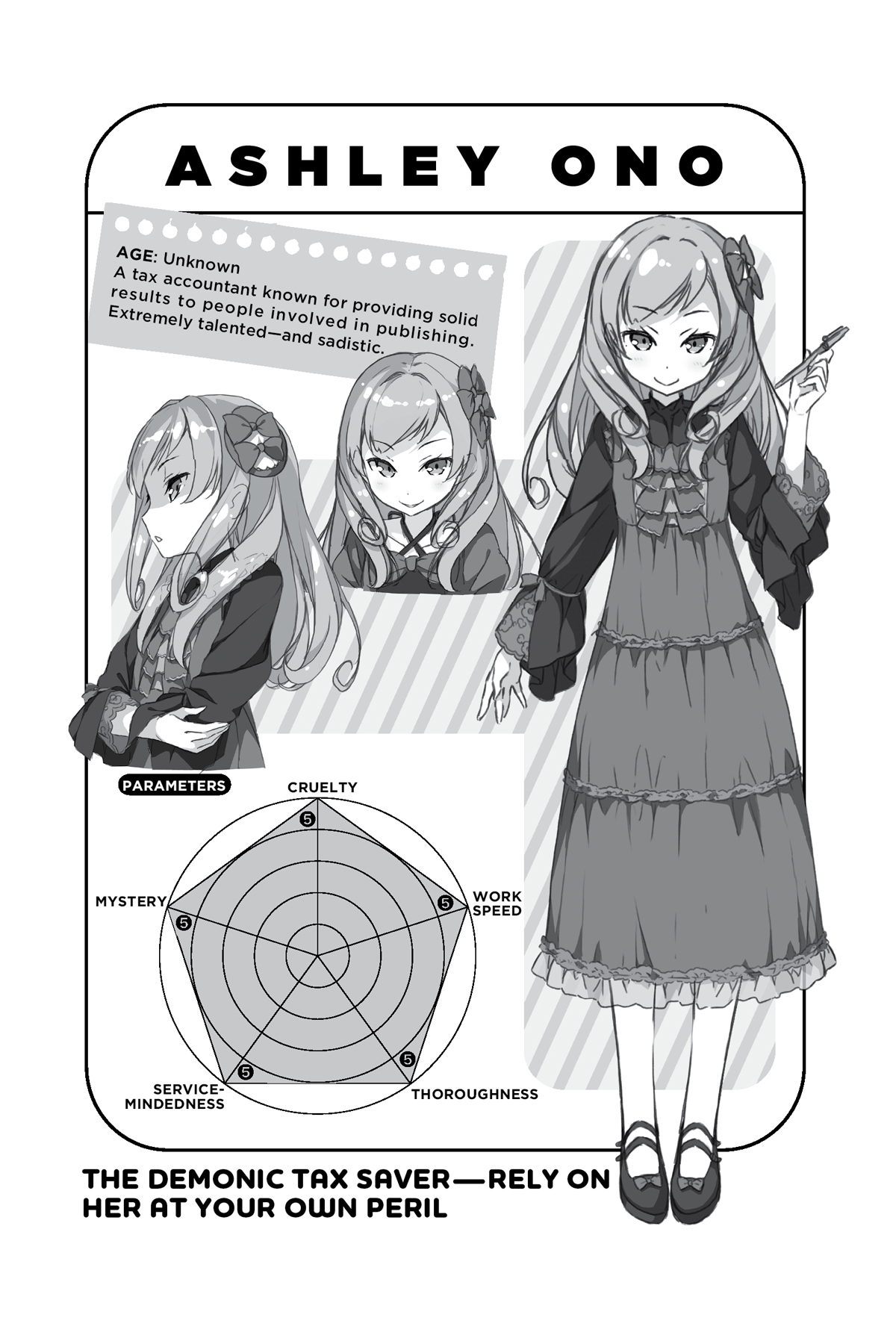
It was a sunny day in late February when a woman paid a visit to Itsuki Hashima’s apartment. She looked young—like a child, in fact. Maybe fifteen years old at the most. Her skin was lightly tinted, a worthy canvas for her blond hair, blue eyes, and frilly, childish crimson-red dress. Nothing could’ve looked more touchingly sweet, but her eyes glinted with an unmistakable sharpness, and her smile was somehow sadistic.
This was Ashley Ono, exact age unknown. Her job:
“Ashley Ono, tax accountant. Are you Itsuki Hashima, my client?”
“Um… Y-yeah. Thanks for coming…”
Itsuki found Ashley’s haughty self-introduction a little nerve-racking as she stood there at the front door, running her eyes up and down his body.
After three years of writing, this would be the fourth final tax return he filed but the first year he hired someone to help him with it. His first return came not long after his debut; he’d had only one book published by then, and he hadn’t bothered saving any of his receipts, so there wasn’t much to fill out. He managed to cobble together the second and third returns following tutorials on the Net, but he wound up having to file revised reports both years after discovering a couple of math errors.
It was extensive work for a relatively small refund, and Itsuki was sick of it. “Why do I have to do all this crap every single year?” he’d said with a groan. “I’d make a ton more money if I just used the time to write!” So he’d asked Haruto for a tax-accountant reference, and Ashley Ono was the name he’d received.
The conversation had gone a bit like this:
“Hey, Haruto, you know any good tax accountants?”
“…By ‘good,’ do you mean ‘high quality’?”
“Um… Yeah, what else would I mean?”
“…Never mind. I’ve got the perfect one for you. She’s incredibly talented, and you can totally rely on her. I kind of think she’d like you, too.”
Haruto was clearly hinting at something, but Itsuki didn’t let it bother him.
Among self-employed people, authors were kind of unique, and there weren’t many of them. Even a seasoned tax accountant might not have a lot of experience handling them. Along those lines, Ashley Ono was apparently fairly well known in publishing circles for her strengths with creative types.
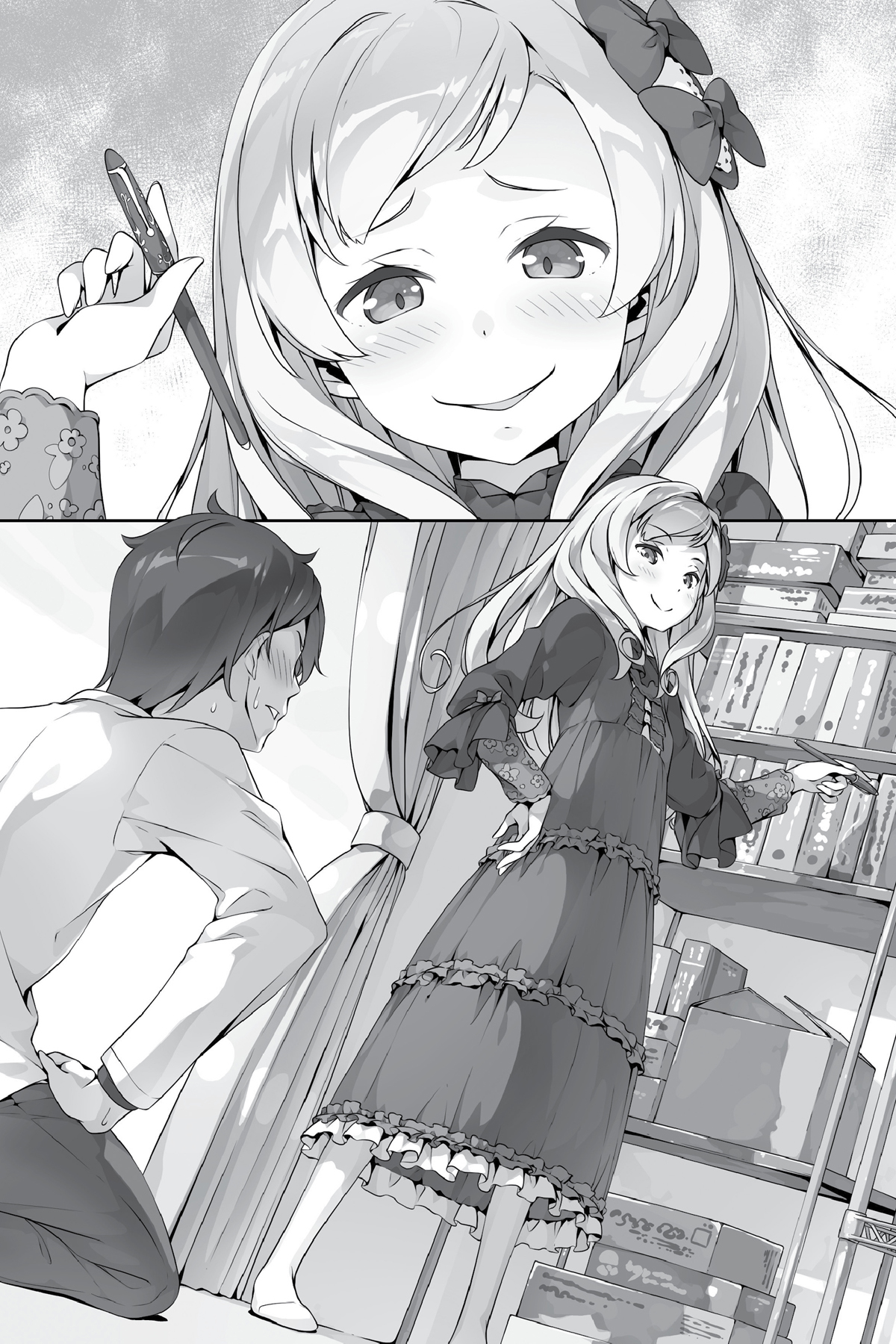
Now Ashley had invited herself to sit down in the fancy office chair Itsuki used for work. “Hmph. Pretty clean-looking place for some kid living by himself,” she said as she looked around the place.
“Oh, thanks,” Itsuki replied, unsure where he was supposed to sit.
“All right. Shall we get started, then? Can I see your payment records?”
“…Um, sure.”
The pay stubs from his publisher, as well as his receipts and credit-card statements, were all inside a plastic file folder divided into months. He handed it over to her.
“…Hmm. You actually organized your receipts by month? You’re a lot more detail oriented than I thought,” Ashley said, almost looking disappointed. The organizational work was all thanks to Chihiro, but Itsuki didn’t feel that was important to mention. “My…,” she continued as she fished out a pay stub from the folder. “You’re making quite a lot, aren’t you?”
“…Yeah, it’s been an okay year, I guess,” Itsuki replied, still forced to stand up.
“Oh, you can sit wherever you want.”
“…Oh. Okay.”
So he knelt on the floor Japanese-style. It was tremendously unsatisfying, but there was no place else handy.
“Hmm… Copies of your old final tax returns, too? Hmmm… Pretty steady earnings, for an author… No point smoothing these over with the average taxation rate, but not quite enough to bother incorporating with, either…”
Itsuki nervously watched as Ashley continued to mutter to herself. She seemed to take a sheer sense of joy from it.
“…By the way, is this your registered place of residence?” she suddenly asked.
“…No, I’m still registered back at home.”
He hadn’t bothered to switch it out after moving, since the family home was in the same city anyway.
“Is it close to here?”
“…Maybe about twenty minutes by car.”
“Ah. Good. In that case, we’ll declare this apartment to be your office. That way, we can claim ninety percent of your rent as business expenses.”
“Ninety percent…?!”
“You use this place as a dedicated workspace. At night, you return to your family’s residence and sleep there, and then you commute here for work. Right?”
Itsuki found Ashley’s preresolved decisions a tad unnerving.
“Well, I mean, I live here, pretty much… I got a bed and everything…”
“Oh, that’s just for the occasional nap.”
“Umm, well, if we’re calling it that, those’re some pretty long naps, ma’am…”
“It’s just for the occasional nap,” she repeated, accepting zero differences of opinion.
Itsuki gave up. “…It’s just for the occasional nap, and I sleep at my parents’ place at night.”
“Mm.” Ashley nodded. “Did you make any high-end purchases last year? Like a car?”
“…I don’t own a car. That chair’s from the year before… Oh, I did buy that laptop last year.”
“Aw. Too bad you didn’t splurge a little and buy a fancy import car or something.”
“That’d be crazy, ma’am,” Itsuki countered. “I don’t even have a license.”
“Oh, just joking,” Ashley retorted with a smile. “I think you can get away with spending a bit more of your money. Writing novels, as self-employed careers go, usually don’t involve a lot of necessary expenses. You know what I mean?”
“…I suppose, yeah.”
He understood what she was getting at. A butcher needed to spend money on meat to turn a profit on processed goods; they’d have running costs to keep the store open and the freezers operational, and having employees meant having salaries to pay out. Manga artists needed to regularly purchase pens, ink, and paper, or maybe scanners, tablets, and a computer powerful enough to run image-editing software if they had made the leap to digital. Hiring assistants, if they were at that level, would be the greatest expense of all. Novelists, meanwhile, didn’t need much besides a PC to write on. If you could bang text into an editor, you were good, so even a cheap one from several generations ago would function just fine for years on end. You generally didn’t need to hire anyone else, either. In terms of outlay to get started, there were fewer cheaper careers to take up than writing novels.
“It’s my job as a tax accountant to find as many government-approved ways of increasing your required expenses as possible. You’ve been reporting the cost of your books as research costs up to now, right?”
“Right.”
There was very, very little investment required to write novels, but that didn’t mean (most of the time, anyway) that you needed nothing else. A creative endeavor like this basically involved taking what was inside your brain and outputting it to some form of media, but (most of the time) you needed something to output first. Simply cobbling together what you’d personally experienced over the years might let you write one or two volumes, but (most of the time) that wouldn’t be enough to produce a constant stream of commercially viable content. So—most of the time—you needed some input before you could start outputting.
An easy-to-understand example of this is collecting books on some historical figure so you could write about them or listening to someone lecture about a specialized piece of technology so you could insert it into your work. Or traveling to certain locations for use as story settings.
These sorts of directly connected resources could easily be reported as necessary business expenses, but there were other not-so-direct things that also counted. For a writer, novels in general all counted as “research material.” You needed to read novels to know how to write novels, and people generally understood that logic—regardless of how well it described you, personally, as an author. This also applied, for the most part, to things like manga, magazines, and other books on specialized subjects that weren’t directly relevant to your work.
The tricky part was how to classify nonbook entertainment—CDs, DVDs and Blu-rays, movie tickets, action figures and models, travel to places not directly connected to your books, and so on. If the tax office asked you “How did you take advantage of this in your work?” and you could provide a concrete answer, then that absolutely counted as an expense. But if the connection was weak or overly vague or you spent money sheerly for the sake of pleasure, what then?
“So how did you report nonbook items up to now?”
“Well, with the stuff I bought for my novels, I reported all of that as research materials.”
“Ooh. Good lad.” Ashley snickered. “…I love taking good lads like you and exposing them to the face of evil.”
“Um, pardon?”
“Oh, nothing,” Ashley said, shaking her head as she stood up and walked toward the shelf lined with figures and models of anime robots. “I’ve done some research into your writings,” she said as she marveled at them. “You like little sisters, hmm?”
“I love them.”
“Hmm.” Ignoring Itsuki’s immediate announcement, Ashley pointed at one of the figures on the shelf. “I think I’ve seen this girl before.”
“That’s Kirino Kousaka, the main heroine of Oreimo and the hero’s little sister. What a goddess! Wow, even tax accountants know about her…”
“And who’re these two little girls in the cat ears and the swimsuits?”
“That’s Kobato Hasegawa, the goddess who’s the little sister of the hero in Haganai, and her fellow goddess Maria Takayama.”
“…I think I read a synopsis of the movie version of that once. The heroines were these little girls, though…? Ah, not that it matters. And who’s this woman with the rather well-developed chest?”
“Suguha Kirigaya, the main heroine of Sword Art Online and one goddess of a little sister to the protagonist.”
“Ah, yes. I’ve heard of that Sword…whatever through my publisher contacts. They’re stuck inside a video-game world or something, yes? And this is one of them?”
“Oh, um, that’s her in the real world, yeah.”
“Hmm. So the heroine was this buxom in real life?”
“Yep.”
Sadly, there was nobody in the room to yell “No! The main heroine of SAO is another girl!” at them.
“…And this lady in the school uniform?”
“Ui Hirasawa. She’s the godly main heroine of K-On! and the protagonist’s little sister.”
“…That title’s famous enough that I know a little about it, but I don’t remember her playing the role of the main heroine… And this one?”
“Elpeo Ple. The godlike star heroine of Mobile Suit Gundam ZZ and the protagonist’s little sister.”
“All right. So is this robot that looks like a moth someone’s little sister, too?”
Ashley was pointing at a pair of red-and-black Gundam robots lined up next to each other.
“Those are the Qubeley Mk-II models piloted by Ple and her godlike little sister Ple Two. They’re classified as mobile suits, but they aren’t Gundams.”
“Well, if it’s a robot in an anime, it’s all Gundam to me.” She turned around, apparently getting sick of asking about every single piece in the collection. “…So what you’re saying is that every figure on this shelf is a little-sister character of one sort or another?”
“Yeah.” Itsuki nodded.
“Hmm. I think it wouldn’t be a problem to count all of this as research material.”
“No!”
Ashley arched her eyebrows at the bark of denial.
“…No what?”
“The robot models are one thing, but these girls aren’t ‘materials’! I bought them all because I felt a pure love for them! I can’t put them into a category as cold and unfeeling as ‘materials’!”
“…Materials, then?”
“N-no…” Itsuki shook his head, flinching at the cold, unfeeling eyes staring at him.
“Look, do you want to pay less taxes or not?”
“I do…but I can’t sully the good name of my little sisters like that!”
“If we classify these as research materials, you can use the money you’ll save to buy more little-sister figures.”
Itsuki’s eyes bugged out, as if he’d been struck by lightning. His face was serene.
“…These figures are genuine, authentic research materials. I use them fully in all my work. Thank you.”
“Tee-hee-hee…” Ashley nodded. “You are in good hands.” Then she turned her attention to the rows of anime Blu-rays and video games on the shelf. “Hmm… You have quite a game collection. And what kind of game is this? The one called The Little Sister Who Loved Her Brother So Much, She Wore His Boxers on Her Head as She Pleasured Herself Daily?”
“…It’s a game featuring a girl who loves her brother so much, she wears his boxers on her head as she pleasures herself daily,” Itsuki replied, blushing all the way to his ears.
“All right. And how about this one: No, Big Bro, We’re Siblings!: Beautiful Sister-Wife Caught in Forbidden Relationship?”
“It’s a game about a beautiful sister-wife caught in a forbidden relationship.”
“What’s a ‘sister-wife’?”
“A sister who’s your wife, ma’am.”
“Seems like a rather complex concept to me. Let’s see here… Big Brother’s Counterattack: One Year Since a Giant Anteater Killed My Sister?”
“Oh, that game sucks. There was no sister in it at all,” Itsuki spat.
“But it says on the box that an anteater killed her, doesn’t it…? What about this one, Boink-Sis?”
“It’s a game where you boink your sis. The ending makes you cry so much, I swear.”
“And I’m Your Sister—It’s Not Weird to Eat Your Poo at All, Big Bro! …It’s not?”
“It is. That’s what makes it so good.”
“…I’m impressed by your decisiveness.”
Completing her rounds, Ashley sat back in her chair and began checking the credit-card statements. Itsuki returned to the floor and watched her.
“Hmm… Certainly use Amazon a lot, don’t you? I’ll compare these with your receipts when I return to the office, but… All these four-hundred-yen and six-hundred-yen purchases. Were these all e-books?”
“Yeah. I think all of the smaller charges are gonna be those.”
“Did you print out the receipts for these books?”
“Huh? No…”
“I imagine not, no… I doubt anyone would bring up expenses this small, but we might need receipts for them anyway, so prepare for that if need be.”
“…All right.”
“There’s a lot of charges to the iTunes Store, too, I see. Is this music?”
“Um, yeah. That kind of thing.”
Ashley gave Itsuki a sharp look for his sudden vagueness. “…You’re spending nearly ten thousand yen here, all told. Albums don’t cost that much, do they?”
“…There was music, and I maybe bought just a few Magic Stones, too,” Itsuki sheepishly admitted, turning his eyes aside.
“Magic Stones?”
“Yeah. You buy them so you can open loot boxes in mobile games.”
“Ah, yes…I believe several of the clients I’m advising have engaged in that.”
The term mobile game is a little difficult to define succinctly, so let’s just go with “games playable on smartphones.” Many of these games utilize simpler gameplay systems than their grown-up relatives that are played on consoles. A large number of them have a “loot box” or similar reward that, when opened, earns players a random chance at new cards, items, or characters. Loot boxes can often be purchased with in-game items (called “Magic Stones,” “Spirit Stones,” and other names, depending on the game), and charging real-life cash for these items is how many games make their money.
“What kind of games were you playing?”
“…LS Legion… It’s short for Little Sister Legion.”
“I think the title’s already told me everything I need to know about this game.”
“…You’re probably right.”
LS Legion was a mobile game that, as the name suggested, featured a large number of little-sister characters. Buying loot boxes let you obtain more sisters, some of whom were a lot rarer and more valuable than the others. The only way to obtain them was with a little luck and a lot of Magic Stone purchases. The gameplay was so simple, it barely qualified as a game. There was almost no real story to speak of—just a few lines of background and dialogue for each sister.
…Even Itsuki knew that LS Legion wasn’t exactly Game of the Year material. A lot of mobile games, like Puzzle & Dragons or Chain Chronicle, were starting to challenge console games in quality, and he fully knew playing them would be a far better use of his free time.
He knew it full well, and yet…
“…You’re plowing quite a bit of money into this game, aren’t you?”
“…Yeah. I mean, there’s no turning back now,” Itsuki offered, eyes glazing over as Ashley thumbed through the statements. When he first started playing this game, he wound up spending the equivalent of several thousand dollars on loot boxes so he could obtain the little-sister characters he wanted. If he quit playing, that would all go to waste. So he kept going.
“…Do… Do you think those Magic Stones could count as business expenses, too? Maybe?” a hopeful Itsuki asked.
“Are you using the game in your own work?”
“…” Itsuki thought it over for a few seconds. “I can positively tell you,” he gravely droned, “that I haven’t at all. There’s no story, and all the sisters have are a few lines of dialogue and a couple sentences of backstory, so it’s not like I have any attachment to them. It… It’s just a big JPEG folder with the word sister attached to it…”
He raised a shaky fist into the air.
“Ah,” Ashley drily answered. “Well, start using it.”
“Well, yeah, but how…?”
“What’s your next book going to be about?”
“…? It’s Volume Five of Sisterly Combat,” a bewildered Itsuki replied.
“Ah.” Ashley thought for a moment. “The last volume ended with the hero surrounded by enemy forces, yes? At the end of their rope?”
“You read my stuff?!”
“I read everything my clients have released in the past year. I started with Volume Three, though, so I didn’t understand most of the little details,” Ashley listlessly reported. “But let’s talk about how we can make Magic Stones into business expenses. Your hero is facing desperate times. I want you to have him say in the next volume, ‘Heh! Guess we don’t have much of a chance. The odds of surviving this are about the same as getting a rare character out of a loot box in a mobile game…’”
“W-wait a second!” Itsuki begged. “The protagonist of Sisterly Combat is a coolheaded dark knight who threw away everything he had to fight in the Dark World and save his only sister!”
“Well, if he likes his sister, then even better. Let’s make it ‘The odds of surviving this are about the same as drawing a rare sister from an LS Legion loot box.’ Even more perfect.”
“That would mess up everything! I told you, he’s a coolheaded dark knight battling in the Dark World!”
“A coolheaded dark knight battling in the Dark World can play games on his phone, can’t he?”
“No! And if he’s making a mobile-game metaphor when he’s surrounded by foes and seconds away from death, what kind of demented loot-box addict would that even make him?!”
“Oh? I think it’d be nice, having that kind of unexpected side to your unflappable dark knight.”
“…I mean, yeah, it’s a pretty conventional tactic to take a cool, composed character and give him some kind of unexpected quirk to riff off of, but…hmm…”
They continued to debate the issue, to no avail.
“I can’t do it! I just can’t see any appeal to a protagonist who wastes tons of money on little-sister-themed mobile games!”
“All right, well, let’s not make it the protagonist, then. He has a nemesis in the story, too, yes? Whenever they fight, why not have him say ‘Pfft… The only things in the world that excite me this much are fighting you and playing cell phone games.’”
“Great, so you want me to destroy the main villain instead of the protagonist?! What kind of shallow life has this guy even been living?! And after four volumes of the hero struggling against him? He’s gonna look like such a wuss!”
“You’re being rather selfish, you know. If you’re going to be that way, then fine. Just find a way to shoehorn mobile-phone games into your story.”
“I can’t! And I know I forgot to mention this until now, but Sisterly Combat’s set in a fantasy world! Bringing up smartphones would ruin the entire setting instantly!”
“Well, what’s wrong with ruining it a little?”
“What’s not wrong with it?!”
“…Look, what’s more important to you: an intricately woven story world or saving money on your taxes?”
“The story world!”
“Ugh!” Ashley shrugged, dejected. “You writers, I swear…”
“Oh, now I’m the bad guy…”
“Well, so be it. I’ll make up some justification for the Magic Stones.”
“Why didn’t you just do that from the start?!” Itsuki shouted, practically at the top of his lungs.

The questions about his credit-card statements and receipts continued for a while, and Ashley took great pains to read out the title and content of all the porn videos Itsuki had purchased for download before finally taking her leave.
“…I’m exhausted,” he groaned before lying his head on the kotatsu. And he was. To him, it was even more grueling than filling out the tax return by himself. If possible, he wanted to do nothing else for the rest of the day.
I’m never gonna go to that tax accountant again, he swore in his heart.
Then, three days later, Ashley sent an e-mail with an estimate of how much his tax refund would be. It made Itsuki jump out of his chair. The estimate was nearly three times the rebate he’d earned last year.
Now Itsuki understood what Haruto had meant. “She’s incredibly talented, and you can totally rely on her.” He was right, and Itsuki thought he knew what he was trying to hint at, too. She was talented and reliable, but Ashley Ono was also an unrepentant sadist.
…Unrepentant…but reliable. She read her clients’ work and asked about the content of the games they bought, and—Itsuki was pretty sure—that wasn’t just so she could watch other people stew in their own juices. Hopefully.
“…Ugh…!”
Talk to you next year!
Having written that sentence at the end of his reply, Itsuki pressed the “Send” button. There were a lot of little-sister porn games and figures he could buy with that refund.