The Road She Can See Ahead
The Road She Can See Ahead
It was now late June, approximately three weeks after her first interview, and Miyako’s inbox was now loaded with e-mails from companies nationwide calling her Ms. Miyako Shirakawa and wishing her the best of luck in her future endeavors.
For the time being, her ventures into the financial, insurance, and securities fields were essentially failures. She had made it into the second round of interviews with exactly one insurance firm. Over in publishing, she did get an invite to another interview with that self-publishing firm (which would most likely be the last one), but she politely turned it down.
Apart from that firm, and the first one that she flubbed the dress code for, she interviewed for two other publishing outfits—in business attire, of course. However, even before the “best of luck” e-mails came in, she had a hunch they’d probably go nowhere. She had a vague sort of appreciation for the job of editor, but in terms of exactly what kind of book she wanted to create, and what kind of editor she wanted to be, Miyako had no vision. Naturally, this meant the answers she had for her interviews were exactly the kind of pat lines she memorized from the job-hunting guides she read.
She knew what was expected of editors: working with authors to create an original work, supporting authors when times are tough, extracting the talent from authors, making surefire hits out of the titles they work on. She thought they were wonderful—that was no lie—but did that accurately encapsulate the kind of editor she would want to be? She wasn’t so sure.
Essentially, she thought, she failed to make it past the first round because the interviewer could tell how transparent her words were.
“Ahhh… I had heard about this, but the job search just totally breaks your heart…” Miyako sighed as she sat nude in the bathroom.
“Myaa,” Kaiko said as she washed Miyako’s body, “if you can’t find somewhere to work, you should just join me.”
“Ha-ha!” Miyako snickered. “That’s crazy. I’ve never drawn manga before.”
“No. I’m not talking about myself. I’m talking about my family.”
“Your family cultivates silkworms, right?”
“That’s right. My father said he’d love to have you working for him.”
Miyako recalled when Kaiko’s father stormed into the editorial department. He acted like a stubborn old man and certainly fumed like one, but there was no denying the fact that he loved his daughter deeply.
“Yeah, but I don’t know a thing about silkworms.”
“Well, most of our income comes from silk mills that we’ve been working with for decades now. We have a set of patents and a factory overseas as well. We’re using the income from that to try to turn around our silkworm-culturing business—it’s been declining the past few years. We’re even coordinating with the government to improve our cultures and develop new production environments. It’s a long road ahead, but Dad always talks about how satisfying the work is for him.”
By the sound of it, Kaiko truly respected her father and his company. But despite that, she still overcame his dead-set resistance and chose the path of a manga artist.
Will I be able to find a job I know is mine, like Kaiko and her dad…?
“…Thank you. If I can’t find anything else no matter what, I’ll keep that in mind.”
Miyako felt safe in saying that for now.

The next day, Miyako saw Toki drinking some coffee in front of a Gift Publishing vending machine, so she decided to ask why he decided to become an editor.
“Well, I started working here part-time during college like you, Miyako, but my current boss and the EIC at the time both wanted me to stay on, so I took them up on the offer.”
“Oh… So was it like: You’ve always loved light novels, so you wanted to get involved in making books?”
“Nah. I didn’t read anything except manga before starting that part-time gig, and I had no interest in publishing whatsoever.”
“Huh?!” The answer surprised Miyako. “So why did you take a job with GF Bunko at all?”
Toki took a sip from his coffee can, eyes staring afar. “…I’m probably gonna embarrass myself when I say this, but is that all right?”
“Oh? Um, sure.”
“Well…I spent college kind of mooching off this woman.”
That was even more embarrassing than Miyako expected. She gave him a hard stare as he waxed nostalgic.
“Once I began college and started living by myself, I got addicted to this old online game—Final Fantasy XI, to be exact—and I hit it off with this player who was always on at the same time. So we started hanging out in real life.”
“Wow, that really happens, huh?”
“Yeah. She was a manga artist in her mid-thirties, but at the time, she didn’t have any work and was just playing online games all day. She absolutely refused to tell me the pen name she published with, but all signs indicated that she did pretty well for herself. So eventually my parents found out I wasn’t attending class, and they stopped sending me money. I couldn’t afford rent any longer, so I wound up joining her in this luxury condo setup she had.”
“……”
“For about a year,” Toki continued, failing to notice Miyako’s cold eyes, “we pretty much just played games and fooled around with each other. But one day, she was basically like ‘I want to draw manga again, so get out!’”
Toki made a fist, crushing the empty can.
“I got down on my hands and knees, begging her not to toss me aside. But I couldn’t change her mind. She said that if I wanted to see her again, then I should go become an editor at a top-name publisher or something. I was de facto dropped out of college by that point—isn’t that just the most merciless thing she could’ve said? …But at the end of it, she almost called the cops on me, so I reluctantly left her condo. After that, I got down on my hands and knees in front of my parents until they started sending me money again, and it was back to living alone in a cheap apartment. One day, I found a magazine that I remembered seeing lying around in her place…and that was Comic Gifted. I figured maybe that’s the magazine she drew for, and I was so excited about it that I applied for a part-time job there. That job was already filled by the time I asked about it, though, but I couldn’t give up yet, so I got down on my hands and knees and begged them for something. The security guard was just about to haul me out when my boss, Godo—he was the assistant EIC back then—he just happened to roll by. I yelled out at him, and between this and that, I wound up working at GF Bunko…”
It sounded like this was all a vital memory in Toki’s life, but it was frankly kind of pathetic. He’s sure spent a lot of time on his hands and knees, reflected Miyako.
“…So did you ever see your ex again? Or…like, if you did get into Gifted, what were you gonna do then?”
“I dunno.” Toki snickered. “I’m not completely sure what I was thinking back then, really. I’m certain that I didn’t want to get back together with her, though. I still haven’t seen her since. Not even at any of the publishing parties. I’m not even totally sure she’s an artist for Gifted. But that’s all in the past anyway. It’s way better to tap into the sex industry, you know? Keeps you away from trouble later.”
He nodded to himself, convinced he made the right choice in life, as he tossed the crushed coffee can in the trash and walked off.
Miyako, extremely unsure what to make of this, thought a bit. The path Toki took to becoming an editor was surprisingly…well, pedestrian. But in her eyes, he was an extremely talented editor now, and she knew the passion he brought to his work.
Maybe how you got your start wasn’t such a big deal after all. Whether you got in via a mutual connection or you were hung up about your ex, if you kept plugging away at a job, you might just find that it’s the job you were put on planet Earth to do.
Listening to Toki’s story lightened Miyako’s mood a little…but just then, a few feet away from the vending machine, two people stepped through the doorway. One of them was Satoshi Godo, editor in chief of GF Bunko and clad in a gold-flecked suit that certainly matched his yakuza looks. The other was a wispy-looking lad who couldn’t have been past his midteens.
Oh, that guy…
They had spoken for just a bit at the awards ceremony. It was Soma Misaka, one of the honorable-mention winners at the 15th GF Bunko New Writers Contest. His eyes were bloodshot, perhaps after a bout of crying, and his despondent face was pointed straight at the floor.
“…Speaking as a member of editorial,” Godo flatly told him, “I’m disappointed this had to happen.”
“……”
Tears fell from Soma’s eyes as his shoulders shook. Miyako could hear him sobbing as Godo sighed, face as scary as ever. One look, and it was clear Soma was in serious trouble.
“But…but we’ve come so far…” Soma’s voice was scratchy as he weakly wept.
Unable to restrain herself any longer, Miyako carefully approached.
“Um… What’s wrong?”
“None of your business,” Godo coldly replied.
Soma lifted his face toward her and frantically wiped it with a sleeve.
“…I’ve been banished from GF Bunko,” he said in his fragile voice, self-deprecating.
“Huh? Uh, banished? What’s that mean?”
“…We can’t publish any of his future work,” her boss said with a look of disgust. “That’s what it means.”
“What?” This only confused Miyako further. “Uh, you’re Soma Misaka, right? One of the winners last year? You debuted in March.”
“…Yeah.” Soma nodded.
Maken Wars, his debut work, hit stores back in February. She had heard from another editor that the sales weren’t too great.
“Wait, so you’re canceling it after one volume…?”
“…Yes,” Godo replied, “but that’s not all.”
“That’s not all…?”
Godo glanced at Soma for a moment. “Due to lagging sales,” he said in his heavy voice, “his editor told him we wouldn’t be able to publish any more books in the Maken Wars series. A few weeks afterward, he started pitching to another company.”
“Pitching?”
“He brought his work to another firm instead of us.”
“…?”
This didn’t mean much to Miyako. Godo sighed. “Have you heard of the term three-year noncompete?”
“…No.”
“The custom is that a writer who wins a new-author award can’t work for another company for three years.”
“Why not?”
“Well, it costs a lot of money to hold that contest every year, as you can imagine. It takes money to revise the entries and bring them up to a commercially publishable level. If a new writer debuts with us and immediately hops over to another company, then we’ve wasted both the prize money and the time we’ve spent discovering and raising that writer. Plus, having a rep for shedding new writers fast is bad for both our label and our contest.”
“……”
Putting it like that, the logic made sense to Miyako. It made sense, but…
“…But was that written in the terms for applying to the contest? Like, not being able to write for other labels for three years?”
“…It’s not spelled out, no,” Godo awkwardly said. “It’s the custom.”
“And did you know about this three-year noncompete, Mr. Misaka?”
“…No,” Soma whispered.
Miyako turned back toward Godo.
“Not being aware of it doesn’t exempt you from it,” Godo said. “It’s a matter of common sense.”
“…!”
That made Miyako recall her interviews over the past month. That first publisher, instructing her to come in “everyday attire.” She did exactly that, and she was lambasted for lacking common sense. She began to see herself in the weeping Soma.
“…Common sense?” Miyako’s voice was shaking. “So in an industry as closed and insular as this, if you break this custom that’s not written out anywhere, it’s one strike and you’re out? Isn’t that crazy?! And yes, I know it’s bad if you’re not up on common knowledge or break the rules or whatever! But if the rule is there, then tell him about it! I mean, whatever you accuse him of, if he doesn’t know, he doesn’t know! Don’t just be like ‘Get the picture’ or ‘Figure it out’ or ‘Hit the books’ or whatever! I mean, what do you think we use our mouths and hands for?! This is a publisher! It’s a company full of professionals who work with words, isn’t it?!”
Miyako gave Godo her emotional tirade with tears in her eyes. He weathered it, face expressionless.
“…You can say what you want, but I’m not changing my mind with Misaka. GF Bunko’s done the same thing to any new writer who broke that in the past. If I treat him as a special case, it’ll set a bad example for other writers.”
Miyako reared back a bit at Godo’s coolheaded glare. “B-but what if…? What if, like, N-Nayuta Kani started pitching ideas to another company?!”
“What…?”
“It’s still been less than three years since her debut, hasn’t it? Would you kick her out, too?!”
“What a silly argument,” Godo said, wincing.
“Answer me!”
Godo gave Miyako an irritated sigh. “…All right. Let’s say Kani pitches to another publisher. You know the entire GF Bunko editorial department would do everything they can to stop her. And even if we can’t stop her from publishing something elsewhere, then no, there’s no way we’d cut ties with her.”
“But that doesn’t make any sense!”
“Yes, it does!” a defiant Godo countered. “No matter how much she bends the rules—even if she breaks them—it’s worth putting up with Kani. And it’s not worth putting up with Misaka. That’s how it is… Excuse me.”
“Wait—!” Miyako tried to stop Godo as he turned around. But:
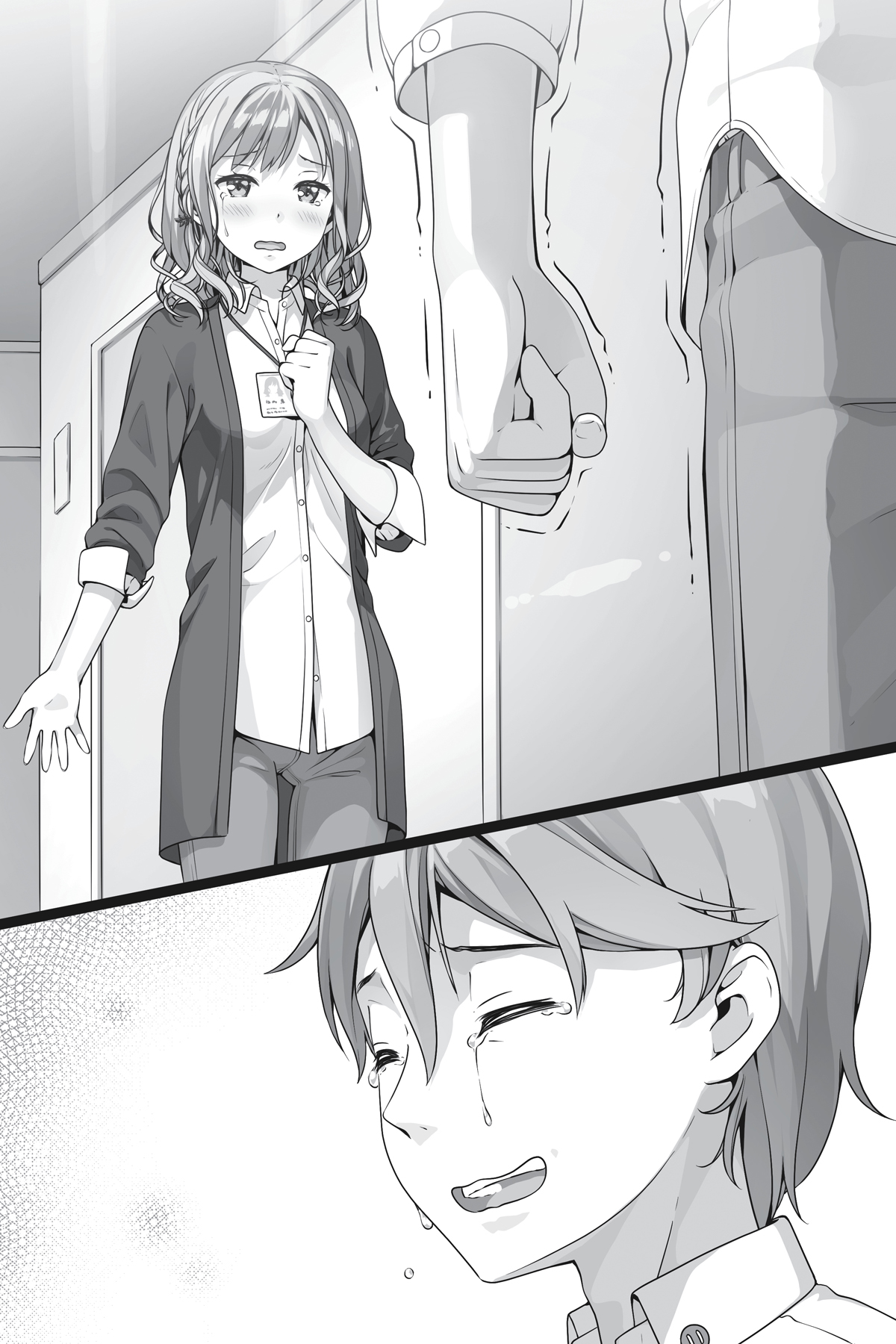
“…It’s all right.” Soma seemed in better control of his emotions now.
“But…!”
“It’s all right,” he repeated, obviously trying to force a smile through his tears. He made his hands into fists, shoulders shaking, but he still tried to put on a strong face. Miyako had no words for him. “I only went elsewhere because I wasn’t happy with how my editor treated me. Even if they let me, it would’ve been super-awkward… Plus, the label I approached turned me down anyway, but I’ll try elsewhere. If it doesn’t work out, I’ll start applying to new-writer contests again.”
“Mr. Misaka…” Now the tears were escaping Miyako’s eyes.
“…Um, could you tell me your name? I think we met at the ceremony, but…I’m sorry; I don’t remember it.”
He bowed his head a little in apology.
“Miyako Shirakawa.”
Soma gave a calmer smile, no longer trying to act strong. “Thank you very much, Ms. Shirakawa.”
“Huh… For what?”
“I’ll never forget there’s an editor out there who cried for me. I hope I can write a book with you sometime.”
The words struck Miyako like lightning. And as she stood there blankly, he said “I better get going” and walked down the hall.
* * *
I’ll never forget there’s an editor out there who cried for me.
I hope I can write a book with you sometime.
Soma’s words echoed in Miyako’s head, over and over.

Two days later, Miyako was interviewing for yet another publisher.
This was a smaller firm, founded by an editor from a large outfit who went indie a year or so back. With his connections, they were publishing new stuff from popular authors and working on assorted anime tie-ins, but they still didn’t really have anything they could call a flagship series.
“What kind of editor would you like to be?” the interviewer asked.
Miyako took a breath and looked straight back.
“I want to be an editor who can cry with her authors.”
“Oh…? Can you go into more detail?”
“Certainly… When an author is sad because their work got bad reviews, or their series got canceled, or the media tie-ins failed, or something just unfair happened to them, I want to be just as sad as they are. I want to cry with them, get anxious with them…and then, I want to stand back up with them and keep going forward. That’s the kind of editor I’d like to be, I think.”
Hearing this, the interviewer—still young, maybe around thirty—flashed a slightly mischievous smile.
“You sound pretty green.”
“……”
“Generally speaking, an editor has to work not with just one author but several at the same time. Do you think you can come to grips with the sadness of each one and bear it like it’s your own? Because that’s going to burn you out, sooner or later.”
“Well,” the undaunted Miyako replied, “an editor might have several writers to deal with, but a writer’s only going to have their single editor.”
“So you have to bear it all?”
“Yes. I do.” She confidently nodded. “But no matter how sad something is, if we bear it together, that reduces the load by half. And that’ll work. Besides, it’s hardly going to be sadness all the time. We’ll be happy at times, too, and enjoying ourselves… I want to be the kind of editor who can experience all the same feelings as her authors.”
“………All right. Thank you very much for your time today. We’ll be in contact with you over the next few days.”
“Certainly. Thank you very much.” Miyako stood up and left the room.
“…That’s dangerous,” the male interviewer said to himself.
Her way of thinking leaned far too close into the writer’s mind. As an editor—an employee of the publisher—there were many aspects of the job where she’d have to prioritize the company’s logic over her writers’ feelings. Those ideals of hers were so green, so loose, and so dangerous.
“…But it’s good.”
Nobunaga Shirogami, president of Branch Hill Ltd., flashed a gentle yet meaningful smile on his well-proportioned face.