Considering the Obi
Considering the Obi
As Itsuki, Aoba, and Nadeshiko were enjoying an impromptu board game party, Yoshihiro Kiso was having a meeting with his editor Kenjiro Toki in a Gift Publishing meeting room.
They were joined by Miyako, sitting next to Toki. The GF Bunko editorial team often let her shadow meetings and conferences like this in order to help her prep for her new job. Editor in chief Satoshi Godo didn’t want the folks at Branch Hill to think “Didn’t GF Bunko teach her anything? What a disappointment,” so he’d ordered his team to train Miyako so she could hit the ground running at her new workplace. But enough about her for now.
Kiso’s first light novel series, Tsurugi: Sword of Sengoku, had wrapped its run with Volume 3’s release in August. They had tied up the plot nicely, but they definitely had enough content to keep it going, and many of its readers wanted it to continue. The series enjoyed both great reader feedback and a great retention rate of old readers who’d reached out to buy a new release. It certainly had the potential to become a popular series, but Tsurugi was wrapping at Volume 3 for the simple reason that it didn’t sell enough. Volume 1 stumbled out of the gate, and while the positive reviews gave it a little more footing, it still wasn’t enough to merit a second printing, so the sales department decided they couldn’t let it go past Volume 3.
…Listen, KenKen. If Volume 1 of a series stumbles on the initial release—especially if it’s from an unknown author—it’s 100 percent the editor’s fault.
That’s what Godo had told Toki once, back when he was still working part-time here, and Toki still believed that was true. For a brand-new series debut, the initial success of a Volume 1 release depended almost entirely on the packaging and advertising—and that was all the editor’s responsibility. Of course, an editor could find excuses—sometimes the manuscript took so long to complete that they didn’t have enough time to consider the packaging; sometimes the illustrator and designer didn’t see eye to eye on things; sometimes the ad budget was too low.
In the case of Tsurugi, Volume 1, they had revised the winning manuscript from the writer’s contest so much it was essentially a different novel, so they didn’t have much time to spend really molding the package. It was a hardcore samurai story, one with a fleshed-out backdrop…but it was also a classical light novel with a beautiful girl taking center stage, which made finding the right illustrator a challenge. They needed someone who could draw cute girls—that was a given—but add in katanas, kimonos, period backgrounds, and a tight schedule, and that limited the talent pool. Winning “honorable mention” in a new-author contest wasn’t exactly a glamorous award, either, so the book didn’t get too much hype in the bookstore flyers and posters.
Still, these were editorial issues. They were nothing the author needed to be concerned about. To an author, a novel is like a child they risked their lives to give birth to. Saying to them “This precious child you entrusted to us bombed after blowing its debut, but hey, the editors had it rough, too” would never sound very convincing.
Thus, messing up a production always produced bad karma, a heavy cross for the editor to bear. But Toki believed that anyone unaware of this burden had no right to preside over a series. He couldn’t revive someone’s baby after it was already killed, but he’d never forget about it, and he’d keep pondering over what he could do to not make the same mistake again. There would be more children, and he wanted to guide them to as happy a future as possible.
That was the sort of reinforced resolve Kenjiro Toki brought to this meeting.
“All right. So that’s a go on the plot for Volume 2. As for the deadline…would the end of the year be asking too much?”
“No,” Kiso replied in his low, rumbling voice, “that won’t be a problem.”
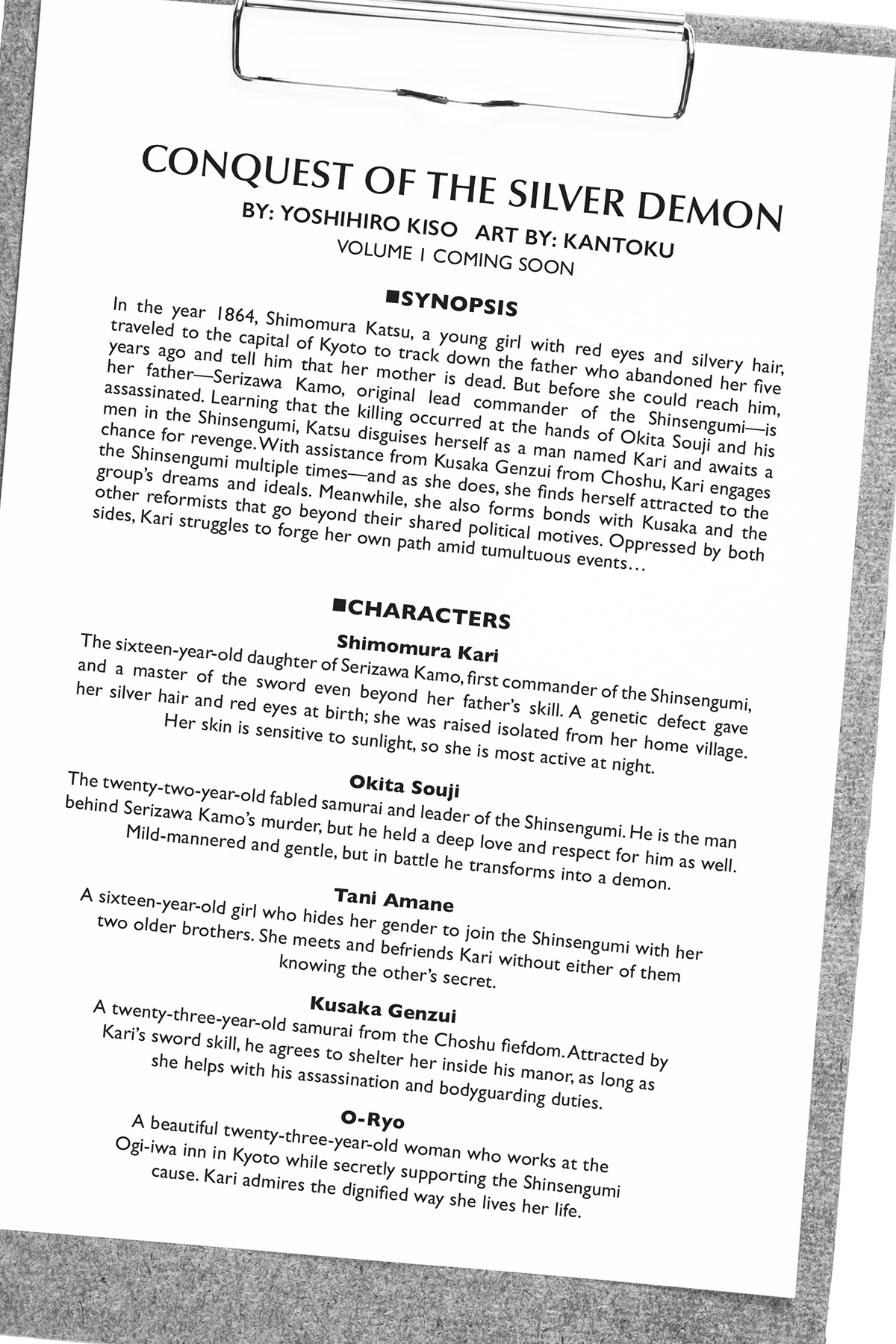
Yoshihiro Kiso’s latest series, titled Conquest of the Silver Demon, was slated to go on sale next January. But Volume 1’s text was in final author revision, the cover illustration was done (along with three front-of-book color pinups), and the roughs were also done for ten black-and-white illustrations—and if that wasn’t prompt enough, they had just wrapped a plot meeting for Volume 2.
Across Toki’s entire career, he had almost never experienced such smooth sailing with a project. But this wasn’t a rush job—Toki was confident about the content, too. The genre was still samurai action, ensuring they didn’t lose any of their previous audience, and the characters were young overall, with an emphasis on pretty girls (and pretty young girls), adding more flashiness to the cast. Kiso’s natural expressiveness had been further polished, and the you-are-there fighting scenes and appetite-whetting meal descriptions began to take on the feel of a seasoned writer. Best of all, the illustrations would be handled by Kantoku—who was not only heralded as the greatest artist of the generation when it came to drawing cute girls, but was also known for portraying fancy clothing and accessories, beautiful backdrops, quiet and dynamic scenes, and being consistently good in both color and monochrome.
Toki was absolutely positive this book would sell. But he couldn’t let his guard down. He had to do everything required, and they had to publish this release in the best shape possible. Volume 1’s cover and summary blurb were complete, both up to his standards—and when it came to packaging, there was just one aspect left to tackle.
“So, Mr. Kiso, what should we do about the obi?”
The obi—the strip of paper around the dust jacket of many Japanese books, serving as additional advertising—is an extremely important part of the pitch light novels make to readers. Its design and ad copy can often spell the difference between a customer making a purchase or putting it back on the shelf. But for The Conquering Silver Demon, Toki wasn’t quite sure what the best approach was for the obi. So he decided to get Kiso’s take.
“The obi…?” Kiso asked, eyebrows down.
“R-right…”
Kiso already looked like a living samurai, but his frown with furrowed brows instantly raised the tension in the conference room.
“I must apologize, but I am still a rank amateur when it comes to the packaging of light novels. I have only begun exploring this world as a reader a scant few months ago, so I’m not sure my opinions would offer much of a reference for you. That was why I had surmised I could leave this matter to you, Mr. Toki.”
With all that modesty and politeness, the author was placing his full trust in an editor less than half his age, despite his past failures. Toki took it as a high honor, his respect for Kiso growing even larger. Again, he reminded himself of just how much he wanted this book to succeed.
“Ah, well, Mr. Kiso, there’s no need to think so deeply about it. I’m just looking for some perspective you might have on this, you see, so you shouldn’t be afraid to speak your mind.”
“Mmm…” The stern Kiso watched Toki as he continued.
“In my personal opinion, with the quality we’ve got in the story and its cover, I don’t think we need to resort to anything gimmicky. The obi can just give it to the reader straight, touting the story or using a catchy slogan or something.” As he spoke, Toki banged out a couple images on his tablet. He had several preloaded templates designed by their pros in the graphic team, so he could just fill in a few fields and create a decent-looking obi in a flash.
…Yes. Indeed. Neither were any problem at all. But:
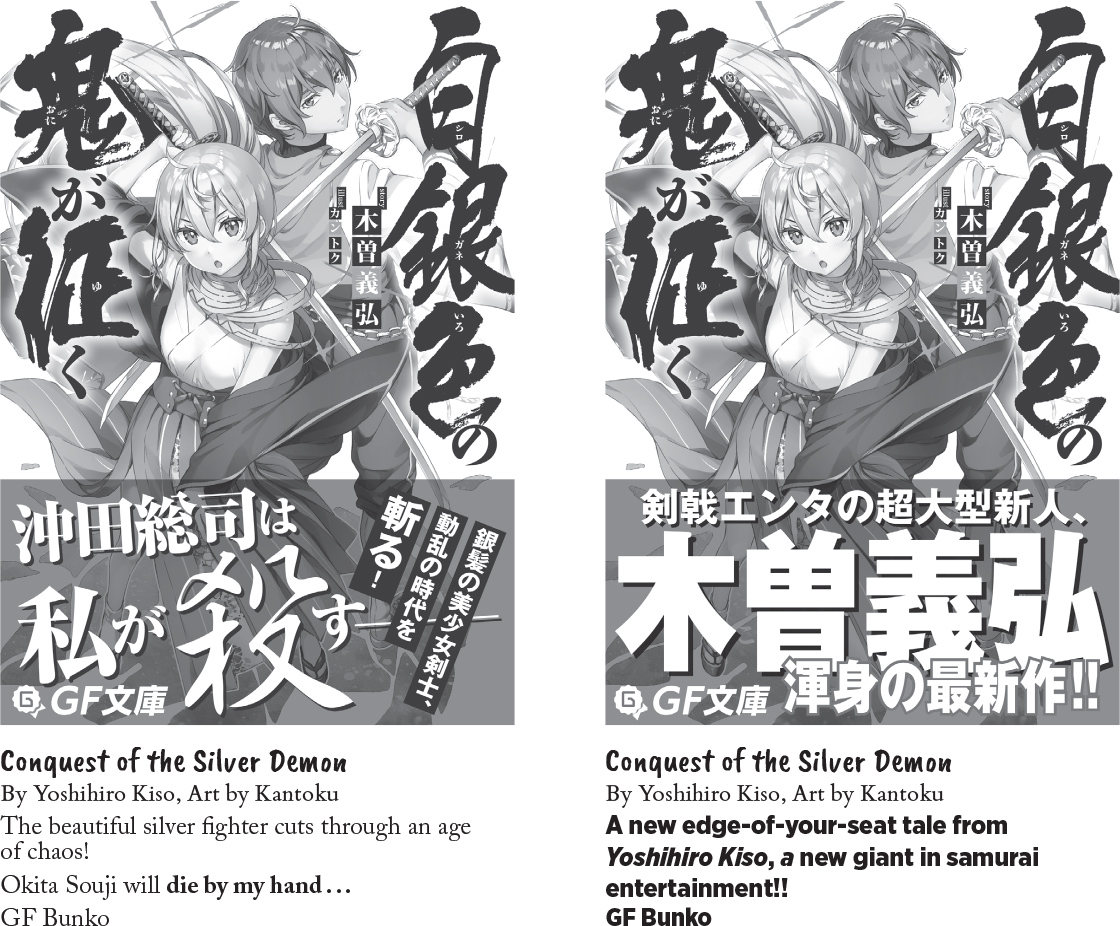
“But if you ask me, I’d like to try challenging ourselves a little further. If someone picks up the book for its cover and the blurb seems interesting enough to them, I want an obi that, you know, gives them that one final push toward a purchase… Oh, and if you have any ideas, Shirakawa, don’t be afraid to chime in.”
“Well,” Miyako said, “maybe it’s kind of a cliché, but could we get a comment from somebody famous, maybe?”
“Yeah, I actually thought about that first as well. But with a book like this, I’m having trouble deciding exactly what sort of celebrity endorsement would work the best.”
“If it’s a samurai period piece, maybe we could bring in a famous novelist in that genre?”
The quick suggestion inspired Toki to create a new image.
“…Certainly,” Kiso said as he looked at Toki’s tablet. “If Ikenami wrote an endorsement, I would have no complaint about that. I’d certainly buy it, anyway.”
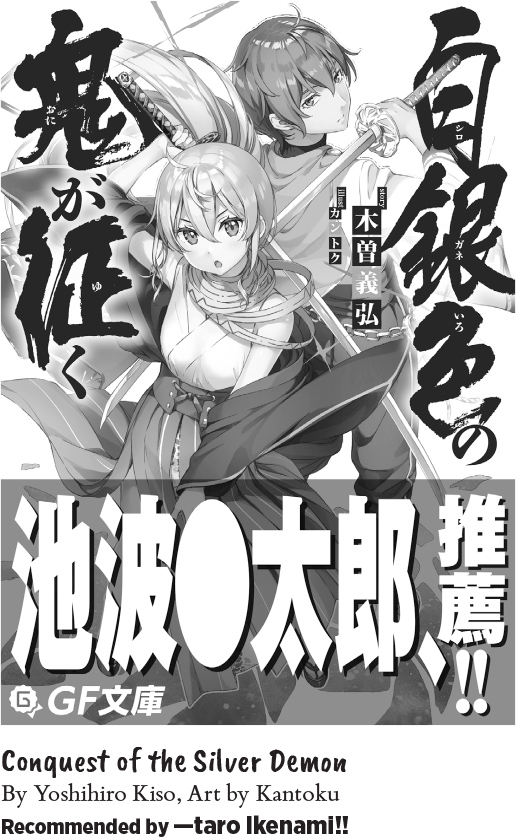
His voice was as flat and detached as always, but his lips seemed a little more tensely stretched than usual.
“…Ah, yeah, I probably shouldn’t have put a dead author’s name in there…but you see what I mean, regardless. Let’s add this idea to the list of candidates.”
“All right,” replied Miyako. “Beyond that, um… How about a big name in samurai movies? Like, someone that everybody would know?”
“A samurai film star that everybody would know…” Toki turned toward Kiso. “Who would that be, for example?”
“Well, as a fan of the genre, I can think of several names…but on the other hand, I’m not sure which of them would be household names at the moment.”
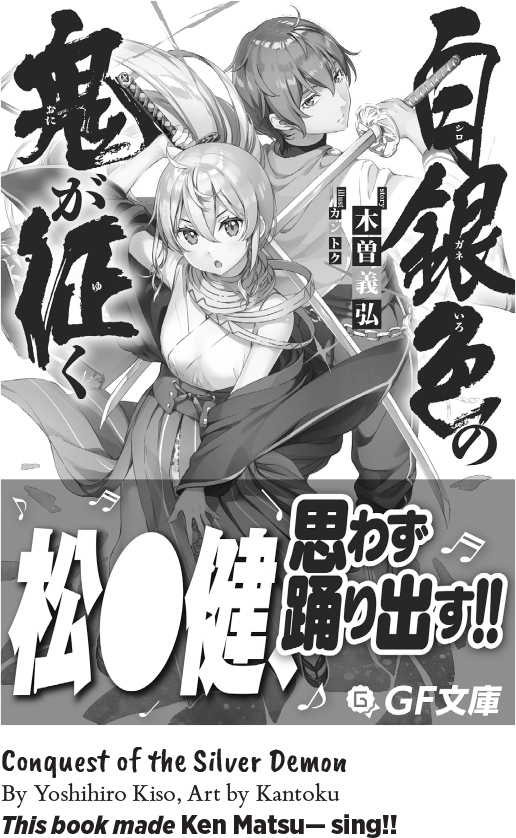
“Well, like Ken Matsudaira, for example? You don’t even need to watch samurai films to know him.”
“Ahh, I see!”
Toki nodded and created a new image.
“…Hmm. This is certainly eye-catching as well,” Kiso said in his flat voice. “Apart from it being all but impossible to happen in real life, I think it is excellent.”
“It’s really not possible?” Miyako asked.
“…Well, I think we can pitch it to his agency, at least. Worth a shot.” Toki tried to sound upbeat. But he didn’t like their chances much, either. “I guess getting an endorsement from a light novel writer is more realistic, then…”
Toki whipped up a few samples. The results didn’t seem to satisfy him.
“Hmm… Certainly, going with people in this industry would be a lot easier to make happen, but it’s already kind of been done to death. It wouldn’t seem too fresh to readers. Especially Hirasaka—he’s written blurbs for like two dozen or so books by now. His name doesn’t mean anything anymore.”
“Yeah, I think I’ve seen his name on the obis of a few different books. Do you think he actually reads the books he recommends? (Author’s note: Yes, I only write endorsements for books I read and like. Promise.)
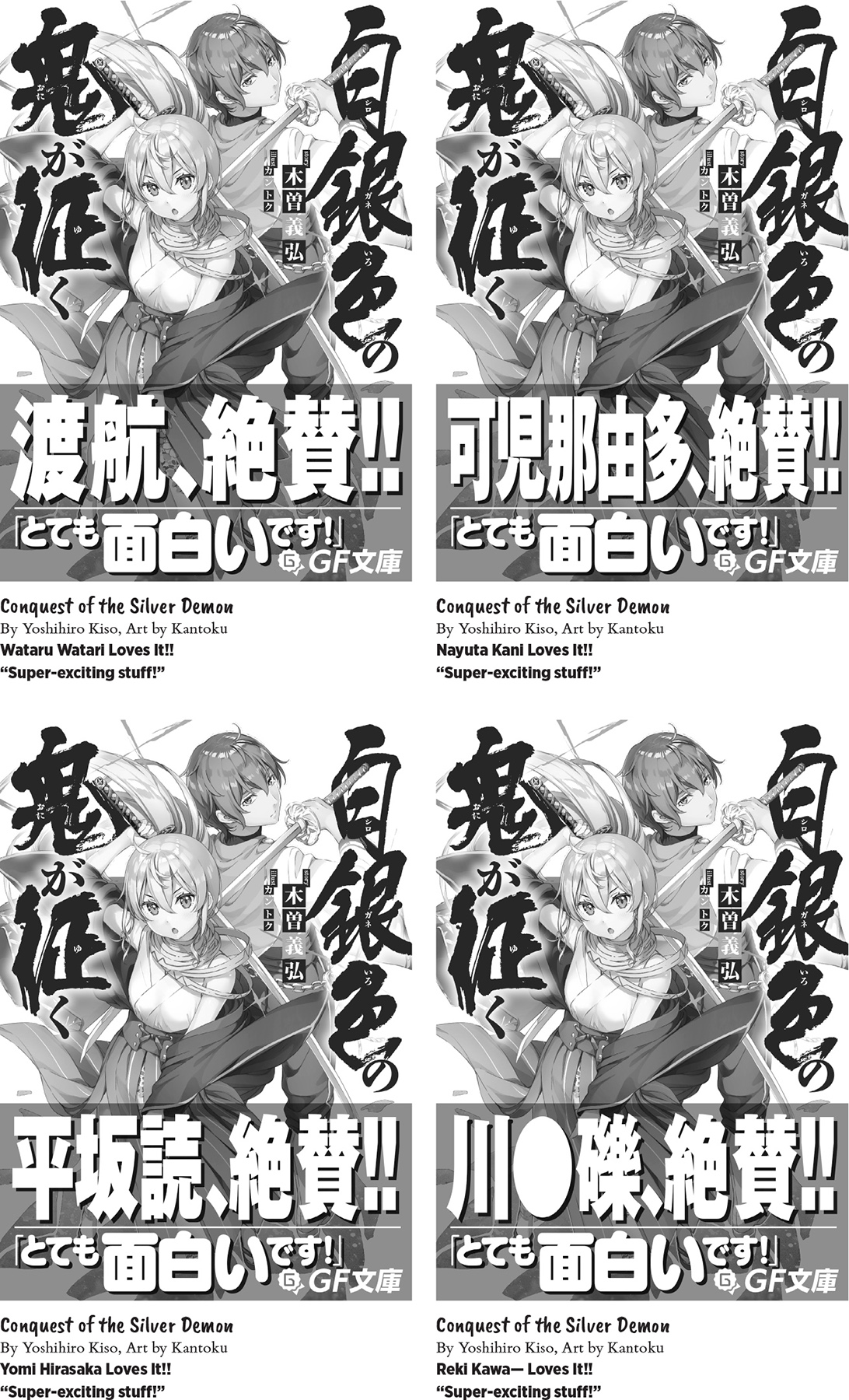
“Who knows?” Toki sighed. “But anyway, let’s step away from the endorsement idea for now. Put yourself in my shoes for a moment. If you were at a bookstore, what kind of obis draw your attention enough to pick up the book?”
“Mmm, I don’t really pay attention to obis when I buy books… Oh, but if they advertise an anime version, I do wind up checking on that.”
It was a very “future editor” thing for Miyako to say. This approach was pretty threadbare as well, but notices like “Anime Coming Soon!!” or “Check Out the Manga Version Too!!” were a direct way to tell buyers “Hey, here’s how popular this franchise is.” It remained a strong advertising approach—but you really can’t use it on Volume 1 of a new series.
“We could also go with this…”
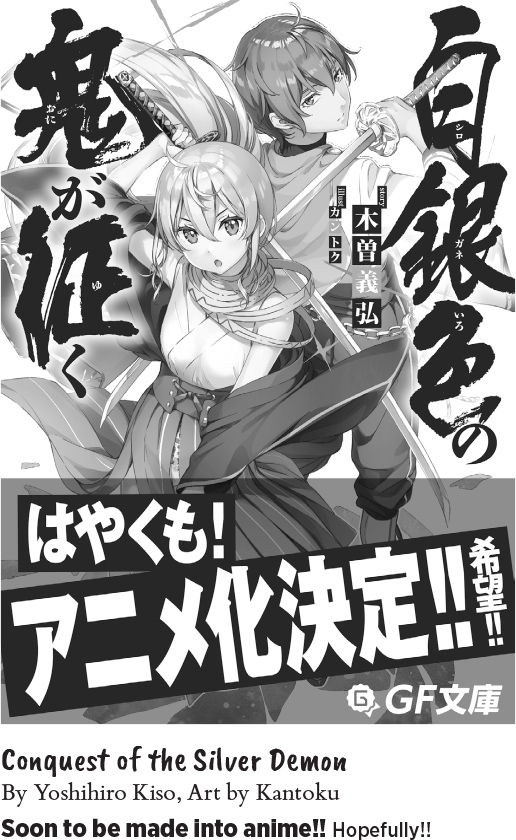
“Ahh, I see… It’s not a lie, no. I think some people would get angry about it, but…” Miyako’s reaction to the image Toki made was half astonishment, half disgust.
“I’ve been purchasing historical samurai novels for a long time,” Kiso said, “but I often tend to pick up books featuring whatever character is prominent in the ‘Taiga drama’ NHK is broadcasting that particular year. The industry is aware of this as well, so every year, they produce mounds of novels featuring the hero from the NHK drama. They pop up like weeds.”
“Yeah, I’m sure the year’s Taiga drama has a huge impact on the period-novel business.”
“Indeed. In fact, I even see some books print ‘Now a Taiga Drama!’ on the obi even if they had nothing to do with NHK’s production. It is a fairly common thing to see in that genre, but yes, it’s just as misleading as this obi here.”
“I see…”
Miyako nodded at this, curious about how the industry worked in other genres. Then an idea struck her.
“Oh! I know! Why don’t we put ‘See the Taiga drama!!’ on the obi?!”
“Huh?”
“What do you mean by that…?”
Toki and Kiso gave her quizzical looks.
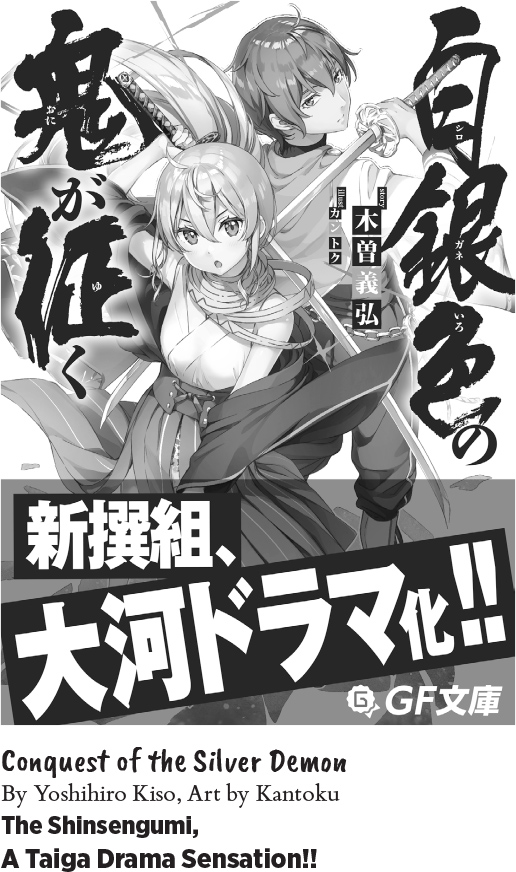
“Well, Mr. Kiso, this work is focused on the Shinsengumi from the nineteenth century, right? And NHK released a Taiga drama about them in the past, I know. So it wouldn’t be a lie to say ‘the Shinsengumi, as seen in Taiga drama!’ or something! Not that this particular novel’s been adapted or anything, but…!”
“I… I see…!”
Toki, understanding Miyako’s idea, opened his eyes wide. Immediately, he produced a sample.
This was the simple truth—the Shinsengumi [were] a Taiga Drama Sensation [in the past]. Nowhere did it say that NHK chose this exact book for a drama adaptation.
“…It’s not just the Shinsengumi,” Kiso softly pointed out. “The main cast includes Ryoma Sakamoto and many other ishin shishi activists from the late Edo period.”
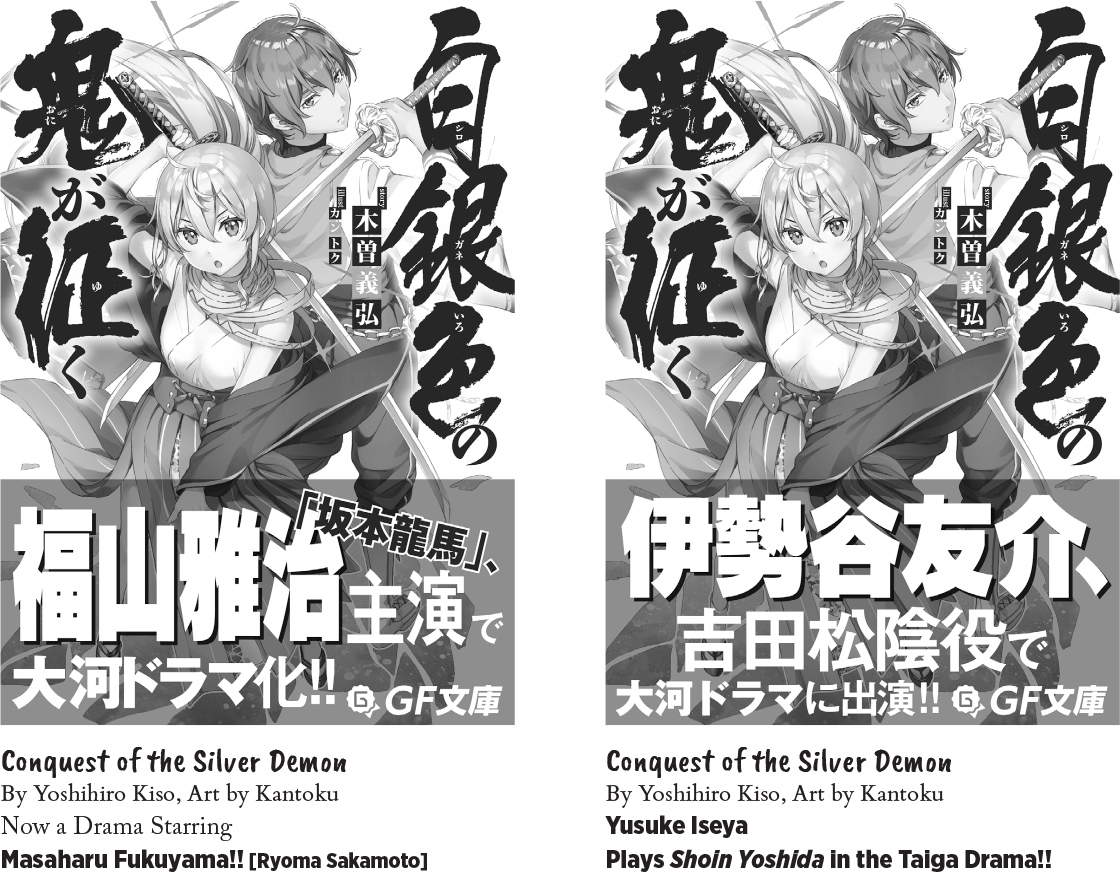
“…! Mr. Kiso, do you mean…?
“…we can write whatever we want on here?!”
Toki immediately began jabbing at his tablet.
Again, there was nothing false about this. Everything written on these obis was 100 percent the truth. It was just that Taiga dramas, Masaharu Fukuyama, and Yusuke Iseya didn’t happen to have much to do with this particular book.
“…Hmm.” Kiso closely eyed the images. “If we can get away with this much tangential material…
“…then why stop with Taiga drama? What do you think about writing ‘Hollywood picture showing now!’?”
““…!!””
Toki and Miyako were thunderstruck.
“Y-you’re right… There are Hollywood films in theaters right now…!”
“Definitely,” Miyako agreed. “It’s not like it’s based on this book, but there’s definitely some kind of Hollywood movie playing in theaters right now!”
“Great job, Mr. Kiso! That’s a genius idea!”
“Heh…”
Even Kiso had to smirk a little at Toki.
This wasn’t a lie. The number-one movie in the US (whatever it was) might not have had anything to do with this book, but it was definitely filling seats in movie theaters across Japan at the moment.
“Hey, I think we’re on to something here…!” Toki looked incredibly satisfied with this. “How about this?!”
This wasn’t a lie!
Not that it had anything to do with this book, but the hit series Sword Art Online was being adapted into a live-action drama by Hollywood, and the megahit One Piece definitely had its latest volume out sometime recently! All totally true!
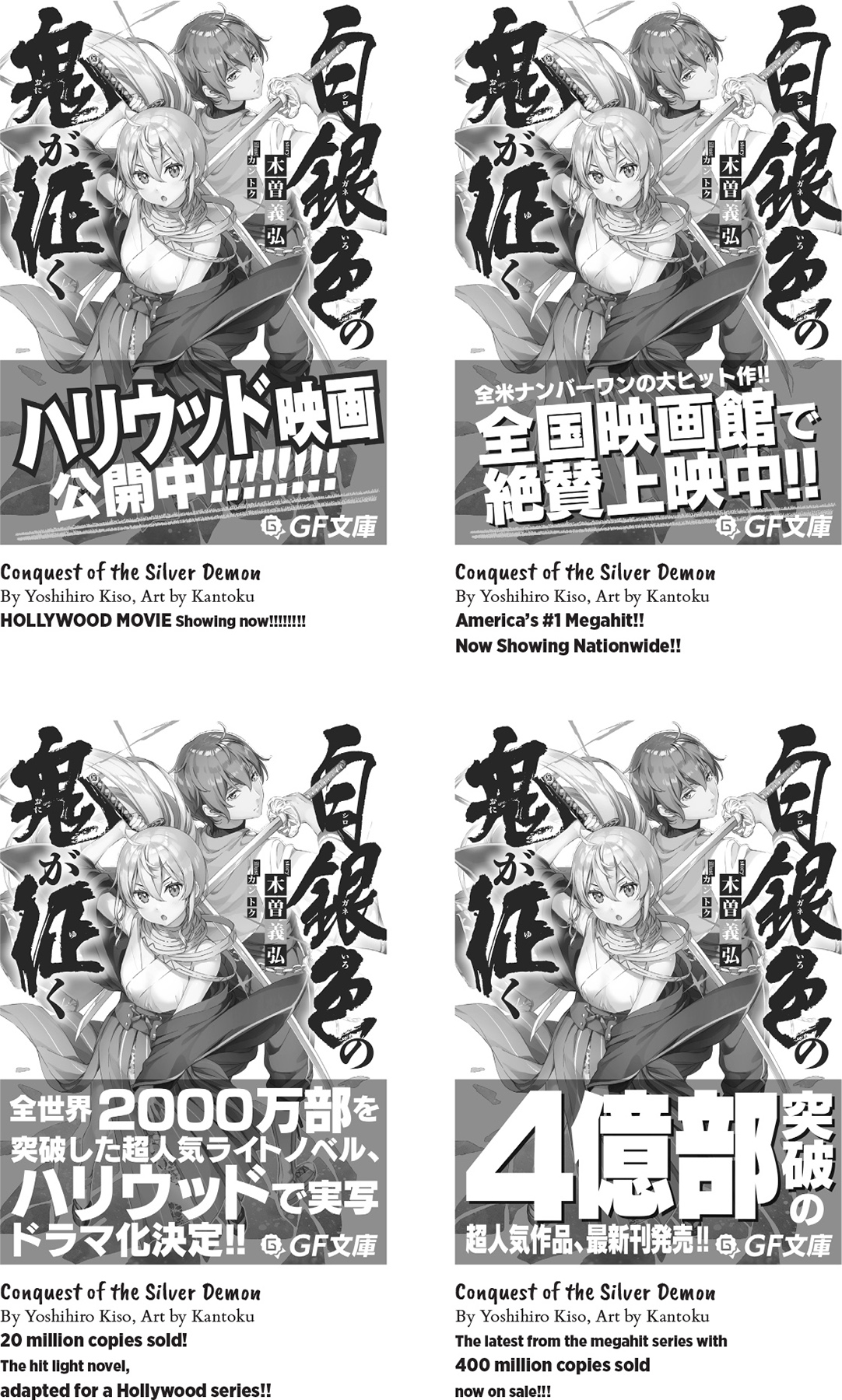
“Whoaaaaa!” Miyako cried. “This totally works! Like, totally! We’re creating obis with impact like nothing that came before!”
“You can do this, Toki!!”
“Heh… I look forward to the final result.”
The three of them continued to brainstorm, creating the most outlandish obis they could come up with.
“All right, the Bible’s sold like four hundred billion copies, right? It’s the biggest bestseller in history. Let’s try doing something with this…”
“…Whoa, KenKen.”
They were making so much noise, in fact, that editor in chief Satoshi Godo peeked into the room to see what was going on. He patted the excited Toki on the shoulder.
“Oh, hey, boss! Look at all these amazing obis we’ve come up with! We’re bound to have a hit with these!” Toki smugly showed off his images.
“That’s called ‘misrepresentation,’ you dolt.”
With that dispassionate statement, Godo ended the fantasy immediately.
A misrepresentation is a statement of fact designed to mislead people into believing a product is better than it really is. It’s prohibited by the Household Goods Quality Labeling Act of Japan. You could get away with jokes like “Anime Coming Soon! I hope!” and in the samurai novel genre, taking advantage of whatever historical drama was showing on NHK was a long-running tradition at this point—but get too naughty with it, and you’re out.
So they were back to the drawing board for obi ideas.
“Sorry we kinda got out of control, Mr. Kiso…”
Kiso gave the truly apologetic Toki a light smile. “No, no, I realized midway through that this was probably illegal anyway.”
“You did?! Why didn’t you say something?!”
“Because sometimes, if you’re stuck on a problem, going on a wild tangent opens up a pathway toward a solution.”
From a man his age, Kiso’s statement held significance, and Kenjiro Toki realized just how immature he still was.
Miyako eyed the despondent Toki and earnestly said, “You really are Itsuki’s editor, aren’t you?”