The Anime Version
The Anime Version
One day in early August, Itsuki was summoned to the Gift Publishing building, a five-minute walk from his place. This was something that almost never happened, what with Kenjiro Toki stopping by Itsuki’s apartment for most of their work discussions. But this wasn’t about novel business. Today, he would be meeting with the core staff for the anime.
The animated version of All About My Little Sister had first been brought up to him in late May of this year. It was typical to see a lengthy time gap between the planning of an anime project and the start of its actual production, so a writer like Itsuki meeting with his core team less than three months after signing on the dotted line was normally impossible to imagine. However, by the time Itsuki was approached with the offer, nearly all the broad production details—the sponsors, the broadcast networks, the production companies involved, the main staff members, even the TV broadcast schedule—had already been decided.
This unusual speed wasn’t for very auspicious reasons. The whole project wasn’t originally meant for All About but for another GF Bunko novel series (SILLIES, written by Yohei Kitagata and illustrated by Puriketsu). Due to extenuating circumstances, this suddenly got canceled, and among the many possible last-minute replacements available, All About got picked. In other words, All About was not the choice made by the production companies, the staff, or anyone else actually producing the anime. Worse, the series was also meant to launch on TV next July. A year between starting production and launching episode 1 was not much time at all. There was next to no leeway in the schedule.
This entire project was the result of good intentions falling through and people scrambling for something, anything for plan B—but Itsuki knew all that and still said yes. If he wanted to take the next leap forward as an author, he firmly believed that overseeing an anime adaptation was unavoidable along the way. He knew this was a risky bet—but he didn’t want anyone taking his work and turning it into a piece-of-shit anime. He wanted the series to work out well, to become a hit that’d prop up novel sales along the way.
Thus, it was a mixture of anxiety, expectation, and nervousness that had him standing bolt upright as he took the elevator to the fourth-floor conference room and called Toki on the phone. He arrived before long, alongside editor in chief Satoshi Godo and part-time helper Miyako Shirakawa.
“Haven’t seen you in a while. Doing well?” Godo boomed in his high-pressure voice.
Itsuki shivered for a moment before smiling vaguely and squeaking out a “Just fine, thanks.” He debuted on the GF Bunko label almost four years ago, but he talked with the editor in chief so infrequently that every meeting still made him nervous.
Godo gave him as kind of a grin as his villainous visage allowed. “Congrats on the anime. You’re part of the writers’ elite now. I hope you keep flying higher and higher after this…!”
You just slotted me in place of something else, Itsuki struggled not to reply. His EIC wasn’t aware, after all, that Toki had told him the whole story about his series getting subbed in. You two-faced bastard, he thought as he stretched his lips into a smile and said, “Thank you very much.”
“Let’s go to the meeting room. Everyone else should be here soon.”
The four headed off, Toki and his boss in front and Miyako and Itsuki in the back.
“…You’re attending this, too?” Itsuki whispered to Miyako.
“Yeah. He wanted me to get some tea and stuff ready.”
“…Oh.”
“…Why do you seem so tense? Are you nervous?” Miyako gave him a concerned look.
Itsuki blushed a little. “Of course not! I’m cool as a cucumber! And I’m here to calmly and precisely give the animation staff just the guidance they need, ah-ha-ha-ha!”
“Sure, sure,” Miyako replied with a gentle laugh. “Good luck.”

Several minutes after they entered the meeting room, the anime staff filed on in. For this meeting, it consisted of the director, the screenwriter, the production manager, and the producer.
After a few quick hellos and exchanges of business cards, they all sat down—novelist and editors on one side, animators on the other. Itsuki sat at the head of his table, followed by Toki and Godo; on the other side, the director sat closest to the door, then the screenwriter, producer, and assistant. Miyako, after passing out tea, stood meekly in front of the door.
The director was named Munenori Tarui, age forty-two. He was of medium build and looked friendly enough, although he didn’t have much of a presence in person, dressed in his wrinkled jacket and slacks. Based on Itsuki’s net research, he started his career as an animator; this would be the third series he’d directed. The other two were romantic comedies based on manga series, both released to good-but-not-great reviews. His art style was fairly nondescript; Itsuki had the impression that he preferred a workmanlike approach, taking the original material and doing a perfectly acceptable job of animating it.
The screenwriter was Masahiko Hirugano, age thirty-eight. A pen name, apparently. He was a pudgy man in a short-sleeved tee and shorts, looking every bit like an anime industry old-timer. He’d made his screenwriting debut ten years ago, working for a large number of series across multiple genres. On three of those, his credit was story editor, the main person overseeing the other screenwriters; one series was an original, while two were light novel adaptations. Itsuki didn’t know much about the writing on those two, but the box sets (DVDs and Blu-rays) on both weren’t too shabby. The original anime, however, didn’t have a very good rep among fans.
The producer was Tsutomu Oshima, age forty-five. He gave a bit of a mobster-like impression himself—stocky, well-built, and dressed in a full business suit. His release list included a wealth of anime known for their sexier scenes, including several series that Itsuki knew and enjoyed.
Finally, the production assistant was Kakeru Yamada, age thirty-two. He was tall, dressed in a polo shirt and slacks, and looked like a well-tanned sportsman, although one with a notably hangdog look on his face.
Many more people than this would be involved with the production, but it would largely be these four people dealing with the original series publisher.
“Thanks to all of you for coming out here today,” Godo began in his low voice. “This will be the first meeting between the publisher and the main animation staff, and I’m hoping we can use this chance to talk about our goals and compare notes on how we picture the series going.”
Everyone murmured their agreement.
“So,” the producer said, “we have less than a year before launch, so we’ll need to proceed quickly. Along those lines, I’ve had Hirugano here prepare a treatment of the series’ overall structure for us to discuss.”
This was a surprise to the Gift Publishing side.
“Oh…? Let’s see it.”
At Godo’s bidding, Hirugano passed out two sheets of paper to all the attendees. Itsuki nervously picked them up.
The outline called for twelve episodes. The first few seemed to follow the plot of the books pretty well, not going into great detail on the events they contained. About what I figured, Itsuki thought as he kept reading. But starting around episode 4, the descriptions tapered off into loose, bare-bones sentences. It unnerved him, but he didn’t know why—not until he reached the end of episode 9, which featured the debut of an anime-original enemy that wasn’t in the novels. The battle against this villain occupied the brunt of airtime beginning in episode 10, and episode 12 capped things off with the final battle and the hero and heroine being linked together—a totally anime-exclusive ending.
“…An original enemy?” Itsuki asked in a quiet but foreboding voice. Hirugano, apparently expecting this, began to explain.
“In the original books, there isn’t really a neatly defined climax to round out the final episode of a series, so we need something in the final quarter to build up anticipation for the ending. We want to be sure the viewers are satisfied with the series as a whole.”
“Hmm…”
Hirugano had a valid point. The original novels weren’t known for strong endings, each one capping things off with a “To Be Continued,” and the screenwriter’s evaluation made Itsuki realize that there really wasn’t a single perfect plot point to hang a final TV episode on. Maybe some original storytelling was in order, and with that would come an original character or two. Dogged devotion to the original material didn’t necessarily make for good anime viewing, and given that this was a whole different type of media, there were bound to be differences here and there, no matter how hard you tried. Even the All About comic, which Itsuki was arguably the world’s biggest fan of, featured edited dialogue, abbreviated scenes, and original content.
It made Itsuki recall what he told Haruto once. We’re not here writing anime pitches. He didn’t say that just to assuage Haruto’s damaged ego. As a writer and as a performer, Itsuki was firm in his belief that his novels could never be 100 percent reproduced in some other media. Thus, he thought, if it improved the final anime, changing the original was a necessary evil—something worth actively pursuing, even.
If it was meant to improve the final anime, that is. And this was not.
Yes, this series would tell a complete story in twelve episodes, but that was it. It wasn’t a story but a summary of events. Cutting out scenes and foreshadowing from the novels and cramming all the rest into a neat package like this? This wasn’t adaptation. It did nothing to optimize the series for anime.
“…I’m seeing that the Onizaki siblings barely appear in this,” Itsuki commented, holding his emotions back.
All About My Little Sister mostly focused on the adventures of Kazuma Akatsuki and his sister, Ichika, but there was another pair of siblings: Shingo Onizaki and his sister, Yukiko. They were undercover monster hunters but also classmates with the Akatsukis, totally unaware of the demon blood running in that family. Sometimes they’d fight; sometimes they’d work together in battle; and along the way, the story developed. The Onizakis weren’t just handy friends or rivals to have around—they existed as foils to the Akatsukis, an important asset to the series’ diverse depictions of love between brother and sister. They were kind of the shadow hero and heroine, and Itsuki devoted as much strength and devotion into writing for them as he did for the Akatsukis. And there was almost nothing written about them in the story structure.
Hirugano had a smooth answer ready. “If we bring in the sub-characters too much, the viewers will have trouble identifying who the hero is, so I’m thinking that we should put the spotlight on Kazuma and Ichika for the anime. There’s only so much airtime to work with, besides. Of course, the Onizakis will have appearances in areas I didn’t specify in this summary treatment, and I’m thinking we could include a few more Yukiko fan-service scenes that weren’t in the original.”
“Sub…character…?”
Itsuki could feel the blood rushing into his skull. Shingo and Yukiko were shadow protagonists. Some of the most vital characters in the books. Dismissing them in crude terms like sub-characters or sidekicks was out of the question. In fact, all the characters that appeared in the novels were like children to him, complete with their own emotions, their own lives, and their own stories. Deep inside, Itsuki didn’t want any of them to be treated as carelessly as this.
There’s no such thing as a dispensable character in my stories. Don’t use excuses like “simplicity’s sake” or “lack of time” to snuff out someone’s entire life!
“Do you—?”
“I see, I see.”
But before Itsuki could erupt into a furious diatribe, Godo opened his mouth.
“Certainly, there are a few things that slightly veer off from the novels, but we’re dealing with different media, after all. We’re all amateurs here when it comes to anime production, so I’ll want to respect the professionals on questions like these, no doubt.”
He was turned toward Hirugano, but it felt like the words were meant for Itsuki.
“So I’d be glad to leave the anime in the able hands of all of you here, while Mr. Hashima continues on with his own tale. I know it’ll be a hectic schedule ahead for us, but I’m looking forward to doing everything we can to make All About My Little Sister as exciting as possible.”
…leave in the able hands of…
…while Mr. Hashima continues on with his own tale…
…doing everything we can…
In other words, Godo had just told Itsuki to keep his nose out of the anime.
“…!”
Itsuki bit his lip, pushing the words back inside. He knew from Toki that his story was plan B for this project, that he shouldn’t expect much of anything to go the way he thought it would. He knew that, and he had still agreed to it. So no, he shouldn’t meddle. Godo was right. He had to accept the anime for what it was and devote his full attention to the original story ahead. He was an anime amateur. The only real option was to trust in the pros and let them do their work…
He tried his best to bottle up the frustration, to convince himself that this was all right. But then, someone else gave his inner conflict the voice it deserved.
“Um… Isn’t that kind of weird?”
The loud, sharp voice came from Miyako, standing in front of the door.
“Ms. Shirakawa!” Toki rebuked, wincing.
“I mean…”
“…We’re not asking a part-timer for feedback.”
The sheer authority behind Godo’s powerful voice made Miyako freeze in place. But she was still upset, and she matched his glare, remaining firm. “I mean, this anime’s supposed to be based on Itsuki’s work, isn’t it? I just think it’s weird that you’re telling the original creator to butt out of his own anime.”
“…We aren’t telling him to butt out. We’ll be glad to have him help out as the original author, but I just want to be sure Hashima keeps the novels as his primary focus.”
The almost threatening tone Godo took made the anime staff cower in their seats. Miyako didn’t let it bother her.
“So why don’t you let Itsuki have his say right now, then?! Isn’t the episode structure one of the most important elements of any anime project? I really don’t think we can delegate all that to somebody else!”
“He’s an author, but he’s still an amateur when it comes to anime. That’s why we should trust in the professionals—”
“Well, as an editor, you should know that not even professionals are perfect all the time!”
“Bffph,” Toki said, stifling a laugh. “She has you there.” Godo just stared him down.
“That’s why, um… I think you should talk things out and really think about this. To make sure that you can trust each other!”
“And that’s why I said this isn’t something a part-timer needs to worry about…!” Godo’s voice was turning rough with frustration as Miyako gave Itsuki a forlorn, almost crying look.
Itsuki, a casual observer to this exchange so far, snapped out of his torpor.
“Itsuki! What about you? You want to leave all of this to them? Maybe they’ll put out a really great anime if you do, or maybe it’ll wind up like Fuwa’s series, no matter how hard they try…but this is your precious story, isn’t it?!”
“…Heh-heh.” An impudent smile crossed Itsuki’s face. “I’ve come back to my senses, Miyako.”
“…Oh.” She turned away, blushing.
“…What on earth was I thinking just now? Why do I have to act like I’m so inferior to you all just because I’m subbing in for SILLIES…?!”
“You told him, KenKen?”
Godo glared even harder at Toki. The editor just looked away and played dumb.
“…All About is my story,” he said, voice sharpened to an edge. “What’s so wrong with me throwing everything I’ve got into the anime version?! What’s so wrong with me calling a shitty episode structure a shitty episode structure?!”
He held up the summary printout in his hands and ripped the two sheets in half.
“…I’m not so sure about that, Mr. Hashima,” Hirugano, the screenwriter, slowly began. He kept himself calm on the surface, but the anger inside bubbled up nonetheless. “…I can understand that the original author might find some off-putting elements in this, but I’ve taken my understanding of your work and done my best to put it in a format suited to animation. So I hope you can understand that. These are the differences in media that everyone has to deal with.”
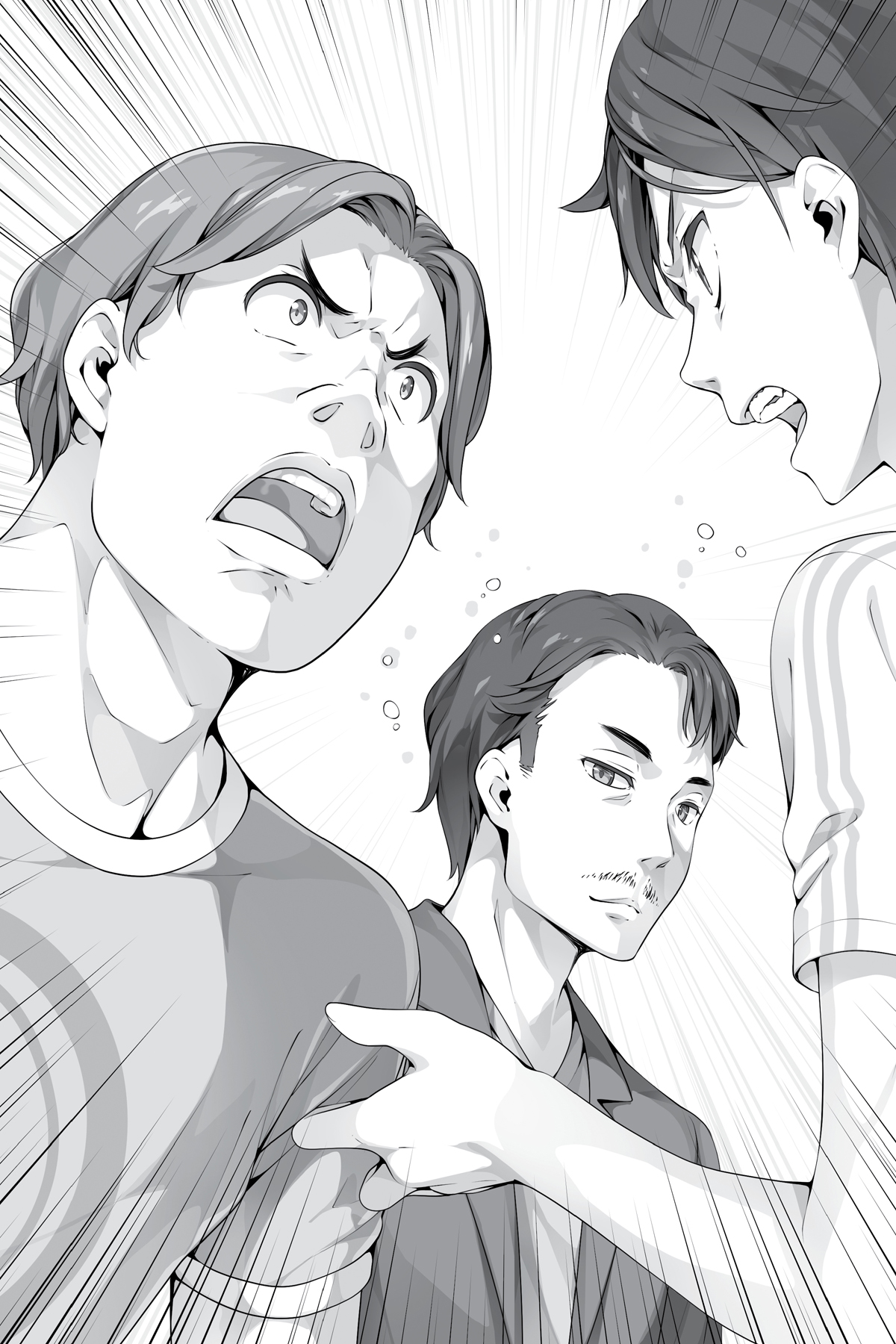
“What are you, stupid?!”
“S— Stupid?!” The word stopped Hirugano in his tracks.
“‘I hope you can understand’? ‘Differences in media’? That’s nothing but a lame excuse from a bunch of people who have no idea what they’re talking about with media. People who’re gonna totally fail to bring out the charms of what’s probably the greatest slice-of-life masterpiece ever written! Don’t give me that crap like it’s some kind of wise old adage! Oh, you did your best to format it for anime?! You’re a liar! Liiiiaaaar! I can’t believe you’d come in here and give me that bullshit with this total mess of an episode summary! It just screams ‘Well, here’s a summary; hope you like it’! It’s so obvious you barely even thought about it! And if you did and this is the result, you’re a talentless hack! Just quit and find a new career!”
Hirugano gritted his teeth against Itsuki’s crashing tidal wave. “Where does some mid-level writer who lucked into an anime get off telling me to—?”
“Ah, Hi-Hirugano…!”
“Please, Mr. Hashima, calm down…”
“Itsuki, that’s kind of going too far, isn’t it…?”
Oshima, the producer, Yamada, the production assistant; and Miyako, the part-timer, all expressed their panic in different ways, as Toki and Godo winced in shame. Only Tarui, the director, retained his serenity, almost seeming to enjoy the argument between author and screenwriter.
“…I’ll give you that. Yes. I’m a mid-level writer. That’s why I decided to take this chance at an anime and do everything I possibly can to grab something with it! And I can’t do that if I have to work with a bunch of crap from a screenwriter whose heart isn’t even in it!”
“Anime isn’t some kind of RPG monster the writer can milk for experience! It’s a team effort! You have a huge staff of professionals working together to create this work of art! Just because you’re the original creator doesn’t mean we have to listen to a total amateur when it comes to anime!”
“Ha! If you keep calling yourself a pro, I’d like to see some actual pro-level work from you! You probably have a bunch of projects ongoing and figure it’s safe to phone it in on at least one of ’em, huh?!”
“Don’t give me that shit! You think the industry’s that easy to work in?! If you submit a bad script, that’s a permanent mark on your résumé! It’ll affect the work offers you receive for years on end! You can find a screenwriter’s entire past career in two seconds on the Internet—we get fans and haters just like everyone else in the business! I can’t phone it in on anything and expect good results!”
“So why did you phone in this total garbage of an episode plan?!”
“I didn’t phone it in!”
“Yes, you did!”
“No, I didn’t!”
“Oh, really? Well, if you didn’t phone it in, am I supposed to assume this is your one hundred percent best effort?!”
“No! I’m not totally satisfied with this episode setup, either!”
“So why did it end up like this?!”
“Because the original is fucking boring!”
“Hrnngh (>д<)?!”
Not even Itsuki could reply to such a frank evaluation.
Hirugano let out a regretful clearing of the throat. “…Or, to be more exact, I’m not sure I understand what makes this story interesting. I’m a huge fan of Mr. Kitagata’s SILLIES, so when I heard about the SILLIES anime project, I went directly to the director and asked him to let me handle the screenplays! And then that all went down the toilet, so we had to do some other property… It just doesn’t make any sense!”
It seemed Itsuki wasn’t the only one struggling to deal with this bait and switch. The feeling might’ve been mutual among the anime team.
“We had all the episodes fully mapped out. All we had left to do was wait for production to officially begin! And just because the main heroine has a dick, the fans lost their minds! These nerds drive me up the goddamn wall sometimes! …But this is my job, so I read through all the published volumes of All About My Little Sister to get a grasp of it. More than once. But I couldn’t! I just don’t get what’s so attractive about the little-sister trope! I’ve got four younger sisters of my own in real life, and…just picturing them as, like, girls? It makes me sick. So I tried to mold this into something I could understand, and these are the results…”
He looked down at the proposal in front of him and gave a dejected shrug.
“Ngh…!” Itsuki pointed a clenched fist at him. “You…… You……… You lucky bastard!!!”
Anger, sadness, frustration, honest-to-God jealousy—all of it was mixed into that insult (?) lodged at Hirugano. He blinked, unsure how to parse it, then sighed deeply.
“…I’ve said way more than I should have, so I really have no right to be involved with this project. I apologize for losing my temper.” Hirugano bowed his head deeply at Itsuki.
“…You want to step down from screenwriting?”
“Yes.”
“I’m not gonna let you.”
“Er…?”
“You call that responsible, saying all that and just waving good-bye? I thought you were a professional.”
“…But I told you. I don’t understand this series at all.”
“If you don’t, then keep reading it until you do… Actually, you know what? It doesn’t even matter if you get what makes All About good or not. Just understand what makes a little sister so wonderful. I’ll be glad to give you all the guidance you need until you do. You’ve got four of them. Four. And I’m gonna make you understand just how blessed you are, right down to the bottom of your heart…!”
Itsuki’s speech seemed to be at least partially motivated by a personal vendetta against him, but Hirugano gave an abashed smile. “I’ll…do what I can.”
And it was at this point, finally, when Tarui the director spoke for the first time.
“All right. So we’ll keep Hirugano on as the writer, but it sounds like we’ll need a top-to-bottom overhaul of our story structure.”
“Mr. Tarui…!” Oshima, the producer, was the first to react. “That’s going to ruin the schedule…”
Tarui ignored him, looking Itsuki straight in the eye. “Mr. Hashima,” he calmly began, “you and Hirugano just exchanged your first honest thoughts about this with each other. So I’m going to be honest with you, too. With this project, there’s essentially one thing expected of me, and that’s to cut our losses.”
“Wha…?!”
This was almost too much honesty for the conference room. Everyone was visibly taken aback.
“We have to deliver this thing on time, of course. We have to cut down on scenes with lots of action or characters running around; anything that consumes too much animation time. We have to keep the number of characters that appear in any given episode as low as possible. We have to do everything we can to keep production costs low, push the sexy scenes on the forefront, and recoup as much as we can on the box sets. Keep the losses to a bare minimum. That’s the prime directive, and that’s at the root of Hirugano’s episode structure.”
Oshima gave his boss a pleading look. “Mr. Tarui…”
Itsuki took that moment to reply. “Wait a minute, Director… When you say ‘cut our losses,’ is that, like, basically expecting this anime to fail from the start?!”
“Well, look, everybody would love this to be a big success. But the top people in the production committee have come to the conclusion that there’s very little chance of this anime succeeding. That’s mainly due to the substitution we had to do, which creates all kinds of scheduling and personnel issues. But beyond that, this story is a love comedy set in a Japanese high school, and it has incest as one of its themes. I suspect that will put up a lot of barriers to worldwide distribution.”
The anime-industry model was rapidly shifting from one that made its money off DVD and merchandise sales to one that lived or died off distribution deals. Itsuki, being part of an affiliated industry, knew that as well. In an era where people were no longer buying physical discs, any successful anime—i.e., a profitable one—needed to resonate with audiences overseas. That’s how important they were.
“…But…,” Itsuki weakly responded.
It was a lot to ask of a writer to care about whether their work would be accepted in a foreign nation. Whether they wanted their novel to get the anime treatment or not, it wasn’t like they were picturing the anime version from the first word they wrote. Now Itsuki knew that something he could never have accounted for was threatening to drag down his anime. It depressed him.
“Still,” Tarui continued, “I certainly don’t want to lead a project I’m sure is doomed to fail from the beginning.”
“Oh?”
“Maybe this is presumptuous of me, borrowing your work, but I like to think of the series I work on as my own children. And no parent raises their child with the intention of making them a failure in life, do they?”
“Director…”
Tarui was putting it as softly as he could, but Itsuki felt sure that he could see the passionate flame of a creator in his eyes.
“Plus, you know, sometimes you find an anime series that nobody expects anything from, but once you pop the lid open, it turns into a huge hit. So instead of going into this full of pessimism, I want to believe that we can win in this… It’s certainly cooler, wouldn’t you say? Like the hero of some anime.” He flashed a mischievous smile.
“Well, thank you very much,” Itsuki said, meaning it from the heart. “I… I look forward to working with you guys.”
“Right. I’m going to do whatever I can to make this series work…and to do that, I’m going to need your help.”
“Of—”
Of course, Itsuki was about to say before Godo interrupted. “Of course, from our perspective, we’ll be glad to help check on the character designs and oversee the story settings.” The pressure in his voice was nearly suffocating.
“That’s not going to be enough,” Tarui flatly replied. “We need the original creator to take a full, active role, if we want to turn the tables on this. First, I need you, Mr. Hashima, to work with Hirugano to remake the series structure as quickly as you can. I want you to be present at all our script meetings. If we need original characters or settings, you’ll be crafting them for us. Depending on how things go, we may need you to write a script or two. That and a special bonus novel to package with the disc releases. And I’m sure we’ll have more things for you that I can’t think of right now.”
“Yes, but we need Hashima to keep up the pace on his novel work. I don’t think he has the time to—”
“I’ll do it.”
Godo winced at being so forcefully interrupted. “…Hashima, being ‘fully’ involved with the anime is much more work than you’re picturing. It’s going to affect your writing pace, I guarantee you. If you get too busy with it, and it slows your novels down, all that hard work’s going to be for nothing,” he lectured.
“…I still want to be involved with the anime. And I’ll, um…” Itsuki steeled his resolve. “I’ll be very purposeful about keeping my pace up!”
“…Boss,” Toki said, “we don’t have the right in editorial to ban him from anime work.”
“……”
Godo wordlessly stared Toki down before turning to Itsuki. Itsuki didn’t flinch.
“…Ugh. Don’t blame me if it blows up.”
And with that parting shot, Godo looked away.
“Well, Mr. Hashima, once again, thanks for joining the project,” Tarui said with a light bow.
“And thank you for working with me.” Itsuki bowed in reply.
He was part of the team.

After the meeting, Itsuki, Toki, Tarui, and Hirugano went out to discuss the project, get to know one another, and (most importantly) do some drinking. Oshima, the producer, and Yamada, the production assistant, left soon after, leaving the stern-faced Godo alone with Miyako as she cleaned up the glasses.
“You know, most writers should really see the whole media-mix thing as large-scale advertising more than anything. Whether it succeeds or not, they shouldn’t care. All they have to do is focus on their project—their own project. Of course, if any of ’em actually thought that way, they probably wouldn’t have become writers in the first place…,” Godo muttered, eyes fixed on some faraway point.
“…Why do you want to keep writers so far away from their anime, sir?” Miyako asked.
“Because the more engrossed they are with the anime, the deeper it hurts when it fails. I’ve seen more than a few authors get so bent out of shape about the anime that they stopped writing altogether. And even if it succeeds, it can still burn them out.”
“…Well, that won’t necessarily be the case with Itsuki, will it?”
“Maybe. But maybe it will be. And based on my experience, there’s a greater chance of ‘will’ than ‘won’t.’”
Godo’s estimation was based on his twenty-plus years of experience dealing with untold numbers of writers. It had real weight behind it. Miyako had little to counter with. But:
“…If you put it that way, then why bother making an anime adaptation in the first place?”
It was an honest question, the kind only someone the opposite of Godo—someone totally ignorant of the industry—could ask. Godo smiled a little and remained silent.
Because anime is always on the move, pulling in the hopes and dreams of vast crowds of people.