Chapter 2: Regis and Jestina
Chapter 2: Regis and Jestina
July 22nd, noon, in the First Army’s camp—
After the strategy meeting had come to an end, only Latrielle, Germain, and Regis remained in the tent. The prince was the one to break the silence.
“How do our preparations look, Regis?”
“They’re going steady enough that I’m pretty sure we could pull things off this very instant if we needed to. Failure is not an option, however, so we are still adjusting the finer details.”
“I see.”
“Is all this really possible...?” Germain asked as he spread a map over the table.
“There was a siege two hundred years ago that used this same plan on similar terrain. I must admit, though—all my knowledge on the event is from a drama written about it.”
“Betting the lives of over ten thousand soldiers on a theater play...” Germain murmured, his brows tightly knitted. “No matter how I try to look at it, that’s a terrifying notion.”
“The play is based on events that really did happen though,” Regis replied, awkwardly scratching his head.
“And this really is possible, yes?” Latrielle asked, fixing the tactician with a firm stare.
“Of course. We sent our units ahead to conduct fieldwork, and after more than half a month with this many sappers, we are more than prepared.”
That said, there were no guarantees. Regis could have easily spent days listing off everything he was worried about, but there was little point in doing so. The way he saw it, this was currently the plan with the highest chance of success.
The prince’s lips curled into a wry smile. “I see. If you had grown fainthearted this late into the game, I would have needed to chastise you for your cowardice. Please proceed as scheduled.”
“Very well.”
Once before, during the meeting after the Seventh Army’s defeat, Regis had felt that something was off about Latrielle; not once had the second prince even attempted to meet his gaze. Now, however, he looked Regis dead in the eye as they spoke, as though staring into his very soul.
Has he recovered, or was I simply mistaken back then? Regis wondered. In either case, it seemed that his concern was no longer an issue.
“Still...” Latrielle muttered, chewing his lip as he lowered his gaze to the map.
“Is something the matter?” Germain asked.
“Say this plan does succeed. We will of course be able to fend off the enemy.”
“Certainly, sir.”
“But what of Grebeauvoir?”
“That is...”
Both men turned their attention to the tactician; this was a question he had addressed back when he first proposed the plan.
“...Reconstruction is possible, but it will require quite some time,” Regis reiterated.
Latrielle nodded. “And for that reason, you’ve proposed that we fall back to the fort on the mountain summit, correct?”
“Yes, sir.”
Grebeauvoir stood to the north of a large mountain, while the city of Mordol stood to the south. Between them, at the summit of the mountain, was an old, mid-sized fortress—one that had served as the Empire’s front line before Grebeauvoir was established. Some modifications would need to be made to its stone walls, since it had been constructed during a time before cannons became so powerful, but the terrain advantage afforded from being at such a height would make it a much easier position to defend.
Latrielle’s expression became tinged with uncertainty. “You’re suggesting that we surrender territory?”
“We will certainly lose the city, but we will also show the other nations that the Empire stands firm,” Regis replied.
“That is not enough.”
“Attempting to keep Grebeauvoir will place a great burden on the garrisoned forces. I believe that setting up a defensive base atop the mountain and focusing troops on the other lines, at least for now, will benefit our nation in the long term.”
“Langobarti swindled a city from the Empire. They must pay the price.”
“I-In that case...what will we do about High Britannia?”
“That goes without saying—we shall ensure that we receive just recompense from them as well.”
“It is reckless to take on two countries on at once, especially when the Belgarian Army has already lost so many troops.”
“So we lack the men?”
“Correct. It would take at least a hundred thousand well-trained soldiers just to invade Langobarti.”
Germain’s expression turned grim; Regis’s current position in the First Army did not encompass advising Latrielle on long-term policies. The prince seemed to be permitting it, however, so Germain had no choice but to let it stand.
A faint smile played on Latrielle’s lips. “I see. You’re surprisingly set in your ways, Regis. Even when you have the wit to propose such an outlandish scheme.”
“To be honest, I would prefer clashing fair and square. Not fighting at all would of course be the best option.”
“Hah. The imperial army is certainly exhausted, and we’re lacking in numbers...but those notions are grounded in the thoughts of a bygone era.”
“What do you mean?”
“I expect you’ve already noticed. I know that you sent those captured rifles to Argentina.”
“Th-That’s...”
Before the expedition, Regis had received a letter from Altina stating that Eric’s grip strength had deteriorated due to his injuries. He had replied suggesting that the knight become a sharpshooter, a duty that would entail using a rifle to guard the fourth princess, and then eventually serving as an instructor when specialized gun-wielding units were eventually formed. Regis wanted someone he knew and trusted to master the rifle before anyone else.
I knew it—he’s been checking the items I send to the Fourth Army. I doubt he would have opened the sealed letters, but... For now, the letters weren’t a priority. What really mattered was figuring out Latrielle’s intentions. It was partly to this end that Regis had joined the expedition in the first place—he needed to know what policies the prince would enact after becoming emperor.
“From now on, wars are going to be settled with firearms,” Latrielle concluded.
“...Indeed, sir.”
“I’ve already given the order to have our own ones developed, though I’m sure you’ve heard about that.”
Regis nodded. Thanks to bookshop owner Carol and southern noble Fanrine, among others, he had formed a moderate information network since arriving at the capital. As such, he was clued in whenever there was a large maneuver of any kind.
“I’ve also heard that you summoned a great many blacksmiths from Rouenne,” Regis noted.
Latrielle chuckled. “You have no backing in the capital, yet news reaches you this quickly. You’re quite something.”
“I’d assumed that you had only just begun developing the new guns, but to bring in that much assistance... Have you already made considerable progress?”
Latrielle paused for a moment in thought, while Germain placed a contemplative hand over his own mouth. The latter man was no doubt trying to avoid conceding any information, but that was enough for Regis to surmise at least some intel about their current situation.
It seemed that Latrielle had also surmised something from Regis, as a sly smile crept onto his face. “Hm... Regis, I see you as a talent who could change the very fate of the Belgarian Empire.”
“Sir, I couldn’t possibly—”
“At the very least, your recent string of accomplishments makes this an appropriate conclusion to come to.”
“I’m not...”
Regis was on the verge of denying the prince’s words when he recalled what Fanrine had told him: “No matter how little self-confidence one might have, successes bring with them the anticipation of even further successes.” His duty right now was not to lament his poor self-esteem, but to figure out the best next move.
Regis took a deep breath. “Say your evaluation is indeed accurate... Would you tell me about the guns then?”
“Of course. Please take a look.”
Latrielle gave Germain an order, and for the first time, Germain did not act on it straight away. He seemed hesitant, no doubt wondering whether this was really all right. The loyal adjutant could not oppose his lord’s wishes, however; he fetched a wooden crate from the back of the tent and carried it over to the table.
“Go ahead,” Latrielle said, urging Regis toward the crate.
“Is this a gun...?”
“Yes, a prototype that only just arrived. I received a number of variations, but I personally believe this is the best one so far.”
“...I’m going to take a look.”
Regis lifted the lid, and as expected, inside was a rifle. At first glance, it looked almost identical to those used by the High Britannian Army, but a closer inspection revealed that it had more streamlined contours, making it appear slightly more elegant. It seemed to be functionally different as well.
“I call it the Fusil 851. Belgaria’s very first,” Latrielle declared. Even the name had been decided.
“May I touch it...?”
“Of course.”
Once Regis had the gun in his hands, he noticed it seemed a tad lighter than any other he had held before. When he pulled the lever to open the chamber, he saw that rubber was being used to create an airtight seal. Rubber was a valuable material that could only be procured in the south—a material that was easy enough to obtain in Belgaria, but not in High Britannia.
“So that’s the difference...” Regis mused aloud.
“There’s more. We use this as ammunition,” Latrielle said, placing on the table a bullet wrapped in paper.
“Paper casing?”
“Indeed. We immediately understood how hard it would be for us to mass-produce the metal cartridges used in High Britannia. These paper ones, however, can be prepared in no time at all.”
“I see...”
“The Fusil 851 exceeds the High Britannian make in both range and firepower. Its parts wear out faster, but that is a problem for another day. It won’t be long before we can mass-produce them.”
“You’re already moving to mass production?”
“We cannot let ourselves fall behind. We’re speeding up cannon and steam engine development as well, but those will require more time than the cartridges.”
“So what you mean to say is, we will soon have weaponry on par with the High Britannian Army.”
“On par with or better than, in half a year’s time.”
Regis was astounded. By poring through documents, he had gleaned that Belgaria had a high latent potential for industry. The late emperor had been apathetic to military and political matters alike, so he had never made use of that might...but Latrielle was about to wake a sleeping behemoth, the strength of which surpassed even Regis’s expectations.
To think they’re expected to produce improved cannons, steam engines, and rifles in only half a year!
“With such developments on the horizon, wouldn’t you say we have even more reason to pull back the war fronts and sort all our domestic matters?” Regis asked. “Investing more time will put us at a greater advantage.”
“Wrong. You’re missing the point.”
“Am I really?”
“At the moment, only Belgaria and High Britannia are capable of procuring so many rifles. In ten years’ time, however, the technology will spread, and our neighbors will naturally produce their own.”
“Right...”
The circulation of technology was inevitable, no matter what efforts were made to conceal it. If any conflicts broke out, regardless of scale or outcome, a gun or two would eventually end up in enemy hands. Even if other nations could not recreate them exactly, they could at least produce something similar and use a touch of ingenuity to compensate for any shortcomings. Perhaps they would even come out with a superior product.
Latrielle placed a hand on the Fusil 851. “I intend to use this gun to conquer all our neighbors within the next two years.”
“Wha—?!” Regis’s voice suddenly caught in his throat. This was a bold statement for the second prince to make, and yet his expression could not have been more serious. Germain beside him looked just as sober.
Regis considered the situation from as many angles as he could, thinking over myriad possible outcomes, before ultimately reaching his conclusion: this was much too reckless.
“The look on your face tells me you do not agree,” Latrielle said, his expression not wavering in the slightest. “Are you about to say we cannot win?”
“We will only end up in the same situation High Britannia is struggling with now. Guns and cannons are heavily dependent on supplies; we cannot properly engage our opponents with barrels of gunpowder in our hands, and once the powder runs out, it would be impossible for us to fight on. When our supply chain is inevitably severed, it would only be a matter of time before our soldiers are routed.”
“You say this, but there is no guarantee the enemy will also have a Regis d’Aurick capable of such plans.”
“It is far too optimistic to expand every war front under the assumption that not a single one will have its supply chain cut.”
“We wouldn’t attack without a plan. I’m not naive enough to think we could claim victory with our new guns alone.”
“Why are you so fixated on invasion...?”
That was the mystery. It was true that Belgaria could mass-produce rifles that would pose a threat to all the nations that did not have them, but as High Britannia’s recent retreat had proven, war was not quite so simple.
Latrielle sighed, staring into the distance as though gazing at some faraway land. “Everything I do is to ensure the Empire lives on. It may seem as though our prosperity is ensured, but it is ever fleeting. This war has proven it, painfully so. If we fail to keep up with the developing weaponry of other nations or lose even a few battles, our capital will fall. In the grand scheme of things, we are but a small nation. Like La Dame Blanche, we must become a great monolith—a superpower.”
Latrielle spoke with conviction, but his ideals were far too grand. There were countless wars waiting on the path to his goal.
“And that’s why we must conquer those around us...?” Regis asked.
“Our nation shall never fall to war if only one power remains on the globe.”
“Plenty of countries have collapsed due to civil war.”
“And most successful civil wars involve outside powers.”
“There are plagues and famine.”
“If a country is large enough, when tragedy strikes one area, the rest of the nation is there to provide aid. This happens in the Empire already.”
“But if a country is too large, its orders will not reach its farthest borders. You would need to grant the lords of each region a great deal of authority. Is that not ultimately the same as having separate countries?”
This much was basic knowledge written in every book on governance, so it was only natural that Latrielle must have considered it. By raising his question first, Regis could remain a passive listener.
“We will deem each territory beyond a certain size a state. Each state will have a lord to govern it, but these lords will possess no military authority.”
“Pardon?”
“A national army is necessary to manage a large nation. Argentina is the commander of the Fourth Army, but she is not the lord of Beilschmidt, nor does she govern the lands around Fort Volks.”
“That is correct.”
“We will arrange the entire army as such, and do away with that system of allowing each noble to keep their own army—after all, even a lord who wishes to rebel can do nothing without military authority. Meanwhile, I will personally manage a thorough upheaval of the army’s personnel and deployment procedures.”
“You’re...doing away with noble armies?”
“Yes. The deployment of officers will be settled by the Ministry of Military Affairs. We intend to respect the wishes of each commander, of course...but we will not permit any arbitrary promotions or dismissals, and we will not keep them with the same members for too long.”
Moving the officers around on a regular basis would make it much harder for anyone to conspire. If a rebellion was being plotted within one army, it would disperse once the commander was swapped out, and those with nasty rumors following them could simply be sent elsewhere. This tactic would also make it less likely for military executives to get too close to the lords. Commanders assigned to completely new units would naturally struggle to get a grasp of their men, but...
“Without any opposing forces, there shouldn’t be any problems...” Regis murmured to himself.
“Correct.”
By abolishing noble armies, taking military authority away from the lords, and uniting the army under one banner, commanders would be treated not as those with authority, but as those with ability. Regis could feel a sudden chill run down his spine; he had read enough books that contained similar ideas, but none that had set forth a plan that was so all-encompassing and yet also so particular. What would the intelligentsia have to say if they learned of these ideas? A number of new books would no doubt be added to the nation’s bookshelves.
This is completely novel. Latrielle is looking toward a completely new type of nation... Regis thought. It was an exciting concept, to say the least.
“But even so...this idea relies on us having conquered every country in the vicinity,” Regis said.
“We will win. We must win. Otherwise, the Belgarian Empire will eventually fall.”
“Is it not possible for us to form peaceful relations with our neighbors?”
“Your pacifism must have influenced Argentina...”
“...I can’t deny that. But even if we do manage to conquer the surrounding nations, the embers of resistance will continue to burn. Many will die, and these deaths will only breed animosity.”
“That is what the system is meant to contain.”
“Are the nobles really going to obey a plan that involves using their armies to invade other nations, only to dismantle those very same armies after the fact?”
“The First Army will deal with those who refuse to cooperate.”
“You’ll incite a nationwide civil war. To make matters worse, the Fusil 851s are going to be in circulation by then; there’s no guarantee that you’ll win against the nobles’ armies.”
“There’s no guarantee, but even so, we will win.”
“Just how much strife do you intend to cause...?”
“I will fight every single enemy who stands in my path—who stands between me and my ideal—and I will defeat them all. That is my only choice; otherwise, it will be impossible to create an evergreen utopia, the peace and prosperity of which would not wane in a thousand years.”
There was a fire burning in Latrielle’s eyes—one that proved beyond a shadow of a doubt that he was Altina’s brother. Regis felt outmatched and overpowered. Without everything he had experienced over the past year, perhaps he would have fallen to his knees and pledged his allegiance—that was simply the degree of magnanimity the second prince exuded. But Regis had made an oath.
I will move for Altina’s sake. I’ll go on the offensive, no matter how insecure I am.
At this point, it was too late for him to find the optimal solution to their problems as they were presented to him; he needed to be proactive in pushing the entire situation in Altina’s favor.
Latrielle had devised an innovative form of organization, but it was rooted in militaristic hegemony. His path differed from the one that Altina and Regis had set their sights on, and once upon a time, simply knowing this would have been enough to make Regis shrink back. Now, however, he dared to press onward.
“Was His Majesty also standing in your path?”
Germain’s eyes shot open. “What are you implying?!”
Latrielle, however, did not react. His face remained an unchanging mask, and it was in this mask that Regis saw the truth. Had the second prince truly not been involved in the emperor’s death, such a remark would have caused him to fly into a rage, no matter how highly he viewed Regis as a tactician.
“If the head of one old man had been enough to save a million imperial lives, then I would have swung my sword however many times it took,” Latrielle replied, forcing a calm voice. “Tradition, authority, purity... How many lives have been stolen by our obsession with these words? And what do they give the people in return? We must proceed toward our ideal, and the blood that has been spilled in the process cannot be wasted. You should think long and hard about this, Regis. About where you should stand.”
In other words, I need to side with him, or I’m dead.
Latrielle wouldn’t feel any qualms about eliminating a mere tactician, nor would he so much as hesitate to cut down his sister Altina—after all, he had already killed the emperor.
There was one more thing that Regis now knew for certain: Latrielle had the imperial court in the palm of his hand. That was why he had admitted to his crime before Regis, who was loyal to the fourth princess Altina—Latrielle knew there was no evidence, and that it was pointless for them to even raise the issue.
Regis closed his eyes. “I’m not the brightest, I must admit... May I have some time to get my thoughts in order? For now, I think it’s best we focus on the siege.”
Latrielle nodded. “Indeed, you have a point. I’ve been somewhat...hasty. We’ll continue our discussion once this matter with Grebeauvoir is settled.”
“...Thank you.”
After giving a firm salute, Regis stepped out of the tent.
✧ ✧ ✧
Regis walked out into the blinding sunlight and exhaled a long breath; it almost felt as though he were emerging from a serpents’ nest. The sentries hurried to salute him, and it was then that he noticed—there were crumbs dotting their lips.
Are those from...sweets?
Standing before the sentries were two women, the first of whom was Fanrine. Her black hair reached down to her hips, and she was wearing an equally black one-piece dress that was bound at her waist with a large ribbon. While she was a daughter of the esteemed House Tiraso Laverde, she had been sent by the Ministry of Military Affairs to assist Regis as an escort officer, even going so far as to join him on the expedition. While she was at times an incredibly mature-sounding lady, she was otherwise an energetic girl with a carefree smile on her face.
The woman standing beside Fanrine had faintly colored hair, ghastly pale skin, and slender limbs. She seemed very much like a woman with a high-class upbringing—she had serene eyes and a voice that was like the chime of a silver bell. Her name was apparently Jestina.
“Good work, Regis.”
“Splendid work...Sir Aurick.”
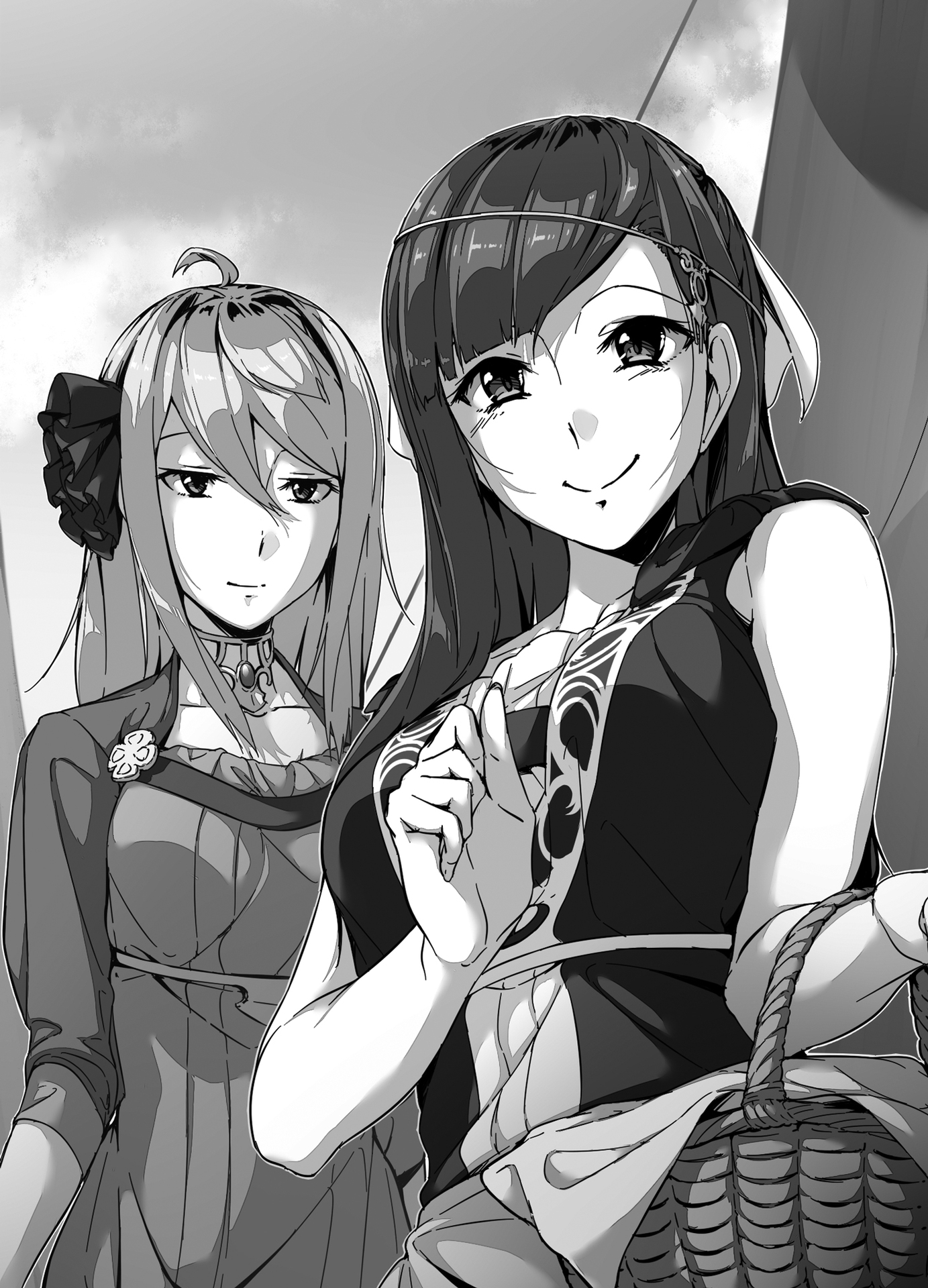
“Oh, not at all,” Regis replied.
Jestina was a servant sent by the Ministry of Ceremonies who had recently started aiding Regis with his daily routine. Why the Ministry of Ceremonies had found this necessary, he wasn’t entirely sure. Perhaps they wanted to strengthen their ties with Altina, or maybe they had some other intention entirely. Either way, Jestina came on the recommendation of the minister of ceremonies himself, Marquis Bergerac—or rather, on the recommendation of his grandson, Third Prince Bastian.
Fanrine had been wary when Jestina first arrived, but she had relaxed considerably over the course of the expedition thus far. Regis similarly took no issue with the development—Jestina spoke fluent Belgarian, had a courteous demeanor, and boasted incredible housework skills—but the simple fact she was an older woman meant he found her somewhat hard to deal with.
“What are you doing all the way out here, Fanrine?” Regis asked.
“I baked some sweets and thought the fine men here might want a taste,” Fanrine replied with a giggle as she held out the basket hanging from her arm. A white cloth covering the top was pulled back enough to reveal the cookies stored inside. Sweets were completely unsuited for the battlefield, but they looked and smelled absolutely delicious. It was quite impressive that she had managed to make them with the impromptu stoves set up at camp.
“Those look amazing...” Regis breathed. “Oh, but...” He could already imagine one of the more serious staff officers finding out and then yelling something like, “Did you come here for a picnic, Tactician?!”
Fanrine slumped her shoulders, evidently crestfallen. “Have I done something I shouldn’t have?” she asked.
“Ah. No, not exactly. But there is a proper time and place...”
“My apologies,” Jestina interjected, lowering her head. “It is because I insisted.”
“You did...?” Regis asked.
“I have heard that sugar helps immensely when thinking over difficult matters.”
“Ah, that’s a good point. Maybe you can get the head chef to give them out?”
“Great idea!” Fanrine exclaimed, clapping her hands together. “These cookies do need some tea, after all.”
“Aha...”
It seemed that Fanrine’s leisurely lifestyle had seeped into her character, making her somewhat more laid-back than one would expect.
Altina is always drinking tea as well, so maybe this is just normal behavior for high-class women.
“Why not come with us, Regis?”
“I’ve just come out of a long discussion, so I think I’ll return to my tent. I’ve got some matters to attend to.”
Jestina leaned closer to the tactician, bringing her lips to his ear. “Miss Fanrine worked very hard to make them...” she whispered. Those words alone were enough to make Regis’s heart ache; he knew now that he could not leave empty-handed.
“I-If you’re, er... If you’re busy, I wouldn’t want to take up your time...” Fanrine said apologetically. “Oh, but are you not going to have lunch?”
Regis hadn’t intended to, but from what he could see, Fanrine had prepared some lunch as well. I might as well eat now, otherwise my next meal might not be until tomorrow.
“Right... I guess I’ll have something then,” Regis conceded. “I am in a bit of a hurry though; I need to get quite a few things in order before this afternoon.”
“Is something happening then?” Jestina asked.
Regis nodded. “You should start packing as well. Load the carriages if you can.”
Fanrine tilted her head. “Is the camp moving?”
“That depends...”
The trio made their way to the head chef and asked that he take the sweets. After “tasting” quite a few—supposedly to ensure they weren’t poisoned—he decided they were just right to serve with tea and accepted them.
With that done, Fanrine and Jestina accompanied Regis to his tent—that is, assuming it could even be called a tent. It consisted only of a few pillars with sheets stretched between them as makeshift walls, and there was no ceiling to speak of. When Regis brushed aside the cloth serving as the entrance, however, he noticed there was a servant girl inside. Long brown hair hung down over her glasses, and freckles peppered her cheeks.
“Erk...” she groaned.
Regis cocked his head. “Do you need something? Er... Ms. Franka, was it?”
For a brief moment, Jestina shot the servant girl a hard glance.
Fanrine placed a hand on her hip. “You there!” she called, her voice firm. “I don’t care if you’re Regis’s personal maid or whatnot—do not enter your master’s room without permission!”
“I-I’m sorry...” the servant girl replied in a feeble whisper, deeply bowing her head. Jestina moved next to her and apologized as well.
“My apologies... This all happened because I told her to change Sir Aurick’s sheets.”
“I’m not sure how you handled things at the last place you worked, but startling a master in his room is disgraceful behavior for a maid. Please take care next time,” Fanrine chided. As expected of a noblewoman, her words really packed a punch.
Regis scratched his head. This was his first time living with servants, so he couldn’t help but wonder whether this was how things were supposed to be.
“Yes, well...there’s always next time,” he said.