Chapter 02: The Bullet That Changed the World
CHAPTER 02
THE BULLET THAT CHANGED THE WORLD
1
The winds of war may have been blowing across Tokyo Area, but the weather determinedly refused to play the part. It was gloriously sunny, and Rentaro was constantly surrounded by the symphony of late-summer insects as he walked on.
After seeing Enju off to class and informing Magata High School that he wouldn’t be in today, he wiped the sweat off his brow and immediately took the bus to Magata University Hospital. The receptionist waved him through, and in another moment, he was headed toward Sumire’s laboratory, going down a stairway so steep that it seemed to descend into an abyss. There was one issue he wanted to get straight with himself before he sat down with Litvintsev.
“Doctor, are you—?”
Before he could finish, there was a bang and Rentaro noticed something whizzing through the air toward him.
“Aghh…?!”
He promptly blocked his face. Then he felt something light and fluffy cover his head. He slowly opened his eyes and removed the aluminum casing and shredded paper that had been launched, crumpling it up. In the midst of this, the university’s living ghost story had appeared in front of him, wearing Groucho glasses and a conical party hat. Just like that, she tossed the cracker she’d deployed at Rentaro’s face into the garbage.
“Congratulations, Satomi!”
She pulled a string to her side, opening up a large ball strapped to the ceiling. From it unfurled a banner that read RENTARO SATOMI: CONDOLENCES FOR GETTING DUMPED BY KISARA.
Rentaro could feel himself getting dizzy.
“…Doctor, come on. You weren’t waiting to ambush me just so you could do this, were you?”
“‘Do unto others what annoys them the most.’ The Muroto family motto.”
The woman in the lab coat removed the glasses, the grin behind the fake mustache now glaringly obvious.
“Why did your parents marry each other, Doctor?”
“A mystery that time may never unravel, my friend. Now, then—” Sumire sat down on a chair, about to die of sheer joy. “You got dumped?”
“I didn’t get dumped, Doctor.”
“Well, give me some details, then. I only got the CliffsNotes version over the phone. Don’t be so afraid to ask for help, man. Dr. Muroto, love adviser, at your service!”
She winked, gave the peace sign, and stuck out her tongue. It didn’t exactly befit her age. Rentaro was struck dumb.
“You’ve got enough love experience to advise people, Doctor?”
“Nooooo! The only loves I’ve had in life were all cold and rotting by the time they got carted in here. Even the one man I did love wound up dead at the end of it. So, corpses, mostly. Basically, if they’re breathing, they can go screw themselves, as far as I’m concerned.”
“Does that count for me, too?”
“Uh, yeah? Did you think I had a thing going for you, you piece of garbage? Pfft!”
“Whoa! Don’t spit on me, man!”
Something about the way Sumire used the word dumped made him grit his teeth. Maybe it was because he couldn’t deny it out of hand. From an impartial perspective, it might look that way.
“…What’s the point in asking you for advice, anyway?” Rentaro asked, his heart still reeling.
Sumire shrugged. “Well, is there anything I can help you with?”
“…”
Rentaro brooded to himself as he sat on a stool, staring at the floor. Could he really be honest with Sumire? He ran a finger along his lips. The chill it evoked helped him recall past events with more clarity.
Stopping the Black Swan Project helped mend their frayed relationship beyond all expectation…and it led Rentaro to take just one step forward to close the distance. But what happened next went completely beyond his expectations: Kisara turned completely ashen, started to shake, and, hugging her own body, pushed Rentaro away and ran off.
He thought it was some error on his part at first, but looking back through his memories, that really didn’t seem to be the case. No matter how much he dwelled on it, though, he couldn’t figure it out. Even now, he had no idea why she acted like that. She dodged the question whenever he tried to ask her, leaving his heart feeling like it was hanging in midair.
“I don’t think this is just a matter of a woman’s whimsy or anything,” Sumire said, eyes now serious as she propped her elbow on the table.
“…You aren’t gonna pick on me? Like, ‘You went too fast and started rubbing her assets,’ or anything?”
“Well, if that’s what you want, then sure. But that’s just gonna depress you even more, wouldn’t it? I like to strike a balance, you know? Don’t leave ’em dead, but don’t let ’em live. It wouldn’t be any fun unless you roused yourself back into shape and went at her again, after all.”
She phrased it jokingly, but Rentaro’s heart still found itself lightened. He could feel a thin strand of sympathy between the words. He thanked her internally.
“I think,” he said, “Kisara feels kind of guilty at the idea that she can find happiness in her life.”
“Why?” Sumire grudgingly asked, almost rising off her chair. “Just chill out. You know full well that Kisara got her groove back because she’s using her desire to avenge her parents as an emotional support. It’s been a long time, but I had a chance to look at her medical records back during my practicing days. It was stuff like her insulin dosages, the interviews they conducted when she underwent counseling after her parents were killed, that kind of thing. One thing I remember seeing in there is that she said whenever she feels happiness, it triggers feelings for her dead parents. Apparently she had visions of them every now and then. They’d be standing there like ghosts, and they’d admonish her for leaving them behind. They begged her for revenge.”
“No way…”
It was like the ghostly king from Hamlet. But unlike that apparition, Rentaro could hardly believe that Kisara’s parents, Osamu and Yomiko, would choose those words for their daughter.
“Anyway, I checked it again a while later, and all that material had been struck from her records. The doctor wrote at the end of it that she had gotten over her depression and was ready to tackle life on her own. It was a little too neat and pretty for my tastes. You saw how she got revenge against someone just a bit ago, right? It wouldn’t be weird at all if she’s letting those visions bother her again.”
“…”
Even if it were true, that explanation would never please Rentaro’s heart. He scratched his head to calm down.
“Are you sure you should be giving other people’s medical information to me, Doctor?”
Sumire shrugged. “Don’t go asking a no-good doctor like me for morals, please.”
“Guess I owe you one.”
“Oh, no need to repay the favor. If I started expecting you to repay them at this point, I’d have to get reincarnated before you finally made up the difference. Still, though…” Sumire paused to stretch herself out, arms wide. “We’ve got two Areas ready to declare war on each other, and here you are worrying your little head about love, huh? Are your danger sensors screwed up or something?”
“And what do you think about a war, Doctor?”
“I think it’s a total waste of time. What’s the point of killing one another? We’re all gonna die anyway.” She gave a defiant grin. “None of us can escape it. Sooner or later, it dawns on us all that there’s no point trying to resist death.”
“You’re the same as always, huh?”
Sumire raised her arms up dramatically. “I am simply here to offer praise unto death. Death, you see, is death. People like you, trying to find some deeper emotion or meaning to it—that’s what I don’t understand.”
“There’s something about this situation I wanted to ask you about, Doctor. Two labs in Russia and Japan were attacked. Someone broke into them and stole two items: Solomon’s Ring and the Scorpion’s Neck.”
Sumire’s eyes twinkled. “Go on.”
He did, telling her everything the Seitenshi said yesterday, having received permission from her to ask Sumire for advice.
“Hmm…Solomon’s Ring, huh? Pretty fancy name for a dumb little translation device.”
Sumire stared blankly into space.
“‘Wise King Solomon talked about animals and birds, reptiles and fish.’ The First Book of Kings from the Old Testament. I think the story about putting on Solomon’s Ring to understand animals came from a mistranslation in another edition or something.”
“Do you know anything about it?”
“No,” she said, her face troubled. “I focused my studies on mechanized soldiers that could fend off Gastrea. I never looked at ways we could tame them or anything. It’s a pretty novel approach, I think, but judging by how incomplete it is, I’m guessing they probably hit a wall somewhere.”
“If you combine that with Scorpion’s vocal cords, though, I think you might be able to give orders to Libra, at least. We can’t just ignore those things.”
“A fair enough thing to keep in mind, true. I’m afraid there’s not much help I can give when it comes to Russian translation devices. But if this stare down between Tokyo and Sendai keeps going, I have a pretty good hunch how it’ll turn out.”
“Full-on war, right?”
“No, even worse,” Sumire barked, like a teacher admonishing a wayward student. “I’m talking worldwide nuclear warfare. World War III.”
Rentaro stared at Sumire, forgetting to breathe for a moment. “Wh-whoa, Doctor,” he managed to spit out. “Haven’t you been watching the news?” He smiled, trying to classify Sumire’s response as a joke. But there was no humor in her stone-cold face.
“Reality, Satomi, is a nightmare that always unfolds one step ahead of where you expect it to. Turn on the TV.”
He grabbed the remote thrown at him, pointed it at the musty old television in one corner, and turned it on. It just barely sputtered into action, the image slowly coming into focus.
It showed a number of ships pushing their way through the waves—cruisers, destroyers, supply boats, all accompanying a much larger battleship piercing its way through the wind. A nuclear carrier, it looked like. No Area in Japan as of 2031 had one in its possession—they simply cost too much to build and maintain. He assumed this was some drama at first, but a familiar news network logo in the corner convinced him otherwise.
The text below told the story. US ACTIVATES NAVAL FLEET: ACCUSES TOKYO AREA OF VIOLATING BIO-WEAPON TREATY. And before Rentaro could recover, the screen switched again, this time showing another fleet—this one apparently from Russia.
“This is the latest footage of the American and Russian fleets as they make their way toward Tokyo Area waters,” a harried-looking commentator said as the studio cameras focused on him. He looked at his wits’ end, and that was the final confirmation Rentaro needed. This was no large-scale practical joke after all.
“What the hell?” he said, turning around. “‘Bio-weapon treaty’…?”
He found Sumire glumly staring at the screen. “Things took a turn for the worse while you were on your way here. That’s an international biological weapons treaty they’re talking about. That’s what they’re probably interpreting the Inheritance of the Seven Stars to be, since it supposedly controls Stage Fives and stuff. The US claims we’re violating that treaty. They’re demanding inspections in all Areas, including the palace in Tokyo Area. I’m sure we’ll refuse, but…”
“Why’re foreign nations getting involved? It’s just between the two Areas.”
Sumire gave Rentaro a commiserative look. “On the surface, it’s because Tokyo Area asked its allies for help. Russia, the UK, France—they’ve got priority Varanium-supply relationships with those countries. Why do they ask for help? Because Sendai’s asked for help from its own allies in the US, Australia, and China, of course. The real reason for this, though, is a little different.”
“What do you mean?”
“Any type of natural resource dug up from the ground is inevitably distributed across planet Earth in an uneven fashion. Africa’s got gold and diamonds; the Middle East has oil; that sort of thing. And in the case of Varanium, the top nation just happens to be Japan. Tokyo Area alone produces thirty-one percent of the world’s Varanium supply. Sendai Area has sixteen percent. If Sendai fell apart and Tokyo managed to expand its territory—and, with that, their mining rights—that’s almost half the Varanium in the world, right in their hands. And it’s the same deal vice versa. If Sendai decides to open fire on Tokyo before Libra releases its viral sacs—let me remind you, an exhausted Tokyo after fending off both Scorpion and Aldebaran—then bam, they’ve got an oligopoly on forty-seven percent of the world supply. And do you know what that would mean?”
“No…?” Rentaro replied, voice clearly nervous.
“We all need Varanium to survive. It’s used to build our Monoliths, not to mention our weapons and ammo. If a single nation controlled half the world’s supply, it could basically name its price for the stuff.”
Rentaro made a startled gasp.
“They see what’s going on with the other nations, too. For example, let’s say that Tokyo Area had to rely on imports for one hundred percent of its food. If the other Areas decided to ban exports to Tokyo, we’d pretty much have to be their lapdogs. Even if they set the prices sky-high, we’d still have to buy it, right? So depending on how this little skirmish between two Far East city-states works out, one of us might wind up controlling the very fates of the rest of the world. That’s something other nations would like to avoid at all costs. It sounds like the US and Russia have their fingers on the nuclear buttons right now, but the fact that grown-ups like that are getting involved with this playground squabble has everything to do with Tokyo’s untapped resources. It’s a curse, in a way.”
“But isn’t there a noninterference treaty between the Areas or anything?”
“Not really. The five Areas of Japan are treated as independent nations, after all.”
Rentaro quickly searched his head for something to counter with. It was proving to be a struggle.
“Well… Well, so won’t the UN do anything? That’s their job, isn’t it, to step in between conflicts like this?”
Sumire shrugged, like she’d known this was coming. “The UN’s been pretty much dysfunctional ever since the Gastrea came along. And even if they weren’t, what could they do? It’s not like they could stop the Cold War from happening. That’s what the twentieth century should’ve taught us all—once things get too big, it’s beyond anyone’s ability to stop it.”
The TV now showed a set of pundits, each wailing in their own creative way about Japan’s current uncertain future.
“Satomi,” Sumire said, voice more gentle now, “you’ve probably read about World War I in your history book, haven’t you? Do you know why that war happened in the first place?”
Rentaro shook his head, lost.
“On June 28, 1914, a young Serbian man involved in a clandestine terror organization just happened to come across a car carrying an Austrian archduke that had taken a wrong turn in Sarajevo. He took the chance to shoot the guy down, and the fallout made the already-unsteady relationships between the European nations, Turkey, and Russia even worse. That led to World War I, and well over ten million people died because of it. And look at the Battle of Lexington. That was fought outside of Boston on April 19, 1775. The US colonies didn’t have the nerve to stage a full revolution against Britain yet, and when the American commander saw British troops advancing, he was within seconds of giving the retreat order. But then someone or other fired a shot, and all hell broke loose. The proverbial shot heard ’round the world—nobody knows who shot it, but there you go. The bullet from the Serbian, the bullet in Lexington—both of those trigger pulls changed the world.”
“…What are you getting at?”
“I’m saying, once things go all the way to the very edge, all it takes is a single bullet to start a war. And once it starts, it won’t stop until an astonishing number of people are dead. Right now, Tokyo Area and Sendai Area are both fanning the flames—closing their embassies and their airports. If that’s not playing it on the brink, I don’t know what is. All it’d take is one more bullet. It’s a lot more serious than you could ever imagine.”
Sumire placed both elbows on the desk and put her chin on her crossed arms.
“Satomi, you need to start negotiating with Andrei Litvintsev as soon as possible. You’re the only one left with any control over this. Don’t let anyone fire another bullet that changes the world.”
Then she grinned, as if recalling a joke.
“The fate of the world might be resting on your shoulders right now.”
2
During the Gastrea War ten years ago, when Tokyo put up the final temporary Monolith and shut the Gastrea out of the city for good, the people’s hearts were filled not with relief from returning to safety but with a mix of boundless despondency and a sneaking suspicion that it wasn’t really over.
When Prime Minister Zama, head of state at the time, announced on TV, radio, and the Internet that the war was over, most people greeted the news with warm tears, even if they didn’t know where their reaction was coming from. The tears symbolized sadness for the people who were killed, chagrin at losing the war, and a deep melancholy, a self-reckoning over what they had just done with their lives.
Soon after, the last prime minister to rule over a united Japan lost his standing in the political world when, fearing for a Japan whose population was ten percent of what it was before, he placed intense pressure on the medical world to institute a blanket ban on abortion. This ban ultimately led to an explosive growth of what would later become known as the Cursed Children. The lack of access to birth control also led to an increase in unwanted children, causing a rash of abandonment and abuse—and indirectly leading to the urban legend that illegitimate children were more likely to be Cursed.
Zama, ironically enough, met his demise in 2029 on the way to the hospital after one of the Cursed Children his policies allowed to be born snapped his neck in two. His rule was followed by the first Seitenshi, who worked to merge the city of Tokyo with the scattered prefectures that surrounded it to create the forty-three districts of Tokyo Area.
After the end of the war, the Area was faced with a mountain of tasks—repairing broken infrastructure, solving the Area’s endemic power shortages, procuring a reliable food supply, and securing more territory for the large population crammed into this relatively small space. That led to the construction of the so-called Mega-Float, an artificial island off Tokyo Bay.
Construction on the bay had been frequent and vigorous before, but after the war, the shore was so densely packed that the buildings were eating into the bay itself, literally changing the map.
And now Rentaro stood in front of one.
The heavy shadow of a bird crossed the ground. Rentaro looked up, exposing his face to the torturous sun. He raised a hand to his forehead as the cries of some distant shorebird hit his eardrums. Probably a flock of seagulls, he figured, lazily working their way along the seaside. They were called umineko in Japanese, literally sea cat, because of their distinctive cry—a cry that Rentaro always thought sounded more like an infant than anything.
Seagulls, he didn’t mind so much. Especially compared to the herring gulls that shared this shore with them. They were stupid birds. Stealing chicks from other nests, ripping them apart and feeding them to their own, or sometimes taking them for their own babies and raising them instead. Ugh.
Rentaro would’ve wanted to continue exploring the natural knowledge he had encased in his brain for a while longer, but he stopped himself and eyed the ominous-looking entrance before him. This was part of the rush of sloppily built construction the Area saw after the war; despite being less than a decade old, the white outer walls already sported cracks and falling plaster. There was a rustic feel to it, like an old seaside sanatorium, coupled with an inscrutable sense of pure evil.
This was Tokyo Area’s District 32 Offshore Criminal Detention Center.
Among the chaos people had to endure in the postwar years was a short but intense period of hyperinflation, with a box of cornflakes almost reaching 100,000 yen for a time. But that was a common occurrence in history—things like 1,000-yen and 10,000-yen bills were just pieces of paper, after all; they only held value because of the good name and trust people held in the Japanese government. The Gastrea War cost these bills their liquidity, and once the Tokyo Stock Exchange shut down, people’s trust in their currency went right with it.
In the ensuing months, it wasn’t unusual to see entrepreneurs with money to burn a few days ago suddenly being forced to poke around garbage cans for food. There was, naturally, an accompanying increase in crime.
Most cases involved people with no other choice but to break the law—but there were light and dark sides to every person. People who lost their sense of guilt after committing one crime and getting away with it; people whose crimes escalated thanks to the adrenaline thrill they got… This offshore prison was built for people like that, people who took a step over that most final of lines.
Looking back the way he’d come, Rentaro eyed the impossibly long wharf. The only thing visible on it was a solitary gate and guard booth. Despite being considered part of the Outer Districts, this bayside locale was free of rubble; it had been fully revitalized, in fact, the crescent-shaped bay around it now a beachfront park. It was an urban oasis of sorts, lined with lovers walking shoulder to shoulder, mothers pushing strollers, and activity centers for the elderly. Then there was this prison. It was cut off, separate.
Rentaro gave his name and civsec license to the man at the front desk. He looked rather surprised when Rentaro asked for an urgent meeting with Litvintsev. He left for a moment, then brought back an older guard who said, “Come with me.” Rentaro followed, hands balled into fists as he prepared to face this most final of confrontations.
“Ah, you civsecs come pretty young these days… You’re the guy who arrested Litvintsev?”
It wasn’t until they passed the second locked door that the guard leading him had finally opened his mouth.
“Well, by sheer coincidence…but yeah.”
“I dunno if you know, but you won’t find any normal prisoners in here. These are all people who were too much for our other facilities to handle.”
“Yeah, looks like it,” Rentaro said as he looked around. There wasn’t a single light on. It felt empty, with only the sounds of their footsteps filling the space. Small, barred windows dotted the walls at regular intervals, and light flowed diagonally down. It smelled like the sea, and the sound of seagulls in the air was incessant—and, once Rentaro looked hard enough, he spotted the lenses of surveillance cameras on all four corners of the ceiling. There were lines of holes in the floor, which he assumed contained metal bars that shot up in case something happened.
He was also surprised to find some girls among the security staff. One was seated on a chair, with one leg over the other, as she tapped her foot nervously. There was a spade symbol painted below her right eye, like she was part of some underground club scene; it was clear she was trying to project a bad-girl image.
“Wow, you’ve got Initiators on payroll here?”
“Transfers from the IISO, yes. Not sure we need them, though. It’s kind of going overboard with the security.”
Rentaro turned his head toward a particular bit of darkness that seemed to waver for just a moment. A pair of sharply lit eyes followed his movements silently from a darkened cell. He didn’t know what the guy was in for, nor did he care, but it was clear he was one of the prisoners. The way he remained perfectly silent only made it all the stranger.
“Over here, civsec.”
He could still feel the eyes stabbing into the back of his head as he approached a small guard post at the other end of the hallway. This marked the third gate he had gone through; presumably every gate opened the way to inmates who had committed more and more serious crimes. Once he passed, he noticed that the guard accompanying him was gone. Turning around, he found him standing at the entrance.
“This is as far as I go. Be careful, civsec. That guy used his handcuffs to put me in a chokehold the first day he was here. If help came any later than it did, I would’ve been strangled.”
“…All right. Thanks.”
The guard bowed down to him, as if shrinking back in fear. Rentaro turned around, crossed the large C BLOCK stencil painted on the floor, and stepped into the darkness. He didn’t exactly want to go it alone, but there was no way he could make the guard join him now. He wiped his sweaty palms on his pants.
This block was generally built like all the others, but the eyes upon him seemed to stick more closely to him than before, infused with a vague yet clearly murderous animosity.
Suddenly, there was a jangling sound from somewhere, like someone rolled a jingle bell along the floor. He followed the sound, which came from the far end of the corridor.
When he approached it, the first thing that struck him was the brightness. It was a single cell, a bit larger than the rest, and it had a window much larger than elsewhere, illuminating almost all of the cell’s bare mortar walls. They loomed over a plain pipe-frame bed and a simple shelf lined with books, their titles written in Cyrillic. His attention then turned to the wind chime tied to one of the bars. The wind blew at it now and again, sending a bell jangling along inside its glass compartment every time it did. That must have been it.
And there, sitting in a folding chair and reading a book, was—
Rentaro made a pair of tight fists as he felt his blood vessels constrict.
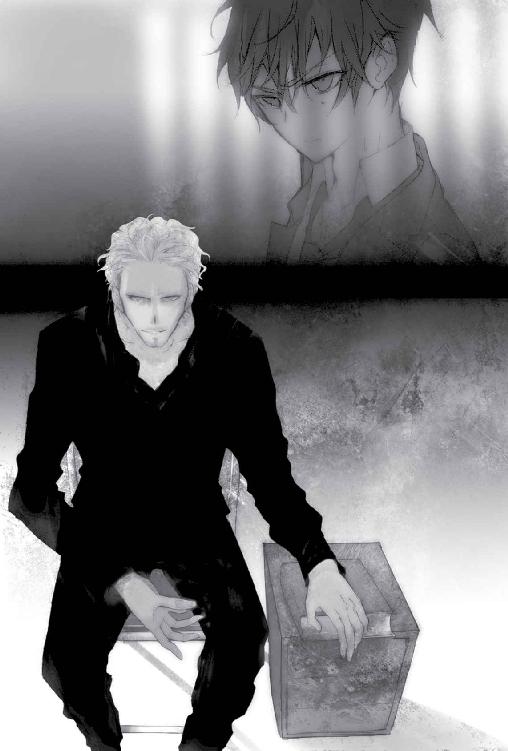
“It’s been a while, Andrei Litvintsev.”
The man wedged a bookmark in his book, put it on the shelf next to him, and looked up.
“It sure has, Rentaro Satomi.”
The tenor of his voice evoked unpleasant memories in Rentaro’s mind.
He had a cleft chin and a well-chiseled face, one that didn’t go too well with his black prison uniform. His blond hair shone in the sunlight. The tracking anklet on his right foot personified the sense of terror he projected, the same one the guard spoke of.
“Why did you ask for me?” Rentaro asked.
“I’ve been looking into you since my arrest.”
Litvintsev tilted his head, inviting Rentaro to have a seat. Rentaro picked up a folding chair propped against the corridor wall and set it up for himself, never taking his eyes off his adversary. He made sure to leave three paces’ worth of space between himself and the iron-bar door that separated them, just in case.
The chime jingled sweetly in the air, a sound heavily out of place in the oppressive atmosphere.
“First Scorpion, then Aldebaran… You’ve been busy since you caught me, haven’t you?”
“You didn’t bring me here just to crack jokes at me, I imagine. You sure got it good here, huh? Three hots and a cot, and all that.”
“Wanna trade places?”
“Hey, I’m just saying, be glad you didn’t get the death penalty.”
Litvintsev’s lips curled into a smile. “You don’t have to be so nervous. I’m not gonna kill you or anything.”
“I’m sorry, has your time in jail hurt your eyesight or something?”
The prisoner sneered a jeer of supreme confidence. “Fear has a certain scent to it. You’re masking that fear with your anger right now.”
“…”
Rentaro glared back, fists on his legs, as he kept himself from trembling. As much as he hated to admit it, he was never any good at playing mind games with people.
This was Andrei Litvintsev. A spy who gave bribes to several Tokyo Area politicians and tried convincing them to switch over to warmongering extremist groups. He was accused of building connections to the Area’s heavy industrial, economic, and political powers, then reporting his findings back to Russia. He even built an operational office inside Tokyo Area for his activities.
The authorities finally caught up with him, but when they did, they were only able to arrest five other people connected to him. All exercised their right to remain silent, so the courts weren’t able to pin anything on him apart from the meandering offense of “disturbing the peace in Tokyo Area and collusion with other nations.”
It was sheer coincidence that a master spy like this was arrested at all. He was installing a litany of bugging devices in the house of a politician that opposed his friends, and the noise from the construction work annoyed one of the neighbors. That neighbor employed a civsec in order to file a complaint, and soon his entire cover was blown.
Litvintsev was the darling of the news media for a while after his arrest as his other crimes came to light—but to the Tendo Civil Security Agency, which had the limelight taken from them by the district attorney and was only involved in the first place because they were handling a dinky little noise-complaint job, it was a little embarrassing, if anything.
“The only reason you managed to catch me was because I didn’t have an Initiator by my side. I don’t want you to forget that.”
“Heh. Pretty lame excuse. That’s the kind of explanation an elite-level agent like you’s turning to? Almost makes me wanna cry. Or should I say ex–elite agent?”
“Is that princess of yours doing well?”
“Lady Seitenshi, you mean? Was she in here?”
“Just for a little bit. Looked like a pretty delicate woman.”
“Well, don’t pick on her too much. She’s a really devout woman.”
“Devout?” Litvintsev asked, lowering his voice an octave or two. “She’s turning to religion in times like these?”
“Are they all atheists over in Belarus?”
“Sorry. I stopped practicing once the Greater Minsk Area got thrown into the deepest pit of hell.”
“…Look, Litvintsev, you know what’s going on in Tokyo Area right now. The Area’s been falsely accused of making Libra do its bidding. We’re half a second away from war with Sendai. They’re looking for a fight, in fact, and unless something happens soon, they’re gonna get it—and once that happens, it might wind up being a world war. Now, there’s a chance the things your people stole—Solomon’s Ring and Scorpion’s Neck—are involved with this. You were up to your neck in that, too, weren’t you?”
“Why do you think that?”
“You’re paying off the staff here so you can contact the outside world. That’d be easy for you, wouldn’t it?”
Litvintsev chuckled as he shook his head.
“If you tell me where those people are now, I can negotiate to have your sentence reduced. And just so we’re clear—if you don’t give me some intel soon, don’t be surprised if it’s worthless for you later. I’m not as patient as you are.”
Rentaro paused, gauging the response from the other man. Negotiations like these were largely unexplored terrain for him, but still he thought he did at least a tolerable job sounding caustic enough.
The Seitenshi had given him advance permission to promise Litvintsev a release if the need arose, on the condition that he’d be deported to Russia and forbidden from entering the five Areas of Japan again, but it’d be foolish in man-to-man negotiations like these to show your cards right at the outset. He was a dropout, yes, but Rentaro was once a military cadet during his years with the Tendo family, and he had a grip of the fundamental rules here, at least.
The regulations around this prison were strict to the point of paranoia. Only one visitation was allowed per month—even then limited only to family—and visitors were heavily restricted in what items they could bring into cells. Inmates weren’t allowed to speak in the cafeteria, a place that served as the main social outpost for most other prisons. The ceiling was lined with tear-gas sprays set to deploy whenever any disturbance took place. Roll call took place twelve times per day; if you failed to respond, you were treated as an escapee and thrown into solitary. Even the twice-a-week outdoor recreation period, the lone chance inmates had to breathe fresh air, took place in an area surrounded by high concrete walls, patrolled by guards with live-ammunition rifles who circled above the prisoners like buzzards.
There was, in other words, no chance to relax for a single moment. It sickened most inmates. Many tried to escape, but there was no report of any successful attempts.
The strong defenses that lurked under the battered-looking exterior were symbolized by the extreme security measures taken in all areas. It was said that even the most hardened of thieves, killers, and arsonists broke down and cried like babies when told they were coming here.
Litvintsev may be acting tranquil, but half a year in this facility must be taking its toll. That was the conclusion Rentaro had made when he profiled Litvintsev beforehand. It meant Rentaro was the one dangling the fishing pole in front of him; there was no need for easy compromises. He just had to put the carrot in his face, then keep reeling it away.
The logical part of his mind knew that anyway, but on another dimension, his temples were throbbing with a sense of abject dread. There was no sense that the man in front of him could be driven by quick impulses. Is that just an act? Or am I missing something fundamental, something decisive in my thoughts…?
Litvintsev let out a snicker that, after a few seconds, changed to a louder, more ridiculing laugh.
“What’s so funny?” Rentaro demanded. The prisoner glared back.
“I think you’re misunderstanding something. I have no intention of negotiating with you.”
“Wha…?!”
Rentaro couldn’t believe his ears. What did he just say…?
He found himself lost for words as Litvintsev continued, “Now yes, I know I told that government official that I wanted to see you. That wasn’t a lie, either. But I didn’t call you here because I wanted to negotiate.”
“So, what, then…?” Rentaro muttered in a raspy voice.
Litvintsev stood up and walked toward him. Rentaro knew the iron bars were there, but he still instinctively tilted his head back, steeling himself.
“Listen,” Litvintsev said sternly, face against the bars. “Starting now, I am going to destroy both Tokyo and Sendai Areas. The people you love in your life are going to kill one another. They’ll be blown to pieces. They’ll have their guts splattered all over the pavement like a bug on the sole of your shoe. And you can’t do anything except grit your teeth and watch, cursing yourself for being so powerless.”
For a moment, Rentaro felt like he and Litvintsev had switched sides around the bars. The light from the window illuminated the prisoner’s body only from the neck down; his head was completely dark, but his staring eyes shone brightly from within. They overpowered Rentaro, immobilizing him. But even in his paralyzed mind, one corner of his thoughts could understand the truth. His expectations had been completely overturned.
This wasn’t a negotiation. It was a declaration of war.
“You better take your family and get out of this Area as soon as you can. I’m telling you this out of respect. You caught me once, so I owe you that much. But if you ignore this warning, you’ll have to face a hell that’s even worse than death.”
“Don’t give me that shit!”
Upon realizing that he could still move his arms, Rentaro immediately unholstered his handgun and pointed it between Litvintsev’s eyes. The sight of the muzzle right in front of him put the prisoner into an eerie silence, his eyes stabbing at Rentaro.
“Why? Why would you do something like that?! Are you controlling Libra because you want Tokyo Area to taste what happened to your homeland? Why?!”
“You caught me once. But I’m not going to lose to you again.”
A harried voice shouted out. Before Rentaro could comprehend it, someone rammed into his side, clouding his vision. By the time he realized it was a guard forcing his way between them, another had stripped the gun away and put him in a full nelson. He tried to resist the guards but stopped after they twisted his neck, incapacitating him in dull pain.
Litvintsev simply looked on, eyes frozen.
Damn it. Rentaro groaned as he was dragged away. He had me in the palm of his hand. Here I am, thinking I’m reigning supreme, taking the leadership role in this chat—how could I be so stupid? That vague gut feeling he’d had about the guy before he had met him—that had been correct the whole time. He was like a natural enemy—someone he should’ve killed the moment their eyes met.
After being chewed out by the guards and kicked out of the prison, Rentaro found himself awash in waves of inferiority. He dragged his body up, braving the intense fatigue as he traversed the wharf. Taking a look back, he glanced up at the bright sun, accompanied by the ever-chattering seagulls.
With a sigh, he began to wonder how Enju was doing in school.
3
The sound of Ms. Yagara’s voice as she took attendance seemed to drone on and on like a mantra. The wide-bodied teacher seemed fully defeated by the day’s humid weather.
“Hozui Watanabe… Um, right. Next, the girls. Enju Aihara… Er, Aihara?”
Momoka Hieda, alert upon hearing that name, stole a look three seats down. The seat was empty, her friend nowhere to be seen.
The sounds of the waves seemed to cleanse her head as she listened to the seagulls and closed her eyes, the light sound of water flowing nearly to the trunk of the knotted beech tree that her back leaned up against.
Swishing her legs to enjoy the feel of the grass against them, Enju Aihara took in the sight of the faraway buildings across Tokyo Bay.
The evaporating seawater made the offshore prison moored to the long wharf seem to shimmer in the air.
I wonder how Rentaro is doing with that prisoner. He happened to mention the location to her, so she decided to abandon school and head over to the nearby beach park.
Reaching into a bag, she took out a sandwich she had purchased at a convenience store along the way. Removing the plastic, she took a bite from one edge and swallowed. Now used to eating with her classmates, a solitary lunch seemed dull by comparison.
Just then, she turned her face up at the sound of a shrill voice. A family of three was enjoying a beach outing—at a time like this, no less. A mother and father were smiling awkwardly as a girl, their daughter presumably, pulled at their hands and shouted, “Come onnnn, let’s gooooo!” The parents may have wanted a relaxing trip to the park, but their child, too inured to social games and other, more exciting entertainment, must’ve found it incredibly boring.
It was a happy family scene, one that should’ve warmed anyone’s heart—but to Enju, it was discomforting. She was born as one of the Cursed Children, with no place in the world to call hers, and it was hard for her to look at a girl raised under the love of two parents and not take it personally. Normally she didn’t even think about it, but whenever she felt battered down like this, even a teeny little trigger could break the seal on all the painful memories in her mind.
The first thing that sprang to her ears was the sharp sound of someone striking her. It was just a memory replayed in her head, but it seemed so real that she physically tensed up. There they were, two figures grinning at her swollen cheeks. The unforgettable Aihara family, her mother and father.
They never liked talking to her much. They preferred to express themselves through physical abuse instead. They starved her, made her sleep in the kitchen—they didn’t want her; they wanted the stipend the government offered for adopting war orphans.
She recalled the way Sumire put it a while back: “When you start attaching a monetary value to good intentions, you absolutely can’t price it too high—or too low, either. For example, blood donation is so valuable precisely because it’s meant as a donation. If you price it too low, people would see it as beneath them and stay away, but if it’s too high, you’d start to see underground operations trying to profit off it. The late first Seitenshi is widely respected as a wise and able leader, but even she made at least one policy mistake. What was it? It was pricing the monthly benefit too high for taking in orphans.”
The Seitenshi must have gone into that with good intentions, but in the end it led to hyenas like the Aihara family appearing, licking their lips as they took in girls like Enju. Without love, of course no one could ever be a good parent. As long as Enju was breathing, they were satisfied. All other aspects of handling her eventually boiled down to either starving or punching her.
Of course, it didn’t last.
She recalled herself standing in the living room, panting for breath. The dirty tatami-mat floor had been thoroughly destroyed. Her father, dressed only in a pair of boxers, was unconscious on the floor, his cheekbone practically caved in. Her walruslike mother, punched in similar fashion, was furtively edging away from her.
Her eyes were glowing a sheer red, blood dripping from each solid fist. She was pretty sure she was crying at the time. She had spent the past year trying everything to make them love her, but all the wishing in the world didn’t get her that prize. Now, her relationship with her adoptive parents had finally crossed the line.
“It’s—it’s over for you!” her mother screeched at her as she bared her teeth, snapping Enju back to reality. “You’re gonna be branded as dangerous and they’ll get rid of you! I hope you’re happy now!”
Stricken by terror, Enju fled. She wound up in District 39, where she kept herself alive by performing almost any crime one could think of apart from murder. It put her in danger of being shot on more than one occasion.
The care facility Enju lived in before the Aiharas took her knew that she was Cursed. They had long ostracized her, hoping she’d get out of there as soon as possible. There was no way she’d be allowed back.
Along the way, her eyes had started to harden. Scared of the ill intentions of those around her, she began to live with her abilities unleashed at all times. She stopped believing in people.
Somewhere along the line, another one of the Cursed told her that if she became an Initiator, they’d give her medicine to control her corrosion rate and wouldn’t ever have to worry about where her next meal was coming from. She tried to volunteer, more testing it out than anything else—and while she could admit it now, there was something about the “Promoter” role, someone to guide and support her, that she was even looking forward to a little.
The sorrowful, hangdog-looking face on the Promoter that the IISO official linked her with, however, made her want to curse the heavens. And the face wasn’t the worst part. He acted like some street hoodlum, and he barely had two pennies to rub against each other. Between him and the agency president, who looked as if most of the nutrients in her body were being used to support her voluminous boobs, she swore she’d never get along with either of them.
Enju took a big bite out of the sandwich in her hand. Why did she have to remember something like that at this point? Probably because Rentaro mentioned the Aihara family for the first time in a while over dinner last night. It was a sad connection for her—they gave her nothing but her last name—and now here she was, running again. First from her adoptive parents, and now from her classmates.
“It’s so gross. Their eyes light up red, don’t they? Why can’t they just leave this school alone?”
“Why do they let ’em out of the ghetto at all?”
“They should stop pretending to be people. It makes me sick!”
All their words replayed in her mind, accompanied by their hateful expressions. She had eyelids that kept her from seeing the things she didn’t want to, in theory at least, but she had nothing to plug up her ears.
It was a sharp, inarticulate “Agh!” from nearby that lifted Enju from her pit of self-loathing. She craned her neck to find a girl, younger than she was, staring up at an adjacent beech tree and looking about ready to bawl. Following her eyes upward, Enju quickly found out why. A bright red balloon, its string no longer held by anyone, was caught on the tree’s branches, liable to break free and into the wide-open sky at any moment. The tree, at a good four meters or so, was too tall even for a grown-up to summit.
“Do you need that balloon?” Enju asked as she approached. The child looked timid at first but nodded after a moment.
Enju looked at her surroundings. For a single moment, nobody else was around—she could do it, but it’d have to be right now.
“Close your eyes for a minute.”
“Close my eyes? Why?”
The question mark was practically visible over her head, but she meekly followed Enju’s instructions.
“Keep them closed, okay?”
Enju closed her own eyes, focused on the center point of her body, and took a deep breath. With a single exhale, she unleashed her powers in one fell swoop. Her body grew lighter, as if gravity was starting to taper off, and her arms and legs felt longer as she enjoyed the feeling of omnipotence.
Crouching down to keep the girl from suspecting her, she leaped. Buoyed by the feeling of being pushed upward, she opened her eyes to find the red helium balloon right in front of her face.
Easily grabbing it, she went back down and patted the girl on the shoulder. She opened her eyes, a little reluctantly at first. There were many ways to describe how she reacted to the balloon provided to her—confusion, surprise, wonder, joy. Just watching her face vault between all the emotions filled Enju with happiness.
“Thank you, lady!”
Enju gave her a proud nod. “You’re right! I’m totally a proper lady!”
The girl smiled back, although she didn’t know what Enju meant. Her mother chose that moment to run up to them, bowing thankfully and chiding the girl for letting go of the balloon before taking her away.
The child waved at Enju several times as she walked off. Enju watched, reflecting on how doing a good deed for someone always made one feel great afterward.
“Are you one of the Cursed Children?”
The question made her spin a lightning-fast 180 degrees. There was another girl there, this one about the same age as Enju. Her silvery hair reflected the sunlight, and her black skirt and ruffled white blouse made her look stereotypically rich. Her unique ice-blue eyes gave her an intellectual air.
Enju froze, cold sweat running down. She saw me? An adult discovering her in her Cursed state would cause a huge uproar, a gaggle of onlookers, and God knew what after that.
“Wait just a second,” the girl said, her cold eyes keeping Enju from turning around and running off. She covered her eyes with her right hand, then drew it away. Her ice-blue eyes were now a shade of dark ruby, shining amid the daylight. Enju gasped.
“You too?”
The girl nodded, put her hand up again, and removed it. Her eyes were back to their original shade.
“I wasn’t expecting to see somebody like me here, so close to the Monoliths.” She was about to raise a hand to salute Enju but stopped. “What are you doing here, though?”
“What about you…?” Enju stammered. It wouldn’t do to reveal her current boycott of school. The girl looked down on the floor, her motives apparently just as difficult to discuss frankly.
Just as the conversation looked doomed to end, it was interrupted by a low, long rumble. The silver-haired girl grabbed her stomach, her cheeks blushing.
“That looks pretty good,” she said, her eyes on the half-eaten sandwich in Enju’s hand.
Ten minutes later, the girl and Enju were sitting on a shaded bench, the girl with a steaming fish-shaped taiyaki sweet cake in her hand. She gave the sweet a long hard look.
“The batter looks like it’s made out of wheat flour, but there isn’t really any fish inside, is there?”
“You’ve never had one before?”
The girl meekly shook her head.
“Well, it’s got anko inside. Sweet red bean paste. It’s good!”
“Oh,” the girl replied. Then her brows fell, as if she was regretful of something. “But what about the money…?”
“Ah, it’s my treat.”
The girl still looked fiendishly conflicted about the taiyaki. Her body was less dishonest, releasing a single drop of saliva from the corner of her lips. That was enough of a trigger. She turned to Enju and gave a deep bow.
“Thank you for this. You really didn’t need to feed me. This is my fault anyway. I didn’t bring any extra money for today’s activities.”
“Activities?”
The girl opened her mouth and took a big bite instead of answering.
“Oh,” Enju tried to warn, “it’ll be hot, so you should take it slow instead of…”
“—?!”
The subsequent reaction from the girl was nothing short of intense. She squirmed on the bench, both hands covering her mouth.
“Hey! Spit it out! C’mon!”
“Ih…ih’s nah haht ’t all…”
“No, but…”
“…Ih’s nah haht ’t all!” the girl practically shouted, as if trying to convince herself. Her teary eyes suggested otherwise. She rolled the bite of taiyaki around in her mouth for a bit but finally managed to get a couple of decent chews on it before swallowing.
“B-besides,” she added as she began to blow excessively on the rest of the treat, “I don’t want to waste this after you gave it to me and everything.”
Once bitten, twice shy, Enju thought as the girl timidly brought it back to her lips.
“Ah,” she said solemnly as she enjoyed another bite. “I see. This works nicely, doesn’t it? I burned the inside of my mouth too much to feel how it tastes, but…”
The sight made Enju laugh. She was about to call her by name until she remembered that she never asked it.
“My name’s Enju. Enju Aihara. What’s yours?”
The girl stopped just as she was about to take another extra-large bite, then thought for a moment before raising her eyebrows apologetically.
“I’m sorry, Enju. I’m afraid I can’t tell you right now. Or I guess I should say that I don’t want to, since if I told you, it might put you in trouble.”
Don’t want to…? It took a little while for Enju to understand what that meant.
“What does that…?”
The girl looked up at the clock mounted in the middle of the park. “Well, it’s just about time. This might be good, actually. Enju, would you mind if I took a little of your time?”
The light-red sun set the sea ablaze in color as it slowly tilted its way westward. It was already too dark to see below the water’s surface.
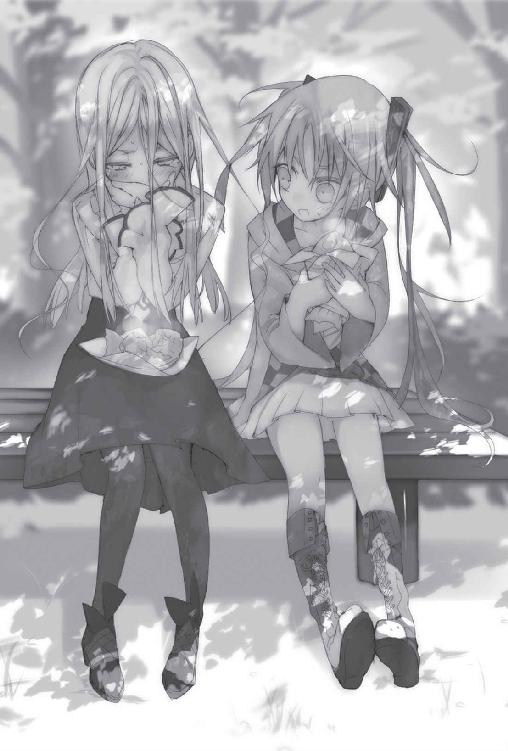
There was a sense of having no escape, coupled with a difficult-to-describe feeling of excitement. Enju reached out to the warm water’s surface and put a finger to her lips. The salt stimulated her tongue, burning her throat on the way down.
The ripples lapped up and down along the boat’s hull, making little splashing sounds as it bobbed the vessel this way and that. The distance from the boat to the shoreline was becoming unnerving to Enju.
“Are you sure we’re okay here by ourselves?”
“No problem at all.”
The silver-haired girl Enju was sharing the boat with gave her an assuaging smile as she kept pumping the oars. They were facing each other, and while the girl seemed to be looking right at Enju, her focus was actually on the area behind her back. Her eyes were red, her powers released; she must’ve been too afraid of someone at the beachfront park noticing them to keep them that way back there.
The two were out in Tokyo Bay, and Enju was starting to regret being so impulsive. She had been led to a dock where the girl had a boat hidden, and when she told her to hop on, Enju wound up doing so without really understanding what was going on. It was a tiny little thing, more suited for a tranquil pond than the wide-open sea—and they were alone on it, two children. If a fishing boat or cruise ship passed by, it might just land them in the news.
“Could you tell me why we’re all the way out here already, please?”
“Because I wanted to be with you, Enju,” the girl said with a half smile. Enju sat there, wondering what that meant. Even she could tell this wasn’t the truth. With a sigh, she turned her ears toward the waves. A steam whistle went off somewhere. She decided to change the subject as she noticed the setting sun.
“Listen… What do you think about Cursed Children going to school with normal people?”
“Why are you asking me that?”
It was hard for Enju to explain. She decided to give the whole story—her origins; the one time her secret was revealed at school; the way her memories were dragging her down at her current one; her self-hatred at being dishonest with her own school friends. As she did, she couldn’t help but wonder why she was revealing all this to a girl she had only met that day. If there was someone Cursed in her life she could open up to, it ought to have been Tina, not this girl.
The girl listened intently. When Enju was done, she closed her eyes, then opened them after a few moments.
“I’m sorry, Enju. I don’t think I can really give you an effective solution to your problems.”
Enju grinned and shook her head. “Ah, just listening to me… And not laughing at me, either. That’s all I needed. I’m glad I did it.”
“My homeland was already gone by the time I was born.”
This startled Enju. The girl stood up as she looked at her, turning to a flock of seagulls, her eyes focused off in the distance.
“I lost mine in the Gastrea War. I was actually born in a neighboring country, but that country was rife with famine and discrimination. It was hard to live in.”
A pause.
“The more you live in poverty, the more it makes you closer to an animal. You just eat, sleep, and produce offspring. Did you know, Enju? They did a study, and they found there’s more than a ten-point difference in IQ between people who grew up hand-to-mouth and those who didn’t. Supposedly your IQ goes back once things get better for you, but once you’re in poverty, it’s hard to gain the knowledge you need to claw your way out. That’s what makes it so pernicious. Myself, I was lucky. I got picked up by someone and I lived in a pretty upper-class housing situation, but escaping that yoke—the three core desires of any living thing—made me realize that thinking, and reasoning, really is the only thing separating us from other animals.”
She turned around, holding her hair down against the wind.
“I don’t know if that really compares to your problems, but whenever things get hard for you, I think you should remember that. How you aren’t the only one who has issues in their life.”
Is it really right, though, using that as a support—that there are people worse off than you? That’s simply looking down on them, isn’t it?
The girl, perhaps reading Enju’s mind based off her expression, gently shook her head.
“I mean, the connections we make with other people, Enju, no matter how annoying they can be sometimes, form the net that helps you break up and absorb the sad or difficult things that happen in your life. There’s nothing shameful about taking advantage of that when you need to.”
Enju felt that her closed heart had suddenly grown lighter, that the setting sun looked a notch brighter than before. She looked at her palms, balling them into fists and releasing them.
“It’s weird,” she said. “I don’t feel as gloomy.”
“It’s an honor to help you,” the girl said, narrowing her eyes with a smile.
“You’re a really nice girl,” Enju replied, giving her a smile of her own. “You should come to my place, so I can introduce my Promoter to you. We’re madly in love—he barely even lets me sleep at night, even!”
“Oh? I’m glad to hear you have a good Promoter, too.”
“Is yours nice?”
“Oh, very much so,” the girl said, beaming as if she was the one who had received the compliment. It made Enju wonder who this girl was all over again. Given her pale white skin and silver hair, she must have been a non-Japanese Initiator, at least. They came to Tokyo Area a lot, Enju had heard, whenever some issue related to Varanium rights popped up. She wouldn’t know, though. It wasn’t like Initiators always revealed their abilities freely to one another.
“Well,” Enju blithely noted, “I bet you’re a pretty good Initiator. Strong, too. Able to make the right decisions all the time.”
The girl scowled a bit at this appraisal. “Oh, not at all, no,” she said in a dejected tone before falling silent and pretending to focus on rowing the boat.
Enju brought her body up, worried she had touched upon something she shouldn’t have—then a pang of pain crossed her head. Looking around, she immediately saw why. There were two gigantic walls of jet-black Varanium in front of her, one on each side. She had taken care to scope out the beachfront first and stick to an area between the Monoliths where the Varanium force was at its weakest. This boat must have taken her to a point beyond what was safe for maintaining her equilibrium.
“Are you all right?” Enju asked.
“I think I am, yes. It’s hurting you at this distance? You must be pretty sensitive. Forgive me if I’m being rude, Enju, but what is your corrosion rate?”
“Around 25.4 percent, I think. You?”
“Fairly close to that, yes.” The girl looked at Enju, perplexed. “It’s strange, though. If our rates are nearly the same, we should be equally affected by the Varanium fields, too.”
“Oh, really?”
Come to think of it, Tina had about the same corrosion rate, too, and it was the same deal with her. Enju figured her body was just more sensitive to Varanium than the norm.
“Well,” the girl concluded, “maybe it’s related to your genetic makeup or something. Ah, we’ve arrived.”
Enju looked around. There was nothing near them they could have moored to.
“I needed to visit that building over there,” the girl said, pointing to the landing point as she pulled out a pair of binoculars. It was starting to grow dark, and even without the visual aid, Enju could see the offshore prison looming far larger than before.
“You’ve got something to do in this prison, too?”
The girl’s eyes opened up wide. “Well! That’s a surprise. I didn’t think you’d know that was a prison.” She looked at her watch, then threw herself down, lowering her center of gravity as she kept the binoculars in hand.
“They’ll be here in a second.”
As Enju puzzled over this, she spotted the presence of a boat advancing upon them from the side. She lowered her own head as well. It was about as large as a fishing vessel, and it passed them by without paying their boat any special attention. Once it passed, though, it made a wide turn and approached the prison from the rear, mooring at the Mega-Float’s small loading dock.
“There’s a network of naval mines around the area to keep prisoners from escaping, and the guards can set them off from land if they want to. The ship’s taking the longer route in order to avoid them. They must be shipping something over that’s too difficult to carry by land.”
The girl beckoned Enju to come next to her, then handed her the binoculars.
“Very tight security, indeed. Can you see, Enju? It looks like just another weather-beaten building, but it’s packed with all the latest technology—sensors, biometric authentication, you name it. The walls look like they’re falling apart, but I heard they’re reinforced with Varanium core material, so they can probably take a real beating.”
The girl was too focused on her excited commentary to notice the expression on her conversational partner.
“Um, so why are you scoping out a prison?”
The girl flashed a look of guilt before averting her eyes. “Oh, I’m just a fan of prisons like these…”
Enju shot a perplexed look at her suddenly taciturn partner. Presumably, the girl would have arrived here even if they hadn’t met—and yet, when she ran into Enju, the girl was dead set on her coming along. Maybe she was just being used to fill up the ranks, since two people on a little recreational boat ride would draw less attention than a solitary rower in the bay. Enju should’ve been angered by being used like this, but she couldn’t drum up the reaction.
To be honest, she was starting to like this mystery girl quite a bit. She recalled Rentaro telling her that if she found someone she wanted to be friends with her whole life, she needed to treat them well, no matter what.
“I guess there’s a reason why you can’t tell anyone else. I won’t pry, I promise.”
The girl furrowed her brows. “Thank you, Enju, but…we should probably head back. Sorry to ferry you all around the bay like this.”
The seagulls above them cried out into the evening as the dwindling sunlight colored the girl’s face red.
“Do you think we could meet again?”
“I think it’d be better for both of us,” replied the girl, “if we didn’t.” She gave an inscrutable smile. “My name is Yulia.”
“Huh?”
She ran a hand through the hair above her ears. “I said, my name is Yulia Kochenkova.”
4
“Yulia Kochenkova,” the Seitenshi said as she looked at the photograph that popped up. “Andrei Litvintsev’s Initiator; the strongest of the former Belarus region. She was once a member of Witch Squadron, a special-forces unit manned exclusively by Initiators. Her Gastrea factor is the cheetah.”
It was past seven in the evening at Rentaro Satomi’s darkened apartment. The crystal in the middle of it shone blue, just like it had the day before, as it projected a holographic window into space. Rentaro tapped the photo, expanding it out. The girl, in what looked like a hidden-camera photo, was turned toward the left, lips pulled tight in an off-putting expression.
“Cheetah…?”
“Yes. Oriented for speed. The same type of Initiator as Enju, in other words.”
Rentaro whistled in astonishment. The cheetah required no introduction. It was the fastest hunter in the animal kingdom, clocking speeds upward of 110 kilometers an hour. An Initiator’s strength in battle was far from wholly dependent on their animal-based Gastrea element. But, Rentaro thought, if it’s a cheetah we’re talking about, that’s practically a thoroughbred among Initiators.
“What’s her IP Rank?”
The Seitenshi paused for a moment before reluctantly blurting out the number. Rentaro reacted by rubbing his arms nervously, a chill coming over him. If that number was for real, this might turn out to be the toughest job assignment he’d ever taken.
“You haven’t run into her before, have you, Mr. Satomi?”
“If we had run into her half a year ago,” Rentaro said, embittered, “Enju and I would be dead right now.”
The Seitenshi fell silent at this statement, taking a sip of tea from the low table. “Ten years ago,” she said, “when Belarus was by and large obliterated by the viruses released by the King of Plagues, Yulia Kochenkova’s mother just barely managed to flee to Russia safely. She gave birth to her at a refugee camp set up by the Russian government, but she died soon after from a postpartum infection and fever. Any well-equipped medical facility would have been able to save her life, but that just didn’t exist at the time.”
“…How are Cursed Children treated in Russia?”
“About as bad as it gets,” came the melancholy reply. “Moscow Area is the largest colony in Russia, and they agreed to take in all refugees without any restrictions, leading to a severe financial crunch that affected the lives of all Russians. That, to say the least, led to discontent. Rumors went around that the Belarusians were all infected with delayed-action viruses from the King of Plagues.
“This ultimately led to a sort of caste system put in place across Russia after the war. Refugees from Greater Minsk were the low rung on the ladder, and among them, the Cursed Children—they’re literally called the House of Witches in Russian—are barely even treated as human. They were almost wiped out from the region entirely before the Russians realized the threat from outside Gastrea and formed the Witch Squadron to fight them. Kochenkova was lucky to still be alive when she joined them. She was found curled up in some alleyway, eating rotten food, and she didn’t even have the strength to bat away the flies around her face.”
The Seitenshi closed her eyes. Rentaro had known her long enough to understand what she was thinking. She was at it again—feeling personal sympathy, personal pain for the plight of people she had no chance on earth of saving. He didn’t see that as a waste of time per se, but in her position, he thought, it was important to pick her battles.
She continued her silence. Was she just being stubborn? Or was she truly as holy as the aura she portrayed, still searching in the darkness for a better answer to the problems Rentaro had resigned himself to abandoning long ago?
“So?” he asked, breaking his chain of thought. “What happened then?”
“She received a high level of education in the squadron, something she still feels an enormous debt of gratitude for. Reportedly she met Litvintsev around the same time.”
The Seitenshi turned toward Rentaro.
“Mr. Satomi, if you don’t mind me asking about your gut feeling on this… How did you do with Litvintsev?”
“He’s definitely pulling the strings.” Rentaro bit his lip as he recalled the previous afternoon. “He’s a dangerous man, and he’s sharp as a knife, too.”
Damn it all. There’s so little time left, too.
Then Rentaro noticed something warm on top of the clenched fists over his knees. Surprised, he looked up to find the Seitenshi, in all her pale beauty, right next to him. He swiveled his eyes back down, only to find her smooth, velvety long gloves covering his own hands.
“This hasn’t ended yet. We need to place our hopes on tomorrow.”
“Y-yeah…”
Rentaro found himself reflexively rearing back at the sight of the beautiful, snowlike face, the glossy lips, just a few centimeters from his body. Her breath, the breath of a woman who a rich real-estate developer once reportedly expressed a desire to spend his entire fortune on a pair of lace gloves for, was beating against his neck.
This situation—the two alone in a man’s apartment with only the crystal’s erratic illumination to light them—was probably something he should have been better prepared for. He gave her a look. “What is it, Mr. Satomi?” she replied innocently.
He turned back toward the photo of Yulia, racked with guilt from the assorted unpleasant situations his mind conjured up.
“…So we’re basically one hundred percent sure she’s in Tokyo Area, right?”
“Her current whereabouts are unknown. She managed to evade our investigators, and I’m sure it’ll be all but impossible to get a bead on her again.”
The lights went back on, the crystal automatically turning off in response.
“I’m back!”
Turning around, Rentaro found Enju at the light switch, removing her shoes by the front door.
“I made a new Initiator friend today. You wanna hear about her?”
Rentaro waved his hand in front of his face. After their conversation just now, he preferred not to think about Initiators for a while to come.
“Welcome back, Enju,” the Seitenshi said graciously.
“Why’s Lady Seitenshi acting like a newlywed wife around you, Rentaro?”
“Huh?”
“Rentaro,” she angrily continued, “I want my customary welcome-back peck on the cheek.”
“We never do that.”
This made Enju jump up and down indignantly. “I don’t care! I wanna kiss!”
Why she was choosing this hill to make her last stand on, Rentaro had to wonder as he tossed Enju into the bathroom and made her wash her hands and gargle.
“I’m gonna skip school tomorrow, Rentaro,” she said, sticking her head out the doorway with a cup in her hand, “so I can help you find the terrorists, okay?”
“You’ve got school tomorrow?” Rentaro asked. He had just gotten word that Magata High School was giving students the day off tomorrow, in light of the whole King of Plagues scare.
“Yeah. They’re going on a field trip to some power plant in the Outer Districts. The teacher said it didn’t see any action during the Third Kanto Battle, so it won’t get caught up in a war this time, either, so…”
This exasperated Rentaro. What a place I got Enju into, he thought to himself. But then he realized this could be a good chance for him.
“Yeah, you go to school tomorrow, Enju. You just got into it; you oughta take every chance you have to get into the swing of things. You don’t have to worry about us.”
“But isn’t there gonna be a war if we don’t…?”
Rentaro patted Enju a few times on the head. “It’s fine. If I need your help, I promise I’ll contact you.”
She nodded, albeit with some reservations.
Enju’s already had two schools taken from her, Rentaro thought. I won’t let it happen a third time.
5
The ocean wind running between the iron bars set off the wind chime again.
From within the eternal darkness surrounding the moon, the sound of the waves continued incessantly, and the sharp scent in the air seemed to attach itself to everything that it found.
It was past lights-out time, and Andrei Litvintsev’s eyes were closed as he sat on his bed and counted the number of wave crashes. In the single cell across from his, a large man with an eerily porcine body lay sound asleep. He had the sleeves on his prison outfit rolled up and he unconsciously scratched his stomach as he snored. Other people, in other cells, could be heard either weeping or muttering to themselves.
It made Litvintsev feel like he was traversing the space between dreams and reality. There was no telling how much time he spent in this state.
Suddenly, he heard a single word—Captain—in the air. Slowly, he opened his eyes, only to find another pair illuminated in the darkness on the other side of the bars. And it wasn’t alone—there were others behind it, although they were trying to hide themselves.
“You’re right on time.”
He stood up and walked to the iron-bar door. The electronic lock was disengaged, as if by magic, and with quiet footsteps Litvintsev’s late-night visitors crammed into the cramped cell. Among them were five men and two young women.
“Great to see you again, Captain,” a man in a balaclava and full tactical gear said, almost overcome with emotion. Litvintsev knew him. The other men followed his lead, removing their masks and saluting.
Litvintsev nodded and sized up each one individually.
“Max, Misha…and Sonia, too, eh? Great to see all of you. Where’s Yulia?”
“Right here.”
Another girl entered the dark cell. Her silvery hair and ice-blue eyes reflected the moonlight as she stood bolt upright and gave a brisk salute. After she put her hand down, her face twisted, grimacing, and she hugged Litvintsev’s midsection, burying her face in his side.
“I’ve wanted to see you for so long, Captain.”
“Everything going well?”
“Exactly as you commanded.” Remembering her role in the current mission, Yulia took a step back and kneeled. “I’m off to support our people occupying the monitor control room.”
She stood back up, turned around, and soundlessly disappeared. In her place, the man Litvintsev had identified as Max stepped forward and saluted.
“We need you to prepare to leave in twenty seconds, sir. Your escape ship is waiting out back. We’ll be detected any moment now.”
As if on cue, a shrill alarm cut through the night. The sleeping prisoners jumped to their feet, yelling confusedly at one another.
“Speak of the devil,” observed Max as he replaced his balaclava and removed the safety on his rifle. “Please hurry, sir. We’re here to guide you out of here. We have the Neck and the Ring for you, too. You’ll have a front-row seat for the final events.”
Another member of the team provided Litvintsev with his favorite coat to wear over his uniform. He sized them all up one more time.
“Okay. We’ve been wanting this long enough. Let’s do it.”
They moved out in perfect sync—Litvintsev’s people taking the lead with rifles slung over their shoulders, the rescued prisoner coursing through the wind behind them.
The prison, forced awake by the alarm, was transformed into a whirlwind of chaos. The bars that should have slapped upward from the floor to prevent escapes never deployed. No contact was made with authorities outside the prison. And the guards who headed for the monitor control room after the alarm went off were more than a bit surprised by the hail of bullets that greeted them there.
The gunshots thundered across the whole facility, sparking off the steel desks used as impromptu barriers.
“Get back!” one of the guards shouted over the furor. “That’s a professional team that’s taken over the control room! We can’t beat ’em with our equipment!”
One of his coworkers found a free moment to jump over the barricade and fire a volley with his shotgun. He immediately threw himself back down after a swarm of bullets was sent his way. “Damn it,” he growled.
It went without saying that the prison guards were not professionally trained soldiers. They had a modicum of firepower, mostly meant for riot suppression, but asking them to take on a clearly sophisticated squadron of well-supplied fighters was beyond their abilities.
Just as they were trying to figure out what to do, they realized the gunfire had stopped. One of them looked up to scope out the room.
Just as he did, a masked man tossed something out from behind his barricade. The guard froze as he observed the circular object—a fragmentation grenade. He drew his head back, anticipating the intense pain about to greet him.
There was the sound of something hitting against metal, followed by an explosion. A shockwave struck any body parts not hidden behind the barricade. Dust filled the air as bits of plaster blew off the walls.
“Get out of here! You’re too weak!”
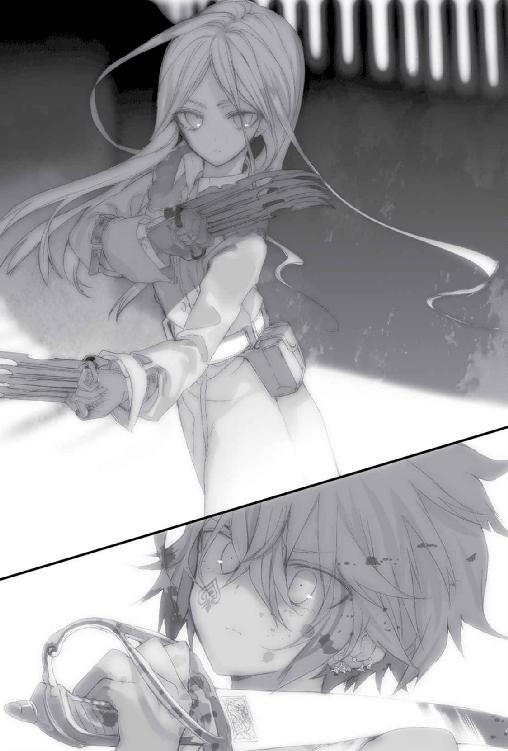
Am I alive? The man honestly wasn’t sure when he opened his eyes. There he saw the back of a compactly framed young girl. She stood there wielding a pair of Varanium cutlasses, each one about sixty centimeters long.
She whirled around at the stunned guard, earrings spinning in the air. There was a spade mark painted under her right eye.
“Oh! The Initiator!”
The girl grunted sullenly at him. “Ritsu Urabe, Initiator Rank 550. You—get out of here and call for backup. I’ll take care of these guys.”
Few of the guards appreciated the presence of an Initiator among their ranks before, but—as they discovered now—she had just kicked the grenade away from them. It put the guards in a daze.
“Uh, okay. Be careful. There’s two of them stationed in front of the control room.”
The guard gave Ritsu a pat on the shoulder before running off. She watched him go, then turned toward the door. She grinned at the barricade, teeth grinding, as she spotted something moving behind it. The next moment, a barrage of muzzle flashes was quickly followed by a mass of bullets.
Ritsu, reading it perfectly, jumped away. Amid the insane rush of gunfire, she dashed to and fro, slashing right through the barricade once she reached it. The look of sheer shock on the face of the enemy soldier behind it was exactly the kind of thing she savored in life. She gave him no time to regroup, burying her fist in his collar. He screamed and dropped his rifle.
Then her animal instincts told her to jump. She did so, and a rifle bolt pierced through the air she had occupied a second earlier, sending concrete pieces flying as it embedded itself in the wall.
“You picked the wrong girl to mess with!”
She flipped her body and kicked off the ceiling, falling toward the armed enemy and slashing diagonally with both swords when she landed. The Varanium blades easily sliced through the body armor, neatly placing the soldier out of the picture.
“Gr…ahh…”
The skirmish was over. The masked man fell to his knees, gushing blood as he looked up, mortified, at his attacker.
Ritsu licked her lips in excited anticipation. There was nothing she liked more than seeing this—taking those who underestimated her and making them crawl away in pain.
“I’m not gonna kill you yet,” she said. “I got a ton of things I wanna ask you.”
She turned around to visit the control room. Then, sensing another threat, she turned around again. From the other end of the corridor, a girl appeared.
She had silver hair, ice-blue eyes, and a khaki military uniform. In another place and time, one might think she was just a tiny little girl who had gotten separated from her parents.
However, this was neither that place nor that time. The enemy terrorists must have had an Initiator on their side, too.
The silver-haired newcomer eyed her downed comrades, then nodded in understanding. She knew what needed to be done. It was Initiator against Initiator; no need to exchange words. Both knew this wouldn’t end until blood was spilled.
But as the girl stalked her prey, Ritsu couldn’t help but speak up.
“What’s up with that? You’re actually gonna fight with those things?”
She had on a pair of knuckle guards, a metal pole attached to each arm with four long claws per hand and rings to put her thumb through. It was a pair of bagh naka, tiger claws, made for assassins to give their victim deep stab and claw wounds, as if they were attacked by a vicious animal.
Ritsu was dubious. They were Varanium, yes, and lightweight enough to keep the user agile, but they had essentially no reach. They were a relic from a past era.
“Ritsu Urabe, Initiator Rank 550. Model Shark.”
The girl bowed respectfully in reply.
A moment later:
“…What?”
The girl raised an eyebrow, wondering if Ritsu didn’t hear her. Then she lowered herself, ready for combat. Her eyes looked straight ahead.
“I said, Yulia Kochenkova, Model Cheetah. Initiator Rank 77. This is over.”
6
He didn’t bother asking for change as he threw a wad of cash at the cabbie before flying out of the car. It was brighter outside than he’d expected, forcing him to shade his eyes. It was cold, but the eastern sun had already risen. The waves made soothing sounds, something they’d no doubt be doing a thousand years from now.
By comparison, the offshore prison had undergone some major transformations since his last visit yesterday. There was now a tinge of blood to the salty sea breeze. He could feel his body tense up.
As he ran across the long wharf, he began to see a large number of onlookers jostling for position, along with the police officers trying to keep them away. “Hey, no entry—” a guard shouted at Rentaro. He stopped midsentence once Rentaro took his civsec license out and tossed it at him.
The elderly guard looked at it, then made a face at him. “You guys horning in on our territory again? This ain’t no Gastrea job.”
“But there’s a chance an Initiator was involved with this, right? That oughta give me the right to go in.”
“Pfft…”
The guard rolled his eyes as he lifted the police tape for Rentaro. “Show me who’s in charge of the scene,” he asked. The guard motioned for him to follow and started walking.
He took advantage of this invitation to scope out the rather noisy surroundings. This artificial island usually housed nothing but prisoners, guards, and their families; now it was full of forensics guys, local police, even a few special-forces men. In a way, one could describe it as a festival-like atmosphere, although not a very happy one.
Underneath the crape myrtle flowers that blossomed by the outer walls, there were a few red spider lilies strutting their stuff, a bold crimson color as they rocked in the wind. There was no telling where their seeds could’ve flown in from. Nearby, Rentaro could see blood spatters, human figures outlined in tape on the floor, and a seemingly infinite number of bullet holes.
“That tape… Which side were they on?”
“I dunno.”
The scene inside the prison was even uglier than the one outside. On their way in, Rentaro passed by the SAT (Special Assault Team), all decked out in bulletproof gear, assault rifles, light machine guns, and more. Fatigue was written all over their faces; they must not have gotten any sleep since their overnight deployment.
After that, Rentaro passed a guard prodding a handcuffed prisoner down the hall. The prisoner alternated between muttering to himself and cursing at the guard as he stubbornly held his ground for as long as he could.
“Move it!” the guard shouted, running past Rentaro’s elderly guide just as they reached the large door that led to the monitor control room. The remains of some barricades were nearby, indicating that combat must’ve happened here as well.
There was a small crowd in front of the door. Rentaro saluted them, and then the forensics crew, decked out in jumpsuits and identifying armbands, cleared the way for him.
That brought the girl on the floor into view.
“…”
The field of psychology tells us that people use clothing to appeal to others, to adjust how they want to look to the world around them. It was clear that the girl sprawled out at Rentaro’s feet wanted people to know that she considered herself a rebel. One could imagine a career in punk rock for her, cameras flashing nonstop as she surfed over a crowd of passionate, screaming fans. She had probably imagined it, too.
Along those lines, her dream had come true. The “camera flashing” part, at least, although the cameras belonged to the police crime-scene unit instead of some entertainment outlet.
The direct cause of death, Rentaro presumed, was shock brought on by the slashing claw wound to her abdomen. The strike had plucked out a great deal of her innards, making sickening red designs on the floor. The wound, which looked like it was administered by a grizzly bear, left much of her stomach cavity open for the world to observe.
She was looking straight at Rentaro now, eyes still full of surprise. Chances were, she didn’t have enough time to comprehend what had happened to her before the end came.
“Ritsu Urabe. She’s an Initiator, IP Rank number 550.”
Rentaro turned around to find a plainclothes police detective in short sleeves addressing him. He had a square jaw, black hair that was graying in spots, and black-framed glasses that gave him an intellectual look, although his thick eyebrows suggested an equally strong will beneath the smarts.
“You running the scene, sir?”
“I’m the one. Yoshitatsu Akutsu, superintendent.”
He took a cigarette out of his chest pocket and lit it up.
“Uh, you shouldn’t be smoking at a crime scene.”
“Ah, lay off. I wouldn’t be able to stand this stench unless I masked it with something stronger… Hey, we’re done here, right? Let’s send ’er on her way!”
He motioned to the crime-scene officials, who had just finished taping up the girl’s outlines on the floor. They responded by loading her on a stretcher, putting a white cloth over her, and carrying her off.
There wasn’t much of a physical resemblance, but the aura Superintendent Akutsu presented to Rentaro reminded him a lot of Detective Tadashima, his old acquaintance. Probably just as stubborn and in the trenches as Tadashima, too, he thought. And once Rentaro was sure of that, he knew exactly how to deal with him.
“Do you really need to bother with doing up the entire crime scene like this, sir?”
“We gotta make it clear who killed who before anything else. Sentencing gets to be a pain in the ass if you skip that part.”
“Oh. Makes sense.” Rentaro turned to Akutsu. “Has the riot been stopped?”
Akutsu shut his eyes for a bit, blowing tobacco smoke from both nostrils.
“More or less.”
The news all but horrified Rentaro this morning. Last night, a riot had broken out at the offshore prison, leading to the escape of no less than three hundred and eighty inmates. They had taken a hundred and twenty people hostage, including the guards who didn’t make it out in time and their families who lived on the Mega-Float; they’d managed to take over the entire island for a period of time. They asked for a ransom and safe passage out of Tokyo Area, and promised to shoot one hostage dead every hour that passed beyond their deadline, although the time they gave was clearly not enough to satisfy their demands.
They followed through with their threat, taking their first victim once the deadline came along, despite the efforts of police negotiators. Eyewitnesses talked to the media about the despair, spreading like a disease across the hostages’ faces, when the news went around.
“I’m impressed you got things under control in less than half a day.”
“Don’t thank me. Save the compliments for our SAT teams on the ground. They swam their way through the minefield, entered through the prison’s back entrance, and took control of the prison’s monitor control room. There they activated the tear-gas sprays across the entire prison and synced that with their assault from the front door.”
Akutsu blew some smoke into the air, deep lines around his eyes.
“We lost a few of the hostages, sadly, but that was the whole reason why speed was so important. Even as it is, we’re running into some serious shortages in beds and free prison cells.”
“Any SAT casualties?”
“None at all, they said.”
Rentaro was astonished. “Talk about some real pros.”
Akutsu gave him a look. “Oh, like you’re one to talk. You subdued an entire team of SAT officers barehanded back at the Magata Plaza Hotel, didn’t you? I mean, that’s not even human, man. You know? Some ‘Hero of Tokyo Area’ you are.”
Rentaro had been about to take out his license, but it turned out there was no need for that.
“So you know me?”
“Of course I do. And just in case you didn’t know, there’s, oh, a thousand guys in police headquarters who’d love to kill you right now. Our HR situation is a complete mess, thanks to you taking down Commissioner Hitsuma and all those other managers. I’m supposed to be a superintendent, but I’m having to do police-chief duties on the side, too. To hell with that shit. I wanna be out on the streets, not behind some creaky old desk.”
“Well, keep it up, and I’ll make you commissioner before too long.”
“Oh, God, anything but that,” Akutsu said, grinning as he waved his hands at him.
“So, was there someone named Andrei Litvintsev among the dead or injured prisoners?”
“Nope,” the superintendent said, “no one like that. There might be a chance he’s still hiding out on the island somewhere, but I sincerely doubt it. According to the prisoners we interrogated, he went out of his cell with a whole group of people and pretty much immediately vanished.”
Akutsu flipped open his notebook, bringing it up to his horn rims so that it was practically touching.
“Other prisoners witnessed a single motorboat roaring away from this island. They wired the minefield behind the prison so they could set it off whenever they wanted, but if nothing went boom out there, I’d say our suspects somehow got their hands on the safe route out to sea.”
“Well, yeah. The first thing they did was take over the control room and turn off all the security. They definitely did their homework.”
Akutsu scratched his head in aggravation. “Damn it. Why does this have to happen just before we’re gonna go to war or somethin’ with Sendai Area?”
If only he knew how related those two things were.
“Um,” a voice said from behind. Rentaro turned around to find a younger officer, looking a bit agitated as he fiddled with the brim of his hat.
“Are you Rentaro Satomi? There’s a woman here to see you.”
Oh, now what? Rentaro tsked to himself. This isn’t the time.
“Tell her I’m busy.”
“I told her several times that this was authorized-personnel only, but she refuses to listen to me, and”—the officer hesitated for a moment—“I didn’t get a good look at her face because she’s got the hood up on her outfit, but she’s really beautiful. Like, elegant, or something. So I had a really hard time saying no to her, but…”
Rentaro’s temples throbbed. He didn’t like where this was going at all. He zoomed around to find someone jumping up and down among the throngs behind the police tape, waving frantically.
“Mr. Satomi! It’s me!”
He brought a hand to his face. “Get over here,” he shouted, raising the tape and grabbing the girl’s hand. A few moments later, they were in a more secluded area on the island, behind the prison itself.
“What the hell are you doing here?”
The girl pulled down her hood, revealing her clear, pale skin and snow-white hair shining keenly in the sunlight. It couldn’t have been anyone but the Seitenshi.
“I couldn’t allow myself to merely sit alone in your home while you were running about, trying to handle my request. I know I can help you, Mr. Satomi. Besides, my disguise is perfect.”
The Seitenshi spun around in place, and the bottom of her skirt lifted into the air as if floating. She was wearing a collared white dress with a white jacket and a pair of white boots to tie the outfit together. Smiling, she lowered the jacket’s light hood.
She was, in a word, beautiful.
Any annoyance Rentaro felt at her presence was instantly banished as the beauty, indescribable by mere words, floored him. He realized he had never seen her in anything other than her formal palace dress. As a full-fledged public figure, she wore that outfit every waking hour of her life; it was another way to inform her citizens that she was in their service.
Seeing her do away with that, even for disguise purposes, indicated to Rentaro that something deep within the Seitenshi had changed. He wondered if he was improper to think it.
Realizing she had stunned him into silence, the Seitenshi timidly lowered her head. But her eyes looked up, toward his, as if begging for something.
“Does it…look good on me?”
Rentaro turned his back to her.
“Uh, if you’re gonna disguise yourself, try picking one that won’t make ten out of ten men passing by try to ask you out.”
The Seitenshi blushed, bowing her head even farther.
“Oh, Mr. Satomi, are you…?”
Just before things got even more awkward, three crime-scene handlers arrived from around the corner of the opposite building, chatting with one another. The Seitenshi hurriedly put her hood back on.
Rentaro breathed a sigh of relief. Then he realized she was looking right at the group of chatting men.
“I’m impressed the police force is still functioning as normal. There might be war tomorrow, for all we know. I suppose we owe that to Kikunojo’s managerial skills.”
Rentaro sized up the group. “Nah,” he rebutted. “Disaster experts call it normalcy bias.”
She looked up at him with large, questioning eyes. “Normalcy bias?”
“Yeah. When someone’s facing an upcoming disaster, it’s hard to make them pull the switch that says ‘Hey, this is really bad, we need to do something.’ People can be surprisingly lazy like that. Plus, if everyone around you’s acting normal and you’re the only one freaking out, people find that embarrassing. Even if there’s a hot iron right at your feet, a lot of people can’t make themselves take action at all.”
“I think people were a lot more on edge during the Third Kanto Battle, though…”
“Well, that’s because everyone knows that a Monolith falling down spells instant annihilation for all of us. The Gastrea War was only ten years ago, and we’ve had a handful of Pandemics since then, so everyone in the Area’s used to the evacuation drills by now. But the last time people fought against one another in large-scale combat here in Japan was in World War II, back in 1945. Pretty much everyone who experienced that for themselves is dead, so none of us are capable of imagining what’ll happen next. They’re probably thinking something like, ‘Well, maybe it won’t be as bad as a Pandemic, at least.’”
The Seitenshi despondently narrowed her eyes. “Oh, but it could wind up so much worse, though…”
Rentaro crossed his arms. “The real problem,” he observed, “is over in Sendai Area. Like, things are a lot more urgent for them, because they’re seriously in danger of being wiped off the map. I wish I knew what Ino was gonna do next…”
“Hey! Guys!” a man shouted to the trio on the other side, running up to them. “Check out the TV! It’s crazy!”
The trio exchanged looks, nodded, and followed the newcomer. Rentaro turned to the woman beside him. She was already gazing at him.
“We should go, too.”
They entered the prison, following closely behind the trio as they filed into the cafeteria. There was a single LCD TV attached to one wall of the cavernous chamber, assorted police detectives and crime-scene officials fanned around it in a crowd. They all watched the screen with bated breath, the air tense. Rentaro had to stand on his toes to get a look.
A chill ran down his spine.
The screen showed a gigantic centipedal Gastrea, one that made the bare rock surrounding it look like a miniature set. Its face was reptilian, and its legs, outfitted with scythelike serrated blades, seemed to be nearly infinite in number.
It was Libra, the King of Plagues. But what shocked Rentaro wasn’t the sight of Libra itself; it was the translucent viral sacs around its stomach area. They were inflated and taut, like party balloons, and they jiggled around, seemingly ready to release their lethal payload at any moment.
Rentaro wiped sweaty palms on his pants legs.
The scene changed to what was presumably file footage of Ino holding a press conference. The content was nothing if not predictable. The prime minister shook his fist in the air, his speech too loud and anger laden to make out clearly. Among what Rentaro could make out, however: “If Tokyo Area does not withdraw Libra by three a.m. tomorrow, we will launch a simultaneous full-scale attack on both Libra and Tokyo.”
The officers around the TV nervously chattered with one another as the screen returned to the news studio, an anchorman warning viewers to stay away from private weapon manufacturers, self-defense force facilities, and other locations likely to be Sendai Area’s initial targets. He then moved on to a primer on basic anti-disaster preparations.
Rentaro gingerly turned to his side. The Seitenshi, head under the hood, watched the screen sternly.
“Before I fled the palace, I asked them to send a diplomat over to Sendai Area, but…by the looks of things, I doubt they’re making much progress.”
She turned toward him.
“Mr. Satomi, did you notice? Prime Minister Ino may have been incensed, but he did not act like an insane man. He sounded rational to me. Despite how bellicose they’re being with their speeches, wouldn’t it be safe to say that Sendai Area is still hesitating to go through with it? Isn’t this their way of telling anyone who noticed that they’re willing to wait up until the very last moment?”
Rentaro silently admired her for making that observation. She hadn’t become head of a nation out of pure happenstance, after all.
After a while, once the TV news started repeating itself, the Seitenshi shrugged, her face exhausted. “Would it be all right if I rested over there?” she said, pointing to a corner of the cafeteria.
Taking a chair and following her, Rentaro couldn’t help but notice that despite the early-morning hour, there was an oddly spicy scent coming from the kitchen.
“I’m sure the cafeteria staff must be making breakfast for all the police who spent the night handling the riot,” observed the Seitenshi. “I’ll go see if we can get some, too.”
She stood up before he could stop her and talked things over with one of the cooks, who bowed deeply to her. “Here you go,” she said as she carried two trays back, each with a plate of rice curry. Never in Rentaro’s life did he ever imagine the most powerful person in his homeland running waitress duties for him. He wondered what her servants in the palace would think about that as he took in the warm, inviting curry aroma, the spices stimulating his sense of smell in an extremely pleasant fashion.
Although not too enthusiastic about it at first, he picked up a spoonful and brought it to his mouth. Then his eyes shot wide open. It was a perfect harmony—sweet, spicy, and just the right amount of salt. The sensation of the melt-in-your-mouth curry, accompanied by the onions and potatoes in the sauce, made him drown in euphoria. He wasn’t even really thinking about food before the plate arrived, but the next thing he knew, he was taking one spoonful after another, trying to get at every grain of rice.
On the other side of the table, though, there was the Seitenshi, spoon in hand, just staring at her own steaming plate.
“What is it?” he asked.
“No, I…I mean, my meals in the palace were managed for an exact balance of vitamins and nutrients down to the last milligram, so…I was just thinking what they’d say if they saw this.”
“Lady, you’re the head of state. You can eat whatever you want.”
The Seitenshi quietly shook her head. “Not quite. I may be head of state, but that does not put me in a ruling position over my people. I speak for the people who selected me, and I have a duty to give them everything I have.”
She closed her eyes, bringing a hand to her cheek.
“I am blessed, it is true, to receive a great deal of compliments on my appearance. People, for better or worse, seek beauty from me, and if beauty helps my voice come across more clearly to my people, then I would gladly consider my body, too, to be in their service. That is why I strive for beauty, and if I disrupt my nutritional balance, that could cause my beauty to disappear, breaking the unwritten law between myself and my— Mmph!”
Rentaro used the hand that wasn’t shoving a spoonful of curry in her mouth to rub one of his shoulders. Just listening to her go on was making them ache.
The Seitenshi shot to her feet, shaking with surprise. “Wh-what are you doing?! I—I… Not even my own mother ever did something as brazen as—”
“—It’s impolite to talk with your mouth full.”
It was only then that she realized she hadn’t so much as chewed yet. She covered her mouth, blushing, as she swallowed. Now her eyes were filled with a more pleasant sort of surprise.
“…This is good.”
“Yeah, isn’t it? Isn’t that the whole point? If it’s good, who cares? As long as you’re with me, at least, forget about all that ‘head of state’ crap. If you can’t, then get your ass back in the palace now.”
“Y…es. You’re right… Thank you, Mr. Satomi.”
The Seitenshi gave him a warm, bright smile, so bright that Rentaro couldn’t stand to look at it with the naked eye. Something about the pickled relish the curry came with seemed particularly bittersweet to him, now that he was eating it to hide his embarrassment.
The two fell into an amicable if slightly awkward silence after that, opting to concentrate on their meals instead of idle conversation. It was the Seitenshi who finally broke the ice again.
“You’ve made your rounds around the prison, right, Mr. Satomi?”
“Yeah. Looks like Litvintsev fled on us.”
“Did you notice anything else, though?”
Rentaro’s spoon halted in midair before reaching his mouth.
“There’s one thing that’s bothering me, yeah. There was a dead Initiator sprawled out in front of the control room. She was sent out from the IISO on security detail; Rank 550. Done in by that Kochenkova girl, the one you warned me about yesterday.”
“Are you sure about that?”
“We’re talking about someone who could kill Rank 550 in one strike.”
Rentaro recalled the tigerlike claw wound as well as the death mask of surprise on the victim’s face. He shook his head. “They got us… They really got us. This Yulia Kochenkova girl—I know she’s way more powerful than Enju. I swear, that’s one Initiator I could never let her fight…”
“Mr. Satomi, I’ve been thinking about Litvintsev a little myself, and I’ve been wondering: Why did he take the risk of calling you over if he knew he was going to escape the very next day?”
“…”
“Because here’s my idea. I’m thinking that he wanted to give you a personal message before he left. Something along the lines of…well, ‘Catch me if you can,’ I suppose.”
Bitter, Rentaro crossed his arms, rubbing them with both hands and gritting his teeth. Are you saying you can make the entire world shudder all by yourself? You, a single person? He had to be honest with himself—he didn’t want to get involved with that man ever again. Just seeing the full strength of Yulia in action turned him off the idea for good.
If he kept pursuing Litvintsev, he felt instinctively it’d lead to events that he’d likely regret for the rest of his life. This was, after all, the Russian military he was dealing with. Each one of them a trained professional. Cold-blooded pros who wouldn’t flinch at murder for the sake of their mission. They lived in a different world.
But, at the same time, he also knew that there was no turning back. If he didn’t take action, after all, it would affect the lives of an unimaginably huge number of people.
“This fight isn’t over yet, Mr. Satomi. Let’s rack our brains and figure out where Litvintsev might be hiding.”
Rentaro heaved a sigh and tried to keep his mind serene. “Yeah,” he said. “Let’s start by thinking about where Litvintsev and his crew could have gone.”
The Seitenshi gave him a soft smile. “I’d be glad to help.”
It didn’t matter to him if this was just a brave show she was putting on. He silently ordered himself to think about the future instead as he sat back in his seat and crossed his arms.
“Okay, so do you have any ideas, even rough ones, of where they’re hiding out? They couldn’t have fled Tokyo Area that quickly.”
“That’s what I thought, too. Even if the hull of their motorboat was lined with Varanium, that wouldn’t be enough to engage seafaring Gastrea. I would guess they’re hiding out in Tokyo Area after getting back on land.”
“Could they have taken a plane out of the Area?”
“Tokyo Area’s air defenses are on high alert with the whole Sendai Area threat. They wouldn’t let a single gnat escape the Area right now. There’s a nonzero chance, I suppose, but I think we’d be safe to ignore it.”
Rentaro carefully took his thoughts one step further. “You explained to me a couple days ago that Litvintsev’s people were using Solomon’s Ring and the Scorpion’s Neck to take control of Libra.”
“Right. Stage Fives can communicate with one another via sound and electrical waves, so they might be stimulating the vocal cords taken from Scorpion’s corpse to create those waves. Then they could use the Ring as a translator to exchange messages. To put it another way, they could use the Neck to convince Libra that Scorpion is still alive.”
“But how are they getting those signals or whatever all the way to Mount Nasu in Tochigi Prefecture? That’s over one hundred and fifty kilometers away as the crow flies. I don’t know anything about wave physics or whatever, but can you send an electrical signal that far without it falling apart?”
“The answer to that is right above your head, Mr. Satomi.”
Rentaro followed the Seitenshi’s pointed finger up to the stained, faded ceiling. A line of tear-gas sprayers was situated directly above. That probably wasn’t what she meant, Rentaro figured. But then it finally struck him:
“Oh! A satellite…?”
The Seitenshi nodded approvingly. “Good. That was some fast thinking, Mr. Satomi. Geosynchronous satellites are generally equipped with relay devices called transponders. A site on Earth’s surface can send a signal up to one, and the transponder will amplify the signal and send it back to another site. That essentially eliminates any physical wave-strength limitations, and I’m sure that’s what Litvintsev and his men are using.”
“Well…wait. Hang on.” Rentaro raised a hand to stop her as he attempted to collate his disparate thoughts. “Aren’t satellites expensive? It’s not like everyone’s allowed to use them.”
“Exactly. As of 2031, most satellite access is restricted to police, civil security, or military usage. Someplace like Shiba Heavy Weapons launching a satellite of their own is the exception to the rule, really. I don’t know if your mobile phone can work via satellite access or not, Mr. Satomi, but if it does, you have the right to own that only because of your civsec license.”
Rentaro nodded. A satellite phone, which by definition never found itself without service access, was a must for civsecs active in places like the Unexplored Territory. Agents like him had permission to use them, as well as military-grade GPS tracking technology.
“Is satellite bandwidth or whatever still that precious these days?”
“Yes. Geosynchronous satellites have a shelf life of five to fifteen years, so they have to be relaunched on regular occasions. The Gastrea War, however, cost most nations the entirety of their space programs. Sagittarius shot down a lot of them during the War, too…”
“Oh…right,” Rentaro said, a sour taste in his mouth.
“So it’s fair to say that wherever Litvintsev and his team are hiding, it’s got to have a satellite uplink and downlink on premises. That’ll narrow our list of candidates pretty quickly.”
“An uplink and a downlink? Is that like sending and receiving data from a satellite?”
“Right, right.”
“Kind of like uploading and downloading, huh?”
The Seitenshi frowned a little, finger on her chin. “Um, not really, is it?”
Rentaro dropped the topic instead of letting it slow their progress. “So, uh, how many places in Tokyo Area would have that kind of up- and downlink capability?”
“One.”
“Huh?” Rentaro asked incredulously. “So that’s gotta be the place, right?”
“No,” the Seitenshi said as she solemnly shook her head. “Not there.”
“What? But—”
“It couldn’t possibly be there. That’s why nobody in the palace is doing anything about it.”
Now there was real force behind her voice. Force that would’ve made anyone hesitate to press on. If she was that insistent about it, Rentaro reasoned, it must have been safe to remove it from the list.
But—damn it, this was getting annoying. Anything he could’ve thought up with his feeble knowledge, the Seitenshi already considered a decade ago. I guess this is the end of the road, Rentaro thought. So this is it? I’m doomed to just sit here and watch Litvintsev engineer all-out war between Tokyo and Sendai?
Just as his mind was about to voyage into dark, murky waters, a helping hand arrived from an unlikely source.
“Oof!” uttered an elderly voice as something pushed Rentaro from the side. It was Superintendent Akutsu, sitting down at the table with a plate of curry in hand. The eyes buried in his wrinkled face swiveled over to his.
“Why’re you guys helping yourself to the food they made for us, huh?” he growled. “And you’ve got your girl here, too? What the hell?”
The Seitenshi’s chair clattered as she got up, face red as an apple as she struggled to say something.
“I…I…I am not Rentaro’s ‘girl,’ good sir…!”
“Good what?”
She covered her mouth, brought the hood down over her head, and sat back down on the chair with a heavy thud.
“Wh-what do you want, though?” Rentaro asked, striving to get the conversation back on track.
“Could’ve sworn I heard that voice before…but anyway, you’re trying to track down Litvintsev, aren’t you?”
“Yeah.”
Akutsu narrowed his eyes and let out a chiding laugh.
“Well, you’re in luck, ’cause we got a witness here who might just know where he ran off to.”