Chapter One: After a God Dies
Chapter One: After a God Dies
“Hrk—!”
A blade-like talon slashed through the air. Given the effect it had, it might as well have been an actual blade. Several small bushes in its path went flying into the air the moment it touched them, as if they had been cut with a giant scythe.
It was sharp, and huge, and strong. If it struck an average human, it would probably take off their arm—or leg, or head, or whatever it caught. It wasn’t even trying to cut anything—just to grab. Even that was enough to kill a person easily. This was no ordinary power of destruction.
To anger such a creature would surely be to invite death. It could kill any mere human in a single blow; its overwhelming power amounted to authority over life and death.
And that was why, with fear and trembling, such creatures were called “gods.”
“Feh...!”
Yukinari gave a cluck of his tongue as he ducked just low enough to evade the claw.
“You’re no slouch, huh...!”
At what he judged to be the best moment, he moved forward—and the demigod, as though it had been waiting, attacked. This couldn’t be chance. It was clearly intentional.
This was what was called a “counter.” It didn’t simply mean the opponent’s attack was hard to avoid; Yukinari’s own momentum would be used against him. If he had been a fraction of a second slower to duck, it was likely he would no longer possess the top half of his body.
They were called “demigods”: those who wished to become the local erdgod. Then again, one might emphasize that they were demigods—from Yukinari’s perspective, barely gods at all. They hadn’t become true gods yet; they were just pretending to be.
But the power in their bizarre bodies was already close enough to that of a deity. As the earlier attack had revealed, a demigod had intelligence close to that of a human and wasn’t afraid to use it. A demigod knew how to apply their powers, and a single human pitted against one of these beasts could never hope to match it. He could only be overwhelmed and destroyed.
“You friggin’ monster!”
Yet as Yukinari shouted, there was no fear on his face. He knew that gods were not absolute, and they were not invincible. He didn’t have to bow before them and beg for mercy. He was their enemy, someone with power close to their own.
The demigod roared as if in response: “Gryyyaaaahhhh!” The sound bounced off the cliffs on either side.
Yukinari and the demigod were in a valley. To the left and right were cliffsides, walls of stone that wound about in dizzying layers. It was not a very deep valley, but the rocks were hard; there were few places to hide and nowhere to run.
Yukinari moved forward again. As he did so, he swung something in his hand to the right—it was an attempt to take off his enemy’s head, but like the demigod’s claw, it met only air. The demigod had avoided it with an agile backward move.
“Grr!” Yukinari clucked his tongue again and pressed forward. This time he stretched out his arm and torso and brought his beloved weapon—Durandall—up in a rising sweep. But the blow again failed to strike home.
He couldn’t reach the thing. The demigod began to rise, even as it kept sliding backward.
“Get down here, you oversized roast chicken!”
“Grrryyyahhhhh!” The demigod spread its wings tauntingly as Yukinari stared daggers at it.
This demigod was a bird, if that was the word for it. Yukinari knew of no other way to describe a creature that had wings and feathers and flew through the air.
But its body was something vastly different from the image the word “bird” brought to mind. It could only ever qualify as a monstrosity of a bird. It had four massive wings on its back, its talons were long enough to pick up a cow or a horse, to say nothing of a human, and in addition to its beak, it boasted fangs and horns.
From several meters in the air, the demigod gave a cock of its head.
“Roa—st chic—ken. whAt iS That?”
The ability to speak proved its intelligence approached a human’s. Its mouth and throat were constructed differently from a person’s, making its voice screechy and hard to listen to, but Yukinari could understand it perfectly well.
“It’s something we eat for dinner,” he said. “And you better believe we would never let it eat us! You oughta learn what birds are for.” He prepared Durandall for another attack. “So come on down here like a good little chicken. I’ll pluck out your feathers and cook you right up!”
“whaT stRAnge thinGs yoU sAy. HuMAns eat anImals, godS eAt huMans. It is naTurE’s Law.”
The hideous grryaaah! that accompanied its words must have been laughter.
“Like hell it is. I think they changed the definition of nature’s law since you looked it up last.”
“YOU youRself dO not sEEm to kNOw whAt hUmAns are FoR. Do yOu thiNK to eAt a gOD?”
The creature rose even further into the air. Up and up, to a great height—and then it spun. It fell—no, dove—so fast it produced a roar, as though the air itself were crying out in terror.
Yukinari leaped forward to avoid the diving attack, but just when he thought the demigod would slam into the ground, it opened its wings, pushing off the rock face to change direction. Its massive body slipped through the air, following him.
Its claw slashed again. Yukinari ducked once more to dodge it—but he misjudged his movement by the tiniest bit, and the talon brushed the back of his black leather jacket, leaving a long tear.
“Gryaaah! Gryyaah! yOu hAVE no hOpe!” The demigod was jubilant as it began to ascend once more. “swIng your SWORD, iT cannOT reAch mE. Or wiLL yoU trY thrOWing iT? BY RighTs, yOU wHo crawl oN the Ground arE bUt playThings for Me, whO fLIEs iN the SKy!”
Yukinari grunted and adjusted his grip on the sword the demigod spoke of—Durandall—and looked at the sky in frustration. The demigod could come down to attack him, but his sword couldn’t possibly reach the creature where it hovered in the air. He could try to catch it just as it was attacking, of course, but that meant the demigod would always hold the initiative.
“Now what am I gonna do...?”
“DO yOu sEE noW? StAy yoUr hanD, and Be EAten. It iS youR desTINy to noUrish mE.”
And then the birdlike demigod began another dive.
“Pfft,” Yukinari said. “I was just playing you.”
A crack rang out, an explosion as loud as thunder. In the next instant, the onrushing demigod pitched violently.
“whAT—is thIS—?!”
It looked at Yukinari—at the weapon he held. A wisp of smoke rose from an oddly large piece attached just above the blade: a cylinder of steel that had produced the noise of a moment earlier.
It was a gun.
To the untrained eye, Yukinari’s blade Durandall might look like nothing more than a roughly-constructed longsword. But in fact, it included a Randall—a sawed-off Winchester M-92 lever-action rifle—in what amounted to a sword-gun.
“Grryah...”
The .44 Magnum bullet from Yukinari’s weapon had lodged itself deep in the demigod’s head. This time, it was the demigod who had suffered a counterattack. As quick as its reflexes may have been, it could not dodge a ball of steel coming at it faster than the speed of sound.
“Grrrryahh!”
Even with blood gushing from its head, the demigod continued to glide at Yukinari as if hoping to snatch him up. Its closely layered feathers seemed to have acted as natural bullet-proofing, blunting the power of the shot somewhat. The flow of blood soon stopped as well. Smart enough to call itself a god, the creature seemed to understand that it couldn’t let itself bleed out, although how it had stopped the bleeding, Yukinari didn’t know.
“Should’ve used steel-tipped bullets, not hollow-point,” he muttered, turning his back as he worked the loading lever, putting the next bullet in the chamber. And then...
“—Dasa.”
“...Mm.”
The next shot did not sound from Durandall.
When had she gotten there? Behind Yukinari, on top of a large-ish rock, was a girl wielding a crude-looking gun.
She was very pretty: silver hair trimmed neatly to shoulder length, blue eyes blinking behind her glasses. Her cheeks were as white and smooth as a piece of pottery; she was as beautiful as if a finely made doll had come to life.
Dasa Urban. To Yukinari, she was like a sister, a savior—a partner.
There was a silence. The gun Dasa used, “Red Chili,” was a revolver with a bipod and scope for sniper work. It took the same .44-caliber Magnum bullets as Durandall. It was of a construction known as “single action,” a relatively old style popular back when the West was being won.
There was another roar. Another and another.
“Grryaaahh?!”
The demigod screeched. Red blossoms bloomed across its body, showing where bullets had hit. Several of them, in the blink of an eye. Fanning. Rather than cocking the gun and then pulling the trigger in two distinct steps, the right hand steadies the gun and holds the trigger down, while the left quickly works the hammer. The quick motion of the left hand resembles someone fanning themselves, hence the name. The technique is specifically for revolvers, and an experienced shooter can let off six bullets so fast that the effect is almost like a machine gun; the sound of the shots becomes one continuous roar. Dasa, though, was not at that point yet.
The demigod began to garble its words, perhaps from shock. “whAt whaT wHat maNNer of weaP wEap weAPyyyahh!”
Even if its skin or feathers were almost as good as a bulletproof vest, six Magnum rounds would have an effect. The creature began to weave through the air—it brushed the ground as it found itself unable to stay aloft, gave a great bounce, and slammed into a rock wall.
“Got a bit too into playing god, birdbrain? Do me a favor and die.”
Durandall howled as it finished the fight.
“Gyygrahh...!”
The demigod’s head snapped back, turning red. However strong its defense was, two or three shots concentrated in the same area would penetrate deep into its body. That required a certain precision on the part of the shooter, of course—something much easier to achieve when the target was collapsed on the ground, unable to move.
“Grah...”
The body slumped over, twitched briefly, and then went still.
“That’s it for him, then,” Yukinari said with a sigh. “You can come out now.” He was speaking in the direction of a nearby boulder. About ten people emerged, looking absolutely terrified.
“Honored... Honored erdgod?” one of them asked.
“I’m not—” Yukinari started, then seemed to change his mind. “Sorry, I guess I am.” He scratched his cheek in embarrassment.
“Did you... fell that demigod? All by yourself?”
“Well, I had help,” he said, glancing at Dasa.
The people who were accompanying him on this survey knew that Yukinari was “the Godslayer,” but they had never actually seen him fight. To them, the battle that played out before their eyes must have seemed like a dream, or an illusion. From what they saw, two seemingly ordinary humans had just killed a god—a fantastical story if there ever was one.
Yukinari was just saying, “All right, back to our survey,” when a sharp cry from Dasa called his attention.
“Yuki!”
He immediately spun around to find the demigod he thought he had killed taking a great leap. Then the birdlike creature was rising into the air, its four wings producing a tremendous wind.
“Thanatosis?!” Yukinari shouted, looking up.
Some animals “play dead” when confronted with an especially powerful enemy. Apparently, the demigod had only been pretending to be defeated so Yukinari would let down his guard. He had only his own inattentiveness to blame.
The massive size of the demigod was not one any bird or animal would have attained in the normal course of growth. In most cases, an older creature became the “core” to which a dozen or even several dozen other animals would become spiritually bound. They came to look like a single, massive entity.
When the demigod died, the bond would be broken and the various animals that composed it would be separated. But this one hadn’t shown any sign of falling apart—that should have been proof enough that it wasn’t really dead.
Yukinari brought Durandall to bear as fast as he could.
“I won’t let you go, you—!”
But the monster was ascending strenuously. Yukinari looked at its back and let out a little breath. It was already out of range.
“Eh. That oughta teach him a thing or two, anyway.”
Yukinari didn’t have a special hatred for or grudge against this demigod. He had simply fought back when it attacked. If it wanted to run away, he didn’t care.
Dasa rendered her verdict immediately:
“You’re being foolish... Yuki.”
Her face rarely showed her emotions or gave any hint of what was going on inside her, but at this moment she almost looked proud of herself, even if only Yukinari, who had known her much longer than anyone else there, noticed it.
“Foolish? How’s that?”
“That’s... a bird. They can’t remember anything... for more... than three steps. It won’t learn.”
“...That right?” Yukinari smiled grimly, watching the retreating demigod. To him, it didn’t look like it had any interest in coming back.
●
Friedland was a frontier town. It was far away from the capital, for better and for worse: it received no significant support, but also had a certain administrative freedom. So long as taxes were paid and the local trade routes were kept open, its duties were fulfilled.
Such remote cities had not begun as part of a concerted effort by the capital to colonize untamed lands. Rather, they were the cumulative result of expeditions sent by the king, which found villages or even small kingdoms already in these areas. These settlements would become part of the royal purview, not always voluntarily. Often, the people who were already running these areas were simply dubbed mayors or provincial lords.
Many of these localities, of course, had different cultures and customs from those of the capital. One such was the anonymous cult that revered the erdgods—and made sacrifices to them. An erdgod was a deity that had formed a spiritual link with a specific place, and ruled it in more senses than one. The erdgod’s blessing could bring abundance to the land and keep demigods and xenobeasts at bay.
But such protection usually came at a cost. In Friedland, this had been the regular presentation of living sacrifices. Every few years, a young maiden would be offered to the erdgod. The priesthood existed to support this ritual, and they ran an orphanage to ensure the town would have a steady supply of sacrifices. This became a social institution, and had continued for hundreds of years.
And then, one day, that “tradition” abruptly ended.
This was due to travelers who had come to the area—just one of them, really, a young boy. Yukinari Amano. His hair was snow-white, his eyes blood-red, but otherwise he appeared to be a completely normal human boy. He had stumbled into the middle of the ceremony and killed the erdgod that had been about to eat its sacrifice.
The result was a vacancy; Friedland was left without an erdgod. This meant two major problems were likely to occur: the villagers would once again be subject, as we said, to the threat of demigods and xenobeasts, and the harvest would be less fruitful. Yukinari solved the former problem by taking the role of erdgod himself. But as for the latter—it was not so easily fixed.
“All right,” Yukinari said. “Let’s stop here and have some lunch.” He looked back over his shoulder. The ten Friedlanders who had accompanied him on this survey were lined up behind him. Eight men, two women. Add Yukinari and Dasa, and they made a twelve-person survey corps.
“Lord Yukinari!” a small woman said, running up to him. Her flaxen hair was in braids, her amber eyes were gentle, and her chest gave the impression of being large. Her movements and expressions were reserved and mature, but whether this made one want to protect her or bully her depended on the person. Not that she seemed to realize this.
“You must be tired. Here...” She held out a canteen.
Her name was Berta Wohmann. She was a former sacrifice, and the reason Yukinari had killed the erdgod. With the deity gone, she was offered to Yukinari instead, and was now widely recognized as Yukinari’s “property.” Yukinari himself didn’t specifically want this, but Berta had nowhere else to go, and he couldn’t leave her to fend for herself. And so, she attempted to serve him whenever possible. But...
“That’s not... necessary.”
It was not Yukinari, but Dasa who rebuffed Berta’s attempt to be helpful. She showed no more expression than usual, but a hint of annoyance entered her tone. Even though, again, Yukinari was probably the only one who noticed.
“But, Lady Dasa—”
“Yuki will drink... this.” She slid the bag she always carried off her back and dug through it to bring out a small bottle.
“What’s that...?”
“It has special nutrients,” Dasa said with an unmistakable note of triumph. “A drink I... prepared. My older sister was an alchemist. So... of course I know how... to make things like this.”
Berta let out a breath, her expression somewhat overwhelmed. Dasa made sure Berta could see her hand the bottle to Yukinari.
“Yuki, drink.”
“No, hang on a second.” He seemed gripped with a sense of foreboding. “What you know how to make is alchemical medicines, right?”
“So?”
“So that’s not the same as making food.” He paused. “Have you tasted this stuff?”
“Don’t need to. I followed... the recipe exactly.”
“That’s when you most need to taste it. I guarantee it didn’t come out like you expected.” Yukinari looked like he was about to heave a sigh.
Dasa was indeed the younger sister of the alchemist Jirina Urban, and had served as her sister’s assistant. She was well-versed in certain kinds of knowledge, but her long period of blindness meant she had never been allowed to help with crafting or the other work of actual production, and her practical experience was almost zero. She was working from theoretical knowledge alone.
Back when the two of them had been traveling, she had attempted to cook several times. Her tendency to simply follow the steps in the recipe without ever tasting or adjusting anything meant that her efforts lacked a certain spontaneity; they didn’t account for the ingredients she actually had on hand. The results were inevitably too sweet, or too spicy, or too bitter. In due course, Yukinari learned to handle the cooking himself.
“...Yuki.” Dasa’s blue eyes peered up at him through her spectacles. “Do you mean you... like Berta’s water better?”
“This is the dumbest argument I’ve ever seen... Look, it’s not about you or Berta. I just want water, period. I mean... I appreciate your making that just for me, but...”
There was a very long pause. “Fine,” Dasa said at length. With a nod, she exchanged the bottle she was holding for a different one from her bag. “It’s distilled water. Drink.”
“That seems like a little much to go through for drinking water, doesn’t it?”
Yukinari understood boiling water to kill bacteria, but specifically distilling all their drinking water would have been a laborious process. Although, to the extent that it got rid of most bad things in the water, it certainly was good to drink.
Regardless, if he continued to reject her offers, Dasa’s mood would only get worse. She wasn’t the type to shout or sulk, but her angry silence could be profound. Once she got like that, it would take a good deal of time and effort to bring her back around.

“Give it here,” Yukinari said, accepting the bottle from Dasa.
Then Berta, who had been watching all this unfold without a word, smiled and said, “Now, Lord Yukinari, please have something to eat.” She offered him a small bundle.
“That’s not... necessary,” Dasa broke in again.
“Uh, actually, Dasa, it is necessary. Definitely necessary.”
“Yuki, eat this,” Dasa said, bringing the “nutrient-rich liquid” back from its brief stint in her bag.
“Pretty sure that’s a drink.”
“It’s full of nutrients.”
“And that’s great. But I just want to eat a normal meal!” Yukinari’s voice was close to a desperate shout. Dasa seemed bent on competing with Berta in every possible way. Berta usually backed down, so it never came to an actual fight, but Yukinari felt a little bad for the other girl constantly having to contend with his companion.
There was also the fact that he didn’t trust Dasa when it came to food, and felt safer eating Berta’s meal... But actually saying so would send Dasa into a pout if anything would.
The third and final girl in the survey group came over to them, sounding annoyed:
“What are you doing?”
Fiona Schillings. With her light golden hair and jade-green eyes, she was truly beautiful. Her facial features were well-formed, giving an impression of personal strength. She was the polar opposite of Berta in a number of ways. If Berta was the submissive type, Fiona was outgoing, seemingly always ready to take the lead and show the way.
It was only natural—Fiona was the mayor’s daughter and had taken over the day-to-day duties of running the town when her father became bedridden with illness. It wasn’t a position in which she could simply wait for others to tell her what to do. Yukinari didn’t know whether Fiona had always been so proactive or if it was a trait she had developed as she tried to fill her father’s shoes.
Now she had her long hair tied back behind her head, perhaps to keep it from getting in her or anyone else’s way while they were surveying. In combination with her cold demeanor, it gave her a somehow mature look—and yet cute, suited to her age.
“Oh, we were, uh... nothing...” Yukinari said, in a poor attempt to distract her. It would have been easy enough to explain that Dasa and Berta were finding little ways to fight over him, but the thought made him feel very self-conscious, and he was too embarrassed to voice it.
“By the way, what do you plan to do about that?” Fiona pointed ahead of them to where a boulder the size of a small house blocked their path. Cliffs closed in on either side of it, so unless they could climb over it, they were at a dead end. This was the reason Yukinari had called a halt here.
“What do you mean, what?”
“As long as that thing’s there, we won’t be getting any water.”
Yukinari had no ability to directly control the land as most erdgods did. But one didn’t have to be a god in order to improve the farming situation. He felt the first order of business should be to procure plenty of water, and he drew up blueprints for an irrigation canal that would run from the lake in the north to the vicinity of the town.
But there was quite some distance between the lake and the fields. An irrigation canal that ran all the way from one to the other would require a huge amount of work to build. They were here to investigate whether they could channel water through this valley, which lay in between the two. If possible, Yukinari hoped to complete construction on the canal before they went home. Hence, several of the people of Friedland had come with him.
His response to Fiona was unconcerned. “Oh, that? It’s not that big. We’ll work something out.”
“Just like that?”
“Hmm. Maybe we ought to go ahead and do something about it. Berta!”
“Yes, Lord Yukinari?” Berta responded, happy he had called her by her name.
“Tell everyone to keep their lunches packed for a few minutes still,” he said. “I would hate for their food to get all dusty.”
“Dusty, my Lord...?”
“Yeah. Just let them know.”
And then Yukinari started walking toward the huge rock.
As he went, he reached into his brain for various bits of knowledge. Chemical structural formulae. Material calculations. All were things he’d learned in his “previous world,” but before his “rebirth,” he’d barely called them to mind. It was only since obtaining this body that he had become able to access the memories of his past at will.
They say the human brain never loses information it has seen even just a single time. But many people are unable to reach those memories—to bring them into the conscious mind. Because the amount of information we can deal with at one time is limited, many memories recede into the depths of the mind over time.
But Yukinari was able to call up any of his memories as if searching through a computer database. Perhaps this was because those memories were in “parallel” after he died, or perhaps it was a special quality of this body—he didn’t know.
Silently, he touched the boulder with his right hand. He made some broad mental calculations, then focused his attention.
“...Mrm.”
A pale blue light seeped into the rock from the palm of his hand. It only took a few seconds. Then he looked back and said, “Everyone, back up a bit, please! This could get messy. Oh, and just for safety’s sake, cover your ears.”
Several of the people with him stood there looking as if they didn’t understand what he was saying, and Fiona ordered them to block their ears and take a step back.
“Welp, here goes.”
He focused on the boulder, then backed up ten meters or so. He quickly drew Durandall from its holster on his back and fired at the place he had touched a moment ago.
There was a dull, quiet explosion. The next moment, the very presence of the boulder seemed to give way, and the instant after that, it was a pile of minuscule fragments on the valley floor. Some of the rock had turned into dust that floated on the breeze, but not much of it reached where Berta and the others were waiting. The surprisingly quiet explosion was proof that, although quick and dirty, his calculations had been largely correct—the sound of a blast was just unused energy escaping into the air.
“Yukinari...!”
He turned around to find Fiona standing behind him, her eyes wide. Dasa and Berta joined her a moment later.
“What in the world did you do?”
“I guess the words ‘physical reconstitution’ wouldn’t mean anything to you...?” He gave a helpless smile. “But you know explosive powder, right?”
“Well... More or less.” Fiona’s response was noncommittal. She seemed to know of its existence, but had never seen it in action before Yukinari came to Friedland. The method of its production was probably not widely known; to the average person, it was likely as rare as gold or silver.
“It’s because I’m an ‘angel.’ I can change dust into gold, and I can definitely change part of a rock into black powder. That’s how I destroyed the boulder. I guess I could’ve just transformed it wholesale into something more useful, but there’s a limit to how much physical material I can alter at one time.” Hence why he hadn’t been able to simply turn the rock into pure air.
“You really are an angel, aren’t you?” Fiona said, sounding deeply impressed.
“What, you’re surprised? You’ve seen me use my power before.”
“I suppose so. But only when you were fighting. And you try to avoid using it even then.”
“’S true, I guess.” Yukinari fixed an ambiguous smile on his face. Then he asked, “Does it upset you?”
The “angels” were artificial humans created by a religious organization called the True Church of Harris for the purpose of evangelism. Produced using the best alchemy available, they were living alchemical devices that made for an easily digestible “divine miracle.” They were almost like mascots, a way of drawing people to the faith. And what did a mascot need with a sense of self? They were merely tools for the Church.
A human soul was apparently necessary to start these man-made dolls working, but the soul was to the angel as a pilot light is to a furnace. Just a way of starting things. Once the artificial person’s heart began to beat, the humanity the original soul bore with it was stripped away, eliminated like an impurity.
But Jirina Urban—the one who had made Yukinari’s body—had not destroyed his selfhood, though he didn’t know why. Whatever her reasons, she did it in defiance of her orders, and was killed as a traitor to the Church.
But regardless—
“Upset me? Not especially,” Fiona said. “Although I think it’s pathetic that you can kill an erdgod, but not win an argument with Dasa.”
“Okay. I didn’t mean that kind of upset.”
“I told you, you don’t look any different from a normal human. You just seem to have some unusual abilities. But I guess saying that is sacrilege now, isn’t it, O god?” Fiona said with a teasing lilt. “Honestly, I was just surprised.”
“...Huh.” Yukinari shrugged. He had been concerned that, confronted with a fresh reminder that he wasn’t human, she might feel revulsion or disgust. But he need not have worried.
“If you don’t believe me,” Fiona said with a smirk, “shall I come to your bedroom tonight?” She had strong features, and her eyes were somewhat almond-shaped to begin with. When she squinted with her smile, she looked a bit like an amused cat.
“How would that prove anything?” Yukinari said.
“Yuki... you womanizer.”
“Dasa, I told you not to take Fiona’s jokes so seriously!”
The young girl was shooting him a resentful look from behind her glasses.
“You think that’s a joke? I’m hurt.”
“Do you enjoy tormenting me, Miss Deputy Mayor?”
“Torment a god? Perish the thought!” Fiona said, clearly enjoying herself.
“Oh, uh... of course, I also... offer myself...”
“Berta, you need to learn when Fiona’s joking, too.”
“Oh,” Berta said. “Is... is she joking?” It seemed that Berta, at least, had been making a perfectly serious offer.
“Forget it. The map says our lake should be just up ahead, which means we’ll have crossed the first hurdle to getting water. If the men could help clear the debris, I’d appreciate it. Oh, after they’ve finished eating is fine.”
“Sure, of course,” Fiona nodded. “We have no intention of making you do everything by yourself.” Then she turned to the men, who had come closer to see what exactly had happened to the boulder, and started giving instructions. They had been dumbfounded by this “miracle” of Yukinari’s, and seemed almost relieved to be given concrete orders. They all nodded at Fiona without a word of complaint.
“Now maybe I can get my meal in,” Yukinari said, rubbing his shoulder with his right hand.
“Yuki, my special nutrient drink.”
“...Okay, okay. Let me have it.”
As the silver-haired girl handed him the bottle with something like a look of triumph on her face, Yukinari nodded at her, resigned.
●
The day’s survey and construction work stopped before the sun went down. Or rather, a halt was called when the sun began to sink. Sunset would plunge the world into darkness. Besides the usual threats of demigods and xenobeasts, there would be wild animals with good night vision to worry about, and the chance of bandit attacks increased as well. To the citizens of Friedland, the lawless types who lived in the countryside might as well have been monsters.
Yukinari could slay all the gods he wanted, but protecting the ten defenseless villagers was his first priority. There would be no point making them work at such a dangerous time of day.
“Good work today, everyone,” Fiona said, taking in the group at a glance. They had returned to town and would go their separate ways at the square Friedland used for special events. This area had originally been used to prepare for religious rituals—that is, to ready the sacrifices before they were sent out to the erdgod. Because of that, it was naturally located near the sanctuary where the priests lived.
Incidentally, the structure set up for the observation of the ritual was also called a sanctuary, perhaps because it too was administered by the priesthood. To the extent that a sanctuary is supposed to be home to a deity and not the deity’s priests, it was this latter “sanctuary” that most deserved the name. The building where the priests lived in town should perhaps have been called something else. But in Friedland both were called sanctuaries by tradition, and other than the sacrifices who went to the erdgod in the mountains once every two years, nobody deliberately went out to the wilderness sanctuary. Hence, when Friedlanders referred to “the sanctuary” in everyday conversation, they usually meant the one in the city.
“Have a good night,” Fiona said, and then the men of the survey team each made a brief bow in Yukinari’s direction before heading off to their respective homes.
It was now fully dark, and torches burned in the town square. The wavering flames produced complex plays of light and shadow.
Yukinari glanced over to see Berta looking at him with a confused expression. It seemed to contain a variety of emotions—as if she might be about to laugh, or cry, or not do either of those things.
“Berta?”
“Oh—yes?” She blinked when he said her name, then gave him a questioning look. “What do you need?”
“Are you all right? You almost looked like you were about to cry. Or—wait. That’s not it.” Yukinari stumbled, searching for the right words. “Anyway, you look like there’s a lot on your mind.”
“...It’s just, I... left from here.” Berta smiled as if at a fond memory. “And I didn’t... think I would ever come back.”
She was right: this was where she would have gone when she had been offered up as a sacrifice under the euphemism “shrine maiden,” and just beyond the sanctuary that faced the square was the orphanage where she had been raised. It must have been an emotional place for her.
She smiled, a hint of girlish shyness in her voice. “If I could go back and talk to myself then, I’d want to tell her. Tell her it was going to be all right, that she would come back here safely, in the company of someone better than she had ever imagined—could ever have imagined.” She spoke joyfully, placing both hands over her heart.
“Berta...” Yukinari looked at her for a fleeting moment—but it was enough to notice something in the window of the sanctuary. The shutters were open ever so slightly, and someone was peeking out. A priest, most likely. When his eyes met Yukinari’s, the shutters closed hurriedly.
“Yuki?” Dasa said, studying his face. “What’s... wrong?”
“Oh... It’s nothing.”
“Were... you... looking at Berta?” Yukinari had been looking at the building behind Berta, so from Dasa’s perspective it must have appeared as though he were looking at the other girl. “At her... chest, I suppose?”
“Whatever. No, I wasn’t looking at Berta. I was looking at that building,” Yukinari said, indicating the place where the priests lived. “The priests were watching me.”
“...Oh.” Her blue eyes blinked.
“That’s all. Anyway, can’t say I’m surprised. Nothing for you to worry about, Dasa.”
“But, Yuki...”
“Really. Don’t worry.” He smiled as he spoke, and reached out to touch Dasa’s cheek. Dasa had been born with cataracts and had been unable to see for much of her life. Yukinari had produced artificial lenses that gave her vision almost as good as an average person’s, but even so, she never seemed quite comfortable relying on sight alone. A hand on her cheek or in her hair was much more reassuring to her than words alone.
Now she placed her hand over Yukinari’s, as if feeling his body heat. Coming from a girl who rarely showed much emotion, such gestures were heartwarming. Yukinari moved his hand slightly, rubbing her cheek. Dasa narrowed her eyes like a happy cat and smiled a little.
Fiona, having dismissed the other members of the survey team, spoke up. “Yukinari. I’d like to talk about our plans for tomorrow. Will you come over to the mansion? With Dasa and Berta, of course. I can have rooms prepared for you for tonight.”
Currently, Yukinari, Dasa, and Berta were staying in the sanctuary—the one some distance from town. On the spot where the sanctuary of the erdgod had once stood, an impromptu dwelling had been built, but it was impossible to avoid the impression that it had been hastily constructed. It was solid enough to keep out the elements, but the toilet, bath, and other amenities were difficult to use.
“That’d be great. It would make my day if I could take advantage of the bath while I’m there, too.”
Fiona nodded with a wry smile.
The bath at the Schillings mansion was drawn from a nearby wellspring, which meant there was plenty of hot water to bathe with. Incidentally, Yukinari had asked if it might be possible to cool the water down and use it for agriculture, but the same idea had occurred to Fiona at some earlier time, and had already been tried. Apparently, there was some kind of issue with the water quality that made it unsuitable to use for crops.
“Allow me to wash your back, Lord Yukinari.”
“Ooh, great idea,” Fiona chimed in. “Let’s all bathe together.”
“...Womanizer.”
“Dasa, please, you have got to understand I didn’t ask for this!” Yukinari said, his shoulders slumping under her glare.
The map of the area lay open on the floor of the Schillings’ parlor. This was chiefly because the house lacked a table of sufficient size to hold the map—the dining table was long enough, but not wide enough—but now, Yukinari discovered some surprising advantages to viewing the map this way. If he stood up, he could take in the entire thing at a glance. Since he was charged with protecting all of Friedland and the surrounding area, this was a useful perspective.
Standing on the far side of the map, Fiona said, “So today, we got rid of the boulder at the pass. That opens up the shortest route between Friedland and the lake to the north. What do you have planned for tomorrow?”
Fiona wasn’t the only woman looking at the map; Berta stood to Yukinari’s right, and Dasa to his left. These seemed to have become the places they always occupied; it wasn’t so much that they had chosen these spots as that Yukinari, half-unconsciously, usually stood with Dasa to his left. This led to Berta frequently being on his right.
“All we’ve done so far is get ourselves close to connecting the valley and the lake. We have to do more than just link them up and let the water flow. We’ll need another controlled blast—to remove another obstacle like we did today—to connect the lake to Friedland. But it’ll take some real preparation to get the water coming steadily. Right, Dasa?”
“Mn—agreed,” was her response to Yukinari’s attempt to involve her in the conversation.
From being an assistant to an alchemist, Dasa had experience with stills and similar equipment, as well as drugs and herbs, so she understood the properties of fluids. The difference between a test tube and a canal, however great, was ultimately one of degree and not of kind.
“So,” Yukinari went on, “I think this should be our last visit to the lake area for a while. Let’s focus on digging a canal alongside the road. We can add branches that go to the fields, to make sure the water will have somewhere to go when it gets here. That’s pretty much just physical labor, so I’ll have the men handle it. I don’t expect any trouble with demigods this close to town, and we can have several teams working at the same time. As for where we’ll dig, we can follow my original map.”
Of course, Yukinari could use his power as an angel to turn all the earth he touched into air or water or whatever he wanted. It would have been possible to dig the irrigation canal that way, but the truth was that physical reconstitution was not the most efficient way to do such work.
“I don’t really think people are going to listen if I tell them to do something. So Fiona, I’ll be counting on you to get them on the job.”
“Sure thing. And... what will you be doing during that time, Yukinari?”
“I’ve got some ideas in mind. I’d like to improve the soil itself.” For his answer, Yukinari pulled something that seemed helpful from his memories of his “previous world.” He told her: “The soil in this area—it’s not barren, but it’s not rich, either. If we could make a simple fertilizer... No, wait. Maybe we should produce better farming tools first. Anyway, I want to figure out a way to give the land some life.”
Growing crops in a concentrated area, such as a field, effectively exhausts the land. The plants put down roots that absorb the nutrients and air in the soil, turning it, for all practical purposes, into a wasteland. Yes, rain and air carry nitrogen, which can help nourish the plants, but in the long run it isn’t enough. One can raise crops, and harvest them, but then the land must be allowed to rest—to lie fallow, soaking up the sun and regaining its nutrients. In a word, it has to regenerate itself. Friedland, needless to say, practiced this system of cultivation and rest, but in a primitive form; their broad calculations meant efficiency was poor.
The current state of the Friedlanders’ farming tools seemed to include large plows pulled by horses or oxen. Yukinari couldn’t help thinking that better equipment—not combines or complex machinery, mind you, just improved tools—might enable agriculture on a larger scale. The earth had been in use for so long that it had grown tough, hard to put roots into. Regular cultivation was necessary, but if possible he wanted to improve efficiency. Yukinari mulled over the possibilities, scouring his memories of his “previous world.”
I might be able to create a simple motor, but an electric generator facility is probably asking too much. Once we get that irrigation canal set up, maybe we could manage a waterwheel? But...
The ease with which Yukinari had produced Durandall and Red Chili was thanks to the model guns he had disassembled in his previous world. He remembered doing a science experiment in elementary school where he had made a basic motor by wrapping copper wire around a permanent magnet. But when it came to creating anything like an actual generator—well, that was somewhat beyond the knowledge of the average high schooler. Even though he understood the principles involved, he would have to work out the details by trial and error.
“Anyway, since I don’t share a spiritual bond with the land or whatever, I can’t just control it. I have to find other ways to make it do what I want.”
“I see,” Fiona said with an admiring nod. Having studied at the academy in the capital, she had by far the most knowledge of anyone in Friedland. And there was no doubt that she was a good thinker: she even seemed to understand what Yukinari was talking about without him having to break it down for her.
Berta, on the other hand, listened to all of this with a blank expression. It wasn’t her fault; she had never had an opportunity to receive a proper education.
“I gather quicklime is a common fertilizer,” Fiona said. “And I hear on the coast they use crushed shells—but that’s expensive when you get inland.”
“Sure. That’s not so much an actual fertilizer,” Yukinari replied. “It’s more a way of improving the soil, or balancing the pH...”
“The pH...?” Even Fiona was thrown by this.
“We could be in for a very long talk if I go into the details. But... Hmm. Soil is actually like water; it can be ‘soft’ or ‘hard’ or somewhere in between. And different plants like different kinds of soil. So by putting the right plants in the right earth, you can get more out of them. Make sense?”
This world at least seemed to have basic soil-improvement techniques. But without a knowledge of chemistry, farmers could only take an educated guess at what would help. That, anyway, seemed to be where Friedland was technologically. And here, the productivity of the land was tied to more than simple environmental factors. Spiritual power or earth meridians or whatever it was the erdgod controlled entered into the equation, too. That made the situation so complicated that it might have been impossible for anyone to understand it well enough to spur technological progress.
“Look, I’ve been talking about an irrigation canal as if we only needed one. But once the main canal is ready, we’ll need to dig supplementary canals to get water to each of the fields.”
“Supplementary canals...” Fiona narrowed her eyes for a second as if in thought. “Meaning smaller canals to carry the water to the fields, right? And we would have to be able to dam them off or open them up depending on which fields were being rested at any given time, right?”
“Yes, exactly,” Yukinari said, and then he regarded the deputy mayor with surprise. “You really are a quick study, aren’t you, Fiona?”
“Wh-What, you’re surprised? I mean, s-so what?”
It was an unusual reaction from Fiona, given that Yukinari had simply offered his honest opinion. She was clearly a bit flustered, as if it made her feel awkward.
“So nothing in particular. Just like I said. I always figured you were smart, but you really pick up on things quickly.”
“It’s not that complicated. Anyone with an education could have followed you...”
“I really don’t think so. Some people are all knowledge and no intelligence.”
Broadly speaking, there are two types of education a person can receive: one that deals in simple facts, or one that teaches how to think. The latter alone is meaningless, of course, but it does little good to be fixated on the former, either. It would be like someone having a huge collection of weapons and no idea how to fight: not very efficient, and not good for much. From that perspective, Fiona had an excellent balance in her education. She had covered everything and learned to be thoughtful and perceptive.
“It helps a lot that you’re so quick. Honestly, I know a lot of things, but I’m not a great thinker, myself...”
“You’re kidding. And anyway, I just got the education they give you in the capital.”
“Some people get an education, but never figure out what to do with it,” Yukinari said. Then it occurred to him: Fiona was probably the only person in Friedland to have gone away for higher education. The people of the village may have known she was smart, but they probably saw it as the simple product of having attended school in the capital. If they admired her for it, it was only as someone who had gone to be educated in a place that, for them, might as well have been a foreign country.
Chances were, very few people here understood the nature of Fiona’s intelligence. Only Yukinari—and Dasa, perhaps—could evaluate it fairly.
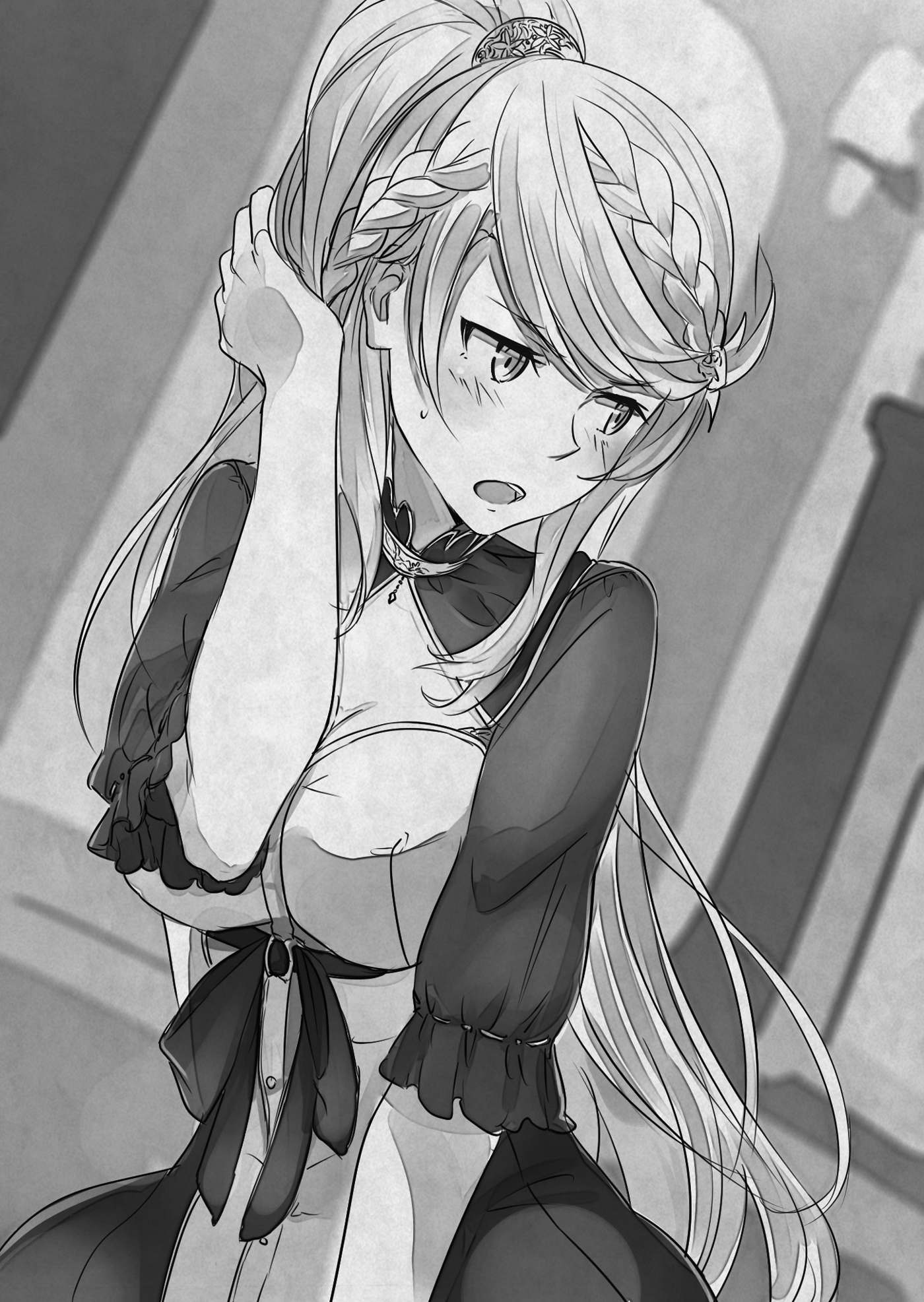
This was why her reaction to his praise was a mixture of surprise, embarrassment, and pleasure.
As these thoughts ran through his head, Yukinari felt a pair of eyes staring at him. Specifically, blue eyes, from his left. Dasa was gazing at him through her glasses, as though she were waiting for something.
“Dasa?”
When he said her name, she wordlessly looked away. She almost appeared to be pouting—not almost, he realized. That was exactly what she was doing.
Ah, Yukinari thought, grasping the situation immediately. Now I get it.
“I know a thing or two about smart people,” he told Fiona. “I’ve had more than a little help from them.” As he spoke, he put his hand on Dasa’s head. Dasa no doubt had every bit as much trouble as Fiona did being properly recognized. Yukinari saw her as second only to Jirina in teaching him about this world. But her knowledge and thoughtfulness were so familiar to him that he rarely thought to remark on them.
“...Yuki.”
Dasa peered up at him from under the hand he was running through her hair. She didn’t like that he had heaped so much praise on Fiona and had none for her—or, to put it bluntly, she was jealous. Moments like this revealed her childish side. The special circumstances of her upbringing had left her somewhat unacquainted with proper social behavior—the result being that she could seem emotionally younger she was.
“Anyway.” Yukinari ran his hand gently through Dasa’s hair, wrapping some of the silver strands around his finger, with all the delicacy one would use in scratching a cat under the chin. “I’ll let you take care of the preparations for the irrigation canal. I’ll try to figure out if there’s anything else we can do.”
“All right. Let me know if you come up with anything.” Friedland’s deputy mayor looked first at Yukinari, then at Dasa, with a slightly crooked smile.
●
Night passed, and morning came. Yukinari and his companions left the Schillings mansion for their usual place of residence—Yukinari’s “sanctuary.”
As explained earlier, this was a single house built on what had once been the sanctuary of the erdgod. No one knew exactly if there were energy meridians in the earth, or lines of spiritual power running through this place—or something else altogether—but when demigods and xenobeasts came seeking the station of erdgod, this was where they most often went. That made it an ideal strongpoint to protect Friedland from these same threats, and Yukinari judged it unwise to be away from it for long.
“Turns out gods have their own problems,” he muttered as he walked along the main street, heading for the gate that led out of town. Yukinari had no regrets about felling the erdgod, but he also had to admit that, excepting the need for living sacrifices, the erdgod “system” had been fairly effective. It had presumably arisen organically through long years of natural refinement, so it only made sense that it would do its job well.
“...Yuki,” Dasa said suddenly. She pointed toward the gate. A lone man was standing there. For second, Yukinari thought it might be the gatekeeper, but his clothes were wrong. That blue outfit was familiar—priest’s robes.
Yukinari stopped several meters short of the gate. Dasa and Berta came up alongside him and stopped, too.
“Berta,” the middle-aged man said, walking toward them with a friendly smile. “You look well.”
“...Yes,” she said with a quiet smile of her own. “As do you, Master Luman.”
Apparently, they knew each other. Given that the clergy ran the orphanage, Berta might very well have known every priest in town. Yukinari had met several of the priests as well, but this was the first he had seen of this “Luman.” The priest had a square face, narrow eyes, and a large nose. The overall impression he gave was almost like a doll carved from wood—artless and unaffected.
Yukinari looked around silently. Now he saw them: priests, emerging from the shadows of surrounding buildings, forming a large circle around Yukinari and the two girls. Each of them wore a hard expression, but none could meet Yukinari’s eyes when he looked at them.
Hmm...
When Yukinari had found himself involved in everything surrounding the erdgod, the priests had initially attempted to take Dasa as a hostage. This, at least, made them his enemies. But they had made themselves scarce during the trouble with the True Church of Harris, and that made whether or not they were hostile to him less clear.
The priests were no doubt aware that Yukinari had less than favorable feelings about men of the cloth. That was why they had gotten Luman, a priest he hadn’t met before, to waylay him and his party.
I’ve got a bad feeling about this.
Yukinari thought about Durandall, holstered across his back. The priests knew about his power, so it was unlikely they would try a sudden attack. But as they had shown with their attempt to kidnap Dasa, they understood that a strong foe may still have a weakness that could be exploited. Even a god.
“Berta. We come to you today with an earnest supplication. We ask that you and the honored erdgod... Lord Yukinari... come with us to the orphanage.”
“I—”
Berta looked to Yukinari for his reaction. She saw herself as his property, and so probably felt she had to let him decide.
“Berta,” Luman said softly. “Are you not a shrine maiden?” The words sounded gentle, like a mild reproach, but he was clearly not expecting her to talk back. “Shrine maidens exist to intercede with the gods. It is your duty to ask Lord Yukinari to accompany you to the orphanage.”
Berta looked at Luman and Yukinari, plainly torn. The priests had raised her like parents. Raised her to be a sacrifice, yes, but she had been indoctrinated into the idea that they must always be obeyed. She could not simply ignore Luman now.
It was just like how Yukinari and Hatsune, his older sister in his previous world, had been unable to abandon their mother even as she slipped away into the “new religion” she had found. Their father had seemed to leave her behind all too readily, but Yukinari and Hatsune were her children, and couldn’t simply forget about her the way they might have if she were a stranger.
The question is, what do they want?
He resented the priests, with their insistence on making Berta their go-between, but it couldn’t hurt to find out what they had in mind. He could go along for now—it didn’t mean he had any obligation to do anything for them later. Yukinari was a god now, and as such, it behooved him to forgive arrogance, capriciousness, even hypocrisy.
“Luman, right?” Yukinari’s eyes narrowed as he spoke.
“Yes, Yukina—Lord Yukinari.”
“Don’t make Berta do your work. If you have something to say to me, say it yourself. Berta—” He hesitated for an instant, but then pushed ahead: “—is mine now. She’s not your tool and she’s not your problem.”
“Lord Yukinari...” Berta’s face was shining for some reason, while Dasa’s brow had furrowed darkly, but Luman nodded, his expression undisturbed.
“Yes, I see. Fair enough. Then let me start again. Lord Yukinari, new god of our home of Friedland, I humbly request that you come to the orphanage and hear what we have to say.”
Yukinari left them hanging for a moment, then said, “...All right.”
At that, Luman and the other priests formed a line and set off walking toward the orphanage.
Berta whispered to Yukinari as he made to follow them. “Lord Yukinari.” Her hands were joined above her head in a simple gesture of prayer. “Thank you very much.”
“Don’t mention it,” Yukinari said, a wry grin tugging at his lips.
●
“Big Sis Berta! Lord Yukinari! Big Sis Dasa!”
Berta’s “little sisters” greeted them at the orphanage. None of the girls here had a family. Their parents had died, or abandoned them—in any case, they were children who wouldn’t be missed when they were eventually offered up as sacrifices to the erdgod. Because they protected the town by performing this “sacred duty,” their livelihood had been supported in large part by donations from the townspeople.
In fact, “had been supported” was now the best literal description. For all practical purposes, the orphanage’s chief role—producing sacrifices—was at an end.
“Hello there,” Yukinari said. He bent down and smiled at a girl he had met the last time he was there. “Hannah, right? How are you doing?”
“Great, Lord Yukinari!” She giggled, snuggling up like a kitten to the hand he held out.
“Hannah! You mustn’t be so familiar with Lord Yukinari—!”
“Aw, don’t worry about it.” Yukinari cut off Berta as she tried to scold her younger sister, then lifted his right arm, to which Hannah had attached herself. The young girl gave an innocent shout of joy, but the first thought that went through Yukinari’s mind was how light she was. Much lighter than she looked. Under her clothes, she was probably just skin and bones. He had lifted her on his arm in part because she looked gaunter than before—and indeed, she seemed to have lost weight. Life at the orphanage had never been luxurious, but it shouldn’t have been so destitute that a growing child became a skeleton.
“Ahem, Lord Yukinari,” Luman said, gesturing toward the interior of the orphanage. “If you will follow me. I’m sure the children would interrupt our talk out here.”
Yukinari forced a smile onto his face as he turned to Hannah and the other girls. “...Guess I’ll see you later, then.” Then he headed for the room Luman had indicated.
“Berta. As Lord Yukinari’s shrine maiden, we request you accompany him. Lady Dasa, if you would kindly wait out here.”
Dasa said nothing, but a deep frown crossed her face. She reached out for her bag, which she had set on the floor—no doubt because she hadn’t forgotten their last attempt to make her a hostage.
“It’s okay, Dasa,” Yukinari said. “You haven’t had a chance to chat with your little sisters in a long time.” He touched her silver-haired head.
“Little... sisters...?” Dasa blinked in perplexity.
“They called you ‘Big Sis Dasa,’ didn’t they?”
“Oh...” It was almost as though it hadn’t registered until he mentioned it. With some confusion, she looked back and forth between Yukinari and Hannah and the other girls.
“I’m... a big... sister?”
“From their perspective, sure. Go ahead and play with them.” Yukinari mussed her hair.
“...Mm.” Dasa narrowed her eyes happily.
“I’m gonna go in and have a chat. Just... keep Red Chili nearby, okay?”
“Okay.” Dasa made sure the clasp of her bag was undone, and Yukinari and Berta went into the next room.
“This way, please.” Luman ushered them into the room and offered them chairs. They seemed to be in some sort of parlor or receiving room. They sat not on a couch, but on hard, wooden chairs, six of which were spaced evenly around a round table in the middle of the room. Luman sat across the table from Yukinari; Berta took her place to Yukinari’s right.
“So. What do you want?” Yukinari asked.
Luman cleared his throat, then set his hands on the table, fingers interlaced.
“Lord Yukinari, it has now been something more than twelve days since you felled our previous erdgod and took up residence here.”
“Yeah. Twelve days since your barbaric tradition of living sacrifices went out the window. Bet everyone’s feeling pretty good about that.” He didn’t bother to hide the note of contempt in his voice, but Luman’s expression didn’t waver.
“Barbaric... Is that how you see it?”
“Damn right it is. What else would you call living sacrifices?” From the bottom of his heart, Yukinari believed it was awful.
Luman was silent for a moment, as if looking for the right words. Then he said:
“Very well. Everyone has their own opinion about our tradition, and it will do us no good to argue about it now. But at the very least, please understand that not everyone is ‘feeling good’ about the demise of our custom of sacrifices.”
“Good point. You guys, for example.” Yukinari kept Luman fixed with his glare. The erdgod no longer demanded sacrifices. That meant no more ritual, which meant no more need to raise sacrifices, which meant all these priests were out of a job.
“Your appearance here,” Luman went on, ignoring Yukinari’s jab, “has upset the order of things in this town.”
“Oh, the order of things, huh?”
“Yes. The money to support this orphanage, for example. It was previously provided by donations from the townspeople, but with no need for sacrifices, donations have gone down. The attitude among the citizens is that they can barely afford to support themselves—let alone some mere orphans.”
Yukinari said nothing. It wasn’t just the orphanage, but the orphans—former candidates for sacrifice—who had lost their reason for being.
“And, yes, we priests have no ground to stand on, either. Now that the veneration of the erdgod is over, there is no need of priests to conduct the ritual.”
“...Figured.”
“You, Lord Yukinari, are the erdgod of this land now. ...And we have one request we would humbly make of you.” Luman leaned in ever so slightly as he spoke. Apparently, he was coming to his point.
Truth be told, Yukinari had come in with a pretty good sense of how the conversation would go up to this point. But he wanted to hear the priest say it himself.
“At present, you deliver all of your instructions to the townspeople through the deputy mayor, Miss Fiona Schillings. We ask that, in the future, you allow us to act as your intermediaries.”
About what I expected, Yukinari thought. The erdgod no longer demanded sacrifices—but there was a new source of power and authority. It was Yukinari himself. He had felled the erdgod and held off the Missionary Order the True Church of Harris when it had invaded the town under the guise of evangelism. And this evoked from the townspeople a feeling of devotion—almost of religious fervor. This came out in the way everyone but those closest to him referred to him as “honored erdgod,” despite the fact that Yukinari was not an erdgod in the strict sense.
He had, in effect, replaced the erdgod. As such, he was the new banner the priests could rally to, and thereby protect their status. They saw that they had to put themselves between Yukinari and the townspeople in order to assure their position.
“You think getting between me and the citizens will let you keep your power—right?” Open hostility entered Yukinari’s voice, but Luman nodded calmly.
“In broad terms, I suppose, yes.”
Yukinari squinted at Luman. Why had the priest insisted on having this conversation not in the sanctuary where he and the other priests lived, but in the adjoining orphanage? Most likely, he had wanted Yukinari to see Hannah and the other orphans before the talk began. It would make him that much more open to their pleas.
But wasn’t that, in essence, taking the children hostage? There was no weapon, but the threat was the same. If you don’t do what we want, these poor children will starve to death.
No doubt they had wanted Berta present for a similar reason. Yes, she was his “shrine maiden” now, and if she added her voice to their own, it would be that much easier to persuade him. And Luman, of course, knew Berta’s personality full well: she would never turn away from her little sisters at the orphanage.
Indeed, at that very moment Berta was nervously switching her gaze from one of them to the other, looking as if she might burst into tears. She may not have understood the nuances of the power they were negotiating for, but she at least grasped that Luman wanted something from Yukinari.
I guess I don’t lose anything by letting them play my representatives, Yukinari thought, picturing Hannah’s smiling face. Luman and the others weren’t asking anything exceptional of him. All he had to say was “Sure,” and they would once more be the god’s spokesmen.
“No, thanks,” Yukinari said. “I grant I’m the god of this town—but I’m not doing it for priests like you. I’m doing it to take responsibility for what I did, and to protect the people I need to protect. I couldn’t care less whether you guys get anything out of it or not.”
He remembered how the religion his mother had joined would always squeeze money out of her on one pretext or another. It served no purpose, didn’t change anything; it only supported the people who made their living from being connected to the organization. It was no more and no less than that, and yet his mother had given gladly, and even seemed grateful for the very act of giving money to these people. She believed fervently that the amount she gave reflected her devotion, that she was somehow storing up virtue by these gifts.
And... Yukinari began thinking through things again. If I let these guys speak for me, yeah, they’d probably keep their power.
But it was hard to believe that donations to support the orphanage would continue now that sacrifices were no longer necessary. It was possible, of course, that with their safety and livelihoods guaranteed, Luman and the other priests would use their extra resources to take care of the orphans. But their willingness to use Hannah and her sisters as a bargaining chip suggested a high probability that the priests saw the girls as nothing more than a means to an end. Even if Yukinari went along with their request, it was unlikely to solve the real problem.
“Are you quite sure? Is there no way you will reconsider?” Luman cocked his head with just a hint of questioning. Or was it that he sensed the hesitation and conflict within Yukinari, saw that with one more push, he would give in...
“Forget it. I said no.”
There was a silence from beside him. When Yukinari glanced over, he found Berta looking at the ground, trembling. She was caught between him and Luman now and had no idea what to do. Yukinari took her hand and stood, then turned once again to the priest. “I want to be clear. Like I told you: I’m not playing god to put food in your mouths.”
“And most clear you are. A shame, my Lord. A terrible shame.” His tone was detached. His calm did not seem shaken despite being so thoroughly rejected. It would only make things harder on Berta to stay there. Leaving Luman sitting in the room, Yukinari gave Berta’s hand a firm tug and led her out.
●
No sooner had they returned to the “sanctuary” where they lived than Berta threw herself on the ground in front of Yukinari.
“My humblest apologies!”
“Whoa! What are you doing?!”
“Berta...?”
They hadn’t even all made it inside; they were still at the entrance to their house. Yukinari and Dasa had walked in as normal, whereas Berta was now prostrate behind them, offering a stream of apologies. Apparently, she felt she wasn’t fit to set foot inside the sanctuary until she had received Yukinari’s forgiveness.
“Please... Forgive me...”
“Forgive you for what? Is this about the orphanage?” In his mind’s eye, Yukinari saw Hannah and the priest, Luman.
“Yes, my Lord!” Berta didn’t even pull her face out of the dirt as she answered.
“It wasn’t like that was your fault or anything. Now, get up. You know I hate this kind of thing.”
“But...” To Berta, it was entirely because of her that Yukinari was angry, and she wished desperately that he would spare Hannah and the priests any punishment.
“All right, look,” Yukinari said, crouching in front of Berta and taking her by the shoulders. He forced her to stand, sighing a little as he asked, “What exactly do you think I am?”
Did she take him for someone who would murder everyone who annoyed him a little bit? What was he, some kind of evil monster?
“You... You are my most revered god, Lord Yukinari.” Her eyes swam with tears as she looked at him.
“Yeah,” he said with a hint of exasperation, “that’s what I thought.”
Gods could dispense divine punishment on a whim. To Berta, it must have seemed obvious that Yukinari would lash out at Luman for his infuriating request. Unlike Yukinari’s previous world—unlike modern Japan—this world lacked any legal code or universally accepted social conventions. Even if such things had existed, they presumably wouldn’t have applied to gods, who transcended mere humans.
Here, souring the mood of a god was reason enough for a person to die. Anger a deity, and it would kill you: this was as unshakable a reality as the fact that things fell when you dropped them, or that standing in front of a light produced a shadow.
“Anyway, I’m not gonna kill those guys.” Yukinari took Berta by the hand and pulled her into the sanctuary. “And if it doesn’t bother me, it definitely shouldn’t bother you.”
“But, my Lord—”
“Don’t worry about it. Consider that a divine command.”
Yukinari wasn’t sure whether to be further annoyed that Berta accepted this almost immediately. “Y-Yes, sir. I won’t... I won’t worry about it.”
If only it were as easy as that. If words were all it took to change our feelings, there wouldn’t have been any problem. But if he left her to her own devices, Berta was likely to grow more and more depressed under a self-inflicted sense of guilt.
Yukinari seated Berta on the bench in the sanctuary, determined to listen once more to what she had to say. If kowtowing and apologizing would make her feel better, maybe he should let her. But...
“I believe what... what Master Luman said has... some merit to it,” she said.
“You think there’s merit in letting young girls be eaten in exchange for a god’s blessing?” Yukinari’s voice grew harsh before he knew what happened—when he saw Berta flinch and cower, he quickly apologized. As she herself had said, be he kind or evil, Yukinari was the god she now worshipped. She had begged for his forgiveness simply because Luman and the priests had upset him. If she herself were to be the cause of his anger, there was no telling what she might do.
“I... I was raised in that orphanage,” Berta said after she had calmed down. “Hannah, the other girls—they’re like sisters to me, and the priests are like my father...”
To Berta, who had no family of her own, the priests and other orphans were as priceless as blood kin, even if her life had been the product of a system under which she would be a sacrifice.
“We have no parents. If we hadn’t been chosen as shrine maidens, we would have just died in the streets or the wilderness somewhere...”
“I mean... Yeah, I guess you’re right.”
In his time here, Yukinari had already come to understand that Friedland was not a rich town. Certainly not rich enough for the townspeople to support an orphanage full of girls simply out of the goodness of their hearts. None of the villagers were in immediate danger of starvation, but neither did they have the spare resources to take care of anyone who didn’t contribute. Poor nutrition meant illness was more likely, and recovery more difficult. In other words, there would be only a slow, wasting death in store.
“Now that we don’t need shrine maidens, there won’t be any donations... And without donations, the orphanage can’t go on. Hannah and the others will end up on the streets...”
As the priests’ authority declined, so had donations to the orphanage. Chances were, the first thing the priests would do as they tried to save themselves would be to cut the orphanage loose.
“For the time being, the girls are surviving on stored-up rations... But I don’t think the orphanage will last for much longer...”
And then the children would have nowhere to go. Just as Berta, when she hadn’t been sacrificed, had had nowhere to go.
“What you’re saying is, you want me to take those priests up on their offer.”
Berta said nothing further. She couldn’t say it.
Yukinari looked back in the direction of Friedland and muttered, “Who knew being a god could be such a pain in the ass?”
●
Arlen Lansdowne was exhausted.
“Pathetic,” he muttered. He had made this complaint so many times he had lost count. “How utterly... pathetic...”
It was not physical, but spiritual fatigue that afflicted him. Despite his fallen state, he was a member of the Civilizing Expedition of the Missionary Order. The training he had received in the year immediately after he joined the Order left his body relatively fit. The Order traveled by horse, but they had to be capable of fighting in full plate mail, so they couldn’t afford to be scrawny.
“...To think that I—even I—!”
What he felt now was altogether different from that wonderful tiredness that had followed each day of training in the capital. Fatigue of the body could be remedied with a night’s sleep, but that of the spirit was much more difficult to escape; it was like being mired in clinging mud.
“I, a knight of the proud Missionary Order of the True Church of Harris!”
Now here he was on the frontier, in Friedland, constantly covered in dirt and grime, set to one menial task after another, used as carelessly as an old rag. And when the day was done, where did he go to sleep? A pitiful hovel of a “church.”
Arlen and his men had ostensibly converted Friedland to the True Church and were now staying here in order to instruct the people—but the truth was that, though the knights wore no chains, they were treated like slaves. For Arlen, the son of nobility, this was such a dizzying decline in station as to drive him mad. The other knights felt much the same.
“Curse him... Damn that ‘Blue Angel’!”
The missionaries had come all the way to Friedland to spread the true and proper teachings from the interior among the ignorant populace. This had been their mission, and it was glorious. So he believed, or had. But when they had finally arrived at the site of their mission, they were shocked to find their work disrupted by the “Blue Angel,” who even destroyed their greatest tool, the statue of the guardian saint.
Then Fiona Schillings, once Arlen’s classmate at the capital and now deputy mayor of Friedland, had blackmailed them, trapping them here. Even if they had been able to escape and get back to the capital, they would certainly be the scapegoats for the loss of the statue. At best, they would spend the rest of their lives as laughingstocks; at worst, they would be tried and found guilty.
“Just you... remember this. I swear... I swear, one day I will...”
Repeating those words like a curse, Arlen dragged his weary body back toward the shanty—no, the church. Five other knights, in various states of exhaustion, accompanied him.
“Excuse me—you there.”
A voice spoke to them out of the night, and they stopped. The summons had come from a narrow alleyway between two buildings—from several priests of Friedland’s native cult.
The knights raised their collective eyebrows, giving the priests a long, questioning look. The local religion was in direct competition with the True Church of Harris; they shared what amounted to a professional rivalry. So what did they want with Arlen and the others? And why were they taking such care to avoid being seen?
The man who appeared to be the oldest of the priests gave Arlen’s group a reverent bow. He looked around, making sure there was no one else there, then took a step out of the alleyway. Finally, he spoke:
“We earnestly wish to speak to all you knights of the Missionary Order of the True Church of Harris.”
The six knights looked at each other silently. They had no idea what the priests could want. Did they seek revenge for how the missionaries had treated the people of Friedland like slaves when they first arrived? But there was no hint of anger or even derision on the priests’ faces.
What, then?
The man who had been Arlen’s superior was no longer there. He had supposedly been put to work somewhere else, and Arlen ranked highest among those who remained.
Arlen spent a moment in anguished reflection. Then he said, “We will hear what you have to say.”
Whatever was going on, their treatment could hardly get any worse. Arlen guessed he had nothing to lose by accepting.
●
There was an exhalation in the dimness.
“Mn...”
Yukinari ran his finger over Dasa’s tightly shut eyelid. Again and again. Carefully, gently, as if tickling the spot where her eyebrows started.
When Dasa got nervous, it became impossible to inspect her eyes—even if he forced her eyelid open, he would find the eye itself rolling wildly. Instead, he gently massaged the area around her eyes to warm them. After a while he could look at them up close, the blue of them filling his vision.
Her glasses were off to one side. Slowly, with great care, he lifted the eyelid of her right eye. Nothing stood between her eye and his. He looked carefully at it, but saw no clouding. No sign of inflammation. The eye seemed to have fully accepted the artificial lens he had produced and then inserted to treat her cataracts.

“Yu... ki...” Dasa fidgeted from the neck down. Yukinari held her head in his hands, so she couldn’t move it freely. She shifted her bottom several times, as if trying to find a comfortable way to sit.
“...This... is embarrassing...”
“What is?” He let go of the right eyelid, placing his thumb over the left instead. Again he began to rub it gently with the pad of his finger.
“My glasses...”
Her right hand reached out for where the spectacles lay beside her. Apparently, she found it awkward for someone to look directly into her eyes. That piece of transparent glass didn’t seem like much to Yukinari, but to Dasa it mattered.
Come to think of it, Hatsune didn’t like to be seen without her glasses, either...
If you were used to wearing glasses all the time, it made sense that you might find it embarrassing for someone to look directly into your naked eye, or even touch your eyelid or breathe on it. Having said that, this wasn’t the first time he’d inspected Dasa’s eyes like this. Yukinari found himself wishing she would just accept it.
“You know they have to be off. Just be patient.”
Their faces were so close they could feel each other’s breath. If Dasa put on her glasses, Yukinari’s breathing would fog them. They would only get in the way.
He pulled the left eyelid open with a certain amount of force. Another clear, blue eye stared back at him. No problems that he could see.
“You’re in good shape.” He took his hands off Dasa’s slightly crimson face. “No changes to speak of. Everything feel all right?”
“...Yes, I think. I’m fine.” She grabbed her glasses and put them on. She blinked twice, three times. It was enough to return her moist eyes to their usual, cool look. “But Yuki, you’re... not fine, are you?”
The question came very suddenly.
“Who, me?”
“The talk... with Berta this... afternoon,” she said, glancing at the wall.
On the other side of that wall was Berta’s room. She was already asleep in there—perhaps exhausted by everything that had happened since that morning.
“Are you... worried about her?”
Just as Yukinari was the only one who could read Dasa’s expressions, Dasa was capable of intuiting a great many things from Yukinari’s subtle looks and gestures. As the person who had known him longer than anyone in this world, it only made sense.
“I... You know how much I hate religion. Not any specific religion, just in general.”
“...I know.” Behind her glasses once again, Dasa’s blue eyes looked at the ground.
“My mom got sucked into religion, put all kinds of money into it. She tried to force me and my sister to join her. She even wanted my sister to be the founder’s lover—can you believe it? It will be good for you, too, she told her. It’ll be wonderful. You were put on this earth to be his lover. My own mother said shit like that with a straight face.”
He was, of course, talking about his previous world. But this wasn’t the only reason Yukinari detested religion.
“And then I came here... and the Church took Jirina from me.”
“...Yeah,” Dasa said with a small nod. As sisters, they had been very close. They didn’t look much like each other—but even if they hadn’t shared a blood connection, they were unmistakably family. But Jirina was killed as a traitor to the Church, and Yukinari had been torn away from his older sister by death when the two of them perished in a fire.
His older sister had been more important to him than anyone in the world. In that respect, he and Dasa were the same.
“I don’t care about anyone’s personal faith,” he said with the beginnings of a rueful smile. “Believe, don’t believe, it’s everyone’s choice. Lots of people seem to find real inner peace by believing in God. But when people try to force their beliefs on others—I despise that. And when it’s to get power, or money, or to control others? I can already feel the bile rising in my throat.”
“...Yeah.”
“That’s why I turned them down. Because of a little personal history. To think—” he gave a shrug and a sudden ironic smile. “—I’d do something like that, when I’m the one being worshipped as a god. The world can be a pretty twisted place sometimes, huh?”
“...Yuki...” Dasa reached out and touched his cheek.
“...Dasa?”
Touching the other person was Dasa’s way of making sure they were really there. She did it often, even in the middle of boring, everyday conversations. But this...
Wordlessly, she put a finger to his lips, as if to tell him there was no need to force a smile.
“If we can set up the waterworks, improve the farmland, they’ll need more workers. When the harvests get better—when Friedland is richer—then they might have the spare resources to take care of the orphans.”
But it wasn’t a simple question of amounts and numbers. People needed a certain level of comfort in their own lives before they could think about protecting the needy, helping them, caring for them. If they didn’t reach that level, the only alternative was to somehow force them to help. With religion, for example. Make such help for the needy something that was good by definition, because it would store up virtue—as the Buddhists believed with almsgiving.
In this place, Yukinari was a god. If he ordered it, people might help support the children at the orphanage, even if it impinged on their own lives. But he knew that wouldn’t solve anything in the long run.
“I’ll think of something eventually. But...”
“...It will take... time,” Dasa said. And she was right. Yukinari might be taking the wisest path, but it would demand a great deal of time. And without an erdgod who could guarantee at least a decent harvest, the crops might fail the next year. That would mean starting over from less than zero. The process couldn’t not take time.
“Yuki,” Dasa said as if something had just occurred to her. “What if you use your... powers of physical reconstitution?”
“Yeah, I thought of that,” Yukinari said with a frown. “But I don’t think I could keep making grain, or anything edible, for very long.”
Yukinari’s powers were limited in several ways. He could only reconstitute a certain amount of material at once, and to do so he had to first reduce something else to dust, storing up the information inside it.
His abilities consumed information. For him to continually produce food, even if he himself could endure it, he would have to reduce the area around the village to a wasteland.
“It’s a... question of efficiency,” Dasa said. “What... if you were to produce something... valuable? Like a precious... metal?”
This must have seemed a perfectly obvious idea to Dasa, as an alchemist’s apprentice. Yukinari himself was a sort of living alchemical device. He could produce gold or silver, if he wanted to. He could become a rich man overnight.
“A whole mountain of gold and silver wouldn’t do Friedland much good right now.”
Gold was used for currency because it was relatively durable and easy to produce. Put another way, it hadn’t become prized for any dramatic, direct connection to human needs for clothing, food, or shelter. You couldn’t eat it; it wouldn’t slake your thirst. You certainly couldn’t grow crops with it. All the gold in the world would do little for one of these remote provincial cities.
Dasa had grown up in a big city, in the capital. She had been shut away with her older sister, true, but material goods were plentiful, and she was familiar with the use of gold and silver as money. Unconsciously, she believed that money could buy close to anything.
“Those Church bastards have angels, too,” he added, “but they aren’t making precious metals left and right. It’s because money is so closely connected to the social system—make a whole bunch of it, and you’ll screw up more things than you realize.”
If he put all his effort into making gold, for example, its value would plummet—it would no longer be rare enough to act as a representative currency. The economy would be thrown into chaos.
And more than anything else, using his powers that way would be as good as telling the Church that either an angel or a powerful alchemist was in the area. That would bring the missionaries down on them, in numbers vastly greater than Arlen had had with him. Yukinari was perfectly happy to fight them, as revenge for Jirina, but he also had to protect Dasa, and Friedland... It would be more than he could handle alone.
“From a broad perspective, markets and exchanges are a kind of network of information...”
Then he stopped, something pricking at the edges of his consciousness. Currency. Exchange. A broad perspective. The production and control of value. Take a step back, look at the big picture...
He and Dasa spoke at almost the same moment:
“Yuki. What about trade?”
“I get it! Trade is the answer!”
They looked at each other in surprise, their eyes wide.
“We don’t have to limit this to Friedland—and we don’t have to think exclusively in terms of the capital’s trade routes.”
Suddenly, he hugged Dasa with a smile.
“Y-Yuki...?”
“Dasa, you’re brilliant! Thank you! Now we have something we can at least try!”
Her glasses slightly askew, Dasa made an uncharacteristic expression of confusion, her face a faint red. But whether this was happiness or unhappiness, Yukinari, embracing her, couldn’t see.
“Was I... helpful...?” Dasa asked, moving her hand in a hesitant circle on Yukinari’s back.
“Helpful? You were perfect! Thank you so much!”
Yukinari was an angel, and he was Friedland’s god, but his spirit was still that of a human—indeed, a teenage boy. It was all too easy for him to become fixated on what was right in front of him, and forget to take a step back. He had been completely set on trying to make Friedland prosperous all by himself.
“We’ve still got the map we took with us when we ran away from the Church, right? That’s a huge scale and not very detailed, but it should help us look for a trading partner.”
“...Erm, Yuki.”
“...Hm?”
“Let go of... No, don’t, but please... take it easy...”
Yukinari realized that in his joy at this new idea, he had nearly crushed Dasa with his hug.
●
At the exact moment Yukinari was giving Dasa that joyous hug, Arlen and several of the other knights of the Missionary Order of the True Church of Harris were in the building where the priests lived. Several of the missionaries had balked at the idea of meeting with representatives of the local faith against which they were supposed to be fighting, but Arlen was more than ready to hear the priests out. He had had just about all he could take of being worked like a slave. He would do anything if it might change his situation.
The conversation had circled several times, the two parties sounding each other out with polite greetings and empty formalities. Finally, after a brief silence, one priest said:
“Let me come to the point. That erdgod—no, that demon, ‘Yukinari.’ We wish to help you destroy him.”
This set the missionaries murmuring. Most of them probably couldn’t believe what they were hearing. Arlen doubted the sanity of the man in front of him. Perhaps losing their power had driven these native cultists over the brink.
But the priests appeared to expect this reaction. They smiled as if this were just what they wanted. “We follow different teachings, but we are alike in that this ‘Yukinari’ has left us all in a most untenable position. Hence, we have resolved to end him.”
Their logic was simple enough. Yukinari had felled the erdgod, meaning the priests, who relied on the deity for their position, had lost their authority. They meant to kill Yukinari in turn, making room for a new erdgod to come to Friedland. They might call Yukinari a demon in deference to the Harris Church, but what they meant was that he was in their way, and they intended to be rid of him.
“You’re taking this too lightly!” Arlen exclaimed. “He’s an actual angel! A monster! Even the statue of our guardian saint could not stand against him—what do you have that is more powerful than that?”
Arlen reviled Yukinari’s very existence. As he toiled away at his chores each day, he spent his time repeating to himself that one day he would make Yukinari—the cause of it all—pay. But it was as much a way of getting himself through the day as it was a genuine resolution. He didn’t really believe there was any way of defeating Yukinari.
“And that bastard is—”
He swallowed his words before he said something he shouldn’t.
The Blue Angel. Yukinari had murdered the former Dominus Doctrinae. It had happened right in the capital, in the midst of thousands of missionary knights and tens of thousands of believers. And afterward, they hadn’t even been able to catch him. He had escaped.
In a one-on-one battle, Yukinari was probably invincible. If they had a whole army of guardian statues, they might manage something—but the knights themselves, however well trained and armored, were still only human, and had no hope of defeating this enemy. They would die, and die instantly.
“Whatever the case, this is no laughing matter,” Arlen shouted. “We refuse!” Two of the other knights were nodding, expressions of terror on their faces.
“Pathetic!” The voice of another man tore through the discussion, as if to overpower the quailing warriors. “And you call yourselves members of the Missionary Order of the glorious True Church of Harris?!” One of the other knights had risen from his chair, and was looking down at Arlen and the others.
“A-Arnold...?”
The man’s name was Clifton Arnold. His marks in training had put him below Arlen in the ranks of the Missionary Order—but the noble family he came from was just as prestigious as Arlen’s. Arlen held their respective ranks in the Order as reason enough to look down on Clifton, but the latter took this poorly, and they had clashed more than once.
Their superiors had quickly tired of this, and endeavored to keep Arlen and Clifton as far away from each other as possible, even when they were assigned to the same unit. Hence on their visit to Friedland, Arlen had been part of the group tasked with bringing down the erdgod, whereas Clifton had stayed in town to help with the edification of the villagers—that is, to help with putting collars around their necks.
This meant Clifton hadn’t seen it with his own eyes—hadn’t seen Yukinari casually annihilate the statue of the guardian saint, which was supposed to be the missionaries’ ultimate weapon. Clifton’s reflexive disgust for Arlen no doubt led him to believe that it was Arlen and his knights who had failed to properly utilize the statue. His viewpoint, in other words, was not so much that Yukinari was powerful as that Arlen was incompetent.
“This is an angel we’re dealing with!” Arlen said.
“And that has you cowering in your boots? An angel—pfah.” Clifton’s voice was even. “If it looks like a man, it will bleed like a man, and if you cut off its head it will die like a man.”
“If you think it’s as simple as that, why haven’t you done it yet?” Arlen felt as if he were about to vomit at Clifton’s sheer idiocy. This from a man who had never had a novel idea, never tried a bold move in his life, but only followed orders happily. No doubt he would paint his impetuousness as a willingness to seize opportunity. “We cannot win against that,” Arlen went on. “You are a fool, Clifton Arnold, an utter fool! There is nothing further we can do to resist that thing! You truly know nothing, you—”
“You are the fool, Arlen Lansdowne. Can you not see these men are attempting to offer us a way to do exactly what you say cannot be done?” Clifton snorted.
“Just so, sir,” the priest said, that knowing smile still on his face.
“If it helps us destroy that demon, I would join hands even with these native priests,” Clifton said. He looked each of the other missionaries in the face. “Is there no other man here who would do likewise?”
After a long moment, two of the others raised their hands. Neither of them had witnessed the destruction of the statue, either. In contrast, the remaining three knights, including Arlen, kept silent.
“I see a craven wind has blown through our ranks,” Clifton said, gazing down at Arlen and the others. “Let it carry you away from here. We will deal with that devil. You, Arlen Lansdowne, are a coward not worthy to be called a knight. Perhaps you should go to the barbarians and beg to be their manservant.” There was no hitch in Clifton’s voice, even though those very “barbarians,” the priests, sat directly across from him.
Arlen and the two other knights stood. “You will regret this.” They headed for the door, resolved to have nothing more to do with the matter. Clifton’s amused laughter followed them out of the room.