Chapter One: Malign Influence
Chapter One: Malign Influence
Angela Jindel had always hungered for something.
Born the daughter of a powerful noble family, blessed with both looks and intelligence, she had become used to being better than those around her from a very young age. Indeed, the people around her recognized it—even sought to put her ahead of themselves.
Angela’s mother, despite being a woman, had pushed aside her less competent brothers to take over headship of the Jindel house. She often seemed to look down even on her own husband, who took the Jindel name. Angela’s father never objected to this; he was less a partner than a servant to her mother. In noble society, where men were normally more valued and respected than women, this was very unusual—but Angela’s mother was made of stern enough stuff to make it possible.
With these people for parents, Angela naturally grew into a capable woman who refused to be bested by any man, and her achievements showed as much.
She had originally entered the Missionary Order of the True Church of Harris to bolster her reputation. She had to show that she wasn’t just smarter than the men around her; she could beat them in matters of war as well. Hence, Angela had studied the martial arts since she was a child, and once she joined the Order, she never showed any fear of battle, be it with barbarian tribes or erdgods, demigods, or xenobeasts.
But the converse of all this was that there was a constant thirst in Angela. Something was missing. Unfulfilled. The fact that she didn’t know what it was only increased her anxiety about it.
She believed that when she finally figured out what this thing was, it would turn out to be very simple, a blunt force rising up from within her, unyielding precisely because it was so obvious.
But if she continued as she was, she would never find it. That much, she knew. So Angela threw herself into her Church duties as if to forget the longing within her. She memorized the scriptures and proclaimed how wonderful they were to all who would listen. Everyone around her could only marvel at her fervent devotion.
In due course, she surpassed all those moronic men; in the blink of an eye, she was a vice captain. Of course, it helped that she came from a famous family such as the Jindels, but she was able to gain the position at the tender young age of twenty because of her own competence and intense effort.
When she opened her eyes, however, she was in a dark room. The decor could have been generously described as minimalist; bare stone walls were all she could see. The room was humid and smelled faintly of mold. She presumed she was underground somewhere.
She blinked her almond-shaped, catlike eyes and sighed.
First, she should take stock of her physical condition. She moved her hands, feeling her face and then her body. This was not, of course, to ensure that she was unhurt. It was to check that this was not a bad dream—that it was, in fact, cold, hard, pitiless reality. She didn’t know how many days had passed since she had been imprisoned here, but this had become her ritual each time she woke up.
The dull pain of the blows remained here and there on her body, and pain lanced through a cut on her right arm, although the wound was shallow. She was not manacled, but her armor had been taken from her. Perhaps they assumed it would have a weapon hidden in it somewhere. Instead she had been given a completely plain one-piece dress, just a piece of cloth with a hole for her head. It was tied with rope in a few places. Practically rags. If she moved carelessly, her chest and behind would be on full display.
Maybe because it was underground, the room was warmer than it looked, and she had been given a blanket, albeit a ratty one, so there was no fear of her freezing. The only people who got anywhere near her room were the female mercenary and the girl who came to deliver her meals and empty her chamber pot, so Angela didn’t have to worry about being seen by any men, but that didn’t change the fact that she was embarrassed.
This was all a perfectly normal way to treat a soldier from a defeated army.
“Hrk...”
Friedland was a speck of a frontier town. And it was where Angela’s shining record had been besmirched for the first time in her life. The Ninth Missionary Brigade, to which she belonged, had been in the middle of a civilizing expedition. The True Church of Harris was great and powerful—but even the Church’s glory didn’t extend this far from the capital; this area was still home to barbarians who believed in local cults that worshipped evil spirits.
Specifically, the erdgod cults.
These so-called “deities” ate people. That was how they gained strength, returning a portion of that strength to the earth. That made the land abundant, allowing people to live in areas that would not normally have yielded enough to be habitable. Of course, the monsters called erdgods didn’t improve the land for the people’s sake. It was just a way of making sure there was a steady supply of living sacrifices available.
In short—and she felt dirty even thinking this—those beasts raised humans like livestock.
It was hideous. What human would acquiesce to be treated that way, even if it was for their own survival?
The glorious and honorable knights of the True Church of Harris had been dispatched to spread the Church’s precious teachings among those who clung to such awful faiths. It was they who would bring the true teachings, and it was the Missionary Order that had organized and militarized them.
Angela had come to the frontier town of Friedland as vice captain of the Ninth Missionary Brigade, along with her subordinates. Her sacred duty had been to announce the will of God to this place where monstrous beliefs had taken such root.
She had felt no anxiety about this. Her strategy had included not one but two of the statues of the guardian saint, the missionaries’ ultimate weapons, capable of destroying an erdgod in a single swoop. There had been no chance of defeat. Or shouldn’t have been.
But Angela and her forces had, in fact, lost. Her statues had been destroyed and her followers scattered, and she, their commander, had been captured and imprisoned.
She wasn’t sure how many days had passed since then. Her wounds had given rise to a fever that made the first several days after her capture fuzzy, and because no light got into this basement room, she didn’t know when it was day and when it was night. There was a window the size of the palm of her hand on the door, but only a flickering lamplight came in through it. She could judge the passage of a day only by how many times meals were delivered to her.
“This is the worst,” she muttered to no one in particular.
Born a daughter of nobility, hailed by all and sundry for her talents, made a knight of the True Church of Harris—there was no blemish or failure anywhere in her life. Everything had been ideal, precisely as she had imagined it.
Yet now she was subjected to this humiliating treatment.
Her wounds had been tended, and they brought her food. There was nothing that compelled them to treat an enemy, a mere defeated soldier, that way. From another perspective, it could be that the Friedlanders were keeping her alive because they sensed some advantage in doing so. Whether Angela liked it or not, she was going to be used by her enemies.
Just the thought made her want to vomit. What base humiliation. And it was all because of...
“That man...!” She could see his face in her mind’s eye. A white-haired boy. The reason Angela was in this situation. “The Bluesteel Blasphemer...!”
He was a monster in the form of a man. He had single-handedly destroyed a statue of the guardian saint and brought about the defeat of Angela’s unit. Of course, he’d had the help of the Friedlanders and the female mercenary, but those had been minor considerations in light of the power that man had displayed.
He had defeated the statue, the one that destroyed gods.
She couldn’t shake the image of him. It wouldn’t go away. She understood that she feared him on the deepest level of her being, and that was the most awful thing of all. In the bright light of the teachings of the True Church of Harris, the only thing the believer should fear was God above.
“Hrk...”
A tremble passed through her, nervous energy with nowhere to go. At the same moment, Angela detected the sound of footsteps approaching her prison.
She looked dubiously at the door. At first she thought it might be her meal, or a change of chamber pot, but these weren’t the footsteps she was used to. There were more of them than usual. Three people, probably. And one of them had a long stride. Someone tall.
And then...
“You?!”
The heavy door opened to reveal the one Angela had pictured so many times. The Bluesteel Blasphemer.
He was tall and thin, obviously powerful, showing no sign of weakness despite his lean form. His features were symmetrical and young-looking, yet he had white hair like an old man and pupils the color of blood—somehow, it made her think of Death.
His name, if she recalled correctly, was Yukinari Amano.
It was the first time she’d seen him since she’d been taken prisoner.
“Angela Jindel, right?” Yukinari cocked his head slightly as he spoke. The gesture looked somehow cynical to Angela, nonchalant, and that frustrated her. It showed that he knew he was in a vastly more powerful position than her and was intent on reminding her of it. It disgusted her, so much that she began to shake.
Was there no way to get that pretty face twisted in pain and humiliation? How good that would feel. She had done it to every other man she’d met who had taken her lightly because she was a woman, but at this moment, Angela had very few options.
“Looks like your wound is a lot better,” Yukinari said, eyeing her right arm. “Maybe we could sit down and talk one of these days?”
“Hrmph,” she said. “I have no obligation to parley with the likes of barbarians.” She didn’t understand the trembling that came from deep within her, but she consciously suppressed it as she spoke. She was careful to make the mockery in her voice and smile obvious. “Release me. Immediately!”
“Sheesh,” Yukinari said with a frustrated sigh.
Then a voice came from behind him. “You knew she would be like this. Just torture her already.” It was the mercenary woman who stood guard over Angela. She had red hair and feline grace. She was rather tall for a woman, almost Yukinari’s height. Her smallest gestures, the way she carried herself, indicated a well-trained body. But unlike the knights of the Missionary Order, her demeanor was unpolished. Crude, even. She was one of those contemptibles who fought not for faith but for money.
Yet even so, every now and again she would do something that hinted at a more noble bearing, and Angela found it confusing. Or perhaps she was a former noble who had fallen from grace. Her name was... Veronika, yes?
“Torture her, huh?” Yukinari said. “Not really my thing.”
“How can you act so superior?” Angela demanded, staring at him. “You’re the Bluesteel Blasphemer, the evil murderer.”
She knew who and what Yukinari really was. He was actually a creature called an angel. They were spiritual beings summoned to this world by the True Church of Harris in order to demonstrate the Church’s miraculous power and proclaim the Church’s ideals to the world. Just the same as the Missionary Order, in other words.
This man, however, had abandoned that august vocation. Had even betrayed the Harris Church, slaughtering a vast number of believers. The details were not public, but rumor had it that the death of the previous Dominus Doctrinae could be attributed to this Yukinari—the Bluesteel Blasphemer—as could the sudden changeover of much of the Missionary Order’s command structure.
“You are a betrayer, an apostate who turned against the True Church of Harris even though you were summoned to this world as an angel. So it seems it’s true that even the holy ritual might meet with failure when what is unclean mingles in it. A true pity.”
“Unclean...?” Yukinari’s brow furrowed.
Angela seemed to enjoy his reaction. “To think, after His Holiness, in his benevolence, had her help in the ceremony to summon one of the exalted angels.”
“What are you talking about?”
“You know,” Angela said, a smile on her face. “The witch. The one who was at the ritual by which you received flesh.”
Yukinari was quiet for a moment. “Are you talking about Jirina?”
“Yes! Yes, was that her name? His august Holiness, the former Dominus Doctrinae, made only one mistake, and that was showing any feeling at all for that contemptible magic-worker.”
“Jirina was an alchemist. She didn’t help with or witness anything...”
“Yes, I know. Most likely, His Holiness hoped that participating in the sacred ceremony would open Jirina’s clouded eyes. Yet even though she was given that priceless chance to see the truth, that witch profaned the ritual, plotted to make the angel her own! It is difficult to save someone out of such idiocy, out of such baseness—”
“Shut up.”
“I believe she was killed with a sword to the belly at the end, wasn’t she? The former leader of the Missionary Order was himself a merciful man, to let her meet such an easy end. A disgusting witch like her, a betrayer and apostate, should be drawn and quartered and fed to the pigs—boiled alive—!”
“I told you, shut up.”
“Such creatures are vulgar and lewd to begin with. They should have chained her in the dirtiest brothel, made her serve as a slave so she would at last understand the depth of her sinfulness, and then finally—”
There was a dry sound of impact, and Angela’s vision tilted crazily. It was only a moment later that pain began to spread slowly through her left cheek, and she realized that Yukinari had slapped her.
He had done it on sheer impulse; Yukinari himself was looking at his hand in surprise. Angela was almost as shaken as he was.
“Y-You see?” she said. “Barbaric! Look what the filth of that witch has done to an angel! How sinful, how vile a woman she must have been! What an error on the part of His Holiness, to have come anywhere near a woman who was fit only to have men force themselves between her legs!”
Yukinari watched Angela as she shouted, saying nothing.
A strained sound squeaked from between Angela’s lips as she watched the expression disappear from Yukinari’s face. For the first time, she realized it was possible to see the moment when someone’s anger burned white-hot. Or perhaps it was simply more obvious with Yukinari.
The Bluesteel Blasphemer. A man who could single-handedly overpower a statue of the guardian saint. A man who could kill gods.
Angela found herself like a small animal before a predator; she felt the instinctual terror of a living thing faced with an impossibly powerful enemy.
She couldn’t win. She had no hope of defeating something like this.
She had, of course, accumulated plenty of experience against a variety of opponents in her study of the martial arts, and there had been times when she simply hadn’t been strong enough to achieve victory. But even then, she had been more or less able to gauge her opponent’s strength and then sometimes think of a clever way to win. There may be differences between men and women, but humans are humans. Differences in strength aren’t absolute; they’re a gap that can be bridged.
But this thing, this man, he was different. Completely different. She didn’t have the first inkling what she might do against him. The difference in power between them was simply too vast. Finding a chink in his armor or coming up with some clever little trick would avail her nothing. She was like a fly facing a bear. She had no hope of turning the tables, of coming out victorious.
Angela began to quake from simple fear.
“If you’re willing to say all that,” Yukinari said, and he sounded strikingly nonchalant. “Then I assume you’re ready to meet the same fate yourself?”
His hand reached out and grasped her by the neck.
This was the hand of an angel, a hand that could perform miracles. If he wanted to, Yukinari could spit fire from his palm or create a blade out of thin air. He might as well have been holding a dagger to her throat.
Angela gulped heavily. An unfamiliar sensation came from deep within her, causing all the hair on her body to stand on end in an instant. The same fate? In other words, he would do to her all the things she had just suggested doing to Jirina?
Tear away the ragged cloth (barely) covering her body. Beat her, kick her, make her crawl on the ground. Then he would grab her legs and—
“S-So you intend to rape me?!” she exclaimed. He didn’t respond. “I sh-should expect no more from a b-beast like you! You’re trash, tainted by that awful witch, and y-you should kn-know your place!”
Yukinari was absolutely silent. He only stared at her, his eyes red as blood.
He was angry. Yes. Enraged. She needed him to get angrier. So angry he forgot himself. And then... What? What would happen?
“There’s a word for you among the common people—barbarian!” Angela, still trembling, hurled every insult she could think of.
She suddenly had a sense that the something that had gone unfulfilled in her would soon be satisfied. This. This was it. Something like a god—no, more powerful than a god—would come against her with overwhelming violence, force her to yield to it...
“That’s enough.”
It was Veronika who had broken in. But which of them was she speaking to?
The mercenary had one hand on Angela and one on Yukinari. Yukinari released Angela’s neck with surprising alacrity.
“I know she provoked you. But what were you thinking, Yukinari?”
“...You’re right. I’m sorry.” He let out a long sigh.
Slowly he regained his composure, the blinding rage that had possessed him a moment earlier draining away. Angela watched it go with an inexplicable disappointment.
●
When Yukinari got back to the reception room, he all but threw himself on the sofa. He put a hand over his face and let out a long sigh.
“Yuki...?” the girl who sat down beside him asked in puzzlement. She cocked her head to look at him, causing her simple, not-quite-shoulder-length silver hair to quiver. She was pretty; there was no question about that. But...
“Did... something happen...?”
Her skin was white as new-fallen snow, her eyes blue as jewels, and combined with her somewhat hesitant way of speaking, she appeared almost doll-like: she gave off a slightly stiff, cold aura. Like a delicate work of art that was very nearly lifelike. Her glasses, the glass-and-stainless-steel vision aid that bisected her face, strengthened the impression.
This girl was also somewhat lacking in facial expression. It was possible to guess from her gestures and words that she was concerned about Yukinari, but her tone and face hardly wavered. Her actions were human actions, yet some essential ingredient of humanity was lacking about them; it was almost like she was only pretending to be human.
Dasa Urban. Yukinari’s partner, and the little sister of the person to whom he owed his life.
“Oh... No... Not really.” He gave an ambiguous shake of his head.
He couldn’t tell Dasa. It was her sister, Jirina Urban, about whom Angela had been saying those awful things just moments before. Dasa had loved Jirina even more than Yukinari did; he had no idea how she might react if she heard half of what Angela had said. Actually, he had a pretty good idea, which was precisely why he wasn’t going to repeat any of it to her.
“.........Mn.”
Dasa gave a small nod as if to say, I understand, you don’t have to tell me everything. Her right hand made a flowing motion, almost too fast to see. Grasped in her willowy fingers was a crude metal weapon she had pulled out from somewhere.
Red Chili: a Sturm Ruger Super Blackhawk .44 Magnum Custom. In other words, a handgun. In this world, where even the concept of guns hardly existed, it might not be an exaggeration to say that Dasa was the only “hand-gunner” alive. A larger weapon might not have worked with her lithe body, but this little pistol was perfect for her. With the hammer half-cocked, she opened the loading gate and checked that the rotating chamber was loaded. Every step of the process seemed utterly familiar to her.
“Okay. Hold on. What do you think you’re doing?” Yukinari said.
Dasa, already rising from the sofa said, “That... missionary woman. I know... she said something terrible to... you, Yuki.”
Dasa knew Yukinari had gone down to the underground room to interrogate Angela Jindel, who was being held captive there. And when he came back, he was suddenly sighing and sinking into the sofa. It wasn’t hard to guess that something had upset him.
“I am going to make... her pay.”
“I told you, wait. What have you got in mind, waving Red Chili around like that?”
“It’s all right,” Dasa said expressionlessly. “A bullet in the palm, say, wouldn’t be fatal.”
“What’s all right? Just stop it. Please stop.”
Dasa looked at Yukinari closely, but when he asked her a second time, she sat down beside him again. Apparently, she had given up the idea of an interrogation of her own—or, well, since she didn’t intend to ask any questions, it would have been mere torture.
“Looks like you’ve collected yourself a bit, too.”
The words came from Veronika as she entered the room a moment later.
“Yuki... too?” Dasa asked, cocking her head again.
Veronika leaned against the wall beside the door and gave a sad smile. “A few minutes ago, Yukinari looked ready to torture that woman to death.”
“Really? Yuki did...?” Dasa blinked behind her glasses. She must have been surprised. Yukinari rarely resorted to violence, and he wasn’t the type to take joy in hurting someone else, even his enemies. All the more so when it came to women and children. Dasa knew this better than anyone, so she was truly startled.
Now a third voice, somehow hesitant, joined the conversation. “Um... Lord Yukinari?”
A girl had come in with tea supplies on a cart and began serving tea on the table near the sofa.
“You must be tired,” she said. “Please, have some tea.”
This girl had braided, flaxen hair; she gave a very simple impression. For better or worse, she formed a contrast with Dasa; she was full of gestures and expressions that bespoke a constant jumpiness. Her facial features were pretty, but the first thing one noticed about her was not her looks so much as a sense of vulnerability.
The girl’s name was Berta Wohmann.
She was one who, for a variety of complex reasons, had been “offered” to Yukinari. She was often to be seen attending him or doing various chores. But at the moment she was staying in this house, the Schillings mansion, helping to look after the prisoner Angela and Veronika, the female mercenary who was guarding the captive.
“Oh, thanks,” Yukinari said.
Berta smiled. “Not at all.” She looked down, blushing.
Her position of servitude to Yukinari was not initially something she had chosen for herself; it was the result of a number of factors outside her control. But be that as it may, she had come to respect Yukinari greatly. Over the last several days in particular, she had been acting like the very picture of a maiden in love each time she had seen Yukinari, and it left him very confused.
“What the hell was all that about, anyway?” Yukinari said, sighing again.
“What exactly happened?” Another girl, with blonde hair and blue eyes, entered the room behind Berta. She was a beauty, very collected; she seemed a bit more adult than Dasa or Berta. She wasn’t any older than they were, but she had more experience as an administrator than her contemporaries did.
Fiona Schillings—the daughter of the mayor of Friedland, currently filling in for her father. She had studied in the capital and had a broad range of knowledge; she was a quick thinker, yet very flexible. There was hardly any need to call her the “deputy” mayor anymore—it wouldn’t have felt wrong just to call her the mayor.
“Er, uh, you know...” Yukinari trailed off, unsure exactly what to say.
Veronika answered for him. “Angela Jindel insulted and provoked Yukinari every way she knew how. He got pissed enough to slap her.”
“Yukinari did?” Fiona said in surprise. She, too, knew how he usually acted. She hadn’t been around Yukinari for as long as Dasa had, but Fiona was a keen observer of people.
“I just... I just sort of saw red.”
“So it is possible to get a rise out of Yukinari.”
“Disappointed?” Veronika asked. “Sorry to find out he’s a disgusting villain who would raise his hand against a woman?”
“Not especially,” Fiona said with a laugh. “I sort of feel like it makes him more human.”
“You might be right about that.”
“Anyway,” Fiona went on, looking at Veronika, “a real brute would use his fists when he decided to beat a woman. The fact that Yukinari used an open-handed slap practically proves he’s a gentleman.”
“...Heh. Could be,” Veronika said with a smirk and a nod. As a mercenary, she was probably all too well acquainted with moments when people’s true colors came out. “That woman had a weird reaction, though,” she went on.
“Weird how?”
“She wasn’t intimidated at all when Yukinari hit her. If anything...” Veronika frowned and stopped for a moment. “It was like... It made her try even harder to rile him up.”
Yukinari pictured Angela’s face. She had been bright red, her eyes shining, her breath ragged—there had been something strange about it. She had been trembling, but not from fear or anger. More like... excitement, almost. Truthfully, recalling the incident made him a little sick. In the moment, Yukinari had been agitated, angry beyond belief, and he hadn’t thought about anything that was going on. But now...
“She wasn’t insulting him just because he’s her enemy?” Fiona asked.
“I don’t think so,” Veronika replied, looking a bit perplexed. “That was joy, I’m sure of it. Although I don’t know if she herself noticed.”
“Joy...?” Fiona, Berta, and Dasa all looked at each other, mystified.
“I’ve run into a lot of different people in my mercenary work,” Veronika said. She let out a breath. “There are some out there who... Well, they enjoy certain stimuli that people normally don’t.”
“What does that mean...?” Berta whispered, genuinely stumped.
“Mercenary work attracts a lot of people who aren’t welcome in polite society,” Veronika said. “Strange people, people who aren’t very easy to get close to—they’re the rule, not the exception. Especially ones who have specific preferences related to... ahem. That part of their bodies. Some prefer partners of the same sex. Others can’t get off unless their partner is way younger or older than they are.”
“Ah... Now I get it.” Fiona nodded knowingly. Dasa and Berta were listening to Veronika with evident interest.
“Then of course,” she said, “there’s the people who want to do it with their own sister.”
Veronika’s offhand comment tugged at something in Yukinari’s heart.
Where he came from, strong feelings of love or attachment to an older or younger sister—especially romantic feelings or sexual desire—were popularly known as a “sister complex.”
Hatsune...
Amano Yukinari had grown up under rather unusual circumstances. Neither his mother nor his father had been home often, and for as long as he could remember, he and his older sister had had only each other. So the first thing Yukinari thought of when he heard the word family was not his workaholic father nor his cult-member mother, but his sister, Hatsune.
Typically, the first “other” that human children recognize in their worlds is their mother. This is why the mother is such an influential presence for most children, the first object of their burgeoning love. But the first “other” Yukinari had acknowledged in his world was his sister.
She was the one who understood him best, the member of his family he loved the most. That was why, as the flames roared around him in the last minutes of his life in his prior world, he took solace in the fact that at least he and his sister could die together.
And yet...
I’m the only one who ended up here.
His beloved sister was gone.
He, and he alone, was alive here, blessed with friends in this new world. Sometimes he even felt guilty about it.
“Lord Yukinari...”
Berta hesitantly called his name, bringing Yukinari back to himself. “Huh? Oh, Berta, what is it? What’s wrong?”
The girl who called herself Yukinari’s “shrine maiden” looked at him with pleading eyes. “Lord Yukinari, do... do you prefer ‘unusual stimuli’?” She had the same apologetic tone as ever, even as she approached this most sensitive subject.
“Huh? Wh-What brought that on...?” He felt just a tiny bit panicked, maybe because he’d been thinking of his sister until that very moment. He supposed there was no way Berta could have known that. He didn’t even think she knew that he’d once had a sister.
“Oh. I just— I thought if I knew what you liked, Lord Yukinari... I might... be able to offer it to you...”
“You’re already offering me what I want. You’re doing fine.”
“Yes... but...” Berta seemed more worried, more displeased, than usual. And beside Yukinari, Dasa seemed to be having an odd thought...
“Yuki...” She suddenly clenched her fist as if in resolution. “It’s all right.”
“Uh... What is?” He had a bad feeling about this.
“I don’t care if you... prefer something strange. I’ll try... my best.”
“You don’t have to try anything. Wait... try what?”
“A slap...?” Dasa moved her right hand as if to pantomime hitting something. Despite her lean frame, she had surprising strength, and a slap from her looked like it would hurt.
“I’m really not into that kind of thing.”
“Is that... right?” She looked puzzled.
Veronika had been watching the exchange with amusement. “Well, the interrogation didn’t get us anywhere,” she said. “But that girl ought to at least be useful as a hostage. I say we just keep her in that room for now.” She seemed to be trying to bring the conversation to a close.
“For now? How long is that?” Fiona asked. She probably wasn’t entirely comfortable having one of the enemy in a room directly under the house. Yes, Veronika was guarding the prisoner, and all of Angela’s weapons had been taken away, but even so.
“I don’t know. It will depend on what our enemies—on what the Church does.”
“I don’t suppose we should send an emissary from our side to negotiate with them.”
“I appreciate your consideration for my comrades, but...”
Veronika frowned. Some of her fellow mercenaries, as well as the merchant who was their employer, were still captive in the town of Aldreil. Part of the reason they’d kept Angela alive and captive was in the hope that they could trade her for Veronika’s friends.
“But I’m pretty sure this is the first time the Church has ever seen a town they couldn’t overpower, despite the use of two separate guardian saint statues. The missionaries left in Aldreil are probably pretty confused. There’s some possibility they might even hesitate to report to Church headquarters. But whatever the case, I think we buy ourselves more time if they don’t know exactly what we want.”
“I see,” Fiona said, nodding in agreement. Whatever stance Friedland took vis-à-vis the Church after this, it would be best to make sure they had enough time to prepare the town.
“I assume the Aldreil garrison is well aware that we have that woman hostage. If they have any interest in an exchange of prisoners, they aren’t likely to kill my friends or employer.”
Angela was the scion of a powerful noble family; before her capture, she had been vice captain of the Ninth Missionary Brigade. There was no question she was someone important, and the Church would presumably want to get her back if it could.
“In other words, we’re okay for a while, huh?”
“However long that is.”
“Is that good by you, Yukinari?” Fiona looked at Dasa, Berta, and then Yukinari in turn, and none of them objected.
“Sounds like we have a plan,” Yukinari said with a shrug.
●
The town of Friedland was located on the frontier.
At least, the frontier from the perspective of the capital, the place considered by many to be the center of the world. It was also on the frontier from the simple perspective of the density of the transportation network and the flow of goods that resulted therefrom.
The area where Friedland was located was essentially a giant wasteland pockmarked with human settlements, connected by the merest of country roads.
Even those roads had been made back when the king’s army was attempting to civilize the area. Now the responsibility of caring for them fell to the various districts and merchants’ associations, and upkeep was sporadic at best.
The roads, which were made of stone or brick near the capital, turned to dirt in this part of the country. After a rain they were muddy, making life difficult for the merchants and travelers who were their primary users. In some places, fields of tall grass came right up to the roadside, while in others the path ran along sheer cliffsides.
The poor condition of the roads made accidents more likely, yet the attempt to guard against trouble meant taking no shortcuts. As a result, many were the times travelers would be forced to camp out far from any human habitation. Lawless bandits were a concern, as were wild animals, xenobeasts, and demigods. One literally took one’s life in one’s hands to travel these country roads. Merchants would go heavily armored, or at the very least accompanied by mercenary bodyguards, and everyone avoided moving at night.
But now, a lone traveler could be seen on the road to Friedland.
Strikingly, it appeared to be a girl in her early teens. She had long, platinum-colored hair, but her irises were purple as a precious stone.
Her body was as elegant as it was possible to be. It was hard to tell at a glance where she had come from, but it was clear enough that she was not accustomed to travel. The air about her suggested that she didn’t even have much experience of leaving home—truly a sheltered girl. Above all, her clothes were not those of a traveler. She wore a long dress, almost blindingly white, as well as woven sandals. She didn’t even appear to have a bag, let alone a weapon—she looked like she was just going for a walk through town.
Clearly, she wasn’t in her right mind. The very fact that she had managed to get this far safely bespoke an almost miraculous luck. But how long would her luck last?
The girl stopped walking suddenly, a puzzled look on her face. At the same time, the grass by the roadside rustled.
Igi. Gi. Gigigigi. Gigi. Gi.
A strange voice came from the bushes. Something was hiding nearby, and it was getting closer. That much was clear. The girl, however, showed no sign of concern; rather, she blinked as if in confusion and looked toward the sound.
Gigigigi!
Now the sound from the grass was unmistakable, and a bizarre creature launched itself out of the weeds.
It was an animal, huge and ugly. Its body was covered in fur and, surprisingly, it walked on two legs. But its legs were short and its arms were long; it walked hunched forward in a way that suggested moving on all fours might have been more efficient.
Perhaps it was a variety of monkey. Or had been. It was animalistic, yet not an animal. It was weirdly human, and yet not human. Its face was close to a human face. It was unsettling, as though someone had stuck a human head on an animal’s body. It was bizarre, and it reeked. A hideous creature trapped somewhere between human and animal.
“Brrrrn...”
What’s more, it spoke. Emotion, something more than animal but less than human, was evident in its eyes. It craved something, something that went beyond the basic instinctual need for food or sex.
“Brr—Brrrains!” Its head nodded vehemently up and down. “Brains, Brains, Brains... Gray Matter... Give It To... Me...!”
“Brains? Gray matter?” the girl repeated with a stumped look.
A full-grown adult could not have helped but be terrified by the misshapen creature, but there was no change in the girl’s demeanor. She was no more bothered than if she had seen an odd-looking cat or dog during a walk through town. Nor did she seem surprised that the animal could talk.
“Brains... You Give Me... Brains, And I... I Let You Go...”
“Well, I’m just not sure it works that way,” the girl said earnestly. “I don’t think I can give you my brains.”
“Brains... Delicious. Suck Brains, Slurp Brains, Chew Brains... Head... Get Smart... Slurp Delicious, Delicious Brains!”
They seemed to be talking past each other.
Perhaps that was only natural. The thing that had appeared in front of the girl was not intelligent enough to hold a proper conversation. That was precisely why it wanted human brains: so it could get smarter.
A demigod. That’s what creatures like this were called. A type of living creature who, for any number of reasons, had surpassed its normal lifespan and become something greatly spiritually advanced. They were somewhat more intelligent than mere beasts, yes, but it was nothing approaching human intelligence. Thus, in order to become smarter, they sought to consume the brains of intelligent creatures and continue to raise their spiritual status.
Their physical capacities greatly outstripped those of humans. A young woman, walking along in sandals, had little hope of escape.
It was unlikely that all these calculations entered into the demigod’s approach, though.
“...Hrn?”
The girl took a nonchalant step. Not back. Forward.
One step. Two, three.
The girl got so close to the demigod they could have touched. The fact that the creature didn’t react was perhaps because even this monster was at least smart enough to realize how strange the girl’s actions were.
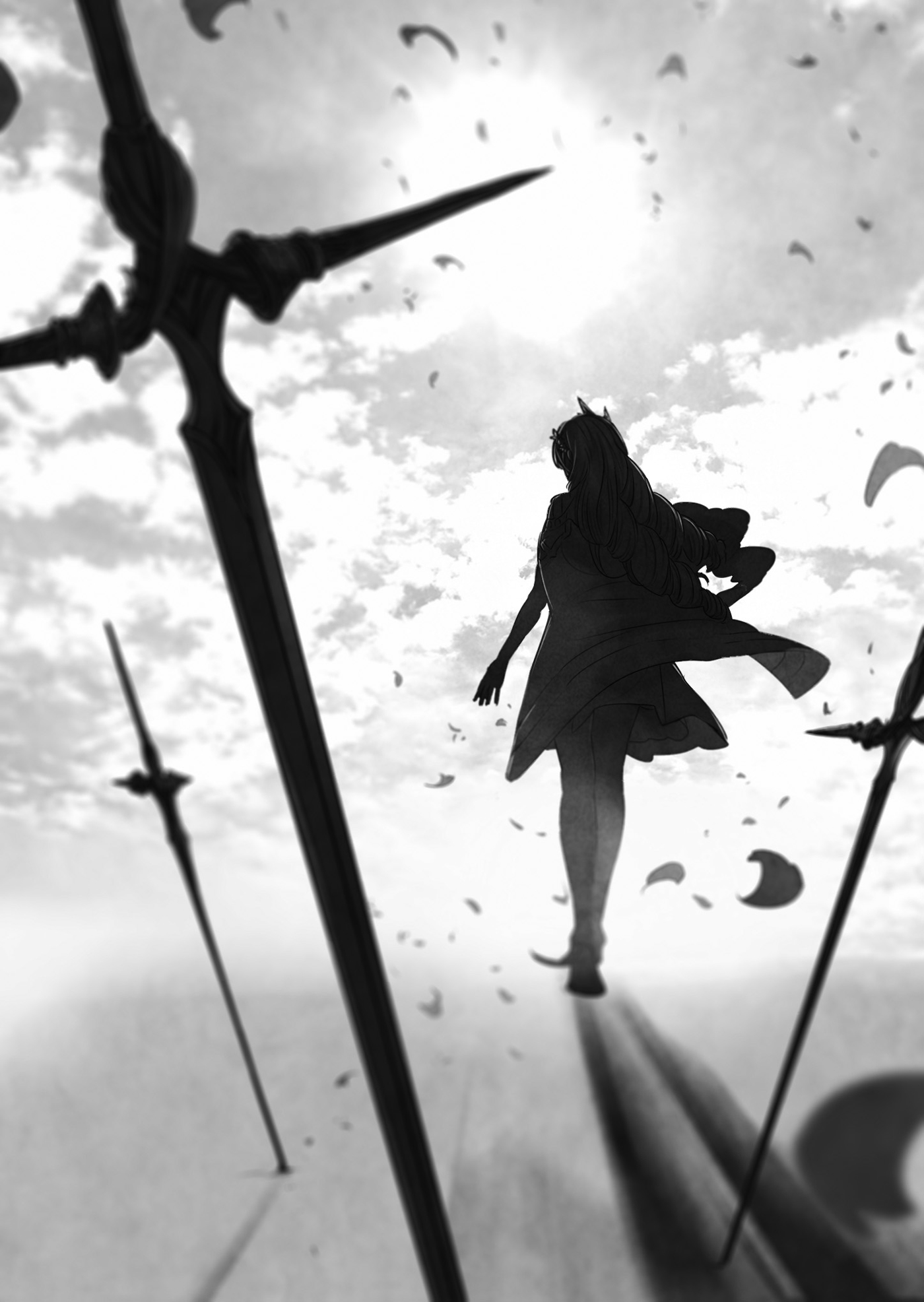
Suddenly, the girl had weapons in her hands. Where had they come from? They were shimmering, double-edged rapiers. An extremely simple creation—nothing more than a blade, a grip, and a hilt between them. There were no unnecessary flourishes; the only thing resembling a decoration was the rose worked into the crescent-shaped guard that ran from the bottom of the sword to the hilt to protect the girl’s fingers. That part, and that alone, was as red as if it had been drenched in blood.
She had one of these rapiers in each hand. It was impossible to say where she had pulled them from. She had certainly not been carrying a weapon as she walked along. She hadn’t even had a bag with her. It was as if she had produced the swords from thin air.
She thrust. The movement looked so natural, it was almost as if she were simply handing the sword to the demigod. She didn’t appear to have put strength into it, and indeed, the tip pierced the demigod only superficially. Nothing close to a fatal blow.
Surely it hadn’t even reached the demigod’s muscles. Maybe it had pierced the skin, but then again, maybe it had stopped at the layer of fur. The demigod’s fur was, after all, stronger than crude leather armor.
Obviously, the next thing to happen was that the creature would strike back with its claws. It would rend the girl into pieces.
Or should have.
“Hrr... rrrr... HRRRRRRAHHHHHH!!” The demigod fell backward, howling. No. Screaming. At the same time, something began to spew out of the rapier where it had been stopped. “ERRRAGGHHH!! GRRRRAHHH!!”
The girl didn’t move. The sword hadn’t moved either, from where it had stopped after administering that tiny pinprick. Yet somehow, the tip of the sword was now peeking out of the demigod’s back.
What was more, an instant later, rapier blades suddenly emerged from all over the demigod’s body.
“HRRRA...GGHH...”
The monster slumped over.
It only made sense that if someone had been pierced by a host of blades from inside their own body, they would die. That, at least, is what a human would expect. But the demigod continued to collapse.
Demigods weren’t made up from a single animal. In many cases, they attracted and covered themselves in creatures called familiars, the group forming a larger body that acted as a single living thing. Hence, killing the “core” animal released the bonds that held the familiars together. Then again, it was also possible that strength may well up from within one of the familiars and a new core may appear. Completely exterminating a demigod was difficult for that reason.
The girl, however, unflinchingly set about the business of cleaning up the familiars.
“Krah?!”
One familiar found itself pinned to the ground. The girl had tossed the sword from her left hand down into it. The other familiars seemed to see this as an excellent opportunity to escape, and scattered. The girl had only one blade left. Perhaps the familiars assumed that even if the girl gave chase, she could kill at most only one more of them.
How wrong they were.
Thock, thock, thock, thock, thock. One by one the familiars found themselves immobilized. It was a hideously easy slaughter.
The girl pierced one familiar after another with rapiers that came from they knew not where, looking as happy as if she were twirling in the rain under an umbrella. Closer inspection, however, revealed that these creatures had not simply been impaled. Each animal had holes all over its body. Just like the original demigod, they had been stabbed to death from the inside.
But... how?
What in the world had happened to them?
Where did so many swords—more than thirty of them—come from?
“Is that all of you?” the girl asked as she finished off the last creature. She looked as innocent as a small bird.
“I’m very sorry. I guess I’m the one who got something here.”
What could she possibly mean by that?
Suddenly, the wind came up. It wasn’t very strong, just enough to elicit a susurrus from the trees, yet all at once the impaled familiars dissipated, turned into dust that was carried off by the breeze. Nothing remained of them.
The girl set off walking again, relaxed. She left behind her more than thirty rapiers, standing like gravestones.
●
Before sunset, Yukinari and the others had left the Schillings mansion and returned to the sanctuary. Despite the imposing name, the sanctuary was not some huge stone building. It was on the large side, but it was just a house. It had been built for Yukinari, who now protected Friedland in lieu of an erdgod. Yukinari wasn’t always completely comfortable using the term “sanctuary,” but it seemed to make the most sense to the townspeople, so he went along with it.
“This has gotten to be a serious pain,” he muttered, sitting in a space known as the audience hall.
Yukinari had actually gone to interrogate Angela again before returning to the sanctuary. This time, to help avoid getting agitated, he had brought Veronika and Fiona with him, but the outcome had been the same.
Angela seemed to have grasped that insulting Yukinari himself was less effective than demeaning Jirina, and she had resumed her provocations. At length Yukinari had found himself unable to control himself again, but Veronika had stopped him when it appeared he might do the girl harm. It was a failure on his part. He had been right, though, to avoid bringing Dasa along. There was a good chance she would have simply left Angela with a Magnum bullet in her. Not just for insulting Dasa’s older sister, but for upsetting Yukinari as well.
Obviously, killing Angela wouldn’t get them anywhere. Even doing her any physical harm would be meaningless. Finally, Yukinari decided to suspend his interrogation for the time being, to give all of them a day or two.
“The question is how the Church—how the Missionary Order—is going to move against us.”
The thought reminded him that he didn’t have time to waste. The battle with Angela’s forces meant Yukinari and his allies had become proper enemies of the Missionary Order. They hadn’t utterly annihilated the two missionary units that attacked them, so there were survivors who could have, and presumably had, reported that Friedland had taken hostile action toward the True Church of Harris. It was possible that even Church headquarters already knew.
What was he supposed to do now?
Initially, Yukinari had hoped to get information from Angela about the city of Aldreil, where her forces had been based. He’d assumed she would know something useful, since Arlen Lansdowne, another missionary knight, had informed him of the surprising fact that the girl Angela was a vice captain with a civilizing expedition despite her youth.
If possible, he wanted to rescue Veronika’s companions who were being held in Aldreil. That was his first thought.
Yukinari had made several simple weapons, Durandalls and Derrringers, but the people of Friedland were still essentially amateurs when it came to making war. There was a group of men, a sort of community watch that served to protect the town from threats both internal and external, but they functioned mainly in an emergency capacity. Once upon a time, the town had been under the protection of the erdgod, leaving them now with few defenses against any vicious animals in the surrounding area. The community watch was no more than a sort of police force; it was certainly not an army prepared for battle.
If they were going to have to fight the Missionary Order, it would certainly be invaluable to have people on their side who fought for a living.
In this world, after the capital’s wars of unification, there had been no major conflicts for decades, centuries even. However, territorial skirmishes among local lords continued unabated, and that, he’d heard, often meant employment for mercenaries.
Yukinari had considered the possibility of attacking Aldreil in order to rescue Veronika’s mercenary friends. But he balked at the notion that after being so careful to fight only defensive battles, he would now deliberately attack another city.
Attacking was just another way of saying you were going there deliberately to kill people. Yes, of course there were cases where treachery opened the town’s gates bloodlessly, or an army’s sheer numbers so overwhelmed the opponent that they simply surrendered. But Yukinari, and Friedland, hardly had the strength for such things at that moment.
An effective attack against Aldreil—in other words, one that produced the fewest number of casualties on both sides—would hinge on information Angela could give him. But...
“She can’t be pretending... can she?”
Surely she wasn’t just pretending to have an unusual sexual fetish just to avoid being tortured. Especially not because she herself didn’t seem to realize what she was doing. Veronika had been right; Angela had a masochistic streak. Even if she had a pretext that allowed her not to think too hard about it: the belief that she was faithfully and fearlessly resisting Yukinari, the Church’s enemy, even as he held her captive.
But she had so clearly wanted him to slap her again. At least, it had looked that way to him. That was why she had tried so hard to anger him.
What a frustrating person to deal with. He could try torturing her, but it would only bring her pleasure. There were, of course, ways of inflicting so much pain that it would overwhelm even the most twisted desires, but Yukinari didn’t know how to go about it. What if he hurt her too much and killed her? Then everything would be lost. He also wasn’t sure if Angela was eager to be struck by anyone, or just Yukinari.
He supposed that it would be possible to figure out the answer to that question, but it bothered him that he should have to indulge his enemy’s fetish so much. Torture was supposed to be torture, but it could so easily turn into something she enjoyed. How absurd.
Yukinari sighed loudly.
A voice responded. “What is the matter?” A strange-looking girl peeked into the living area.
“Ulrike...”
The girl’s face was perfectly normal; indeed, she was adorable. She lacked nothing in cuteness. But her hair was green like new leaves, and on her head she had horns. There were two on top of her head and two toward the front. The two in front stuck out almost like the horns on a traditional Japanese demon, but the two behind split into several branches, giving an odd sense of volume. It gave her otherwise sweet face a certain intimidation factor.
It all made sense, more or less.
This girl was a god—or rather, the terminal of one.
Ulrike. That was what Yukinari normally called her, but it was only the name of the “terminal” girl; behind her was a plant-god. Specifically, Rostruch’s erdgod, Yggdra. Because Yggdra’s main body couldn’t move from where she was, Ulrike had come to Friedland as something like her representative.
“You look rather tired. Did something happen in Friedland?”
Ulrike hadn’t gone to the Schillings residence. Yukinari had asked her to keep an eye on the sanctuary while he was gone. Incidentally, there were plans to build a sanctuary for Yggdra’s representative next to Yukinari’s own residence, but since the defense of the town was being prioritized, the construction of Ulrike’s sanctuary had hardly begun, and for the time being she lived in Yukinari’s building.
“It’s the... the girl from the missionary knights. I didn’t manage to interrogate her...”
“You weren’t able?”
“Well, uh... How do I put this?” Yukinari tried to find the right words, but couldn’t think of a good way of saying it, so he decided to be blunt. “This woman is... I don’t know if you could call her a pervert. She’s got strange preferences. She enjoys being hit, so you can’t really intimidate her. Even torture probably wouldn’t be very effective.”
“Oh-ho,” Ulrike said with interest. And then...
“...Yuki.”
“Lord Yukinari.”
Dasa and Berta, apparently having finished changing clothes, entered the living area.
“What’s... wrong?”
“Oh, uh, nothing. We’re just talking about Angela again,” Yukinari said, scratching his cheek.
“Yukinari was telling me how she derives pleasure from being hit, so he’s unable to interrogate her,” Ulrike said. Then she cocked her head quizzically. “Perhaps I could turn her into a familiar?”
“Huh...?”
“We begin by killing her,” Ulrike said, with a complacent smile that made her look as innocent as a little bird. “Then, before the body rots, I place a seed—or more properly, a sprout—in it. Actually, she needn’t be killed. I can do it while she’s still alive. At any rate, it would turn her into one of my familiars, and I could control her. Her memories would remain largely intact, so I could make her tell you everything you wanted to know.”
“Whoa, whoa, whoa. Wait,” Yukinari said a bit frantically.
Ulrike, or rather Yggdra, was unusually warmhearted for an erdgod; she wasn’t given to the brutality of attacking or killing people. Still, she wasn’t human. She was, ultimately, a plant. She sometimes had a very different way of thinking from Yukinari, and was capable of nonchalantly saying things whose morality Yukinari would seriously have questioned.
“I don’t want to kill her.”
“No?” Ulrike blinked, perplexed. “I believed it was rather a good suggestion.”
“I’m not saying it wouldn’t be a way to get the information from her...”
Sometimes combat ended in death; that was unavoidable. But Yukinari hesitated to kill someone who wasn’t resisting. Angela would no doubt have laughed and reminded him of the slaughter of Church people he had committed in the capital. But he had been in a frenzy then, and now, with cold hindsight, he felt a certain guilt for it—and that was why he wanted to avoid death as much as possible, even the death of those associated with the Church.
“In that case,” Ulrike said, “the opposite would also be a possibility.”
“How do you mean, the opposite?”
“You say she takes pleasure in pain and torment? Then help her to enjoy herself.”
Again, her expression was all innocence. But she seemed to be thinking along slightly inhuman lines, a somewhat alien set of values.
“What do you mean by that?”
“Hit her, punch her, kick her. Perhaps break a finger or two. Cut off an ear. Hmm... What other ways are there to torture a human...?” Ulrike pondered for a moment. “Ah, rape! Yes, rape. If you raped her, would this not give her the greatest pleasure, on which account she might obey you? It would be what you humans call a win-win. A fine idea.”
“No, I really don’t think—”
“Or do you mean that this Angela girl is not to your own liking, Yukinari? It is my understanding that human males require emotional stimulation in order to pollinate a female.”
Yukinari could only put his head in his hands.
It was all too obvious that Yggdra wasn’t human. She wasn’t even an animal; and her way of thinking allowed her to tread with a smile on ground that humans would consider taboo. Even her use of the word “pollinate” was a sign of how different her views of sex were from most people’s. And the total lack of malice on her part made it difficult to decide how to respond.
I guess maybe plants aren’t big on morality, Yukinari thought.
The sexual behavior of plants, i.e. pollination, was typically not something that happened one-on-one, nor were plants able to freely choose their partners. That choice was made by the wind or by insects, without any deliberate action on the part of the plant.
Of course, by turning humans into familiars, Yggdra gained some notion of the human concept of sex and all that was associated with it, but the erdgod lacked any visceral understanding of it. But still...
“U-Um, Lord Yukinari...?” Berta, who had been quiet until then, spoke up as though she had just thought of something.
“Hm? What’s up? Something bothering you?” Yukinari turned to her like she was holding out a hand to help him out of a terrible swamp.
“Um, there’s... something I want to ask you, Lord Yukinari,” she said, all hesitation.
“Yeah?”
“Yes. Lord Yukinari......... Ahem.” She looked down at her knees for a moment. “Are we not to your preferences, Lord Yukinari...?”
“Say what?”
“I mean, your... your desires!” There was an unusual edge to her voice, a sense that she was resolved to this—there was a decisiveness in her tone that was very uncharacteristic of her. Perhaps she had had to work herself up to saying this, because immediately after, she flushed red and looked at the ground.
“Is this about what we were talking about at the Schillings place?” Yukinari sighed.
True, the subject had come up, but Yukinari had passed it off lightly, as though it were a joke. But Berta, it seemed, hadn’t been able to accept that. He hadn’t expected it to come back to haunt him like this. And then...
“Who’s... ‘we’? Does it in...clude me?” Dasa asked, raising an eyebrow.
“Yes. Us. All of us.”
“That’s surprising. I’m very much within Yuki’s preferences,” Dasa said. “He likes girls with glasses... and silver hair... I think.”
“Hey, wait. Don’t put words in my mouth,” Yukinari said.
“Am I... wrong...?”
The look Dasa gave him brought him up short.

Her expression and tone were as blasé as ever, but there were subtle hints of anxiety that Yukinari was able to discern.
It would have been a lie to say he didn’t see Dasa as a member of the opposite sex. It was the same with Berta. Even Ulrike—when he had seen her at her “morning exercises,” buck naked, he had felt a certain sexual stirring. He was an angel now, but if he wanted to, he could probably have sexual intercourse just like when he’d been human. But...
“Arrgh,” he groaned.
Berta wasn’t finished yet. “I’m the shrine maiden who’s been offered to you, so I want to help you in any way I can. If I can change myself to suit your tastes better, I will.”
“Look, it’s like I said before, it’s not your duty to—”
“This isn’t about duty!” Berta said hotly—before turning red again and looking at the ground.
He had never known Berta to be so forward. Something had changed within her. Now that Yukinari thought about it, he realized how long it had been since the two of them had talked face-to-face like this, what with Berta living at the Schillings mansion to look after Angela ever since the last battle. Maybe the key lay somewhere in that fight.
What am I gonna do?
Quite apart from his instinctual physical desires, Yukinari cared deeply for all the women in front of him. But was that reason enough to make love to them?
What the heck... is going on here...?
Despite the question he asked himself, Yukinari had a fairly good idea of the truth of things. He had trouble picturing himself in that sort of relationship with Dasa or Berta, or for that matter Ulrike. It just didn’t seem real, somehow.
Who would do, then? One image floated up in his mind...
An outstretched hand. Inviting. Healing.
The hand belonged to Jirina, the first person he’d seen when he arrived in this world, and it belonged to the last person he’d seen in his previous one.
Big Sis...
Amano Hatsune. His older sister by blood.
Of course, carnal desire for one’s own sister was not something that was normally smiled upon. So who was he to criticize Ulrike if her ideas seemed a little off?
But at the moment immediately before his “transference,” immediately before the Amano household was engulfed in flames, it had been full of a strange atmosphere. One that made common sense madness, and madness common sense. The place somehow turned systems of value on their head, caused taboos to lose their force.
Common sense wouldn’t make them happy. Common sense held no salvation for them.
Yukinari, and Hatsune, too, had understood that all too clearly.
That was why they had spent their days in each other’s arms. That was why—
Suddenly, it came to Yukinari. The guilt. The sense that he had been wrong.
Hatsune was long dead now. If that was his punishment for allowing improper feelings between siblings... then how could he go on to be happy with someone else, as though he had simply forgotten what happened?
“Well, uh...” he said. “Honestly, I’ve just been so busy lately... I haven’t had time to think about it.”
So he forced a smile onto his face, at least for now.
●
It was twilight. The day was ending, and everything was bathed in a golden light. It wasn’t the best time for humans, with their poor night vision, to be out and about. All the more so when they were outside the town walls, where there was no artificial illumination. Many of the most dangerous animals were nocturnal, and everyone who had busied themselves with farm work beyond the walls during the day tried to get home early.
Amongst the fields near Friedland...
A man and his wife were walking back to town. The man was wearing work clothes specked with the mud of the field.
“Well, that’s another day’s work done,” he said with a smile, resting his hoe on his shoulder. With his free hand he scratched just under his nose. The gesture was as innocent as a child’s. The mud on his hands wound up on his face.
“Hehe! Dear, now you’ve got mud on your face.”
“Oh! Have I, now?” The man kept smiling.
The woman, who appeared to be his wife, was wearing a plain but clean outfit. It seemed she had not been engaged in outdoor work. Most likely, she had come from town to see her husband home. A wife who would come all the way out to meet her partner was rare indeed; it spoke to what a happy couple they were.
They were still young, in their early twenties. As they walked, an odd distance could be sensed between them—a sort of mutual hesitance toward each other. They would need time yet before they could intuit each other’s thoughts. Most likely, they hadn’t been together for very long.
“Thanks for taking the trouble to come out and meet me every day.”
“Don’t worry. I enjoy it.”
“And that lunch you packed me—delicious!”
“Really? I’m so glad to hear it.”
“You came all the way out to give it to me. I could hardly complain about it, could I?”
“Well, everything tastes better fresh.”
Perhaps they still found it somewhat awkward to walk along together in silence, because the man kept up a steady stream of chatter. The touch of overeagerness in his tone was innocent and sweet.
It seemed the woman didn’t just come out to meet him at twilight; she brought him lunch during the day, too. She appeared to see this as a wife’s duty—or perhaps it was simply an excuse to see the man.
“Today we, ah, we worked on the irrigation ditch and the new fields Lord Yukinari suggested.”
“Oh, did you?” So far the woman had simply nodded along with what the man was saying, but now she asked a question of her own. “I’ve never met Lord Yukinari myself... What’s he like?”
“Lord Yukinari?!” the man said, his eyes aglow. “He’s a wonderful person. He’s taught us how to widen rivers and even change their paths! He suggested new fields and even fertilizer. I was worried when our previous erdgod passed, but I don’t think we need to be concerned about this autumn’s harvest at all!”
The man seemed more than a little excited. Apparently, he really did venerate Yukinari.
“Wow, really? Have you seen Lord Yukinari do one of his mighty works?”
“One of his mighty works? Yes!” the man replied excitedly. “Yes, I have! Oh, how I’ve seen it! Once, there was a boulder practically the size of our house. And he just touched it—his hand glowed, and a second later the whole thing turned to dust!”
He was quite enraptured by Yukinari—by Friedland’s new god. He happily answered all his wife’s questions about “Lord Yukinari.” He talked about the girls Berta and Dasa, who were always by Yukinari’s side; he told the story of how Yukinari himself had gone to Rostruch to initiate trade; and then he recounted the recent battle with the knights of the Missionary Order...
“Wow, really? What about Lady Ulrike, then?”
“Lady Ulrike? Ah, the child-goddess who’s with Lord Yukinari? She’s quite pleasant, that erdgod of Rostruch... In fact, I’m impressed you know her name,” he said, blinking. “In fact... Wait...”
“Yes? Is something wrong?”
“Now that I think about it, didn’t you... Didn’t you meet Lord Yukinari when he took off those things the missionaries had put on us? The Holy Mark?”
When the Missionary Order had first come to Friedland, they had deceived the townsfolk with their words and yoked the majority of them with the Holy Mark, a collar not unlike that which might be used on livestock. The symbol inscribed on it was indeed that of the True Church of Harris, but it was possible for the missionary knights to heat these collars, burning any townsperson who dared to go against them. And of course, the Marks could not be removed by the townspeople.
Yet Yukinari had removed them with nothing more than a touch of his hand. This was the first “mighty work” of his that many of the townspeople saw.
“H-Hey...” The man gave his wife a suspicious look; she hadn’t answered his question, but had fallen silent. “Why’re you so interested in Lord Yukinari, anyway...?”
The woman still didn’t respond, but only gave the man a gentle smile. The man blinked repeatedly at his wife.
“Wait... What the... You’re you, but... are you?” He was very confused. He didn’t quite understand why this all felt so wrong to him. Wasn’t that his wife’s face he was looking at? And yet... “...You... You...”
Humans judge other humans by more than just their most obvious facial features. Subtle changes of expression, posture, gesture, the way someone walks or even breathes—there are infinite combinations of these things, and together they mark out a unique individual. It might be possible to replicate each one, yet taken together, they might still look not quite right.
“Are you really... you?” The man felt like he was beginning to doubt his own sanity. But on the other hand, it was in some sense a display of how much he loved his wife. Even if he couldn’t put his finger on the tiny differences, he knew her so well that he could perceive them.
There was no one else around but the two of them. So there was no one to laugh at the man’s ridiculous question.
Even the woman in front of him stayed silent.
“It’s... It’s almost as if you’re...”
...someone else.
That was probably what he had intended to say. But what came out of his mouth next was not words, but blood.
“Hrggh—?”
The man looked at his own chest in surprise. When had it happened? It had occurred so suddenly, his astonishment was understandable. But now a long, thin sword was piercing him through. The blade had gone all the way into him, through his heart, and out his back. And his wife was holding the grip.
No. No she wasn’t. This woman wasn’t his wife.
The man dropped his hoe with a clatter.
“Wh— y— ...?”
He could form no more words.
The woman let go of the sword and the man fell to his knees, his blood dribbling down his chest, then fell farther to one side. The woman looked at him quietly for a moment. Then she murmured, “Oops, you found me out. Did I get too greedy?”
But the man on the ground couldn’t answer her. He had lost copious amounts of blood, and his death throes had begun; maybe he couldn’t even hear her. But if he could have, he would have realized his suspicions had been right: the woman’s voice was different from before, no longer that of his wife.
●
It was a beautiful, sunny afternoon. Fiona had been called out to a humble home on the outskirts of Friedland. This wasn’t a personal visit; it was a request to the deputy mayor from the community watch, which was charged with preserving public safety.
“I’m sorry to bother you when you’re so busy, Deputy Mayor,” said a middle-aged man, a manager in the community watch. He had a square face framed by his hair and a full beard. Combined with his large frame, he looked a bit like a bear standing on its hind legs. His name was Hans Cutel. His family had been leaders of the community watch for three generations.
“Not at all,” Fiona replied. “You said something about a strange happening...?”
“Yes. Let’s talk inside.” Hans nodded and gestured into the house.
As she walked along behind him, Fiona said, “I believe I heard someone died in this incident...”
“Yes, ma’am. If it were any normal death, we wouldn’t have to bother the deputy mayor with it. But in this case...”
As noted, Hans’s family had been part of the community watch since his grandfather’s time and had been involved in many of the goings-on in Friedland. They had encountered more than a few dead bodies and several murders in their work. They knew perfectly well how to deal with these cases, and a simple murder wouldn’t have required Fiona’s attention. The community watch could simply have dealt with everything itself. They would have submitted a report, and that would have been that.
“Ugh...”
No sooner had she entered the building than Fiona put a hand to her mouth. The air inside was thick, and—
“I’m sorry. We tried to get the air moving, but the smell won’t go away.” Hans didn’t seem especially bothered by it; perhaps he was already used to it.
“No, it’s all right. Don’t worry about it.” Fiona steeled herself and headed farther inside.
It was unmistakably the smell of death that pervaded the house—the smell of rotting flesh.
This was a fairly standard Friedlandian private dwelling. It contained all the things one would have seen in any house in the town, and nothing one wouldn’t. It was normalcy itself. Perhaps the furniture was on the new side. From what Fiona had heard on her way over, the house had belonged to a young married couple.
“Over here.”
She followed Hans’s guidance to a bedroom. On the bed in the center of the room lay a single corpse. The stench of rot was practically visible now; Fiona squinted. She had seen many things as the deputy mayor, and this was not her first corpse, but she had never seen one so thoroughly decomposed.
Decomposition was to be expected when someone died in the mountains or drowned in a river—someplace where it might take time for the body to be discovered. But right here in town, in the person’s own house—it was very strange.
Fiona found it difficult to want to get close enough to examine the particulars of the corpse. From what she could see, though, the chest area was especially dark. The color didn’t suggest decomposition so much as a large amount of dried blood.
Had the person vomited blood? Or...
“Did they die of illness? Or was it murder...?”
It was hard to imagine someone dying accidentally while lying in bed. Friedland was a comparatively peaceful town, but anywhere there were large gatherings of humans, it would be impossible to avoid serious arguments. And unfortunately, it would be impossible to go without the sort of fighting that sometimes led to killing.
“Murder,” Hans confirmed. “There’s an external wound—looks like a bladed weapon. On the left side of the chest. One thrust, straight through the heart.” He pointed at his own chest.
Hans must have brought Fiona to this room because he wanted her to see the body for herself. Seeing that it might be too hard for her to stay any longer, he ushered her back out of the bedroom.
“The body is that of the man who lived in this house.”
“So he was killed in his own home.”
“That’s still under investigation, ma’am. There are some traces of blood in the hallway, so it’s possible he was killed somewhere else and then moved here.” Hans sounded calm, practically dispassionate. So he and his people had already examined not just the corpse, but the inside of the house. “He was recently married. And speaking of his wife—”
“Let me guess. Missing?”
“As you surmise,” Hans nodded.
If his wife had been around, the body might have been noticed sooner.
“Meaning there’s some chance she was abducted?” Fiona said.
“No, ma’am. That would certainly make things simpler.” Hans frowned with his bearded face. “As it happens, this man was working on the development of one of our new fields outside town. Apparently, he failed to show up for work several days in a row.”
The other people working on the same project had become concerned about the man’s absence, and had gone to his house to check on him. As Hans told it, this had been seven days earlier.
“When they showed up, his wife came to the door and said her husband was indisposed, had a cold.”
Fiona had a bad feeling as she listened to Hans’s story. Seven days ago. Not ten or even twelve.
“I’m no specialist,” Fiona said, trying not to vomit at the stench even as she spoke. “But I would have sworn that body had been there at least ten days...”
“We thought the very same, Deputy Mayor. And it so happens that the man’s unexplained absences from work began exactly ten days ago.”
Fiona didn’t say anything. In other words, if this man had died ten days earlier, and seven days earlier his wife had met the visiting villagers, then she knew of the man’s death and lied to them. Or, wait. If the man had been killed somewhere else and brought to his house only later, it was possible the woman didn’t know about her husband’s death when she spoke to his coworkers. But if so, he would still have been missing for three days at that point. And yet she told them he had a cold.
The lie had been enough to get the man’s colleagues to go on their way. But when he still hadn’t shown up for work four days later, they began to get suspicious. If his cold wasn’t getting any better, he might at least send word. They worried that perhaps the illness had spread to his wife and that both of them were indisposed, so the colleagues went back to the man’s house.
This time, however, neither the man nor his wife came to the door. It was locked soundly, but a neighbor said they had seen the man’s wife leaving the house that morning.
Still not knowing what had happened, the man’s colleagues left again.
“It was another three days after that,” Hans said as he led Fiona out of the house. “In other words, today. The men came back one more time. They said they could smell the stench of death the moment they got to the door.”
In other words, the stink of the decaying corpse had well and truly permeated the entire house. The door was still firmly locked, but the smell leaked out even through the door and windows. Now sure that something was amiss, the fellow workers enlisted a neighbor’s help to break the door open, and when they got inside, they had discovered the body.
“The most obvious theory is that there was some kind of trouble between the two of them, and the wife ended up killing her husband. After that, she tried to throw off his coworkers by saying he was ill.”
“Yes, that makes sense.”
“That means that in the most obvious theory, the wife is the murderer. But the strange thing about that would be that she then lived with the body for several days.”
“Hmm...”
True, that behavior didn’t make a lot of sense. Had she wanted to hide the fact that she’d killed her husband? But it would have been obvious that she would be charged with murder, so why wouldn’t she leave as quickly as possible? Friedland may have been a frontier town, but there were still plenty of places for a determined fugitive to hide. She could have bided her time and joined up with a merchant caravan heading to another town when the opportunity arose.
There was an eerie quality to all this that Fiona couldn’t quite put her finger on. Had the wife gone mad after she killed her husband?
“We don’t know what something like this might lead to,” Hans said in a subdued tone. “The community watch will go on the alert, but... perhaps, as the deputy mayor, you could make sure that Friedland as a whole is closely guarded?”
“Right.”
It still wasn’t certain that the woman was the killer, so it wouldn’t do to carelessly make the incident public. But there were people and organizations besides the community watch that contributed to public safety. It would, she supposed, be possible to at least consult with them. Yukinari in particular—he didn’t just have immense power, but was pretty intelligent. He might be able not only to come up with a good way of keeping the town safe; he might even be able to solve the case—notice something that Fiona and the others had missed, perhaps.
“All right. I’ll talk to some people I think can help us.”
“Good. Thank you,” Hans said with a bow.
Fiona offered some encouraging words to members of the community watch waiting outside, then began walking back to her mansion.
●
Yukinari was Friedland’s god.
Fiona and the residents of the town had looked to him to replace their erdgod, whom Yukinari, as it happened, had killed. And part of being their deity was protecting the town and its environs.
An erdgod was an animal who, for one reason or another, had become intelligent and begun to raise its spiritual power, finally forming a spiritual bond with the land that was its territory. As a result, erdgods were immensely powerful and effectively immortal, and they could manipulate the land they were bonded to almost like a part of themselves.
Even a relatively fallow place could be made somewhat more fertile, less prone to disaster, by being joined with an erdgod. That was why humans worshipped these creatures as “gods of the land,” or erdgods. These entities did things that were beyond human power. An erdgod could make an area habitable for humans.
However, being joined to the land also meant that an erdgod would be absorbed by its territory. In order to control its own massive “body,” an erdgod’s consciousness gradually got spread thinner and thinner, becoming a part of the land. Eventually its own existence began to fade as the erdgod became unable to hold onto the thoughts and feelings that made it itself.
In order to prevent this dissipation, erdgods sought to preserve their spiritual power, their intelligence. There were several ways to do this, but the simplest and most effective was to eat another intelligent creature. And there was one creature with both the most innate spiritual power and the largest numbers: humans.
For this reason, erdgods would demand living sacrifices from those who lived in their territory. And in order to ensure a steady supply of these sacrifices, the deity would protect its humans from attacks by other monsters, specifically xenobeasts and the demigods. It would attack any such creature that got near its land.
Yukinari had killed one of these erdgods.
The natural result was that all the xenobeasts and demigods that had previously been kept out by the erdgod now flooded Friedland. If a xenobeast ate enough humans and increased its spiritual power enough, it could become one of the more powerful demigods; after reaching the status of demigod, it could seek to become an erdgod.
But there were no guarantees that the next erdgod would be anything like the previous one. Maybe it would have a more voracious appetite, demand five or ten times as many sacrifices as the old deity. Rather than make such a dangerous gamble, Fiona and the townspeople considered it wiser to worship Yukinari as their new god and ask him to assume the role of erdgod.
So it was that Yukinari guarded Friedland and drove away or destroyed any xenobeasts or demigods that dared to attack.
“Why, you—!”
Yukinari made a sideward sweep with Durandall—his Winchester M92 Randall Custom, a carbine modified to include a sword. But his opponent was quicker and nimbler than they appeared, dodging his attack. The enemy leaped backward, opening up space.
“Looks like this is a bigger fish than I realized,” Yukinari muttered, glancing down at where his shirt had been torn by the creature’s claws.
At the moment, Yukinari was at a bit of a distance from Friedland. He was patrolling around the outside of the fields, which ran around the outskirts of the town. He was riding on the two-wheeled—or rather, four-wheeled vehicle he had created, Sleipnir.
Despite its large size, Sleipnir was really modeled on a motorcycle and could not seat more than two people, so only Dasa was with Yukinari.
And on this patrol, the two of them had discovered a xenobeast.
It was a four-legged creature covered in black fur. Perhaps it had been a wolf at one point. It was hard to tell now, because it was close to twice the size of an ordinary wolf. In addition, its head was no longer wolf-like, having become something that would allow it to open its mouth wider, perhaps so it could eat more prey more efficiently. Snakes sometimes eat things many times larger than themselves; in the same way, this monster looked like it could swallow a small human whole.
Yet despite how bizarre it was, it also somehow looked... almost human. Not quite the way a werewolf did; it was a sort of man-beast.
A more hideous creature could hardly have been found. Anybody in their right mind who saw it might well have fainted clean away. But this did not mean that Yukinari necessarily found it an intimidating opponent.
Durandall was chambered with .44 Magnum rounds with special heads designed for hunting. He could also have used overloaded shells for extra piercing power, but only if he was prepared to damage the gun in the process. Long-distance sniping was of course impossible, but he did have a way of attacking the beast without having to go toe-to-toe with it.
But today, Yukinari’s response had been too late; the monster had jumped on him from the treetops. Hence he had found his shirt torn and scratches left on his shoulder before he could even get off a shot.
“Yuki...!” Dasa exclaimed, shocked.
Yukinari stopped Sleipnir and dismounted.
“Stay there,” he ordered. Dasa gave a small nod.
Perhaps the xenobeast intended to use hit-and-run tactics, because it had already distanced itself from Yukinari and Dasa, hiding once more amongst the vegetation. But that didn’t mean it had run away. The sound of crunching leaves was still close.
It hadn’t given up on eating them.
Yukinari moved forward, Durandall in hand.
“Come on out. I’m right here,” he said to the bushes.
An instant later—
Rrroowr!
There was a sharp, short howl, and the xenobeast jumped out of the underbrush. Yukinari brought up his empty left hand. The xenobeast opened its gaping maw to eat him. Its fangs tore his sleeve; it swallowed his fist, then his elbow, and then its jaws were about to close...
“...Hey.”
They never got the chance.
Yukinari’s hand, now deep down the monster’s throat, had a firm grip on something inside the beast. The monster shook with surprise and went stiff.
They say that if you stick your arm in a dog’s mouth and grab its tongue, its whole body becomes unable to move. The xenobeast was rather doglike. Yukinari didn’t know whether that meant it would have a similar weak point, but he figured it wouldn’t enjoy having someone’s arm down its gullet, grabbing some internal organ in any case.
In general, xenobeasts were formed of animals that had been drawn to a single core creature. Thus, like worms and some reptiles, they could split themselves apart; this meant the xenobeast could break itself up in order to run from Yukinari.
Yukinari, of course, was not about to let it do that.
Yukinari brought Durandall to bear, stabbing it into the creature. When he was sure it was mostly buried in the xenobeast, he fired again.
There was a roar.
A .44 Magnum round hit the xenobeast from closer than point-blank range. But one shot wasn’t enough. Yukinari let go of Durandall’s grip for a moment, pulling the loading lever and firing five more rounds into his enemy.
Vrrahhh!
This evidently had some effect, or perhaps he had landed a lucky shot on the core creature. The xenobeast lost strength and began to twitch. Yukinari pulled his left arm out of the creature’s mouth—but then frowned.
“Yuki, are you... okay?”
Dasa had Red Chili in one hand. She must have meant to back him up if the need arose.
“Sure. I guess I don’t smell so great now,” he said, looking down at his arm.
“Yuki, you mustn’t let... down your guard.”
“Yeah, maybe I was a little rash,” he said with a grimace.
It was more than six months now since he’d come to Friedland. Maybe it was the fact that he went on these patrols every day, but he couldn’t deny he had relaxed a little too much.
Suddenly, though, Yukinari went quiet.
“Yuki? What’s wrong?”
“Hang on a second.” He was studying the xenobeast intently where it lay on the ground. This was itself a matter of not letting his guard down. Wild animals’ survival instinct sometimes outdo human intelligence. Some animals are known to play dead, making it hard to tell at a glance whether they are really gone or not.
Yukinari stabbed Durandall into his opponent again, but there was no response. He doubted even an animal pretending to be dead could dampen its reactions that much. He scratched the monster’s skin, but the blood was slow to come out. Proof the heart had stopped.
“Oh...” Dasa said.
The source of her surprise was the gentle wumph as the body collapsed. With the spiritual bond broken, it divided back into its constituent animals. Yukinari jabbed each one with Durandall, to be sure the core animal was really dead, but there was no reaction from any of them.
Only then did Yukinari finally set his weapon on top of Sleipnir. He kneeled down by the largest corpse and used both hands to pry its jaws open.
“I thought so,” he nodded. He pulled out whatever it was he had apparently expected.
“An armband...?” Dasa looked at it. It was covered in the xenobeast’s saliva. Made of pebbles and metal, it had been stuck between the monster’s teeth.
“I felt it when I had my arm in there,” Yukinari said.
“It belonged to someone... he ate...?”
“Probably.” Yukinari frowned. “Maybe someone just dropped it, but I can’t imagine a xenobeast going out of its way to eat an armband off the ground.”
“That’s true.”
“In other words, there’s a good chance that it ate the owner of this band while he or she was wearing it.” The band got stuck in its teeth and avoided being digested.
After a moment’s silence, Yukinari said, “I’m not really looking forward to this, but...” Then, he grabbed Durandall again and plunged it into the monster’s belly. “Since it’s already dead, I don’t think there should be any spray of blood or anything, but stand back. Just in case.”
“Mn...”
Dasa obediently retreated and watched as Yukinari opened the monster’s stomach with his weapon. When the tear was wide enough, he set the gun aside once more and began feeling in the opening with his hands.
“Ugh...” His face contorted at the ripe stench that emerged from the creature’s stomach as his fingers sought something within. He found what he was looking for, cut it out with Durandall, and finally produced precisely what he expected: a human skull, or at least part of one.
“Is it someone from Friedland...?” Dasa asked from her spot a few paces away.
“We don’t know exactly what this guy’s territory was, but I have to think any bones would have been completely digested in the time it took him to come from another town or village.”
Truth be told, even the skull wasn’t all there. An inventory of the rest of the stomach’s contents revealed pieces of a pelvic bone and a femur, relatively sturdy bones. Everything else appeared to have been digested already. Yukinari suspected that the process would have taken more than a day or two...
“What’s this? A ring...?” There was something else left along with the bones; maybe it had survived because it was made of metal. “Maybe these two things will be enough to identify the owner.”
It wasn’t a mass-produced item, and close inspection revealed what appeared to be a name carved on the inside. It was extremely dirty, hard to make out at the moment, but a bit of cleaning would make it legible. And once they knew who the items belonged to, perhaps the effects could be returned to their family.
“If they’re from Friedland, I’m responsible,” Yukinari murmured.
Obviously, he couldn’t patrol everything outside the town and the fields, nor could he look out for every single person who might carelessly wander away to some dangerous place. And yet he couldn’t help thinking that if he had been stronger, strong enough that the xenobeasts and demigods knew to stay away from his territory, he might have prevented this person from becoming a victim.
“It’s not your... fault, Yuki.”
“...Thanks.”
He wiped off his left arm with a cloth and then remounted Sleipnir.
●
When he got back to Friedland, Yukinari went straight to the Schillings residence.
This was actually his normal procedure. Yukinari was Friedland’s god, and with his unusual hair and eye color, along with his rather unique style of dress, he tended to stand out. Or rather, he naturally drew the attention of the townspeople. The citizens were apt to think that any time their god went out, it was for some important reason; anticipation and anxiety would spread among them. Even if Yukinari felt he was simply going for a walk, the people of the town would assume there was some deep meaning to his excursion.
And so he had come to begin and end his trips at Fiona’s mansion, as a way of telling people that this was just a normal patrol. Since arriving in Friedland, Yukinari had realized that even gods had problems of their own.
Of course...
“There’s this thing, too,” he muttered as he parked Sleipnir in front of the mansion and hopped off, intensely aware of the small leather pouch at his hip. It contained, of course, the armband and ring he had recovered from the xenobeast. The leftover bones he had wrapped separately and loaded on Sleipnir. He figured he would have them interred at Friedland’s cemetery later.
Fiona was the town’s deputy mayor. Information naturally came to her. She might not know all the details, but if someone had gone missing in town, she should have at least gotten a report about it. It might give Yukinari the hint he needed to figure out who owned this jewelry.
He greeted the servant easily, as he always did when entering the Schillings mansion.
“Hm?”
In the living room, he found Berta and Ulrike. Berta, he assumed, was once more there to take care of Angela, who was still in the underground room, and Ulrike must have accompanied her from the sanctuary as a guard. So it wasn’t necessarily surprising to see them both there, but Fiona was in the room, too, and seemed to be conferring with them about something.
“What’s going on? Something wrong?” Yukinari asked, perplexed by the somber atmosphere.
Fiona looked up, apparently startled by his voice. “Yukinari, perfect timing,” she said.
“It is?” These visits to the mansion were, as mentioned, completely routine. “Did something happen?”
“Yes, that’s what—” Fiona gave a small shake of her head. “I’m sorry. First, tell us about your patrol.”
Evidently she assumed he would give his typical report of “nothing unusual.” She could have easily asked him to put it off; that she didn’t was a sign of the deputy mayor’s methodical nature.
“I found something a little strange myself,” Yukinari said. Feeling almost apologetic, he produced the armband and ring from his pouch and set them on the table.
“What’s this?” Fiona asked. “It looks like... an armband and... a ring?”
“Yeah. Actually...” And Yukinari went on to give them the short version of events. How he had been attacked by a xenobeast. How he had defeated the monster without trouble but found bones inside it that appeared to be human. How these accessories had also been in there. His guess from the condition of the bones and ornaments was that the victim had not been very far away when they were eaten. In other words, that there was a good chance it was someone from Friedland.
Fiona listened to him with a pained expression on her face—but when Yukinari told her the name carved into the ring, she blanched.
“Yukinari. Are you sure about that?”
“Er... Yeah. I suspect it’s... the name of whoever owned this ring. I can’t be certain, though.” Somewhat intimidated by Fiona’s reaction, Yukinari picked up the ring and handed it to her. He had already washed off the xenobeast’s saliva and dried the ring, so it no longer looked repulsively dirty.
Fiona studied the inscription on the inside of the ring.
“What’s going on?” Yukinari asked.
“I never expected to get the proof from inside of a monster,” Fiona muttered after a minute. Then she looked at Yukinari as if just remembering he was there. “I’ve actually been looking for this woman myself. The issue I wanted to address has to do with her...”
“I knew it. Missing? Her family must be worried.” Yukinari felt a stab of guilt.
But Fiona said, “No, they’re not.”
“Say what...?”
What could it be, then?
“Actually, something strange is happening in town,” Fiona said. “Or I should say, happened in town.” She related how a man’s rotting corpse had been found in a certain home, and the man’s wife might be the killer. “So hypothetically, if she is the killer, we thought it would be more dangerous to leave someone who would do such a strange thing at large.”
And Yukinari, through sheer chance, had discovered what seemed to be the remains of the same woman.
“So maybe that xenobeast attacked her while she was trying to flee. Either way, she won’t be able to cause any more harm.” There was just a hint of relief on Fiona’s face.
She had wanted to talk to Yukinari precisely about the search for this woman and the possibility of strengthening the town’s safety measures. But with the suspect deceased, there would be no more need for concern. And yet...
“Wait, hang on,” Yukinari said with a frown. “All we’re sure about is the name on the ring. We don’t know whether the bones I found in that monster belong to the woman or not.”
He was thinking back to the detective novels he had read in his previous world, when he had been a normal high schooler. This could be misdirection, a deliberate attempt to send an investigation off in the wrong direction. The body and the personal effects were ultimately separate things. Just because they’d been found together didn’t mean the remains belonged to the woman in question. Maybe the woman had been trying to throw off her pursuers by dressing some body in her own clothes and feeding it to the xenobeast.
And then there was...
“The date.”
The mutter came not from Yukinari but from Dasa.
“What about the date?” Fiona asked.
“The man was killed ten... days ago,” Dasa said. “The woman received... visitors seven days ago. And she was last seen three days ago.” She calmly laid out the facts. “But the remains... we found in that xenobeast must... be at least seven days old.”
“Oh!” Fiona exclaimed. “Are you sure about that, though?”
“Seven days at the very least,” Dasa said. “Perhaps more than ten days. Bones... are remarkably hard to digest. In my sister’s... laboratory, we learned that when we had to dispose of... the bodies we used in our experiments.”
According to Dasa, the alchemist Jirina had created several homunculi, artificial humans, before Yukinari. But although they were physically similar to humans, they lacked any spiritual power or sense of self; in addition, their hearts did not beat on their own. They were, practically speaking, corpses—and because they were of no use, the Church secretly ordered them disposed of.
But because chopping them up or burning them would attract too much attention, Jirina chose to dissolve the bodies in acid. It was almost as if the corpses were being digested in an artificial stomach. Even so, it took more than ten days before everything was gone.
Nobody knew if a xenobeast’s stomach contained exactly the same chemicals, so it was impossible to say for certain, but it seemed unlikely that the creature’s stomach acid would be more powerful than the agent Jirina used. Meaning...
“It doesn’t add up,” Fiona muttered.
The man had been killed about ten days earlier. Seven days earlier, his wife had appeared at the door of their house and told visitors the man was indisposed with a cold; that was why she was a suspect to begin with. And finally, an eyewitness had last seen her three days prior. Yet it seemed that at least seven days had passed since the owner of the ring had been eaten by the xenobeast.
So who was the woman the eyewitness had seen?
For that matter, if the remains did belong to the woman, and if she had been eaten by the xenobeast more than ten days ago, that would mean she was already dead when her husband was killed.
“C-Could she have been... a ghost...?” Berta asked fearfully.
I guess even in a world where monsters literally walk the earth, ghosts are still scary, Yukinari thought. But maybe monsters and ghosts were scary for different reasons. The terror of xenobeasts and demigods and erdgods was an instinctive response rooted in the desire to avoid death. But the fear of ghosts was something more intellectual—they defied normal expectations about the world, made people question their own place. Life and death. Existence and nonexistence. Ghosts made even these baseline assumptions seem questionable.
“I don’t personally believe in ghosts, but let’s say for the sake of argument that they exist,” Yukinari said. Fiona, Dasa, Berta and Ulrike all looked at him. “I mean, maybe she would be less a ghost than the living dead...”
“The living... dead...?” Dasa asked, mystified.
Of all those present, Dasa was the most versed in this kind of rare knowledge, but even she didn’t seem to know what a zombie was.
“Sorry. It’s, uh... It’s when a living thing dies, but then... somehow starts to move again...” It turned out to be surprisingly difficult to explain.
In this world, where medical science and the like were not much advanced, even the definition of death itself was somewhat ambiguous. Even in Yukinari’s previous world, there had been debate about whether it was brain death or the stoppage of the heart that constituted true death, and even once brain waves ceased or the heart was no longer beating, the cells of the body survived a short while longer. If those cells were quickly transferred to another living person, they could even go on without dying.
Obviously, none of that would mean anything to the people in this room. If they didn’t understand when he called it a “moving corpse,” what more could he say? But then—
“It is something like me!” Ulrike broke in. She seemed oddly proud of this conclusion. “I am deceased as a living thing, but as a plant I continue to live and move!”
“Er— well— yeah, I guess that’s true...”
“Moving corpse” wasn’t exactly a compliment, but Ulrike looked so pleased that Yukinari refrained from pointing this out. He decided they had gotten too far into the weeds; it was time to move the conversation along.
“But anyway,” he said, “where would the remains have been?”
“Where...? Oh!” Berta seemed to grasp what he was getting at. Until that morning, the remains with the ring had been digesting inside a xenobeast’s stomach. Even if the corpse had gotten up and walked around, even if it had been able to speak—even if any of this were possible or had happened, it still couldn’t be the woman in question.
Well then, what about a mass of spiritual power? In essence, the ghost question again.
But typically, spiritual power couldn’t exist on its own. It required some vessel, and if it were to overflow that vessel, it would soon dissipate. The vessel was a living body, along with the red liquid—Holy Oil—used by the True Church of Harris. Spiritual power was a real and recognized phenomenon in this world, but it wasn’t exactly the same as a ghost.
Even if, hypothetically, spiritual power could have appeared as a ghost under some particular circumstances, how could it have killed the husband? And even if that were possible, it was hard to imagine the ghost would simply run him through once with something sharp. It would have been incorporeal precisely because it had no living vessel.
“And that means...” Fiona murmured, cocking her head, “it’s not her...?”
“That seems like the best explanation,” Yukinari said.
The wife had put her ring on someone else and fed them to the xenobeast. After that, she killed her husband and disappeared—this at least would explain the things people had seen and heard.
“I just don’t know why,” Yukinari went on.
Why go to all that trouble? After all, it was sheer dumb luck that Yukinari had defeated the xenobeast and noticed that it had eaten someone. Misdirection didn’t work if nobody ever noticed it. If she’d only wanted to hide her husband’s death, why feed someone else to the monster? Why not just give it her husband?
So were these just the inexplicable actions of a disturbed individual? Or...
Yukinari didn’t say anything. He couldn’t think of anything else. With no one able to come up with an explanation that made any real sense, a chill and unnatural silence settled over the living area of the Schillings mansion.