Interlude: The Atonement of a Coward
Interlude: The Atonement of a Coward
With the hour growing late, Guido let Volf take the carriage first to be dropped off at the barracks while he remained at the restaurant. Keeping up with his brother’s pace of drinking had left him ever so slightly woozy. Still, it wasn’t a bad feeling—quite pleasant, in fact.
As his younger brother had waved him goodbye with a cheerful smile, he couldn’t help noticing how tall Volf had grown, far taller now than himself. He tried to recall just when it was that Volf had overtaken him, only to find, with a tight twinge deep in his chest, that he had no such memory.
Guido, the eldest son of Earl Scalfarotto, had three younger brothers. The closest to him in age was Fabio, the son of the earl’s second wife. After him was Eraldo, a full brother to Guido. Finally, there was Volfred, the only son of the earl’s third wife. Despite their gaps in age and different mothers, Guido had always thought they’d gotten along remarkably well. Even their mothers were always amiable. They were much closer to the four boys than to their husband, whose duties kept him largely absent throughout his sons’ childhoods.
Guido had been in elementary school when he’d heard that his father, Renato, intended to take a third wife. The news hadn’t come as a shock. Around that time, talk had first begun to circulate of the next Earl Scalfarotto—namely, Guido—being made a marquis. In his mind, it made sense for his father to establish further connections with the high-ranking nobility. However, the day he was introduced to Vanessa saw all of his expectations defied. This woman was no noble, but a commoner, the daughter of a baron conferred with a nonhereditary title. She was young, and a knight, to boot.
With her lustrous ebony hair, snow-white skin, dark and mysterious eyes, and exquisite, doll-like features, her beauty was arresting. However, socially speaking, she was no proper match for an earl. She hadn’t so much as been adopted by a noble. As he watched the care and tenderness with which his father attended to Vanessa, a suspicion came over him. Could his father, at his age, have fallen in love? It was difficult to believe. It was only after that, when he learned that Vanessa had been the personal bodyguard of Altea Gastoni and was proficient in ice magic—even able to produce an ice sword—that Guido became somewhat more convinced of her merits.
Unfortunately, his younger brother Fabio appeared not to share that conviction. Fabio harbored a wish to become a knight instead of a mage. He’d been clearly unimpressed with his father’s choice of wife.
Soon after Vanessa came to live on the estate, he said to her, “If you truly are a knight, I should like to spar with you.”
Guido had joined in, half-jokingly. “As would I. To spar with a mystic knight is a rare opportunity.”
Eraldo sensibly kept silent, but simply due to his being there, he was roped in as well. Fabio and Guido would be punished for their impudence soon after, made to spend their allowance on magic textbooks.
“I wonder which of us ought to meet you first. It may only last one round,” Fabio had sneered, to which Vanessa had offered a serene smile.
“Then you may all come at once.”
Back then, all three of them were still just young boys. Born into the Scalfarotto household and taught magic from the moment they could understand it, they were proud, precocious children. Guido, for his part, had imagined his water magic to be quite powerful. Fabio had received some training in swordsmanship and showed promise.
As they stood before Vanessa in the back garden, they were confident that with their powers combined, the three of them couldn’t possibly lose. They attacked with all guns blazing, but the battle, naturally, was over before it had begun. Vanessa didn’t pull her punches, and she blew them away swiftly and decisively. Anyone watching would have laughed themselves silly at such a spectacular defeat.
Deftly evading their water magic and swords, she produced a platform of ice and leaped from it high into the air. None of them could have foreseen her next move as she bore down on them, bringing her fists down hard upon their heads. Vanessa fought entirely bare-handed, not even bothering with a mock sword. Within no more than a couple of minutes, all three boys were cowering on the ground, clutching their aching skulls.
“Honestly, is this the best you Scalfarotto boys have to offer?” she nonchalantly chided them afterward.
Painful as the experience was, Guido was filled with admiration for her. His feelings were not so positive when, early the next morning, he and his brothers were dragged out for training. They had to build their stamina, Vanessa said as she had them run laps. She declared that no son of Earl Scalfarotto should be without basic combat training and set about teaching them that too. The boys rarely went to bed without aching muscles after that day.
Guido recalled bearing a tiny bit of resentment toward their father, who had obviously given his blessing to the whole endeavor. His and Fabio’s mothers had merely looked on in amusement. Of course, it wasn’t all hardship; Fabio, at least, had seemed delighted to receive the extra instruction in swordsmanship.
At the beginning of the boys’ training regime, knights had kept watch over them to prevent accidents, but they, too, were roped in somewhere along the way. Guido was given a renewed appreciation for Vanessa’s strength when he saw that even those knights couldn’t best her in sparring. As he came to know her better, he found that she was utterly guileless—unsophisticated, some might say. She took whatever she was told at face value, often struggling to read between the lines. However, it was thanks to that ignoble honesty that the boys felt comfortable talking to her openly.
The next year, Vanessa bore the earl a fourth son: Volfred. He was an enchanting child with the countenance of an angel. He took after his mother, sharing her ebony hair and snow-white skin, though his eyes were a rich golden hue. His brothers were slightly disappointed not to have a little sister, but they promised they would never tell him so and would always look after him. As the eldest, Guido had been rather proud of shouldering the responsibility to protect all of his younger brothers.
Even their father must have been unable to resist Volfred’s charm. In spite of his hellish schedule that kept him away from early morning until late in the evening, he never failed to pay his newborn son a visit at the end of the day.
“He never puts the light on and he creeps in so stealthily; I’m never sure whether it’s Lord Renato or a burglar!” Vanessa had complained, laughing uproariously with the earl’s other wives.
Volfred grew rapidly. His older brothers began calling him “Volf” for short. Although they were burdened with schoolwork and their lessons on noble etiquette, they played with him often. Unfortunately, it transpired that Volf didn’t possess the water magic the Scalfarotto line was known for. He had none at all, in fact, aside from common strengthening magic. Cruel whispers began to travel around the estate.
“A Scalfarotto and not a drop of water magic in him. His parents must be so disappointed.”
“I can’t fathom how they could’ve produced a child like that.”
Volf was still too young to understand what was being said about him and why, but Guido wasn’t, and he challenged the gossips whenever he could. Although he was older, he was still a child, and most simply fobbed him off with vague excuses. Guido, Fabio, and Eraldo swore that if these foolish remarks pursued Volf as he grew older, they would stand up for him and defend him at every opportunity.
Heir to the Scalfarotto estate, with a wish to become an elite mage, Guido found his days growing ever more hectic, eaten up with lessons and study. His brothers were soon absorbed in pursuits of their own. Fabio, increasingly infatuated with the sword, sparred with the household’s bodyguards almost daily. Eraldo devoted himself to books and research, hoping to gain true mastery over water and ice magic. Volf began to train under his mother as a knight, a worthy pursuit that would make the best use of his strengthening magic.
Guido was filled with admiration for every one of his younger brothers. He couldn’t say for sure when their bonds, which had once held them so close, had begun to unravel.
Around the time he entered high school, the earl’s second wife fell ill and returned to her parents’ home to convalesce. All he’d hoped was that she’d soon be well again, not giving much thought to why she was returning home so often. Looking back now, however...he couldn’t help thinking that someone should have read the signs.
One day, Guido, his mother, Volfred, and Vanessa set out in carriages on a trip across the earl’s domain. Guido was looking forward to doing some horseback riding with his younger brother. When the carriages were suddenly attacked, he was frozen with shock, which quickly turned to terror. The idea that his own small circle of relatives could be behind it never crossed his mind for a moment. Bandits were an ever-present danger—they might be killed. These terrible thoughts paralyzed the young Guido, and then he found himself pulled into his mother’s arms. She held him to her with all her might.
“It’s all right, my darling. The guards will protect us.”
She was trembling even more violently than he was, but he couldn’t fend her off. By the time everything had gone quiet and they finally dared to venture outside, it was all over. Vanessa’s body lay in two pieces on the ground. Volf crawled in a pool of blood, still desperately trying to fight. Dead knights lay scattered on the bloodstained grass.
Guido trapped the few remaining assailants with his ice magic, and the knights still alive quickly restrained them. Somehow, the party managed to return to the estate in the capital. It was then that Guido witnessed his father’s wrath for the first time in his life.
“They will pay... I will make them pay!”
As Renato roared in cold fury, blood trickled from his clenched right fist, falling to the floor as scarlet crystals of ice. The air began to shimmer with thousands upon thousands of ice crystals, and total silence fell over the room. Suddenly, the servants collapsed, and even some of the knights dropped to their knees or instinctively clutched their weapons. Guido’s teeth chattered; he couldn’t speak, overcome by the horrifying, murderous rage emanating from his father.
It was the father of the earl’s second wife who’d ordered the attack. As soon as this knowledge reached him, Renato was quick to act. He took the finest mages in his employ and stormed to the home of his second wife’s parents. What he did there, Guido had never been told. The next day, it was announced that the second wife’s father had passed away from illness and that his eldest son would inherit the estate.
Fabio disappeared that same day. He had set out on a long ride and become separated from his escort somewhere along the way, so the story went. His body was carried back to the estate late in the night. He’d died from a fall, they said. His face was whiter than candle wax, his cheeks as rigid as marble. Guido knew the symptoms of poison when he saw them. He couldn’t bring himself to ask whether it had been suicide or his father’s order that had killed his brother. To this day, he didn’t know.
On the day of Fabio’s funeral, a knight committed suicide. They had guarded the boy for years and had been one of his escorts on the day he went riding, never to return. Having already lost her father and her son, the earl’s second wife wept inconsolably over the knight’s body. Renato said not a word. Soon after, she announced that she would enter a convent and left the estate immediately. Guido had never seen her since.
He began to have nightmares of the day Vanessa was killed, forced to relive the horrible events over and over again in his sleep. He was often sick as soon as he awoke, and he struggled to eat his meals. Naturally, his mother was deeply concerned about him, but having her near at hand only exacerbated his suffering. Each time he looked at her, he was reminded of how weak he’d been as he’d huddled in her arms, safe inside the carriage, while others fought for their lives outside.
Guido’s mother, on the other hand, could no longer stand the sight of Volf. She would freeze up or even faint in his presence. He put it down to irreconcilable guilt. On their father’s orders, Volf was sent to live in a separate villa with only maids for company. Eraldo moved out the same day; he would take up residence in his school’s dormitory so as to have more time for his studies and research.
On that terribly quiet night, Guido found himself outside Fabio’s room. It still felt as though his brother were there—as though, just on the other side of the door, he was swinging his wooden sword like always, and he would come running out if only Guido called to him. But the room was empty, tidier than Guido had ever seen it. The only thing on the desk was a bestiary he had lent to Fabio just a short time ago. Looking closely, he noticed a piece of white paper slipped between the pages. It bore just a few words, written exceptionally neatly for Fabio.
Thank you, Lord Guido.
Not “Dear Brother,” not “Brother Guido,” just his name and title. It appeared that even his right to call himself Fabio’s brother had been taken away from him. The moment he realized that, both the paper and the fist that gripped it froze with a crackle. It was too late for apologies, but perhaps freezing to death, right here in this spot, would make some sort of amends. It was an absurd, senseless thought, but he couldn’t shake it from his mind, and all the while, the ice crept over him, thicker and thicker.
That moment, his friend and servant burst into the room and punched him with all his might. Guido was left sprawled on the floor, blood flowing from his mouth while he was made to drink a potion. He was given such a tongue-lashing that he cried like a baby, sobbing the whole story out to the man, who listened patiently before plying him with strong liquor until he fell asleep.
The following afternoon, despite a pounding headache, he somehow managed to drag himself out of his bed. The servant with the rusty-red hair was there to greet him.
“Good morning, Lord Guido Scalfarotto.”
The man had never before called him by his full name, only “Lord Guido.” He understood the significance at once. He was not just any Guido. He was Guido Scalfarotto, the eldest son of Earl Scalfarotto. His was the house that had allowed Vanessa to die and traumatized the young Volf; it had driven Fabio to his end and cast out the boy’s mother. And, years from now, this was the house Guido would succeed.
No matter how wretched he felt, no matter how consuming his survivor’s guilt, he couldn’t run from his duty to inherit and shape the Scalfarotto legacy. Tears and tantrums didn’t become him. He could no longer allow himself such weakness. If he could only increase his power, solidify and extend the Scalfarottos’ influence, then such terrible events need never happen again. For the time being, the best he could do was to pour all his energy into becoming a worthy, competent heir—so he believed to this day.
After a drink of ice water to sober him, Guido finally looked up and turned to the servant waiting dutifully at his side.
“I want the name of every man who tried to attack Volf during the joint maneuvers today,” he said coolly. “If they are unmarried, find out if they have a fiancée.”
“Very good, sir. I shall pass the message on.”
“In fact, I’d like a list of all the participants. I also want to know of any members of the First Regiment—no, of the Second and Third Regiments too, and the Mages’ Corps—who might have reason to bear ill will toward Volf.”
“Certainly, sir,” he replied with a nod. He stepped from Guido’s side to face him. “Pardon me, Lord Guido, but may I speak freely?”
This man had served him for many years; they’d been friends since Guido was at school. He was looking at the silver-haired man with consternation. There was even a touch of anger in his russet eyes.
“Of course, Jonas. I think I know what you’re going to say, but go ahead. Sit down; it’s just the two of us.”
“Thanks.”
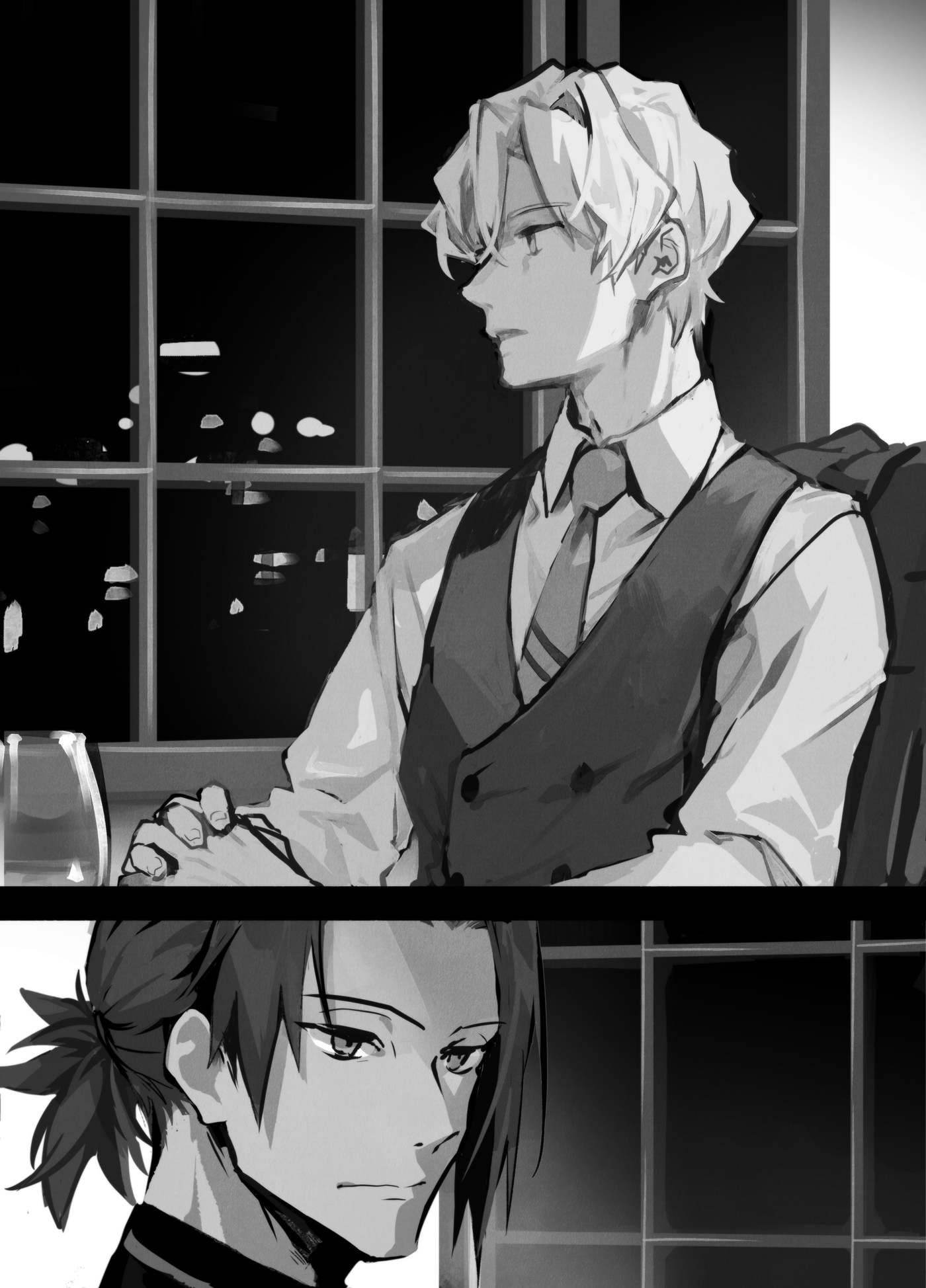
He seated himself opposite Guido. His eyes, a shade darker than his rusty-red hair, were unwavering as they stared at him across the table. Guido placed a glass in front of him and filled it nearly to the brim with red wine.
“You need to stop wandering off on your own, Guido. I know you were on the castle grounds and there was no one but knights around, but your guards in the Mages’ Corps were beside themselves.”
“I lost my temper. I’ll be more careful in future.”
“This city’s been a hotbed of jealousy ever since your promotion to marquis was confirmed. For goodness’ sake, tread carefully.”
“I will. I mean it.”
“Just look at you, slinging your coat over your chair, eating oysters with your bare hands... What would your mother say?”
Jonas’s eagle eyes could be a nuisance sometimes, but he was absolutely right. Guido’s coat hung untidily over the back of his chair, and there were shallow cuts on his fingertips where he’d gripped the jagged oyster shells, betraying his inexperience.
“Keep it a secret, will you? I just wanted to put Volf at ease. Though I admit, I always wanted to try this.”
His impish smile was met with a sour look from Jonas. The man did finally deign to take a sip of wine, at least.
“What about you, Jonas? How did you find the meal?”
“The meat was decent enough. The oysters...I wasn’t so sure about.”
His answer was rather ambivalent, but he didn’t appear to be lying. He’d eaten his meal in a separate room, and by the sounds of it, he hadn’t particularly enjoyed the oysters. Perhaps he didn’t have the palate for them.
“I might take Volf out for some good steak next time. Why don’t you join us?”
“If you mean as your bodyguard, I’ll go, yes.”
“We’ll have a private room. Surely you could sit with us.”
“Guido, I’d strongly prefer you didn’t take meals alone with Sir Volfred. He’s third in line to inherit the Scalfarotto estate. If anything happened to you...”
“What, you think he wants me out of the way so he can become the marquis instead?”
“That’s hardly likely. I just wish you would think carefully about your position and your own safety.”
“For my part, I’d like to grant any wish Volf makes of me, but—”
“Guido!”
“I’m joking.” With a hollow laugh, Guido shifted his gaze to the window, staring out into the blackness. “If Volf hadn’t been there to protect me that day, I wouldn’t be alive now.”
Guido had lost count of how many times he’d been forced to relive that dreadful day in his sleep. Even if the nightmares left him in peace one day, some images would remain etched in his memory for eternity. He would never forget the sight of his little brother dragging his mutilated body through a pool of blood, his right leg and arm reduced to stumps, bones protruding from his left hand. Even in this desperate state, the boy had still gripped his sword, trying to haul himself onward. All alone, beside his mother’s motionless body, he had still been trying to fight.
When Volf was taken to the temple, Guido had watched him as he’d cried in his sleep. Guido’s cowardice had cost his little brother everything, and he was crushed by the guilt. He couldn’t bring himself to embrace Volf or offer even the smallest comfort. Unable to face his brother, he’d simply run away.
He’d run and run and run, leaving the young Volf to endure his loneliness and nightmares all alone. Guido knew better than anyone who truly deserved punishment. It wasn’t their father’s fault for taking three wives. It wasn’t his mother’s fault for trying to protect him. It wasn’t the second wife’s fault for getting caught up in her birth family’s schemes.
Who was it who’d trembled like an infant in his mother’s arms inside the best-armored carriage without even trying to lend his power to the fight? Who was it who’d spared no thought for Fabio after the attack, nor spoken to Eraldo, and had abandoned Volf out of guilt? The source of all this misery was none other than his craven self. A thousand nightmares would be far too light a punishment. Even after ten thousand pleas, he would still not be worthy of forgiveness. He’d allowed his younger brother and the many brave knights to sacrifice themselves so that he could survive the attack without so much as a scratch.
Volf should have resented him, hated him, held him in the utmost contempt—until now, that was how Guido had always assumed he’d felt. Now that he knew how wrong he’d been, however, he was determined never to let guilt or anything else separate him and his brother ever again. Even if Volf himself tried to push him away, he would stand firm. How could he do anything else, knowing what he knew now?
“He’s my little brother. I think it’s only natural that I should want to protect him this time.”
To stand guard over Volf was the only option left to him—the sole means of atonement for his cowardice.