4 - Infinite Universes
4 - Infinite Universes
Maybe opening up all the possibilities was a mistake. Space is finite. Characters are finite. But their combinations are infinite. Opening up a possibility meant breaking down the walls of the worlds within Akuto that might have been.
It was the equivalent of giving birth to a new universe within himself. Of course, the tools for this universe weren’t limited to what was inside Akuto. The gods of the outer universe, even they became a part of the story. As a result, the story became chaos.
What does it mean when a story turns into chaos? You can find the answer within one of our oldest stories: “The Tower of Babel.”
Until then, you could say that humanity shared a story. Everyone, essentially, was playing their own role in the story. That’s why the world refused to allow anybody but Akuto to alter it.
But what happens if a story ceases to be shared?
The answer is: chaos.
The gods of the outer universe were, you could say, their own main characters, with their own main stories. So multiple protagonists tried to advance their own stories within the same place. It may have been chaos, but there was no conflict.
The reason for this was that it wasn’t just strong stories that were trying to take control, but even weak stories were included in this as well. The frustrating thing was that the strength of a story had nothing to do with its size.
Weak, huge things drove daily life.
Strong, small things drove the abnormal events.
Those stories that explained the birth of the world and made humanity realize its shared nature were large in scope, but some of them dissolved unnoticed into the bustle of daily life. Stories of individuals were carved irreparably into the mind, but of course, they applied to nothing more than individuals.
Individuals.
This was the first time that humanity became “individual”.
With shared words, but no shared stories, no relationships could be born. It was impossible for someone to be an enemy or a friend, of course, but they couldn’t be a stranger either. Infinite possibilities made stories impotent.
Infinite loneliness.
First-Person Pronouns.
But still, I begin the story, no, what comes before it.
Sleeping in the darkness. No, rolling.
Being thrown. Doing nothing.
I hear a voice.
Fast. No, near.
I don’t understand. Is the voice calling someone? Calling me? Or someone else? No way to know. Maybe it is my voice.
As long as the voice continues, I may be able to understand that time exists. But there are no units. It is continual, eternal. No guarantee that the same word isn’t being repeated. Count an eternally ringing bell, and you’ll have no words to describe a single toll.
How many times? Counted how? From which eternity?
I hypothesize that the voice is my own. It’s still not a story. There’s not even loneliness. Because I am a first person pronoun.
I speak. Sound.
I speak to speak.
I speak. Words.
Can’t find the right answer. No meaning. Not even a wrong answer. Meaningless.
A misspoken word. A mistake.
Everything, nothing.
I move my body.
Move.
Outside and inside.
Barely separated.
Move.
Which way? Is space outside? Or inside? Go inside, and find nothing. Go outside, and find nothing.
Separation.
Count an eternally ringing bell, and you’ll have no words to describe a single toll.
How many times? Counted how? From which eternity?
I count anyway.
Split. I split more and more.
Split the heavens and earth.
I move.
I can move.
I can move upon the Earth.
Stand. With bones. With muscles of the spine inside.
Hurt.
Not everything. The inside. No pain outside.
Howl. Meaningless.
A misspoken word. A mistake.
All that there is.
Only the misspoken words dwell in the voice.
Only the mistakes dwell in the inside.
Only pain is there.
Not there. Can’t be sure.
Only mistakes.
I mistake.
I make better mistakes.
I mistake, somehow.
I mistake with a strong will.
I mistake again and again.
And beyond that. Nothing.
I see.
I see mistakenly.
I see mistakenly, better.
I see mistakenly, somehow.
I see mistakenly with a strong will.
I see mistakenly again and again.
There was a mistake, there.
I see.
You. A second person pronoun.
Standing in the light. No, standing there lost, in the light.
There. Doing nothing.
I hear a voice. Far. Calling out.
To me? Or to someone else?
I split more and more.
Me and others. Here and there.
I hypothesize that the voice is there.
It may be a story. It may be loneliness.
Because it may not have been spoken to me.
Because it is a second person pronoun.
I speak. Sound.
I speak to speak.
I speak. Language.
I can’t find the right answer.
There is meaning.
There is also misspeaking.
Howling.
Meaning.
Misspeaking.
Failure.
That is all that there is.
Only the misspoken words dwell in the voice.
The mistakes are everywhere.
The pain is there.
Only mistakes.
I mistake.
I make better mistakes.
I mistake, somehow.
I mistake with a strong will.
I mistake again and again.
And beyond that. There is a story.
Thus, reality became reality.
To recognize reality, stories are needed. And this is because relationships with others are born here. But recreating all those possible stories took Akuto what amounted to an infinite span of time. Because, of course, he needed to test every story. But even so, the stories instantly became more complicated.
As soon as the modern era arrived, they became exponentially more complex, because the machines and cities themselves became elements in the story. But what made things particularly difficult here were the elements brought in by the gods of outer space. Things that the Law of Identity lacked were there.
Akuto tried conflict with the outer gods several times. Sometimes he won. In the academy in another world, a story was born where Akuto, bossed around by Fujiko, helped her with her plan for world conquest. There, Fujiko’s world conquest never ended, and the story ended without Akuto and Fujiko even kissing.
The test of that possibility ended.
Sometimes, the outer gods won.
February 23rd, 1945. Dresden.
Akuto was there.
The allies launched a completely meaningless bombing raid, and both he and Junko were caught up in a terrible explosion. Akuto was badly injured, and could only watch as Junko died in front of him. After that, he stood in the city as a wounded veteran, living off donations, until he died from malnutrition. That possibility ended there.
Akuto was born with the strange power to see ghosts. Using that power, he solved complex mysteries with the help of Korone, a ghost.
Hundreds of thousands of stories were tested, and all of them discarded.
July, 1950. Korea.
People belonging to the Bodo league were gathered from nearby villages in an old cobalt mine that the Japanese army had run during its occupation, and massacred. They were suspected of being communists. However, the Bodo League was created to re-educate communists.
And what was worse, in an effort to increase its numbers, the league had begun offering employment to anyone who joined it, which meant that most of its members had no idea what communism was. There were barely any communists there who would sympathize with North Korea. The cobalt mine had been chosen because it would make it easy to bury the bodies.
Akuto was killed there. He’d been a member of the league. What shocked him, just before his death, was that the Korean police who killed him didn’t even know what communism was.
Yoshie was reborn in another world, carrying her memories of her previous life. This other world was medieval, and she used the power of science to do great deeds there. This story was easily ended when he realized that the ending wouldn’t be a story. He couldn’t be sure that it wouldn’t end with the modern world being proven superior to the medieval one.
Junko ran away from home. She’d always been a wild child, so her parents didn’t go to the police. She was walking down the street at night when she was kidnapped by a band of thugs. When she told them her story, they realized that no one would look for her. So they drugged her, raped her, and dumped her in the mountains. They’d given her enough drugs to cause an overdose, and she died in the mountains. Her body was found, but her killers never were.
Akuto was an ordinary boy who was visited by a ninja. The ninja’s name was Junko. She was a beautiful girl, but had grown up in the countryside with no knowledge of the modern world. She causes chaos in Akuto’s peaceful town. Countless variations of this story were tried, but it ultimately became clear that it would never see a real ending. Thus, it was abandoned.
Fujiko was born to wealthy parents. Her parents, however, were gaudy socialites who disliked having to care for a child. Despite the fact that they had the money to hire nannies, though, they held the odd belief that it was a parent’s responsibility to care for a child themselves. Fujiko was, of course, abused almost from the moment she was born. With no one to rely upon but her parents, and no concept that a higher power like god, might exist, she worshipped the parents that abused her, and only made them hate her more, and fear her.
The murder was done by her father. He spun her around by the leg, slamming her into a wall and splitting her skull. She died. The family doctor was well-paid to keep this quiet. A year later they’d forgotten she’d existed.
Akuto awoke to psychic powers in a world where only girls could be psychics. He became the one male student at an all-girls psychic training school...
That was where Akuto gave up making stories. It had all started to seem pointless. The stories were all developing, but everything he made felt so... stupid. The only thing he seemed to want was a world where he could feel peace and comfort forever.
Perhaps in a way, that was the final form of a story. If he focused his attention on times that were hard, he could even make a story where he did nothing more than eat a full belly of food. And in any era, it was possible to find happiness by interacting with people.
On the other hand, the stories where the outer gods intervened involved the things he wanted being destroyed. They would also hide the fact that they were stories, and make it seem as if, instead, they were reality.
This, too, was another form of story concluding.
It had taken thousands of years to reach this point, and still stories hid themselves from mankind, he now believed. This belief had started as a doubt, and had only grown stronger. To make the stories flat, Akuto prepared an infinite plane, with a chair and table on it, drinks, and a few fruits. Even here, stories still emerged, but they could be kept under control.
People can only recognize reality through stories. And he was searching for the end of stories. This meant he was looking for the end of reality. For an end to time.
The stories started to fight back, as if they were trying to survive even past humanity’s demise.
An infinite flat plane. Akuto summoned a visitor into that space. There were very few personalities outside his influence now. And only one who could give him advice.
Hiroshi was there, with a blushing smile on his face.
“It’s our first time talking like this, isn’t it?” Hiroshi said. He wasn’t wearing the suit, but he was still Brave.
“We’ve spent a lot of time apart, haven’t we?”
“I never thought about trying to talk with you as an equal.”
“Maybe not. But I think we knew that this time would come.”
“I didn’t come here because you called me. I chose this spacetime to warp to. I knew this time would come. So for me it’s been a few months. For you, a few thousand years? That’s a long time.”
“Sorry I couldn’t find a better place to invite you.” Akuto laughed as he offered a drink.
“This place is... an endless flat plane. Like a desert, I guess.” Hiroshi looked around.
“Of course, I can make it look like anything I want. But I’m trying to keep stories from emerging.”
“This is your world, then.”
“I guess so. What do you want to drink? I haven’t decided what this is yet,” Akuto said casually. When Hiroshi looked in the cup, there was what he could only describe as a liquid that hadn’t become anything yet.
“I’ll take water. Natural mineral water,” Hiroshi said. The liquid bubbled and became cold mineral water.
“I see.” Hiroshi swallowed the water. It felt pleasant and cool as it went down his throat.
“What’s it like being able to do anything?” Hiroshi asked after a moment.
“It feels like I’ve reached the endpoint of the pleasure I can experience as a living thing,” Akuto said. Hiroshi laughed a little.
“I’ve never felt that before.”
“Right?” Akuto smiled. “But right now we’re on the same stage. I think we’re the only ones who haven’t become concepts.”
“Concepts?”
“In this state, I can really understand the fact that a personality is something that can’t be truly understood by another person. If another person’s responses were actually mechanical, we wouldn’t be able to tell the difference. Perhaps the infinite personalities that exist inside us right now are actually that.”
“If you have a box that only an individual can look inside, and something with the same name but different is put inside it, can you have a conversation? If you have a dictionary in a foreign language that you don’t know, and it tells you how to respond to different greetings, if you use it are you having a conversation?” Hiroshi asked.
Akuto seemed entertained.
“Yeah. What you just said doesn’t seem like something you’d say.”
“When I’m here, I’m a unified version of the concept of Brave.”
Hiroshi grinned too.
“I see. So concepts really are concepts then.”
“But I do understand what you’re trying to say. You and I are the only incarnate beings in the Law of Identity’s world. We can call being a concept that is equal before its creator being incarnate, right? So in your world, all the people inside are equally incarnate.”
“You use the word creator, but it doesn’t feel like I’m a god. I can feel it. Stories are what are tying us down. Even if we were to attempt to create a world, the only freedom we’d have is what story we would choose. In the end, what I’m trying to do is kill that and escape from this world.”
Akuto’s voice seemed to echo a sense of loneliness.
“So you’ve reconfirmed that your goal is to kill stories.”
“I guess so. When I made the decision, I didn’t think much of it. Ever since I decided to kill the gods,” Akuto said with an exasperated sigh. Hiroshi chuckled.
“Show some consideration for those of us who got caught up in it. If you include the stories you created after that, we’ve lived countless ordinary lives, and countless extraordinary ones. And Korone and Keena are still asleep. I think they could probably endure a few thousand years of that, though.” Despite Hiroshi’s words, there was no harshness behind his criticism.
“That’s why I decided to talk to you. You’re the only one that’s outside my story,” Akuto said, his voice suddenly serious.
“I don’t mind when you sound weak like that. After all, we weren’t very well balanced. I was much lighter than you were,” Hiroshi said, jokingly.
The two of them both laughed, a little embarrassed.
“That’s right. You were always the saner of the two of us. You were normal, so you were never cut out to be caught up in something like this.”
Hiroshi shook his head confidently, however.
“That’s not true anymore. That’s why I can end this story.”
Nothing on Akuto’s face said he believed this, though.
“You mean your decision to kill me, right?”
But Hiroshi was unphased.
“Of course. With you gone, I can rewind the world and restart the story, with all its patterns. You can be there, just not as the demon king.”
“Isn’t that a waste of time? You’ve already killed me a bunch of times, haven’t you?” Akuto asked, confused. Hiroshi pointed at him, as if to say, “That’s exactly the point!”
“That’s the problem! In this world... yes... even in your world... everybody wants to kill the demon king. Of course, so do you. But it doesn’t work because the Law of Identity’s power is still in effect here!”
For the first time, Akuto seemed like he’d figured something out.
“That’s right. It was Keana who stopped me from destroying the world.”
“So first I’ll kill the Law of Identity, and then I’ll kill the demon king. That will solve it.” Hiroshi had a mischievous grin on his face. Akuto sighed and pouted.
“You know that’s impossible.”
“Right now, I’m basically fused with Boichiro. Not only do I have his knowledge, I have his sarcastic personality as well. I’ve lived a whole life without value. As a side character.”
Hiroshi reached out toward one of the fruits on the table. Only then did he realize that it was a peach.
“Well, I feel bad for what I did to you. But I don’t think it was devoid of value... No, I actually suppose I consider my own life devoid of value now.”
Akuto picked up a peach. He took out a knife and made a cut on the peach, then ran his finger down it and the peel came off.
“That’s why I can’t come up with a good solution for this problem. In the end, maybe there isn’t anything I can do. It feels like I called you here to just destroy everything.”
Akuto’s face darkened, but Hiroshi just laughed.
“Haha. I’ll stop being mean to you now.”
“Mean?” Akuto looked into Hiroshi’s eyes.
“I mean, I think there’s more you can do. I’ve got an idea, you could say.”
Hiroshi cut into the flesh of his peach with a knife, and took a big bite out of it.
“Is there? Really?” Akuto asked. Hiroshi’s response was immediate.
“If you feel bad, it means you feel some degree of responsibility. The people within you are pawns, but you don’t think of them as pawns.”
Akuto gasped.
“I see. I’ve got a responsibility not just towards you, but to the ghosts who were once personalities too, don’t I? When it comes down to it, I’m the king of the ghosts.” He nibbled his peach in contemplation. “Humanity went extinct, and everyone became data, you could say. But even in the past, people’s actions were digitized.”
“If you became digitized, boss, it means you had a real soul. That’s something Boichiro told me.”
“A real soul? In other words, something that makes me what I am. That was the concept that took root in Zero. And also the meaning of the Law of Identity.”
“Correct. It can’t be called anything but a ‘concept’, but we still need to treat it as something real. We need to assume that anything under the Law of Identity’s influence has a soul.”
“I see. So if we assume that a soul is real, that means there’s a difference between ghosts and data. The black mages always did say that necromancy was an incomplete field.”
“And that’s why you can summon ghosts.”
“Ghosts, huh?” Akuto mused, “And if I can do that, I can figure out what my mistake is, and maybe understand the nature of this world, huh?”
Akuto tossed the peach he’d been eating into the air. When it landed, a long table appeared. There were four chairs there. Before long, someone appeared from beyond the horizon. The image of them seemed to be wavering like a mirage, but as they approached, they became clearer and more distinct. It was a young girl.
Perhaps he hadn’t expected to see her, or perhaps Boichiro’s memories held some degree of influence over him, because Hiroshi gasped in surprise.
“Eiko Teruya!”
A slim, well-proportioned body, with long hair tied behind her back. It was indeed the girl who’d once used a complicated conspiracy to get Akuto to agree to her deal.
“My memories are an absolute mess,” she said, complaining to Akuto as if it had only happened yesterday. She pushed her way past Hiroshi, casting a pridefully indignant expression toward Akuto.
“I understand. You lived in a prison. But if you grow used to introspection, there’s no place easier to live in than a prison. Anyway, sit down. I prepared a table and chairs so we could have a long chat.” Akuto spoke gently to the new arrival.
“Hah! You’re a nasty one, aren’t you? Fine, I will. I’m going to hate you so much that you’ll eventually go crazy from it.”
She went around to the other side of the table, before sitting down in the middle chair and crossing her long legs, as if to show them off. Her underwear was showing, but that seemed entirely deliberate.
“Well, I was never able to come to like you, you know,” Akuto began.
Eiko snorted.
“Sometimes things between men and women don’t go well regardless of whether you like somebody or not. You’ve lived thousands of years, and yet you’re still just a child, Akuto Sai.”
“You’re not even 20 yet,” Hiroshi interrupted. Eiko gave him a scathing glare.
“Age isn’t everything. Before, you seemed like the adult to me.”
“When I was trying to find the Law of Identity, you betrayed me.”
Eiko just grinned.
“We’re not all here to talk about what a bitch I am, are we? And anyway, I did what was right.”
“Right?” Akuto raised an eyebrow. “How were you right? All you did was do what the computer gods told you, and try to raise your status in the real world.”
Eiko smiled.
“I don’t think that’s wrong. Whether the world ended up destroyed or not, that would happen long after my generation. Have fun while you’re alive, and leave a good society for the next generation. If the end of the world only comes a long time after that, what else can you do? You and I, or maybe Boichiro and I, depending on who I’m talking to, could’ve gone to the future together.”
“You tried to take control of society, didn’t you? By altering the gods’ data to deceive people.”
“And what’s wrong with that? You’re so arrogant. Here, you’re trying people as a collective. The citizenry. The masses. The people. The mob. The crowd. It doesn’t matter what word you use. They’ve all sunk into the background, if nothing else. You should’ve figured this out after the end of the world. You did something stupid to try and control people. You tried to give them a religion.”
Akuto fell silent.
“You and I are the same. Maybe I didn’t know the truth about what was coming in the distant future, but if you had infinite time, you would’ve done the same thing I did.”
“That’s right. It’s the same thing.” Akuto was practically choking on the admission.
“Just like you, I didn’t believe in religion. Just like you, I looked down on people who acted without thinking. But the reason you didn’t come with me was that at your core, you believed in eschatology and the creator of the world. You were actually a believer, in something that was illogical.”
Eiko mocked him. There was nothing in her words that he could dispute, though, so he simply slumped into his chair. Both Akuto and Boichiro were believers in the Law of Identity. Eiko’s face warped into a victorious grin.
“I haven’t felt this satisfied since I died,” she said. But Hiroshi cut her off.
“Normally, when you die you don’t get a chance to defend yourself. And the imprisoned are not facing justice, either.”
Hiroshi’s tone suddenly changed. He stepped away from the small table Akuto was sitting at and went around to the longer one.
“Maybe this is to be expected, since you’re the Demon King, but you shouldn’t need that kind of forgiveness. You don’t want to claim that you are the Demon King, I’m sure.”
Hiroshi’s face had, at some point, turned into Boichiro’s.
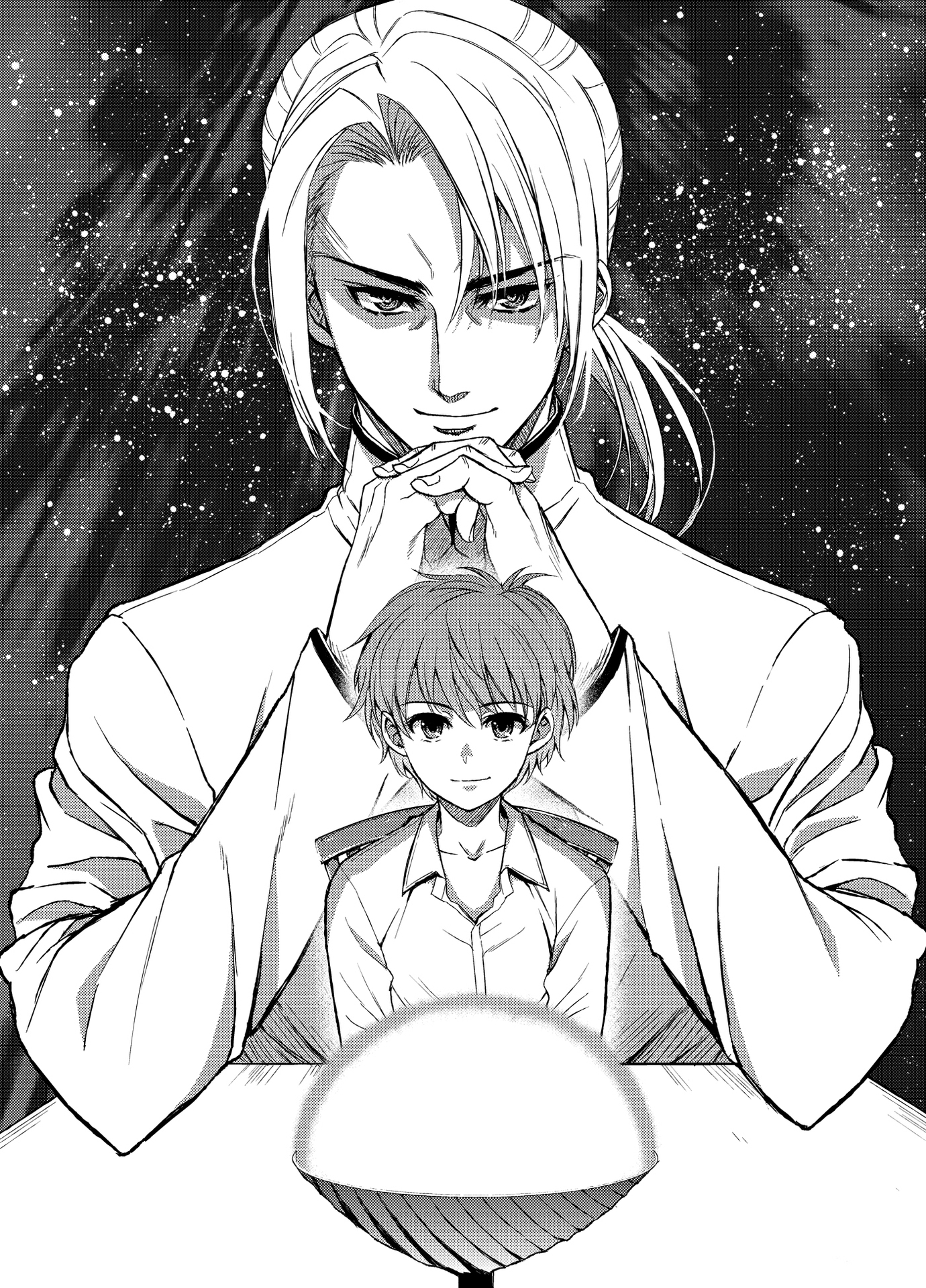
“Now it’s my turn. My prophecy is now clear. No, my predictions, based on precise data and experience, proved to be right. Of course they did. You ignored my warning. Now the outer gods have invaded us and turned everything into chaos.”
“I’ll have to admit my mistake there,” Akuto nodded.
“I wasn’t the one to be bound to the Law of Identity. But it could’ve been you, instead. You could’ve done what I tried to do, and saved the world. It could have continued eternally, as it was, in another universe.”
Boichiro’s words became heated.
“But you were obsessed with Rimu Sudo and Keena, too, weren’t you? What you’re talking about isn’t the world,” Akuto said, but Boichiro’s response was quick.
“If my ego and my values were in sync, what’s wrong with that? You had the right to destroy the world. Your decision to kill the gods then was wrong.”
“You’re right. I’d given up on thinking. I just let impulse take over and did what Keena calls ‘the way boys settle things.’ I just thought I was doing what Keena’s voice told me to.”
Akuto’s words were only coming out reluctantly. Boichiro laughed.
“...Even the space you have full control over was invaded by the outer gods. The real universe is doubtless no exception. If you attain true satisfaction and go to your death, this space will cease to exist. And then all will turn to dust. Even eternal beings like us, who’ve been reincarnated to carry out our roles, will cease to exist.”
“And I won’t ever save Keena, will I?”
“Outside of this world, Keena and the outer gods are of equal importance, no doubt. The Law of Identity itself is no exception either.”
Akuto thought for a moment about what Boichiro said. Then, he spoke.
“I’ll summon the outer gods.”
That surprised even Boichiro.
“Can you do that?”
“They’ve become stories too, or at least they should have. I don’t know if I can communicate with them on a deep level. We don’t share any stories. But it should be possible.”
The instant he said this, a black figure was in the chair. No, everyone understood that it was there. When they turned to look at it, it was a shadow whose race couldn’t even be determined. But when they looked away, there was someone there. They could see it out of the corner of their eye, but they couldn’t make out its gender, let alone its expression. But when they went to get a closer look, it was only a shadow.
“I am the Void Universe,” the black figure said. It was a strange voice, only audible if you strained to hear.
“The Void Universe?”
Akuto’s question seemed to get through to it. There was a faint answer, difficult to hear, but clear if you focused on the sound and not the words.
“A universe with no stories. No matter. Only a single voice. The only things there are the occasional voices meaning things like ‘you’, ‘thou’, ‘vous’ or ‘sue’.”
Akuto reconstructed in his mind the meaning of the black figure’s words. He continued his questions, hoping to learn more about this strange figure.
“Only a voice that says ‘you’?”
“The word ‘You’ is shouted, and identity is born. When I first entered this world, it gave birth to a story. The second person pronoun. I am only voice. You! You! You!”
“But if there’s a story, there shouldn’t be a void.”
“The one who is called is never met. No one is ever met. The voice is simply there, alone.”
An image of the Void Universe’s visual senses spread out before them. A darkness that wasn’t a darkness. A void without even light. Only a nameless voice echoing. A voice that was only a single sound. Repeating and repeating. The voice never reached anyone. The only thing there was an existence that thought that there must be something else. It wasn’t even clear if this existence was singular or a plurality. But someone was there, endlessly seeking another.
“Hell,” Akuto whispered. The black figure, however, denied this.
“It’s not even hell. It’s not even pain. It’s nothing.”
“The only thing in the Void Universe is existence itself.”
Suddenly there was another voice. When they looked, there was nobody there. But when they looked away, a figure in red appeared. It had the exact same nature as the figure in black.
“I am the Faceless Universe.”
It was a different voice than the black figure. But its voice was just like the other, so faint it was hard to hear.
“...The same as the Faceless Power?” Akuto asked, and the red figure answered, and continued.
“In the Faceless Universe, existence melds together. Primitive life maintains external walls for the sake of its existence, but two life forms meeting results in the destruction of their walls. They devour each other. There, the existences point at each other, and shout, ‘You!’”
An image of the Faceless Universe’s vision spread out before them. There were multiple beings there. They were akin to an amoeba, or a water droplet in zero gravity, or perhaps a cloud, and were squirming in the void as if seeking each other out. They made the same sound as the ones in the void universe.
“You!”
Sometimes, they would run into each other by chance. And in that moment,
“You!”
The sound was the same as before, but now it sounded joyous.
“It’s a different ‘you’ than the Void Universe. It’s a ‘you’ of discovery,” Akuto whispered. The red figure agreed.
“Consumption. Only in that instant is another noticed. ‘You! I finally found you!’ it screams.”
The image changed. Two beings collided and became one. Then, another voice was born.
“But in the next instant, there’s no telling who’s who. However, what should be a single being is instead filled with a voice inside. Who! Who! Who! In the Faceless Universe, there is a single instant of ‘You’, followed by an eternity of terrible ‘Who!’.”
“When another is found, they cease to be another. However, others make you realize, whether you want to or not, that you yourself exist.”
Akuto whispered to himself as he gathered his thoughts. And then he had a realization, and let out a sharp gasp.
“The awfulness felt when you realized that you are you... The Law of Identity!”
When he realized this, another voice appeared.
“The Faceless Universe allows the Law of Identity to exist.”
Now it was a figure in blue.
“I am the Gravity Universe. There, existence becomes one with its outer walls and gains mass.”
The image turned to that of the gravity universe. There was light and darkness. And existence there, while still amoeba-like, had clearly defined walls separating it from its exterior. They were like the walls of a cell, shining in the reflected light.
“You!” the voices shouted. But though it was the same sound, they sounded like an angry yell. This time, the beings were aiming for each other. They would fly at each other in order to collide.
“The walls mean that the cry of ‘Who!’ never escapes to the outside. The beings advance in search of others,” the blue figure said, as they continued to see what was happening. The beings collided, and the one with the weaker walls burst. Most of its insides would melt into space, but a tiny part was absorbed by the walls of the stronger.
“Consumption?” Akuto’s voice shook as he watched this. A voice was emitted from the beings that he’d never heard before.
“The loss of the walls means the loss of being itself. So when the walls collide, a scream is heard. ‘I killed! I killed! I killed!’”
As Akuto sat in silence, a new voice could be heard.
“The Gravity Universe allows pleasure to exist.”
This one was white. The images changed again. This time he saw the brilliant sparkling of stars. There was life there, but primitive. Single-celled organisms were starting to split.
“I am the Antigravity Universe. Here, existence increases in number. Walls swell and split.”
“Voices fill the space. Me! Me! Me!”
“Me!”
It was a voice of newborn joy.
“The Antigravity Universe allows love to exist.”
Beings there consumed each other, but the moment they collided, sometimes they shared their being, and gave birth to new existence.
“Me!”
“You!”
“I killed!”
“I increased!”
Lively voices filled the space.
“I guess the universe I know is really close. Is that all the universes, then?” Akuto asked. And the outer gods said no.

“These are the original models that gave birth to the universes.”
Their voices compelled him to look behind them. He did so, looking out towards the horizon. There were shadows! Shadows! Shadows! as far as he could see. These were not simple figures like the ones he’d seen so far. They had different clothes. Different genders. Their shadows flickered in the corner of his eye. And within them, they had billions of beings. Each of the shadows had ghosts within them, just like Akuto.
“Are they all like me?” he asked, and the outer gods disappeared without answering. The people, or universes, that he’d glimpsed vanished as well. Only Boichiro and Akuto remained at the table.
“They’re probably the same as us.”
They sat in shocked silence for a while, but eventually Boichiro was the first to speak.
“They, and you, are universes. God Universes, I guess you could call them. No, you could say that until you unleashed the possibilities of the world, you alone were like them.”
Boichiro pointed at Akuto, Akuto let out a long sigh and nodded.
“The birth of a universe is like the birth of a story. If a universe is a collection of stories, there could be any number of beings on the outside that are like us.”
“Which means there should be a spectrum,” Boichiro said, suddenly sure of himself.
“A spectrum? Of what?” Akuto asked. And the outer gods responded.
“A spectrum. In other words, they can be divided into levels. Levels of ‘story density’, you could call it. Each of them has been turned into a story at different levels. That’s one way to think of it, anyway.”
“And our level of storification is strong?”
“We realize our world is fictional. So it must be strong. Don’t you think?”
Boichiro’s words made Akuto remember something. Those stories which seemed under the outer gods’ influence seemed to be those where the world’s fictional nature could not be realized. These stories were always those of people who’d only been incarnated once.
“After looking outside, only now do I feel like I understand myself.” Akuto nodded.
“But in the end, the outer gods themselves are fictional. They just can’t tell the difference between gods, humanity, and ghosts themselves. Only when a higher being tells you, and your universe is walled off, can you clearly understand what’s a god, what’s a human, and what’s a ghost. You understand who they are inside.”
Akuto thought to himself as he listened to Boichiro’s analysis.
“Now... that means we have to think of what we say to our own higher power in answer. I want to save not just what’s inside me, but everything in the Law of Identity’s universe. I want to free them from their stories. That is my wish,” Akuto said. Now it was Boichiro’s turn to think.
“...We’ll just have to assume that stories are viruses. Originally, when living creatures were born from the anti-gravity universe, they should have been considered complete. No matter how complex a creature’s cells become, and how complex their reflexes, creatures consume, kill, and give birth. That’s all. There’s no sin or forgiveness there. There can’t be.”
“But the outer gods brought the idea of an unreasonable death into me. Their story density should be low.”
“Then an unreasonable death is natural. There’s no reason needed for murder. That explains it.”
“But we should still try to avoid meaningless murder.”
“You only say that because the stories tell you that you should. But you said that stories were the greatest murderers of all.”
Boichiro’s words made Akuto pause in thought for a moment, and call someone else. He waved a hand out towards the horizon. A dark-skinned, heavily-built man walked towards them from beyond the horizon.
Marine.
The man who’d once lead the Republic, used the Faceless Power, and battled with Akuto. He was also the one who, through no will of his own, caused the destruction of the world.
“I feel like I’ve been called as a representative of ideology, and I have to say it upsets me.”
Like the other ghosts that had been summoned, Marine opened with a complaint.
“Ghosts are always complaining to me.” Akuto shrugged.
“Because, of course, you killed us. But you’re here before me, unafraid of my condemnation. You deserve credit for that, at least.”
Marine laughed loudly, and sat down in the chair with bold, exaggerated movements.
“If you’re my ghost, then that’s just me praising myself,” Akuto whispered.
“Don’t worry about it. Humans and ghosts are indistinguishable from the outside,” Marine said.
“Yeah. That’s starting to seem to me to be the reason why murder should be avoided. If you’re really someone else, people should have no laws but those of living things.”
“That’s the good part of stories. If you allow others to exist inside you as ghosts, you can love them, and thus avoid consuming and murdering them. Even if that gives you no advantages in reproducing and splitting.”
Marine looked at him as if surprised that it took Akuto this long to understand.
“But I’m looking at you as a manifestation of the bad side of stories. That’s why I’m here.”
Akuto looked back at Marine.
“That can only take us back to the first debate we began with. The nature of a ghost creates others. The ghosts of the Republic citizens were oppressed by the ghosts of the Empire. Pointing out that this oppression was only a fantasy also means throwing away the good side of stories,” Marine responded.
Akuto flinched, as if he’d been caught by a weakness in his argument.
“I see. And I was a man who was willing to throw that good side away.”
“You were a man without love, is what that means.” Marine laughed.
“And that’s my sin?”
Akuto always had a serious look on his face, but now his expression was completely frozen. Marine flashed a natural smile.
“My friend, the answer of the condemned has been given. Isn’t that enough?”
“But, what does that matter? Basically, I’m stuck, unable to break out from within myself. I can’t free everyone, if it’s been decided that I’m carrying a contradiction I can’t solve.”
“Then perhaps I have a solution.”
Suddenly Boichiro spoke.
“First, erase everything but us.”
Akuto didn’t know what to make of that.
“What are you going to do?”
“Just do it.”
There was resolve in Boichiro’s words. So Akuto did as he was told, erasing both Marine and the table. There was silence, as Akuto and Hiroshi sat alone across from each other.
“Will this... do?”
“Yes.”
Hiroshi nodded, and began to speak, as if he was reluctant to say anything.
“Actually, I’d been resolved to do this from the start.”
“Resolved?”
“No, I mean I knew from the start. That it was a problem you wouldn’t be able to solve yourself.”
“That’s rather rude... But yes, I’m afraid you’re right. There’s a reason they called me the Demon King. I’m a weapon. In the end, all I have is logic, not love.”
“You should’ve noticed that when you were alive.” Hiroshi laughed.
Akuto laughed too, this time.
“You’ve got that right.”
“Now, on to the point...” Hiroshi leaned forward.
“Make a world where I’m the hero.”
“Huh?” Akuto was stunned.
“A world where I’m the hero, I said. One with as low a story density as possible.”
“You just want to be the hero? ... No, that doesn’t feel likely.”
“Correct. A world where I’m a normal person. That’s what I want you to make.”
Hiroshi was serious. And that only made Akuto more confused.
“What happens then?”
“I’m going to redo my life, with my memories, in a world which isn’t very story-fied. And there, I’m going to write a story about destroying stories.”
Akuto’s eyes went wide.
“That’s... an unexpected idea.”
“Stories have their good sides... so maybe it’s impossible to get rid of them entirely. But if nothing else, I’ll be able to put an end to your story.”
“In other words, you’re going to write my story... and end it.”
“Yes.”
Akuto wasn’t sure what to think. This was an idea he’d never come up with.
“Is it okay for me to ask you that?”
He couldn’t predict what would happen, but he knew that if it worked, it would put him on a course for a true ending.
“It’s fine. It’s something only I can do, and anyway, killing you is my goal. And by doing that, I can save this world. That’s how it feels to me,” Hiroshi said softly.
Akuto stared him in the eyes for a moment, and then smiled.
“Alright. I’ll rebuild the afterlife then. You want me to strengthen the influence of the outer gods, and return the world to its pre-mana-civilization form, right?”
“That’s right. Maybe sometime in the 1990s?”
“I’ll try it. How it works... is up to you.” Akuto balled up the world in his hands again, and then let it spread out wide.