1. Before the Storm
1. Before the Storm
As one of the founders of Mithril, as the leader of the now eliminated leaders’ council, and as a son who had been toyed with for decades, Sir Edmund Mallory Jr. had to settle things with his father.
He was four hours west of London at the moment, driving alone, without a single bodyguard, in a rusty old Toyota he’d gotten from a used car lot. He passed through Hereford, near the border with Wales, then spent another hour and a half going north.
He’d been laying low for close to a year, but that time was now coming to an end.
He continued driving through desolate farmland under a cloudy, drizzling sky until, at last, a small farming village came into sight. I haven’t been here in thirty-eight years, Edmund Jr. reflected, yet the village looks just like it did in my boyhood.
Then again, this place never changed. The small group of buildings stood there, just as they had a hundred—no, three hundred years earlier. The old church on the outskirts, too, was just how it had always been.
Edmund Jr. stopped the car before putting on his cheap raincoat. Then, shoving his Browning pistol into one pocket, he marched up to a small brick building adjoining the church. The thick mud along the path made his footsteps feel heavy, and the 9mm pistol in his pocket was as freezing cold as the rain that spattered his cheeks.
He made it to the entrance, took in a breath, then kicked at the thin wooden door. One hit didn’t break it. He slammed the sole of his shoe against it a second time, and then a third. The door came off its hinges and fell in with a crash.
Edmund Jr. stepped inside as he drew his gun, just as he’d trained for so often during his time in the SBS. Holding it in both hands with his elbows slightly bent, he kept the upper half of his body straight and level as he moved. Though he was over fifty, his body moved just as he willed it to. It’s like riding a bicycle, he thought to himself.
He passed through an empty dining room and entered the bedroom, where he found an elderly man sitting in an old rocking chair. An eight-inch LCD television sat on the small table next to him, playing news from the BBC.

The crisis had begun two weeks ago, and things were only getting worse. Neither the USA nor the USSR were backing down, and violence was breaking out in Poland, the Balkans, and Kurdistan. The Soviet-led Warsaw Pact Army was holding large-scale exercises and preparing nuclear missile firing tests. In response, NATO was mobilizing its forces on all fronts, “just in case.” Though unconfirmed, there were reports of small-scale armed conflicts breaking out as well.
The light from the little screen cast flickering shadows over the elderly man’s melancholy face.
“Lord Mallory,” Edmund Jr. said to his aged father.
“Sir Mallory,” his father said back to him, as if he hadn’t even seen the gun in his son’s hands. “Good to see you.”
As the heir apparent to an earl, Edmund Jr. held the title of ‘viscount,’ which meant that he could also be styled a lord, along with his father. However, Edmund Jr. preferred to be called “Sir Mallory,” in recognition of the knighthood he’d been granted after having earned the Order of the Bath for a dangerous mission conducted during his days with the Royal Navy. The alternate title, despite being lesser in rank, also served as a way for Edmund Jr. to distinguish himself from his father.
“I thought I’d see you sooner,” remarked Lord Edmund.
“I came as fast as I could.”
“Oh?” The old man closed his Bible and set it down on the table next to him.
His hands are more wrinkled now than when I last saw him a year ago, Edmund Jr. thought.
“I thought you knew about this place,” said Lord Edmund.
“Yes,” Edmund Jr. agreed. “Only you, the butler, Dent, and I knew about it. Dent died a long time ago, which leaves only the two of us.”
Every year, the two of them had stayed in this village for one week in the summer. They’d lived in this bare-bones house together with no hunting or riding, no mother or sister, doing all of the housework themselves. Even when their butler would look in on them, worried, his father had refused the man’s help. Together they’d chopped wood, drawn water from the well, and on the last night, taken apart a chicken and cooked it.
It wasn’t an especially grueling lifestyle, but it had been an invaluable experience for a child of nobility. The young Edmund Jr., who had been born heir to the title Earl of Hereford, had been learning things that any human should know. He didn’t like to admit it, but the experience had served him well, first at Eaton and then during his time in the military.
Lord Edmund turned his enfeebled gaze to the window. “Dent, eh? I wonder what he’d think if he saw us now.”
“He’d be greatly saddened, I’m sure,” Edmund Jr. replied.
“I wonder. Perhaps he knew this would happen.”
“Why?”
“Dent brought me wine when you were injured in the Falklands,” Lord Edmund explained. “A Cheval Blanc, from the year you were born, to celebrate. He said, ‘Now Master Edmund will never do as you say ever again. He’s become a true man.’”
Edmund Jr. wasn’t sure if his father was praising him or grieving. Even so, Dent’s prediction had been right; the reason he’d come here was not to ask for his father’s counsel, but to finish things with him.
“Did you come here to kill me?” Lord Edmund asked suddenly.
“Yes,” Edmund Jr. immediately responded. “But first, I want to know why you betrayed us; why you sold Mithril out to them.”
The old man, Lord Edmund Mallory Sr., had been Mithril’s original founder. The still-unexplained use of nuclear weapons during the Gulf War; the sudden reignition of American—Soviet hostilities; the ideological, ethnic, and religious wars that flared up in the world from time to time. Energy issues, food issues... Coals that fed the fires, crisis after crisis. If such things were allowed to continue, they knew, the world wouldn’t survive into the 21st century. National interest couldn’t stop these escalations, and it was unlikely that any country’s politicians, bureaucrats, or officials could stem the crisis. To quell internal distress, a surgeon was needed, and Mithril had been the scalpel capable of performing the delicate work.
Edmund Jr. and his father fancied themselves as the Tracy family from the puppet drama Thunderbirds. But the purpose of their “international aid organization” would be to protect people not from accidents and disaster, but from war.
The biggest issue they’d faced in Mithril’s creation hadn’t been funding—Lord Edmund had easily worked up the necessary funds by mobilizing his family’s entire portfolio of assets. By selling off real estate, corporations, and intellectual property holdings in their various forms, as well as by flexing his considerable personal connections, Lord Edmund had worked a miracle.
Instead, the main problem had been acquiring the appropriately skilled personnel. Spending ten billion pounds on hardware meant little with mediocre hands at the helm. You needed a large force of soldiers with talent, experience, and most of all, loyalty. Men of a younger generation than Lord Edmund’s set. That left things up to his son, Sir Edmund Mallory Jr.
Edmund Jr. was a war hero. He’d been injured saving the crown prince, who’d been left in enemy territory when his helicopter went down, and received the Order of the Bath for it. Afterwards, he’d traveled the world as a military attaché and intelligence officer, contributing to the mitigation of various military crises. He’d done everything in his power to scout the people needed to found Mithril. He’d faced many challenges on the way, but his judgment had always been top-notch.
“I poured my whole life into that organization because I agreed with your ideals, and because I was proud of you,” Edmund Jr. said bitterly. “I didn’t care about the fortune I was supposed to inherit. You made me believe that the hideous ‘reality’ I’d witnessed during my time in the military might just be changed.”
“It was always a fantasy,” Lord Edmund said in an exhausted voice. “Think about it. The name is Mithril—a fictional metal, cooked up by a daydreaming linguist.”
“So you’ve been mocking us from the start?” Edmund Jr. asked.
“I wanted it to be true,” Lord Edmund insisted. “I wanted the evils in the world to be something that could be slain, for there to be a silver sword that could slay them.”
“We were that sword!”
“No, we were not.”
“Only because of what you did. You were Mithril’s founder, but you were also in league with Amalgam,” said Edmund Jr., accusing his father. “You disappeared just before their all-out attack, as if you’d known about it beforehand. I figured out the codes you were using—stock prices from companies in your holding—along with numbers written in obscure trade journals, converted through a unique algorithm to be used as a public key on the network.”
It was a simple yet powerful method of encoding, especially when used in tandem with modern communications methods. Those who analyzed things through a lens of modern technology would be inclined to overlook such outdated means, just as the methods which spies in their fifties might catch on to were frequently missed by modern spy organizations.
“Those stock prices were merely my personal encryption key,” Lord Edmund told his son. “But I’m impressed you figured it out.”
“The trade journals you left in your office were my clue. When you looked at each edition from above, there was a gap in the same area, a sign that you’d held each one open on that same set of pages,” Edmund Jr. explained. “Once I realized that, it took me close to six months to track you down because I was trying to stay anonymous while I looked into it.”
“Then you found me and came to have a showdown?” Lord Edmund surmised.
“There’s always an order to these things.”
“That’s the kind of thing I expect you to say.”
“But I still don’t understand,” Edmund Jr. insisted. “Why did you do it? You didn’t start the organization for fun. Did you simply tire of Mithril and cast it aside?”
“Certainly not,” Lord Edmund said, his tone one of self-recrimination. “Mithril is too vast to be a mere child’s plaything.”
“Then tell me. Your behavior... It’s not like you at all. You worked with the enemy, abandoned the organization you founded, and became a hermit all the way out here in the country,” said Edmund Jr. “It would be easy to blame you, but I don’t understand. Why?” It was as if he was accusing his father of cheating on his mother.
“You never knew.”
“Knew what?”
“Mithril was like my bastard child: a tool to oppose Amalgam, which had gotten too big for me to control, and to bring it new rules,” Lord Edmund clarified. “The rivalry between good and evil, order and chaos... The balance of overwhelming power that’s continued uninterrupted since the days of myth.”
“Too big for you to control?”
“My son, you still don’t know anything about Amalgam,” Lord Edmund rebuked him gently. “Its origins, or the ideals it originally held.”
“Ideals? What nonsense are you—” Just then, blood began to spurt from Edmund Jr.’s gun hand. At first, he thought he’d lost the hand entirely. Against his will, his right arm had jerked, and the pistol had spun away, hit the wall, and fallen. He thought the gun had exploded, that the bullets loaded into the grip had magically burst on their own...
In fact, someone had shot him through the window.
Who did it? he wondered, as other questions began to form in his mind, which was going hazy with pain. When did they arrive, and how did they know I’d be here? First, he stumbled away from the window to check the status of his hand. His entire arm was in blinding pain as if it had been blown off from the elbow, but in fact, his fingers mostly appeared intact. Only the first joint of his pinkie appeared to have been blown off, and there was a copious amount of blood pumping out of the wounded digit.
Idiot, he thought, mentally castigating himself. Why did you let your guard down? Immediately, Edmund Jr. abandoned his rage for his aged father. Cursing his foolishness for not having noticed the ambush, he reached for his fallen pistol with his uninjured left hand, aware that he didn’t have a spare weapon.
But before he could reach it, a man in black stepped through the door from the kitchen. He kicked the gun away, slamming the stock of his own submachine gun into Edmund Jr.’s head. Sparks raced in front of his eyes as he lost his sense of balance, and his vision went dark.
“Ugh...” When Edmund Jr. next emerged from the mist of semi-consciousness, he was able to make out the other man’s face: it was the commander of the forces who had entered the house. Gray hair on his head and his face, a melancholy air and the chiseled features of a marble statue... He looked somehow older than Lord Edmund, but Edmund Jr. knew that was just an illusion; this man was probably no older than him. He knew him, after all. “Andrey Kalinin...” he groaned.
“Sir Mallory,” Kalinin, the former ground forces commander of the Mithril West Pacific Battle Group, replied. “It’s been a while.” His tone of voice was absent any fragment of goodwill.
It seemed to have been less than a minute since the attack. Edmund Jr. could feel his back soaked with sweat, and he was almost delirious from the pain in his hand. On Kalinin’s orders, the men must have treated his right hand while performing a careful pat-down of his body. At least, he thought, they don’t seem to want to kill me right away...
The elder Mallory had remained sitting in place, but he did seem to be surprised by the raid. He must not have organized it, nor known that it was coming.
Kalinin was the first to speak. “Sir Mallory,” he said succinctly, “I’ve been watching you for two months now. We’ve been looking for your father and thought that tailing you would be the best way to find him.”
“You used me, then?” asked Edmund Jr. “Is it my father you’re after?”
“Yes,” Kalinin answered. When he gestured slightly at his subordinates with his jaw, they quickly picked up on the message and left the room. Once they were all gone, Kalinin went on to say, “Your father has information that we require.”
As if anticipating his next words, the elder Mallory let out a soft groan. “The registry?”
His son looked up questioningly.
“We know you have it, Mr. Mercury,” Kalinin told him bluntly. “There are other things I want to confirm, though, which is why we stopped your son before he killed you.”
Edmund Jr. didn’t know what Kalinin was talking about. No, that wasn’t exactly true—a desire not to know was blocking the recognition from his thoughts. “Registry?” he muttered. “Mr. Mercury? What are you talking about?”
“Amalgam has a ‘manager,’” Kalinin explained. “A unique individual who never gets involved in its policies, but has authority over its procedures. He’s like an arbitrator, watching to make sure nobody breaks rules. That is Mr. Mercury. Until now, nobody knew his true identity.”
“And he’s... my father?” Edmund Jr. stared at the old man, who remained expressionless, staring unresponsively at a point on the wall.
“What about it, Lord Mallory?” Kalinin asked.
Edmund Jr. found his voice breaking, annoyed at his father’s continued silence. His right hand felt like it was on fire. “Answer him, Father!”
After some time, the elder Mallory finally opened his mouth. “The Russian is correct. I am the arbitrator of Amalgam, Mr. Mercury.”
“It can’t be...” his son choked out.
“I always meant to tell you when the time was right,” Lord Edmund admitted. “I thought that once you’d matured sufficiently, you might consider taking over for me.”
Ridiculous! thought Edmund Jr. He didn’t think his fifty-year-old son had ‘matured sufficiently’? And... take over for him? Out loud, he said, “I might be the son of a traitor, but I’m not one myself.” He meant it to sound like a scathing rebuke, but it ended up sounding more like self-reassurance.
“It’s nothing to be ashamed of,” his father protested. “Amalgam wasn’t always the evil organization you people imagine it to be.”
“They’re a terrorist organization starting wars for short-term profits!”
“True, but they weren’t always,” Lord Edmund said firmly. “Amalgam first formed after World War II—the summer of 1948.”
“1948?” Edmund Jr. echoed incredulously. “That long ago?”
“Even we didn’t know that,” Kalinin put in. He sounded almost impressed. “We’d assumed it was an old organization, but nobody knew the precise history, not even the current executives. Many have taken on the names ‘Gold’ or ‘Silver,’ but most of them never knew who their immediate predecessor was.”
“The only information they were ever given was a page number in a textile trade journal, and the method of communicating with others through the numbers printed there,” Kalinin continued. “Whatever you might call them, it was shocking to learn that an organization like that could make decisions and influence policy on a global scale based on that information alone.”
“Not knowing each other’s names or faces... That was the real source of its power,” the elder Mallory said. “It meant nobody could create factions or try to seize power. For instance, during the sixties—the Cuban Missile Crisis—there were three people calling themselves Mr. Gold at the same time. It made it impossible to tell who was who.”
“But it still functioned?” asked Kalinin.
“Yes,” Lord Edmund affirmed. “During the Cuban Missile Crisis, one of the Mr. Golds was a man close to Khrushchev, and working to get the missiles removed from Cuba. The rest of the executives agreed with him and worked to secure the situation.”
“Ridiculous,” Edmund Jr. snorted. Any student of modern history knew about the Cuban Missile Crisis: in 1962, the Soviet Union had placed nuclear missiles in Cuba, effectively holding a gun to America’s head. Of course, the US wasn’t about to take that lying down, and the tensions over who would shoot first began to rise. The situation grew more and more serious, until all-out nuclear war seemed inevitable. All of human civilization had been on the verge of collapse, until bold decisions by leaders in both countries pulled things back from the brink.
His father was saying that Amalgam had seriously influenced First Secretary Khrushchev’s decisions—that, in effect, Amalgam had saved the world.
“You don’t want to believe that your enemy saved the world, I’m sure,” the elder Mallory observed, as if reading his mind. “But—as I’ve said several times before—Amalgam began with ideals. After the fall of Nazi Germany, many feared the nascent US—Soviet Cold War, both in the East and the West. My grandfather, who held a key intelligence office during the war, formed the organization afterwards with a mere four like-minded men. One was an American oil baron, one a Russian scientist, one a former German SS officer, one a Japanese trader... and then there was my grandfather, a real estate giant and cryptologist.”
“Only five...”
“Five brilliant men,” Lord Edmund insisted. “Their beliefs and ideologies differed, but they were united in their desire to provide a future for humanity. Five very different men, bonded together with one ideal as their catalyst: to guide the world from the shadows. And so, they called their curious empire ‘Amalgam.’”
“‘A future for humanity’?” Edmund Jr. scoffed. “Please. The arrogance!”
Following his outburst, Kalinin whispered, “It’s not so different from Mithril. The only slight difference was in the topics they dealt with.”
“Of course, a traitor would say that!” Edmund Jr. said accusingly.
“I’m simply being honest,” Kalinin returned. “At the time of its founding, those five men’s intentions were pure.”
Edmund Jr. was neither stubborn nor self-righteous enough to insist that Kalinin was wrong, but even so, it felt like some kind of sick joke. “Fine,” he finally said. “Let’s say Amalgam had ideals and that it got results, too. But... eventually, it became what it did.”
“I’m afraid so,” his father agreed. “Amalgam expanded its network at leisure and secretly grew its membership. Its original five founders retired one by one, and alternates popped up in their place. Twenty years after its founding, it had become an organization larger than its own members even realized. That was around the end of the 60s.”
“Around the quagmire of the Vietnam War?” Edmund Jr. guessed.
“Amalgam wasn’t involved with all of it, but they were one of the reasons it went on for so long. You see, the organization had unintentionally ended up being composed primarily of people whose financial interests were better served by the war continuing,” Lord Edmund explained. He went on to say, “I don’t think they even realized it at the time. Since then, Amalgam’s actions have been primarily focused on the protection of their members’ vested interests. There have been wavering goals, conflicting desires, and tug-of-wars of compromise... There were repeated internal conflicts, and before long, they started holding ‘fixed matches’ on the world stage. A new rule naturally came into being, and fraud became expected.”
“And that went on for thirty years?” Edmund Jr. asked.
“The current membership is entirely unaware of Amalgam’s original ideals,” Lord Edmund said. “They use the organization simply as a tool for their little power games, drunk on the wine of invisible authority.”
Over the course of many years, an organization founded with lofty goals in mind had changed, swelled into something ugly, and made self-preservation its only goal. It was an archetypal fall from grace. No matter how many brilliant people you brought together, no matter what kind of systems you put in place, you couldn’t escape that eventual rot.
“Then it’s already a conspiracy without purpose or morality,” Edmund Jr. insisted. “And its resilience just makes it more out of control.”
“That’s right,” his father agreed. “Twenty years ago, when I was bequeathed the role of arbitrator by my father, Amalgam was already out of control. ‘Mr. Mercury’ has a fine ring to it, but in practice, I had no power beyond that of mediation. Although I maintained the network and expelled rule-breakers, I wasn’t allowed a voice at the executives’ conferences. Even if I tried to share Amalgam’s original ideals with them, I was simply ignored. Mr. Mercury’s arbitration is only tolerated because he does not assert himself. There was nothing I could do.”
“You couldn’t destroy the network itself?” Edmund Jr. suggested.
“No,” the elder Mallory said with a sigh. “Fifteen years ago, I sincerely tried to find a way to destroy them. We didn’t have the online conferences then, but communicated solely through codes made up of three-column announcements in newspapers and text information services. The public key was decided in rotation among executives. I used stock prices in trade journals, some used weather reports for the American East Coast; others, tabloid gossip columns. Those who wrote for those publications never even dreamed that their articles were being used this way.
“Of course, the purpose of this setup was so that no individual could disrupt the encryption key,” he continued. “There were always multiple backup communication methods, and since it was all based on public information, it couldn’t be altered. The advent of the Internet has only made it harder to control and disrupt their communications.” The elder Mallory then added, with a glance at Kalinin, “Of course, I’m told Mr. Silver made it possible.”
“He has limited precognitive abilities. He can predict the encryption code and transmission protocols in advance, then analyze and manipulate them to serve his ends,” Kalinin acknowledged.
“He planted a virus in the network, then?” asked Lord Edmund.
“Put simply, yes,” Kalinin told him. “Not just an electronic virus, but a psychological one, as well. It appears to have been inconceivably complicated, as well as time and labor-intensive.”
The conversation taking place between his father and Kalinin was completely over Edmund Jr.’s head. It sounds like someone tried to take control of Amalgam from within, he thought, and succeeded. There was no sign of the pain of his wound abating, and he wanted to curse in order to distract himself. But he also didn’t want to show weakness in front of the other two.
“What were we talking about again?” Lord Edmund wondered. “Ah, yes, my inability to stop the growth and rot of Amalgam...”
“I think I’ve heard enough,” Kalinin told him. “So, that’s why you created Mithril, is it?”
“Yes,” Lord Edmund affirmed. “If I couldn’t control them from within, I knew I’d have to make an organization to oppose them from without. I used Mithril to halt Amalgam’s excesses. You may be able to guess when it started: with the use of nuclear weapons in the Gulf War. That was the height of Amalgam’s arrogance.”
That nuclear launch, still wreathed in mystery, that left the Middle East in a state of ongoing tragedy... And here is my father, thought Edmund Jr., saying that Amalgam was behind it.
“In that moment, I made a decision,” Lord Edmund continued. “Which was that I would create an organization to stop them.”
“You don’t think that was a noble decision, do you?”
“It was the only option I had.”
“You stayed in hiding, betrayed both organizations, and manipulated them... Even if it was for a noble purpose, it’s unforgivable fraud,” Edmund Jr. fumed. “I can’t even conceive of the cowardice, the arrogance—!”
“Spare me your childish criticisms,” Lord Edmund said tiredly, cutting his son off.
But Edmund Jr. didn’t stop. “It’s not just the organization you betrayed. You mocked and used me, your own son! You sweet-talked me into recruiting the people you needed!”
“Because you were the man for the job. A romanticist disguised as a pragmatist was ideal for leading Mithril’s executives.”
“You—”
“Your reaction disappoints me,” said his father, cutting him off. “You should reserve your shame for your own weakness in failing to outwit me.”
At this, a soul-rending rage welled up in Edmund Jr., who found himself itching to kill the older man now. He’d asked himself over and over on the drive from his hideout in London, Can I really shoot my own father? But now, he knew for sure that he could.
“I’m glad I took your gun away earlier,” Kalinin observed, clearly sensitive to the man’s rising bloodlust.
“I suppose I am being unbecomingly antagonistic, Mr. Kalinin,” said Lord Edmund, turning away from his son. “You said you wanted to confirm something, didn’t you? Perhaps you should get that done first.”
“No, I’ve heard enough.” There might have yet been many things even Kalinin didn’t know about the circumstances around the founding of Amalgam and Mithril; their conversation thus far had made that clear. He probably just didn’t want to have to watch any more sniping between father and son. “May I have the registry now?”
The elder Mallory furrowed his brow at Kalinin’s request. “It’s not complete.”
“I don’t care,” said Kalinin, who had expected this answer. In fact, it had seemed the most likely scenario. “I believe you know the names of most of the executives throughout Amalgam’s history, from its founding to the present. There are multiple examples of Mr. Mercury ‘expelling’ rulebreakers by revealing their names to the other executives.”
The trouble was that the arbitrator couldn’t give out those names for reasons other than rule-breaking, as that would diminish trust among other members. Leonard Testarossa’s limited precognitive abilities had enabled him to track down most of the current executives, but still he knew nothing about the past ones. The only person in the world with that information was the arbitrator, Mr. Mercury.
“What do you want with information on past executives?” Lord Edmund asked suspiciously. “They’re almost all dead.”
“There’s no need for you to know that,” Kalinin told him unpleasantly.
No, there was no need for the elder Mallory to know, as Kalinin and the others already had an unchallenged grip on Amalgam through their knowledge of the current executives. But that information was also worthless to their current needs; it was the past that had real value. More precisely, the information on the Amalgam of eighteen years ago.
They would be redoing everything from that point, after all, so the contemporary members of Amalgam would be useful tools in setting the world right. That’s why she wanted this registry—as a reference, to carry into the next world with her. Kalinin was just following her orders.
“Mr. Kalinin,” said Lord Edmund coldly, “there is one line as arbitrator of the organization that I have never crossed. You’re telling me to cross it and sell them all out.”
“Is that line really worth holding?” Kalinin asked, while thinking, It’s this pointless sense of duty that let Amalgam run rampant, isn’t it? Instead of really doing anything, you just formed your little “Justice League” to maintain a masturbatory balance. What point is there now in remaining loyal to Amalgam’s past?
“If you want the registry, you’ll have to find it yourself,” Lord Edmund announced. “Don’t expect me to just hand it to you.”
“As you wish.” Kalinin looked around the small room, then reached for a bookshelf that took up most of one wall. He threw everything on one shelf unceremoniously onto the ground, spreading dust that stank of mildew. Edmund Jr., lying on the floor beside it, coughed. Kalinin was just reaching for the next shelf of books when he realized something. “No,” he murmured, “that’s not right.”
A Bible lay on the small table next to the elder Mallory. Kalinin picked it up now, first tracing a finger along the spine, then grabbing the upper edge to peel it down and reveal the binding beneath. From that binding, he pulled a piece of paper, which had been folded into quarters. On it were lines of letters and numbers: some kind of code. This was the registry he was after, and Kalinin carefully folded it back up to place in his breast pocket.
The elder Mallory just watched as Kalinin went about his work. “How did you know?” he finally asked.
“This is iniquitous information,” Kalinin answered. “Hiding it in the spine of a Bible seemed like the kind of thing a man like you might do.”
“You’re not going to ask about the code?” Lord Edmund inquired.
“Let’s see... Perhaps the Vulgate knows?” suggested Kalinin, lightly tapping on the Latin Bible in which he’d found the paper. The numbers likely correspond to its verses, he thought. A highly primitive method. If I put it to an AI designed for cracking codes, I’ll have it decoded in less than an hour.
The elder Mallory sniffed in displeasure, confirming his suspicions.
“I’m finished here,” Kalinin announced. “You’re free to do as you wish.” With the Bible tucked under his arm, he turned to leave the room.
But the elder Mallory called out to him. “You’re not going to execute me?”
“There’s no need,” Kalinin replied. “There’s nothing you can do now, after all.”
“You’re saying I’m already a person of the past?”
“Not just that,” he pointed out. “You’re already a prisoner.” I would imagine the old man never leaves this room, Kalinin thought. He’s bound to it by invisible chains...
Kalinin cast a final glance at the man’s son, Sir Edmund. His face was pale and hollow, but below the surface burned a clear hatred for his father... He could tell from the indifferent way he’d watched their conversation, as if the younger man had forgotten even the pain of his current injury.
The father who had disengaged from life; the wounded son enraged by his betrayal. A desolate feeling came over Kalinin as he imagined himself and Sagara Sousuke in the same roles. What a hypocrite I am, he thought, to look at this man, my shadow self, and tell him that he is a prisoner. Am I not also bound by the chains of my past?
Perhaps acting out some kind of personal desire, Kalinin took out the Browning that he’d confiscated before, squatted down, and placed it in front of Edmund Jr. “I’m returning what’s yours,” he announced, and then silently left the room.
He sensed the man picking up the gun behind him, but he knew it wasn’t to shoot him.
Outside, the rain had grown heavier than before. Two black station wagons were parked in front of and behind Sir Edmund’s Toyota, with six subordinates waiting in front.
“Let’s go,” Kalinin said.
The men silently piled into the wagons and prepared to withdraw. Kalinin didn’t have the good relationship with them that he’d had with his old squadron, and they were somewhat less skilled, but he liked that. It meant less time wasted on conversation and less disappointment when they were inevitably lost.
As he sat down in a passenger seat, Kalinin heard a single gunshot from the cottage. The driver’s hand paused for a moment over the key, but then he started up the engine with an attitude of indifference.
Kalinin heard another sound coming from the house, a sort of grief-filled wail, not quite a moan and not quite a scream. But as the station wagons drove off, scattering mud, it eventually faded from his hearing.
Maybe the elder Mallory preferred this end, he thought. Perhaps his presence there—in that village, which only his son knew about—was proof that he’d hoped his son would come and settle things with him. Perhaps that bullet, liberating him from the strong bond they shared, was a more suitable finale to his journey than an assassin’s gun or the slow diminishment of old age.
What is the world worth, if I can’t— Kalinin dismissed the thought immediately and opened a pre-prepared channel on his satellite phone. “I’ve acquired the registry,” he announced.
“Excellent. Return, please,” Leonard Testarossa’s voice responded. There was a bit of a lag since he was on the other side of the planet, but the voice was otherwise very clear. “Things are going more or less smoothly for us, too.”
“‘More or less?’” Kalinin noted. “Is there an issue?”
“My little sister has sniffed out our plan,” Leonard admitted. “We can’t hide from satellites, so I think it’s only a matter of time.”
“Any countermeasures?”
“We have the US Navy acting on our behalf,” Leonard told him. “They’ll do everything in their power to sink the Toy Box. In fact, they should be just in the thick of it now...”
●
“Con, sonar! Torpedo on bearing 1-2-0, distance 2500! Approaching at fifty knots!” The tense report came in from the sonar shack just as a red symbol appeared on the front screen. A Mk. 48 torpedo, fired from the US Navy nuclear attack sub, Augusta, was heading for the Tuatha de Danaan.
Tessa, in the captain’s seat, immediately gave her orders. “Right full rudder, bearing 290. Maintain speed.”
“Aye, aye, ma’am. Right full rudder, bearing 290. Maintain speed,” Mardukas, her executive officer, repeated.
It wasn’t the ideal move for evading an incoming torpedo. In theory, the best choice would be to turn east and speed up. The crew in the control room, seeming to think the same thing, all looked at Mardukas in confusion. With just the slightest shake of his head, the XO told them not to doubt the captain’s orders.
Indeed, thirty seconds later, a new report came from the sonar technician. “New torpedo contact, bearing 2-9-3! Distance 800! Speed fifty knots!”
“I thought so,” Tessa whispered, without even a smile. If she’d chosen to escape in the standard way, they would’ve flown right into the enemy encirclement, but she had anticipated this attack by reinforcements. “Maintain course,” she commanded. “Reduce speed.”
“Reducing speed, maintaining course, aye.”
“Open torpedo tube doors, three and four.”
“Open tube doors three and four, aye. Data input complete.”
“Good,” said Tessa. “Fire three and four.”
“Aye, aye, ma’am,” said Mardukas, acknowledging the order. “Firing torpedoes three and four.”
Two ADCAP torpedoes fired from the de Danaan’s launch tubes. These were decoys to keep the enemy at bay. The nuclear attack sub front of them would be forced to take evasive maneuvers, and they’d use that gap in their formation to break through.
The first torpedo approached from behind, and the numbers signifying its distance ticked down. Seven hundred yards, six hundred yards, five hundred yards...
Now, thought Tessa. “Come right to 3-3-5,” she announced. “All stop. EMFC to passive.”
“Aye. Coming right to 3-3-5. All stop. EMFC, passive.”
Once her steadfast piloting had drawn the torpedo in just far enough, Tessa swung the boat around, and in that same instant, activated their electromagnetic fluid control. A curtain of particles arranged along the hull dropped its water resistance significantly. The Tuatha de Danaan slid sideways through the water like a car skidding on the ice.
It was an unthinkable move for a submarine of its size. The floor of the control room tilted hard, and those who hadn’t grabbed onto something were thrown to the port side.
“Incoming!”
The enemy torpedo’s guidance system wasn’t designed to tail a large submarine moving this way. It lost sight of the de Danaan, and slammed into a countermeasure six hundred meters away instead.
There was a roar and a jolt; the de Danaan’s frame groaned, and the control room’s screen blinked wildly.
“EMFC, active!” screamed Tessa. “New course 1-1-0! Fire one and two while reversing course!”
“Aye, ma’am!” Mardukas hollered back. “EMFC active! Course is 1-1-0! Fire torpedoes one, two!”
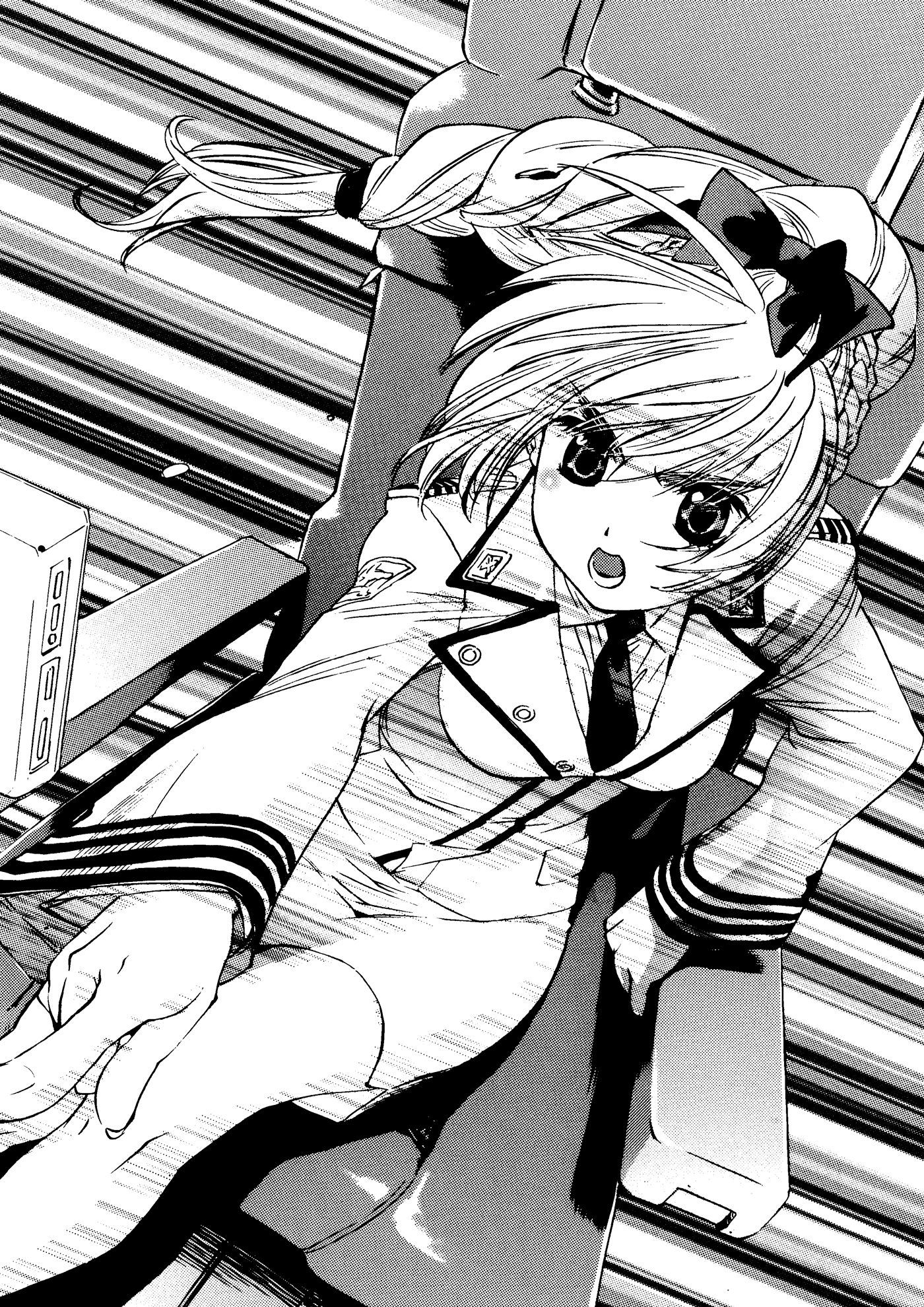
The nearby explosion would mask the sound of their firing torpedoes, and they fired these new shots right at the enemy behind them by shifting the momentum from their drift into a backward slide. It was an acrobatic method of attack.
“One, two, fired!”
“Good,” said Tessa. “Come left to 0-4-0. All-ahead one-third. Increase depth to nine hundred, twenty degrees down bubble. Escape to the north-northwest.”
“Yes, Captain,” said Mardukas, a hint of relief entering his voice at the mention of escape. The noise from the other enemy torpedo’s explosion gave the de Danaan perfect cover to flee the scene. Several minutes later they activated their safety devices, silenced their machinery, and sank deeper into the water.
Tessa knew that the torpedoes they had fired were just a way to buy the de Danaan time. They wouldn’t explode even if they hit, and probably wouldn’t even do that much. She didn’t want to kill anyone on those submarines if she could help it, after all. They were just pawns being manipulated by Amalgam and probably questioning the attack on the Toy Box themselves.
But...even so, their opponents were serious and attacking them with live torpedoes. She’d managed to avoid firing a real shot this time, but even if these people knew their orders were nonsense, they would continue to obey them and attack. Tessa wondered, Am I really obligated to have mercy on these people?
She could confirm that there were three US Navy submarines out there, plus one most likely hiding beneath the thermal layer. If she wanted to, she could change course now and fire off ADCAP torpedoes, ADSLMM autonomous mines, and MAGROC aerial dispersal mines, and sink all four instantly.
Really, she wondered, why not do it? If I just kill them all here, I’ll be able to give my subordinates plenty of rest in the twenty or more hours to come. It would make things so much simpler...
“Captain,” said Mardukas, interrupting her dark chain of thought. “Should we reload the launch tubes with the same torpedoes?”
Under normal procedures, that was what she would do. But if she was going to seriously try to wipe out their enemy, strategically speaking, Tessa would have to switch two of them to ADSLMMs. Mardukas was circuitously—circuitously enough that the rest of the crew wouldn’t catch on—feeling out Tessa’s intentions.
She cast a glance at Mardukas, who was standing by her side. His brow was furrowed, sending her a tacit message: I know what you’re thinking, and I’m against it.
“Yes, the same torpedoes,” Tessa said out loud. “We need to escape this area quickly.” She was effectively saying back, ‘We won’t be mounting any more attacks.’
“Yes, Captain,” Mardukas said simply.
When the Tuatha de Danaan arrived at nine hundred feet, they leveled out and quickly began navigating north-northeast to escape. The commands to silent running and battle stations were lifted, the hangar deck lighting returned to normal, and the maintenance crew resumed work at their stations—the transport helicopters with their rotors folded up and arm slaves with their outer armor removed to expose their internal frames—and got back to work on maintenance.
Sousuke was helping with the maintenance on his own machine, the ARX-8 Laevatein. It was their only lambda driver-mounted arm slave, and probably the second most powerful machine in the world. Its armor was mostly white, with dark red highlights painted on. Its silhouette seemed to be both more massive and aggressive than that of its ancestor, the M9 Gernsback.
Still, there wasn’t much Sousuke himself could do to help with maintenance. He spoke with the machine’s AI and offered simple advice to the maintenance crew. He expected that if he touched the machine’s internals himself, the head of the maintenance team, Lieutenant Sachs, would strike him down with lightning. It was the same in any military; engineers were very possessive of the machines which they were put in charge of. If you asked them, they’d say they were merely lending them out to their operators during deployment.
《Please readjust alignment of sixth cartilage unit on right bicep to .12,》 the machine’s AI, Al, requested both through speech and text.
“The sixth? You said to do it at .05 earlier,” Sousuke said through his headset.
《The abrasion from muscle packages 32 through 37 added since then have exceeded expected limits. Make it .12.》
“Understood,” said Sousuke, who then explained the circumstances to the engineer. The man nodded back, making adjustments to the artificial cartilage unit in the right elbow—a part that looked like a short damper—fine-tuning its elasticity.
《No, return it to .05 after all.》
“What did you say?” Sousuke asked.
《At .12, it puts a burden on the 10th cartilage unit instead. It’s better to keep it at .05.》
Sousuke scowled, swallowing back the urge to complain, and then asked the engineer to reverse it. The engineer just shrugged and did as he was told.
“Done,” said Sousuke. “How is it now?”
《Sorry, please try .08.》
“Excuse me?”
《I take it back. Leave it at .12.》
“Well, which is it?”
《Ah, maybe it’s better to try it at .15 so—》
“Figure it out and then tell me,” Sousuke ordered.
《But—》
Sousuke turned off his voice input and threw the headset onto the desk. He’d had enough of yelling at his machine.
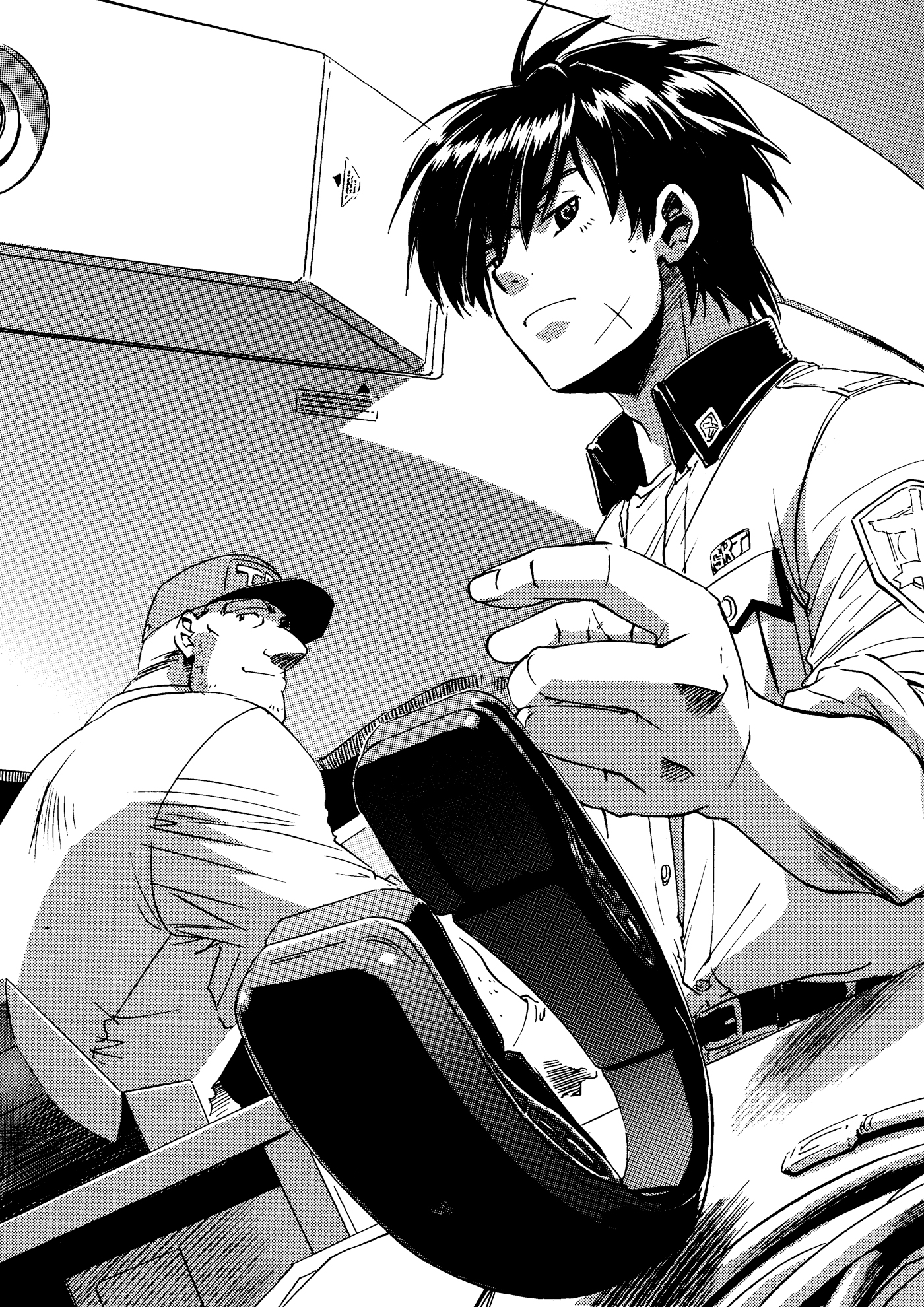
“So, what should I set it to?” the engineer asked.
“Go with .12,” Sousuke told him, assuming that’s what Al would decide on, anyway. After giving his supposition to the engineer, he opened his laptop and went back to the draft he was working on.
He was writing his last will and testament. Mithril members were supposed to write down what they wanted to happen after they died, and it was also preferred that they renew those wills once a year. Sousuke had submitted his will two years ago and hadn’t changed it since, but Villain, Tessa’s secretary, had recently nudged him into updating it.
Sousuke had finished all the business about things like his possessions and money but hadn’t made much progress after that. There wasn’t much he wanted to leave behind in words, after all. He couldn’t think of much to say to his various acquaintances, friends, and comrades. He didn’t feel like it mattered what kind of person he’d been, or what kind of feelings had propelled him in the fight. Too much—far too much—had happened by now for him to think up any clever words to describe it.
Fights he’d won, fights he’d lost... Lives he’d saved, lives he couldn’t save. Unraveling everything he’d been involved in, with appropriate commentary... Sousuke couldn’t do that anymore. He couldn’t think of a single word to leave to those survivors who would continue being tossed around on fate’s stormy seas after he was gone.
Best of luck. That was all he could think to say. These words, which dying soldiers left to their comrades, had changed over the millennia, but they always added up to roughly the same thing: “God be with you,” or “See you on the other side.”
Is it the same with what I want to say to Chidori Kaname, then? he wondered. Maybe not. There were so many things he wanted to say to her; so many that he didn’t know where to start. Yet, at the same time, Sousuke also felt like words weren’t sufficient. If she could return to her right mind, then he could imagine how she’d feel; she’d blame herself. It would be painful. She’d have to walk a long and cruel road of penance, just as Tessa was doing now.
Was there really anything he could say to her in that state? After writing “Best of luck” to his comrades, Sousuke remained staring at the blank text document, until the voice input indicator blinked. Al was calling him.
“Have you decided?” Sousuke asked through the headset.
《.12, please.》
“Thought so.” It was exactly what he’d expected; Sousuke had found himself able to anticipate Al’s demands of late. He mostly just felt it on an instinctual level, but he was usually right, and there was nothing supernatural about it. It was similar to recognizing that a dog was asking you for a walk because it tilted its head at you just so.
The arguments between Al, Sousuke, and the engineer continued after that. Their growing concern was the Laevatein’s exhaustion.
《The machine’s entire frame is showing fatigue. It’s still within the limits of what maintenance and software can compensate for, but you should avoid exceeding movements that cause 20 gs or more when possible.》
“Understood,” Sousuke said shortly. Of course, it’s not as if an operator ever wanted to exceed 20 gs, even for a moment... The Laevatein’s maximum movement potential was, to use an extreme example, like being in a car crash every few seconds. The M9 Gernsback, on which the Laevatein was based, wasn’t built to withstand the engine output and firepower they’d strapped to it.
It was like strapping an F1 engine to a commercial sports car; there was no way the car was getting out intact. Its operation time was limited, its electronic warfare options sparse, and it overheated on the regular. Maintenance was an issue, too. Many of its parts—frame included—faced a faster rate of wear and tear than those of a normal M9. The Laevatein could no longer fight in the reckless way it had during its debut sortie.
Once they’d discussed the wear issue, Al asked, 《Will that cheating bastard appear in our next mission?》
“Most likely,” Sousuke told him.
Al was referring to the black AS that Leonard piloted, the Belial. They’d found the machine’s name in the information they’d acquired from the mansion in Mexico. Sousuke and Al had lost to it the first time they’d fought it, and been forced to retreat the second time. Al seemed to feel a particular enmity towards the other machine, and always spoke about it in the most hateful of terms. He’d call it ‘the cheating bastard,’ or ‘the lambda driver-reliant wreck,’ or ‘the one-trick pony fail machine.’
Ironically, these labels all applied to the Laevatein as well, but AIs probably had their own pride, so Sousuke refrained from pointing that out. Instead, he said, “We’re the only ones who can face him.”
《Then our next sortie will likely be our last.》
“Yeah...” Sousuke agreed, looking up at the Laevatein. There were countless cracks running through its armor. “One more. That’ll be enough.”
Just then, a short alarm sounded, warning of an incoming shipboard announcement. It was the voice of the XO, Mardukas. “The interrupted meeting will now resume. All relevant personnel, please report to the first briefing room. I repeat. The interrupted meeting—”
Across the hangar, maintenance chief Sachs stopped in the middle of his work to head for the aft deck. Sousuke was ‘relevant personnel’ as well, so he closed the text file he’d been working on and began tidying up after himself.
《Will Colonel Testarossa be at the meeting?》
“Yes.”
《Shall I attend as well? I might be able to offer meaningful support. I could also fill the hole left by Master Sergeant Weber—》
“Shut up,” Sousuke told Al. Then he threw off his headset again and headed for the briefing room.
Tessa entered last. “Sorry for the wait. Let’s get started,” she said.
“Right.” Belfangan Clouseau started things up, addressing Melissa Mao, Sousuke, and the others in attendance. “I’ll have to start with the bad news: Afghanistan. A Soviet nuclear missile base in the northeast mountains has been occupied by an unknown armed force.”
The Republic of Afghanistan, a landlocked nation on the far eastern side of the Middle East, was currently under Soviet control. The USSR had their armies stationed all around it and had built countless military facilities there, including the missile base in question.
“An ‘armed force?’” Melissa Mao asked with a scowl. “That area’s right on the Soviet border, isn’t it? They’d have tight security. I doubt any force small enough for an ambush would be able to cut it.”
“There are a few that could pull it off,” Sousuke agreed. “Us... and them.”
“Leonard’s gang, eh?” Lately, Mao and the others had stopped calling the enemy “Amalgam” and started calling them “Leonard’s gang” and similar. It was clear by now that Leonard Testarossa was the real power behind the otherwise faceless enemy.
“A single one of their lambda driver-mounted ASes could wipe out all defenses in ten minutes,” Sousuke said flatly. “Then they could take over the facility with coordinated attacks from Alastors and infantry.”
A new screen came up, showing the latest satellite images of the area. Remains of BMP mechanized infantry and Savage-model Soviet ASes were left scattered and smoking around the base, high in the mountains. Several AS silhouettes of unknown affiliation could also be seen occupying the base.
“But why a nuclear missile base?” asked Mao.
“I don’t know. Perhaps they want to pour gasoline on the fire of the upcoming nuclear war,” Clouseau speculated. “With the US and USSR presently in a staring contest, the occupation of a nuclear silo would clearly heighten tensions. But neither Leonard nor Amalgam have any reason to want to see the world destroyed. They couldn’t want to actually fire them. Which means...”
“Distraction, and to buy time,” Tessa said.
“What do you mean?”
“I intend to take Merida Island,” she said succinctly. “It used to be our base, and it seems to be serving as theirs, now. They’ll want to keep me from it at any cost. So...”
“So they took over a nuclear missile base?” said Mao. “To try to make us go there instead?”
“Yes.”
“Tessa, I’m not sure I understand...” Mao admitted.
Tessa looked into the faces of her subordinates, most of whom looked highly confused. Why so desperate to protect Merida Island? What’s there? they seemed to ask.
Yes... why was Tessa so obsessed with taking back Merida Island? Before now, she’d kept her subordinates at arm’s length about the matter, but now they wanted to know the entire truth: the ultimate reason lurking behind her battle with Leonard.
She cast a glance at Sousuke. He was the one person there who already knew most of it.
Sousuke hesitated a moment before nodding, as if to say, There’s no more use hiding it. Lay it all on the table.
Why was Tessa so desperate to take back Merida Island? Why was the enemy so fixated on keeping it? The answer would divide opinion even among her most trusted subordinates.
“All right. Just let me finish, without any joking around...” Tessa took a deep breath, then explained everything. She told them about the Soviet experiment in telepathy eighteen years ago. She explained how it had gone wildly out of control and brought information about technology from the far future to the modern world; about the Whispered, who had received this ‘black technology’ and far increased the tech level of the world they lived in; about how this had likely caused a massive change in the course of their world’s history.
“People...” said Tessa, continuing to speak into the hushed briefing room. “People who might have lived are now dead, and people who might have died are alive. Leonard and those with him want to ‘fix’ that. He wants to build a new TAROS—an extremely powerful space-time transmitter—on Merida Island, and use Kaname-san’s power to set history right.”
Her subordinates—who had likely expected something unusual, but surely nothing quite this extreme—had nothing to say. Although dubious, they also knew that Tessa wouldn’t make something like this up, so they didn’t quite seem to know how to react.
Mao was the first to speak. “Tessa... I’m sure what you’re saying is the truth. But it’s a little hard to take in just like that.”
“I suppose it would be.”
“We’re soldiers, you know? We follow realistic plans. And now you’re throwing this fairy tale stuff at us... It’s hard to take,” Mao admitted.
“But it would certainly explain some things,” Lieutenant Colonel Mardukas, Tessa’s executive officer, was the next to whisper. He was also a realist, and a veteran—the one who seemed least likely to believe the story. “I’ve always thought it was strange,” he continued. “Arm slaves, lambda drivers... all of it. These Whispered I’ve been hearing about, too. Absurd as the story is, it makes an odd kind of sense.”
“Thank you,” said Tessa. “That’s why I—”
“However,” Mardukas interrupted, cutting her off. “It is also too much for the imagination of an old man like me to take. Even if history did change, as you’re suggesting, the life I’ve lived these past eighteen years is reality to me. What will happen if Leonard Testarossa uses this ‘Taros’ to ‘correct’ history? I’ve lost many comrades in my time, your father being one of them.”
Mao and the others looked surprised by his words. They’d never known that Carl, Tessa’s father, was one of Mardukas’s old war mates.
“Will Carl Testarossa, my old friend, appear before me again as if he were never gone?” Mardukas wanted to know.
“It won’t be quite like you’re imagining it,” Tessa said. “If the corrected timeline is a world in which Carl Testarossa never died, I would expect you to view that as the way things have always been. You would be who you are in that world, meeting and chatting with my father like you always have. The world itself will change the moment the TAROS sets history right, so you would live the rest of your life in that world as if it were where you’d always been.”
“Mithril would be gone as well?” he wanted to know.
“Most likely.”
“And I would lose the last three years I spent serving under you alongside all these brave men and women?”
“Most likely,” Tessa affirmed. “But the ‘you’ in that world wouldn’t realize that...because you never would have known them.”
“I will not forget them,” Mardukas said with rare intensity. “I don’t understand the methodology exactly, but I would never forget the comrades who died with me.”
The words were unexpected, yet Tessa found they suited him well. “I feel the same way,” she told him. “But you wouldn’t be able to care about them if you’d never met them, would you?”
“Ah... perhaps not.”
“This isn’t a matter of memory loss or brainwashing,” she said. “It’s a change in reality itself. The chemical reactions in your brain simply follow the pathways established as things happen around you; successes and failures, life and death. Your personal will never even factors into it.”
Mardukas fell silent after hearing this statement.
“I’m struggling with this too, Colonel,” Clouseau, who had thus far been silent, spoke up hesitantly. “I... er, I have a little understanding of science fiction myself. In books and movies, even when they use a time machine to interfere with the past... ah, it just creates a branching timeline. It doesn’t change the world they came from.”
“The multiple-worlds theory, you mean?” Tessa specified.
“Yes, also known as ‘parallel worlds.’ What if their use of that strange machine doesn’t actually change things for the rest of us?”
“I couldn’t say,” Tessa admitted honestly. “The parallel worlds theory you’re talking about is a recent hypothesis—the existence of the mental—physical theory that takes the omni-sphere into account neither confirms nor refutes it. Like the wave function of particles—No, I’ll keep it simple. It’s because the rest of you cannot perceive both worlds.”
“That’s all very ambiguous... Wait a minute,” said Clouseau. “You said, ‘The rest of you.’ What did you mean by that?”
“I mean that we can perceive them,” Tessa said with utmost calm. “The omni-sphere allows the Whispered to converse via mental waves across the barriers of space-time. If parallel worlds exist, we might be able to perceive them.”
“I’m getting confused.” Clouseau let out a sigh and ran his fingers over his close-cropped hair. “Can you boil it down for me?”
“I think that’s what Leonard is after,” Tessa speculated. “He wants to change history in a way that’s convenient for him, then transfer our memories and consciousnesses—our personalities in this world—to that ‘other side.’ Try to imagine it... What if tomorrow morning, you could remake the world however you wished it could be and actually enjoy your knowledge of the changes while no one else is any the wiser?”
“Like creating a new save file,” Clouseau murmured. “It’s appealing.”
“So, it’s all a fraud,” Sousuke said grumpily. “Leonard talked about ‘correcting the world’ back at Yamsk-11, restoring it to the way it should be. I had a feeling his lofty ideals weren’t on the up-and-up, and now I see why. He wants to take Kaname and go to a world where we can’t follow. A world where I can’t follow.”
“Precisely,” Tessa agreed. “That’s why I want to stop him.”
“Still, this is all pretty abstract...” Mao said with a groan. “And even if what you’re saying is true, it won’t affect most people, right? Whether there are parallel worlds or not, we won’t be able to experience the change.”
“Yes,” Tessa acknowledged.
“Then what’s the point in us taking back Merida Island?” Mao asked. “Look, Tessa, I’m not criticizing you... If you really think it’s necessary, I’ll die to get it done. But we also need to convince the rest of the crew and my subordinates.”
“Of course, you’re right,” Tessa agreed. She’d known that Mao would say these things and that the others probably felt the same way. Everyone except for Sousuke...
Tessa cleared her throat lightly and went on to explain things carefully. “I suspect Leonard’s people know about this issue,” she said. “Which is why they took the missile base. They’re making us choose between the taking of Merida Island—which most of you won’t care about—and the clear and present danger at the nuclear site. Speaking as soldiers, which would you prioritize?”
“It’s obvious,” Clouseau said first.
“Doesn’t need to be stated,” Mardukas agreed.
“The missile base, right? Not really a contest,” Mao shrugged.
Sachs, the few other SRT members in attendance, and the heads of various departments seemed to be in agreement.
Tessa remained silent and glanced at Sousuke. “And you, Sagara-san?”
“I...” He felt a brief struggle. He wanted to fly right to Merida Island where Chidori Kaname was. Even if his logical mind agreed with those around him, his heart found it more difficult. “I think... I’d give priority to Afghanistan.”
“Good.” Tessa got out of her seat, folded her arms and looked over the group. “Perhaps it is just a diversion, but we still have to take back that nuclear base. They’re going to be willing to fire those missiles, just to motivate us. And as long as they can activate the TAROS on Merida Island, it won’t matter to them whether the rest of the world survives or not.”
In fact, Tessa thought that reducing the population of this world might actually be to their benefit... But she wasn’t certain, and therefore decided not to share this with the others.
“That’s madness,” Mao said.
“Even so, Leonard is quite charismatic,” Tessa pointed out. “If he’s convinced the non-Whispered working for him that he’s changing the world, they’ll go along with anything he asks for, no matter how destructive.”
It was all too big and too complicated. What to prioritize, how best to get the drop on the enemy... none of them had an answer to these questions, and the air in the room grew heavier.
“Regardless, Captain. What do you intend to do?” Mardukas asked, finally getting to the heart of the matter.
Tessa looked out at the faces of her comrades. “We’ll divide our forces,” she decided.
“Divide...?”
“I’ll deploy the helicopters,” she clarified. “The rest of you will fly to Afghanistan and take back the missile base. Whether or not the parallel world exists, this is still your reality—Please protect it.”
“But what about you?” Mao asked.
“I will take this vessel to Merida Island,” said Tessa. “Thankfully, the de Danaan has a TAROS of its own. It’s a smaller, older model, but it will enable me to control it all by myself,” she said quietly.
Mao and the others stared in stunned disbelief. “B-But... this submarine can’t take the island by itself, right?” asked Mao. “You’ll need ground forces.”
“Yes. He will be the landing team,” Tessa said, looking over at Sousuke. He’d probably expected this announcement, because he didn’t look at all surprised and met everyone’s gazes evenly.
“Sagara-san and I,” Tessa mused. “When you come down to it, we’re the only two who have any business on Merida Island.. So, we’re going to go ourselves. We’ll be taking the Tuatha de Danaan and the Laevatein, though. Is that all right, Sagara-san?”
Sousuke nodded silently. But it was a nod of resignation, as if to grudgingly admit that this course of action was their only choice.
“It’s suicide,” Mao said, her voice trembling with anger. “We’ve come this far—fought every moment together—and now you’re saying ‘go on and handle this without us’? Do you realize what it is you’re saying?”
“Yes,” he told her simply. “But you said it yourself... You wanted a reason to take back Merida Island that your subordinates could accept.”
“And what is it?” Mao demanded to know.
“There is none,” said Tessa, answering for him with a lonely smile. “There’s absolutely no reason for the rest of you to come along. I’m a Whispered, so I have a reason to want to stop Leonard’s plan. Sagara-san is an ordinary person like the rest of you, but he’s only with us in the hopes of bringing Kaname-san back to Japan. The rest of you have no reason that even comes close to matching ours.”
Mao was silent.
“We’ll be reaching our final resupply point in five hours,” Tessa continued. “The rest of you will disembark there and head for Afghanistan. If you manage to take back the missile base, you can go your separate ways after that and live your lives however you wish.”
“Tessa!”
Tessa knew exactly what Mao wanted to say, but there was no other answer for her to give. “I’m sorry,” she said gently, “but this is goodbye.”
The Soviet forces sent to take back the base arrived a bit later than Sabina had expected. It was winter in the northeastern region of Afghanistan (the region of Badafshan, to be specific) and smack in the middle of a mountain range with an altitude of four thousand meters. The terrain was dangerous, the ground was white as far as the eye could see, and the roads that wound through the mountains were covered in deep snow. Bitter cold and snow... It was impossible for normal squadrons to move in this season.
The AS that Sabina was operating, the Eligore, was currently crouching on a ridge, concealed via ECS as she evaluated the power of the enemy squadrons. Standard armored vehicles couldn’t traverse this terrain, so naturally, the main force was composed of ASes.
The enemy force consisted of ten of the latest model of the second-generation Savage—the Rk-96—along with six new ASes bringing up the back line. These were more slender than the Savages, with their egg-like torsos; the third generation of the Soviet model, the Zy-98, codenamed ‘Shadow’ by the Western powers. Their stats massively outstripped those of the Savages, putting them more on par with the M9 Gernsbacks used by both the USA and Mithril. They were the model on which Sabina’s Eligore was based, as well.
A sixteen-machine AS squadron, new and old together. Common sense would suggest that it was more than enough to retake a missile base from occupying terrorists—but there was nothing common about this situation.
“Fowler here: sixteen ASes approaching from the north. How are things on your end?” came a voice over the radio. It was from Lee Fowler, who was watching the expected north side entry route. He and Sabina were using a totally encrypted channel, so they weren’t bothering with call signs.
“I’ve just sent you the data,” she told him.
“Hmm... The same, eh? Thirty-two ASes in total. They’ve really turned out,” Fowler observed.
“There’s likely a transport helicopter squadron waiting behind them, too.”
“Most likely. They’ll want to use the ASes to scatter us and then send infantry to storm the base,” Fowler predicted. “Too bad they don’t stand a chance.”
Their own forces were made up of Sabina and Fowler’s Eligores, four Shadows standing watch over the base, and a single platoon of infantry. But the lambda driver-mounted Eligores were invincible next to normal ASes; there was nothing to worry about.
“Even so, we’re about to be busy for a while,” Fowler continued in a grumble. “It would be easier with a few Codarls on our side.”
Codarls were Amalgam’s lambda driver-mounted ASes. They weren’t as strong as the Eligores, but they were overwhelmingly more powerful than standard ASes.
Sabina felt a slight irritation at his words. “All of our Codarls have been dedicated to the defense of Merida Island. Leonard-sama decided we were enough to complete this mission. Why don’t you stop complaining?”
“Of course,” he snapped back, “but I think you’re the one who’s unhappy about it.”
“What makes you think that?”
“You wanted to stay on Merida Island, didn’t you?” Fowler pointed out. “Considering what’s about to happen, I’m sure you want to be with Leonard-sama.”
“No,” Sabina denied. “I wouldn’t be of any use on that island at all.”
Besides, that girl was on Merida Island. Even though she had ‘awakened’ at Yamsk-11, her attitude hadn’t changed as far as Sabina was concerned. She was as arrogant and stubborn and self-righteous as ever.
And yet, Leonard needs her, Sabina reminded herself. And not just him... Everyone who serves him—all of us—need that girl. She has the power to right the mistakes of this cruel world and make them never have happened.
He doesn’t look at me anymore. He doesn’t touch me anymore.
Of course, I never expected I’d have him all to myself. That’s the kind of man he is. I’m sure he’s slept with any number of women just like me, more than I could ever know. There’s nothing wrong with being one of that number.
But...
Why must he give his heart to that girl—to that brat, Chidori Kaname, of all people? It would be one thing if it were for her body, but it isn’t. He’s kept it perfectly platonic, devoting himself to her to an almost laughable degree...
Things had improved for a while after his injury in Mexico. He’d ordered Sabina to be rough with Kaname, to drive her to the psychological brink... to exhaust her. Sabina had felt relieved then, glad that he had finally decided to treat Kaname as a tool—that he’d decided to take her by force. That situation was much easier for Sabina to handle.
But the girl had changed before Sabina could break her down. It happened at Yamsk-11, where Kaname had suddenly become the one in charge. Then everything had gone back to the way it was before, and Leonard had never raised a hand to her again. Instead he’d begun to dote on her, agreeing to the spoiled princess’s every demand...
Sabina was sick of watching them. Taking the Ishkashim missile base was merely a decoy to lure out the remnants of Mithril, but she was glad that it had taken her seven thousand kilometers away from Merida Island if it meant she wouldn’t have to look at them anymore. Even if it meant becoming a sacrificial pawn...
“I don’t mind at all,” Sabina said calmly. “But, Mr. Fowler...what about you?”
“I do mind a little bit,” he admitted. “It’s a shame not to be present for the historic moment.” His voice over the radio was self-recriminating.
“Is that all?”
“Yes, that’s all. As long as the TAROS activates properly, I won’t have any cause for complaint.”
Those who followed Leonard were very strongly motivated. The reasons for their motivation varied widely, but what they had in common was an almost frenzied hatred and anger towards the current world, and for the past events that had brought it to its current state. If there was some way to reject that past they hated so much, they’d take it. That feeling was what had led them to join this ridiculous war.
Sabina, having grown up in a life of exploitation in the slums, had many reasons to hate the past. Fowler seemed to have his reasons, too. When they were working together on missions, she had seen signs of the same anger in him now and then. That seething anger—an anger like a charcoal fire—was proof that he had left some piece of himself in the past.
She’d heard he’d had a wife and children. That something had happened, that he’d been unable to protect them. But that was all. Sabina would probably never get to learn the whole story, just as she’d had never told anyone but Leonard the reason for her own anger.
Returning to the task at hand, Sabina zoomed in with her optical sensors. The Soviet AS forces were approaching in the middle of her screen, marching to their deaths, step by step...
“Shall we initiate?” Fowler asked.
“I was planning to watch a bit longer, but... if you wish,” Sabina agreed. “I’d like to stretch my legs.”
“Let’s begin, then.”
Sabina closed the channel and switched her Eligore’s power source—the palladium reactor—from idle to battle output. The machine’s low hum grew louder. The reactor itself was silent, but the cooling device made noise based on its output.
The winters of northern Afghanistan were harsh, and the current temperature outside was a blistering minus thirteen degrees. The heat put out by their palladium reactors was probably exceeding what they could hide, and outside of the ECS’s field they were probably already registering as unnatural heat sources.
One of the enemies searching with infrared sensors seemed to have already noticed the heat source. The troop stopped and began scanning carefully in the direction where Sabina lay hiding. Their allies seemed to be exchanging conversation and data, arguing about whether or not there was a “suspicious heat source” there.
Of course, Sabina thought. Electronic data... She knew their wavelengths and the protocols well, and she knew the various types of signals they were exchanging. Sabina’s Eligore analyzed it all with a powerful operative function, exploited weaknesses in the systems that would normally be unexploitable, and swiftly rewrote important battle programs which should not be rewritable. She was turning it all to their benefit.
The specialty of Kaspar, who had died at Yamsk-11, had been sniping; hers was electronic warfare. The electronic warfare systems that had been customized for Sabina, used in tandem with her own unique skills, turned her Eligore into a witch on the battlefield.
The six Shadows in the sixteen-machine squad began to go berserk. They had cutting-edge electronic weaponry and data link functionality, and they hadn’t been in the field for long, which made them as vulnerable as children raised in cleanrooms exposed to bacteria for the first time.
One Shadow began firing at its allies, while another began launching anti-AS missiles randomly across the area. The remaining two turned their guns at each other and fired simultaneously—as if they’d coordinated it—and destroyed one another in a fireball.
The ten Savages didn’t seem to have gone quite as mad as the Shadows, but they had been rendered immobile. Some had lost all their sensors, some had had issues with their drive systems, some saw their gas turbine engines begin to go haywire and put out smoke.
Sabina could hear the voices of the enemy operators: fear and confusion; shouts of anger and pain... Magnificent, she thought appreciatively. The screams of Russians are the most sublime.
She lifted her ECS invisibility mode. In the twilight that bathed the mountains in orange, her Eligore appeared. Her machine’s armor was as white as a virgin bride.
Pulling a 37mm rifle from her back, Sabina leaped her Eligore into the air, scattering snow. “Leonard...” she whispered. I don’t need the power of the lambda driver. If you want to see the world burned in nuclear fire, I’ll make it happen. With my own innate abilities, I will prove I can be your sword. I’ll do things that that other woman could never do…

Chidori Kaname remembered this wide, underground space as being the Tuatha de Danaan’s maintenance dock. It wasn’t a dock now; the seawater had been pumped out, and the underground waterway that led out to the ocean had been sealed up by concrete.
It was an underground cavern large enough to comfortably house the 218-meter Tuatha de Danaan, a vessel as long as a Shinjuku skyscraper was tall. What they were building there now was a facility of a scale far exceeding that of the one at Yamsk-11.
Various cables and tubes stretched from a dome fifty-three meters in diameter. The massive amount of electricity, which was being sent from an independent generator facility several kilometers away, was enough to power a whole city. Around the dome were large devices meant to store and transform said electricity, paired up with cooling units.
This device, whose need for practicality rejected concerns of aesthetics and refinement, was the world’s largest TAROS. The project team called it TARTAROS, short for “Telechrono Alteration Reactor Transform and Response Omni-Sphere.”
Strange to name a symbol of hope after the God of the Underworld, thought Kaname, who liked to joke that the TARTAROS was like a What-if Phone Booth. It was a perfect reference, if she did say so herself, but no one around her got the joke.
The TAROS was a device found in every Codarl, Eligore, and other lambda driver-mounted AS. But the TARTAROS didn’t just exist to power a lambda driver. It was built for a grander, more sublime purpose.
Sublime... That was how Kaname currently thought of it, at least. Sublime. A grand duty. An ultimate display of love... And other such things.
How sweet it was to surrender oneself to platitudes.
“Almost there,” Kaname whispered from the observation platform near the old dock’s ceiling as she looked down on the tangle of cables and tubes. It had been six months since construction started, two months since Kaname had arrived and begun to oversee its construction. They were working at a fever pitch to complete it. “You’ve gotten it prepared so quickly.”
“Your wish is my command,” said Leonard, standing behind her. “But since we were in such a hurry, I’m afraid we left tracks... and now the enemy is on the way.”
“The enemy?” she questioned.
“My sister,” Leonard clarified. “Teletha, Sagara Sousuke, and the remnants of Mithril will likely storm this island soon.”
Leonard’s saying such odd things again, Kaname observed. He was talking about Teletha Testarossa and Sagara Sousuke as if they were still alive, but they weren’t. Kaname had shot them to death herself, so she was quite sure of that. “Tessa and Sousuke are both dead,” she told him. “What are you talking about?”
“You’ve just convinced yourself of that. They’re really—” Leonard started to say, and then stopped himself. “No, you’re right,” he said. “I must have been mistaken.”
“Honestly, you need to get it together,” said Kaname, laughing as gaily as if she’d pointed out a mistake in his math homework. She didn’t even bother to question why she was laughing. It didn’t occur to her for a moment that her mind might have been terribly damaged somehow.
“Well, one way or another, the enemy is likely on their way,” Leonard said easily. “I’ve sent Fowler and Sabina out as a diversion, so I think I’ll successfully divide their forces.”
“Will they arrive before we activate it?” Kaname asked.
“Most likely.”
“Then you know what we should do, right?”
“Send everything we have at them, of course. Come on, this way,” said Leonard, stepping out of the path. Kaname passed him by, leaving the underground dock behind and heading to the surface by means of the elevator, which was located a few blocks away.
Outside was a clear, starry sky. They arrived at the supply holding area, a large open space created from hollowing out part of a mountain. The island’s defense forces were on standby there.
Twelve Codarls were lined up like an honor guard to meet her, their spear-shaped monomolecular cutters pointing towards the night sky. Behind the Codarls stood three giants lit up by floodlights—those massive ASes, the Behemoths. They were holding their massive cannons vertically in front of them, showing loyalty to their leader.
At the end of the line of Codarls stood Leonard’s black AS, the Belial. The machine, which made use of Leonard’s limitless abilities with the lambda driver, was the undisputed strongest machine in the world.
There were also mid-sized infantry squadrons and helicopter squadrons; anti-air squadrons, as well. They were all arranged in a line, saluting Kaname and Leonard.
“All units assembled.” Their commander, Andrey Kalinin, walked out to report to Leonard and Kaname. He was currently dressed in olive-colored fatigues. He’d just returned from a long trip to England but showed no sign of exhaustion.
“Mr. Kalinin,” Kaname said by way of greeting. “You do look better that way than in a suit.”
“I agree,” Kalinin replied, seeming to find the comment rather funny.
“Are these all the forces we have to defend us?” Kaname wanted to know.
Kalinin looked out at the sea on the other side of the supply area. “There are two platoons of Leviathans on standby underwater,” he told her. “Any ship that attempts to approach the island will take heavy losses before arrival.”
“I see.”
“And even if they successfully make landfall, these squadrons will be there to greet them.”
“As will my Belial,” Leonard pointed out.
“Hmm...” Even so, Kaname was surprised to learn that these were the last of Amalgam’s forces. Of course, it was all quite impressive if you included those sent to Afghanistan and those dispatched elsewhere in the world to heighten tensions, but...
“We’ve prioritized all available resources and funding for the building of the TAROS,” Leonard reminded her. “Restocking our weapons has been a secondary matter. And also...”
“Because of Mithril, eh?” Kaname commented.
“I’m afraid so. Or their remnants, more precisely... They’ve been quite annoying to us these last six months. That ARX-8 had caused a lot of trouble as well, and they’ve done some guerrilla work on our production facilities and supply lines. As you know, lambda driver-mounted ASes require special parts.”
Kaname had read the report, so she knew most of this already. The remnants of Mithril had continued their stubborn resistance, located Amalgam’s secret production facilities and related corporations, and meticulously attacked them one after another. Dealing this kind of organizational damage had also made it harder for them to track the enemies’ remaining movements.
Allowing the Tuatha de Danaan to escape in the initial capture of Merida Island appeared to be coming back to haunt them. It remained a symbol to the regrouping Mithril remnants: a mobile command fortress operating deep beneath the sea.
“I’m impressed they managed to remain united, even with Tessa gone,” Kaname mused. “Could it be Mardukas-san leading them?”
Kalinin frowned a bit, and turned to watch Leonard’s reaction. Leonard shook his head briefly, subtly enough so as not to be seen by the others.
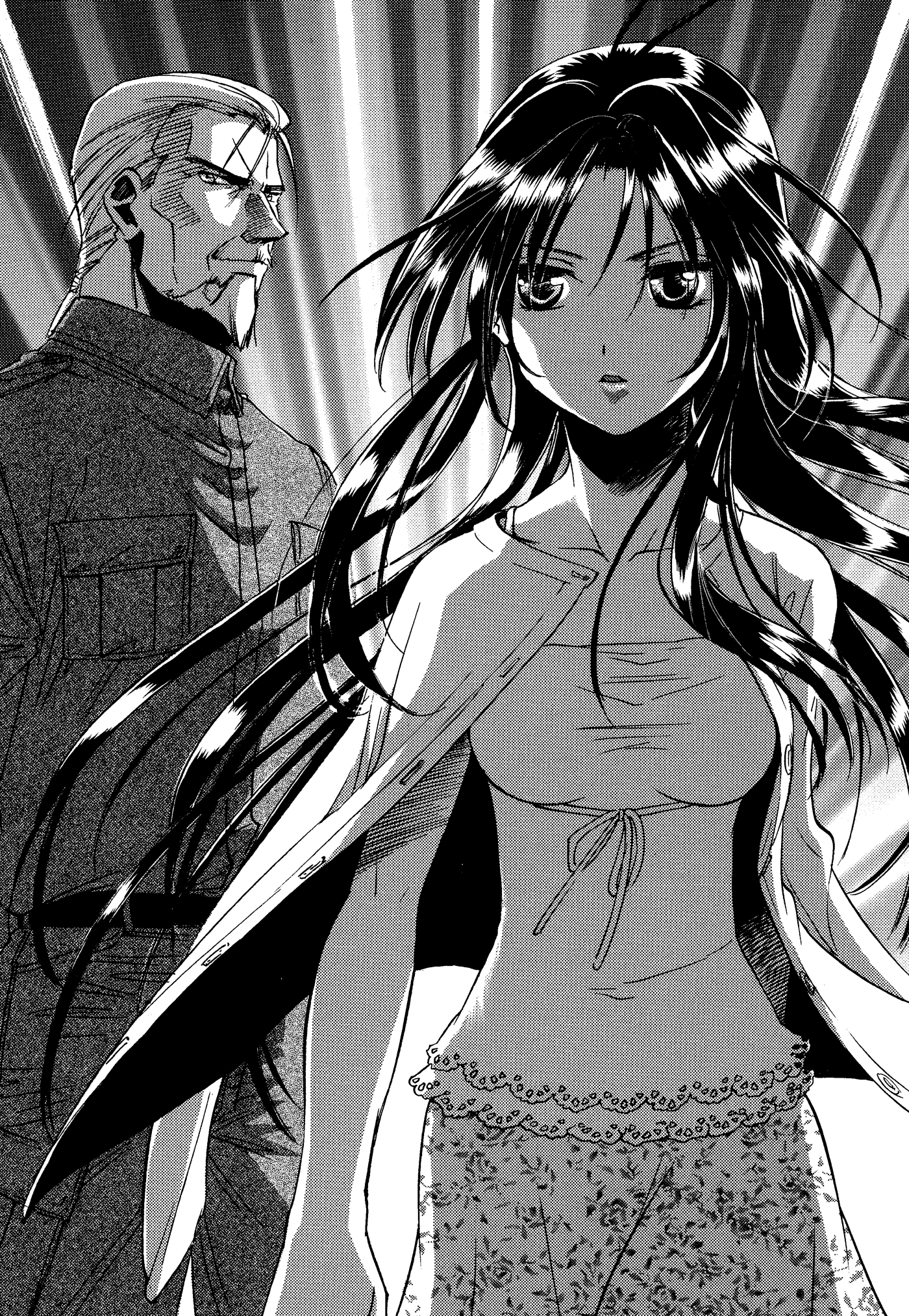
“Hmm? What is it?”
“Nothing.” Kalinin changed the subject. “One way or another, their forces are slim, and they’ll have to divert some of them to take back the Afghani missile base. On top of that, we have political power on our side.”
“The US Navy?” Kaname asked.
“Just for peace of mind,” he told her. “They’ve been ordered to sink the Toy Box on sight. Many officers among them seem to find it suspicious, but... well, they’ll at least cover a large swath of ocean.”
“Good.” Kaname clapped her hands together firmly. “Well, once we can get the TARTAROS running, none of these weapons will matter anymore. Just leave it to me. I’ll make sure everything goes perfectly to plan.”
Just hold the island until it activates, she thought. How hard could it be?