3: Real Bout
3: Real Bout
“Come out. Hurry.” With a grinding sound of metal, the rusty iron gate opened and the guards yanked Sagara Sousuke out of the shared cell.
He’d spent the night there.
An unjust arrest based on forged evidence—It was a common enough story in third-world countries like this one. Sousuke wasn’t surprised at all by it, and the dingy state of the holding facility, too, simply inspired the thought, Ah, of course.
Still, it was an awful place to spend a night. The floor and the walls were moist. They were also perpetually grungy and sticky. A variety of pervasive stenches blended together in a unique cocktail, and winged insects buzzed annoyingly around them at all hours. The only real light came in through a tiny window close to the ceiling.
Three days here would be enough to break anyone, either physically or mentally. In fact, there were several other men in the cell with them in that very condition, their bony shoulders trembling, constantly mumbling to themselves.
Sousuke was the only one brought out. Lemon, who had been arrested with him, remained in the cell. He watched him go with a mixture of nerves and exhaustion. “Sousuke,” he said.
“Don’t worry,” Sousuke told him, and then left the jail behind.
With his hands cuffed behind him, Sousuke was taken to an interrogation room on the second floor of the station. Really, it was just an empty room with no furnishings except for two folding chairs and a naked bulb hanging overhead. The walls were made of exposed concrete, and marked here and there with reddish-black stains—bloodstains put there by the officers’ “interrogations,” no doubt. And the blood wasn’t all; in a corner of the room, mixed in with the dust and trash, he saw a scattering of what looked like small, brownish pebbles.
Teeth.
Had they been knocked out, or yanked out with pliers? How many people had they brought through here to reach a collection of teeth that large? It seemed like they had been left there intentionally, rather than cleaned up, to inspire fear in their next victim.
But Sousuke, looking at that tragic sight, merely felt a strange sense of nostalgia.
That’s right. This is where I belong.
A warm apartment in Tokyo. A classroom filled with light. High-quality food, happy laughter... They’re all wonderful things, of course. But they’re no longer part of my world. At least, for now.
I have to become a weapon, he told himself. The right tool for the job at hand.
Sitting there in that room, empty except for old signs of suffering... Just staring at a point on the wall long enough left his heart slowly desiccating. He closed his eyes and honed his nerves. Sharper. Colder.
He was becoming Kashim again. It had been happening gradually since he’d left Tokyo behind, and it would be necessary for what was to come. In a way, his life with Nami and Lemon had actually stalled that necessary process.
After leaving Sousuke to wait for nearly an hour, the chief entered the interrogation room. He came forward with slow, evocative steps, probably meant to assert dominance over the pathetic Sousuke. The flared thighs in his pants, combined with a pair of riding boots, brought to mind the monstrous officers of Nazi Germany.
“Robbery, assault, attempted murder,” the chief said. “Blackmail, giving false testimony, illegal immigration, gambling, forgery of documents, obstruction of an officer in the line of duty, unlawful possession of a weapon... any other requests?”
“What are you talking about?”
“Your sentence, Sagara Sousuke. Altogether, you’re looking at a sentence of at least forty-eight years. I’d like to get you to an even fifty...” mused the chief.
“How about assaulting an officer?” Sousuke suggested. “I could do that one now.”
“Hm.” The chief scratched his chin. Immediately, the musclebound officer beside him punched Sousuke across the face. The smack echoed through the interrogation room.
Sousuke had expected it, but the hit still knocked him for a loop. His body reeled backwards in defiance of his will, and his chair would have toppled over if not for the officer pulling him roughly upwards again.
“You don’t seem to understand the position you’re in,” the chief leered.
Sousuke grunted in response.
“This is no mere interrogation room,” the man clarified. “It’s a courtroom, and it can be an execution chamber, too. I’m the judge. I’m the jury. And I am the executioner.”
“You appear rather understaffed,” Sousuke whispered, putting in extra effort for the sarcasm. His mouth was full of blood, and a broken molar rolled onto his tongue. He thought about spitting it out, but he didn’t want to add to the room’s trophies, so he swallowed it instead. “Now, what do you want? I’m sure you didn’t come here just to tell me I was getting fifty years.”
“Very perceptive.” The chief laughed, his stomach and jowls swaying rhythmically. “It’s about the Arena.”
Sousuke said nothing.
“You’ve won every match you’ve fought since you started,” the chief observed. “If you win your next match, your team ascends, correct? You’re already getting a reputation among the organizers for your skill. Once you move up to Class A and the money rolls in, you’ll shoot right to the top in no time.”
“That’s the plan,” Sousuke agreed stoically.
“But we can’t have it.” The chief took off his cap and rubbed his bald head. “The Arena has its star teams. They win and lose in the proper ratios, and we control who wins the title, to ensure the perpetual enjoyment of the audience. It’s a very efficient way of running things; stable and balanced. And very profitable for us. Understand?”
Sousuke knew exactly who the chief meant by “us.” He was speaking for the Arena’s management: the organizers; the merchants who sold AS parts; influential people in the city; organized crime lords and government bureaucrats. All the usual people who swarmed to a massively profitable sport like this, hoping for a piece of the action.
“Dao and the others are Class B, but they’ve done good work for me,” the Chief went on. “And... Sagara Sousuke, was it? You’re on your way to upending the order we’ve established. That’s why I brought you in here. Do you think we could come to an understanding and do a little ‘adjusting’ for the sake of both of our futures?”
“I see.” Adjusting—in other words, rigging the matches. Or something similar. “And if I don’t cooperate, you’ll lock me away for fifty years?”
“That Frenchman, too,” the chief agreed. “And the owner girl, and the rest of your team. I don’t think I need to tell you the way bored guards and prisoners like to treat young women. No one defies me in this town.”
Even when he brought Nami and Lemon into it, Sousuke felt no sense of panic. To the contrary, he began to run the mental calculations needed to determine if he could kill the two guards and the chief, even with his hands cuffed behind his back.
I most likely could, Sousuke decided. He imagined killing them, removing the handcuffs, stealing their weapons and escaping. It wouldn’t be especially hard.
Could he get Lemon out of prison, run to Nami, and escape this town with them? Easily, he told himself. But that would defeat the point of everything. So instead, Sousuke just responded: “It appears that way. If things need ‘adjusting,’ I’ll play along. But I have a request.”
“Hmm?” The chief raised an eyebrow in amusement.
“I don’t mind fighting fixed matches in that soccer stadium, but I want a chance to go all out,” Sousuke explained. “A place where I can stretch my legs and earn more money. Does a place like that exist?”
The chief eyed him silently.
“It does exist, doesn’t it?” Sousuke asked.
The chief said nothing for a time as he evaluated him cautiously. “What are you talking about?”
“I’ve heard the rumors.”
“From where?”
“Around.”
The chief, expressionlessly, said something in the local language. One of the officers nodded and silently left the room. The other officer—the one who had hit Sousuke earlier—remained. He must have been aware of the circumstances in question.
Once the door was closed, a smile appeared on the chief’s lips. “You know all about it, then?”
“Of course,” Sousuke answered. “Underground battles staged for VIP guests, using live rounds. The rewards are appropriately excessive.” Sousuke related the story he’d heard from an old war buddy during his time in Tokyo. It was tales of those underground battles that had brought Sousuke to this town in the first place.
“Half of the participants die within a few months,” the chief remarked. “Do you know that, too?”
“I expected it,” Sousuke said casually.
The chief adjusted his cap as he whispered, as if feeling him out, “There are only two kinds of people who participate in those fights: former AS pilots in debt or being blackmailed, and cocky idiots. I want to know your reason for pursuing this.”
“First, I need money,” Sousuke told him. “I want to buy my woman back. She’s a prostitute.”
“Where?”
“Not here. In Tokyo.” It was all nonsense, of course, just a common story he’d heard in bars and on TV. The only reason Sousuke had said she was in Tokyo was to make it harder for the chief to check up on his story.
Fortunately, the chief accepted it easily enough. Showing no further interest in Sousuke’s woman, he asked, “And second?”
“Well, it’s a little bit like your job. You like this room, don’t you?” Sousuke looked around the interrogation room—the blood stains, the teeth, the scratch marks on the walls. Traces of suffering. The scent of violence. The real thing, not a show. “Arena matches are just a sport,” he clarified. “You get the stinging smell of jet fuel, but no blood or gunsmoke.”
“And that’s your reason?” the chief wanted to know.
“Isn’t that enough?”
The chief’s body shook a little, and he smiled. His jowls quivered, and a stiff laugh drifted from his purple lips. “I see you’re the second kind,” he observed. “Cocky as hell.”
“What’s your verdict?”
“It’s interesting, interesting. I’ll take you up on the offer. But... you don’t have a backer. Until you complete your first underground match and I know I can trust you, I’m keeping that Frenchman in lockup. You can go now, Sagara Sousuke.” And with that, the chief left the interrogation room.
Sousuke didn’t like the idea of leaving Lemon there, but he didn’t have a choice for now. Before he left the station, he handed fifty dollars to a likely-looking officer, and told him, “Treat the Frenchman in the cell well, and I’ll give you the same amount later.”
He’d only been walking outside for a little while before he heard Nami’s voice. “Sousuke?!” She cut across the dusty street, running towards him. She must have heard that they’d been arrested, and was apparently killing time at a run-down cafe across the way. “What happened? Where’s Monsieur Lemon?”
“He’s still inside,” Sousuke told her. “I talked to the chief and he let me out.”
“The chief... that snake?” she asked.
It seemed the chief was well-known in these parts. Sousuke could tell that much from the surprise and concern on Nami’s face, and he nodded.
“Why’d he let you out so easy? ...And whew, you stink.” Nami sniffed at him, then grimaced hard. He’d only been there one night, but after sleeping in that unhygienic cell, it was only natural that he’d stink to high heaven.
“Let’s get back to the hotel,” he told her. “I’ll explain there.”
They got a taxi back to Lemon’s hotel.
Sousuke took a long, refreshing shower, then put on a freshly-laundered T-shirt and chugged a bottle of cold mineral water. Clean clothing and fresh water—it had been a long time since he’d appreciated them for the luxuries they were.
When he returned to the living room, he found Nami sitting cross-legged on the sofa, watching the room’s TV in silence. She looked extremely agitated, which was understandable. “So? What happened?” she asked.
“Our victories have been too ostentatious and it’s made his associates angry. He threatened to imprison Lemon, you, and the others for life if I refused to fix the matches, so I agreed,” Sousuke said, sitting down on the sofa across from hers.
“Fixed matches, huh? Okay, I get it.”
“You aren’t angry?”
“Not really,” she admitted. “There’d been rumors going around about that kind of stuff for a while. Shame on me if I expected sportsmanship from gamblers and scam artists, y’know? Actually, the fact that they came to us proves that we’ve made it. But...”
“But?” said Sousuke, prompting her to go on.
“We won’t want to bend over too far for them,” Nami decided. “They probably arrested you and Lemon as a threat in the hopes that they could get us to play along for cheap. We’ll need to be hard-nosed in negotiations, or they’ll chew us up and spit us out. Did the chief offer you some kind of condition?”
“Yes.”
“What was it?”
“That I participate in underground battles,” Sousuke told her.
“What?” Nami’s legs suddenly stopped their fidgeting. “Underground battles?”
“Yes.”
“For real?”
“Yes. It’s good money.”
“Uh, you know what kind of matches those are, right? Everyone in the business has heard about ’em, but they’re not exactly lining up to volunteer. You know what that means? It means it’s suicide. I mean, that’s real combat with live rounds, you know?”
“That’s what he said,” Sousuke confirmed.
“And you’re gonna participate? In our machine?”
“That’s the plan.”
“You’ve gotta be kidding me!” Nami objected, rising to her feet. “You know that machine can’t handle underground battles! I haven’t touched the fire control system since I found it, and the armor’s falling apart! I get why the administration would want to fix our fights. But underground battles are beyond the pale. They’re seriously dangerous, okay?!”
“Of course they are,” he said.
“Then why’d you agree?” she demanded, just as furious as he’d expected her to be. “I mean, no skin off my nose if you wanna go suicidal, but you’re not wrecking my machine!”
“Well...” Sousuke finished drying his hair with his towel, then fell silent. It was time to answer the question he’d been debating since he left the police station. Should he tell the truth, or should he lie?
Nami wouldn’t accept the generous stipends as a reason for participating in underground battles; even Sousuke could predict that much. He could try, I had to accept, since they took Lemon hostage. If he told her that, and they resolved the funding issues involved, she might be convinced.
He’d lived with Nami all this time, and understood that she was a good person. But he still didn’t know if she trusted him enough to get in his corner about this.
Then the words popped back into his mind: I don’t want to die without knowing anything. The words Tokiwa Kyoko had said in that moment, her eyes filled with tears, had stayed with him every day since.
Pathetic. Just hours ago, I was on the verge of becoming an emotionless machine, thought Sousuke. My heart is constantly being swayed by my immediate circumstances and environment. How can I fulfill my mission like this? He wasn’t sure.
Close to a minute passed. Nami waited patiently, then said, “What’s the cost—benefit analysis you’re running there, huh?”
Sousuke said nothing.
“Look. I know I’m a loudmouth when it comes to budgets. If people call me a cheapskate, I’m not gonna deny it. But do you really think of our relationship like a business? You have to choose your words that carefully?”
Sousuke blinked. Confused, he looked up and peered into Nami’s large eyes. She was leaning forward on the sofa, staring at him. “...Of course not,” he said.
“I mean, I figured we were friends, at least. Aren’t we?”
The cleavage visible through her tank top inched closer. He realized his heart was beating faster, and he was forced to speed through his inner argument. An emotionless machine, fulfilling its mission? It’s all nonsense. I learned that before, didn’t I? I’m a human being, full of contradictions. No matter how I might try to change it, it’s a fact.
It’s also the source of all my trouble... Averting his eyes from the supple skin before him, Sousuke said, “I see. I’ll tell you, then.” Maybe it was better to reveal the whole story to this new friend. If she heard it and rejected him, he’d deal with it then. “I’m the one who proposed the underground battles.”
Nami’s eyes went wide at that. “Why?!”
“That’s what I came here for from the beginning,” he admitted. “The Arena matches were merely a means to get closer to the shiftier elements of the local administration. My fellow mercenaries used to talk about the ‘real combat’ underground battles here—and I think Amalgam is involved in them.”
“Amal... gam?”
“The name of a certain organization. They have deep ties to terrorist groups and the military-industrial complex, and they incite regional conflict all over the world. They’ve played a role in most major terrorist activities these last few years.”
“H-Hang on,” Nami objected shakily. “Wait a minute, here...”
“There’s also a top-secret mercenary squadron that fights against Amalgam,” Sousuke went on. “They use equipment a generation ahead of the rest of the world, and have training on par with the special forces of most national militaries. They fight evil terrorists and criminal organizations, intervene in regional conflicts and try to stamp out fires before they spread. I’m their last survivor.”
Nami seemed even more confused by the sudden scale of what Sousuke was describing. “I... I’m not sure I followed all of that. But... survivor? Um... exactly what happened to these mercenaries you were a part of?”
“They were slaughtered by Amalgam.”
Nami fell silent.
“Amalgam keeps its existence a highly guarded secret. I have no way of finding out who runs it, where they are, or who’s involved. The underground AS battles here in Namsac are my only clue,” he told her. “My squadron has destroyed several of Amalgam’s ASes in the past, and when we recovered the operators’ ID tags, we learned that many of them had participated in matches here in Namsac.”
“I...”
“You don’t believe me?” Sousuke asked, gazing at her with all the sincerity he could muster.
But Nami remained frozen, returning his gaze dubiously. “Are you serious about all this?”
“Affirmative.”
“Well, I always thought you were freakishly good at what you do... but that means the guys you’re after are seriously dangerous, right?”
“Yes.” Sousuke nodded, as if this went without saying. “I want to get closer to Amalgam. And I need your help to do it.”
Nami took a deep breath. What followed was, again, a perfectly reasonable reaction. “You’ve got to be kidding me!” Nami had fumed. She’d flipped the table and shouted, “Go fight on your own time,” then threw a plastic bottle at him. She screamed, “Never show your face around here again!” and stormed out of the hotel room.
He couldn’t blame her at all. She was entirely justified.
I knew it was too much to ask, Sousuke told himself with a deep sigh, and then went to work cleaning up the messy room. He considered how, without Nami, he could round up a new machine himself. But the line of thought turned up dry.
Well, what now? He rolled over the question in his mind as he picked up the trash. Then, he heard the doorbell ring. He opened the door and found Nami standing there. She was looking up at him awkwardly.
“I just wanted to be sure,” she said, lips pursed. “You’re at the end of your rope, right?”
“Yes.”
“You really need my help?”
“Affirmative.” He said it genuinely.
Nami let out a sigh, relaxed, then clenched a fist and tapped it against his chest. “Got it. Then I’ll indulge you, at least for a while.”
“You’re sure?”
“Monsieur Lemon’s still in prison, after all,” she told him. “And the purse is good, right?”
“Well, yes.”
“But don’t get your hopes up. I still don’t know if the crew’ll go for it. If they say no, it’s a no.”
“Understood.”
“Also, don’t tell them about this Amalgam stuff,” she decided. “That’ll lessen the chances of them getting hurt.”
“I appreciate this.”
Nami really was a force of nature, because in the end, she convinced Team Crossbow’s maintenance crew to agree to participate in the underground battles, as well. Quite a few of them were against the idea, but when she told them that the administration was holding Lemon hostage and explained that Sousuke could handle himself, they reluctantly agreed.
The next evening, a messenger from the police chief stopped by their maintenance area and told them, “Saturday night at nine o’clock: be at the dilapidated church on the north side of Munamera by then. With your machine, of course.”
Munamera was a small farming village along the main road, twenty kilometers north of Namsac. Naturally, there was no way Namsac itself could play host to live combat; they’d be employing live 30mm AS rounds capable of blowing away a truck in one hit. Instead, the venue for the underground battles were somewhere outside Namsac, in a nearly unpopulated mountainous region, it seemed.
“And don’t be late, unless you want to see your friend in the holding cell pay the price,” the chief’s messenger said, then left their hangar.
“Poor Monsieur Lemon. I hope he’s not going crazy, or playing bottom to one of his cellmates,” Nami whispered while taking apart the white Savage’s control box.
While helping her, Sousuke said, “I bribed one of the guards just in case.”
“That might improve things a little, yeah... Hey, take out that one, too. We don’t need it.” Nami poked at a circuit board connected to the fire control system.
“Are you sure?”
“Yeah. The Flbn-32 will be useless either way, so better to lighten the load on the homebrew software.”
“Homebrew software?” Sousuke asked.
“I rewrote it for the underground battles. Took me all morning! I’m not great with that kinda stuff, so I’m feeling pretty accomplished!” she grinned.
Sousuke stopped what he was doing and stared in disbelief. “You rewrote that software in just one morning? By yourself?” As far as Sousuke knew, that wasn’t something a person could accomplish in the span of a few hours. It was more the kind of thing that a brilliant, highly trained engineer might just manage after days of careful work. It was far beyond the capacity of a teenage girl off the streets.
Case in point—during Sousuke’s time in Afghanistan, he’d seen a group of former engineering students serving with the guerrillas mess around with the software for the same model of Savage, and it had taken them weeks to get it working right.
“Did you ever study that kind of programming?” he checked.
“Nah,” she told him. “I just mess around with it from time to time.”
“That shouldn’t be sufficient. Where did you learn how to—”
“I told you!” Nami waved a hand in annoyance. “I’m not great with it or anything. I just messed with it until I worked it out. Quit making a big deal out of it.”
Impossible. With an indescribable anxiety bubbling up in his chest, Sousuke asked her his next question: “Who was it that taught you to service this machine in the first place?”
“Huh?” Nami stopped her work and gazed at Sousuke in deep, genuine confusion. “Um, nobody?”
“Then how—”
“I told you, I messed around with it until I figured it out. I just did.”
It was unimaginable. Even if it was a mere second-generation machine, it took significant training to be able to understand and operate an AS’s system with this much precision. A girl with no engineering experience couldn’t “just do it” without being taught.
Could she also be... he wondered. No, it was too much of a coincidence. Those people were one in ten thousand, in a hundred thousand, maybe even fewer. The idea that he would run into one, completely by chance—
“What are you staring at?” Nami asked, and Sousuke snapped back to reality. “Get back to work,” she ordered him. “Unplug it already.”
“Right.” Setting his remaining questions aside, Sousuke went back to working on the Savage. It was true that he had no time to lose right now. Once this was over and done with, he could take her aside and ask her more.
At the time, it had seemed just that easy.
That Saturday evening, Sousuke packed the Savage into a large rented trailer. He then headed for the village of Munamera outside of Namsac, where damage done to the road’s pavement in the war still hadn’t been fully repaired. The street itself was narrow enough that things got dicey any time a car coming from the other direction had to pass.
To the east of the road were vast rice paddy fields, and to the west, a mountainous region covered in broadleaf forest. That monotonous scenery seemed to go on forever. There was a strange chill in the dry season air, and the trailer kicked up dust that compromised his vision.
Upon arriving at the old church, he found several armed officers waiting: the Namsac police. The agreed-upon time came and went, but they just pointed their rifles at them suspiciously and told them to wait.
About thirty minutes later, the chief finally arrived in a helicopter. The turboshaft engine shook the ground around them as the helicopter landed in front of the church. The chief got out, inspected Sousuke carefully, then grinned his unpleasant grin. “Board your machine here,” he said. “Sagara Sousuke. Head for the ruins two kilometers northwest of here. That’ll be your ‘Arena’ this time. The rest of you can wait here.”
“Huh?! But at that distance, I won’t be able to radio him instructions! What are you—” Nami and the others attempted to argue, but the officers just pointed their carbines at them. “—Of course. A very sensible order, sir. Ohoho...”
“Well done, little girl,” the chief said, then began walking toward the pickup truck that had arrived just after the helicopter.
From behind him, Sousuke spoke. “Where do they watch from?”
“There’s a special place for that. You don’t need to know it.”
“Really? I thought you’d want me to watch out for stray fire.”
The chief stopped in front of the truck and snorted. “No need to worry. We’d never let anything happen to our precious patrons.”
“Then I’ll gladly let loose.” Just as the chief boarded the truck, Sousuke began heading for his white Savage.
First, Sousuke activated the auxiliary power unit, then booted up the main electronic equipment. Then, after running his preliminary checks, he activated its main power unit—the 1200 horsepower diesel engine.
The engine roared. The drive system hummed. He released the safety, moved the legs carefully, and stood his Savage up. The hydraulics were green. The muscle packages were as good as new. Three days of grueling hard work had gotten the capacitor back in top shape too.
“I’ll be back,” Sousuke said to the worried Nami after flipping the switch on the just-repaired external speakers.
The machine’s ears—in other words, its directional microphones—weren’t the greatest, but he could see Nami shouting at him through the low-res screen. “Be careful!”
“I’ll be fine. Don’t worry.”
“I’m not worried about you! I’m worried about my machine!”
“I see.”
“But—” Nami turned her eyes hesitantly downwards, then looked back up at his Savage. “Seriously, don’t be reckless, okay? Come back in one piece!”
“I intend to.”
Her expression was a blur in his optical sensors, yet her gaze seemed fretful somehow. She was staring at him, her cheek trembling slightly. “Okay, then. You’d better treat me to something good when this is over.”
Sousuke found her smile very inviting. He wanted to forget what he was about to do, return to Namsac at once, and have a meal with her. Actually, there was something else he felt even more urgently—he couldn’t explain why, but he felt a sudden urge to leap down from the machine and take her in his arms.
And then a strange question appeared in his head, almost against his will. Why not just call it off? Why not forget all this dangerous nonsense, and accept a life of fun and freedom with Nami in Namsac?
“What is it?” she asked.
“...Nothing,” he said, speaking to them both. Don’t be stupid. Why am I thinking that now, after everything? Have I gone completely mad? Sousuke struggled to remember Chidori Kaname, and felt a vague sense of guilt wash over him. Feeling guilt for someone he had to work to remember—it was a strange mental trick, but it allowed him to shake off the strange urges that had swept over him so suddenly.
“I’ll treat you to anything you ask for.” With those as his final words, Sousuke set his machine running. After about a hundred meters, he turned back. Nami was still there, watching him go. He held up the machine’s hand in a casual acknowledgment, then continued on to the designated location.
The area around him was full of deep hills and valleys. Each step onto the dried mud below raised up a cloud of dirt and sent a dull jolt through his machine. He broke through the sparse trees and headed northwest.
As the white Savage ran, he ran a checklist of its various systems. He was especially focused on the ones this machine hadn’t used before: the just-replaced optical sensors and fire control system. He still didn’t have any weapons.
It was much less reliable than the equipment he’d had in his Mithril days, but... This is how I started out, anyway. In fact, relatively speaking, he wasn’t holding a bad hand at all. The Savage he had started out in was the same model as this one, but in much worse shape.
Keeping one eye on the digital map display, Sousuke managed to make it to his destination, which was the ruins of an old temple. Vines the width of human legs ran up the crumbling stone walls. Next to a broken idol snapped at the waist—something that had likely happened in a relatively recent battle—lay a 37mm AS rifle.
A BK-540. In appearance, it looked a bit like a human-sized AK-type assault rifle, and it was a standard AS optional armament. Next to it lay two spare clips for the rifle, and two close-range weapons—HEAT hammers.
“Welcome to the true Arena, Crossbow,” came a voice on his radio’s preset band. It was the chief. “Those there are your weapons. Use them however you wish.” Sousuke tried using his transceiver to track the source of the radio waves. He also used his old-fashioned infrared sensors, but there was no sign of the chief and other spectators. A sonar or ultra-wide band radar would be extremely useful right now, but such luxuries were limited to Mithril’s ASes. He’d have to save the search for the spectators for later. For now, he had to defeat his enemy.
“Very kind of you.” Sousuke’s Savage knelt down and picked up the weapons and clips. He equipped them to his hip and back hard points, then whispered quietly, “So, where is tonight’s opponent?”
“Right in front of you. Its operator is laughing at you.”
Sousuke looked around questioningly. All his sensors were picking up around the ruins were a few small mammals. His machine, kneeling on the stone floor, couldn’t perceive anything in front of it at all.
Not with optical sensors. Not with infrared sensors.
Wait...
If he’d been in an AS with a completely sealed cockpit, he wouldn’t have noticed it, but his busted-up Savage was another matter. He could smell the outside air through the vents, and the gaps formed by warping in the machine’s body.
The familiar smell of ionization tickled his nose. It triggered old memories and told Sousuke that there was, in fact, something there.
The air rippled in front of him.
Sousuke gasped. He moved his limbs instantly, and the Savage reeled back with almost maddening slowness. There was a scream of metal. A blade appeared out of thin air and flew in an arc, shaving off part of the Savage’s chest plating. A monomolecular cutter!
He went into a roll and pointed his machine’s rifle at the empty space in front of him. There, a gust of wind whipped up a cloud of dust, indicating that something had jumped high into the air. The only reason Sousuke was able to guess its destination was because of his experience and skill.
The enemy’s jumping power was incredible. It landed atop the main hall of the crumbling temple ruins. It was a move that a second-generation AS like a Savage or a Bushnell could never pull off, no matter how skilled the operator.
What, then, was the enemy that had landed on the temple’s roof? The invisible enemy that had executed such a terrifying ambush?
“Caught on yet?” the chief asked him.
Lights danced on the centuries-decayed temple summit. A veil of blue light flickered into being, and an AS appeared from within. Backlit by the moonlight, a slender gray silhouette. A head that resembled a fighter pilot’s helmet. Relaxed movements that belied the great power behind them, reminiscent of a bird of prey.
“An M9...?” He’d operated one countless times in the past, but in this moment, it felt completely otherworldly, as if he was seeing it for the first time. He’d known he’d be facing a difficult opponent, but this? They really were merciless.
He was fighting an M9. A next-generation arm slave, the M9 Gernsback. Sousuke had piloted these cutting-edge machines many times before as part of Mithril. He knew better than anyone the incredible specs and advanced equipment they had at their disposal.
Meanwhile, he himself was in an old-fashioned Savage. Nami and the others had done a great job getting it into shape, but its performance in every respect was inferior to an M9’s.
Power, for instance—the engine output for a Savage of this type was 880 kilowatts; in other words, about 1200 horsepower. It was roughly on par with a tank of the same generation, or ten civilian passenger vehicles. This was nothing to sneeze at, but the M9’s horsepower—as the name of its low-temperature nuclear generator APR-2500 would suggest—was 2500. That meant an output of 3300 Kw from the Roth & Hambleton-made engine. It was far outside the territory of conventional land weapons, and well into that of high-priced jet fighters.
Despite its slender, artistic appearance, the M9 packed power far beyond that of any tank or armored car. On top of that, its weight was seventy to eighty percent that of the Savage. With a weight—power ratio like that, it obviously far outstripped it in agility. The M9 also came mounted with all the latest technology in terms of sensors and electronic weapons.
The reason that Sousuke had been able to dispatch so many Savages in his missions with Mithril wasn’t purely his incredible piloting skills. His machine’s specs had been on another level to begin with; his victories had essentially been inevitable. It was a necessary level of functionality to perform difficult and delicate missions like “save a hostage without backup.” In fact, thanks to its M9s, Mithril had succeeded in several missions that most would have previously deemed impossible.
Right now, the battle was a simple one-on-one, which meant there was nothing holding the M9 back. It had no need to conserve ammunition or worry about stray fire, and there was no time limit. But even so...
I made the right decision. Despite all of those factors, Sousuke’s primary feeling was one of relief. There was no way they’d paired him up with this cutting-edge machine by chance; at the very least, the chief must have the backing of an organization with incredible financial power. He’d come to the city of Namsac and made a name for himself in the Arena based purely on speculation and rumor, but this confirmed to him that it had all been worth it. It was a better response than he could have dreamed of.
Yes, it couldn’t be a coincidence. The chief, or someone who worked with him, had figured out who Sousuke really was. That he was a Mithril elite, and one who had repeatedly foiled Amalgam’s activities in the past.
It was the reaction he’d been hoping for when he’d chosen to use his real name. It had been a dangerous ploy, but it had clearly been effective, if they were sending an M9 at him. Maybe they were hoping to figure out who he was working with, based on his reactions to fighting this cutting-edge AS. Or, then again, maybe it was some kind of game...
“Surprised, are you?” the chief said over the radio. “I’m told you used to use that machine all the time, in some organization or other called Mithril.”
“You knew my background, then?” Sousuke whispered, not particularly fazed by this revelation.
“You didn’t use an alias, so how could I not? I could have finished you in the city, but that wouldn’t have been as much fun. Then, since you gave us the chance, I decided to have you fight the M9. Of course, you have no hope of winning.”
Sousuke was curious about where the M9 had come from, but his mind gave first priority to the chief’s words, “finished you in the city.” In the city, he’d said—not while I had you in custody. In other words, the chief hadn’t known who he really was when they were hashing things out in the interrogation room. It was only afterwards that he’d learned about Sousuke’s involvement with Mithril.
He’s a minor figure in the Amalgam hierarchy, Sousuke decided. That had to be the case. How had he learned about Sousuke, then? Someone close to the chief must have either known his history, or at least had a very good information network.
Sousuke decided to test him. “Your patrons must be very happy tonight.”
“Perhaps so. They want to see a good fight,” the chief mocked him through the staticky radio. “But... if you tell me who’s backing you, I can order the other operator to take it easy on you.”
“Sorry to say it, but I’m alone.”
“Then you can die.” The radio cut off. Static, then silence.
The M9 on his monitor moved, and the battle began.
It’s coming, Sousuke realized. It was like a hungry hunting dog being ordered “sic ’em” by its master. The M9 spun the knife-like monomolecular cutter in its hand before sheathing it in its hip holster. It was a theatrical move, but easily performed for a third-generation AS. Then it smoothly drew the rifle from its back hardpoint and pointed the weapon at Sousuke.
Sousuke’s Savage pointed its rifle back at the enemy, then lurched its body to the left. Left was the only path to survival—he knew that very well.
The roar of shots tore through the quiet ruins. Both of them fired while moving; the M9 had leaped effortlessly into the night sky to dodge Sousuke’s shot—more precisely, it had begun its evasion before Sousuke had even opened fire; not even an M9 could move faster than bullets. Of course, the same went for the Savage. He’d also started his evasion before the shot ever came, but the old machine’s movements were sluggish compared to the M9’s.
A shot grazed his right shoulder armor, and Sousuke gritted his teeth. It had been terribly close; just a split-second later, and it would have hit the chest where his cockpit was located. The only reason he’d managed to dodge the enemy’s first shot was that rather than having the Savage jump, he’d let it basically fall to the left.
ASes were bipedal, so unlike a normal vehicle, they stored up some potential energy simply in the act of standing. Thus, just letting it succumb to gravity would move it faster than a jump, given the Savage’s specs.
Why, then, to the left?
From the enemy’s point of view, he was moving to the right. The M9 held its rifle in both hands, but it used the right one to aim. This meant that, to keep the Savage in its sights, it had to move its right arm to its right side.
ASes—to a very minor degree that rarely mattered at all—were slightly better at moving their arms inward than they were at moving them outward. This was also true for the human body that the AS was modeled after. The arms of ASes and humans were wonderfully flexible, but they weren’t like the rotating turret of a tank: their structure meant that movements to the outside of the body would always be slightly slower and less accurate.
The effect was then amplified when holding something heavy, like a rifle, which severely raised the weight at an arm’s extremities. If a human held a barbell of about three kilograms, or a plastic bottle filled with ice, and swung their arm back and forth sharply, they wouldn’t be able to stop as precisely as if they were empty-handed.
The same was true for an AS. The M9 might be a cutting-edge piece of equipment, but it couldn’t escape the structural issues fundamental to a humanoid form. In other words, the direction that Sousuke had chosen for his Savage demanded the least comfortable movement possible from the M9. He’d spent enough time in the machine, after all; he knew exactly what he could do to frustrate the enemy operator.
What would that operator try next, then? It would probably land and then run forward, low to the ground. Considering the terrain, obstacles, and their relative locations, that would be the best way for him to get into an ideal firing position.
Sousuke had to be on the watch for bullets, too. The M9’s bullet resistance was better than the Savage’s, but a hit from a rifle would still damage it easily enough. A 37mm shot would at least bring it to a severe drop in functionality.
Like most armored cars, the M9’s armor could be thicker or thinner in certain places, and the armor on its back was much weaker than on its front. Thus, the enemy would try to avoid turning his back on Sousuke at all cost. Of course, there would be times when he would have to, but he’d try like hell to avoid it.
In that case... Sousuke carefully manipulated the Savage into a clean forward roll, then leaped it behind the wall of the ruins to the left and ahead of him. Then he kept his posture low and ran, keeping hidden behind the obstacle. These were more movements that should be difficult for the enemy to cope with. It would make it hard for the M9 to get the Savage in its sights, but more importantly, it would also force it to expose its vulnerable armor plating on the rear-left-diagonal.
Bounding from a patch of dried mud, the M9 landed on the ground, and began to run in the direction Sousuke expected... then stopped. It used a lithe step to change direction, trying to give itself a minute to decide what to do next... but Sousuke caught the moment of vulnerability, thrust his gunbarrel through the crumbling wall and fired a three-round burst. It was a manual shot, reliant only on the master arms in the cockpit; he knew better than to trust this machine’s fire control system.
He missed.
The three-round burst of 37mm shells hit a stone wall two meters to the left of and behind the M9. The impact sent shards flying, and kicked up dust as the gunshots echoed through the surrounding mountains.

I can’t take him in a shootout... Sousuke clicked his tongue. His aim had been awful; it would have basically been a miracle if he had hit. He’d hoped that by continuing to apply pressure, he might just lure the enemy operator into a mistake, and then—
Sousuke gasped as the M9 returned fire. By weaving his machine lithely around the battlefield, in between rapid successions of shots, the enemy operator was trying to get into an advantageous position.
Sousuke felt a jolt of impact. The stone wall the Savage was hiding behind was like cardboard before the power of an AS’s rifle. Countless stones, penetrated or pulverized, showered down on the Savage’s armor.
An alarm sounded and warning lights flashed. The first cooling unit was having problems. The words “losing hydraulics” appeared over the left arm’s power transmission system. No fire in the power system, though; Sousuke had managed to avoid taking fatal damage.
He released the stick, and manually worked damage control from the switch panel. Engine management, hydraulics control. He smelled gasoline. Was there a fire after all? An instrument breakdown, maybe?
His fingers flicked the switches quickly, almost automatically. It was work that the AI in an M9 could do in an instant, but he wasn’t far behind: his precise, swift movements had been ingrained in him over long years of piloting.
While Sousuke managed damage control with one hand, he used his remaining limbs to dodge the enemy’s continuous attacks and fire occasional checking shots back at it. A less remarkable operator wouldn’t have been capable of such a thing; a newbie soldier would have had to stop somewhere, open the user manual, and undergo a process of trial and error to get the system working again.
How much longer could he move freely like this? The machine’s control system listed 120 seconds as the amount of time until the left arm stopped functioning, but Sousuke knew very well that he couldn’t trust those numbers. They were the result of a disgustingly simple algorithm, applied by some engineer in some design department with no real combat experience.
Sousuke ran some rough calculations based on his experience and his machine’s status, and the tactics he was going to have to take in the future. Fifteen minutes at the longest. Eight at the shortest.
He’d have to do the impossible before then. But could he get the M9 to show an opening?
“It’s started,” Nami whispered, from the outskirts of Munamera Village where she’d been left. Even this far from the battlefield, the roaring of cannons and bursts of fire that illuminated the mountains told her that her Savage was doing battle with Sousuke inside.
The officers continued to surround her and the maintenance crew, carbines in hand. There were about five of them in all, too many to fight.
The maintenance crew, meanwhile, were whispering to each other.
“Sure, it’s started, but that doesn’t tell us much...”
“Let’s go watch it closer up.”
“Stupid! You wanna get hit by a stray shell?!”
They seemed awfully laid-back considering the circumstances. Ashe, the team leader, was the only one who seemed worried. “I tried to stop this. I don’t like it... Not a nice vibe. Just because it’s good money...” he kept muttering.
“Quit griping, Ashe,” Nami said in irritation.
“I can’t help it. I’ve got a bad feeling about this. I mean it,” he whispered, eyeing the silent officers and their rifles.
“You know how good Sousuke is! He’ll be back in no time.”
“Right. But... that’s not exactly what I meant...”
One of the officers, wearing a sergeant’s badge, pulled out a walkie-talkie and began a short exchange. “Yes, Chief? ...The girl? ...Yes, sir. ...Consider it done.”
Nami and Ashe watched the sergeant’s conversation, then looked at each other gravely. “See? This is what I was—”
“Time to move,” the sergeant said, interrupting him as he shut off the walkie-talkie. “Girl, you come with me. The rest of you, into that van.”
“Huh? Why—”
“Just do it!”
“H-Hang on—”
The man grabbed Nami’s arm and dragged her into the nearby police car, while Ashe and the crew were forced into the black van at gunpoint. “Nami!”
“Don’t worry! I’ll contact you later and—”
“Get going already!”
The police car drove off in a cloud of dust, carrying the sergeant, one other officer, and Nami. The van carrying Ashe and the others departed in the opposite direction.
The spectator seats, from which the chief and his guests were watching the battle, were at the peak of a mountain two kilometers from the ruins. Structurally it was built like a pillbox, buried halfway into the ground, with the wall facing the conflict reinforced with armored plating and concrete several meters thick. Even the small window through which they watched the fight was fortified with bulletproof glass, to keep the VIPs safe even if a stray shot did fly toward them.
In contrast to this spartan exterior, the interior was unspeakably luxurious. The floor was carpeted; the ceiling stocked with high-quality, understated lighting equipment; and the walls covered in paintings of Roman gladiators done in a realistic style. All of that, along with the finest quality sofas, left the space reminiscent of a lounge for first-class passengers.
Multiple large-screen LCDs offered multiple angles of the battle between the Savage and the M9.
“Honestly...” A man, watching with binoculars out the small window, sagged in disappointment. “I knew it was a small world in our business, but to run into him again already...”
“Mr. Kurama. You know him personally?” asked the chief, who was lounging on one of the sofas.
“I wouldn’t go that far. I’ve spoken to him for a few minutes at most,” the man named Kurama whispered flatly. He was a large, stoic type with short-clipped hair and small, round sunglasses. Despite a robot battle with live rounds unfolding right before his eyes, his body language was that of someone watching a tedious soccer match.
“A few minutes? Seems like more than enough to me... Though he doesn’t seem much different from any other ex-child soldier I’ve seen. We get them all the time around here.”
“That ‘child soldier’ entered Mithril, qualified for their elite special forces, and held his own several times against Gauron.”
“Who’s Gauron?”
“You haven’t heard of him?”
“No, never,” the chief said guilelessly.
Kurama met his smile with a glance of indifference, then whispered in Japanese, “Must be nice, living out in the sticks...”
“Hmm?”
“Nothing.” Kurama returned his gaze to the binoculars to focus back on the battle.
The spectator area provided an excellent vantage point to view the two machines in the ruins. Sagara Sousuke’s white Savage was using terrain and obstacles to just barely keep the fierce attacks of the M9 at bay. An outside observer might think he was only delaying the inevitable against the far more advanced machine, but...
“Not bad at all,” Kurama murmured, his tone tinged with a sense of irony. “With skill like that, it’s no wonder he was unstoppable in that white thing.”
“Hah,” The chief said scornfully. “Whatever color it might be, a Savage is still a Savage.”
“Not that white thing—Ah, never mind. That M9, though... does its operator know Sagara?”
“No, they’re not acquainted.”
“He might just lose,” Kurama said.
The chief snorted. “Oh, please; that’s impossible. It’s an old-model Savage. And he’s not even giving him a handicap.”
“I wonder.” But never mind, Kurama thought. That M9 was simply one of many prizes they’d acquired during their grand assault. They couldn’t exactly reveal it to society at large, and anyone who saw it would have to be killed. Even if it was destroyed here, by chance, it would just be a minor delay on one data collection project.
Besides, the chief’s confidence was entirely understandable. No matter how good a fight it might put up, common sense rejected the idea of a Savage beating an M9. The eventual result seemed inevitable. A shame, Sagara Sousuke, Kurama thought again. You made it pretty far, but you deserve what’s coming to you.
Just then, the room’s phone rang. The chief picked up the receiver, had a short exchange in the local language, then hung up immediately.
“What is it?”
“The Savage’s team is being dealt with,” said the chief, his purple lips twisting into a smile.
“You’ll be sure to take care of them, right?” Kurama pressed.
“Yes. The crew will be taken to a nearby hog farm. But the owner is a girl... and I’m going to have a little fun with her first. Heh heh heh...”
“Neither of those things is worth bragging about.”
“I disagree. Maybe not the men’s deaths, but what I’ll do with the girl is definitely worth bragging about,” the chief gloated. “If you’re interested, I’d be happy to tell you my stories.”
“I think I’ll pass.”
“Don’t be like that. First, I’ll tie her—”
“I asked you to stop,” Kurama interrupted with a quiet but firm voice, and the chief didn’t say any more.
Sadistic pervert, Kurama spat to himself, pulling a cigarette case of carrot sticks from his pocket. You’re the one who deserves to be in a pigsty. He’d quit smoking a long time back, but he always missed them whenever he got annoyed.
They were assuming they’d be taken back to Namsac, but Ashe and the rest of the maintenance crew soon found themselves in a farm close to Munamera, just two minutes outside of town. No... As they got out of the van, they realized it. This was a pig farm. Why in the world would they be brought here?
“Officer. What—”
“Walk. That way.”
Ashe felt another nudge from a carbine’s muzzle. Unable to fight back, he and the others walked into the feed hut, where a rank smell stung their noses. It was a plain little hut, piled high with feed pellets. In the center was a large chipping machine; the pellets were thrown in the top, then spat out in a granular form that was taken by the conveyor belt to the neighboring pig pens.
“Hey...” By now it was obvious what the officers were up to: they were going to kill them and grind their bodies up in the chipper.
“Line up over there.”
“Y-You’ve got to be kidding!”
“I said line up!”
“No! Hey, you can’t treat us this—” The officer used the butt of his rifle to slam Ashe in the temple.
“Urgh!” Ashe fell to his knees.
“Don’t waste our time. I want to get out of this vile place too.”
“Are you serious?!”
“Please, don’t do this!”
The maintenance crew gathered around the fallen Ashe and begged for their lives. But the officers just looked down on them with cold eyes and thin smirks. “Yeah, I feel sorry for you,” one of them admitted. “It’s a bad break. We’ll give you time to say your prayers, so shut your traps and line up.”
Just then, a man entered the hut. “Don’t listen to them,” the skinny white man said. He was wearing a trim button-up shirt and slacks, and glasses that gave him an air of a frail intellectual.
“Monsieur Lemon?” It was the journalist Michel Lemon, whom they’d assumed was in prison. He looked extremely calm, completely different from the anxious air that had hung about him perpetually in the Arena’s unfamiliar environment. Ashe had never actually seen Lemon this calm before. “Wh-What are you doing here? Weren’t you in holding?”
“Don’t worry about that,” Lemon whispered back with a smile. “Just get down.”
The two shocked officers snapped back to reality and turned their carbines towards him. “I don’t know what you think you’re doing here, but it’s a stupid thing to try. Maybe we’ll feed you to the pigs, as well.”
“Sorry about this,” said Lemon. Then, not moving an inch, he merely whispered a word: “Kill.” The next instant, a rifle bullet hit the lead officer in the side of the head. Blood and bits of brains went flying. The officer died on impact and slumped to the floor.
The other officers cried out in shock. At the same time, men in black battledress crashed into the feed hut, sweeping in through the entrance and the windows. They were all carrying suppressor-attached submachine guns, and opened fire before the officers could even react.
It was over in three seconds.
Ashe and the others opened their eyes timidly, and they looked around to see every officer there dead, on the ground, shot through the head.
“What...” As Ashe tried to inquire, the men in battledress cautiously turned their guns on the crew. “Hey... d-don’t hurt us!”
“It’s okay. It’s okay.” While Ashe reflexively cringed, Lemon walked up and patted him on the shoulder. The heavily-armed men quickly stood down. A few of them let out what sounded like curses, all in fluent French.
“That was a close call, monsieur,” one of the men said through his mask.
Ashe stared in disbelief. “Monsieur Lemon, what’s going on here?” he asked.
“Yeah, about that...” Lemon let out a sigh and helped Ashe up. “I was lying when I said I was a journalist. Though it’s true that I know nothing about ASes, and I was in a pretty desperate spot. These men are my comrades, and I’m afraid that’s all I can tell you. Although...” he whispered, walking to the entrance of the feed hut to look in the direction of the “battleground” in the distant mountains, sporadically illuminated by a gunshot or a cannon flare. “Sousuke seems to have gotten close to his target. Most likely the same target I’m after.”
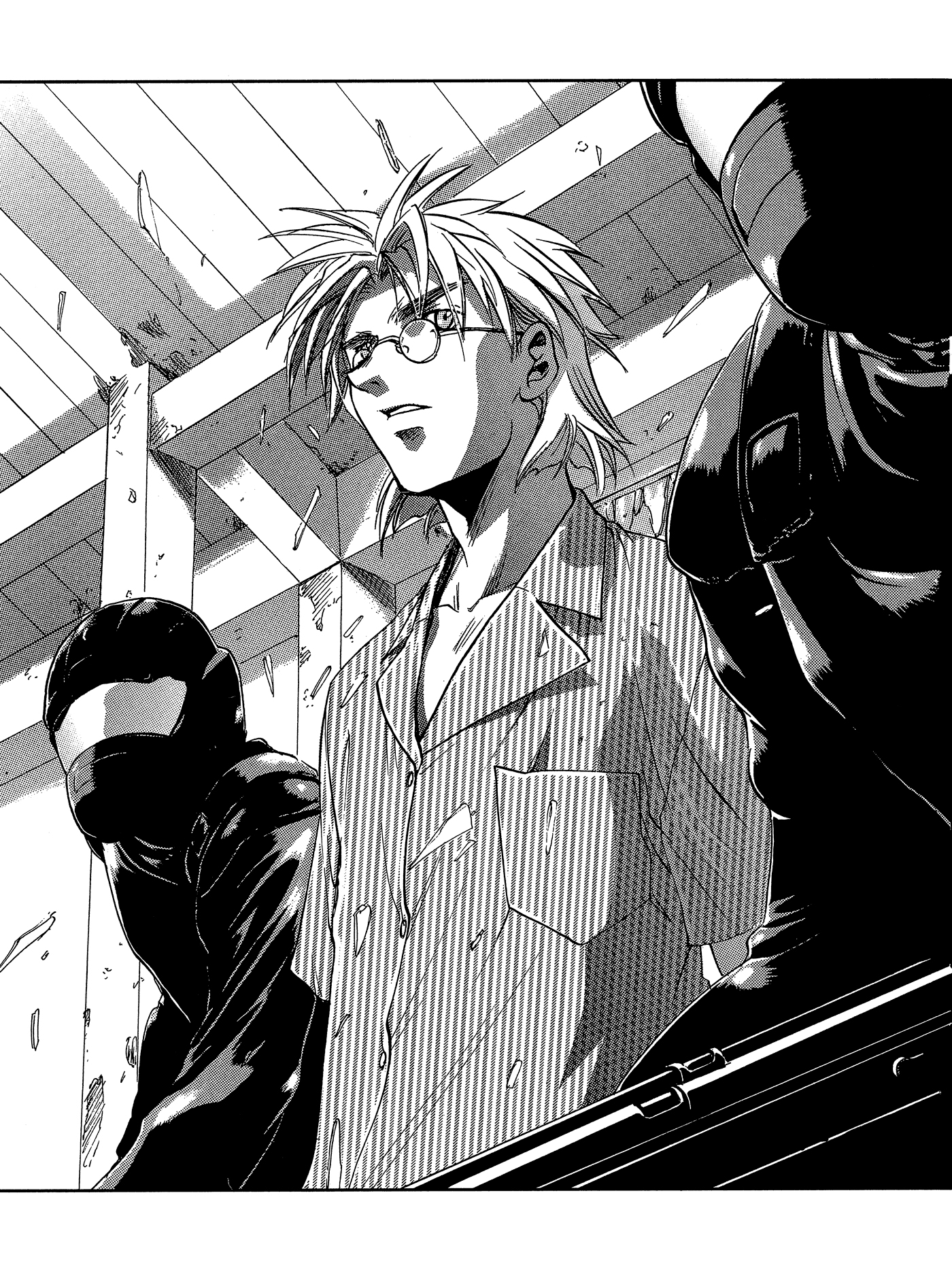
Explosions. Gunshots. Roaring of engines. A tracer bullet tore through the night and grazed the Savage’s head. The M9’s silhouette flitted through the air, charging straight for him.
“Ngh...” Sousuke sent his machine into a sharp turn and pointed his rifle at the enemy. But... I won’t make it, he realized instantly, and decided to focus on evasion instead. An M9 had amazing accuracy while in the air; there was no way he could win a straight shootout.
Fire rained down on him from above. Moving his machine in well-timed steps back and forth, left and right, he managed to dodge all the enemy’s shells. Doing so took every bit of maneuverability the Savage had, and then some.
The M9’s leap carried it over the Savage’s head to land on the stone floor behind it. Sousuke fired the second it was grounded. The M9 ducked lithely to avoid the blast, then opened up parts of its armor to activate its ECS. With an outpouring of faint blue light, it immediately vanished into the night.
So he’s ready to end it. Sousuke clicked his tongue. His Savage didn’t have an ECCS, an ECS counter-sensor. All it had were last-generation optical and infrared sensors and a crummy radar—and even the radar was showing its age. In other words, he had no way of sensing the enemy when it was invisible. The only way to survive was to get moving.
Sousuke retreated his machine back into the temple that towered behind him. The M9 opened fire, to try to take him down before he got away.
There was a flash and a jolt as a bullet struck his chest armor. Thankfully, it was a shallow angle, and the chest armor—already the sturdiest part of the machine—managed to deflect the shot. The damage was light, but the jolt from the hit reached the cockpit and sent Sousuke’s head spinning. Even so, he couldn’t afford to stop.
He continued to back up, always facing the M9, until he made it inside the temple proper. The ruins were home to sacred statues at least a dozen meters tall, which left the ceiling high enough to easily accommodate an AS. Thick stone pillars towered around him, and moonlight streamed in through the holes in the ceiling.
Sousuke got his machine to the back of the temple and changed its rifle clip. This was his last one; his only other weapons were the two HEAT hammers stored on its back. The hydraulics in the left arm, damaged in that first shot, were also reaching dangerously low levels. It might hold out a minute longer, at most.
Should I risk it? Sousuke asked himself, but decided instantly. He didn’t have one second to hesitate.
He fired his rifle at the stone pillar on the left side of the entrance. Five shots, six... The pillar crumbled. He fired at a few other pillars at the same time and destroyed them, too. He watched his “shots remaining” counter slowly tick down, until it stopped at one. The massive hall was now swirling with dust; he’d be able to see his enemy now, even if it used ECS.
There was a brief silence, and then the M9 entered the hall. It moved straight at him, with the speed of an arrow. Its ECS was disengaged; the operator must have judged it useless with all the dust around. Smart thinking.
Sousuke fired his one remaining shot. The M9 dodged it cleanly with a pivot, then pointed its own rifle back at the Savage. Sousuke had expected it to miss, and before the enemy could return fire, he’d pulled out his HEAT hammer.
The HEAT hammer—As the name might suggest, it was a melee weapon, a powerful hammer-shaped object with a shaped explosive “head” for taking out tanks. It was single-use only; it would explode when it hit the enemy, and the energy released would tear through armor and destroy whatever was inside.
But instead of the enemy, Sousuke slammed the HEAT hammer into the pillar next to him, which instantly crumbled from the force of the explosion. The temple’s ceiling, already barely hanging on after the destruction of the other pillars, could remain in place no longer after the HEAT hammer strike. There was a massive roar, and hundreds of tons of rocks came raining down. With nowhere left to run, the two machines in the hall found themselves buried by the collapsing walls.
Sousuke felt an unrelenting series of impacts, and the sight of the enemy machine on the monitor disappeared in an instant behind dust and rubble. His machine rocked back and forth, with all of his warning lights and displays flashing. The mechanical attitude indicator began to tremble and roll, telling Sousuke that his machine had gone from standing to flat on its face. And that was all that he, buried under the collapsing temple, knew about the situation.
At last, the cave-in stopped. The echoing rumbles vanished, and the silence of the night returned. The only sounds were the growl of his just-barely-working diesel engine, and the groaning of his frame and armor beneath the tremendous weight above.
Sousuke was silent. Their machines were both buried alive. His monitor showed nothing but blackness, and the cooling system must have shut down, because his engine and hydraulics temperatures were rising.
He didn’t have any time to waste. Sousuke manually manipulated his joints’ torque control, setting reaction speed to minimum in exchange for maximizing arm strength. It was the same principle as putting a vehicle into first gear.
He manipulated the machine’s four limbs to slowly bring it to its feet. It pushed its way out from under tons of rubble, and began to crawl out towards the night sky again. Fragments of pulverized stone fell in through the gaps in the Savage’s armor, and dust clouded around him.
And the enemy? Sousuke searched for the other machine, using the simple cleaning device to wash off the dust clinging to the Savage’s optical sensors. The M9 was nowhere to be seen; it must still be struggling under the rubble. It would surely dig its way out eventually, but it had taken considerable damage, and its functions would be severely compromised—just as he’d planned.
The M9’s drive system was all-electric, lacking the hydraulics of the Savage. It was designed to move its joints purely through muscle expansion and contraction, just like a person. That made the M9 vastly lighter and more maneuverable, but at the same time, prevented it from dealing with heavy loads in the same way. If one had to move something of incredible weight by force—a rare situation, of course—the Savage, with its heavy but flexible hydraulics system, would have a great advantage over the M9. No matter how high a machine’s engine output, it was the makeup of the drive system that controlled how its power was applied.
There were also relevant differences in the machines’ designs. The Savage had a much simpler joint structure than the M9, and its resilient egg-shaped torso helped it to resist external pressures better than the M9’s flexible concave one. In terms of bullet resistance, the M9 had the advantage due to its armor composition, but overall structural integrity was one area in which the old-fashioned Savage was by far the M9’s better.
Sousuke’s plan to take the enemy out with him by collapsing the temple was effectively gambling on the Savage’s characteristic durability. It might not be strong, but it was a tough little machine. You could push it to its limits and beyond, and it would stick with you to the end. This was the greatest strength of the Rk-91/92 series. Heat, humidity, sand, and dust; inferior-grade fuel and oil; outrageous payloads and wear and tear... it was a professional tool that could take anything the battlefield might dish out, while continuing to fight without complaint. That was this “bestseller” machine’s true value.
It was only natural that Sousuke, having started out in ASes like these, would have initially hated the Arbalest he piloted for Mithril. The only people who would enjoy being stuck in a glorified prototype crammed with advanced technology were new recruits wanting to play hero.
Sousuke glanced at the machine’s status. Hydraulics in the left half were dropping. The engine’s heat wasn’t going down. The balancer was acting up. There was an unpleasant grinding sound coming from the frame around the leg joints.
Yet Sousuke still whispered, in satisfaction, “It’s a fine machine.”
At last, the M9 parted the rubble and crawled into view. The collapse had really done a number on it. Sousuke worked the Savage’s arms to grab the head of the M9 unceremoniously, then swung his last remaining HEAT hammer into the enemy machine’s abdomen, crushing the generator within.
Kurama let out a snort of laughter as a precision strike to the generator took the M9 out of the fight. He didn’t like it, but he had to admire the bastard for pulling it off in that big hunk of junk. Kurama had met more than his share of AS operators in his time, but he’d never seen one beat odds so stacked against him purely through intimate knowledge of a machine’s capabilities.
That coolheadedness, that quick thinking... The AS as a genre of weapon had a limited history, of course, but Sagara Sousuke’s operating skill and combat experience far outstripped that of most professional soldiers. He was just the kind of man Amalgam wanted in their ranks, but...
I doubt he’d accept an invitation, Kurama reflected. There was little chance Sousuke would willingly join up with the people he’d been fighting tooth-and-nail since Sunan. Even if they used the woman Mr. Silver had brought in as bait, there would be no way to enforce a contract or instill any real loyalty in him. The moment he had a chance to get the girl back, Sagara Sousuke would turn those same combat skills back on Amalgam.
Which meant they’d just have to kill him.
Kurama cast a glance at the chief, who clearly hadn’t expected the M9 to lose, either. Unable to hide his dismay, he was muttering things like, “Impossible” and, “Who is that man?”
“So? What are you going to do?” Kurama asked, and the chief blinked as if awakening from a dream. “You let him know who we really are. He’s going to come after you now. And when he finds you, he’ll interrogate you to within an inch of your life.”