1: Fallen Witch
1: Fallen Witch
Martha Witt, psychiatrist, adjusted her glasses and scanned carefully through the documents given to her by the SFPD officer once more: patient name, distinguishing characteristics, approximate age, state of health, circumstances under which she was taken into police custody. Many of the entries were simply blank.
She was sitting in a hospital in southern San Francisco, while the patient sitting across from her gazed vacantly at a point on her desk.
The girl appeared to be in her mid-teens, but her lips were dry and her skin had lost its luster; one might easily mistake her for thirty or forty. She was wearing a baggy blue T-shirt that someone at the police must have provided her with, and her waist-length ash blonde hair was tangled and untended. No one had bothered to clean the dirt from her face.
According to the doctor who had first examined her, she was relatively lucid in response to questioning. Martha introduced herself to the girl first, and then asked her, in the gentlest tone she could, “What’s your name?”
“Teletha... Testarossa,” the girl responded.
“That’s a beautiful name. All right, Teletha. How old are you?”
“Seventeen.”
“Where do you go to school?”
“I don’t.”
“I see,” Martha commented. “I’m sure that if you cleaned up a little, the boys there would all want to date you.”
The girl didn’t respond. She showed no embarrassment at the mention of her dreary state, and neither interest nor revulsion at the mention of boys.
“Now... the officers who took you in say they found you walking barefoot down the freeway near Redwood. It was three o’clock in the morning, and you were alone.”
“Yes.”
“Did something happen that you don’t want to remember?”
“No.”
Her responses were indeed fairly lucid... but she also wasn’t volunteering any information.
“What were you doing there?” Martha asked next.
“I was abandoned.”
“By whom?”
“By my former subordinates.”
“Subordinates?” Martha looked piercingly at Teletha Testarossa. She clearly wasn’t joking. “Er... you said you don’t go to school, I believe. What kind of people are these ‘subordinates’?”
“Mercenaries.”
“Mercenaries?”
“Mithril mercenaries.”
“Mithril?”
“A private armed organization designed to stamp out terrorism and regional conflict. I was the commander of their West Pacific Battle Group, the Tuatha de Danaan.” Teletha’s eyes remained focused on a single point on the desk. She talked as if she wasn’t saying anything particularly extraordinary. “My rank was colonel. I had an amphibious assault submarine, third-generation arm slaves, and other cutting-edge equipment I used to attain victory on numerous dangerous missions.”
“Ah-hah... I don’t understand any of that, but it sounds quite impressive,” Martha told her. Yet even as she said that, her hand scribbled in her notebook. Exceptionally rare delusion. Accurate(?) use of specialist terminology—battle group, amphibious, etc. Further investigation needed.
Martha didn’t know much about military terminology herself, so she changed her line of questioning. “You mentioned ‘Tuatha de Danaan’ before, didn’t you? Isn’t that from Celtic mythology?”
“Yes,” Teletha confirmed. “It means ‘the tribe of the goddess Dana.’”
“Would that make you Dana herself, the earth goddess?”
“‘Dana’ is the name of my submarine’s AI. It’s a massive and complex system that utilizes quantum computing.”
“I see.” Martha added, sci-fi novel? to her notes, then asked another question. “And... as the commander of this military organization, what were you doing on the freeway? You said your subordinates abandoned you?”
“Yes.” Teletha fell quiet for some time. The examination room was dimly lit, with weakly flickering fluorescent lights in the ceiling, and filled with the heavy, humid night air. “My base was attacked by a large enemy force.”
“Enemy?”
“An organization called Amalgam. Mithril was destroyed by a massive attack that they mounted. I escaped on my submarine with my subordinates and managed to survive, but...” Terrible pain appeared in the girl’s eyes for the first time. Whatever had happened to her next must have been a difficult memory to face. Her shoulders tensed up and began to shake.
“Are you all right?” Martha asked. “You don’t have to tell me, if it’s painful.”
“It’s okay.” Teletha gulped and let out a small sigh. “The submarine didn’t have adequate supplies aboard. We managed to last a few weeks after escaping, but soon the vessel broke down. We had no money. I couldn’t even pay my people.”
Martha said nothing.
“The environment of a submarine in a dive puts extraordinary stress on its crew,” Teletha explained. “Soon, some of them began to complain about me. They began whispering about selling me and the boat out to the enemy.”
“What happened to them?”
“I had them executed,” Teletha said again, her tone of voice suggesting that this wasn’t at all remarkable.
“You killed them?”
“Yes,” she said faintly. Then she shut down, refusing to respond to any more of Martha’s questions.
A week had passed since that first meeting. Martha met with the girl named Teletha Testarossa twice a day and, little by little, she eked out the story of how she’d come to be here. She didn’t have much confidence that she was building up a proper doctor—patient trust, but in fits and starts, she’d managed to get Teletha’s full account of how she’d come to be in police custody.
In short, the girl was an officer with a private military organization that ran counterterror operations. That organization had suffered an enemy attack, and her squad had ended up isolated on the high seas. Dissatisfied soldiers had rebelled, they’d run low on supplies, and in the end, the cutting-edge “amphibious assault submarine” that she commanded had suffered a fatal malfunction and ended up dead in the water.
She’d then taken a small group of subordinates on one of their on-board helicopters to escape the capsized vessel, but the helicopter had run out of fuel and crashed into the sea off California. By the time their lifeboat reached the shore of Half Moon Bay, she was down to a mere five subordinates, and they were all thoroughly sick of her. Annoyed by her continued attempts to order them around, they’d thrown her out of their stolen car onto the street. One had wanted to rape her first, but she’d managed to avoid that fate. That was how she’d ended up walking down the road despondent and alone until a truck driver saw her and called the police.
Martha had never heard this particular delusion before. The talk of mercenaries, submarines, and helicopters was all utterly absurd, but the rest of the information she gave, about the circumstances of being taken into custody, was coherent.
To be honest, when Martha had first read the information in the report, she’d assumed a traumatic assault had occurred. That turned out not to be the case. The chart made up by the ER doctor that had first taken the girl in showed no sign of sexual or physical abuse, and her external injuries were limited to a few small scratches that had clearly come from walking through the underbrush.
Then, not only did her story not contradict any facts as Martha knew them, but she was also using proper military terminology. There were no obvious inconsistencies in her story about the “private military organization,” either. Martha knew a member of the police who was former Navy, so she’d called him up to confirm a few things.
“I’m pretty ignorant about these things. Are there really submarines that can carry helicopters on board?” she’d asked, and the officer had laughed it off.
“Well, there used to be submarines that could carry aircraft, but that was a long time ago,” he told her. “It would have to be huge, for one thing, and that’s just not practical. She sounds delusional to me.”
“But she said it was a special submarine. An amphibious... assault submarine, or something like that.”
The man laughed. “Sounds awesome.”
“She said that the Navy referred to it as the ‘Toy Box,’” Martha persisted.
There was a pause. “What did you say?” The voice of Martha’s friend, who had previously been jovial as he waited for a chance to hit on her, suddenly tensed.
“The Toy Box.”
“Who told you about that?” he asked now, pressing her for more information.
“The patient, I told you. Is it familiar?”
“No... No, it’s not.”
“What?” Martha tried again, feeling baffled.
Her friend responded in a very serious tone, “Well... I heard a rumor from a friend who’s still in the service. That’s all.”
“What did he say?”
“Listen, Martha. I don’t know what’s going on here, but you should probably drop this patient,” her friend cautioned. “Pretend you never heard anything she said. Just say she was totally incoherent or something.”
“I don’t understand. Why are you suddenly—”
“Sorry, but I need to get to work. Talk to you later.”
“Wait—”
Her former Navy friend hung up on her.
Curiouser and curiouser... There was no way the girl could know real military secrets. Just to be sure, Martha ran an online search for “toy box” and “submarine,” but all she got was a history of submarine toys from a collector site.
The next day, Martha decided to ask Teletha about what her former Navy friend had said.
“I suppose he would say that,” the girl replied listlessly. “The US Navy isn’t going to admit to the existence of an advanced weapons system they can’t detect. It’s probably only known in the form of rumors whispered among the rank-and-file.”
“All right. In that case,” Martha said, feeling a bit of indignation, “why give this very classified information to a mere psychiatrist like me?”
“Because none of it matters anymore,” Teletha said with a self-reproachful smile. “I’m finished. An incompetent commander. That’s why my people abandoned me, and why I’m here now. I’ve lost everything except my life.”
Martha listened quietly.
“Dr. Witt. You think I’m mad, don’t you?”
“No, I...”
“I don’t mind if you think that. I’m just an empty shell now, anyway...” Teletha slowly turned her eyes downward. Locks of disheveled hair fell over her cheeks, and the stark fluorescent lights gave her face a sickly pallor.
“I’m sorry to say this, but...” Martha paused for a moment, then continued. “You’re being transferred elsewhere. It’s a communal living facility. You’ll be with other people who have similar conditions.” They couldn’t keep her in this hospital forever, after all. Teletha was a minor with no family, no money, and no insurance. They had no choice but to send her to a specialized facility outside of the city.
“Yes. Of course,” Teletha said, showing no particular surprise at this.
“It’s a shame,” Martha said sincerely.
Despite being inconceivable, the girl’s ramblings had an air of plausibility about them. There were none of the obviously paranoid delusions about receiving secret transmissions from underground or from alien invaders, or of the American government having planted a microchip in her brain. Teletha knew things only specialists could know, and she was able to speak coherently and in detail about nuclear fusion cells and amphibious combat tactics. Martha had never met a young patient like her before.
“The transfer will take place tomorrow evening,” she told the girl. “I’ll accompany you then.”
“All right,” Teletha said indifferently.
The transport car arrived at the hospital the next day. The black station wagon, designed to hold a wheelchair, was five minutes later than expected. The driver and his two assistants exchanged simple greetings with Martha. She didn’t recognize any of them, but there was nothing suspicious about their identifications or the transfer order they handed her. Teletha, fast asleep, was wheeled to the car by a nurse.
“She was complaining of a headache this morning, so her doctor ordered me to give her a sedative,” the nurse explained to Martha.
“Any history of violent behavior?” the driver asked.
“No, she’s been very cooperative,” Martha responded in the nurse’s place.
The driver nodded. “I’d like to restrain her just in case, even so. It would be dangerous if she lashed out during transport.”
“Of course. But...”
“Don’t worry,” he said reassuringly. “We’ll be gentle with her. Oh, and... has she said anything strange to you?”
“Strange? Well... strange is my job. It would be more unusual if she didn’t say anything strange,” Martha responded with an ingratiating smile. The odd question left her slightly unsettled.
“True enough,” the driver said with a laugh as he cast a look around. They were close to the hospital’s service entrance, so the only people around were Martha, the nurse, the driver and his two assistants. “Doctor,” he said next.
“Yes?”
“Did she, by chance... say anything about Amalgam or Mithril, or something like that?”
“What did you say?” Martha found herself replying, and a chill ran up her spine.
“I see she did.” The driver smiled brightly. At a glance, he looked like your average thirty-something-year-old Caucasian, wearing navy blue chino pants and a jacket. He was about 180 centimeters tall, with a small scar just under the hairline of his short-cropped hair. But in that moment, the man’s appearance changed. An aura of intimidation welled up from him suddenly, and he seemed to grow twice as tall as before.
“Don’t you scream now,” he warned, grabbing Martha by the arm when she tried to draw herself back. His grip was so strong, she thought he might snap it. Then he used his free hand to flash her a glimpse of the small automatic pistol—yes, a gun—hidden under his jacket. Martha didn’t have much experience with firearms, but she knew immediately what that gesture was supposed to mean.
“Get the idea, Doctor?” he asked curtly.
“Yes.”
“Now stay quiet and get slowly into the car,” he instructed. “The nurse there, too.” The nurse, who was standing stock still and looking utterly confused, gulped when she saw the man’s gun. “We can’t leave the nice lady there all by herself,” he jeered. “Now, get in.”
“Wait,” Martha tried to protest. “She’s not part of this. I don’t know who you people are, but—”
“Just get in,” the driver ordered. Left with no other choice, Martha and the nurse climbed into the back seat of the transport wagon. The driver’s assistant got into the cargo area behind them, pistol in hand, taking a position where he could watch all three women at once.
The doors closed and the car pulled out. Martha could see a police car stopped in front of a coffee shop across the three-lane road, but the idea of screaming and calling for help didn’t even occur to her.
“Don’t be afraid. We just want to ask you a few things. Right, Bill?” the assistant said calmly.
The driver gave a short response. “That’s right. You’re safe.”
Liar. You’re going to kill me. Wouldn’t you blindfold me otherwise? Wouldn’t you want to make sure I never saw your faces, or heard your names? The nurse remained silent and pale-faced. Martha wished she could reassure her, but no words came to mind.
The car left San Bruno and headed for the harbor via Route 280, heading opposite the main flow of pre-rush hour traffic. At last, they arrived at an old warehouse near the harbor.
The setting sun streamed in through the small, barred windows, casting beams of light through the dusty air. There was almost no cargo in the wide-open space; just a few small shipping containers and two black sedans.
“Get out,” the driver told them as the car stopped in the middle of the warehouse. Martha and the nurse hesitantly did as they were told. Five men stood in front of them. The man who appeared to be their leader was wearing a brown suit, while the other four wore dirty coveralls, each with an automatic rifle on his shoulder.
“You’re five minutes late,” the man in the suit said, checking his watch with a practiced gesture. He was quite young, not much older than thirty, if that, with a slender face and black hair, which was nicely smoothed back. Strikingly attractive, the young man’s facial features seemed to have been drawn on with an ink brush.
The driver spoke up hesitantly. “Sorry, sir. We didn’t want to be pulled over for breaking the speed limit—”
“I don’t want to hear excuses. So? Is she here?” the man in the suit asked.
“This way.” The assistant got the wheelchair out the back of the station wagon and brought Teletha Testarossa to him. She was awake now; perhaps the sedative had run its course. But ‘awake’ was all she was as she gazed blankly into space, as if indifferent to her surroundings.
“Miss Testarossa?” The man in the suit crouched in front of her wheelchair and gazed into her face. “I am Lee Fowler. I work for your brother. We met by your parents’ graves once... although I was inside my AS at the time.”
She said nothing.
“We heard you were in the area, so we came to fetch you. I hope you’ll relax in our custody.”
Teletha remained unresponsive.
The man named Fowler straightened up and released a whisper mixed with a sigh. “She really is an empty shell, then. Hard to believe this is the ‘Witch of Mithril’ who gave us so much trouble.”
“She doesn’t look it, does she?” the driver observed.
“But that’s the nature of slow decline, isn’t it? Thus ends the legend; in the real world, heroes rarely die nobly in battle. They’re defanged by logistics issues, interpersonal squabbles, and other petty matters, until they fade away into obscurity.” Fowler fell into contemplative silence for a moment before walking up to Martha and the nurse. “I’m sorry about this, Doctor,” he apologized. “Were they very rough with you?”
“No,” said Martha simply. Her fear remained, of course, but she also couldn’t help but be hypnotized by his dark eyes.
“We had to find out if the girl had told you anything,” Fowler explained politely. “May I ask you a few questions? Did she tell you about organizations named Amalgam and Mithril, and the weapons and battle groups that they utilize?”
“Yes.”
“Did she mention the names of any people or places?”
“No.”
“You aren’t lying, are you?” Fowler asked closely.
“O-Of course not.”
“Did you mention what she said to you to anyone but your ex-Navy friend?”
How does he know what I said to my friend? Martha wondered. Was I bugged? Are these men really professionals, spies for some secret organization? In her shock, Martha felt her last remnants of skepticism fall away.
This whole time, part of her had held out hope that this might turn out to be some kind of complicated prank; that this man would suddenly shout, “Happy birthday, Martha!” and all her friends would burst out with mischievous smiles, tables of food and beer and cake, and they’d have a hell of a party together. But of course, that hope had always been a false one—for one thing, her birthday was last month.
“I won’t tell anyone,” she promised. “Really, I won’t.”
Fowler searched her eyes deeply and carefully, and it gave her a moment’s inkling of how her patients usually felt. “I believe you,” he said, and smiled for the first time. “But I have some unfortunate news: the secrecy of our organization is of utmost importance to us. We’d like to... avoid the things that happened here today, and knowledge of that woman, from going public. Do you understand?”
“I understand. I swear I won’t tell anyone. Please take me home.”
“If it were at all possible, I would,” Fowler said regretfully. “But there are techniques nowadays that can draw information out of a person no matter how hard they try to resist. That’s why I said it was unfortunate... I truly am sorry.”
Goosebumps rose up all over her body, and she began to tremble uncontrollably. I don’t want to die, Martha realized. I can’t die now.
“Do you understand why I’m explaining all of this to you?”
“Please don’t kill me,” she begged.
“I’m afraid of death myself,” Fowler told her gently, “but I think it’s even more frightening to die without knowing why. That’s why I wanted to explain the situation: not in some playful way because I enjoy watching your fear, but simply so that you would know.” Sorrow and pity appeared on his attractive face; it looked genuine.
“Please don’t kill me.”
“I really do regret this.”
“I’m begging you, please—”
“Goodbye, Doctor.” Fowler stepped back, and his men stepped forward. In the corner of her vision, which was blurred with tears, Martha saw the nurse, who had been silent all this time, look up. Her face was pale but she was very quiet, and not trembling at all. Was she very brave, or simply too dense to realize the fate that awaited her?
The nurse was young, in her mid-twenties at most. She was East Asian with short black hair, and had almost feline almond-shaped eyes. The nurse drew in a breath and then whispered, in a penetrating voice, “My goodness. Was that dramatic buildup really necessary?” There was a clear mockery in her voice. “I just knew we wouldn’t get to catch up to you guys without having to deal with another unbearable pretentious asshole.”
“Y-You... stop!” Martha hissed at her. Had the woman lost her mind?
But the nurse just ignored her. “Well? Wasn’t I right, Tessa?!”
“That’s not nice, Melissa. We’ve engaged in a bit of dramatic buildup ourselves, after all,” Teletha whispered, then stood up theatrically from her wheelchair. Her eyes, which had been empty and hollow just moments before, suddenly regained their focus—and a powerful light of will. Life and agency came to dwell again in the once-gaunt face. It was like a doll suddenly coming to life.
The armed men around them seemed a little shaken by the girl’s sudden change. They didn’t even try to approach her as she began to stretch out, leisurely. After a little bit of that, she turned to Fowler and gave him a nod of greeting. “Hello there, Fowler-san. I’d meant to hold off my introduction until just a little later, but your determination to kill the good doctor forced my hand.”
“I see,” he responded. “So I’m the one you’re after?” As befitted an apparent leader of men, Fowler showed no sign of surprise, but his expression was also far from relaxed. He seemed to be running a few calculations in his head: What kind of trap had Teletha set for him? What were his chances of winning if he stayed and fought?
“Be a good boy and tell your men to put their guns down, please,” she requested. “Otherwise I’ll have to teach you a rather violent little lesson.”
One of said men, the driver who had brought Martha here in the first place, snapped at last to his senses and began striding up to Teletha, angrily. “A lesson, huh? Quit messing around, kid!”
“Don’t,” Fowler said shortly, his eyes narrowed.
As the driver reached for Teletha’s neck, a bullet suddenly hit him in the center of his back, and he fell forward. There was an unpleasant cracking sound, and fresh blood spilled out onto the floor. A split-second later came the sound of the distant rifle shot. Someone had sniped him from far away, through the slight crack in the warehouse door...
“Nice one. Center shot,” the nurse called Melissa said into a miniature transceiver in her ear. “If anyone else tries anything funny, feel free to give ’em the same treatment!”
“Yeah, yeah. Uruz-6, roger!” Martha could just barely hear a staticky male voice reply on the other end of the transceiver.
Meanwhile, Teletha repeated her warning. “Did you hear me? Drop your weapons.”
“Ahh... wonderful.” An earnest smile appeared on Fowler’s face, despite him just having witnessed the death of a subordinate. “Truly magnificent,” he went on. “I thought I was being so cautious: thorough tapping of communications; tailing; listening devices; checkpoint monitoring... You slipped through all of that to make it here, and your performance fooled even me. And now, in the greatest of all possible power moves, you intend to take me alive? You really are his little sister. The legend continues!”
“You appear to have been under a number of misapprehensions as well. Did you really think that as long as I live, I would ever hold up the white flag to your people?” Teletha asked, a somehow intimidating smile appearing on her face. Her eyes flashed violently, flickering with quiet rage and vengeful spirit. It seemed absurd to have ever called her an empty shell; Martha had never felt such a powerful force of life emanating from anything so small, frail, and lovely.
“I can see that I was,” Fowler agreed, making a slight gesture with his right hand. “But you still don’t know how to finish the job!” He had pressed some kind of button that he’d been holding in his palm, and in that instant, a series of explosions occurred across the warehouse. After a barrage of flashes and deafening blasts, black smoke began to spread.
They were bombs meant to distract, not to kill. Martha cried out but could only stand where she was, baffled and disoriented. Teletha ran up to her and tackled her to the ground. “Doctor, don’t move,” Teletha told her.
“But...!”
“Don’t worry,” the girl reassured her. “My people will handle this.”
Martha looked and saw that the nurse called Melissa had knocked the closest man over with lightning speed—she didn’t know how she’d done it, but the nurse had swiped his gun at some point and now opened fire at the other men.
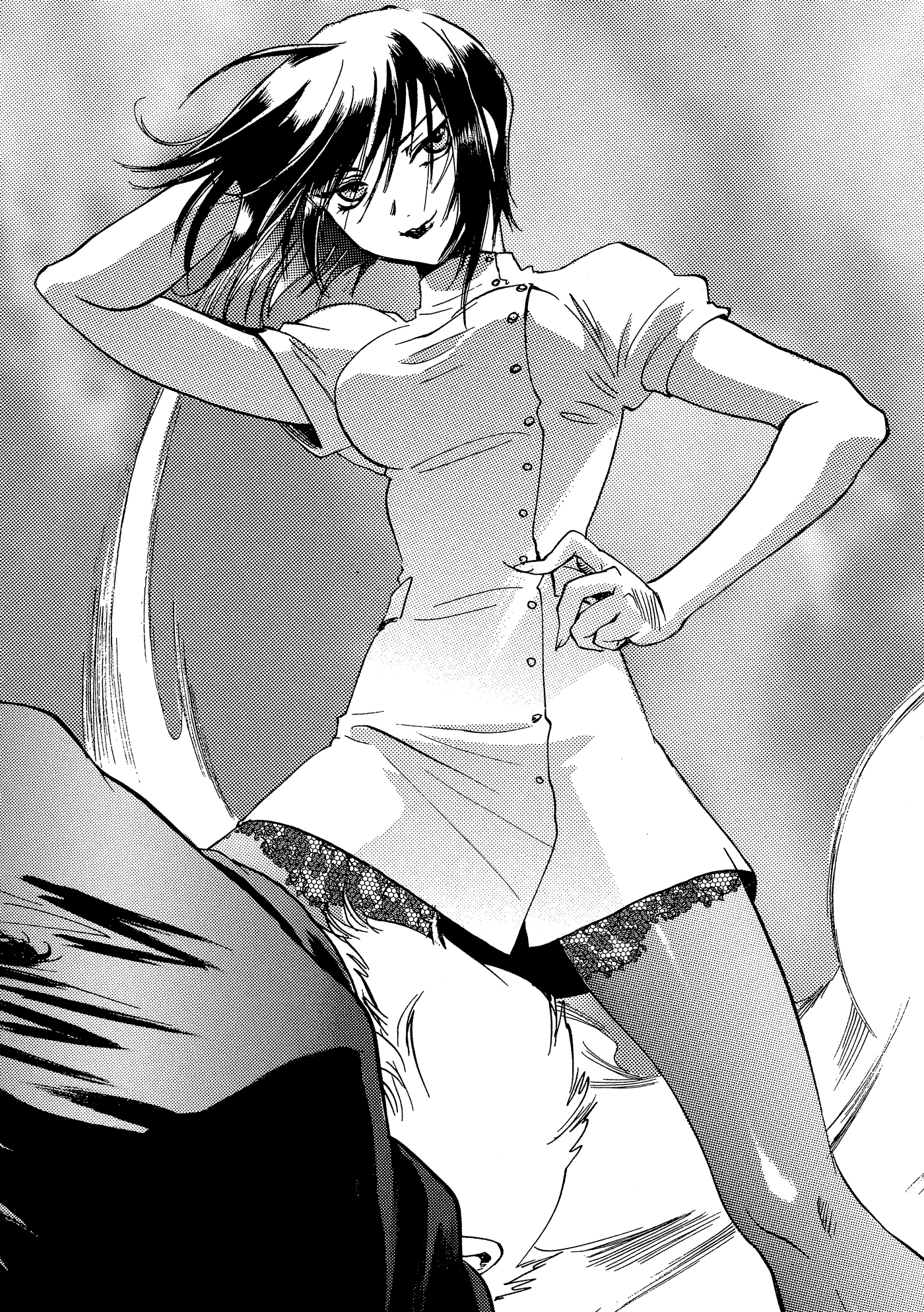
Shots, screaming, cursing... the automatic rifles the men were carrying echoed around the warehouse. The invisible sniper kept up his work, causing more of these men to fall. Fowler shot at Melissa, even as he began to draw back, but she jumped to the side to avoid his shots and hid behind a car. Martha realized that Teletha must have had more allies than just the nurse and the sniper when several entrances were blasted in with explosives, and men wearing bulletproof vests over plainclothes rushed in.
“Give it up, sissy boy!” Melissa shouted.
“Give it up?” Fowler responded from behind a bullet-ridden sedan. “But I think we both still have more tricks up our sleeves. I can’t afford to let things end just yet!” As he made his declaration, the roof of the warehouse split open and a massive form appeared.
There was a violent roar. Dust and smoke swirled around, and shards of building material showered the floor. Martha could only look on helplessly while Teletha, her former patient, sheltered her with her body.
A gray giant was kneeling above them, clad in streamlined, angular armor. A heat sink grew from its head like a long tassel of hair. It was a humanoid military weapon. An arm slave. Even Martha knew that name... and she also knew there was no way for soldiers on foot to oppose it. This wasn’t one of those robots with the rotund, squat shapes that she saw on CNN, either. It was slender, with a silhouette that seemed to boast incredible skill and power.
Fowler drew back behind the AS without any sense of triumph. Melissa and her reinforcements didn’t try to pursue him, or retreat; they just took shelter.
“Of course,” Teletha whispered. She was still smiling... but now, it was more of an unenthusiastic, self-recriminating smile.
“Wh-What’s going on?” Martha asked shakily.
“Don’t move.” Teletha whispered back, and then raised her voice again. “You saw it, Uruz-1. Destroy the enemy AS!”
“Roger that, Colonel!” A voice resounded over a speaker from all around them. The roof collapsed with a roar and a new, black AS burst through the warehouse wall. Then, without even allowing time for a proper faceoff, it crashed into the gray one.
The glass of the skylight shattered into pieces as steel bent and concrete broke. The crumbling structure of the warehouse danced around the black machine. Belfangan Clouseau’s arm slave, the Falke, had shut down its ECS to tackle the enemy. His first priority was to get the ASes away from vulnerable humans.
Grappling with the other machine, he crashed through the wall of the warehouse and straight into a cluster of cargo containers on the wharf. Still, the enemy machine didn’t go down. Holding his monomolecular cutter in a reverse grip, Clouseau plunged the weapon into his opponent’s chest.
It was a meticulously timed surprise attack that would earn perfect marks in a scored simulation. Yet his enemy seemed to have anticipated it. Clouseau’s strike was met with a dull jolt as the enemy machine erected a force field to block the cutter’s strike. A special sensor equipped to the Falke—the fairy eye—registered the lambda driver force field’s appearance. Then, a moment later, it began to blare an alarm.
A graphic overlay that utilized colors like a thermal readout shifted around the enemy machine’s arm: from yellow to orange, and then to red. Clouseau braced himself; an enemy force field blast was coming. He recognized its formation before it even appeared.
The enemy’s right arm came roaring towards him, warping the air around them as it passed. Clouseau only just managed to duck his machine under the coming shockwave. It hit a cluster of containers behind him, scattering their remains through the air like confetti.
He then tried a sweep on the enemy machine’s leg. It lost its balance and backed up, but when the Falke stepped forward to execute a follow up, another alarm blared. The enemy’s lambda driver unleashed another offensive force field, this one as powerful as a surging wave. Clouseau managed to anticipate this one, too, and leaped into motion just in time to dodge it.
He got good hangtime in the jump, flipping midair as he passed over the enemy’s head and throwing an anti-tank dagger down at it from above. The tandem warhead-shaped charge flew sharply towards the enemy machine’s neck. There was an explosion, and the enemy was temporarily masked by smoke and fire.
Of course, Clouseau didn’t fool himself for a moment that the job was done. The Falke landed and then immediately leaped to the side, entering into combat maneuvers. In a clash between two third-generation ASes, both of them capable of extreme three-dimensional combat, they would be at their most vulnerable the moment they came out of a jump. He couldn’t spare a single moment to rest.
As expected, the gray machine shot immediately out of the swirling smoke, heading right for him. The enemy Codarl-type’s lambda driver could nullify most incoming attacks. In terms of equipment, he was at an overwhelming disadvantage. But nevertheless...
“I can do this,” Clouseau whispered, doing his best to endure the resulting turmoil as his combat maneuvers jolted him back and forth in his cockpit.
The enemy machine’s power was truly incredible, and the difference between them felt nearly insurmountable. But didn’t the operators’ skill matter, too? If not for its lambda driver, their back-and-forth would have seen the enemy dead three times over by now.
In skill, the advantage is mine! Clouseau affirmed to himself. He could tell his opponent was no amateur, but he could also detect a degree of unconscious arrogance there. His bold, straightforward movements—purely reliant on his machine’s superiority—were proof of it, and sooner or later, that arrogance would provide an opening to attack.
An alarm sounded. The enemy was upon him, and Clouseau had to resist the urge to pull the trigger for the head-mounted machine guns. The move would have been instinctual, but he knew that it came too soon. Relying on the fairy eye display, he dodged the enemy’s shockwave. Then he called out on his radio, “Uruz-1 to HQ! Where’s the package?!”
“HQ here. Firing is already complete,” replied the dour and steady voice of Richard Mardukas. “TLAM currently on inertial guidance. ETA, thirty seconds. Yielding terminal guidance to Uruz-1.”
“Uruz-1, roger!”
It was at this point that his machine’s AI chimed in.《Alert message: code from HQ confirmed. TLAM01 terminal guidance received. Twenty seconds to arrival.》
“Activate TLAM01 warhead,” Clouseau ordered.
《Roger. Activating TLAM01 warhead.》
A blue “SAFE” symbol in the corner of his weapons display switched instantly to a red “ARMED.” The smart warhead on the cruise missile, flying somewhere high above them, was ready to unleash its power.
Clouseau’s machine was still taking evasive maneuvers, but the Codarl was closing in. It caught the light of the setting sun as it vaulted over a mountain of containers, and the heat sink at the top of its head, like tassels of hair, glinted with rainbow light.
“Okay, come and get me!” Clouseau dared it before throwing an anti-AS grenade. The Codarl stepped nimbly to the right and dodged the explosion. Massive cargo containers behind it went flying, spinning end over end.
Clouseau opened fire with his head-mounted machine guns. The Codarl used its lambda driver first to repel the rain of low-caliber fire, but dropped the force field after determining that it was no threat to its armor. Instead, it focused that power in its hand, preparing to unleash it directly at Clouseau.
Just as he’d planned it.
The first fifty rounds in the Falke’s machine guns were normal rounds, but after that all he had were practice rounds loaded with acrylic paint. These paint rounds now rained down on the Codarl’s head, and the acrylic, aerosolized by the impact, clung to the enemy machine’s sensors.
The intention was to blind his opponent, but modern ASes were equipped with high-frequency wipers and nozzles of cleaning fluid. These were typically used to combat the mud and dust that frequently clung to external sensors during combat, but even when dealing with acrylic paint, they could restore visibility in just a few seconds.
Fortunately, a few seconds was all he needed. In those few seconds, the enemy machine wouldn’t be able to track millimeter band radar.
《TLAM01, ten seconds to impact,》 Clouseau’s machine’s AI announced.
The air around them began to tremble as the roar of a powerful jet engine drew nearer overhead. From out of the sun that burned in the western twilit sky, a cylindrical object approached.
《Five... four... three...》 The small red light of a terminal guidance laser was projected from the Falke’s head onto the chest of the guarded Codarl. 《Impact.》
A massive explosion hit the enemy machine from above. The cruise missile, flying at close to the speed of sound, had detonated its shaped charge right at the place where the laser was pointing—in other words, the Codarl. Burning gas, denser than steel, transformed instantly into a fiery spear aimed at a single point on the enemy’s armor.
The explosion’s shockwave rocked the Falke’s body. Clouseau grunted as he felt his machine being lifted into the air, but he skillfully kept his footing, and then ran straight for the enemy machine, knowing that the Codarl was still alive inside the smoke. It had erected the lambda driver in the instant before the hit came.
But...! The fiercely surprising attack, right on the heels of the blinding one, would have left his enemy disoriented. The fairy eye confirmed that the lambda driver was active; it had just managed to put up a defensive wall to prevent a follow-up attack from the Falke.
But that wall was only at its front.
Clouseau slipped past his enemy and, faster than the eye could see, plunged his monomolecular cutter into the machine’s right side. The engineer’s report he had read said that was the location of the lambda driver module. He received quick confirmation of his success—the force field display surrounding the Codarl flickered a few times, then disappeared.
The enemy’s lambda driver was neutralized, and the enemy machine, shaken by the unexpected hit, stood stock still... but the iron law of battle for third-generation ASes was to always be moving, quickly and mercilessly.
As it turned back, Clouseau threw his last anti-tank dagger sharply at the enemy machine, hitting the Codarl in its newly-exposed chest. The dagger exploded. This time, the hit sent the machine’s upper half scattering into pieces. The Codarl’s severed arms tumbled end over end, tracing strange arcs over the twilit bay.
Turning his back on the scattering shards of machinery, Clouseau immediately switched his scanners to active mode. His ECS counter-sensor checked for the presence of enemy reinforcements, just in case.
Nothing.
“Whew...” Once he was sure they were alone, he allowed himself a deep sigh of relief. It seemed the enemy had only prepared one machine, as well.
He’d had his AS on standby, to support Tessa’s decoy strategy just in case things went south. Then, for even greater insurance, they’d had the submarine, the Tuatha de Danaan, waiting in San Francisco Bay, ready to fire a cruise missile in support. They’d rigged up the head-mounted machine gun ammo for the same purpose. They’d known there was a chance that the enemy might also prepare an AS, and one equipped with a lambda driver, at that.
Glad we played it safe, Clouseau thought as he called to his allies over the radio. “Uruz-1 to all units. I’ve destroyed the enemy Codarl-type AS.”
Following the departure of the Falke and the Codarl, the outcome of the battle in the warehouse was well on its way to being settled. The warehouse itself was in pieces, the parked car was crushed, and the ground was littered with enemy bodies. Most of what remained around them was rubble, still being licked by tongues of flame that billowed white smoke.
“Tessa. Ben took out the enemy machine,” Melissa Mao, dressed as a nurse and carrying a submachine gun, said to Tessa after a brief radio exchange. “There don’t appear to be any other enemy machines present. It’s impressive—our first time having an M9 beat a Codarl in a one-on-one fight.”
“Indeed,” Tessa—Teletha Testarossa—answered shortly from the place where she was sheltering alongside the psychiatrist, Martha Witt. She looked out over the thoroughly destroyed warehouse, confirming that her PRT soldiers were still carefully monitoring the controlled area, and then checked herself for injuries.
She’d popped the buttons off the back of her patient’s smock, leaving it in danger of falling from her exposed shoulders. She wasn’t wearing underwear, either, so she was all but naked... but any injuries she had were minor scratches. Not an issue.
“The target escaped, then?” Tessa flicked her eyes to the side, looking around for Lee Fowler with little hope of satisfaction.
“I lost sight of him when the ceiling collapsed. I’m sorry,” Mao responded.
Tessa just shook her head. “It’s all right. This operation was mostly just saying hello, anyway. Too many innocent civilians were put at risk to call it a success.”
“I tried to get the doctor as far away as possible, but... yeah, it didn’t go the way I wanted it to. Yeesh...” Mao grumbled with a shrug. But as the warehouse fell silent again, an electronic beeping suddenly rang out. It was a simple, high-pitched alarm, intrusive and inappropriate to the scene.
Barefoot, Tessa walked towards the sound. A black cell phone lay among the fragments of concrete scattered across the floor. She picked it up and silently pressed the ‘receive call’ button. “Fowler-san, was it?” she asked.
Her prompt was met with a chuckle. “That’s right. I felt like we had more to say to each other, you see... but not so much as to simply let you catch me. As a compromise, I left my phone behind.” Fowler had probably already left the area, likely on his way to the city in a backup vehicle he’d had prepared. He’d have taken measures to prevent the call from being traced, as well. “First, my compliments on your success. You killed at least ten of my men and destroyed one of my ASes, and with such a minimal force of your own. I was completely outplayed.”
“I’m not sure I’d agree,” Tessa told him. “You’re still free, after all.”
“Indeed.”
“I’d meant to take you into custody and extract as much information from you as possible,” she went on. “Even if it took methods that would wipe that smirk off your face for good.”
“Your voice is far too lovely to say such frightful things.” Fowler’s tone conjured images of him smirking on the other end of the phone right now. “But, I wonder... Do you really intend to continue fighting us?”
“I don’t think you need a formal declaration,” Tessa said. “I wouldn’t have gone through such a complicated performance if I wasn’t dedicated.”
“I’d thought we’d done more than enough to demonstrate our power already,” Fowler mused in reply. “Mithril is gone, and it’s not as if Amalgam is out to destroy the world. Quite the contrary; we’re venting a little pressure from a world on the verge of bursting. You have no reason to want to fight us.”
“How naive of you,” Tessa said, her tone one of scornful mockery.
“Naive?”
“Yes, naive. You assume we’re fighting you from some moral high ground, out of some grand sense of justice?”
“If I did, it sounds like you’re about to correct me.”
“Your people have killed many of mine. That’s all the motivation we need,” Tessa said plainly. In fact, that wasn’t the only reason that she and her subordinates were fighting, and there was more that they could do, but... but when you drilled down, that was the most fundamental of their reasons. Teletha Testarossa could no longer abide the continued existence of Amalgam after it had killed so many of her people.
“I feel the same way,” Fowler said calmly. “My bond with my subordinates isn’t as strong as yours, I’m sure, but we’ve suffered significant losses as well. Yet I swallowed my resentment and extended a hand to you. What I want to know is why you slapped that hand away and went to the lengths that you did.”
“Thank you very much for the clarification,” Tessa said. “So, your intention was to establish dominance through an overwhelming force of arms, then extend an olive branch? I once subscribed to a similar approach, but no longer. What you call ‘venting’ involves playing with the destinies of too many people. I cannot abide such arrogance.”
“I see. Would this be a sort of partisan spirit at play, then?” Fowler’s teasing had an edge of bitterness to it.
Tessa paused. “Fowler-san. Given the situation, may I be blunt?”
“Feel free.”
Tessa chose her next words carefully, emphasizing syllable after syllable. “Just to eliminate any ambiguity... I utterly despise hypocritical, pretentious fucking shits like you people. Do I make myself clear?”
Silence reigned.
Mao and the rest of the PRT members, who’d been watching the phone call, were so shocked by Tessa’s use of profanity that their eyes opened wide and they stared.

“I’m done now, messenger boy. Pass my words along to Leonard Testarossa.” Before Fowler could reply, Tessa turned off the phone and unceremoniously dropped it onto the ground. “Let’s withdraw,” she commanded. “We need to reach the Pave Mare’s LZ before the local police arrive... wait, what’s wrong with you all?”
The staring Mao and the others finally snapped back to their senses, exchanged looks, and at length, burst out laughing. They seemed truly delighted.
“Really, what is this all about?”
“Fucking shits!” The men clapped their hands and cheered.
“Honestly... you got balls, babe.” Mao clapped the baffled Tessa on the back and put an arm around her shoulders.
“What? Ah...”
“I know I’ve said it before, but I love you dearly, my commander.”
Tessa’s cheeks went red as she remembered what she’d said, and Mao gave her a big sloppy kiss on one scarlet cheek. “A-Anyway, we must withdraw! The local police are on their way, surely! This is no time for mock sexual harassment!” Wriggling out of Mao’s arms, Tessa began to give orders to her crew.
“Yeah, yeah, we got it. But Tessa... what do we do with the doc?” Mao shot a nod in the direction of Dr. Martha Witt, who was still slumped against one of the warehouse’s metal supports, gazing glassy-eyed at the entire exchange.
“That’s right.” Tessa walked up to the frightened Martha with an expression of melancholy, and addressed her as delicately as she could. “I’m sorry for putting you in danger, Dr. Witt.”
“Wh-What are you going to do with me?” the doctor asked shakily.
“You can be assured that I won’t harm you,” Tessa promised. “For now, we need to leave.”
Tessa and the others promptly withdrew from the warehouse where the battle had taken place, en route to a park in the city several kilometers away. Clouseau’s AS activated its ECS in invisibility mode and accompanied their car by leaping from building to building, alley to alley, in order to avoid obstacles.
On the way, Tessa explained things to Martha. “That Fowler man’s threat to kill you was more likely intended for me.” She’d managed to successfully lure him out, but the enemy had remained cautious. Fowler’s reason for prodding Martha in front of Tessa the way he had was likely to assuage any personal doubts he still had about Tessa’s performance.
In actuality, basic knowledge of “Amalgam,” “Mithril,” and the various terms associated with them was no longer top secret information. Most military and government officials powerful enough to have a vested interest in such organizations would already know that much. The same went for the things the students of Jindai High School knew about them.
After the attack on the Merida Island Base and their subsequent escape via submarine, while Tessa was wrestling with logistics issues, she was also gathering as much information as she could about the outside world. That included the objective truth about what happened to the transport helicopter and Arbalest they had sent to Tokyo, and also Sagara Sousuke and Kaname.
What she’d learned was that the Gebo-9 transport helicopter had been shot down in a park within the city immediately upon its arrival, and that everyone on board—including the pilot, Lieutenant Santos—was dead.
The Arbalest had fought a violent battle in Sengawa, Chofu—near the school attended by Sagara Sousuke and Kaname—against forces dispatched by Amalgam. In the end, though, it had been destroyed in a battle with an “unknown new AS.” The Japanese police had recovered the Arbalest’s remains, but someone had made off with its core unit immediately afterwards.
Chidori Kaname had also gone missing during the battle, and nobody knew where she was. Most likely, she had been taken by Amalgam. And as for Sagara Sousuke... Several days after the destruction of the Arbalest, he’d popped back up at the school, met with the students of class 2-4—no, it would be class 3-4 now—explained to them why Kaname was missing, and left. He’d also declared that he would bring her back, no matter what.
None of this had been on the news, but most intelligence organizations would know it by now.
What Amalgam would want to know, then, was more urgent: the location of the Tuatha de Danaan, the weapons it carried, its remaining resources—whether it was still battle-ready, in other words—and how much Tessa had learned about them.
Martha didn’t know any of that. If she talked to the police, the FBI, the CIA, or the NSA about the things Tessa had told her, they would probably treat it as low-value information.
After explaining all of that to Martha in the car, Tessa told her, “That’s why I think Fowler only said all that to test me. It was purely a cautionary measure.”
“I don’t understand, Teletha.”
“He was probably watching me to see if I was affected. And if I had kept up the performance, he really might have killed you. That’s why I gave up my act then and there. In other words...”
“In other words... what? What are you trying to tell me?” Martha asked, exhausted by the flurry of bizarre events she’d just been through.
“In other words, you have no informational value,” Tessa said plainly. “If you return to your old life now, you’ll probably never hear from any of us again.”
“I see. That sounds wonderful.”
“I’m sorry, Doctor. You were very kind to me. When we first planned this out, I was expecting to be in the care of someone far more indifferent.”
“I see. I’m just too kind, then? Why, if only I’d cared less about my job, I might not have been manipulated by a patient I cared about and then targeted by killers!” the doctor shouted, half-hysterical.
Tessa just gazed at her placidly. “I apologize for that. But it was quite a convincing performance, wasn’t it?”
“I suppose so.”
The car entered the park that was their destination. The city around them, sinking into evening darkness, had already begun to sparkle like artisan crystal under the various colorful lights.
Urged by Tessa, she got out of the car. Despite the park containing a few passersby, Tessa’s subordinates got out of the car, guns in hands. From above came the sound of rotors pounding the air, and a powerful wind buffeted the park’s greenery. An invisible transport helicopter was descending. In just a few seconds, Teletha Testarossa and her comrades would be gone.
Holding down her hair to keep it from being tousled by the gale, Martha called to Tessa, “Can I ask you one last thing?”
“It depends on the question. Go ahead.”
“Didn’t you... feel anything? When you were carried to the emergency room, you were surely subjected to a humiliating inspection. And even after you came to me, you weren’t treated as fully human. How did you endure it?”
“Many of my friends have died,” Tessa said calmly. “You can imagine it was nothing compared to that, can’t you?”
“So you’re trying to avenge them?”
“I’m not sure.”
“Then why go to such extremes—”
“I wish I could tell you.” Tessa smiled brightly. “Whence comes this wellspring of determination to fight? Whence this desire for revenge so powerful that I’ll run through fire to achieve it? I would love to explore that question, with your help... but I fear we’re out of time.”
As the invisible helicopter landed in a wide-open space in the park, powerful downcurrents buffeted them, causing leaves and flowers to swirl around Tessa. Bathed in the park lights, her sparkling silver hair billowed beautifully in the wind. The helicopter landed behind her, disengaged its ECS, and appeared in a shower of pale blue sparks.
“Hey, Tessa!” Kurz Weber shouted, stepping onto the opened cargo hatch. They’d already picked him up from his sniper point.
“Yes, I’m coming. Goodbye, Doctor.” That was all Teletha Testarossa said before running up to the transport helicopter and vanishing into the cargo bay. She didn’t turn back once to look at Martha Witt, who could only stand there, staring after her.
The other men boarded, and the helicopter was in the air even before the hatch was fully closed. Once it had ascended past the park’s tallest tree, it activated its ECS again and disappeared. Seconds later it was gone, having faded into the violet darkness of evening.
●
The dining room had a curious design; neo-Gothic elements had somehow been incorporated into a simple, modern cheeriness. It took in bright sunlight from the southeast-facing windows, and the furniture had a tasteful, calming color scheme that was very relaxing to visitors.
Leonard Testarossa was returning from a journey, conducting errands and negotiations across both hemispheres. He had just entered the dining room when he got a call from Lee Fowler.
“Your sister gave me quite a run,” Fowler said over the phone.
It would be night in San Francisco now, but here in tropical latitudes, the sun still hung gold in the western sky. “She’s still in her right mind, then?” Leonard asked.
“Yes. It appeared to be a plot to take me into custody. They destroyed a Codarl-m.”
“Well, well...” Leonard let out a sigh, the receiver still to his ear.
“I’m very sorry, sir.”
“Ah, I’m not criticizing you. I’m exhausted by her stubbornness.” He’d thought she was smarter than this. When did she change? he wondered. The more time she spent with Mithril, the more foolish her decisions seemed to become. Now she was no different than those coarse and vulgar “sea dogs” he so hated—his dead father and the man’s friends, those absurd anachronisms wallowing in self-pity...
“What do you recommend I do?” Fowler asked, interrupting his thoughts. “I’ve prepared a few options—”
“No, don’t bother. There are far more important things I need your help with, Lee.”
“Thank you, sir.”
“First, return here,” Leonard ordered. “Leave my sister be for now.”
“Are you certain?”
“She’ll come here eventually,” he predicted, “risking countless lives just to ‘teach me a lesson.’”
“Yes, sir. That did appear to be her intention.”
“I see.” He chuckled.
“She left a message for you, as well,” said Fowler.
“Oh? What did she say?” Leonard asked, idly wondering if it might be simpler to just set up a sibling hotline.
“I’m afraid it’s rather vulgar.”
“That’s fine, just tell me.”
“Certainly.” Fowler’s voice became ever-so-slightly more strained. It sounded less like he was afraid of Leonard hearing it and more like his throat was seizing up in embarrassment. “Teletha-sama said that she despised... ‘pretentious fucking shits like us.’”
Ah, there it is, thought Leonard, like some gutter quarrel between working-class siblings. She had truly fallen in with the wrong crowd. “How aggressive of her,” he commented.
“Forgive me, sir.”
“Not at all. I’m glad to hear her sounding so feisty. Now, I’ll talk to you later.” Leonard hung up the phone and looked around the dining room. The table, likely a bit over five meters long, had nothing on it but candlesticks and a few dishes.
Dinner wasn’t ready yet, but he could hear stirring through the half-open door at the end of the room. Someone was working in the kitchen. Fallen in with the wrong crowd... Maybe he wasn’t much different from his sister, in that respect. Leonard passed through the door with a slight shrug, entering the kitchen to address the girl inside. “I’m back,” he announced.
The girl—Chidori Kaname—was standing in front of the large gas range, messing around with a frying pan. She stopped and gave him a short nod. “Good for you,” she responded indifferently, and then went back to her cooking.
“You know the cook doesn’t like it when you make dinner on your own,” he observed.
“Oh, yeah?” Kaname shook the frying pan back and forth a little as she reached for a small shaker of salt nearby. “Do you know what I’m making?”
“What?”
“Omelet rice. But there’s no Thai rice here, and no Japanese ketchup. I’ve made a few substitutions, but it won’t be the omelet rice I know.”
“That’s a shame.”
“Could someone buy some for me?” Kaname requested. “Any supermarket in Tokyo would have it.” It seemed like a weak complaint, more so than malicious sarcasm.
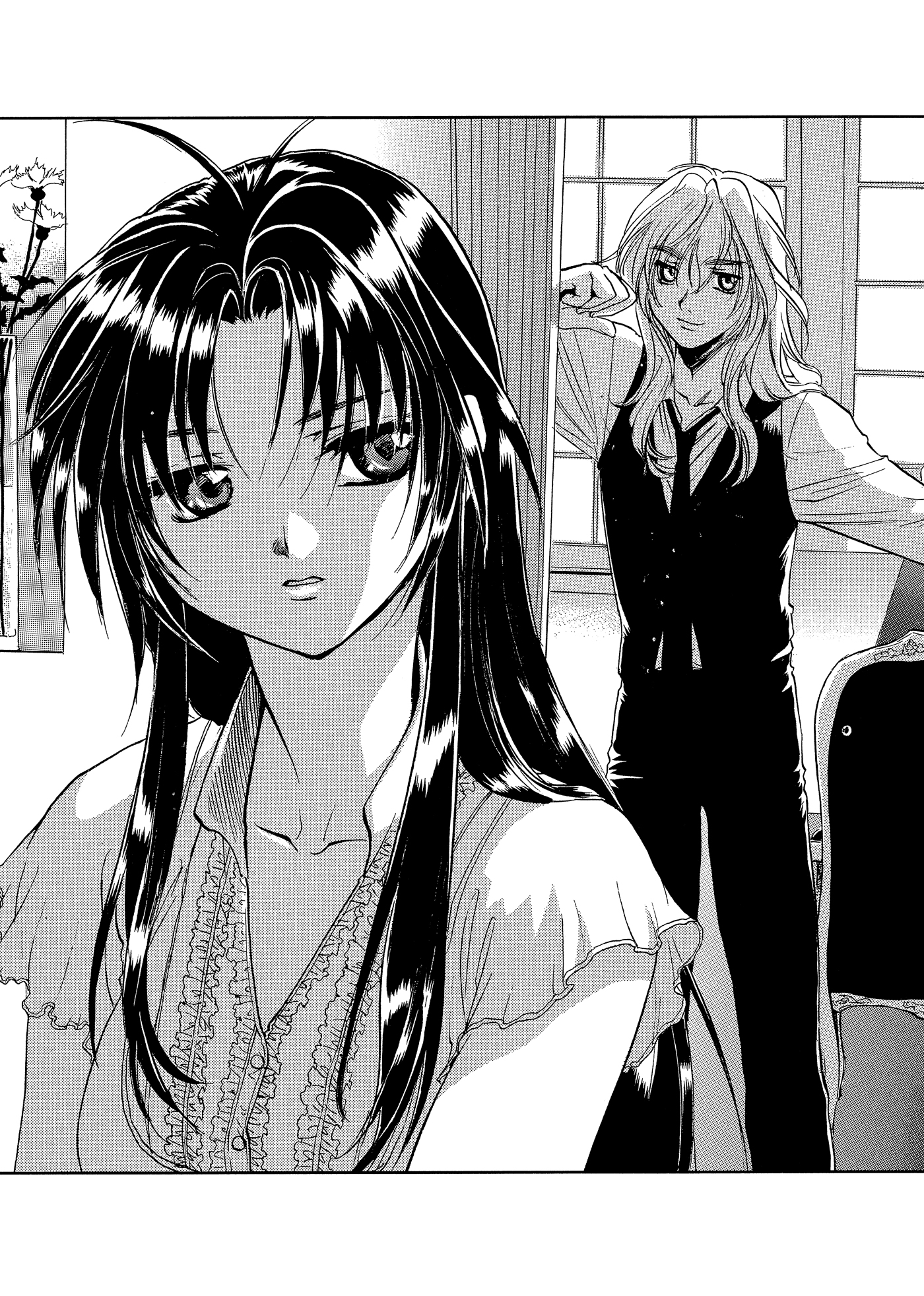
He sat down in a nearby chair and said, “You’ll forget soon enough.”
“The taste of omelet rice?”
“I forgot, too, the taste of the roast lamb I ate so long ago,” Leonard told her. “And the face of the mother who made it.”
She didn’t respond.
“That’s what time does.”
“And so, someday I’ll come to love you. Is that it?”
“I didn’t say that.” Leonard gave her a self-reproaching smile. “But we can’t hold off fate forever. All I’m saying is that acceptance can be a relief, in its own way.”
Kaname gazed at him, her eyes as quiet and still as a lake. They were emotionless, like the sensors of a machine, but Leonard accepted that as inevitable.
“I wonder if that’s really what you think,” she whispered, then went back to her frying pan.
He continued to stare at her from behind. Her thin pleated skirt and fitted silk shirt... as he pondered the gentle lines from the nape of her neck to her back, from her hip to her thighs, he considered the meaning behind her words.
Is that really what I think? Of course it is... He considered saying that as he drew up and embraced her from behind. She probably wouldn’t fight him... But then, it wouldn’t mean anything. So Leonard shrugged, standing up to leave the kitchen instead.
“But...” she whispered. “The real omelet rice, the omelet rice only I can make... it was really good. It’s a shame you won’t get to try it.”
“Indeed.” He let the comment roll off his back as he left the kitchen behind. He then realized he was feeling a sense of displeasure—reminiscent of that which he had felt in the schoolyard that day—and it left him slightly annoyed.
He passed through the dining room and into the corridor on the side of the mansion’s courtyard, where he found a woman in a suit waiting for him. It was one of his subordinates, Sabina Rechnio. She was holding a portable tablet, and seemed to have just finished some kind of communique.
“Survival is confirmed,” Sabina said.
He didn’t even have to ask who she meant. Leonard Testarossa already knew. “You’re talking about him?”
“Yes,” she confirmed. “Sagara Sousuke.”