2: Briefing
2: Briefing
A simple bed and brick walls, light streaming in through small windows... He was in a room in an old building somewhere, and all he could hear was the sound of waves in the distance. The checklist replayed in Sagara Sousuke’s hazy consciousness for the thousandth time: Name, time, location.
All he knew was his name.
How long has it been since I was mortally wounded in the battle with Kurama, and collapsed lifelessly in the Arena in Namsac? he wondered. Why am I still alive? Where am I?
He realized he’d asked himself those questions several times already.
Yes. I kept waking up in a daze, realizing that I couldn’t move an inch... Then a nurse would arrive and inject me with something, and I would drift back into a deep sleep...
But things were slightly better this time, because he could feel pain: dull, heavy pain in his chest and back and right thigh. Each beat of his heart was an ache that washed over his entire body. His head felt like it had been hit with a sandbag—no wonder he was dizzy.
There was an IV stand next to the bed, medical monitors were all around him, and a mess of EKG cords were attached to his body... an oxygen tank and an aspirator, too. He was covered with a thin sheet, and he was wrapped in bandages.
The toes of his right foot... mobile.
The toes of his left foot... mobile.
The same could be said for the fingers of his right and left hands. Everything seemed to be in place... but he couldn’t discount the possibility of a phantom limb phenomenon. Silently, hoping to check his limbs for himself, he labored to move his head.
There wasn’t much around him beyond medical equipment, but there was a large painting on the wall beside his bed. It was a panoramic landscape, nearly as long as two adults’ armspans. Barely clothed people stood in a blue jungle. Babies, dogs, and divine statues, too. There were lounging women and men writhing in torment. At the center, a young man in a loincloth looked up, his posture that of someone waiting to see if a basketball he’d shot had gone through the hoop. It was simultaneously relaxing and despairing. He couldn’t think of where he might have seen it before, but it felt strangely familiar nonetheless.
“Do you know the name of that painting?” a man’s voice asked, though he couldn’t see the face of the person who had entered the room. The slightest attempt to sit up was met by waves of pain. “Where Do We Come From? What Are We? Where Are We Going?” The man peered into Sousuke’s face. He was handsome, blond, with round glasses.
Michel Lemon.
Is that its name? he tried to whisper, but his voice refused to leave his throat. Instead he just let out a pathetic moan, while his lips flapped uselessly.
Nevertheless, Lemon let out a quiet, “Yes,” as if understanding his words. “It’s a replica, of course, but it’s quite a famous work.”
“Gauguin, correct?” This time, he managed to speak.
“I’m surprised. You know things that aren’t weapons and military tactics?”
“I saw it in an art textbook,” Sousuke whispered, feeling a sudden nostalgia for the art teacher who would rattle on about all kinds of complicated, difficult things if given the slightest chance.
“Ah. That’s right, you went to high school...” Lemon pulled out a small wooden chair nearby, turning it to face away from Sousuke before sitting down on it with his arms folded over the back.
After studying him for a while, Sousuke asked, “What’s the situation?” He already knew he was alive, but he didn’t have time for pleasantries, or even to revel in that fact. He needed to know as much as he could as quickly as possible.
Lemon let out a distasteful snort, shrugged his shoulders, then let out a soft sigh. “The situation, eh? All right. It’s been fifty-six days since Nami died. It’s the twentieth of May.”
Sousuke said nothing.
“You were badly wounded in the fight with that Kurama guy,” Lemon went on. “You took a rifle round in and out, so it’s basically a miracle that you’re not dead. It missed your heart, major arteries, and spine, but you lost part of your liver, a kidney, and part of your digestive system, too. You’ll never drink liquor again, and you’ll have a few other dietary restrictions.”
Sousuke didn’t even flinch. It was a small price to pay to not be dead. He’d sworn off drinking since that day in Hong Kong, anyway.
“You got lucky. My medics managed to hook you up to life support, but it still seemed like you were done for,” Lemon continued. “Your heart nearly stopped a few times. I manned the defibrillator myself, so I know. We brought you to a hospital in Namsac under a false ID, and got you in good enough shape for surgery. But there wasn’t a surgeon in the local hospital that could do what needed to be done. The enemy was tracking us, too, so we had to carry you while on the lookout, and airlifted you to Phnom Penh in Cambodia. There’s a hospital on our payroll there, and a skilled French surgeon happened to be working with an NGO in the area at the time, so we could call him in to do the procedure while remaining incognito. It took twenty hours in all. We had to keep the nosy local press away while dealing with the aftermath of the incident—”
He got that far before Sousuke stopped him. “The point is, you saved me, right?”
“I suppose. And now you’ve fought your way back to verbal conversation.” Lemon’s voice sounded disbelieving, yet at the same time, amused.
Sousuke wondered why he might have to go to such lengths to save him, but the reasons that his imagination volunteered were too numerous even to count.
“You regained consciousness several times after that, but you weren’t in any condition to talk. You whispered a few location names, usually along with things like ‘bring her back’ and ‘get her back.’”
“I don’t remember that.”
“Of course you don’t,” Lemon whispered, then pulled a cigarette out of the pocket of his short-sleeved shirt. He lit it with a match and took a drag.
He’d lived with him for a month, but Sousuke had never seen Lemon smoke before.
Lemon must have noticed Sousuke’s inquisitive gaze, because he cast a glance at his cigarette and shrugged self-deprecatingly. “Yeah, I smoke,” he said, circling the lit end of the cigarette in his fingers. “I thought playing the mild-mannered photographer would be a good chance to quit, but I just couldn’t cut it.”
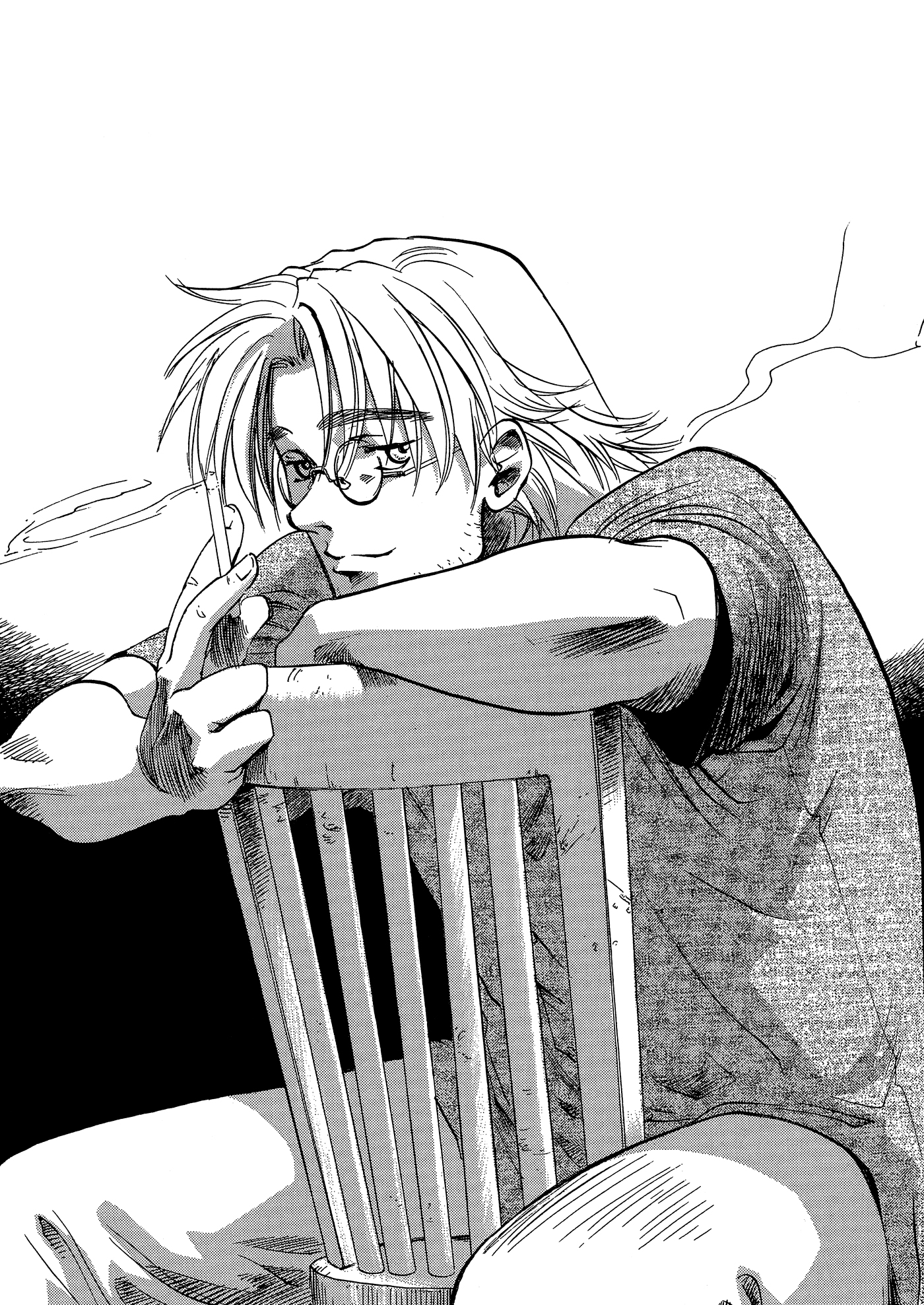
“I see.” Sousuke nodded, thinking back on Kurama’s last words.
“Once we had you out of the woods, we carried her back to her home village, and held a funeral for her,” Lemon told him.
Sousuke said nothing.
“After that, I got about a hundred meters from her grave before I couldn’t take it anymore. I broke down and had a smoke. I think I really loved that girl. I choked on the smoke some, and then cried a lot. About ten years’ worth of tears,” said Lemon, although he showed no particular emotion now, as if he were talking about something from the distant past.
“I don’t blame you for what happened,” he continued. “I’m as guilty as you are. We both used her, got her in over her head, then let her die. It’s a common story in our line of work. Of course, some day...” He dropped the cigarette on the floor and rubbed it out with his shoe. “...Some day, I’ll pay for it, I think.” Lemon fell silent for some time, staring emptily at a point on the wall. The sunlight streaming in through the window created deep shadows on his face.
Sousuke felt like he’d seen this expression many times before. It was one he saw on the faces of his battle comrades from time to time; a sort of death mask, unique to those who made their business in and around death. Whether far in the future or soon to be, the shadow spoke of the inevitability of entropy.
“Where am I?” Sousuke asked, and Lemon slowly turned to look at the painting behind him.
“That painting is a hint; the artist spent his last days here. Hiva Oa in the Marquesas Islands, smack in the center of the Pacific. It’s like the end of the Earth to a Frenchman like me.”
The Marquesas Islands. Polynesia. He seemed to recall that being French territory, but Sousuke wondered why they’d bring him out to the middle of nowhere. They probably wanted to hide him from someone, which was enough information to give him a good idea of what organization Lemon belonged to.
“Answer my questions thoroughly,” said Lemon, “or you’ll spend your last days here, too.”
“I doubt that.”
“I didn’t just save you out of friendship or the goodness of my heart. I wanted to know what you know, about Amalgam and Mithril. So does the DGSE.” He took his glasses off to peer at Sousuke again, then turned his chair around and sat in it properly. “Let’s start the questioning,” he said, his tone strictly business.
It was after nightfall when Lemon left Sousuke’s room. He passed through the corridor and entered the nave of an old church, erected in the 19th century, which they’d chosen as their local base of operations. It wasn’t a known tourist destination and no locals worshiped there, but Lemon’s fellow special forces members still kept a strict watch over the area to prevent unknown elements from wandering in.
It was another hot day on the equatorial Hiva Oa Island. Outside the window, beaming sunlight reflected off the ocean beyond the cliff, bright enough to sting Lemon’s eyes as he left the dark room. His only salvation came from a cooling wind that passed through the stone corridor.
His superior, who was waiting for him in the nave, now noticed Lemon and began to approach him. The man’s name was Delecour. He was slender and just over forty, with black hair and a goatee. They were both agents of France’s Directorate-General for External Security, and they’d been on countless operations together.
“Well? Did the kid talk?” Delecour asked.
“Well...” Lemon shrugged. “He was evasive. Lots of ‘I don’t know’ and ‘I don’t remember...’ He probably knew we couldn’t torture him in his current condition, though I don’t know why he’s so reticent to inform on an extinct organization.”
The other man said nothing.
“He was being cagey with information about that submarine and its battle group, too,” Lemon continued. “I think he was trying to find out what I knew, if you can believe it.”
They didn’t know much about the amphibious submarine that the American military referred to as the “Toy Box.” Some data said it had capsized, while other sources claimed that it was still hiding in the Pacific. In practice, this was as good as knowing nothing. Even Sousuke, who Lemon was sure had been part of that battle group, seemed genuinely ignorant of his allies’ whereabouts.
“Anything else? No one cares about that submarine whatsit. What we want is information on Amalgam,” Delecour pressed him, his irritation plain. “We were originally investigating their open dealings in world arms markets, but some incidents this year have begun painting us a much clearer picture: These men manipulate international conflict to prolong the stagnating Cold War structure—and much more importantly, to deny us influence over it. But the fact that we can’t get any information about them, either through soft or hard power, is—”
“I know that,” said Lemon, waving his hand in annoyance. He didn’t like Delecour. As someone who had worked his way up from the bottom, Delecour had a tendency to condescend to Lemon, who had been on the fast track since he was a child, and could have become a high-ranking bureaucrat if he’d so desired. He seemed to regard him as a spoiled graduate school intellectual. “Sagara Sousuke said he’d cooperate in exchange for certain things.”
“‘Things?’” Delecour questioned.
“Yes.”
“What ‘things,’ exactly?”
“Weapons, ammunition, funding; an easy-to-procure arm slave, a cargo ship for transport, and a safehouse in a designated location.” Lemon relayed Sousuke’s words exactly as they’d been spoken.
Delecour’s brow furrowed. “He still wants to fight Amalgam?”
“It seems so.”
“So we save his life, and he treats us like his errand boys. Arrogant, isn’t he?”
“Are you going to accept his requests?”
“Absolutely not,” Delecour spat. “We haven’t decided for sure that we’re going to fight Amalgam. The only thing we can offer him is a promise not to kill him.”
“Makes sense to me.”
“Let’s let him recover a while longer. Then I’ll apply the thumbscrews myself.” When Delecour talked that way, he was usually serious. He’d wait for Sousuke to recover his stamina, then torture him severely, maybe drugging him for good measure.
Lemon didn’t have the authority to stop him. Depression sank over him as he considered the scene to come.
“You don’t approve?”
“Well...” Lemon hedged.
“He may be getting to the point where we need to restrain him as well,” Delecour pointed out. “Go on and cuff him.”
“That won’t be necessary yet,” Lemon protested. “He can only just move his head. He won’t be causing trouble for a while.”
But “trouble” went down that very night.
The church where Sagara Sousuke was being held had been built on a low mountain slope, facing the southwestern sea of the isolated island. There were no civilian houses or harbors around, and the agents who came in and out dressed as tourists blended in well. It was a perfect place for a spy organization’s safehouse.
All the locals knew was that some rich foreigner had bought up the church and used it from time to time. Very few of them ever ventured nearby, either.
The 29 SA—the special forces of the DGSE—ran patrols around the church in shifts. The soldiers, wearing plain clothes and night vision goggles shaped like sunglasses, carried only small machine pistols hidden under their Hawaiian shirts. It was hardly an ideal security situation, but if a young person or a tourist wandered into the grounds—the likeliest scenario—then scaring them away with body armor and carbine rifles would be counterproductive. Such things would cause more trouble than they would prevent.
That night, a young foot soldier on watch duty was walking along the cliff face, which was being lapped at by the quiet waves. He’d come out of the army, gone through grueling training and tests, and only just gotten himself assigned to a squad mission.
He wasn’t about to complain about how boring the mission had been. The fact that they’d been called in especially to run these patrols in lieu of some over-the-hill security forces meant that whoever was being held in the church was of the utmost importance. Anyone who would yawn and slack off in the face of sentry duty in the sticks would never have been chosen for Special Forces in the first place.
It was this state of alertness that allowed him to spot three men silently trying to come ashore from the sea below the cliff. They were holding brand new carbines and dressed in black diving gear, wearing water-resistant tactical vests. He could tell at a glance that they weren’t local youths or tourists.
Naturally, he wasn’t about to come right out, pointing his gun at them while shouting, ‘Halt! Who are you?’ The young soldier knew that he couldn’t confront three armed professionals with a machine pistol alone. Instead, he hid and whispered into his mobile transceiver. “Éphémère-4 to Éphémère-1. Three armed intruders sighted at E12. Instructions?”
Commander Delecour responded immediately. “Éphémère-1 here. Continue monitoring. I’ll send support in three minutes.”
“Éphémère-4, roger. Out.” Turning off his radio, the young soldier moved soundlessly to hide behind a nearby rock. That would serve as a blind spot for the enemy making landfall, and he could watch their movements from a hundred meters above.
Just then, a hand wrapped around his neck from behind. He opened his mouth in shock, but didn’t have time to shake free; the knife was at his neck.
There had been a fourth man.
“Where is Sagara Sousuke?” the person whispered in the voice of Death itself. Then, “One more time: where is Sagara Sousuke?”
The young agent didn’t answer.
In response to his silence, the man said, “Impressive spirit.”
He felt a burning pain in his back; the knife had pierced his kidney. The enemy dug the tip of his dagger in mercilessly, and the shock of it made it impossible for him to cry out, even if he’d wanted to.
The knife was pulled back out, stabbed twice into his heart, and then drawn straight across the young soldier’s throat to finish him off before dumping him onto the rock. They hadn’t tried to finish him with one blow, but had struck multiple vital areas to make sure he was dead. It was the best way to kill with a knife.
Something strange was happening. Sousuke could sense that, based on the sounds of security guards running around in panic. Faintly, he could hear people having conversations via transceiver. He could barely read and write in French even with a dictionary on hand, so he didn’t stand a chance of understanding the conversations he’d overheard. Nothing else seemed immediately amiss, but there was definitely trouble brewing.
Something hung in the air that hadn’t been there before... It was malice, he realized, as the smell of blood came drifting towards him on the salt wind. It seemed very far away, and he didn’t know where it was coming from, but Sousuke’s finely honed sense of smell caught it immediately.
Someone was dead—murdered.
That realization came at the exact same moment he heard gunshots from outside. Low-caliber rifles and submachine guns, likely M4s or MP5s. They weren’t using burst shots or full automatic except for when obviously in support. It was the rhythm of the professional soldier, firing only as much as was needed.
The minute I regain consciousness... Sousuke gritted his teeth and picked his head up, and agony went coursing through him. His head was swimming and his fingertips trembled, but he knew he had to stand.
Sousuke felt the alluring urge to tell himself that the chaos outside wasn’t related to him and to go back to sleep, but he dug down deep and fought it. If the situation was really as Lemon had described it, then it was obvious who the battle outside was being fought over.
It felt like he was carrying a multi-kilo sandbag when Sousuke put a hand on the bed and picked himself up. Fighting the pain, he sat up, twisted his body, and pulled out the various wires and tubes that had been hooked up to him. He just barely managed to remain upright on the bed.
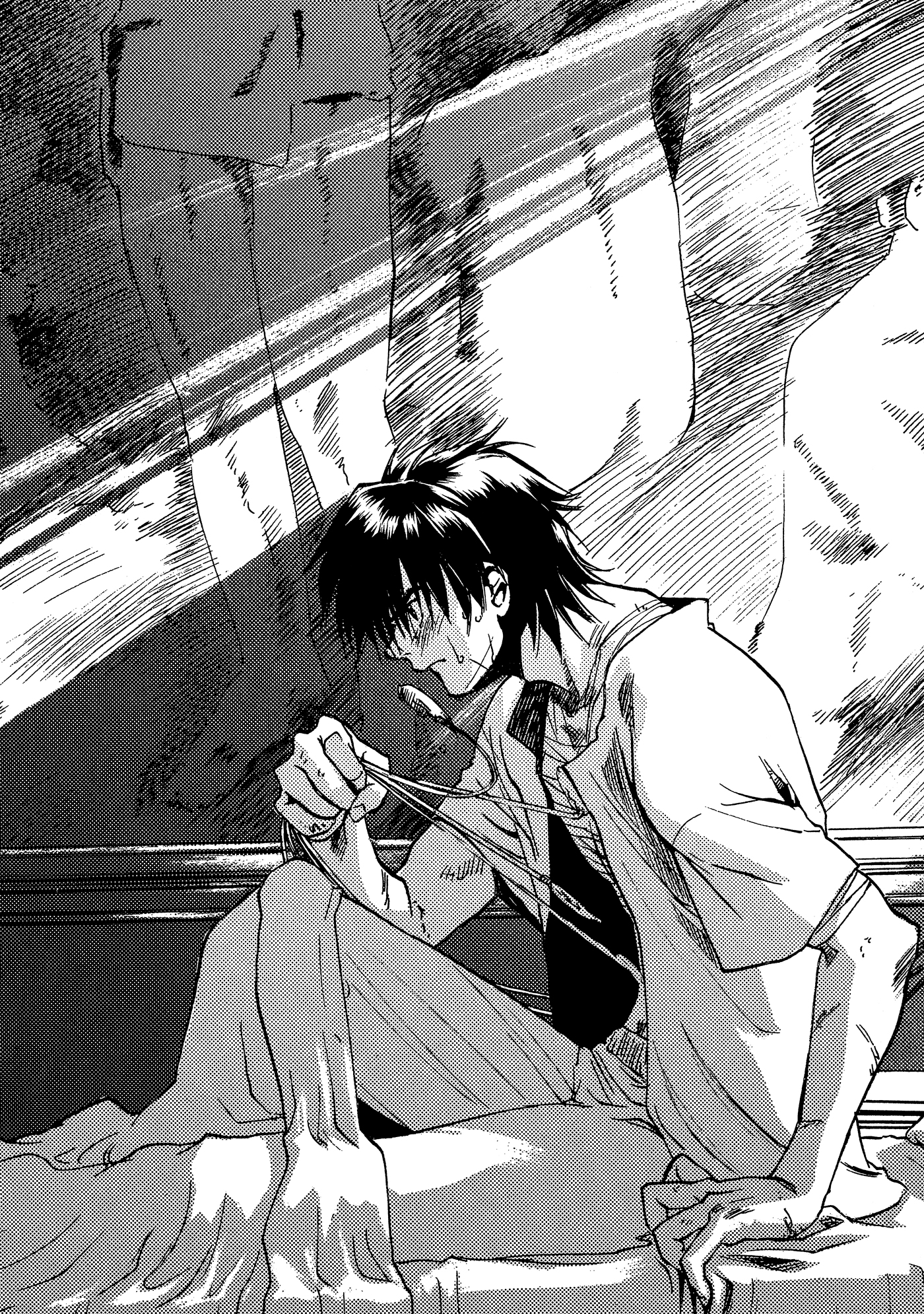
His muscles were shockingly depleted; if Lemon had been telling the truth, then he’d been asleep for a month and a half. “Damn...” Sousuke cursed, looking at his arm, which was so thin and frail he didn’t even recognize it. It almost looked like a woman’s. It would be no exaggeration to suggest he might lose an arm-wrestling match to Teletha Testarossa or Tokiwa Kyoko.
The shots outside continued sporadically, coming closer bit by bit.
Any weapons? he thought. None. All he had was his IV pin.
Anywhere to run? None. His door was locked; he’d heard it snap into place when Lemon had left. The windows—if he could even break through the glass—were too small and too high up. It would be impossible for him to climb out in his current condition. Frankly, even walking was a dicey proposition.
Gunshots and screams echoed from the hallway. They weren’t far now. In fact, they were right on his doorstep. The enemy would enter his room, no question about it.
Sousuke clicked his tongue and ran his eyes over his scant available resources: an IV set; several medical devices; a medical oxygen tank; and a bottle of mineral water. That was it. And he didn’t have the strength left to run, let alone fight off a group of highly trained enemies. If the enemy entered the room, he’d be shot to death; that was all there was to it.
There was no way to fight back. No, actually... Fueled by knowledge and instinct, Sousuke began to move, clenching his teeth as he shifted his feet from the bed to the floor. If it turned out he couldn’t stand, that would be it—game over.
Fortunately, his legs just managed to hold his weight. From there, he made his way shakily to the heart monitor, and reached for the medical oxygen tank beside it. He tried to yank out the tube attached to the tank, but didn’t have the strength for it... so instead, he opened the tank’s valve all the way and slammed the attached inhaler mask against the wall until it broke. With that task accomplished, he could hear the sound of air leaking out.
Destroying the breathing apparatus had proved hugely draining, but Sousuke wasn’t finished yet. Shoulders heaving from the effort, he grabbed the bottle left on the simple side table. It felt incredibly heavy, and his subsequent pouring of the mineral water out onto his bed felt like a herculean effort.
He then dumped the last fifth of the water in the bottle over his head, then wrapped the wet sheet around his exhausted body.
“Ngh...” That was the best he could do. The rest would come down to luck. Sousuke lay back down on the bed, grabbing the pin of the IV that had been sticking into his right hand, and calmed his heaving breaths.
Outside, he heard gunshots. Inside, there was the sound of oxygen rushing out of the tank. His body was aching all over, but he ignored it. He’d done this many times in the past. It would work out somehow.
There were more gunshots, this time in his immediate vicinity. A few seconds later, a man in black battledress kicked the door in with a crash.
The man pointed his carbine straight at the bed. “Sagara Sousuke?” he asked.
“I would try to deny it,” Sousuke admitted, “but you’d shoot me anyway.”
“Indeed.” The man fired.
In that same moment, Sousuke twisted away. He knew that even if he dodged the first one, the man’s follow-up shots would finish him off... But before the man could fire again, the air in front of him exploded.
The man let out a cry of shock as a raging flame swelled up from his hands. With the abruptness of an acetylene torch flickering on, a fireball engulfed the area three to four meters around the man, accompanied by the dull, heavy roar of an explosion.
The oxygen released from the medical tank had filled the room, and had been triggered in an instant by the man’s gunshot. It wasn’t as effective as a military incendiary device, but flame consumed him as surely as if a massive lighter had been switched on at his feet.
The flame reached Sousuke on the bed, and a violent wave of heat washed over his body. He tried to hold his breath, but the heat still got into his nose and throat. If he hadn’t been doused in water and wrapped in wet sheets, he probably would have been badly burned as well.
Once the worst of the heat had passed, he sat up again. The next thing he heard was the enemy’s screams. “Ahhh! Ahhh!” the man shrieked, dropping his gun to clutch at his eyes, which must have been burned in the blast. Sousuke got up out of the bed—faster now than the first time—and staggered towards the enemy in front of the door.
The painting on the wall was in flames. Where do we come from, what are we, where are we going? he thought, musing over its title.
“Chidori...” he said, whispering under his breath. Then Sousuke walked straight forward, grabbing his enemy to pull the pistol out of the man’s own thigh holster. While the man clung to him for dear life, shrieking in confusion and fear, he pressed the gun against his enemy’s jaw and pulled the trigger. There was an ear-splitting scream, and the man fell dead on the spot.
Sousuke stood there silently. Maybe it was because of the painting behind him, twisting and blackening as it burned, but for some reason, he found the action exceptionally painful. He didn’t know anything about this man except that he’d been trying to kill him. He had no reason to pity him.
And yet, Sousuke felt miserable over the knowledge that the cycle had resumed; that the nightmare hadn’t ended, after all. He would have been content to die back at the Arena, but some unknown force had ordered him to remain alive and keep killing.
Sousuke knelt down next to the body and stole the man’s equipment: tactical vest, digital transceiver, carbine rifle, spare magazines, blood-stained knife, smoke grenade, survival and medical kits. He put the vest on over his naked upper half, holstered the pistol in its hip pocket, shouldered the carbine rifle, and left the room.
He seemed to be in some kind of old church. He didn’t know what had happened to Lemon and the others; maybe they’d run off, or maybe they were dead. Either way, he had to get out of there. Once he had done so, he could hide. It was dangerous to be where people were, so he’d escape to the nearby mountains and recover his strength there.
That was the best option Sousuke could think of right now, and he began to move wordlessly. His breathing was ragged. His legs were heavy. The equipment he’d taken from the enemy weighed on him. The carbine felt like a fifty-kilogram cement bag on his shoulders. How could he have ever swung this thing around weightlessly?
He came upon a dead body. Judging from his civilian outfit, he must have been one of Lemon’s colleagues: a man of just over forty with black hair and a goatee. Sousuke felt as if he recognized the man; he must have seen him several times during the month he’d spent drifting in and out of consciousness.
He passed through the corridor and came out in an open space. Apparently, it really was a church; the worship hall had high vaulted ceilings, and silvery moonlight streamed in through the stained glass windows despite the surrounding darkness.
He could see Lemon and several other men standing beyond the beams. “Don’t shoot!” Lemon sharply ordered the men who’d pointed their rifles at Sousuke. “Look, it’s him.”
Lemon then began to approach him as Sousuke supported the carbine with his shaking arms, all while trying to keep the other man in his sights.
“Sousuke. You’re safe?” Lemon asked.
“Unfortunately. Where is the enemy?”
“We’ve cleared out all the ones outside. It looked like one was heading our way. I heard a big explosion earlier, but...” Lemon said, then furrowed his brow as he noticed the gun and equipment Sousuke was carrying. “Isn’t that enemy equipment? Did you kill the invader?”
“Affirmative.”
“That’s all of them, then... But I can’t believe they’d come this far to attack us,” Lemon spat ruefully.
Sousuke had already slumped back against the nearby wall, uneasy on his feet. “You have a dead comrade back there.”
“What did he look like?”
“Forties, goatee, black hair.”
Lemon’s eyes went wide, then he looked down and closed them. “Delecour? Damn.”
“But it seems I’m the one they were after,” Sousuke pointed out.
“You are. But how did you know?”
“He knew my name.”
“I see.”
Just the act of standing was so taxing that Sousuke ended up slumping down the wall to the ground.
“So? What were you planning to do, dressed up like Rambo?”
“Escape. But I think it’s proved beyond me.”
Hearing Sousuke’s exhausted words, Lemon smiled. “Yeah, I agree. You’re not your usual Superman self. You should save your strength.”
“Agreed.”
“The real question is why someone wants to kill you so badly that they came here to the end of the earth to do it.”
“Yes,” Sousuke agreed.
Lemon walked up to him, knelt down, and peered into Sousuke’s face before asking, “Any ideas? Why would they see you as being valuable enough that they’d send forces to kill you? I could hazard a guess, but it would be a shot in the dark. So why don’t you just tell me?”
“I don’t know,” Sousuke whispered, fighting his not-yet-healed wounds. “They have their fair share of reasons to hate me.”
“That wouldn’t explain it, I’m afraid.”
“There’s one other possibility I can think of.”
“What’s that?”
“Al.” Sousuke said, naming his partner. “If he’s still alive and Amalgam knows about him, then they know that he and I as a team are a threat, and they’ll want to take one or both of us out.”
●
Teletha Testarossa’s problems kept piling up. Her week-long performance had left her mentally and physically exhausted, and she didn’t have time to take the long break she needed.
First, she had to deal with the aftermath of the San Francisco operation; even though there hadn’t been many witnesses at the harbor, there had still been a massive AS battle there, and a panic was sure to follow. If she’d had the power of Mithril behind her, she’d have been able to spin a cover story about a drug war, but she was on her own now. Still, some degree of information control was necessary, so she had her ship’s AI, Dana, and various subordinates handle it, before personally checking their work.
After meeting up with the Tuatha de Danaan, which had been waiting for them in the ocean near the coastline of California, their next job was to stay under the twin radars of the US Navy and Coast Guard.
That was no easy task; the United States Naval Forces weren’t stupid, and the de Danaan had been out in the world for over a year and a half. They would have spent that time finding ways to detect the rogue submarine, and by now they should be achieving some results. And the further the United States detection systems evolved, the more limited the actions of Tessa and her crew became.
After three days of silent running, they reached an area 120 miles off the shore of Mexico. Only then could Tessa relax their security levels a bit. When XO Mardukas and the ship’s AI relayed her announcement, it was met with a sigh of relief throughout the boat, even from the crew in the control room.
“Ma’am. Captain Clouseau has been waiting for two hours,” Mardukas said.
“That’s right,” Tessa agreed, rising from the captain’s chair. “Let’s go.” Her ash blonde hair, which would normally have been done in a braid, was tied behind her in a simple ponytail. She hadn’t had a shower in two days, either. The last three days had been so unpredictable that there had been no time for basic hygiene. Had she been a male captain, she’d have had stubble by now.
She left navigation and monitoring duties to the officer of the deck and headed towards the first briefing room. The sailors and officers she met on the way continued to salute her. It seemed vaguely inappropriate; Mithril had been effectively neutralized as a military organization, and while she’d told the crew many times that they didn’t have to salute anymore, none of them heeded her suggestion.
“Everyone’s exhausted,” Tessa whispered, going out of her way to maintain a straight posture and walk with a swift step for the benefit of onlookers. She was exhausted, too, but couldn’t let her men see that.
“Yes, Captain. There’s been no adverse effect on morale yet, but I’m worried about mistakes slipping through,” Mardukas whispered from behind her. “Twelve hours, if possible, but a break of at least eight would be advisable.”
“Impossible. We’ll take six hours’ R&R, then continue on south.” Tessa knew that Mardukas never exaggerated his advice, but six hours really was the longest they could afford to rest. Any longer than that, and the US Navy would find them. Then Amalgam, who was surely monitoring the Navy’s communications, would know their location, too.
“I don’t mean the crew. I mean you,” Mardukas nagged, predictably enough. “You haven’t taken a single proper rest since your decoy performance in San Francisco. It’s creating tension in your orders to the crew, as well. I’m sure Captain Goddard and the rest of the control room crew are talking about how tired you look right now.”
“If they’re sympathetic to it, why can’t I just keep going?” Tessa asked, fighting back the annoyance rising inside her chest. She immediately regretted her words. “I’m sorry. You’re right. I’ll be more careful.”
“Not at all...”
“But six hours is still our upper limit. I’ll take a proper rest later. Let’s try to hang in there a bit longer.” She gave him the prettiest smile she could, but Mardukas seemed unmoved.
He stopped, checked briefly to make sure no one was watching, and then spoke again. “Captain. May I?”
“What is it?”
“My loyalty to you is unchanged, as is that of the crew. I hope that was made clear after our escape from Merida Island.”
“Yes...” Tessa nodded, thinking back on what had happened after they’d left Merida Island in the wake of the attack there.
The three Behemoths and the bombings had dealt them a mortal blow, but the de Danaan had escaped. And despite the severe losses they’d taken, Tessa and the others had used all of their knowledge and experience to shake off the enemy’s pursuit. The United States military seemed to have learned about the attack as well, and evading them had proven to be exceptionally difficult. Had she had a normal submarine under her command, there would have been no way to escape their search nets.
After shaking off their pursuers and coming to a rest in the ocean near Indonesia, Tessa had revealed to the crew that the other battle groups had undergone similar attacks, and that Mithril was effectively dead. They would have to accept the fact that they were now on their own, and would need to evade the enemy without any organizational support whatsoever.
Their enemy, Amalgam, had started various civil wars and regional conflicts in the past. With Mithril gone, they’d probably become even more active in world affairs, and be able to reap rewards from their warmongering with impunity.
After explaining her sources for that information, Tessa had added, “Of course, it would be impossible for us to create any kind of absolute, everlasting peace. We’ve always known that. Yet the purpose of Mithril was always simply to use force to create ‘as much peace as possible.’ It’s too late to debate the merit of that use of force. Idealistic pacifists call us human garbage, but you wouldn’t be here if that bothered you. The nature of violence is that you’ll be called such things. There’s no honor or glory in it.
“With all that in mind,” she continued, “I will remain on this vessel, the strongest tool of violence in human history. I will do whatever it takes to oppose them tooth and nail, and force their backs to the wall. Let us abandon all platitudes: This is a mission of revenge. I want them to pay for those they took from us on Merida Island. It may be difficult, but we do stand a chance.”
She could even remember, clearly, the feeling of the microphone in her hand.
“I can’t pay you properly, of course, and things are about to become far more dangerous. You’re mercenaries, so I can’t force you to stay. I’ll prepare helicopters in the hangar deck for anyone who wants to leave the ship. The helicopters will fly to Jakarta, and from there you’ll be free to go. There’s no need for officers or NCOs to hold back. If anyone doesn’t want to be a part of this, meet me in the hangar one hour from now. That is all.”
She’d spoken it all plainly, and turned off the microphone once her long speech was finished.
Thinking that the control room personnel would need time to consider the offer as well, Tessa left her chair and shut herself up alone in her quarters for the hour to come. Mardukas appeared to have something to say to her, but Tessa ignored him. Melissa Mao, her best friend, also knocked on her door while she was waiting out the hour. But even then, Tessa just said through the door, “Return to the duty room and think it over.”
I’ll be lucky to have thirty percent of my crew remaining... No, maybe even twenty percent, thought Tessa, who knew that what she was asking for was utterly unreasonable. It would then require multiple round trips to transport off the hundreds of people leaving with the few helicopters they had. She spent the hour calculating the logistics of it all, as well as how to restock their still-insufficient supplies.
Tessa headed from her quarters to the hangar deck, opened the heavy door all by herself and went inside. There were about a hundred crew members hanging around there, Kurz, Mao, and Clouseau among them. They were chatting among themselves, showing no particular signs of tension.
“Is this all of you?” Tessa asked them, finding it strange.
Mao furrowed her brow. “All of who?”
“Well... all of those disembarking.”
“Oh, them? They’re down that way.” Mao gestured with her chin.
A little ways away, a group of twenty was standing next to the transport helicopters. They were joined by ten seriously injured people in need of proper treatment, and three members of the nursing staff to accompany them. Thirty-three in all.
A mere thirty-three.
“Most of the ones leaving are the ones with families, kids. It makes sense,” Kurz said.
“But what about the rest of you?”
He glanced into Tessa’s face, then shrugged. “Look around you, Tessa. This is all ground force guys, base personnel, and maintenance crew. We’re just here because we don’t have anything better to do. By the way, there are other base personnel around at various posts, studying up for how they can be of best help.”
“B-But... Isn’t there anyone else? If you’re having any second thoughts at all, you’re under no obligation to stay,” Tessa pressed them.
The group all looked at each other. “You heard her. Hey, anyone here have doubts?”
Nobody responded. No, one private from logistics raised his hand and shouted, “Colonel, ma’am! There’s a TV show I recorded on land! Can I have permission to go ashore for just a little while to watch it? I’ll be right back!”
Immediately, the hundred people present burst out into laughter.
From the center of the group, the large maintenance chief who’d just finished drinking a cola, Sachs, broke through the crowd to approach her. “You heard ’em, Captain. Now, we do have plenty of worthless assholes sucking up the boat’s oxygen. So if you want to fire ’em, now’s your chance! Right, barkeep?” Sachs asked, turning back towards the others.
A plump, elderly man standing in the crowd—the man who’d run Darza, the bar at Merida Island Base—shook his fist, and cursed back at him. “I’m not worthless, you idiot. I was a mercenary in Africa in my youth! I could step into the shoes of the old Russian if you want!”
“Sounds good to me,” Sachs called back. “The old man can take Major Kalinin’s place as field commander. Starting today, you’re Perth-1!”
“Bet he’ll be getting everyone drunk every day, though,” someone else predicted. “Wouldn’t expect much out of them from now on.”
“Idiot, as if I had time to bring a drop of alcohol on board,” the man grumbled back. “Too many dead assholes to haul along, instead. Lousy bums...”
The group clapped their hands and whooped.
It was only later that Tessa learned that the man who’d run Darza really hadn’t brought any alcohol on board. Instead, before he evacuated, he’d packed into his bag all the pictures of their late colleagues that hung on the bar wall, including Captain McAllen.
“No real man would ever turn tail and run, you know?” another man called.
“That’s right!” chimed in another.
“Excuse me! Don’t forget there are women here, too,” the engineer, Lieutenant Lemming, shouted across the crowd.
Tessa’s secretary, who’s name was Villain, and communications officer Shinohara raised up their cola bottles and joined in. “Hear, hear!”
“But... but... we’ve lost dozens, remember? And I told you what to expect here, too. Why would you possibly...” Tessa trailed off, standing there uncertainly.
Mardukas, who had come up behind her at some point, said, “Honestly... What reckless lowlifes.”
“Mardukas-san?”
“Myself included, of course.” His words got another roar of laughter from the crew. For once, Mardukas didn’t shout for them to quiet down. Instead, he spoke further to Tessa over the ruckus. “Captain, everybody here is honored to serve you. You’re the commander every soldier dreams of. It’s true that, at first, they dismissed you as being an impudent girl who knew nothing about the world. But things are different now.”
Tessa was speechless.

“You’ve accomplished things beyond what even the most battle-hardened veteran has. If you tell us to fight, we’ll fight. What’s more, you were genuinely honest about your motives. If you’d told us it was ‘for peace’ in your speech earlier, I might’ve disembarked myself.”
Merely for revenge... Tessa actually didn’t see it as being that simple. She had other, more practical reasons for wanting to destroy Amalgam. But she couldn’t deny that that primal motive was the main force spurring her along.
She had no great cause, no honors to promise them. The soldiers were sticking with her purely for the sake of revenge. She could anticipate and plan for most eventualities, but this one had completely escaped her imagination. She was expecting them all to chew her out and abandon her, and she wouldn’t have blamed them if they had.
“I can’t believe it,” she said. Not long ago, such a sight might have caused her to break down in tears, but not today. That wasn’t what her people wanted to see. Instead, Tessa put her hands on her hips and proclaimed, in a clear and resounding voice, “Very well. But as I said before, I can’t pay any of you, all right? I’ll do what I can to feed you, but that’s all. Understood?”
“Sure.”
“Well, makes sense.”
“Yeah, yeah,” came the slovenly replies.
She took a deep breath and raised her voice to a shout. “I can’t hear you! What was that?!”
They all moved in a panic to shout out in unison, “Yes, ma’am!”
“Excellent.” Tessa nodded in satisfaction, and a strange silence fell over the room. Then, unable to take it any longer, she began to snicker, and then the rest of the group began to chuckle with her, which soon grew into roars of laughter until the incongruous sound echoed all throughout the hangar.
She wasn’t quite sure herself what was so funny; maybe all the tension had made her slightly mad. While she laughed and laughed, she found tears flowing from her eyes. Not wanting the others to see, Tessa dismissed them and quickly left the group. It took about thirty minutes for her to regain enough composure to say her goodbyes to the people disembarking.
“Captain?” Mardukas called out to Tessa, pulling her from her memory.
“What? Ah, I’m sorry...” she apologized, snapping back to reality.
Mardukas examined her haggard face. “As I was saying, it’s your exhaustion I’m worried about. Are you sure you’re not feeling an exaggerated sense of responsibility towards the men and women who chose to remain?”
“What do you mean?”
“It’s not good for your mental state to beat yourself up like this,” he said. “I recommend you take a month’s vacation on a tropical island.”
“You know I can’t do that.” She’d said it in a self-chastising tone, but Mardukas didn’t smile.
“And there it is, exactly.”
Tessa gave him a questioning look.
“In the past, you would have responded with a bit more wit,” he observed. “Something like, ‘Then let’s occupy an island somewhere and have a nice rest,’ perhaps... Of course, I’m hardly a comedian myself, so I cannot say for sure... but at least, you would have a more ready response than, ‘You know I can’t do that.’”
Tessa said nothing.
“You’re lacking in your usual humor,” he said gently. “This itself is proof that you’re at the end of your mental rope.”
Tessa struggled to keep her composure in the face of Mardukas’s words. Maybe he was right, but they still couldn’t afford to take a break under these circumstances. And—
Then the realization hit her. Why hadn’t she immediately noticed the irony of Mardukas—that stuffy, overserious man—telling her that she was lacking in humor? Was that not itself proof that she was exhausted?
“You may be right,” Tessa responded weakly. “I’ll keep that in mind. But for now, we have a discussion to deal with.”
“Yes, ma’am.” There was something almost pained in Mardukas’s voice as he responded.
Resuming their walk, Tessa and Mardukas finally arrived at the briefing room, where they found Ben Clouseau, Melissa Mao, and Kurz Weber waiting for them. Clouseau had succeeded Kalinin as the commander of their ground forces; Mao had taken on the duties of Castello and other officers. And lately, Kurz had begun undertaking various duties as well; the role of SRT sub-leader, which Mao had assumed in the past, and go-between for the NCOs. Although the role was almost meaningless, now that they’d lost most members of the SRT to death or injury.
Ranks were effectively meaningless now that Mithril had been destroyed, but Tessa kept them in place to preserve a chain of command. Clouseau had been promoted to captain, and Mao to first lieutenant. Kurz was being treated as a master sergeant.
It had been Clouseau, whom Tessa had believed to despise Kurz, who recommended his promotion to Tessa. She had asked him, “Are you sure he can handle it?”
Clouseau had responded, “I think so. His skill and experience are all in the top of his class and, despite his behavior, he’s more attentive than you’d think. Captain McAllen liked him, too, though I confess I can’t see why,” he’d added gruffly.
Kurz himself seemed to like the title “Master Sergeant Weber,” and he’d made a big fuss about the other soldiers calling him that. Of course, that mainly meant a lot of, “Master Sergeant Weber. Please return the ten dollars I lent you, jackass,” and “Master Sergeant Weber. If you need something to do, go peel potatoes, stupid.” In other words, his new title hadn’t changed much.
Kurz didn’t do things in the manner of your typical senior NCO, but his unique personability and sociability made it work. In fact, Kurz had managed to resolve several disputes that had come up between the soldiers. He was as jocular as ever, but he wasn’t quite as irresponsible and reckless as he had been previously. He seemed to be mentoring the less experienced soldiers, too.
Clouseau and Mao seemed to have realized it earlier, but Kurz had the makings of a real leader. It wasn’t like the sort of grand officer’s responsibility that someone like Tessa bore on her shoulders, either; he acted more like the captain of a baseball team.
Incidentally, the remaining members of the SRT who had survived the battle at Merida Island, like Yang Jun-kyu and Sandraptor, had boarded the submarine, worked hard on their recovery, and were now devoted to rehabilitation and basic training.
This was the general state of affairs on the de Danaan at present.
Their greatest unsolved question—the matter of how to resupply—had been resolved in a way that none of them could have anticipated. An anonymous person had left information with Dana about a stockpile of provisions on an isolated island near Indonesia that none of them had known about.
Dana had told them about it one day after they’d made their escape. Of course, it could have been a trap, but it was also their only hope. While staying on their guard, the de Danaan had headed for the given coordinates and found several dozen containers of ammunition, fuel, provisions, and sundries waiting for them on the island.
It still wasn’t clear who had left them there, but Tessa and Mardukas both felt they had a vague idea. There weren’t that many people who’d be capable of arranging this, for one thing. It had to have been someone who had set up various underground routes independently from Mithril; someone extremely cautious, with great foresight, who would have known what supplies the de Danaan would need in case of emergency.
Andrey Kalinin seemed to be the only possibility, and they were ninety-nine percent sure he was dead. But even if he were, it was still a mystery as to why he would have made such scrupulous preparations, and why he would have gone about preparing a stockpile that neither Mardukas nor Tessa had been aware of.
“Sorry I’m late,” Tessa said to Clouseau, Mao, and Kurz, who’d been waiting for her in the briefing room. Clouseau started to stand up, but she stopped him with a gesture and quickly took a seat. “The currents were faster than expected, and getting us here took longer than anticipated. I’m sorry.”
“Not at all,” Clouseau responded, settling back down in his seat. “Now, regarding our next move, since Fowler escaped capture...”
“Yes, I fear that we failed to pick up Leonard Testarossa’s trail,” Tessa agreed. “We’ll have to get to him some other way, somehow.” All those present were accustomed to hearing Tessa talk about her brother like a total stranger by now. She’d already told them that her brother was working as an executive for Amalgam, and that he was also a major force behind their enemy’s technological prowess. “Fortunately,” she continued, “we’re not without leads. This is why I sent most of the former base personnel to land months ago. They’ve managed to build up quite an information network in the time since.”
Most of the base personnel who’d come aboard to escape Merida Island had disembarked by this point. She’d distributed them around the world, with each working in their own specialty field: Buying of provisions; acquisition of funds; preparation and preservation of supply lines... Of course, they were also gathering information while doing so, working to locate and contact surviving members of Mithril. They had spent over a month making preparations for how to contact old allies and keep their existence a secret.
Mao spoke up next. “Still, it won’t be so easy for them to track down the enemy, will it? The base personnel aren’t exactly professional spies.”
“Indeed. That’s why their priority order is to locate Mithril’s survivors,” Tessa affirmed. “Sagara-san, for instance, may be out there somewhere, searching for the same things we are... If we can get in contact with him and those like him, it might open up new avenues for us.”
The mention of Sagara Sousuke’s name caused Mao and the others to lower their eyes. “Sousuke, huh...” Mao said.
“We don’t even know if he’s alive,” Clouseau observed.
“Yeah. Though I doubt they could take him out that easily...” Kurz whispered, sounding surprisingly confident. He let out a deep sigh. “Still... I think it’s time you came clean with us, Tessa.”
“About what?”
“About why you’re so obsessed with Leonard. His being your brother, or being an Amalgam executive, doesn’t explain the fixation. There’s another reason, right?”
“Weber,” Clouseau warned Kurz, reacting to his overly frank comment.
“It’s all right, Clouseau-san.”
“But—”
“I was planning on doing that soon, anyway. With the caveat that I’m not certain of any of this myself yet, I’ll share the theory I’ve been exploring.” Tessa had been keeping her reason for pursuing Leonard a secret, because she hadn’t been sure how much of her theory was safe to reveal. But for now, she was choosing to open up to the four people she trusted most in the world.
“Amalgam is an extremely resilient organization,” Tessa began, choosing her words carefully. “They lack a pyramid-style command structure like Mithril’s, opting instead for a spider’s web; it’s full of complex intertwined branches, with the executives at the center. These executives are more like the ‘nodes’ of the Internet... and high-functioning nodes, at that. But even if you were to find and nullify one of those executives, it would deal only minor damage to the organization as a whole.”
“Why? Wouldn’t that throw their command structure out of whack?” Kurz asked in confusion.
Mao whispered, “It’s like a scale-free network. Another hub just swaps in.”
“Precisely,” Tessa confirmed. “I’m sure you all know this, but the Internet was originally created to decentralize US command structure, allowing it to survive in the event of an all-out Soviet nuclear attack. Amalgam has adopted that concept to create an unusual sort of secret organization. Some in the structure have more power than others, but there’s no strict hierarchy with someone on top. They all participate in decision-making and have executive power, as well.”
“How very democratic,” Mardukas whispered sarcastically.
“It is democratic,” Tessa agreed. “That’s why their decision-making is slow. But it also makes them overwhelmingly difficult to destroy through force alone, which is why they’ve given us so much trouble.”
“Am I the only one not following this?” Kurz asked, furrowing his brow. “What’s the upshot, exactly?”
Clouseau spoke up after a moment’s hesitation. “In video game or anime terms,” he explained, “it means there’s no one big boss we can defeat to resolve things.”
“Ah-hah...”
“There are simply a lot of mid-level bosses instead... too many for us to see them all,” he went on. “And while we work on beating one, another middle boss will arise organically to fill his place. It’s like an unending game of whack-a-mole.”
“Okay, got it... Hey, wait! So, how’re we supposed to fight them, then?” Kurz demanded, his voice cracking.
“I realize that I’m making them sound invincible, and it’s true, they are resilient. But resilient doesn’t mean invulnerable,” Tessa clarified. “I said before that a path to victory exists. It came to me after the Christmas incident... I sent a report to Admiral Borda about it, and I think he took it seriously. But before we could come up with a proper plan, he was killed in the destruction at operations headquarters. Fortunately, I am still alive, and I know what the weak point of a system like this is, both in terms of biology and computer science.”
“What is it, then?”
“I see... a virus,” Mao said, deep in thought.
“Precisely,” Tessa replied with a smile. “Perhaps we can’t eradicate them entirely. But we can cripple them beyond recovery; so badly that they might as well be dead. That is our path to victory.”
“But Colonel,” Kurz said. “We’re not dealing with a computer or a single organism. It’s an organization of people coordinating in ways we still haven’t even identified. We don’t know anything about them, either. How could you even start preparing a virus to deal with them?”
“I couldn’t.”
“Then how—”
“I can only think of one person in the world brilliant enough to prepare such a virus... someone deep enough in the organization and sufficiently knowledgeable about its inner workings to execute it. Can you guess who I’m thinking of?”
“Your brother, huh?” Kurz asked.
“Precisely. Knowing who he is and what he’s capable of, I suspect he’s already come up with such a virus behind the other executives’ backs,” Tessa predicted. “Therefore, I believe our best course of action is not to crush Amalgam’s institutions or weapons manufacturing facilities, but instead to capture Leonard Testarossa, and gain his cooperation by any means necessary.”
“Any means necessary?”
Tessa nodded, her eyes cold. “Any means necessary. I don’t need to elaborate, do I?”
“B-But—”
“Thank you,” said Tessa, “but I’m fine.” She smiled quietly.
Tessa’s friends and subordinates examined her face and body language, each of them attempting to gauge how serious she was. Kurz, lips pursed, felt a chill go up his spine. Clouseau and Mao peered at her seriously, and Mardukas’s expression was pained.
“Fowler may have escaped, but the confrontation gave us several useful pieces of information,” Tessa continued, unperturbed by their scrutiny. “I’m going to take us south, so we can remain on standby in the Pacific while Dana continues to analyze that intelligence. We might need to head for the Atlantic at some point, but with our capabilities, getting around South America shouldn’t take that much time. Any objections?”
“No, Captain,” Mardukas said first, with the other three agreeing right after him. The conference ended shortly afterwards, following another brief discussion. Mardukas, Clouseau, and Kurz left the room.
But Mao stayed behind to talk a little more. “Tessa,” she began.
“Yes?”
“You okay?” Mao’s gaze was serious.
“Yes,” Tessa replied. “Why do you ask?”
“Why do I... ask? Well, I just had a feeling...”
“Mardukas expressed his concern earlier, as well. But I’m fine.” Tessa smiled, but Mao didn’t.
“If you insist,” Mao said instead. “But we only have about five hours left. Why don’t you eat something and get some proper shuteye?”
“Yes, I intend to.”
“Remember what Dr. Goldberry said? If you have an appetite—”
“I know, I know! Eat when I have an appetite and sleep when I can, wasn’t it? Please stop reminding me!” Tessa forced herself to yawn, stretching out her arms, and left the briefing room.
As she arrived at her quarters, she found a club sandwich and a vegetable juice pack waiting for her; Private Kasuya from the galley must have dropped it off. Tessa hadn’t eaten anything for over twelve hours, so she took a bite of the club sandwich and forced it down her throat, but couldn’t manage a second. She also downed half of the vegetable juice, but couldn’t drink any more. She dumped the remains of the sandwich in her bathroom toilet and flushed it down like a criminal hiding evidence.
Tessa thought about taking a shower next, but couldn’t bring herself to do it. Instead, she just turned off the lights, stripped off her clothes and lay down in bed, curled up under a blanket. Ten minutes passed, then thirty... After an hour, she finally gave up on trying to sleep.
She sat up slowly, pulling the blanket to her chin and leaning back against the wall, huddled up in the darkness. Her eyes remained open the entire time. Swirling through her mind were the names and faces of her dead subordinates: the men and women she had left to die.
She did nothing but stare silently at the wall.