1: Wall of Sand
1: Wall of Sand
Major Martin Estes received the bad news just after 1400 hours, at the peak of the desert heat: a large enemy force was approaching the ruins of the Marinid Sultanate-era structure they were using as a base. Thirty MBTs and four second-generation arm slaves had been confirmed, and a force of equal or greater size was expected to join them soon. It was Amalgam—more precisely, a Moroccan Armed Forces squadron in Amalgam’s employ.
Estes and the others, who had escaped the initial ambush on Mithril’s facilities, had been working for months to gather together the organization’s remaining resources and manpower. Their hope had been to eventually mount a counterattack, but now they would be crushed before they even got the chance.
“Goddammit,” he cursed, sucking in some of the simple tent’s dry air through his nostrils.
They were in North Africa, the desert region between Morocco, Algeria, Mauritania, and Western Sahara. There were no mountains for dozens of kilometers. The sun was blazing down on them, warping the horizon in a heat haze. At times, Estes thought he was in Arizona or Nevada.
Tents and barracks lay here and there, camouflaged among the lines of stone pillars, and they had a makeshift runway cleared out of cracked flat earth. It was disguised enough to avoid detection in satellite photographs, but it was barely a base to begin with. They had less than one hundred men and a handful of second-generation arm slaves. They had stocks of M6 parts as well, but in many cases they were useless: a leg without a hip joint, a torso without a cockpit. He was crushed that the enemy had found their resistance base, of course... but he was also shocked they were sending such an ostentatiously large force to crush them.
“Hell... It’s like sending a tank to roll over a doghouse,” Estes muttered.
At this, Master Sergeant Zimmer, who had made the report, shrugged. “It’s unlikely that they know the full extent of our forces.”
“Oh, so they’re overestimating us?” Estes returned bitterly. “I’m honored.”
The small Central American country of Belize had once been home to a Mithril operations division personnel training camp. They’d trained mercenaries gathered from all over the world, screened them for aptitude, and sent those who qualified to front line squadrons. Estes had been the “principal” there, more or less, and with a few exceptions, most of the ground unit personnel in Mithril’s operations division came out of Estes’s camp. This included the West Pacific Battle Group trio: Melissa Mao, Kurz Weber, and “Sosuki Segal.”
When the massive Amalgam attack in January had destroyed Mithril bases all over the world, Estes and the others had gone into hiding in the jungles around Belize, entirely on foot. Tanks and armored cars couldn’t pursue them in a tropical forest, after all, and even ASes would have a hard time of it. Running on foot would put them at an advantage for evading enemy pursuit, and the heavy jungle cover even helped them avoid tracking by air.
After about three weeks of running, they’d made it to an airport in Honduras and escaped to Colombia from there. In the city of Medellín, most of those present had made the decision to give up and go home. Those who remained included a dozen or so Mithril instructors and four or five eccentric trainees. Knowing they stood no chance against Amalgam’s massive force at less than twenty strong, Estes and the others had decided to set up a private military company in North Africa and use that as cover while seeking information on the fates of their allies.
For the next few months, about all they’d had to show for their efforts had been reuniting with ten or so more former Mithril members. There seemed to be quite a few pockets of individuals like theirs out there, but tracking them down while they were in hiding had proved to be difficult. Most of those they did manage to contact were too pessimistic about their chances to rejoin. In time, Estes felt his own hope waning, and began to wonder if running a small PMC for the rest of his life might not be such a bad deal.
It was around that time that the incident in San Francisco occurred. The news reported it as an explosion near the harbor, but scattered photographs from the scene suggested it was actually the aftermath of an AS battle.
Master Sergeant Zimmer flew to San Francisco with a few of his men and spent a day scouring eyewitness testimony, security camera footage, and police radio records. It didn’t take long for them to work out that there had been a hand-to-hand fight between a black M9 and a Venom. What’s more, during the battle, the black M9 had received support from a cruise missile, which had enabled it to dispatch the Venom solo.
The operator of the M9 had to be Ben Clouseau, formerly of the Mediterranean Battle Group. And the cruise missile... it had to have come from that submarine, the Tuatha de Danaan. He’d never met the woman who commanded it, but the rumors all said she was gutsy as hell.
The news had electrified Estes and the others. To think the members of the West Pacific Battle Group had hung on, survived... and even managed to give the enemy a bloody nose.
Word of the incident seemed to have spread far and wide among other Mithril remnants as well. Encouraged by the Tuatha de Danaan’s resistance and deciding they’d like to stick it to Amalgam after all, they began to contact Estes again, in numbers he could never have imagined. A mere two months later, they’d tripled their meager roster and established a base on the edge of the Sahara. They’d even managed to recover their training camp’s funds from overseas banks and had begun rounding up supplies. The hope was that they’d eventually get a real fighting force together, but...
Now the enemy was on its way.
Estes didn’t know how Amalgam had found the base they’d worked so hard to hide, but it didn’t matter now. Their forces were overwhelming. Estes wanted to withdraw on the double, but the enemy would overtake their ground vehicles easily, and the transport plane they used for personnel and supplies was 1200 kilometers away. It was on its way at top speed, but it would take it at least two hours to arrive, and there was no way they could hold out that long.
A hopeless battle was about to begin.
“Damn. I really thought we’d last a little longer,” Estes whispered. He watched his subordinates scrambling around the baked earth outside the tent, making their nigh-fruitless preparations for battle.
“Never thought I’d hear you give up so quickly,” said Zimmer. “It’s understandable against a force like that, though.”
“Hah, who’s giving up?” Estes retorted. “At least we’ll give them a fight to remember.”
“Right. Let’s really make a show out of it.” The two men exchanged genuine grins, untainted by any sense of grim heroism. Then Estes grabbed a nearby assault rifle, put on a desert camo hat, and came out of the tent, where he felt the glittering sunlight burning against his skin. A dry wind brushed against his cheek, but it carried only the stifling heat of a hand dryer. How can the Saharan sun be so hot when it’s so cold at night? he wondered.
After giving instructions to his subordinates, Estes trained his binoculars in the expected direction of the enemy’s approach. The white sand of the desert and the horizon heat haze was all he could see. But, no... there was a sand cloud. A 4WD vehicle was streaking towards them across the rolling sand dunes, traveling at top speed in spite of the unstable terrain. It was a little over a kilometer away.
“What’s that?” he asked.
“Should I take the shot? I think I can hit it,” his subordinate in a nearby trench said, peering through his .50-caliber rifle scope.
“No,” Estes decided. “Look closer.” This wasn’t a suicide run; on a second glance, he could see that the driver was leaning out of the window and waving to them. At first, all he could tell was that the driver wore a khaki shirt and had black hair, but the closer he got, the better Estes was able to make out his face.
“I know him,” Zimmer said. He’d been one of the instructors in Belize with Estes, which suggested that the newcomer was one of their own.
“Who is it?”
“The Korean. The one who passed the test at the end of the year, two years ago. We sent him to the West Pacific Battle Group, I think.”
“I don’t remember him,” said Estes.
“Oh, come on!” scoffed Zimmer. “The one who didn’t want to be there but did everything flawlessly.”
“Oh, that one. I remember now. He never distinguished himself, but he still made it to a passing grade at some point...”
“Right. That guy.”
“What was his name again?” Estes mused.
“I don’t know why I can’t remember... Yong? Yung?”
“It would be a little awkward to ask now. Hmm...”
After ordering his men to hold their fire, Estes walked out in front of the trench. Zimmer and one other man followed after him with rifles in hand. The vehicle finally arrived at the base, stopping about thirty meters away from Zimmer. Its young East Asian driver left the engine running as he got out.
“Major Estes, great to see you! I’m so glad you’re safe!” said the young man who ran up to him breathlessly.
“Ah, yeah... good to see you, too,” Estes responded, in the vague manner unique to someone who’d forgotten the other person’s name.
“I figured the old encrypted channels were too risky, so I dropped by,” the young man confessed. “I can’t believe I made it in time!”
“Have a little decorum, soldier! Name, rank, and affiliation!” Zimmer suddenly barked, like a veteran NCO.
At this, the young man sprang to attention. “Excuse me, sir! Sergeant Yang Junkyu, West Pacific Battle Group, Special Response Team... assuming Mithril still exists, that is.”
That’s right, Yang, Estes thought. Nice job, Zimmer.
“Well, enough formality,” announced Zimmer. “I’m glad to see you alive and well, Yang.”
“Th-Thank you, sir.”
“So, what are you here for? You seem to know the enemy’s on its way.”
“Yes, actually—”
Just then, an ear-splitting sound cut through the air. It was a sound they all knew well—that of a falling artillery shell. Close by, too... The minute Estes thought that, the car Yang had come in burst into flame and rocketed into the air, ten meters up. Its tires arced through the air, hit the ground, and then rolled away.
“They’re here,” Estes commented.
They hadn’t been aiming at the car; that was just a test shot. The artillery beyond the horizon would fire off a few such shots, and adjust their aim before beginning proper FFE. They had no time to waste. Estes and Zimmer, lying flat on the ground, showered sand from their heads and backs as they stood up and began jogging back to the camp. Yang stared briefly in distress at his trashed vehicle, then quickly recovered and ran after them. “Wait, Major!”
“Battle stations!” Estes yelled. “There must be someone nearby spotting the artillery shots! Find them and crush them! Zimmer, eyes on the west!”
While Estes ran around the base giving orders, Yang followed him, shouting. “Major Estes, I still have to talk to you!”
“Later! I’m busy!”
Another shell landed. This one hit closer to the base than the last one, near to where they’d been talking. The base itself was in a flurry as they prepared for a serious bombardment. Some were hauling as much ammunition into the trenches as they could, others preparing to fire anti-tank missiles, others boarding their pitiful ASes...
“FFE incoming!” someone shouted. Estes’s men all leaped into the trenches. The shells whistled towards them in terrifying numbers. Ten shells—no, twenty...
“Major, I came here to—”
“Shut up!” With the shells closing in, Estes dove into a nearby trench. He thought about grabbing Yang and pulling him with him, but he didn’t need to; it wasn’t as if the other man was an amateur. He’d slid immediately into the rather narrow trench alongside Estes, covered his ears, opened his mouth, and prepared for the blast.
And so it came.
No matter how many years you spent on the battlefield, there was no getting used to that sensation. The shockwave hit you like a sandbag, burning your skin as it forced the air out of your lungs and pounded your eardrums. And now it was happening, over and over again.
“Dammit,” Estes cursed once the shelling was over. His first priority was to check for damage. The trenches had helped to keep injuries to a minimum, but the shelling had chewed through their infrastructure, vehicles, and supplies. Parts littered the area around them, spewing smoke. The camp echoed with cries for help and the panicked screams of men experiencing their first serious FFE. There was a report of the approach of enemy tanks, and a report of their number.
“The second wave is on the way. They’re clearly coordinated.”
“M-Major...” Yang crawled shakily out of the trench.
“We can talk later,” said Estes. “Take up arms, and do it quickly.” The approaching enemy tanks had opened fire from beyond the flickering heat haze. An explosive shell landed just outside of the base, kicking up a plume of sand. Two shots came, three... the fourth hit an unoccupied armored car and sent it flying into the air, now a burning lump of scrap metal.
It was relentless. At this rate, their numbers would be more than halved by the time the enemy reached firing range. He’d put up a brave front for the men, but inside, Estes was panicking. After considering the enemies’ movements, he ordered them to let the enemy get as close as possible. The tanks had split up to approach from a variety of directions. “Don’t lose heart!” he bellowed. “They can’t really aim from this distance! Draw them in, then fire!”
“Major!” Yang shouted, not giving up.
“Later!” Estes could feel the back of his neck burning as the enemy squad from the north opened fire. He narrowed his eyes and saw a horizontal line of tanks... modernized M60s, twelve or more. They might be able to cut that in half if they really worked for it, but no more. The camp would be crushed beneath their treads.
But wait...
That was when he saw it, beyond the heat haze and smoke: one of the enemy tanks suddenly caught fire and exploded.
It didn’t stop at one, either. Another followed, then another. Someone was picking off the enemies on the horizon, using sniper cannons and superfast missiles. The shots were precise and efficient, aimed from far enough away that Estes couldn’t make out the source.
“That’s what I came to tell you,” Yang said behind the wide-eyed Estes. “‘Reinforcements are coming in fifteen minutes, so try to hold out.’ I guess they arrived earlier than expected...”
“Why didn’t you say that earlier, stupid?!” Estes screamed.
“You wouldn’t let me!” said Yang in self-defense.
“I don’t remember that. It’s your fault!”
“Hey!”
“Well?! Who are the reinforcements?” Estes demanded. “Where are they?”
“One of them’s right here!” said a woman’s voice from overhead. Estes looked up to see the image of a large, human-shaped silhouette created by the negative space of the billowing smoke: an AS, rendered invisible with ECS. It was an M9 Gernsback, Mithril’s cutting-edge third-generation machine.
“An M9?” he said wonderingly. “How long has that been here?”
“Just arrived now, Major. Glad we’re in time.”
“I know that voice!” said Estes, shocked. “Mao? Melissa Mao?!”
“Bingo!” The M9 disabled its ECS and came into view, then fired off the super-fast K1 javelin missiles it held in both hands. The powerful rocket motors accelerated them to Mach 4.5 as they streaked for the enemy tanks on the horizon, and sent their turrets flying into the sky.
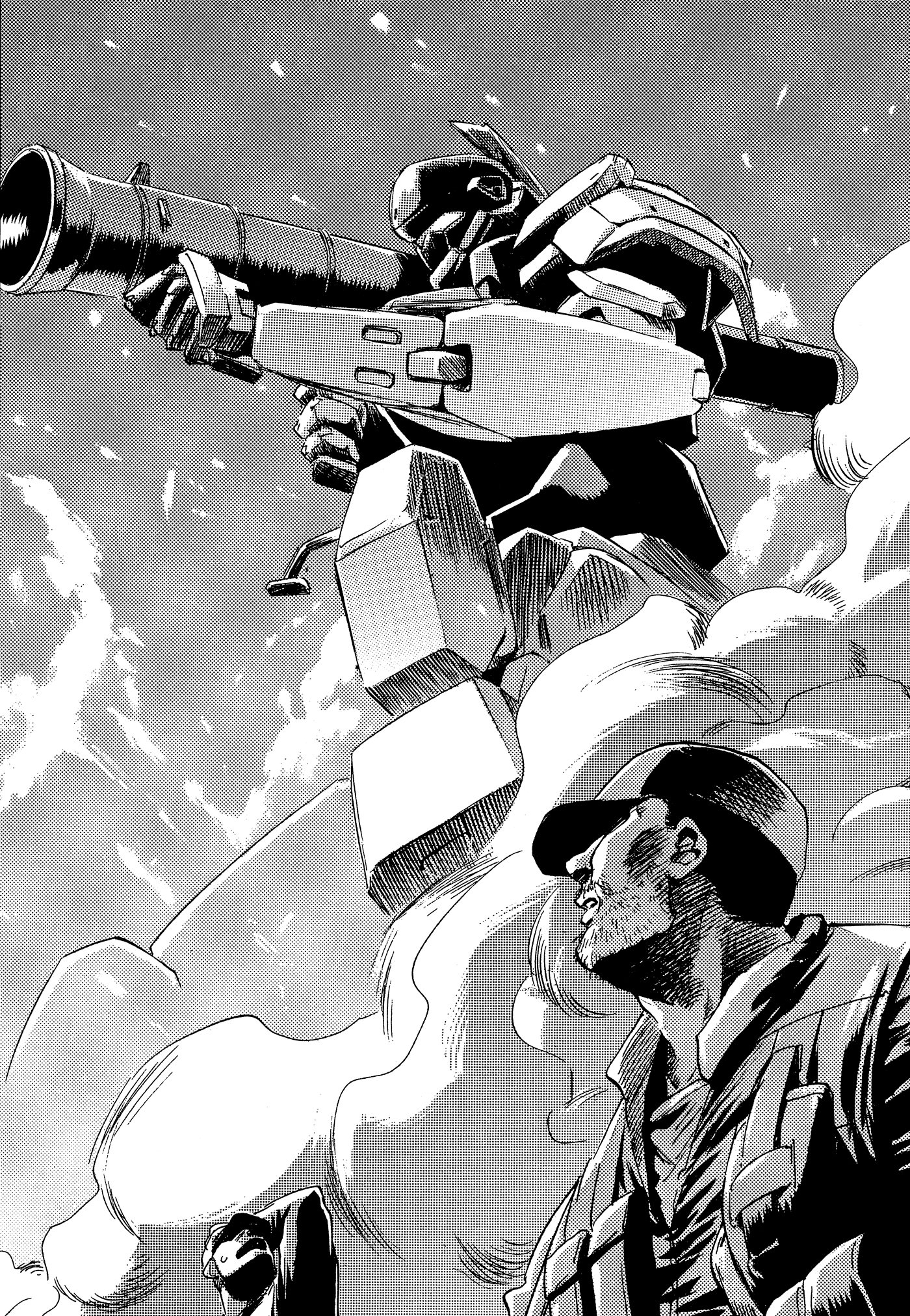
“This is Melissa Mao of the West Pacific Battle Group Tuatha de Danaan. But before we help you, there’s one thing I want to check: you guys got any beer on your base?”
“Up to the ceiling!” Estes told her.
“Stick it in the cooler!” Mao crowed. “Initiate combat!” With that, her M9 leaped over the camp and entered combat maneuvers. Heartened by her words, the other soldiers whooped with joy.
Behind them, Yang slumped over. “She gets all the good parts...” he muttered.
“Yang,” said Estes. “Are ASes our only support?”
“Yes. We have transport helicopters too, but they won’t offer much firepower.”
Estes quietly clicked his tongue. He was glad for the help, but the desert played against an AS’s strengths. They still had a hard fight ahead.
The battle is on, he observed, and the frequency of communications between his allies was increasing. Most of the units assigned to guard the base had already engaged the enemy.
“Uruz-2 here. We’re taking fire from tanks in the southwest. Returning fire now.”
“Uruz-6 here. I’ve taken down four. En route to Point Hotel.”
“Tiwaz-12 to all units. Reinforcements approaching 04-23. Six battle tanks and four IFVs en route to ‘Alamo’ from the north.”
“Uruz-1, roger. We’ll hold off the 04-23 enemy platoon. Uruz-2, how are you for ammo?”
“Uruz-2 here. Three javelins left. It’s about to get dicey.”
“Zeta-3 to Tuatha de Danaan. We’ll give you a little firepower support. Any requests where we send it?”
“Uruz-2 to Zeta-3. Forwarding coordinates now.”
“Roger, Uruz-2. You have a beautiful voice. If we live through this, I hope I can take you to dinner.”
“Better not, Zeta-3. She’s a real firecracker.”
“Nah, I’ll think about it. Ah! Two tanks down... But I’m trapped. The enemy shelling is too heavy, and if I’m not careful—”
Despite the severity of the situation, all of the voices were perfectly calm. This was how it always was: The greater the danger, the calmer they were, the less hesitation and shock they felt. They’re almost like me, he realized, like machines.
Al, the AI of the ARX-8 Laevatein, was listening in on their ally’s conversation carefully. Their electronics systems fed him far more information than their conversations did—locations of enemy and ally, movement speed, direction, condition, coordinates—all streaming in from radar, infrared, and optical sensors. This battle would be a purely two-dimensional affair. The theater was an endless span of desert, with dunes and rocks the only terrain.
The Laevatein remained on standby, squatting in the hangar of an invisibility ECS-enabled Pave Mare. It was maintaining its silence, sorting through the data sent to it by its allies. Its special machine interface, the TAROS, conveyed to Al its operator’s mental state: irritated. Sousuke didn’t seem to like hiding up here and watching the battle while his allies struggled. There was little chance that the psychological stress might drive him to make a careless mistake or to defy orders, but Al decided that it would be strategically beneficial to help him relax, so that he could reliably activate the lambda driver when the time came.
《Sergeant,》 he said.
“What?” The operator in the cockpit, Sagara Sousuke, responded. There was more strain in his voice than Al had expected.
《Shall I play some music?》
“No.”
《Right.》 That was the expected response. The chance that the operator would respond, ‘Sure thing, give me something with a beat,’ had been less than 0.1%. The offer was just a simple test of his communication functions. 《You seem rather tense, 》 Al observed. 《I was hoping to help.》
“Shut up, then,” Sousuke told him shortly. “That will help me plenty.”
《A fine joke.》
“It’s not a joke. Shut up.” Recently, Al had begun to interpret Sagara Sousuke’s ‘shut up’ as a kind of buffer phrase rather than a true demand.
《You’re worried about your allies? It’s a risky battle, but it’s important that we wait.》
A battle against tanks in a flat desert was the most disadvantageous situation possible for an arm slave. An AS might be packed to the gills with bleeding-edge tech, but it still couldn’t beat the armor and firepower of a tank. Its own armor couldn’t repel tank shells, and its standard armaments—assault rifles—couldn’t take them out in a fair fight.
Then there was its frontal projection area—in other words, the total area of the machine’s silhouette as seen from the front. Compared to a tank, which rolled along the ground, the bipedal AS was far easier to see and to target. The AS’s greatest asset—flexibility when moving through complex terrain—meant little in a desert, as well. In a head-on shootout with tanks, they’d be sitting ducks.
So their AS squadron’s plan was to run through the trenches of the allied base—codename ‘the Alamo’—while picking off their enemies one at a time. While using their limited stock of anti-tank missiles to its fullest, they would exploit smoke screens, radar jamming, and infrared jamming in order to move to other trenches. It was a simple strategy, but it was all they had.
《We are the ace in the hole,》 Al said. 《If we remain hidden even as the battle begins, we remain a ‘potential threat’ to the enemy, which will greatly limit their options.》
Amalgam had learned of the Laevatein’s incredible offensive capabilities from the battle in Mexico, and there was no way they’d leave an AS that could take out three Codarls and three Behemoths at large if they could help it. Sousuke and the Laevatein knew they would be their number one targets in every engagement where they appeared, which meant they couldn’t afford a prolonged head-on encounter. Once they sortied, their only choices were total shock and awe or immediate retreat.
This meant that the most effective role for the Laevatein to play was actually that of a lurking phantom: able to appear anywhere, at any time. Its mere absence from a given battlefield, hiding in an ECS-equipped helicopter, kept the enemy from freely distributing their forces. They’d be forced to keep more forces in reserve in every engagement, just in case the Laevatein appeared.
“I know,” Sousuke grumbled. “If the major is with them, a brute force offensive won’t work anyway.”
From his tone, Al could intuit to whom ‘the major’ likely referred. 《You believe Andrey Kalinin is in command?》
“I don’t know,” said Sousuke. “What do you think?”
《An objective analysis suggests not. He would choose more cautious attack routes.》
“And what does your incredible instinct say?”
《That’s a no as well.》 Just then, Al received information from Tiwaz-12 that a new enemy squadron had appeared. Fifteen tanks, four IFVs, two combat helicopters. There were no ASes, but it was the largest force they’d sent yet. They were approaching from ten kilometers southwest of the Alamo.
“Here they come,” Sousuke whispered.
These were clearly the reserve troops that the enemy had been keeping in store. The enemy commander had seen Sousuke’s allies fighting the good fight and, at last, decided to send them into the battle. From the various data he’d collected, Al determined this to be the last wave of enemies.
He completed a discussion with the other units on the datalink instantaneously: Uruz-2’s AI, Friday, and Uruz-1’s AI, Dragonfly, supported Al’s judgment, while Uruz-6’s AI, Yukari, offered support with conditions. He cleaned up the data and passed it on to each of the operators.
Melissa Mao was the first to respond. “Uruz-2 here. We don’t have anyone to spare to deal with the newcomers. Time to send out the ‘stopper.’”
“Uruz-1, roger. Did you hear that, Uruz-7? You’re up. Deploy to 07-18—”
“Hey, wait a minute!” Uruz-6, Kurz Weber, interrupted.
“What’s wrong, Uruz-6?”
“Can you check the hills around 09-18 first? It smells fishy to me.”
“Fishy how? Explain.”
“Hmm... don’t know how. I hope I’m wrong. Just watch out for snipers.” That was Kurz Weber’s one strange request.
“Uruz-7 here. I’ll destroy the southwest enemy forces,” Sousuke responded, and gave the coordinates to the pilot of the transport helicopter carrying his machine. The turboshaft engine roared louder as the invisible helicopter sped towards the enemy reinforcements and opened up its cargo hatch.
Speed: 163 knots. Altitude: 39 feet. Sandy terrain below. The scenery picked up by his optical sensors was cast in purple-tinted monochrome by the helicopter’s ECS field.
The helicopter flew low over the dunes. The landing point was approaching.
Countdown. Five, four, three, two...
He felt a jolt. The hydraulic bolts holding the machine in place released on Al’s signal, and the Laevatein plunged from the helicopter. The locks on his joints came free during the 2.3 seconds of freefall.
The fiber-optic gyroscope and artificial semicircular canal readings whirled tumultuously. Ground speed started at ten knots, then slowed dramatically. Speed vector anticipated. Attitude control engaged. Sousuke oriented the legs downward and set the shock absorber and artificial cartilage units to maximum extension, increasing the machine’s length by 928 millimeters. After selecting ground hardness and friction modifiers from the terrain library in the databank, he moved the machine into the ideal landing posture.
The landing came with a force of 30g, causing shock absorbent in each joint damper to vaporize. To keep from toppling, he engaged semi-active joint control via the motion manager and let the full-body muscle package contract organically. The ARX-8 Laevatein’s legs sank knee-deep into the sand, kicking up a dust cloud that dwarfed the machine’s own height.
Despite the harsh landing, Sousuke immediately entered combat maneuvers, hiding the lower half of his machine’s body in the swirling sand while turning to face the tank squadron approaching from ten o’clock. They seemed to have noticed the sand plume caused by his landing, and didn’t hesitate to start peppering him with shells.
Al chose their weapon. He readied the extremely high caliber cannon, the 165mm demolition gun mounted on his machine’s hardpoint, then used his support arm to attach the elongating muzzle. This “gun-howitzer mode” was designed to drastically increase the range and precision of the demolition gun, and the lambda driver even made it feasible for it to trade fire with a tank.
Despite this, the giant cannon itself was an extremely low-tech weapon. It had none of the independent ballistics computers of a cutting edge AS sniper cannon, and its targeting system’s sensors were basic optical ones.
Sousuke could see the enemy’s silhouette flickering in the distance across the white, burning desert. “Here we go,” he said.
《Roger, Sarge,》 said Al.
Sousuke took aim and fired. The lambda driver activated to throttle the recoil, but the Laevatein’s legs still dug deep into the sand as the machine’s frame creaked eerily. The high-caliber shell missed the tank it was aimed at, exploding a bit to the right and behind it instead. He’d known his first shot would miss; the helicopter above him now provided him with data to adjust the shot.
Adjust windage left 1.5 millimeters, elevation up 1.2 millimeters. He integrated the drift and arc of the fired shot and recalculated. While he was reloading, the enemy tanks returned fire.
Sousuke fired again. Shells peppered the area around the Laevatein, seven meters away at four o’clock and six meters away at nine o’clock. The shockwave pounded the Laevatein’s white armor from the side as the machine staggered and vibrated in a strange rhythm.
《It’s not safe. Adjust firing point.》
“No, I’ll meet them shot for shot.”
《Roger.》 Al didn’t argue.
There was less hesitation in Sousuke’s decisions now than there had been during his time in the ARX-7. Not that he’d exactly been hesitant then... but now, his decisions were backed by an unflinching will. A normal AI probably wouldn’t be able to pick up on such abstract notions, but Al could. He could read the mental state of his operator directly and adjust the machine’s systems to match it.
Of course, Al knew he wasn’t human. He remained conscious of his status as a glorified calculator designed for battle support. But... at the same time, he had begun to understand the complexities of human emotion on a deeper level.
He was also gaining an element of self-identity. A few days ago, on a whim, Kurz Weber and some of the maintenance crew had suggested changing Al’s voice to that of a woman, insisting that it would make him more likable. Al strongly rejected the idea. He had no logical reason to object; it simply felt wrong to him. Sousuke backed him up by simply saying, “It’s creepy,” and Al agreed. In other words, his voice—a mere synthetic element of his human interaction interface—would feel wrong if it was changed to something else.
Besides, Al thought, a woman’s voice hardly feels appropriate for a strategic support veteran like myself. It’s practically an insult, in fact.
Smoke trailed from a shot fired four kilometers away. The enemy’s aim was growing more accurate—Al issued a warning as the 120mm shell bore down on the Laevatein, and the TAROS reacted immediately. The operator’s instinctive—but well controlled—defensive instincts activated the mechanism, and the air in front of it warped. The invisible power stopped both enemy shells in midair, pulverized them, and then sent the fragments flying easily.
《Success, 》 Al reported. 《Activation of lambda driver—》
“I know,” Sousuke said shortly, and then pulled the trigger again. This time, his shot hit. The enemy tank at the center of the line was blown off its treads, and went spinning through the air like a papier-mâché replica.
Reload, fire: a second tank went flying. Slight change of position. Enemy shot incoming. Sousuke blocked that one, then fired the demolition gun again.
The gun’s muzzle flared as he took out a third, a fourth, and a fifth. The tanks burst into pieces one after another. No ordinary AS could accomplish such a thing. Having apparently realized they were outmatched, the enemy platoon began to withdraw, firing checking shots as they went. Eventually they vanished behind the ridgeline of the dunes.
“Gebo-5 here. Enemy squad retreating to the northwest.”
“Uruz-2, roger. You guys hear that? We’re almost out of this!”
With their reserves having taken such serious losses, the enemy gave up on taking the Alamo. The forces from all directions began to withdraw, following the lead of the Laevatein’s opponents. Al analyzed the tactical map and checked the condition of their machine, adjusting the output of the capacitor and cooling units appropriately.
They’d navigated the gauntlet. They were going to win this.
Data came in from his machine’s sensors, sent from allied units’ ADMs. All available information showed potential threats dropping. But just then, he detected something in a rocky area four kilometers away. Sagara Sousuke reacted before Al did, and threw the Laevatein to the ground.
The bullet came in from an unexpected angle, moving about a thousand meters per second. It broke through their lambda driver force field, but Sousuke had dodged it in such a way that it only grazed their left shoulder armor before kicking up a sand plume in the ground forty meters beyond.
The sniper shot had been aimed for their lambda driver generator. If Sousuke had moved just a millisecond later, it might have hit the Laevatein in the center mass, snapping it in half.
《Distance 40, ten o’clock. Lambda driver-mounted machine—》 Al reported.
“Returning fire,” said Sousuke. The enemy machine was out of sight range, but he fired at it anyway, over and over, weaving together randomized maneuvers. His allied machines’ AIs, pulling information from Al via datalink, turned their ECS counter-sensors on the rocks in full force, and located the enemy immediately.
The Laevatein continued to fire based on their data, and at least one shot must have landed in the right ballpark, because an allied machine with a lambda driver detector reported an impact between force fields. The shot probably hadn’t dealt any damage, though it would have been fatal to an ordinary machine.
The enemy machine made its judgment call quickly, turning its ECS up to full before beating a high-speed retreat. Further attacks on it would be pointless; it was too dangerous for the normal ASes or helicopters to pursue, and too far away for the Laevatein. The other allied units and operators must have reached the same conclusion, because they focused instead on watching for new enemy arrivals.
“I knew it,” Kurz Weber whispered over the radio. “Didn’t I tell you? I could smell it in the air.”
“Yeah,” Sagara Sousuke responded. “I couldn’t have dodged that without you.” It was Kurz Weber’s vague warning that had allowed him to react before Al could. He’d been keeping a fragment of his attention focused on 09-18, as directed... and indeed, the enemy sniper had appeared.
Kurz was something of a clown, and frequently said things that made no sense whatsoever. Telling his nonsense pronouncements apart from his important strategic advice—the ability to interpret instinct and gut feelings reliably—was beyond the capabilities of Al, who was still highly reliant on Bayesian statistics. Though maybe it was beyond most humans, as well...
“The question is why the enemy held its fire until then,” said Belfangan Clouseau. “If he’d wanted to, he could have blown away at least one of our machines at the start...” The LD-mounted enemy AS had had more than half the battlefield in its firing range. Yet it had remained hidden and silent, even as its allied tank squadrons were being ripped apart.
“That’s an easy one. It’s because of the Laevatein, right?” Melissa Mao offered.
Even if it might have taken out a few M9s at the start, doing so would have revealed its location, making it vulnerable to the as-yet-unrevealed Laevatein. So, it had been forced to lie in wait, ECS activated, until the Laevatein appeared. It would normally have been able to finish it off in one shot then, but Sousuke had dodged... which meant it had lost its one chance to shoot down the Laevatein. That was why they’d withdrawn immediately. In other words, the Laevatein Reserve Plan had worked just as designed.
《All enemy squadrons have withdrawn,》 Al announced after having analyzed data from all units.
“Great,” said Sousuke. “Master Mode 6. Monitor area with ECCS.”
《As I’ve told you, 》 Al retorted, 《we don’t have one.》
“That’s right,” sighed Sousuke. “I forgot what a hunk of junk this thing was.” The Laevatein’s single-minded focus on generator output, agility, and attack power meant they’d had to omit all of the electronic warfare systems that came standard in M9-style ASes. Sousuke hated it.
《You’re a hunk of junk, too, 》 Al muttered. 《I heard you have dietary limitations due to your injuries.》
“I was told to reduce my alcohol and salt intake,” Sousuke said. “None of which really bothers me.”
《I see. I’ve heard the saying that ‘humans who do not drink are missing out on life.’》
“I don’t want that kind of life,” Sousuke insisted. “Now stop nitpicking.”
《I’m merely trying to give as good as I get.》
“Shut up.”
《Negative,》 Al replied stubbornly. 《I will now explain the thirty-eight reasons why this machine is not a hunk of junk. First, it integrates the experimental cutting-edge generator, the PRX—》
“Fine!” Sousuke exploded. “Just shut up!”
The Mithril squadron had withdrawn from the desert base within a few hours. They’d piled as much equipment and weapons as they could hold into ECS-enabled transports, and then disappeared off into the south or the west. All they’d left behind were cleaned-out containers, obsolete documents, and lots of empty beer bottles.
Gazing at the scene through the night vision sensors of his AS, the Eligore, Wilhelm Kaspar clicked his tongue. They were investigating a barracks for a platoon’s worth of soldiers and the remains of their armored vehicles, but they hadn’t found anything worthwhile. To the contrary...
An explosion rang out; one of the soldiers had carelessly touched an attache case on the ground and triggered a bomb trap. The soldiers nearby hit the deck, then looked around warily as the blast died down.
“Calm down. They left us a little gift, that’s all,” Kaspar said to them with an internal groan. Most Amalgam forces were recruited on-site. There was no guarantee of quality, which meant there was no way to keep them from falling for this kind of elementary trick.
The enemy was already thousands of kilometers away.
The commander of the clean-up squad, a bribed local official, shouted back at him, “This wasn’t the deal!” He was getting paid quite handsomely, but his forces had taken serious losses from Mithril’s unexpected resistance... and when they had finally taken the base, they’d found it stripped bare, with nothing to seize for profit. His dissatisfaction was only natural.
Still, there was something Kaspar had wanted to check before negotiations began. He moved his machine to a sand dune a few hundred meters away, opened his cockpit hatch, and disembarked with practiced movements. Perched atop the complicated red armor of the shoulders, he looked around the area with his naked eye. The blazing heat of noon was still present, despite the weak wind blowing past, and the afterglow in the western sky had turned a dusty purple.
He removed his headgear and narrowed his eyes. Kaspar had a square Aryan jaw and short blond hair darkened in places by a life spent outdoors. His age was hard to determine; he could have been in his 30s as easily as his 50s. There was a joviality in the light turn of the corner of his mouth, despite the hunter’s glint in his blue eyes as they pierced the dark.
After surveying the area with a sniper’s eye, Wilhelm Kaspar dropped from the kneeling machine to the ground and carefully investigated the traces left behind by the enemy AS: the footsteps and hollow left in the sand by an M9 lying in a sniper’s posture. Tracing back the trail of shell casings buried here and there, he could estimate where the M9 that had been here had shot from, and how it had moved.
“My, my...” Kaspar whispered, calling to mind the face of the sniper he imagined to be the M9’s operator. He had hardly moved with each shot taken, prioritizing effective, swift, and rapid fire—in other words, on eliminating as many enemies as possible. He let the distance between himself and his enemy be his sole defense, suggesting overconfidence in his sniper instincts.
“Ah, that child,” Kaspar sighed. “He has a long way to go.” Then again, he was probably also the one who had warned the white lambda driver-mounted AS about Wilhelm’s position. He could give him credit for that one; thanks to him, it had been able to dodge what should have been a killing shot. Even a bullet that flew at 4300 kilometers per hour would take three seconds to fly four kilometers. An anticipated shot could be dodged easily enough.
Just then, Kaspar received a transmission via satellite. He put his ear to the headgear and acknowledged the call.
“Did you succeed, Mr. Tin?” the voice asked. It was the Amalgam executive Mr. Kalium, AKA Andrey Kalinin. He was a Russian who’d organized several of their missions at the direction of the currently convalescing Leonard Testarossa.
“No,” Kaspar admitted. “I tried to take him out with my first shot, but he dodged it. That student of yours is very impressive.”
“Do you think so?” Kalinin mused. “I wondered if it was because of your student, instead.”
“Of course, there’s that, too.” Kaspar laughed.
“Weber was a fine sniper.”
“Past tense? He’s still alive.”
“It’ll be past tense eventually,” Kalinin said with no particular emotion.
There was movement in the abandoned base: the voices of soldiers complaining about the losses they’d suffered for no real profit; the officers whispering to each other and pointing to his Eligore. Perhaps they intended to take his machine as “compensation.”
“Hold on. Wait just a minute,” Kaspar said, and climbed up the back of the machine. He opened the weapons rack underneath the cockpit hatch and retrieved a .30-caliber rifle wrapped in thick cotton cloth. It was an old-fashioned bolt action hunting rifle, smelling of oil, its wooden frame darkened in places by years of use. It seemed almost out of place in such a high-tech machine.
He didn’t even have to adjust the scope. Two hundred meters was nothing. Kaspar pressed a cartridge into the chamber, slid the bolt forward, twisted it smoothly and locked it in. He aimed, then fired.
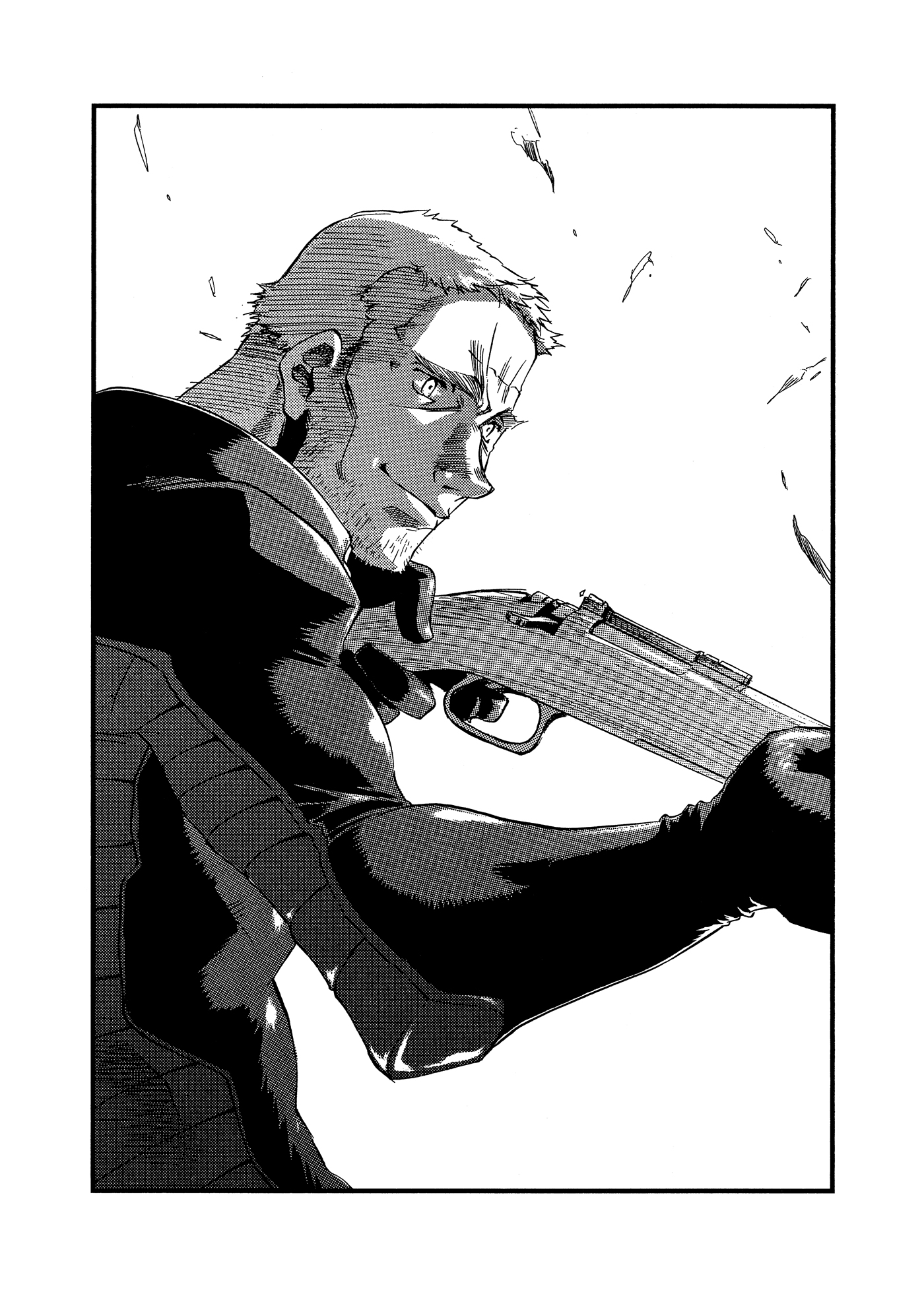
Two hundred meters away, the commander giving the order to attack Kaspar suddenly doubled over, hands to his crotch, with a truly undignified scream. The subordinates around him backed off, looking around wildly.
“Better not try it. The next one will take the other ball!” Kaspar said over the Eligore’s external speaker. Some ran to treat the commander, some just stood there dumbstruck, some ran off to take shelter—but none of them tried to fight back.
“Problems?” asked the radio voice.
“No, just had to tighten the reins on these fools,” Kaspar responded, then quietly wrapped the smoking gun back in its protective cloth. “Anyway, there’s nothing for us here. Returning now.”
Kaspar slid into the cockpit and ran his machine to the transport helicopter rendezvous point. He’d failed to take out his priority target, the Laevatein, and Amalgam’s primary opponent had escaped. There was no reason to remain here now. The plan was in motion, and they didn’t have an eternity to deal with Mithril. Nor his old student, now clearly on the enemy side...
No, they would surely face each other someday. And after they’d both enjoyed the thrill of the mutual hunt, he would bestow upon his former protege a magnificent death.
●
Her life in captivity had grown harder than before.
After Niquelo, Chidori Kaname had been moved around between various sites. She’d spent two weeks at a farm somewhere in Texas before being taken to Switzerland, where she’d spent a week at an old mountain lodge. These accommodations were all much shabbier than the mansion at Niquelo. She didn’t get much to eat, either—just canned goods and MREs.
After that, they moved her around once every few days. Belgium, Denmark, northern Italy; through Turkey to Libya, where she spent a week in a cheap hotel. The mode of transportation was mostly cars and helicopters, and she was exhausted from the long hours of travel. Sleeping in the same lousy beds, eating the same lousy food, she felt herself wasting away.
She stayed a month and a half in Europe, Central Asia, and North Africa, then returned to North America. There she spent a week in a luxury hotel in Las Vegas. She hadn’t been allowed out of her room, but the chance to sleep in a proper bed, eat decent food, and take a shower whenever she wanted was a real comfort to her.
After that, though, she’d been abruptly flown to Sri Lanka. There, her condition had grown much worse, and she’d collapsed. Going from an air-conditioned neo-Gothic hotel to a tropical terrorist training camp where electric fans were a luxury... It was like they were intentionally throwing her into even more extreme conditions, just as she was beginning to relax. She’d caught a fever there, and it wasn’t going down. In that camp deep in the jungle, on a folding bed in the best of bad huts, she slept and slept.
This was the worst location yet. The heat was bad; the humidity was worse. An awful smell hung over the camp, leaking into the hut where Kaname lay trapped. It was like the sickly odor of trash, cheap booze, and vomit mixed together with the harsh stinging scents of exhaust and oil.
Morning and night, she heard gunshots and explosions, departing helicopter and AS engine noises, and the rough shouting of male voices. There was no peace to be found.
And then there were the bugs. They came in from the floor, from the windows... all kinds of bugs crawling on the walls, flying around the light bulbs. And they were big, twice as big or larger than those she’d known in Japan, fluttering and crawling and making scary noises around her head.
At one point, a centipede at least half a meter long crawled into her clothing. She wanted to cry and scream, but she resisted the urge. It was a matter of pride; she didn’t want to give them the pleasure of seeing her weakness. She refused to be known as the kind of spoiled brat who cried and screamed at the sight of a few bugs.
They’re trying to wear me down, Kaname thought. She was sure of that now. She didn’t know exactly why, but it was likely that they couldn’t abuse her outright. Instead, they were tightening the thumbscrews, little by little. Spartan bedding, unappetizing food, unhygienic rooms... they were all real trials to a girl who was accustomed to civilization. Shuttling her from one awful environment to another, they wanted to wear away at her slowly. Anyone’s will could be chipped away in time. The hotel in Las Vegas had been part of the scheme to break her.
Leonard was apparently alive, but he hadn’t shown himself since then. She didn’t know if he was the one who had ordered this treatment of her or not. That Polish girl, Sabina Rechnio, was always with Kaname, but all she would tell her about Leonard’s status was that he was alive.
Kaname had also met Kalinin a few times. Once at the ranch in Texas, once at a small airport in Belgium, once at the hotel in Vegas... but she wasn’t able to have a substantial conversation during any of these encounters. He seemed less to be coming for a visit and more checking on the status of a prisoner. He’d walk up to her, study her face, make sure there was no sign of excessive thinness in her arms or neck, or any bruises or burn marks. Kaname didn’t try to question or berate him, either. She knew that nothing she could say to him mattered now.
The fever brought her bad dreams.
One morning, she went to school like always, and then a silver AS destroyed the school building. Her classmate’s bodies were piled high in the courtyard, burning. She tried to look away, but she couldn’t. Tears poured from her eyes as she saw the blackened and burnt body of Tokiwa Kyoko.
One morning, she woke up in a mansion. Men she didn’t recognize were standing in her room, grinning and looking down at her. She tried to leap up and run away, but she couldn’t. The men grabbed her and held her down and stripped her, and their hands became the legs of a centipede. Help me, Sousuke! she screamed, but he didn’t come. He’s dead, the centipede cackled as it crawled its way around her body.
One morning, she was in middle school. So many indifferent eyes, so many sticky thin smiles... Her textbook was missing again. Her open notebook echoed with jeers. Die. You stink. Piss off. She felt nauseous and ran to the toilet, where filthy water rained down on her from above the stall. The girl who’d done it laughed at her, then walked off hand-in-hand with Sousuke. Unforgivable. He’s mine, she cried and raged. You should die. You should all die!
Countless awful mornings like that assaulted her.
“Ugh...” Suddenly, the light burned her eyes, and Kaname let out a groan. Sunlight was streaming through the window onto her cheek where she lay. Her sheets, her clothing and her hair were drenched, pasted to her skin.
What time is it? she wondered groggily. Probably noon, or just before... But she wasn’t sure how many days she had spent passed out in this camp. Her fever at last seemed to have gone down.
Kaname tried to get out of bed, but lost her balance and collapsed again. As she grabbed the nearby desk, she ended up knocking an empty mug onto the floor. Someone must have heard the noise, because she immediately heard the sound of the door unlocking.
Sabina Rechnio entered. She wasn’t wearing her suit, of course, but a plain black T-shirt with olive pants, and she wasn’t sweating despite the heat. “You appear to be awake,” Sabina said. “You were tossing and turning quite a lot.”
“Can I have... water?” Kaname croaked.
“Later. I’ve come to take your temperature.”
“I’m parched.”
Ignoring Kaname’s words, Sabina took a digital thermometer from the bag on the table and put it in her ear. As she got a reading, Kaname thought that the pleasant electronic beep felt out of place in this primitive hut.
“Hey...” she tried again. “Can I have water?”
“It’s gone down.” Sabina showed her the digital reading on the thermometer. It read 37.30.
“I guess I should’ve realized it earlier,” Kaname muttered. “You really hate me, huh, Sabina?”
“What exactly do you expect me to say to that?” the other woman asked indifferently, poured some water into the still-dirty cup, and handed it to Kaname.
“Fine, I get it.” Kaname said, drinking down the cloudy water inside. It didn’t taste cold, or even tepid; it didn’t taste like anything at all. “Did Leonard order you to do this?”
“What do you mean?” Sabina asked.
“Shutting me into all these places to deplete my stamina,” Kaname clarified.
“There are many people who want you,” Sabina said simply, without answering her question. “If we want to ensure your safety, we can’t let you stay long in comfortable locations. This camp is much safer than the hotel in Las Vegas.”
“I see.”
“That’s the only reason. You’ll just have to get used to it.”
“Yeah, but Leonard sure is inconsiderate,” Kaname mused. “If he’s feeling better, he should really come to visit.”
“Do you want to see him?” Sabina asked.
“No. I mean, he should come to visit you.”
Sabina’s breathing stopped for a moment.
“You like him, right?” Kaname inquired.
“I don’t understand.”
“It would annoy me if I were in your shoes...” said Kaname. “Having the man I love order me to look after the very person who shot him. And then on top of that, he won’t even come to see you? Well, I’d sure want to take it out on me, at least...”
“You seem to be under a misapprehension.” Sabina’s voice was very quiet. “Leonard-sama only recovered very recently. I wasn’t able to receive instructions from him before then. There’s been no change in my orders now, so I’ve simply been caring for you as I did in the past.”
“I see. A loyal little doggy, aren’t you?” Kaname asked, now in a challenging tone. Her fogged brain was churning at full speed, trying to figure out how to make Sabina angry. “Boy, Leonard’s a real jerk, isn’t he? He’s got a girlfriend who would do all this for him, but all he cares about is me. And then I go and put a bullet in his brain. He deserved it, I gotta say.” She knew it was an awful sentiment, but she also knew that guilt would get her nowhere. She had to be as nasty as possible for Sabina to rise to the provocation. “Ah, I get it. Is that why he won’t show himself? He’s not sure how to explain himself to you? He’s embarrassed about how stupid he looks—”
Suddenly, the glass Sabina was holding broke; she’d shattered it with her grip. With the fragments of the glass in one hand, she used the other to grab Kaname’s throat and throw her forcefully down to the bed.
“I won’t let anyone speak about him that way,” Sabina hissed as blood dripped from the glass onto Kaname’s face. “Especially not you, Chidori Kaname. He chose you, yet you refused him. You tried to kill him. Such arrogance alone is worthy of death, and yet you scorn him and mock him on top of all else. It cannot be forgiven. No matter what he thinks, I will make you pay.”
Kaname couldn’t even argue. Sabina wasn’t much larger than her, but she was incredibly strong. It was like a pro wrestler was sitting astride her.
“I grew up in Lodz, a town like a garbage dump,” Sabina continued. “The first person I killed was a policeman into S&M whose name I didn’t know. The next was my mother, who’d sold me to him. From that day on, my job became ‘killer.’ I was taken in by the Warsaw mafia and I killed many people for them. I never expected anyone to treat me as human, but he found me and took me in. He is the one who can wipe all debts clean. There’s something about him that makes me believe that,” Sabina insisted. “I don’t care if he loves me. All that matters is that I make myself useful to him.”
Kaname didn’t speak. She couldn’t.
“Do you know how many male guards I’ve thought about siccing on you?” Sabina asked. “I know that it would break a sheltered little girl like you. But I didn’t, because that’s not what he wanted. That you can only see his attitude as ‘creepy’ is proof that you’re a hopeless fool—an incorrigible, arrogant woman. I won’t let it continue. I’ll make you pay,” Sabina promised, and held up one of the glass fragments. An expression of pure joy lit up her pale face, and her eyes locked onto Kaname’s throat. These were the eyes of a killer, the eyes of someone well used to this work, ready to finish their opponent in one stroke. Inhuman eyes. “Nothing else matters now but killing you.”
“Don’t—”
“It’s all your fault,” snarled Sabina, and then the glass pierced into Kaname’s throat. It dug in hard, sharp, cold, and deep, opening a hole in her windpipe. Instead of screams, wordless pants of breath came out as warm fluid flowed into her mouth.
Sabina dug into the wound, pulled out, then stabbed again. But apparently she wasn’t satisfied with the throat alone; she cut into Kaname’s face, too. She struck her cheeks as they twisted in despair, tore off her nose, slit her mouth, crushed her eyes... destroyed everything that made her recognizable as Chidori Kaname. Kaname’s arms and legs convulsed and her fingers grabbed at the blood-soaked sheets. She was now a lump of flesh breathing foam.
Sabina was laughing at her, and her cackles of glee blended together with the taunts of the centipede and the laughter of middle school students. Sabina, sitting astride her, transformed into another girl. A girl with long black hair, face enraptured and stained with blood spray. It was Kaname herself.
“Let’s trade places,” Chidori Kaname whispered to the lump of flesh that was once Chidori Kaname, drawing her face close. “Why don’t you let me out already?”
Kaname screamed and sprang up from the bed. She was in the Sri Lankan camp, in that spartan hut, where sunlight now streamed in through the window. Her breathing was ragged, and her head felt heavy. Sweat and humidity drenched her underwear.
The room’s one door opened and Sabina Rechnio came in. She was wearing a black tank top and olive-colored pants. She wasn’t sweating, even in this heat. “You appear to be awake,” she observed. “You were tossing and turning quite a lot.”
“Can I have... water?” Kaname croaked.
“Later. I’ve come to take your temperature.”
“I’m parched.”
Sabina took out a digital thermometer and put it in Kaname’s ear. There was a familiar beeping sound.
“Hey... Can I have...”
“It’s gone down,” Sabina observed. The digital reading was 37.30, the same as in her dream.
Kaname felt a chill up her spine. “Sabina,” she said.
“Yes?”
“Do you know a place called Lodz?”
Sabina was pouring water into the dirty cup. She stopped. “That’s the city where I used to live.”
“I see.”
“How did you know?”
“I don’t know,” Kaname admitted. She snatched the cup away from Sabina and gulped the water down.
●
With the roar of a turboprop engine, the C-130 transport landed on Rakan Island. On the kilometer-long strip of flat sand lay a runway made of layered sheet metal. It wasn’t long enough for takeoff, so they would have to employ disposable rocket boosters when it was time to leave.
Sousuke had been up working since the break of dawn, but the afternoon gave him his first break in a while.
Rakan Island was isolated and tucked away on the edge of the Caribbean. The amphibious assault submarine, Tuatha de Danaan, was currently using it as its resupply point in the Atlantic, as well as a provisional base. Of course, it had no dock upon which to moor a large submarine, so the de Danaan remained on standby two kilometers from the beach, with the hatch of its flight deck open to take in supplies from transport helicopters.
This was Sousuke’s first chance to go fishing in a year; the last had been the time he’d spent with Chidori Kaname on Merida Island. That had been a mere thirty minutes—yet a wonderful thirty minutes. He tried hard not to dwell on the fact that she wasn’t here now. Brooding would just wear him down.
Under the blue sky, he stuck the large reel pole into the ground and waited for a fish that would probably never come while paging leisurely through Jane’s Fighting Ships. He’d borrowed the fishing pole from Private Falkowski in the infantry unit. He was sure they were making preparations to leave the island within the hour, but enduring the background roar of transport planes on the makeshift runway was a tolerable tradeoff for an indulgence like this one.
“Well, no one expected this to be a beach in Guam, after all,” Melissa Mao said from where she lay next to Sousuke. “But still, a chance to sunbathe at all feels like progress, huh?” She was in a bathing suit, stretched out on a mat that had been spread out on the beach. Beside her were technical officer Nora Lemming, Tessa’s secretary Jacqueline Villain, and communications officer Sachi Shinohara, who were all similarly sunning themselves. They were all wearing bikinis made from urban camouflage patterned cloth, and every movement caused their suntan oil-soaked skin to sparkle as beads of sweat rolled down their curves.
They’d had to leave Merida Island without much in the way of clothing, and they probably hadn’t had time to buy swimsuits, so apparently they’d used their spare time on the boat to make some out of extra urban camo fabric. It seemed as though the thought that they might get to wear them someday had helped keep them motivated through those uncertain early days.
There were relatively few female officers in the Tuatha de Danaan battle group. Among them had formed a kind of solidarity that transcended rank, and the escape from Merida Island had only strengthened that bond. Learning about the pilot killed in action in Tokyo, Eva Santos, had probably helped.
“I see. It has been a long time,” Lemming said, while fixing the lay of the bikini around her ample bust.
“See? Aren’t you glad I made them?” replied Villain, putting the straw of her sports drink to her crimson lips.
“I’d... have preferred a less bold design, myself. Ahaha...” Shinohara laughed nervously.
Shinohara was Japanese, like Sousuke. She typically wore minimal makeup and black-rimmed glasses, but today she appeared to be following the lead of Mao and the others, fashion-wise. He’d heard she was a college graduate who’d spent some years in the JASDF before joining Mithril, which meant she was probably in her late twenties... even though by appearance, she could easily have been the same age as Sousuke. On top of her youthful looks, Shinohara was a sergeant, the lowest rank of them all, and she had a shy demeanor. The result was that, even though she was probably the oldest of all of them, she was frequently treated as a little sister by Mao and the others, especially when Tessa wasn’t around.
Shinohara’s behavior got a laugh out of Mao and the others. “What are you talking about? We never get chances like this.”
“You don’t want to die before you get a tan, do you?”
“Yeah, you have to enjoy it while you can... hah. Look at the gazes on those louts!”
The soldiers working to load up the transport plane were whistling and clapping at them from afar.
“I don’t like them looking!” Shinohara wailed.
I don’t care how you dress, but why do you need to sunbathe next to me? Sousuke thought privately, and let out a small sigh.
No, he could surely guess the reason... There were three beaches on the island large enough to really stretch out on, and all of them were being taken up by the men. Some were goofing off while sunbathing or eating, and others did target practice to maintain their skill. Sousuke had left the men’s group and found a place to enjoy some solitary fishing for the first time in forever (he’d only recently realized what an indulgence solitude was), when Mao and the others had forced their way into his private party. They didn’t mind the gazes, they’d said, but having the men actually hitting on them constantly was a pain.
“Be grateful you get an eyeful like this,” they told him. This had been accompanied by, “You already have a girl, so we’re not worried.” Ever since the conversation between him and Chidori Kaname in Niquelo had made the rounds, the girls in the squad seemed to have become a lot more relaxed around Sousuke. In fact, they seemed even more likely to talk about (what sounded like) romantic entanglements in his presence.
For instance, a rather lengthy example...
“So, how are things with Bruiser lately?”
“Pretty good,” said Lemming. “He’s nice.”
“Wow, I figured he was the wild type.”
“He’s not! Though we’re not really there yet... Of course, he’s still a maintenance guy... heh heh.”
“Ohh!”
“Are you saying he’s good with his hands?! Nora-san!”
“I guess. We don’t get a lot of time together,” Lemming admitted. “He mainly hits on me a lot when we’re working on Al.”
“Oh, is that it?”
“What about Weber-kun, then? I hear snipers have soft hands. And he’s musical.”
“You know what they say about men who play the guitar...”
“That’s an urban legend.”
“Cut out the dirty jokes,” Mao scoffed. “Sousuke’s right here. Anyway, why are you asking me about Kurz?”
“Huh? You’re not hooking up?”
“Of course not! Don’t be stupid.”
“Oh, I see...”
“Could’ve fooled me.”
“Hey! Wait a minute, are people saying that about us?!” Mao demanded.
“No, I just had my suspicions.”
“Me, too. He’s very handsome. I think you’d make a good couple.”
“Oh, please! Give me a break!”
“Just kidding, sorry. I know it wouldn’t work.”
“Then knock it off.”
“Sorry! Ahaha.”
“He’s more like a little brother, honestly,” said Mao. “There’s no way...”
“Aw... So what about the captain?”
“Which captain?”
“Stupid. You know which captain. Ben!”
“Oh, Ben... Well, he’s my superior,” Mao pointed out, “so it’s not really possible right now...”
“Well, he doesn’t seem like the ‘smooth operator’ type.”
“Yeah, he hasn’t made the slightest offer.”
“I see.”
“Aww... But he’s pretty attractive. He’s got that whole stoic thing down. He’s like a samurai.”
“Oh-ho. Is that what you’re into, Sachi?”
“Should we set you guys up?”
“Ohh! P-Please do! But oh... I couldn’t.”
“Pick one! You Japanese people, I swear...”
“But, but...”
That was about how it went. At this point, Sousuke didn’t even care who was saying what about whom. He was never going to tell anyone about what he’d heard, and he couldn’t even understand most of it. But Sousuke did understand one thing: They treat me like a statue of Jizo... like I’m not even here. He wouldn’t have given that a second thought before, but he was starting to get a vague realization of what an empty feeling that was.
Meanwhile, Mao adjusted her sunglasses and said, “By the way, where are Emilia and Yvette?”
“They couldn’t get away from work. They’ll probably miss this, poor things,” Lemming replied.
Sousuke recalled that Emilia was a communications officer from the control room, and Yvette was an engineer in the engine room. They’d probably wanted to take part in the sunbathing, but were so busy loading up the aircraft that they couldn’t slip away.
“I guess she couldn’t make it, either.”
“Who?”
“The colonel.”
“Oh, Tessa?” Mao whispered and fell silent. “She probably did have a lot to organize. It’s understandable that she couldn’t get away.”
“I guess that makes sense...”
“I even made a swimsuit for her...”
“I’m sure she’ll get another chance.”
The talk of Tessa seemed to bring a pall over the otherwise cheerful proceedings. They probably knew how hard things had been for her.
“You think she’s all right?” Shinohara asked.
“Hmm... Well, she insists she is.”
“Hasn’t she lost weight?” Lemming asked.
“Yeah. I guess it’s... like...” Mao paused, then shrugged.
“What is it?”
“Nothing. She says she’s fine. She’s just a little tired, like we all are.”
Lemming and the others probably didn’t realize it, but Sousuke picked up on the slight change in Mao’s tone in that moment. He recognized it as being that of a team leader in battle, telling her subordinates that reinforcements were on the way, whether or not they really were. Mao was close to Tessa outside of work, so she’d probably been able to tell that something was weighing on her mind... Something the others couldn’t pick up on.
Sousuke hadn’t had a real conversation with Tessa since Mexico. He’d filled her in about the battle in Tokyo and his days in Namsac, as well as everything that had led him up to his reunion with them... but that conversation had taken place in the presence of Mardukas, Mao, Kurz, and Clouseau.
Due to their close personal relationship, Sousuke knew how vulnerable Tessa could be, and it was easy to imagine the burden on her shoulders right now. Mithril had been driven to the brink of destruction, but most of her battle group had survived, and now they were trying to bring the team back together.
When Sousuke had first been assigned to the Tuatha de Danaan battle group, Tessa hadn’t yet earned the trust of her subordinates. But in the two years since, she’d made herself indispensable, not just militarily, but psychologically. She was brilliant, charismatic, and a terrific leader. Most of the officers simply assumed she was exceptional, and never gave her another thought beyond that.
But Teletha Testarossa was by no means superhuman. Staking the entire group’s fate on the wits of a mere seventeen-year-old girl... how could that lead to anything but disaster? Those who knew her well—those few subordinates who had seen her laughter and her tears—couldn’t talk about it with the others. She wouldn’t want that.
It was at this time that the siren in the base began to ring, blaring over the beach from makeshift speakers in the tent erected at the center of the resupply area hundreds of meters away. Two short and one long, the signal to “withdraw completely ASAP.”
They didn’t know the specifics, but something must be approaching Rakan Island, probably a Pave Mare or a Super Harrier patrolling the area. The base personnel would stop their work and board the Tuatha de Danaan, which would do an emergency dive and disappear. The aircraft would take off, leaving the remaining supplies to be blown up or burned. They hated to lose the provisions, but it would be dangerous to let the enemy discover what they’d left and get an idea of what the de Danaan did and didn’t have. The soldiers in the distance—those relaxing on the beach, bored from target practice—quickly began preparations to withdraw.
“Vacation’s over, I guess.”
“A thirty-minute vacation. I wonder when we’ll get our next one...”
Mao and the others sulked as they put parkas and T-shirts on over their swimsuits and began cleaning up their provisions. Sousuke also cleaned up his fishing instruments. He quickly reeled in his line to find a lump of some kind of unrecognizable seaweed on the hook.
“Depth, 650. Speed, twenty-five knots. No pursuing ships within twenty miles,” XO Richard Mardukas relayed to Tessa.
She ran her eyes over the information on the front screen, checked the accuracy of her XO’s report, and told her sonar technicians which directions to watch out for. After receiving a few reports from the officer of the deck, she decided they were safe and let out a sigh of relief. “Set alert level to yellow three. Lift sound restrictions as well.”
“Aye, ma’am. Alert level, yellow three. Lift sound restrictions,” Mardukas repeated, and the OOD relayed the instruction shipwide.
It had been five hours since they’d detected the enemy approach, left Rakan Island and disappeared into the deep sea. Right now, in the hangar deck, the ground forces—who, up til now, had been holding their breath—began quickly sorting through their new supplies.
“Well within expectations,” Mardukas said.
“Indeed,” Tessa replied. “But it felt so fast...”
She’d known from the start that the enemy would eventually find and attack their Rakan Island base. They’d been forced to leave some supplies there, but most of what really mattered had made its way onto the de Danaan. Matters of crew morale aside, they could now remain at sea for up to four more months. As long as it could dive, the de Danaan would remain the world’s most powerful vessel. Only those in its control room knew where it was, where it was going, and where it might next appear.
Even so, something seemed off about the speed at which the enemy had been able to find and approach Rakan Island. It was just a little too fast... not in a way that Tessa could quantify in numbers, but in a way that she felt in her gut.
“You don’t think it’s just a sign of the enemy’s desperation?” Mardukas questioned.
“No,” said Tessa. “In Western Sahara, too, we just barely made it in time. Remember?”
“That’s true. In that case...” Mardukas didn’t say anything more, but Tessa knew exactly what he was thinking: something was afoot in Amalgam’s organizational structure. She’d considered it from several angles, and that was the most likely explanation she could think of; Amalgam’s movements had simultaneously become more efficient and more active.
This meant more strain on Tessa and the others to stay one step ahead, but it wasn’t all bad. It was also proof that something had changed in Amalgam’s decision-making structure. The organization that was once so sluggish was now nimble and quick to attack; did that mean they were shifting to more of a pyramidal hierarchy? No... probably nothing that radical, but something like it, perhaps? Though even if they were, Tessa had no idea who was at the top...
It was as if she had seen the smallest hint of a flaw in a towering giant. She still didn’t know exactly where that flaw, that weakness was... The Achilles tendon, the crotch, the heart? And did they need silver bullets to damage it? That much remained a mystery.
The battle ahead would still be painful and hard, but Tessa had noticed something in the enemy’s movements that she felt she could sink her teeth into. It was just the slightest tug on the fishing line in the water, but...
“It’s a good sign,” she decided, recrossing her porcelain knees in the captain’s chair. The enemy was coming into the ring with them. They couldn’t hope to compete punch for punch, but they might be able to deliver a hard sock to the nose. But in order to do that, they’d have to move on to the next step.
“Goddard-san, you have the bridge,” she announced. “Mardukas, come with me.”
“Yes, Captain.”
Having left command to the officer of the deck, Tessa got out of the captain’s chair. She began thinking about all the various preparations she had to do for what came next, but just as she was about to leave the control room, the communications officer stopped her.
“Captain, wait.”
“What is it?” she asked.
“A telegram. From Lemon in the DGSE.”
The encrypted message, taken in by the autonomous turtle craft that remained just below the surface to receive communications, showed itself on the console monitor. The communications officer bent over a little bit and waited for Tessa to read it.
The content of the telegram was very short. 《Yamsk-11 located. 60° 8’ 10.66”N 153° 5’20.60”E / File ed 1258-09-02》
So, it paid off, Tessa thought, almost exactly as I expected. And they managed it sooner than expected, as well. Michel Lemon was in Moscow with a comrade, on a dangerous infiltration mission to learn something she needed to know. They should be making preparations to withdraw around now, and reaching Hungary en route to Western Europe by tomorrow.
“Good,” she said shortly. “Now delete it.”
“Yes, ma’am.”
Having confirmed the message’s subsequent deletion, Tessa left the control room.
In the eight months since the battle at Merida Island, Tessa and the others had more or less gotten things back under control. The former Merida Island staff had secured new supply routes and income sources, and also rebuilt their information network. Hunter, Wraith, and other intelligence division members were gathering information across the world, while men like Estes had dispersed, bringing their allies back into the fold, and rapidly expanding their forces.
The top-class executives—operations division head Admiral Borda, intelligence division head General Amit, and research division head Dr. Panerose, as well as Lord Mallory—were still unaccounted for. Any one of them could be dead, or simply laying low.
According to Hunter, General Amit had moved most of the intelligence division functions elsewhere before the attack, so they were probably still out there, under the radar, collecting information. Nobody could contact them, and they couldn’t be sure they were even still friendly towards Mithril. The general had forbidden Hunter to act, yet he’d gone against orders to help Tessa and the others, as had Wraith, bringing the scattered research division members together and spearheading the effort to build the Laevatein.
They’d initially undergone the construction in secret, and Tessa had heard the design was scrapped multiple times. They were on the verge of giving up completely when they’d decided to incorporate the secretly retrieved Arbalest core unit. With the help of the recovered Whispered, Mira, and the AI, Al (who was part of said core unit), they’d managed to get it done.
The Laevatein was a powerful lambda driver-mounted machine, but it was also a makeshift prototype based on recycled parts; not at all the balanced all-rounder machine aimed for in the original plans. There was a story that long ago, when Lockheed’s engineers were designing the stealth fighter prototype, Have Blue, they mainly recycled existing parts. Sachs and the rest of the maintenance team had named the Laevatein “Have Red” after that legend.
They wanted to improve their other equipment in addition to the Laevatein, but unfortunately, their budget was limited. Just the money for supply restocks and personnel living expenses had to be paid for by selling off equipment, dummy corporations, and other distributed assets. Over two thousand personnel were working to put Mithril back together, and they were dealing small but real blows to Amalgam over time. The Tuatha de Danaan was like a mobile headquarters coordinating it all. This meant that in practice, the effort’s commander in chief was its captain, Tessa.
More than a few of her subordinates seemed to be concerned about this. It was natural for them to worry about a girl of her age having that much responsibility placed on her shoulders. But given the situation, Tessa was the only one who could take command. Mardukas was an incredible officer, and he had the intelligence to do the job as well as Tessa did, but he lacked her charisma. He knew as well as anyone that he was perceived as being fussy and bossy. And the fact was that aside from him, there just wasn’t anyone else capable of leading Mithril.
Tessa often wished Kalinin were there. He was more cut out to be an aide than a true leader, but his presence would significantly reduce the burden on herself and her subordinates.
Andrey Kalinin... Learning that he had joined Amalgam had been a terrible psychological blow. He was a mercenary, and it wasn’t unusual for mercenaries to switch sides to whichever was stronger or paid better. It made sense from that angle, but then... he had been so important to them in the past. He was a man of few words, and he rarely offered his personal thoughts or opinions, but everyone assumed that his most fundamental drivers were loyalty and pride.
Why would he join the enemy, then? It was hard to believe that anyone except Kalinin could have prepared the spare supplies for the de Danaan that they’d used upon escaping from Merida Island. That would suggest he had chosen to join the enemy only after the battle on Merida Island. Had he changed his mind after being taken prisoner? Thinking back now, he had shown a rare sense of hesitation during that battle... as if he’d known it would happen—or that someone had told him it would.
Or had Kalinin been brainwashed? Did they have a loved one of his held hostage? Was it possible he’d been in cahoots with Amalgam even before he had joined Mithril? Or was there some more complicated reason at play? The only thing Tessa knew for sure was that Amalgam had acquired a terribly powerful ally in Kalinin...
But, wait, maybe not... Maybe it wasn’t Amalgam that Kalinin had joined, but her brother. That might explain it then. Could the reason he was helping her brother be—
“Captain?” Sachs’s voice snapped Tessa out of her thoughts. “That’s my report. Is it sufficient?” He and the ten others gathered in the briefing room were all looking dubiously at Tessa. They were in the middle of one of their regular meetings, and maintenance chief Ed “Bruiser” Sachs was explaining about the state of the resupply.
Tessa nodded as if she’d been listening the whole time. “Yes. Anything else?”
“The M9s are in trouble,” Sachs told her. “That includes the Falke and the other two E-types. The spare parts are easy to track, so we’re having a hard time setting up secure routes to get them. The result is they haven’t had a proper overhaul in over six months. Normally all three would need thorough testing in a dedicated facility, but we’ve just been doing patch-up jobs, and that’s starting to show its limits.”
Currently, the only ASes they had available were the black Falke, two E-types, and the Laevatein. The Laevatein was a comparatively new addition to their forces, so it hadn’t lost much in the way of parts, but the remaining three machines were seriously depleted from the extreme conditions they’d been dealing with.
“How long will they hold out?” she asked next.
“Three battles, tops. After that, anything could happen. The palladium reactor could shut down in combat, the frame could snap, the joints could lock up... You name it, it’s a possibility. If we break one up for spare parts, it could extend the life of the others, but—”
“Hold on. We can’t afford to lose any more machines,” Mao said. “Three machines plus one lets us more or less run operations we used to do with six or more, but if we lose another, that’s all out the window.”
“But all three will break down at this rate,” Sachs argued back.
“Yeah, but—”
“That’s all right,” Tessa said confidently. “I think I can find a new route for securing supplies before that third battle comes. Keep things up as they are for now.” In truth, she had no idea how to secure new M9 parts, but it was a waste of time to get everyone worried about something that was so out of their control. Estes or Hunter might eventually deliver them good news, but failing that, the de Danaan’s battle power was going to end up sharply reduced.
But either way... I think things should be resolved within three battles. Tessa truly felt there would be no need to send the M9s out a fourth or fifth time. If the battle dragged out any longer, they were most likely doomed anyway.
“So, where’s our next operation?” Kurz asked. “We’ve gathered up almost all the allies we parted ways with previously. We’ve managed to resupply for now, and the information network is back in place. But we still don’t know where Leonard is, or even if he’s still alive. We need to know what he knows if we want to crush Amalgam, right?”
“We have no information on Leonard Testarossa’s current status,” said Tessa, “but I believe he’s alive.”
“Instinct?”
“Yes.” It wasn’t much to go on, but she was his twin sister. Since she was also a fellow Whispered, nobody was about to argue with her. The more experienced the soldier, the more they respected the power of instinct.
“Well, Kaname did say he might be dead,” Kurz replied. “Let’s assume he’s alive.”
“Still, we have no idea where he is,” Clouseau said. “Our information is still hazy. It would be difficult to mount an effective attack at present.”
“That’s true,” Tessa agreed. “I’ve had Al and Dana debating about the virus question for a while, but they haven’t reached a conclusion.”
“First I’ve heard of it. They debate?” Sachs said.
“In their spare time, yes. But it wasn’t any use. Al’s questions are too difficult for Dana to keep up.”
“I thought Dana was the more powerful AI?”
“She is.”
“And Al is terrible at chess,” Sachs mused. “I put him up against Friday, Mao’s M9’s AI, and he lost nine out of ten.”
Tessa hadn’t heard this before, but the thought made her shoulders shake with laughter. It fit perfectly into what she knew. “I see. Al is quite an AI.”
“Why? He sucks.”
“He’s not using tactics that would result in equal matches,” she explained. “He’s playing the way we do. And yet, he still managed to win once.”
“‘The way we do’?” Sachs furrowed his brow, and the previously silent Mardukas spoke.
“Instinct: chess players, mathematicians, tacticians... when facing a difficult problem, their first task is to form an image of the final result in their mind, then work the logic backwards from there. The thought of ‘how I want to win’ comes first, like a vision of the future. In simple games, a von Neumann-based computer will have the advantage, but reality is far more complicated.”
“Hm...”
“We can discuss the definition of intelligence another time. For now, let’s talk about next moves,” Tessa said, snapping the file case on her knees shut decisively. “I’ve noticed a slight change in Amalgam’s activities. Their decision-making has grown swifter, which is visible in how decisively they act. At the same time, they seem distracted as well... I think our guerrilla operations are having an effect.”
“You think they’re panicking? That’s good news.”
“Yes. But I don’t think we’re the only reason.”
“What do you mean?”
“Leonard. Or possibly Kalinin-san... What if one of them has taken on a leadership role in the organization?” Tessa questioned. “We’ve destroyed several of Amalgam’s bases in the past, and seen some signs of internal discord. If that’s the case, could there be a power struggle in play? It seems worth considering.”
“Sounds like there are still some secrets to root out,” Clouseau said, showing a rare pessimism.
“Regarding that, I’ve received some information thanks to Lemon-san, and I’m going to investigate it two days from now.”
Mardukas furrowed his brow at Tessa’s words. “Investigate? Personally?”
“Yes,” she said. “It’s a place that would be difficult for anyone but me to investigate. I expect it to be dangerous, so I’ll want an escort. It’s quite far away.”
“Where is it?”
“The Far East. A ruin in the Soviet Union.”
The de Danaan was currently in the Atlantic. If she wanted to take ASes for support, it would be quite a long journey. They couldn’t take them all, either—two, at most.
“Let’s see... I’d like Weber-san and Sagara-san to be my escort,” Tessa decided. “In the meantime, Clouseau-san, you gather information about the matter in the Ukraine and begin laying groundwork. Melissa, work with Courtney to take out the enemy base in South America. I know he can be difficult, but please try.”
“Sure, sure,” Mao mumbled.
“What was that?”
“Yes, Commander!”
“Better. Now, you have your assignments,” Tessa told them. “I don’t want to see any mistakes. Dismissed.”
The morning after the meeting with Tessa and the others, Melissa Mao realized her terrible mistake. It was clear to her the minute she woke up. Compared to this mistake, friendly fire on an allied machine, stepping on your infantry escort, or leaking classified information over an open channel would have been preferable.
Mao was in a small officer’s quarters, a room she’d been assigned now that she was serving as vice commander to the ground forces and had to do more paperwork. Private rooms were an extravagance when you were living on a submarine.
In that small bed, in that small room... Kurz was lying naked next to her, snoozing blissfully, without a care in the world. He let out a long, weak sound, halfway between a sigh and a groan.
She checked again. It was inevitable that she didn’t have a stitch on, either. Mao hadn’t been in a drunken stupor or anything, so she remembered the night before clearly. It’s just, when she woke up, she wished it had been a dream.

Yes, she remembered...
Last night, she had been going over the paperwork for their resupply when Kurz came by with some documents for her to sign. While he was there, he’d asked her for advice about some members of the PRT. Kurz often gave special attention to the less experienced PRT members. One thing led to another, and it became a long conversation.
Someone brought up alcohol, so she took some Perrier out of her fridge. Then her hand slipped, and she’d dropped it on the floor. That was her big mistake: If only she hadn’t dropped the Perrier on the floor, this never would have happened.
After cleaning up the spilled beverage, they drank some ginger ale, and talked about how tired they were of this life, and how they wished they could have a little adventure on a resort somewhere. When the word ‘adventure’ came up, Kurz reacted with his usual arm-around-the-shoulders. “In that case, Sis, why don’t we enjoy a little hot-and-heavy adventure right now? You know...”
She’d shoved him off as usual, but the room was so small, and the floor was wet—yes, the Perrier again—so she’d slipped and started to fall. Kurz reached out to catch her, but they just ended up on the floor together.
Mao seemed to have bumped her head on the wall when she fell, and felt a little dizzy. It was only for two or three seconds, but when she opened her eyes, his face was all she could see. In a serious voice, he’d said, “Hey, sorry. Are you okay?”
And then, for some reason, she’d started crying. No, she wasn’t really crying... but she’d wanted to cry. Her thoughts were swimming. What am I doing in this submarine? Why’s he so worried about me? Maybe it was all the stress of being shut up in a steel box, after the loss of Merida Island, coming to a head. Mao felt crushingly alone, and wanted the worried man in front of her to dote on her. He was stunned for a minute, but they looked at each other for a few seconds, and then...
Oh, right... She was the one who’d kissed him.
She just felt so... you know... Pathetic. Miserable. Court martial-worthy. It was such a cliché; she couldn’t possibly tell Nora and the others, out of pure embarrassment.
But if the other girls found out, their eyes would glitter in curiosity, and they’d surely ask her, “So, how was it?”
Well, you know... It was kind of... Okay, let’s be real. It was incredible! Mao never would have imagined they’d be so compatible. She’d completely lost her mind. Her body was aching all over. In fact, while she was pretty sure the room was soundproofed, she was forced to wonder how thoroughly it was done...
Those were the thoughts about last night that swirled through her mind as she turned first red, and then pale. It was then that Kurz let out a moan and began to wake up. She knew it was pointless at this phase, but Mao instinctively covered her chest with a sheet.
“Ughn... mm... Mm?” Kurz looked up at her. His gaze was blank for a moment, but then he cringed as she had, covering his head with his hands. “Ahhhhhhh... Not good...”
Mao was shocked by his reaction... and on top of that, she was shocked that she was shocked. “Wh-What kind of attitude is that?” she asked.
Then Kurz peeked out at her from under the sheet, and grinned. “Just kidding. I wanted to tease you a little.” Then he put an arm around Mao’s shoulders and kissed her softly on the cheek. He used his free hand to gently trace around the nape of her neck.
“Huh? Hey... wait... stupid!”
“C’mon, I gotta tease you a little,” he informed her.
“Hey, you! Cut it... ah...”
“You were adorable, Melissa.”
“Mm... hey, stop it!” she protested. “Hey... knock it off already!” Learning from her mistake last night, Mao held tight to the edge of the bed to steady herself and kicked Kurz off with all her might.
“Wugh... what was that all about?!”
“Don’t get full of yourself. And don’t look at me.” She hiked the dropped sheets back up to her armpits and threw a pillow at Kurz’s face.
“Huh? What’s this all about? Last night, you were so—”
“That was then! This is now! Don’t act like we’re sweethearts over one time!”
“It was three times, actually,” Kurz grumbled.
“Don’t keep count! Besides, that’s not the point,” she added. “And don’t call me Melissa.”
“But you told me to!”
“Did not!”
“Did so! And you said it in the sweetest little voice...” Mao threw a mug at his face, and he tumbled off the bed.
“Ah... what will I do?” she moaned. “What’s wrong with me? When did I get so soft?”
“Hmm... I guess you have gotten pretty soft...” Kurz said, and then cackled.
“Wait... did you arrange this?”
“Oh, come on,” he scoffed. “Even I’m not that good.”
“But you were nicer than normal last night...” Mao observed suspiciously.
“I was just worried about you. I didn’t expect us to end up like this either... well...” Kurz sounded serious, and went silent for a moment, thinking. “Hmm. Well, I guess I can’t say it wasn’t on my mind...”
“Why, you...!” Mao snatched the pillow away from Kurz and slapped him with it as hard as she could. Apparently once wasn’t enough, because she found herself hitting him with it again and again.
“Hey, cut it out already,” he pleaded. “Ahaha... That tickles! C’mon...”
“How are you so calm about this? It’s infuriating!”
“Come on, don’t sweat it so much. Everything’s fine.” As Mao stomped him, kicked him, and wrung his neck, Kurz just kept smiling affably. At last she got tired and gave up, and while she was panting on the bed, he peered carefully into her face.
“Well, you’re looking better,” he said.
“Huh?”
“You feel better, right? You must be, if you’re acting this way.”
Kurz was right. That depression that had been hovering over her through yesterday was gone. The feeling she couldn’t shake off, even sunbathing on the beach—that another, gloomier version of her was gazing over her shoulder with hollow eyes—had vanished like early morning mist. To think that one night could leave her feeling so refreshed... Mao was disgusted by how basic she felt.
No... That usually was all it took, wasn’t it? One good meal, a single night of passion... Such things were enough to solve most human problems.
I wish Tessa could feel this too, she found herself thinking. If only she had someone like this... Sousuke would be the best choice, but unfortunately, he was devoted to Kaname. His single-mindedness was usually one of his more charming aspects, but it could also be annoying. It didn’t have to be anything so complicated and serious...
Noticing Kurz’s expectant gaze on her, she said, curtly, “Well, maybe I do feel better. The exit is that way.”
“Hey, c’mon!” he protested. “You don’t have to kick me out.”
“I told you it was just one night. I have a reputation to think about, you know? So, forget this ever happened. If you tell anyone, I kill you.”
This time, Kurz let out a genuine sigh and slumped over. “This is, like... a real blow to my ego. Good grief...”
“What?” she replied, stunned.
“Oh, um... Um... The way you’ve been acting. I guess it could’ve been anyone, huh? I really enjoyed it, but... Yeah, I get it.” Kurz stood up weakly and began to slowly put on his pants.
“Well... I... I didn’t mean it could’ve been anyone...” Mao said, floundering.
“Really? But it sounds like you didn’t enjoy it?”
“I didn’t say that, either.”
Kurz stole a glance at her. “Then it was good?”
“Well... er... That’s not the point!” Mao declared. “I’m worried about e-everyone finding out what happened...” As she fiddled with the edge of her sheet, Kurz leaned forward suddenly, and stole a kiss. A long kiss. It was a simple kiss, but heavy and sweet.
“Mm...”
“You can be awful cute sometimes,” he told her.
“Darn it... Did you even hear what I said?”
“It’s okay. I won’t tell anyone, and I’ll pretend nothing’s changed,” Kurz said. “So no worries.”
“Promise, okay? I really can’t have it getting out.”
Kurz cast a glance at the clock on the desk. “Shift starts at eight, right? Which means we’ve got an hour.”
Mao hesitated. “What are you trying to say?”
“One more time?”
“Stupid.”
“Is that a no?”
She thought for a second and then whispered into his ear, “Just once, okay?”
It ended up being twice. They just barely made it to their work shift on time.