Chapter 1 — A Train Station Floating on Horizon Blue
Chapter 1 — A Train Station Floating on Horizon Blue
1
Four days had gone by since I found that truck.
I still hadn’t seen anything that could be called a landmark, and I’d probably have been reduced to tears if I hadn’t stocked up from the truck. My optimism about the situation was dwindling at the same rate as the food and fuel I had left.
On top of being lost, I had to deal with the Kettle not doing too well. You could say it was breaking down, and not knowing what was wrong with it made me all the more nervous.
If it just stopped running that would be one thing, but given the pressure from the steam, I was terrified the engine might explode out of nowhere. Each time I put my hand on the throttle, I could feel a nervous sweat start up.
Suddenly, the back tires slid out and the vehicle started to shake. I hurriedly pushed at the throttle and sped up, stopping the shuddering just as quickly as it had started. A moment passed.
“I’m gonna be in trouble soon.”
I could do with finding somewhere to take a load off sooner rather than later, what with the nerves. Straining my eyes at the horizon, I fancied I could see something on the edge of the plains. But, no, the landscape was as undisturbed as ever. The tension in my back started to wear on me. I was sick of keeping up such rigid focus when the same tranquil scenery just stretched on forever.
Kicking my shoes off and crossing my legs, I fished out my phone. I tapped at the screen, starting up some familiar western music. I’d have downloaded loads more music if I’d known this was going to happen, I thought idly.
I’d only started driving after arriving in this world, and so for me driving was free time. After all, the only thing I had to do was keep a hand on the wheel. The monotonous sights, the flat road, and the soft English lyrics had me zoning out before too long.
And so I wasn’t quite sure if I was dreaming or not when I saw it. My vision was wavering like when you see a mirage in the desert. It was only when the waves of sleepiness and wakefulness rolling over me surged their furthest toward the latter that I came to and suddenly understood that it was real.
I could see a train station.
There was a long building—a train station—standing on a huge pool of water. The water, which tightly encircled the station, reflected the blue and white of the sky. Two rails extended from the station, one to the left and another to the right. A single black train sat halfway out of it.
I rushed to pick up the map from the passenger seat and unfurled it. There was only one train station on it, so this was probably the one.
A weight suddenly dropped from my shoulders. You may as well call it relief. It was the first time I’d realized how heavily not knowing where I was had been weighing on me.
A train station. That’s where I was—a train station. That knowledge alone lifted my spirits more than I’d have thought possible.
My drowsiness having vanished in an instant, I opened up the throttle. The Kettle said nothing, but I could feel its speed rising as I urged it toward the train station.
Finally, I reached the water. Apparently a depression in the ground had formed the pool, and the water covered roughly a third of the tires. The steering wheel instantly grew heavier.
Ripples spread across the water’s surface as the Kettle progressed. The reflection of the sky warped as I cut through the water and closed in on the station. I parked up by the entrance and finally got a look at the building up close.
The station had a white facade, but it had been heavily worn by the wind and rain. Even so, the building looked completely normal if you ignored the tired exterior. It almost felt like people might come pouring out at any moment. The station building stood at a slight elevation, which must have been how the interior had stayed dry, and a set of stairs seemed to rise from the water up to the entrance.
I shut off the fuel valve and pushed the door open, only to see the sky spread out beneath my feet. I took my socks off and stuffed them inside my shoes before rolling the cuffs of my pants up. When I put my feet into the water, I noticed it was pleasantly chilly.
After opening the rear door, I hauled my backpack onto my back. Shoes in hand, I sloshed through the water toward the stairs. I climbed up a step, and then another, before sitting down on the highest step and taking a towel from my backpack to dry my feet. Replacing my socks and shoes, I stood up and faced the entrance again.
Blue shadows filled the interior, and sunlight streaming in from the windows along the walls dappled these shadows with spots of light. There were benches, and a counter with what looked like a ticket window, but no signs of people. Only the colorful posters and notices on the walls, along with the timetables, gave any hint of the station having ever been active.
The air in the shadowed areas was cold, making the hairs on my arms rise up. Each time I walked through the sunlight, though, the light warmed me up and made me want to close my eyes in pleasure.
The premises weren’t that large. I passed the ticket window and walked out into a corridor, then through some sort of ticket barrier into an area shining with yellow light, which seemed to be the platform. Orange metal pillars held up the roof, interspersed with back-to-back dark gray benches. I could see the vivid greenery of the plains beyond the platform, and the mounds of white sand that almost swallowed up the green. The parked train loomed before me. And...
Sparkling silver threads swayed through the air.
I came to a stop.
There were holes through the thin roof, letting the late spring sunlight form pools in scattered places across the platform. A girl stood in one of them. Each tiny movement she made sent the sunlight scattering from her silver hair. She wore a blue dress—the lighter shade stood out against the sky—that bared her pale shoulders and legs.
The girl was facing the train, and a three-legged easel held a sketchbook level in front of her. She was painting—the brush in her hand moved ceaselessly over the paper as she worked. The scene captivated me so much that it took me a moment to process it. The gentle, dappled light set the girl in stark relief against the shadows around her. It was like looking at some kind of idyllic artwork.
Suddenly, the girl lifted her head.
Just as I thought she might be surveying the sights, she turned casually toward me and I saw her eyes widen. They were a deeper blue than the sky reflected in the water outside. I guess you’d call them azure.
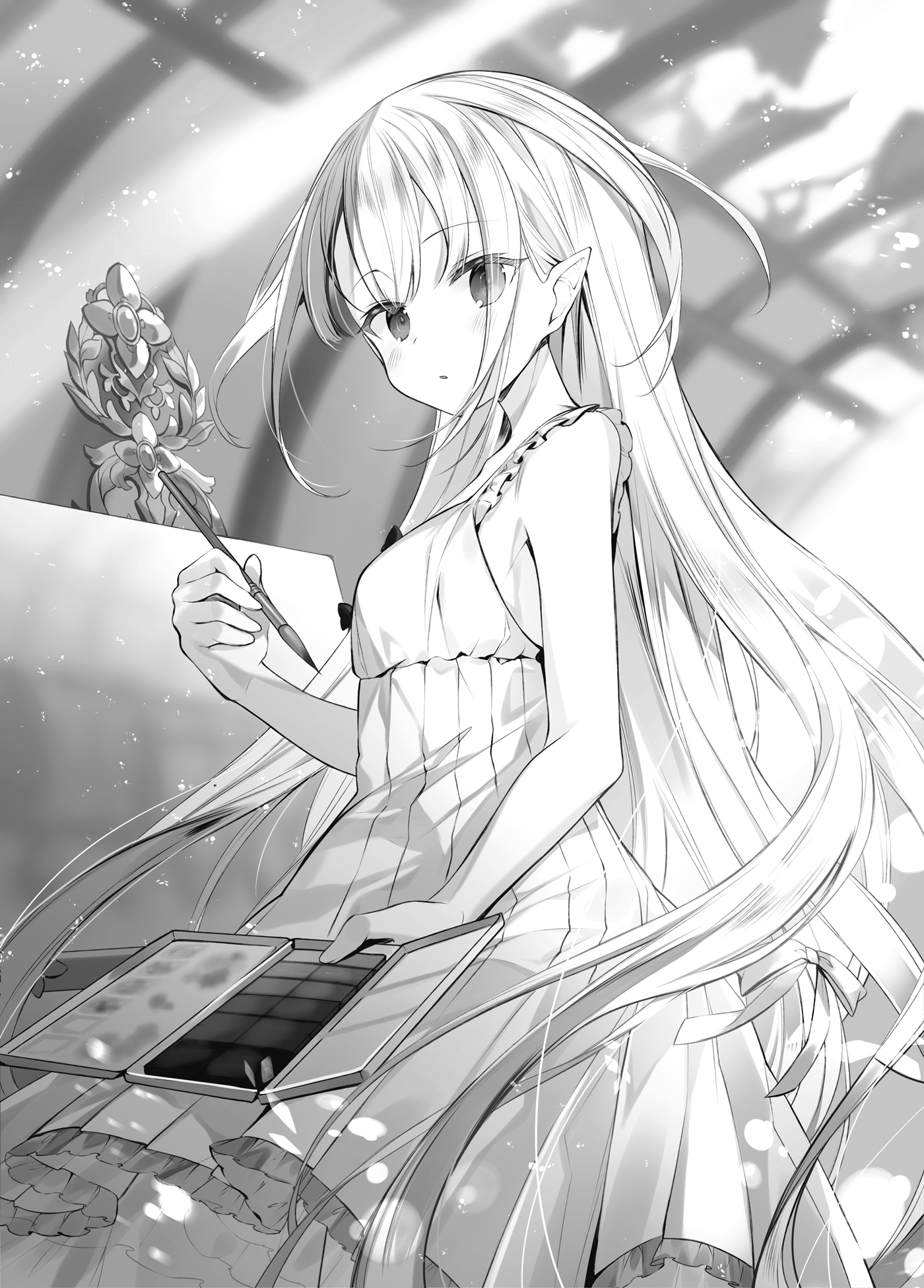
Time stood still as we stared at each other. Neither of us knew what to say. After all, this world had barely any inhabitants, so you didn’t expect to run into anyone.
Well, I’d noticed her first, so I decided I should speak up first as well.
“Hi there.”
I hadn’t greeted anyone in quite a while. It felt like I was using a different part of my throat than when I talked to myself, and I sounded clumsy and hoarse. I cleared my throat to try to play it off.
“Hello...there,” she replied after a short pause.
A breeze would have easily drowned her out, and she sounded as hoarse as I had. She covered her mouth and let out an uncertain mewl that reminded me of a cat.
We were too far apart to talk properly, so I moved toward her. The air grew pleasantly warm as I stepped out into the open. I stopped about three meters short of her, held back by the suspicion in her eyes.
“I’m not a weirdo. Well, I guess I just sound more like one if I describe myself like that,” I started, saying something I’d never before thought I would. “I’ve been driving for ages and came across the station and decided to take a break, and then you were here.”
The deluge of words leaving my mouth just sounded like excuses. Apparently, I’d forgotten how to hold a conversation.
“I...see,” she said after another pause.
Damn, she’s totally on guard. I get that, but I don’t have a clue what to do about it.
Then I thought about things more calmly and realized it seriously looked like I was some pickup artist. Also, given the state of the world, it was even harder to say she shouldn’t be on guard. I’d called out to her impulsively because I was desperate for human contact, but I should have given it more forethought.
I scratched at my cheek, at a loss. Of course, nothing useful came to mind. I could have asked if she was painting, but it didn’t look like she wanted to chat.
“Um, well, sorry to interrupt,” I offered with a strained smile before turning on my heel.
I might not have intended it like that, but looking at it objectively, I’d just failed my first pickup attempt.
A quiet call came from behind me and I jumped in surprise. When I turned around, the girl had a hand over her own mouth like it had taken her by surprise as well. Our eyes met, and her gaze wavered. Sensing her hesitation, I waited in silence, but...
“No, it was nothing,” she said to her feet before turning back to her easel.
I wasn’t dense enough to miss that she was ending our conversation, so I returned to the cool shade.
There was nothing else in the station really worth talking about. There was a little room for the staff behind one of the windows, but it was an utter shambles. I wondered how many people had kept the station running as the end of the world became apparent. The world ending would obviously mean more people wanting to board a train to somewhere else, but I doubted it’d make more people want to organize those trains.
The setting sun gleamed on the water’s surface as I returned to the entrance and walked outside.
Guess she’ll be there for a while, I mused with a glance back toward the building.
I was tired of it all—just sitting in the seat constantly, holding onto the wheel and driving through featureless plains—so I wanted to camp here. The girl had been here first though, and she was wary of me, so maybe I shouldn’t.
Ah well, I decided, I’ll shift away from the station and camp out of the damp.
My shoes and socks needed taking off again, and once I’d done that and rolled my pants legs up, I headed down the stairs barefoot. The chill of the water enveloped my toes as I stepped into it. When I reached the Kettle, I opened the driver’s door and threw my shoes and bag inside, then dried my feet off before settling into the seat. I reached for the throttle and realized...
“Huh...”
The needle on the dial that showed the boiler pressure had dropped all the way down. When I went inside, I’d left the boiler warm. I always did that so I could get going again immediately, until I parked wherever I was camping for the night.
That’s weird, I thought, an ominous chill running up my back.
I glanced over the other dials next to it. The fuel pressure gauge showed it was ready to go, lit and everything. I wound the fuel valve around again. That should have opened up the pipe between the fuel tank and the boiler, turning the water into steam. However long I waited, though, I couldn’t hear the water start bubbling. The needle on the pressure gauge shuddered a bit, but nothing more.
Back around the other way the valve went before I turned off the burner. Then I just collapsed across the steering wheel. The blood drained from my face as I pressed hard against my temples. I just lay there, my head spinning.
I’d expected this, I told myself. There had been signs the car was breaking down. If anything, I was glad I’d made it this far considering how little I’d done to keep it running.
Biting my lip, I opened the door. This time I just jumped down into the water with no fanfare. The legs of my pants got soaked, but I didn’t pay that any mind.
I walked around to the front and opened the hood, gazing upon the Kettle’s heart. The steam pistons that drove the wheels resided here, along with the boiler that made the steam itself. I checked everything over from front to back. Then I did it thrice more. There was nothing to see though—nothing as obvious as a crack in one of the pipes or leaking oil, at least.
I gave up, closed the hood, and went back to the driver’s seat.
Through the start-up process again I went: Ignition lit, setting the mana stones in the fuel tank alight and making the fuel pressure rise. No problems with the water level in the boiler. Prayers in my heart, I slowly opened the fuel valve.
I counted the time on my watch. The hand went around. Once, twice, thrice...
The needle on the boiler’s pressure gauge rested on its stop, utterly motionless. I closed the valve and extinguished the fuel.
Today was done for; the question was if there would be a tomorrow. There was an abandoned station in front of me, and a flooded hollow around me. Other than that, nothing.
2
I had a cylindrical stove among my things, small enough that I could carry it in one hand. Long use had dulled its original color—probably gold—and the metal surrounding the cup-like burner at its center had been scorched a bluish-black. I’d inherited it in this condition, and I couldn’t even guess how long it’d been in use. This stove—they’d called it a Svea camping stove—was dead simple, which meant that it was rugged. They always used to say that Svea stoves would still be around even after everyone had gone.
A small key dangled off it, attached with a chain. I put that key into the pipe connecting the stove’s fuel tank to the burner and turned it as if unlocking the pipe. Then I put a match to the burner. Womf. A flame began dancing on the top of it. It ebbed and grew with a faint sputtering noise. The flame was unstable until the heat reached the mana stones in the fuel tank.
I peered inside my match tin and gave it a shake. The bottom of the tin showed through the matches. I’d used a fair few of them, and I decided I’d need to find some more from somewhere as it went back into my storage box.
I sat down on the station’s stairs and crossed my legs, staring vacantly up into the sky. The edges of the clouds floating in the sky glowed red, and the expanse of water below reflected that same gorgeous color.
The Svea quieted down and the flame stabilized. It took some feeling around in my backpack, which I’d taken from the car, but I eventually pulled a small kettle from the bag. Then I scooped up some water from the bottom of the stairs.
Spreading a handkerchief on the floor, I took a cup’s worth of roasted coffee beans from a leather bag and placed them in the middle. Then I wrapped the cloth around them and used the back of a small handaxe to break them. I kept hitting them, only opening up the cloth once they’d stopped giving any resistance. The beans weren’t exactly ground, even coarsely, but this was the best I could do under the circumstances.
I poured the broken-up beans into the kettle, put the lid on, and placed it atop the Svea. I toned down the flame, and then all I had to do was wait.
Once steam started rising from the kettle, I plucked out a metal cup and a sugar container from my bag. I used a leather glove to pick the kettle up and slowly transferred its contents into the cup, making sure not to shake it. The brown liquid poured forth, and the scent alone was glorious.
They called this brewing “in the field”—an old method passed down from cowboys and Native Americans. In some ways, you could call it the most traditional method. I blew over the cup, sending the steam away and cooling the drink, then took a sip.
“Bleh...”
Of course, traditional did not in any way mean tasty. The drink was intensely bitter. The rough breaking of the beans and the long steeping time meant that all the bitterness and other unpleasant flavor notes came right out into the drink. It’d been some time since I’d found the beans, and they’d just gotten worse and worse. It was more like a caffeinated slurry than actual coffee.
A mound of sugar dumped into the drink made it somehow—only just—bearable to drink.
The cup rested in my lap as I looked vacantly out at the scenery, occasionally sipping the bitter mud. The olive green Kettle was enshrined within the pool on the plains. Wind blew across the water’s surface, sending ripples skittering across it, which swirled around the Kettle’s tires before carrying onwards. They warped the reflection of the setting sun, making it feel like the motionless world had come back to life, if only by a little.
Suddenly, I heard footsteps and turned to look in their direction. The girl was standing in the dark shadows of the station, a rucksack on her back, carrying her easel in front of her. She was leaning back to balance the easel’s weight.
“Evening,” I greeted, trying to hide the slight awkwardness I was feeling.
The girl frowned, not hiding her distrust as she answered in kind. I tried to keep the conversation going.
“I figured I’d stop here for the night. Want some coffee? It’s pretty bad though.”
After a long pause, she asked, “You’re offering me something that tastes bad?”
“It’s all right once you’re used to it.”
“Thank you,” she said, drawing out her words, “but no thank you.”
The girl moved to the stairs at the edge of the entrance—as far away from me as she could—and put her things down. She then crouched and started undoing her high-cut boots.
Her hair had a strange color to it. The sunlight on her bangs gave the silver a reddish hue and an almost transparent sheen. The rest of her hair was a much lighter gray, probably due to how the light fell.
She leaned forward and her hair fell in a curtain, covering the side of her face. As she brushed it back over her ear, I could see that the ear came to a sharp point.
“Have you not seen a half-elf before?” she asked icily.
“Sorry, I was just thinking how your hair had a strange color to it. I don’t know anything about half-elves.”
Whatever reason I had, it was rude to stare at a girl like that, especially when I didn’t know her at all. I turned back around and sipped at my coffee for something to do.
Splashing drew my attention and I looked over out of the corner of my eye. I could see the girl walking away. She had tied her boots to the easel, and they swayed with each step she took. The hem of her dress fluttered over the surface of the water, just barely skimming it. She walked around the side of the building and then I couldn’t see her anymore. I guessed that’s where she’d parked her car or whatever she was traveling in.
My eyes followed the ripples she had left in her wake, but before long they had vanished too and I was assailed by loneliness. Speaking with someone had reminded me of normalcy, so it weighed on me all the more.
The remnants of my coffee were bitter as they went down my throat. The harshness had increased as it cooled, making my face pucker up.
Well, there was nothing to do about it. Growing close to people in a world like this wasn’t easy.
I could feel grit in my mouth from the coffee beans. Since I hadn’t used a filter, they had settled in the bottom of the cup. I threw away the last mouthful and scooped up some more water to rinse it out.
3
Eating is one of the great pleasures of life.
That being said, the only ingredients I had were water and canned food, so I hadn’t eaten fresh meat or fish in quite some time. I often saw plants growing, but I couldn’t tell which were edible. All in all, I had a pretty unbalanced diet.
Darkness had fallen over the area. There were no streetlights, but the moon in the sky above cast a soft light over everything. My lantern was dimming, so I spun the handle on it. The rotation generated electricity, allowing me to also charge my phone a tiny bit.
I lined up my cans and looked over the labels by the lantern light. Of course, I couldn’t read the writing from this world, so I didn’t know what the labels said, but experience opening up various cans and looking inside meant that I could tell their general contents from the label’s size and design.
The can I’d picked for tonight held a dark-red sauce and lumps of meat. Its spiciness prickled at my nose, yet it also smelled slightly sweet. I picked up a lump of the meat with my chopsticks and put it in my mouth. It was sweet and sour, and also...
“Agh, hot!”
It stabbed at my tongue. Spiciness could taste nice, but this was just excessive. The meat—something like chicken—was pretty common in the cans here. This was the first time I’d tasted this sauce though; it reminded me of a chili sauce. It was spicy at least, and far hotter than I could enjoy.
As I pondered how to cook it, I lit the Svea, sending flickering red light up the wall of the station. I put a small pot atop the burner and emptied the chili chicken into it. Then I scooped up some water and used it to wash the remaining sauce from the can into the pot. It cleaned the can and also diluted the spice: two birds with one stone.
Two more familiar cans came out from my stockpile. One contained boiled beans, and the other some sort of pickled cabbage. Both of them went into the mix. I used a spoon to mix it all up and let it simmer. Once it was hot enough that the mixture was bubbling around the edges, I took a spoonful and tasted it.
I paused before uttering a nonplussed, “Well, yeah.”
About what I expected. That was the only phrase I had for it. It was just one of those tastes.
I took a small case out from the box and opened up the metal fasteners on it. An assortment of bottles and cylinders lay inside. This was my spice case of seasonings from this world.
I took out the sugar and added some to the pot along with some powdered stock, hoping that would bring out the flavor. Then I tossed in some chopped herbs and a pinch of salt, all of it by eye. This wasn’t a restaurant, and I was the only one who’d be eating it. I always cooked by instinct, and it usually turned out pretty well. The mixture simmered away, and I made sure it didn’t burn.
Eventually it thickened up, and when I fished out some cabbage with a spoon, it had softened. I blew on it and pulled it off the spoon. It was painfully hot on my tongue. I sucked in air to cool it and could then actually taste it.
It had a thick sweetness to it, and the sourness had abated. The flavor now had some depth, like you would get from dashi stock, probably because of the powdered stuff I’d used. It was far less spicy and much more pleasant on the tongue. My mouth still stung slightly after I’d swallowed, but it was a pleasant heat.
“I might just be a cooking genius,” I said with a serious expression.
Obviously I was just speaking to myself, and there was no one in this world to offer a retort. My dreams of a comedy double-act were dead on arrival.
I extinguished the stove and took out a cylindrical can. Inside was an evil, hard, plain-tasting bread that stuck to the inside of my mouth and sucked up all the saliva inside. This was the main base of my diet.
It was then that I heard splashing from outside my field of vision. I stiffened. People were naturally more on edge at nighttime; I could feel a chill run down my back as I grew warier. I tightened my grip on the can and looked out into the darkness. Shadows moved in the pale moonlight.
A sigh of relief passed my lips as I realized the figure in the lantern light was the artist girl. Her boots were dangling from the fingers of one hand as she climbed the stairs with a deadly serious expression on her face.
“Excuse me,” she said sharply. “That smell is bothering me.”
“Th-The smell? Sorry, does it stink?”
She shook her head and frowned angrily. A moment passed before she spoke.
“The tasty smell is bothering me. I can’t settle down.”
I’m sure I looked stupefied.
Then I burst into laughter. I tried squeezing the bread can to resist it, but that didn’t work too well. I wonder how long it’s been since I’ve laughed like this. I wiped the tears from my eyes and found her still looking unhappily at me, her expression almost childishly upset.
When I beckoned her over, she stepped out of the darkness cautiously, like a stray cat. Even then, she stopped where she was still out of my reach, positioned so she could run away immediately.
“Have you eaten yet?” I asked.
She took a can out from the pocket of the jacket she was wearing over her dress and showed it to me.
“Is that it?”
“Food is...precious,” she said after a hesitant pause.
I nodded in agreement. That was even more true in this station on the water.
The lantern light made her hair look ashen in a different way than the setting sun had. The way her hair seemed to change color with the lighting drew my eye.
“Want to eat together? I’m pretty sick of eating alone.”
At first, she said nothing.
Then, shaking her head, she answered, “No.”
She was gazing steadily at the pot even as she voiced that refusal. Then her stomach growled, and she immediately hunched over and held it.
“You didn’t hear that,” she told me.
“Nope, heard it loud and clear.”
“It was a bird,” she insisted after a sullen pause.
“Oh right, that’s fine then,” I agreed with her.
She just kept glaring at me.
“How about we trade then?” I suggested. “You give me that can, and I’ll share this chili chicken and vegetable stew. How ’bout it?”
“Ugh,” she groaned.
She looked for all the world like she was facing down a tough math problem. Her gaze wasn’t on me though—it was on the steaming pot. I exaggeratedly stirred the contents with my spoon and heard her sniff. After that, she was silent for a moment.
“I’ll agree to your terms,” she finally proclaimed.
It must have been a tough decision. I laughed again.
“Come over here then.”
I ferreted around in the box for a metal bowl and spoon. I usually just ate straight from whatever I’d cooked my food in, so it had been just as long since I last used the tableware as it had been since I last ate with someone.
I dished up some stew and she approached, still moving warily. She’d probably leap up and dart off if I startled her.
“I’m Keisuke. Who’re you?” I asked, passing her the bowl and spoon.
She looked at the offered food before glancing toward my face.
“Nito,” she answered eventually, putting her can on the floor and pushing it toward me before taking the bowl.
Her unwavering stubbornness was honestly adorable. She stared down into the bowl, and I stared at her. When she suddenly looked up and our eyes met, I turned to face the pot again.
I took the bread out of its can and sliced it up. It held the cylindrical shape of the can, making round slices. I took the pot off the burner before using the flame to toast the bread.
A quiet cry of surprise broke the silence. When I looked up, Nito was holding the hand grasping her spoon across her mouth, like she was surprised at herself.
“Do you not like it?” I asked in concern.
After all, I’d seasoned it to my tastes.
She shook her head, though, and her expression smoothed out almost as if she was embarrassed at her reaction.
“I was just surprised... It’s tasty.”
“That’s fine then.”
“Are you a chef?” she asked eventually.
“Hardly. It’s just a hobby.”
I reached over and put the browned bread in her bowl.
“Ah,” she muttered.
“It’s even tastier if you put it on this. Well, it might be.”
She hesitated.
“Bread wasn’t part of the deal.”
“It was always supposed to be served with bread.”
“That just sounds like you’re trying to justify your charity...”
“It’s your fault for not confirming the details before you agreed. Eat the bread too,” I told her, returning to toasting my own bread.
I carried on, unconcerned, even as she pouted at me. After a while, I heard the crunch of the toast, followed by a surprised murmur, and had to hold in my smile.
There were two types of meals: meals you ate alone, and meals you shared. We didn’t have a pleasant conversation or anything, but I could still hear someone other than me blowing on the food to cool it down, someone other than me crunching their toast, and the gentle clatter of someone else’s cutlery. There was someone other than me in this lonely world.
I soaked up the rest of the sauce in the pan with a piece of bread and put that piece in my mouth. It was much softer now and fell apart on my tongue. The bread itself was nearly flavorless, but when you ate it like this it had a pleasant salty-sweet aftertaste.
Nito had already finished, and the tableware looked almost like it hadn’t even been used. The look of longing on her face was probably just my own conceit though.
“Was there not enough?”
“There was,” she answered reluctantly. “It was tasty. Thank you.”
I took back the bowl and spoon she offered and put them on top of the pot.
Droplets of water began to fall from above. I couldn’t hear the plops, but they looked like they were making that noise as they landed on the pool’s surface. They started to fall faster; round ripples spread constantly through the water, distorting the reflection of the moon.
“We should head in before it gets too strong.”
We were in front of the staircase, and while it had a roof, we’d get wet if the rain fell at an angle. I shouldered my backpack and picked up the box, heading inside. The moonlight didn’t reach that far, and the darkness stretched out in front of me, making me unsure where to step.
Then, suddenly, light filled the room. Nito had come in holding the lantern.
“Thanks, that’s great.”
“It’s nothing.”
We stood side by side, looking at the sky as the rain grew stronger. The moon was still visible, so I figured it might stop soon, but it also might carry on until the morning. Either way, Nito couldn’t leave until the rain stopped.
“You have a car?” I asked her.
“No, an auto-trike.”
“An auto-trike?”
Her expression showed blatant disbelief that I didn’t know what it was. At first, she said nothing, but then finally she explained.
“It’s a small, three-wheeled vehicle with space for luggage. It’s not as hard to drive as a steam car. I don’t have the qualifications for either though.”
“Ah, so you do need to be qualified?”
Her expression became baffled as she looked from me to the Kettle, a clear question in her eyes: Do you drive that or not?
“I learned how to drive it, but I’m not qualified. I’m not from this world.”
“Oh, you’re an otherworlder?” Nito asked with wide eyes, pausing in surprise. “So they really do exist. I thought they were just in books.”
“We do indeed. Nice to meet you.”
Nito’s gaze wandered.
“It must be tough in these circumstances. If you’d been here earlier, the country would’ve paid you.”
“That’s the first time I’ve heard that.”
“Civilization here progressed due to what we found in the labyrinths, and the otherworlders who were summoned there. Every country desperately wanted to gain favor with them.”
“I guess it was the wrong time to come here,” I said after a moment. “Not that I wanted to come at all.”
I put a hand to my head. I didn’t have any knowledge that would help, but I’d much rather kick back as a state guest than have my current homeless life.
“Well, whatever, nothing I can do about it. Do you know how I can get back?”
She paused, considering.
“It used to be that an otherworlder would be returned when the labyrinth that had summoned them underwent a mana fluctuation, but the world is saturated with mana now, so that doesn’t happen anymore. I also heard that the labyrinths’ resources all ran out and they’ve been sealed. What I want to know is, how did you get here?”
All I had was a vague recollection of a stone ruin. I’d been heading out to camp for a couple of days, then it felt like I fell through a manhole, and when I came around I was in that ruin.
“I have no idea. I know of someone that seems to know what’s going on, but I don’t know where they went.”
“I...see...” she said, her gaze gaining a soft sympathy.
I decided she was a nice girl.
“Are you traveling too?” I asked her.
“Yes,” she answered hesitantly. “It’s my first journey.”
And didn’t that phrasing have implications! I mused over whether I should dig deeper. There was still a large gulf between us. People took time to get to know each other, and suddenly trying to get closer was just in bad taste.
“Right, guess we’ve both got it tough,” I said instead.
“We do.”
The rain came down steadily, covering the surface of the water in endless ripples. Thick clouds blew in and slowly blocked out the light of the moon.
“Actually,” she said, “my auto-trike has broken down. It won’t move anymore.”
“What a coincidence, my car’s broken too. It’d been struggling for a while.”
“Huh?” she cried, whirling to look at me.
I looked right back at her.
An uncomfortable silence fell as we continued looking at each other.
“I see then,” she said.
“This is a problem. What should we do?”
“You’d normally rely on Reboil Traction, but considering...” She trailed off, seeming to notice my confusion at the unfamiliar term, then made a small noise of understanding and started to explain. “Ah, they’re a mobile repair service for steam-powered vehicles. They drive along the roads and will repair broken-down cars they find, or tow you to a workshop.”
“Sounds convenient.”
We could really do with the help.
With the moon covered, I couldn’t see a single sign of life on the mountain or the plains. I wondered if you could see headlights across the plains or hear birds and insects back when the people that had used the station were still around. It was the same kind of feeling as you’d get standing in the ruins of a castle. It was difficult to imagine what the past had been like in a world you weren’t familiar with. More pressing than my emotions was the concern of what to do tomorrow.
“I should get going,” Nito said, bowing slightly. “Thank you for the food.”
“It’s still raining. Why not wait for a bit longer?”
“It’s not far, and it’s late.”
Like a princess whose curfew was approaching, she picked up her boots and walked down the stairs in the rain. I watched her go until she vanished into the darkness, and eventually the splashing of her footsteps faded out into the rain.
I stood there for a while, the night looking a little darker now that I was alone.
“Ah!” I exclaimed, realization hitting me like a lightning bolt.
Maybe she’d been asking for help? I wasn’t the only one stuck with no transportation.
“‘What a coincidence,’ indeed, Keisuke.”
I was in the same situation, so I couldn’t help her, but I could have found a better way of putting it. I looked in the direction Nito had gone, but I couldn’t chase after her now.
I let out a deep sigh and went back inside. Time to turn in for the night.
4
Paper-white sunlight streaming down greeted me as I left my tent. I sat down on the stairs with bleary eyes and looked out. The big clouds that you see a lot in summer were billowing up from the mountains, and the pool of clear water in front of me reminded me of the sea.
A palmful of water scooped up from the pool let me wash my face. The sharp chill of the water felt good against my skin, and three rounds of it left me fully awake. I used the cuff of my shirt to wipe my face and then let myself fall backward.
The faintly shadowed underside of the staircase roof filled my sight. Narrow tubes that looked similar to fluorescent lights hung from it. The tiles against my back were ever so slightly warm and pleasant, sapping my wakefulness. As I closed my eyes and stretched out my arms where I lay, I heard splashing. It eventually became a pattering noise that drew closer, then came to a stop near me. A soft breeze carried over the scent of early summer.
“What are you doing?” asked a slightly high-pitched voice, a remnant of childishness in the questioning tone.
“Soaking up the sun,” I answered.
“Is that a custom from your world?”
“Nope, just a hobby of mine.”
“I see,” the voice replied after a pause. “It looks fun.”
I opened my eyes to see Nito crouched down next to me with her arms around her legs.
“Morning.”
“Right, good morning.”
“Want breakfast? Give me just a minute.”
“I do not,” she insisted with reddened cheeks. “I am not so rapacious as to presume upon you like that.”
Rapacious indeed! It was the first time I had heard someone use the word in real life, regardless of how true it was.
“What’s up then?”
“I thought that your car might have a signal gun...”
“Well, there’s a little gun in a case at least.”
“That’s it. My auto-trike doesn’t have one.”
“And what will you do with the gun?”
“Call for help.”
“Give me the details,” I demanded, leaning forward quickly, which made her rear back in surprise.
“When your vehicle breaks down, or if you run out of fuel or water, you fire a signal that lets off red smoke. Reboil Traction sees it and comes to help.”
“Oh, so that’s the custom here?”
“I’ve only read about it in books though...”
I wasn’t sure there would be anyone weird enough to carry on staffing this “Reboil Traction,” what with the practically deserted state of the world, but this seemed more worth giving a go than just basking in the sun.
“Let’s try it out,” I said, standing.
Nito followed suit. I rolled up my pants legs again and descended the stairs, my feet sinking into the water. Nito trailed after me. The heavy rain had made the water level rise, and it was harder to walk than yesterday, but eventually we reached the car.
Out from the passenger seat the small case came. I set it on top of the hood, then unlatched it. The pistol was in two parts, each one nestled in an indentation lined with red cloth. The lid of the case had space for six bullets, but it currently held only two, both with red tips.
“This is it, right?” I asked, turning to Nito, who stood at my side.
“It is. The red-tipped bullets are the signals.”
It was loaded, but I had never fired it, so I hadn’t known there were signal rounds. I’d always wondered why the two bullets were red.
The gun weighed heavily in my hand as I took it out; though small, the entire thing was solid metal. As I gripped the handle, I felt a small lever just under my thumb. I pressed the lever in and held it as I pushed the muzzle down with my other hand. The gun bent, looking like it might break apart, before the base of one loaded bullet protruded out.
I took the two bullets out and put them back into the case’s lid before replacing them with the red-tipped ones and putting the gun back together. The hammer came back with a sharp click when I pulled it with my thumb. Now all I had to do was pull the trigger.
I glanced at Nito and found her looking at me with some amount of worry. She didn’t look like she was going to stop me, though, so I lifted my arm. I covered one ear with my upper arm and used my free hand to do the same for the opposite ear as I put my finger on the trigger.
Once I saw Nito frantically follow suit and cover her ears, I curled my finger tighter, only for the trigger to come to a jarring stop halfway through its course. Confused, I pulled harder, and it suddenly lightened. An instant later the sound and vibration of the gun firing traveled up my arm.
Nito looked up with her mouth slightly open, still covering her ears. A plume of smoke rose above our heads, straight up into the air like a vertical contrail. It worked, I thought as I looked down at the gun in my hand.
“What’s wrong?” Nito asked.
“When I was pulling the trigger, it just stopped halfway through. It got really heavy.”
“That’s the safety device.”
“The safety device?”
Oh, right... I’d heard that phrase a lot in movies. Weren’t those supposed to be levers or buttons though?
“The trigger is made so it stops halfway through to prevent misfires. If you put more force behind it after that, the gun fires.”
“I see. You sure know a lot.”
“I read about it.”
“You must be a savant.”
“No, I only know what I know,” she said, not showing any signs of kidding, despite having phrased it like some kind of philosopher.
Still, I never realized it had a safety.
I looked down at the gun in my hand. The weight of it never changed at all, no matter how often I held it. Knowing about the safety would come in handy.
“Is something wrong?” she asked after a pause.
“Nope, nothing,” I answered as I put the gun back in its case, closed the lid and latched it shut. “I just hope someone does come.”
“Right. If they don’t, we’re in trouble.”
The two of us looked at the sky. The red cord had risen high, thinning out toward the top. The wind muddied its outline. Was there still someone out there to see it?
We stayed like that for a while before a dull groan brought our gazes back down. Nito was hunched over with her hands covering her stomach.
“The birds are lively this morning, huh?” I offered.
“You’re awfully...discerning.”
“Right, let’s have breakfast. You’ll join me, right? It’s just canned stuff though.”
As I started to walk back to the station, I heard her movements from behind me.
“I’ll pay you back...” she muttered.
I burst into laughter.
5
Once we’d eaten a simple meal warmed up on the Svea, we sat down on the stairs to wait. I looked at my watch and checked how long it had been. The red smoke had long since faded, and there was no sign of anyone coming. Neither Nito nor I said anything; this was what we had expected. We’d never thought anyone would come to begin with.
“Maybe we should give it another shot,” I said and stood, earning a frown from Nito as she looked up at me.
“Right now? I think leaving it a little longer would be better.”
“Waiting won’t help. It’s not like we know when the best time to fire it is,” I replied, rolling up my pants.
“B-But we only have one left. We should act carefully.”
“And carefully do what? Wait?”
“Ugh,” she grumbled, chewing her lip. Eventually, puffing her cheeks up, she said, “If you want to shoot it off that badly, go ahead. I don’t care.”
“Think of it like this. If we fire it now, we won’t need to worry about when to fire it anymore. If it doesn’t work, we can think of something else.”
“You’re too optimistic... Your skull must be nothing but an empty hollow...”
“And you’re pretty harsh,” I said, wishing she’d use that loquacity for something other than insulting me.
I stepped into the now warmer water and headed for the Kettle. The case was still on the hood. I’d always intended on firing both. I had no clue about Reboil this or Traction that, but I knew no one was ever going to turn up. The population as a whole had dropped, and systems of law and order would have vanished along with the collapse of schools and workplaces, so no one would still be devoting themselves to a job like that.
I unlocked the case, took out the signal gun, and gripped it tightly, pointing it to the sky and pulling the trigger. On the first pull, the safety stopped it halfway, so I tightened my finger. That second pull sent the recoil up my arm as the loud retort of the firing resounded in my ears.
I looked up to see the red smoke climbing without any issues. Firing had gone more smoothly the second time. The practice from the first time had definitely stood me in good stead.
I pushed on the lever and opened up the gun to see the empty shell casings. I took them out and pushed them into the slots in the case’s lid, then reloaded it with the two bullets that had been inside it earlier, before putting everything back away and setting the case on the passenger seat.
When I got back to the stairs, Nito was crouched near the entrance holding her knees, her cheeks still puffed out.
“Cheer up.”
“I’m not in poor cheer,” she said after a while. “The gun is yours, and you can fire it whenever you like.”
“You might not realize it, so I’ll let you know, but the way you’re acting right now really makes it seem like you are.”
“Oh? I’d never heard that before. I’ll keep it in mind.”
Her pointed tone had me smiling despite myself.
“It’ll be fine, they’ll be here soon,” I offered.
Of course, I didn’t believe it myself, so it just came out sounding blatantly false. Well, whatever, I decided, planning to go get my things from the Kettle and laze around thinking about what to do. But then...
“That’s...”
Nito’s head shot up and her eyes opened wide before she rushed forward to the stairs. I didn’t even need to ask why: I could hear the metallic noise she’d moved in response to as well as she could. It was the sound of pistons being pushed by steam, of a huge engine venting. The distance muffled it somewhat, but it reached us clearly enough.
Nito whirled around in surprise, pointing over the plains as she shouted brightly.
“Yellow smoke! It’s Reboil Traction!”
There was indeed a bright line of smoke climbing into the sky. Then, almost as if rising from the shifting sands, a black spot appeared on the horizon, unmistakably coming this way. It took a moment for my mind to catch up.
“Seriously?” I let out.
I couldn’t conceive of anyone still setting about their work like usual despite the decrepit state of this world, but my eyes told me otherwise. The vehicle let off another plume of yellow smoke and kept approaching us.
6
The bearded man with tanned skin opened the Kettle’s hood and looked in. He opened the back door and looked in. Then he spoke.
“Can’t fix it here. The joints from the boiler have melted apart. Whoever drove it wasn’t used to it and ran the thing too hot. The steam leaking from here’s ruined three of the fuel lines too.”
I gave a sigh, and he continued.
“There’s problems with the combustion chamber as well, the crank’s too noisy, and the whole chain needs replacing.”
I gave another sigh before his sharp look made me straighten. It felt like being hit by a brick.
“It’s your car, listen up,” he scolded.
“R-Right.”
“I’ll tow it back to the workshop. I need to get it open.”
He waited, his gaze boring into me.
“Please do.”
It’s not like I could have said, “Actually, no thanks.” I didn’t want to say that either, but even if I had, the way he spoke left no way to argue.
“So, what about the other one?” he asked, this time fixing his gaze on Nito.
He probably wasn’t angry or anything, but the look in his eyes was still plenty sharp. Nito jolted before scurrying around behind me. Don’t use me as a human shield!
The man glared at me for an explanation instead, so I helplessly pointed at the side of the station.
“Right,” he said, before taking his toolbox in hand and roughly wading off through the water.
“Come on, he’s gone now,” I told Nito, who was still behind me.
“Thanks...” came her reluctant, murmured reply.
“Were you scared?”
“I was not!”
She moved away and followed after the man. It was adorable how she was purposefully standing up straight. I trailed along after the pair of them.
As I went, I looked at the huge truck beside the Kettle out of the corner of my eye. Apparently this was Reboil Traction. Whatever it was, it was huge. Just in terms of width, you could probably fit three of the Kettle across it. Curled metal pipes, spare tires, and similar items hung off its sides, and a platform with a rusted yellow crane and winch made up the rear. It was more of a mobile workshop than a recovery vehicle.
When I rounded the corner, I saw another small set of stairs and a side entrance. Nito’s little vehicle that she’d called an auto-trike was there too. It was a literal trike—three wheels and everything—and had a pretty spherical shape. It had a driver’s seat and one passenger seat, with space for luggage behind them. At the moment, there was a canopy stretched over it. The tires were small too, and its simple design reminded me of a mini pickup.
The man had his head under the hood, but the noise of our approach prompted him to lift his head. Once again, Nito skittered around behind me.
“Hey, you’ve been driving this ’round without any real maintenance. You’ve got old mana stone ash baked into it,” he said as he shut the hood with a crash, then put his tools away and lifted the tool box. “We’re going to need to take this one back as well.”
That was all he said before he walked straight past us.
“He said it needs to go back to the workshop.”
“I heard,” she said at length.
“That’s fine then,” I answered.
I retraced my steps back to the Kettle with her glaring at me from where she was hiding behind my back. The mechanic had set about loading the car with efficient motions, and all we could do was watch. The only thing I actually did do was put my camping gear back into the Kettle.
The man hooked a thick wire to the underside of the Kettle. He climbed a ladder up the side of the recovery truck into the driver’s seat and gave us a look before he shut the door.
“What’re you spacing out for? Hurry up and get in it. We’re leaving.”
I did as I was told and got into the driver’s seat of the Kettle, putting the luggage from the passenger’s seat into the back. Nito was still standing alone. A puff of smoke came out of the recovery truck along with a shrill whistle.
“Come on, get in,” I said, sticking my head out of the window. She straightened and came over, then opened the passenger door after some hesitation.
“Umm... May I intrude?” she asked.
“’Course. Come on, or you’ll get left behind.”
The truck had started slowly moving off like some lumbering mammoth. She frantically slid into the passenger seat.
“Ah, whoa.”
The wire had gone taut, and the Kettle lurched into motion. Nito used both hands to pull the door shut and I gripped the wheel, just controlling the direction. The truck ponderously swung around to the side of the station and came to a stop next to her auto-trike.
We both craned our necks to see what he’d do, and the man climbed out onto the platform. He put his hand on a lever nearby and then the loading arm started moving, venting steam. It looked almost like a claw machine in an arcade. Once it hung directly above the trike, he climbed down and fixed cables from the arm to each of the trike’s four corners. He finished in a flash, and then used the levers again to hoist it up.
“Wow, that’s something,” I breathed.
“Huh... Won’t that fall? I don’t like it.”
“It’ll be fine. Probably.”
“Probably? You just said probably, didn’t you?”
She fretted as she watched the auto-trike float through the air. Contrary to her worries, it reached the platform without a sign of faltering, and the man bolted it down before slipping back into the driver’s seat. We kicked back into motion. I was holding the wheel, but all I had to do was match the steering when we came out onto the road, and after that our path was just a straight line.
Nito had her nose pressed up against the window as she watched the station grow distant. The station stood quiet on the water, and the ripples trailing behind us died out before they reached the building. The whole scene was ethereal when you looked at it from a distance.
“I want to paint it...” came a longing murmur from beside me.
I remembered the look on her face when I’d first seen her on that platform, devoted to her painting. We couldn’t stop our progress as the station on the water eventually shimmered into the distance. Once it was completely invisible, she moved away from the window and sat back against the seat.
Her expression was composed, but the slight downturn of her eyebrows spoke to her regret.
“Once your trike’s fixed, you can visit it again, right?”
“That’s true,” she answered, but I could tell her heart wasn’t in it.
It was the type of “that’s true” that you used when you knew the person you were talking to wouldn’t understand even if you explained, or when you couldn’t bear talking about it in depth, or when you weren’t even sure where to begin talking. It didn’t signal approval or agreement, and it was a fairly indirect way of speaking. She sounded like someone from Japan—like a real modern girl.
The truck in front of us groaned and let out a blast of steam which engulfed us like a thick fog. Our vision went white, and we couldn’t see anything. We didn’t know where we were going, or what would happen to us.
[Keisuke’s Notes] Otherworlder
It looks like people from other worlds are much more familiar beings than aliens. Others of us came here in the past, and everyone used to know about them as a matter of course. There’s probably a way to get home then, but I doubt I’ll be able to find anyone that knows the specifics...