Chapter 2 — Sepia Shut within the Box
Chapter 2 — Sepia Shut within the Box
1
As I got closer to the area around the lake, the rows of buildings tucked in among the surrounding trees came into view. It wasn’t all that far from the village, but the buildings here had this overwhelming “big city” air, like they belonged in an entertainment district. Most of them were shops, theaters, bars, and so on. I caught sight of one in particular that was so gaudy it couldn’t have been anything but a casino. The street must have been so vibrant in the past, and yet now it was a shell of itself. It felt even more depressing seeing this place abandoned than a normal town.
I slowed down and kept an eye out as I continued through the area. The paved road became plain dirt and gradually thinned out. As I emerged from the thicket of trees, I suddenly saw a light to my left. I looked toward it and saw water—a huge lake reflecting the blue of the sky and the shining light from the sun. I’d have thought it was the sea, except that I could see the opposite shore.
The road started to climb, passing between huge houses on either side. I could tell at a glance that these chic wooden structures were villas. The old man I was looking for lived right at the center of these, so I followed the road as it climbed. Eventually I arrived at a more isolated area and saw a house nestled away in a corner. The years it had seen were clear in the darkened color of its wood siding. There was a large open space in front of the house, but no car parked there.
I brought the Kettle to a halt outside the entrance. Overgrown greenery surrounded the house on three sides, but the front had been kept clear and I could look straight down on the lake from where I’d parked. It must have been the best view in the area. While thinking the building was a little understated for the prime location it occupied, I stepped up onto the porch and moved toward the door.
There was a screen door on the outside of it, so I opened that first and then knocked on the door itself, but there was no reply. I peered in through the windows, but it was completely dark inside, so I couldn’t even tell if the house was furnished.
Just then, I caught sight of an armchair sitting out on the porch. A closer inspection showed that although it had been kept outside for many years, the seat of it was clean of any dust. Someone was definitely caring for this chair.
I heard the crunch of a footstep on sand from behind me. Looking toward the lake, I saw someone climbing the slope. Our eyes met, and mine went round. The other person’s eyes were round as well—not metaphorically, but physically.
They had...round, beady eyes.
“Why’re you here?” they asked.
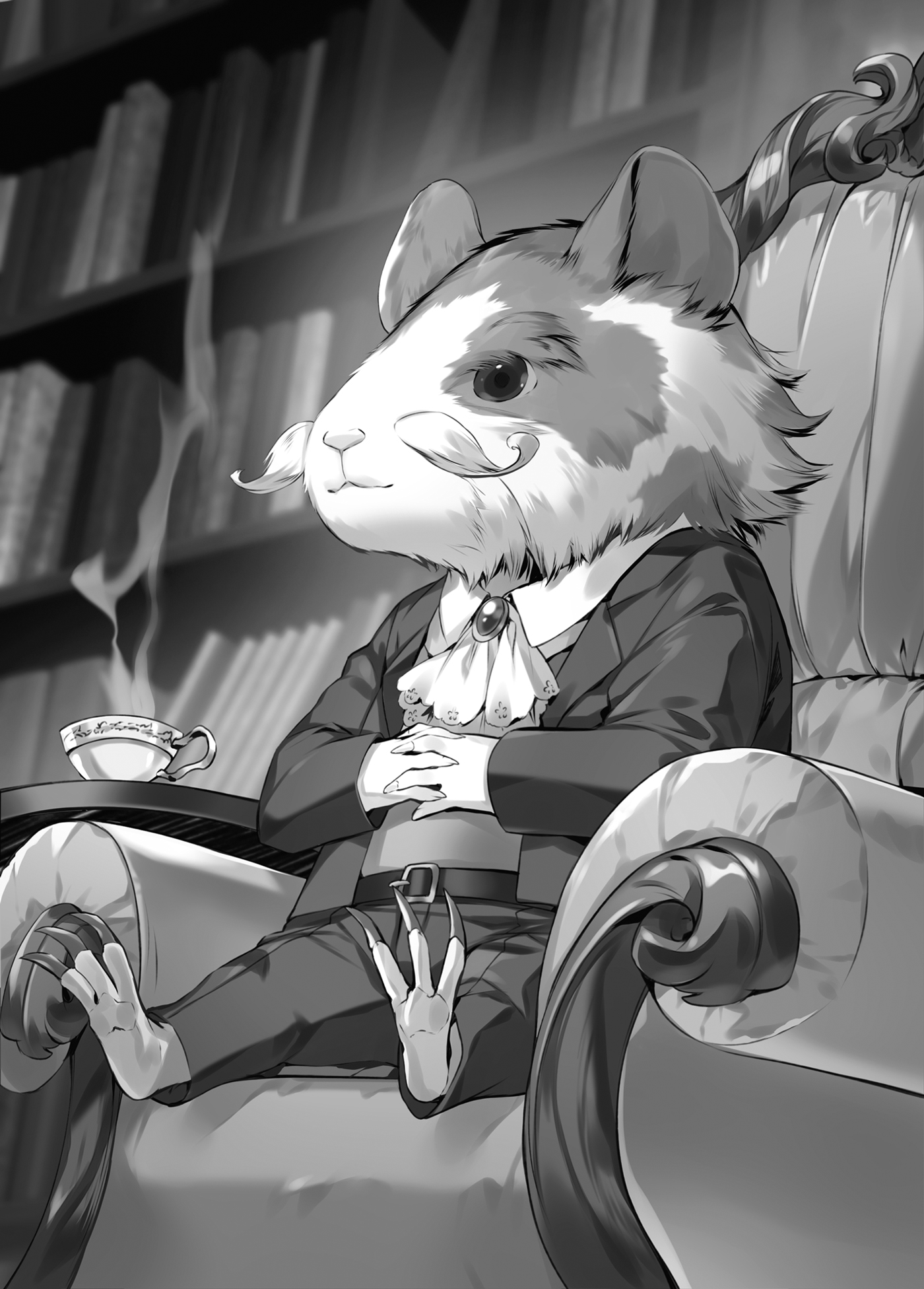
The voice was an elderly man’s, with a slight wispiness to it. If my eyes were to be believed, though, the person in front of me was not a human at all. I was looking at a guinea pig. A guinea pig that was wearing pleated pants and a pristine shirt, had a spotted pattern on his furry face, and could speak.
“Ah, yes, well,” was all I could manage.
“None of those are answers.”
The guinea pig...man had a fishing rod over his shoulder and a fish hanging from his hand. It got crazier; the fish was about as big as my arm. Do guinea pigs even eat fish?
Without really seeming wary at all, he walked over and passed by me. As I watched his retreating back, I finally calmed down.
Right. This is another world. Of course there’s a guinea pig that walks on two legs, fishes, and speaks like an old man. After all, Nito’s a half-elf. Not that I know what a full elf is like.
I jogged after the guinea pig and called out to him.
“Um! Fago sent me with a package.”
“Huh, so she’s still alive. Now I’m glad I didn’t throw the chit out,” he answered, entering the house without me.
I went and grabbed the package from the passenger seat, then returned and knocked at the door. I knew there was someone inside this time, but there was still no response. There was nothing else I could do, so I opened the door and stepped in.
Behind it wasn’t a hall, but the living room. I sighed admiringly as I looked around the room. Bookshelves, sofas, and a table filled up the space, but rather than feeling crowded, everything was in harmony. Maybe that was due to good interior design, or perhaps just to all the furniture being a reddish brown, or maybe even just to how things were laid out.
“Would you show me?” the guinea pig asked, wiping his hands with a cloth as he approached.
Standing in front of me, he folded the cloth and set it on the back of the nearest sofa. He took the wrapped package from me and used a hand to unwrap the paper. Inside was a pair of boots. They were the same reddish brown as the furniture in the room, but the round toes were polished to a shine.
The guinea pig nodded with a hum before sitting on the sofa and putting the boots down at his feet. He quickly shed the shoes he had on and replaced them with the new pair. Then he started walking up and down the middle of the room, checking how comfortable the new boots were.
“So, how is she?” he asked, looking at his feet while he did his check.
“I think she’s fine. She was cleaning the temple this morning.”
“It’s an important custom for her. I’m impressed she’s kept at it while the world’s falling apart.”
He came to a stop and looked at me. I couldn’t read his expression; all I could do was awkwardly meet his gaze.
“Just out of interest,” he asked, “do otherworlders get caught up in their habits as well?”
I let out a gasp.
“You needn’t be so surprised. You looked shocked when you saw me, but beastmen and demihumans aren’t that rare. Otherworlders are the only ones that react like they’ve never seen one of us before. Honestly, you’re the more interesting one from my perspective.”
I could understand and agree with his explanation, but I couldn’t quite agree with being a more interesting sight than him.
“Well, regardless,” he said with a nod, pulling a folded piece of paper from his breast pocket and holding it out to me. “The receipt. It’s signed as well.”
As I took and checked it, the guinea pig turned his back on me.
“I need to prepare the fish, so excuse me. Give my thanks to Fago.”
He picked up the cloth from the sofa and headed farther inside. I was left standing alone in the room.
It had been a shock to see a guinea pig who felt more like a person wearing a costume, but what felt even stranger was his behavior. He’d acted way too normally, almost like this was just any old day. He’d fished, accepted a delivery, and tested out his new shoes. It didn’t feel like he was living in a dead world in the slightest. He might have lived the exact same way five years ago, and maybe he still would even five years from now. While there was nothing in particular that I wanted to ask, I really wanted to talk more with him. Still, I knew it’d be rude to call him back out just for that, so I gave up and left.
It was getting toward noon as I stepped outside. The sunlight was falling straight down, setting the shadows from the leaves in stark relief against the ground. Just standing still I could feel the heat on my cheeks. The gentle waves from the lake sent scattered droplets of light ricocheting around the area as well. I’d never really seen why people needed holiday homes in the past, but now I could at least somewhat understand their value. Spending the warm, vibrant days of summer gazing at the brilliant blue of the lake was probably pretty pleasant.
I moved to the edge of the clear space and noticed a set of stairs descending the slope. They weren’t paved or anything, just steps cut into the earth and anchored with thin planks of wood and logs. I headed down them, and found a small boat moored to a jetty at the bottom. He must have used it to go out fishing on the lake.
“This really is the ideal retirement.”
It was almost too calm. I stood there for a while looking at the lake before I climbed the stairs back to the Kettle. I twisted the wheel and slowly pushed the throttle, heading down the road again.
As I got back to Mercian Street, it definitely did feel deserted. Despite being a man-made location cut out of nature, it showed no sign of being used, so the buildings among the trees just felt out of place. I was halfway down the street when I came across a chair in the middle of the road. With no other choice, I stopped the Kettle in front of it, and then a thought occurred to me.
What’s a chair doing here?
A chill ran down my spine. There hadn’t been a chair here on my way in. Someone had put it there afterward, and the obvious reason was to stop me here on my way out.
Someone else must be here.
The moment that thought passed through my mind, there was a knock at the driver’s window. Someone was standing outside it.
2
I just sat there, staring wide-eyed; any other reaction I might’ve had was delayed, naturally, by the shock. However, if you were to have asked me what had shocked me so badly, I could only have said it was a combination of several things. Firstly, outside my window loomed the hulking figure of the stranger that had just knocked on it. Secondly, said stranger held a sturdy-looking metal pole, flecked with rust, in the opposite hand. Finally, the stranger’s chiseled face sported a thick layer of makeup, and a flashy dress clung to...his?...muscular frame.
Our eyes met and the stranger’s free hand rose again to tap on my window lightly. My frazzled brain, running on autopilot, sent a signal to my right hand, which wound the window down. The assembly squealed as it descended.
“Sorry for stopping you so suddenly. Who are you, by the way?” the stranger asked in a practiced falsetto, speaking with a feminine lilt.
“I feel like I should be the one asking that...”
“You have a point there. Well, okay, I’m Paula.”
“Right... Paula.”
“Yup, Paula.”
Silence fell between us, until a sudden thump on the door cut through it. I jolted upright in shock.
“We’re introducing ourselves, right?” Paula prompted. “You’re just a tad slow, aren’t you? What’s your name?”
“I’m Keisuke...” I eventually managed.
“Right. Okay then, Keisuke. What did you come to that village for?” Paula asked, eyes narrowing under purple eyeshadow.
“I didn’t exactly have a reason, just came across it on the road.”
“So you’re just a traveler?”
“Guess so. Though I’m doing some peddling on the side.”
Paula looked steadily at me for a long moment, before eventually nodding and tossing the metal pole backward. It landed with a clatter.
“We’re all good, then. Sorry ’bout that. Must have been a shock, huh?” Paula said in a much cheerier tone, waving a hand around.
“Yeah, it sure was...or more like a string of shocks... Um, do you live around here, Paula?”
“Sure do, right in that theater.” With a wave of a finger, Paula indicated the big building I’d just driven past. “Why not stop by if you’re free? We’ll give you a combo welcome and apology performance.”
Paula gave an intense wink that more or less wiped out any courage I might’ve had to refuse. At the same time, I was actually really curious to learn more about this unusual stranger.
“Sure, I guess.”
“That’s perfect, then. Guess I’ll take the passenger seat.”
Paula jogged around the car and opened up the passenger door, climbing in. I was the shorter of the two of us by a lot, and there was quite a bit of muscle on those arms. Even so, a feminine, almost citrusy, scent wafted forth from Paula, making my mind go just a little fuzzy. I gave Paula a searching look and he...no, she shyly put her hands on her cheeks as if to hide her face.
“Oh my. It’s rather rude to stare at me like that.”
“Sorry,” I apologized after a moment.
Earlier it was the oversized guinea-pig person, and now it was this burly man...or woman. With an internal comment about how many unusual new faces there were here, I turned the Kettle around and headed for the theater. I was still trying to think of something to talk about when we got to the entrance a few moments later. Paula opened the door and got right out, and I followed suit from my own side of the car.
The space behind the theater’s glass doors was dark. It felt even more like an abandoned ruin than the normal houses, and yet Paula looked completely at ease opening the doors and heading inside. Through the front doors was a small entrance hall. A reception desk stood directly in front of us with a door on either side of it. Both of them were wide open, but the darkness shrouding whatever lay past them was thick enough that I couldn’t see where they led.
“This way,” Paula guided, heading through the right-hand door.
I could smell dusty cloth inside as I followed. The light at our backs—the only source of illumination in the room—fell in a rectangle on the floor, our shadows stretching across its center. My eyes hadn’t adjusted to the darkness and I could barely see anything else. Paula strode off, while I progressed more carefully. I found a row of chairs and grabbed hold of one, feeling around for the chair in front of it. Moving row by row, I clumsily headed forward.
Suddenly, I heard a noise—the rasp of something metal sliding across a surface. Eventually, it morphed into the sound of castanets tapping out a rhythm. My confusion shifted into concentration. As I listened, a beam of light hit the far wall and brought the stage in front of me into focus. It shone brighter than anything I’d ever seen from a lantern, sparkling across the stage. Layered over the rhythm of the castanets came a more distorted noise of something thumping out across the stage.
Paula leaped in from the wings, dress fluttering as she landed in the center of the stage and twirled in place. The dress left shimmering trails in its wake as she spread her arms toward me, crooking a finger invitingly. The music got faster and more intense, and Paula’s dancing followed suit. She swung her massive frame around, tracing out feminine, almost alluring, curves with her arms and hips. I was shocked, of course, but before I knew it, her dance had me enraptured and tightly gripping the back of the chair.
Eventually, the music stopped, and so too did the dance. Her arms and legs came neatly into place at her sides, and I started applauding. Loudly. Paula’s shoulders were heaving, but she bowed toward me with a smile, then vanished off stage and reappeared from a door at the side of the seating area.
“So, did you enjoy it?” she asked, still breathing heavily; she was giving off enough heat that I could feel it just from standing next to her.
“It was incredible.” Those were the only words I could find to express myself. “So you’re a dancer, then?”
“Well, more accurately, I wanted to become one, yes.”
“You didn’t use to dance here, then?”
Paula hid her mouth behind her hand and laughed cheerfully. It was a dainty, feminine laugh, with only the slightest hints of masculine roughness showing through.
“I’d never have been able to dance in a place as high-class as this. I came here to... Well, let’s call it the end of my version of your journey.”
“Huh... The end of your journey was dancing in this theater?”
“Well, I haven’t got anything else to do, have I?” she asked, waving a hand at me. “I’d always wanted to do this, and yet my wish could never have been granted before... It ends up rather boring dancing to no audience, though. I’m glad you showed up, Kei. I finally got myself fired up again.”
Kei?
The look in her eyes was somewhat alluring, but also somewhat devious, and I felt a chill run down my back. I quickly shifted to put more space between us.
Paula giggled teasingly and murmured, “How innocent.”
I wanted to argue the point, but in the face of the somewhat mature mood she’d created, my relative immaturity stood out, so she wasn’t exactly wrong.
“Right. I need to introduce you,” she said, apparently having just remembered something.
She turned toward the stage and called the name Jill in a languid, high-pitched voice. It was the first time I’d ever heard someone stretch a name out into such a sweet sound. Once the saccharine echoes of her call died out, silence returned with a vengeance. There was no sign of this Jill, either in person or in voice.
Paula put a hand on her hip and puffed out her pectorals before letting out a sigh.
“Honestly, that girl. She’s so shy.”
With a brief “wait here,” she vanished backstage again. She returned before long, dragging another young woman with her. She pushed this woman forward, planting her in front of me, and put a hand on her shoulder.
“Right. This is Jill,” she said. “Jill, this is Kei. He’s our audience.”
The young woman named Jill hunched in on herself, winding her hands around each other, and ever so slightly shook her head. Even her gaze wouldn’t settle on a specific target.
“Uh, hello,” I tried greeting her.
Jill jolted in surprise and then gave several trembling nods.
“’llo...”
Her voice was so faint, I only caught the tail end of the word. I could see why Paula had called her shy.
“She’s a bit introverted, as you can see, but she sings really well.”
“You’re a singer?”
That was a surprise. I couldn’t imagine her standing like this on a stage, belting out lyrics. Yet Jill shook her head frantically, sending her long braid bouncing.
“No, um, that’s too much...”
That was all she said before she ran off and hid behind Paula. Apparently, this was the most she could bear.
“Ahhh, jeez. There’s no helping her,” Paula said with a sigh. “Thanks to that personality of hers, she’s never actually stood on the stage. She’s so good she’d fill this theater and send shivers down everyone’s spines. She’s practically magic.”
“I’d love to hear that.”
“Right? I could die happy if I got the chance to dance along to her singing.”
She then called a wheedling request over her shoulder for Jill to come out, but there was no response. Paula just gave me a reluctant, apologetic smile. I’d pretty much expected that outcome, of course, given how Jill had been frantically shaking her head earlier. I might have figured that if you had such a good singing voice, you’d be able to hold your head high, but apparently it wasn’t that simple. Personalities don’t work off of logic, after all.
“So you two spend your time here singing and dancing?”
“That we do.” Paula nodded. “We don’t need to earn money, and there’s a veritable mountain of food in the vault, so we just do what we want.”
“The vault?” I asked; my sharp hearing wouldn’t let that word slip past it.
“Yup. Lots of the rich villa owners fled here. They all pulled together a bunch of food and necessities and collected them in a warehouse at the end of the street. There’s plenty left in there.”
“Would I be able to get some of that?”
“Well, it’s not like it’s actually ours, so I’d say do whatever you like.”
Paula paused there and put a finger to her lips. A grin made its way onto her face, and she leaned in closer.
“Actually, nope. It’s for the people living here,” she decided instead. “I’ll split some with you if you give me a hand though.”
It was strange. This was probably just a normal trade we were talking about, but with Paula facing me down so intently, it felt like I was making a deal with the devil.
“What do you mean, a hand?” I asked, swallowing.
“I want you to be our customer.”
“Uh...excuse me?”
“I mentioned earlier. We’re the only ones on this stage, and yet we’ve got no audience. I want the watching eyes, the applause, the cheers! I’d even take the jeering from back in the day! I’m tired of dancing for empty seats.”
She had her arms spread wide, hands and face turned up toward the ceiling, almost as if she were striking a pose in a play. She had a bit of a tendency toward exaggerated gestures.
“So I want you to come to this theater. I want you to watch my dance,” she said, then paused and dragged Jill out from behind her. “And listen to her song.”
“Wha? I-I didn’t agree to this...”
“Jill doesn’t seem entirely on board. Are you sure?”
“It’ll be fine. If we don’t try, she’ll never be able to get on that stage, and we might never get another audience considering the state of the world. They say opportunity only knocks once, right? So we need to open the door wide.”
As she spoke, she lifted Jill’s hand to point toward the door, before casting me a flirtatious look and a wink. She’d worded it like a business deal, but there was no downside in it for me. We’d started to approach the bottom of our food stocks, and with this I could both resupply and enjoy a dance performance at the theater, and perhaps even a song. You could even say it’ll slightly enrich my mostly boring life, I reflected.
“Of course I’ll help,” I told her.
“Excellent! You’re a sweet boy, Kei.”
She suddenly opened her arms toward me, but I swiftly retreated. It might have been the quickest reaction time I’d ever had. I could foresee only asphyxiation awaiting me if I got stuck between her burly arms and chest.
“I’ll pass on the hug.”
“Such a shy guy,” she said, reluctantly dropping her arms. “Shall I show you to the vault now? Or would you rather listen to Jill sing?”
As the topic shifted to Jill, the girl in question shook her head so fast I thought her braid might fly off. She’d probably have fainted if I accepted Paula’s offer.
“I’ve got some things I want to sort out first, so I’ll head back to the village for now,” I answered. Nito and Charolles were still waiting there, and I figured I may as well invite them too. “I might even bring some more audience members with me next time.”
“Oh, how wonderful,” Paula squealed, clasping her hands in front of her chest.
Meanwhile, at her side, Jill was shaking her head even harder. She really can’t deal with people, I guess, I thought as Paula spoke again.
“You’re staying at that temple for a while, right?”
We didn’t have any real itinerary, or any reservations waiting for us at the next hotel, and we didn’t have our tickets home booked either. Nito and I were on a journey to find the places in her notebook, and we’d just stopped here looking for a map to follow on that trip. So the answer to how long we’d be staying was simple, if vague: either until we found a map in the library, or else until we knew that there wasn’t one to find. I had to rely on Nito and Charolles for that search, and with Nito so captivated by the books, I doubted she’d find anything very soon.
“I think we’ll be there for another few days at least,” I answered Paula. “Probably.”
“Right. Then feel free to come visit whenever you’ve got the time. We’ll be practicing, right, Jill?”
Jill seemed on the verge of tears as she frantically shook her head.
“See, Jill’s feeling super motivated as well.”
“Are you sure that’s really motivation?” I asked.
“It’ll be fine. It’s only scary and painful the first time.”
I decided not to ask anything else at that point. After all, if you go looking for trouble, you just might find it.
3
Fago had already prepared lunch by the time I got back. While I felt guilty about imposing on her, I ate gratefully along with the others. Afterward, Nito and Fago got back to work, focused on adjusting the former’s boots, and Charolles switched out with me, heading off to the temple library. Therefore, I was stuck sitting on the sofa with too much time on my hands.
The tea that followed the meal had been delicious, but the teapot didn’t make a great conversationalist. Boredom soon had my gaze wandering, bouncing from item to item in the room. Someone had hammered boards into the wall to make a set of three shelves. There were several framed photos displayed neatly on the shelves, but one of them had been turned facedown. I couldn’t help but be curious. I stood up without really thinking about it and picked up the photo. It showed a young woman and a boy, both dressed up, and the boy looked a bit tense. Guess he’s Fago’s son?
I looked through the other pictures, but oddly, he wasn’t in any of them. There was Fago, someone that was probably her husband, and a girl that must have been her daughter. The girl was in several pictures—she went from a small child to an adult, and then showed up alongside a young man and new children—but there was only that one picture of the boy.
“He’s dead.”
I rushed to put back the picture in my hand, but I knew it was already too late. Still holding it, I turned around awkwardly to find Fago coming through the doorway with Nito in tow. We stood in silence for a moment.
“Sorry,” I finally said. “I couldn’t help myself.”
“Going through facedown photos is hardly the best look.”
I couldn’t refute that and just softly returned the photo to the shelf.
“Was it an illness?”
“No, we killed him.”
I definitely hadn’t seen that coming. I stared at her in shock, with Nito mirroring my reaction. Fago wasn’t smiling like she’d just told a joke. Her expression was gravely serious.
“Raising children is hard. However much we care for them, we parents are still only human,” she told us, pouring a cup from the teapot.
I couldn’t exactly parse her abstract way of wording it, and Nito probably couldn’t either. Fago’s mood didn’t seem to have worsened, but intruding on such a personal topic was definitely a delicate problem. I wasn’t sure whether to actually ask any further, so I just stayed silent.
“Do you...regret it?” Nito asked.
“Regret?” Fago repeated, closing her eyes and bringing the cup to her lips. “You’re rather insensitive too. What good would that do? Regrets and repentant prayers wouldn’t bring my child back.”
She inclined the cup, taking a sip, then lowered it again and let out a shallow breath that felt a lot heavier than it sounded.
Nito opened her mouth again and I shook my head in warning. Family matters were about as private and personal as issues got. Digging at that kind of stuff out of pure curiosity was one of the rudest things I could think of. Whatever the circumstances were, only the actual people involved could understand or resolve them.
Nito’s lips twisted as she gave a jerky nod in response. She was wearing her normal boots, so I assumed they were done adjusting the fit for the moment. Things weren’t exactly awkward, and Fago didn’t seem angry either. I just felt too out of place to stay in the same room as her, so I spoke up.
“We should head off, then.”
“Right. Come back tomorrow. I want to hear how they fit.”
We left Fago’s house and climbed aboard the Kettle without speaking. I drove off, moving down the hill at a crawl. I would need to turn the Kettle around to head back up to the temple, and the roads around her house were too narrow for that, so I needed to find somewhere more open.
“I wonder what happened,” Nito said eventually.
She was compassionate and earnest, so she had a tendency to treat other people’s problems as her own.
“Whatever happened, I don’t think we should ask about it.”
“But she said she killed her son.”
“It’s a family matter.”
Nito fell silent, but I could feel her gaze on me. We came upon a house with a big front yard, so I drove into it and backed out onto the road again.
“Keisuke,” she asked eventually, “aren’t you curious?”
“Of course I am. But asking won’t do any good, even if she did kill him.”
We climbed the road back toward the temple, the Kettle feeling much heavier as we went past Fago’s house.
“Doesn’t speaking to someone about a burden like this make it easier to bear than holding onto it alone?” she asked.
“I think so, yes. It’s probably easier that way,” I answered, before adding, “But it isn’t our place to ask after it or decide who that confidant should be.”
“That...sounds like a very detached way of looking at things.”
“Well, yeah, asking about difficult things might be kind in a certain way, but giving solace like that’s the role of the gods, and we’re far from gods. Actually, I guess here it’d be the saint.”
Fago had prayed to that saint’s statue the day before. I didn’t know for sure what had been in her prayers. Maybe they’d been about her son, maybe not, but it seemed likely that she would pray about that type of thing.
Nito didn’t reply, so I spared a glance at her. She sat in silence with a slight pout on her face. Her own kindness had probably left her feeling unhappy. Nito was too earnest to abandon her curiosity and urge to meddle. She was the sort of girl that always wanted to understand people’s worries, to ease their pain.
“Are your boots finished?” I asked.
Nito didn’t complain about my blatantly changing the subject. She just had a slightly sulky tone to her voice as she answered me. “She added cushions that match the shape of my feet. If they don’t work, she’ll adjust them tomorrow.”
“And how do they feel now?”
“They’re rather agreeable.”
I couldn’t help but snort slightly at her unique way of speaking. Soon, we finished climbing the hill and drove into the space in front of the temple. I stopped the Kettle next to the entrance and checked my watch. It was already nearly evening, so I decided that we wouldn’t be going out again that day and extinguished the boiler before hopping out. Nito had left the Kettle before me and waited by the entrance.
“Did you finish the delivery?” she asked when I walked up to her.
“Ah.”
I put my hand to my chest and found the receipt from the guinea pig in my breast pocket. I’d completely forgotten.
“I’ll go finish it now.”
I turned around and saw the sun starting to set before my eyes. It was moving slowly—the evenings were still long and summery—and I expected I’d have the time to deliver the receipt and be back before it had fully set. Having to make another round trip in the car was kind of annoying, though, and I’d just put the boiler out, which made it all the more irritating. My emotions must have shown on my face, because Nito was looking up at me with a smile.
“You could do it tomorrow instead.”
I thought it over for a moment. It wasn’t a particularly urgent errand, so it likely wouldn’t be an issue. Fago would probably head up to the temple to clean in the morning, and we had to go back to get Nito’s boots checked anyway. It would literally be no issue to do it tomorrow; I’d just need to accept going to sleep with a minor bit of regret.
Just as I was about to say so, though, I had a thought.
“This is a job for a pro,” I declared.
Nito gave me an odd look as we entered the temple. I headed for the library with her close behind. As we got there, Charolles had just closed a book and was standing up.
“I have a job for you,” I told her.
It was only at times like this that Charolles ever seemed surprised. She looked at me for a moment, puzzled, but her face soon smoothed back into her usual blank expression.
“Well, that came out of nowhere.”
“It’s the perfect job for a courier. But maybe it’s a bit too difficult for you?”
I added just a little challenge to my words. She put the book in her hands back on the shelf and faced me again.
“What kind of job?”
I pulled the receipt out of my pocket and proffered it.
“I want you to take this to Fago.”
She was silent for a beat.
“What is this, a kid’s errand?”
Well, yes, pretty much.
“That’s not all. This is the more important bit: once you’re done, you need to head to the theater on Mercian Street. It’s the biggest building on the street, so you’ll see it right away. There’s someone called Paula there. Tell her that I sent you, and then you’ll understand.”
Charolles frowned doubtfully.
“I don’t see the point.”
“What matters is whether or not you can do it.”
“Fine. What’s the pay?”
“Dinner tonight. Along with a shock the likes of which you’ve never before experienced.”
“I hate people that are all talk,” she warned me.
I just smiled back at her. She looked me over, evaluating me, but not for very long. In the time it took to blink, she’d taken the receipt.
“I’m looking forward to it. Just a little though.”
I kept my laughter under control as I watched her leave. It was just a little joke. People needed fun like this in their lives. While I was musing, Nito pulled at my sleeve.
“What’s this ‘shock the likes of which you’ve never before experienced’? I’m curious too.”
Her eyes were sparkling with said curiosity, but I hesitated to explain.
“You’re a little young,” I told her eventually.
“What’s that supposed to mean?!”
“It’s just sorta too intense, or something.”
That didn’t quell her interest, though, and after her wheedling wore me down, I ended up promising to take her there the next day.
4
Once I heard the characteristic noise of exhaust from a steam engine and the crunch of tires on gravel from outside the window, signaling Charolles’s return, I lit the burner on the Svea and waited. Soon, the faint sound of the temple door opening reached my ears. Following that, the door into the corridor opened and a figure stepped into the moonlight shining in from the window. She wasn’t holding any light, but she still didn’t falter as she approached.
“Isn’t it a bit dark?” I asked.
The faint light from the flames licking the bottom of the pot was just enough to let me barely see Charolles. I was in the same place as the night before, sitting just between the corridor itself and the library. That meant that I served as a bit of a roadblock for her. Charolles crouched down in front of me, the hem of her cape fluttering out to rest over the carpet.
“Beastmen have good night vision,” she explained.
“That’s good. Did you hand it over to Fago?”
“She said that you could have brought it over tomorrow, and that you’re impatient for your age.”
“That sounds like a thanks to me, so I’m all good with that.”
“Life sounds a lot nicer the way you see it.”
“Anyway, good work. Here’s your reward,” I told her, pointing at the pot of water I’d put on to boil.
“Oh my, how did you know that hot water was my favorite?”
“I investigated, of course. Asked all over the place.”
Charolles raised her shoulders in a slight shrug, lifting her left hand from where it’d been resting in her lap, and pointed at me.
“Paula said hi.”
“Not a letdown, was it?” I asked smugly.
Her eyebrows furrowed in apparent unhappiness, but she couldn’t keep up the act for long. Letting out a soft snort, she smiled.
“Definitely not. I’ll admit it. That was...certainly a surprise.”
“Right? It was a shock, yeah?” I leaned forward.
“I don’t think you’d find anyone that wouldn’t have been surprised. It’s not something you’d expect, after all. That dancing was so passionate.”
“Yeah, it was incredible,” I agreed, before adding, “That’s great. It’s not just me misinterpreting things.”
I relaxed at having found someone who shared my opinion on this. I’d been worried that the moving nature of what I’d witnessed and my surprise over it had only been my misunderstanding of something this world saw as commonplace. If Charolles shared my surprise, though, then that wasn’t the case. The shock of Paula’s appearance and dancing crossed worlds.
“Where did you find her?”
“Ah, well, I just happened across her.”
Just as we were getting into a proper conversation, I heard someone clear their throat. I turned around and saw Nito sitting inside the library, reading her book as if nothing had happened.
“You okay?” I asked.
“I’m fine. My throat was just a little dry.”
She hadn’t even looked my way as she spoke, but I figured if she said she was fine, then she must be fine. I looked back at Charolles and carried on.
“There was a chair blocking the road on my way back from the lake,” I explained.
A round of exaggerated, almost pointed, coughing interrupted us a second time.
“You sure you’re okay?” I asked, turning around again, but Nito was still focused on her book.
“I’m fine. Indeed, nothing at all is wrong, no sir.”
“That’s fine, then... You hungry?”
“Hungry? Rather, yes. I’m absolutely famished.”
I paused for a moment, watching her closely.
“You know it’ll be done soon, right?” I asked eventually.
“As fast as possible, if you please?”
“It sounds like there’s an implication in your words there...”
“An implication? That’s impossible. If there were then I’d eat it. After all, I’m famished.”
I wasn’t entirely sure what either of us was talking about at that point, but I was broken out of my thoughts by a quiet laugh. Nito seemed surprised by it too, and looked over at Charolles. I turned back around again to find Charolles laughing, hiding her mouth with a hand as her eyes crinkled up in amusement. It felt like I was witnessing a rare event, like finding the end of a rainbow.
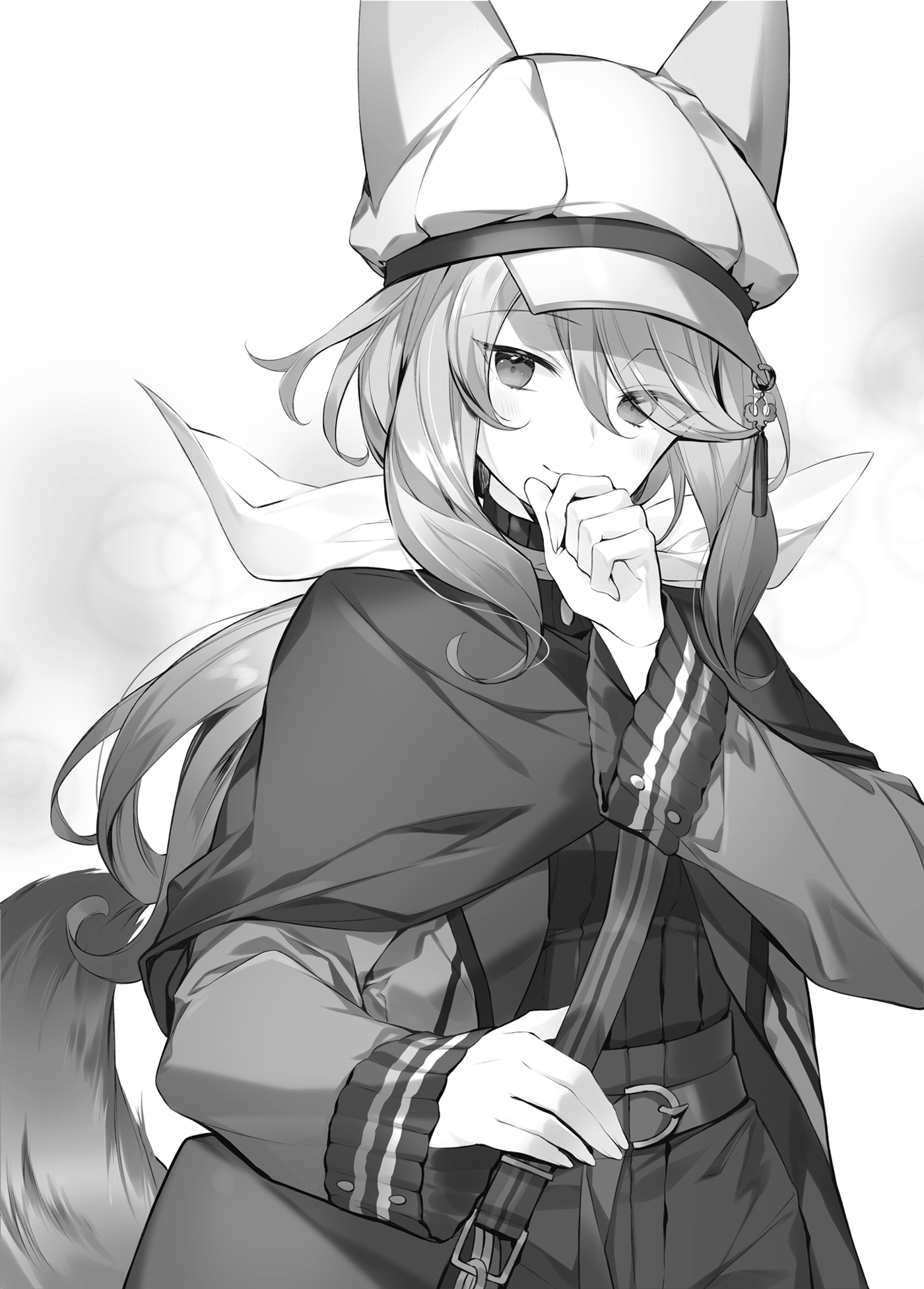
Our conversation must have been pretty amusing, then. While I was a little embarrassed about that, it wasn’t an unpleasant feeling, and I soon joined in on the laughter. Turning back to Nito, I saw that she seemed to share my same mood. She was shying away, but as our gazes met, she laughed. However, apparently remembering herself, she turned away with a pout right afterward.
“You make a really good pair,” Charolles told us, slight hints of laughter still audible in her voice.
“We’re the best of friends, after all,” I answered.
“We are not the best of friends.”
I had a feeling we’d had the same exchange before; apparently, she still didn’t see me that way.
“Being the best of friends sounds wonderful. I’m jealous,” Charolles said, chuckling.
“I told you, we’re not!” Nito insisted.
“It’s okay. I know you’re embarrassed to admit it,” I said in a soothing tone.
“Keisuke, are you mocking me?” she demanded.
“Oh, the water’s boiling.”
“And now you’re ignoring me?!”
She stood up with a clatter and came over, smacking my back repeatedly. Nito was surprisingly weak, though, so it ended up being more of a massage than anything. I ignored her physical protestations and picked up the can I’d set down by the wall. I’d already opened it, revealing the broccoli-ish vegetables packed inside, which meant that it was destined to be the main component of our meal for the night. We had a lot of cans of broccoli to get through.
“Just wondering, Nito,” I spoke up. “How long are you going to keep up the shoulder massage?”
“It’s not a massage. I’m demonstrating my displeasure with you,” she insisted, before making a quiet admission that it’d tired her out.
Giving up on it, she sat down next to me. She looked into the pot of boiling water with an air of disapproval.
“Is that all we’re having?” she asked.
“I get you, but you don’t need to be that put out.”
Adding the broccoli had turned the liquid inside the pot green. It wasn’t a particularly appetizing sight. I used a knife to shave some rock salt into the pot and then left it to simmer and soften the vegetables.
“That looks like it’s got a while to go,” Charolles commented.
“Yeah, probably around half an hour.”
“Then I’ll read until it’s done. Nito, want to join me?” Charolles offered.
Nito’s eyes widened, but her surprise then immediately morphed into a smile and she happily agreed.
“I found an interesting book earlier,” she said as she stood.
“Oh? What kind of book?” Charolles asked as she followed suit.
She walked past me into the library, and the both of them sat down at the table in front of a book, chattering away. They were getting along like a house on fire. And there I was, over at the neighbor’s place. I watched the broccoli rise and fall with the bubbling water. It felt rather lonely, actually. All I had was broccoli...
I got tired of that before even a minute had passed and I decided to lean against the wall. I pressed the button on my watch to set the timer. That way I wouldn’t forget about the broccoli, though I had no idea what in the room I could ever get so engrossed in that I’d lose track of the time. Nito and Charolles were absorbed in their book. I considered that maybe I should help look for the map. Actually thinking about things, I realized I didn’t need to be able to read to tell something was a map. I’d be no use at finding Charolles’s story, though.
But, truthfully, I couldn’t be bothered. I wasn’t a massive fan of books, and that went double when they were in a foreign language. Just the thought of flipping endlessly through them and putting them back on the shelf made my head hurt. In short, the extra time on my hands was something I had out of pure selfishness. It was like the melancholy of a student on summer vacation, wanting to do something easy and fun. In the same way that they’d never think of actually studying, I didn’t want to look for the map.
I stirred the broccoli intermittently with a spoon and started drawing up vague plans for tomorrow. I’d help Fago with the temple cleaning. I’d take Nito to that theater and let her meet Paula and Jill. Then I’d ask Paula to show me to the food stores. We’d search here in the library for a map... Actually, I want to learn the guinea pig’s name. I don’t want to just keep calling him “the guinea pig.”
Thinking it over in detail like that made me realize that I’d met so many people recently. It was actually only a few, but after all the completely deserted plains, mountains, and ruins, even that felt like a lot. Thinking back on the memories of the day made it obvious that it was a momentous one, and yet I’d spent it in the same way as any other. Guilt assailed me at that, like the mourning at the end of a meal when you’d wanted to keep eating and tasting it.
Would we forget about today when tomorrow came? Maybe it’d just be vaguer, the impressions slowly fading as time passed. My surprise at meeting the guinea pig, the shock of watching Paula’s dance, and the joy of seeing Charolles’s smile—I’d forget it all one day, and we’d all vanish at some point as the world fell to ruin.
I felt a sudden shock. For some reason, I was crying as I boiled the broccoli. Come on, it’s just broccoli, I scolded myself. Still, the weight on my chest was overwhelming, and I felt almost like I was going to throw up as I glared at the broccoli.
The world was dying. What a late realization.
Back when I’d been traveling alone through it, I’d wanted it to hurry up and die off. And yet now the fact that it would all vanish one day was heart-wrenching and terrifying. Today would never come again, and even the memories of the day would fade away.
The mounds of crystals I’d seen up until now crossed my mind. Those crystals were remnants, the final lingering proof that someone had lived. That would probably be me someday as well. I didn’t know how to get home, so I’d end up as crystals just the same as everyone else in this world.
I pressed my head back against the wall, rubbing my skull into the hard surface. These feelings were the same as before, the same ones I’d had when I’d put that gun to my head. I’d been right to give Nito the bullets.
I looked at the watch on my wrist. I was more than good on time, but sitting around not doing anything was only depressing me more and more. I pushed the button, stopping the countdown, and pulled a frying pan out of my backpack.
Once I’d fished out each piece of broccoli from the pot and transferred them to the pan, the pot went on the floor. I replaced it with the frying pan, settling it right over the weak flame. Then I added a glug of oil and fried the chunks of broccoli, crushing them as I did. They still had resistance to them, but they were much softer and broke easily enough due to the extra water they’d absorbed. I added salt and pepper, took them off the heat, and put the pot back.
I decided that the best use of the stock left over from boiling the broccoli was to heat the pasta in it. Pulling out a can of dried pasta from the case, I put it in the once-more boiling water. The pot wasn’t big enough to cook for all three of us at once, so I would have to do it a single portion at a time. I used the stopwatch again to keep track of the time as I periodically tested the pasta’s hardness. Once it had just a slight bite to it, I moved it to the frying pan. I decided it was fine to add some of the broth in too, which ended up making an amazing soup. After adding fresh pasta into the pot, I stirred the mixture in the frying pan.
“It’s done,” I said as I scooped it out into bowls.
Nito came over first. She looked at the pasta I’d dished up from the frying pan, and then gave me a—frankly—loaded look.
“There’s nothing but green and light yellow here. There’s no color balance.”
“Could you leave your artistic judgment out of the food?” I asked, though honestly, I had to agree that the color maybe wasn’t great.
“It looks very healthy,” Charolles cut in.
“Isn’t that what you say when you’ve got nothing else good to say about it?”
Charolles sat next to Nito and I handed her a bowl of her own.
“Here, boiled mashed broccoli pasta.”
They both thanked me and Charolles picked up her fork. She rolled up a forkful of pasta and brought it to her mouth. Nito watched warily.
“Mm,” Charolles mumbled. She swallowed and then spoke bluntly. “That was a surprise the likes of which I’ve never before experienced.”
“I’m glad to hear it,” I said honestly; it was a big achievement for me.
Nito’s eyes widened from her vantage at Charolles’s side, and she cautiously took a bite of her own. It was quickly followed by a mumble of surprise from her throat.
“It’s only two colors, but it’s so tasty!”
“I told you, taste isn’t based on color.”
Once I saw the two of them eating wordlessly, I picked up my own fork and twined pasta around it, bringing that and a piece of broccoli to my mouth. There wasn’t enough substance to the broccoli to chew—it just melted in my mouth, letting the soup it had soaked up flow over my tongue.
The flavor was simple and slightly sweet. It wasn’t the saccharine taste of sugar, but the natural sweetness hidden within the broccoli. The salt had drawn out that sweetness, and the strong taste of the pasta went well with it. Boiling them in the same water, and then using that leftover broth as a sauce, had unified all the flavors. The unexpected tingling from the bits of pepper that peeked through from time to time within the light flavors tied it all together. It didn’t have the heavy feeling of a rich and satisfying meal, but the savory tastes blended into something very much more than the sum of their parts. It was the kind of flavor that made you want to go back for seconds and then thirds.
I suppose I must be a pasta genius as well. The recipe is just something I found ages ago on the internet, though. Mwahaha.
“Yup, delicious,” I judged.
When I opened my eyes from my self-satisfied haze, Charolles and Nito had both stopped eating and were waiting politely. A glance at their bowls showed them empty.
“You two sure ate fast.”
“Well, it was delicious!” Nito defended.
“I enjoyed the taste as well.”
There was no misunderstanding the silent urging for seconds behind those words. I checked my stopwatch and saw that it was time for the next batch of pasta to be done, so I scooped it up into the frying pan.
5
I awoke with a start.
A faint beam of moonlight was drifting in through a crack in the curtains. Woolly-headed, I checked my watch and saw that it was the dead of night. Past the easel that stood between our beds, Nito was curled up around her bedding. She must have been up until late, either reading or painting; I didn’t even remember saying good night to her, so I must have gone to sleep first.
I let my head fall, burying my face into the pillow. My eyes were gradually getting lighter, though, and I was already fully awake. I knew I probably wouldn’t be able to sleep again for a while, so I got up. My throat was dry. I took out the canteen in my bag, but its lightness in my hand reminded me that it was completely empty. I’d used all the water to boil the pasta.
Shoes on, my phone and the canteen in each of my hands, I left the room as quietly as possible. The corridor, and the temple as a whole, were bathed in soft moonlight, giving the place a peaceful atmosphere. I used the flashlight on my phone to find my way outside. Once I reached the Kettle, I pulled a water tank down and refilled the canteen before drinking my fill.
I sighed, surveying the quiet streets of the village below. Only the roofs were clearly visible, standing out against the night. The lake glistened in the distance, catching the light of the moon. It wasn’t the blinding radiance I’d seen during the day, but more like the sparkling of sand as you scattered it through the air. Out in the middle of the lake was a dark silhouette, a trail of ripples following it. A small boat, I guessed, floating on the water. I looked bemusedly out at the scene—one that wouldn’t have looked out of place in a hauntingly mysterious painting. The boat was completely stationary in the middle of the lake. Was it the guinea pig?
It wasn’t the maudlin feelings the broccoli had inspired that dragged me along now. Or so I’d like to think. I was wide awake and oddly restless, so I didn’t feel like going back to bed. I’d just seen a convenient distraction that I could use, and it wasn’t a bad excuse for a nighttime drive. I drained my canteen and lit the Kettle’s boiler, then climbed up on the hood and settled in to wait, watching the boat floating on the lake. After about twenty minutes, the Kettle was finally ready. I climbed down, got into the driver’s seat, and drove out of the courtyard surrounding the temple.
The Kettle’s headlights cut a path ahead of me through the dimly lit night. The more overgrown area closer to the lake was pitch black, and it took a fair bit of courage to keep driving through it. If I hadn’t already made the trip once during the day, I might have turned back. I continued along the essentially straight road and then suddenly broke from the trees.
The entertainment district spread out before me, rising abruptly out of the forest. The open ground was lit evenly by the moonlight, exposing full buildings to my gaze. These had all been places of merriment once, hidden away among the trees, almost like a secret base for adults with too much time on their hands. The place felt all too lonely now, though, what with them having fallen to ruin.
I drove past the theater and passed back into the trees. After I’d gone by several residences, the lake appeared off to my left. Its entire surface seemed to gleam in the moonlight. While keeping my eyes on the road, I peered through the trees at the lake as best I could, looking for the boat. Before long, though, I was in a more thickly wooded area and once again couldn’t see much of anything.
Eventually, I saw a light atop a small hill, like someone had bottled the evening sun. It was a lamp, shining from the window of the farthest house—the guinea pig’s house. I drove the Kettle into his driveway and stepped out, my feet crunching on the gravel. Either the trees surrounding me, or the nearby lake, lent a slight chill to the air that brushed against my skin.
I hesitated, considering whether to go into the house or head down to the lake, before eventually heading to the stairs that led down to the shore. The boat had just arrived at the jetty. I used my phone to light up the ground beneath my feet as I picked my way down. The boat had stopped completely, but the small figure sitting in it showed no sign of moving.
Eventually, I got close enough to make out the figure of the guinea pig sitting in the boat in more detail. He was facing me, but looking down, writing something in a small black notebook that lay open on his lap. It didn’t seem like he’d noticed my approach.
“Um,” I said, after much hesitation.
The guinea pig didn’t react at all. I drew in a breath, preparing to speak more clearly this time. As I did so, he pulled the cap off the base of his pen and placed it back over the nib, raising his head.
“What concerns an otherworlder?” he asked.
The breath I’d taken left my mouth as a confused exhalation.
“I’m sorry? What do you mean?” I asked once I’d recovered enough to speak.
He tucked the pen and notebook away in his breast pocket.
“People walking around at night are always those with concerns. Those without any are still abed.”
I wanted to argue the point and talk about how many people went out to convenience stores in the night...but this world didn’t have those stores. Our cultures were different. Here in this world, it was probably a period of history where people didn’t really leave their homes at night. Plus, even as I opened my mouth to argue, I got the feeling he might have had a point about why I was out this late.
“Do you have concerns of your own, then?” I asked.
“When you get to my age, nature starts to call throughout the night as well. Hence, my sleeping hours have shortened.”
The guinea pig rose from the bobbing boat with practiced movements and started to use a rope to moor it in place. Halfway through, he rose and beckoned.
“Want to come with me? I’ll treat you to a cup of tea.”
He didn’t wait for a reply, just set off up the stairs.
6
The room he brought me to looked really cozy overall, but as I sat down on one of the plush-looking seats, it turned out to be awfully cramped. It didn’t fit with the refined vibe the space had going for it, and I felt almost out of place. I looked around at the lanterns scattered throughout the room. They filled the space with soft light, like mood lighting. Each of them was finely decorated and seemingly antique. The light played off of the color of the furnishings, giving the whole space a glossy caramel sheen.
The guinea pig came back from the kitchen and placed a round tray on the wooden coffee table. On it sat a fine china teapot decorated with a complicated pattern, along with two matching cups and their saucers. The finely detailed tea set was a little at odds with the image I’d gotten of the guinea pig so far. As I reflected on this, he poured tea into the cups, sending steam blooming up into the air alongside a sweet fragrance.
Then he did something strange. He took a lighter from his pocket and began heating the tip of a teaspoon.
“This is a way of drinking tea that only people with money and boredom to spare partake in. Do you know it?” he asked.
Obviously, I shook my head. I had more time than I knew what to do with, so the boredom was one thing, but I had no money. Plus, I wasn’t exactly the most knowledgeable about tea.
The guinea pig rested the heated teaspoon across the top of one cup and then placed a sugar cube in its bowl. Then he picked up a small bottle from the tray, its label showing an image of feathers and a man wearing a tipped hat. The bottle itself was transparent, and its contents looked like liquid amber. The cork came out with a cheerful pop, and then he poured the liquid over the sugar cube. It overflowed from the small teaspoon, and the characteristic heady scent of alcohol prickled at my nose.
As the edges of the cube started to dissolve in the booze, the guinea pig once again brought the lighter flame toward it. The alcohol pooled in the teaspoon lit up with a blue flame. The flame was weak and looked like the slightest puff of wind would extinguish it, even as it engulfed the sugar cube. The cube got smaller and smaller, looking for all the world as if it were an ice cube melting into the alcohol it was floating in. Drops fell from the edge of the spoon, sending ripples through the tea beneath it.
The flame died out abruptly, the sugar cube having completely dissolved into the alcohol. The mixture in the spoon looked like sherbet. The guinea pig grabbed it by its handle, quietly submerged it in the tea, and stirred it delicately throughout. When he took the spoon out, the sugar and alcohol were both completely gone. He offered me the cup, and I took it, sniffing its rich fragrance. It wasn’t the thick scent of alcohol, but more the tangy sweetness that I associated with fermented fruits.
“This is an old way of drinking tea that they used to call ‘Noble’s Tea.’”
“Um, I’ve never drunk alcohol before,” I admitted.
“Don’t worry, I won’t tell your mother.”
I laughed at that, relaxing a bit. I knew that when cooking with wine and such you burned off most of the alcohol in the process, so the fire would probably have done much the same thing. Besides, there hadn’t been much alcohol there to begin with. Chanting those almost-excuses in my mind, I took a sip of the hot tea.
“Huh... It’s delicious.”
“It would appear that you also have a noble bearing,” he said.
“There’s a bitterness to it, but the fragrance is amazingly sweet, or maybe ‘deep’? ...It’s a mature flavor.”
The guinea pig poured his own cup and put the spoon across it. He didn’t add the sugar this time, just the alcohol, before lighting it. He also tipped it in without waiting for the flame to extinguish. I guess that’s a less sweet, more alcoholic way to drink it, I reflected as I watched him and sipped from my own cup. The sugar dissolved in the tea, along with the dash of alcohol, was enough to ease the stiffness in my body. Relaxing my rigid posture and leaning back into the springy cushioning of my seat made me feel like I was finally part of the room.
“Um, can I ask your name?”
“It’s Monterachet.”
“I’m Keisuke. Sorry to disturb you so late at night.”
Despite his clipped way of speaking, I knew he was making me welcome. The cozy atmosphere of the room matched his own.
“Monterachet,” I began, but he interrupted.
“Monty is fine. Saves time, and it’s easier to say.”
I was slightly taken aback, but then I smiled. It was the first time someone had asked me to address them differently for a reason like that.
“Monty, then. Uh, what were you doing on the lake?” I asked.
He hadn’t had a fishing rod with him like the first time we’d met. All I’d seen was him writing something in his notebook. Monty placed his cup down on its saucer and stroked his long whiskers between his fingers, beady eyes considering me.
“I was spacing out.”
“Excuse me?” I blurted without meaning to.
I’d heard him properly, and I could understand what he meant. It was just such an unexpected answer.
“I get lost in thought, I ponder, I navel gaze—use whatever phrase for it you like. I find ‘spacing out’ to be appropriate.”
It took me a moment to gather my thoughts together into an actual question.
“You’re doing that in the middle of the night? At this hour?”
“Exactly.”
I didn’t know how to respond to that, so I took a sip of the—actually quite rich—tea.
“Have you never done it?” he asked.
What? Spaced out in a boat late at night?
“I...haven’t had the pleasure, no.”
“You should try it, then. Time spent thinking about nothing of consequence is vital.”
“Thinking about nothing of consequence?” I parroted.
“You can’t space out if you’re looking for something specific from your thoughts.”
Well, that is indeed true, I suppose.
“And you go out on the lake at night to do that?”
“It holds a charm you’ll understand if you try it.”
That laconic explanation was far more intriguing than a long diatribe on its benefits would’ve been. I suppose you could say it was a matter of piquing my interest.
“Also,” Monty added, “if you’re going to worry anyway, the solitude is nice.”
I could tell the comment was something akin to curt encouragement from him. He’d already figured out that I was worrying.
“Am I that transparent?” I asked.
“Smiths know their metal, chefs their food, and shepherds their flock. Anyone would notice things others wouldn’t within their own specialty.”
“And what’s your specialty?” I asked.
He picked up the teapot and topped up his drink, giving a single word in reply.
“People.”
I thought his answer over carefully, scratching my temple. It was like a quiz.
“So are you a politician or something?”
“A fine idea. I’m nothing so grandiose, though.”
“A con man, then?”
“Wonderfully done,” he said, raising his cup to me.
“Uh... I was joking.”
“Of course, I’m not actually a con man. It isn’t a matter of social acceptability, but more a matter of capability. You have an incisive mind, though—neither profession can be done well without knowing people.” Monty blew the steam from his tea and took a sip, talking again once he was done. “A second-rate deceiver becomes a con man. A first-rate deceiver becomes a politician. I am nothing more than a third-rate deceiver. In other words, an author.”
Once again, I didn’t know how to reply. Had that been self-deprecation, a joke, how he really felt? I didn’t have the slightest clue. This was a familiar feeling, one I sometimes got from adults—like they were carrying their words around and bringing them out to play with. Replying to the literal meaning in comments like these always ended in the conversation shuddering to a stop. It was like the strange slang used by high school girls; adults also had their own unique dialect.
Still, even if I didn’t know the right answer, I couldn’t just remain silent.
“Perhaps being an author is third-rate in terms of actually being able to deceive a person, but isn’t it a far better profession than being a politician or a con man because the deceit isn’t malicious?”
It was the first time that I’d ever met an author. Obviously, he didn’t have the word tattooed across his forehead or anything, but it felt almost like meeting some mystical creature in a daydream.
“Politicians live for glory, con men live for profit. Authors simply live for their curiosity. For instance, I am interested in what an otherworlder like you has concerns over. Would you be willing to sate that curiosity?”
“You’d ask someone what they were worried about out of pure curiosity?” I asked, after a shocked pause.
“Would you trust someone that said they could save you from your worries, that they could give you the answer?”
I bit my lip. He was right, even if I didn’t want to admit it to him. You worried about something because you didn’t know the solution to your concerns. Some random person wouldn’t be able to solve them out of nowhere. Asking out of pure curiosity was perhaps more honest, and more pleasant as well.
“Still, I don’t quite know what to say,” I answered, fumbling for words. “It’s hard to explain. It’s like my emotions are all jumbled up.”
“Such a thing would indeed cause concern. Not understanding your worry is definitely a problem. The first step to solving it would be to make the issue clear to yourself.”
“Do all authors think that convolutedly?”
“Most of our work is sitting in gloomy contemplation. Actually writing the words down is nothing more than a means to an end.”
That felt like a bit of an overstatement, but it wasn’t as if I knew any other authors to ask, so I couldn’t really comment on it. I considered my feelings for a while, but I couldn’t find a specific problem that I could sum up in a phrase, so I just spoke plainly, as words came to me.
“Why did this world fall?”
“Specifically?”
I paused for a beat, then simply parroted back the exact same word.
“‘Specifically’?”
“Do you want to know the material cause, or are you being more abstract? Some people believe the forces that rule over the world are beyond human ken. Some of the most religious even called this a sign of the world’s salvation.”
“I’d like to know any of those reasons, to be honest.”
Most of its people had already vanished by the time I came to this world. I’d come to understand it was due to something called the mana collapse, but what process or phenomenon had led to that was still beyond me.
Monty leaned back into his seat, folding his hands in front of his stomach.
“Unfortunately, it is rather difficult for me to give you a definitive answer. Countless scholars researched it, but they all died before coming to a conclusion. Various theories came about, but none of them were proven. The general thought was that the mana throughout the world went out of balance and simply started a breakdown of established natural forces.”
“Does the balance of mana have something to do with magic?”
“Mana still exists. It fills the air and dwells within everyone and everything. Magic is merely a technique of putting the power of mana to work. We lost the technique, not the power.”
“So did the mana collapse happen because you lost magic?” I asked after a pause.
“There were certainly people who said so. Other explanations included the idea that it was a deleterious effect of the rise of steam technology. Yet another was that it had nothing to do with us and was simply a change in natural conditions. In the end, it is a mystery none have solved.”
“No one could solve it?”
I sighed. I suppose I’ll never know, then.
“Do you have an imagination?” Monty asked suddenly.
“Well, yeah...”
“Then you must never have learned to use it.”
“What’s that supposed to mean?”
That had been just a little bit rude of him, I thought. Monty fixed his beady black eyes on mine and spoke steadily.
“The terrifying thing about the mana collapse was that no one could see it coming. If you spend your days pouring water into a glass, then someday it will overflow. In the same way, once your body saturates with mana, it will turn into crystals. You can’t hold anyone in your final moments. Not your parents, or siblings, or children, or friends. You just die.”
I knew what that looked like—waking up and seeing the person you’d been laughing with the night before suddenly nothing but a mound of crystals. I could remember the chill of finding the pile, the ringing numbness behind my ears. Just remembering it made me want to throw up.
Finally, I understood what Monty had meant about imagination. That same thing had happened all across the world. Pretty much everyone living here had experienced it firsthand. Would there be anyone that wasn’t sent into desperation by that? Would people not be so desperately afraid that they couldn’t focus to do the necessary research? Wouldn’t they all have given up from the start, accepted their fate, and decided there was nothing they could do?
I bit my lip and covered my mouth with my hand.
“The learned suffered. They had the knowledge, the will, and the responsibility. The foolish—with no learning, no position, and no influence—were at peace. They didn’t know the despair they would need to face. People searched for a method to win against the encroaching ruin facing the world. The vast number of theories is not due to their foolishness but rather to their courage as they spent their scant time left in this world searching for an answer. An answer for the people they would leave behind.”
I felt a prickling up my back, like I was lying on wet sand. An inescapable weight laid itself over me. I had never thought of that before.
Monty continued, “We don’t know why the world is in ruin. Perhaps one of those theories is correct, but there is no way to tell which one. Whether people understood that fact or not, they accepted their doom, grieved, raged...and many vanished. The survivors will end up the same way, sooner or later.”
I grasped for words. “Doesn’t... Doesn’t that make it all seem empty?”
Putting it into words, I suddenly felt a sense of understanding. That was it: I felt empty. I met people, laughed with them, took on their burdens, and continued my journey. Regardless of what I did, though, I’d someday vanish. What was the point in talking with people if the end was nigh?
“Is there any point to us still being alive if everything’s ending?” I asked.
Monty looked quietly back at me.
“It seems you’ve found what you were worried about. I suppose otherworlders aren’t all that different from us.”
Monty stood up slowly and walked over to some shelves in the corner.
“Many people chose suicide over falling apart through the mana collapse,” he continued. “To go on living, we need something more important than money.”
“Right...”
If the path I’d taken had been different, I probably wouldn’t have been sitting here either. I sat, shaken, as Monty returned. He placed the thing he’d picked up off the shelves on the table. It was a tarnished-looking metal box with a padlock hanging off of it.
“For me, that something is inside this box.”
Quiet hung between us for a moment, until I spoke up.
“What is it?”
“It’s a secret.”
I frowned back at him and Monty let out a rumbling laugh.
“You’re mocking me.”
“No. It really does have something inside it... My hope.”
Hope.
It was an ineffable thing, and a word I’d have hesitated to use. The pure, unvarnished nature of it would have made my embarrassment win out if I’d tried to. Monty had said it without any passion or pretension, though, as if doing so were a matter of course.
“I gaze at this box every night before I sleep. The contents are the only thing keeping me going. There is only one thing I can tell you, one piece of advice. Find your box of hope, and lay your heart upon it.”
I looked at the box on the table. I was in some random country in a ruined world, in a village I didn’t know the name of, in a small house by the lake, and on top of the table next to me was a locked box. A box with hope inside it. A smile welled up on my lips.
“I think that’s the best advice I’ve ever gotten,” I told him.
“I’m glad to hear it,” Monty said, softly patting the box before carefully picking it back up. “If you would take your leave, please? I’m a little tired now myself.”
[Keisuke’s Notes] Mercian
It used to just be a place for the wealthy to put their summer homes. Somehow or other, though, it developed into more of a resort. I’d have thought people would want to get away from the chaos, but I guess the rich must just hate boredom.