10
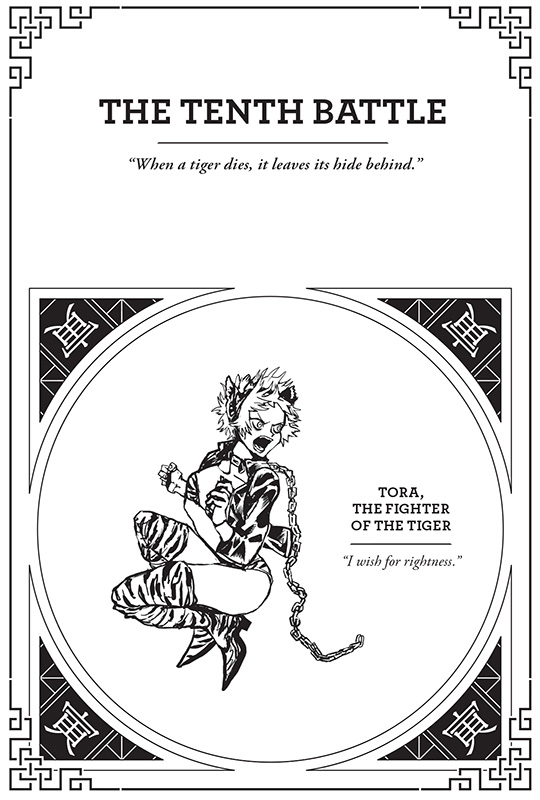

Real Name: Kanae AIRA
Born: January 1
Height: 154 cm
Weight: 42 kg
Kanae claims to use the Drunken Fist technique, but the true style only imitates drunken movements—the consumption of alcohol is not actually required. It would be more accurate to say that she took up Drunken Fist as an excuse to drink. In truth, she possesses extensive knowledge of martial arts beyond her favored method. The Aira are a military clan focused on hand-to-hand combat, and Kanae is quite a remarkable warrior, even among them.
One downside to the Drunken Fist style is that its users are often told they don’t look strong, but Kanae in turn believes that only the truly weak need to make a show of strength. Naturally, over time, she became less and less of a visible threat. One could go so far as to say that making a show of weakness was her defining feature. She was incredibly, exceptionally good at it, even if it wasn’t a conscious act.
Her fingernails were her only weapon, and being killed by her was a terribly painful way to die. If a survey among her peers asked whom they would least like to face on the battlefield, she would be ranked higher than her relatively infrequent deployments would otherwise suggest.
She likes to keep elaborate decorations on her nails, but before she goes into battle, she always removes her polish. She just wouldn’t feel right killing her enemies with decorated nails.
On her days off, she likes to go shopping with her lady friends, and they inevitably end up going out for drinks.


As perplexing as the White Rabbit and as bewildering as the March Hare, Usagi, the Fighter of the Rabbit, ended his remarkably spirited performance as if snatching defeat from the jaws of victory—but his loss was not caused by a failure to take the battle seriously. The necromanticist’s thoughts were impenetrable to others, and he was a thoroughly odd man, but if nothing else, he approached the Zodiac War in total earnest.
Though his enemies would have preferred a less enthusiastic adversary, he hadn’t blatantly cheated as did Sheep, and he hadn’t actively avoided the fighting as had Rat and Dragon. Viewed objectively, none had matched Rabbit’s diligence in pursuit of the war.
A man like that had most definitely not revealed himself to Ox and Tiger out of simple incaution.
Most observers would likely consider his death the result of a foolish mistake. Though Rabbit had correctly concluded that his minions Dragon and Snake required reinforcements, he could have pursued Rat—the other remaining, and less threatening, enemy—and sent his strongest asset, Monkey, to kill Ox and Tiger instead. Surely that would have been the better strategy—despite his tremendously advantageous ability to befriend those he killed, the necromanticist’s actual talent for combat was decidedly lacking.
In hindsight, Monkey would also have arrived too late to prevent the twins being frozen, but the overwhelmingly powerful fighter would have forced Ox and Tiger into their toughest battle yet.
That said, sending Monkey after Ox and Tiger was only the right choice if winning the Zodiac War was Rabbit’s sole concern. If you looked at it from Rabbit’s perspective—that of a necromanticist who took a medium-term rather than a short-term view—his goals should become clear. Granted, putting one’s self in the mind of that mad hare might be a stretch for an upstanding citizen, but the key point is this: winning the Zodiac War wasn’t going to end the necromanticist’s battles.
No matter how strange or how inscrutable the man was, Rabbit was a warrior. Once he won this war, the next would be waiting. When he won that war, then would come another. As long as he kept on winning, he would have to keep on fighting; such was a warrior’s fate.
His necromanticist’s instinct was to secure the undead allies that might give him a needed advantage in the next fight. There was no telling how much easier his next battle would be with the Natural-Born Slayer on his side—or even Tiger of the Drunken Fist. Their corpses would eventually rot, but they would remain valuable for some time.
Rabbit viewed fighting—or in other words, making corpses—as his only way of making friends. He sent himself to join the fight against Ox and Tiger not because he believed his help was needed—he had come with his dual blades to finish them off. Though he trusted his allies, this was something he felt he needed to do himself. Were they anyone else besides Ox and Tiger, he would have left them to the twins.
When his corpses killed for him, they could go too far—an inevitable consequence of the zombies’ lack of any restraint or inhibition. When Snake roasted Horse to death, Rabbit lost his chance to befriend the stalwart warrior—and harness Stirrup, Horse’s defensive ability. The necromanticist had ultimately found a use for the birds shredded and killed by Boar’s machine guns, but if he left Ox and Tiger to his undead and unfettered helpers, he risked his new friends becoming damaged beyond usefulness. And so, he decided he would be the one to finish them off.
With the Zodiac War’s end in sight, he turned his attention to what would happen after. Such presumptive thinking came with its advantages and drawbacks, but as a warrior he had to think that way—as such, his decision to join the fight wasn’t an outright mistake. If any flaw existed in his reasoning, it was the assumption that Ox and Tiger couldn’t possibly defeat the Tatsumi brothers with such haste and relative lack of injury.
He didn’t base this assumption on the brothers’ lifelong history as a team or their close connection as twins—the necromanticist simply hadn’t imagined that the free-willed pair of Ox and Tiger could prevail over the undead who had no free will. With no minds of their own, Snake and Dragon would never betray each other, but Ox and Tiger should have—at least at some point—been at odds. He couldn’t have conceived his allies would be so ignominiously routed.
When faced with this impossible truth—that living people too could forge bonds of trust, Rabbit knew he had lost—and so, he chose death.
But he didn’t choose death out of despair.
For the necromanticist, the Zodiac War was not yet over.

Seeing Tora, the Fighter of the Tiger, as she was now, it might be hard to believe, but at the time she first went into combat she was a deeply contemplative and serious woman—too much so at times. Raised in a military clan and tutored on their training grounds, she was taught that fighting, with its barbarism and violence, was her path.
When she ventured onto the real battlefields, she thought and felt in too much earnest. Unable to switch off her mind, she ruminated over each of her commanders’ orders. She found herself thinking, Why do people have to fight each other? and How much worth is in a life? It only progressed from there. As she danced through blades and bullets, she tormented herself with thoughts like Do humans deserve to live? and Wouldn’t the world be better off if we went extinct?
She was too pure for that way of life—pristine even. She lacked that tainted quality that enabled others to shunt away or repress feelings of guilt and awareness of surrounding corruption. As she continued killing her enemies, her actions stayed with her, and her misgivings grew heavier, eventually affecting her in her daily life.
She began to see the world as filled with hypocrisy and contradiction. What she had once seen as just and right was now mere façade; what she had once seen as harmful evil was what propped up the system from within.
She had believed she fought to bring about peace but realized the insignificance of her accomplishments as an individual: that in saving someone, she hurt someone else. When she thought she’d saved a country, the new government collapsed under its own illegitimacy. The more she fought, the more the wars increased in scale. Eventually, she realized that she was being sent into wars for the purpose of further intensifying the conflicts.
It was also true that without those battlefields, some people would have no reason to live. Fighting brought happiness to many people, and an equal measure could find happiness in only that way.
Her belief that she was doing the right thing seemed nothing more than a cliché now. To consider herself a good person would have been about as meaningful as the summary on the back cover of a children’s picture book.
Her life’s path was nothing more than a paved road.
Except there wasn’t even a road at all.
She felt as if she was walking on a muddy expanse, a bog sloshing stickily under every footstep, threatening to twist her ankles—and just as no fish would live in waters that were completely pure, no road could be built upon unstable earth.
And yet everyone else constantly extolled their ideals; rather than admit the world was corrupt, they spouted pretenses of morals and the ability to tell right from wrong. When she thought about the ridiculousness of all the artifice, Tiger felt like she could puke.
To hold fast to her path would be to face constant pressure coming from all sides to turn that path astray. As much as she tried to walk straight, as straightforward as she tried to live, the world would never permit her to continue. Wherever she went, the road ahead of her was closed for construction.
In the end, Tiger left her path.
Before anyone else changed her course, she left it of her own free will—by turning to alcohol.
When she was drunk, she didn’t have to think. Nothing troubled her anymore. The contradictions of the world that had weighed upon her never entered her swaying vision. If her footsteps were caught in a mire, she could simply crawl instead. On her hands and knees, she didn’t feel so nauseous.
For better or worse, Tiger didn’t become a pacifist like Monkey. It wasn’t because she was too weak or a bad person—she was simply too innocent for it. She didn’t have Monkey’s good kind of stubbornness or Chicken’s bad kind either.
Ironically, the more Tiger pickled herself in alcohol, the better a warrior she became. It was as if her talents had been awakened—though despite her claims, she didn’t become stronger the more she drank. Rather, the alcohol saturated her mind, erasing all the troubles that had settled inside her and leaving no room for other unnecessary thoughts. Those thoughts and troubles—or, by another name, her sense of ethics and morals—had been cast aside. Whenever she began to remember them, she drank whatever she could find, no matter what kind or what proof.
She’d often been told her heavy drinking was physically harmful, but she preferred drinks that were bad for her body over thoughts that were bad for her mind. If the world in which she believed was rotten, then she could rot a little too.
She stopped caring what became of her. She truly thought she’d be better off if her very blood fermented into alcohol. The earnest and hearty girl had grown into a cynical and unhealthy adult—or, if that’s too redundant, she became an adult. In a way, that was what growing up was.
Tiger thought she was just going through a slump, like could happen to anyone. Anyone could have a setback and could become discouraged. She began only to go into battle when she felt like it, and her fighting grew increasingly perfunctory. Despite this, she still got results, and her reputation increased rather than plummeted. This approval was another of life’s contradictions that continued to hound her.
She received more praise now that she wasn’t trying than she had when she took everything seriously. That thought drove her to drink even more. For what had been all her effort? Where had her diligence gotten her? For what had she been striving?
At some point, Tiger started getting drunk on blood. Blood and alcohol were the only things that could make her forget everything else. She had once been a superior student, but now she felt her intellect slowly but steadily wane. No matter how much she lost, it didn’t hinder her on the battlefield.
She lost her ability to strategize and started fighting haphazardly. It didn’t hinder her. She stopped being able to remember the names of her allies, so she started fighting alone. It didn’t hinder her. She lost the ability to read expressions, so she quit looking at her enemies’ faces. It didn’t hinder her. She stopped being able to tell the difference between who was important and who wasn’t, so she started treating everyone as though they were unimportant. It didn’t hinder her. She couldn’t read maps anymore. It didn’t hinder her. She stopped being able to read kanji that had more than six brush strokes. It didn’t hinder her. She could still do multiplication, but not division. It didn’t hinder her. She had long since become unaware of what day it was, but now had to struggle to remember her own birthday. It didn’t hinder her. She could no longer walk in a straight line. It didn’t hinder her. She couldn’t even tell if she was still alive or if she was dead. It didn’t hinder her. None of it did.
Then, one such unhindered day, Tiger met a lone master.
In one exceptionally dire battle, she met a warrior. Rather, she was saved by one. Letting the alcohol do the thinking as always, she had made a reckless charge into what she knew was a trap. She had just wanted to get the fighting over with.
Then a dashing swordsman appeared, and with his saber he dispatched the enemy group in the blink of an eye. His was nice, clean swordsmanship, of the sort she once had admired and aspired to attain. He wielded the blade with such precision that to call the display beautiful wouldn’t be doing it justice. In his arm, the saber moved without hesitation, as if he held the conviction that he was doing the right thing in the right way.
He engaged the seemingly limitless enemy in the correct order, taking the shortest appropriate route in the most effective and efficient way. The sight was a bucket of ice water poured over her to wash away her drunken stupor. She couldn’t remember how many years had passed since the last time she had been herself and sober. His transcendent swordsmanship cut her to her heart, and she froze, not moving a muscle.
“Are you hurt, young miss? Did they force you to drink? That’s dreadful. People like that bring disgrace to all fighters. Don’t worry; you’re all right now. I’m not going to harm you. I’ll take you someplace safe.”
Tiger thought, Young miss? Me? It was an easy mistake, as she did look rather childish—the regression of her mental age had reached into her appearance. Either way, the warrior seemed to think he had rescued a civilian—and he might not have been wrong at that. Tiger had long since stopped considering herself a warrior. This phase of her life was, at its essence, a cry for help and for someone to save her.
When she spoke, it wasn’t to firmly insist she was a warrior, or that she was no “young miss,” or that she hadn’t needed any rescuing. Instead, falteringly, fearfully, meekly, and with her words all tangled up, she asked how he could do everything so right—how she could do what was right—and do so without hesitation, doubt, or mistake.
He gave her a puzzled look. She blushed, embarrassed by her question, although whether it was noticeable or not was unclear; she remained, in effect, still drunk. No matter how much her thoughts had sobered, her cheeks had been flushed from the start.
“Hmm,” he said. Apparently, the puzzled look was not directed toward her but toward the question itself. “I’ve never thought about it before. Tell me, young miss, do you want to do the right thing?”
She responded with a demure nod. She couldn’t remember the last time she’d done that. Young miss indeed.
He said, “Well, let me think about it. Sometimes it can be good to put one’s principles of conduct into words.”
He sheathed his saber, and his expression turned thoughtful. Then, moments later, he nodded, seemingly having found his answer—and so quickly, after she had struggled with it for so long.
“First,” he said, “you decide to do the right thing.” He put his hand on the hilt of his saber. “Then you do it.” He drew his sword in a swift, smooth motion, and said, “That is all.”
Decide to do the right thing. Then do it.
Her hopes fell—right off a cliff. The philosophy was so esoteric he might as well have not said anything. Maybe he’d tried to simplify it because he thought he was speaking to a child, but if that was the case, he overdid it by far.
She found herself saying she couldn’t do that, and that was why she hurt.
It was at that moment she realized she still hurt—that she hadn’t forgotten her anguish or washed it away with booze. It had been with her the whole time.
The swordsman said, “Don’t you see? The point is that you can’t do the right thing unless you first decide to do the right thing. One way or the other, people err. Circumstances carry them into misdeed. Without any reason, without any thought, without any intention, they find themselves having been turned astray, onto the wrong path. The opposite never happens. No one says, ‘Without realizing it, I found myself doing the right thing,’ or ‘At some point I must have started doing good deeds,’ or ‘I inadvertently did something right.’ Without intent, there is no being right. Proper conduct requires proper intent. Without first deciding to do the right thing, you can’t do it. If you say you hurt because you can’t do the right thing, that’s because you haven’t decided that’s what you want to do.”
He’d done his best to simplify it for her, but he didn’t pull any punches. Ultimately, his advice remained too abstract for a mere mortal, but his words were just what her tumultuous heart thirsted for, and they stung her core like a disinfecting splash of alcohol in a wound.
The man continued. “There are many reasons not to do the right thing, plenty of causes for indecision and fear. People can blame it on others or on society at large—or even on the times or on fate. But what people who don’t do the right thing must understand is that it’s not because they can’t, but because they don’t. You certainly don’t have to force yourself to behave the right way, but never allow yourself to forget that the choice was yours to make. Everyone who does right follows the steps: decide, then act. To remain on the first step while fretting over the second is the height of folly.”
The master seemed to consider the lesson concluded, but Tiger still didn’t fully comprehend it. They were both warriors, but the gap between them was like that between an adult and a child. Despite not understanding, she wanted to. She wanted to become someone who could understand.
Then, despite her being uninjured, he carried her on his back to a nearby town—as if she really was a child—and she didn’t object.
When they arrived, he said, “Be careful from now on.” Now that he had taken her to safety, he seemed about to return straight to the battle.
Tiger still wanted to talk to him and even faked feeling unwell to try to get him to stay.
“I can’t do that,” he said flatly. “I have other girls like you to rescue. It’s my job. Now, try not to go near a war zone again. I’ll pray that you’ll never meet another killer—another slayer—like me.”
He was right in everything. He walked the right path in the right way. He looked at the contradictions of war with clear eyes, and he battled them head-on.
She felt painfully aware that to him she was just one person among a great many others. She and he were supposedly both warriors, but they weren’t the same. She wondered if only people such as he truly had the right to be called warriors—but the thought didn’t upset her. Instead, for the first time, she felt as if she had a purpose. She hadn’t felt like this when she followed the path she had been taught or when she had decided to stray from it.
The next time I meet that man, she thought, I want to be someone he can acknowledge as a warrior.
He told her he would pray that they would never meet again, but he could pray whatever he wanted.
First decide, then do.
She would likely never understand what was right or what purpose fighting held, but at that moment, she decided to start living again. She decided to reexamine the thoughts she had excised from her mind. On that day, she had found someone to inspire her—someone who had built a mighty wall that closed off her previously unhindered life.

Tiger didn’t have to search long before learning that the master who had given her the incomprehensible advice was also the warrior said by some to be incomprehensibly strong—the Fighter of the Ox—and that his name was Ushii. But the world was large and its battlefields countless. She had been hasty to assume she would encounter him again and was beginning to give up on the idea of ever meeting the master swordsman, when the Zodiac War came.
She went to her family, with whom she had severed nearly all ties, and got on her hands and knees—genuflecting, not crawling—and bowed her head all the way to the floor as she begged them to have her chosen as a competitor. With the next Zodiac War not due for another twelve years, she viewed this as her last chance.
Then, when she saw him, looking as if he hadn’t aged a day, on the observation deck at the battle’s start, she felt so elated she nearly wanted to dance—and she wasn’t even drunk.
And that idiot—that ox of a man—he doesn’t remember me at all! It’s infuriating!
Now he had challenged her to a duel. Without warning, the enraged woman threw herself at him. To launch a surprise attack without naming herself was a breach of propriety that—to quote Ox when he rescued her long ago—would bring disgrace on all fighters. But she had no choice.
She hadn’t the time to say anything—not if she was going to shield Ox from Rabbit’s twin blades, which flew at Ox from behind.
When she pushed Ox aside, she unavoidably put herself in his previous position—right in the path of Rabbit’s blades.
Ahh, damn it, she thought. Just when I’d finally made it. Just when the master had finally challenged me to a fight. I couldn’t get anything to go right in the end.
To say she had shielded Ox wasn’t strictly true—that would imply he couldn’t have handled the attack on his own. Rabbit must have used some aspect of his necromanticist’s power to make a puppet of himself, and if he were one of those walking dead, his strength and speed would have been lessened. And yet despite her lesser expertise, the woman still intervened—but why?
Because I decided to.
The twin blades, Shiro-usagi and Sangatsu-usagi, plunged into the softness of her stomach.
Rabbit’s severed arms had jumped from the ground to attack. Being just arms, they hadn’t the best aim and missed vital points. But the wound was deep—so very deep. Pain didn’t even begin to describe what she felt. If another attack came, she couldn’t have defended herself.
She closed her eyes, preparing herself for the end, when Ox shouted. For the first time, she heard anger and dismay in his voice.
“Tiger!” he yelled, as he threw himself at Rabbit’s eight separate pieces, leaping from one to the other if he were the rabbit, striking each one down.
Without concern for future consequences, Ox carved apart Rabbit’s corpse. He knew that the more pieces he created, the more enemies he would later have to face, but getting out of this situation—and getting out now—was his only concern.
He’d saved the arms for last, chopping them to little bits, scattering them to the ground along with the long-bladed hatchets they once held. He grabbed Tiger by the nape of her neck and fled from the multitude of Rabbit parts. He pulled her up and onto his back, then ran blindly and as fast as he could.
Here I am being carried by him again, Tiger thought.
“Don’t worry, I won’t let you die!” he shouted, trying to keep her conscious, his voice uncharacteristically loud. “No one has ever risked their life to save me—I still have to repay my debt.”
What a load of crap, Tiger thought. I’m the one who owes you for saving my life.
She said, “Let me down.”
Ox drew in his breath.
“It’s okay,” she said, forcing determination into her voice, even if part of her wanted to just let him keep carrying her. “If you keep bouncing me about, it’ll only worsen my injuries.”
“Then we’d better stop the blood flow first. We’ve bought enough distance for now—he shouldn’t catch up with us so quickly.”
Ox did what he was told. He didn’t like the idea of stopping—especially when he imagined what was coming after them—but staunching her bleeding was better done now. He held her face up in his arms, then gently laid her on the ground.
Even to one with his skills, stopping a gut wound from bleeding was not going to be easy. Given the wound’s placement, a tourniquet wasn’t an option. He’d need to find an abandoned hospital and search for medical supplies—but did they have the time?
We don’t, Tiger thought. We just don’t.
“Don’t give up,” Ox said. “If you die here, then what becomes of our duel?”
You’re just saying that because you’re too good to have ever been wounded like this. You don’t know what it’s like. Even if by some miracle you managed to stitch me up in time … I wouldn’t be able to fight. We’ll never have that duel. And so …
“Listen, O Fighter of the Ox,” Tiger said, still on her back. “I don’t need that duel anymore. Just... do me a favor.”
“A favor?”
“It’s more of a plea. I want you to do one thing for me.”
The blood felt like it would never stop.
She growled softly.
If I were just some normal girl, I might ask him for a kiss. But that’s not who I am.
“Please,” she said, “kill me.”
Ox looked at her in disbelief.
She continued, “If I die from losing too much blood... that’ll mean that Rabbit bastard will have killed me, won’t it? And I’ll become one of those walking dead, won’t I? I don’t know much about that necromanticist and all that stuff... but I don’t want any of it. I don’t want to fight you badly enough to die for it.”
Just having you challenge me to a fight made all my battles worthwhile.
“Before that happens, I want you to kill me,” she said. “Didn’t you tell me earlier that you’d kill me so that I’d never become one of those wretched zombies? So, Natural-Born Slayer, just kill me. Give me a fine death.”
Ox looked down at her for a short time, then said. “All right. But we’re going to have that duel. You will lose to me. Now, follow the custom—declare yourself.”
Can’t you see it’s hard for me to speak? Here I am on the edge of death, and you’re still going to be this strict? Except … no, you’re just doing what’s right.
It’s a better ending than I deserve—a good-for-nothing like me dying in a duel against a master. At some point along the way, I made a mess of my life, but at least it’ll have a proper ending.
“One more thing,” Ox said, pointing his saber down at Tiger. “Why do you have a grudge against me? We have met before, on some battlefield, haven’t we?”
At first, Tiger said nothing, then she pointed her claws at him. “I’ve got no grudge. We’ve never met before. I just hate dreary men like you.” She growled.
“I am Tora, the Fighter of the Tiger. I kill with drunken power.”
“I am Ushii, the Fighter of the Ox. I just kill.”
It was over in an instant. The master did the right thing and killed the dying woman.
She was Tora, the Fighter of the Tiger, drunkard and wielder of the Drunken Fist—and in the history of the Zodiac War, she was the first to lose and still get her wish.
Ox vs. Tiger
End of the 10th battle