6
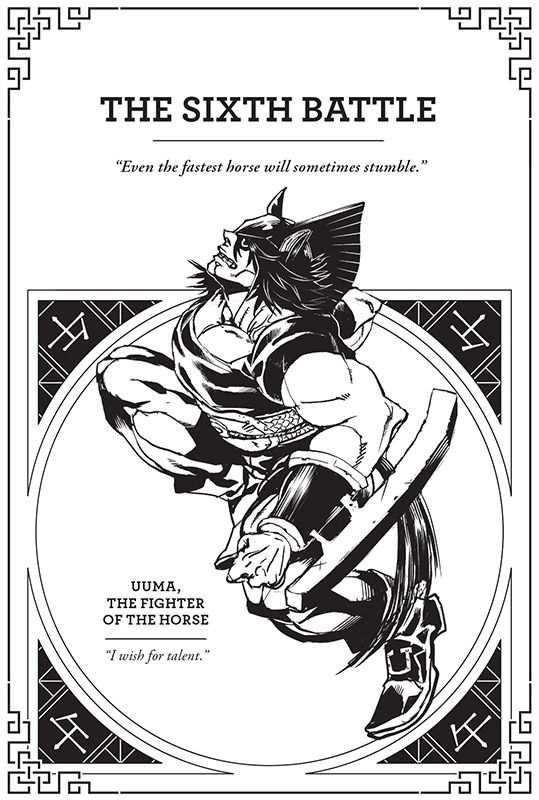

Real Name: Yoshimi SŌMA
Born: September 9
Height: 230 cm
Weight: 150 kg
In his teens, Yoshimi was tall but slender, but after experiencing a decisive defeat in battle, he took up bodybuilding. He augmented his physical training by unhesitatingly reaching out for drugs to alter his body chemistry. The result is the most physically massive man in the history of the Sōma clan.
He is known as a man of few words, and only his closest associates have heard him speak, aside from when he announces his name before battle. (As a fact of little relevance to this document, he has a very nice voice.)
In battle, he fights with a stoicism befitting his quiet nature. It goes without saying that the attacks launched by those powerful muscles are extraordinary, but most notable is his defense. He has a special ability he calls “Stirrup,” which can increase the toughness of his body beyond normal human limits.
Incidentally, he intended to name this ability the rather unremarkable “Armor,” but he made a mistake when writing the kanji. Luckily, it still fits him rather well.


The Zodiac War, held once every twelve years—now that only half the participants remain, allow me to reveal what I can of the inner workings of the Zodiac Wars.
As I’m sure you’ve guessed, the chosen warriors do not stake their lives and souls in a bloody contest of ability, talent, skill, and sometimes luck simply to determine which among them is the strongest. For one thing, the Zodiac War militates against good sportsmanship, but its hidden workings are perhaps even uglier and more unsavory than its gory surface.
There is a reason these fighters, who normally do battle in war zones across the world, are assembled to compete in the same place.
When the organizers of this Zodiac War sacrificed an entire city to serve as the battle’s stage, the measure wasn’t some atypical extravagance or splurge. For one past Zodiac War, they destroyed an entire mountain range; for the ninth—the largest-scale event so far—they utilized a space station. Not only do the organizers go to great expense to prepare the battlegrounds, the prize—the granting of any single wish—could, depending on the wish, be of astronomical cost.
The organizers go to such extreme lengths to hold these Zodiac Wars, at the not so infrequent timing of once every twelve years, because it serves as a war via proxy.
The Zodiac War is held at a great cost of wealth, lives, and land, but only fought by twelve chosen warriors. The imbalance is, on its face, absurd. But the twelve fighters don’t fight as representatives of any particular nation; in fact, nations are nothing more than gambling chips in the hands of the ultra-elite.
A few individuals, wielding far more power than any country, compete for nations in a fair and controlled manner—for example, a Chicken win could be worth two countries; a Monkey win with Ox in second could be worth three. Depending on the results of the Zodiac War, nations can change owners, be created or destroyed, or merge or gain independence. The world map is redrawn.
Of course, the twelve fighters know nothing of this arrangement. Each puts their life on the line for their own reasons.
The betting takes place once six warriors remain, as they’ve now had sufficient time to display their strengths. For the Twelfth Zodiac War, the survivors’ odds have been ranked as follows:
1) Ox
2) Rabbit
3) Tiger
4) Horse
5) Dragon
6) Rat
Having shown astounding ability in his fight against Chicken, Ox has secured his place in the lead as many had expected of him, but Rabbit’s position in second comes as something of an upset. This is undoubtedly due to his powers as a necromanticist. Depending on how effectively he puts his two corpse followers to use, he has a solid chance at victory. Both he and Ox are far ahead of the pack.
As for the rest, Tiger, in third, also came into the contest with no expectations, but her defeat of the veteran among veterans was the likely cause for reconsideration. Dragon ranks low not because of anything he has done, but because he has lost his brother and partner. And Rat—on the one hand, he’s seen as too young, and on the other, he’s shown no interest in the fighting. Neither Dragon nor Rat has performed any noteworthy actions in the contest thus far, but Dragon likely places the higher of the two because at least something is known of his ability. The same can’t be said for Rat.
But what I want to focus on is not them, but the fighter in fourth place, which is not a good ranking, but also certainly not bad—neither a sure bet nor a long shot, but a bet with average odds. I’m talking about Uuma, the Fighter of the Horse.
In a survey conducted before this Zodiac War, the elite betters ranked Horse near the very top of the competitors. In a battle royale, where survival means victory, his impenetrable defense—equated by some to the aegis shield of lore—should be a considerable advantage.
Why then, at the halfway point, has he failed to follow through on expectations? The answer comes next in the story—but before you read on, perhaps you would like to consider the official odds and try to predict who will win. If you have any countries to wager, the ultra-elite will call all bets.

Before Chicken was defeated by Ox, and her body was given a Sky Burial, she saw the matador’s bloody saber and assumed that he had killed at least one other fighter, but that conclusion was a hasty one. Chicken could hardly be faulted for believing the rumors that surrounded the Natural-Born Slayer—indeed, up until that day, none had ever faced Ox in combat and survived—but his perfect killing streak had been broken just shortly before she met her death at his hands. Against his previous opponent, his saber had wounded its intended target, but he hadn’t been able to make the kill.
Even though a single thrust of his blade had always been more than enough to kill, Ox took the precaution to stab Chicken in both her eyes due to the experience he’d just had. If the encounter had been enough to rattle the Natural, it would have stricken terror into the heart of an average person.
That being the case, this enemy who faced Ox and lived should have been proud at breaking the Natural’s perfect record. But that wasn’t the kind of person Horse was.
Horse was Horse. Now, for the first time, he had been wounded—both in body and in spirit. Anywhere and anyone he fought, he had never—literally never—received a single scratch, but now his armorlike body, the product of the technique he called Stirrup, was covered all over with saber wounds.
None had been fatal, and most were mere scrapes. None had penetrated to his bones or internal organs, and few even reached his muscles—but wounds were wounds. A good number of them even looked like they would leave scars. The thought of it left his well-earned pride as shredded as his skin.
He hadn’t been able to counter Ox’s attacks by any measure worth reporting, and though their match resulted in a draw, it was only because Horse hadn’t died—to him, the tie felt like utter defeat.
But his betting odds hadn’t languished in the middling ranks simply because of the great number of physical wounds he had. By virtue of simply having survived Ox, Horse’s popularity should have risen, if anything, but his actions after the fight made for a tremendously poor impression.
Horse fled into the vault of a major bank, barricaded himself inside, and then did nothing. The man with the impenetrable defense had shut himself away to wait for an attack to come. From no possible perspective did the strategy make any sense. With the time limit imposed by the poison jewels, no great leaps of logic were needed to realize that holing up somewhere wouldn’t work.
The only conclusion to be drawn from Horse’s actions was that the nearly two-meter-tall warrior was afraid to face Ox again, and now, broken and demoralized, he had confined himself away from the battle. That his odds hadn’t plummeted all the way to last place was a small miracle.
Of course, Horse didn’t know of the odds assigned to him by the gods on high, and he cared nothing for what others thought of him—but no one found him more a disappointment than he did. Contempt and disgust might have even been better words for what he felt toward himself.
He wasn’t lacking in excuses for the stalemate had he wanted to take solace in them. When he encountered Ox, Horse didn’t think it was going to turn into a fight. Maybe he should have known better, but they shared something in common—both had supported Monkey’s proposal in the starting room. Then, when Rabbit had raised his hand, Ox and Horse lowered theirs in unison. Even though the collapsing floor cut Monkey’s alliance short, the two men could have been considered a moderate faction by virtue of showing interest in a peaceful solution, should one have existed.
When by chance he encountered Ox, Horse hoped the two could team up. With Ox’s sword-fighting skills and Horse’s defense combined, teaming up would have been like equipping themselves with the spear that could pierce all shields, and the shield that could block all spears—unstoppable force and immovable object working in tandem. So great would be their advantage they might have been able to shape the battle as they wished. But that didn’t happen.
Horse felt ashamed—ashamed that he had let himself hope he would be so lucky. So strong was his shame that he wanted to tear out his hair. Of course, with his impenetrable defense, he couldn’t have plucked a single eyelash even if he tried with all his might. His flesh had been carved with wounds even he couldn’t have made.
In his present state of mind, Horse wouldn’t have felt any better knowing that his judgment had been fundamentally correct—he and Ox were the moderates among the twelve fighters of the Twelfth Zodiac War. Horse was Horse, but the Natural-Born Slayer—though he brought merciless massacres to every battlefield he graced—didn’t fight because he enjoyed it. If calling a professional soldier a moderate would be too much of a stretch, think of it this way: fighting was only a job to him, as opposed to Ox’s polar opposites, Rabbit and Tiger, who fought in order to kill and took pleasure in combat.
Though Horse couldn’t know it, Ox had an unobvious reason for forcing the fight. After the eleven combatants were separated, the muscled giant ran into Ox first. But Ox had encountered another before him—although to be precise, he didn’t encounter this other fighter, because he was very careful to steer clear of the ashen-faced walking corpse belonging to the woman who used to be the Fighter of the Boar. At that point, Ox didn’t know that Rabbit was the one controlling her, but he inferred from her presence that a necromanticist was among the twelve combatants.
The moment Ox reached that conclusion, finding a peaceful resolution to the Zodiac War was no longer an option for him. Instead, he decided he needed to kill as many of his opponents with his own hands as he could. A necromanticist gained dominance over those whom he killed—if Ox stood idly by, this adversary could forge an unbreakable alliance of up to eleven people. The only way Ox could prevent this outcome was to kill the other fighters before they were killed by the necromanticist. Though the moderate Ox might have allied himself with his opponents under different circumstances, killing them had become an act of mercy; it was the least he could do for them. Compared with the necromanticist defiling their corpses, a quick and painless death at the hand of the Natural-Born Slayer might deliver them more peace in the afterlife. Unlike Horse, his moderate counterpart, Ox possessed the pure talent that allowed him to make that decision.
Regardless, Horse had no way of knowing Ox’s intentions, and when abruptly faced with the battle, the giant hadn’t been mentally prepared. The Natural, on the other hand, having already decided to kill the other fighters, was vastly more resolute.
But excuses were only excuses. The battle had been abrupt, but Ox didn’t catch him unaware or unguarded; the matador gave the proper introduction and even allowed Horse time to prepare himself before lunging with that saber. Ox’s conduct had been beyond reproach, and the fight was fair.
Though thrown into disarray at first, Horse was soon fighting to kill, and the ultimate stalemate mortified him. No wonder he wanted to hide. It bears repeating that the mere act of surviving against that master saber-wielder was a spectacular feat—but that made for cold comfort when the bodybuilder’s devotion to his muscles was practically religious. In a sense, Ox’s attacks had pierced his defenses and inflicted critical damage to the core of who he was. Even if Horse had from now to the end of the Zodiac War, it was not an injury from which he would easily recover.
But for a man who boasted such an impenetrable defense—or rather, if that label no longer applied, then a peerlessly robust defense—to now barricade himself in a bank vault was like protecting a steel statue with a plastic case. It was nonsensical.
Withdrawing from the battle was the lowest course of action a warrior could take, but as a human, as a living being, the choice was not necessarily a bad one. Looking at it from a different perspective—from a proper distance—the notion was hard to dismiss as merely foolish—not when winning this Zodiac War required collecting the swallowed poison jewels. If just one participant vacated the field of battle, the rest would all die from the poison. The way the contest was set up, even the weakest fighter, who might have little chance at victory, possessed the real potential to make the rest die with him.
The strongest fighter, then, needed to avoid overwhelming the weakest fighters so thoroughly that the weak would abandon the contest—and in Horse’s case, Ox had gone too far. Once Ox crossed that line, he needed to do everything in his power to make the kill. Maybe the natural-born warrior couldn’t fathom what it felt like to not be dead but broken-spirited.
Setting aside the discussion of the nature of Ox’s virtuosity for another time, when Horse lost his will to fight and barricaded himself away, he put the more likely winners, like Rabbit and Ox, in greater jeopardy. For all twelve fighters to die would be an unsatisfying end to the contest, but what reason did Horse have to give anyone a satisfying ending?
Horse wasn’t even sure he’d die from the poison when the time limit ran out. That would depend upon Stirrup. If this were a role-playing game, Stirrup bestowed upon him the defense of a post-game item. If his special ability could protect him from external attacks, then maybe—just maybe—it would work against internal attacks—even poison. That could have been his advantage, just as Rabbit the necromanticist could gather a tight alliance, and Dog had neutralized the poison in his body, and Chicken’s Eye of the Cormorant lifted the fog of war. If he, too, possessed some advantage tailored to the rules of the game, maybe this was it.
Of course, Horse had no proof behind this theory, and it wasn’t as if he barricaded himself in the bank vault having thought through any such plan. But if all the other fighters died from their poison, and Horse alone survived, then maybe the result wouldn’t count as a victory under the rules of the game, but as a living being, survival itself was a victory. As Sheep would have said, to live was to win.
Given this unexpected turn of events, the warriors who were still fiercely competing now found themselves in a precarious position. The likely winners—Ox, Rabbit, and Tiger—all possessed abilities that focused on fighting other people—none had the capability to smash through a barricade that had no entrance or exit. The only ones who had possessed that kind of pure destructive power had been Boar and her machine guns and Sheep and his grenades, but both fighters had already passed on to the next world. Barring any dark horse upsetting the contest’s current trajectory, the Twelfth Zodiac War would reach an ignoble conclusion.
The worst ending, however, would be if Horse’s Stirrup proved ineffective against the poison and he died like the others, only all alone in the vault.
Then a voice said, “If we don’t get some light in here, I’m going to fall asleep.”
A light then sprang to life and pierced the pitch-black darkness inside the vault. It seemed like magic, although the source of this light was purely technological, the exact opposite of fantasy. Though everyone walked around carrying one of the gadgets, it represented the culmination of modern technology—a smartphone. The glow of the awakened screen illuminated the vault and revealed not only the giant man slumped over, hugging his knees as he sat on the floor—but also the smartphone’s owner.
He was a boy in his mid-teens—of the demographic perhaps the least surprising to own a smartphone. It was the Fighter of the Rat, though Horse only knew him as the napping kid from the high-rise.
Rat’s sleepy eyes were fixed on his phone, like a commuter checking his email on the train. Without looking at Horse, he mumbled, almost as if talking in his sleep, “They say the glass they use on these smartphones is the same stuff the military uses. I heard about this guy that got shot with one in his pocket, and the phone stopped the bullet. Like an urban legend or something. You think it’s true?”
Without waiting for an answer, Rat continued, “You know, when I get a new phone, I’m the type who cracks the screen on purpose, first thing. The screen gets these radial cracks, almost like a spider web. It looks kinda badass, right?”
Horse hadn’t heard of anyone who broke their new phones on purpose, let alone that there was apparently a “type.” Horse was the type who never even removed the protective film. One could say that he had holed himself away in the vault because he spent his life fearing such scrapes, and that touches upon a serious, broader social issue, but this was no time for a therapy session. A more pressing question was at hand—how had the boy gotten inside?
Answering the unasked question, Rat said, “Oh, don’t worry about that. The thing about rats is, they always find their way in through even the smallest cracks.”
A crack? When Horse had entered the bank vault, he broke the lock behind him. The vault door was already built to keep intruders out, and he had enhanced the bulwark even further with a hastily constructed barricade of the heaviest objects he could find. Horse couldn’t guarantee that, given infinite time to search, an invader would never find a way through, but he was certain he hadn’t left any gap or any crack that could have been found and exploited so quickly.
Yet here the boy was.
“I am Nezumi, the Fighter of the Rat. I kill inexorably.”
Rat tossed out his introduction without even looking up from his smartphone. There was nothing of the fighter left in Horse, but he responded by rote.
“I am Uuma, the Fighter of the Horse. I kill in silence.”
Here he was calling himself a fighter when he didn’t even feel he deserved to be called the head of the Sōma clan. Until now, all he had felt was fear; for the first time, he felt self-loathing.
If Rat noticed, he didn’t show it. “Okay,” he said, eyes still glued to the glowing screen. The boy gave no indication that he was going to attack. From the battle’s start, he hadn’t once shown any interest in fighting. Since Horse was in no condition to fight, he owed his life to the boy’s apathy.
But Horse still had questions he would have liked to ask, like, “How did you get in here?” or similarly, “Why did you come in here?”
Unprompted, Rat said, “Oh, I just needed kind of an emergency shelter. Like a panic room, right? This Snake guy is chasing me. Well, I say Snake guy, but he’s really a corpse. I was supposed to be chasing him, but things happened. It’s like I’m being surrounded by the coils of a boa constrictor. Well he is Snake, eh?”
Horse didn’t know what the boy was talking about. Rat certainly didn’t seem to want to stop and explain either—it felt like he was talking to himself, if anything. A fighter who didn’t talk and a fighter who talked to himself, together in a locked room—just where was this going?
“Say, you were on board with Monkey’s peace proposal, weren’t you? Since you’re letting me crash here, I’ll let you know—that all went up in smoke. No Monkey, no peace. And Monkey got herself killed. That pacifist was at the heart of whatever plan she was cooking up, so that’s finished now. You know, I shouldn’t speak ill of the dead, but she was a real loser. It’s like, what good does all that talk about peace do when you’re killed? She never even told anyone what her plan was. Now it’s gone with her. You ask me, I think she might have just been making it up. She saw negotiating ceasefires as her heroic duty, after all. So maybe the first step was just to say anything she could say to stop the fighting, and then everyone could think of a solution together, or something like that. Sounds believable to me. No matter how prim and proper a front she put on, a hero would still pull a trick like that for the right cause. Don’t underestimate her hollow words, right?”
These half-mumbled ramblings weren’t enough to give Horse a good picture of what had happened outside, but he caught the part about a top competitor being killed. Who had killed her? Was it Ox with his saber?
“I just don’t get it,” Rat said. “Just how important is peace anyway? If everyone just stays on the defense, like you’re doing, the world will stop changing, won’t it? Audacity and mischief, that’s what brings change and evolution. A world that’s gone still is no different than a world that’s been wiped out. Just like how you’re the same as dead right now.”
Horse didn’t know what the kid was talking about. He didn’t want to know either.
“Being alive without taking action is the same as being dead. Compared to that, those corpses under that freakish rabbit’s control seem more alive. Say, you don’t know where that Sheep geezer is, do you?”
Sheep … geezer? Did he mean that old man who asked about his use of explosives? Horse had a vague recollection of the man, but why did this boy want to know his whereabouts?
“Ah, you don’t know,” Rat said. “That’s fine. Well, don’t worry about it. All right, I’d better get going. Hiding away in a place like this would be too demoralizing—or like being a horse with a busted leg, waiting to get shot. Bye then.”
The boy put his phone to sleep as if he’d finished replying to his mail. The vault plunged back into total darkness, and the boy seemed to have gone.
Then Rat said one last thing. “That Snake guy might come here looking for me. I think you should escape too. At least, you should do something, anything—that is, if you’re still alive. If you want to keep living.”
By the time Horse’s eyes adjusted to the dark, the boy really had left. Rat’s parting commentary was as arrogant as his invasion of Horse’s sanctum, but the fact was they were in the midst of a battle. The broken-spirited fighter should have been thankful that Rat had spared his life. He wondered if maybe he should take the child’s advice. If he simply blamed Rat for bringing danger to this place, then Horse would be the arrogant one.
But where could Horse run? Outside was Ox, the Natural-Born Slayer. However dangerous remaining in the vault might have been, going out there was far worse.
The mystery of how Rat had slipped past the barricade remained, but Snake—or was it Snake’s corpse—would surely be incapable of the same feat. Even if Horse took Rat’s warning in earnest, remaining barricaded in the safety of the vault still seemed the best course of action. As long as he was safe, he needed nothing else.
Rat’s words echoed in Horse’s mind. “A world that’s gone still is no different than a world that’s been wiped out. Being alive without taking action is the same as being dead.” For some reason, he couldn’t shake them. Again and again, the phrases repeated, dizzying his thoughts.
They were just the casual teasing of some kid who knew nothing about how the world worked. They were just one-sided ramblings which Horse had no need to take seriously. But he couldn’t get them out of his mind.
To shelter, to withdraw, to do nothing; to no longer need to fight should have been the easiest thing in the world, but instead it felt stifling—so oppressive, so suffocating, Horse could hardly breathe.
He could hardly breathe.
Suddenly, Horse realized it wasn’t the boy’s words that were making him feel this way, but by the time he stood, the vault was already filled with smoke, the shadows taken over by black clouds. Something was burning.
Not something. Everything.
The entire vault was burning. The temperature was rising with no end in sight, and the air carried an acrid stench so foul and so powerful it almost made Horse faint.
But the vault wasn’t just burning.
It had been set on fire.
Had someone judged his barricade too strong to be destroyed and decided to burn it? What, to melt it away? It made no sense. Horse’s defensive ability, Stirrup, would not be so easily damaged, even from the heat of a blaze.
But even though Stirrup was resilient against damage inflicted upon him, it was not so robust against damage resulting from something being taken away. Human life required oxygen, and so did fire; if the latter consumed all the oxygen, then the fate of the former was certain.
Confronted by this primitive, primal force—this chemical action—the silent warrior (or rather, former warrior), who sought survival through inaction, released a final cry that might have been a whinny.

The headless corpse stood before the burned-out husk of the bank. He had set fire to the vault, barricade and all—or rather, it wasn’t he who had done it. Yes, the liquid flames had been spewed by the flamethrower strapped to his back, the one he had worn as the Fighter of the Snake before his head was taken from him, but his actions after his death were under the necromanticist’s command.
His current command was to pursue Rat, and Snake had only set fire to the vault as part of the chase. Though he had no head with which to see or speak, he sensed that he had failed to finish the boy off. He didn’t linger over the building’s smoldering remains; he simply turned his back, and tenacious as his namesake, he pursued his prey.
In this way, Horse, the defensive giant, succeeded in escaping the battle—by being defeated without a fight.
Rabbit vs. Horse
End of the 6th battle