7
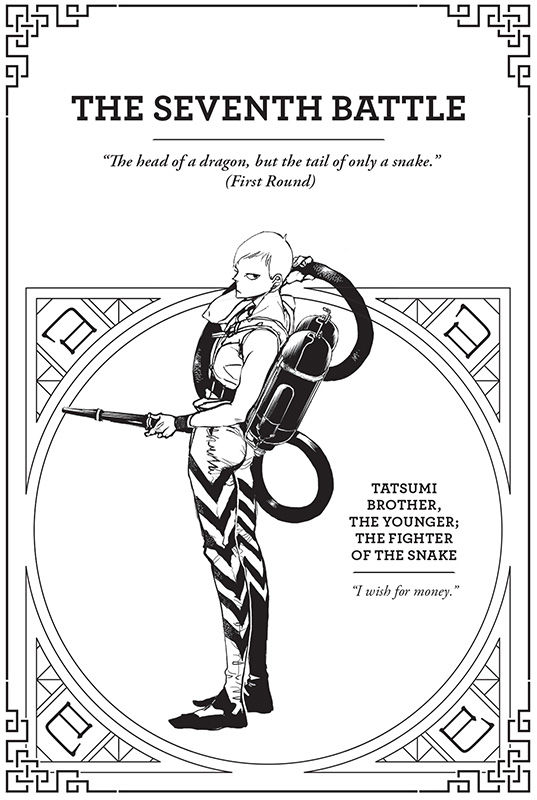

Real Name: Takeyasu TSUMITA
Born: October 10 (officially)
Height: 164 cm
Weight: 58 kg
Takeyasu is a young warrior who fights alongside his elder twin brother. Such fiercely idiosyncratic fighters rarely band together on the battlefield, but Dragon and Snake provide a legendary exception. Their superiority in battle goes without saying; though they are only the most recent of a long line of Tatsumi Brothers, they work together better than any in history.
The younger brother favors weapons of flame in battle, and he has a reputation for starting fires so devastating that the bodies of his enemies can’t be told apart from one another. He often claims that without the outlet his mercenary career provides him, he would have been a serial arsonist. He is undoubtedly a most dangerous man.
He calls the flamethrower he wears on his back Hitokage, written with the kanji for “person” and “shadow”—the implication being that he will burn people until not even their shadows are left. That the name shares the same pronunciation as the word for “salamander” is intentional.
At home, he raises a wide variety of reptiles. He publishes an anonymous blog, which is incredibly popular among fellow enthusiasts, about his experiences raising the creatures. Whenever a precious pet passes away, he grills the reptile and eats it. Unlike the battlefield, where he doesn’t give any thought to those he kills, when it comes to his pets, he looks after them all the way to the end.


Five challengers remained in this, the Twelfth Zodiac War. In zodiac order, they were: Rat, Ox, Tiger, Rabbit, and Dragon. To recap their accomplishments, Rabbit had killed Snake, Boar, Monkey, and Horse; while Ox and Tiger killed Chicken and Sheep respectively. Rat had not defeated anyone, and Dragon had not yet been in a fight. That said, the Zodiac War was not a contest of who could kill the most people, nor was it at all relevant who among the fighters was the strongest. In some cases, depending on the rules and the course of events, a person might claim victory without ever fighting any opponents.
Based on all present knowledge, one fighter—Rabbit, the only to form a lasting team—held an overwhelming advantage over his enemies. Not only had he successfully formed an alliance, his corpses acted as a monolithic unit over which he held absolute command. He had lost the former Fighter of the Boar to a ravenous flock of birds, but his remaining forces continued to pose a considerable threat to the other fighters—and now that fewer than half the combatants remained, Rabbit and his minions were a greater danger than ever.
The second half of the Twelfth Zodiac War would now hinge upon the eradication of Team Rabbit. In theory, the simplest solution would have been for the other four fighters to join forces, if only temporarily, and fight as one team against another. That idea, however, was doomed to remain a fantasy. The fighter most capable of building an alliance was Monkey—who now belonged to Rabbit—and of the remaining living challengers, Dragon—who had not yet battled any opponent, and whose movements remained a mystery—was unlikely to cooperate. In all of Dragon’s experience on the battlefield—and off it, in his daily life—he had never worked alongside anyone except his little brother.
At present, the surviving fighters had no practical course of action to thwart Usagi, the Fighter of Rabbit, and his corpse army.

I am Tatsumi the Elder, the Fighter of the Dragon. I kill for the money.”
“I am Tatsumi the Younger, the Fighter of the Snake. I kill for the money.”
The brothers would never again stand shoulder to shoulder, striking an intrepid pose, and announce themselves in unison. For one thing, the younger brother’s vocal chords had been severed in two. Unable to hear, smell, or speak, his headless corpse wandered the ghost town that served as the Zodiac War’s battlegrounds. The roaming dead seemed a perfect fit for an abandoned city, but this corpse wasn’t simply walking at random.
He walked with a purpose—not his own, as he possessed no consciousness, but a purpose nonetheless. His superior had assigned him a command as relentlessly unfeeling as the corpse itself—kill the Fighter of the Rat.
He didn’t have to understand whom it was he pursued. Nothing mattered to him anymore. Without a consciousness, he couldn’t think; without thought, he couldn’t make any decisions; without making a decision, he couldn’t stop. The corpse kept on walking and kept on moving.
That he couldn’t see or hear didn’t matter either. Much like the slithering reptiles with which Snake shared affinity, the fighter’s feet detected minute vibrations in the ground that allowed him to sense and react to his surroundings—although to be clear, he was dead, so he didn’t sense anything. He merely reacted to the stimuli, like a dissected frog hooked up to electrodes, each jolt spurring its legs into motion.
The detailed mechanics aside, Snake’s unique ability—Earth’s Guidance—served as a kind of sonar that would lead him to Rat wherever the youth fled and hid—even if the hiding place was, for example, a bank vault. But a zombie was still a zombie, and Snake didn’t move with great speed, but because he had no conscious self, he would never give up his tireless pursuit, not until his legs rotted and snapped—and possibly not even then.
Meanwhile, Rabbit kept Snake’s head and took it with him to a new location. Rabbit had made excellent use of the severed head in his fight against Monkey, and he seemed to have another use for it in mind now.
That brings up a difficult question that once raised may never be settled—what constitutes a person? Which portion of the human body is the man? When Snake’s head was removed from his body, in what part did his essence dwell? His mind was in his head, but his heart was in his chest; his hands were what used tools, his legs were what walked.
To take the question a step further, at what point could a person be said to have died? Even when a person’s heart stops, if their heart can be restarted within five minutes, their brain might not be affected. If a person’s brain stops functioning, modern medical science can keep their body alive. What about judging by volume? The human liver accounts for a miniscule portion of the body, but remove it, and that person would have a lot of trouble staying alive. A haircut doesn’t hurt at all, but a person’s hair still contains their unique DNA. When children lose their baby teeth, can those teeth be considered separate lives? What about a corpse? Even a body declared dead, with its pupils dilated, still retains warmth for a time. Is that warmth entirely separate from life?
As a question of bioethics, the subject may never be settled, but fortunately for Rabbit and Snake, the necromanticist had no ethical code, and the corpse no consciousness—neither found themselves troubled by the matter. By Rabbit’s unfeeling orders—no lingering warmth to be found in his machinations—Snake, the headless corpse, would prowl the abandoned streets until he caught the escaped rat.
Someone hiccupped.
With footsteps even more faltering than those of the corpse, a drunk woman moved into his path.

The Zodiac War had progressed beyond the initial standoff phase—where the fighters felt out the situation and each other. Partly, this was due to the handful of fights that had already broken out here and there, but the bank fire started by Snake became the deciding factor. The blaze spread across a far wider area than just the vault itself, with plenty of combustible material to keep the fire burning for quite some time.
A giant column of smoke rose like a beacon above the abandoned city and commanded the attention of the remaining combatants. Its message was clear: like it or not, the battle was not merely half over—it was entering its endgame.
Neither was the message lost on the drunken Tiger. Following the smoke plume, she staggered there from the park on tottering legs. Skunk drunk and wearing next to nothing, the young woman made for a repulsive sight, but Snake had no reaction. The repugnance he might have once felt toward her was nowhere to be found in him.
The corpse didn’t need to feel anything; he simply mechanically followed Rabbit’s instructions: to kill any warriors who stood in the way of his search for Rat. That his opponent was a young woman, or a drunk, didn’t concern him—nothing did.
Tiger growled at him, then slurred, “Huh? What’s with you? Did your head fall off somewhere?”
She regarded the zombie with a bewildered tilt of her head—tilting so far that hers too might have been about to fall off. Tiger was as yet unaware that a necromanticist was among the fighters, and stumbling across a roaming, headless corpse should have come as an extreme shock to the drunken woman, but that was the extent of her reaction—either because her blood wasn’t doing a good job of reaching her brain, or the alcohol was doing too good a one.
“Wait, I remember you,” she said. “You’re that guy with that badass weapon on your back.” Then she laughed and pointed a mocking finger at him. “You got killed before we even started.”
The insult, of course, didn’t anger him. Had he still been alive, he would have likely been enraged—he had despised this kind of woman before his death—but he had no likes or dislikes now; no prejudice and no disdain.
Seeing that he wasn’t going to respond, she continued, “Well then, what am I going to do with you? This is complicated. I’m not good with complicated.”
She had no idea what to make of this walking corpse—either she didn’t know anything about necromanticists, or she was too drunk to remember.
Then Snake attacked.
“Whoa!” she said, performing a backflip out of Hitokage’s blast of flame. In her state, whether she had easily or only barely evaded the liquid fire was hard to guess, but either way, she failed to stick the landing, instead crashing flat on her stomach in a sloppy heap.
Sensing the vibration from her impact, Snake released another burst of fire at her. But the drunk, more herself on the ground than on her feet, skillfully rolled and dodged the merciless attack.
“This isn’t the circus,” she said, distancing herself from the corpse. “I’m not jumping through fire for you.”
Then the wielder of the Drunken Fist got on all fours, as she had done when she faced off against Sheep in the park, and let out a long, menacing growl. Tiger was more savage beast than fighter, but the corpse couldn’t be intimidated.
Instead, like a machine stuck in a perpetually looping routine, the zombie simply adjusted the aim of his flamethrower’s nozzle to keep it trained on her.
She clicked her tongue. Still trying to get a rise out of him, she said, “What drunks need are cold showers, not hot ones. Anyway, my throat’s parched enough as it is without you drying it up any more. Besides, what I drank burned enough on the way down already.”
Nothing. He aimed his flamethrower, ready to unleash fire hot enough to melt the asphalt around her. Then, as he was about to squeeze the trigger—
“I am Tora, the Fighter of the Tiger. I kill with drunken power.”
Before he could finish squeezing the trigger, his arm was gone. The corpse felt no pain when her sharp claws ripped off his limb, nor did the trauma send him into shock. He didn’t try to go after it either.
But when a weight suddenly lifted from his back, even the corpse reacted. She had relieved him of not only his right arm but his flamethrower as well.
This time, the drunk woman made the landing, though in a three-point stance. In one hand, she had the flamethrower and its tank. “What’s in this anyway? Alcohol, isn’t it? Well, it’s mine now.”
She unscrewed the tank’s cap and happily chugged its contents. The liquid inside was of course not alcohol, but it burned going down all the same. Within moments, she’d drained the flamethrower’s many gallons of fuel as if performing a magic trick. She smacked her lips and tossed the weapon back to him, saying, “All done.”
Snake let the flamethrower clatter onto the ground. The faceless corpse oriented toward her and took a different fighting stance than before.
Her eyes widened. Drunk as she was, she still recognized that stance. Despite his missing arm, the stance remained familiar to those who knew it—and Tiger knew it.
She grinned with delight. “Hey, that’s snake style! Nice. Nice. Snake boxing versus drunken boxing—kind of old school, huh?”
Then the next instant, her mood soured. Severe mood swings were a drunk’s staple, but she took it to the extreme, growling and baring her teeth in rage.
“What the hell? You’re just a corpse, aren’t you? Some goddamn corpse under someone else’s control?”
She’d come to the realization perhaps a bit late—but she’d noticed something that would have clued in anyone no matter how drunk or how ignorant of necromanticism.
Not a single drop of blood flowed from the arm’s stump.
Several hours had passed since Rabbit had killed the younger twin. Rigor mortis was beginning to set in—Snake’s movements had begun to slow, and the blood inside him had completely coagulated. This development had little effect on the zombie, whose movements were already sluggish to begin with, but it mattered to Tiger.
The woman, whose Drunken Fist was more powerfully charged by blood than by alcohol, said, “That’s it, I’ve had enough. This is stupid. My blades,” she said, brandishing her claws, “are thirsty.”
Tiger released her fighting stance and got to her feet. Whatever her particular grievance, the woman losing interest in the fight was—from a broader point of view—entirely reasonable. Setting aside her possibly fetishistic desire to get drunk on blood, from her position as one of the few remaining fighters, battling Snake at this point would be of limited benefit. The younger twin had been killed before the Zodiac War began; having never swallowed the poison jewel required for victory, he didn’t possess one for her to take. Fighting him now, even assuming she would win, would bring her nothing of measure.
Killing him would fulfill some strategic purpose in reducing Team Rabbit’s strength, but she had no particular need to do that here and now. If her goal was to be the ultimate winner, then she could leave the corpse for a rival to fight—or, looking at it from another angle, force a rival or rivals into fighting the monster. To do so risked Rabbit gaining yet another follower, but that outcome wasn’t guaranteed. Also possible was the ideal result—that her rival and the corpse killed each other. If she instead chose to fight, the worst outcome was the corpse somehow getting the upper hand on her. Tiger had no compelling reason to risk her life by fighting Snake.
Whether or not Tiger, in her drunken haze, had performed such an analysis of the scenario, the fact remained that she had lost all desire to fight the corpse. And if she didn’t want to, she wouldn’t, instead choosing to back down from the standoff. The decision was one of incredible arrogance, but the dead Tatsumi brother didn’t respond.
But a response was required of him. Her insolent, one-sided withdrawal faced him with an internal conflict he struggled to resolve.
The conflict didn’t stem from any emotional source such as anger or indignation. He was, after all, a corpse, and her lack of consideration for him was normal, in a sense. He didn’t feel slighted, nor did he have the capacity to—but his instructions compelled him to follow two separate and incompatible actions: to pursue the leaving woman, and to let her go. No matter how loyal the corpse was to the necromanticist, no matter that he would never betray his only friend, a contradiction in his orders made following them impossible—just as an error in programming code created bugs in a program.
If Rabbit told him to fly, Snake didn’t have the capacity to obey. If Rabbit told him to turn left and right at the same time, Snake couldn’t do that either—well, seeing how he was a dead body, he probably could have torn himself in two and followed the command, but that was beside the point, which was this: the younger twin had been ordered to seek, fight, and kill his target—Nezumi, the Fighter of the Rat—and to kill any other fighter who tried to stop him.
On the surface, this appeared an entirely reasonable command capable of covering a wide range of circumstances. Besides, instructions much more complicated than that would have been more than an unthinking zombie could handle. But the orders left one question unresolved—how should he deal with a fighter who didn’t try to stop him?
Faced with the puzzling behavior of the fickle drunk, who first stood in his path but then turned away on a whim, the zombie didn’t seem to have permission to attack her, and so he didn’t know what to do. Even the dead man could recognize he shouldn’t let Tiger get away, but without the proper instruction, he couldn’t. Instead, he froze.
This lasted only a brief moment. The indecision did not present an infinite loop. The conflict would resolve itself as soon as she left his sight, and even if she didn’t, the problem was not so complex as to be insurmountable. In the end, he would have likely concluded that his primary directive was to find Rat, and if forced to choose between pursuing him or Tiger, the corpse would choose Rat.
Snake didn’t know that the necromanticist hadn’t actually placed that much importance behind the order. Rabbit had simply intended to use the headless corpse to lure away an interloper from interfering with his true goal—to make Monkey his follower. Rabbit just hadn’t bothered to overwrite the command. The necromanticist felt no particular attachment toward the instructions, and—though he probably hadn’t forgotten about them entirely—he would hardly think twice before replacing them, should another need for the zombie arise.
And so, dutifully following orders that only still existed by default, the younger twin turned his attention from the departing Tiger and back onto Rat, when—
“I am Ushii, the Fighter of the Ox. I just kill.”
The long, slender blade of Ox’s saber struck the corpse.

This time, Snake’s left arm went flying. Unlike his right arm, which was violently torn off, this was done with a perfect surgical slice, but as before, no spurting blood accompanied the amputation. The corpse lost its balance and keeled over. Now the body was without a head and both arms, but he still didn’t die. Well, he was dead, technically, but not destroyed. Tottering, he tried to stand on his legs.
The melancholic swordfighter, Ox, looked down at the corpse in silence, waiting for the body to stand. This wasn’t out of some fighter’s code of conduct, but rather out of necessary caution toward his undead adversary. Ox knew how a living opponent would react to his attacks, but the zombie’s unconventional movements couldn’t be predicted. The swordfighter’s working theory was that if stabbing the corpse wouldn’t stop it, then he would keep cutting parts off until the corpse could no longer move.
Ox usually targeted a vital organ and a quick kill, but when he lopped off the zombie’s arm, it wasn’t because he missed, nor was he holding back. If Snake managed to stand back up, Ox would cut off his legs next. No matter the necromanticist’s powers, no matter the state of Snake’s undeath, a zombie physically incapable of movement was effectively the same as a plain dead body.
Unlike Tiger, Ox had a heightened fighter’s awareness—when he had seen Boar’s shambling corpse, the swordfighter had stayed away from the obvious trap, but when the opportunity was right, he didn’t let the minutiae of risk and reward stop him. He just killed.
“No,” Ox said, “please wait a moment. There’s no need to rush, now, is there?”
But Ox wasn’t talking to Snake’s corpse, which continued its vain struggle to rise. If Monkey had been a believer in peace, then Ox was a devout pragmatist. Talking to a corpse would have been a solely self-serving act with no discernible useful purpose. Rather, he was addressing Tiger, who had come growling back to the scene.
Hardly had she announced her departure before she reappeared—and she came on all fours, ready for battle. She must have sensed the fight and doubled back. Despite her drunkenness—or possibly because of it—she keenly sensed the strangest things. Ox’s masterful saber slice hadn’t made the slightest noise, but maybe she’d heard the sound the arm made when it plopped to the ground—or maybe the blood-drunk beast caught the scent of the blood-soaked swordsman.
The crawling beast and the gloomy swordfighter stood on either side of the writhing corpse in a bizarre three-way standoff. This wasn’t the stand-off of legend between snake, frog, and slug, but rather Snake, Tiger, and Ox—and it didn’t look like Tiger was going to wait her turn.
“You can’t wait?” Ox said. “I think it’s more important I take care of this corpse first. Worry not, I promise I’ll make sure to kill you so that you’ll never be turned into a wretched zombie like him.” He paused, then added, “If I’m not mistaken, you’re the Fighter of the Tiger, yes?”
“Yeah, I am.” Compared to when she had confronted the corpse, she was not so glib now. Like the kind of drunk who talked less the more she drank, Tiger spent few words as she glared at Ox. But she did say, “And you’re Ox, right? Ushii, the Natural-Born Slayer?”
She made it sound like she knew him from more than just his reputation. “That’s right,” Ox said. “You seem to know me—have we met somewhere before?”
Rather than answer, Tiger scraped at the pavement as if sharpening her claws. She growled with even deeper ferocity than when she’d realized Snake—who continued to struggle between them—was a corpse whose blood had gone too thick to drink.
Ox sighed. “It seems like I’ve earned your enmity somewhere along the way. Perhaps I killed your parents?”
He said that as if it were a common occurrence for him, then reoriented the tip of his saber from Snake to Tiger. The Natural-Born Slayer seemed to have decided to deal with her before the younger twin’s corpse managed to stand—and that the change of order posed no major upset.
The two favored winners announced themselves at the same time.
“I am Ushii, the Fighter of the Ox—”
“I am Tora, the Fighter of the Tiger—”
Only they were interrupted. In all their time in battle, no one had ever had the audacity to interrupt either Ox, or even Tiger, in such a manner.
Snake’s roughly ripped-off right arm and his cleanly severed left arm leaped onto Tiger’s and Ox’s throats and clamped down tight.
The arms squeezed the necks of their transgressors as if to snap their vertebrae rather than simply choke them. Tiger growled and Ox grunted.
Where does a person begin and end? Where does a life begin and end? The two arms attempted to crush any such questions along with the necks of the two fighters.
The corpse was still not yet standing.

From above, a figure watched the chaotic battle between Ox, Tiger, and the dead body and the two dead arms. Not the Eye of the Cormorant, this watcher’s measured gaze came from somewhere higher than birds could fly, and higher still, almost in the stratosphere. He was less witnessing the battle than he was watching over an underachieving little brother who was trying to do his best.
This watcher, who flew through the sky with more freedom than even the birds, was the fighter who represented the only mythical creature in the Zodiac—the Dragon.
End of the 7th battle