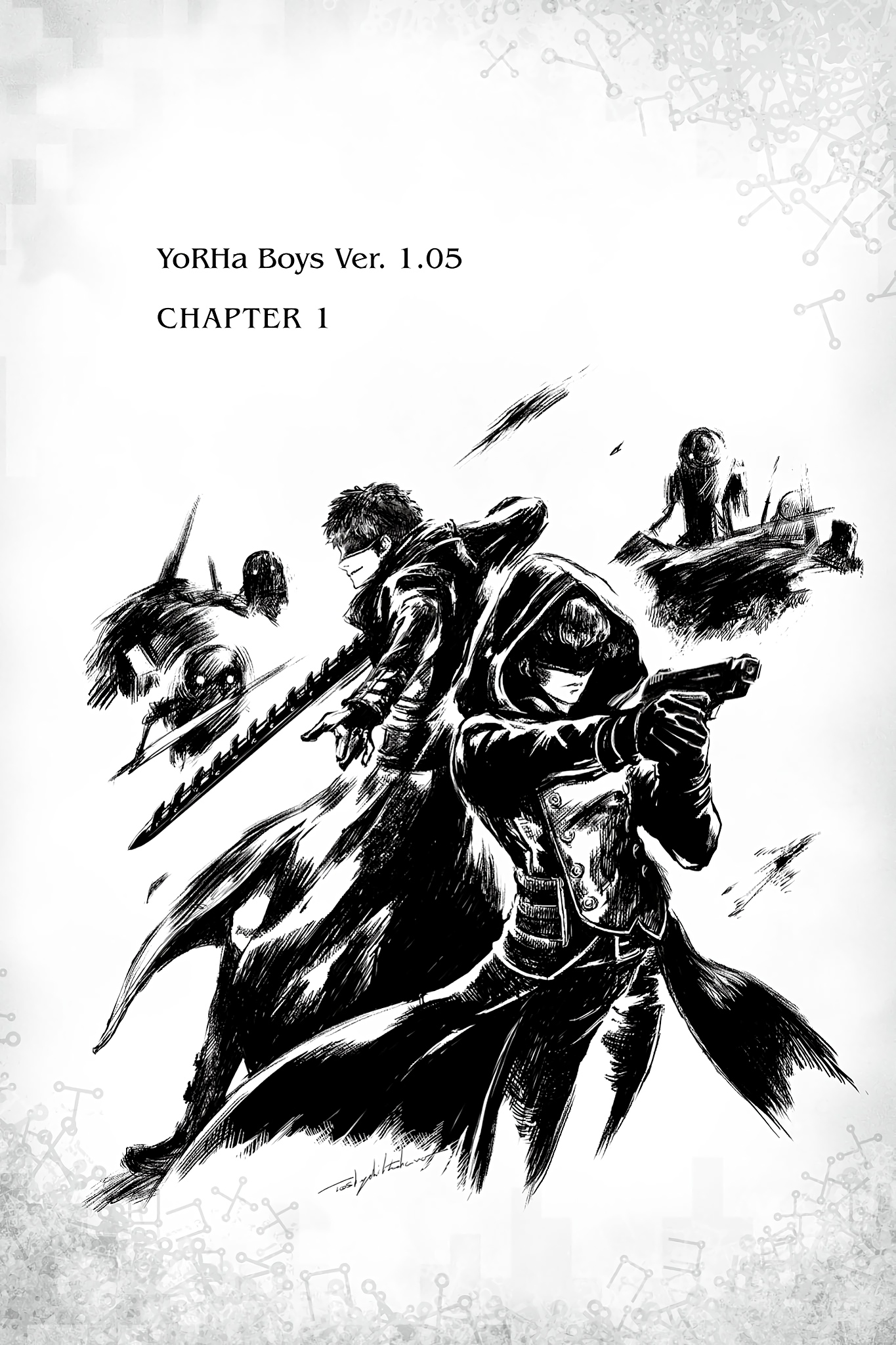
CHAPTER 1
[Log Entry: No. 2 / Orbital Base “Bunker”―
Residential Block]
“NO. 9.”
On murmuring the name, I was overtaken by a strange sensation. It took me a moment to pinpoint why: it was the first time I’d ever spoken a code number out loud. I had yet to come face-to-face with any of my future squadmates.
“Engaging in unproductive personal conversation is inadvisable.”
I pointedly ignored the voice emanating from my wrist and returned my attention to the display screen hanging in the air before me. This time, I read with purpose, in a voice several times louder than my initial mumbling.
“No. 9. Healer. Squad recovery. Low combat specification.”
Naturally, this unit wasn’t expected to be handling weaponry. He was designed to provide support functions. But while he wasn’t meant to get directly involved in battles, he was also the only Healer in the YoRHa Experimental M Squadron. If No. 9 were to fall, the operational capability of the entire squad would be severely limited.
“No. 21. Scanner. Battlefield reconnaissance and intel acquisition. Low combat specification.”
As with No. 9, nobody was expecting No. 21 to be spearheading assaults. But unlike No. 9, he’d be directly engaged in facilitating other squad members’ duties. A Scanner couldn’t just sit around on the back lines. His specific role could vary depending on the squad’s precise configuration, but it was conceivable that he’d be tasked with working alongside offensive units, right where the action was at its hottest.
“No. 2.” The voice from my wrist had grown stern.
I ignored the rebuke and continued reading aloud.
“No. 22. Gunner. Long-range attacks. Notable performance in rifle marksmanship. No. 6. Attacker. Close-range assaults. Proficient in use of swords. Boasts exemplary agility. These four units are hereby assigned to M002.”
All four androids were configured with male frames designed with an adolescent appearance. Boys. Just like me.
“So this the new face of M Squadron. The second batch of recruits.”
YoRHa M Squadron was the first experimental squadron composed entirely of male-type units. It was quite a novel thing, really, given the fact that the overwhelming majority of YoRHa-type androids were configured with adult female frames.
“Vocalization is unnecessary for retaining the presented information. Unnecessary actions waste resources and increase likelihood of delay in completing assigned duties. Proposal: Cease reading aloud.”
The voice droned on. The pronouncements of the Support System unit outfitted on my wrist were as long-winded as the device’s official designation: Support System Model Delta Code 153.
“Tone it down a little,” I muttered.
The unit was meant to provide us with all manner of necessary support when we carried out operations. But I’d quickly discovered that sometimes it provided a level of support far beyond what was necessary. In other words, it had a tendency to nag.
I’d have been hard-pressed to name anything more annoying than the constant stream of commentary emanating from my wrist. The thing was so obnoxious, in fact, that I’d recently decided to try drowning it out with the sound of my own voice―hence my reading the new squad assignments out loud. Unfortunately, this particular plan had backfired.
“Alert: Calibration of the No. 2 unit’s auditory systems is already complete. At present volume, voice communication should be within tolerable―”
“What I meant was, shut up!”
But I’d already lost my train of thought. My auditory systems might have been deemed ready to go, but much of my other training and calibration was far behind schedule. I didn’t need my SSU to remind me of that.
Originally, I’d been scheduled for assignment to M001. I was supposed to make my descent alongside No. 3 and No. 4, two offensive units who, like me, were part of the first batch of recruits. As was standard for M Squadron, they both had male-type frames. However, unlike me, they had the appearance of full-grown adults.
I looked down at my palms. The hands on No. 3 and No. 4 were probably a full size larger. And their wrists and biceps were undoubtedly much thicker than my scrawny arms. Contrary to what our physical appearances suggested, there wasn’t any age difference between us. Still, my body was that of a boy’s. I was shorter, and my physique more slender.
Of course, differences in physical build didn’t reliably correspond to differences in physical capability. The other M002 units had the same kind of frame as me, the same short, slender build. But as far as their test results were concerned, the second set of offensive units―No. 6 and No. 22―didn’t display the slightest functional inferiority compared to the first. If there was any difference, I imagined it wouldn’t amount to much more than the first-batch units having a slightly longer reach during close combat encounters.
The thought did little to console me. While No. 3 and No. 4 were sailing through their preparations, I was here marking time in orbit. Not literally marking time, of course. That was just a figure of speech.
Training, tests, and calibration. That was my life up here. And once I finished with a cycle, it was rinse and repeat: More training. More tests. More calibration.
I’d heard that No. 3 and No. 4 got to perform their combat training as a pair. I was always on my own. Of course, I had to admit that the nature of my training didn’t exactly make it the kind of thing you did with a partner.
Memorizing the data in front of my face now―these details about the squadmates I’d eventually rendezvous with on the surface―was one more vital step in ensuring my own operational success. Still, I couldn’t help but sigh.
Another page of data appeared on the screen.
“No. 2 Type D, huh?” I muttered to myself.
Defender. An experimental model built to withstand attacks, both physical and otherwise, equipped with a defensive barrier that would protect against logic viruses. That was why I had more physical strength than other models, and why I was equipped to resist viral infection . . . If any of my squadmates were to ask about my unusual specs, that’s what I was supposed to tell them. I wondered if it would really be enough to stem their curiosity.
I continued reading. “Type D units position themselves on the front lines, absorbing enemy attacks amidst the fray, and are prepared to lay down their lives to keep their comrades safe.”
“Well, that’s ironic.”
My comrades? The other members of my squad were no more than still images on a screen. I hadn’t interacted with any of them, not even once, from the moment I rolled off the production line. I’d spent days on end without anyone to talk to except my SSU. I was always alone. Solitude was the definition of my life in orbit.
Maybe my frustration explained why my progress was so slow. I’d fallen so far behind that it seemed like even the second set of units might overtake me. No . . . Surely it wasn’t possible that feelings as trivial as that had held me back.
As I stood in contemplation, the grating voice of the SSU cut in once again.
“Alert: Dynamic load test to begin in 300 seconds. Proposal: Proceed immediately to the testing block.”
“Yeah, yeah.”
Even I had to admit that my response was a little rude.
[Log Entry: No. 4 / Orbital Base “Bunker”―
Firearms Training Area]
Pistol reports echoed in the darkness. Three discharges in rapid succession. Then another set. A total of six shots fired. The pings of the third and fifth shots sounded higher than the others. My guess was that they’d failed to hit their targets.
“Shooter: No. 3. Four targets hit,” came the assessor’s report.
Six shots, two misses. No. 3’s previous performance had been similar: six shots, one miss. A subtle reminder of how unsuited he was to the Gunner role.
“No. 4, swap in.”
At the instructor’s command, No. 3 left the booth, and I stepped in.
We’d had 120 minutes of firearms training, followed by a fifteen-minute rest, and now this test. In the initial round, there were both stationary and moving targets, and luminance and reflectivity values matched the standard lighting conditions throughout the Bunker, in order to establish a baseline for each unit’s firearms proficiency.
After that, we were asked to fire again, this time in the presence of a single, harsh light. On the surface, we could be forced to operate in “blinding daylight”―that is, in areas that received intense amounts of sun, like deserts or ocean shores. The second round was meant to simulate those conditions.
Finally, there was a round in complete darkness. The insertion of M Squadron would take place somewhere in the daylands, where the darkness of night didn’t obtain. But that didn’t mean every op was guaranteed to happen in daylight. Apparently, there were plenty of locations on the surface with minimal light conditions, places like underground passages, caves, and ancient ruins.
I picked up the handgun and got into position. The display inside my visor adjusted in response to the sudden darkness.
A disc-like target sprang upward from the bottom left. I aimed my gun toward the estimated endpoint of the target’s trajectory and squeezed the trigger. At that precise moment, another target shot out from the top right. I rapidly calculated an endpoint for the new target and fired again. Sparing no time to confirm the hit, I lined up my sights once more, firing to hit a third target that had also emerged from the right almost immediately after the second.
The reason behind No. 3’s inferior performance was starting to become clear. He had a bad habit of relaxing his attention between each executed procedure. A test like this required actions made in quick succession. It was designed that way precisely to catch a wandering mind off guard. Up against a demand like that, his performance would suffer.
No. 3 concentrated too much effort into each thing he did. Too much focused tension in one moment meant not enough in the next. Gunners were constantly forced into situations demanding sustained fire at a large number of targets. Inability to let one’s focus flow from one shot to the next was a fatal flaw.
The next targets came as a trio, simultaneously launched from three different directions. Each moved at a slightly different speed. This was another test pattern that No. 3 would have had trouble with.
When you’re processing multiple simultaneous tasks, your mind has to assign an order of priority. As long as you’re operating an AI with an upper limit on processing capacity, it’s something you just can’t avoid. Prioritization is determined by levels of necessity: the things that have to happen, the things that should happen if the situation allows, and the things that can be safely left alone.
No. 3 always tried to give every demand equal attention. If it was in front of his eyes, he couldn’t leave it alone. If you spent any time with him, you’d pick up on that real fast. He was the kind who valued action over thought. Shoot first, ask questions later.
I’d heard that carnivores on the surface exhibited behavior like that. The lower brain was already passing signals to all four limbs before the creature had a chance to think. When it came to hunting, getting the jump on prey―even by a matter of milliseconds―was the difference between dinner and an empty stomach.
“Shooter: No. 4. All targets hit.”
Once the assessor had made his report, I placed the handgun back down. When I exited the shooting booth, No. 3 clicked his tongue in a noise of disgust. This, too, was typical. If a thought entered his mind, you’d be hearing it. He was incredibly transparent, which I guessed was a quality to be thankful for in someone I’d be operating alongside.
“So you got lucky, big deal. Just wait until next time,” No. 3 grumbled.
Still, everything had to be a competition with him. I could put up with a sore loser, but that wasn’t the only consideration here. The real problem was that stubbornness like his had a way of clouding judgment.
“Didn’t realize we were keeping score,” I said. “Aren’t we on the same side? The more dead machines, the better.”
“Excuse me?!”
It was a shame. If he’d fix his attitude, his marks in battle simulations would undoubtedly skyrocket. At the very least, you’d think he could quit routing every spare processing resource into motor functions. A few spared for logic would have made a world of difference.
“Are you saying I’m not even worth your time?” he demanded. “Huh?! Is that it?!”
When No. 3 pressed in, it was the instructor who intervened. “That’s enough, you two.”
“Sir!”
I immediately stood at attention, bringing my left fist up to my chest. It took a moment, but No. 3 followed suit. Instructor Black wasn’t just in charge of our training. He was the commanding officer for all of M Squadron. His orders were absolute.
The instructor lifted his right hand casually, signaling for us to be at ease. No. 3 and I each lowered our arms, but kept our rigid posture intact, awaiting the instructor’s next words.
“Get some rest,” he ordered. “Six hours from now, you’ll both undergo final calibrations.”
“Final calibrations?!” No. 3 exclaimed. “Does that mean what I think it does?!”
Even from the corner of my eye, I could see the way No. 3’s face lit up. Final calibrations could mean only one thing: we were done with our preliminary training at the Bunker.
“Once final calibrations are complete, you’ll head down to the surface for on-the-ground exercises.”
Currently, the enemy dominated the airspace over almost every region on the planet, which meant that making a descent trip was practically the same thing as dropping straight into battle. Just getting to the surface would put us in extreme danger, and here No. 3 was, treating it like a dream vacation.
“Hell yeah! Did you hear that?! We’re going to the surface!”
I wasn’t sure whether he’d failed to understand the situation, or if he did understand it and was delighted at the thought of days spent in all-out war against the machines. Maybe a little of both. In any case, the surface wasn’t a place you showed up at feeling like a kid in a candy store. I wished for the umpteenth time that my companion might try diverting a few resources to his logic circuits. As usual, my wish was in vain.
“Oh, and one more thing,” the instructor continued. “You may have already caught word, but be advised that the YoRHa Experimental M Squadron will consist of seven units. The others will join once their training and calibration are complete.”
“So there’s seven more aside from us?”
“Great math,” I said. “No. That’s seven including the two of us.”
No. 3 looked away as he muttered his response. “Wise-ass.”
“Sir. Permission to ask a question,” I said.
“Go ahead.”
“Will you be accompanying us for on-the-ground training, sir?”
“That’s the plan.”
If the instructor was traveling with us, that meant he didn’t need to be around for the training and calibration of the other units. There were probably other Attackers and Gunners among the remaining five, and I doubted their regimen would vary much from ours. It put all the training No. 3 and I had completed into perspective. Clearly, the real work was yet to come.
“On-the-ground” training was probably as close to actual battle conditions as possible, including the degree of danger. Apparently, there wasn’t a single place left on the surface that could be considered completely safe from enemy assault.
I continued to consider the implications after I’d returned to my own quarters to rest. The surface. We’d be training as two isolated units in a hostile environment rampant with machines. Eventually, we’d move on to real combat operations. I wondered what our mission might be, once our seven-unit team was finally assembled.
No. 3 probably would have laughed at me if he could hear my thoughts. “God, you worry too much,” he’d say. “It’s still so far off. What’s the point of stressing about it?” Not the kind of thing I wanted to hear from someone who couldn’t even manage to think three minutes ahead.
For the time being, No. 3 was the only partner I had. What was so wrong about teammates seriously evaluating each other’s faults and weaknesses? Why shouldn’t we try to stamp them out?
A single major shortcoming would cancel out any significant strengths we might possess. Conversely, if we eliminated all our major shortcomings, we’d manage to survive, even in the absence of particular strengths. That was the endpoint of the target. That was what we needed to be aiming for. What could I do to make sure it happened?
I thought, and thought, and thought some more.
[Log Entry: No. 9 / Orbital Base “Bunker”―
Server Administration Room]
“Glad to make your acquaintance, No. 9. ’Course, I guess an introduction’s pretty long overdue.”
No. 22 gave me a sheepish grin as he said it. Next to him stood No. 21, who wore a faint smile. We’d actually encountered each other before in the training area. Several times, in fact. We’d even had a few brief conversations.
No. 21 was a Scanner, and No. 22 was an Attacker. Though their specialties differed, the two always seemed to do everything together―probably because they were designed as twin models.
“Hold up. I’m glad you’ve all met, but I don’t know these two yet.”
“Oops, you’re right. Sorry, No. 6.”
I’d been part of a battle simulation with No. 6, another Attacker, once before. It involved a scenario in which he had been wounded, and as the Healer I had to provide emergency aid. So for me, all three of the other units present were familiar to some degree. But it seemed today was No. 6’s first encounter with the twins.
Presently, No. 6, No. 21, No. 22, and I were undergoing our final checks and calibrations in the server administration room. It was also an unofficial chance for us to meet and interact before the formal establishment of M002.
As to why this wasn’t an official introduction, that was because at present, the leader of the YoRHa Experimental M Squadron wasn’t aboard the Bunker. He’d gone on ahead to the surface with M001. So we M002 units wouldn’t officially be a part of M Squadron until we descended and received our commanding officer’s approval.
That said, here we were, talking to each other and introducing ourselves. It might not have been official, but in a way, we already felt like part of a team.
“Nice to meet you, No. 6. I’m Scanner No. 21. Um . . . Let’s see, you must be a . . .”
“An Attacker.”
No. 6 answered with a grin. His always-pleasant smile belied an incredible degree of strength. His motor faculties were top-rate, and his movements swift. Like the crack of a whip―that might have been the most accurate way to sum him up. No. 21 and No. 22 would probably be blown away the first time they observed his performance up close.
“And I’m Gunner No. 22. My specialty is long-range precision fire.”
Huh? Wasn’t No. 22 supposed to be an Attacker? It seemed I’d misremembered. I was thankful at least to have avoided slipping up and referring to him as an Attacker in person. I imagined that having one’s role mistaken wouldn’t be a very pleasant experience.
“Hey. Cut the chatter.”
The rebuke came from a member of the R&D team. All four of us shrugged our shoulders in unison. No. 6 poked his tongue out ever so slightly, and No. 22, on seeing it, burst out laughing.
“Enough!”
“All right, all right. Sorry, sir.”
Having comrades was pretty fun. Every other time I’d come in for checks and calibrations, I’d been bored to tears, but today it didn’t feel tedious at all. Before I knew it, the whole thing was over and the four of us were walking down the corridor, the server administration room at our backs.
We’d been given six hours to rest. But using the time to actually sleep seemed like an enormous waste. So instead, the four of us wandered the Bunker, excitedly talking away.
“Wonder how long it’ll be before we’re back to the Bunker.”
“Ha ha! Don’t tell me you’re already feeling homesick, No. 22. Can’t handle spending a night away from home sweet home?” No. 6 teased.
No. 22, clearly flustered, shook his head vigorously.
“Th-that’s not what I meant! I just wondered how long our mission on the surface was gonna take.”
Speaking of which, I hadn’t heard a word about our mission, either. And if No. 22 didn’t know what we were going to be doing, that meant No. 21 was probably in the dark, too.
“No. 6,” I began, “Have you heard anything?”
“Not a word. Probably hasn’t been decided yet.”
“What makes you say that?”
“Doesn’t seem like the kind of call you can make from up here. Missions have to be planned based on the enemy’s latest movements.”
His logic seemed sound. No. 6 always came across as highly intelligent. Of course we couldn’t decide something like that ahead of time. The length of our deployment―the length of time we had to spend in battle―would depend entirely on what the enemy was up to. Any plans we made up here could be rendered obsolete during the time it took us to complete our descent.
No. 22 snapped his fingers and exclaimed, “Hey, let’s go take a look at Earth!”
The planet wasn’t visible from the residential block; it could only be seen from the side of the Bunker that housed facilities like the hangar and the command center.
“What’s the point of doing that?” No. 21 seemed puzzled. “I mean, why go out of our way to look at it when we’ll be heading there in person soon enough?”
“Once we’re down on the surface,” No. 22 explained, “we won’t be able to see the whole planet all at once. The way it looks from up here, I mean.”
“Good point. And I guess there’s no telling when we might be back to see it like that again,” I responded, to which No. 22 nodded in apparent delight.
“Yeah! Like, just in case. But who knows? Maybe we won’t even be gone that long. Maybe they’ll send us back right away.”
“Sure hope they don’t,” No. 6 said, in a slightly sardonic tone.
No. 21 pretended to headbutt No. 6 as he retorted, “Hey! What’s that supposed to mean?!”
We made our way to the block containing the hangar, all the while intentionally bumping shoulders and playfully chasing each other down. Along the way, we were reprimanded by a member of the maintenance team, who called out, “You lot settle down before I have to write you up!”
On my own, the idea of running down the hallway wouldn’t have even occurred to me. Yet as a group, suddenly there were all kinds of new things we wanted to try. It was strange, but also exhilarating.
If No. 22 had been on his own, I imagine he’d have never come up with the idea of one last moment spent observing Earth. Well, maybe that was a moot point―it was hard to imagine No. 22 ever being alone, since No. 21 was always right by his side.
Setting that thought aside for the moment, I stepped up to a window. We’d all lined up along the corridor’s wall, staring out at the planet as it hung there in space, perfectly round and lit with a faint blue glow.
“It’s so pretty . . .”
Humanity’s home. The world we were fighting to reclaim.
“Kinda feels like we’re saying farewell.”
“No. 6! How could you say such a thing?!”
We YoRHa units were the ace in the hole. We were going to turn the tide of the war. It was the whole purpose of our experimental squadron. At least, that’s what everyone was saying.
“Hey, what’s the first thing you want to see once we get to the surface?” I asked. “C’mon, everyone give an answer.”
I pointedly didn’t ask about the first thing they wanted to do. After all, once we descended, we’d be occupied with one thing and one thing only: fighting the machines.
No. 22 gave a dry laugh. “How are any of us supposed to answer something like that on the spot?”
I considered his response. Was my question really so difficult?
“You go first, No. 9. What do you want to see?”
No. 6 added, “Yeah, you can’t just throw it out there. You have to get the ball rolling.”
“Umm . . .” I began. “Well, stuff like birds and insects, I guess. And maybe plants? Oh! And I’d really like to see fish swimming through the water. And animals as they run across the ground.”
The other three stared at me. They looked baffled. Was my answer really so strange? Was I asking for too much? But I was just being honest. The surface was surely full of all kinds of living organisms, and I wanted to protect them and see them flourish again, for humanity’s sake.
Maybe a dream like that was far too big for an android like me. I frightened easily, and I was honestly a pretty clumsy fighter. Yet I truly wanted to see that dream through, with all my heart.