Chapter Two: Super-Dimension... Carrier?
Chapter Two: Super-Dimension... Carrier?
The ship rang with alarm bells. It was so sudden. All hands looked at each other, then rushed to their emergency stations. We hadn’t heard the emergency alarm for quite some time, and no information about any threats had reached us over the international network, so all of us—including myself, Naval Lieutenant Carl Douglas—were wondering about the alert. What in the world could it be?
We were on board the Nimitz—the USS Nimitz, CVN-68. A nuclear-powered supercarrier attached to Carrier Striking Group 11, lead ship of her class. As nuclear-powered carriers go, she was getting on in years: it had been more than forty-five years since she’d been launched, and with the operational life expectancy of a ship like this being about five decades, it was getting to be time to think about decommissioning. A trustworthy old sea dog if there ever was one. In fact, with the first nuclear-powered carrier—the USS Enterprise, nicknamed the “Big E”—inactivated in 2012 and decommissioned in 2017, Nimitz was now the oldest serving aircraft carrier in the world.
All right, so she might not look like much compared to the newest, shiniest vessels out there, but the massive ship was still an object of reverence in the U.S. Navy, and still boasted combat prowess beyond anything in any other nation’s naval forces. She was the pride and joy of us, her crew. And we weren’t about to run away from any little storm.
The alarm that had us all scurrying about, though, was only supposed to go off in one of two scenarios: either during a training exercise intended to help us practice responding to an emergency, or else in case of something happening in our waters that amounted to war.
“What the hell?!” When I got out onto the flight deck, I saw something that betrayed all my expectations. The sky was... gone. Not only that— “What the hell?!”
“Where’s the Kidd?!”
“The Lake Champlain?! Where’d it go?! I don’t see the Milius, either!”
None of the Aegis missile destroyers that normally sailed escort alongside the Nimitz were anywhere to be seen. For that matter, neither was the ocean we were supposed to be sailing on. All I saw was a black void, as if the ship had suddenly been transported into outer space.
“Hey, with no ocean, where are the destroyers supposed to sail?”
“That makes sense! Ha! Ha! Ha!”
“This is no laughing matter! Besides, if that’s how it works, then what the hell are we doing here?!”
“And can anybody tell me where here is?!”
Close inspection revealed a very small amount of ocean directly around the Nimitz. Apparently some of the water we’d been floating on had come with us. Like a slice of the world had been cut out and moved. But how? And by whom? What could do something like that to a ship this big?
“Hey, you ever seen that movie?” one of our older sailors drawled. “Final Count**wn? This is exactly what happens!”
“Huh? Final what?”
“You young pups don’t know anything. It’s a famous sci-fi movie, and our Nimitz is the star!”
“Never heard of it, sailor!”
I didn’t really blame them. Couldn’t expect kids like them to know about a film from thirty-five years ago. Hell, even the F-14 Tomcat that had featured right alongside the ship had been retired more than ten years back.
All right, so we had other things to worry about.
“What the hell’s that?!”
“Look out!”
I turned at the shout to find the Super Hornets on the flight deck—the very planes that had replaced the Tomcat—upside down.
“Hey, what is all this?!”
No, scratch that: they weren’t upside down. Their front wheels were secured to the deck, and they had all tipped onto their noses, the back of each plane floating into the air. Those things weighed a good ten tons before you added fluids or ammunition, and they were floating like balloons! But why?!
“Arrrgh! Heeeelp!”
“All hands, grab onto something!” I shouted, taking my own advice and grabbing hold of a nearby pipe. As I watched, not just the Super Hornets, but everything started to drift into the air. The fighter jets, the attack aircraft, people—everything that wasn’t nailed down seemed to simply float up off the high-strength, low-alloy steel deck.
This was clearly some kind of gravitational abnormality. In fact, had gravity completely disappeared?!
I looked again at the water that appeared frozen around the Nimitz and saw it forming into a procession of rings. It was quite beautiful, in fact—as if we were passing through alternating archways of light and darkness. But we were hardly in a position to admire it.
“This really is like Final C**ntdown!” I mumbled. In that movie, the Nimitz had been transported to December 6, 1941, just before the outbreak of the Pacific War. The eve of the attack on Pearl Harbor. I had no idea whether what was happening to us bore some bizarre connection to that film, but if things continued to follow the movie’s plot, then... “Are we going back to World War II?!”
“Yes! That has to be it!”
“I’m gonna bag me a couple of Zeros!”
“You think the pilots will speak really weirdly accented Japanese?”
“So you have seen it!”
“It’s in the library in the ship’s rec room...”
“Don’t we have bigger problems right now?!”
And so on and so forth.
Forget the movie—we’d never encountered anything like this in real life. We howled, shook, screamed, and clung to whatever was nearby, but all we could really do was wait and hope this situation resolved itself.

It had been ten days now since the disaster in the Third Capital. And as a Bahairamanian soldier, I, Amatena Harneiman, was still there on military duty.
“Silverman Harneiman. Your meal.”
“Thanks,” I said, accepting the food from my subordinate as he came up the stairs.
“How’s it look?” he asked.
“No change to speak of.” I suppressed a sigh before it could get out my mouth. The Third Capital had become a strange place in the days since the commotion. A woman named Theresa Bigelow, claiming to be the original administrator of the Dragon’s Den, had announced that the area was under her control, and now it was being patrolled by her werewolf, elf, and dwarf soldiers, along with dragons in the air. Theresa and her lackeys, though, showed no sign of leaving the Den to attack the residential areas of the Third Capital, or at least they hadn’t during the ten days we’d been observing them. We’d seen dragons and werewolves on what we assumed were reconnaissance missions, but Theresa and her forces hadn’t done anything more dramatic than that. It seemed things would remain peaceful, so long as we chose not to strike.
Thus for all practical purposes, the Bahairamanian army lost control of the Dragon’s Den at the center of the city, instead establishing a perimeter some distance away and beginning the process of rebuilding. Of course, my superiors and the honored father-ruler himself had naturally considered an attempt to retake the facility. It was, after all, the production site for the puppet drakes, Bahairam’s most advanced weapon, as well as a number of other strategically vital resources. But it was obvious that without a very special, very thorough plan, we stood no chance against Theresa Bigelow and her forces, so the decision was made to ignore them for the time being and focus on getting the city back on its feet.
This wasn’t to say, though, that we had abandoned the Dragon’s Den. Hence why I had been assigned to watch the facility constantly. Hence why I was here now.
Admittedly, surveillance was arguably of limited value: I couldn’t see the great part of the facility that was underground; all I could do was record the occasional comings and goings of soldiers or dragons. A watchtower was built not far from the Den for this entire purpose, and Clara and I, along with about a dozen more junior soldiers selected for the task, dedicated ourselves to watching the Dragon’s Den at all hours of the day and night.
“Much as I know this is an important mission...” I muttered. From the uppermost level of the tower, I used a telescope to observe the Dragon’s Den. If there was any change, even the slightest thing, I noted and reported it. It was truly tedious work. I was of the opinion that there were no unimportant missions in the military, and had always drilled the same idea into my subordinates—but with the near-total lack of visible activity in the Den, I ran out of things to write after about three days.
Lethargy quickly spread among Clara and the others; I could feel it. We werewolves and weretigers have a certain day whereupon, after a given age, we routinely go into heat, dramatically increasing our sexual appetite and our instincts for hunting and combat, so much so that it’s practically palpable. Many were able to dissipate the excess energy by throwing themselves into military exercises, or otherwise losing themselves in a particular hobby or interest, but on duty like this, there were few opportunities for such distractions.
As a result, many of my people went out to run a few laps around the Third Capital after they got off duty. All of the soldiers assigned to me were werewolves, weretigers, or werebears. All people with substantial physical capabilities compared to elves, dwarves, or humans, so they could go out on a run with no real concern about whether they could make it back quickly if an emergency came up.
“You know, I wonder what he’s doing right now...” I said, thinking aloud, as the image of one particular man in the Holy Eldant Empire flitted through my mind. It was nothing more than that: a passing thought in the midst of some boring work. Absolutely no more meaningful than that.
I couldn’t exactly get up and exercise in the middle of duty; the most I could do was to exercise my mind, try to keep thinking. It certainly didn’t mean anything that I was thinking of that man on “that day.” Nothing at all...
“Honored Elder Sister!”
I almost jumped out of my skin at the shout. My longest-serving subordinate, the weretiger Clara, was rushing up the stairs.
“It’s not what you think,” I said, feeling oddly panicked. “It was only coincidence that I was thinking about him!”
“Elder Sister?” Clara asked, looking at me curiously. The soldier who’d brought me my meal was likewise perplexed. “When you say him,” Clara said, “are you talking about Shinichi-sama?”
“N—Not as such. I couldn’t care less about him.”
“Perhaps we can talk about that another time, Honored Elder Sister. At the moment, there’s something you have to hear.” Clara was never terribly expressive, but her breath seemed to be coming harder than usual, and her gaze was unsettled; she looked almost nervous.
“What is it? Has something happened?” I asked. Clara had been off duty—in fact, she’d been out running with some of the other soldiers to burn off energy, just as I’d been describing.
“In the wilderness to the northeast... There’s something strange.”
“What does that mean?”
“There was nothing there until just yesterday, I’m sure of it. And now, there’s some kind of... castle.”
“A castle?” Castles didn’t simply appear overnight. But I was sure Clara hadn’t come rushing up here just to play some practical joke on me. She’d never been the joking type.
“Or something like one. I’ve never seen anything like it. It’s in a very strange shape.”
“Explain,” I said, frowning at her, and Clara pulled out a piece of sheepskin paper. She’d done a quick sketch of this “strangely shaped” thing. She was right: it was very odd.
Most buildings are narrower toward the top. The foundation is the widest point; it only makes sense. At the very least, I’d certainly never seen a building that got bigger the higher it got. But that was exactly what was depicted in Clara’s sketch. The top of the structure was mostly flat, with a tower along one edge. Below the flat area, however, the construct narrowed precipitously. As a foundation, it made no sense. For that matter, how big was this thing I was looking at?
Clara told me that the strange thing was filling a rift out in the wilderness, a gash in the earth we had noted in the area.
“And how big is it?”
“I can’t be certain because of the distance I observed it from. But judging by the size of the humans I saw on the roof, I would say almost as large as Eldant Castle.”
“What?!”
Eldant Castle had been created from a hollowed-out mountain using dwarven magic. I assumed it was the largest building in their empire—and unfortunately Bahairam, which I’m forced to admit lagged behind Eldant in building, had nothing remotely that size. I wasn’t sure any country around us did. They would need dwarves, magic, and a mountain at least as big as the one that had been used for Eldant Castle. Arguably the Dragon’s Den was larger overall than the seat of the Eldant Empire, but so much of it was underground that it was hard to say it really competed in size.
In any event, if what Clara was saying was true, then in a single night, a structure dwarfing the largest building in our world had simply appeared in an empty field. Considering the location, we couldn’t just leave it alone. We would have to dispatch a squad to investigate.
“You don’t think it could be connected to the Dragon’s Den?”
“I can’t say, Elder Sister. However—” Clara was interrupted by a sound like distant thunder that washed over us from above.
“What the hell was that?!” It couldn’t be actual thunder, not with the sky as clear as this. I stuck my head out the window of the watchtower and looked up—and then I saw it. “A dragon?!”
No—no, it wasn’t. That was just the word that came to mind, because it was the nearest thing in my experience.
A huge gray shape flew through the air. It wasn’t a bird, but looking carefully, I could see it wasn’t a dragon, either. It showed no sign of flapping its wings; it looked more like a massive blade slicing through the sky. But what was it?
I could only look at it in astonishment. It made a large arc in the air, as if mocking us, and went back the way it had come, trailing a long tail of cloud. Back toward the vast, strange castle Clara had seen.

“So,” I said, standing at the front of the classroom looking out at the familiar faces of my students. “The ultimate result of the polarization of the light novel field was the coming of the Black Ships, by which I mean web novels. It forced serious changes, not so much in content as in the way the books were marketed and sold. It marked a wholesale shift in sales strategy, really.” I glanced at my phone, which was perched on the lectern in front of me. Class time was just wrapping up. “All right, that’ll be all for today. Thanks, everybody.”
“Everyone stand up! Bow! Thank you very much, Sensei!” The class rep, Romilda—a dwarf girl—called out the commands, and everyone followed her as they all bowed to me. With that, class was over. A pleasant buzz filled the room. If you weren’t really listening, it really did sound like they were saying “walla walla,” but if you paid a little attention, you started to make out individual conversations. For example...
“You think the new issue of Hugs with Majin Girls is out yet?”
“It’s gotta be coming soon, right?”
“Hey, didn’t that get an anime in Ja-pan?”
“What? No way! Really?”
Here’s another example:
“Didja see Shin Gozura?”
“Boy, did I! Had to wait a whole week to get it from the library.”
“Is it wild, or what?”
“Yeah! Who knew he could shoot plasma fireballs from his tail, too?!”
“You thought that was the most surprising thing in that movie?”
Et cetera. Anime and games and manga and tokusatsu and light novels... They were drinking it all in, and then comparing notes. Now, this was how to be an otaku. The seeds of otakuism that I—that we—had planted in this world had put down roots and were starting to sprout, to spread their leaves. What a beautiful sight. I couldn’t have been happier.
At least, until a few days ago. But now I felt deeply uneasy. The Japanese government was going to cut ties with this place, whether I stayed behind or not. In other words, no more otaku stuff would be coming over here from Japan. The budding sprouts would be deprived of water and nutrients. Worst-case scenario, ten or twenty years from now, maybe the very idea of otakuism that I had tried so hard to foster would have withered and vanished. Maybe people would forget it had ever existed. Everything we’d done would have been for nothing.
Let’s just say I wasn’t in the best place mentally. Probably needless to say, I hadn’t yet broken the news to my students about Japan leaving forever. Even all the empire’s administrators didn’t necessarily know yet, so the kids didn’t suspect anything; they just kept coming to class as usual.
It killed me to see them like that.
“All right, then,” I said, coming down from behind the lectern with the roll and my materials in hand. I was about to leave the classroom, the laughter and chatting of the students behind me, when:
“Sensei! Shinichi-sensei!”
A student came running after me. No, two students. I found our class rep Romilda and her best frenemy, the elf Loek, coming up to me. One dwarf, and one elf. They always used to get along, well, about as well as elves and dwarves are supposed to get along. Which is to say, they were always fighting. In fact, they were still usually fighting, but now they also worked together sometimes, and even their arguments seemed oddly harmonious. It was enough to bring a smile to your face.
The relationship between Loek and Romilda was another thing that we, I think, had changed. More precisely, the otaku stuff we’d brought in had gradually helped shift their perspective. That’s why it made me happy to see them together, quarreling amiably.
“Uh—yeah?” I said. “What’s up? You have a question?”
“Shinichi-sensei,” Romilda said quietly as she came up to me. “Is it true you’re going back to Ja-pan?”
“Who’d you hear that fr—oh. You got it from your dad, didn’t you?”
Odd as it was for demi-humans to have high-ranking posts in this world, Loek and Romilda were both the kids of important advisors to the Eldant Empire. Romilda’s father was the head of a place called the Guld Workshop, a job he seemingly held in tandem with his responsibilities to the country.
“I haven’t told anyone yet. And you can’t tell anyone, either,” I whispered back.
“Sure, I know,” Romilda said. “But...” Her eyebrows knitted in an expression of deep sadness. “Is it true you won’t be coming back?”
“Yeah. At least, that’s the Japanese government’s plan. And the JSDF is getting ready to pull out, too.” They were well underway removing files and other assets from the garrison. I assumed they would start breaking down the electronics at the mansion—the security cameras and stuff—today or tomorrow. In fact, I wasn’t sure what would become of the electronics here at the school. Including things like the portable game consoles that the students actually owned.
“Does that mean Minori-sensei is going, too?!” Loek asked with an expression of despair. “She’s part of the Jay Ess Dee Eff, isn’t she? Is she going with them?!”
“Well... I guess so,” I said. Ever since Minori-san had saved his life, Loek had been obsessed with her. I was sure Minori-san knew it, but she always pretended not to notice how he felt. Maybe that was because she was a teacher and he was a student, or maybe even because she was a human and he was an elf. Or maybe... maybe Minori-san had imagined, somewhere deep down, that this day might come. She’d known she was really just a visitor here, and that if she ever had to leave, it would hurt anyone who was too close to her.
Come to think of it, on paper, she had supposedly been killed in the Middle East on some kind of peace-keeping operation. Maybe she’d been on another mission not so different from this one. It wasn’t that unusual for soldiers to get close to local people on the ground at their assignments, was it?
That’s right. Minori-san was a member of the Japan Self-Defense Force. She would go to a war zone if her superiors ordered her to, and if they ordered her to, she would come back. No matter what she might be leaving behind.
“No...” Loek swayed on his feet, leaning against the wall for support. It must have been a real shock to him to think of Minori-san going away. He could hardly stand up. “Minori-sensei! Oh, Minori-senseiiiii!! I swear, I’ll—”
“Please don’t leave, Sensei. Stay here with us!” Romilda added, stepping forward. “Please. I can’t stand the thought of never seeing you again.”
“Romilda...” The words Petralka and Myusel had held themselves back from saying out of consideration for me, this young dwarf girl had spoken candidly. It made me happy. Really, truly happy.
Maybe she hadn’t really thought about the fact that staying here would mean abandoning my family in Japan. Or even if she had, maybe they were just too abstract for Romilda, who had never so much as seen them. Hard to empathize with. Harder than for Petralka, Myusel, and Elvia, who had gone to Japan and met my mom and dad and Shizuki, even shared meals with them. So I didn’t blame Romilda for what she said. I couldn’t. I was so happy to hear those words from her I could almost cry.
And yet, I couldn’t just say, “All right. I won’t go, then.”
“It’ll be so lonely without you, Sensei,” Romilda said. “And without you... How will we learn how to be better otaku? We won’t know what to do...”
“I think that might be tough even if I stayed here,” I said with a self-deprecating smile.
“Wha...?”
“If the Japanese government cuts ties with this world, that means there won’t be any more otaku stuff coming from Japan. Even if I were here, it wouldn’t do much good. We wouldn’t be able to see any new shows. Or even...”
Japan and the Holy Eldant Empire: the far past and the far future. The scholars the Japanese government had consulted about what to do felt that in order to avoid messing with cause and effect, we should keep any influence of one on the other to an absolute minimum. Maybe that meant they would even want to get rid of most of the otaku stuff that had already been brought into this world, just throw it away. Maybe the JSDF would be ordered to destroy it or burn it or whatever. The way they used to do with books.
Then there really would be no more point to me being here.
“What’s an evangelist without anything to evangelize about? I’m not worth anything here on my own.”
“What? No, you’re—”
“I’m not a creator,” I shrugged. When it came right down to it, I was a consumer of otaku culture. A critic or researcher at best. No new otaku stuff would appear in this world just because I stayed here. I didn’t have any talent for creating. I was painfully aware of that, having watched my dad at work all my life.
“But Sensei... But—” Romilda couldn’t seem to find the words, stumbling over herself several times.
“Don’t fight too much with Loek when I’m gone, okay?” I said. The two of them looked so good together. I knew how despondent Loek would be when Minori-san left, and I suspected Romilda was the only one who would be able to cheer him up.
“Sensei, what are you saying?! You make it sound like you’re dictating your will or something,” Romilda wailed. But just then:
“Oh! Shinichi-sensei!”
“We found you! Do you have a moment, Sensei?”
I wasn’t sure whether to be disappointed or deeply relieved when the somber atmosphere was broken by a pair of oblivious students who came rushing up to me. Or to be more accurate, a pair of students who came up to me, one of them being dragged by the other.
The first, I knew very well: Eduardo Teodoro Pertini. A human boy. He was one of the very best in class when it came to reading and writing Japanese, and he’d absorbed the lessons of otaku culture like nothing else. He was even writing his own light novels these days. Stuff that was practically as good as any of the published material he’d read. When we’d made a little movie of our own, he was the one I’d trusted to write the script, and he’d come back to me with some pretty high-quality stuff.
“This is my newest work! Could you read it and tell me what you think?” Eduardo said, thrusting a sheaf of paper at me.
“What? This?” I asked, startled. The pile of paper was awfully thick. Probably longer than your average novel. Unlike a short-story collection, where the main thing you need is a bunch of ideas, writing a long-form novel takes more than just imagination or even writing ability. It demands endurance. At least, that was what my dad said. He claimed it wasn’t that one was harder than the other, but that writing short stories and writing full novels were different skills, and the ability to do one didn’t beget the ability to do the other.
Eduardo, it seemed, at least had the talent to do novels. When I saw how he was brimming with confidence, I knew the story must be a pretty good one.
Then he said: “And hers, too!” He pulled the person he had been dragging along and shoved her toward me. She was a weretiger girl. Her black hair was streaked with gold in places—it made her pretty conspicuous, but she herself preferred to blend in. She could barely bring herself to look at me. Hmm... If I remembered right, she was from our second or third wave of students...
“Um... I’m... Canal Maldemia,” she said. Oh yeah. Canal. She was our only weretiger student, which made her stand out even more. We didn’t exactly have strict grade divisions in this school or anything, but from the perspective of Eduardo, Loek, Romilda, and the other students who had been there since the beginning, Canal would be a kouhai.
“This girl’s something else!” Eduardo said. “You should see her drawings!”
“Drawings? You mean, like, for manga or anime?” I didn’t think he would go out of his way to point it out if he’d meant her watercolors or oil canvases.
“Yeah! I’ve got an idea: I do the original work, and she does the manga version!” Eduardo was beaming. He was proud to have noticed Canal’s talent before even us teachers. I knew how he felt.
“Wow. Manga, huh? Can I see some of your work?”
“Oh! Um, yes, but... It... It’s not very good, so please... don’t laugh...” Canal said. She was blushing furiously, but she handed me some sheets of paper she was holding.
“You’ll be fine!” Eduardo insisted. “‘Not very good,’ my butt! It’s fantasti—”
“No, it isn’t!” she exclaimed.
I looked at the papers she’d handed me, her drawings. Loek and Romilda, their interest piqued, tried to get a look.
“Wow...” I said. I was surprised. Loek and Romilda seemed to feel the same way. They were perfectly convincing manga pages. They had panels and sound effects and everything. Backgrounds were present and accounted for, but never so detailed that the characters got lost in them. There was proper depth in the images; Canal had carefully modulated the thickness of her lines. Sure, you could see less-than-perfect spots here and there, but it was a totally readable manga. More than readable, in fact. Inviting. It looked interesting. A quick scan of three pages was enough to tell me that.
I remembered how good Elvia was at drawing. Was it possible lycanthropes had some special gift for the visual arts? As natural predators, maybe their physical and spatial awareness was especially keen. Anyway...
“These are awesome. It looks like a great manga. I would read this.”
“Right? I was right, right?!” Eduardo was practically bursting.
“Th-Thank you very much...” Canal said. “And sempai, um, thank you, too...” She turned toward him, blushing a little.
Wait. Don’t tell me. Was this...
Eduardo had never seemed super manly or anything, but maybe, with the lovely, young Canal right there, he was subconsciously letting his manliness out................ Holy crap! That was wicked bittersweet! That was some bittersweetness right there!
I was so overwhelmed that I just about burst into outdated slang, but anyway, forget about that.
“I see now...” I said, feeling myself relax just a little. It hadn’t been futile. They were learning. Not just Eduardo. Several of the students were moving beyond simple consumption to become creators themselves. I’m not saying creators are inherently better people than consumers or something, but when a culture really takes root, when it earns a lot of admirers, that’s when people start to think, Maybe I could do that, and creators begin to appear. That’s just how it works. Today it was Eduardo and Canal, but maybe soon, some of the other students would come to share the desire to make something of their own.
Eduardo and Canal were this world’s otaku-culture Adam and Eve. At this rate... “Maybe there really will be a Comiket around here in a few years,” I said. It was something I’d said back when the Japanese government and I, uh, weren’t seeing eye to eye, but back then it had been something of a bluff. Now, it seemed almost plausible. Otaku culture might be able to flourish in Eldant even without Japan.
And as proud as that made me, I also couldn’t help feeling a little sad.

We had left the school and were in a carriage riding home, just like any other day. Except today, it was awfully quiet inside the cabin. The only sound was the rumbling of the wheels coming up from below; we didn’t have any conversation worth mentioning. Hikaru-san and Minori-san had acted normal at school, but now that we were safely in our carriage, they both fell silent. I didn’t blame them. They might have been willing to give me a good talking-to when I was out of line, but they had friends here, too. It couldn’t have been easy for them to be told that they would never see them again.
Minori-san probably had no choice but to return to Japan (and anyway, without a steady supply of BL, she’d probably turn into a living corpse), but Hikaru-san I wasn’t so sure about. We didn’t have a lot of time left to decide, though. The withdrawal operations had already begun. Recognizing that if Hikaru-san and I immediately disappeared the school would be thrown into chaos, the government decided to move out the JSDF assets first, then the physical stuff from our mansion. Several shipping containers had arrived at the house this very morning, with instructions that by and large, our equipment would be removed back to Japan. JSDF soldiers would do most of the heavy lifting, but I guess they wanted us to get a start packing up.
You know... they’d told me to put off packing up my books and DVDs and Blu-rays and games and stuff. Maybe they planned to just collect it all right at the end and burn it or something.
The End of Days, if you will, was coming. What would Hikaru-san do? What should I do?
I let out a long sigh. But then I heard a weird sound. At first, it was like my sigh just wouldn’t go away. But that wasn’t it. It was something else, a low buzz from somewhere nearby. It gradually grew louder...
“Huh?”
That couldn’t be what I thought it was. I knew that sound—but I hadn’t heard it once since I’d come to this world. It was a rumble like distant thunder. The difference, though, was that it didn’t disappear after a moment—it went on and on. Like, rrrrmmmmmmmmmmmmmmm.
Minori-san was looking around—she’d noticed it, too. We opened the carriage window and looked out, both of us craning our necks toward the sky.
“It’s—”
“—a Super Hornet?!” Minori-san said. I knew she was smart.
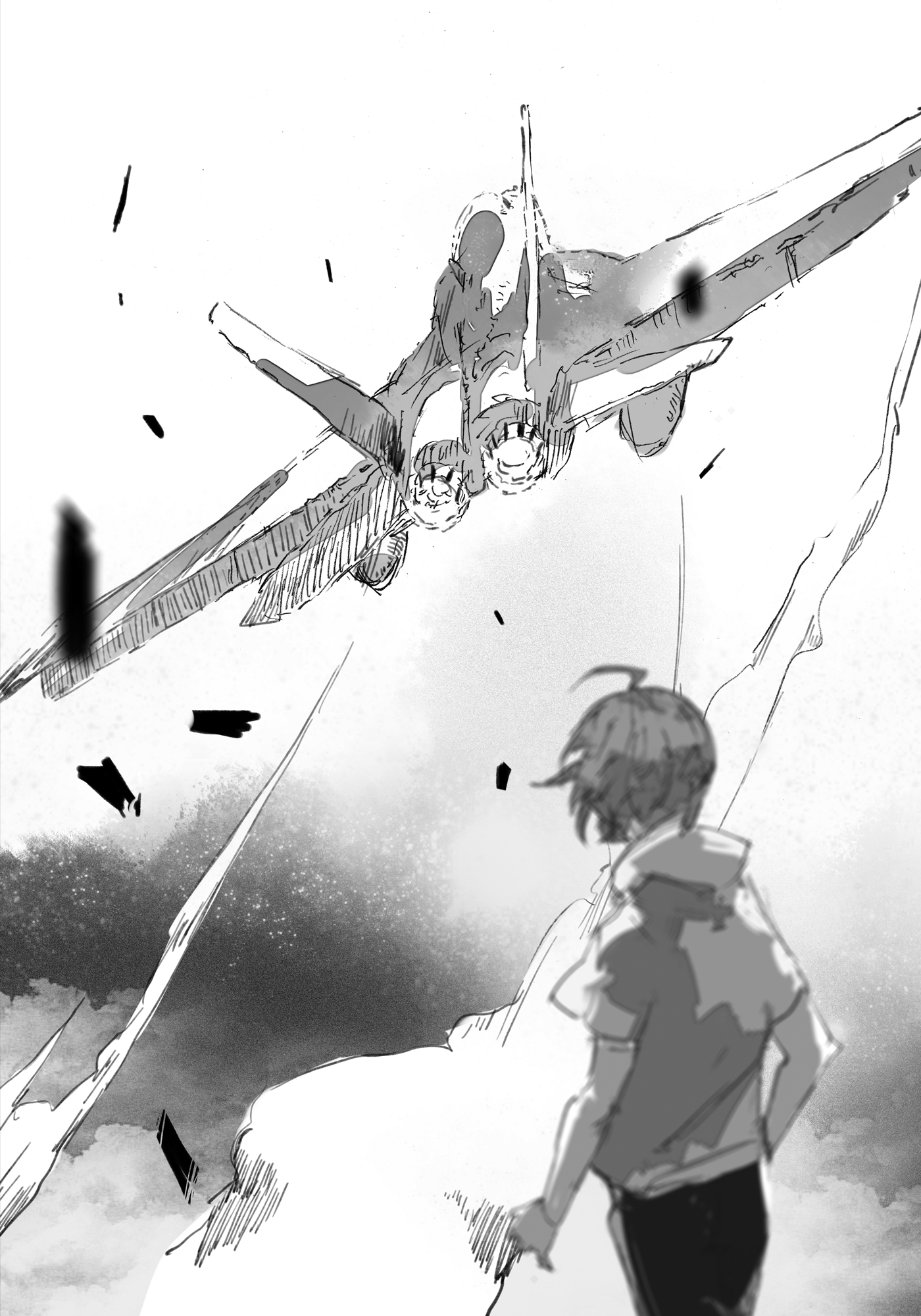
The F/A-18E/F Super Hornet, as I recalled, was a carrier-capable, multirole fighter aircraft used by the U.S. Navy. It had air-to-air combat capabilities, as well as air-to-ground strike capacity, of course... Uh, also, the Block II plane was equipped with active electronically scanned array radar, which could use reflected radio waves to produce an almost photo-real image. In other words, the Super Hornet could even make a decent spy plane when it came to scoping out ground-based facilities. I was pretty sure about all that, at least. My memory was a little hazy on the details.
Anyway, more important things to think about...
“What the heck is that doing here?!” Minori-san shouted. Nothing that big was supposed to exist in this world. The JSDF had found the wormhole so small they’d had to disassemble their LAVs to bring them over. And so much equipment was needed to assemble a jet fighter that there was no point even trying to transport one in pieces. That was before you got to the matter of fuel, too. Seriously, what was that thing doing flying over our heads?!
“You think the JSDF got it over here somehow?”
“Not a chance! Not when they’re actively trying to get all their equipment out of here! Besides, the JSDF doesn’t even use F/A-18s! If it was one of ours, it’d be an F-2 or an F-4!”
Fair enough. The JSDF doesn’t have any carrier ships that can handle fighter planes—that kerfuffle a while back was about a “helicopter destroyer,” naturally—but they did have attack-capable fighters. The F-2 “Viper Zero” and the soon-to-be-retired F-4 Phantom, though, lacked much in the way of multirole capabilities. But they would have been the first attack aircraft to show up in this world. The JSDF wouldn’t have gone out of their way to borrow an American jet to bring here. Okay, so I guess Australia was supposed to have some Super Hornets, too, but obviously most such planes resided with their country of production, America.
But that would imply... No.
“Does the U.S. know about this place? But...” There weren’t supposed to have been any leaks. Which would mean...
Minori-san and I each caught our breath. We looked at each other, then at Hikaru-san. I think we were all thinking the same thing. About how Theresa had warned us the wormhole might connect to unpredictable places. Suppose one of them had been directly under an American naval warship traveling on the ocean?
But then I would expect more—
“This is Koganuma! Did you see that?” While I was busy conjecturing and wondering, Minori-san had grabbed a wireless unit from the briefcase at her feet and was already in contact with the garrison. “It was American, sir, no question. I don’t know what’s going on...”
She was trying as hard as she could to get answers, but it didn’t sound like they knew what was happening any more than we did. So maybe this really was some kind of accident. But the timing...
I guess it was better than the wormhole connecting itself to the inside of a volcano, or the bottom of the ocean, or the middle of a nuclear reactor or something. But maybe not by much. I had a very bad feeling about this.

“So what you’re telling me...” Theresa-san folded her arms. “...is that until the Japanese showed up, no one here knew about the ‘hole’?”
“It seems that way, ma’am,” I said, placing a cup of tea on the table in front of her. She and I were in the living room of the mansion, waiting for Shinichi-sama and the others to get home. Shinichi-sama hadn’t finished explaining everything to Theresa-san—I mean everything about the way things were in the Holy Eldant Empire and its surroundings—but they had school to teach, so they’d had to leave. While they were gone, I was supposed to keep Theresa-san company. She didn’t have a magic ring, but she’d already more or less picked up our language, so we didn’t have any real problems communicating.
I couldn’t shake the sense, though, that Theresa-san was a little uncomfortable around me, as well as Elvia-san and Brooke-san. From what Shinichi-sama and the others had said, it seemed like maybe she was in a bit of a bad mood, or unhappy about something. Theresa-san often referred to us demi-humans as “bee-oh-yous,” and whatever those were, apparently hundreds of them had been employed at the Dragon’s Den. Theresa-san didn’t seem quite sure how to interact with us demi-humans out in the world, whom she called “feral bee-oh-yous.”
“Which would imply that it was only after the Bahairamanians started messing with our reeyactor that the high-per space tunnel appeared. Kinda figured.”
“Yes, ma’am...” Theresa-san was nodding as if this all made sense to her, but I hardly understood half the words she said. She didn’t seem to care whether I understood; she was talking mostly to herself, trying to put the pieces together in her own mind.
“Lot of network interruptions. Won’t be as powerful as it used to... But maybe I should try having our computer do some calculations.” Theresa-san closed her eyes. Even here and now, some part of her was still connected to the Dragon’s Den, deep underground in faraway Bahairam, and she was in regular contact with the demi-humans on patrol there. She was evidently connecting to the computer there. Whatever it was, it seemed to be on a different scale, of a different class, from the “lap tops” Shinichi-sama and the others used here.
Theresa-san opened one eye and picked up the cup of tea, taking a sip. “Whatever the case,” she said, “the past and the future being contiguous obviously poses some problems. And I don’t just mean some cause-and-effect bullshit. More fundamental stuff. Issues with the conservation of energy. Could hurry up the heat death of the universe, if we aren’t careful.”
“Ah...”
The universe. Heat death. Energy... At least I recognized that word. It had to do with force or power. I didn’t have the slightest idea what Theresa-san was talking about, but it sounded dire.
“I guess for safety’s sake the best thing would be to analyze the reeyactor logs and push the energy back into it with reverse phasing. Gotta cut the connection between here and there.”
“So it really won’t be possible to go between the Holy Eldant Empire and Ja-pan ever again?” I had asked the question before I could stop myself.
“Huh?” Theresa-san eyeballed me. Maybe she was angry that I’d spoken out of turn. But I couldn’t simply sit by and listen to this.
“If Shinichi-sama goes back to Ja-pan, I... I’ll never see him again, will I?” I’m embarrassed to admit that my voice was shaking.
“Listen, you...” Theresa regarded me with surprise for a long moment. “Huh. I get it. You’re a distant descendent of the experiments those lunatics did. They gave the ferals the ability to reproduce... so of course they might fall in love.”
“Wha? L-Love, ma’am?”
It was true that I deeply, profoundly respected Shinichi-sama. But could the feeling that existed between two people of such different social status truly be called love? I wasn’t sure.
Theresa-san scratched her head. “Well, the one thing I can pretty much guarantee is that the high-per space tunnel is gonna go kaput, and that means no traveling between this place and Japan. That’ll be the last you see of your little boyfriend. Probably won’t even be able to communicate with him. No information will be able to go either direction. Practically speaking, you might as well consider your Shinichi dead.”
“Dead...” The weight of the word made me dizzy.
“The tunnel’s gonna be out of the picture for sure, but the real issue is the energy deflection caused by the contact between the future and the past so far... If we could take care of that somehow...” Theresa-san went back to muttering words I didn’t know.
“Shinichi-sama...”
So it was true. He was going to have to choose one of our worlds and abandon the other. Would he go back to Ja-pan? Then again, even if he chose to stay here—would the Ja-panese government let him? But then, what about Shinichi-sama’s family? The more I thought about it, the more distressed I became. The sorrow of it was almost too much...
“Hrm?” While I was busy contemplating this tragedy, Theresa-san was looking at the ceiling. Suddenly, she made a sound. “What the hell?” she exclaimed.
I looked up. Theresa-san had her pointer finger to her forehead, her head bent in thought. She almost sounded like she was talking to someone. Presumably one of the demi-human soldiers back at the Dragon’s Den. “A dimensional-shift weapon? Looks like a fighter jet? Check the database. I’m authorizing you to use my code. Start with anything from the late twentieth century. Huh? What’s that? A large-scale military vessel with onboard reeyactor... on land? You think it beached itself?”
Whatever was going on, Theresa-san made it sound very urgent. Maybe something had happened in Bahairam. Something big, by the look on her face. Was it possible that the Third Capital was a sea of flames once again? I swallowed heavily, but then...
“Theresa!” I heard Shinichi-sama from the entryway. He was home a little early—had something happened to him? I wasn’t sure whether to stay with Theresa-san or go greet Shinichi-sama. I half stood up, hovering between the two possibilities, but then Shinichi-sama solved my dilemma by rushing into the living room. “Theresa, this is bad! A twenty-first-century fighter jet got into some kind of time slip or something...”
“Ah, Shinichi,” Theresa-san said, taking her hand from her forehead. “I’m aware of it. We’ve got eyes on it, too.”
“What?” Shinichi-sama asked, flabbergasted.
“A large military sea vessel, seemingly nuclear-powered, ran aground near the Third Capital of the Kingdom of Bahairam, that’s the report. I sent a dragoon in to reconnoiter, and all the data I’ve got back so far suggests a carrier ship from your era. Nimitz-class atomic cruiser, to judge by the identification code. The Nimitz itself.”
“Wha?” Shinichi-sama looked confused, then frightened. I wasn’t sure what “nuclear-powered” was. But their conversation was studded with words like “fighter” and “military.” Maybe there was some kind of weapon involved. Shinichi-sama’s eyes were the size of dinner plates. “Whaaaaaaaaaaat?!” The mansion echoed with his astonished cry.

When the word came in—mysterious flying dagger sighted coming from the direction of Bahairam—it was brought immediately to our castle. None of the eyewitnesses had any idea what exactly the thing was, but given that it had come from Bahairam, nearby officials concluded it could well be some new weapon of theirs, and rushed a report here. If Bahairam was staging an attack, we would need to be able to respond as soon as possible.
But it wasn’t as simple as that.
“What do you make of this, Garius?” At this, the collective gaze of the gathered advisors settled on the man beside us.
“To be honest, I don’t think it’s clear whether this thing is from Bahairam,” he said.
We, Garius, Zahar, and our advisors—who had been summoned urgently; we had gone so far as to have magic used to do it—were in a conference room at the castle, analyzing the report. On a round table before us was a picture of the “flying dagger” sketched by a resident artist based on the eyewitness reports. Secondhand, yes, but the best we had. The object did indeed look like two daggers arrayed against each other.
“Considering how recently they lost the Dragon’s Den, I have to assume the Bahairamanian military is still in some state of disarray. Besides, if they’d managed to muster a puppet drake, that would be one thing, but an entirely new weapon like this? I don’t think they’ve had the time or the resources.”
“So you think so too, Garius?” We were of the same mind. None of the gathered advisors raised any objections.
Garius frowned and continued. “Then there’s the fact that this object resembles something I’ve seen in the otaku works that Shinichi and his friends brought here. Something of roughly this shape that travels accompanied by a very large noise...”
“An air-plane,” we said. “Or... No, the word they use is fighter plane.” This received nods from Garius and some of the advisors. There were some among them who, like us and Garius, had gone out of their way to learn to appreciate otaku material. They might have encountered these “fighter planes,” weapons that flew through the air under their own power. According to anime and manga, these things were terrible indeed: fast as sound, powerful as a shock wave, high-flying as the clouds. Our own nation possessed weapons that were capable of flying via magic, but the height and speed at which they flew were nothing compared to these fighter planes.
“Yes, now that you say it, it is indeed similar to that flying weapon from A**a 88,” Zahar observed. “And, in fact, to those that appear in many other anime.”
“Yes, mostly as cannon fodder,” an advisor quipped.
It was true that, notwithstanding works in which the air-plane was the star, most such weapons seemed to appear chiefly to demonstrate the power of the hero or villain. But when they were bested, it was usually by the hero operating a superweapon, or by a kaiju. Our own country possessed nothing resembling such threats.
“One thing is beyond question: it comes from the other side of the high-per space tunnel.”
“But Your Majesty,” one of the advisors objected. “The Jay Ess Dee Eff is preparing to withdraw from our country as we speak. Why would they bring such a thing here now?”
“Are we certain it belongs to the Jay Ess Dee Eff? We have a part in overseeing the high-per space tunnel as well. Could such a thing get by us without us noticing?” That seemed the biggest question of all. There was only one tunnel, and it was beyond the capabilities of mankind to make it any larger or smaller. What’s more, one end of it existed here in our empire, while the other was controlled by Ja-pan. Perhaps the weapon had been brought over one small part at a time and then reassembled here, but such an endeavor would have required time and space to accomplish. Considering that the Ja-panese forces were at this very moment breaking down their garrison and training grounds and preparing to withdraw, it would have been silly for them to attempt such a project now.
The gathered advisors were of a wide variety of opinions.
“They’re leaving anyway. Perhaps they intend to take what they can before they go?”
“You really think a friendly nation such as Ja-pan would do such a thing?”
“Don’t forget, their original intention was to use Shinichi-dono as the spearhead of an invasion.”
“Yes, but they’ve been so cooperative lately...”
“Surely attempted robbery would mean an increase in soldiers and supplies, not the other way around.”
“Yes, but—”
“We must consider—”
The disagreement was only natural. We could imagine many different scenarios, but we desperately lacked the actual information necessary to draw any conclusions.
“We have it on good authority that just as our Empire is not the only country in this world, but is surrounded by the likes of Bahairam and Zwelberich, Ja-pan has its neighbors in its world. Perhaps this weapon came from one of them,” we said. This brought our advisors up short. “Further, perhaps a high-per space tunnel existed in one of these other lands without our knowing it—or perhaps one has come into existence. This seems a possibility.”
“Y-Yes... Well...” No one seemed able to muster a response. Of course, one presumed such a possibility had occurred to them. But it was so terrible that they no doubt preferred not to think about it.
Thanks to that lovable loser Shinichi, and the fact that he was the first to arrive here on that fateful mission of “invasion,” our country and Ja-pan had built a relationship that was at least cordial. But suppose a high-per space tunnel existed in some other country, and suppose that what they sent through it was not a cultural ambassador, but an army. Not everyone would do as Shinichi had and protect another land from invasion by their own mother country.
We knew so little about the high-per space tunnel, including how it was formed. We had no guarantees that there was in fact only one, or that others might not appear in places we didn’t know about. Suppose another tunnel opened on the edge of the world, and powerful foreign weaponry streamed through it. It was enough to send a shiver down the spine.
We did not have the heart to deride the ministers as fools for not entertaining this possibility.
“We will come to no answers by sitting here and debating. Matoba we doubt, but Shinichi we believe we can trust. Summon him. Questioning him about these events seems the quickest way to find out what’s going on.”
“As you command.” Garius rose from his seat and bowed.

The flight deck resounded with the bellow of an aircraft engine turned up to the max. The shuttle was already attached to the front wheel, and the deflector that would shield us from the jet blast was in place. Ready to launch anytime.
“GO!” A catapult officer wearing a yellow hi-vis jacket waved a hand and shouted. The next instant, the steam catapult restraining the Super Hornet launched with almost blinding speed, flinging the aircraft toward the edge of the flight deck. The pilot pulled up the nose of the plane just as it edged off the ship, and the Super Hornet lofted up into the unknown sky.
It was a familiar sight to those of us aboard the Nimitz, but even so, this time it sent a nervous tremor through the crew. After all, we were in a world we didn’t know. Would our usual expectations and assumptions hold here? We had no idea. We didn’t even know if the laws of physics operated the same way here as on Earth, or if the plane might suddenly come plummeting out of the sky. Having said that, this was the fourth plane we’d sent out, and we were feeling a lot better than we had with the first one.
“But there are still things like that up there,” I said, gazing out the window of the ship’s bridge. The sky above looked much like the one in our own world, but in addition to our aircraft, strange shapes could be seen above us. Well, not exactly strange, to be fair: I’d seen things like them many times in cartoons and special-effects extravaganza movies.
Dragons. Fantasy creatures, right? The stuff of myth and legend. Now they danced over our heads, mocking the laws of nature as we knew them. An entire day had passed since we first observed them, but they didn’t seem to be going anywhere, and a number of crew members had witnessed them with their own eyes. Several had taken pictures. They were definitely, really there. Three of them at the moment—more than before.
“This is getting ridiculous...” I mumbled. I knew that deep in Earth’s past, there had been a giant flying reptile called pteranodon. This “winged dragon,” which lived during the Cretaceous period, was said to have a wingspan of many meters. Fossil research, however, suggested that the creature didn’t have that much muscle in its wings; it was believed that instead of flapping its wings in flight, it simply held them out and rode the air currents like a glider. In fact, pteranodon was now believed not to have had too many muscles at all—the idea was that it had sacrificed flesh and bone density to make itself light, and that the creature was essentially a skin-draped skeleton. In other words, it was a far cry from the dragons of cartoons and movies, invincible in the air and powerful as a tyrannosaurus on the land. Such a creature couldn’t exist, biologically speaking.
And yet there they were, right above our heads. You could tell how well-muscled they were even from a distance, and they obviously flew where they wanted, with no regard for air currents. They might not move as fast as one of our aircraft, but they evidently had at least the autonomous power of a propeller craft. Despite looking like they did. Despite having no propellers or jet engines. Hell, with their makeup, they might be able to pull off some nimble dogfighting maneuvers that might not even be possible for carrier-based aircraft. It was like their entire bodies were living FBW systems.
“At least they seem to be keeping their distance. Silver linings...” I said. These were obviously predators. Potentially apex predators, when it came to a bunch of weak, ground-bound, latter-day apes like us. I didn’t have any idea what they might be thinking. Maybe they were scared by the sound the Super Hornets made—in any event, they just circled slowly around the Nimitz, never coming too close. Given that they were leaving us alone, we decided to return the courtesy, sending the planes out purely to gather information about our immediate surroundings.
We’d learned a few things from our sorties. The latest plane was going out to confirm what we could.
“Lieutenant Douglas, have a look at this,” one of my men said, coming up to me with a clipboard full of papers. They included a hastily drafted map along with photographs of the humanoid, seemingly sentient life forms of this world—including towns and villages we assumed they had built. This suggested some commonalities with us. The towns and villages—maybe even nations—we were observing seemed to show a medieval or even almost modern level of culture. Some of the photos showed giant birds and lizards pulling carriages through flagstone streets, much as horses or oxen might in our own world. There were beings who looked human, but also some that looked like walking reptiles.
All this stuff only contributed to the feeling that we had landed in a cartoon or something. If they’d said we were in a trailer for a new movie that was coming out, I might have believed them. It would sure make a lot more sense than having to accept that what we were experiencing was actual reality. All we needed was laser swords and some four-legged tanks, and we’d have a Star Wa*s movie going on. Come to think of it, I’d promised to go see The Last Jedi with my seven-year-old son on my next shore leave... Forgive me, my dear child. Daddy might not be coming home for a while.
“The captain will be giving the final briefing on the operation at 14:00,” I said. “The Black Knights will be out on patrol. Otherwise, I want all hands assembled on the main deck.”
“Aye, sir.” My subordinate nodded, then headed for the deck. I guess the captain had made his decision. Why else would he call everyone together?
The Nimitz, our ship, didn’t have much longer to serve out its combat life. Whether we were going to find a way home or find a way to continue living in this world, our safety demanded that we let these people know how much trouble they would be in if they made enemies of us. We had already detected several groups that appeared to be military forces moving toward the ship. They were armed with spears and swords—suffice to say, it didn’t look like they were coming to roll out the red carpet. That only left us one choice.
“Ugh. Why is it always the Nimitz that gets caught up in this ridiculous shit?”
“Fina* Countdown was just a movie, sir.”
“True enough,” I said, sharing a wry smile with the sailor who had spoken. “I forget that sometimes.” Then I walked over and gazed at our newly completed map.

We were in one of the audience chambers in Holy Eldant Castle. A very big one, where Her Majesty the Empress had summoned all of her advisors and even a bunch of royal guards. It felt a little like a large chapel; it was frequently used for public or ceremonial occasions, or for meeting foreign dignitaries. It was immense, the ceiling way, way above our heads. And of course, that meant gigantic walls, as well.
And at the moment, something unbelievable was projected on one of those walls. A massive gray structure. The silhouette was distinctly asymmetrical but nonetheless looked something like a table, including the way objects could be placed on a large, flat board on top of it. Form follows function, I guess. But this was hundreds—thousands—tens of thousands of times bigger than any table we might use in our homes.
“Nyoo-clear-powered battle ship...?” Petralka, sitting on her throne, repeated the words in a befuddled whisper. No wonder she was confused: this was a weapon that operated via something that didn’t exist in her world. Something they didn’t even have a concept for. But then she said, “Yes, we seem to recall such a thing from Silen* *ervice.”
“Oh...” Come to think of it, that was one of the manga I’d brought over here. And yes, there had been a chapter in which a nuclear submarine faced off with a nuclear-powered battleship. But of course, that had taken place on the open ocean. Neither of those ships had spontaneously appeared in a wilderness ravine like the Nimitz just had. Sile*t S*rvice was realistic. This was ridiculous.
“We seem to recall they are like castles that float on the water. Yes?”
“Excellent recollection. That’s exactly right,” I said.
Incidentally, the video clip of the Nimitz, currently beached (or whatever you want to call it) in Bahairam, that we were watching was being provided by Theresa. She was using her communications network connection to get info from the BOUs still patrolling the Third Capital. Apparently we were watching from the perspective of a dragon she’d left there to observe. She’d then instructed the nanomachines—the agents of what most people around here called magic—to create what amounted to a projector and display the image on the wall of the audience chamber.
“We’ve also got this,” Theresa said, changing the picture. Now it showed a fighter jet, a Super Hornet, tearing through the air at incredible speed. The assembled advisors were flabbergasted. The beached carrier might look to them like just a really strange castle, but to see a jet plane actually flying through the sky had to be quite a shock. In the image, it was flying low enough that you could see the ground, giving plenty of reference for just how fast it was going.
“We suspect this is the ‘flying dagger’ that was witnessed in our nation,” Petralka said as she waited for the mumbling to subside.
“We saw it, too. Definitely the same kind of plane,” I said.
“Ah. And, Shinichi...” Petralka leaned forward slightly on her throne. “What in the world is this thing? Was Ja-pan not going to leave our empire behind? What, then, do they mean by bringing such a thing as this to us?” Her emerald-green eyes studied me intently. It was clear she would permit no half-truths, no excuses. She wanted to know everything.
“One thing I can tell you—that’s not a Japanese vehicle. We don’t have any of those,” I said, slightly panicked. “I think all of you realize, Petralka, that Japan isn’t the only country in our world. That weapon belongs to another one of them, called America. You remember, uh, they tried to kidnap us in Akiba when we were in Japan...”
“Ahh, them,” Petralka said, nodding.
Garius spoke up from beside her. “But Shinichi, is it not the case that the high-per space tunnel exists only between our land and yours?”
Expectant gazes fell on me from all around the room. Suddenly I understood. They knew perfectly well that Japan hadn’t brought the jet plane here. Petralka had only asked about that to be completely sure. This was the question they really wanted answered. Was the wormhole, they wanted to know, really the only one? Were we sure there weren’t any others?
“That’s, uh, supposed to be the case, yes,” I said, frowning. “But remember what we said about the wormhole becoming unstable? I guess that makes it possible for it to suddenly connect to unexpected places. And this time... it accidentally dropped an aircraft carrier into your world.”
“Accidentally...” The advisors looked at each other. I didn’t really blame them; it would be hard to just accept that this was an accident, sheer chance. But it was...
“The fact is, it’s an accident that this world and that one became connected at all,” Theresa broke in. She’d apparently spoken to Garius personally after the events at the Dragon’s Den, but it didn’t change how out of place she looked. Her clothes were completely different from everyone else’s, and the shining objects shimmering in her chest were unusual. She must have looked very, very strange to the assembled advisors. They hadn’t stopped giving her questioning looks throughout the audience. Not that Theresa seemed to care at all.
She continued: “I’ve been doing some analysis with our computers, and I’m pretty sure I know what’s going on. Here’s the deal: the excess energy generated from Bahairam or whoever was messing around with our reactor just happened to find its way into an abandoned new-stealth tech project, which started up and went out of control just like the reactor. Simple as that.”
“Simple or not, I’m afraid I don’t quite follow the subtleties. But are you saying that the very fact that the Holy Eldant Empire was ever connected to Ja-pan to begin with is a freak coincidence brought about by whatever was happening in Bahairam?” Garius asked.
“That’s about the size of it,” Theresa said, nodding.
“So, did stopping the reeyactor in the Dragon’s Den make this happen?”
“No, that’s not actually the proximate cause. For better or for worse, the tunnel had been pretty stable as far as connecting Japan to Eldant, but then Bahairam stepped up their experiments, the reactor went even crazier, and the additional output of energy made some experimental equipment go on the fritz. The hyperspace tunnel could no longer dissipate all of it.”
“Hmm?” Garius frowned. That was fair; you couldn’t really expect him to follow this twisted sci-fi plot and all these details. Frankly, even I wasn’t completely sure what was going on.
“I sent a dragoon to investigate, but the wormhole that brought the nuclear carrier here was already gone. Just as well. Otherwise it might have brought over other ships, too, and who knows how much seawater.”
A carrier... No aircraft carrier sailed alone. They were big, and that meant they were slow by the standards of military craft, making them vulnerable to quicker, more agile vehicles like attack aircraft, submarines, and destroyers. So carriers traveled with Aegis ships or missile destroyers in what was collectively known as a “carrier strike group.” The point is, the wormhole that had brought the Nimitz here must have covered a comparatively small area and existed for only a short time. We didn’t know if there might be another such fluctuation—we could only be glad this one had avoided disaster.
“Whatever’s going on, though, this is bad. Like, really bad,” I said.
“Is it?” Petralka asked. “Was it not an accident?”
Yes, it was, in the sense that the Nimitz hadn’t shown up here specifically to attack the Holy Eldant Empire or something. Obviously not. It had just been pulled through the time warp in a freak occurrence.
“But that’s the cliché!” I said, clenching my fist.
“Um, Shinichi-kun?” Minori-san said, a little startled, but I went right on:
“A modern weapon is transported to a fantasy world, or time-slips to some other era, and it’s invincible! That’s how it always goes! Like in Final Countdo*n! Or G.I. S*murai! Or Gat*! Or Drago* Harrier!”
I couldn’t begin to guess what the crew of the Nimitz might be thinking right now. But they’d come here by sheer chance and were probably convinced there was no way to get home. They had no idea that there was a portal to twenty-first-century Japan right here in the Eldant Empire. So they’d sent out planes on reconnaissance missions and had discovered that this wasn’t the world they knew.
What would they do next? Even a nuclear-powered aircraft carrier doesn’t have infinite combat capability. The reactor might keep running for a good long time, but without resupply, jet fuel would quickly run low, and the same for ammunition. They might start thinking about fighting while they still could—a dangerous mental path to go down.
That was how it had turned out in each of the stories I’d just mentioned. Sure, maybe it was just something the authors came up with because these were supposed to be entertainment and they thought it sounded dramatic. But then again...
Anyway. We were way beyond the question of whether or not a couple of humans would go back to Japan or stay here. A weapon capable of destroying something like 80% of the Earth was now loose in this other world—who knew what that could do to space-time?
“How do you think we should respond?” Petralka said to me, voicing the question on the mind of every Eldant person in the room. Well, that was the real issue, wasn’t it? I tried to force my gray matter to work even as I panicked. Umm. Uhhh... Fighting was usually a last resort. We often talk about “starting” a war, but war is often more like something that happens after every other possibility has been exhausted. Nobody really wants to get involved in a killing match.
“For starters, somebody has to get to them and give them information, tell them what the situation is, before they turn violent!” I said. Talking, that was the place to start. If we could somehow communicate with them, we could avoid needless fighting.
“And who’s somebody?” Garius asked.
“Maybe one of us from Amutech, or someone from the JSDF...” Er, but the JSDF was busy breaking things down and getting out of here. I had no idea how many soldiers were still here. “Anybody from the twenty-first century like them, to try to convince them not to do anything reckless.”
“And this person will go into Bahairamanian territory?”
“Oh...”
I saw what he meant. Bahairam. The Nimitz wasn’t here in Eldant. I’d crossed the border a number of times unofficially, but strictly speaking, from our perspective as guests of the Eldant Empire, Bahairam was an enemy country. Naturally, they felt the same way about us. In other words, we weren’t just going to waltz in there, and if we attempted an invasion instead, the Bahairamanian army would probably attack us before we could make contact with the Nimitz. We wouldn’t even have a chance to talk with them, let alone explain the situation. And after what had happened at the Dragon’s Den, I was sure Bahairam would be even more on edge than before. If we were going to try to cross the border in force, we would have to really mean it.
“Yikes...”
What were we going to do? How were we going to avoid a worst-case scenario? I could only clutch my head, overwhelmed by the enormity of the problem that suddenly faced us.

An emergency communiqué from the other world was almost never a good thing. From the moment that little problem child, Kanou Shinichi-kun, had been assigned General Manager of Amutech, I had been prepared for a certain amount of trouble, but somehow the size of the problems always managed to exceed my expectations. And I was the one who had to tell all the Japanese leadership about them. It was going to give me an ulcer.
“Hell of a time for this!” the prime minister sighed, sinking into his chair and staring at the ceiling. I guess I wasn’t the only one with potential gastric problems. I suppose I shouldn’t have been surprised. All the earthquakes these days were bad enough—the country was flirting with chaos—and then the Chinese and the Americans and the Russians all started deploying soldiers to Japanese soil in the name of disaster relief.
It was true enough that the unprecedented scale and frequency of the quakes produced more disaster zones than the JSDF could reasonably cope with on its own, so turning down the offers of foreign assistance would have been political suicide. Meanwhile, ships flying the Chinese flag seemed to see their opportunity, turning up everywhere at once, upsetting fishing grounds, interfering with local patrols, assaulting Japanese fishermen...
As for the prime minister, the opposition party and the mass media would be all over him if, say, he didn’t know what it cost to ride the subway these days, or if they spotted him eating even remotely expensive katsu curry at a hotel. “He’s out of touch with the people!” they’d proclaim. Just imagine the reckoning there would be if he made one wrong move in his response to these disasters.
“You were telling me about cause-and-effect and... space-time or something, weren’t you? How dangerous it all was? I followed my gut and gave the order to pull out of Eldant, and now there’s an American nuclear carrier there?!” The prime minister was practically shouting at the ceiling now.
He had already been briefed on the possibility that the “other world” was in fact our own far future, and that the opinion of our experts was that the interference via the space-time wormhole ought to be minimized. That the tunnel ought even to be closed, if possible. Given that a worst-case scenario involved the potential destruction of the entire world, the safest course of action seemed to be to withdraw the JSDF and Amutech—that was the Diet’s opinion, anyway, and so the operation had begun. And now, right in the middle of it, this happened. It was enough to make anyone, not just the prime minister, scream at the ceiling.
There was another factor: America didn’t know about the other world. Or, it hadn’t. It had been Japan’s little secret. America had noticed, however, that there was something going on around the Sea of Trees surrounding Mount Fuji. They’d made more than one attempt to poke their noses into it. Such as the time when Shinichi-kun had returned to Japan, only for the Americans to kidnap him on the assumption that he was some kind of key to the whole thing.
There were other other factors as well. China and Russia might not know as much as America, but presumably they suspected something was up. Why else would they have been so eager to send military forces in the guise of disaster relief? And then there was the matter of the “American colossus” and its lust for profit, stricken as it was with class and economic inequalities. If they found out about the other world, they would be desperate to snatch it away from us, along with whatever profit it might represent. All this being the case, could Japan approach America with information on the real state of affairs at this moment? And if we did, would America believe us?
I started to worry about that ulcer again. And although I knew the prime minister was even more worried than I was, I felt compelled to say, “I’m afraid this is more than just a diplomatic dilemma, sir. This time, it was only a nuclear carrier that got transported, but—”
“Only? Did you say only a nuclear carrier, Matoba-kun?”
“Yes, Prime Minister. Nothing worse than a nuclear carrier. But who knows on what scale the next time slip may occur, what sort of area it may engulf, or how frequently they may happen? Imagine whole cities being dropped into the other world, or the wormhole connecting itself to the inside of a nuclear reactor, or a missile silo somewhere. You think it can’t happen? There’s no way to rule out the possibility.”
The prime minister made a sound halfway between a choke and a groan.
“Our esteemed scientists are investigating possible ways to seal off the space-time tunnel, but needless to say, we’re starting from scratch here, and there are no certainties. We may not have time to figure out what works. But one thing we can say—if military action starts up on the other side of that wormhole, it will only increase the rate of cause/effect interference, and perhaps its scale.”
“Forget the physics lecture. What are we going to do about that carrier?” the prime minister interrupted irritably.
“Sir?”
“The report said that the tunnel that transported the carrier to the other world is probably gone already. Which means there’s no way to get that ship back through to our world, is there?”
“No, sir, not so long as we don’t figure out a way to control the time slips.”
“In that case, the only practical solution is to get the American soldiers to abandon the ship and evacuate through our wormhole.”
“Yes, sir, I would say that’s realistic.” There was no way of knowing what sort of effect abandoning a nuclear aircraft carrier would have on space-time, but that wasn’t something Japan could do anything about at the moment.
“Do you really think the American soldiers would go along with that?”
“I’m afraid I can’t say. But nuclear-powered or not, that ship won’t function forever. And anyway, at the moment, it’s like a fish on dry land. It can’t move under its own power, and without a sea to sail on...”
“Yes? Without a sea, then what?” The prime minister furrowed his brow.
“It won’t be possible to cool the nuclear reactor.”
The prime minister looked stricken.
It was the truth: most nuclear reactors were built on coasts or along rivers to facilitate cooling. That was one reason why it made sense for large military vessels to be nuclear powered. They would never want for water to cool their reactors. At least, as long as they were at sea. But the Nimitz was now sitting in the bushes somewhere on the other side of that wormhole.
How long would that reactor hold out for? Being a military ship, I was sure the Nimitz was equipped with a variety of safety systems, but if they had to use them—if they had to shut the reactor down—it would deprive them of most of their combat power. With no electricity, they wouldn’t be able to use their air-control systems, their steam catapult, or any of their other electronics. The fighter jets that formed the core of the ship’s strength would be unable to take off. At best, they might be able to make use of any helicopters stationed on board. Of course, that might be seen as threatening enough in the other world...
“The crew of the Nimitz have been thrown into a strange world with no safe harbor. We can only pray that they don’t turn to violence. But to be perfectly honest...”
If I were in their position, I would use my fighting strength while I still had it to dominate the largest area I could, in order to secure land and resources to enable me to survive. If I took the people I was dealing with to be intelligent, I would try to demonstrate the extent of my power, in hopes of controlling them through fear. I doubted the Nimitz would immediately resort to the use of nuclear weapons, with the environmental contamination they entailed, but they could all too easily end up in a conflict with Eldant or Bahairam...
“I suppose we have to let the Americans know about this,” the prime minister said. “We need to try to get in touch with their naval command, tell them not to do anything reckless.”
“In theory, sir, that may be our best option. However, there’s no telling how the Americans might respond when they find out about the other world...”
When they discovered that world, with all the riches it might hold, would they be willing to simply let it go? Would they actually believe us if we tried to explain that it wasn’t another world, but a future one, in which thoughtless interference could threaten all our existences? Would the Americans really accept that? Even we still hardly believed it. Even less did we know what to do about it.
The prime minister let out a very long sigh. We both knew this was an urgent matter, but a rapid conclusion didn’t seem likely.