Chapter Four: The Melancholy of an Invader
Chapter Four: The Melancholy of an Invader
I sighed to myself.
I was standing in Eldant Castle.
It was the day for me to visit the royal residence, as I did once every three days, but to be perfectly honest, I hadn’t wanted to come out of my room. It was the first time I had felt this way in a long time—in fact, it was the very first time I’d felt this way since coming to the Eldant Empire.
Normally, I would go to the school immediately after my visit to the castle, but today I just couldn’t summon the enthusiasm. Who knew there were days when teachers didn’t want to go to school, either? I thought back on my high school instructors with a twinge of sympathy.
The attempt at recollection didn’t go well.
Their faces were already all but lost to me in the mists of memory. Factoring in the year I’d been a shut-in, I hadn’t seen them for eighteen months now, so it was no surprise that I couldn’t remember them. My classmates, too, seemed oddly unreal to me, like characters in a story.
Maybe it just went to show how important this half a year in the Eldant Empire had been to me. It loomed so large in my mind that that other world—the “real” one—seemed hazy by comparison.
And yet, standing there in the castle courtyard with morning light streaming around me, I felt deeply weary. Since the conversation with Matoba-san, I had been doing my best to do some thinking. I had tried questioning Minori-san, too, and although it could take a little cajoling, she was mostly pretty open about things—maybe she figured it was too late to keep secrets now.
It turned out, of course, that the Japanese government had always planned to invade this world, this place to which they were connected by a hyperspace wormhole. The first sniff they got of this “virgin land” smelled to them like profit. A veritable treasure trove.
Take, for example, agrobiology, which has been such a topic of discussion lately. Basically, people realized that the bacteria and other plant and animal life-forms unique to specific geographical areas could help make a lot of money depending on how you used them. They could be good for farming, medicine, industry, and even military applications. As biotechnology developed, people started looking for more and more profitable genetic data, the grim hand of research reaching from the tops of the mountains to the bottoms of the seas.
But as the riches these agrobiological resources could generate became clearer and clearer, the people who owned the land where those resources were found, to say nothing of the countries where that land was located, sought to assert ownership over those resources—right down to the genetic data that could be gathered from them. The days of digging through the earth, hoping to find some new bacteria, were coming to an end.
And just as the window was closing, what should appear but this world? The government officials were probably dancing for joy. The mere thought of what agrobiological resources might exist in a world like this, one totally separated from our own, was dizzying. It could be on the order of tens of thousands—it could be millions, or billions! And there was no one here who was trying to claim ownership of those resources—yet.
They were there for the taking.
Of course, agrobiology was hardly the only precedent here. Think of the Europeans buying the island of Manhattan from the natives for a swindler’s price. On the Eldant side of the hyperspace tunnel we were dealing with an effectively medieval level of cultural development, which made it easy to take advantage of the other party’s ignorance. For example, in a world without electricity, rare-earth metals were just rocks and dirt. (That was, of course, providing this world actually had any resources like that.)
Anyway.
The simplest way to bring this world, or at least the Eldant Empire, under Japanese control would be a military invasion. That, however, would have demanded deploying the JSDF.
The real problem wasn’t legal qualms about Article 9 or whatever. It was that a military invasion would require a good deal of weaponry and manpower to be sent over here, and the wormhole was an awfully tight fit. Plus, if the government wasn’t careful, other countries would be apt to smell something fishy. America and China in particular weren’t likely to let such a thing pass unnoticed.
Japan wasn’t exactly the world’s 500-pound gorilla. Once other governments got wind of what was going on, there was a good chance Japan’s priority and resource rights would be taken away. I mean, we’re talking about countries like America, which for all its fulminating about national autonomy was willing to throw its weight around in the Middle East to make sure its oil supplies were secure. They would find some reason to intervene here, too.
On top of that, even if the JSDF managed to get over here secretly, there remained the question of whether they could actually win. Sure, we’ve got movies like G.I. Samurai, but the truth is, we couldn’t be certain that modern military equipment would have the advantage. Modern military history provides more examples of numbers overcoming a technologically superior force than I could name.
Then there was the little fact that people in this world could use magic. The Japanese side hadn’t yet figured out what principal this magic operated on. There was always a certain possibility that the actual laws of physics were different in the Eldant Empire than they were in Japan, and we simply hadn’t realized it yet. The JSDF’s weapons involved a lot of electricity and sheer physical mass, so in a world that had different laws of physics, weapons might malfunction in exciting new ways, right when we least wanted them to.
For what it was worth, the armored personnel carrier seemed to be running smoothly—but I supposed the engineers would be left shaking their heads if anyone tried to tell them it was really fire sprites doing the work over here.
Another thing we didn’t know was how powerful military magic was around here. You couldn’t discount the possibility that someone would just shout “Abracadabra!” and turn the whole army into frogs.
In light of all this, the Japanese government hit on a better plan: cultural invasion.
Once upon a time, Christian missionaries—along with narcotics—were used as the tip of the spear wherever there was to be an invasion.
Religion is a powerful brainwashing device. Even if the founders and their immediate disciples didn’t intend it—in fact, probably never imagined their teachings being used that way—a religion’s power to bind people together can become the basis for large-scale rebellions and wars, as history teaches. You can use it to destroy an enemy country from the inside without ever firing a shot.
At the moment, though, Japan had no really “addictive” religion. Buddhism and Shinto have become a sort of transparent part of people’s lives precisely by softening their own most powerful characteristics—and on the other end of the spectrum, the various “new religions,” which undoubtedly do have an “addictive” quality, would probably be downright dangerous if deployed by the government. One wrong move, and Japan could have a hostile country right next door with nothing but a hyperspace portal for a border.
So the question arose: was there something similar to drugs or religion, but easier to control?
As it happened, otaku culture fit the bill. And the idiot otaku who wandered right into the government’s clutches was... me.
“Dammit...”
This whole situation was like a rock that had started to roll down a hill. Even if I quit, they would just bring in the next oblivious nerd—and maybe it would be someone without any compunctions about invading another world.
That meant there wasn’t much I could do to thwart the plans I was now a part of. I would simply be “dealt with,” as Matoba-san had put it.
What to do, what to do?
Should I pretend I hadn’t noticed anything? Yes, this was an invasion, but not exactly the way they did it back in the Middle Ages. The Japanese government didn’t intend to conquer the Eldant Empire, massacre its people, and make slaves of the survivors or anything wildly inhuman like that.
Well, wait... Didn’t they?
I highly doubted that the Japanese government would endorse traditional slavery, but there was no question that a system of exploitation would emerge. It would cause the gap between rich and poor to widen, further exacerbating the Eldant Empire’s already class-conscious society: the people who were already starving would starve worse, while the small minority that was the ruling class would tighten their grip. You don’t even have to look as far as our—ahem—neighbor to the north. The pattern seemed likely to be the same no matter what world you were in.
I stood there, not making a sound. I felt like I was in some kind of nightmare, one of those pain-in-the-ass ones that refuses to end. I rubbed my eyes, then stared at my palms. But there was no escaping it: I wasn’t going to wake up, because this nightmare was my reality.
As I was thinking these gloomy thoughts, someone tapped me on the shoulder. I looked up with a start to see a handsome, silver-haired guy frowning at me. It was the knight, Garius. An important young mover and shaker in the Eldant Empire, he was a minister as well as a knight.
“How very melancholy you look,” he said. “What troubles you, Shinichi?”
“Oh, uh, you know. Just things...” I said evasively. I was definitely not about to explain to him of all people that I was among the first elements of an invasion intended to gain a foothold in his world.
I looked at the ground, feeling too sick to meet his eyes. If our gazes met, I was sure he would suspect me—but I didn’t have much choice.
“Hm?” he murmured.
Despite the fact that I was staring at my feet, I could sense that Garius was looking at me doubtfully. I hoped he would be content to leave it at that and go away, but if that were the case, he wouldn’t have started talking to me to begin with.
The air was full of the warm sunlight of early afternoon. You could tell a ruler lived here at Eldant Castle, because everything beyond the railing of the marble terrace we were on looked like a giant nature reserve. I leaned against the railing, an oppressive feeling settling over me. Still I didn’t speak.
I peeked back over my shoulder at the terrace behind me. A short distance away there was a table, the legs fashioned to look like cat’s paws, laden with silver trays bearing bite-sized cakes. Petralka was sitting there, enjoying her afternoon tea. Myusel and Minori-san were with her, and Minori-san and Petralka were trying to talk down Myusel, who was insisting on serving them.
The scene was almost peaceful enough to bring a smile to my face. And yet, sitting there together were the invader and the invaded. And the people who were being invaded didn’t even know it yet. If Petralka or Myusel knew the truth—knew what the Japanese government was really planning—what would they think? The sight of their little tea party looked so precarious to me, like a house built on sand.
“Shinichi?” The voice that brought me back to reality was again that of Garius, who was still standing in front of me. He wasn’t looking at me, though. He had his eyes on Petralka and the others just like I did.
“I believe you spoke to me once of the ‘knightly virtues,’” he said.
“Huh? Oh... Yeah.” That conversation seemed so long ago now; his reference brought me up short. Thinking back on it, I realized how arrogant I must have sounded—me, who was nothing more than an agent of some invaders.
“I think it could be, Shinichi, that this culture you’re bringing us will undermine our own long-standing traditions.”
I almost choked, but Garius either didn’t mind or didn’t notice, because he went right on.
“I am a knight of the Eldant Empire; myself and others all esteem me as such. I know the knight’s principles, and... Well, I believed I was living them. But I found the knights depicted in the manga you brought to be shocking. To be precise, I suppose I should say the knights in the manga Her Highness read aloud to me. ‘This is what it means to be a knight,’ she said. Tell me... is that truly how knights in your country are?”
“Well, uh...”
The truth was, things like the knightly virtues and bushido were post-hoc creations, developed in times of peace, to help take ruffians whose talents were only useful in war and turn them into members of a less violent society. These codes were, in their own way, tools of political brainwashing, not anything born of necessity...
“I was angry, at first,” Garius said. “I felt you were dismissing knighthood as it had been passed down to us through the generations. I suppose that’s still true.” He didn’t sound as upset as his words suggested. “But of late, I sometimes feel... Let’s say it feels as if I’ve been defeated.”
“Wha...?”
A lot of fantasy stories involving knights are morality plays. It may seem obvious, but we see them defeating the strong and defending the weak, and it looks heroic to us. We hold them up as ideals, people who fight for what they believe in even when it seems ridiculous to do so. What did Garius, who was a real, actual knight, make of that?
And what did he mean by defeated? Did he feel he had lost to the idealized image of a knight from some other world? If that was true, he must have found it immensely embarrassing.
I remained silent; Garius made a little motion with his chin.
“In all my life, I’ve never seen anything quite like that,” he said. He was indicating Petralka, sitting happily in the sun. Myusel, sitting across from her, was smiling kindly, and Minori-san seemed to be enjoying herself, too. There were maids besides Myusel there to serve—but even they, standing against the wall, seemed somehow happy, swept up in the pleasant atmosphere.
“Her Majesty—Petralka...” Garius said to me, almost whispering. “She was so young when her parents died. Politics... Everyone poisoned everyone else in a dispute over the succession, if you can believe it. The previous Majesty was deeply distraught, passing from grief just a year later. That’s how Petralka ended up on the throne at such a young age.”
I couldn’t say anything. For someone to be an empress when she was still practically young enough to be called a child—I knew there had to be some kind of story there, but even I hadn’t realized...
Wait. Hold on a second.
If they were disputing the succession, that meant...
“Yes,” Garius said with a grim smile, as if he had read my thoughts. “The ones who poisoned Petralka’s parents were my own parents.”
The shock must have been clear on my face.
“Petralka inherited the throne because—well, of course, she’s ostensibly first in line for the succession. The reality is, though, that it was the product of a compromise between the factions who supported the First Prince and the Second Prince, in order that they might not simply destroy each other. Petralka could be put forth as putative empress, with myself as regent, and both factions could continue to exist.”
“But that would mean...”
That would mean Petralka was a puppet ruler, no more than an ornament on the throne.
“Of course, Petralka herself is aware of that much. That’s precisely why she works so hard to appear suitably imperial. She knows that her own parents, as well as her aunt and uncle, died by poison, and she’s quite keen that such a thing not happen again. So she does her duty as empress with as much fanfare as she can muster. At the same time, it appears she’s been quite considerate toward me, as well.”
“Petralka did all that...?”
I hadn’t had any idea of the sort of position she was in. Now that I thought about it, though, it struck me that a true child empress would be unusual; that her presence pointed to some covert structure of power.
“Thus it was only after our parents’ deaths that I ever saw my cousin, Petralka, smile in a way befitting a girl of her age.”
I was speechless. I didn’t know what exactly it looked like to Garius, but he smiled, a bit sadly.
“Petralka has had favorite ministers, but no one she could rightly call a friend. Someone and something has finally arrived that she can truly admit into her heart. That is you, and the culture you’ve brought.”
I never expected him to say it so frankly.
Without any pretense, he said, “I thank you.”
Could it be... Could it be that even this handsome knight had days that he simply wanted to be a friendly older cousin for Petralka?
“But...” I began, but as I expected, I couldn’t bring myself to go further.
But that was just... coincidence.
The otaku culture I’d brought—it was supposed to be a tool of invasion.
“I don’t know precisely what worries you, Shinichi,” Garius said, “but you may hold your head high. So far from being as weak as I took you for, you have saved Her Majesty.”
Then he turned and began to walk away, toward the table where the girls were having tea; he no doubt intended to join the conversation. As I watched him go—as you might guess—all I could do was sigh.
Hold my head high? As if.
Minori-san stood up on the pretext of offering Garius her seat and came up to me. She was glancing back and forth between me and Garius, smirking.
“Shinichi-kun,” she whispered in my ear as she came up beside me. “You two were looking awfully friendly. I don’t think anyone could have gotten between you if they’d wanted to.”
She sounded like a schoolgirl trying to wheedle some sweet little love story out of her classmate.
“No we weren’t! Yes they could have!” I said, my voice on the edge of a shout. “This whole BL, yaoi, whatever... thing that you’re hoping for, it’s not going to happen!”
“Oooh. Methinks he doth protest too much!” she said.
This woman...
“Minori-san,” I said, suddenly changing my tone. “If... If I said I wanted to quit, what would happen?”
It took a moment for her to respond.
“At the very least... I think you’d better not say anything like that in front of Bureau Chief Matoba.” She was looking at me very seriously. “Unfortunately, you already know what you are and what you’re here for. And I’m pretty sure your beloved manga and anime and light novels have given you an idea of what governments do with people who know too much.”
“That’s... That’s true.” I knew, all right. That was why I was so damn depressed.
At that exact moment—you couldn’t have scripted it better—we heard Petralka talking.
“Mm. Otaku culture is quite a good thing. It broadens one’s views and enlarges one’s world! I believe we shall make it part of the foundational curriculum for noble education going forward. Perhaps we can gradually give the commoners opportunities to study it as well. In fact, I believe our political and judiciary systems could benefit from the philosophies set forth in otaku culture—”
“No! You can’t!” I shouted, almost reflexively.
That killed the mood on the terrace. I had shattered the peace that had reigned until just a moment ago. Now there was an unsettling tension in the air instead.
Petralka and Myusel were both wide-eyed with surprise, Garius was looking at me questioningly, and the maids seemed downright terrified.
“Why not?” Petralka asked, knitting her brow. “Is there some problem? Shinichi, what moves you to say such a thing?”
I didn’t answer. How could I possibly?
“Shinichi... are you not the evangelist of otaku culture?”
“Well...”
I had been convinced I was simply bringing otaku culture to this world. Just anime and manga and light novels and games. Nothing more than that, nothing more meaningful than that. As much as I, an otaku myself, loved all those things, I had mistaken their power.
If you take too much medicine, it can be poisonous. If somebody takes medicine they’re not used to, that can be poisonous, too. To a place with an underdeveloped entertainment culture like the Eldant Empire, otaku culture turned out to be far more insidious than I had realized, and it was spreading fast. It was like a bioweapon, and the contagion was on the move. This was a cultural “outbreak.”
Changes as sudden and dramatic as this, of course, are bound to create friction. Some of them might lead to good things, like the friendship between Petralka and Myusel. There was no question of that. But at the same time, there was just as much possibility that they would create problems.
Destruction was, after all, destruction. Cracks would appear in traditional systems and ideals, and in the attempt to maintain internal consistency, logic would eventually fail. In an extreme scenario, abruptly introducing otaku culture, created as it was in a world of freedom and equality, to a socially stratified empire could practically inspire a rebellion against the state.
There are plenty of examples where the internet spread in countries in which the government formerly kept a tight leash on information, the state found it was no longer able to repress the populace, and the system crumbled.
What if something similar occurred in the Eldant Empire? What would happen to Petralka? The existing social system would turn to rubble. Power would be held in name only, institutions no longer able to function. Rebellion would break out, and the nation wouldn’t be able to continue under its current legal system.
Wasn’t that exactly what the Japanese government wanted?
Or was I overthinking it? Was all this just an ugly flight of fancy?
I would be so, so happy if it were.
“Shinichi?” Petralka was looking at me with concern. But I didn’t have it in me to answer.
How much of what I was doing was invasion, and how much was enlightenment?
Was it really right to bring in ideas like freedom and equality?
I groaned, lost in a philosophical maze I saw no way out of.

A weary voice came from the other side of the door: “I was afraid he might end up like this one day.”
Maybe they were deliberately speaking loudly enough for me to hear them. Then again, you could hear what was going on from pretty much anywhere in the house, despite the overall high quality of the construction. I didn’t know if it was a problem with architectural technology or what, but most buildings in the Eldant Empire seemed to have poor sealing and soundproofing.
Regardless. I was slumped down, leaning my back against the door to my office. In a way, it was strangely familiar—this was how I had spent much of my time as a home security guard.
The door was locked, but there was a chance that Myusel or Brooke had matching keys, so I had tied the doorknob securely to one of the candleholders on the wall with a piece of string. I guess if Minori-san or someone got really serious, it would still be easy enough to break in.
“As soon as he gets home, he locks himself in that room...”
It was Myusel, sounding worried. I was happy to know that she was concerned for me, but the way I was feeling right then, even that considerateness felt like a burden.
“What in the world is wrong with the master...?”
“Search me,” Minori-san said.
Obviously, she couldn’t divulge what she knew. What was she going to do, just tell Myusel that I was part of the first wave of an invasion and I was currently feeling overwhelmed by the enormity of what I had done?
A second later, I picked up the tapping of shoes coming closer.
“Bureau Chief Matoba,” Minori-san said, helpfully informing me of the shoes’ owner.
Matoba Jinzaburou, head of the Far East Culture Exchange Promotion Bureau—and the one responsible for the current plan of cultural invasion.
“It seems things aren’t going well,” I heard Matoba-san say. He sounded painfully calm, as if none of this really concerned him.
“I’m sorry, Myusel, but could you leave us alone for a while?” Minori-san asked. I heard Myusel reply “Yes, ma’am,” and then the sound of her footsteps growing distant. It sounded like only Minori-san and Matoba-san were left outside my room.
“This is not a good thing,” Matoba-san said.
“I’m—I’m not sure it’s really that big a deal...” Minori-san said, trying to cover for me. “Emotional volatility is pretty common in boys his age.”
“That might have held water before,” Matoba-san said with a sigh, “but at this point, I doubt the higher-ups will brook any delay in their plans. After all our efforts, we’ve managed to produce a small group of people addicted to otaku culture. A strong early result. Next, one would expect us to secure the foothold we have and then expand from there.”
In other words, to make more addicts—scads of them.
The spread of otaku culture was going more smoothly than we could have dreamed, and I got the distinct impression that the Japanese government was feeling pretty good about it. We had been granted an increased budget, whatever expensive supplies we wanted. That included a projector for showing anime—the latest model—to say nothing of some computers.
But of course, if they were throwing that much money at us, it meant they expected us to do something with it. They wanted measurable results. Something they could assign a number to, proof that the plan was working.
“Some have suggested that if he won’t help us, he be replaced with someone else.” I caught the threatening undertone in Matoba-san’s seemingly casual remark. I knew all too well that if they had to replace me, it wasn’t going to be with a Sorry for the trouble, have a good life. No, they would have something else in mind...
“Wait just a second!” Minori-san said, sounding a bit shaken. “The present situation is... It’s part of Kanou Shinichi’s work. A function of his talent, you might say.”
Matoba-san didn’t answer. On the other side of the door, I laughed noiselessly.
Talent, huh?
My talent as an otaku. My talent for invading other worlds. My talent for destroying culture.
The truth was......... I was the worst otaku ever.
“If you’re absolutely certain that someone else could do his job as well as he does, then fine. But sir, you should know as well as anyone that you can’t just change him out for some other random nerd! He’s gained the trust of the Eldant Empire!”
Apparently Minori-san was really committed to protecting me. Yet at that moment, it actually didn’t make me happy. I couldn’t shake this feeling that even Minori-san had been duped.
“If they try to hurry things too much, it’ll only end up causing everything we’ve done to go to waste. I think he could use some time to... to rest, or recuperate, or whatever you want to call it. So—”
“Koganuma-kun,” Matoba-san said, wresting control of the conversation back from Minori-san. “That decision is for my superiors to make.”
Silence. Even from the other side of the door, I could tell Minori-san was lost for words.
Matoba-san, however, wasn’t. He went on calmly: “I hope you won’t misunderstand.”
“Misunderstand what, sir?” Minori-san asked in a barbed tone. She was by definition on the government’s side, but as an otaku herself, she couldn’t have been entirely happy about what the government was trying to do.
“Please realize, I’m not speaking as the chief of the Far East Culture Exchange Promotion Bureau here. This is my own personal assessment,” Matoba-san began. “But despite everything that’s happened, I still like the boy. As such, I would be glad if he continued to serve as the general manager of Amutech—making his best effort in the position, of course.”
Yeah? And why was that? Why in the hell would I believe that now?
For that matter, even if Matoba-san was telling the truth—so what?
“I imagine you can hear me, Kanou Shinichi-kun,” Matoba-san called through the door. “You haven’t much time. Unlike your honored parents, the people over my head are neither patient nor especially merciful. I promise you they won’t abide a shut-in for very long. We’re not asking you to kill anyone, are we? You only need to keep on spreading otaku culture. That’s all.”
I didn’t answer. I didn’t want to hear another word from Matoba-san—I grabbed a nearby blanket and tossed it over my head.

There was one very simple, very obvious matter I had to attend to.
No matter how much one might want to shut himself away in his room, it just isn’t possible to live one’s entire life there. Myusel was kind enough to set my food outside my door, but of course, what goes in, uh, must come out—and even I couldn’t bring myself to do that in my room. Heck, I didn’t even have a plastic bottle.
That was how I found myself checking that neither Minori-san nor Matoba-san was outside my room, then creeping out, walking gingerly to quiet my footsteps. It was past midnight already, and the house was wreathed in silence. I moved down the stairs, heading for the first-floor toilet.
But then I stopped. A giant shape loomed up out of the darkness. It was in a lump on the floor, a surface I generally expected to be flat. Hidden by the blackness of night, it was really pretty creepy.
“...Brooke.” I sighed and called out to the lolling lizardman. “Please don’t sleep on the floor in the dark. Someone’s gonna step on you.”
“V’ry... sorry, sir... Please, don’t... don’t hesitate t’ step on me.”
Coming from a young woman, those words might make me wonder if she had some very strange preferences, but coming from Brooke—really, here in Eldant as a whole—I knew they meant something different.
“Hey... Brooke.” I crouched down, calling his name again. “You say getting beaten is just an occupational hazard, but doesn’t that ever bother you?”
No matter how tough they might be, I was sure no one liked getting smacked around as a matter of course.
Brooke heaved himself up, crossing his arms and looking a bit at a loss. “Ahh... ’Fraid I don’t understand much what you’re talkin’ about, sir.” After a second, he went on. “Lizardmen don’t... rank very high.... in any country.”
“Huh. Now that you mention it, I guess you’re right.”
I had spotted some lizardman kids at the training grounds, but there were none enrolled at my school. Elves and dwarves might have been lower on the totem pole than humans, but that was in terms of average treatment as an entire race. There were definitely elves and dwarves in this country who had managed to work their way up and earn a fair amount of respect, and a lot of them were sending their kids to our school.
Lizardmen, on the other hand, would find there was only so far they could go, even if they tried to make their own way in the world. Their fundamental position was so low, in fact, that even if one of them achieved a degree of success, they still couldn’t send their kids to the school.
“Even in the... ‘otaku goods’ you’ve brought us, Master... lizardmen... are the villains, oft as not.”
“Huh? Oh... Yeah. I guess... I guess you’re right...”
Maybe it had something to do with their mean looks, but lizardmen tended to be the most recognizable members of the bad guys’ gangs.
Feeling a little sick, I stopped talking. The corners of Brooke’s mouth rose ever so slightly. I knew it was a smile, but it was still a little spooky.
“You’re a most unique person, Master,” he said after a moment.
“I—I am?”
“I don’t mean t’ sound like I’m... complaining, sir. Not at all. I grant maybe... we lizards aren’t best pleased... t’ be treated so ill. But it’s not... like we don’t understand.”
“I’m sorry?”
“Perhaps you didn’t know, Master... once, long ago... the lizardmen used t’ be the... the mortal enemies of humankind.”
“Wait, they were?!”
Brooke briefly recounted the history of his race, to my mounting astonishment. Unlike the other races, the lizardmen were reptiles—meaning they were cold-blooded; they were even born from eggs. They also didn’t feel pain as keenly as the other races, and had big, powerful bodies to boot.
Maybe it only made sense that these biological differences would have caused the lizards to produce a fundamentally different set of values from the warm-blooded races—the soft-skinned humans, elves, dwarves, and werewolves. Lizardman morality wasn’t completely different from the human equivalent, but it was definitely distinct.
For one thing, the lizardmen liked killing.
They had serious inborn offensive capabilities, and they took joy in attacking and killing things. For them, it wasn’t just about catching their next meal. Big group hunts were a major part of their culture and indeed something they did for fun.
“I see,” I said. “Like the way humans go hunting or fishing...”
Hunting in modern Japan—not all of it, necessarily, but a certain percentage—is basically a hobby for the hunters, not an absolute necessity for survival. You end up with people who argue that killing other living things for your own enjoyment is cruel, and others who say it’s cultural and should be preserved.
Anyway.
When hunting is a matter of culture and interest, it naturally becomes more complex and sophisticated. In lizardman culture, stronger opponents were preferred. Ideally, prey at least as intelligent as themselves, who could use weapons and tools. In other words, elves, dwarves, werewolves—and humans.
They especially liked to hunt that last race. Humans were slower than werewolves, weaker than dwarves, and less magically adept than elves—individually, they were the weakest race of all.
For many long years, the lizardmen enjoyed their human hunts.
Precisely because humans are so weak alone, however, they form groups, using the abilities they do have to the fullest. When it comes to battle, humans get together, using complex strategies and tactics to elevate their collective fighting abilities far beyond what any one of them could do alone. When these advanced human organizations—in other words, nations—collided with the lizards’ large-scale hunts, a huge interracial war broke out.
And who came out on top in that conflict? Take a guess.
The cold-blooded lizardmen weren’t well-suited to a long war. They lost battle after battle—in winter, when they were too cold to move readily; in early morning and late evening, when their mobility was at its lowest. Too many lost battles amounted to a lost war, and they were absorbed into human society as slaves, or so Brooke told me.
“Slaves...?” I could only goggle.
Scratching the back of his head in embarrassment, Brooke said, “After centuries... of pillage and... looting, what else... would they do? Anyway... we may have loved blood, but now we... we don’t quite have the edge we used to. Our modern position... has taught us the virtues of... living peacefully... And so I’m... quite satisfied with things as they are.”
“You... You are?”
Even as I asked, I thought back to the conversation Elvia and I had had earlier. There were those who had been forced to change their traditional ways of life in order to be a part of human society, but that didn’t mean their lives now were nothing but tragedy, crying out to be changed—at least, apparently.
“Master.” Brooke was whispering and looking from side to side as if he wanted to make sure no one was there. “This is something I could only say to you, but... as luck would have it... I’ve received word from... the Tribal Council... that some of our kin, ones who live... apart from human society... go on raids, like in... the old days...”
I didn’t answer. Elvia had said something much the same. I suspected there were similar enclaves of elves and dwarves, as well.
“Even we lizards aren’t... all carved from a single stone... Some aren’t content with our present station... and choose to live as we did before... Just a few. But because we already know... life with the humans... the Tribal Council considered what those lizards... were doing, and declared... that we would abide our current situation...”
I still didn’t say anything. Had they found it a painful decision to make? Or were they simply running away? I didn’t know. But...
“Right, then... I’m going t’ make a li’l fire outside... and get some sleep... G’night, sir...”
“Yeah... Sure. Good night.”
I watched Brooke shuffle away with his head down. There was a heaviness in my heart. Even after I came back from using the toilet, it still hadn’t gone away.
Something was nagging at me. I couldn’t put it into words, but I felt like I had brushed up against something I should grab onto. As if in an effort to settle what exactly it was, I headed back, not to my own room, but to where Elvia was staying.
“Elvia,” I called quietly.
When I came in, there she was, hunched over her art books as always, her hands working silently but furiously. This time, though, I was glad to see that she seemed to notice me come in right away. “Shinichi-sama,” she said. Her tail wagged a little, but she didn’t look back at me.
“What’s up?” I asked.
“I just can’t seem to get this right. Do I not have the right supplies or something?”
This time she looked at me, indicating a book of illustrations lying in front of her. It was open to a page entitled “Coloring with Photoshop.”
“Oh... Well, uh, I won’t say it’s impossible to get colors like that using a brush, but it’s pretty darn hard.” I smiled apologetically. “I guess you could get a similar effect with an airbrush, but they did those colors using a computer.”
“What’s an... ayr-brush? And a com-pyoo-ter?” She cocked her head, confused by these new words.
Our magic rings essentially allowed us to communicate telepathically, but there was one fundamental problem: if the other person had no concept corresponding to a word you used, the ring wouldn’t be able to translate it; it would simply come across as a floating piece of vocabulary.
Computers were a concept that hadn’t existed in this world until I had brought some over, and airbrushes still didn’t. Elvia, meanwhile, had spent all her time with her books and, as far as I could tell, hadn’t even touched the computer we had installed in the mansion.
So I could use the word, but she didn’t know it; and she could look at the book, but she didn’t understand what she was seeing.
“It’s—you know the box on the wall in my office? It lets you create illustrations digitally, connect to the net—well, it would, if we had the net.”
No sooner had I said this than something which had been only a vague conception in the back of my mind took on a concrete form.
Yes. Net. Internet!
Think... China, for example. There’s a country that gives the impression of having absolute control over the flow of information, but it isn’t actually an airtight system. The internet itself is too amorphous and huge for them to be watching every corner of it; there has to be a way out somewhere.
As a result, as the internet became more widespread in China, people started to gain access to information that they hadn’t had before. I don’t think the fundamental nature of the Chinese state or people changed because of that—there are still plenty of people who believe only what the government tells them, just as there have always been; and for every person who hates Japan, there’s probably someone who decided Japan was all right.
But either way, it was their own free choice.
“So that’s it...”
I thought I saw the first ray of light piercing my personal darkness.

I went back to my office and tried to organize my thoughts.
A ray of light was nothing more than that. In order to escape the darkness, you had to walk toward it, one step after another.
I tapped away on my keyboard. My thoughts appeared on the screen of my PC—I was just making a list, but even so, taking some vague ideas I’d had and trying to put them into words made them a lot more concrete.
You know, I thought I remembered my light novel-author dad saying something similar once. While it was all in his head, he told me, it was just fantasy. And as long as you did nothing but mull over those ideas in your mind, you would never escape the realm of fantasy. Your thoughts only took on form when you entrusted them to some kind of tool that would communicate them to others, be it words or art or music. It didn’t matter if you were just writing a note or shooting the breeze—getting an idea out of your own brain and into the world was the true first step to creating something.
What was I trying to create?
It was...
“Um... Master...?”
The trembling voice that called out to me was not very loud, but I had been so focused on my typing that it took me by surprise. I jumped a little and looked back at the door to the room.
“Myusel...?”
It was awfully late already. Never mind Elvia, whose power switch seemed to be permanently on, and Brooke, with whom it was always hard to tell if he was awake or asleep. I had been sure Myusel would be sleeping by now.
“You’re still up?” I asked.
“Yes, sir. Um... May I come in?”
Her questions always sounded so tentative. I thought about it for a second, then said, “Sure.”
I had spent the last several days cooped up and isolated, not wanting to see anyone—but to tell the truth, the person I was most afraid of seeing was Myusel.
It wasn’t as if I had come to hate her or anything like that. I was just... really scared, because it was so painful to see her face. Still, though...
“Thank you, sir,” she said, and came into the room.
Not only was she up late at night, but she was carrying a tray with a pot of tea and a cup on top of it.
“Is that...?” I asked, staring wide-eyed at the tea set.
We didn’t have a water heater in this mansion, and we definitely didn’t have one of those fancy electric tea kettles that keeps the water hot for you. No gas burners, no induction cooktop. You couldn’t make tea on a whim; the water just wouldn’t be there. Whether you used a small stove or summoned fire sprites with magic, you would have to get a fire going and heat the water yourself—not a quick or easy process.
That meant Myusel hadn’t just passed by my room, seen the light leaking out, and decided she’d make me a quick cup of tea. No. She must have been constantly making sure we had plenty of hot water, gotten all the tea supplies ready, and then gone by my room several times. She had been waiting for me, so I could come out at any time and tea would be waiting.
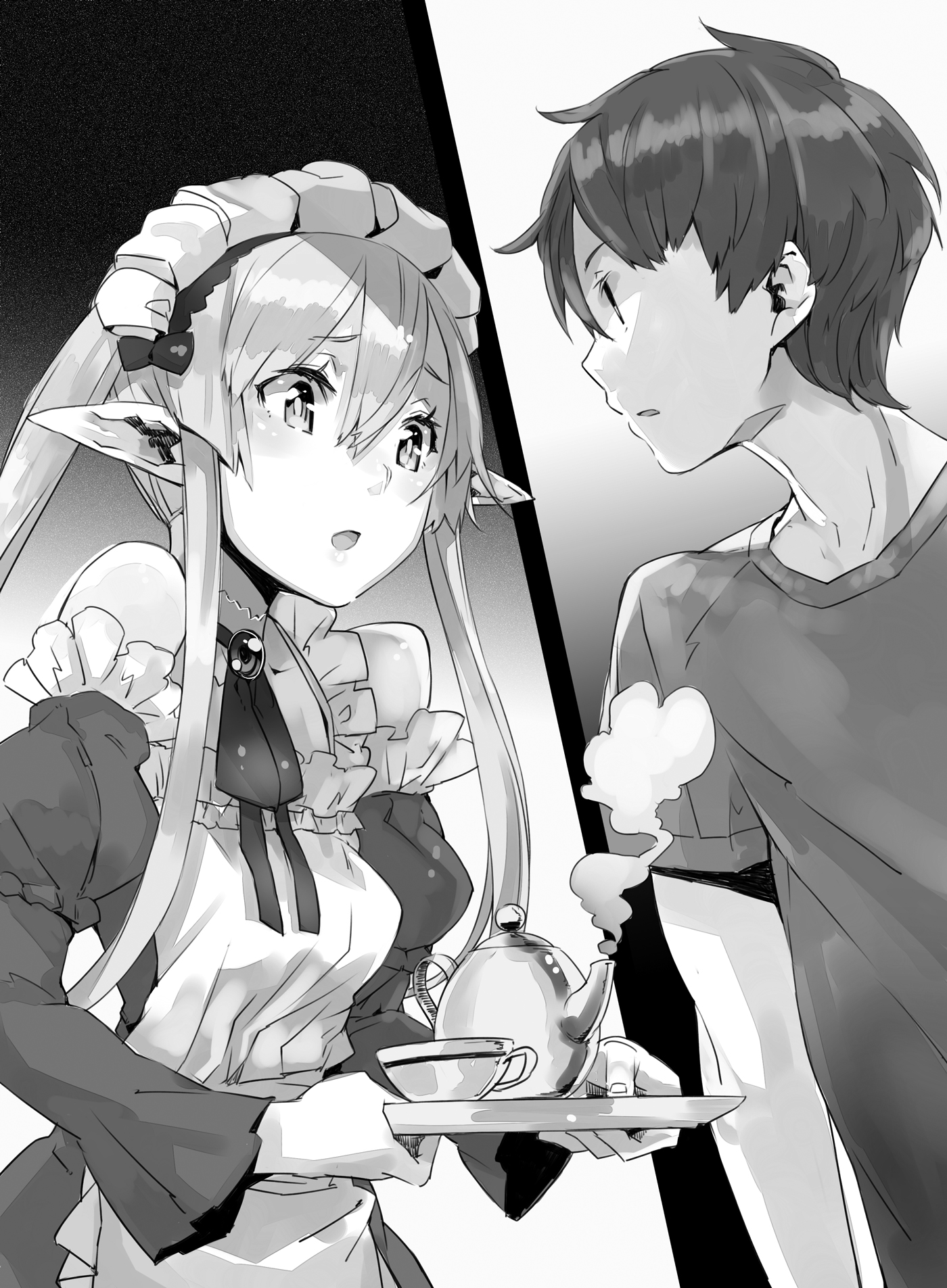
My chest tightened with regret; I felt terrible for putting her to the trouble.
“...I’m sorry,” I said.
“Wha? S-Sorry for what?” she asked, blinking.
She was understandably not sure why I was apologizing to her. Given her personality, it only made sense. I felt too bad to make direct eye contact, but scratching my cheek, I said, “Well, you know, uh... for worrying you like that.”
“Oh... Yes, sir.” She nodded quite candidly, but then she seemed to realize what she was doing and quickly shook her head instead. “Er, I—I mean, it’s my job as a maid to take your physical and emotional needs into consideration, Master. You c-certainly don’t need to apologize to me...”
As far as it went, she was right. But I was still happy that she cared that much about me, and I wanted to express that somehow.
“Right,” I said. I thought for a few seconds, then started again. It was a little bit embarrassing to say all this directly, but...
“Thanks. It makes me happy. Maybe that works?”
“Yes, sir!” Myusel said after a very long pause. Her cheeks were red and she was looking at the ground, almost as if she was... embarrassed?
We had spent more than six months now living in the same house. Yet somehow I never got tired of seeing her; every little gesture seemed fresh and sweet.
That’s why I was afraid.
It terrified me to think of her looking at me with hatred, or despair, or rejection. To think of her knowing what I really was.
And yet...
“Myusel,” I said, shifting in my seat. “It looks like I’ve been... an invader this whole time.”
“...What?” She looked at me in astonishment.
Fair enough, given the bombshell I’d just dropped.
“An... An invader, sir?”
“Yeah. I was sent here to help make the Holy Eldant Empire a vassal state of Japan. I was supposed to use otaku culture as a way of undermining any resistance from the people here. Or anyway, that’s what I’m told. I may not be carrying a sword or whatever, but I’m basically an enemy from a country that’s at war with your home.”
In a corner of my head, part of me was still yelling, Stop!
I didn’t have to tell Myusel these things. What if she rejected me? What if she hated me, or fell into despair, or looked at me with contempt? I might never recover. If Myusel abandoned me—well, I had a dim sense that the shock would be way worse than getting shot down by my former childhood friend.
But still...
“It might... It might be best if I had never come to this country. I might not be able to stay with you guys.”
Myusel swallowed hard, but didn’t say anything at first. After a moment, though, she collected herself.
“I... I don’t really understand,” she said; and it was true, she sounded awfully lost. I mean, I had launched into a conversation about invasions and affairs of state. She wasn’t an imperial or a noble, and she wasn’t used to dealing with stuff like that on a moment’s notice. She didn’t know exactly how to respond.
“I’m very sorry. I’m... I’m stupid, and... and uneducated...”
No, wait, Myusel! I don’t think you’re stupid. And yeah, maybe you’re not educated, but it’s hardly your fault. You just never had the chance.
“Master.... you’re so... you’re so kind.” She stared ever more fixedly at the ground. As if not content with that, her hands grabbed her apron tightly, as though she were trying to shrink. “You do so much for me... even though I’m no more than I am...”
“I’m not sure I’d say so much...” Certainly nothing to warrant somebody talking about me like this. “And anyway... how do you know it’s not all just an act, part of my invasion?”
“What about when you... protected me? Even though it meant angering Her Imperial Majesty?”
She glanced up at me as she spoke. Just for a second, I wasn’t sure what she was talking about—but I realized she must be thinking back to when I had only just come to the Holy Eldant Empire, when I had taken her side against Petralka, back before the two of them had become friends.
“Master... Whatever you’re trying to do, surely protecting a pathetic servant girl like me from an empress... can’t gain you anything, can it?”
“That’s... I...”
When Myusel turned her imploring gaze on me, I found I couldn’t speak.
She was exactly right. I guess there was some self-satisfaction to be found in looking out for Myusel, but otherwise, nothing. However Myusel felt about me, whether she loved me or hated me—it wouldn’t make any particular difference to my work. Yes, she was supposed to be taking care of me, but that was her job, just like I had mine. She would do it, even if she despised the person she was working for.
If anything, talking back to the empress was—from the perspective of my role as General Manager of Amutech—ten times, a hundred times, a thousand times worse than sticking up for my maid.
“And I’m so happy...” Myusel went on, “that we get to eat with you. I never knew... that eating could be so much fun. I learned that from you, Master.”
“Myusel...”
“And yet I... can’t do anything to thank you, Master...”
“Thank me? You don’t have to do anything to—”
“I’m jealous of Elvia-san. Because she’s able to help you...”
“I told you, Myusel, you’re a big help to me. Heck, you saved me!”
It reminded me of what she had said before, so I told her again what I had told her then—about the cooking, and the cleaning, and the laundry. Those things might seem simple enough to her, but I was extremely grateful for them. And you never want to be hated by someone you’re grateful to.
At that, a thought occurred to me.
Didn’t Myusel feel the same way about me? Whatever I was thinking, whatever was in my head, didn’t matter. Facts change in all sorts of ways depending on who’s looking at them. “Truth” has a lot to do with the feelings of the person accepting it. My gratitude toward Myusel was my truth, and her truth was that I was kind to her. Yeah, it was kind of confusing. But still.
“Master... Shinichi-sama,” Myusel said. “Please don’t say such frightening... and sad things... like that we would be better off without you...”
I couldn’t speak.
“I’m begging you... Please... Please stay here with us!”
This girl... It’s like she was created to tug on my heartstrings.
I had a dangerous bit of tightrope-walking in mind. I didn’t know if it was going to work out, and if I screwed up, there was a good chance I would find myself in a very different position. I might even have to leave this mansion without a chance to say goodbye to Myusel or the others.
That was why I’d needed something to stoke me up. Someone to say to me, “It’s okay for you to be here.” I’d wanted someone to give me a little push to help get me going.
No... Not someone.
Myusel.
She was the first person from “this side” that I’d met when I arrived in the Eldant Empire; she was basically the physical embodiment of what the words “another world” conjured for me.
That was why I’d wanted her permission, or perhaps her forgiveness. Why I’d wanted to ask her the question: Can I stay here?
“Okay,” I said, nodding. “Thank you.”
“Wha...?” She looked at me for a second, confused, but then—
“Yes, sir...!”
A smile as beautiful as a flower blossomed on her face.

The sun shone brightly. It was still early in the morning—my watch said not even 6:00 a.m.
The Eldant Empire, though, was a country of early risers, and people were already out and about. I could hardly complain about being sleepy—although in fact, I hadn’t slept a wink the night before.
I stood in front of the thick door. Beyond it was the audience chamber, the place where you could meet the empress publicly to talk, or to make your case. It wouldn’t be an exaggeration to say that all the power in the Eldant Empire was concentrated in this room. I hadn’t thought too much about it when I’d been here before, but a few words exchanged right here could decide the fate of hundreds or thousands—in extreme cases, even tens of thousands.
No pressure.
No sooner had the two royal guards announced, “Kanou Shinichi-sama has arrived!” than the door ground open.
“Master,” Myusel murmured encouragingly from beside me.
Minori-san, who was also with me, didn’t say a word, just nodded. Given her employer, I could understand if she didn’t want to be too obvious about taking my part. It’s tough to bite the hand that feeds you.
“Yeah. It’s gonna be fine,” I said with a nod, and then I stepped into the audience chamber.
It looked just like it had the last time I’d been there. The ceiling vaulted above me; a narrow red carpet stretched ahead of me like a road. Against the far wall was a dais raised so high that several staircases were required to reach it, and on top of it was the throne.
Dressed in their most resplendent outfits, the prime minister along with nine of the empire’s other ministers were lined up one step below the throne and looking down upon the supplicant—namely, me. In addition to Prime Minister Zahar, I could see the knight Garius among them.
Sitting on the throne was, needless to say, the girl empress Petralka.
Silence. The collective gaze of all these worthies fell upon me. It seemed to ask, Just what is he here for?
I hadn’t yet explained the reason I had asked for this official audience with Petralka. They would never normally have accepted an audience request whose purpose was unspecified, but I leaned on Petralka and Garius to make it happen.
Minori-san, who was armed, and Myusel, who was a maid, were not allowed into the audience chamber. After the terrorist incident, they had become more strict about who they let into this room.
But the show must go on...
“Well come, Shinichi. We’ve been waiting!” Petralka announced.
Beside her, Prime Minister Zahar gave a pointed cough. “Shinichi-dono requested to be allowed to participate in the morning audience today...”
“And despite its suddenness, his petition has been accepted,” Petralka said in her most dictatorial tone. “The otaku culture he has brought from Japan even now influences our empire in a way that cannot be ignored. We believe there is wisdom in hearing the thoughts of its evangelist, Shinichi.”
A murmur ran through the assembled VIPs. Well, that was only natural. Some “evangelist” drops by from who knows where, earns the attentions—I mean the totally platonic attentions, okay?—of the empress, and then starts acting like he wants to meddle in politics and stuff. I could understand why I was getting the stink eye from a few of them. I must have seemed a bit like the Japanese monk Dokyo, or Rasputin in Russia—religious figures who got close to female rulers, to the detriment of their countries.
“Not that I know the first thing about politics,” I muttered to myself with a wry smile, before stepping forward to address that very ruler and all the people around her.
I looked around at the ranks of important personages, then spoke in a voice loud enough to carry to everyone in the room.
“I have a suggestion.”
There was a mix of caution and curiosity in the looks that came back at me. I was sure the nobles would be paying close attention to everything I said and did. If I got too close to the empress, their own share of authority could be severely threatened. I assumed they were each evaluating me: if they thought they could use me, they would; but if they thought I was going to get in their way, they would get rid of me.
“Some time has passed since the establishment of Amutech, the company that’s introducing otaku culture. The same is true of the school Amutech runs,” I said, forcing a quaver out of my voice.
Calm down, Kanou Shinichi! You need to have your game face on.
“At present, we have some people who have learned enough Japanese to conduct daily conversation without trouble, and more and more students are learning to read and write. I think it may be time to consider taking the next steps.”
“...And what steps would those be?” Zahar asked on behalf of the crowd.
“I have several in mind. Consider: otaku culture, and the Japanese language necessary to understand it, have begun to spread among the nobility and the merchant class of commoners, but ultimately only a very small percentage of the population has been able to encounter otaku culture directly. Most commoners are left with only secondhand knowledge that they pick up from the students.”
“Meaning?” Garius asked solicitously, his interest obviously piqued.
I gave an exaggerated nod and went on. “I propose opening the school to everyone, including commoners. In addition, I recommend foreign expansion.”
The murmur among the nobles became a distinct buzz.
Now was the time to press my point home. I raised my voice a little more and forged ahead. “Any merchant interested in the current state of Eldant has surely noticed the craze for otaku culture among the nobility. Because of the limits on how much product we can bring from Japan, the sale of otaku goods has been prohibited until now—but I say we should permit buying and selling those goods, as well as allowing them to be exported to other countries.”
I let my eyes sweep the assembled crowd, then delivered the coup de grace: “We allow traveling merchants to carry otaku culture beyond the Eldant Empire.”
“Are you suggesting our empire should take otaku culture as its export?” Petralka asked, sending a fresh wave of chatter through the crowd.
Up to this point, the otaku culture Japan had brought in was a localized phenomenon, a trend in the Eldant Empire. For better or for worse, it had been centralized under Amutech’s control and oversight.
But what would happen if it became a commodity from the Eldant Empire itself? Of course, the Japanese government might try to exact a large payment from the empire. Granted we shared no common currency, it might be in the form of something like mineral resources or food, something that had real value in Japan. As far as that went, there was still no official exchange rate established between the two nations. The chance of Japan totally ripping off the Eldant people would be obvious to anyone. But—
“But it’s not such a bad idea.” This came from Garius. “Just like any import or export, even a small tariff on a commodity good like this could produce significant profit. For that matter, if we were able to fix the selling price of otaku works themselves, that itself could bring real abundance.”
I knew he was sharp. He practically made my points for me. And he kept going.
“Allowing general admission to the school is intriguing as well. If we don’t concern ourselves with noble qualification, we could easily be open to those who wish to come from abroad to study with us... bringing their money with them, of course.”
Another noble broke in hurriedly, “Perhaps so, but that would be as good as inviting in enemy spies in the guise of ‘studying abroad.’”
Garius frowned and said, “All the better to have them in one place where we can keep an eye on them, then. Kill a spy or an intelligence agent, and another one will replace them, but so long as the current agent is alive there will be no others. Indeed, to a living agent we can feed convenient misinformation and send them on home.”
Several of the nobles exchanged stunned looks.
“On top of that, the increased flow of people and money will allow our own merchants to report back to us about the state of other nations.”
“That’s true,” I nodded.
As Garius had understood almost immediately, if they got rid of their rigid perspective and took the long view, this could actually be a pretty good thing for the Eldant Empire. A new market, a new source of income. And after seeing how wildly otaku culture had succeeded here, it was easy to imagine it exploding the same way in other countries. Each place would have its own national characteristics, but the many variations of otaku culture would, I was confident, allow it to adapt.
I offered a further suggestion. “Otaku culture has already spread among the people of the Eldant Empire. As a test, why not send out bards and minstrels and the like to other countries, to see how they’re received?”
The elves had developed a mode of declaiming light novels to musical accompaniment that was experiencing a small boom in the downtown markets. People at the bars loved it, of course, but I had heard that even farmers were humming the songs as they worked in the fields. Nobles were summoning groups of famous bards to hold contests and sing-offs.
“I see...” someone muttered. By giving a concrete example of something they were familiar with, it looked like I had helped wake them up to the possibilities. Now the nobles were starting to talk amongst themselves, and a lot of what they were saying was positive.
Okay. Looking good.
I was just starting to feel confident when—
“Wait, Kanou-kun!”
—there was a shout from the audience chamber door. I turned and looked—and there was Matoba-san.
“That’s going too f—”
“Why is that?” I asked, interrupting him.
I knew, of course, why he would oppose what I was saying. For the Japanese government to take advantage of Eldant’s resources, first they had to brainwash the place with otaku culture, make it their puppet. If the empire were to take control of the industry before that happened, the Japanese government would be out of luck.
“What, exactly, is going too far?” I pressed.
“You...” Matoba-san was actually lost for words. At last, with a sour expression, he said, “.........You overstep your authority.”
Obviously, he couldn’t threaten me outright with the empress and all those nobles in attendance.
Take that. I felt a nasty little rush as I smirked at the silent Matoba-san.
“My authority has nothing to do with it,” I said. “The Eldant Empire would be doing everything. I only offered a suggestion.”
There was no chance now of stopping otaku culture from having an influence on the Eldant Empire. And unless the Japanese government decided to seal off the hyperspace tunnel for some reason, well, it would eventually spread to the rest of this world. I could struggle and fight all I wanted; it wouldn’t change that.
We’re not just talking about otaku stuff—when culture is accepted by a large number of people, then it spreads, goes everywhere. There’s no arguing with it. Sure, governments have tried from time to time, but that’s how the world works.
If the people receiving the culture have a choice—if it’s not being forced upon them or withheld from them—then that’s enough. Maybe I could help create an environment where the people of the Eldant Empire, and indeed of this whole world, could choose for themselves. Eventually, otaku stuff would be subsumed, become part of this world’s native culture. After all, what got brought on board and what didn’t was partly a function of the culture and history these people already had.
“We see. Very interesting,” Petralka said, leaning forward on her throne.
She seemed to buy into what I was saying, as did Garius. I suspected Prime Minister Zahar, who had always been in favor of cultural exchange, would be on my side as well. And with the empress’s two most powerful advisors in agreement, and the other nobles seeing something to gain, it was going to be almost impossible to stop this from happening.
Which meant, of course, that now I was pretty much useless. My mission had been to “spread otaku culture,” and it looked like I had just done it.
Matoba-san couldn’t very well get rid of me publicly. But...
At that moment, it struck me. I saw that all expression had vanished from Matoba-san’s face, which until now had always had that pasted-on smile.
And I knew what that meant.