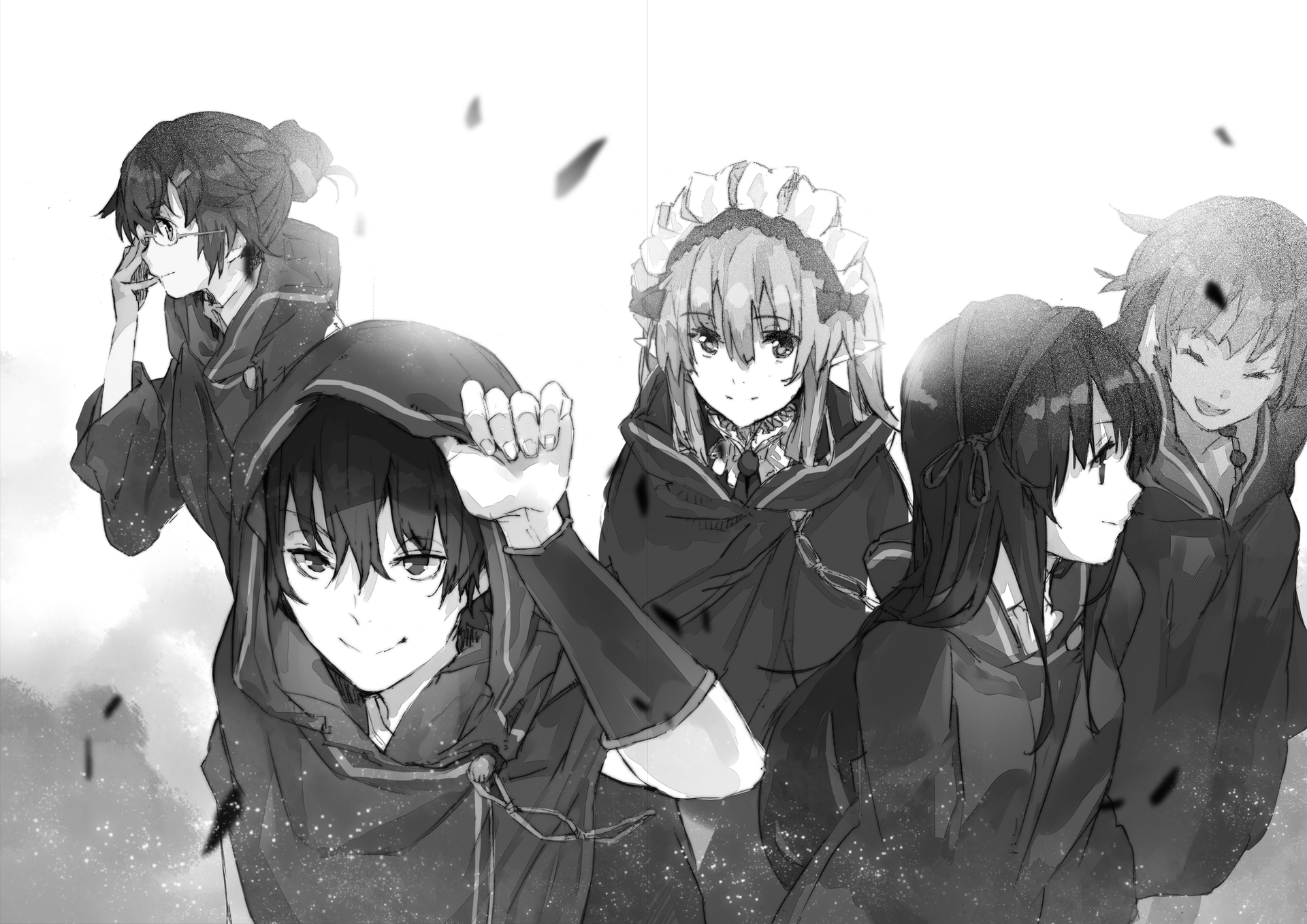
Epilogue
Epilogue: The Power of Moe
I ran desperately between the towering buildings, choosing side paths and little detours and racing from shadow to shadow so as not to be seen. But I knew—I knew it was futile.
“Huff... huff... huff...”
There were so many of them after me, and they had so many little gadgets. They might even have had dogs. They were supremely used to hunting prey like me. They knew that “bringing down a criminal” was the perfect pretext to do anything they wanted. They were thoroughly experienced, and that made them dangerous.
“Huff... pant... pant...”
It was no use. I couldn’t run anymore. I dove for the first back alley I saw. It was small, inconspicuous; I hoped my pursuers would run right past it. Even if I knew the odds were ten thousand to one.
“I have to... I have to at least—!” I clutched the bundle I held in my arms. “I have to protect this...”
It was a thin, flimsy book. An offset-printed doujinshi.
“This... at least... must survive...”
My whisper was nearly drowned out by the sound of gunshots.
At a recent Diet meeting, the Agency for Cultural Affairs had approved a statute giving license to execute thought-crime perpetrators on the spot. The Culture Police began openly carrying guns, shooting otaku almost for sport.
How had things gotten like this? It was a lament you often heard from old activists. They still remembered a time when Japan had been peaceful, when everyone could make doujinshi and enjoy whatever works they wanted. When, supposedly, a hundred anime episodes had aired every day, for adults and kids and everyone in between, and manga had overflowed off the shelves. There had also been books that included pictures like manga, but told prose stories of adventures or romance—they were known as light novels.
A golden age of otakudom.
It had gone on for a long, long time—until it abruptly ended. As relations between Japan and America began to deteriorate, leftist Diet members rose to prominence—and promptly sold our country out to China, which had been expanding its sphere of influence and growing increasingly hegemonic. They had pleasant, logical names for it, like “economic cooperation” or whatever else—but in the space of barely a decade, Japan had virtually become a Chinese territory.
The result had been strict limitations on expression, until just about the only things that were allowed were officially sanctioned works that glorified the government. Meanwhile, the wealth of Japanese anime and manga and novels and games that had existed in the past was confiscated by the police and burned. Protesters compared it to the time in ancient China when the Qin government had burned dissenting philosophical treatises and even buried opposing scholars alive, but every one of the protesters was arrested or killed. Otaku culture in this country was as good as dead.
But there were still a few: a small handful of otaku who secretly held onto copies of these works so that they might be passed down to future generations. In slang terms, they were called “activists,” and they did everything they could to preserve the works that had been made in such quantity until the first half of the twenty-first century—or otherwise to recreate, reclaim, or even make doujinshi of them to help communicate their greatness.
What I held in my hands was just such an item. A precious doujinshi, into which great love and passion for the source material had been poured. Doing offset printing in this day and age was probably harder than getting a gun or drugs. Even so, the spirit of the activists couldn’t be broken enough to keep them from making these things, and sharing them with their compatriots.
Moe is life!
Even a young woman like me, who had never known the golden age of otakudom, might just happen to see such a doujinshi, or a manga, or an anime, or a novel, or a game, and feel her heart skip a beat. I wanted to see this book. I wanted to read this book. I wished desperately for it.
That was how I found myself part of an underground doujinshi ring. On an almost daily basis, oppressed otaku would gather, declaring without fear or hesitation how much they loved the things they loved, speaking freely of the power of moe in their lives.
That was where I had bought a BL doujinshi based on an old anime. Its author was no longer with us, I’d heard. They’d been arrested on grounds of “encouraging unnatural forms of love and perpetuating value systems detrimental to the good of the state” and were said to have died in jail. A friend and fellow activist of theirs had collected some rough drafts found in this person’s house into a book—the one I was holding now.
I began to weep. Moe wouldn’t die. Authors might perish, but their ideas and hopes and dreams would live on, just as I had taken up this doujinshi. That’s the great, innate desire of all humans, no matter how oppressed.
“Everybody run! It’s a raid!”
I remembered the moment one of the Culture Police’s Armed Re-education Squads had come bursting into the doujinshi ring, which degenerated immediately into a cacophony of shouts and cries. I don’t know how I managed to escape. All I knew was that suddenly I was running, the one BL doujin I’d purchased clutched to my chest.
What had happened to the others? Had the doujinshi they’d created with such love all been confiscated and burned? What about the facsimile body pillows? The character keychains? What about the discs full of cosplay photos? Had they all been... destroyed?
“Argh...” All I could do was hug the book even tighter, trembling, feeling like I might cry.
I was useless. Weak and impotent and useless. I crouched in the shadow of a garbage can, cursing my own pointless existence.
I heard a shout echo among the buildings: “There she is!”
I looked up, feeling empty, to see the armed police squadron running toward me, guns in their hands. This was it. I couldn’t run anymore. If I wanted to live, then the only thing to do was to let them see me throw the book away and burn it. Then I would sign a written oath stating that I would never speak such words as moe or top or bottom or switch ever again, and that I would lead a pure, moral life from now on. After that, there would only be a few years of forced labor between me and my freedom.
Instead, I bit my lip, curling into a ball. I would protect this doujinshi, if I could do nothing else with my life. I knew it was futile, but I couldn’t not do it. The shock that radiated up from the deepest depths of my heart allowed me no other choice.
It was over. They were going to kill me. I tried to prepare myself...
But nothing happened. I waited and waited, but the Culture Police didn’t lay a hand on me.
“What’s... happening?” Terrified, I opened my eyes—to discover the Culture Police on the ground, out cold. “What?”
Several figures stood nearby. They wore something like robes, their faces hidden by hoods, so I couldn’t tell what they looked like or even whether they were male or female. All I could tell was that they weren’t ordinary people. No one in Japan today would walk around in an outfit that actively concealed their identity. The government had forbidden that sort of thing; they said it interfered with the facial-recognition system they used to monitor the populace.
The figures tossed several small bottles to the ground.
“That should be enough sprites to cover us,” one of them said.
“I’d heard the stories, but wow, it’s gotten pretty depressing since I was here last. Is this really mid-twenty-first-century Japan?”
“I hate to say it, but I think it is,” said a voice that sounded female.
“Restrictions on speech, on thought, strict control of creation... Who do they think they are, the Khmer Rouge?”
“Well, at least it shows it was worth a visit home,” said a young man’s voice.
I hardly had any idea what they were talking about. Then the young man said, “Oh, yeah. Myusel, go see how that girl’s doing.”
“Yes, sir.” One of the figures approached me. I could hear an unusual lilt in her Japanese.
I immediately tried to run, but my legs just laughed at me. I could barely stand. “No...” I squeaked.
“Um, please do not worry,” the person said. She was obviously female, and there was that slight accent—was she a foreigner? “We will not hurt you,” she said. “I see that you’re injured.”
She crouched in front of me. I followed her gaze and discovered a pretty serious wound on my left elbow. I must have rammed against something while I was running, and the adrenaline must have hidden the pain from me.
“Please stay still. I’ll heal you,” the woman said, and then she reached out her hand...
“Wha?!” The strangest thing happened. When my elbow fell under the shadow of her hand, the long, vicious cut disappeared. The bleeding stopped and a layer of skin began to form, and in less than ten seconds you couldn’t tell the injury had ever been there. She’d said she would heal it... Could she have really meant it?
“Wh-What’s going on?!” I stared at my arm in amazement.
“Hey.” Another woman spoke, not the one who had just healed me. I looked up to realize I was surrounded by the robed people. “That’s...” She was pointing to the doujinshi, which I had dropped in my astonishment. It was half out of the bag, so you could see the cover. That cover image alone could be enough to get me reported to the police, if I wasn’t careful. Yet the woman simply said: “...Zero of the Rebellion, isn’t it?”
“You... You know it?” The series had begun as an anime in the first half of the twenty-first century. My BL doujinshi was based on—wait, this wasn’t the time.
“Of course I do. That’s basic knowledge.”
“Basic knowledge?”
“I don’t think I remember Zero wearing clothes like that, though...”
“Huh? That’s his outfit from the third cour, where—”
“Third cour?!” The figure tore back the hood of her robe, shoving her face right up in front of mine. She was a young woman who wore glasses and exuded maturity. She had black hair and dark eyes, along with Japanese facial features—in fact, she was practically the epitome of the Yamato nadeshiko, the perfect Japanese woman. There was just one thing: behind her glasses, her eyes glinted like a wild beast’s.
What was with this person?
“What are you talking about?” she demanded. “The second cour ended with the MC dying—but they did a sequel?!”
“Uh, well...”
“Details! I need details!”
I wasn’t sure I could help her. I had never personally seen the third cour, myself.
“She’s having another flare-up,” one of the other robed figures said. He turned to one of his companions and said, “Elvia, can you take care of this?”
“Yessir!” that person replied. Then she grabbed the overexcited bespectacled woman by the collar and dragged her away from me. The woman in the glasses fought and struggled, knocking the hood from this new figure and revealing her face. She was tanned, adorable, and looked lively. All of which was perfectly normal. Until you got to the floppy, dog-like ears that graced either side of her short-cropped hair.
“Wha—Whaaa?!” Was that some kind of cosplay? But...
“Shinichi-san,” said the young man who’d spoken to the one named Elvia. “It’s these hoods. That’s why everyone’s so scared of us.” He lowered his own hood as he spoke, revealing a gorgeous face. This person had long hair, and although his voice sounded masculine, from his looks alone I wouldn’t have been able to tell whether he was male or female.
“You’re right. How’s it look, Myusel?”
“Good, sir. I have just now finished,” said the woman who’d healed me to the figure standing behind her. The woman called Myusel drew back from me, and then, like the others, she removed her hood. She was a cute young girl with twintails—but that wasn’t what got my attention. Like Elvia, Myusel had ears that belonged to no human. They were pointy.
“An elf?” I said in wonderment. Or maybe a devil? Either way, they were both things I had only heard about in my forbidden doujinshi.
Myusel smiled at that. “Yes, ma’am. A half-elf, to be precise.”
“H-Half?” I could only stare foolishly at them in amazement. Who were these people? They’d appeared out of nowhere, defeated the Culture Police, and rescued me. They had seemingly magical powers, the ability to heal injuries just by waving a hand over them, not to mention animal ears and elf ears...
“Wh-Who are all of you?” I asked.
“Heh!” One of them took a step forward importantly. It was the one who had spoken to Myusel earlier. He appeared to be in his mid-twenties, if I had to guess, and everything about him looked like a perfectly ordinary Japanese person...
“I’m Kanou Shinichi,” he said with a smile. “And the Earth is being targeted.”
That seemed to come out of left field. “U-Uh, targeted by whom?” I asked.
“By me!”
“Er?”
This was making less sense with every passing moment. The young man seemed amused by my confusion, though; he held out a hand to me and said, “We come as invaders. Nice to meet you.”
After these events, the icy atmosphere in the state of Japan would be blown open by a war between the Culture Police and cultural invaders from another world who used smuggled culture as their primary weapon. The entire government system would be turned on its head, and ultimately Japan would be restored to its status as the world’s crowning producer of fine content.
But that’s a story for another time.
おしまい
(Fin)