III
III
"Are you comfortable, nephew?" asked Alfonso. By some chance, Alfonso d'Este himself entered the isolation cell, accompanied by nuns bringing in dinner. Cognizant of his malice-filled expression, the skinny boy who occupied the cell shrank back, frightened.
Alfonso scornfully clicked his tongue in response to his nephew's cowardice. "Untidy . . . but you are the son of my great brother Gregorio, although you were on the throne temporarily. Can't you be a little stronger?"
Alessandro remained silent while he was being teased and looked as though he wanted to cry. His teeth were visibly chattering behind his half-parted lips.
Shaking his head bitterly, Alfonso said, "Really, for a weakling like you, sitting on the holy throne is like the end of the world. I could cry to think that the last precious five years were wasted on the likes of you."
The isolation cell was on the highest floor in Spielberg Castle s north tower, and if one stood by the window, he could see the streets of Brno below. Gazing down at the streets that had been illuminated by the sunset, Alfonso blamed the nephew who'd stolen his throne. "Understand, Alessandro? When I say that five years have been wasted, it means that the Vatican and faith were lost for five years. Do you know how much of a loss to the world that is?"
Alessandro s lips quivered as he stammered: "A-a-am I going to be killed?"
"I grieve for the future of the world, and His Holiness the Pope is worried about himself? Can't you at least show enough strength and spirit to call me a traitor?" chided Alfonso. He wholeheartedly lamented his nephew’s frailty, but he didn't hate the stupid boy. The ones he knew he really should hate were Francesco and Caterina—they were the fiends who'd betrayed their uncle Alfonso and who had driven him away. But Alfonso was a very fair man when he was calm. "Don't worry, Alessandro. I won't kill you," he said, trying his best to soothe his nephew, "because no matter what you say, you're a hostage. Hostages have no value if they're killed."
"H-hostage? Th-then, my brother Francesco—
"Oh, he doesn't care about your life," Alfonso replied plainly. It was irritating to him to have to explain obvious things. Alfonso narrowed his eyes as though the nephew he despised were there. "Don't worry, because I've prepared a different trump card for that damned Francesco. This time, he can't put a hand on us, and as long as he can't put a hand on us, you're safe, too."
Rather than feel a sense of relief after being told he wouldn't be killed, Alessandro began to show signs of suspicion. "D-different trump card?"
"One more trump card—the missile," Alfonso declared. II Ruinante's lips turned up slightly as he peered into his nephew's face. "If Francesco tries to move the siege army, I'll use it at once."
"M-missile? You'll drop a b-bomb on R-Rome?" Alessandro exclaimed.
Alfonso shook his head as if he regretted his nephew's ignorance from the bottom of his heart. "Who said I'd shoot it at Rome?" His saggy jaw didn't jut toward the south, where the holy capital was, but in the opposite direction—toward the east, where dark Carpathia lay. "If I fired the missile at Rome, it certainly would be shot down en route. I'll shoot it at the Empire—into that nest of monsters."
"A-at the Empire?" said Alessandro as his face rapidly blanched.
The New Human Empire, founded by Methuselahs, was the largest nation on Earth. It possessed numerous lost technologies that contributed to an overall strength said to exceed that of the Vatican. Was Alessandro's uncle saying that he'd shoot a missile at the Empire? Even a baby knew that the vampires wouldn't take a unilateral attack from human society quietly.
"I-i-if you do that ... w-war ..." stammered Alessandro.
Although at times Alfonso came off as a virtuous person, that guise quickly diminished. "Yes, there will be a war. Moreover, that bomb's warhead was exhumed and restored in absolute secrecy— it's very special. The vampires absolutely won't take it quietly. Heh heh. I can imagine Francesco's confusion."
Alfonso's thirst for vengeance was highly apparent, and Alessandro gradually began to experience a glimmer of understanding as what he'd been told began to resonate. His brother's and sister's schemes hadn't been the reason that his uncle had been defeated at the papal election council five years ago—it had been the weakness of his virtue that was the cause.
"Uncle, I can't believe you're going that far. Do you want to be Pope that badly?" shouted Alessandro in one breath, without stuttering for a change. "Do you really want to get your hands on the Vatican that badly?"
"Get my hands on the Vatican? Stupid—that was mine to begin with. Wasn't that stolen from me underhandedly by you and your siblings?" asked Alfonso. His nephew's censure didn't impact his deep-seated delusion one bit. As he ground his teeth, Alfonso's fingers crooked fiercely as if trying to grasp something he'd lost. "Yes, that's mine! After my great brother's death, it should have been me who led the church and people, but you and your siblings stole that from me!" He didn't notice that the nuns behind him flinched as if threatened. Glaring directly at the powerless boy, Il Ruinante bellowed, "Watch, Alessandro! I'll take back my glory. The papal throne is mine. I was unjustly robbed of my throne, even though I had the talent, the achievements, and all the necessary qualities. I'll make you and your siblings repay this debt without question! Yes, I absolutely—"
Suddenly, a low voice echoed: "Your Holiness ... Excuse me bothering you amid this confusion. There's something I urgently need to speak with you about."
Acting as though he'd been doused in cold water, Alfonso turned around. "Havel?"
The tall priest stood in the isolation cell's doorway. His face was covered by carefully clipped whiskers and was terribly thin, and his green, calm eyes were somehow reminiscent of an ancient martyr. Vaclav Havel—former Agent Know Faith—bowed deeply to the Pope. "Sorry for interrupting your chat. There's something I want to tell you about the castles defenses." "What is it?" asked Alfonso.
Whether he didn't notice the displeasure in his master's voice or did notice but ignored it, Havel's voice was very businesslike. "You should've entrusted me with this castle's defenses. When I confirmed a little while ago, a considerable number of guards had been placed in the cathedral that I didn't know about. When I asked about it, they said it was by your direct order. Is that true?" "Oh, that matter?" asked Alfonso. Having his thoughts, which had been lofted toward the glory of heaven, abruptly brought back to trifles probably made him feel as though he'd been insulted. Alfonso nodded, annoyed. "Yes, the defense of the cathedral was too thin for tomorrow's coronation. I diverted about four hundred people. What about it?"
"You can't," Havel said in a tone that was too blunt to have used with his master.
The priest somberly shook his head. "I carefully calculated the location of the defense units. Withdrawing two companies' worth of personnel from there will cause holes in the castle's internal defense system. I'd like you to recall them at once," said Havel.
"It's no use. The units already have entered the cathedral. It's beneath me to recall them," Alfonso declared. Unable to hide his disgusted expression, Alfonso studied his subordinate's thin face. "Besides, you saw the knights who hastened to join us, didn't you? They're all strong, matchless people who've gathered for the sake of true faith. As per your advice, this castle's defense equipment has been perfectly set up. Who could possibly wriggle through this defense net? It's fine to be cautious, but I can't condone you overdoing it."
With his arms folded, Havel spoke plainly: "Agents ...With their abilities, they easily could break through this much of a defense line. Underestimating them is unconscionable."
"Agents?" asked Alfonso as spontaneous laughter broke through from his lips. "Havel, I understand your feelings and that you don't want to underestimate your former comrades, but after all, aren't these the people who couldn't protect Alessandro? They're insignificant. Isn't it more important to prepare for the coronation?"
If one could remain impartial, it was clear that what Alfonso had said was reasonable. The following day's coronation wasn't merely a reception—it was a strategic event that would shake the Vatican and widely challenge the existence of Neue Vatican. Naturally, hindrances would arise, and there wouldn't be enough guards no matter how many there were.
The stubborn priest was about to further argue his case when a new person entered the isolation cell. An aging soldier—his military shoes clanking—saluted and said, "Excuse me, is His Holiness here? Sorry for interrupting your conversation. I'm Captain Barbarigo of the Eastern Army Twenty-Seventh Infantry Regiment. There's something I urgently must inform His Holiness the Pope about."
"Oh, it's you, Umberto?" asked Alfonso, turning to face the aging captain who'd slipped out of the Vatican's Eastern Army the other day and joined Neue Vatican.
Umberto Barbarigo was a soldier whom Alfonso had been friendly with when Alfonso was a cardinal. Attached to the Eastern Army's Sixth Brigade—the "Justinians"—Umberto had frequently engaged in distinguished services in battle, but he'd also been prosecuted on suspicion of massacring POWs and civilians. It had been Alfonso, then Minister of the Department of Doctrine, who had saved Umberto when he was put on trial. Because of that, Umberto had come running up at the very front in this uprising, leading his subordinates.
"What's wrong? Some business?" asked Alfonso. "Yes, please look at this. My subordinate on patrol found it sinking in the water intake pipe in front of the castle wall," Umberto said, showing him a fist-sized plastic disc.
Spielberg Castle took in water from outside the castle through underground aqueducts. Having probably submerged to the bottom of the water, the disc had wet mud clinging to it. "Well, what is this?" asked Alfonso. "A bomb—with a timer," alerted Umberto. "A bomb?" Although Alfonso unconsciously threw his head back, he didn't try to run away. He glared at the disc on the old captain's palm with a suspicious face. "Who did this? And what kind of strength does it have?"
"When I showed it to an engineer, he said its contents were an extremely low-power fire bomb. At most, it could burn down one house," Umberto explained.
"That much?" said Alfonso, the tension leaving his face. He glanced over at Havel and then at Barbarigo. "Thank you, captain. For the sake of caution, make sure that there aren't any more set. Did you hear that, Havel? I don't know whose doing it is, but it seems our enemy can only set fire as a nuisance." Without acknowledging Barbarigo, who'd saluted, Alfonso continued to sarcastically address the silent former agent. "Half the defensive troops will turn to guard the cathedral as scheduled. We don't have time to split off hundreds of people to deal with a spiteful opponent. Havel, I'll leave the castle's defenses to you. Take good care of them."
Havel took Alfonso's comment with a grain of salt, and with his typical melancholy expression, he asked, "Where are you going, Your Holiness?"
"To the cathedral. I have to make all kinds of preparations for tomorrow's coronation. Oh, that's right—why don't I go look at my missile before that? Because, no matter what you say, our faith depends on that," Alfonso replied, laughing good-humoredly as he left the isolation cell with the attending nuns hurriedly following him.
The priest remained in the isolation cell, watching Alfonso go, looking deeply depressed.
"U-um, Vaclav?" asked Alessandro.
Havel's eyes turned toward the timid voice. Seeing the pimple-faced boy gazing up at him worriedly, Havel broke into a sad smile. "Do you despise me, Your Holiness?" The former agent twisted his mouth as if he were mocking himself. "I swore to protect you, and I betrayed you. I suppose you're rather angry?"
Alessandro stammered as always, but not so much that he was hard to understand. "Wh-when I was brought here, I-I c-certainly was a little afraid of you, but . . ." he said, slumping his shoulders and scratching his head, "b-but you d-didn't make fun of me. E-even now, you p-protected me from my uncle. I a-absolutely d-don't think y-you're a bad person. I j-just don't understand wh-why a person like y-you betrayed the Vatican. F-for money? Not that, right? Why did you do it?"
Havel was silent, looking down at the street from the window. The expression on his thin face was calm and didn't show any sign of displeasure. It was difficult to ascertain his state of mind as his response had nothing to do with the Pope's question. "I love this place, you see. Brno is at its most beautiful when viewed from here."
The isolation cell was the highest point from where one could view the streets below. Bonfires kindled around the streets, lighting up the city as if it were high noon. Gas lamps lit the lanes, which stretched like blood vessels, and tenderly warmed the soldiers and citizens mingling among them. Outside the city's castle wall, beyond the darkness of the valley, countless lights could be seen twinkling brightly to one side. They were the searchlights of the Vatican-Duchy of Bohemia combined army, who were wary of a surprise attack.
"Brno is an old city. For ages, the people who came to spend their lives here have marked the city here and there. Of course, Brno isn't equal to Rome or Prague, but I still love the place I was born," Havel said.
Standing beside the priest as the two gazed down at the fantastic night scenery, Alessandro asked, "Vaclav, you're a n-native of this city?"
"Yes. My father was a carpenter here," Havel replied. The north wind blowing down from the mountain brought with it a piercing chill. Autumn tended to be short in Brno, but this year, it was especially so. There was a chance for snow the following day.
While draping his own cape over Alessandro's shoulders, Havel answered precisely: "I moved frequently after my father had died—to Prague, Firenze, Rome—but my home forever will be this city."
"Hmm. Wh-what's th-that?" Alessandro shouted, leaning out over the window handrail. He saw shabbily dressed men and women applauding around a small group of men who were skillfully operating a strange instrument that looked like a big cello with a lever stuck onto it.
"That's called a hurdy-gurdy. It's a musical instrument that's been used in the farming villages around this area since long ago. They play it and dance to polka during festivals and whatnot," Havel explained.
"F-farmers? So, th-those people are p-peasants?" asked Alessandro. Suddenly, his eyes lit up with curiosity. "Wh-why are p-peasants in the c-city? D-don't p-peasants 1-live in v-villages?"
"The Vatican army is outside the castle, so they've evacuated to the inner city," Havel answered.
Havel's response was clear, but it didn't seem to satisfy the boy. Tightening his spotty face, Alessandro asked again: "Wh-what do you mean, evacuated to the i-inner c-city? Th-this place might become a battlefield, right? They should flee to a d-different place."
"Flee—and then what?" asked Havel kindly, although an extremely sensitive person might have sensed underlying hints of anger in his voice. "They're poor and have no savings. By changing addresses, all they can do is die by starvation or freezing. Your Holiness, do you know why they're taking part in Neue Vatican, which is at an overwhelming disadvantage?" The priest extended his arm and pointed at the valley. "Abnormal weather has been prevalent in this area for a few years. For the past several years, there has been terrible damage from cold weather, and this already is an agricultural area without enough industry. In order to avoid starving, the farmers had to dispose of the assets they had on hand—first their land, and finally, their children."
"Ch-children?" asked Alessandro. At first, the Pope blinked as if he didn't understand what the priest was saying, but he finally seemed to grasp his point. A rare flush colored his pure white face. "They s-sold th-th-th-their own children? Wh-what a thing to do! What did the church in th-this area do? If th-things like that were happening, seeking aid from Rome . . ."
"The church couldn't do anything. No, it's more appropriate to say that they didn't do anything," Havel replied.
It was true that the church in this area had overlooked their business dealings. It chiefly had been rich people and nobles from Prague who'd bought the fields from the farmers on the cheap and resold their daughters and children. Nearly all the high-ranking church workers in this area were young people who were purchased with church allowance money. It wasn't at all to their disadvantage.
"Until the Neue Vatican uprising, the farmers in this area nearly all spent their lives not unlike livestock. During the uprising, Archbishop d'Este promised a three-year tax exemption for Brno and its surrounding farmers. I don't have to explain the rest, do I?" asked Havel.
The farmers' laughter was louder than a while ago. How could they be this optimistic tonight when they might die tomorrow?
Observing the farmers' merriment with a grim expression, Havel muttered, "This is the reason I betrayed you, to answer Your Holiness' question from a little while ago. I couldn't forgive them for using faith to make money, or for turning weak people into food, or the system that allowed that." Before he knew it, the priest's fingers had dug deeply into the handrail, warping it like putty, but Havel kept looking at the farmers as though he hadn't noticed. With more sadness than anger in his voice, he continued: "Maybe survival of the fittest is the way of the world. Maybe it's wrong to blame the strong for eating the weak. Maybe justice and strength are irreconcilable. However ..." said Havel as the handrail tore off with a strange sound, "because those are absolute realities, shouldn't only faith and God be the ultimate allies of the weak? Wasn't that what the system was for?"
The man who'd fought for God and church as an agent and as the former Chief of the Bureau of Inquisition had mechanized the majority of his body at the end of a series of battles. As if trying to wring out his strength, Havel blamed himself for wasting half his life. '"Blessed are the poor' — I couldn't forgive that God ignored the weak!"
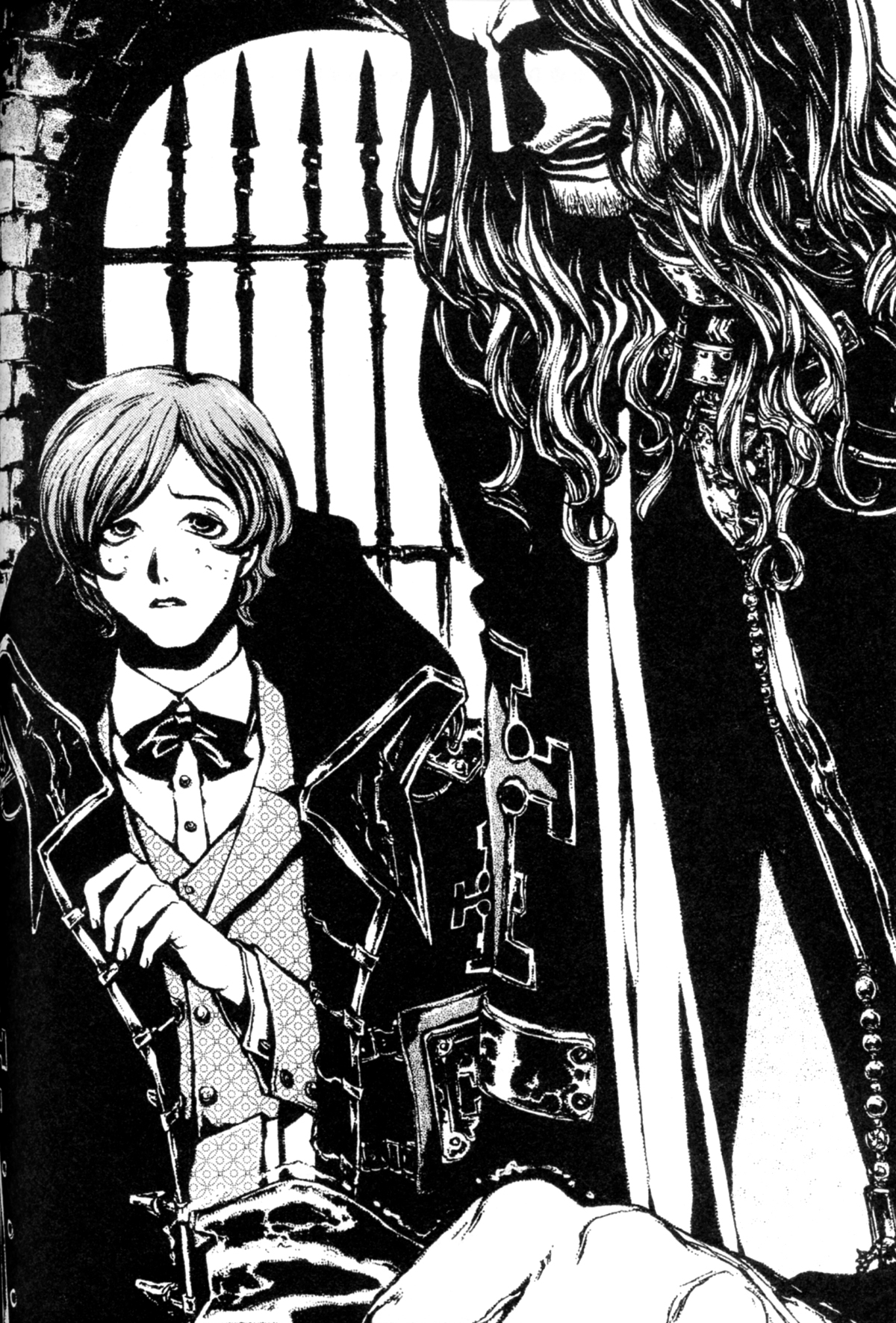
Still motionless and silent, Alessandro listened to the traitor's words. Because of his mental illness, Alessandro had been made fun of in the Vatican, but his intelligence never was low, nor was his sensitivity dull. He could fully understand what Havel was saying, and he also was aware of what it meant that the priest was speaking in the past tense. But . . . what can I do? he thought. He'd become Pope solely because of his bloodline and rarely was able to look people in the eye or speak to them — and he hid behind his sister when anything dangerous happened. What in the world could such a pitiful boy do? What could he do about heretics? There's nothing I can do.
A gentle voice fell upon the ears of the boy who was standing there helpless. "It's fine, Your Holiness," said Havel, smiling as though he were embarrassed by the torn-off handrail he held in his hand. "You shouldn't blame yourself like that. You didn't cause today's situation."
"B-but, I'm the Pope. I-if I were stronger, th-this kind of—"
"Maybe so, but you didn't have that strength," Havel replied in a tone somewhere in between sadness and scorn. "It isn't weakness or evil. At least, it isn't something for which you should be blamed — especially when said person is ashamed of that weakness." Offering the powerless boy encouragement by hugging him, the priest peered into his face. "Your Holiness, right now, you can't help me or the people gathering here. But in the future, you —
"Fire!" An unexpected scream interrupted Havel's sentence.
Lights switched on around the castle, which had gotten somewhat noisy, and the sound of military shoes shuffling resounded down the corridors.
"F-f-fire?" asked Alessandro.
"It seems that way; however, there's no need to worry. Your Holiness, please stay here," instructed Havel. As he cautioned the boy looking down anxiously not to slip, the priest muttered quietly: "AX have come at last."