The Meeting
The Meeting
I was wearing jeans and a plain, long-sleeved shirt—an admittedly poor choice of attire for the long hike ahead—as I boarded the bus, weighed down with bags. The bus took me most of the way up the mountain and I rode it until the very last stop, where I disembarked and passed through the border gate. After that, it was all on foot.
I walked uphill for quite some time before finally coming across a clearing. This wide area gave the impression it’d been carefully carved out of the dense forest. In this clearing stood a single-story building with a thatched roof and a veranda running along its side. An old-fashioned living room and a prayer alcove, both visible from the outside, fully qualified the house as an authentic, traditional Japanese dwelling.
When I was a child, I’d spent pretty much every summer here, at my great-grandpa’s house. After he’d passed away, nobody wanted to live in it, out here in the middle of nowhere…but it had to be passed down through the family. Somebody had to take care of it.
As Great-Grandpa had laid dying in the hospital room, the whole family had crowded around him. It’d felt like they were drawing straws, each trying to pass the buck to the other. Their behavior was more than insulting, given the situation. Finally, I couldn’t stand it anymore. I spoke my mind and stood my ground. Their reactions were harsh, the ensuing discussion heated. But in the end, it was settled—I’d be the one to inherit the house.
“A homeowner at twenty-five…can’t say I saw that coming,” I muttered to myself as I approached the house. I sat down on the veranda and finally dropped the various bags I’d had slung over my shoulders and back. They hit the floorboards, one thud after the other.
Hauling all those bags had been no picnic. I was so out of shape. I’d lost some muscle since my university days, and it seemed my stamina had vanished with it. I wouldn’t last very long living on this mountain if a few heavy bags were all it took to wipe me out.
I peered into the living room. Inside, the luggage that I’d sent ahead lay arranged in large piles. It looked like everything had arrived safely.
But something wasn’t quite right.
I’d expected to be greeted by a very different scene—all the storm shutters firmly closed, a thick layer of dust in the corridors, the tatami mats detached from the floor to keep them from going moldy. But this house was totally ready to be lived in.
I wondered if someone had been looking after the place. After all, who exactly had been here to receive my luggage? Somebody must’ve been. I pondered this while I caught my breath, then removed my shoes, stepped up onto the veranda, and explored the rest of the house.
The kitchen and bathroom faucets turned easily and the water ran clean. The gas and electricity were both working, and all the fuses were in the upright position. Strange. When Great-Grandpa was being admitted to the hospital, they knew he’d be gone for a long time. When a house is going to be vacant for a while, isn’t it normal to shut off all the valves and breakers?
All the appliances were still there—the fridge, the microwave, the TV—even a Wi-Fi router, as Great-Grandpa ordered a lot of stuff online. I don’t see a computer anywhere, though…maybe Gramps upgraded to a smartphone? Or maybe…maybe a relative had thought it was worth something and took it to a pawn shop. It seemed likely. I dashed frantically back to the veranda, slipped on my shoes, and rushed to the warehouse next door.
The warehouse. This cave of wonders had always been packed to the brim with Gramps’ various treasures. Now the shelves were empty. Nothing left. The fridge and the freezer units were empty, too…but the circuit breakers in here had all been safely shut off.
It’s not like I’d honestly expected anything to be left over. But I was still disappointed. The part of me that remembered that beautiful spectacle was a little heartbroken. I left the warehouse in a funk, shoulders slumped, and headed deeper into the mountains behind the house to check on Great-Grandpa’s orchard.
“Thank goodness. It’s just like I remember.”
My ancestors had cleared this plot of land many generations back—they’d literally carved it out of the hillside themselves, if our family stories were to be believed. Gramps had tended it faithfully right up until he’d fallen ill.
The chestnuts and walnuts harvested from this orchard had let my great-grandparents raise six healthy children and put them all through college. The trees stood tall and proud above the neatly tended soil, as they always had, and their verdant green branches swayed in the spring breeze.
It was a sight to behold, and seeing it finally put my heart at ease. I’d given up a very promising career in its early stages in order to come and live here. If something had happened to this orchard, I had no idea how I’d pay the bills and put food on the table.
“Hmm… This should all be growing wild now, though. It’s far too neat. Somebody’s clearly looking after it,” I muttered as I strolled into the orchard.
Row after neat row of trees stretched into the distance, so many that they became too indistinct to count. As far as I could see, there wasn’t a single dead leaf in sight nor the slightest sign of debris on the ground. I went right up to a nearby tree.
No insects or pests of any kind. No holes chewed in the leaves. No broken branches. No sign of neglect.
Between the state of the house and now the orchard, it was perfectly clear that this place had some sort of secret caretaker. Secret, as I’d heard nothing about anybody living nearby nor seen any signs of human life since I’d arrived. I looked around once again, now with greater suspicion.
The birds sang and the insects chirped with almost deafening intensity while the swaying trees provided a background chorus…but I was sure I was alone. And yet, the state of the orchard suggested otherwise. It was a disturbing feeling. Maybe it was because I’d lived in the city all my life, but the complete lack of other humans made me restless—I suddenly realized I felt extremely on edge.
I reconsidered my situation. I might be living out the rest of my life here in this quiet, lonely place. Nobody to talk to. Nobody to have tea with. Completely alone. My heart sank. My mind raced. I found myself drowning in a deep, spiraling anxiety.
If I got sick or took a bad fall, or if there was an earthquake or a forest fire, there’d be nobody to turn to for help. That idea—of having nobody near me—seemed to upset me the most. I couldn’t shake that unease.
And yet, despite all my nerves, I understood that this, too, was part of my inheritance. It was my duty and there was nothing to be done. Somebody had to live here and that was that.
Yes, part of me wanted nothing to do with it. Part of me felt backed into a corner, forced into this situation by my selfish relatives. That was all true. But I’d said my part—and sharply at that—and in the end, I’d made the final decision for myself. There was no point in looking back.
The moment I’d quit my job, I’d resolved to make the most of things. Because this was my life now. I tried to recapture that feeling as I vigorously ruffled my shortly trimmed black hair. Then I turned around and headed back toward Great-Grandpa’s house.
…No.
Toward my house.
“So, we’ve got chestnuts and walnuts… I’ve researched the basics of chestnut cultivation online, and I packed a bunch of different books…but this orchard is massive. I don’t think this is a job for one person.”
I continued to ponder the problem under my breath on my way back to the house. One of the books I’d brought with me suddenly sprang to mind. But when I headed for my bags to retrieve them, I spotted a strange figure.
A young woman was sitting on the veranda. In her hands, she was holding a book on chestnuts—the very volume I’d been thinking of.
This girl, who’d rifled through my things uninvited and now looked to be casually reading my book, was wearing the strangest clothes. Her long-sleeved, indigo blue overcoat reminded me of some sort of traditional folk dress. She also had on a pair of soft, billowing trousers, which were tucked into her long boots. Completing her ensemble was something like a mailman’s messenger bag, slung over her shoulder. It seemed a bit too big for her delicate frame.
But what drew my attention even more than her outfit were the large, brown ears quietly perched atop her tawny, bobbed hair…and the large, brown, bushy tail behind her that occasionally twitched.
“A squirrel? No…her ears are slightly different. Maybe she’s part chipmunk?” I quietly surmised. “They don’t call them the Beastly Wilds for nothing.”
I continued to stare intently at her while I mumbled to myself.
Her delicate features didn’t seem to be adorned with any makeup. Yet, her skin was clear and smooth, and her deep blue eyes had a sparkle to them. She was a really beautiful girl…although I guess I should say Beastgirl? Beastwoman? I wasn’t sure how these people referred to themselves.
The Beastly Wilds were home to a people known as the “Beastfolk.” Not quite human, not quite animal, they were something in between. Access to the mountain was only possible through special border gates, which doubled as quarantine stations for medical examination purposes when crossing the border.
The Beastly Wilds—this whole forest—was their territory. The nation of Japan had no rights to it. None, that is, except for one small human settlement—a single house and an orchard, both, until recently, belonging to my great-grandpa.
In the distant past, my ancestors had somehow earned the right to have this plot of land. And in the name of harmony between humans and beastfolk, or reconciliation between our peoples, or something like that, it’d been strictly passed down through my family for hundreds of years. Every generation, somebody would be forced to take ownership of the house and have no choice but to live in it… This was the true inheritance that the rest of my family had been so desperate to avoid.
Still, I hadn’t expected to meet a beastperson on my very first day. As I stared at the girl, trying not to gape, she noticed me.
“You there,” she said in a high but resonant voice. “Are you a relative of Tomiyasu’s? Are you his heir? You humans, with your dark hair and your dark eyes—I can never tell you apart. But I think I see something of Tomiyasu in you. Judging by these books, I take it you’re here to look after the orchard. Will you also be making a pact with us, as Tomiyasu did before you?”
She said it so seriously—so sincerely—but I had no idea what she meant. Initially, all I could manage was a confused tilt of my head.
“…Yes, you’re correct,” I finally replied with some apprehension. “I am indeed Tomiyasu Moriya’s great-grandson. But…I don’t know anything of a pact. You mean some sort of contract? What exactly are you talking about?”
She responded to my bewilderment with a grim scowl and a long sigh, making no effort to mask her annoyance.
“We look after the orchard and, in exchange, Tomiyasu handed over 30 percent of the harvest. That was the deal we had before,” she explained, eyeing me with a stern face.
She was watching me closely for any reaction. I guess she was trying to get a read on me—what I thought about such an arrangement and whether I’d agree to it.
For 30 percent, it seems I can have everything taken care of… Everything?
“Just what do you mean by ‘look after’?” I asked. “Could you tell me what that means, in detail? You mean to say that, for just 30 percent of the harvest, you take care of all the necessary work? Right up till harvest time?”
I voiced my doubts in a shower of questions, but the girl just nodded silently in answer to the final one and continued staring me down.
Thirty percent in exchange for all the work… If you flipped that around, then these folks put in all the effort, only to have 70 percent of the proceeds taken off the top. Gramps got a hell of a deal out of this arrangement. It was positively brutal—feudal, even. In fact, it sounded a lot like old-fashioned tenant farming.
Great-Grandpa owned the land and orchard and gave the laborers a portion of its harvest as payment. If I remembered right, tenant farmers also got something like 30 percent of the yield at harvest time…at least, that’s what I seemed to remember from school.
Thirty percent. It was a very good arrangement. A new idea came to me.
“I understand,” I said. “You receive a payment of 30 percent for your efforts, which entails all the work needed up to and including the harvest. That said…I was wondering if you’d be open to negotiation regarding the exact figures. I was thinking—”
As soon as I mentioned an adjustment, the girl’s gaze became much more intense, and a truly terrifying expression began forming on her face. Her hands balled up into tense fists, suggesting a terrible strength. She looked like she might leap toward me at any moment. I stepped back a bit unconsciously, but I still had the presence of mind not to turn away and not to break eye contact. I quickly kept speaking.
“I was thinking of increasing your share to 40 percent for the same work. However, while you’re at it, I’d also like you to teach me everything there is to know about the orchard and its trees. Would that be possible?
“I don’t know the first thing about tending an orchard. Leaving everything to you is a pretty good deal for me, but I’d rather think a little more long-term here. This orchard belonged to my great-grandfather, and I think it’s important for me to learn everything I can in order to keep it secure and productive for many years to come.”
I said my piece and waited to see how the girl would respond. I doubt she had expected her share to jump a whole 10 percent. The fierce expression that’d been brewing on her face melted away, and her previously sharp eyes and mouth were now round with surprise. Her tense fists relaxed and opened. The tip of her big, bushy tail began to meander in the air behind her.
She was stuck in this state of blank amazement for some time. Then, attempting to rearrange her vacant expression into something more self-possessed, she responded.
“Teaching you the ins and outs of orchard work is no skin off my nose,” she said. “I have to teach the new kids every year, see? It’s hardly worth mentioning. You sure you’re okay with giving us a whole extra 10 percent for a little job like that?”
I couldn’t believe how honest her answer was. Perhaps she’s just straightforward by nature? The girl had laid her cards right on the table and they were very much in my favor. She’d given me the perfect reason to withdraw my offer. This was completely backward from how things had been at work—my colleagues had kept their cards so close to their chests, you never knew who was friend and who was foe.
In that moment, the young woman won me over. I could feel a warm smile threatening to stretch across my face. She was frank, honest, and no doubt hardworking, given the orchard’s spotless state. She and her comrades were probably responsible for the house too—even though it wasn’t covered by this pact of theirs, which, in any case, would’ve been null and void when Great-Grandpa passed away. Despite all that, everything had been spotless when I’d arrived.
So while the extra payment could be considered a token of gratitude for their keeping the house clean, if this girl’s comrades were half as upright and hardworking as she was, I could hardly think of fairly paying them for their services as any kind of loss.
“Yes, I’m quite certain,” I told her. “You’ll get 40 percent. We’ll start with a one-year agreement for the standard work and the extra training, and if I need another year of tuition, we can always arrange an extension. Speaking of which, do we need to write up a contract? I can grab some stationery…”
As I made to enter the house, the young woman stood up from her perch on the veranda.
“There’s no need,” she said, reaching for my hand and grasping my wrist firmly. “What’s your name?”
“…My name is Mikura Moriya,” I said.
“I see. I’m Tokatechi Kurikara,” she replied.
What an unusual name, I thought to myself. A moment later, every tree in the vicinity began violently rustling. This was no murmur of trees in the wind. Even a large earthquake wouldn’t shake the leaves like this. I had no idea what was going on.
“Calm yourself,” Tokatechi said, still gripping my wrist tightly. “It’s only the beastfolk who live in these woods. They can kick up a real storm, don’t you agree? The Beastly Wilds are home to a great many creatures, big and small. They will be the ones to witness our pact. But remember this—if you break your word, you’ll be making an enemy of them, as well as me.”
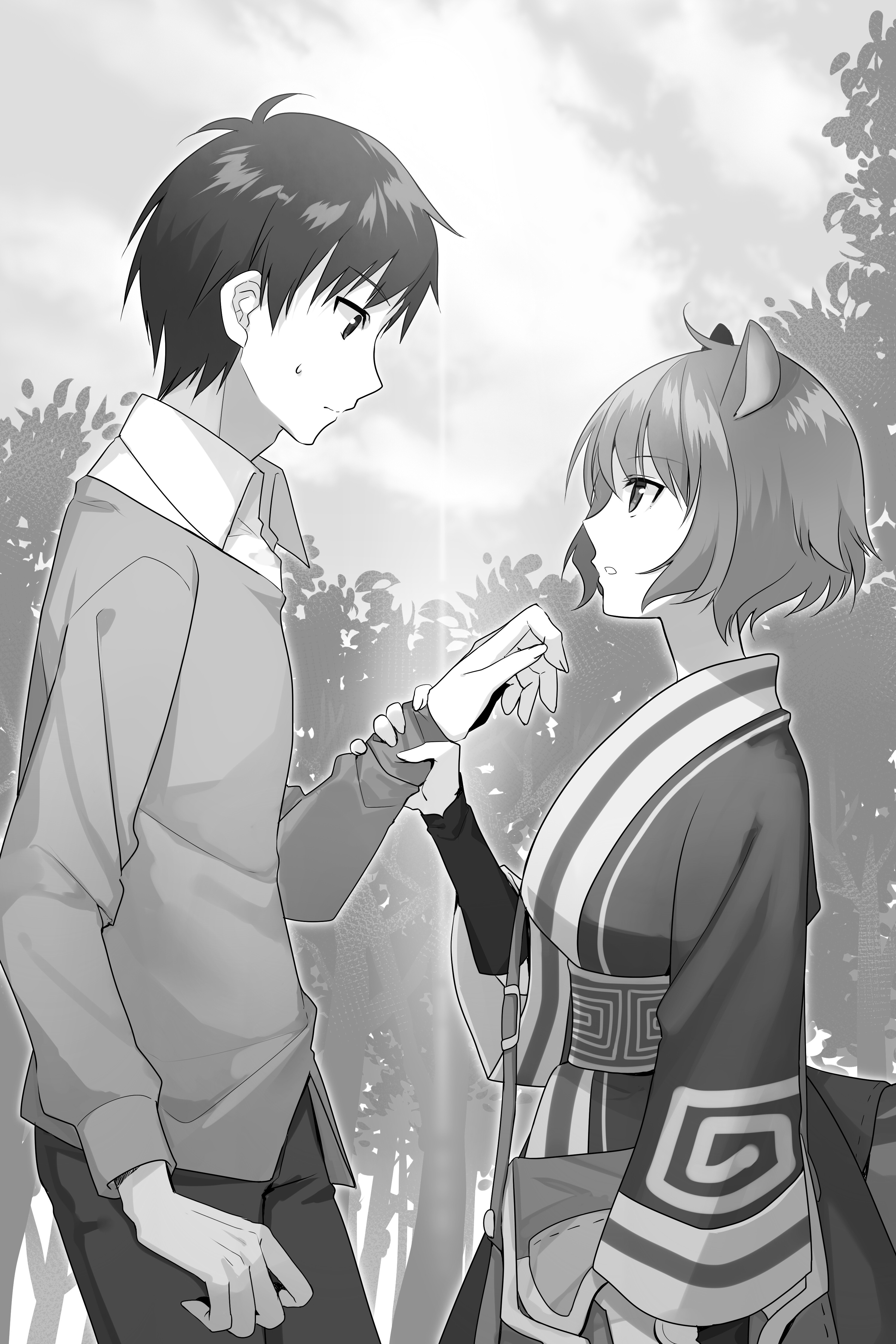
I took another look at the forest around me and it stared back. There were eyes everywhere—in the trees, behind the tree trunks, beneath the leaves and clumps of grass on the forest floor. We weren’t short of witnesses. This young woman certainly knew how to make a point.
She was making things very easy for me as well—if I’d ever had even the slightest intention of not honoring the pact, that temptation was gone in an instant. Of course, I wasn’t one to break my word in the first place. But I made a quick mental note to keep it that way and follow this agreement to the letter. I gave a solemn, confident nod, exaggerating my gesture for our observers’ sake.
Once I’d done so, the young woman released my wrist. Her grip was very firm, leaving behind a clear handprint.
“By the way,” I said, rubbing my tender wrist with my other hand, “I can’t say I’ve ever heard a name like Tokatechi before. Is it popular around these parts? Or is it a traditional name among beastfolk or something?”
“Oh,” she replied. “I was wondering why you made a funny face when I told you my name. Yeah, I don’t know if I’d say it’s traditional, but it’s been passed down through my family. If you can’t get your mouth around it, Techi is fine too. That’s what Tomiyasu used to call me.”
“I see. In that case, if you don’t mind, I’ll allow myself to take that liberty. I shall call you Miss Techi from now on,” I said, with a customary bow.
“Listen…” she said, sounding maybe a little annoyed. “I know we just made a pact and we’re now technically coworkers or whatever, but let’s cut the polite business talk, yeah?”
I nodded in agreement but using casual speech with a woman I’d just met— a perfect stranger—still didn’t sit right with me. What’s more, this was my first time meeting a beastperson, and I wanted to show the right level of respect.
But if that’s what she wants… I set my discomfort aside and flipped that switch in my head.
“Right. Yeah. Got it,” I managed, trying my best to sound casual. “I’ll do that then. I look forward to working together, Tetch.”
Dropping polite speech was one thing, but trying a nickname right out of the gate was too much. She glared at me sternly and I immediately regretted it. I quickly corrected myself.
“Sorry, Miss Techi. Just a little joke.”
Now seemingly content with my term of address, she gave a satisfied nod, turned toward the forest, and drew in a deep breath.
“All right, you guys!” she bellowed. “Out you come! The pact is made, so show yourselves!”
And out they came; an army of little chipmunks. Well, I say little, but they were far bigger than any rodent I’d ever seen at around a foot-and-a-half tall. They didn’t look human like Techi. Rather, they looked just like regular chipmunks, except for their extreme size and that they all wore clothing. A whole swarm of these strange creatures was coming out of the forest.
Some wore shirts and trousers, others dresses. There was even one completely hidden beneath a long cloak. The mob of oversized chipmunks chattered excitedly to each other in perfect Japanese as they walked this way and stood in a long row before us.
“S-So cute!” I blurted out, unable to stop myself.
Chipmunks are stupidly cute in the first place, but the way they were all lined up, staring at me with those adorable, round eyes, was too much for me to bear. Not to mention their delightful little plush toy outfits or the slight toddle in the way they walked like human children. It’s a wonder I managed to restrain myself as much as I did.
“Techi! Techi!” shouted one of the little ones. “Does that mean we can keep looking after Grampa Tommi’s orchard?”
“That’s right,” Techi replied with a firm nod. “The deal’s done. The orchard is our responsibility. So don’t you worry—we can keep looking after it, just like before.”
The little faces of the oversized chipmunks lit up with big smiles. They started running and jumping all over the place, hands joined together and bursting with joy.
“Erm…Miss Techi? What exactly are these young creatures?” I asked. “Are they also some kind of beastfolk?”
I was unable to tear my eyes away from the joyful spectacle before me. I could have happily watched these little chipmunks frolic about all day long.
Techi frowned once again—though briefly this time—but still answered my question with her usual look of annoyance.
“Oh yeah…I forgot, you don’t know the first thing about us, do you? These kids are beastfolk, yes. They’re the children of other members of my clan, about five or six years old. Looking at their perfectly animal-like appearance, you might be surprised to hear that. But that’s how we are.
“Beastfolk are born in animal form, and as we grow, we stay that way. Only when we approach adulthood do we begin shedding our fur, our teeth and claws shorten, and we start to look like humans.
“There are some differences,” she continued. “For example, some beastfolk grow both human ears and animal ears, like me. Others will only have one or the other. Occasionally, a beastperson will grow into a perfect human lookalike, but that’s very, very rare.”
She pulled back her hair, revealing a pair of human ears, hidden away in their usual places on either side of the head, in addition to her chipmunk ears perched up top. I curiously inspected them in turn; first one pair, then the other, then the first pair again.
“Those ears…” I asked. “Do they all…work? Do they all hear?”
“Of course,” she replied. “That said, my human ears aren’t as sensitive. And I always cover them with my hair anyway, so you could say I don’t really use them. If a beastperson hears a loud noise with both pairs of ears at once, it can really throw them off balance. It feels kind of like motion sickness. So most folks will cover their human ears with their hair like I do. Some’ll even use earplugs or earmuffs. Beastfolk with only one pair of ears don’t have to deal with any of that. They don’t know how lucky they are…”
I wondered what might cause such a phenomenon. Perhaps it had to do with the ear’s semicircular canals? Maybe the ear canals of both sets of ears were somehow interconnected, creating an unpleasant echo? Or perhaps each ear had its own eardrum, with all four being overstimulated? In the end, I decided that trying to apply human logic to beastfolk biology might be a futile exercise. But it was a fun thought experiment nonetheless.
But now, there were more important things to attend to.
“I do have one major concern that I have to raise,” I said. “In your talk with the children, you seemed to suggest that they would be working the orchard. That might be a problem. They’re so little! Isn’t that technically…child labor?”
In response to my question, Techi’s mouth visibly turned down at the corners, fully expressing her incredulity without saying a single word. It was the most irritated face she’d pulled all day.
“Look, that might be how you see it,” she huffed. “But that’s human logic, based on human laws and human values. Trying to bring that into the forest…I’m not sure whether to question your good sense or just laugh.” She paused and gave me a hard look.
“As you can see, young beastfolk are near-indistinguishable from ordinary animals,” she began to explain, seemingly deciding our pact required it. “And so they possess equal…no, an even greater physical agility than the animals themselves. Naturally, we adults are still very strong climbers. But our skills pale in comparison to the little ones. They’re so light, they can zip up a tree like nobody else.
“Moreover, there are some jobs that can only be done by children. It’s not just limited to members of our clan—it’s common throughout beastfolk society for children to do such unique, skilled work. Of course, nobody’s forced into anything,” she stressed. “They’re all paid very fairly, and there’s always a grownup around to supervise the work. Also, once the youngsters reach a certain age, we start to prioritize their education instead.
“All this is to say that every one of these kids wanted to be here today. And when the autumn harvest comes, they’ll get to stuff their little faces with chestnuts and walnuts till they’re sick. Trust me, these kids can work harder than any adult. Isn’t that right?”
Techi turned to look at the kids, who displayed an amazing range of reactions. Some puffed their little chests out with pride. Some raised their arms in the air in mock superhero poses, as if to say I can do this! Some even covered their faces in embarrassment at the compliment. However, there wasn’t one gloomy face nor one look of aversion. Observing their enthusiasm, I compared them to the kind of helpful spirits you sometimes see in fairy tales as I tried to adjust my perspective.
“Well, if that’s the case, I guess that’s fine. I’ll leave the orchard in your capable hands,” I said, nodding profusely.
If I nod hard enough, perhaps I can convince myself that I’m not violating any child labor laws.
“So…” I continued. “Did you want to start work right away? Or was today meant to be more of a meet and greet situation so we can start fresh tomorrow? What’s the plan?”
Techi and her little gang all peered over in the orchard’s direction.
“May as well start now,” she said.
They set off, the children leading the way, once again in their neat line, with Techi following behind at a relaxed pace but keeping an eye on them. It felt exactly like a preschool class out on a day trip.
I rushed over to my bag and grabbed a notebook and pen—key items for my new education. It might also be good to take some photos or videos. I checked my phone battery. …Better grab a portable charger too, just in case. That should cover all the basics. I slid everything into my jean pockets
“Left, right, left, right!” the kids shouted up ahead, cheerfully making progress. I ran to catch up with them, their bobbing tails visible even from a distance.
When we arrived at the orchard, the children formed another line in front of Techi, who’d sat down. They filed past one by one, and she gently patted each child on the head, counting them as she went.
“Nineteen…twenty. Okay, there are twenty of you helping out today,” she said, standing back up. “Now, listen up—the landlord may have changed, but the work hasn’t. Pay attention, don’t hurt yourself, and be thorough in your work. All right?”
“Yes, Techi!” echoed the kids in a cheerful chorus.
Then they all dashed to a small cabin tucked away in one the corner of the orchard—some sort of storage shed—and disappeared inside. They emerged a short time later, each clutching a small wooden pole in one hand and a small garbage bag in the other, raising them overhead so we could see. Then they broke into a run and scattered throughout the orchard, each picking a nearby chestnut tree.
The little chipmunks hopped and swiftly climbed high up into the branches in an incredible show of skill and agility—despite still holding their bags and poles. Once they found a suitable branch to perch on, they each sat still and began carefully scanning the trunk and branches, sniffing the air as they did so.
“Today’s chestnut day. We might check on the walnut trees tomorrow. Although we can do it whenever, really—walnuts don’t need much looking after. Chestnuts are pretty hardy too. But, since we don’t use any chemicals or pesticides, we have to keep a careful lookout for pests and disease,” explained Techi, keeping an eye on the climbing kids while we headed toward another structure not far from the storage shed.
This one resembled a rest area you might find on a hiking trail—a concrete foundation underfoot and a wooden roof overhead, with a set of wooden benches and tables in the middle. There was also a small washing area, much like you’d find at a campground, and a water pipe, complete with a faucet.
Upon closer inspection, I also saw a gas pipe, next to a spot clearly meant for a cooking stove. There was no stove in sight. But it’d be easy to get a hold of one and cook out here, or even just boil fresh water for green tea.
Judging from the comfortable way that she seated herself, I could tell Techi had spent a lot of time here. I pictured her drinking tea together with Great-Grandpa as they’d supervised the children. I sat down on the bench opposite and took another look around the shelter and at the children in the orchard beyond. Then I readied my pen and notebook and launched into my first question.
“What exactly are the children doing?” I asked. “What’s with the bags and the sticks?”
“It’s like I said. They’re checking for signs of disease and keeping an eye out for bugs and other parasites while they’re at it,” said Techi, glancing over at the children as she spoke. “If they find any pests, they pry them loose with the pole and collect them safely in the bag. Small, swarming insects like aphids need a different approach. But the stick method is fine for most of the bugs we get here.
“If we do find a diseased tree, we can mix up our own medicine. But usually, we’ll just call the arborist and get them to look at it for us. Do you know what an arborist is? Sometimes, they’re also called tree surgeons—they specialize in tree medicine. Tomiyasu used to call in his arborist twice a year, even if there was nothing wrong. You know how it is; sometimes you just need to talk to a specialist. I’ll give you their phone number, so be sure to call and introduce yourself later.”
Techi reeled off a series of digits from memory as I hastily scribbled them down.
“What else do we do…” she continued. “Oh! Every year around February, we prune back all the trees. The pruned branches are refrigerated for use as scions when grafting new saplings. You must’ve read about grafting, right? You grow a new sapling from a nut or seed. Then, once it reaches a certain size, you graft one of your pruned branches onto the trunk to create a completely new tree. When you graft rather than growing from scratch, you get far more nuts. They taste better, too!
“But, no matter how careful and attentive you are, eventually, a tree will wither and die. So it’s very important to keep numbers up by grafting new saplings every year. You don’t want to wake up one spring and find yourself with a tree cemetery.”
I’d read that it can take several years for a chestnut or walnut tree to reliably bear fruit, unlike, say, vegetables. That means that if a large number of your trees died all at once, your harvest would be hard hit for several years, even if you immediately scrambled to plant a full set of replacement trees. It seemed to be critically important to increase your tree numbers in a gradual and measured way, every year without fail.
“Also…if any trees start to grow weak, we can use fertilizer to reinvigorate them. That’s pretty rare, though—the soil in this forest is incredibly fertile. In fact, using too much fertilizer can also cause trees to get sick. So you need to be very careful not to overdo it.
“What else… Ah, yes! It’s a long way away yet, but at harvest time, you’ll want to sell the chestnuts and walnuts we gather. I’ll give you the contact details for our buyers—we have two. One’s a discerning and reliable businessman. The other rides the coattails of one of Tomiyasu’s childhood friends. And that one’s a good-for-nothing bum who’ll gouge you for less than half the market rate. I strongly recommend you don’t sell anything to that bum. Don’t even call him to say hi!”
Techi gave me two more telephone numbers then proceeded to carefully remind me not to use the second one (in case I’d already forgotten). I added a comment next to the number in my notebook to make sure I wouldn’t. She was clearly very serious about this.
We sat in silence for a moment. My eyes wandered back to the young chipmunks in the trees.
“Hang on,” I said after a little while. “That’s it? That’s all there is to it? Pest control. Fertilize as needed. Graft saplings regularly. Call the tree surgeon in a pinch. That’s…a very short list.”
Techi put her elbows on the table and rested her chin in her hands.
“That’s right. It’s not much when you put it that way,” she replied, peering at me through half-closed eyes. “Chestnut trees are very resilient. They do well in the heat and well in the cold; strong winds and heavy rain are no big deal either. Unlike growing fruit and vegetables, you could not lift a finger all year and still get a half-decent chestnut harvest. Walnuts are even more robust. They’re fine with massive weather changes and are very resistant to disease.
“So tell me, how do you feel about that 40 percent now? Was it worth it? Or do you regret taking the loss?”
It felt like she was testing me—her expression was that of someone trying to ferret out another’s intentions. I took a moment to think it over before I replied.
“I don’t think I can judge that until after I’ve counted the earnings from the harvest…wouldn’t you say?” I countered. “Perhaps at that point, I might find that I need to renegotiate our agreement for next year…but Great-Grandpa was an experienced veteran, and no doubt, he’d had good reason to keep the same terms year after year. This is to say…I trust you, Miss Techi, and your helpers.”
Techi let out a sharp breath through her nose and cracked a gentle smirk, her elbows still propping up her face. Her eyes wandered toward the orchard and mine followed. To my astonishment, many of the chipmunks were lounging among the roots beneath the trees or ingeniously wedged in between the higher branches, sleeping soundly.
“Kids will be kids,” said Techi. “They take regular naps. They also like to play and mess around during the workday. Trust is a big word for little creatures like that. Don’t worry—I won’t think any less of you if you admitted that you miscalculated.”
She grinned, clearly delighted by my look of surprise.
“Yes, well… I say it’s a good thing,” I replied, trying to regain my cool. “It just goes to show that you and Gramps weren’t working these poor kids to the bone! What a relief!”
Techi said nothing in response. She simply continued to stare me down with that smirk on her face.
🐿🐿🐿
WOULD the pact with Techi and her clan lead me to profit or loss? I decided to drop that question for the moment, saving such thoughts for after the harvest. Techi and I hadn’t said anything to each other for a while, so I watched the kids at work in the orchard instead.
Some were enthusiastically working hard, some sleeping soundly, and others were enjoying a game of tag with their friends or generally running around and playing. As I observed them, I saw that some were serious, some were happy, and some were smiling away. But I didn’t see a single look of misery or pain or distress. Gradually, my heart lifted and I was finally convinced—no one was coercing these children. There was no forced labor here. I let out a deep sigh and kept watching.
After a while, a new thought arose from the quiet.
“Miss Techi,” I said. “Could you write down all their names for me? It doesn’t have to be today.”
Techi acknowledged my question with a contemplative noise and thought about it for a while.
“I mean…sure, I can,” she replied eventually. “But what on earth do you need that for?”
“I was thinking it’d be a good idea to make them nametags. See, if a kid gets hurt or there’s some other sort of trouble, the last thing I want is to not know their name. An injured kid crying their eyes out is going to have a hard time answering my questions. But, if everyone has a nametag, I can immediately see exactly who was where and figure out what happened. That’s my thinking anyway.
“You may know everyone’s names, but, I hate to say it, these kids all look alike to me. It’ll take me a while to remember their names and faces. I think it’s important. It may not seem necessary if you’re always here, but you never know what may come up.”
“…That’s fine. Well said. You’ll have your list tomorrow,” she replied. “Tomiyasu was very good with names. If he met someone new, he’d remember their name right away…but I guess you’re still fresh from the outside. You haven’t seen many beastfolk yet. That probably makes things difficult.”
“Gramps could tell all those kids apart?” I asked, very impressed. “Wow. I’d expect nothing less. Speaking of which, I guess Great-Grandpa was able to keep this place running right up until his hospitalization thanks to these kids’ hard work, huh?”
“Yeah, that’s right,” said Techi. “He had a pact with us, so we looked after the orchard for him. He’d sit out here drinking green tea while he supervised the little ones. Other days, he’d be toiling away at that weird hobby of his. Well, there’s a limit to what you can do out here while also watching the kids, but he always found some prep work he could do.”
Great-Grandpa’s hobby. The treasures that he’d produced had once filled that warehouse to the brim. That hobby of his had saved my life once, back when I was a little boy.
Whenever I thought of him in his later years, completely obsessed with his favorite pastime, as happy as the day was long, it brought a warm smile to my face. It must have done so now as well, as Techi was giving me a strange look.
“So, what’re you gonna do?” she asked. “Your ‘orchard education’ isn’t exactly going to take very long, and the tasks you’ll need to do yourself are few and far between. If you don’t find something to do between now and the autumn harvest, there’s a real risk you’ll go a bit loopy from having too much time on your hands. You’ll need a hobby too.”
Too much free time? That was an unimaginable problem to most citizens of modern Japan. I’d be the envy of every working adult in the country, many of whom fantasized about exactly such an existence. How curious, I thought. I had long since figured out exactly how I’d spend such time, given the chance.
“I’m going to take up Great-Grandpa’s hobby. The very same,” I replied matter-of-factly. “I want to uphold his vision, humble as it was. When I was a kid, looking up and down the shelves in that warehouse, every little space crammed with colorful bottles and jars…I thought it was the most beautiful thing in the world. The mere sight of it inspired me. I’d like to recreate it.”
Techi let out a small sigh and shook her head in disbelief.
“Tomiyasu had some peculiar habits,” she admitted. “So…I guess I shouldn’t be surprised that the same strange blood flows in his great-grandson’s veins. I used to think that only a man like Tomiyasu would consider preserving food to be an engaging pastime. But now I’ve met two of you maniacs.”
Gramps loved preserving food. It was his favorite way to spend his free time.
Salting foods. Sugaring them. Pickling in vinegar. Pickling in alcohol. Smoking. Drying. Canning. Bottling. Vacuum packing. Freezing. He could make umeboshi, jam, compote, dried fruit, beef jerky, pickled wasabi, western pickles, frozen jellies, even freeze-dried tofu. He loved it all. He made such a vast range of foods. And they kept so well, retaining their delicious flavor for years at a time.
Sometimes, he’d send them to relatives. Sometimes, he’d eat them himself. And occasionally, he even organized “preserve parties” just to enjoy them with other people. They brought him joy in so many ways. I was sure that even the sight of all that countless glassware lined up neatly on the shelves must have filled him with a deep sense of satisfaction.
And it was those countless jars and bottles that’d saved my life as a boy when I’d come to visit Gramps one summer.
I’ll admit, I’m exaggerating a bit when I say that, but it definitely felt that way at the time. That warehouse full of food let us weather a very scary situation with hardly a care in the world.
“One summer, when I was just a kid,” I began to explain, “I was visiting Great-Grandpa like I did every year. This was…fifteen years ago now. Summer break had just started and I’d just arrived at the house…when that huge disaster happened.
“The Great Disaster, they’d called it. This whole area had been hit—the town at the mountain’s base had been completely devastated, as had the road connecting the town to the forest. In an instant, Great-Grandpa’s house had been cut off from the rest of the world. Although, I suppose that the result would’ve been the same even if the road had been spared.
“In the news reports, the town looked like a picture of hell itself. Homes, schools, roads; everything was damaged or destroyed. Everything the townspeople would normally take for granted about daily life had been snatched away. Nothing was coming in or out; everyone was stuck here. The camera crews filmed the survivors piling into the evacuation shelters, desperate for food and water. Seeing the aftermath unfold before me on TV, I was terrified of what was to come. I was sure that I’d starve. I thought there was nothing but suffering ahead and I started bawling my eyes out.
“But…Great-Grandpa simply smiled and told me there was nothing to worry about. He said that, until the town reopened and I could return home at the end of the summer, I could eat as much as I wanted of all my favorite foods.
“He led me straight to the warehouse building. Normally, it was strictly off-limits to us kids, so this was my first time seeing the glorious spectacle hidden inside. It was quite a shock. I remember the long rows of jam jars caught my eye right away—a full rainbow of the most delicious-looking hues. I wondered what fruits had been used in each jam—some of the colors were so exotic, I couldn’t even begin to guess. I was drooling at the thought of all those different flavors.
“At some point, I realized I’d stopped crying…and true to Great-Grandpa’s word, I enjoyed an amazing summer without a moment’s hunger or fear. What’s more, as soon as he got word that the road had finally been repaired, Gramps went down the mountain and handed out jars of food to everyone he knew. They were all so grateful—Gramps seemed like a real hero in that moment, you know?”
That, I reflected as I finished, was when I came to understand the charm of preserving food. I’d tried making jam and umeboshi a few times, first at my parents’ house and then in my own apartment. But I could only ever make small batches. There was simply no space to store all those jars for later. I was only a dabbler.
But this place? The house was huge. I could make as much as I wanted and more. I could finally sink my teeth into this world that’d fascinated me for so long, filling up the shelves in Great-Grandpa’s warehouse with delicious preserves of my own making. My hands tensed into fists—I could barely contain myself.
Techi’s eyes narrowed.
“…Is that so?” she said. “What a…great story…” She didn’t make the slightest attempt to hide her disinterest. Unconvinced by my impassioned speech, she just stared at me with puzzled indifference.
🐿🐿🐿
SHORTLY thereafter, we were interrupted by a rustling sound. A young man—specifically, a brown-haired, brown-eyed beastman of the chipmunk-y variety—stepped out of the forest.
“Hey, Tokatechi! You taking proper care of the little scrubs?” he asked.
Techi was unmoved.
“I should hope so, considering that, as a preschool teacher, it’s my job,” she replied. “Shouldn’t you be at work too, bro? What’re you doing out here?”
The young beastman was wearing a shirt and jeans beneath a white apron. He bore a strong resemblance to Techi, so they definitely seemed to be siblings. He carried a large shopping bag in his hand, which he lifted over his head with a rustle, as if to answer her question.
“Just a little treat for the kids,” said the young beastman. Then he turned to me. “I see Mr. Moriya’s replacement has arrived, and it seems the pact has been made. So I can also use this visit to congratulate my little sister. Of course, it’s also the perfect opportunity to introduce myself to Mr. Moriya the Younger. The name’s Arurei Kurikara, older brother of Tokatechi over there. You can call me Rei if you like! Pleased to meetcha!
“I’ve got to thank you, buddy—working on Mr. Moriya’s orchard has become an important source of income for our household. So, I’m very relieved, from the bottom of my heart, that we can continue helping each other going forward,” Rei finished, flashing a broad grin.
I politely returned the sentiment and his grin only widened. He placed the shopping bag down on the table and started taking out plastic food containers from inside. He placed one of them before me.
“These are candied chestnuts and glazed walnuts, originally picked right here in Mr. Moriya’s orchard. Some people call chestnuts prepared this way marron glacé—did you know that?” asked Rei—rhetorically, of course. “My French isn’t so great, but I believe that marron is the French word for a special kind of chestnut that grows on a marronnier tree. They aren’t regular chestnuts, though! The French call those châtaigne and they grow on a châtaignier, if I’m not mistaken.
“The problem with marrons is that they need a huge amount of prep work before they’re even edible. As a result, they were often substituted with regular chestnuts in recipes, and eventually, those became the norm. So, by the time these recipes got to Japan, there was plenty of confusion around the word marron.
“You know that famous dessert, the Mont Blanc? Its original full name is Mont-Blanc aux marrons. Seems that it used to be made using marrons rather than regular chestnuts.”
It seemed that Rei liked distributing facts as well as desserts. He took the lids off two containers and rummaged around in his bag for utensils. He handed Techi and me a fork each and clearly wanted us to dig in right away, judging by the big smile plastered across his face.
I peered into the plastic box and selected a chestnut to start with. I pierced it with my fork and popped it into my mouth. Almost immediately, the refreshing sweetness and aroma filled my whole mouth. There was so much flavor I couldn’t even put it into words. All I could do was keep chewing. I was blown away.
“Ha ha ha! Pretty good, right?” laughed Rei. “The nuts that grow in this orchard are the best you can get. Second to none.”
He took a break from watching me eat to call out to the kids in the treetops. “All right, worker bees! Time for a snack! First one to wash their paws and rinse their mouth out gets the first helping!”
This was greeted by a tremendous cheer, and the children were back on the ground in an instant, like little lightning bolts. A moment later, they were lined up at the faucet, scrubbing away thoroughly like they’d been told. Turning on the faucet proved no obstacle, despite their little chipmunk paws.
Once a child’s paws were clean, Rei reached into his bag and handed them a small hand towel, then a fork. Then, he removed the lid from a child-sized plastic food container and handed that over too. Once everyone had their share, he started chatting idly with Techi. I listened to their conversation with some interest, while keeping most of my attention on the glacé treasures in the box before me.
With each bite, the chestnuts gently released more of their incredible flavor. These were without a doubt the best I’d ever eaten, by a longshot. It was hard to believe a humble chestnut could taste so amazing. Great-Grandpa’s ban made a lot more sense now. The chestnuts and walnuts that grew in the orchard had always been off-limits. They were only for the customers, he’d always said. Not once had he let me try one. Now I knew why. Their flavor was mind-blowing.
The glazed walnuts were almost as good. Again, they made you doubt what you knew about walnuts, bursting with flavor and offering a very satisfying mouth crunch. To be honest, I’m not a big fan of walnuts. Usually, when you buy them, they taste pretty indistinct. You just get this vague nutty flavor—you’re not really sure what you’re eating. But these were completely different. You’d no doubt in your mind that this was the taste of pure, delicious walnuts.
I kept shoveling them into my mouth, one after another, until they were all gone.
That little box of candied nuts had quite possibly been the most delicious thing I had eaten in my entire life. I let out a long, contented sigh. Seeing this, Rei couldn’t help himself, and he broke into a wide smile, his face glowing with self-satisfaction.
“So, you liked it, huh? Glad to hear it! There’s a lot more where that came from, I’ll have you know. I run a shop over that way, deeper in the forest. So, when you’ve got some time on your hands, make sure you come and visit. Of course, don’t forget to bring some money with you—I only do freebies the first time I meet someone, yeah?”
I finally understood how this absurdly delicious dessert had come about. It seemed that Rei was a professional pastry chef—or pâtissier, to stick to his French theme—and he ran his own shop at that. I was very impressed.
“By the way, Mikura,” he continued, “Tokatechi told me just now that you’re interested in food preservation. Now, I’m not saying you have to start with nuts just because you own an orchard. This is a free forest, after all! But you’ve got some great options open to you. Dried walnuts are a very simple way to get started, as are boiled chestnuts which can be refrigerated or frozen for long-term storage. Some people will also boil walnuts with the inner shells still on. And there’s a traditional method for making dried chestnuts known as kachiguri that’s still popular to this day. That last one’s a real classic. Definitely give it a go!
“It’s a shame that the harvest’s so far off. Otherwise, you could use your own produce. But these days, you can easily buy stuff regardless of the season, so make sure you try a bunch of different methods, yeah? If you ever want to learn how to glacé stuff, just come by the shop. I’ll be happy to walk you through it.”
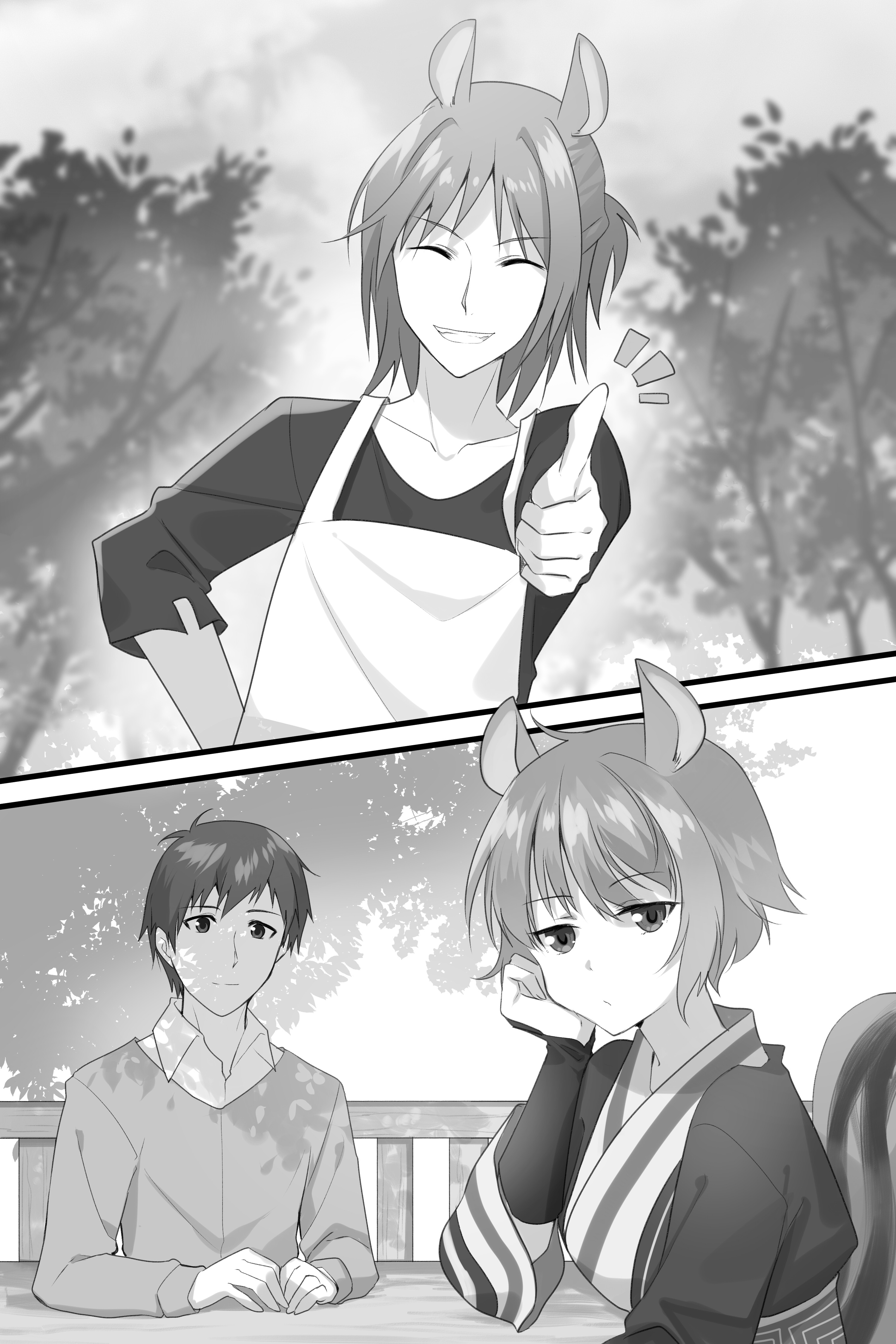
With that, he grinned at me and gave an enthusiastic thumbs-up…but he quickly began packing his things, no doubt because of the cold glare Techi fixed on him.
After he’d retrieved all the forks and towels and food containers, he crammed everything into his big shopping bag. He said goodbye to the kids with a brief, cheerful “See ya!” and vanished back into the forest.
Only once he was gone did I realize that I’d completely forgotten to thank him. How rude of me! It gave me a very good reason to visit the shop, though—I made a mental note to do so. I glanced at Techi, who was still coldly staring at the part of the forest that Rei had disappeared into.
“So…Miss Techi,” I said, “you’re a preschool teacher then? I’m a little surprised. I mean, with the kids working and everything, it’s nothing like the kindergarten I went to. Is this the bulk of your job then? To watch over the kids while they work? That’s very different from how I imagined the job.”
She let out a sigh.
“Well,” said Techi, “there are bound to be differences. We don’t have training courses or certifications here, so the work is pretty easygoing. Speaking of work…what about you? You won’t see any money from the harvest until the autumn. That’s a long way off. Will you be able to afford food with no income? It’s all very well to obsess over a new hobby, but aren’t you forgetting something?”
“Ah, yes,” I replied. “I should be able to manage for a year with no income…maybe even two. Actually, I’ve been dreaming of owning my own home for a while now—one with enough room to build a big warehouse alongside it. I wanted to make that happen as soon as possible. So, ever since I started working, most of my paycheck has gone straight into savings. I’ve led a pretty frugal lifestyle.”
Techi sighed once again.
“I guess you’ve got it all figured out, huh?” she said, with a certain resignation, and returned to her earlier posture—elbows on the table and chin resting on her hands.
The children were back at work, reinvigorated by their afternoon snack, a look of happy satiety still visible on their little faces. And so my eyes too were drawn out to the orchard to watch them.
They really were cute as dolls, working away earnestly with their thick and bushy tails twitching and twirling about. I don’t think I’d ever seen anything so charming. It really was too much.
“This is my first time seeing any up close,” I said absentmindedly, “but… beastfolk really are adorable, huh?”
I hadn’t really meant to say it—it’d just sort of slipped out while I was looking out at the children. But hearing my comment, Techi immediately stiffened and turned to look at me. She was frowning again.
“You mean to say,” she began, “that you’ve no aversion toward us beastfolk? No feelings of disgust or unease?”
I met her eyes and looked at her a while, carefully taking in her bitter glare. I shook my head from side to side.
“I can’t say that I feel anything like that,” I answered. “Anti-beastfolk sentiment is a thing of the past. It feels like a remnant of the Shōwa era…and even among older folk, I reckon people who still think that way today are very much in the minority.
“I’m not up to speed on the latest developments, but universities and other institutes are very engaged with cultural and medical research related to beastfolk. Recently, I even saw an anime about beastfolk airing on TV. What was it again…? Oh yeah, it was all about Aterui, that famous beastfolk hero and a great warrior of the Old War. Now that I think about it…Aterui sounds very similar to your brother’s name, Arurei. Is there any connection? A namesake?”
“Yeah, that’s right,” replied Techi. “Our father loved the story of Aterui, so he adapted the name for his son. We do get TV reception up here actually, so a lot of us watched the Aterui anime. TV dramas are very popular here too.”
She considered what I said for a moment.
“…So, the war is a thing of the past, you say…”
“I don’t know how you might feel about it,” I quickly chimed in, “but the way I see it, we’re only different in culture and appearance. We speak the same language, live in the same country…we’re neighbors now. So no, for my part, I’ve never felt any kind of distaste for beastfolk. As for the war, I guess there are still some loose ends. But I strongly believe that if we treat each other right, we can ensure nothing like that ever happens again. I, for one, want to see the peace between our peoples continue.”
I’d said my part, and I watched Techi in silence, carefully observing her face. Now that I thought about it, in all those summers I’d spent at Great-Grandpa’s house, I’d never so much as glimpsed a beastperson. I guess his cooperation with the beastfolk and this whole pact of theirs must’ve started fairly recently. It was entirely possible that Techi wasn’t yet used to associating with humans.
“Well, you know,” I continued, “all those dramas and anime are made by people who’ve never met a real beastperson before; people who don’t know your culture. Sitting here and actually talking to you in the flesh is a completely different experience. This whole situation is still kind of surreal to me, to tell you the truth. If people on the outside knew what you were really like—if they knew how cute young beastfolk are—I honestly think there’d be a huge demand for child beastfolk to become professional performers.”
All sorts of thoughts ran through my head as I looked at Techi’s face. I glanced up at her chipmunk ears and peered at the bushy tail behind her. Her features were objectively quite beautiful—I doubt many people would disagree. Furthermore, the ears quietly perched atop her head were utterly adorable, and the way her fluffy tail moved around in reaction to how she was feeling only added to her charm. If she ever appeared on TV, she’d become famous overnight.
“Hmph,” she snorted. Her face had become deadly serious. “This whole area is officially part of the Beastfolk-Administered Autonomous Region, a recognized independent territory within the nation of Japan. And yet, to this day, the issue of our citizenship still hasn’t been resolved. Being able to work on the other side of that gate is little more than a fantasy at this point, let alone appearing on TV.
“By the way, you should know that there are equally strict restrictions on people crossing the border into the Wilds. You being allowed to live here is a rare exception, and it’s only because you’re Tomiyasu’s successor and a member of the Moriya family. Don’t you forget it!”
I nodded in acknowledgment and reached into my pocket to take out a handful of leaflets and papers, given to me by the staff on duty at the checkpoint. They contained various precautions, warnings, and information related to life within the autonomous region, as well as lists of prohibited items and behaviors.
I made a note to carefully read them later…at which point, I suddenly remembered the mountain of other things I had to do, starting with unpacking my luggage. At the very least, I’d have to take a bath, find some bedding, change into some clean clothes, and sort out something for dinner. I checked the time on my phone, noticed with a slight panic that it was almost evening, and rose to my feet.
“I’m very sorry to break off our conversation,” I said, “but I just realized how much I still need to get done today. All my belongings are in boxes, I really need a bath, and I still haven’t eaten dinner. Can we pick up where we left off tomorrow?”
She gave me a look of understanding and I thought she was about to say goodbye…when she suddenly slapped her hands together, as if realizing something, and she called out to the kids.
“Listen up, everyone! We’re finishing early today! Pack up your tools and wash your paws! We’re going to help Mikura unpack his things! We’ve cleaned up Tomiyasu’s house plenty of times, so you should have a good idea of what goes where by now. Let’s make it quick—I want everyone home before dark!”
The children acknowledged her with raised arms and a shout of cheerful agreement and rushed all their tools back to the storage shed.
“No, no, no,” I protested. “I can’t possibly ask you to—”
Techi looked at me through narrowed eyes.
“That pile of luggage is huge,” she said. “You’ll be at it forever by yourself. Besides, it’s an old tradition for people to help their new neighbors move in. That’s definitely still the case among us beastfolk. You’re living in our backyard now. So you’d better start getting used to doing things our way.
“…What exactly are you planning to eat, anyway? You know they only let deliveries through the gate on Mondays. Today’s Wednesday—you’ll be waiting a very long time if you order takeout. Your fridge and warehouse are both empty—think you can manage a five-day water fast? Look…if you want to feed yourself properly, that’s all the more reason to get to know the beastfolk way of life, yeah? Anyhow, with the kids’ help, that big pile of luggage will be gone in an hour, maybe two. Let’s go.”
Techi stood up from the bench, swept her backside free of dust and turned tail, said tail swaying behind her as she went. She walked toward the children at the water pipe, presumably to make sure they were all scrubbing properly.
“Th-Thank you very much,” I called out, fumbling my words. “That’d be a great help.”
She didn’t turn around. She merely raised one hand and waved it back and forth in answer. Her tail followed roughly the same movements.
Once all the children’s paws were spotless, we headed back to the house together. With the help of Techi’s little army, we had the place clean and squared away in no time.
As strange as it all was, it seemed the foundations of my new life were starting to fall into place.