Life in the Beastly Wilds
Life in the Beastly Wilds
SILENCE.
“It’s so quiet…” I said to myself as I awoke.
An old-fashioned lamp framed with a wooden shade hung from the ceiling, and I found myself bewildered and disoriented by it. What was this place? Was I on vacation? That lamp looked like something you’d see in a traditional Japanese inn.
I looked around the room in search of further clues and saw some sliding shōji screens that might have been doors to another room or perhaps a built-in closet. It was only when I saw the futon cover I was sleeping under—which had a somewhat gaudy yet nostalgic pattern—that I finally remembered where I was. Yesterday, I’d moved into my great-grandpa’s house.
Last night, Techi and the little chipmunks had helped me straighten out the place. After that, I’d enjoyed a simple meal of instant curry with packet rice, bathed, brushed my teeth…and then I guess I had changed into my pajamas and tumbled into bed. Techi and the kids must’ve prepared a futon for me before they left.
I remembered staggering about after my bath, my mind already foggy with sleepiness, fantasizing about crawling into a cozy bed and repeatedly vocalizing my tiredness. I may’ve been exhausted by the move, but I still wondered about the various ways I’d made a fool of myself. I scratched my head frantically…then abruptly got to my feet, folded up the futon, and stuffed it into the closet.
The bathroom was next. I washed my face with the uncomfortably cold water and gently rinsed out my mouth, all the while wondering what to do about breakfast. Since there was a microwave oven, I decided to have another portion of that instant curry and rice and headed for the kitchen.
Once the rice and the curry pouches were fully heated up, I picked out an appropriate plate to eat my curry on and grabbed a spoon and cup. I thought it was a bit lazy to eat in the kitchen, so I took everything to the living room.
There was an imposing low table positioned right in the center of the room, so I laid everything out on it and sat down on one of the floor cushions. I sat so I faced the window that looked out onto the veranda. Upon closer inspection, it seemed that I’d accidentally left it open overnight.
I put my hands together, voiced thanks for my meal, and grabbed my spoon. And so, I sat and ate my breakfast in the most refined surroundings, savoring the unmistakable taste of instant pouch curry. About half a minute into my meal, I happened to look out onto the veranda in front of me, and I saw a large chipmunk had quietly appeared.
It was staring at me in silence. I stared back and noticed it was wearing clothing. This was no ordinary chipmunk then, but a beastchild—presumably one of the kids who’d worked in the orchard yesterday. No sooner had I thought this than the chipmunk kid scurried over to the table and sat down next to me, still watching me intently.
“Morning,” I said.
“Morning!” replied the child cheerfully, continuing to stare at me.
“Um…” I said next, somewhat distracted by those cute, round eyes. “…Can I help you with something?”
“Um,” replied the child, tilting their head slightly. “Techi told me to come and get you! She said if you were eating breakfast, I should wait till you’re finished and then bring you to the orchard. So…I’m waiting for you to finish your food!”
“I see,” I mumbled with a small nod.
I resumed eating my curry so that the day’s work could also begin. Once the curry was gone, I took everything back to the kitchen and left it to soak in the sink. At this point, I remembered that I was still in my pajamas, so I went to my bedroom to put on some more suitable clothes—a long-sleeved shirt and some slacks.
I was pretty sure the young chipmunk was a boy, so I quickly changed even though he was still watching me. After that, I brushed my teeth and found myself thinking about all the chores that’d be waiting for me when I returned. Once I was ready to go, I headed for the front door, put on my shoes, and stepped outside.
No sooner had I done so than I realized I hadn’t locked the doors. I didn’t even have the house keys on me. But I figured that the place had been left wide open before I’d even arrived and everything was just fine, so I happily gave up the idea. The watchful child was, of course, still watching intently the whole time. We set off toward the orchard together.
“So, what’s your name then?” I asked the child along the way. “My name’s Mikura, by the way.”
The child had been scurrying along the ground quite happily, like a wild chipmunk would. They stopped, turned around, and answered my question.
“That’s right! You’re Mikura! I’m Kon! Nice to meet’cha! I’m a boy, by the way!”
Kon.
I suspected that this too was a shortened version of some longer, much stranger name. Kon struck me as a name you’d give a fox, not a chipmunk. That in turn made me wonder what other species of beastfolk might live in these woods—surely, there must be some foxes too? Indeed, I read a book once that described a range of other beastfolk species. If memory served, there were also boars, bears, foxes, raccoons, badgers, serows, cats, and dogs.
A handful of beastfolk did actually live on the human side of the border, serving as goodwill ambassadors to Japan. However, they always made an effort to conceal their animal features, hiding ears and tails beneath hats, hoods, or other clothes. Some even skillfully used elaborate hairstyles for the purpose. At a glance, you’d think you were just dealing with an eccentric human being.
However, the beastfolk in human books, as well as those appearing in our TV dramas and anime, were only based on the faintest impressions of the writers and producers—products of fertile imaginations, exaggerated for dramatic purposes. I think it’s safe to say those creators had no idea that there were beastfolk out there who were virtually indistinguishable from wild animals, like little Kon.
Well, even if they were to somehow get a glimpse of the little guy, most people would probably assume they were simply seeing a large chipmunk or a plush toy.
But with his wide, round eyes, his adorable movements, his perfect coat of fur; gleaming and smooth, clearly subject to regular baths…his was an entirely different charm than that of an animal or a plush toy. I wondered why.
Was it because he understood human speech? Yes, perhaps, though that still aligned with his age. But while his speech and his gestures were very much like a preschooler’s, there was something animal-like about them as well. Perhaps you could say it was that mix of childlike and wildlife that was the root of his charm.
I mulled this over until the orchard was in sight, the children all lined up in a row with Techi standing over them. At that point, Kon went from a run to a sprint and joined the other kids, quite out of breath. Techi shot the smallest of glances my way, as if to make sure Kon had brought the right person, and she proceeded to pat him on the head and praise him lavishly. Once he’d been sufficiently pampered, she turned her attention to the rest of the group.
“All right, everyone! You know the drill. Pay attention, don’t hurt yourself, and be thorough in your work! Right, off you go!”
The kids raised their arms and called back in acknowledgment. Today, they were working a different plot, further inside the orchard, and they all ran off at once. Techi made for the rest area as she had yesterday; I followed. I took a seat opposite Techi once again, and she handed me a sheet of college-ruled paper. It seemed to have been torn out of a notebook. I was about to ask what it was when I remembered our conversation about the list of the kids’ names.
“Thank you very much,” I said, taking the sheet from her.
Next, she reached into her large messenger bag and took out a chestnut brown pencil box, similar to the one I’d had back at school. She placed it on the table and smoothly opened the lid. The box was packed full of laminated name badges—the kind often used in kindergarten, with a safety pin on the back.
“Since you wanted that list to make nametags for the kids,” said Techi, “I thought I might as well get some badges ready for you to hand out. I can lend you a pen, so help me write these names out.”
The name badges had an acorn design with a white rectangle in the middle where a name could be written. Techi laid them out in rows on the table and handed me a marker pen, which I accepted with a brief nod.
“Acorns. Very appropriate,” I said. “Why don’t you start from the top of the list and I’ll start from the bottom.”
Techi nodded and started writing out names on the badges in big, easy-to-read letters. She casually started a new conversation as she worked.
“…With chestnut trees, the disease you really need to watch out for is chestnut blight. That’s a scary one. America used to be the world’s biggest producer of chestnuts. But about a hundred years ago, the disease spread quickly and destroyed most of their trees. This, in turn, had an impact on the passenger pigeon population, as they nested in chestnut trees, and eventually, they went extinct from overhunting.
“…Some varieties of chestnut trees have a defense mechanism though—their trunks contain high levels of a substance called tannin, which helps keep the disease at bay.”
Not expecting an onslaught of new information, I hurriedly grabbed my notebook and scribbled down the key facts about this dangerous disease. Just as I’d finished and was about to return to the name badges, Techi hit me with another batch of facts.
“Japanese chestnut trees are one of those tannin-high varieties. Chestnut timber has been a firm favorite in Japan since ancient times, and its high tannin levels are a big reason why. Tannins make the timber very rot-and-wear-resistant and, depending on how it’s used, it can easily last for many decades.
“…However, it’s still possible for Japanese chestnut trees to become infected, so we all have to stay vigilant. The last thing we want is a repeat of the American chestnut tragedy. When grafting trees, it’s very important that all cuts and graft points are carefully treated so that there are no entry points for the disease. Insects can also wound the tree and let disease in through the bark. Prevention is the best medicine. That’s why the kids are out there every day.”
The kids were doing very important work by checking for signs of disease and carefully removing every insect—without harming the tree in the process.
Techi went on to explain the downsides of relying on a chemical solution to treat the symptoms rather than the cause. Blight medicine, it turned out, needed to be applied for six months out of the year, and it was eye-wateringly expensive. Specifically, it came to about a third of the total profit from the year’s harvest. Prevention really was the way to go.
“I see,” I replied with a deep, solemn nod.
It would’ve been nice to know that yesterday before we made our pact, I thought to myself. I looked directly at Techi, and clearly she read my mind, because she turned her head upward, almost apologetically, to avoid meeting my gaze.
“…My brother scolded me last night,” she began, almost whispering. “He said that I was foolish to insist on making the pact before I’d fully explained everything to you. That I’d made you uneasy, leaving you unsure of the terms. That concealing details like that could’ve ruined everything. That I’d put the whole contract in jeopardy. He gave me a really hard time… I thought it’d be fine just to explain things as they come up. Sorry about that.”
“I see… Well, we talked it over today, though, right? We have an understanding,” I said, trying to reassure her after her unexpected apology. “I’ve no complaints or problems with the contract. It’s all good. So, don’t worry about it, okay?” I said, then shifted the conversation to something else. “Changing the subject briefly… Don’t walnut trees need this kind of attention too?”
Techi rested her chin in her hands and looked at the walnut trees, deep inside the orchard, beyond the chestnut plot, and began to explain her next point.
“Walnut trees can get blight too, but it’s not that serious. I’ve definitely never heard of it killing a walnut tree—they’re resistant to all kinds of diseases. Again, it’s probably due to their high tannin content. Chestnut blight is counted among the big three tree diseases in agricultural circles, causing major crop damage every year. So that tells you just how hardy the walnut tree must be.
“Walnut lumber’s also highly prized and commonly used in woodwork—it seems to be especially popular abroad. The Japanese tend to prefer chestnut for the most part, but they’ve been cultivating chestnut trees since ancient times, so I’m sure it’s deeply embedded in the culture by now.
“By the way,” she asked me, “do you know how to write ‘chipmunk’ in kanji?”
“It’s written with the characters for ‘chestnut’ and ‘mouse,’ isn’t it?” I replied.
“Hmph! Too easy for you, huh?” she huffed. “I guess there is something bookish about you. I’m sure you’ve read a lot.”
With that, she turned her attention back to the name badges and picked up her marker pen. I didn’t want to have her write them all out alone, so I only jotted down a few key words to Google later, then returned to the task at hand.
We were at it for a good ten or twenty minutes, when finally, the list was exhausted and Techi called out to the children.
“All right, everyone! We’re gonna take a little break and hand out your name badges! Come on down!”
The kids let out all kinds of cheers and whoops of excitement and ran to us, forming a neat line in front of Techi. She got up, grabbed a handful of name badges, and read the names out one by one. As each child responded, she undid the safety pin and neatly attached the badge to their clothing. After she’d done a few, I figured I should do the same. I read out a name and a young chipmunk rushed over to me. I attached the badge and fastened the sharp safety pin with the greatest of care.
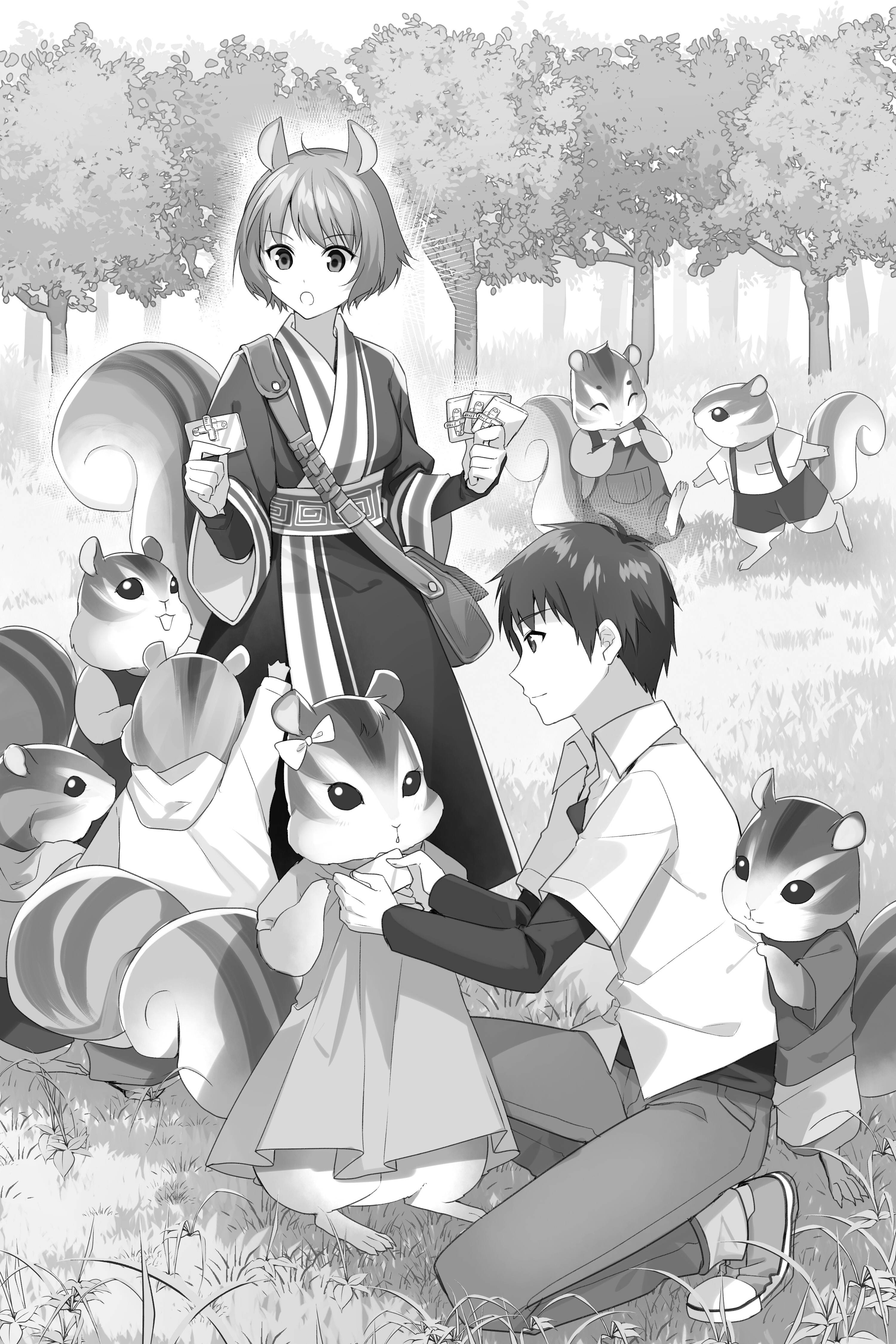
We continued until every child had their own acorn badge, clearly displaying their name. They were all beaming from ear to ear, peering around with chests puffed out—partly with pride, partly to better show off their badges as they glinted in the sun.
🐿🐿🐿
THE children bounced around the orchard, still overjoyed at their new badges, but gradually resumed their work. There were a few nametags left over for children who had not turned up today due to business at home, so they were put away for later.
Just as I started wondering what I should do for the rest of the day, Rei showed up out of nowhere. Today, he’d brought a large bag in each hand.
It looks like he’s brought more snacks.
“Hey! Here I am, folks!” he loudly proclaimed. “You’ll be two or three hours, I take it? Someone’s gotta watch the little nippers while you’re gone, so just leave it to me. Now, off you go.”
With that very insufficient explanation, he started laying food containers out on the table. I was confused as to who exactly was going where and what they’d be doing once they got there. Suddenly—almost as suddenly as Rei had arrived—Techi stood up and looked at me, an expectant look on her face. It was a look that said Aren’t you coming? Don’t make me stand around all day.
I stood up, perplexed.
“I’m sorry…” I said, “but am I forgetting something? Were you planning some kind of trip today?”
Techi looked at me as if I’d said something truly stupid while Rei laughed aloud, clapping his hands. She impatiently spelled it out for me.
“A trip, he says… How about a shopping trip, eh? Or are you planning not to eat until Monday? Didn’t I tell you just yesterday that you’re going to have to start doing things our way? Since you now have a formal connection with our clan, that makes you an upstanding new member of our community. You’ve earned the privilege of visiting the stores in the heart of the forest. We’re going there now, so you can buy food, clothing, or anything else you might need for daily life.”
She paused briefly.
“…Don’t tell me you didn’t bring any money with you?”
Flustered, I patted down my pockets. Fortunately, my habit of always grabbing my wallet when I left the house was still strong. I took out my wallet and checked its contents.
“Erm, I thought I might need money for the move, so I withdrew fifty thousand yen from my bank account. Looks like I still have around forty thousand left… Say, can I use yen in this forest?” I asked Techi.
“Of course you can,” she replied. “This may be an autonomous region, but we’re still located within the fine country of Japan. If you have a bank card, you can even withdraw money at one of our ATMs…although you’ve more than enough cash on you.”
Techi grabbed her bag from a nearby bench, slung it over her shoulder, and headed into the same area of forest that Rei had emerged from. Worried that I’d lose her, I quickly muddled my way through thanking Rei for his help, and then chased after her.
Passing through a gap between the trees, we found ourselves on a quite ordinary, forested mountain trail, which we followed for a time. But gradually, the scenery changed and, as it did so, it simultaneously became much more familiar and yet incredibly bizarre. It’s…difficult to explain.
There was a road. A genuine road, with houses and buildings. Much like any you would find in Japan…except this road was located in the middle of the forest.
Normally, if you wanted to build a road through a forest or houses or what have you, you’d have to clear the land, fell the trees, dig out all the roots and boulders. That’s what I’d thought, anyway. But this forest appeared untouched. The familiar structures began suddenly, deep in the woods, and the road and the buildings were all sort of tucked between the trees. It felt as if I’d stepped into a strange, alternate world.
“These feel just like wooden houses from the Showa era, don’t they?” I offered calmly before my amazement got the better of me. “Wh-What the—?! Those traffic lights are hanging from a tree branch! How bizarre! How do they get electricity?”
“Take a closer look,” said Techi. “There are brackets arranged in a spiral pattern along the branches and down the trunk of that tree. If you look really carefully, you can see the power cables running between them. Speaking of which, we also have our own power station in the mountains. We commissioned the Japanese government to build a dam and a hydroelectric power station, which we own outright and operate ourselves.”
“Wow…who’d have thought?” I pondered aloud. “Is it safe to run electric cables through the forest like this, though? Hmm, you do sometimes see cables snagged by tree branches as they run from telephone poles to residential buildings…so I guess it must be safe enough?”
“Well,” replied Techi, “I don’t know anything about the technology, but I’m sure there must be safety measures. What I can say, almost for sure, is that we’ve never had a power outage or a fire here—at least not to my knowledge.”
We continued to follow the weaving road as it poked and wound its way through the forest. The further we went, the more beastman-made structures appeared, all neatly wedged between the trees, while said trees gradually grew thicker and taller and more majestic. Eventually, we reached a spot where the forest opened up to reveal a large—no, that doesn’t begin to describe it. It gave way to a colossal, round space.
I say “space,” not “clearing,” because the forest didn’t end there. Rather, the trees had grown to the most absurd, gigantic heights—they were almost certainly comparable to city high-rises in size. These giant trees surrounded the space, serving as a sort of perimeter wall, and the canopy above formed a vast, domed ceiling. Sunlight filtered down through gaps in the canopy, like so many streetlights, fully illuminating the space.
“This is unbelievable. Simply incredible…” I muttered, my jaw slack with awe. “I’ve never seen anything like it. It’s like a legendary elven village from a fantasy story or something.”
I’d stopped dead in my tracks, staring up at the impossibly high canopy, unable to grasp the true scale of it. I slowly lowered my gaze, trying to take in the dome in its entirety. When I did, I saw Techi some distance away—she continued walking before eventually spinning around.
“Hurry up!” she shouted.
I quickly obeyed. I made a mental note not to drift off again and to stay by her side. We continued along the sidewalk and crossed the dome’s threshold.
As soon as we entered, I felt a strange sensation throughout my body.
“Huh…what’s this weird feeling?” I asked. “It’s like the air has changed all of a sudden. Has the humidity dropped?”
“It’s those trees,” explained Techi, sounding almost disinterested as she kept on walking. “They purify the air here. You won’t breathe air this clean anywhere else. Our main settlement is in the heart of the forest, and the giant trees that surround it have very unique properties. They say that humans who spend time here can end up living longer. That’s how good the air is for you.”
“It’s just one incredible thing after another today, huh,” I remarked.
“All right, enough of all that,” said Techi. “From this point on, there’ll be a lot more people about, so stay close. Don’t get lost.”
Indeed, I started to hear the sounds of urban life—the hustle and bustle of people going about their daily business—resounding through the area. As we passed by, I spied all sorts of beastfolk rubbernecking out of the glass windows of the surrounding houses. They were watching us…no, I suppose they were watching me— with great interest.
“They all watch TV—they should be completely used to seeing humans every day,” said Techi, an exasperated look on her face. “What do they think they’re doing, poking their heads out of windows? Have some dignity!”
I guess she wanted to be spared their inquisitive gaze, because she quickened her step. She led me down the road toward a sizeable parking lot, in the middle of which stood a large, single-story building. There was no mistaking it—it was a bona fide supermarket.
“Wow…” I muttered for the umpteenth time, taking in the day’s next miracle. “It’s just like one of ours, with its sprawling, single-floor layout…but the all-wood construction gives it a luxury feel.”
“Funny you should say that,” replied Techi, pointing to the supermarket entrance as she spoke. “For us, it’s steel and plastic that make a building feel classy and luxurious. On the inside though, it’s just like the supermarkets you see on TV. There’re products on display, you grab what you want, and you take your basket to the registers so the cashiers can add up the total cost for you.
“Now remember, we have to carry everything back to the house ourselves, so don’t buy too much. Keep it to what two people can carry. You got that?”
I nodded to show I understood and felt a certain nervousness overcome me. I quickly realized it was actually the excitement and thrill of stepping into a new and unknown world. We walked toward the wooden supermarket.
The sliding doors opened automatically as we approached. I grabbed a shopping basket…and what awaited on the other side was an entirely normal, painfully unremarkable supermarket like any other.
“I…I should’ve expected this,” I said aloud, trying to sweep my unrealistic expectations under the rug. “It’s not like you can make refrigerators out of wood…and it must be easier to install lighting and such when you use steel girders. I see they stock products from outside the forest as well… Of course they do. That makes perfect sense…”
Techi ignored me and walked briskly to the fresh produce section near the entrance to pick out vegetables. I followed.
“The vegetables are so cheap…” I noted as I approached. “They’re all weirdly massive though. I can only imagine how great they must taste—they look very firm and juicy. Do all the vegetables in the forest look like this?”
I reached out my hand to give one of those perfect vegetables a squeeze, but Techi slapped my hand away and shot me a look that seemed to say That’s no way to choose vegetables! She proceeded to grab some cabbage, green peas, asparagus, and other greens and gently dropped them into my shopping basket.
“You don’t choose by firmness, you choose by freshness,” said Techi, once again in lecture mode. “The best way to do that is to eat seasonal vegetables as much as you can. It’s difficult to get your hands on good vegetables in the winter, so all sorts of toxins build up in the body. That’s why it’s important to eat lots of fresh, seasonable vegetables when you can, to flush out all those toxins and other nasties. Now, what else do we need…ah, yes. Rapeseed flowers.”
She didn’t stop walking during her lecture, taking a bundle of rapeseed flowers and popping them in my basket too, before heading over to the next aisle to grab some natto and miso soup. I followed Techi around, watching her as she dispensed grandmotherly wisdom, and I realized that she was somebody you could truly rely on. I let her handle most of the shopping decisions from then on.
That said, despite Techi’s firm insistence that we mind how much we buy before we entered the store, her shopping technique clearly had no room for hesitation or restraint. I soon found some much heavier items making their way into my basket, like fresh fish, a two-gallon jug of milk, and a big tub of yogurt.
“…Oh yeah, you have no miso paste, either,” said Techi, completely lost in the flow of groceries. “You’ll need salt and sugar too… Mirin, rice wine, soy sauce…and dashi stock too, of course. Tomiyasu made his own miso from scratch, so I almost forgot about it. Rice! You definitely need rice…well, maybe just a small bag for today.”
Which, hilariously, was probably the only concession she made—otherwise, her shopping style pulled no punches. In the end, we had to use two shopping baskets, and the final bill came to just short of seven thousand yen. We both left the store, heavily laden with shopping bags—several in each hand.
“I think we bought too much,” said Techi, as we stood in the parking lot outside the supermarket. The handles of the heavy plastic bags were biting into her hands, and I could feel mine starting to do the same.
“I guess we’ll have to buy a car,” I joked, then found myself curious about something I’d noticed. “Say, Miss Techi, what kind of cars are popular here in the Wilds? I mean, we walked along that road for quite a while, and now we’re standing in this lot. But I don’t see many cars around.”
“…The most popular would be mini trucks, by far. They’ve been all the rage for decades,” she replied.
“Mini trucks, huh? I can see why. They’re a good fit for the landscape…good for carrying things…”
“Come on, quit complaining and start walking,” admonished Techi. “Standing around like this will only make our hands hurt.”
We followed the road back the way we came and headed home, huffing and puffing under the heavy load. Somehow, we survived the return trip and quickly set about putting away all the groceries in the fridge and kitchen cabinets.
Under Techi’s guidance, I also unpacked food items that spoiled quickly in their original wrapping or kept better if immediately transferred to another container. We were both rather thirsty by the time we were done, so we each enjoyed a glass of milk before heading back to the orchard.
“Miss Techi,” I said on the way. “I’m not sure how many times I’ve said it now, but thank you again. For the shopping, the food storage tips, and for all the cooking advice you offered. You’ve been a huge help.”
Techi, who was ahead of me, looked back at me for the briefest moment then replied, “…It’s no big deal. Until yesterday, I didn’t know if anybody would even show up to take over the orchard. I didn’t know if our clan would get to make another pact. It’ll be quite a headache for me if you die of malnutrition.”
“Ah, so that’s how it is…” I said. “Now that you mention it, Gramps lived a very long, healthy life himself. Was that also because of that forest…and maybe because of his lifestyle here in the orchard? What do you think?”
Well,” said Techi, “we don’t actually know what effect that pure forest air has on the body. It’s not like we’ve done scientific studies or anything… But I can definitely say that our vegetables are far fresher and more nutritious than those found on the outside. They’re delicious, too—it’s easy to eat a lot of them. I’m sure that plays its part.”
The orchard wasn’t far off when Techi suddenly stopped and looked back at me, this time with a very serious look on her face.
“Say…were you…there at the end?” she asked. “Did you witness Tomiyasu’s final moments?”
“What?” I asked in return, a little surprised by the question. “…Yes, I was there. He stayed in the best room in the hospital. The entire family had gathered round to watch over him at the end… That was when I decided to take over the house and orchard.”
“Tomiyasu wanted to die here in the forest,” said Techi. “I’m sure of it… But when the humans heard he’d collapsed, they dragged him to that hospital, almost by force… It’s bothered me ever since… Did Tomiyasu pass on with a smile on his face?”
Her deadly serious expression and the powerful gravity in her voice told me that I should reply with an equally genuine and honest answer. No lies, no evasion. I had to tell it as I saw it.
“When I heard that he was at death’s door, I rushed to the hospital. But by the time I arrived, he was already unconscious. He was on life support. But it was clear that nothing could be done, so the respirator was turned off…and the whole family was waiting for his heart to stop beating.
“But those vultures couldn’t even wait that long. They started squabbling about who’d inherit the house and run the orchard, passing the buck from one to another…all while he lay dying, right there in front of us. They just said whatever they wanted. How selfish can you be?
“It would’ve been far more fitting for someone from my grandparents’ generation to take over than me. But they were also stubbornly defending their selfishness. It was as if nobody could even see Gramps lying there.”
I paused at that point to take a deep breath. I looked off into the distance and continued.
“So I said it. Just like that. In the heat of the moment. ‘I’ll do it. I’ll take over. I’ll quit my job, leave my apartment, and look after everything. It’s over. So give it a rest.’ That’s what I told them.
“They pounced on me with heartless words. ‘Your great-grandfather may be dying, but don’t do something so stupid.’ At that moment, Great-Grandpa opened his eyes. His breath was ragged, like his heart was about to stop any moment…but despite that, he smiled. And he said…
“‘So…Mikura will take over for me? That’s a relief… If Mikura’s in charge, everything will be fine. Good…I can rest easy then…’
“He died with that smile on his face. It was such a warm, heartfelt smile. We even asked the people at the funeral home to leave it like that for the open casket, so that everyone at the funeral could say goodbye to him with a smile of their own,” I finished.
Gramps had lost a lot of weight by that point. He was all skin and bones. It’d be a stretch to call it his best smile. But despite that, I still think back on it when I need a little solace.
In the end—with that smile and those last words—the matter of the inheritance was settled. Realizing that Great-Grandpa had been awake—that their petty bickering had almost been the last thing he’d ever heard—my relatives accepted the final outcome without further question. Even my parents said nothing to dissuade me.
I thought about how they must’ve felt. I’d graduated from a pretty good university, had gotten a job at a pretty good company, and had worked pretty hard to achieve all that. Suddenly, I was going to give it all up. Deep in their heart of hearts, they must’ve been against it…but they never said a thing.
Thinking about it put me in a quiet mood. But Techi interrupted it with another stern, meaningful look.
“Mikura. Thank you.”
Her words had an intensity to them that she hadn’t shown before. I was embarrassed by her directness. I scratched my head nervously and all I could think to say was “You’re welcome.”
With that, we set off again toward the orchard.
🐿🐿🐿
BACK at the orchard, we made our way to the rest area, where Rei was waiting for us with a big smile on his face.
“Hey! Welcome back,” he said, beaming. “Hmm…what’s this? Did something good happen to the two of you? Techi’s face is far less sour than usual.”
No sooner had he said this than Techi took a step toward the bench he was sitting on and kicked it so hard that the whole bench moved.
“Is that how you thank your dear older brother who took time off work to help you out today?” asked Rei, rising to his feet. “You hurt me deeply, sis. Your brother is a gentle and delicate soul…”
He started clearing the table of his belongings, storing them away in the bags he’d brought. He left two lunch boxes on the table—presumably a late lunch for Techi and myself—and he patted me teasingly on the shoulder.
“I don’t know what happened between you two, but I’m glad to see you and Tokatechi seem to be getting along. You kids play nice now.”
With that, he let go of my shoulder and headed back into the forest.
“Uh…we will? Thank you for lunch!” I called after him.
I sat down on the bench, and Techi took up her usual spot opposite me in her usual posture, her chin resting in her hands. She fixed her eyes on the children in the trees and my eyes followed. The children hadn’t noticed the changing of the guard and continued their orchard work blissful and oblivious, happily giving it their all. I watched them for several minutes before feeling the need to speak.
“Miss Techi…” I ventured. “What else do I need to know about the orchard?”
“What’s that?” she asked, turning to face me. “Oh, right… Well, you got most of it this morning before our supermarket trip. That’s pretty much it for now. Trimming and grafting are best learned on the job, and as for fertilizer, you add it in specific circumstances, depending on the condition of the soil and the trees. That’s also better seen than described. With bugs and disease, it’s also probably easiest if I show you when we actually have a problem. And when it comes to prevention…well, as you can see, the children are doing a fine job of it—you can always review your notes from yesterday.
“The only thing remaining is the harvest, and that’ll be dealt with at harvest time… It’s still early spring, so there’s really not anything else I can teach you right now.”
Rei was right—her expression had softened and there was less impatience in her voice now. Was it because we’d gone shopping together? Was it because I told her that story about Gramps? Whatever it was, I was glad we’d moved from the stiff rapport of coworkers to something a little friendlier. That was definitely a relief… But I had a new concern to raise.
“So, in other words…we’re going to be spending most of our time exactly like this, watching the children work for hours on end?” I asked. “Is that it? We’ll just be sitting around doing nothing with our feet up all day?”
“Well, I wouldn’t put it like that,” said Techi. “If the children mess anything up or cause any trouble, we have to deal with it. Sometimes there’ll be one-off tasks, like writing out the name badges this morning… Hang on, we already talked about this yesterday. As I said then: you’ll need a hobby, because you’ll have plenty of time to indulge in it.”
“I guess we did talk about it…” I conceded. “Of course, I’ve every intention of taking a deep dive into my new hobby, but having all this free time is still a very sudden shift. I need to get a whole bunch of tools and supplies before I can start preserving any food. Even with online shopping and that supermarket in the forest, it’ll take some time to get everything together. So, I guess what I’m trying to say is…what’ll I do in the meantime?”
“…If you’ve nothing else to do, then I guess you’ll be sitting around doing nothing, with your feet up all day…” quipped Techi. “Isn’t that considered a real luxury in your part of the world? Sometimes they air TV specials about living the ‘slow life.’ It’s definitely a thing.”
“The ‘slow life?’” I replied. “Hmm… I feel like I’ve heard something like that before. The Slow Life Movement… Wait, is that what this is? I thought that was about doing your job, but not being under constant, crushing pressure. Living a more relaxed lifestyle. I don’t think this counts. I’m definitely starting to feel like I’m lazing around all day as time simply passes me by. That’s a very different kind of slow life.”
“What are you talking about?” said Techi. “You are doing your job. Your job is to manage the orchard. And as the owner, you have entrusted the daily work to my clan and I. Not a bad arrangement. Some people can only dream of that kind of passive income.”
“Oooh, I see what you’re saying,” I replied, somewhat convinced. “So to enjoy living the slow life, you want a passive income stream to support it. Yes, I suppose people would find that desirable…”
Our conversation drifted off. Techi let her eyes drift back to the children. Not having anything to do, I let my eyes go in the same direction. More time passed in silence.
I say silence…well, the two of us were silent. But not much else was. The children were making a spirited racket as they worked, their lively voices echoing through the orchard. The spring breeze tickled the tree leaves, creating a rustling backdrop of sound for a vast chorus of birds and insects that sang above it.
It was anything but quiet. But it was extremely peaceful and calming. My heart certainly felt at peace. I felt embraced by the spring weather. The wind was cool but refreshing. The aromas of the trees and the soil blended with other fragrances I couldn’t yet name, and they all wafted about gently on the forest air.
Those slow life advocates might be onto something.
It was as I was thinking this, my mind absently wandering, that I found myself saying something I’d had no intention of asking.
“So, Miss Techi…are you seeing anyone?”
Apparently nature does indeed abhor a vacuum, even in conversation. I did not pose the question with any ulterior motive—that wasn’t my intention. It seems that in letting my mind wander, I’d lowered my guard, leaving an opening for my mouth to blurt out words without first consulting my brain.
At my old company, openly asking a coworker that kind of question could be construed as workplace sexual harassment. I couldn’t believe my carelessness, and I felt a cold shiver run down my spine as I braced myself for Techi’s response. But instead of an angry frown, I was surprised to see a brooding pout.
“No way,” she muttered, a bit sulkily. “Guys don’t go for my type.”
Her type? I took another look at her profile as she said this, and it was simply…adorable. Out in the human world, that face would melt a million hearts. Are standards of beauty that different here? I was very puzzled by this. Since I’d opened my big mouth and started this conversation, I took responsibility for continuing it.
“I don’t know what type you think that is, but I’m surprised to hear that. I would’ve thought a cute girl like you would have a boyfriend and be very popular with the guys. Maybe that’s just my way of thinking…”
I evasively tried to wriggle out of my original question, but I was only digging a deeper hole. Techi’s shoulders twitched at my bumbling words, but she quickly recovered by stretching out her back and sticking both arms up high over her head.
“Beastfolk like their women graceful and refined,” she said, her statement half-blended with a yawn. “That kind of grace takes a ton of practice and training. It’s a set of skills that have to be learned. Did you know that? There’s elocution of course—you know, what to say and how to say it. But you’ve got to polish and refine all your gestures and movements as well. That’s not something you can learn overnight, y’know.
“I think that people who can show the discipline and commitment to learn those skills are amazing. I have so much respect for friends who have mastered them… I’ve tried to learn too, a couple of times, but the whole thing just doesn’t agree with me. I can never stick it through to the end.”
“Is that so…” I said. “Well, I’ll admit that etiquette and social graces can be very useful skills when navigating society… But for a culture to place that much importance on them is…kind of incredible. Personally, I’d always take a healthy dose of common sense over airs and graces.”
Techi put her elbows back on the table and nuzzled her chin back into her palms. Her tail gently swayed and flicked back and forth, but she didn’t say a word. As it moved about, it almost seemed like it was trying to hide her face from view. It was constantly drifting into the space between us, over and over again. I took it as a sign that she didn’t want to talk about it any further.
I looked out into the orchard once again and got started on the lunchbox that Rei had left behind. As I ate, I started to ponder all the supplies I would need to get started on my new hobby and what kind of prep work I might be able to do out here once I got my hands on them. I continued thinking and planning as dusk slowly began to settle around us.
🐿🐿🐿
WHEN evening arrived, it was time for the work to end and for the little ones to return home. They all marched into the forest in a neat line under Techi’s watchful eye, who accompanied them to make sure they all got home safely.
“See you tomorrow!” I shouted, waving goodbye to them as the little squadron trudged off. When they were gone, I set off for home myself.
When I got back, I washed my hands, rinsed out my mouth, and then went to the kitchen. I opened the refrigerator door and surveyed today’s pickings, struggling to visualize the broad range of ingredients as a coherent dinner.
“If I remember correctly, the rapeseed blossoms are best served with boiled greens and soy sauce…” I muttered to myself in front of the open refrigerator. “The fish needs to be eaten as soon as possible; I can grill or steam that… Some miso soup would go well with that too… Ah! The rice! Got to put the rice on first. Doesn’t matter what else you make. It’s not a full meal without a bowl of white rice.”
It’d been a long day, with all sorts of hustle and bustle, and now I noticed that I was talking to myself. I hoped I wasn’t losing my marbles already. I made a mental note to keep my mouth shut and began preparing my meal in silence.
I’d blown my first ever paycheck on a very nice rice cooker, so I was all set on that front. It hadn’t been cleaned since the move, so I washed out the inner pot and the lid. Next, I took some rice from the small bag I’d bought and rinsed it thoroughly in the pot. I set the timer, pressed down the cook switch, and left it to do what it did best.
Now it was time to attack the main part of the cooking, knives out. I started gathering utensils when I heard a voice behind me.
“I thought I’d drop in to see how you were doing, but I wasn’t expecting this mess. Look, you’ve scattered rice grains all over the floor.”
It was Techi, of course. I spun around in surprise, only to find her diligently picking up uncooked rice off the kitchen floor. I hadn’t noticed her come in. She went to the sink and collected the rice grains I’d left in there, too. Holding them in her cupped hands, she carefully washed them with a little water. Then she popped open the lid of the rice cooker, which hadn’t yet come to a boil, and tossed the orphaned rice inside.
“If you can’t take care of the small things, how can you be trusted with the big ones? Food is precious! Don’t waste it. You should never throw anything away unless it’s going bad,” she said.
She pushed me firmly out of the way, banishing me to a corner of the kitchen.
“You watch from there,” she ordered, reaching into her bag and pulling out an apron made of acorn-patterned fabric. Then she set to work, swiftly and skillfully.
I suspected that she’d already decided on my evening menu back at the supermarket, as her movements were decisive, with no hesitation. She was well-practiced, even at the most meticulous cooking tasks.
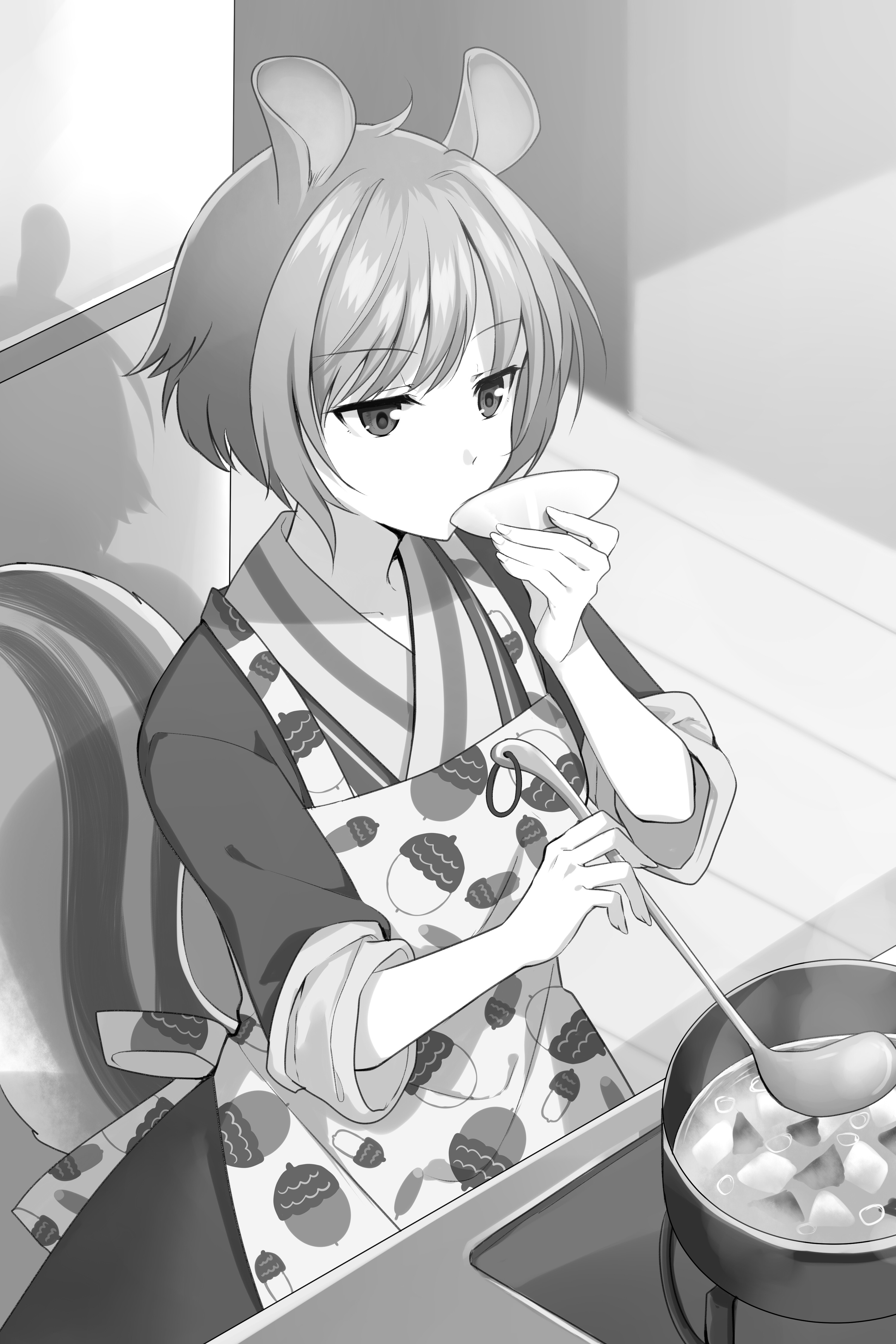
In less than an hour, she’d made miso soup with rapeseed blossoms, green peas, soy-flavored asparagus, and fish simmered in soy sauce. We took everything to the living room and arranged it on the low table. The rice was the last thing to finish cooking, which Techi served up in a large bowl—large enough for two helpings—and gently placed it in the middle of the table without saying a word.
With everything served, she thumped down on a floor cushion, grabbed the TV remote, turned on the TV, and started flicking through the channels. Once she’d found a variety show she liked the look of, she put her hands together, gave thanks for the meal, and began eating as she watched.
I couldn’t quite believe what I was seeing, and I stood there for a moment in a bit of a daze. When I snapped out of it, I seated myself at the table and gave thanks for the meal before digging in, eyes fixed on the TV just as Techi’s were.
“Mmm, this fish is really good,” I said after a few bites. “Also, thank you for going out of your way to check in on me. I doubt this meal would’ve turned out as well if I’d made it myself.”
“This is nothing. Besides, I’m getting a meal out of it as well, aren’t I? I feel well-compensated,” Techi replied. Her face was relaxed, and she enjoyed the variety show as she shoveled away with her chopsticks.
Between the noise of the television and the loud, nighttime cries of the insects, you could hardly call it a quiet meal. But it was still a good one. Before we knew it, all the food was gone. Techi seemed pleased by this, nodded deeply, and gave thanks for the meal once more. She got to her feet and cleared the table, then proceeded to start washing up.
As I watched her, I suggested that I should walk her home, given that it was now totally dark, but she declined, saying that I’d only slow her down—apparently, the quickest way back to her place was through the treetops. She finished washing up, neatly folded up her apron, and prepared to leave.
“I’ll see you tomorrow,” I said. That was all there was left to say.
“See ya tomorrow,” she replied.
She turned her back to me on her way out, casually waved as she walked away…and disappeared into the dark forest.
After Techi had left, I opened my smartphone’s web browser, found a website that sold food supplies, and ordered all the essentials I’d need to start preserving food. When that was done, I took a bath, returned to my bedroom, roughly laid out my futon, and crawled in to enjoy a good night’s sleep.
🐿🐿🐿
THE next day, young Kon once again came by early to pick me up and waited for me to finish breakfast and get dressed before we went to the orchard together. It’d be a while before all my supplies arrived, so I’d resigned myself to another day of watching the children zip up and down the trees.
Like yesterday, the atmosphere was noisy but peaceful. Since there was nothing to do, time flowed slowly, and I surrendered myself to the slow life experience under the open, spring sky.
It wasn’t easy. I thought about all sorts of topics and tried to stay focused, but I felt tired despite this—sleep constantly threatened to overwhelm me. I wondered how Techi was faring. I peered over to see her chin in her hands as usual as she absentmindedly gazed out at the children. She wasn’t doing anything, didn’t seem to be lost in thought, and she certainly wasn’t yawning. She just stared with the absolute patience of a statue.
I didn’t know exactly when the pact with Great-Grandpa had first been made, but Techi must’ve been doing this job for years, every day unchanging. I tried to imagine all that free time with nothing to do…she must’ve become thoroughly used to the boredom by now.
Then, suddenly, I realized that I’d completely misunderstood.
The whole time I was watching her, Techi hadn’t taken her eyes off the kids once. She barely even seemed to blink.
Techi would turn to face my direction when talking to me, but she’d still spend well over half the time glancing back at the children. As I looked closer at her eyes now, I realized there was nothing absentminded about them.
It wasn’t the patience of a statue. It was the focus of a hawk.
As she watched with that perfect concentration, she reminded me of a coiled snake. If a child looked like they were about to stumble or fall off their branch, her shoulders visibly tensed, and her weight shifted subtly from the bench and onto her waiting feet. When it became clear that the child wouldn’t fall—that they were safe—she let out the smallest sigh of relief and relaxed back into her previous state of readiness.
She was ready to pounce at any moment. Ready to sprint. To catch. To help.
No wonder she wasn’t falling asleep.
However, I wondered if it wouldn’t be better to keep watch from under the trees where the children were working. Another look at my surroundings corrected me; the rest area had been built on top of a very small hillock. It was just high enough that you could watch over the entire orchard without having to move.
Moving closer to the children meant you’d no longer have a complete overview, which explained why Techi set up camp here every day—the orchard was very large and this was the only way that one person could keep their eye on everything at once.
Realizing these things one after another, I couldn’t help but mutter some words of approval under my breath.
“Hmm, interesting…”
I was still staring intently at the side of Techi’s face when I said it, which earned me a sharp look from her. She didn’t say a word, but it was very clear what she was thinking.
What the hell are you on about now?
After that little interlude, we continued to pass the time quietly and uneventfully. Just as I was beginning to think it might be time for lunch, there was a rustling in the trees and Rei appeared.
“Busy again today, huh?” he said, holding up a hand to greet us. I wondered if he’d brought anything with him again today when he lifted the bag he was carrying, as if on cue.
“Good day,” I said.
“Good day! Good day!” he said, returning my greeting with a smile. “Today’s visit is for business and that makes it a very good day for you. Mr. Moriya used my services regularly to buy various daily essentials and I’m here to find out if you’d be interested as well.”
His pitch drew a look of ire and impatience from Techi, but she said nothing. Rei thumped down on the bench next to her and showed me the contents of his bag.
“I’m friends with some local farmers, see,” he explained. “I swung by earlier today to collect this bottle of freshly squeezed milk and these chicken eggs, also freshly laid this morning. Mr. Moriya had a standing order for one small bottle of milk and one fresh egg every morning with the farm’s subscription service. I thought you might like to sign up. The supermarket’s got nothing on this stuff! It’s way more nutritious and tastes amazing!”
Rei placed the bottle of milk—the small, glass kind used by delivery services—and a recycled paper carton containing a single egg on the table in front of me.
“This morning?” I asked. “That’s as fresh as it gets. One bottle of milk and one egg every day, how much would that set me back?”
“That’d be ¥5,000 a month. Some think that’s expensive; some think that’s cheap—everyone’s different. But I’ll tell you one thing. I use these ingredients in my pastries, and I won’t use anything else. That should tell you something.”
Fifty thousand yen…that comes out to a little over ¥150 a day. That wasn’t a bad price. I wondered if the farm even made a profit. It appeared that Rei knew exactly what I was thinking, because he smiled just then.
“It’s worth noting,” he said, “that supplementary orders use a separate price list. You live alone, so one egg and one bottle of milk will be plenty most days. But what if you want to cook something special? What if you decide to bake a cake? If you’re having guests round, one egg definitely won’t cut it.
“In that case, all you have to do is contact the courier to increase the size of your order. And since most customers do that a couple of times a week, that’s how the farm makes their money. Their real goal is to upsell you once you’re on the basic subscription. The farm makes its own butter and cheese—even ice cream—and it’s all available via the delivery service. Once you’ve signed a contract, it’s very convenient to order all those extras.
“In any case, why don’t you try that milk for starters, and then you can think about it, yeah?”
“I see… A smart business model indeed…” I muttered in response to his explanation and reached out to grab the bottle of milk that’d been offered to me. I peeled off the paper cap and took a big swig.
“Mmm…this is delicious. I’ve had farm-fresh milk before, on holidays and such, and while it was very good, it doesn’t compare to this. This is very thick and has a wonderful sweetness to it… Yes, I think I might be interested in signing that contract… What’s the sign-up bonus, by the way?”
I thought of the free laundry detergent that’s often bundled with newspaper subscriptions. I never liked the idea of it—using a different detergent from the one you’re used to always leaves behind a weird smell on all your clothes.
“Good question,” said Rei. “If you sign up today, you’ll receive a portable cooler box, complete with reusable ice packs, and an assortment of handmade soaps, made on the farm… Oh yeah…you’ll also get a free pole.”
“What?” I asked, confused. “A pole? Did I hear that right? Um…do you mean like a laundry pole?”
Rei seemed confused by my confusion.
“How can I explain…” he began, awkwardly scratching the back of his head.
Techi had been sitting next to her brother and listening in silence the whole time. Now, she suddenly stood up and walked to the storage shed in the corner of the orchard—the one where the children kept all their tools. She came back out carrying a long pole and headed back toward the rest area.
The pole was about as long as she was tall and looked to be made of iron. There was a round, metal ball fixed to one end, although I had no idea what it was for. When she’d come to within a few paces of the rest area, Techi twirled the pole around in a beautiful, flowing motion. It was suddenly a powerful weapon in her skilled hands, and she wielded it as if it were an extension of her body. It was like she’d stepped out of a samurai film—she had a warrior’s posture.
“This here’s a pole,” she said, brandishing the thing. “Technically, you might be able to call it a pole arm or staff. But round here, we just call it a pole. As you can see, it’s a fine weapon.”
“A weapon?” I replied, even more puzzled than before. “The sign-up bonus for my milk subscription is a weapon? What on earth am I supposed to do with a weapon?”
“Think about it. When the farm signs up a new customer, it’s usually because they’re living on their own for the first time or because they’re new to the area. Both of those groups need some sort of weapon, so it’s a good addition to the welcome package. Very convenient to have it delivered, too.
“As for why you’d want one, the answer’s simple—self-defense. There’re many wild animals in these woods, including boars and bears. If you’re unlucky enough to meet one without a pole in hand, you may pay with your life. Of course, you’d be much better off with a spear or sword or gun. But Japan’s sword and gun laws are a real pain in the ass. Not much we can do about that, so it’s poles all around.”
Judging from Techi’s explanation, it seemed that beastfolk had a very hard time getting a firearms license. Even human applicants have to fill out a lot of paperwork and undergo strict police checks. Living in a bear-filled forest with no gun access seemed terrifyingly dangerous, so I’m sure the police would deem that a valid reason to own a rifle…for a human, anyway. If I applied for a license, I might well get it. But I imagined beastfolk would have to jump through ten times as many hoops with no guarantees.
After all, there’d once been a war between humans and beastfolk. If the government thought there was any possibility of another, I could see why they’d want to make weapon ownership as difficult as possible. Clearly, it was a political matter.
“Doesn’t matter if it’s a bear or a boar, as long as you have your pole with you… One good smash on the skull with the business end of this thing will turn any animal into so much dead meat,” Techi continued. “This place is pretty out of the way—a quiet corner of the forest—so Tomiyasu could simply spray the area with animal repellent from time to time. The last batch should still be working…but you’re still better off owning your own pole. Just in case. If you ask me nicely, I might even show you how to use it.”
Perhaps thinking that it’d help convince me, Techi thrust the round end of the pole in front of my face where I could get a good look at it. The motion was sharp and perfectly measured, as if she’d done it a thousand times. There was no doubt in my mind as to her mastery.
The thought of having to deal with a bear attack weaponless was not very appealing, so I was pretty keen on the idea of owning my own pole and getting some lessons from Techi. However, at that very moment, the iron ball dropped off the end of the pole and landed on the table in front of me with a loud thud.
As the metal orb rolled around on the table, I noticed it had what appeared to be a screw thread sticking out of it. A quick glance confirmed that the pole itself had a matching hole in the end. It seems that the two parts hadn’t been properly screwed together, so they’d become loose during Techi’s little martial arts demonstration.
“What do you know?” I said. “I guess this isn’t your everyday, garden-variety pole. I see this end part is designed to be replaceable…but what on earth for? Even if this ball part took a solid beating and got bent out of shape, there’d still be no need to replace it with a new one…”
I considered the possibilities.
“…Oh, I suppose you could always exchange it for something different. Yes, I see. This is a very flexible tool. By switching out the end, it could become a hoe or a rake…or…a…spear…”
As I spoke, I realized that I’d noticed something I shouldn’t have and promptly shut my mouth. From that point, it easily followed that Techi and her clan had a stockpile of screw-mounted blades that would let them transform these simple poles into spears, or naginata, or other such weapons at a moment’s notice. Techi and Rei had broken eye contact with me and were blatantly looking around, feigning disinterest, almost certainly confirming my suspicions.
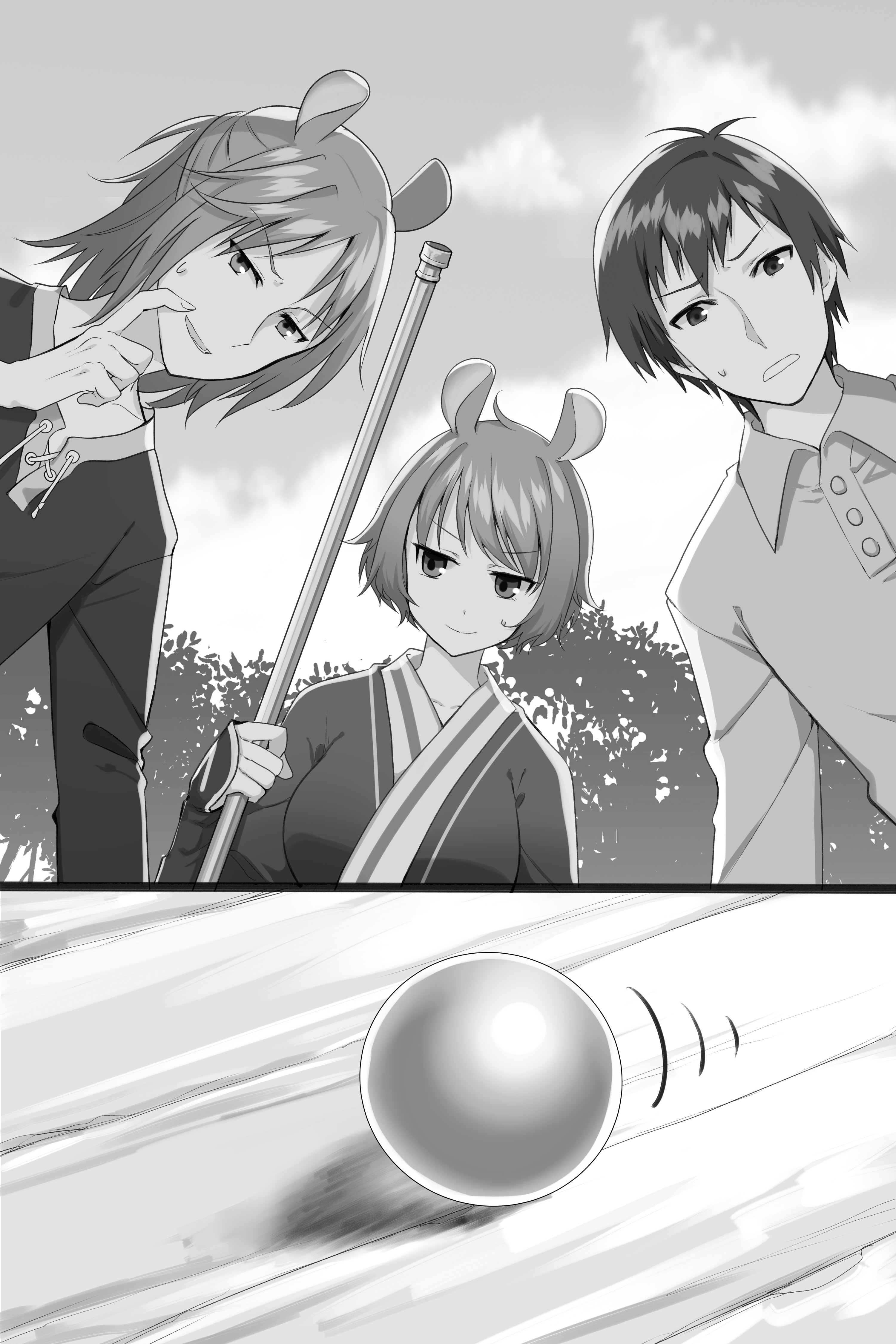
Then again, in this day and age, I didn’t see how a few spears would be much use. That wasn’t how wars and revolutions were started anymore. Maybe these poles were indeed only for self-defense.
In fact, I read in a book once…
“Th-That’s right! I read in a book once about this traditional Japanese utility knife called a nata; it was common to affix one to the end of a pole to extend its reach. But you could hardly call that a spear. Spears, like the ones common during the Warring States period, have thin blades designed to pierce their target, while nata have a broad, single-sided blade designed for chopping through plants.
“I can definitely see how attaching a nata to one of these poles would be useful out here in the Wilds. I suppose that in a pinch, you could even use it to finish off an animal that’s been caught in a trap. A very handy tool, absolutely…”
I spun a convenient lie out of what I could remember from the book, and Techi and Rei finally locked eyes with me again. They stared at me rather intensely for a while…and then they both smiled.
It was abundantly clear what those smiles were saying: Let’s leave it at that, shall we?
I returned their smiles with an equally hollow smile of my own and nodded deeply. I was glad we’d come to an understanding.
The conversation had veered a bit off course, but having fresh ingredients delivered to my doorstep every day was a very tempting offer. I decided to sign up.
Rei immediately handed me a pamphlet with further details and a sample contract. He was very insistent that I read through them both carefully.
“It doesn’t matter who the contract’s with,” he said. “It might be a famous company or a friend or a relative you know well. Whatever. Doesn’t matter. Always. Read. The contract.”
He banged his hand on the table to drive his point home. I appreciated his honesty and began scanning the subheadings of the sample contract while I kept listening.
“If you don’t read the contract first and get tricked or scammed, you’re out of luck, no matter how much noise you make afterward. Always read the contract. ALWAYS read the contract. And make sure you understand it too. If you can’t make heads or tails of it, then seek out expert adv—”
There was a loud, rustling sound coming from the forest. It was just like the sound Rei made as he approached, pushing his way through the dense trees. Somebody was nearby. I looked where the sound was coming from…and a pair of glaring eyes pierced me to my core.
A violent snort followed. A glimpse of a giant tusk. The gaze was one of murderous frenzy: demonic and intense. Behind that, a huge body covered in thick, jet-black fur.
It was an enormous wild boar.
Gripped by equal parts shock and fear at the sight, I found myself completely unable to move. Techi grabbed the iron orb off the table, screwing it back onto the pole with one rapid twist of her hand. A second later, she was between the boar and us, menacingly brandishing her weapon, her fierce posture suddenly making her appear twice her size. Rei also shot out of his seat, sprinting into the orchard like a bullet, presumably to guard the children.
“Be gone! Leave this place!” roared Techi. “There’s no food for you here!”
But the boar paid her no heed. Its beady eyes and great snout and ears were all fixed directly on me…or rather, on the bottle of milk and the egg carton on the table in front of me. It wasn’t fooled by Techi’s words—There’s food right there on the table!—and stamped the ground angrily with its foot as it prepared to charge.
Techi broke her stance for a split second to bash the rest area’s concrete floor with the business end of her pole. The loud clang echoed throughout the orchard—a very clear sign to back off.
“Return to the woods!” Techi roared again. “If you take another step, you’ll get no mercy!”
But despite the warnings, the boar wouldn’t back down. It let out an enraged snort, a seething grunt, and started thundering toward us.
Techi met its charge, nimbly and elegantly dodged to one side and, as the boar was passing, swung the pole around with unbelievable speed to deliver a powerful crack to its forehead.
That single hit clearly did some damage, as the boar let out a loud, angry squeal of pain. Its body twisted unnaturally as it charged and tried to get back on target…but the blow had rattled its brain, and it couldn’t pick a direction. It tripped over its front legs, tumbling over forward and smashing nose-first into the ground. Somehow, it managed to stagger back to its feet, quivering all the while, and once again set its gaze on me.
Its eyes were out for blood.
“Spring is here!” boomed Techi, somehow managing to raise her voice higher still. “There’s plenty of food to be found in these woods! Why do you persist? Stubborn fool!”
She wasn’t angry yet. But she was definitely running out of patience. The boar didn’t seem to care. Once again, it set its sights on me and charged.
But compared to its earlier thundering assault, this one had no bite, no vigor. It was so tame that Techi didn’t even try to dodge. She firmly planted both feet in a wide stance, tightened her grip on the pole, and put all her strength into a single, powerful swing, aiming it straight down toward the beast’s skull.
The boar’s listless rush made it an easy target and it took the blow at full force. It staggered a few steps further and slowly swayed on its feet before its great body pitched over sideways and hit the ground with a tremendous thud. There was one twitch…then another…and then, it was still.
Is it unconscious? Or is it dead?
It was time to make sure. Techi took on a cautious stance, pole at the ready, and edged toward the boar for a closer look. She gave it a good prod with the end of her pole. When it didn’t react, she inched even closer and gently put her hand on the creature’s belly.
“It’s all right now,” she said. “He’s dead. Though, if he hadn’t been so stubborn, he could have left alive…”
She mumbled this second part with a certain sadness and gently put her hands together to offer a short prayer. When she was done, she turned to me.
“Mikura, we need to butcher the carcass. Can you run to the house and grab some kitchen knives?”
Then she turned to Rei.
“As for YOU, my dear brother, courageously running off at the first sign of trouble!” she yelled. “Get over here and help me string up this boar! On the double!”
“Y-Yes, ma’am!” we answered in unison, suddenly spurred into motion. Rei ran toward the dead boar and I headed home. As I went, I could hear the children shouting excitedly amongst themselves.
“Did you see that?”
“That was amazing!”
“Techi’s so cool!”
While I was running back to the house, my mind had the chance to process what had just happened. I broke into a cold sweat. One or more of us could’ve easily ended up with a boar tusk through the gut… I realized that I owed Techi my life.
I went straight to the kitchen and grabbed three knives, but it didn’t seem very safe to carry them unsheathed. I wrapped them tightly in a newspaper that’d been left over after unpacking. Carrying them carefully with both hands, I headed back to the orchard.
Upon my return, the scene was quite different. The boar was now trussed up with rope from the storage shed and suspended from one of the forest trees next to the rest area. Its huge size was even more evident now that it was hanging upside down, its head dangling just above the ground.
Rei was sitting sprawled out on the ground next to it, completely exhausted. Techi stood next to the suspended boar, her head held high—they seemed to be sharing a moment of mutual understanding. I approached her to hand over the carefully wrapped knives.
“Hang on a moment,” she said, “I’m just waiting for the water to boil.”
“Boil? How?” I asked, confused. I looked over at the rest area and gave a small cry of surprise. A small camping stove had been connected to the gas pipe and a pan of water was sitting on top of it. They must’ve been in the storage shed, as they were nowhere to be seen this morning.
I still didn’t know what the boiling water was for, though, and it must’ve shown on my face. Techi glowered at me, much like the boar had earlier, and proceeded to explain.
“You have to disinfect the knives first. Then you can slice open the belly, being careful not to accidentally cut into the intestines. Once there’s a big, clean opening, you carefully cut loose all the internal organs from the surrounding flesh. If you do it just right, everything should tumble out together in one go. Once the organs are out, we can move it to the warehouse, skin it, and cut up all the meat… This thing’s huge, though—it might be a struggle to eat it all…”
Techi had clearly butchered a few animals in her time, given the thoroughness of her explanation. I nodded with understanding, then found myself once again speaking without thinking.
“If there’s too much, we can always freeze it… Or, even better, we could preserve it. Boar meat keeps really well—we could salt it or smoke it…there are plenty of options.”
Techi turned to me with a look of blank surprise. Some unknown thought seemed to pass through her head and her face softened into a warm, genuine smile.
“Yeah,” she said. “That might be good too.”
🐿🐿🐿
“YOU’RE a big wimp, huh?”
I was barely able to move, my face flat on the table. My accuser was young Kon, who was sitting on the table beside me, gently prodding at my head.
“Not…usually…” I struggled to reply. “But I think it’s understandable. Anyone would get weak in the knees seeing that for the first time. That…slopping s-sound… All those organs…”
Before the boar could be dismembered, it first had to be disemboweled—a spectacle that, it turns out, I hadn’t been prepared for. At the sight of the boar’s various innards spilling out onto the ground, I was overcome with such an intense wave of nausea that I was unable to stay upright. Even now, I couldn’t lift my head off the table while Kon kept talking to me.
“Well, it’s gone now,” he said. “Techi and Rei put the boar in a wheelbarrow and took it to the warehouse. That’s where they’re gonna cut ’im up into little pieces!”
I guess he was trying to cheer me up. He supplemented his efforts by gently patting me on the head with his little paws. I laughed feebly.
“…Say, how long does it take to cut up an animal like that?”
“It takes a long time, I think,” replied Kon. “After all, when you’re done, you’ve gotta clean everything up and you’ve gotta take a bath, too!”
“A bath? Why’s that?” I asked.
“Why? ’Cuz we’re beastfolk, that’s why! Wild animals and birds can have all kinds of scary illnesses. The animals are like our cousins, so we can get sick too! That’s why, if we touch an animal or get blood on us, it’s really important to have a proper bath and change into some clean clothes, so we don’t catch anything. Human doctors don’t research those kinda illnesses. So, if you catch one, you’re in big trouble! ’Cuz there’s no medicine!”
“I see…that does sound scary,” I agreed. “I guess we have medicine for pets and farm animals, but who knows how effective they are on beastfolk? I guess the old saying is true: prevention is better than a cure. If you get injured, the risk is even greater… I can see why the beastfolk would be keen to get their hands on guns.”
The more we talked, the better I started to feel, until I could finally pick my heavy head up off the table and look around.
It was like I was in a toy store, surrounded by plushies. There were young chipmunks crowding around me from all sides.
“Oh…hello,” I said. “Everyone’s here… Shouldn’t you be working? Won’t you get in trouble?”
The children narrowed their eyes and stared at me silently—no doubt something they’d learned from Techi. Kon gave me the same look, let out a sigh, and set about educating me—clearly I was missing something.
“We’re just kids! So we can only work with adult super-vision! Since you’re flopped down on the table and can’t watch us, we had to take a break. Techi left us this bag of smelly stuff to keep the boars away, but we already finished spreading it around the orchard.”
He picked up a plastic bag that was lying on the table and started prodding it with his little paw. “Animal Repellent” was written on the label.
“Come on, Mikura! Super-vize us!”
I took another look at the children and I noticed that some of them were firmly holding the wooden sticks they used to knock insects off the trees in the orchard. It almost looked like they were trying to protect me, poles at the ready, scanning the forest for signs of danger.
I hadn’t realized I was quite such a pitiful sight. I slapped my cheeks with both hands a few times to rouse myself, then straightened up.
“I’m sorry, you guys,” I said. “That was my first time seeing something like that, so I felt a bit sick. But I’m feeling better now, so I’ll keep a close eye on you until Techi and Rei get back. You can go back to work whenever you like. Does that sound good?”
I gave a small, apologetic bow and the children smiled and offered me their own encouragement before running back out into the orchard and climbing up into the treetops.
But one of them stayed. For some reason, Kon was still sitting on the table. I gave him a puzzled look.
“Are you taking a break, Kon?” I asked.
“Nuh-uh! I have a special job today. Techi told me I hafta look after you, so I need to stay right here at your side! If something happens, it’s my response-ability! So, until Techi comes back, I’m not lettin’ you outta my sight!”
Kon closed his eyes tightly and smiled as his tail flicked back and forth behind him. I scratched the back of my head at this further proof of my feeble behavior, but I didn’t want to burst the little guy’s bubble.
“I see. Thank you, Kon,” I said. “Everyone’s been very helpful today. I’ll have to do something special to show my gratitude.”
“Something special?!” Kon shouted excitedly. “I know just the thing! Give us some of that boar meat! They say boar is super delish! That one’s male—they say females are the tastiest, but I won’t complain!”
“You eat meat?” I asked, surprised. “But you’re part chipmunk.”
“Mikura, what’re you saying?” he replied, ready to lecture me again. “Of course, I eat meat. Chipmunks eat meat. And besides, we’re beastfolk—we love meat! Chestnuts and acorns and walnuts are amazing! They’re our favorites! But we also eat meat and fish. We drink milk too. I think we eat most stuff that humans eat.”
“R-Really? Chipmunks are omnivores?” I asked. “I had no idea! I guess they eat whatever they can find just like other rodents… Okay, if that’s the case then, let’s make it happen. We can all enjoy eating it together… Wait, no, we can’t. Techi was the one who killed the boar. Doesn’t that mean the meat belongs to her?”
“Ooh, ooh! I know this one!” said Kon, jumping up and down with his hand raised like a kid in class. “If an animal’s killed in somebody’s field or house, then the hunter gets half the meat and the owner gets the other half. So, half the meat belongs to you, Mikura.”
“Oh, is that so?” I said. “It was a big animal and you’re all quite small, so even half should be enough to treat everyone… Okay, if that’s the case, then you can look forward to having some of that boar.”
“Yesss!” shouted the young chipmunk. “Boar’s basically like pork, right? There’re so many yummy ways to cook pork—fried pork with ginger, tonkatsu pork cutlets…chashu pork is good too!”
“Hmm, ginger sounds like a great idea,” I mused. “It’ll help get rid of the boar taint—male boar meat can have a very strong odor. It could turn out to be quite delicious. If we’re all going to be eating together, maybe we should do a botan stew?”
“Button stew?” asked Kon, confused. “Mikura…it doesn’t matter how long you stew them; you can’t eat buttons. They’re hard and they don’t taste very good. I got yelled at once for chewing on my shirt buttons—they’re very dangerous if you swallow them. I know this!”
“Not button stew; botan stew,” I gently corrected him. “Botan is just a word that’s used for wild boar meat. If we add ginger and miso, then simmer it all together with vegetables, it’ll make for a really delicious hot pot… Hmm, you’re still quite young, though… Children your age don’t tend to like stew very much, do they?”
“No way! I love stew!” Kon protested. “Japanese hot pot is amazing! Oooh, I can’t wait!”
Kon closed his eyes tightly and waved his arms about while he hopped around the table. He was over the moon and it showed. His eyes always seemed to screw up like that whenever he laughed or smiled. I laughed too as I watched him bounce around, then stopped jumping and started dancing and spinning instead. His light, nimble steps were captivating.
And so, young Kon and I kept each other company, enjoying a long conversation while we waited for Techi and Rei to return. All the while, I made sure to keep glancing at the orchard to keep an eye on everybody else as I’d promised.
🐿🐿🐿
“HEY! I’m back.”
I was still talking to Kon when Rei reappeared, one hand raised in his usual greeting. He was wearing a completely different outfit than what he had on earlier. Gone was his white apron—he was now wearing a patterned button-up shirt and a fresh pair of jeans.
“I see you’ve changed,” I said, slightly puzzled. “Where did you get fresh clothes from?”
He’d taken a bath at my house. But I didn’t have anything that would fit him. He waved his hand casually, as if to suggest there was an easy explanation.
“We called my family and asked them to bring some stuff over,” Rei explained. “We had some time while we were waiting for the bathwater to heat up. In any case, the beast has been butchered and all the cuts of meat separated out. Everything is in the big warehouse refrigerator. We went ahead and turned the breakers back on; hope you don’t mind.”
“No, not at all,” I said. “Where’s Techi?”
“She’ll be along any minute,” Rei replied. “I think it just took her a little longer to change, that’s all. By the way…half that meat belongs to you. You know that, right? What are you gonna do with it? Eat it by yourself? Preserve it?”
“Ah… I was actually thinking of treating all the kiddos to boar hot pot. Would that be okay?” I asked.
“Sure, I don’t see why not,” said Rei. “That’s a great idea. But even feeding twenty-plus kids, I think you’ll still have a lot of meat left over.”
“Well, in that case, I can always try my hand at preserving some of it,” I said, quite excited about the prospect.
As we were talking, we spied Techi approaching from the direction of the house. I was stunned, completely unable to tear my eyes away while Rei snorted loudly as he tried not to laugh. Kon gave a loud cry of approval.
Techi was wearing a light pink flare skirt, coupled with a balloon-sleeved blouse that was covered in frills. I’m no specialist on women’s fashion, but I could confidently say that this was outside of Techi’s usual selection. In fact, you might say it was the polar opposite—she seemed to strongly prefer comfortable, casual clothes that were easy to move around in. Her tail hung down meekly, poking out from the bottom of the skirt.
I didn’t know if she let her tail hang down like that to accommodate the skirt or if the state of her tail was mirroring her feelings about wearing it. Either way, it was clearly said droopy tail that Rei was looking at as he desperately tried to hold back his laughter.
“Looks like Mom did the washing today!” he snickered. “If she’d searched the house, I’m sure she could’ve found something else. But Techi asked her on the phone not to bring anything weird. So, of course, Mom went and brought the most normal clothes she could find—by her standards, anyway! Mom loves that outfit; she bought it for Techi herself. She never wears it, but you’ve gotta admit, it’s perfect for a tomboy like her, eh?!”
Rei couldn’t hold it in any longer and erupted into a roaring belly laugh, his face twisted up with delight. Techi’s eyebrows formed a sharp V—she looked about ready to strangle him. She slapped the ground with her drooping tail and used it to flick a small stone into the air. Catching it in her hand, she gripped it tightly, drew her arm back, and hurled it at him.
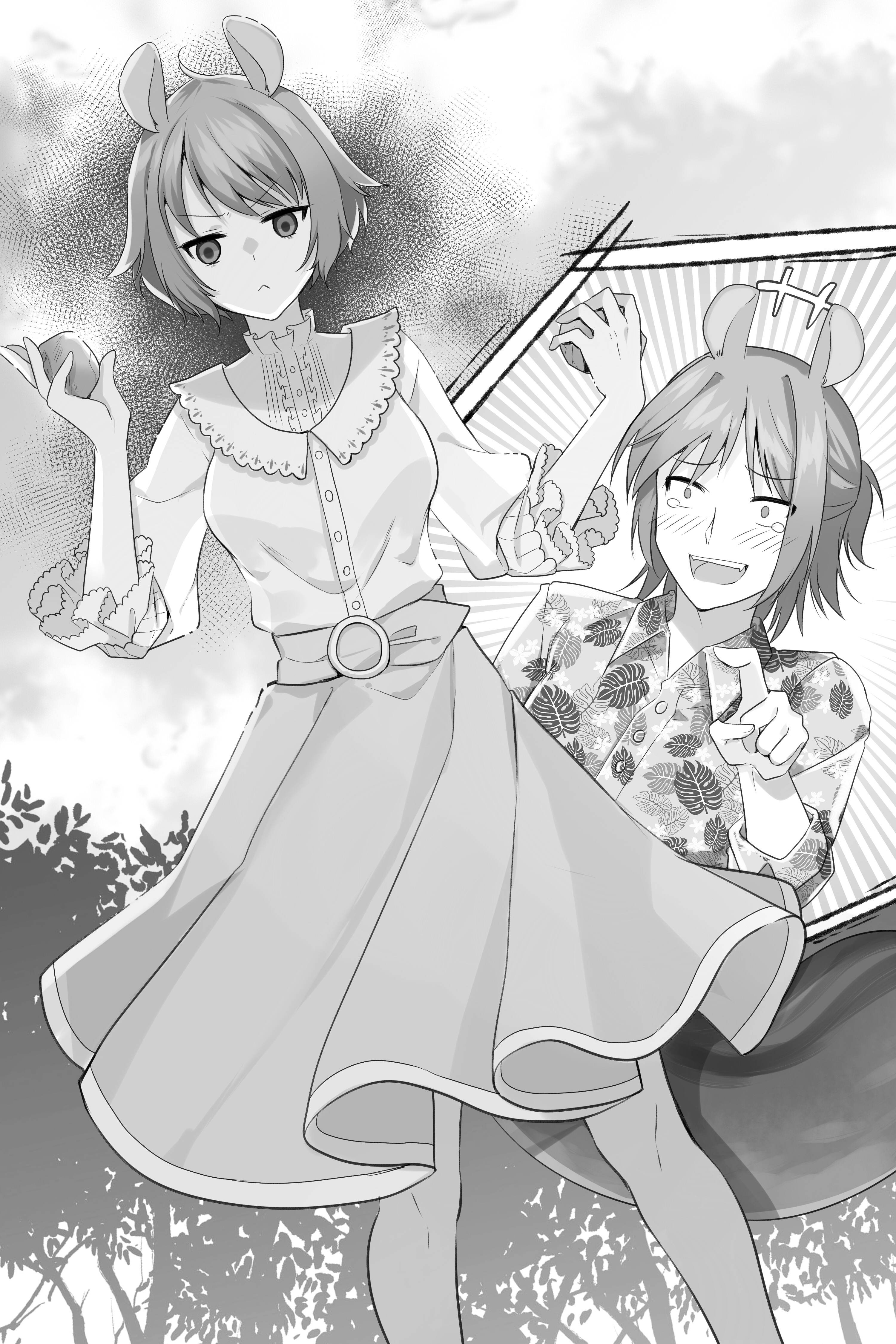
Rei barely managed to dodge the whizzing projectile. He stopped laughing at once—all the blood drained from his face and large drops of sweat started to form on his forehead. He wasted no time on his escape and had soon disappeared into the forest. Techi flung another stone after him as he ran. When he was out of sight, she let out an angry huff and sat down violently on the bench in the rest area. She looked very disgruntled as she rested her chin in her hands.
“…So, what’re you doing with the boar meat?” she asked. She was clearly trying to change the subject. I repeated what I’d told Rei earlier and she nodded.
“If you want to have a hot pot party, Sunday would be best,” she suggested. “It’s best to let freshly butchered meat age a few days—it improves the flavor. With the big refrigerator in Tomiyasu’s warehouse, there’s no risk of it going bad. It should be good to go by Sunday.”
When Kon heard this, he started nodding profusely, as if to make it clear he could find some time in his busy schedule. We’d have to find out if the other children were available, but we could start planning everything with Sunday in mind.
“In that case, shall we buy all the vegetables on Saturday and do all the preparation on Sunday?” I asked as I pulled out my smartphone and noted the days in my calendar. But Techi shook her head.
“Nah, that won’t do,” she said. “For a start, we’ll need more cooking pots—one hot pot won’t feed that many people. We’ll also have to buy enough rice for everyone and cook it beforehand. It’s all good handing out invitations, but a party this big takes a lot of preparation. Get ready to cancel any plans you have for Saturday… Or is a hot pot party too much trouble after all? You can always back out.”
I didn’t pause to consider her words or see Kon’s reaction. I answered without hesitation.
“It doesn’t matter how much trouble it might be. We should do it,” I said resolutely. “Everyone’s been working so hard and there’s plenty more work ahead. The effort of putting together a little celebration’s nothing compared to that. I think it’d be a great way to get to know everyone better, too. …The one thing I’m worried about is whether there’ll be enough meat. What do you think, Miss Techi?”
“Hmm, classic boar hot pot is always full of vegetables,” Techi said, thinking it over. “Worst case, we can always pad it out with more veggies. But even with a glutton like Kon here, I doubt the kids can get through a boar that size.”
“Hmm, I dunno!” said Kon. “If I’m real hungry, there might not be enough for anyone else!”
He rested his hands on his hips and stuck his chest out. Seeing the cocky look on his face, Techi couldn’t help but let out a chuckle. She began to lightly brush the fur on his little head and he let out a squeal of delight, closing both eyes tightly and waving his little arms around like before.
After he felt sufficiently pampered, he looked at me, then at Techi, then he turned to look at his classmates up in the treetops. Realizing that his work here was done, he hopped onto the ground and dashed back into the orchard.
I wondered how best to describe the little scamp. “Hard-working” didn’t quite capture it, and neither did “diligent,” but as I watched him scamper off, I thought that there was definitely something special about him. I glanced over at Techi, who also watched him go, and she seemed to be thinking the same thing. Her expression was so warm and full of gratitude. I realized that “dependable” was the word I’d been looking for. She really trusted the little fellow.
It was rare to see Techi wearing her heart on her sleeve like that. Taken in by her heartfelt expression, I also found myself dropping my guard.
“Those clothes look good on you,” I said, quite accidentally.
It was the combination of the gentle look on her face and that delicate, frilly outfit that drew it out of me. I was a little nervous that she might snap at me. But instead, she turned away from me, and I could no longer see her face. She sat in silence, staring into the distance.
I wasn’t sure how to resume the conversation after that. So I fell silent, too, and the two of us watched the kids working away until evening came at last.