Food Preservation 101
Food Preservation 101
THE next day was Monday.
I wouldn’t be going to the orchard. Instead, I was waiting at home for a delivery. It’d be arriving at some point today, after everything had been inspected at the border gate.
I’d ordered goods from several different websites, but everything was combined into one batch for today’s delivery, as deliveries to the Wilds were only made once a week. Someone had to be around to sign for it, and if I missed the delivery window, it’d have to wait another week. I didn’t want to inconvenience the courier and gate staff, so I felt justified in taking the day off.
However, sitting around twiddling my thumbs felt like a waste, so I set up shop in the kitchen with some of the boar meat that we hadn’t used for yesterday’s party. I’d fetched a cut of boneless rib from the warehouse refrigerator and set about my first attempt at meat preservation since moving here.
Well…this recipe didn’t fully preserve the meat, but I’d be dipping my toe in the waters today.
“A rib is a kind of bone, right? So how can you have boneless rib?”
The person asking this insightful question was none other than Kon, sitting on a small wooden chair above the dishwasher. When we were all making merry after finishing yesterday’s dessert, Kon had gotten so excited and frolicked so hard that he eventually keeled over and fell asleep right then and there. He’d literally partied until he dropped.
It was deemed necessary for him to rest and recover his strength, so he too had been given the day off. I suppose it made sense given the nature of his work—if you’re asking a child to climb a tree and hop from branch to branch all day, you definitely want them in top shape to avoid any nasty accidents.
Now, I thought that meant he’d spend the day at home. But it turned out that both of his parents work late into the evenings. He’d be home alone, with far too much time on his hands to cause mischief. Therefore, he was entrusted to my care, so he’d have someone to cause mischief with.
“Yes, Kon, you’re right. A rib is a type of bone. But the word’s also used to describe the meat that surrounds the ribs. So, if you take those ribs out, you’re left with boneless rib,” I explained. “Rib is very fatty, so some people don’t like it. But today, I wanted to try doing something that will improve the flavor of this fatty cut of meat.”
I placed the massive cut of rib on a large cutting board I happened to have. The slab of meat was so big that I needed two hands to carry it.
“And so you’re gonna reserve it?” Kon asked. “I heard you like reserving food, Mikura!”
“Well, I could preserve it, yes. But in this case, preserving it would make it lose a lot of its flavor. Sometimes, the more long-lasting you make a food, the less flavor it will have. With the method I’ll be using, you still have to keep the food in the fridge. But it will keep for a while. Maybe you could call it half-preserved.”
“Really?” said Kon. “Well, we want more flavor, not less. So definitely do that…”
He made a loud gulping sound as he eyed the slab of meat, no doubt inspired by memories of yesterday’s hot pot.
“With this method, all the great flavor comes from the fat, so we want a fatty cut of meat,” I continued to explain. “Rib is perfect. Red meat’s best enjoyed fresh, so some people will even go as far as separating all the fatty meat to enjoy it on its own.”
As I spoke, I got started on preparing my herb mix. I opened my fresh packets of thyme, oregano, bay leaf, and basil.
First, tear up the bay leaves into small pieces and crush them finely, mixing them together with all the other herbs. Set the herb mixture aside in a small bowl.
Next, prepare some salt and a largish fork. Gripping the fork tightly in your hand, raise it over your head and bring it down sharply into the rib meat. Do this at least a dozen times.
I had a thing for narrating the recipe in my head as I worked.
“Mikura! What are you doing?! What’s wrong?” asked Kon in a panic. I continued forcefully stabbing the meat, over and over.
“By doing this! You open up! Holes! In the surface! It helps! The herb aromas! And the salt! Get deep! Into the meat!”
Turn the meat over and repeat.
“Once you’re done! With one side! Flip it over! And do the same! On the other side! No need to! Do the edges!”
“But Mikura, the holes are just closing right up again,” observed Kon. “I didn’t know meat could do that!”
“That’s! Totally fine! You can’t see them! But the holes! Are still there! The salt! Dissolves! And can still get in!”
Once I was happy with how much I’d brutalized the meat, I grabbed my bag of salt…
Using the finest-grained variety you can find, thoroughly sprinkle the meat’s surface with salt. Once covered, rub everything down with two hands to help the dissolving salt soak into the meat.
“It doesn’t really matter if you use too much,” I said, “as I’ll be desalinating the meat later on. That basically means I’ll be rinsing out the extra salt. If you do use too much though, a lot of it will just stay on the chopping board, which is a bit of a waste. So, you may as well use the right amount in the first place.
“You can use a coarse salt—it will dissolve eventually and get into the meat—but I just prefer using fine salt. I feel that it gets absorbed better. Once you’ve got plenty of salt on there, it’s time for the herbs. You can’t rub those in like you do with the salt. You have to kinda pat them down with your hands.”
After the salt has been mostly absorbed, add the herb mixture. Use a patting motion to make sure the herbs stick to the surface of the meat. Wrap the herb-covered meat in kitchen paper and place it in a lidded container to be stored in the refrigerator.
“You know, in the past, they used to make this with much more salt,” I told Kon, “and they didn’t wash any of it out at the end either. That way, the meat would dry out and could be preserved for a long time. But since we have fridges now, we can use much less. We don’t have to rely on the salt alone to keep the meat from going bad.
“Now we leave it like that for about three days. Then we’ll wash the meat with water to remove the layer of herbs and finally leave it in running water for about ten minutes to remove some of the salt. After that, we use kitchen paper to remove the excess moisture and then wrap the meat again in fresh kitchen paper—but this time, we put it on a tray rather than in a container. That way, it can begin to dry out more easily. After that…you probably want another week in the fridge, and then you’re done.
“There is one thing to watch out for. Depending on the temperature and humidity in your refrigerator, the kitchen paper might stick to the meat’s surface, so it’s best to check for that every day. If it’s starting to stick, change it out for fresh paper, or you can just leave it unwrapped for the rest of the drying process.”
When handling raw meat, it’s important to wash your hands thoroughly before touching other surfaces. If you can, use your elbow to turn the faucet on. An electronic soap dispenser can also help with kitchen hygiene.
I washed my hands, dried them, and put the plastic container in the fridge. Now all that was left to do was wait. I set about washing the chopping board and other utensils while Kon sat restlessly in his chair, repeatedly looking over at the refrigerator.
“And? What happens at the end of all that?” he asked.
“We get pancetta, or salted pork,” I replied. “Well, salted boar in this case. In addition to helping it keep longer, the salt strengthens and concentrates all the flavor of the meat. The fat becomes almost sweet; very delicious. The whole thing has a pleasant salty taste as well, of course. You can even cook pancetta in a pot of vegetables to make a simple and flavorful soup.
“What else is it good for… You can use it to season dishes, it’s a quick and easy base for a meat dish and, of course, you can add it to consommé—it’s very good for that. Oh, it’s brilliant in pasta dishes, too. The aroma of all the herbs we used today will come out in whatever dish you cook with the pancetta. So, choose whatever herbs you like best when making it.”
Kon let out another loud gulp. Now he wasn’t even taking his eyes off the fridge. It’d be ten days before the pancetta was ready, but he continued to stare across the kitchen, impatiently fidgeting in his seat, as his bushy tail waved back and forth.
🐿🐿🐿
THE washing up was done and everything had been put away. I let out a satisfied sigh. Then I turned to Kon, who was still sitting in his little chair.
“Kon,” I asked, “where’d you get that chair? The size is just right for you, and you seem very at home sitting up there on the countertop.”
Kon screwed up his eyes in that happy way of his and flashed me a big smile.
“That’s ’cuz Grampa Tommi made it for me!” he said, tapping the sides of the chair. “He was always doing all kindsa strange things in the kitchen. When I told him I wanted to watch, he made me this chair just like that! When Grampa Tommi died, I put it away ’cuz I thought I wouldn’t get to use it anymore. I’m glad I was wrong!”
Kon got up, stood on the seat of the chair, then climbed up onto the chair’s back, where he balanced with perfect ease… Then he suddenly jumped into the air, flipped over, and landed back in the seat with a little thump.
It was an impressive trick—clearly, he’d done it many times before. He followed it up with a showman-like gesture and a well-practiced “Ta-dah!” before shutting his eyes again for another smile. His tail was swishing with excitement.
We spent our time making silly conversation about nothing in particular until finally, the front doorbell rang. As soon as Kon heard it, he became very serious. He hopped off his chair and swiftly clambered down from the countertop. Rushing over to a corner of the kitchen, he grabbed the small wooden pole that he’d left there and dashed off to the front door.
I hurried after him and found him standing in the entranceway, drawn up to his full height, pole pointed menacingly at the closed door. It seemed he was trying to protect me. I smiled at him appreciatively and asked if I could pass so I could open the front door.
Outside was a man wearing the uniform of a well-known local delivery service. He was an older gentleman with neatly trimmed white hair and a mustache—also neatly trimmed. The man smiled meekly, holding his cap in his hands as he calmly stood there.
To tell the truth, I was expecting someone younger or at least more solidly built. He must have seen my look of surprise, as his face creased up into a more genuine smile.
“Good day,” said the old man. “I have a delivery for you. Should I bring it through here? Or would you prefer me to put it on the veranda?”
“Ah…on the veranda, please,” I replied.
The man bowed and handed me a bundle of papers with the various delivery documents, which I took. He replaced his cap, turned around on the spot, and headed back to his van. I stamped the first of the numerous delivery confirmations with my personal seal, watching him out of the corner of my eye as he unloaded my packages from the car and carried them around to the side of the house.
Kon looked at the old man, then up at me, then at the old man again. A moment later, he was gone, dashing through the house toward the veranda. I guess he wants to keep an eye on the old man’s movements, I thought to myself, as I stamped all the documents. As I was stamping the last one, the old man suddenly reappeared by the front door.
“I’ve left everything on the veranda as you asked,” he informed me.
“Thank you very much,” I responded, returning the stack of papers. “Here are all your documents.”
Kon returned from the veranda and was soon noticed by the older gentleman, whose face creased up into another smile.
“I heard that you moved here only a short while ago, yet you’re already getting along so well with them. How wonderful; that really is something. It’s great to see you’ve got a good relationship—it really helps us out. I pray your friendship grows from strength to strength.”
I wondered what he meant. Taken at face value, I suppose that if I stayed here and got on well with the beastfolk, he and his company would have more regular delivery work here.
Maybe he gets a commission bonus or something, or maybe he only works part-time…
But I felt like there might be something between the lines in what he was saying. Something didn’t add up here. It was almost as if he had some secret motive. I smiled back at him, my heart filled with doubt.
What kind of delivery service hires an old man to carry heavy packages? He must’ve been sixty years old, maybe even seventy. Surely, you’d be better off having him do office work?
What’s behind that smile? He was definitely hiding something. Who was this mysterious man? I started considering possibilities, pondering what questions I might ask…but the old man could sense my suspicion and decided to call it a day.
“Have a good afternoon,” he said and headed back to his van.
I wondered if I should call after him and ask him to explain himself. No, if that was all it took to get the full story, surely he would’ve explained himself right at the beginning. He was very careful to express himself subtly and say nothing directly. There must’ve been a reason for that. I decided to hold off for now and be sure to remember this old gentleman. I looked down at Kon, still brandishing his pole at my feet.
“Thanks, Kon,” I said. “Listen, I’m going to unpack my things now. If you help me clean up, I’ll give you a piece of the candy I ordered. Only a little, but I’m happy to share.”
Kon was thrilled to hear that. He squinted tight and opened his mouth in a wide grin that showed off his little white teeth.
“Yesss!” he cried, sprinting straight for the veranda.
Along the way, he grabbed a utility knife from a drawer in the living room and proceeded to cut through the packing tape and open up all the cardboard delivery boxes with practiced ease.
When Kon and the other children helped me unpack when I first moved in, they’d stowed away my belongings with impressive efficiency. They knew where things should go. All the cooking utensils ended up in the kitchen, food items I’d brought with me were neatly arranged on the living room table, and if they weren’t sure what to do with something, it was placed on the tatami mats in the living room for me to sort out at the end.
Items that were too large or too heavy for them to carry were left exactly where they were—no irresponsible heroics. The tidying had proceeded swiftly, just as it was doing now with Kon’s help. But after a while, Kon was at a loss.
“This is nothing like what we were unpacking last week,” he said, peering into the open cardboard boxes. “It’s all weird stuff—I’ve never seen any of this before.”
“That’s because I mainly ordered things you can’t get around here,” I continued the unpacking process as I explained it to him. “Food preservation needs all kinds of unusual tools. That can make it quite an expensive hobby. Even if you’re only preserving something in sugar or pickling it in salt, all that cost adds up.
“Herbs aren’t exactly cheap either. I guess you could call it a rather extravagant pastime. But then, it only takes one little mistake for your whole batch of food to start going moldy or turning sour, and then all you can do is throw it away and start again. It’s also very unforgiving.”
“Why do people do it then?” Kon asked. “Why do you do it?”
“Hmm…” I wondered. “I guess once you’ve finally made something that you know will keep for a long time, it brings you peace? Also, you can use less aggressive, short-term preservation techniques, like with the pancetta, to enhance the regular flavor of certain foods. But if you truly want to understand the unique charm of preserved foods, it’s best to let your tastebuds be your guide. I’m very happy to let you try the various things I’m going to be making.”
Kon smiled at me again and his large, bushy tail was once again wagging furiously.
“I can’t wait!” he exclaimed.
We unpacked all the boxes and put everything in its proper place. I had ordered a large quantity of yōkan, a kind of red bean paste gelatin dessert, for preservation purposes, and I gave a small block of it to Kon as promised. He was happily chewing his way through it with a satisfied smile on his face. I was flattening the last of the cardboard boxes when he spoke up.
“Boy, it’ll sure be a while before we can eat that meat in the fridge, though. Pruh-zurving food takes a long time!”
“It sure does,” I agreed. “Any time you need to soak or pickle something, you always have to wait a while. That said, ten days is not very long at all in the preserve world. Some preservation techniques can take several months, you know.”
“WHAT?!” shouted Kon. “Months? You’ll definitely forget about it by then!”
I suspect that children and adults experience time very differently. An hour or a day to a child is many times longer—maybe even ten or twenty times longer—than it is for an adult. So, what seemed like a few short months to me must’ve sounded like years to this little guy.
Kon rolled around on the living room tatami mats and kept talking.
“Hey,” he said, “is there any quick way to pruh-zurv food? Like, ‘BAM!’ and it’s done? Somethin’ you can eat right away…”
“Sure, there are. Those glazed nuts that Rei makes are like that. So is the yōkan I gave you. As long as you have the tools and ingredients, you can make that stuff the very same day.”
“Reeeally? Can you make somethin’ like that, then? I wanna try some of your pruh-zurved food today!” said Kon.
I thought about the options, checked the clock to see if we had enough time, and decided on something that could be prepared quickly and easily. I nodded and headed for the kitchen. Kon dashed after me, his little feet rapidly tapping on the floor and took up his previous spot on the countertop, sitting comfortably in his chair.
“So, with pancetta, it’s the salt that keeps it from going bad,” I told him. “But we can also do something similar with sugar. Both glazed chestnuts and yōkan are made that way—using a large amount of sugar prevents the food from going bad.”
I put on my apron and washed my hands as I explained. Kon’s eyes went round with wonder and curiosity.
“So, a very salty food and a very sweet food will work the same way?” he asked. “But when Mommy makes cake, she says that it’ll go bad quickly…”
“That’s because cake is made with fresh cream and eggs,” I said. “Those kinds of ingredients go bad very easily. However, it is possible to preserve foods with milk and eggs in them. If you can remove enough moisture and use plenty of sugar, they can keep quite well. Well, we don’t have time for anything that elaborate today. But we have something that’s just as good.”
I opened the refrigerator and removed a pack of strawberries. Kon’s eyes glinted as they followed me across the kitchen. He looked like he might devour them as soon as my back was turned, so I gave him a stern warning that these weren’t for eating as I carried them to the sink.
Wash the strawberries and carefully hull each one. Once hulled, give them another rinse to remove any debris from the hulling process. Place them in a pan and add plenty of sugar.
I reached for a ceramic container on the countertop that had “Sugar” written on it in large, English letters. I opened the lid and dumped the entire contents into the pot with the strawberries.
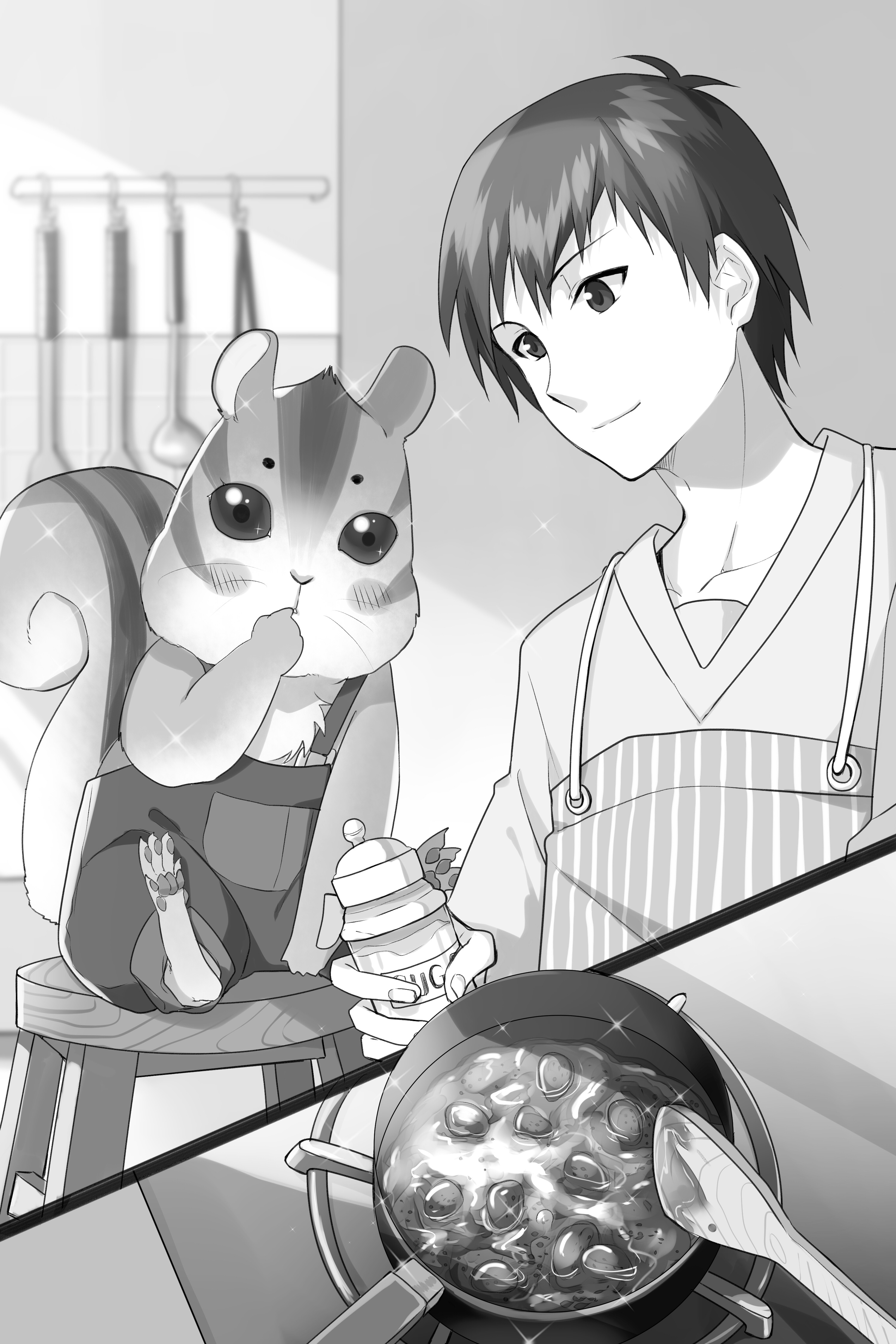
“Whoa!” Kon cried in surprise. “Mikura, that’s way too much! You can’t use that much sugar!”
“Ha ha ha, it is a lot, isn’t it?” I laughed. “Actually, cakes and other sweets also contain a lot of sugar. You wouldn’t believe how much sugar there is in soft drinks. With this recipe, only a small amount of the sugar is needed for taste. The rest is essential for the preservation process.”
Place the pot over a medium heat and gently simmer. Be careful not to burn the mixture, stirring regularly with a wooden spatula. When it begins to boil, add some lemon juice. The citric acid in the lemon juice preserves the color of the strawberries, but be careful not to use too much, or the final product may taste sour.
I’ve heard that some people will even use vitamin C powder that you can buy at the pharmacy, but I find it easiest to just use lemon juice.
Vitamin C is also frequently added to bottled green tea. Presumably, that means it has anti-oxidizing properties as well.
Reduce the heat slightly and continue to slowly stir the pot with the wooden spatula.
“Mikura, this smells amazing!” shouted Kon. “It’s sweet and warm and slightly sour!”
I looked up to see that he’d moved his chair right to the edge of the stove without me noticing.
“It’s a good smell, isn’t it? Can you guess what I’m making?” I asked him. “You’re right to be excited—it’s something that smells as good as it tastes.”
“Smells as good as it tastes… I know!” said Kon. “You’re making strawberry pie! Rei let me have some strawberry pie once!”
“Not quite,” I laughed. “Pie doesn’t keep for very long at all! Well, we’re almost done, so I may as well tell you. It’s jam! I’m making strawberry jam.”
“Jam,” said Kon with surprise. “Strawberry jam? We buy strawberry jam at the supermarket sometimes… It’s not BAD, but it doesn’t really taste like strawberries.”
“Ah, the supermarket stuff,” I replied as we watched the strawberries simmering away. “I wouldn’t go so far as to say they’re all imitations, but a lot of them definitely use more flavorings than fruit. This is the real deal though, made with real strawberries. It’ll taste great, I’m telling you.”
As I was only using a small number of strawberries this time, I was able to boil them up quite quickly. But if I’d wanted to make a whole jar of jam and seal it, it would take several packs of strawberries and would’ve easily taken two or three hours.
As a rule, you want to boil the fruit for a long time, as that ensures a long shelf life, but they also lose some of their flavor during the process. Since this was going to be eaten today, it was fine to do things quickly. I turned off the heat before the strawberries completely lost their shape.
If I were bottling the jam, there’d be one final step in the process.
Sterilize your jars with boiling water, dry them in the oven, fill each with hot jam, and close the lid tightly. Prepare a large pot with water, place the sealed jars inside on a dishcloth, so the glass doesn’t heat up and explode, and bring the water to a boil to pasteurize the jam. When the jars are cooling back down to room temperature, the jam and the air inside will contract, producing a vacuum seal. Once fully cooled, the jars are ready for storage.
However, as I’d only made a little, I didn’t need to cool the jam down. I simply poured it into a dish and took it to the low table in the living room. Then I prepared some toast for Kon and myself and poured us each a glass of milk—by far the best drink to enjoy with jam on toast.
“This doesn’t smell like jam at all! It smells so good!” enthused Kon, eagerly gripping the side of the low table, his tail waving about in a frenzy. I passed him a piece of toast.
“You can put on as much as you like,” I told him.
He took me at my word, completely slathering his toast with jam and vigorously chomping down on it. I spread some jam on my own slice and took a bite.
Good. It was just the right amount of sweet. I nodded to myself in satisfaction. Unlike regular store-bought jam, which simply tastes sugary, the taste of real strawberry jam should fill the whole mouth. What’s more, since these soft strawberries still retained some of their original shape, they added a little more texture to the jam with their squishy mouth feel. Personally, I never grew tired of it.
“When I was living in my own apartment, I made many different jams like this,” I told Kon. “But strawberry was always my favorite. I really think it’s king of the jams.”
Kon had finished the last bite of his jam on toast. He grabbed his glass of milk and greedily gulped the whole thing down until it too was empty.
“That was soooooooo good!” he shouted. “It’s sweet…but a bit tangy…but still sweet! It actually tastes like strawberries! This is nothing like supermarket jam. Mikura! Mikura, Mikura, Mikura! I love this! I wanna eat this again!”
I tried to let him down gently.
“I completely understand, but strawberries are actually quite expensive this time of year,” I explained. “Outdoor-grown strawberries won’t be available until May or June, so we’ll have to put any jam plans on hold until then. When summer comes around, you can buy great-tasting strawberries in bulk for cheap. If we make a big batch of jam then, you’ll be able to keep it in the fridge and enjoy strawberry jam all year long. Even if it isn’t strawberry season and they’re not selling any strawberries.
“Impressive, huh? That’s only possible thanks to the power of preserves.”
Kon closed his eyes, grinned, and gave a huge nod of agreement.
“Pruh-zurvs are amazing!”
🐿🐿🐿
THE jam, the toast, and the milk were all gone. Since we’d been eating sugar, we were in the bathroom brushing our teeth. As the young chipmunks worked in the orchard all day long, they were expected to bring a small bag with various essentials to work every day. Fortunately, that included a toothbrush, so I was able to lift Kon up to the mirror’s level, and he was able to brush his teeth with no problem.
After that, I washed all the jam-making equipment and started putting it away. While I was storing things around the kitchen, I turned around to see Kon sitting in a corner with a packet of instant cup noodles from my personal stash, holding it firmly in both hands and staring at it intently.
“What’s up, little guy?” I asked. “Are you still hungry after all that jam?”
“Nah,” he responded, shaking his head. “I was just lookin’ at the use by date. Talking ’bout pruh-zurving food all day made me curious.”
“Oh, I see,” I said. “Now that you mention it, cup noodles keep for a very long time. I guess you could say they’re a kind of preserved food as well.”
“Right?” said Kon. “This is good to eat for another four years! Do cup noodles also last forever because they’re really salty like pancetta?”
“No, cup noodles are a bit different,” I explained. “They’ve been heated and then dehydrated—that means they’ve had all their moisture taken out. Food goes bad because of microbes…that is, bacteria…germs, basically. But water is very important for microbes to survive.
“So, if we remove all the water, they’ve no way to grow. And by thoroughly heating food, we can kill the microbes already in it. After killing all the microbes through heating, the food is carefully sealed so that no air or new microbes can get in. For example, we can seal it in an airtight can or jar. That’s one of the basics of making food that can be stored for long periods of time.”
“Huh…” hummed Kon. “So salt, sugar, and heat all beat bacteria. You have a lotta options, huh?”
“That’s right,” I replied. “And that’s not all. We can also use vinegar or alcohol or a number of other methods to kill bacteria or keep them out or slow down their growth. But all food goes bad eventually, even if it takes a really long time. That’s why food has expiration dates, and that’s why it’s important to pay attention to them. That way, you can enjoy a healthy life, working and playing without any surprise tummy aches.”
Kon put the cup noodles back where he’d found them in one of the floor-level kitchen cabinets…but he kept the door open, carefully examining the various foodstuffs that were stored away in there, from the food cans to the last of my instant curry. His eyes were almost sparkling as he read the labels—he seemed genuinely interested. I think it was the jam on toast that finally won him over. I was thrilled at the thought, and I crouched down next to him as he kept exploring.
“You know that those cup noodles were made by a big company, right?” I went on. “Those companies have to regularly test the food they’re making to make sure they’re killing all the bacteria and to make sure new ones aren’t growing when the food is being stored. That lets us eat their products without a second thought about whether they’re safe or not.
“Making things at home is a bit different. Most people who’re preserving their own food don’t have the equipment to perform those kinds of tests. So, there are a few important things to remember. You can’t see bacteria with your eyes, so it’s very difficult to tell if there are any in the food you’ve preserved. That’s why it’s so important to follow the recipe for whatever you’re making exactly, for your own safety. In the end, only you are responsible for the food you preserve. If you get a nasty tummy ache or get sick, you’ll have no one to blame but yourself.
“So remember. Be careful. Safety first. Always follow the recipe and always follow best practices. The more you can learn about preservation techniques, the better. And if you ever decide you want to try preserving food on your own, make sure you talk it over with your mom or dad or even me, first. Okay?” I stressed that point, making sure I got a firm nod from him before continuing.
“This is really important. When you make some delicious food, you want to share it with your friends and family, right? Make sure they can enjoy it without getting sick. Remember—always follow the recipe. Of course, if you’re making something that’s going to be eaten the same day like the jam we made today, you don’t have to be as careful. But it’s still good to get in the habit.”
When I first moved into my own apartment and Great-Grandpa heard that I’d been making jam, he’d called me up right away to explain all this. I tried to summarize that conversation as simply as I could for young Kon, to make sure he understood the dangers and how to avoid them. He nodded intently to show he understood, eyes still sparkling with wonder. Rather than be put off or frightened by my warning, it seemed to only deepen his curiosity. This was getting better and better, so I introduced a new topic.
“Before you decide that bacteria are all bad though, you should know they can have different effects on different foods. When bacteria makes food go bad, we call that spoilage—as in, the food becomes spoiled. But in some situations, bacteria can improve the taste of the food. We call that fermentation.
“The thing about fermentation is that it can also preserve foods and help them keep for a long time. I mentioned vinegar and alcohol earlier—both of those are made by bacteria through the power of fermentation. What I’m trying to say is that using bacteria in the right way can also be a great help when you’re preserving food.”
“Hmmm…” Kon made a thoughtful humming noise. “I’m not sure I get it. But it sounds like bacteria are pretty amazing. I don’t drink vinegar or alcohol, though. What other foods can you make with fur-mint-ation?”
“Hmm…” I tried to pick some good examples. “I’m sure you eat soy sauce and miso and natto, right? All three of those are actually made by fermenting soybeans. If you’ve ever eaten Japanese or Western pickles, those are fermented too… Yogurt and cheese are also fermented foods.”
“Oooh!” said Kon. “I like natto! I like yogurt! I didn’t know I ate so much fur-minted food!”
And so Kon and I continued to discuss the finer points of preservation for some time…until I felt somebody’s gaze. Well, maybe not gaze, but I was sure I could feel a presence—outside the kitchen, past the living room, out in the garden. Somebody had arrived at the house.
Who could it be? I wondered, peering through the house in that direction only to see Techi standing out there, looking very imposing. Behind her, I was surprised to see that the sky was not blue as I’d expected but had turned a deep crimson.
Time flies when you’re having fun.
Apparently, the workday was over, and Techi had come by to check on us. She was glaring at me with a look of disbelief that deeply questioned what I was choosing to talk about with the child that’d been placed in my care.
What the hell are you telling this kid?
It’s understandable. Techi certainly wasn’t a diehard fan of this hobby. She was perfectly happy to buy such goods ready-made at the supermarket. And who can blame her? Those store-bought foods are safe and economical. Making these things by hand takes time, incredible effort, and you frequently end up burning through a whole lot of money along the way. I could see why she might not approve of me corrupting Kon’s young mind with these strange ideas, leading him down a dark path… I had to convince her otherwise.
I opened the refrigerator and removed a small jar. I’d ordered these in bulk for ¥100 apiece and they had arrived today. They were perfect for food preservation. The main container and lid were made of thick glass and were connected together with a metal hinge and a metal clasp. A rubber ring was attached to the lid, allowing the jar to create an airtight seal when closed. I took it and walked over to Techi.
Inside the jar was a small amount of jam—the remains of the jam I’d made earlier. This jam had opened Kon’s eyes to the joys of this hobby of mine—I hoped that it might be enough to help Techi understand its charms as well. To nudge her opinion in a slightly more positive direction.
“Kon and I made this jam today… We were hoping you might like some as well,” I said, holding the jar out to her.
She glanced down at Kon, who was standing at my feet, eyes shimmering brightly. She narrowed her eyes at me, suspicious, but she took the jar, albeit with some hesitation.
It wasn’t exactly a lie! Kon may only have been watching, but he was by my side the entire time, listening carefully to everything I said. I was almost telling the truth.
“It’s made entirely from fresh fruit, so it’s very tasty,” I said. And I gave her my classic salaryman smile, a well-worn companion from my old job—almost threadbare by this point—that’d accompanied me in countless business meetings over the years.
🐿🐿🐿
THE following day, I was back at the orchard. I headed over in the morning after my breakfast and went to the rest area. Techi was already there when I arrived. As I was about to sit down, she passed me a familiar jar, which was now empty, and said just two words.
“…Not bad.”
She said it reluctantly, the words flat, trying hard not to make it sound like a compliment. But from the soft expression on her face, I could tell that she’d enjoyed the jam. It seemed that my little bribe may have worked.
“There will be more when strawberry season comes around,” I told her as I sat down. “They start selling outdoor-cultivated strawberries around May or June, so I plan to make a big batch then. I’d love to share some with you.”
Techi made no reply except for a small nod of her head, and we settled into another relaxed shift of watching the world go by. The children were working as energetically as ever, and Techi kept a constant, roving eye on them, her elbows on the table and her chin perched on her hands as usual. Everyone had something to do except for me. I felt a bit useless.
There must be something I can do…
So I decided to do as Techi had suggested last week and find a way to use the time for my hobby. Specifically, I needed to think through what I was going to do with the remaining boar meat that was still lying in my warehouse refrigerator. Techi and Co had taken half of it away to start. Then, we’d had the hot pot party, and yesterday, I’d made pancetta. But there was still meat left over.
What can I make?
I didn’t necessarily have to preserve it. I didn’t even have to cook anything fancy. I could always just fry it and eat it—keep things simple. Or boil it with some bean sprouts and garlic chives, top it with a soy sauce and mustard mix—that could be good too.
But maybe I should take the opportunity to try a new preservation technique. Maybe even smoke the meat…
While I was considering the options, I took out my smartphone and started browsing some cooking websites for inspiration. Then Techi finally spoke.
“Mikura,” she said in a low voice, “did you find the ledgers Tomiyasu left behind?”
“Yes, I did,” I replied. “They were hidden inside the Buddhist altar. Knowing Great-Grandpa, I knew that’d be the first place to look. When I moved the altar though, I wasn’t expecting to find a full-blown hidden compartment inside it. Gramps went all out.”
“Huh… And…did you find anything apart from accounting figures?” she asked. She turned to look at me, chin still in her hands. “Information about business dealings, perhaps? Or anything about us?”
“Yeah, there was something actually,” I replied. “It seems that Gramps knew he was running out of time. Sometime around last summer, he wrote out a long note. It doesn’t really amount to a will, but he left some instructions for how he’d like things to be organized after his death. He wanted you and your clan to continue looking after the orchard. He left the contact details for the tree surgeon that you told me about…and the contact details for his chestnut buyers.
“What’s more, he wrote down, in some detail, the reasons why he continued to sell to that trader you dislike so much—the good-for-nothing bum, as you call him.”
It was a common story. The original founder of that trade business was a childhood friend of Great-Grandpa. They suffered through poverty and worse during and after the Second World War. But they overcame those adversities together, as loyal friends.
This friend’s grandchildren and ultimately, his great-grandchildren, started working for the business and eventually took over. Before he died, the old man had asked Great-Grandpa to look out for his family…and he had been ever since, giving them special treatment. That sort of thing happened a lot with people of that generation.
“When he wrote the note, my great-grandpa still didn’t know who’d be inheriting the orchard. But he did write that there was no need to continue the special treatment. It seems his friend had died many years ago, and Gramps made it very clear that his obligation would be over the moment that he himself passed away.
“If Great-Grandpa was aware enough of the succession problems to write out and hide all these instructions, I’m a little surprised he never called to ask me to take the reins. I was his first choice, after all. Maybe I shouldn’t be surprised, though—I did have a career lined up at a big company… That’s probably why he kept it to himself. That’s just like Gramps.”
I stared into the distance, not focusing on anything in particular as I told Techi all of this.
“Hmph,” she huffed sharply and continued in a low voice again. “That’s just like him—the whole story. That means he was fully aware of what he was doing and just how much he was being exploited…but he kept it up for all those years out of loyalty to his friend… Oh, Tomiyasu. He never could say no to anyone…”
Her tone was calmer and softer than usual, as if a weight had been lifted from her shoulders. She looked genuinely relieved—a warm smile had spread across her face.
“Well,” I told her, “I’ve no intention of being exploited, so I will be saying no. Clearly and unambiguously, with Great-Grandpa’s blessing. Or rather, I would. But I’ve heard nothing at all from the bum since I arrived, and harvest is still months away, so…I haven’t even had the opportunity or the need to say no, you know?”
Techi’s eyebrows twitched. Her smile faded and she stared at me intensely.
“He hasn’t tried to contact you?” she asked. “That is surprising. I would’ve expected him to swoop in straight away to try and snatch up a monopoly… Hmm… By the way, did you contact the tree surgeon?”
“Ah yes, I did,” I replied, “and I asked them to come for routine visits. It’s not cheap but, being the complete amateur that I am, I’d rather have that safety net. As for the other buyer, the honest one, I got a call from them on…Thursday, I think it was? They introduced themselves politely and asked if I wanted to keep doing business with them. Then they explained how they based their rates on the market price around harvest time. So, unless anything unusual happens, I plan to sell the whole harvest.”
“Good. That sounds great. As for the other guy, I wouldn’t even sell him the worm-eaten chestnuts,” said Techi, clicking her tongue with disdain. Her earlier gentle smile was now a tightly knit frown. It was amazing how quickly her attitude changed whenever the bum was mentioned. I’d been wondering about that for a while.
“You know, I understand being upset about Tomiyasu being ripped off. But you’re more than upset. More than angry, even. There’s some kind of deep rage there, and I can’t figure out why. It seems to me like there’s more to this than chestnut prices… So, what did he do?”
Techi looked at me, still frowning, still glaring, and reluctantly began to explain.
“…Everything on this side of the border is beastfolk territory. Tomiyasu owning a house here is a huge exception. Normally, that’d be unthinkable. In order for Tomiyasu to be able to live his life and run his orchard, his trade partners and contractors had special permission to come and visit him—another big exception to the rules.
“Now, we may technically be an autonomous region inside Japan, but if one of those outsiders were to cause trouble, it’d effectively become an international incident. Most businesses wouldn’t want to be involved in that kind of scandal and would make sure to send sensible workers who wouldn’t cause any problems.
“But that stupid buffoon’s a wretched fool, through and through. As a trade partner of the orchard, he had special permission to enter the Wilds. But he was always trying to abuse it in his hunt to make a few extra yen. He secretly tried to take photographs of the children. He was caught at the border trying to smuggle in a small cage one time. Another time, it was a stun gun.
“Fortunately, I spotted his camera, so he didn’t get away with any photos. Every time he tried to sneak something in, it was confiscated. He received stern warnings and was chewed out by the border guards. He was questioned and detained. Tomiyasu tried to get him to change too, but he never learned his lesson. He kept coming and kept pushing his luck.
“It got so bad that both administrations wrote to Tomiyasu, warning him that the situation could threaten his ongoing ability to do business. I’m amazed he kept honoring his commitment to that friend of his through all of that.”
In other words, Great-Grandpa had been stuck between several rocks and a very hard place. His childhood friend’s useless progeny was causing trouble for Techi and her clan, the border guards, government officials on both sides, and who knows who else. I couldn’t imagine how painful it must have been for Gramps, lying on his deathbed, knowing that the situation was still unresolved. The thought saddened me. I sighed.
One thought immediately came to mind. What a horrible situation! Why didn’t he tell us? We could have helped… But I only had to think about it for a few moments to understand the answer. We would’ve told him to cut the guy off, just like everyone else, and that would’ve only added to his worries.
Or, even worse, we might’ve forced his hand, making him break his word to his dear friend. That would’ve been so painful for him. That was one regret he would’ve carried all the way to his grave.
…Now I better understood why Techi had asked about Great-Grandpa’s final moments. Why she’d asked whether he’d died with a smile on his face.
I thought about that smile. I thought about Great-Grandpa in his dying moments, drifting in and out of consciousness and hearing through the haze that I would take over the house. Why was he smiling? Yes, I’d take care of the orchard. But maybe there was more to it. Maybe he was smiling because he thought I’d also be able to finally fix this messy situation that he never could.
At the very last moment, he was freed from the viselike jaws of that dilemma. He could leave this world behind in the knowledge that his great-grandson—the most “successful” and “competent” member of the family (as I was often referred to by other family members)—would take care of it.
If Mikura’s in charge, everything will be fine.
Good.
I can rest easy then.
I had to make sure he could rest easy, wherever he was now. My hands formed tight fists under the table. I had a responsibility to the orchard, of course. But now, I also had a responsibility to stand up to this nasty bully, whenever he decided to show up. To make sure he left and never came back.