Chapter 1
PROLOGUE I
1
Squeeze the ax handle.
Lift it up.
Swing it down.
Such simple actions, and yet the tiniest lapse of concentration would cause the ax to miss its mark, sending a tremendous jolt through the arms as the blade struck hard bark. Breathing, pulse, speed, shifting of weight—all these factors must be perfectly controlled for the heavy ax head to properly unleash its power into the tree and create the sound of its famed bite.
But understanding these things did not make them any easier to execute. It would soon be the second summer since Eugeo had been given this job, which was bestowed upon him in the spring of his tenth year. At best, even now, he could produce this perfect strike only one time in ten. Old Man Garitta, who had previously held this position and taught Eugeo the ropes, could strike true every single time. Garitta never looked tired, no matter how often he swung the heavy ax, but it took Eugeo only fifty swings for his hands to go numb, his shoulders to ache, and his arms to stop rising when he commanded them.
“Forty…three! Forty…four!”
He tried counting aloud the ax strikes against the tree as a means of encouragement, but sweat blurred his eyes, his palms slipped, and his accuracy fell further. He swung the tree cutter’s ax around madly, putting his entire body into the rotation.
“Forty…nine! Fif…ty!!”
The last swing was wildly off base, hitting the bark far from the sharp, deep rut in the tree and producing an ugly ringing noise. The vibration nearly caused sparks to shoot from Eugeo’s eyes; defeated, he dropped the ax, stumbled a few steps back, and plopped down onto the thick moss.
He sat there panting until he heard a joking voice off to his right. “I counted about three good sounds out of your fifty swings. That makes, what, forty-one in total? Looks like the siral water’s on you today, Eugeo.”
The voice belonged to another boy about his age, lying down a short distance away. Eugeo felt around for his leather canteen and lifted it to his lips. He gulped down the lukewarm water and tightened the cap again, feeling human at last.
“Hmph! You’ve only got forty-three yourself. I’ll catch up in no time. Go on,” he said. “It’s your turn…Kirito.”
“Yeah, yeah.”
Kirito—Eugeo’s closest, longtime friend and his partner in this gloomy “Calling” since last spring—brushed back his sweaty black bangs, lifted a leg straight up, then hopped to his feet. But rather than pick up the ax, he put his hands on his waist and looked up. Eugeo’s gaze traveled to the sky with his.
The mid-July summer sky was astonishingly blue, and in the midst of it, the sun goddess, Solus, unleashed all her light. Yet the tree towering over them spread its branches so thick and wide that nearly none of the light reached Eugeo and Kirito on the ground.
With every passing moment, the great tree’s leaves devoured the blessing of the sun goddess and its roots sucked up the favor of the earth goddess, Terraria, healing the damage that Eugeo and Kirito were so painstakingly chopping into it. No matter how hard they tried on any given day, by the next morning the tree had refilled half the damage they’d cut into it. Eugeo sighed and returned his gaze to the tree.
The tree—called by its sacred name of “Gigas Cedar” by the villagers—was a true monster, with a trunk four mels wide and a height of easily more than seventy mels from the ground. Even the bell tower of the tallest church in the village was only a quarter of that height, and to Eugeo and Kirito, who had just grown to a mel and a half this year, the tree might as well be the Titan for which it was named.
As Eugeo looked at the slice cut into the trunk, he couldn’t help but wonder if it was even possible to fell the beast with human strength alone. The wedge was just about a mel deep now, meaning the trunk still had three quarters of its thickness intact.
Last spring, Eugeo and Kirito had been summoned to the village elder’s home, where they were given the duty of carving the great cedar and told its mind-numbing story.
The Gigas Cedar had spread its roots throughout this land ages before the village of Rulid was founded, and ever since that founding generation, the villagers had ceaselessly put ax to trunk. Old Man Garitta was the sixth-generation carver of the tree, which made Eugeo and Kirito the seventh. Over three hundred years had been spent on the task.
Three hundred years! It was more time than Eugeo could fathom—he had only just turned ten. That hadn’t changed now that he was eleven, of course. All he could process was that over his mother and father’s generation, his grandparents’ generation, and generations even before that, the carvers had put a countless number of swings into the tree, and all that work had combined to produce this slice he was looking at now, less than a mel deep.
The elder told him in grave tones why it was so important for them to fell the great tree.
The Gigas Cedar was so large and its vitality so powerful that it was stealing the blessings of the sun and earth gods over a vast region. No seeds could take root in the land over which its towering shadow reached.
Rulid was at the very northern end of the Norlangarth Empire, the northern of the four empires that ruled over the realm of humanity—in other words, it was literally at the end of the world. Steep mountains surrounded it to the north, east, and west, which meant that the only means to expanding their cropland and grazing pastures was cutting down the forest to the south. Unfortunately, the Gigas Cedar was located right at the forest’s entrance, so the village could not grow until it was taken out of the picture.
Yet the tree’s bark was as hard as iron; no amount of fire could induce it to smoke, and its roots stretched just as wide and deep as the reach of its branches. So they used the Dragonbone Ax left behind by the founders, a tool strong enough to cut metal, and the task of carving the tree was passed down through the generations.
When the village elder had finished the tale, his voice trembling with the weight and dignity of duty, Eugeo had timidly asked, “If it’s so hard, why don’t we leave the Gigas Cedar and go around it?”
The elder sternly informed him that cutting down the tree had been the founders’ deepest desire, and it was customary for two of every generation to carry on the carver’s Calling. Next, Kirito had asked why the founders had bothered to start the village here at all. The elder had been momentarily taken aback before exploding with fury and boxing first Kirito’s ears, then Eugeo’s for good measure.
Thus, for the last year and three months, the boys had taken turns chopping away at the Gigas Cedar with the Dragonbone Ax. But perhaps because they were still inexperienced at the task, it did not seem like they were making much progress on the existing slice within the tree. Three centuries of chopping had gone into that cut, so it made sense that two children would not produce much in a year’s work, but it was nonetheless very discouraging to have so little to show for their labor.
In fact, if they wanted to, they could be discouraged using much clearer and more concrete evidence. Kirito had the same thought as he glared silently at the Gigas Cedar and walked over to it, reaching for the trunk.
“Don’t do it, Kirito. The elder told you not to go around constantly reading the tree’s life,” Eugeo pleaded, but Kirito wore only his usual mischievous grin when he turned around to look at his friend.
“The last time I looked was two months ago. It’s not constantly, just every once in a while.”
“Oh, you and your excuses…Hang on, I want to see, too,” Eugeo added. His panting had finally calmed down, so he flipped up onto his feet like Kirito did and trotted over to his partner.
“I’m going to open it now,” Kirito muttered, and held out the index and middle fingers of his left hand, the others tucked away into his palm. Using this brush, he drew a shape like a writhing snake in midair—a primitive version of the sigil of dedication to the goddess of creation.
Once the sigil was done, Kirito struck the trunk of the Gigas Cedar. It didn’t make the usual dry bark sound but instead rang out soft and pure, like silverware. A little square window of light appeared, as if shining right out of the tree’s trunk.
Everything that existed in the world, whether mobile or stationary, was given “life” by Stacia, the goddess of creation. Insects and flowers had small amounts of life, cats and horses more, and humans even more than that. The forest trees and mossy rocks had many, many times more life than humans. Every being’s life grew from its birth until a certain peak point, and then shrank. When that life ran out at last, the animals and people would perish, the plants would wilt, and the rocks would crumble.
A Stacia Window displayed the remaining life in sacred script. Anyone with enough sacred power could call one up by drawing the sigil and striking the target. Just about anyone could bring up a window for little things like rocks and grasses, but it was more difficult for animals, and a background in elementary sacred arts was necessary to open a human’s window. Of course, everyone was a bit scared to look upon their own window.
Normally a tree’s window would be easier to see than a person’s, but the monstrous Gigas Cedar was much more difficult, and it was only half a year ago that Eugeo and Kirito had become skilled enough to see it.
According to rumor, a master of the sacred arts who was elected senator of the central Axiom Church in Centoria once succeeded in opening the window of the earth goddess, Terraria, herself after a ritual lasting seven days and nights. One simple glimpse at the life of the earth was enough to terrify the wits out of the senator, and he fled and disappeared, driven mad by what he saw.
Ever since hearing that, Eugeo was afraid of looking at not just his own window but at other large things like the Gigas Cedar. However, Kirito was not bothered in the least; in fact, his face was pressed up close to the shining window. Eugeo was reminded that sometimes he just couldn’t fathom his best friend, but eventually he gave in to curiosity and peered at the window for himself.
The purple rectangle contained a string of odd numerals written in a combination of straight and curved lines. Eugeo could read just the numbers of the ancient sacred script, but writing it was forbidden.
“Umm…” Eugeo murmured, sounding out the numbers one by one as he counted them on his fingers. “235…542.”
“Yeah…How much was it two months ago?”
“I think it was about…235,590.”
“…”
Kirito threw up his hands in a dramatic gesture of defeat and fell to his knees. He scrabbled his fingers through his black hair. “Just fifty! All that work over two months, and we took it down only fifty out of 235,000! We’ll never topple this tree for as long as we live at this rate!”
“Of course we won’t.” Eugeo smiled wryly. There was no other answer to give. “Six generations of carvers have been working for three centuries and only gotten a quarter of the way through. At that rate, it’ll take, um…at least eighteen generations and nine more centuries to finish.”
“Don’t…even…start,” Kirito groaned, looking up balefully at Eugeo. Suddenly, he lunged and grabbed his friend around the legs. Stunned, Eugeo toppled backward onto the local bed of moss.
“Why do you always have to be such a goody-goody?! Try to figure out some way to deal with this unfair duty instead!” Kirito demanded, but he wore a huge smile as he straddled Eugeo and ruffled his victim’s hair.
“Ahh! Hey, stop it!”
Eugeo grabbed Kirito by the wrists and pulled hard. Kirito yanked back on his own to avoid being hurled over, and Eugeo took advantage of that momentum to roll upward and take the overhead position.
“There, we’ll see how you like it!” He laughed, tugging at Kirito’s hair with his dirty hands, but unlike his own flaxen hair, Kirito’s black hair already stuck out any which way it wanted, so the attack did little. He was forced to switch to tickling instead.
“Agh! S-stop…n-no fair,” Kirito heaved, out of breath, as he struggled against the tickle attack.
Suddenly, a fierce, high-pitched voice broke the grappling stalemate:
“Hey! You’re slacking off again!”
Eugeo and Kirito instantly froze.
“Ugh…”
“Oh, crap…”
They both hunched their shoulders sheepishly and turned toward the voice.
Standing atop a rock nearby was a figure with hands on hips and chest puffed out. Eugeo grimaced and muttered, “H-hi, Alice. You’re early today.”
“I’m not early, I’m exactly on time,” the figure snapped in a huff, the long hair on either side of her head throwing off dazzling blond light in the meager dapple that reached through the leaves. The girl leaped nimbly off the rock, her bright blue skirt and white apron flapping in the breeze. She held a large woven basket in her right hand.
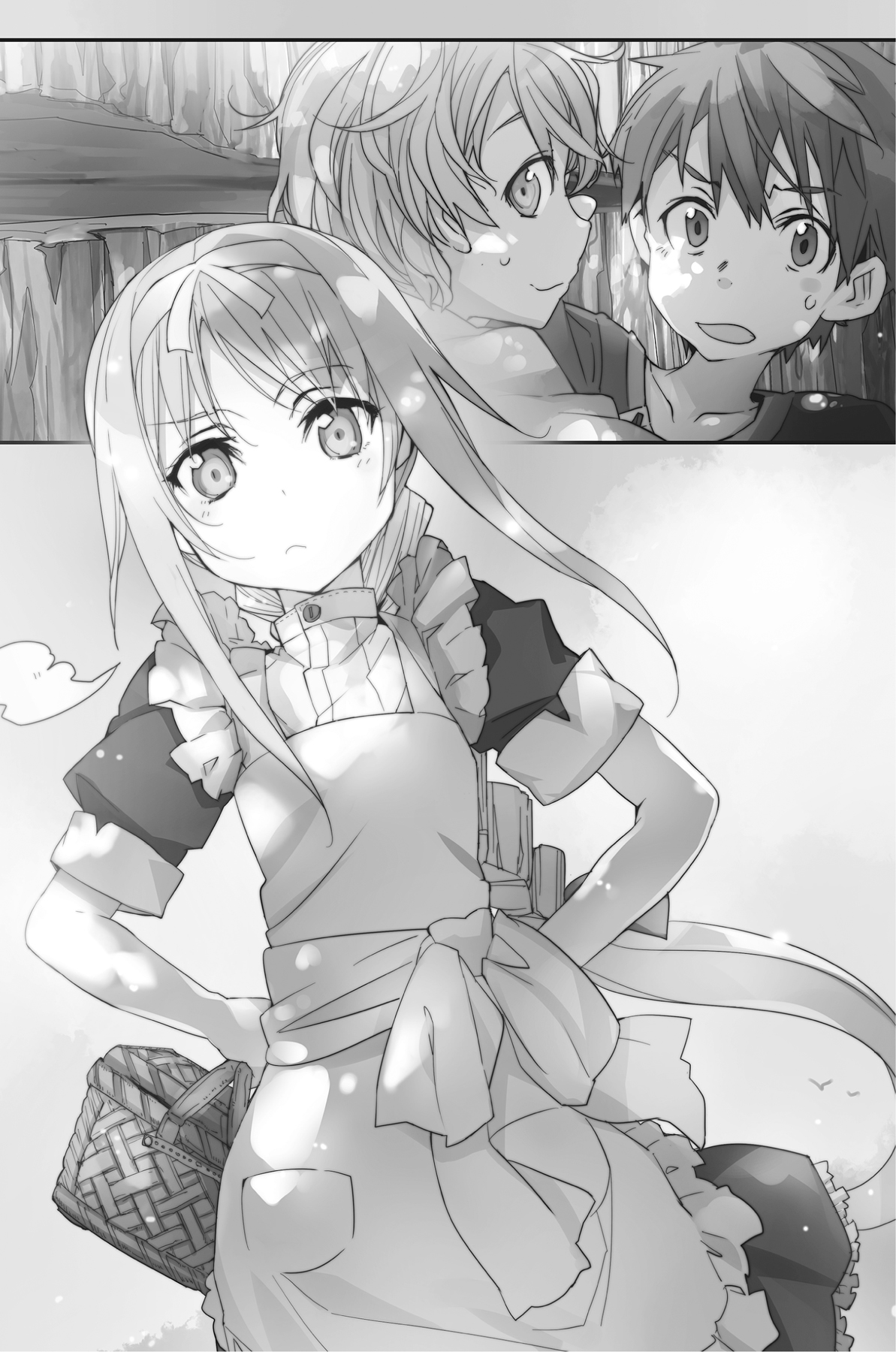
The girl’s name was Alice Zuberg, and she was the village elder’s daughter. She was the same age as Eugeo and Kirito.
Custom in Rulid—in the entire northern territory, in fact—stated that all children in the spring of their tenth year were given a Calling and entered into an apprenticeship for that job. Alice was the sole exception, as she attended school at the church. She was receiving private instruction from Sister Azalia to capitalize on her gift for the sacred arts, which was the most noteworthy of any child in the village.
But Rulid was not a bountiful enough place to allow an eleven-year-old girl to sit around and study all day, even if she was the elder’s daughter and had a preternatural gift. Every able-bodied resident needed to work together to combat the Mischief of the Dark God Vecta—drought and flood, pestilence, and anything else that threatened the life of crops or livestock—or there wouldn’t be enough to survive the winter.
Eugeo’s father, Orick, raised a barley field on cleared forestland to the south of the village that had been in the family for generations. He made a show of being delighted when his third son, Eugeo, was chosen to be a Gigas Cedar carver, but inwardly, he was disappointed. They’d be paid his earnings as a carver from the village treasury, of course, but that didn’t make it any easier to replace that extra set of hands to work in the field.
The eldest son of each family typically received the same Calling as his father, with the daughters and further sons of farming families usually following suit. The child of the general store took on the general store, the sons of the men-at-arms grew up to guard the village, and the village elder’s child became the new elder. Rulid followed these traditions for centuries after its founding. The adults claimed that this preserved the village and was thanks to the blessings of Stacia, but Eugeo couldn’t help but feel something unsatisfying with the explanation.
He couldn’t tell if the adults really wanted to grow the village or if they wanted things to stay exactly the same. If they really wanted more farmland, why didn’t they just go to the trouble of moving past the accursed tree to the lands farther to the south? But even the village elder, purportedly the wisest of anyone, saw no need to change any of their ancient traditions.
So no matter how much time passed, Rulid was chronically poor, which meant that Alice could study only in the morning, after which she would tend to the livestock and clean the house. Her first task after school was bringing lunch to Eugeo and Kirito.
Alice leaped off the tall rock, basket slung over her arm. Her deep-blue eyes glared at Eugeo and Kirito, locked in mortal combat on the ground. Eugeo hastily sat up and shook his head before those lips could issue another bolt of lightning.
“W-we weren’t slacking off! We finished our morning work, promise!” he babbled as Kirito mumbled an affirmation from below.
Alice graced them with another withering stare, then snorted. “If you’ve got the energy to wrestle after finishing your work, maybe I should ask Garitta to up your number of swings.”
“P-please, anything but that!”
“I’m kidding. Come on, let’s eat. It’s a hot day, so we need to hurry before the food spoils.”
She set down the basket and pulled out a large white cloth, which she proceeded to whip open and place on the flattest available bit of ground. Kirito immediately leaped onto the blanket, his shoes already off, followed by Eugeo. The starving laborers watched as more and more food appeared before them.
Today’s menu was a shepherd’s pie of salted meat and stewed beans; thin sandwiches of black bread, smoked meat, and cheese; several types of dried fruit; and fresh milk that morning. Aside from the milk, they were all long-lasting types of food, but the hot July sun was assuredly doing its best to steal away the meal’s life.
Alice held the ravenous boys at bay as though she were ordering dogs to sit, then drew the appropriate sigil in the air to open a window for each item of food, starting with the milk in its bisqueware pot.
“Yikes, the milk only has ten minutes, and the pie, fifteen. And that was after I ran all the way here…You’d better eat all this quickly—just make sure you chew properly.”
A single bite of bad food whose life had expired could cause stomach pains and other ailments in all but the extremely hardy. Eugeo and Kirito gave a brief thanks for their food before tearing into their pies.
For a while, all three ate in silence. The two hungry boys were one thing, but it was surprising just how much food Alice could pack away in that tiny body of hers. First went the three slices of pie, then the nine black-bread sandwiches, washed down with the pot of milk. Finally satisfied, the trio sat back for a breather.
“And how was the flavor?” Alice asked with a sidelong glance.
Eugeo answered in as serious a tone as he could manage. “Today’s pie was good. I think you’ve gotten much better at it, Alice.”
“D-do you think so? I felt like it was still missing a little something,” she said, turning away to hide her embarrassment. Eugeo shot Kirito a glance and they shared a secret smile. Alice had supposedly been making their lunches for the last two months, but it was very clear which days she’d secretly received help from her mother, Sadina. No skill was attained without long years of practice—but Eugeo and Kirito were just old enough to recognize when it was best not to bring that up.
“So anyway,” Kirito started, grabbing a yellow marigo from the fruit container, “it’s a shame we can’t take our time eating such a delicious lunch. Why does the heat make the food go bad so quickly…?”
“Why?” Eugeo scoffed, shrugging. “Because all life drops quicker during the summer, of course. Don’t be weird. Meat, fish, vegetables, fruit—it all goes bad if you just leave it around.”
“I know that, but I’m asking why. During the winter you can leave raw meat outside for several days and it’ll still be good as long as it’s salted first.”
“Because…the winter’s cold,” Eugeo answered. Kirito’s mouth twisted into a childish pout. His black eyes, rare among the northern territory, sparkled with defiance.
“That’s right, the food lasts because it’s cold—not because it’s winter. So if we can keep them cold, our lunches should last longer, even in the summer.”
That caused Eugeo to lose his patience for good. He stretched and kicked at Kirito’s shin. “You make it sound so easy. How do you make it cold when it’s the heat that makes it summer? Are you going to use the forbidden weather-altering arts to bring snow? The Integrity Knights will swoop up from Centoria and take you away the very next day.”
“Hmmm…There has to be some way…Something simpler than that,” Kirito muttered, thinking hard.
Alice, who was twirling her long bangs with her fingertip as she listened to their conversation, interjected, “That’s interesting.”
“Wh-what? Not you, too, Alice!”
“I’m not suggesting using the forbidden arts. Why go to the trouble of freezing the entire village if all you need is to make the inside of this picnic basket cold?”
It made a lot more sense when she put it that way. Eugeo and Kirito looked at each other and nodded together. Alice, now smug, continued. “Some things are cold even in the summer. Like deep well water or silve leaves. Maybe putting things like that into the basket will cool it down?”
“Oh…good point,” Eugeo noted. He crossed his arms to deliberate.
Right out front of the church was an incredibly deep well that had been there since Rulid was founded, and its water was cold enough to bite the skin, even in the summer. The leaves of the rare silve tree that grew in the northern forest emitted a piercing scent and a chill on the skin when plucked, and they were treasured as a treatment for bruises. Now that he thought about it, putting well water in a pot and wrapping the pie in silve leaves seemed like it would be enough to keep the food fresh in transit.
But Kirito shook his head slowly. “I don’t think that will be enough. The well water goes tepid just a minute after it’s drawn, and silve leaves don’t give you more than a brief tingle. That won’t be enough to keep the basket cold from Alice’s house all the way to Gigas here.”
“Are you saying there’s a different way?” Alice snapped, unhappy that her idea had been shot down.
Kirito ran his hands back and forth through his raven hair for a while. At last he said, “Ice. If we had a lot of ice, that would keep the lunch cold.”
“Oh, come on…” Alice groaned. “It’s summer. Where are you going to find ice? There isn’t even any in the market at Centoria!” she lectured, like a mother to her stubborn child.
But Eugeo felt foreboding creeping over him, and he watched Kirito in silence. When his best friend had that look in his eyes and spoke in that tone of voice, it always meant he had some dreadful idea in mind. He recalled countless misadventures from the past: the time they went to get emperor-bee honey in the mountains to the east, the time they broke the hundred-years-expired jar of milk they found in the church basement…
“W-well, who cares? All that matters is to eat the food quickly. If we don’t get started on the afternoon work soon, we’ll be late returning home again,” Eugeo urged, trying to divert the topic away as he returned his empty plate to the basket. But the glint in Kirito’s eyes told him that his fears were about to become reality, whether he liked it or not.
“…All right, what is it? What have you thought of this time?” Eugeo asked, resigned.
Kirito grinned and said, “Hey…remember that story your grandpa told us ages ago, Eugeo?”
“Hmm…?”
“What story?” Alice asked. She was curious, too.
Eugeo’s grandfather, who had returned to Stacia’s embrace two years ago, had been an old man with countless old tales stored in his beard that he liked to share with the three children as they gathered around his rocking chair. He had hundreds of stories—mysterious ones, exciting ones, scary ones—so there was no way for Eugeo to guess which one Kirito was thinking about. His friend cleared his throat and held up a finger.
“There’s only one story about ice in the summer. ‘Bercouli and the Northern White—’”
“Oh, please. You’ve gotta be kidding!” Eugeo interjected, shaking his head and hands.
Of all the founders of Rulid, Bercouli was the most skilled with the sword, and he served as the first chief guard of the village. Given that he lived three hundred years ago, a number of stories about his exploits had been passed down and inflated in the telling, and the one Kirito mentioned was easily the most fantastical of them all.
One midsummer day, Bercouli saw a large transparent stone rising and sinking in the Rul River, which ran to the east of the village. He fished out the object and was mystified to learn that it was a hunk of ice. Bercouli followed the river upstream until he reached the End Mountains, the very boundary of the human realm, where the river narrowed down until it met the mouth of a massive cave.
Bercouli made his way inside, pushing against the freezing winds that blew out of the cave, and, after braving many dangers, he arrived at the great chamber in the very deepest part. In it, he found an enormous white dragon, which was said to protect all the borders of the human world. When he saw that the beast was sleeping atop an immeasurable mountain of treasure, Bercouli boldly snuck forward and chose a single beautiful sword from the pile. He carefully picked up the sword so as not to wake the dragon and was about to scamper off for safety when, dun-dun-dun—so the story went. It was called “Bercouli and the Northern White Dragon.”
Even mischievous Kirito couldn’t intend to break the laws of the village and cross the northern pass to search for a real dragon, Eugeo prayed. “So…you’re going to stake out the Rul and wait for ice to flow down it?” he hedged.
Kirito snorted. “The summer will be over by the time I see anything like that. I’m not going to copy Bercouli and try to find a dragon. Remember how in the story, there were huge icicles right inside the entrance of the cave? Two or three of those should be enough to test out my idea.”
“You can’t be serious…” Eugeo groaned, then fell silent. He turned and glanced at Alice, pleading her to scold the ne’er-do-well in his stead. But the look of excitement in her blue eyes turned his consternation into despair.
Much to their outrage, Eugeo and Kirito were considered the two biggest troublemakers by the elderly in town, receiving scoldings on a daily basis. But few people knew that the driving force behind their many bouts of mischief was the encouragement of Alice herself, the village’s perfect little sweetheart.
Alice put a finger to her plump lips and pretended to think it over for a few seconds, then blinked and said, “That’s not a bad idea.”
“Come on, Alice…”
“Yes, children are forbidden from crossing the northern pass on their own. But remember the exact wording of the rule: ‘Children must not cross the northern pass to play on their own without adult supervision.’”
“Uh…is that how it goes?” Eugeo asked, and shared a look with Kirito.
The laws of the village, officially titled The Rulid Village Standards, were recorded on an aging parchment two cen thick that was kept in the village elder’s home. When children started going to school at the church, the first thing they did was learn all the laws. Parents and elders always droned on and on about “the laws say this” and “according to the laws that,” so by the age of eleven, every child had them thoroughly beaten into his or her head—but in Alice’s case, she had memorized the exact wording of each and every law.
She can’t have memorized the Basic Imperial Laws as well; those are twice as thick as the village’s…Much less that other thing, which is twice again as thick as that, Eugeo thought, staring holes into Alice. She cleared her throat and took on a fussy, officious tone.
“Do you see? The law forbids us from going to play. But going in search of ice is not playing. If we can extend the life of our lunches, it will help not only us but the other workers in the barley fields and pastures, won’t it? Therefore, we should interpret this to fall under the category of work.”
Eugeo and Kirito shared another look. His partner’s black eyes seemed hesitant for a brief bit, but that soon melted away like their fabled ice in a hot summer river.
“Yep, exactly. You are correct,” Kirito declared, crossing his arms. “It’s work, so it doesn’t break the village law about crossing the northern pass to the End Mountains. Remember what Mr. Barbossa always says? ‘Work isn’t just what people tell you to do. If you have free time, find something you can do on your own!’ If they get mad, we can just trot out that line in our defense.”
The Barbossas had the largest barley fields in the village. Nigel Barbossa was a stout man around fifty years old who, unsatisfied with having over double the income of anyone else in the village, would complain that Eugeo hadn’t felled “that infernal cedar yet” every time they crossed paths. Rumor said that he was petitioning the elder to give him first priority on cleared lands after the Gigas Cedar was removed. Whenever he heard it, Eugeo thought to himself, Your life is going to run out well before that happens.
Kirito’s idea to use Nigel’s words against him if they got in trouble was very tempting, but Eugeo was always the first member of the trio to invoke a “but,” thereby holding back the others.
“But…it’s not just the village laws that forbid going to the End Mountains…There’s that other thing, too, right? Even if we cross the pass, we can only go to the foot of the mountains and not into the cave…”
Alice and Kirito both sobered, if momentarily. What Eugeo mentioned was not The Rulid Village Standards or the Norlangarth Basic Imperial Laws but an even more absolute, far-reaching set of laws that covered all the residents of the human world—the Taboo Index.
The Index was upheld by the Axiom Church, residing in its tower in Centoria that stretched nearly to the heavens. The heavy books, bound in pure white leather, were given to every single town and village in not just the northern empire containing Rulid but to those in the east, west, and south as well.
Unlike the village rules and imperial law, the Taboo Index contained well over a thousand entries of forbidden actions, starting with general things like rebellion against the Church, murder, and theft, and going down to specifics like caps on the number of animals and fish that could be hunted in a year or which types of feed were forbidden to give to livestock. Aside from learning letters and numbers at school, the biggest priority was teaching children all the entries of the Taboo Index. As a matter of fact, the Index forbade not teaching the Index in school.
But the absolute authority of the Taboo Index and Axiom Church did not extend to all corners of the world. Beyond the End Mountains that surrounded everything was a land of darkness—what was called the Dark Territory in the sacred tongue. Naturally, the entry that forbade going to the End Mountains was listed quite early in the Index, and that was why Eugeo said they could go to the foot of the mountains but not into the cave.
Eugeo stared at his old friend Alice. Surely she would not dare challenge the Taboo Index. Even considering such a thing was a taboo.
Alice thought for a while, her long eyelashes dazzling in the sun like fine golden threads. Eventually she raised her head, and her eyes still had that adventurous gleam in them.
“Eugeo, your reading of the Taboo Index isn’t entirely accurate, either.”
“Huh…? N-no way!”
“Yes way. Here’s what the Index says. Book One, Chapter Three, Verse Eleven: ‘Thou shalt not cross the End Mountains that encircle the Human Empire.’ When it says cross, it means climbing over. Going into a cave doesn’t count. Besides, our intention is not to go beyond the mountains but to get ice from inside them. There’s nothing in the Taboo Index that says, ‘Thou shalt not search for ice within the End Mountains,’” Alice noted, her crystal voice like the tiniest bell at the church. Eugeo had no response. In fact, what she said was making a certain kind of sense.
But the farthest we’ve ever been are the twin ponds along the Rul, well short of the northern pass. We don’t know what lies beyond that point, and this is the season where the itch-bugs come out along the water…
Kirito roused Eugeo out of his hesitation by slapping him on the back, just softly enough not to damage his life, and shouted, “Alice studies more than anyone else in the village, so if she says so, it’s fine, Eugeo! That settles it—next rest day we’re searching for that white dra…The ice cave!”
“I’ll need to make our lunch with ingredients that last longer.”
Eugeo looked at his friends, their faces sparkling with excitement, and could offer only a reluctant “sure” under his breath.