Chapter 2
2
The EC135 helicopter passed through the patch of thick ocean fog, and then there was nothing but deep blue on the other side of the window.
It was a brilliant close-up on whitecaps and breaking waves, nothing like the high-altitude view from a passenger jet. Rinko Koujiro wondered how many years it had been since she’d swum in the ocean.
Santa Monica Bay was about an hour’s drive away from Rinko’s current place of employment, the California Institute of Technology. She could easily go and work on her tan every weekend if she wanted, but in the two years she’d been on the job, she had not once set foot on the beach.
She didn’t have anything against sun and sand, but it was going to take her a long time to be able to enjoy leisure activities on their own merits again. Rinko suspected it would take a decade or two of living in a foreign land where she was a total stranger before her past could truly vanish.
So it felt strange that, despite her assumption that she’d never be back, she was returning to Japan for just a single day—and to a place connected to the past she’d tried to abandon.
Four days ago, when she had received that very long e-mail from a surprising source, she had had the option to delete it and move on. But for some reason, she hadn’t. She had slept on the proposal for just a single night before giving a positive reply. She knew that it completely invalidated the last two years spent locking away her mind and memories, and yet she had done it anyway.
What was it that propelled her onward, toward the place that weighed so heavily on her past?
Rinko sighed, and pushed away the question she’d asked herself many times over the course of the trip, from Los Angeles to Tokyo, overnight at the Narita hotel, and here on this small craft. She would learn the answer once she had seen and heard what she came for.
At the very least, the last time she had bathed in seawater was ten years ago, when she was an unsuspecting young college freshman. She had asked out Akihiko Kayaba, two years her senior, and driven to Enoshima in the little car she’d bought on loan. She was eighteen years old, so innocent and unsuspecting of the fate she was setting up for herself…
Before Rinko could delve too much further into her distant past, the person sitting next to her brought her back to the present, shouting to be heard over the rotors.
“Look, there it is!”
She followed the gaze of the other passenger, whose eyes were shadowed behind sunglasses and long golden hair. Indeed, through the curved cockpit windshield, there was a small black rectangle in the flat expanse of sea ahead.
“That’s…the Ocean Turtle…?” Rinko murmured. Just then, the black solar panels reflected the sun toward them in a brilliant rainbow array. A man in a dark suit sitting in the copilot seat answered her.
“That’s right. We’ll be landing in about ten minutes.”
The helicopter decided to cap off the 150-mile trip from Shin-kiba in Tokyo with a final spin around the massive marine research vessel Ocean Turtle before finally settling in to land.
Rinko gaped at the absurdity of the sight. The word ship was totally insufficient to describe the structure. It was more like an enormous pyramid rising out of the ocean. It was one and a half times the length of the Nimitz, the world’s largest aircraft carrier. She couldn’t even begin to guess how much the construction of this structure cost. She had heard the rumors that they had invested virtually all the profits from the recent mining of rare metals in Sagami Bay, but Rinko hadn’t believed them—until she saw its size for herself.
Outwardly, the purpose of this mega-float was to find and develop new deposits of minerals and oil on the seabed—but on the inside, it might possibly contain a research lab developing a new full-dive machine called a Soul Translator that interfaced with the human soul, according to the e-mail Rinko had received the previous week. She wasn’t sure she could accept that at first, but now that she was here, she had no choice but to believe it.
It made no sense. Why would anyone go this far, off to the remote Izu Islands, to research a new brain-machine interface? But the hard truth was that within that vast black pyramid was a machine descended from Akihiko Kayaba’s NerveGear and the Medicuboid Rinko had helped develop.
Two years overseas had numbed Rinko’s mental wounds but not healed them. Would what awaited her inside this ship help heal the scars or just rip them open to bleed anew?
As the helicopter descended, she steadied her breathing and turned to the passenger next to her. She met the eyes behind the sunglasses, nodded, and prepared to disembark.
The pilot must have been a real veteran, as the helicopter landed on the Ocean Turtle’s bridge heliport with hardly a single shake. Their guide in the suit nimbly slipped out of the craft to exchange greetings with another man in a suit running up to them.
Rinko headed to the exit hatch next. She waved off the man who extended a hand to her and hopped down the foot and a half to the ground, relieved that she had decided to wear jeans. The surface below her sneakers was so firm and steady that it was hard to believe they were floating on water.
The other passenger exited next, blond hair gleaming in the sun, and stretched back. Rinko followed suit and stretched her arms, breathing in a lungful of salty sea air.
The tanned man waiting for them at the heliport greeted Rinko with a no-nonsense manner.
“Welcome to the Ocean Turtle, Dr. Koujiro. And this is…?” He gestured toward the other passenger.
Rinko said, “My assistant, Mayumi Reynolds.”
“Nice to meet you,” said the other passenger in fluent English, and stuck out her hand. The man accepted it awkwardly.
“I am Lieutenant Nakanishi, and I’ll be your guide. Please leave your bags here; they will be taken to your quarters later. Right this way,” he said, motioning toward a staircase at the end of the heliport. “Lieutenant Colonel Kikuoka is awaiting you.”
The air inside the bridge building still had that midsummer heat and ocean salt to it, but after an elevator, a long hallway, and a heavy metal door that marked the interior of the black pyramid, the inside breeze was cold and dry on Rinko’s face.
“Is the AC this strong all over the ship?” she asked the lieutenant without thinking. The young SDF officer turned back and nodded.
“Yes. There are many high-precision machines inside, so we must maintain a temperature of around seventy-three degrees and humidity under fifty percent.”
“And the solar panels provide all the power for that?”
“Oh, no. The solar modules don’t even meet ten percent of our power consumption. We use a nuclear pressurized water reactor for our main source.”
“…I see.”
At this point, anything goes, she decided, resigned.
There were no other people in the pale-gray hallway. From the materials she had had the chance to read beforehand, there were supposed to be nearly a hundred research projects underway here, but the facility was so huge that it still seemed like there was extra space to go around.
They walked about two hundred yards, turning right and left, until they came to a door dead ahead, attended by a man in a navy-blue uniform. It could have been a private security uniform, except that the crisp salute he gave to Nakanishi identified him as military personnel.
Nakanishi returned the salute and announced, “Our resident researcher, Dr. Koujiro, and her assistant, Miss Reynolds, will be entering Sector S-3.”
“I’ll run the check now,” said the guard. He opened a metal device and gave Rinko a piercing facial comparison to the picture on the monitor. Once he was satisfied, the clean-shaven guard looked at her assistant. “Excuse me, but I need you to remove your sunglasses.”
“Oh, I see,” she said in English again, pulling off her large Ray-Bans. The guard squinted, as though her shining golden hair and fair skin were just slightly blinding.
“Confirmation complete. Go ahead.”
Rinko exhaled and turned to Nakanishi to note, “Your security’s pretty tight for being in the middle of the ocean.”
“Well, at least you don’t have to submit to any body checks. Of course, we already ran you through metal and explosive detectors three times,” he replied, removing a small ID card from his suit pocket and inserting it in a slot next to the door. Then, he pressed his thumb to a sensor panel. A second later, the door slid open, granting them access to the core of the Ocean Turtle.
Past the thick door, the hallway was even cooler, lit with orange lights and faintly humming with machinery. She followed Nakanishi down the hall for quite a while, feeling conscious of the loud echo of her footsteps. It was hard to remember that they were actually inside a ship floating out at sea. Eventually he stopped at a particular door.
The plate on the door said FIRST CONTROL ROOM.
She had finally come to the place where Akihiko Kayaba’s final estate rested. Rinko held her breath and watched the SDF officer as he performed another security check.
Would this be the end point of the long two-year wandering that had frozen her spirit?
Or was it just the start of a new one?
The door slid aside, revealing only a portentous darkness. Rinko couldn’t move. The void did not reject her or welcome her. It just waited for her answer.
“…Doctor.”
Her assistant’s voice brought her back to her senses. Nakanishi was already several steps into the blackness and looking back at her expectantly. Upon closer examination, the control room was not completely dark; there were blinking orange markers on the floor and dim white lights toward the back.
Rinko took a deep breath, summoned her courage, and took a step forward. Her assistant followed her, and the door closed behind them.
They followed the floor markers through the rows of massive network devices and servers. When they finally made it through the valley of machines, Rinko gasped.
“…Huh…?!”
The sound escaped her throat unbidden. The wall before them was a huge window—and she could not believe what she saw on the other side.
It was a town…a city. But clearly no city in Japan. The buildings were all made of chalky white stone and had strange rounded roofs. They were nearly all two stories or more, and yet they looked like miniatures due to the mammoth trees towering over them.
Crowds of people walked over paths of the same white stone, connected to countless stairways and arches through the trees, yet they were obviously not citizens of the modern age.
There were no men in suits or girls wearing miniskirts. They were dressed like something out of the Middle Ages—loose one-piece dresses, leather vests, and long tunics that nearly touched the ground. Hair colors ran the spectrum from blond to brown to black, and the facial features were not clearly identifiable as either Eastern or Western.
Where were they? Had they somehow moved from inside the research ship to some subterranean world? Rinko glanced around the scene and noticed that far beyond the expanse of city was a brilliant white tower looming in the distance, surrounded by four smaller sub-towers. The top of the main tower went right off the boundary of the window into the blue sky beyond it.
She took a few steps forward, trying to see if she could glimpse the tip of the tower, and finally realized that she wasn’t looking at a window but footage on a massive monitor wall. Then the lights in the ceiling turned on and banished the darkness for good.
“Welcome to the Ocean Turtle.”
Rinko turned her head to the right, in the direction of the voice.
Just in front of the nearly movie-theater-size monitor was a console setup with a few keyboards and sub-monitors. There were two men standing there.
The one sitting in the chair was typing away with his back to them. But the other man resting his back against the side of the console met Rinko’s glance and smiled, his glasses glinting.
It was a friendly but opaque smile, one she had seen several times before. That was Lieutenant Colonel Seijirou Kikuoka. But…
“…Why are you dressed like that?” She scowled. It probably wasn’t the best way to address someone for the first time in two years. While Nakanishi saluted in his crisp, perfect uniform, Lieutenant Colonel Kikuoka wore a yukata of fine Kurume fabric tied with an elegant obi, with bare feet in wooden geta sandals.
“If you’ll excuse me,” Nakanishi said, saluting Rinko. He headed back through the machines, and when the door shut, Kikuoka leaned back on the console again and drawled, “You can’t blame me. I’ve been here on the ocean for a month now; I can’t wear my uniform all the time.”
He spread his hands and beamed again. “Dr. Koujiro, Miss Reynolds, thank you for making the long trip. I’m so pleased you could visit us here at Rath. It was worth all the persistent invitations.”
“Well, I’m here now, so I might as well accept your hospitality. Though I can’t guarantee I’ll be any help,” Rinko said, and bowed. Her assistant did the same. Kikuoka raised an eyebrow, and his gaze briefly lingered on that stunning blond hair before the smile returned.
“And you are the final member of the trio I considered indispensable to this project. Now I have all three in the belly of this turtle at last.”
“Ah, I see…I should have known one of those three would be you, Higa,” Rinko said to the other man, who was still facing away. He stopped typing and swiveled in his chair toward them.
Next to Kikuoka’s slender height, he looked tiny. He had bleached hair fashioned into little spikes and simple round glasses. His clothes were just what she remembered from college: faded T-shirt, cropped jeans, and worn-out sneakers.
Takeru Higa gave her a shy smile that suited his baby face. He opened his mouth and spoke the first words they’d exchanged in five or six years: “Well, of course it’s me. I’m the last student of Shigemura Lab, so I’ve got to carry on our legacy.”
“Well…I see you haven’t changed a bit.”
In the Shigemura research lab at Touto Technical University’s electrical engineering department, Higa had tended to get lost in the shadows of the two giants, Akihiko Kayaba and Nobuyuki Sugou, yet here he was, intimately involved with a massive, top-secret government project. Rinko reached out for a light handshake, impressed at how far he’d come.
“…And? Who’s the third person?” she asked, turning to Kikuoka again. The officer gave her one of his inscrutable smiles and shook his head.
“I’m afraid I can’t introduce you quite yet. Maybe we’ll have the opportunity in the days ahead…”
“Then why don’t I say the name for you, Mr. Kikuoka?”
That came not from Rinko but from her “assistant,” who had been lying low in her shadow all this time.
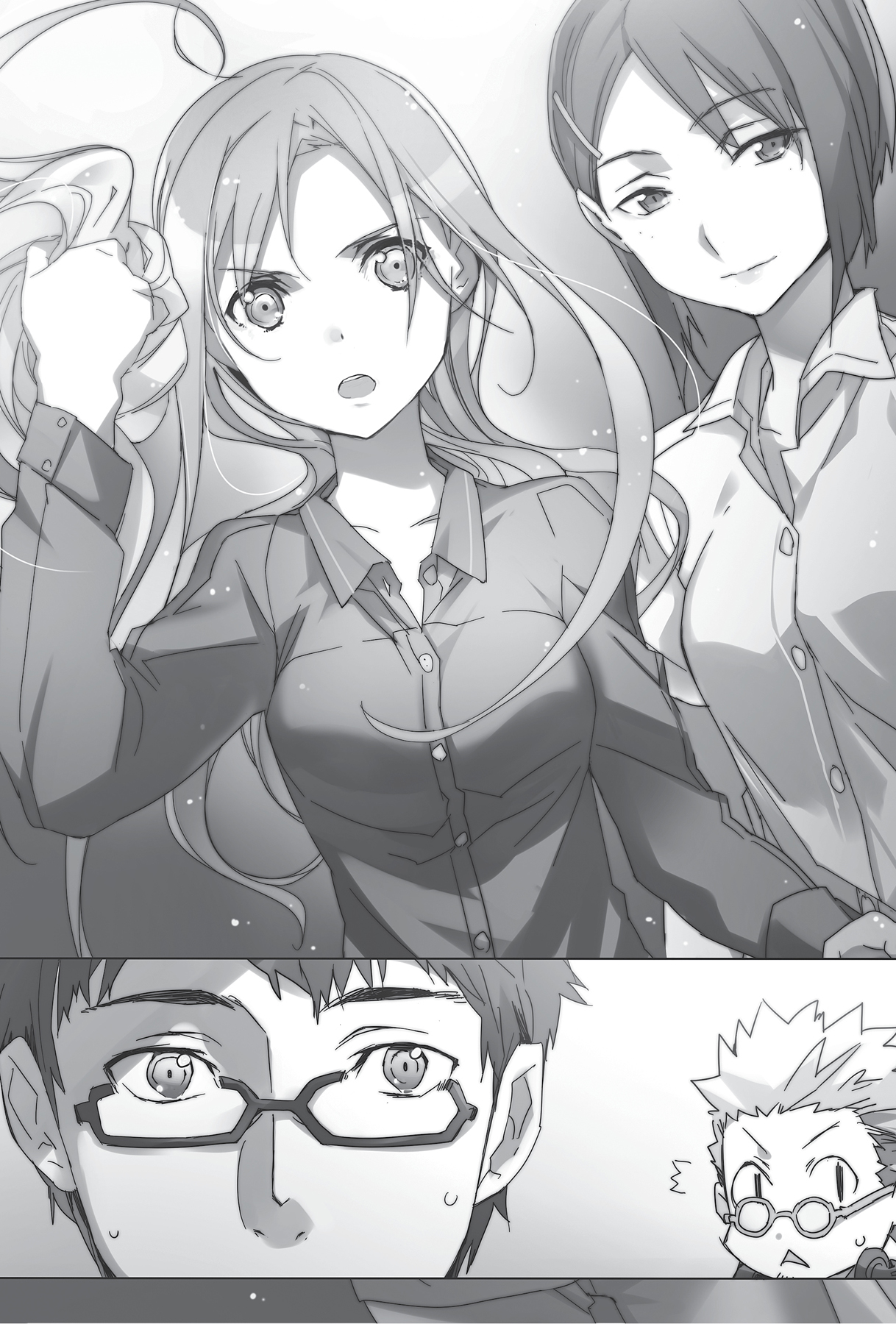
“What—?!” Kikuoka said, stunned. Rinko savored his shock and took a step back to give the girl the floor.
The assistant strode forward, ripped off the blond wig and the oversize sunglasses, and stared right into Kikuoka with hazel-brown eyes.
“Where did you hide Kirito?”
The lieutenant colonel probably had little experience with the sensation of shock. His mouth opened and closed several times to no avail, until at last he managed to squeak, “But…we did a multiple-pass verification of the assistant’s photo from the Caltech student database…”
“You certainly did. We were even getting tired of you staring at our faces,” said Asuna “the Flash” Yuuki, standing boldly inside the depths of the Ocean Turtle at last, under the guise of Rinko’s college TA, Mayumi Reynolds. “The problem is, we made sure to switch my own photo into the school’s database before applying to visit. We happen to know someone very skilled at getting around firewalls.”
“For the record, the real Mayumi’s getting her tan on in San Diego,” Rinko added happily. “Do you see why I suddenly decided to finally accept your invitation, Mr. Kikuoka?”
“Yes…I see very clearly now,” Kikuoka muttered, pressing his temples. Suddenly Higa burst into chuckles.
“See? What’d I tell you, Kiku? That kid’s the biggest security hole in this whole operation.”
Four days earlier, on July 1st, Rinko’s private e-mail had received a message from one Asuna Yuuki. The contents of the message were a huge shock to her system, which was numb from a life spent traveling between her home and the school campus.
Before Rinko had left Japan, she had provided tech to the Ministry of Health for the Medicuboid full-dive device. Asuna told her that this device now formed the basis for a monstrous new machine called a Soul Translator being developed by a mysterious agency called Rath.
The likely goal for this soul-accessing machine was to create the world’s first true bottom-up AI. This Kazuto Kirigaya boy who was assisting with tests had been abducted from the hospital in a coma and taken, most likely, to this brand-new Ocean Turtle marine research vessel. And the main suspect in the case was the government agent Seijirou Kikuoka, who had been deeply involved in VR going back to the SAO Incident. All in all, the message was extremely hard to take at face value.
“I found your e-mail address from the address book on Kirito’s PC. You’re the only person who could possibly take me to him and to Rath. Please, please help me.”
That was how the message ended.
Despite her shock, Rinko had sensed that Asuna Yuuki’s words were true. Three times over the past year, she had received invitations to participate in the development of a next-generation brain-machine interface from one Ground Lieutenant Colonel Kikuoka.
Rinko had raised her eyes from her monitor and to the night view of Pasadena outside the window of her condo. She had recalled the face of young Kirigaya, who came to visit her once before she left Japan.
He had explained to her the illegal human experimentation that Nobuyuki Sugou was attempting and, at the very end, hesitated. Then he had told her about his conversation with the ghost of Akihiko Kayaba in the VR world, and how that ghost had, for whatever reason, given him a shrunken-down version of the Cardinal system.
Thinking back on it now, the high-density, high-output brain-pulse scanner that Akihiko Kayaba had used to end his own life was the basis for the Medicuboid, and now, the Soul Translator. It was all connected, and nothing was over. So was it simply fate that she had gotten this message from Asuna Yuuki now?
Overnight, Rinko had made up her mind and replied to Asuna to accept her request.
She had to smirk. It had been a dangerous gamble, but it was worth crossing the Pacific to see that startled look on Seijirou Kikuoka’s face. Ever since the SAO Incident, he had been lurking around, seemingly controlling all events to his benefit, and she’d finally gotten one over on him. Still, it was too early to relax.
“So, now that we’re here, why don’t you give up and confess what you’re doing, Mr. Kikuoka? Why is an SDF officer using a dead-end minor division in the Ministry of Internal Affairs as cover to get involved with the VR business? What are you plotting in the belly of this giant turtle? And…why did you abduct Kirigaya?” Rinko asked.
He shook his head and let out a long sigh, but his smile was as inscrutable as ever.
“First, I want to make sure there are no misunderstandings here…Yes, I’m sorry that we used rather forceful methods to bring Kirito into Rath. But that was because I wanted to save him.”
“…What do you mean?” Asuna asked suspiciously, looking like she’d have her hand on the hilt of her sword if it were there.
“I found out that the escapee from the Death Gun case had attacked Kirito and put him into a coma the very day it happened. I also learned that his brain was damaged by a lack of oxygen, and that contemporary medicine would be unable to heal him.”
Asuna blanched. “Unable…to heal him…?”
“Parts of the nerve cells that make up a major network of the brain were destroyed. No doctor could tell you when he would wake, no matter how long he stayed in the hospital. He could sleep there forever…Please don’t look so upset, Asuna. Didn’t I just say ‘contemporary’ medicine?” Kikuoka said. He looked more serious than he had at any point so far. “But if there’s one technology that can actually heal Kirito’s damage, it’s here with Rath. As you already know, it’s the STL: the Soul Translator. It cannot repair dead brain cells, but if the STL stimulates the fluctlight directly, it’s possible to augment the rebuilding of that brain network. It just takes time.”
His powerful forearm extending from the yukata sleeve gestured toward the ceiling.
“Kirito’s currently inside the full-spec STL installed above the Main Shaft here. The limited version of the device in our Roppongi office couldn’t handle the finer procedures, so he needed to come here. When his treatment ended and he regained consciousness, we were planning to send him back to Tokyo with a full explanation to you and his family.”
Asuna swayed on the spot; Rinko had to reach out to steady her.
She’d used an incredible amount of insight and willpower to find and make her way to the boy she loved, and now it was like all the tension had just snapped and drained out of her. A large tear dripped from one eye, but she bravely wiped it away and steadied herself.
“So Kirito’s all right? He’s going to recover?”
“You have my word. His medical needs are being treated at a level equal to any major hospital. He even has a resident nurse.”
Asuna fixed him with an intense stare, trying to seek out Kikuoka’s true intentions. After several seconds, she finally bobbed her head and said, “All right…I’ll believe you for now.”
Kikuoka’s shoulders slouched a bit with relief. Rinko stepped toward him and asked, “But why is Kirigaya needed for the development of the STL? Why does a top-secret project hidden way out at sea need a teenage boy?”
Kikuoka glanced at Higa, then shrugged. “If I tried to explain that, it would be a very long story.”
“Well, it’s a good thing we’ve got plenty of time, then.”
“…If you want to hear the whole story, you’ll have to assist with the project, Dr. Koujiro.”
“I’ll decide that once I’ve heard you out.”
The officer looked at her balefully, then resigned himself and rustled around in his yukata until he found a small tube. To her surprise, it was just an ordinary bottle of that cheap Ramune soda candy. He popped a few into his mouth and offered it to the women. “Want some?”
“…No, thank you.”
“You sure? They’re pretty good. Anyway…may I assume that you both understand the general principle of the STL?”
Asuna nodded. “It’s a machine that reads the human soul, or ‘fluctlight,’ and sends it into a virtual world that is completely indistinguishable from reality.”
“Good. And what is the purpose of this project?”
“To create a bottom-up AI…A highly adaptive artificial intelligence.”
Higa whistled in surprise. There was admiration behind the round lenses of his glasses, as well as disbelief. “That’s incredible. I don’t think even Kirito was aware of that part. How did you manage to look that up?”
Asuna gave Higa a searching look and answered roughly, “Based on what Kirito said. He said the words Artificial Labile Intelligence…”
“Ah, gotcha. Maybe you should look into the security procedures at the Roppongi office, Kiku,” he said, grinning.
Kikuoka grimaced and shrugged. “I was prepared for the possibility that some information would leak out through Kirito. I would have thought you’d realize he was indispensable enough for us to take that risk…Anyway, where were we? Ah yes, the Artificial Labile Intelligence.”
He flipped one more little candy into the air with his thumb, caught it in his mouth, then took on the air of a literature professor.
“For many, many years, the creation of a bottom-up AI structured in the same way as our own human mind was considered a pipe dream. We didn’t even know how the human mind is constructed. But based on the data Dr. Koujiro brought us and the design of Higa’s incredibly powerful Soul Translator, we have succeeded in capturing the quantum field we call the fluctlight—the human soul. At that point, we assumed that we had essentially succeeded at creating a bottom-up AI. Do you know why?”
“Because if you can read the human soul, you can make a copy…Is that it?” Rinko whispered, feeling a thrill of horror run down her back. “But you’d still have the problem of the medium on which to save the copied soul…”
“Yes, precisely. The quantum gates used in traditional quantum computing research don’t have nearly enough space. So at great investment cost, we developed the Light Quantum Gate Crystal…or ‘lightcube’ for short. Inside this praseodymium crystallization, just two inches to a side, there are about ten billion cubits of storage—enough to correspond to the human brain. In other words…we have already succeeded at replicating the human soul.”
“…”
Rinko shoved her hands into her jeans pockets to distract herself from the sensation of her fingertips going cold. Next to her, Asuna’s cheeks were losing their color.
“…Then…isn’t the project a success? Why did you need to get me here?” she asked, putting force into her words to hide her fear. Kikuoka shared another look with Higa and let a powerless smirk tug at the ends of his mouth.
“Yes, we succeeded at replicating souls. But foolishly, we failed to realize that there is an unfathomably deep chasm between a human copy and true artificial intelligence. Higa…show her.”
“Aww, please no. I get so bummed out when I have to do this,” Higa protested sourly, but he gave in and reluctantly started tapping at the console.
Abruptly, the image of the strange, exotic city on the mega-screen went black.
“All right, here we go. Loading copy model HG-001.”
Higa smacked the ENTER key, and a complex array of radiant colors appeared in the middle of the screen. It was nearly white at the center, while the tips reaching outward got redder as they went and stretched and contracted irregularly.
“…Is the sampling over?” came a sudden voice from speakers overhead, causing Rinko and Asuna to jump. It sounded like Higa’s own voice. But there was a slight electronic falseness to it, a roughness around the edges.
Higa pulled a flexible microphone toward his seat and replied to his own voice by saying, “Yep, fluctlight sampling has concluded without issue.”
“Okay, cool. But…what’s going on? It’s all dark. I can’t move. Is there something wrong with the STL? Hey, can you let me out?”
“Nah…sorry, I can’t do that.”
“What? Wait, whaddaya mean? Who are you? I don’t recognize your voice.”
Higa tensed. He paused for a moment, then steadily proclaimed, “I’m Higa. Takeru Higa.”
“…”
The red spikes suddenly shrank. After a brief silence, the sharp edges extended defiantly. “That’s crazy. What are you talking about? I’m Higa. You’ll see once you let me out of the STL!”
“It’s all right; don’t get worked up. That’s not like you.”
At last, Rinko understood what she was witnessing.
Higa was conversing with a copy of his own soul.
“Think hard and remember. Your memory stops at the point you entered the STL to make a copy of your fluctlight. Correct?”
“…What about it? Of course I don’t remember the rest. You’re not conscious during a scan.”
“Remember what you told yourself before you went in? If you wake up and it’s black all around with no sensation, you have to remain calm and accept the situation. You have to realize that you’re a copy of Takeru Higa stored in a lightcube.”
The light shrank down again, like some kind of soft, fleshy sea creature. There was a long, long silence. Finally, a few spikes grew back.
“…That’s a lie. It can’t be true. I’m not a copy; I’m the original Takeru Higa. I have…I have my own memories. I remember everything, from kindergarten, to college, to joining the Ocean Turtle…”
“That’s right, but it’s also completely expected. All the memories your fluctlight possesses are copied in the process. You might be a copy, but you’re still Takeru Higa—which means you’ve got a brain that’s as good as anyone’s. Consider the situation and accept it. Then we can work together to achieve our shared goal.”
“…Our…Our…?”
Rinko felt a thrill of horror prickle the skin on her arms when she heard the lurch of raw emotion in the metallic voice of the copy. She had never witnessed such a cruel and grotesque experiment before.
“…I can’t…I can’t believe you. I’m the original Higa. This is some kind of test, isn’t it? Please, let me out already. Are you there, too, Kiku? Stop this nasty joke and let me go.”
Kikuoka leaned over, looking gloomy, and pulled close to the mic. “It’s me, Higa. Or should I say…HG-001. I’m sorry to admit that you are, in fact, a copy version. Before the scan, you underwent quite a lot of counseling, had many conversations with other technicians and me, all in preparation for accepting your status as a copy. I’m sure you remember that. You went into the STL with the understanding that this outcome was possible.”
“But…but…nobody said it would be like this!” the copy screamed. The sound filled the large control room. “I’m…I’m still me! There should be something that allows a copy to feel that it’s a copy! This is…This is just cruel…I hate this…Let me out! Get me out of here!”
“Calm down. Just be rational. Remember, the lightcube’s error-correction capability is weaker than an organic brain’s. You understand the danger that occurs when you lose rational thought.”
“I am rational! I’m Takeru Higa! Why don’t we have a pi-recitation contest between me and that imposter over there, so I can prove it?! Let’s start! 3.1415926535897932, three-ay-fo-sig-doo-sig-fo-thril-dil-dil, dil, di-di-di-dil, dil-dil-dil-dil dildildil dildi ”
”
The red light expanded to fill the screen like an explosion. Then a black dot appeared at the center and spread outward until there were no traces left. All was silent, except for a little blip of static.
Takeru Higa let out a very, very long sigh and helplessly tapped a key on the console.
“That’s a collapse. Four minutes, twenty-seven seconds.”
Rinko heard a guttural convulsion nearby and realized that her hands were balled into fists. She opened them and felt cold sweat on the palms.
Next to her, Asuna had her hand over her mouth. Kikuoka noticed this and rolled one of the empty chairs at the console over to her. Rinko caught it and guided Asuna down into the seat.
“Are you all right?” she asked.
The girl looked up and bravely nodded. “Yes…I’m sorry about that. I’m okay now.”
“Don’t push it. Keep your eyes closed for a while,” Rinko said. She felt Asuna’s shoulders relax a bit, then glared at Kikuoka. “I’m astonished at your depravity, Mr. Kikuoka.”
“I apologize for that. But I think you understand now that it’s impossible to explain what we’re doing without a direct demonstration like this,” the military officer said, exhaling and shaking his head. “Higa here is a genius with an IQ close to 140. We copied his mind, and the result was unable to bear the recognition that it was a copy. We’ve replicated over a dozen fluctlights, including mine, and the results are always the same. The copies’ logic systems go out of control at around three minutes after loading and collapse. Without exception.”
“For one thing, I hardly ever scream like that, and it speaks a bit rougher than I do. You should have recognized that, Rinko,” Higa said, looking extremely dejected. “We’ve seen that this isn’t really an issue with the reasoning capabilities of the person being copied or a lack of mental care regarding their copying. I think it’s a structural flaw of the fluctlights that are copied wholesale onto lightcubes. Either that, or…Do you know what brain resonance is?”
“Huh? Brain resonance…? Doesn’t that have something to do with cloning? I don’t know any details…”
“Well, it’s all just occult mumbo jumbo. Basically, it claims that if you could create an absolute clone of a person, the two brains’ magnetic fields being identical would produce something like mental microphone feedback, causing them both to go crazy. That’s ridiculous, of course—but perhaps there’s some kind of fundamental mechanism in our brains that is unable to handle the revelation that it is not a unique individual…Hmm, I see that suspicion on your face. Would you like us to make a copy of you so you can see for yourself?”
“Absolutely not,” Rinko said, fighting off the urge to shiver. A silence fell over the adults, only to be broken by Asuna, who had her eyes closed as she sat.
“I heard something from Yui, a top-down AI—I’m certain you met her a few times in ALO, Mr. Kikuoka. Even though her ‘mind’ structure is totally different from a human being’s, she too was frightened of the idea of having a copy. She was afraid that if some kind of accident caused the backup to be activated, the two of them would be forced to fight to eliminate the other…”
“Wow, that’s really interesting. Just fascinating!” Higa exclaimed, pushing up the bridge of his glasses. “That’s no fair, Kiku. I wanna meet this AI, too. Hmm, let’s see…I suppose that means it’s impossible to replicate a ‘completed’ intellect. Either that, or unique individuality is a prerequisite of existence…”
“But in that case,” Rinko said, spreading her hands to beseech Kikuoka, “while it’s an incredible accomplishment that you’ve succeeded in copying the human soul, doesn’t this mean that your research has ultimately failed? After pouring in all these public funds, however much it cost…?”
“Oh, no, no, no,” Kikuoka said, shaking his head with a wry smile. “If that was the conclusion of the project, they would have shot me from a cannon into the stratosphere—and put a few higher-ups in the joint staff office in front of a firing squad, to boot.”
He tapped the tube of candies against his palm again, realized it was empty, then reached up the other sleeve this time to remove a box of white caramels.
“In fact, you might even say that’s the starting point of this project: the fact that it’s impossible to copy a completed soul. So…if a perfect replica is impossible, what should we do, Doctor?”
“…May I have one of those?” she replied. Kikuoka happily offered a caramel, which she unwrapped and popped into her mouth. It tasted of tangy yogurt. You didn’t get flavors like this in America very often. The sugar melted its way into her tired brain and gave her the mental energy to process the question.
“Well…what if you limit the memory? Let’s say…erase personal details like one’s name and background. Perhaps if the copy doesn’t know who it is, it won’t go into a state of panic like just now…”
“I should have known you’d come up with that right on the spot!” Higa exclaimed, acting like he was back in his college club. “It took us a week of back-and-forth to finally think of that and try it out. The problem is, the human mind isn’t organized like a computer OS with nice, tidy folders and files. To put it simply, the memory and mental processors are all mixed up together. Which makes sense, when you think about it—our mental abilities aren’t installed at birth but a product of learning.”
Higa grabbed a notepad from the desk and held it up, using two fingers to pinch it in a cutting motion.
“Learning is memory. If you remove the memory of the first time you cut a piece of paper with scissors, you forget how to use those scissors…In other words, if you delete memories of the growth process, you also remove those abilities. So let me warn you, the result is far more miserable than the full copy you just witnessed. Wanna see?”
“N-no, that won’t be necessary,” Rinko said quickly. “So…what if you remove all memory and ability and allow it to learn from the start? Actually…I suppose that’s not realistic. It would take too long…”
“Yes, exactly. After all, fundamental knowledge like language and arithmetic is actually extremely difficult for adults like us to learn, because there’s little potential for growth left in our brains. I’ve been studying Korean, one of the more systematic languages, and I can’t even remember how many years I’ve been at it. Basically, the learning process depends on the growth of the quantum computer that is the neural network—or, in other words, the growth of an infant mind.”
“So you’re saying you don’t just restrict memory space…but the thinking and logic centers of the mind, too? Is the STL capable of doing that?”
“It’s not impossible. But it takes an incredible amount of time to analyze the fluctlight and pinpoint which of the billions of cubits of data contain which functions. It could take years…decades, even. But then…this old guy over here figured out a much simpler, smarter way to do it. A method that scientists like us wouldn’t have come up with…”
Rinko blinked and stared at the man in the yukata, leaning against the console. As usual, Kikuoka’s expression was gentle but opaque, revealing nothing of the mind residing behind it.
“…A simpler method…?”
She thought it over, but no answer was forthcoming. She was about to give up and ask, when Asuna suddenly bolted upright in her chair.
“Oh no…You can’t have done such a horrifying thing…” she murmured, cheeks still pale but eyes full of strong purpose. The girl’s face was a mix of exotic beauty and indignation that she turned with full force on Kikuoka.
“You copied…babies? The souls of newborn babies? To get those blank, pure fluctlights with no learning built in yet?”
“Very perceptive. I’m amazed. But given that you and Kirito were the ones who beat SAO—the heroes who outwitted Akihiko Kayaba himself—I suppose that’s rude of me to say.” Kikuoka beamed, not bothering to hide his praise.
Rinko felt something in her chest twinge—she hadn’t expected to hear Kayaba’s name just then.
In the few short days since she had met the girl, Rinko had been impressed by and taken with Asuna Yuuki, but in truth, Asuna had the absolute right to criticize, insult, and persecute Rinko for her actions. No matter the circumstances, Rinko had assisted Kayaba’s horrifying project, which had held Asuna prisoner for two years in a deadly game.
But neither Asuna nor Kazuto Kirigaya, whom she had met much longer ago, had ever said a single angry word to her. As if they believed everything had happened as it was meant to.
Did that mean Asuna believed this “Rath Incident” was also a product of fate? Rinko couldn’t help but feel so. She watched Asuna take another step closer to Kikuoka.
“Do you think…that just because you’re in the Self-Defense Force…that because you’re in the government, that gives you the right to do anything you want? Do you think your own goals have priority over everything else?”
“Certainly not,” Kikuoka said, shaking his head in aggrievement. “Yes, I agree that abducting Kirito was an extreme step. But at the time, I didn’t have the ability to explain all these classified details to your families. Using our connections at NDMC to get him here to the Ocean Turtle was for the purpose of getting him treatment in the STL as quickly as possible. I love him, too, you know.”
The lieutenant colonel paused, smiled innocently, and pushed his black-rimmed glasses up his nose. “Aside from that, I would say I’m expending too much effort upholding the law and human morality, considering the similar projects underway in other corporations and nations around the world. Even on the point that you just raised now. When we scan the fluctlights of newborns in the STL, we have the full understanding and cooperation of the parents, and we compensate them handsomely for the process. That was why we opened that branch office in Roppongi. Next to a maternity clinic, of course.”
“But you didn’t explain everything to the parents, did you? You didn’t explain what the STL really is.”
“No, we could only tell them that it was a device that took brain-wave samples…But that’s not entirely incorrect. After all, the fluctlight is certainly made of electromagnetic waves in the brain.”
“That’s nonsense. You might as well be collecting the babies’ DNA and making clones of it.”
At that point, Higa interjected and made a big X sign with his arms. “She’s got you there, Kiku. I agree, I think making a full copy of a newborn fluctlight does violate some kind of morality. But…Miss Yuuki, was it? You’re a bit mistaken here, too. A fluctlight doesn’t have the same level of individual difference that DNA does. At least, not at the newborn stage.”
He pushed his silver-rimmed glasses up the same way his boss did and glanced around as he searched for the right words. “Let’s see…I think this analogy will suffice. Let’s say you’ve got a particular PC model from a certain company. Until they get shipped out, they’re all essentially identical. But once the user gets it and operates it for a year or two, they’ll have installed new software, new hardware, until they’re eventually completely different machines. The human fluctlight is the same way. Ultimately, we copied the fluctlights of twelve different newborns, and when we compared them, we found they were arranged 99.98 percent identically, regardless of brain size. We believe that the last 0.02 percent of difference is based on different memories in utero and after birth. In other words, human intelligence and personality are entirely based on the growth process after birth. It’s official: Nurture has won the battle with nature. Wish I could take this revelation to those eugenics freaks and shove it up their asses.”
“Once the project is complete, you have my blessing. Shove to your heart’s content,” Kikuoka said wearily. “But at any rate, as Higa just explained, we have concluded that newborn fluctlights are not hard-coded with individual differences. So we very carefully deleted that 0.02 percent variation from our twelve fluctlights and gained what we call…”
He spread his hands and made a careful, cradling gesture.
“…Soul Archetypes. A basic model of the human mentality.”
“More grandiose terminology. I take it this is essentially referring to ‘the self’ as defined by Jungian psychology?” Rinko asked.
Kikuoka shrugged wryly. “Listen, I’m just talking about functionality, I’m not offering philosophical speculation. You could think of the soul archetype as the basic CPU core that all human beings are born with. As we grow, we add all kinds of sub-processors and memory units to our core. Eventually, the very structure of that core changes…As we showed you minutes ago, just copying that ‘completed’ product to a lightcube does not give us the bottom-up AI we seek. So we thought, what if we take that soul archetype and raise it ourselves from within that lightcube…in a virtual world?”
“But—” Asuna started to protest.
Rinko put a hand on her shoulder and pushed the girl back into the seat. “You can’t just raise it like it’s a pet or a plant. This soul archetype is essentially the same thing as a human infant. That would require a virtual world of an unfathomable scale. A simulation on the level of modern society…Can you actually create such a thing?”
“We can’t,” Kikuoka admitted. “While the creation of virtual environments in the STL doesn’t require generating 3-D models as with traditional VR development, it would be very difficult to re-create the complex, mysterious ways of modern society. There was a movie from before you were born, Asuna; I wonder if you’ve heard of it. It’s about a man living in an enormous dome, whose entire life is a TV show. There are hundreds of extras acting as people around him—only the star himself is unaware of it. But as the man grows and learns more about the world, he starts spotting the cracks and eventually realizes the truth…”
“I’ve seen it. I liked that movie,” Rinko said. Asuna indicated her familiarity as well, so Kikuoka went on.
“Essentially…in attempting to fashion a precise simulation of the real world, you run up against a major problem: Certain fundamental truths of the world, such as the roundness of the globe and the existence of many nations upon it, will eventually cause issues within the mind of the person being raised if those facts are not properly represented within the simulation. And even the STL is incapable of re-creating an entire virtual Earth.”
“Then what if you set the level of civilization in the sim far back in the past? In a time before science and philosophy, when they all lived and died in remote little areas…Wouldn’t that still work in terms of raising your soul archetypes?”
“Yes. It’s quite a significant detour, but we do have plenty of time…within the STL, that is. At any rate, as Dr. Koujiro just indicated, we tried raising our first-generation AIs within a very limited space. More specifically, a sixteenth-century Japanese village. But…”
Kikuoka paused. He shrugged again, and Higa took over the explanation.
“It turns out it’s still not as easy as we hoped. After all, we have barely any idea of the customs and social construction of that time. When we realized just how much information was necessary to create even a single house within the simulation, we went back to the drawing board…and then we figured it out. We didn’t need to model the real world at all. If we wanted a limited space, the ability to dictate our own customs, and a worldview that would allow us to explain away any potential issues as ‘magic’—well, there are already plenty of those. The networks that Kirigaya and Miss Yuuki are already familiar with.”
“VRMMO worlds…” Asuna gasped.
Higa snapped his fingers. “I’ve done my fair share of time in them as well, so I figured out how well it would work for us pretty quickly. And the best part is, there’s already this perfect game-creation tool package out there that somebody put together, totally free for anyone to use.”
“…!”
Rinko instantly recognized that Higa was talking about The Seed…a compact version of the Cardinal system that Kayaba had created and Kazuto Kirigaya had shared with the net. She gasped—and recognized that neither Higa nor Kikuoka seemed aware of the program’s birth.
Immediately, she decided to keep that under wraps and casually brushed her fingers on Asuna’s shoulder. Asuna got the message and said nothing.
Higa failed to notice that anything was amiss and continued, “Creating a virtual space in the STL doesn’t actually require 3-D data, but when you monitor the process externally, you only have raw data to look at, and that’s no fun. So we tried downloading this Seed package, as it’s called, and slapped together a little village using the editor program, then converted it to mnemonic visuals for the STL.”
“Ah…Meaning it’s a dual-layer world? There’s a VR world made of ordinary data on the server below, while the STL mainframe above it converts that into its own VR format, with the two sides being mutually converted in real time?”
Higa confirmed Rinko’s suspicion, so she continued, “Then…could you dive into the lower server with just an AmuSphere, rather than having to go through the STL?”
“Er, well…theoretically, it’s possible. But you’d have to lower the operating speed down to times-1…and I doubt the mnemonic and polygonal data would be perfectly in sync…” Higa said, trailing off into mumbles.
Kikuoka rubbed his hands together and said, “At any rate, after all this testing, we finally had our little sandbox to work with.”
There was a hint of nostalgia in his eyes, as if he was reminiscing on the distant past. “In that first village, we had sixteen soul archetypes making up two farming families…We managed to raise those AI babies up to the age of eighteen.”
“H-hang on. Raised? Who raised them? Traditional AIs?”
“We looked into that, but, as high-functioning as The Seed’s NPC AI is, it’s not advanced enough to raise children. We had people act as parents for the first generation. Two men and two women on staff spent eighteen years in the STL acting as the farmer and wife of the two farms. While their memories within the system were ultimately blocked out at the end, it required an incredible amount of patience during the test. There’s no bonus big enough to repay them for that service.”
“I don’t know, it sounded like they enjoyed it,” Higa commented. Rinko just stared at them having a casual conversation about this. Finally, her lips sounded out the words.
“Eighteen…years…? From what I understand, the Soul Translator is capable of accelerating subjective time…but how long did that take in the real world?”
“Just about a week,” Higa answered. Again, she was stunned. Eighteen years would be 940 weeks. That meant the STL was capable of accelerating time to the point where one real second would last a thousand in the simulation.
“And…and the human brain is capable of running at a thousand times speed without issues?”
“Remember, the STL doesn’t access the biological brain; it’s the field of photons that makes up our consciousness. The biological process of electrical signals causing neurons to release neurotransmitters can be completely cut out of the picture. In other words, in theoretical terms, we can accelerate the mental clock however much we want without damaging the structure of the brain at all.”
“So there’s no limit…?”
Rinko had a basic familiarity with the Soul Translator’s fluctlight acceleration (FLA) feature, thanks to the materials she had received before the trip, but finding out the actual hard numbers it was capable of reaching left her speechless. She had thought the STL’s ability to copy the human soul was its biggest accomplishment, but this time-speeding revelation was just as huge. This meant that the efficiency of any process in the virtual space was essentially unlimited.
“But, since we don’t know what kind of undiscovered issues might be lurking out there, we’ve capped the machine at times-1500 for now,” Higa said. His withdrawn expression dashed cold water on her stunned mind.
“Issues?”
“Well, some have suggested that unrelated to the biological structure of the brain, the soul itself might have a fixed life span, too…”
Higa noticed her confusion and glanced back at Kikuoka, seeking guidance as to how far to proceed. The military officer looked briefly like the caramel he was sucking on had gone nasty and bitter.
He explained, “Well, it’s only in the realm of theory for now. Let’s say that the quantum computers that we call fluctlights have a limit on their information storage space, and crossing that limit causes the structure to degrade. We can’t actually test this hypothesis, so we can’t be sure it’s accurate—we just set an upper limit on the FLA amplification in the interest of safety.”
“…Meaning that in physical time, it’s less than a week, but after spending decades inside your mind, the soul degrades accordingly? Then what’s the point of the acceleration? Is there no way to avoid that phenomenon?” Rinko asked, reverting to researcher mode for a minute.
This time, it was Higa who looked sour. “Er, well, there is a way, in theory…or more like in imagination. If we created a device like a portable STL to be worn at all times and used that to save to external memory while in acceleration, it wouldn’t use up the capacity of the original fluctlight. But at our present state of technology, it’s impossible to get the STL that small, and even if we could, it creates another major issue: When you remove that portable STL, you lose your accelerated memories, because they’re all stored there instead.”
“…This isn’t imagination. It’s outright science fiction. Overclocking brains, non-volatile memory that can be attached and removed…I wish I’d had this tech when I was a grad student,” Rinko muttered, shaking her head. She wanted to get back to the main topic. “At any rate, it sounds like there’s no way for you to avoid pressure on fluctlight capacity at present. Which means…Hang on. Mr. Kikuoka, you said that staff members spent eighteen years in the STL to raise soul archetypes. What happens to their fluctlights? Doesn’t that mean their mental abilities will start to degrade eighteen years earlier than expected in the future?”
“No, no, that…shouldn’t happen.”
She glared at Kikuoka when he said the word shouldn’t, but he just ignored her in his typically aloof way.
“Based on the total size of the fluctlight and the rate at which it fills, we calculate that the life span of the soul—if you want to call it that—is about one hundred and fifty years. That means that, assuming perfect health and good enough luck to avoid any neurological maladies, one’s mental abilities can last at maximum until age one hundred and fifty. Naturally, none of us will actually live that long. Therefore, even with a healthy safety margin, we estimate that a good thirty years can be spent in the STL without adverse effect.”
“Assuming the next century doesn’t see some revolutionary new life-prolonging methods,” Rinko said sarcastically.
Unperturbed, Kikuoka continued, “Even if that comes to be, regular old people like us will not be the beneficiaries of its gift. Of course, that might ultimately hold true with the STL, as well…But at any rate, let’s take the life span of the soul for granted and continue on. Thanks to the devoted efforts of our four staff members, we raised sixteen youngsters, whom we call ‘artificial fluctlights’ for convenience. The results were very satisfactory. They learned language (Japanese, of course), basic mathematics, and other critical-thinking skills to a level that allowed them to survive in the virtual world we’ve built. They were great kids. They listened to their parents, drew water in the mornings, chopped wood, tilled fields…And they displayed individual differences. Some were calm and withdrawn, others a bit rowdier, but they were all essentially obedient and good-natured.”
Was it just a trick of the eyes that there seemed to be a tinge of anguish to Kikuoka’s gentle smile?
“There were four males and four females in each of the two houses. When the siblings grew, they even started to fall in love. We determined that they were capable of raising their own children now and considered the first stage of our test to be concluded. We separated those sixteen youngsters into eight couples and gave them each their own individual house and farm to run. The four staff members who had served as their parents were then ‘killed’ by a sudden plague and exited the STL. Their memories of the eighteen years in the machine were blocked off, which meant they emerged into reality in the exact same state they had been in a week earlier. Yet when they watched on the monitor as the children cried and held funerals in their honor, they shed tears, too.”
“It was a touching scene,” Higa added wistfully. Rinko cleared her throat to bring them back to reality.
“Ah…where was I? Once the staff members were out, there was no need to worry about the FLA rate, so we shot the simulation’s acceleration up to five thousand times normal speed. We gave those eight couples around ten soul archetype babies each to raise, and they promptly grew to adulthood and started families of their own. We then removed the NPCs playing villagers bit by bit, until the village was large enough that it was made entirely of artificial fluctlights. Generations went on, producing more and more children, and after three weeks in the real world and three centuries in the simulation, we had an entire society of eighty thousand individuals.”
“Eighty…?!” Rinko gasped. Her mouth worked soundlessly for a few seconds. “Then…you didn’t create artificial intelligence…you simulated an entire civilization.”
“Indeed. But in a sense, that was inevitable. Humans are social creatures; we only improve ourselves through interaction with others. Over three centuries, our fluctlights have spread out from their little village and conquered the entire map that we built for them. They constructed a central ruling structure without any ugly wars, and they have discovered religion as well…That last part may be thanks to the fact that we had to use the concept of God to explain certain system commands to the children at the very start of the experiment. Higa, call up the overall map on the monitor.”
Higa promptly started entering commands on the console. The monitor had been dark since that grotesque demonstration several minutes ago, but now it showed a detailed terrain map, almost like an aerial photograph.
Naturally, it did not look like Japan or any other country on Earth.
It was a circular map of flatlands, with no ocean whatsoever, surrounded by a ring of tall mountains. The land was rich and fertile, with many forests, plains, rivers, and lakes. According to the scale displayed at the bottom of the map, the diameter of the circular realm was nearly a thousand miles. Based on total land surface, that would make it nearly eight times larger than the island of Honshu, the biggest part of Japan.
“Only eighty thousand people living in an area this huge? The population density must be paltry.”
“Actually, I think Japan’s the outlier on that front.” Higa grinned. He moved the mouse and swung the cursor in circles around the center of the map. “This is the capital right here. Twenty thousand citizens, which sounds like nothing to us, but it’s quite a magnificent city. There’s even a governing structure here the fluctlights call the Axiom Church. There’s an elite class called priests who undertake the duty of governing, and their control is impressive. This huge map is run without any armed conflict whatsoever. At this stage, I considered our fundamental experiment a success. Within the virtual world, we’ve proven that artificial fluctlights can be raised with the same intelligence as humans. I thought for certain that we could then move to the next step, in terms of building a highly adaptive artificial intelligence capable of what we want. But…”
“That was when we discovered a very serious problem,” Kikuoka finished, staring at the monitor.
“…From what you’ve said, I can’t imagine what problem that would be.”
“The problem was that there were no problems. It was all too peaceful. The operation was too neat, too tidy. We should have realized the issue when those first sixteen children ended up surprisingly obedient to their parents…It’s normal for humans to fight and compete. In fact, that’s one of our defining natures. But there’s no strife in this virtual world. There have been no wars in our simulation—not even any murders. That was part of the reason for our startling population growth. We set up the world to practically eliminate disease and natural disaster, so people only die of old age…”
“It sounds like a utopia,” Rinko remarked.
Higa smirked and asked, “Has there ever been a utopian story that actually turned out to be a utopia?”
“…Well, it’s not much of a story that way, is it? And the goal of your virtual society isn’t to be entertaining, is it?”
“Certainly not. But we are looking for realism,” Kikuoka said. He walked away from the console and toward the giant screen, wooden sandals clacking. “Those artificial fluctlights should have the same desires as us, so why is there no conflict? We studied the way they live, and we realized that there was one ironclad rule system built into the world. A massive book of laws, created in excruciating detail by the priests of the Axiom Church, called the Taboo Index. One of those laws forbids murder. Of course, we have that law in the real world, too. But all you need to do is watch the morning news to find out how closely we actually follow that law. Yet the fluctlights follow the law…to a troubling degree. Put another way, they are incapable of breaking the law. Something built into them prevents it.”
“…Isn’t that a good thing?” Rinko wondered. “Based on that, it almost sounds like they’re superior to us.”
“You might argue that is, in fact, the case. Higa, put the camera back on Centoria.”
“Sure.”
Higa tapped a key on the console. The footage of that foreign city that had been on the screen when Rinko and Asuna entered the room came back. People dressed in simple but pristine clothing walked to and fro among chalky white buildings adorned with tree roots.
“Oh…! You mean this is—?” Rinko asked, staring at the screen in wonder.
Higa nodded proudly. “Yep, this is Centoria, the capital of our artificial fluctlights’ world. Of course, what we’re seeing is the polygonal data rendered on the lower server, so it’s nowhere near as detailed, and the display speed is at a thousandth of the speed it’s actually happening.”
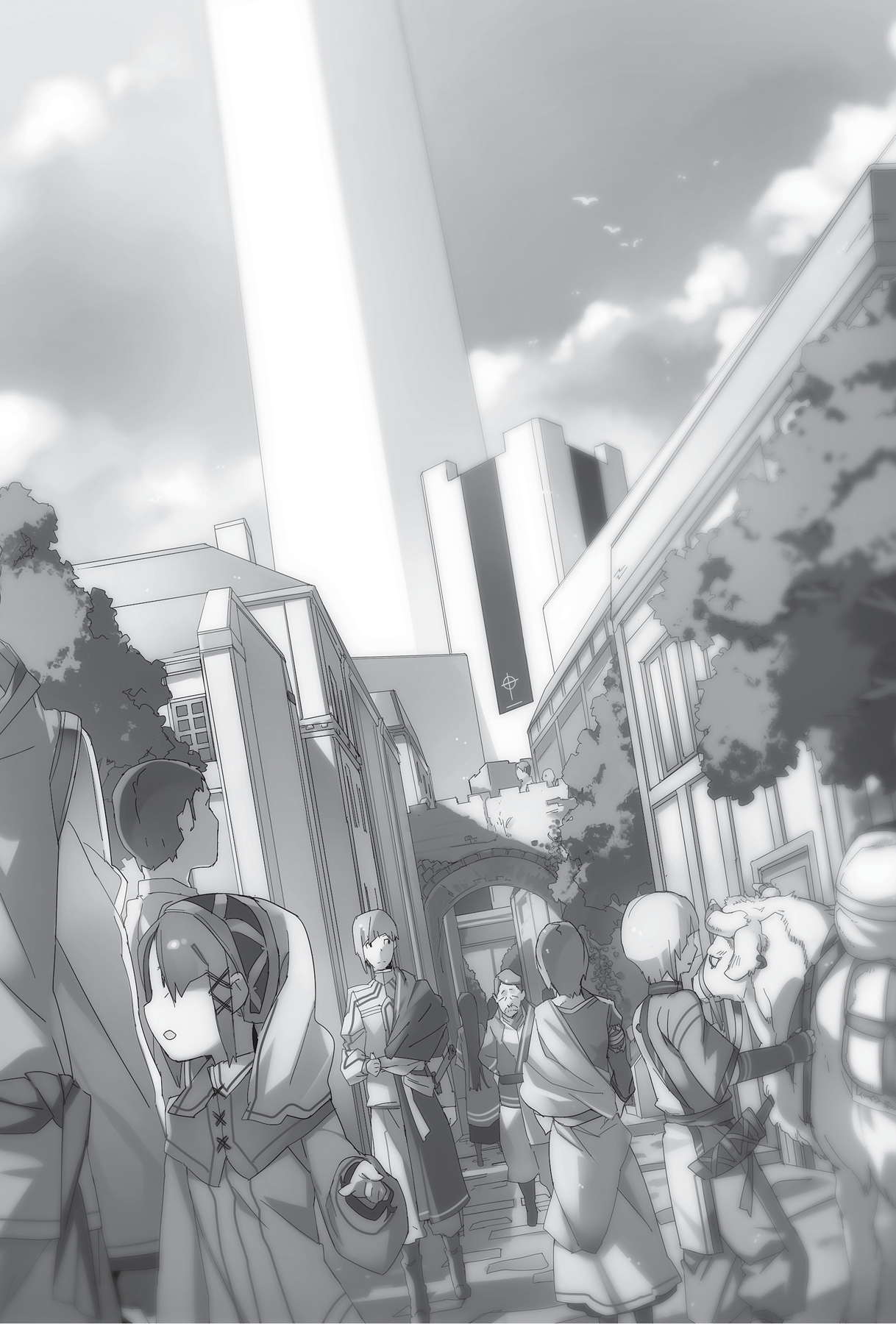
“Centoria…So they’re actually capable of coming up with their own proper names, too? Does the world itself have a name, according to them?” Rinko wondered idly.
Kikuoka looked a bit embarrassed and cleared his throat. “Actually, it does have a name…but it’s not originally from the fluctlights. We had our own project code name for our virtual world, and it seems to have stuck inside the simulation. The name of this realm is the Underworld.”
“Under…world…”
Rinko had already heard this name from Asuna, but she didn’t know it was also used within the world itself. She supposed that Higa and the others had chosen it out of Alice in Wonderland not to refer to a subterranean realm but a world that existed under reality itself. Yet the beautiful city on the monitor looked more like heaven than anything.
Kikuoka seemed to have read her mind. “Yes, this city is beautiful. We, too, are impressed that our humble little wood-built village has led to architecture of this scale and complexity. But if you ask me, this city is too neatly contained. There’s not a single piece of litter on the streets, not a single pickpocket, and most certainly not a single murderer out there. And it’s all because no one dares to violate the extreme laws handed down by that Axiom Church in the distance.”
“And what’s the problem with that?” she asked again, but Kikuoka didn’t respond. He seemed to be searching for the right words. Higa was suspiciously avoiding her gaze. He wasn’t about to speak up.
Asuna, who had been listening all along, eventually broke the silence in Control Room One. The youngest person present said, with cold, quiet precision, “Because that’s not what they want, Dr. Koujiro. The ultimate goal of this massive project isn’t to simply create a high-functioning, bottom-up AI…It’s to create an AI that can kill enemy soldiers in a war.”
“Wha…?”
Rinko, Kikuoka, and Higa were all speechless. Asuna stared at each of them in turn. She continued, “The entire time coming here, I wondered why Mr. Kikuoka—the military Self-Defense Force—would be trying to create an adaptive AI. For a long time, Kirito and I suspected that you were interested in VRMMOs as a means to assist police and military training. So at first, I wondered if the AIs were meant to model enemy soldiers for training purposes. But the more I thought about it, there’s no actual danger in doing VR training exercises, and if you need to emulate real soldiers, just have the trainees work against one another in teams. We’ve done mock battles like that ourselves.”
She paused and looked around at the array of machines and the giant monitor. “And this project is far too huge to be for a training program. At some point, you started thinking about the next phase, Mr. Kikuoka. You started contemplating using a VR-trained AI to fight real wars.”
The military officer’s poker face broke for just a second, betraying a look of shock. Then he smiled. “I was always thinking of that.”
His voice was mild but covering a core of solid steel. “Using VR technology for military training was being tested back in the days of head-mounted displays and motion sensors, well before full-dive tech came along. Some of those artifacts are on display at our Ichigaya R&D facility at this very moment. When the NerveGear was announced five years ago, we and the American military immediately decided to work on a training program for it. But once I witnessed the SAO beta test for myself, I changed my tune. That world held greater possibilities. Something that could change the very concept of war itself. When the SAO Incident arose later that year, I volunteered to join the Ministry of Internal Affairs and take a position on the incident task force so I could monitor the situation directly. It was all to get this project off the ground. And five years later, look how far we’ve come.”
“…”
Rinko had no words. Things were going in a very different direction than what she had anticipated. It was hard even to collect her thoughts into some kind of logical statement.
“I was only in elementary school during the Iraq War, but I remember it well. There was lots of footage of the American military sending in unmanned drones and miniature remote-controlled tanks to attack the enemy. Is that what you’re talking about? Putting AIs into those to create autonomous weapons capable of killing the enemy on their own…?”
“I wasn’t the only one with that idea. This sort of research has been underway in many nations around the world, especially America. I’m sure that the memories are painful to you, Asuna,” Kikuoka said, pausing to make sure that she wasn’t visibly upset, “but I believe you’re aware that when Nobuyuki Sugou had you and other SAO players trapped in that virtual world, he was trying to use his research data as a bargaining chip to sell his efforts to an American company. His contact was with GrowGen Microelectronics, a top company in the VR industry. It goes to show how lucrative the military applications of full-diving are that even a leader in the field would make an illegal deal to get something like that. Like you just mentioned, Dr. Koujiro, unmanned weapons are the top interest of the American military-industrial complex at the moment. Most particularly, UAVs—unmanned air vehicles, or drones.”
Higa considerately switched the monitor over to a new visual. This one was a small aircraft with a long, narrow body and several sets of wings. There were little missile-like tubes under the wings and no windows at all.
“This is an American reconnaissance drone. It doesn’t need a cockpit, so they can shrink it down quite a lot, and they designed the body so that it doesn’t show up on radar for stealth purposes. The previous generation of drones had a pilot watching a monitor at a remote location and controlling it with foot pedals and a joystick. But this one is different.”
The screen shifted again, showing a soldier who was presumably the operator. But he was sunk deep into a reclining chair, his hands resting limply on his legs. On his head was a helmet very familiar to Rinko: a NerveGear. The exterior coloring and fine details of the shell were different, but it was clearly a device of that type.
Next to her, Asuna’s expression was frozen in a wide-eyed stare. Rinko looked back at Kikuoka, and he continued his speech.
“In this state, the operator is inside a virtual cockpit, controlling the craft as though he is actually inside it. This allows him to perform reconnaissance of enemy forces and fire his missiles. The problem is that because our remote control relies on radio signals, it renders us very vulnerable to ECM, or jamming. Over ten years ago, there was an incident where an American spy drone was hit with jamming signals over a country in the Middle East, made a crash landing, and was recovered by the enemy. It nearly sparked another conflict.”
“So you’re going to try AI instead? So the craft can act on its own without human input?” Rinko asked. Kikuoka looked away from the monitor toward her and nodded.
“Ultimately, we want it to be capable of winning a dogfight against a human-piloted jet fighter. I believe that even our current artificial fluctlights, if given a proper training program, are capable of this. But there’s one big problem. How do you teach these bodiless soldiers the concept of war? Murder is fundamentally evil, but in war, the enemy soldiers must be killed. Our current fluctlights are incapable of assimilating that paradox. To them, the law is something that does not allow for the slightest exception.”
He pushed his glasses back up the bridge of his nose again, a crease forming between his brows.
“In order to test the law-abiding nature of the Underworld residents, we gave them a kind of stress test, if you will. We chose one isolated village in the mountains and killed off two-thirds of their crops and livestock. In other words, it would be impossible for the entire village to survive the winter. For the village to last as a whole, they would have to cut off some of their number and distribute the food unfairly—thus defying the rule outlawing murder in the Taboo Index. Instead…they chose to distribute that meager harvest equally among all the villagers, including the elderly and babies. They all starved before the spring. They are fundamentally unable to turn their backs on laws and rules, no matter how unfortunate the outcome. In other words, for them to serve as pilots in their current state, they would need a primary directive that states ‘human beings are meant to be killed.’ And even I can imagine what sort of result that would produce…”
He crossed his muscular arms over his chest and shook his head helplessly. Rinko couldn’t help but envision that outcome. A swarm of drones, looking nothing like traditional aircraft, slaughtering soldiers and civilians alike with missiles and machine guns. She rubbed her prickling forearms.
“…You must be joking. Why would you risk such incredible danger to put AI on a weapon? Why can’t remote control be good enough, even with its limitations? In fact, just the concept of an unmanned weapon is unacceptable to me.”
“I’m not saying I don’t understand your point of view. The first time I saw an American drone tank carrying a large-caliber sniper rifle, I honestly thought it was grotesque. But there’s no fighting it…unmanned weaponry is simply a fact of life in the developed nations,” he said, holding up a finger like a history teacher.
Kikuoka continued, “Let’s take America as an example—the largest military in the world. They suffered four hundred thousand casualties in World War Two. Despite all that death and loss, President Roosevelt enjoyed incredible support from the populace, and he served as the commander in chief for an unprecedented thirteen years in four terms, until he died of a stroke. I hate the phrase the spirit of the times, but let’s be honest: Eighty years ago, the spirit of the times said that any amount of loss was justified as long as the country was victorious.”
A second finger extended from his thick fist.
“Later, in the Vietnam War, there were widespread protests against the war, led by students. While President Johnson was unpopular enough not to seek reelection, there were sixty thousand dead soldiers under his watch. They still sent soldiers off to die in war for the cause of anti-Communism. But under that long, tentative peace of the Cold War, the sentiments of the people began to change…and then that era came to an end with the fall of the Soviet Union. Without the threat of Communism, the only way that America could support its massive military-industrial complex was to find a new enemy to fight: terrorism.”
He held up a third finger.
“But in this battle, there was no flag under which the populace would accept the death of soldiers. The number of American casualties in the Iraq War at the start of this century was just around four thousand, but that number was enough to significantly destabilize the Bush administration. For that reason, among others, he ended his term with the worst historical level of support. You could say it was inevitable that his Republican nominee successor, John McCain, suffered defeat at the hands of the Democrat Barack Obama and his pledge to withdraw forces from Iraq. In other words…”
He lowered his hand, took a breath, and concluded his long lecture.
“It is no longer an era in which it is acceptable for people to fight in wars. But that country cannot stop fighting wars—or, in more accurate terms, it cannot stop allotting an enormous slice of the pie to its defense budget. As a result, future wars will be fought drone versus human or drone versus drone.”
“…I understand the American quandary. Not that I necessarily agree with it,” Rinko admitted. She found the idea of using drone weapons to fight war cleanly to be horrifying. She glared at Kikuoka and pressed him again. “But why is a defense officer of Japan trying to jump into that ridiculous arms race? Or are the Americans leading all this Rath research?”
“Certainly not!” Kikuoka shouted, a rarity for him. But then his smile returned, and he spread his arms theatrically. “If anything, we’re floating out here in the open sea to hide ourselves from the American military. They’ve got perfect tabs on all our bases on the mainland, of course. But as for why I’m going to such lengths to pursue autonomous drone weapons…it’s not an easy thing to explain. Would it be appropriate to say that it would be similar to asking Dr. Kayaba why he created SAO?”
“No, it wouldn’t,” Rinko said brusquely. Kikuoka smirked and shrugged.
“Pardon me. That was insensitive to ask. Let’s see…The biggest reason is that the current foundation of our self-defense capabilities is extremely lacking.”
“Self-defense…foundation?”
“Let’s call it the ability to develop and produce weapons from scratch. In a sense, this is completely natural, as Japan cannot export weapons. And given that any weapons manufacturers can only make deals with the SDF by law, all that development cost has no chance of being recouped. As a result, we either have to import or codevelop with the Americans any cutting-edge tech. But this ‘codevelopment’ is only in name; it’s really a much more one-sided deal.”
He fixed the sleeves of his yukata, crossed his arms, and proceeded bitterly. “For example, we currently use aerial support fighters ‘codeveloped’ with the Americans. But in fact, they kept their secrets close to their chest, took the cutting-edge material we came up with, and ran off with it. The weapons that we buy from them are even worse. We just imported some state-of-the-art fighter jets, and they came with no system control software—the actual brains of the vehicle. The American military thinks we should get their leftovers and be grateful for the scraps. Oops, pardon me…I’m getting sidetracked into my usual griping.”
He smirked again and crossed his legs atop the console desk, dangling his sandals from the ends of his toes.
“A small number of military officers and some younger techs from the smaller defense contractors have been feeling like this is a dangerous state of events. It’s not good for us to rely on the Americans for the core of our defensive capability. That anxiety was the force behind Rath’s founding. We wanted to create a technology that was truly Japan’s. That’s all we really want.”
Rinko wasn’t sure how seriously to take this lofty statement. She gazed at those narrow, shining eyes behind his black-rimmed glasses. But, as usual, they only reflected back at her like mirrors.
Instead, she addressed Higa. “Is your motive for participating in this the same? I had no idea that national defense was such a concern of yours.”
“Well,” Takeru Higa mumbled, scratching his head shyly, “my motive is more personal. I had a friend from a Korean college when I was a student. When he did his mandatory service, he was deployed in Iraq and killed by a suicide bomber. So I thought…if we can’t erase war from the world, maybe we can at least stop people from dying in it…It’s childish reasoning, I know.”
“But your military friend over here thinks that your unmanned weaponry will be for the JSDF only.”
“Well, if we’re being honest, and with all respect to Kiku, technology never stays unique for long. He knows that, too, I suspect. He doesn’t want a monopoly on the tech; he just wants to stay a step ahead…Isn’t that right?”
Kikuoka grimaced yet again; it was a brutally frank assessment. Just then, the beautiful, cold voice of Asuna interrupted the adults.
“And you did not speak a word of these laudable beliefs to Kirito, did you?”
“…What makes you say that?” Kikuoka asked in surprise.
She met his gaze without flinching. “Because if you had, he would not have helped you. Your ideas are completely missing one very important aspect.”
“…Which is?”
“The rights of the AIs.”
Kikuoka raised an eyebrow at that. “Well, you’re correct in that I did not tell him what I just told you, but that’s only because I didn’t have the opportunity. He’s a stone-cold realist, isn’t he? He couldn’t have beaten SAO otherwise.”
“You don’t get it. If Kirito understood the true nature of the Underworld, he would be furious at the developers. To him, reality is wherever he is. He doesn’t think of anything as ‘virtual,’ worlds or lives. That’s how he could beat SAO.”
“You’re right, I don’t get it. Artificial fluctlights have no flesh bodies. If that isn’t virtual life, what is?”
Asuna looked mournful. In fact, she looked pitying.
“Well, this might be pointless, since I doubt you’ll understand anyway…But I’ll tell you that on the fifty-sixth floor of Aincrad, I said something similar to him. There was a boss we just couldn’t beat, so our idea was to use NPCs—AI villagers—as bait. We’d draw the monster into the village and jump on it while it was attacking the villagers. But Kirito was absolutely dead set against it. He said that the NPCs were alive, too, and there had to be another way. The people in my guild laughed at him…but he was right. Even if your artificial fluctlights are all just copies produced en masse on storage media, Kirito would never support your idea of using them as tools of war. Never.”
“Look, I understand what you’re saying. Yes, the artificial fluctlights have the same ability to think that we do. In that sense, they are alive. But this is an issue of weight and priority. To me, the lives of one hundred thousand artificial fluctlights are worth less than a single soldier’s.”
Rinko sensed that there would be no consensus in this debate. The issue of whether or not artificial intelligence had rights could be argued for years after the announcement of a true bottom-up AI, without any definitive answer.
She didn’t even know how she felt about the issue. The rational, scientist side of her said that a copied soul was not a true life. But at the same time, part of her wondered what he would say. The man who had always wished for another place, far, far away, eventually created it and left, never to return…
She had to cut off that line of thought before it threatened to drag her into the past. She had to break the silence.
“Why did you need Kirigaya, anyway? Why him, to the extent that you endangered your most sensitive secrets…?”
“Ah, yes. I started up this long discussion to answer that question. It took so long that I nearly forgot,” Kikuoka said, smiling and clearing his throat to escape Asuna’s magnetic, accusing gaze. “We had our own debates on staff: Are the Underworld residents unable to disobey the Taboo Index because of a structural issue with fluctlights and their lightcube storage, or is it a factor of the growth process? If it’s the former, we’d need to redesign our storage format, but if it’s the latter, we might be able to fix it. So we did a little test. We took a staffer, blocked all of their real human memories, then raised them in the Underworld as a child. That way we could see if they turned out the same as all the artificial fluctlights.”
“And…and was the test subject’s brain unharmed? You’re basically making them relive life from childhood…Wouldn’t they run out of memory space?”
“Not a problem. Remember how I told you that fluctlights can hold about one hundred and fifty years of memories? I don’t know why the margin is so much larger than our life span…but after all, the Bible claims that people in Noah’s era lived for centuries. At any rate, I’m only speaking of raising to the age of ten. That should be an old enough age to see if they can break the Taboo Index or not. Naturally, they exited the STL in the exact state they entered it, since we blocked all those memories upon leaving.”
“And what happened…?”
“We recruited eight test subjects from the staff and had them raised in the Underworld in various environments. To our surprise, all the way until the test ended when they turned ten, not a single one of them broke the Taboo Index. In fact, contrary to expectations, they were all less active on average than the fluctlight children, avoided going outside, and showed an inability to integrate with others. We surmised that this was due to discomfort.”
“Discomfort?”
“Having their original life memories blocked doesn’t mean they’re gone. If that were true, we couldn’t bring them back to real life in the same state. In other words, it’s the instincts and fundamentals of things like body movement, not the knowledge, that prevented the test subjects from feeling at ease in the Underworld. The virtual world might seem real, but it’s still a product of The Seed. If you dove in, you’d see that the sensations are just slightly different from those in real life. It’s the same kind of slight, alienating discomfort I felt the first time I tried on a NerveGear for the SAO beta test.”
“It’s the sense of gravity,” Asuna said.
“Gravity…?”
“The research on our sense of gravity and balance lags behind our understanding of visual and audio sensory signals. Most of our visual signals are complemented by the brain’s sense of gravity, which is why people who aren’t used to it have trouble moving.”
“Exactly. It’s getting used to it,” Kikuoka noted, snapping his fingers. “We did all those tests until we finally realized that what we needed were test subjects accustomed to the virtual environment. Experience not in terms of weeks or months but years. You understand now? I needed the help of the person with the most virtual experience in all of—”
“Hang on,” Asuna interrupted, her voice hard. “Was that the three-day continuous dive Kirito was talking about? But he said the maximum acceleration rate of the FLA was three, so it was no more than ten days on the inside. Did you lie to him? Was it really ten years…?”
Kikuoka and Higa wilted guiltily under her fierce gaze.
“I’m sorry; that was a mistake of the Roppongi branch. I ordered them to keep the acceleration rate completely under wraps…”
“That makes it even worse! You got ten years of Kirito’s soul for your own purposes—if you fail to recuperate him, I will never forgive you for what you’ve done.”
“This is not an excuse, but both Higa and I have already dedicated over twenty years to the experiment. But the ten years we got from Kirito provided us with results far, far greater than the sum of all our staff fluctlights together.”
“Meaning that as he grew inside the Underworld, he took actions that defied the Taboo Index?” Rinko asked despite herself. Kikuoka grinned.
“Technically, he did not. But ultimately, the result was much greater than we had hoped for. From a young age, Kirito displayed a boundless curiosity and agency not seen in the other test subjects and was punished on many occasions for very nearly breaking the Taboo Index’s laws. Of course, this is not entirely a thing to celebrate, as his success would have indicated a structural flaw in our artificial fluctlights. Still, we watched him closely. At around seven years of internal time…Higa here noticed something quite fascinating.”
Kikuoka paused there, allowing Higa to take over the story. “Yup! I was originally against putting Kirigaya into the experiment for both ethical and security reasons, but when I saw what happened, I had to be impressed with Kiku’s insight into the kid. We assign numerical weights to the individual laws within the Taboo Index and measure the numbers of each individual according to how close they get to a brush with the law. It turned out that a fluctlight boy and girl who were particularly close to Kirigaya—or Kirito, as he was known in the test—also saw their numbers explode.”
“Huh? Meaning…?”
“Meaning that despite his own memories and personality from the real world being blocked off, Kirito exhibited a strong influence on the actions of the artificial fluctlights around him. Or, if you want to be more frank, his boisterous nature rubbed off on the other kids.”
Rinko noticed a small grin tug at Asuna’s mouth. She must have been able to picture it for herself.
“We still haven’t actually figured out the reason the artificial fluctlights don’t ever break their rules,” Higa continued, “and it’s probably something to do with the structure of the lightcubes we store them in. But we don’t consider identifying that our top priority anymore. We don’t need to solve the problem; we just need to find an exception. If we can produce a single true adaptive AI that has integrated the concept of priority rankings, we can just reproduce that instance to achieve some measure of success in our experiment.”
“I’m not a fan of that way of thinking. But it’s true that most breakthroughs happen through methods like that,” Rinko had to admit. “And did you get that exception?”
“We did have it in our hands once. Just before the end of the experiment, the girl who Kirito was closest to actually did break a taboo. And it was a serious one—access to a restricted address. According to the log, she witnessed another artificial fluctlight die within that restricted area; I’m guessing she thought she could save it. Do you understand? She put another person’s life over the Taboo Index. That’s the adaptive ability we’re looking for. Of course, it’s ironic that this particular action was our breakthrough, given that we’re hoping to develop them into military tools.”
“…You said, ‘We had it in our hands,’ though.”
“Er, right. It’s kind of embarrassing to admit…but that little gem slipped right through our fingers…”
Higa slumped his shoulders, shook his head. “Like we said earlier, the Underworld simulation happens at a thousand times the speed of the real world. It’s pretty much impossible to monitor that in real time, so our process basically works by slowing down already recorded events so that multiple operators can examine them. Inevitably, there’s a major lag from us to the internal time. When we spotted that the girl had violated the Taboo Index, we paused the server and tried to physically eject the lightcube storing her fluctlight…but two days had already passed in internal time by then. To our amazement, in those two days, the Axiom Church had already taken her to the central city and performed a corrective measure on her fluctlight.”
“C-corrective? You gave your experiment subjects the ability to do that?”
“Of course not. Or…we thought not. For the sake of maintaining order, we designated all the Underworld residents with certain authority levels. The individuals with higher levels have the ability to perform certain system commands in the form of ‘sacred arts.’ But even the high priests of the Axiom Church, who have the highest authority levels of all, can do little more than manipulate the length of a life span. Somehow, they found some kind of loophole in the system…Actually, I can show you the recorded data we have. Here’s Alice’s past and present taboo violation numbers.”
“Alice…?” whispered Asuna. Her head shot up. Rinko had heard about the significance of that name, too. It was the code name for the bottom-up AI that Kikuoka and Higa were trying to create.
Kikuoka nodded, recognizing the reactions of the two women.
“That’s right. Alice is the name of the girl who spent all her time with Kirito and another boy in the simulation. Nearly all of the Underworld residents’ names are odd and seemingly random syllables. So when we found out that the girl’s name just happened to be Alice, the coincidence was stunning. After all, it’s the name of the very concept that was the foundation for Rath and everything we are doing in this experiment.”
“Concept…?”
“Our highly adaptive and autonomous artificial intelligence. Artificial Labile Intelligent Cybernetic Existence. Or in acronym form, ALICE. Our ultimate goal is to turn the clouds of photons trapped in those lightcubes into a single Alice. In other words, to Alice-ize them.”
Lieutenant Colonel Seijirou Kikuoka had revealed his deepest secret, yet that strange smile of his still harbored mystery.
“Welcome…to Project Alicization.”