Chapter 3
3
The space beyond was much larger and deeper than I had expected.
“Aaaah!”
I wailed as I suddenly did three forward flips through empty air, then landed on my back on a fairly resilient surface. My body bounced, and I landed on my butt a second time.
A moment later, Eugeo landed next to me in a similar manner. We both shook our heads to clear the internal cobwebs, and once my sense of equilibrium had returned, I looked at our surroundings.
“…Huh?” Eugeo mumbled. I couldn’t blame him. We’d just leaped through a gate in the middle of the rose garden, so we should have still been in the garden on the other side of it.
But now we were sitting in a hallway, with aged-wood walls, ceiling, and floor. The bounciness of my landing was thanks to the wood. If I’d landed on the paving stones of the garden, I would have lost some life on impact.
The corridor continued a fair ways onward, with a warm orange light flickering at the far end. Even the air had turned from the chilly, damp night to the dry tang of aging paper.
Where are we? I wondered. Then I heard the sound of clinking metal from behind me, far above. I turned around to see a very steep staircase right behind us and, near the top, a small door and smaller person.
I wearily climbed to my feet, the pain in my whipped chest and pierced foot briefly forgotten as I carefully ascended the wooden stairs. The door up there had been bronze fence when we passed through it, but now it was the same wooden material as the rest of the hall. Except that, unlike the antique style of the wood in the hallway, the door itself stood out as looking completely fresh and new.
Once I was three steps from the top, the figure facing the door held out a hand and stopped me. There was a very large cast-iron key ring in her hand, which she had apparently just removed from the door’s lock. That clink of metal had been her locking the door, then.
“…Excuse me…”
Where are we? Who are you? I was going to ask, when I noticed a sound. Just beyond the closed door, I heard what made me think of a small, tough creature scratching and scuttling back and forth. I felt the hair on my forearms stand.
“…We’ve been detected. So much for this back door,” the mysterious person muttered, and waved me off again. I had to give up on my questions and descend the stairs again. When I returned to stand next to Eugeo, the person was just coming down behind me.
There were no lights in the hallway, nothing but the faint illumination seeping through from the far end of the hall, so I could make out only a silhouette. She had on a large, bulky hat and a robe like the sort a magician would wear draped around her small body. The keys were in her right hand and a staff taller than she in the left.
That magic staff swung forward, pushing us onward.
“Go on, get down there! Gotta delete this entire hallway now.”
The voice was still unmistakably that of a young girl, but for some reason, there was an authority even greater than Miss Azurica’s there, and we found ourselves marching quickly toward the light without an argument. At the end of the short hallway, we found ourselves in an extremely strange space.
It was an enormous square chamber, with a number of wall sconces providing warm-toned light. There were no other fixtures but a thick wooden door on the far wall, straight ahead.
On the other three walls were a dozen or more hallways, just like the one we came from. I peered down the one next to ours and saw a dead end, stairs, and a little door.
While Eugeo and I looked around curiously, the robed girl followed us out of the hall, then turned back to face it and raised her staff.
“Hoy!”
She swung the staff with a cute little shout that also sounded like something an old man would say. Nothing should have surprised us at this point, but each successive phenomenon left us stunned. From the far end of the tunnel, the boards on the side walls yanked free one after the other, reassembling as the ground rumbled.
Within a few seconds, the thirty-foot hallway was completely covered, and when the last boards finished placing themselves, it was just a smooth wall. There wasn’t a single bit of evidence that there had ever been a hallway behind it.
For sacred arts, this was quite an elaborate, advanced spell. To manipulate a volume of objects that high, you’d need a very long chant and very high System Access Authority. And yet, this strange little girl did all that with a simple “Hoy!” She hadn’t even announced a system call first. At the academy, they taught us that every single sacred art required that to initiate.
“Hmph,” she snorted, tapping the base of the staff into the ground matter-of-factly, then turning to us at last.
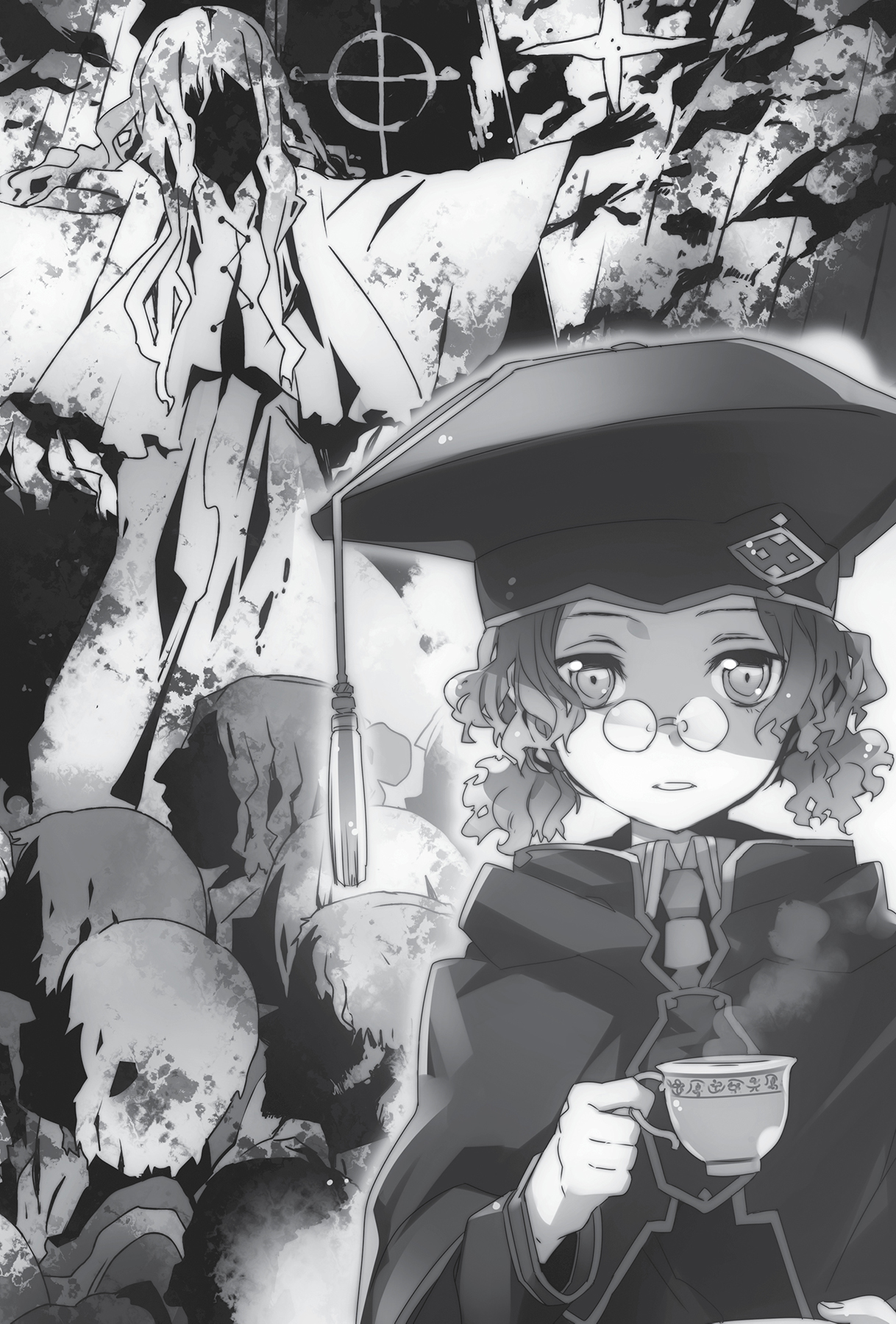
Seen in proper light, she was as cute as a little doll. The black robe shone like velvet and the large hat made of the same material made her look more like an elderly scholar than a magician, but the chestnut-brown curls of hair and milk-white skin under the brim of her hat were youthful.
Most striking of all were her eyes. Behind the round glasses perched on her nose and framed by her long eyelashes were brown eyes the same color as her hair and somehow full of an overwhelming intelligence and wisdom. Looking into them, I felt like I was gazing into an unfathomable depth. There was no way to tell what she was thinking.
But whoever she was, she’d saved us from the Integrity Knight’s attack, so I bowed my head to her. “Um…thank you for rescuing us.”
“Don’t know if it was worth the trouble yet,” she muttered, all business. Based on ample experience over our travels, Eugeo was the better choice to negotiate with strangers, so I elbowed him and motioned up front.
He obediently stepped forward and bowed, hair still dripping, and said, “Um…it’s nice to meet you. I’m Eugeo, and this is Kirito. Thank you so much for saving us. Um, do you…live here?”
He was clearly disoriented as well. The girl looked annoyed and pushed her glasses up the bridge of her nose. “Of course I don’t live here…Come.”
She cracked the staff against the stone, then started walking toward the large door on the far wall. We hurried after her, watched as she waved the staff to remotely open the door—and received yet another shock.
When we passed through the door after her and found ourselves in another mysterious new space, all we could do was stare.
It was a stunning sight. The only way to describe it in one phrase was “a gigantic library.”
A world of infinite shelves and books. It was circular as a whole but with numerous staircases and walkways along the walls, which were lined on one or both sides with massive bookshelves. The span from the floor to the ceiling over the maze of shelves was tall enough to fit a ten-story building inside. I couldn’t even imagine the total number of books contained in all these shelves.
There was no way a structure large enough to house this library could be in the rose garden. I gazed up at the gloomy ceiling far above and asked, “Is…is this inside the Central Cathedral?”
“You could say that. And you could say it’s not,” the girl said. I thought I detected a note of satisfaction in her voice. “Because I removed its original door, this great library exists within the cathedral, but none can enter—without my invitation.”
“Great…library…?” Eugeo mumbled, looking around in disbelief.
“Aye. This library contains all historical records dating back to the creation of this world, the formulas that govern its every working function, and all the system commands that you call sacred arts.”
…System commands?!
I couldn’t believe the words I was hearing at first. I stared at the girl, and through half-open lips, I heard my own voice say, “Wh-who…are…you?”
She looked at me, clearly understanding the shock I had received and the reason for it, and introduced herself.
“My name is Cardinal. I was once the coordinator of this world, but now I am merely the sole librarian of this facility.”
Cardinal.
To me, that word held three meanings.
First was the senior rank in the Catholic Church of the real world.
Second was the name of a bird, so named because its plumage was the same vivid red as the robes worn by the aforementioned priests.
And third was from “Cardinal System,” the highly advanced autonomous program that Akihiko Kayaba developed to run his VRMMO game. The original version was utilized in SAO, where it held the players in the palm of its hand, fine-tuning the economy, items, and monster generation to exacting effect.
After we beat SAO, Kayaba fried his brain by scanning it with a prototype STL, but before doing so, he created a bite-size version of the Cardinal System and included it in a suite of VRMMO development tools called The Seed.
The thought-simulation program Kayaba left behind in cyberspace helped The Seed spread throughout the Net, where it controlled many other games such as Gun Gale Online. I had a part in The Seed’s free distribution, and for a long time, I’d wondered what Kayaba’s true goals were, but I had never come to a satisfying answer. Knowing him, there was no way he’d release his dev kit for free just to absolve his sins in creating the SAO Incident…
That all aside, could this girl here be a personification of that very same Cardinal System?
It was possible, of course, that within the Axiom Church there was a senior rank that they named after the real-life cardinal. But she mentioned that she was once the “coordinator” of the world. Not the leader, not the ruler: Cardinal the Coordinator.
But why would the Cardinal System be here? Was the Underworld built using The Seed? And if that were the case, why would the coordination system, the “invisible hand of God,” take human form? Unlike with Yui, the counseling program, the Cardinal System wasn’t supposed to be able to talk with players, I thought.
I was totally paralyzed with questions, and Eugeo seemed fairly stunned himself. He managed to mumble, “All…of history…? You mean an entire chronology from the founding of the four empires to now? Here…?”
“And not only that. There’s even a record of the Creation, when Stacia and Vecta split the world between the human empire and the Dark Territory.”
He swayed back and forth, looking ready to pass out—Eugeo was a history buff. The mysterious girl named Cardinal pushed her glasses up again and grinned mischievously. “What do you say? My stories can run a lil’ long, so why don’t you have a meal and a rest first? If you want to read, all the books are open to you. However many you want, for as long as you want.”
She swung her staff with another “Hoy!” and a small, round table simply pushed its way up out of the floor next to her. It was piled high with steaming food—sandwiches, meat buns, sausages, fried pastries.
The sight prompted immediate pangs in my stomach after a night of sipping water and nibbling on hard bread, but Eugeo seemed to feel guilty about chowing down and reading books while we were on our mission to rescue Alice. He looked to me with misgivings plain on his face, so I had to shrug and explain. “We had enough trouble against Eldrie, and there’s no way we can push through against an archer knight on his dragon. Let’s rest, recuperate, and work on a new plan. It seems safe here, and we’ve lost a lot of life already.”
“Indeed. I’ve placed a charm so that if you eat, your wounds will heal. But first, hold out your right hands,” the girl commanded. We did as she said, holding out the arms that still bore the shackles. With two waves of her staff, the heavy rings split apart and fell to the floor.
We rubbed our bare wrists, freed for the first time in two days. Eugeo still looked conflicted, but then he scrunched up his face and sneezed. He’d fallen headfirst into the fountain during the fight with Eldrie and was still soaking wet. If we didn’t get that addressed, he’d wind up with a “Head Cold” negative status effect.
“You seem like you could use a good warm-up before you eat,” the girl said. “At the end of that hall there, you’ll find a small bath. You can eat and read after that.”
I didn’t think we were going to end up sleeping here, but Eugeo did at least seem to accept her offer.
“…Thank you. I’ll do that, C-Cardinal. Um, and…where would that record of the Creation be?”
Cardinal lifted her staff and pointed toward a particularly large cluster of shelves situated quite high up in the library.
“From that staircase upward is the history wing.”
“Thank you! Well…I’ll be off now.”
He bowed again, sneezed again, then disappeared down the narrow path between the bookcases. Cardinal watched him go, then muttered, “Sadly, the record of Creation here is an artificial one, dictated by the Axiom Church’s pontifex to a scribe.”
I leaned over toward the girl’s hat and asked quietly, “So…are the gods of this world a fiction? No Stacia, no Solus, no Terraria…no Vecta?”
“None,” Cardinal said simply. “The religious myths the people of the Underworld believe are merely stories spread by the Church to maintain its stranglehold. The gods’ names are registered as supervisor accounts in case of emergencies, but the people outside have never once logged in using them.”
That answer cleared up a portion of my questions, at least. I stared into those burnt-brown eyes and said, “You’re not an Underworldian, though. You’re more like an outsider…like the system admins.”
“Indeed. And so are you, Kirito the Unregistered.”
“…Yeah. So am I.”
At long last, after two years and two months, I had unshakable certainty that this was not some alternate dimension but a virtual world created by human beings in base reality. I felt a powerful sensation rising, taking me by surprise. I sucked in a deep breath and exhaled. There were so many things to ask that I didn’t know where to start. But there was one thing I had to confirm.
“The name of the ones who created the Underworld is Rath, R-A-T-H. Correct?”
“Indeed.”
“And you are the Cardinal System, the autonomous program that operates and manages the virtual world.”
As soon as I said this, the girl’s eyes widened. “Ahh, you know about me? Have you interacted with my kind on the other side?”
“…Er, sure.”
Interaction didn’t cover the half of it. I spent two years in Aincrad fighting for my life, and the greatest enemy of all, in a way, was the Cardinal System. I didn’t think that would make much sense to her, though.
“But…as far as I knew, the Cardinal System never had a personified interface like you. So…what does that make you? What do you do here?”
Cardinal smiled faintly at the succession of questions. She pushed a curly lock of hair from her forehead back under her cap and, in that strange voice that was both young and old, said, “It will be…a very, very long story. Why did I isolate myself in this library…? Why did I wait to make contact with you…? It is a very long story indeed…”
She paused, appearing to lose herself in reminiscence, then looked up. “I can sum it up as quickly as I can. But first, eat. Your wounds must be plaguing you.”
The succession of wild experiences had pushed the pain to the back of my mind, but as soon as she pointed it out, I felt an instant throb in my chest where Eldrie had whipped me and in my right foot where the knight had shot me.
On her instructions, I grabbed a piping-hot steamed bun from the table and took a hearty bite. The meat was every bit as delicious as the stuff in the buns I slipped out of school to buy from Gottoro’s in town. Enraptured, I continued stuffing it into my face. Whatever commands she had put on the food, each bite caused the pain to dim and the wounds to close up and heal.
“Just like a true admin…you can adjust the food settings to anything you want,” I marveled.
Cardinal snorted and said, “Two mistakes. I’m not an administrator. And I can only manipulate objects within this library.”
She turned away and started walking down the aisle along the curved wall. I picked up all the buns and sandwiches I could carry and cast a glance at the hallway toward the bath. He’d need a good long soak to avoid getting a cold, so Eugeo wouldn’t be emerging anytime soon…
“…Hmm? Wait…if you can heal wounds with food, shouldn’t it protect against sickness, too?” I pointed out. Cardinal looked back and grinned. Apparently the bath was just an excuse to get Eugeo away from us.
I followed the scheming sage down the library path, through fork after fork, ascending and descending, until I no longer had any idea where in the library we were. Just as I was finishing up my meal of magical food—eating while walking, a major breach of etiquette—we came to a circular space surrounded entirely by shelves. There was a table in the middle and two old-fashioned chairs.
Cardinal plopped herself down on one of the chairs and pointed at the other with her staff. I obediently sat down.
Instantly, there were two cups of tea on the tabletop. Cardinal lifted her mug, took a sip, and said, “Have you ever wondered why it is that this peaceful, artificial world contains a feudal system?”
It took me a few seconds to remember the unfamiliar word. Feudalism—the social system whereby local landowners were effectively nobles who had complete control over their territory. It was the system of the Middle Ages, with emperors, kings, barons, dukes, and the like, and so common in fantasy-themed books and games that the few exceptions were notable in their own right.
The Underworld fit right into that medieval European mold, so it seemed perfectly natural to me that it had its own nobles and emperors and such. Cardinal’s question took me by surprise.
“Uh…why…? Isn’t it because the realm’s designers set it up that way?”
“Not so,” Cardinal said, her mouth upturned with the anticipation that I would have responded that way. “The outside people who created this world merely set down the vessel. The social structure you see here was created entirely by the Underworldians who live here.”
“I see…”
It made sense that we were excluding Eugeo from this conversation. At last, I recalled one of the first things I wanted to clear up with her. She’d demonstrated familiarity with Rath. So did that mean…?
“H-hang on. Can you make contact with the real world? Is there some method of relaying information?” I asked with excitement.
She looked annoyed. “Fool. If I could do that, I wouldn’t have locked myself up in this dusty place for centuries. The only one who can do that…is the pontifex.”
“Oh…I see…”
That made me even more curious about the figure in question, but I set that aside and clung to my one ray of hope. “Then, can you tell what date it is in the real world…or where my physical body is located, or—”
“I’m afraid I can’t access the system domain now. Even my ability to browse the data register is meager. Compared to the Cardinal you knew on the other side, I am a helpless creation,” she said bashfully, making a disappointed face that suited her apparent age. I almost began to feel a bit sorry for her.
“No,” I said, shaking my head, “it’s a huge help that you even know about the real world at all. Sorry to have derailed your explanation…you were talking about feudalism.” I gave the topic a bit of thought and guessed, “Does it have something to do with…needing a manager in place to maintain security or distribute goods?”
“But as you know by now, the people of this world do not disobey the law as a fundamental rule. They do not harm others, steal, or monopolize harvests. But if their diligence and fairness were enforced by nature, you would assume they’d form a more effective social development, like communism. Do you think such people, in a world of barely a hundred thousand, really need four emperors and various ranks of nobles numbering over a thousand?”
“A hundred…”
I hadn’t heard the total population of the Underworld yet. Cardinal said “barely,” but I was stunned at the total. This wasn’t artificial-intelligence research, it was a full-scale simulation of an entire civilization.
But as she said, each emperor ruling over twenty-five thousand subjects seemed quite small when compared to the Roman Empire or the Frankish Kingdom. It didn’t seem like a feudalism that arose out of need but one built to mimic the real-life example.
As I pored this over, Cardinal again offered some fundamental truths.
“Earlier I said that there were no gods in this world. But in the age of Creation—four hundred and fifty years ago—there were those who resembled that title. Four ‘gods’…back when Centoria was just a tiny village.”
“Four hundred and fifty? Not three hundred and eighty? I mean, it’s the year—” I started to say, but she shrugged in exasperation.
“What did I tell you? The Church invented the creation myth. The genesis of the current calendar was arbitrarily decided afterward.”
“Uh…Oh. So, four gods, you said? Those were humans…staffers of Rath who built this world, right?”
This time, Cardinal grinned, telling me that I was on the right track. “So you can deduce that much?”
“In this world, the chicken would have come before the egg. Someone had to raise the first artificial fluctlights from babies. Otherwise it wouldn’t make sense that all these people are speaking and writing in Japanese.”
“Very wisely argued. You are indeed correct. In the beginning, when I was still a manager without sentience, four outsiders descended upon this land, separated into two farms, and raised eight children each. They taught them how to read and write, to raise crops, to tend to livestock…even the moral arguments of good and evil that anchored the Taboo Index later on.”
“So they really were gods. That’s a lot of responsibility…even a single offhand comment could end up having a huge impact on the outcome of the entire society.”
Cardinal nodded gravely. “Indeed. It was only after I was imprisoned inside this library that I was able to collect these thoughts and come to one conclusion—why does this world feature an unnecessary feudalism? Why does it have such an extreme legal system, and why do some nobles sneak through its cracks for their own profit and pleasure? There could be only one answer.”
She pushed up her round little glasses and intoned, “Given that the Four Progenitors succeeded at their extremely difficult task, it is clear that they possessed the highest intelligence that a human being can have. And given the moral sense of good they instilled in the Underworldians, their good moral character is apparent as well—except that this did not apply to all four of them.”
“…What…?”
“While all four were brilliant, one of them was not possessed of a good heart. And that one was the source of pollution that infected one or two of those first children. I doubt that it was by design…but one’s nature cannot be hidden. That source introduced self-interested desires, like possessiveness and dominance. And that child, or children, became the founder of what developed into the nobles, emperors, and high priests of the Axiom Church that control this world now…”
Not possessed…of a good heart?
So that evilness that dwelt in a certain subsection of nobles originally came from one of the core members of Rath? And the evil was passed down mentally, until it ultimately resulted in people like Raios Antinous and Humbert Zizek today?
I suddenly felt my senses grow distant and cold. In the real world, my unconscious body was connected to an STL in Rath’s headquarters, wherever that was. The thought that right near me was the person responsible for Raios gave me the chills.
Was it someone I knew? I tried to remember the faces of the Rath staffers, but the only ones that appeared immediately were Takeru Higa, the chief researcher, and the mysterious public servant Seijirou Kikuoka, who got me in with Rath. There were other employees at the branch office in Roppongi, of course, but my memory of their names and faces was vague. In my perceived time, that little job for Rath was over two years ago.
The question was, did this just happen to be a person who was greedy and self-interested, or was it someone who infiltrated Rath with sinister designs? Someone stealing secrets, selling them…possibly destroying them?
“Cardinal…do you know the names of these Four Progenitors?” I asked. She shook her head sadly.
“I would need access to the entire system domain to know that.”
“Oh…sorry. I don’t mean to keep asking you the same things.”
It wasn’t like knowing the names was going to help me now. It merely made the need to create contact with the other side that much more crucial. I leaned back against the chair, sipped the sweet-smelling tea, and changed the subject.
“I see…So if a small subset of Underworldians possesses this sense of dominance, then it’s a natural evolution that they would develop into a privileged class. They’re like lions among a herd of gazelles.”
“And like a virus that cannot be deleted. In this world, children do not just inherit physical appearance but mentality as well. Among the lower nobles, where marriage with commoners happens more often, that self-interest seems much weaker…”
Her words put me in mind of Ronie and Tiese, sixth-rank nobles who possessed a very respectable sense of justice and benevolence.
“Meaning…that if the nobles marry among one another, their self-interest is preserved?”
“Quite. The four imperial dynasties and the Church’s high priests are the backbone of this. And standing atop them all is the ultimate ruler of the human empire…the Axiom Church’s pontifex, and now a system administrator. In fact, she has taken that haughty title for her own name: Administrator.”
“Adminis…trator,” I muttered, repeating the English term. Now that she said it, I recalled Eldrie babbling that name when his forehead starting glowing. So that meant the target of the Integrity Knights’ fealty was the Administrator Pontifex…
That was when I stumbled over another very important bit of information in Cardinal’s statement. “Wait…did you say she? This…pontifex?”
Ever since I became familiar with it, I had just assumed that the leader of the Axiom Church would be an elderly man, but it seemed I was wrong.
Cardinal nodded and scowled like never before. “Exactly. And worst of all…you might say she is my twin sister.”
“Wh-what do you mean?” I asked, unable to parse the logic of that, but the sage in the guise of a young girl did not answer quickly. She looked at her own pale, fragile hand in apparent disgust, and only then opened her mouth to speak.
“I will tell you in order…About three hundred and fifty years ago, the Axiom Church was founded to serve as the supreme controlling structure of society. In other words, about a hundred years after the simulation actually began. At the time, all humans married around age twenty and had an average of five children, so the population was over six hundred in the fifth generation alone, and near a thousand if you counted their parents and grandparents…”
“H-hang on. How do marriage and childbirth even work in this world?” I asked, unable to resist getting answers to questions I’d had for two whole years, and then panicked when the question seemed a bit inappropriate for a girl of around ten—regardless of who she was on the inside.
But Cardinal didn’t bat an eye. She said, “I do not know the breeding habits of real-world human beings, so I cannot say for certain, but I believe that the act itself is largely based on the real thing, given the fundamental structure of the fluctlight. When a man and woman registered as spouses by the system—and they alone—commit the act, there is a certain probability that the woman will become with child. In more direct terms, a new fluctlight prototype is loaded into an empty cube in the Lightcube Cluster, synthesized between his parents’ physical attributes and mental/personality patterns, and then activated as a newborn baby.”
“Ah, I see…And what’s this marriage registration?”
“Just a simple system command, delivered as an oath of marriage dedicated to Stacia. The village elder did it in the early days, but once churches started popping up around the place, the monks and nuns would officiate.”
“Ahhh…Oops, sorry to interrupt again. Please continue,” I prompted. She nodded and went on.
“Several decades after the Four Progenitors logged out, there were a thousand residents, already ruled by a number of lords. Those few who had received the weapon of self-interest grew their territory as far as they could, and when the young people nearby could not manage their own fields anymore, they were put to use as serfs. Some resisted the yoke and chose to leave the center of the map for new frontiers.”
“Okay, so those were the people who ended up starting rural towns like Zakkaria and Rulid.”
“Precisely. The lords in control of the center were antagonistic to one another, of course, so they did not join their houses in marriage for quite a while. Eventually, two lords conspired to wed their families together…and produced a child. She was as cute as an angel and possessed the greatest self-interest of any fluctlight created in the Underworld…They called her Quinella.”
Cardinal stared out into space, her eyes glimmering as though traveling the long-distant past.
The lamps placed between the bookshelves surrounding this little room cast complex shadows on her white cheeks. You could have heard a pin drop in the silence. When she spoke again, her voice was calm but had a note of melancholy.
“In Centoria at the time—which had grown into a full town, not just a village—it was one of the lords, Quinella’s father, who assigned children their callings. By the time she turned ten, she showed great talent for the sword, sacred arts, singing, weaving, and every other activity, so everyone assumed that she could shine at any calling he might give her. But because of that, Quinella’s father decided he didn’t want to send his precious daughter out to work…”
A pitying smile crept over her features. “It was a foolish fixation. In order to keep Quinella close to him, he gave his daughter a calling that had never existed before: training in sacred arts. In a room in the back of their mansion, Quinella used all her wits to analyze the sacred arts—which are really system commands. Before then, the Underworldians knew only the most basic of commands, and none even bothered to question the meaning of the words themselves. They hadn’t needed to, in order to live their lives.”
Thinking back to my time in Rulid Village, the most that Eugeo and the other villagers did was open Stacia Windows to check remaining life.
“But with tremendous patience and observation for a child her age, Quinella continued to analyze the command words—strange, otherworldly terms from a language not their own, like generate and element and object. Finally, she succeeded in creating her own art based on a few basic commands: Thermal Arrow. From the system commands that were merely tools to assist one’s living, she had created an attack spell that would harm the life of its target…Kirito.”
The sound of my name snapped me out of my reverie. I looked back at her.
“Do you know why your sacred arts usage level—your System Access Authority—rose so abruptly before?”
“Yeah. Well, I think so. It was because we beat those monsters…the goblin pack in the cave.”
“Precisely. This world was originally designed for the residents to fight invading enemies from outside and increase in strength. That will become necessary during the ‘stress test stage’…But at any rate, to raise one’s authority level requires defeating an invader or simple repetition of commands. At the mere age of eleven, Quinella discovered how to do that all on her own. She went into the woods near her home and used that Thermal Arrow on the harmless golden flying foxes…”
“Meaning…that the target you can defeat to raise your authority isn’t just limited to invaders like monsters from the Dark Territory…?”
“Aye. In other words, the accumulation of experience points occurs when any moving unit is destroyed, including humans. Of course, humans do not kill humans in this world, and almost no human would kill a harmless animal—but those with a high amount of noble genes are a different story. They hunt for sport and, without realizing it, increase their authority level…and it was eleven-year-old Quinella who did this while knowing her own intentions.”
Cardinal paused there and quietly put the cup to her lips. She pulled it away and cradled it in her hands before continuing.
“When she realized that she could raise her sacred arts usage level by killing animals, she started sneaking into the forest at night to kill without alerting her family or the villagers. As the process in charge of world balance at the time, if I’d been conscious, Quinella’s actions would have terrified me. Without emotion…or perhaps with a kind of joy, she cleaned out all the wild animal units around Centoria in a single night. As the system ordained, the depleted unit numbers were replenished…and then she repeated the act the next night…”
To a VRMMO gamer like me, that was a totally ordinary action. In the SAO days, I did that very thing myself, hunting for days at a time for the sole purpose of increasing my own stats. It was the entire point of an MMO.
But hearing the words from Cardinal made a cold sweat run down my back. A young girl in pajamas, prowling the forest at night and burning any animal she found, without emotion. If anything, that was the image of a nightmare.
As though resonating with my own fear, Cardinal’s hands squeezed the cup tighter.
“Quinella’s authority level rose without end. Her decoding of commands proceeded until she could use arts that the people of the time would have considered miracles, like life regeneration and weather prediction. Her father and the other residents of Centoria called her the child of God and began to worship her. At age thirteen, her beauty had indeed become divine. Behind her gentle smile, Quinella sensed that the time had come to satisfy her bottomless lust for power. She wanted not the power of land possession like the feudal lords, nor the strength of the warriors and their swords…but a more absolute form of power…using the name of God…”
For a brief moment, Cardinal looked up to the dome of the Great Library, hanging far overhead, or perhaps to the real world beyond even that.
“It was the greatest mistake of those who built this world that they described the mysterious powers of its system commands through the concept of God. In my mind…the existence of God is an irresistible ambrosia to the human mind. It can heal all ills and permit all cruelties. Fortunately, as I do not possess emotions, I cannot hear His voice…”
Her burnt-brown eyes looked down on the teacup, and she tapped its ceramic rim with a finger. More hot liquid began to fill in from the base, until the empty cup was full of fresh tea again.
“You need not be a blind believer when miracles are performed before your eyes and explained as the work of a god. Men injured on the farm, healed in a snap. Storms foretold three days before their arrival. No one doubted Quinella’s word ever again. She told the lords working under her father that they needed a place of worship, to call forth ever greater miracles. Very soon, they had built a marble tower in the middle of the village. It was narrow back then, and only three stories tall…but that was the foundation of this very Central Cathedral and the founding of the Axiom Church’s three hundred and fifty years of history.”
The story of this ancient saint, Quinella, put me in mind of a different person. I’d never known her myself, only through Eugeo’s and Selka’s stories—but the girl Cardinal described sounded a lot like the girl with the talent for sacred arts at a young age, tasked with being an apprentice sister at the church: Alice Zuberg.
But Eugeo claimed that when she was in Rulid, Alice was kind and warm to everyone. And she was Selka’s sister, too. I couldn’t imagine such a person would sneak out at night to lay waste to wild animals.
So how had Alice increased her System Access Authority? I started sinking into the quagmire of that question when Cardinal’s voice brought me back.
“At the time, the people believed, without exception, that Quinella was a priestess blessed by Stacia herself. They prayed at the tower morning and night and gladly gave up a portion of their harvests. At first, those lords who weren’t her blood relatives did not think kindly of her…but Quinella was a hardy soul. She gave all the landowners noble titles in God’s name. Until that point, some of the farmers were unhappy about donating a portion of their harvests to their feudal lords, but once that became a divine right, they had no choice but to obey. Now that they were proper nobility, the feudal lords decided that it was in their best interests to follow Quinella rather than oppose her.”
She set the teacup down on its saucer, the hard surface clinking, then stared me right in the eyes. “It was longer than I intended, but that is the story of why feudalism exists in the Underworld.”
“I see. So it wasn’t a system that arose to maintain society out of necessity but in order to rule it…I suppose that would explain why the higher nobles don’t feel responsibility toward the realm,” I muttered.
Cardinal grimaced and said, “I doubt you have seen it for yourself, but the actions of the great nobles and imperial families on their own territory are truly awful. If the Taboo Index did not forbid murder and assault, I cannot imagine the carnage that would unfold there.”
“…And was it Quinella who created the Taboo Index, too? Does that mean that she did have some kind of moral compass after all?”
“Hah! I wouldn’t say that,” Cardinal said, snorting adorably. “Even after long years of thought, I still do not know the reason that the people of this world cannot break the rules imposed by their social superiors. Even I am not an exception. Although the Axiom Church does not rule over me, and thus the Taboo Index does not bind me…I must still obey a number of rules created for the Cardinal program. The fact that I have been locked in this place for centuries should tell you that I am shackled by an inescapable fate.”
“Is Quinella bound by higher rules still, too?”
“Of course. Because she created the Taboo Index, that preposterous set of laws does not apply to her…but she still could not break the rules set by her parents when she was young, and now she is controlled by new orders. Think—if her parents had not commanded, ‘you must not harm people,’ would she have been satisfied just killing animals? Of course she would kill humans. The authority level gain would have been higher.”
Again I felt a prickle run along my back. I tried to ignore the sensation and said, “Okay…so in this world, the concept of not hurting people was one of the very first taboos, those lessons that the Four Progenitors instilled in their children. And Quinella put that into writing and added a more complex system and series of rules to it?”
“In appearance only. But it was not out of any wish for the world to be peaceful. When she was in her mid-twenties, Quinella was even more beautiful, the tower was even taller, and she had many disciples doing her bidding. Similar white towers appeared in other villages, and under the official name of the Axiom Church, Quinella’s rule was becoming ironclad. But as the population grew, along with the expansion of human settlements, Quinella became concerned about the places beyond her sight. She was worried that others in the more distant reaches of the land might discover the secret of one’s sacred arts level, as she did. So she decided to stipulate laws that would ensure she had control over all human beings. The first law was absolute loyalty to the Axiom Church, and the second law was against the act of murder. Why do you suppose she did that?”
She paused and stared at me. I waited for the answer.
“Because killing humans would raise one’s authority level. That is the only reason the Church outlawed murder. There is no virtue, no morality, no sense of goodness or justice behind it.”
Stunned, I couldn’t help but argue back. “B-but…didn’t the Four Progenitors instill a moral taboo against murder and harm from the beginning? Didn’t the people have those values already, before the Church told them so?”
“And what if that lesson must come from the parent? What about the slim chance that after birth, a child could be separated from its parent—its first higher structure—and end up growing without that moral education? If such a child had the noble genes, it might kill people around it in its greed and gain an authority level higher than Quinella’s. So in order to minimize that possibility, she put together a book called the Taboo Index and placed it in every town and village. Parents were obligated to teach the entire Taboo Index to their children from page one, as soon as they were old enough to understand language. You see? If the people of this world seem to be overly good, diligent, and benevolent, it is because having them that way suits the purposes of the structure that controls them.”
“B-but…”
I kept shaking my head, unwilling to take Cardinal’s explanation at face value. All those people I’d met in Rulid, along the trip, and at the Swordcraft Academy—Selka, Ronie, Tiese, Sortiliena, and, most of all, Eugeo—couldn’t have been as warm and human as they were because the program forced them to be.
“But…that’s not all there is to it, right? Isn’t there…something in the fluctlight archetype as well? Something that’s placed in our human souls from the very start…”
“You have seen the evidence against that argument for yourself already,” Cardinal said. I stopped in my tracks, taken aback.
“Huh…?”
“Think of the goblins who attempted to kill you and Eugeo for sport. You didn’t really think of them as programmed code, either, did you? They are what happens to the fluctlight archetype when it is given orders that are the antithesis of the Taboo Index—kill, steal, live by your desires. You see, they are ‘people,’ too, just as much as you are.”
“Ah…”
I had nothing to say to that.
I’d had a suspicion this was the case. Just over two years ago, when I saw and heard the mannerisms of those goblins I fought beneath the End Mountains, I felt that they were far too natural to be those programmed NPCs or monsters from a typical VRMMO. The look of greed in those yellow eyes was subtler than any simple texture mapping could re-create.
But that just made it harder to shrug off the knowledge that they were human beings with proper fluctlights. I killed two of those goblins to save Eugeo and Selka, but they were just following the greed etched into their souls. Eugeo had surpassed the limitations of the Taboo Index, so surely goblins could also potentially turn away from their orders to kill and steal. Yet I assumed, just because they were goblins and they looked scary, that they must therefore be evil, and I unleashed my sword upon them without another thought…
“Don’t think too hard, fool,” Cardinal scolded. “Are you imagining yourself to be a god now? You can ponder it for a century or two and still won’t find any answers. Even now, as I’ve finally come across someone like you, I am conflicted…”
She looked up, brows knitted, then stared into her cup. When she spoke again, there was a poetic cast to her words.
“Once, I was a manager without hesitation or qualm. I moved the world by unshakable principles, sparing not a thought for the tiny things in the palm of my hand. But now, in human form…I finally know the fixation on life…I doubt that those who created this world truly understand what it is they have brought about. For they are gods, too…If they learn of Quinella’s atrocities, they might be interested but never mournful. When this world enters the stress test stage, it is inevitable that this will all descend into a hell too horrific to describe—”
“Oh…that! What is this stress test you keep mentioning…?” I interrupted.
Cardinal glanced up again and bobbed her head. “Yes, I should get back to the topic. Let’s go in order—I was explaining that Quinella had distributed the Taboo Index throughout the world. That text solidified the Axiom Church’s control. By adding more and more entries to the index, Quinella not only sharpened the moral compass of the populace to better suit the Church’s needs, she also eliminated the various issues that threatened the people’s livelihoods. It forbid wandering into swamps labeled sources of infectious diseases, identified grasses that prevented the flow of milk in goats that ate them, and so on…As long as they unthinkingly followed the text, no problems would ever arise. Over the years, the people put their blind faith into the Church, until not a single person ever doubted its first rule: Thou must obey the Church.”
It was total control. An ideal society without starvation, rebellion, or revolution.
“The population of Centoria exploded, and with new, advanced construction techniques using large-scale commands, that little village grew into a splendid city. The Axiom Church’s property grew to the size you see now, and the tower only grew taller…If anything symbolized Quinella’s endless desire, it was this tower. She did not know what it meant to be sated. As she turned thirty, then forty, and her beauty faded, it only got worse. It was not the kind of base gluttony of the nobles, with their hedonistic pleasures. After a time, Quinella no longer walked on the surface but stayed locked within the top floor of the ever-growing tower, deciphering more and more of the world’s sacred arts. She sought further authority, greater secrets…until at last, she surpassed the final, ultimate barrier of all: her life.”
The statistic known as “life” was represented in an exceedingly clear way. It grew along with the user’s life span, peaking around the twenties or thirties, then slowly descended until it reached zero somewhere between age sixty and eighty. My life had grown quite a bit in the last two years. Seeing it dwindle a bit each day had to be terrifying—especially to a conqueror who had the entire world in her grasp.
“But…no matter how many commands she deciphered and skills she mastered—including even the weather—the limit of her life itself, her natural life span, was an irrefutable fact. Only those with administrative status could alter it—such as an outside admin or the autonomous control program, Cardinal. Quinella’s life sank, day after day. She turned fifty, then sixty…There was no longer a shred of the beauty that had enraptured so many. Walking became impossible. She was confined to her luxurious bed in the room that overlooked the rest of the world. Once an hour, she would examine her Stacia Window, confirming the numbers as they dropped…”
Cardinal paused. She wrapped her hands around her small body as if to ward off a chill.
“But even then, Quinella did not give up. Her tenacity was tremendous…With her cracked and faded voice, she continued testing all combinations of sounds, trying to call forth that forbidden command. These vain efforts should not have succeeded. The odds would be like flipping a coin that lands heads up a thousand times in a row…perhaps even less likely than that. But…however…”
I felt a sudden, indescribable shiver come over me. Cardinal—this strange girl who insisted that she was merely a system without emotions—was expressing a kind of fear, in no uncertain terms.
“Finally, she was on the brink of death…One little scratch, a mere brush with illness, and it would have all been over…and on that very night, Quinella finally opened the forbidden door. It was an impossible coincidence—in fact, I even suspect that someone from the outside world might have assisted her. I can show it to you, not that you can use it.”
She brandished her staff in her left hand and whispered, “System Call! Inspect Entire Command List!”
And with a tremendously deep and rich sound the likes of which I’d never heard before, a purple window larger than usual opened in front of her.
That was all. No holy light from above, no chorus of angels with trumpets blowing a fanfare. But I understood the tremendous effect of that command.
It was the ultimate sacred art. A thing that should not be.
“I think you’ve figured it out. Yes, this window contains a list of every system command there is. This was another colossal mistake of the founders of this world. They should have removed this command the very instant the Four Progenitors who needed it finally left this realm.”
She swung her staff again, and the forbidden list vanished.
“Quinella pored over the list with fading eyes. Then she understood it all, and rejoiced, and literally stood up and danced. The command she sought was at the end of the list: the command to take over all of the Cardinal System’s privileges in case of a world-balance emergency requiring manual control. The command to become a true god…”
Suddenly, the image floated into my brain, vivid and clear.
The top of a tower that reached all the way into the sky. Beyond the windows, a starless night choked with roiling clouds and brilliant flashes of lightning.
In the center of the wide, empty room was a single canopy bed. But its owner was not lying down in it. She stood on the soft mattress, colorless long hair flying to and fro, sagging flesh writhing in a bizarre dance. Her arms jutted from white silk pajamas like dead branches, and her neck curved backward so that a roar of joy could surge from her throat. Against the accompaniment of the intensifying thunder she squawked, like some monstrous bird, the forbidden command to usurp the throne of God…
The Underworld was no longer an AI test, nor some kind of virtual civilization simulator.
The Rath staffers who created this world, like Seijirou Kikuoka and Takeru Higa, had lived for only thirty-something years. But at the time that Quinella, pure dominance incarnate, had gained full administrative status at last, she was already eighty. If Cardinal’s story was accurate, she had lived nearly another three hundred years since then. Who could estimate what kind of being such an intellect would be now?
Did Rath really have everything under control? How much did they understand about what was happening here…?
The black-robed young sage and I stared at each other, each grappling with our own fear.
There were no doors in the Great Library—we were completely cut off from the rest of the world. And yet, I thought I heard the low rumble of thunder in the distance.
That ominous sound heralded a new storm along the path that should have been near its end—a storm greater than any we had yet encountered.
(To be continued)