Afterword
AFTERWORD
Thank you for reading Sword Art Online 18: Alicization Lasting. And a huge, heartfelt thanks to you for following along with all ten volumes of the Alicization arc, starting with Volume 9.
To repeat something I wrote in the afterword of Volume 1, the story of Sword Art Online (SAO) was originally something I wrote in the fall of 2001 to submit for the Ninth Dengeki Novel Prize. I finished it by the deadline in spring of 2002 but was far over the page limit, and because I didn’t know what to cut out, I gave up on submitting it.
In other words, when I started writing SAO, the only thing in my head was the Aincrad story—just the few weeks before the game was beaten on the seventy-fifth floor, in fact. But when I set up a website after that and published SAO as an online novel, I was fortunate enough to hear from many readers asking for more of the story. I wrote Fairy Dance as the second arc and Phantom Bullet as the third arc (titled Death Gun in the online version), with shorter stories sandwiched in between them. I remember starting the fourth arc, Alicization, in January 2005.
Writing this now, I cannot actually recall why I decided to leave the boundaries of VRMMOs I had been writing about to tackle concepts like bottom-up AI, drone weaponry, quantum brain theory, and simulated reality. All I can remember is writing and writing in a daze, hitting walls, and finding ways around them.
It was in July 2008 that the Alicization arc’s online publication concluded.
About the same time, I was writing a story called Chouzetsu Kasoku Burst Linker for a novel-submission website. After six years’ more experience, I decided to try my luck with the Fifteenth Dengeki Novel Prize, and I was lucky enough to win. I changed the title from Burst Linker to Accel World, and that was my debut as a professionally published author. When I put the notice about this on my website, my editor, Kazuma Miki, saw it and sent me an e-mail saying that they wanted to read SAO.
I sent over all the data files I’d compiled over eight years of writing to them. Between their editing duties, they managed to read it all in a week. I still vividly remember when they said to me, “Let’s publish this with Dengeki Bunko, too.”
At the time, Miki said, “Let’s make it our goal to get to the end of the Alicization arc.” It seemed like a total pipe dream to me. If you converted the word count from the online version into a book manuscript, it would be over fifteen volumes. Even going at a pace of three books per year, it would need to capture reader interest for five whole years to get to that point.
I wasn’t thinking about getting all the way to the end of the Alicization arc. I didn’t think that my career as an author was going to last that long. But Miki’s passion for making books, his work in recruiting abec to provide clean and powerful illustrations, and of course, the support of so many readers made it possible for the series to continue. Now, in August 2016, about seven years after Volume 1 came out, I’ve been able to release the final volume of the Alicization story.
As a matter of fact, there was a lot of added writing that went into the Dengeki Bunko version of SAO. This book is the eighteenth volume—the twenty-second if you include Progressive. It’s the forty-fifth if you include my other series. It’s been seven and a half years since my pro debut, and about fifteen years since I started writing SAO. It feels impossibly long, and it feels like it passed by in the blink of an eye.
Now that I’ve reached the end of it, what I’m left with in my chest is a vague question of why I wrote SAO, and this Alicization story in particular.
Because I liked online games and the idea of games turned deadly? That was probably all it was at the start. I don’t know what would’ve happened if I’d turned in my Aincrad story to the Dengeki contest the way I’d planned, but I do feel it’s likely I would have put just the Aincrad story on my website in installments and called it a day. The scene I really wanted to write fifteen years ago was Kirito and Asuna sitting in the sunset, watching Aincrad collapse, then going back to the real world, where Kirito would start off in search of Asuna.
But I didn’t stop there. I wrote Fairy Dance, Phantom Bullet, and Alicization, and perhaps the engine that kept me going was not just all the people visiting my website, but the story itself—the characters who laughed, cried, and fought together. I kept following, pacing behind Kirito and Asuna as they sought out new worlds and new adventures, until it brought me to today, I think.
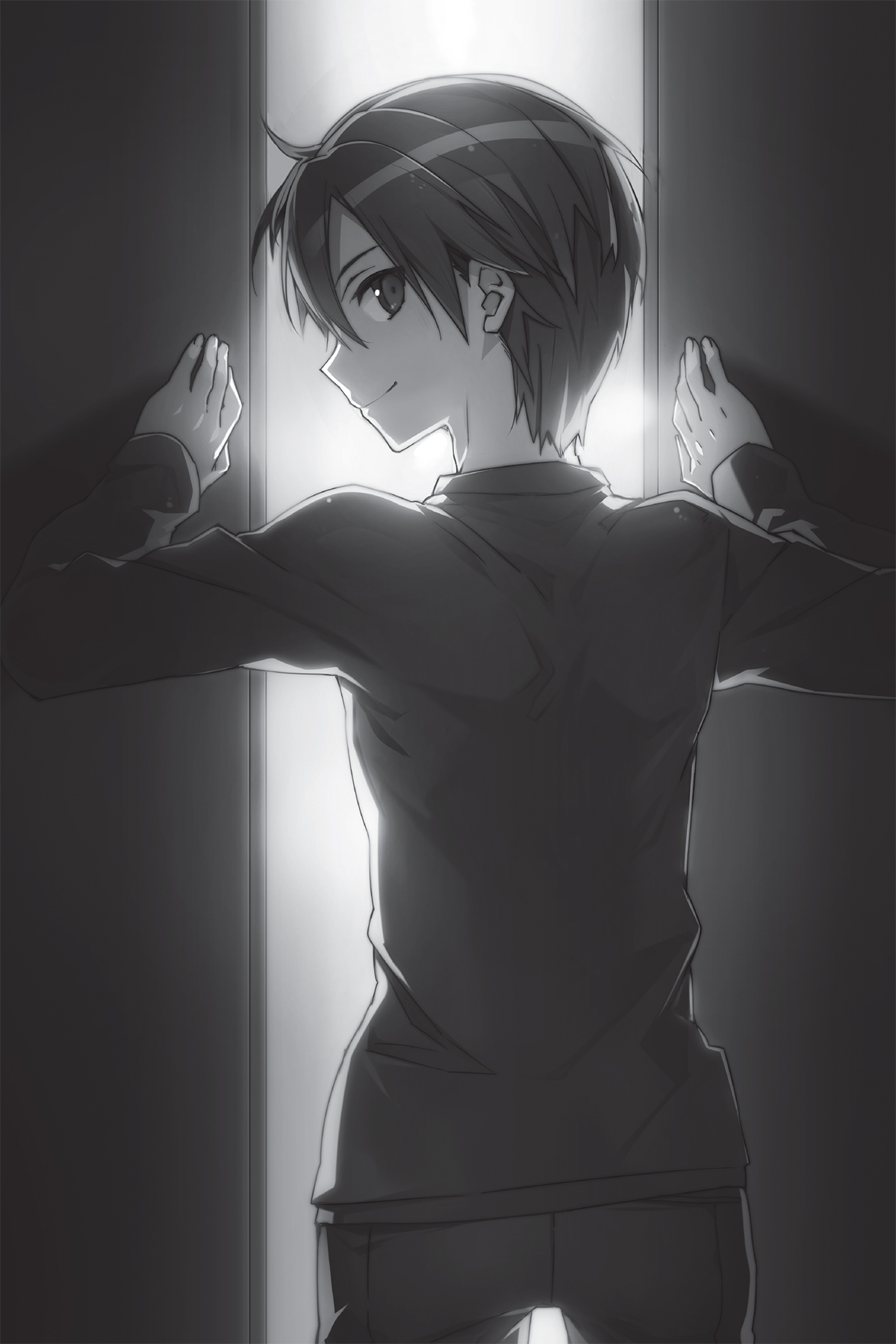
If I stop typing and close my eyes right now, I feel like I can still see the backs of Kirito and his friends as they run toward the distant light. Their journey will not end, and I’m certain that many adventures still await them, in ALO and the rest of The Seed Nexus, in the sealed-off Underworld, and in the real world.
A part of me wants to follow along with those new stories, of course. But at the same time, the map of the future is so vast and uncertain, a part of me is hesitant. Before I step into the next world, I want to think about what the lengthy story of Alicization meant to Kirito, Asuna, Alice—and me—and soak in that feeling. That’s my plan.
Over the course of the SAO series, I’ve come into the debt of a great many people.
Those who have handled the manga adaptations: Tamako Nakamura, Minamijyujisei, Tsubasa Haduki, Neko Nekobyou, Kiseki Himura, Koutarou Yamada, Shii Kiya.
Those who have taken part in the animation series: director Tomohiko Itou, character designers Shingo Adachi and Tetsuya Kawakami, action-animation director Takahiro Shikama, all the people from A-1 Pictures, producers Atsuhiro Iwakami, Nobuhiro Oosawa, Shinichirou Kashiwada, Jun Katou, Masami Niwa. Kirito’s voice actor, Yoshitsugu Matsuoka; Asuna’s voice actor, Haruka Tomatsu; Leafa’s voice actor, Ayana Taketatsu; Sinon’s voice actor, Miyuki Sawashiro; and all the other cast members. The singers for the theme songs: LiSA, Eir Aoi, Luna Haruna. Sound director Yoshikazu Iwanami, sound designer Yasuyuki Konno, composer Yuki Kajiura.
Those who made so many games: Yousuke Futami, Yasukazu Kawai. Takeshi Washizaki, who did promotion on the radio and at events.
My editors, Kazuma Miki and Tomoyuki Tsuchiya. Tatsuya Kurusu, who drew my little maps and such. abec, who brought the story to life with such beautiful illustrations.
And lastly, to all you readers who followed along with the story to this point, my undying gratitude.
Thank you all so much. I hope you’ll continue to love the SAO series.
Reki Kawahara—July 2016