Beneath the Stairs at Wald Abbey
Beneath the Stairs
at Wald Abbey
Sako Aizawa
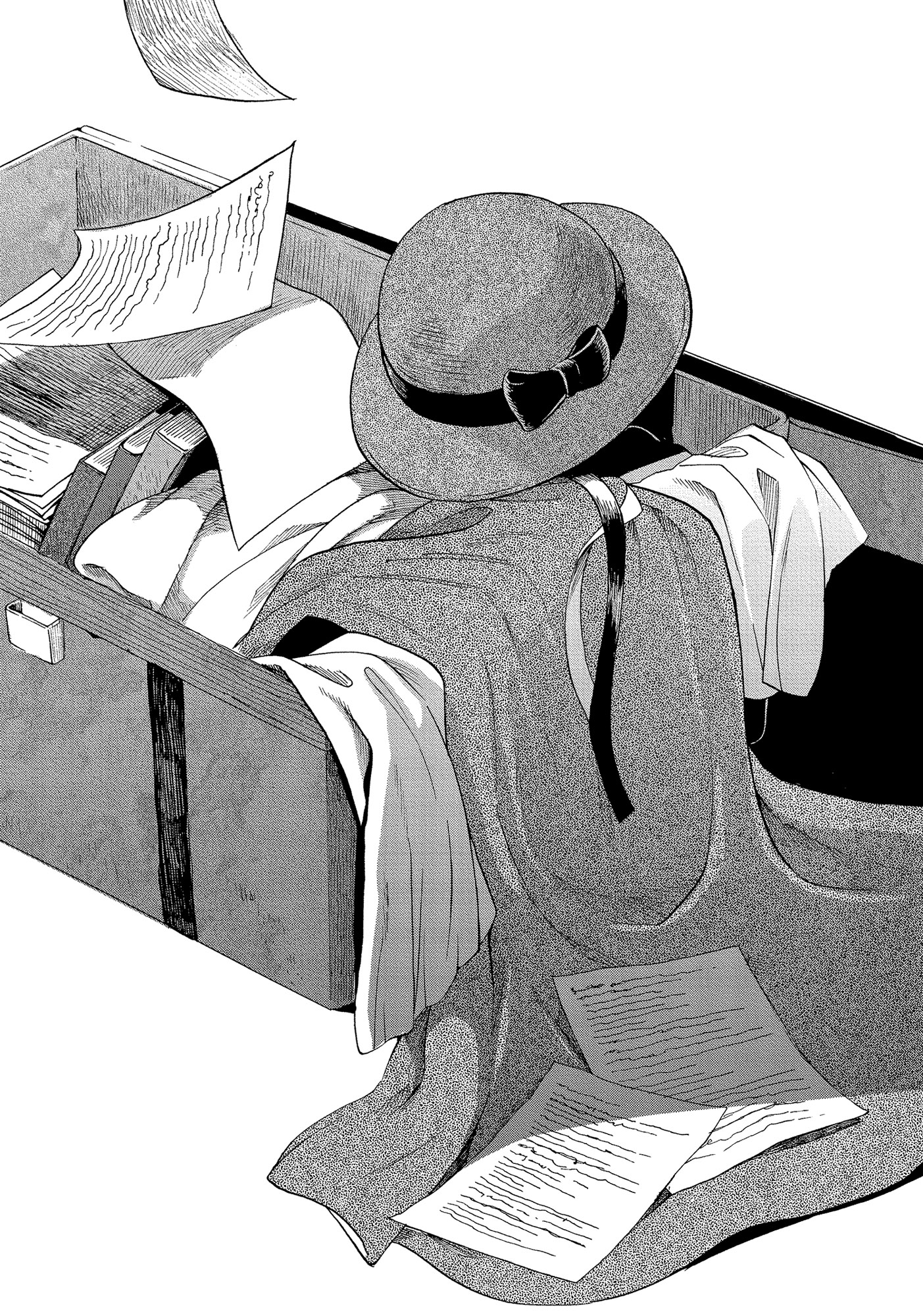
One little tin trunk contained my entire life.
I thought about that as I polished the marble floors. I’d never really thought about it before. I felt like someone had just whispered the notion in my ear, like this was an illusion that the grand old Wald Abbey had conjured up for me.
I gazed upon the rows of silent portraits and elegant furniture.
The head maid, Miranda, had called this room the Long Gallery. The London mansion where I’d previously worked didn’t have any rooms half as big and impressive as these. I was on my knees before rows of gentlemen, all fixed in the same pose, hands on their hips, staring ahead in an empty fashion. Portraits of every Earl of Lowfield, the longtime rulers of this land, watched from the wall.
Shivering in the morning chill, I kept polishing the floor. The spate of bad weather had caused the grime and soot to build up worse than usual. Plunging my rag into cold water and wringing it out, I let my mind wander back to the strange thought Wald Abbey had whispered to me.
My life fit inside a tin trunk.
Since I was thirteen, I’d worked as a maid in a mid-sized London manor. When I started, my mother gave me the little trunk she’d used herself, but after years of neglect it had fallen into such disrepair that buying a used trunk seemed the cheaper alternative to mending the old one.
And so, my current trunk was even smaller than my mother’s.
I’d filled this trunk with my work uniforms and a few personal possessions, dragging it behind me as I walked to Wald Abbey. The trunk’s contents were nearly the same as when I was thirteen. The only difference was how much lighter my luggage felt. Five years of hard work had certainly built up my arm muscles. Up and down a narrow, spiral staircase I’d gone, carrying all manner of things.
“Katie, your hands aren’t moving.”
Her voice echoed through the Long Gallery.
I was still not used to being called Katie, so there was a moment before I responded.
“Sorry, Mrs. Banks.”
I picked up my rag and began polishing the floor again. The elderly Mrs. Banks snorted, but she must have been in a good mood that morning, for she said nothing more. She turned and left the Long Gallery, the bundle of keys at her hip jangling. I breathed a sigh of relief until I realized she’d left footprints all over the newly polished floor and then hung my head.
***
Naturally, there was a reason I’d left London and gone to work at Wald Abbey. I’d messed up badly at my last job. Another maid had accidentally broken an Eastern tea set that was a favorite of the lady of the house. The maid was just a kid, only thirteen, and I’d been responsible for looking after her. The lady was famous for her temper and would almost certainly have fired the girl.
“I’m finished, Cathy. I have nowhere else to go. They’ll send me back to that prison of a poorhouse,” the maid had cried.
I’d already lost my mother, so, like this crying child, Alice, I was an orphan. I couldn’t bear to think of the awful future in store for her.
I put my arms around her shoulders and said, “Don’t worry. Leave this to me, Alice. We’ll say I’m the one who broke it.”
I believed we could trust the housekeeper, Mrs. Jones. I may get my wages docked to pay for it, but I foolishly believed I wouldn’t be fired.
But neither the lady nor Mrs. Jones had any pity for a poor orphan like me. Without the means to pay for the set, I was immediately let go without a letter of recommendation.
Fired with no references!
Alice gave me an apologetic hug and I left, dragging my trunk behind me. Without references, it was hard to find employment. I went back to the busy corner of the East End where’d I’d grown up, living at an inn run by a friend of my mother’s while I searched for a new job. But not many places were willing to hire a servant with no letters. One lead after another fell through, and right as things looked hopeless, I remembered my mother’s words. If I ever lost my job and found myself in trouble, I should go to Wald Abbey, where she used to work.
I wrote a letter to the abbey. It was far away, in Greenfield. I realized the lady and the housekeeper who knew my mother might have passed on, but, as this was my last hope, I wrote to ask them for work. The answer surprised me: One of their servants had just come down with scarlet fever and moved back in with her parents, so they had a position available. This was a stroke of luck.
I put my entire life into that small, tin trunk and dragged it after me on my journey.
Greenfield, as implied by its name, had more verdant sights than I could have imagined. It was already getting late when I’d arrived, but, unlike London, the sky was bright and clear. An elderly gardener met me as I got off the train in the small station at Wald. He was balding under his faded cap, but when he helped me onto the wagon, his bony hands displayed greater strength than his diminutive frame would have suggested. He gave his name as Lloyd. He smiled for the briefest of moments, but that was enough for me to warm up to him.
Wald was a small place, and the wagon only traveled a few minutes before the surrounding homes grew scarce. The coach road ran between fields as if parting the sea, up and down low rolling hills. In the distance I saw a ridge shaped like the curve of a horse’s back and beyond that a deep green forest that stretched as far as the eye could see. Hill after hill after hill, and so many trees. Lloyd’s cap and the sky aside, everything in Greenfield was the color green.
At last, the wagon went through a beech grove and under an old stone gate.
“Is this where His Lordship’s land begins?” I asked, clinging to my seat.
Lloyd’s shoulders shook. Was he laughing?
“Don’t be daft. Everything since we left town is his land. All of it belongs to the master you serve.”
Eyes wide, I looked back the way we’d come. This vast territory must have been hundreds of acres. I stifled a mix of anxiety and anticipation as I looked down the road. Several hills ahead, I caught sight of it.
Like an old painting, Wald Abbey loomed over the desolate grassland.
It looked like an old fortress from the cover of a romance novel. Asymmetrical, misshapen walls were set with countless, beautiful, latticed windows. A large bay window loomed over the entrance, and the pillars supporting it were carved like the statues in a museum. Since it was called an Abbey, perhaps this had once been a monastery or convent, but it had clearly been extensively remodeled. The garden surrounding this country house was enormous, and behind it stood a dense, green forest, like…
“Seems like the sort of place faeries live,” I said.
The wagon wheels clattered loudly, but Lloyd heard me anyway. He glanced back my way and laughed.
“That they do! It’s an old place. They’re in the house, too.”
“They are?” I cried.
The house certainly was hundreds of years old. I could almost believe it had a faerie or two, but I was sure Lloyd was just humoring a young girl’s imagination.
That day, the first time I set foot in Greenfield, I thought no further on the matter of faeries.
***
After cleaning up Mrs. Banks’s footprints, I completed the rest of my morning work. Wald Abbey had had many guests the last few days and that much more work to do as a result.
I changed into my afternoon clothes and ate downstairs in the servants’ quarters. Normally, lunch was partaken in silence under the stern glare of the butler, Mr. Lawrence. But the last few days, that schedule had been upended, as Wald Abbey’s guests had always brought their own servants and maids. When dining with visiting servants, we were allowed to make small talk.
“This place really is like something out of a faerie tale. Is it true you have real faeries here?” asked a young maid in the employ of Mrs. Maven. I thought she was more or less the same age as me, but had no accent, and, while plain, her clothes were quite high quality. If they hadn’t been a decade out of fashion, she may have passed for a nobleman’s daughter.
A footman named Arthur answered Miss Maven (whom we addressed by her employer’s name to minimize confusion.)
“Aye, they do. There’s a faerie on your ankle right now!” he laughed.
Miss Maven shrieked and jumped to her feet.
“They help with our work sometimes,” Anna said. She was a laundry maid and a notorious chatterbox. “There’s lots of them around these parts. Awd Goggie and the like.”
“Awd…”
“They live in the forest and eat bad children.”
Miss Maven turned pale, swallowing every word of this.
“Hardly a problem if you don’t get lost in the woods,” Arthur snorted. “But Diana is the most interesting faerie.”
Arthur had told me this exact same story, with the same evident delight, when I had first come to Wald Abbey. According to him, a faerie named Diana had lived in this house since ancient times.
“Our good neighbor spends her time among us, pretending to be a servant. When she’s in a good mood she helps with our work, but even those of us who meet her don’t know her name or her face.”
“What does that mean?” Miss Maven asked.
“We forget. She helps with the work, but we can’t remember her after. We find we can’t remember the name she’s given, nor can we recall her face. We can’t even remember if she was a man or a woman.”
“How curious.”
“Someone eating with us right now may actually be a faerie. Anyone here you don’t remember seeing before?” he asked.
“Arthur!” Mr. Lawrence cut him off with a fearsome scowl.
Stories of Diana had been around since long before any of us had come here. It was possible such tales dated from hundreds of years before, when this place was still an active abbey.
It wasn’t just the servants either; members of Lord Lowfield’s family also believed the legends to be true. They always referred to faeries as “good neighbors.” In this age of science, I was surprised to find people still believed such things, but, then again, all sorts of people had become obsessed with séances in London. Perhaps ghosts and faeries were the same sort of thing. It seemed the earl’s family, Mrs. Banks, Mr. Lawrence, and the house’s longtime servants all believed in Diana with something akin to religious faith.
“Thank you for suggesting the subject, Miss Maven. Diana is a good neighbor who watches after us all. She’s nothing to be afraid of,” Mr. Lawrence said quietly. “Now, let us resume our meal. We have much to do this afternoon.”
This signaled an end to small talk.
Our afternoon workloads cast a pall over the meal, like a faerie’s spell.
***
Feeling like a well-wrung rag, I flopped down on my bed. My roommate, Ainsel, had already returned and was seated at her desk, reading by candlelight.
“You look exhausted, Cathy.”
She was the only one who called me by my proper nickname.
“I am, Ainsel!”
Too exhausted to stand up again, I began undressing where I lay. Ainsel glanced up from her book, laughing at the sight.
She was a parlor maid and the first friend I’d made after coming here. She was just past twenty and had gorgeous blonde curls that framed her face.
The day I’d first come here, after completing my assigned tasks (without even a moment to recover from my journey), she’d welcomed me with her Scottish brogue, and we’d talked late into the night. Ainsel had warned me that Mrs. Banks patrolled the halls at night like a prison guard, so whenever we heard Mrs. Banks’s footsteps, we fell silent, staring at each other in the darkness, grinning like mischievous children. There was a knock, then Mrs. Banks came in, lamp in hand, to check that we were already asleep. Satisfied, Mrs. Banks shut the door and walked away, keys jangling. I enjoyed this so much I couldn’t hold in the giggles. My laughter proved contagious, and Ainsel soon joined in.
“We really should sleep. You came all the way from London, and you must be exhausted,” she’d said.
Sandwiched between the hard bed and the thin blanket, I’d been bone-weary, but unable to fall asleep. At last even the moonlight had faded, and Ainsel had stopped replying. A wave of loneliness swept over me. This was all so different, like I was in a foreign land. My parents’ graves and the church I’d attended were so far away. Surrounded by forest, this place was isolated, and all the memories contained in the stones of Wald Abbey made it a gloomy place. I was seized by the sudden notion that I would die alone here in this quiet manor. I’d never considered anything like that. Before I knew it, the tears were flowing. I desperately choked back my sobs, trying not to wake Ainsel with my sniffling.
I soaked my flat pillow with tears the first night I ever used it.
“Don’t worry.”
Warm fingers brushed against my cheek. Surprised, I’d turned my face to find Ainsel on her knees, smiling gently down at me.
“Don’t worry. You’ll grow to love it here soon enough.”
Those words had comforted me, like I was praying in church.
“Thank you, Ainsel,” I’d whispered and drifted off, sleeping like a baby.
I’d never had a coworker speak like that to me. I was sure our similar ages partly emboldened her. We both loved to read, which helped. I only read Sweethearts and other romance novels, books that made the mistress and housekeepers wrinkle their noses, but Ainsel was a real bookworm: Shakespeare, Browning, Dickens, and all sorts of books I’d never even heard of.
Tonight she was dressed for bed, and her hair was already down. While I struggled to get undressed, she said, “Cathy, your hands aren’t moving,” sounding just like Mrs. Banks. Then, laughing, she helped me loosen my corset. Ainsel was very good at imitations.
“They really worked you today, huh?” she said, undoing the knots. “You’re extra worn out.”
“The rain left mud everywhere. I’ve got to show Miss Maven where everything is, too. I’m exhausted!”
“There’s a fox hunt tomorrow, so at least there won’t be any bells ringing in the middle of the day,” she said.
“Oh, good.” Letting my hair down, I gave a sigh of relief. “But what of the ladies that don’t join in?”
“They’re going to wander the garden and then eat on the rotunda. Nobody told you?”
“Miranda may have said something.” It was always the same: When Wald Abbey had visitors, so many instructions floated around downstairs that it became impossible to keep track of them all. “But the rotunda? You mean the thing that looks like an old shrine, with the round roof? There’s a cave nearby—old places like that might really have a faerie living there.”
I realized Ainsel was sitting on her bed, laughing at me.
“What’s so funny?” I asked.
“That’s a fake,” Ainsel said. “A folly. The second earl built the thing to make the manor seem more impressive. The rotunda and that cave—the grotto—are both fakes designed to make this place seem like the ruins of an ancient abbey. I’m sure it has no faeries.”
This was a shocking piece of information. All those structures were fake? How much money and time had he sunk into making these vanity projects?
“Then there’re no faeries anywhere.”
“Disappointed?”
“Not like I believe in them anyway,” I said, staring up at the gray ceiling. “But this manor has a strange air about it. Like I’m always being watched by something… And I find myself having unusual thoughts. People hereabouts say that’s the faeries whispering to you, don’t they?”
“They do. Bad thoughts, ill tidings, even an artist’s stroke of keen inspiration. People around here attribute all manner of things to the faeries.”
Ainsel seemed to be done reading for the night. She turned back to her desk and closed her book. Actually, it looked more like a magazine, and she didn’t often read those. I thought I saw the word Strand on the cover, but it was too dark to tell for sure. She blew out her candle, and the room grew darker.
Only a pale glimmer of moonlight shone through the window’s grime.
Hearing her sheets rustle, I drew my blanket up to my neck and whispered, “I wonder if faeries actually exist.”
“Just because you can’t see them, doesn’t mean they don’t,” she replied.
“If it’s just a matter of not seeing, then why can’t we?”
“Hmm.” She thought for a moment. “Perhaps because our hearts are so removed.”
Pressing my cheek into my pillow, I searched for her face in the darkness.
“This is just my theory,” Ainsel said. “I’m sure a long time ago, humans and faeries interacted frequently. But as the times changed, human beliefs changed, too. We no longer needed the faeries, and they certainly had no use for humans and their fickle minds either. So our hearts drifted apart, we no longer needed each other, and we could no longer be together. These days, only mages still need the both of us.”
“Mages?” I giggled. “Like in Shakespeare?”
As I got used to the darkness, I could make out the blue of her eyes looking fondly back. Ainsel’s cheek pressed into her pillow as she watched over me—a thought that made my heart dance. I was sure that last remark about mages had just been her little joke.
“So then that explains the stories about Diana,” I said, trying to show I’d been paying attention. “We can’t remember her face and name because we no longer need each other, and our hearts have drifted apart? Because she doesn’t really matter, our memories of her fade away.”
Ainsel dropped her gaze. In the darkness, I thought she looked faintly sad.
“Perhaps that’s true. She lives according to different rules. It was always impossible for us to live together.”
“If that’s true, then that’s very sad.”
Ainsel closed her eyes, undoubtedly to sleep.
I rolled over, staring at the ceiling and thinking about Diana, the faerie who’d lived here for so many centuries. In my mind, she was a woman. She wore a maid’s uniform, wandering like a ghost through the gloomy interior of Wald Abbey. She must be lonely.
Perhaps Diana was searching the Abbey for someone who could see her, I thought. Searching for a way to prove she was actually here. Just as I was, deep down…
***
The next afternoon was cloudy and chilly but fortunately not rainy. As a result, Lord Lowfield’s family took their guests fox hunting. I’d hoped that would ease our workloads, but Mrs. Banks ordered Miranda and the rest of us to clean.
I was near the mansion’s entrance, wiping the windows of the Long Gallery from the outside, when Mary—another maid, still only thirteen—made a surprised noise nearby.
“What?” I asked.
“Look at this! They’re falling around here again.” Mary spoke with a strong local accent. Her family were farmers near Wald village.
“What’s falling?”
Since she was so much younger, I kept thinking Mary was a new maid. But she’d worked here since she was eight, so she’d been in service as long as I had.
Mary put down the supply box she was holding and pointed to something on the ground. A number of acorns lay on one side of the Long Gallery windows.
“What are those?” I said, dropping my rag in the bucket and moving closer. I knelt down; they were clearly just acorns—but where had they come from?
“They’re from the oak trees, I think,” Mary said.
I agreed, but there were no oak trees anywhere near here. No one would ever ruin the view from Wald Abbey by planting trees next to the entrance, yet there were a ton of acorns about.
“You said again. Have you found them before?” I asked.
Mary nodded. Her baby face sported a ton of freckles.
“Last week. Same place, about the same number. Every three days, once a week. Sometimes it changes, but it’s been like this around here for about a month now.”
Well, that was very strange. If there were no trees nearby, then someone was bringing the acorns here. I glanced up at the forest on the nearby hill; they were all hunting foxes out there. This morning I’d been able to hear the dogs howling and chasing the foxes around, but now the place had gone eerily silent. It would be easy enough to collect acorns in that forest. But what use was it bringing them here?
“Maybe they’re a gift from the faeries,” I joked.
But Mary had had the same idea. “Yes, that’s what Mrs. Banks said.”
“She did?”
“She said if they’re a gift from the faeries, we mustn’t throw them out or tell anyone, or they’ll never bring them again.” At this, Mary clapped her hand over her mouth, her eyes going wide. “Oh! Does this count as telling someone?”
“Don’t worry, I’ll keep it secret,” I said, giving her a reassuring smile. “But what should we do with them?”
“Bring them to Mrs. Banks. She’ll keep them safe in the housekeeper’s room. She keeps a treasure chest full of them.”
Mrs. Banks, the housekeeper, had been working at this mansion longer than anyone. She’d been born in the area. Very superstitious, she believed in the faerie legends with as much fervor as the earl’s own family.
“Come to think of it,” I said, suddenly remembering, “I found something strange lying around a few days ago.”
“Strange how?” Mary asked.
“I think it was a can. A little empty one.”
“A can?”
“It was on the ground near here. I thought someone must’ve tossed it out a window.”
It had clearly been rubbish, so I’d thrown it out. As I spoke, I looked up at the walls and windows above us.
Right above, a woman’s face looked down at me through an open window. Startled, I almost screamed.
“What is it?” she asked.
The woman in the window was a beautiful young lady, watching us maids with her sleepy, blue eyes. Looking closely, I realized she was the earl’s eldest daughter, Lady Lavinia. Feeling like my heart had almost stopped, I forced my brain to begin thinking. Someone upstairs could see us cleaning!
It was one thing for the higher ranked servants to be visible, but maids like us were supposed to be as silent as the shadows, quietly curtsey, then remove ourselves from sight. But Lady Lavinia had spoken to us. I’d never had a noblewoman speak to me before, and I was beginning to panic.
“Oh, there were some acorns lying here, my lady,” Mary said, before I could recover. She raised her voice to be heard, not at all rattled. “Do you know where they may have come from?”
Lady Lavinia shook her head.
“My lady, are you not feeling well? I thought you’d be joining the fox hunt.”
The lady didn’t seem put out by Mary’s question at all.
“I wasn’t feeling up to it,” she said. “Riding is one thing, but I just feel sorry for the poor animals.”
Speaking from the second story window, her voice sounded a little far away, yet I believe she was raising her voice a little for our benefit.
“I’m going back to sleep,” she said and closed the window.
I put my hand over my beating heart and looked at Mary.
“Golly,” I said. “You’re amazing, Mary. You can just talk to the mistress like that!”
“That only goes for Lady Lavinia.” Mary laughed. “You see, I was only eight when I came here, and back then Lady Lavinia and her little sister Lady Alicia used to come downstairs all the time and play pranks on us. But, since I was so little, they often used to stop and talk to me.”
“Oh.” I’d certainly heard many stories about children from upstairs playing tricks on servants. “Is Lady Lavinia good with horses?”
Fox hunts required chasing the hounds on horseback. It was a good chance to show off your skill with a horse, and it was quite common for ladies to ride out with the gentlemen.
“She is. She might be the best in His Lordship’s family.”
“Really? Even better than Master James?” James was the eldest son.
“Ever since she was little she’s been riding with Mr. Gerald. Mr. Gerald’s an expert horseman, so she learned from him.”
“Mr. Gerald?”
“The vicar’s second son. You know, the doctor.”
“Oh, Mr. Gerald Neville.”
If you went through the beech grove, you could just make out the tiny vicarage. I remembered seeing it before.
“The Nevilles haven’t been invited round lately,” Mary said.
They used to visit Wald Abbey all the time, but I hadn’t heard their names in a while and only saw the vicar at church.
“About that,” Mary said, stepping closer to me. Gossip among servants was always delivered in a whisper. “It sounds like the master and Mr. Neville had some fearsome row.”
Mary confessed she’d only heard about it secondhand.
As if to put a stop to our gossiping, Miranda, our direct superior, appeared.
“Why are you just standing there? Are you finished?” she demanded.
We brought ourselves to attention and threw ourselves back dutifully into our work.
***
The incident occurred a few days later.
We assembled in the servants’ hall for the morning meeting. Mrs. Banks appeared to be in quite a state. She was always standing bolt upright, no matter the hour, but this morning she was slumped in a chair and muttering to herself.
“Oh, dearie me. How can this have happened?” she whispered.
We all glanced at one another, bewildered. Come to think of it, late last night Mrs. Banks had entered my bedroom, taken one look at my face, turned pale, and left. It had been so odd I’d assumed I was dreaming.
Mr. Lawrence was holding Mrs. Banks’s hand with great concern. The cook, Mrs. Oliver, snorted, and took the kitchen maids with her to start their work for the day. Clearly, they were much too busy to fuss over Mrs. Banks’s condition. But the earl and his wife were absent, visiting another manor, so the kitchen workload should have decreased significantly…
“What on earth happened?” Miranda asked.
Mrs. Banks took several sips of laudanum before she was restored enough to answer.
“Diana… Diana is gone! She’s left the mansion!”
We all exchanged glances again.
The gist of Mrs. Banks’s tale was as follows: The other day, she’d been straightening up her room when she came across the uniform her late daughter had worn in her daughter’s serving days. It was old, but if washed and repaired could certainly still be used, or so Mrs. Banks had thought. Despite the lavishness of Wald Abbey, Mrs. Banks herself was quite frugal-minded.
She considered asking the laundry staff to take care of it, but the day’s laundry was already done. Never one to dither around, Mrs. Banks resolved to wash the uniform herself. The weather that day was temperamental, and the wind quite strong. Hoping to let it dry before the rains fell, she hung the black servant’s dress not in the usual place for laundry, but in the central garden, out in plain sight where she could quickly retrieve it if it began raining.
But when she finished her next task and looked out at the garden, the uniform had vanished. She assumed the wind had snatched it away and went to look but found no trace of it. She had far too much work to do and was forced to abandon her search…until that evening.
When it came time for curfew, Mrs. Banks and Mr. Lawrence made the rounds to check the locks. Mr. Lawrence was responsible for the main doors, and Mrs. Banks handled the unused rooms and servant quarters. Afterward, they patrolled the servants’ rooms, making sure we were all abed. Mr. Lawrence retired for the night after that, but Mrs. Banks still had work to do and retired to her room next to the servants’ hall. She normally handled her work there, leaving the door wide open. Any servants trying to sneak out at night would have to pass her, and if one of the bells in the hall rang she could quickly answer it.
She’d been working on the ledgers for a while when a bell rang. She hastily stood and checked which bell was ringing. Someone of Mrs. Banks’s experience could tell which room was calling based on the sound of the bell alone, but lately she’d felt both her vision and hearing were in decline. She held the lamp high, checking the row of bells near the ceiling. To her surprise, the call came from a guest room on the second floor, one that wasn’t generally used and that she had personally locked earlier that same evening. It was very strange, seeing as Mrs. Banks had the only key that could open that room.
This was clearly some mistake, yet the bell kept ringing. Mrs. Banks took a bundle of keys from its hook on the wall, the same bundle that normally jangled ominously at her hip. There were two such bundles, with one for rooms in the servants’ quarters, and one for rooms in the main house.
Lamp in hand, Mrs. Banks climbed the servants’ stairs, heading for the second story guest room. By this time, the bell had stopped ringing. She used her key to open the door and checked the interior thoroughly by lamplight. Of course, no one was there. Even the windows were locked. There must be something wrong with the bell, she thought. Or perhaps this was a trick of the faeries. Something similar had happened a number of years ago.
Mrs. Banks locked the guest room, returned to the housekeeper’s room, and resumed her work. But even she wasn’t immune to the sandman’s call and found herself nodding off. The sound of footsteps woke her, and she quickly turned toward the hall and saw someone pass by the door. It was a young maid holding a lamp. Mrs. Banks was so shocked her heart nearly stopped.
She didn’t recognize the young maid.
There were thirty female servants working at Wald Abbey, but Mrs. Banks knew every name and face, even the kitchen staff not under her direct command. If she saw their face, she could recollect their name. However, she had absolutely no memory of the girl who’d just passed by.
Could she have been a faerie?
A thought struck her, and Mrs. Banks hastily ran after the woman. The hall through the servants’ quarters was pitch black, and there was no sign of the maid. Assuming the stranger must have gone out the back entrance, Mrs. Banks tried to open the door, but she had locked it herself; it wouldn’t budge. The woman had vanished without a trace. Mrs. Banks was sure there was only one explanation for this and became very upset. Trying to prove herself wrong, she ran to the servants’ quarters and went room to room, knocking and checking the faces of every female servant. This caused a bit of a commotion. After checking every room, every female servant was accounted for. The woman she’d seen was definitely not anyone she knew.
Which meant it must have been Diana.
Her utter faith in the faerie legends, and her devotion to Lord Lowfield’s family and Wald Abbey, left her despondent. It was her fault Diana had left the manor. You see, part of the faerie legend went as follows:
Never give clothing to a faerie that helps with the housework.
If the faerie puts that clothing on, whether angered or delighted, they will leave the house and never return.
In other words, Diana had found clothing hung out to dry in an unusual place and considered it a gift for her. And then she had left the manor.
***
“I see. If the legends are true, then Diana is a faerie who guarantees the manor’s prosperity,” Miranda said, once the story was done. She spoke without expression. “If the master hears of this, he may well become upset.”
“Yes, it’s quite awful,” Mr. Lawrence said, dabbing the sweat from his brow. “If Diana’s leave leads to a dip in the family’s fortune—” He hastily broke off.
“We’re done for. I… If only it was just me. But if Wald Abbey passed into the hands of another…or if this brings harm to anyone… We have to let the lady know at once!” Mrs. Banks cried.
She staggered to her feet, ready to head to town and send a telegram.
“For now, please handle your duties as always. Do not breathe a word of this to anyone,” Mr. Lawrence said.
Then he lent Mrs. Banks an arm and led her from the hall.
I followed Miranda upstairs to perform my usual duties. Miranda was as unperturbed by this commotion as the housekeeper was undone.
“What does it all mean?” I asked.
But Miranda just shrugged, despite the heavy burden in her hands.
“Who knows? Perhaps Diana really left, or perhaps Mrs. Banks is just seeing things.”
For a while, I thought about all this as I worked.
Was it possible that Mrs. Banks mistook another servant for Diana? She’d chased Diana to the back door, but the door had been locked from the inside and locked by Mrs. Banks herself. A normal servant wouldn’t have been able to unlock the door; they would use a window to slip out at night. This would be difficult on the second floor but easy enough for anyone on the ground floor. For a servant in the basement quarters, the side entrance to the kitchen might be the best bet, but Mrs. Oliver controlled the kitchen and rigorously locked up at night. Even if they went up the servants’ stairs to the main house, Mrs. Banks had locked the doors on all unused rooms, and Mr. Lawrence had locked the main entrance. The first floor hallway had no windows through which a person could fit. You could fit through the windows on the second floor, but not without considerable risk. Because of that, no one in Wald Abbey, not even the master of the house, could get out at night.
After she’d made sure the back door was locked, she’d gone quickly back to the servants’ quarters and checked us all, one by one. It was the middle of the night and she’d been flustered, but Mrs. Banks said we were all sleeping in our rooms. If she’d mistaken a female servant for Diana, then it didn’t make sense for us all to be in our rooms. One of us would have been missing.
And if the back door was locked, the person she mistook would have been unable to get out, and Mrs. Banks would have caught up with them. Unless they could somehow walk through doors…
“Maybe it really was a faerie…” I whispered over tea.
Arthur and the other footmen shrugged it off, but Mary and Anna leaned across the table, saying, “It was!”
We finally had an easier workload, so the servants’ hall was packed. Even Sophie was here, a lady’s maid in training who was normally always in the company of the Lowfield girls. At my previous job, we had all addressed the ladies’ maids by their last names, but, perhaps because she was still in training, everyone just called her Sophie. She seemed to prefer this, so I called her Sophie, too.
“Sophie, what’s going on with the ladies? Have they heard the story?” I asked.
“No,” Sophie said. “I was surprised when Mrs. Banks showed up in the middle of the night, but I only just heard the details when I came downstairs a few minutes ago. Both the ladies are acting like they always do. Lady Lavinia doesn’t seem to be feeling well today.”
“Yes, I brought some tea up to her earlier, but she was quite pale.” Miranda nodded. “Sophie, better keep this to yourself.”
“Certainly. But if the master finds out—”
“He’s visiting the marquess, so I can’t see him cutting the visit short.”
The faerie’s disappearance was being treated like a real crisis. The master was a particularly strong believer, so no one was sure how he would react to the telegram.
A faerie, vanished into thin air…
If Mrs. Banks’s account were true, a faerie seemed the only possible explanation.
Then I remembered the strange dreams I’d been having lately.
***
Had I begun having these dreams after Ainsel and I talked about faeries?
When I finished work, I went back to my room. I was allowed to bathe today, but, naturally, I had to wait my turn. Surprisingly, there was no sign of Ainsel. Was her work taking longer than usual? Or was she just resting somewhere?
I laid my head down on my chilly pillow, lost in thought. Then, I heard something.
I rubbed my eyes and moved closer to the window. From the second floor of the servants’ quarters, all we could see was the drabbest side of the garden. But a faint light was moving through the back garden.
“Cathy!” the light called.
I hastily grabbed a candle and ran downstairs. I went down the corridor through the servants’ quarters, into the half-underground section toward the servants’ hall. Then I went up a staircase to the back door and at last emerged outside. This was the only way out, presumably to keep the servants from leaving without permission. Arthur had once grumbled that they’d built this place like a prison, and I didn’t think he was referring to Wald Abbey’s exterior.
“Katie, what’s going on?”
As I stepped outside, one of the servants having a smoke break called to me. I just said I was taking a walk and headed for the back garden, shielding the sputtering candle flame with my hands.
It was already quite dark. There was no moon tonight.
The candle wasn’t much help. I couldn’t see a thing.
But I found that light bobbing in the darkness.
“Cathy!”
I thought I heard it calling again.
I ran toward it. The candle guttered out, but I just kept moving toward the light.
I realized I’d entered the forest when I heard the leaves thrashing in the wind.
A moment later, there was light all around me.
Strange, unlike anything I’d ever seen, it was much like the colored light through a kaleidoscope.
“Cathy, you came,” it said, passing over my shoulder.
It was definitely a faerie.
If I had to describe it, it was like a tiny human with wings. It had pale green skin, the same color as its clothes. The figure was feminine, but the shape of its face definitely wasn’t human. I held my breath, staring back at her. Strangely, I wasn’t at all scared.
“You’re the one who called me?” I asked.
“Yes. There’s somewhere you need to go.”
“Where?”
“Somewhere that needs you.”
The faerie fluttered around me, speaking as if it read my mind. “Your life fits inside that little tin trunk. Everyone always forgets you. But if you come with me, you won’t need to worry about such silly things.”
“Silly?”
“Yes. Our home is a paradise.”
She fluttered about like she was dancing, leaving trails of brilliant light in her wake. Flummoxed, I ran her words over in my mind: My life fit in a tin trunk; nobody needed me; no one would even remember me… All of this was true, but why did it hurt so much?
I’d been a servant since I was a child, serving the people upstairs and devoting myself to them. But the people upstairs didn’t need us. Lighting fires like faeries, cleaning rooms like faeries, disappearing like faeries—All of us were just like faeries.
We were faeries.
“If I go there, I won’t have to be sad anymore?” I asked.
“That’s right! It’ll last forever! Your mom is there, too!”
Tears streamed down my cheeks.
There was a hole between the roots of an old oak tree. It was real and ancient, nothing like that phony “grotto.” In its depths, I could see a giant tree root that glowed with a blinding light; a light that waited for me. The faerie darted off into the depths.
Come. This is Tír na nÓg, the land of youth, of eternal summer, of eternal light. No getting old, no dying, no fighting. You can hear the birds singing all the time, singing their delightful songs…
The voice beckoned to me, and I stepped toward the light…
“Cathy!”
Someone grabbed my arm.
I turned and saw her there, panting, clutching my wrist.
I was awake again.
I could hear water rushing. I was out of breath, my heart beating a mile a minute.
Warm water surrounded my naked body. I thrashed, grabbing the side of the tin bathtub. My wet hair clung to my back.
“Cathy, are you okay?”
That voice surprised me. Ainsel was in the tiny bathroom with me.
“I…”
Surprised and confused, I finally remembered.
I was so worn out I must have fallen asleep in the bath.
“You never came out, so I wanted to check on you.” She was dressed like a parlor maid, with a lace-covered apron and cap over her black dress. “Thank heavens the tubs are so tiny! If it’d been one of the tubs upstairs, you’d have drowned.”
True enough—there wasn’t enough room for my head to slide under. I laughed weakly.
“But how did you get in here? Wasn’t anyone waiting for their turn?” I asked.
“Yes. Three of them, sitting on chairs outside, their mouths wide open, sound asleep. So I cheated.”
Ainsel undid her apron and began undressing.
“Er, you’re coming in? Hang on, I’ll get out!”
“Don’t be in such a rush. I’ll wipe myself down first. You take your time.”
“But it’s already lukewarm…”
Ignoring my protests, Ainsel happily hummed to herself. She undid her spotless cuffs and tossed her frilly cap and black wool dress aside. Long, beautiful, stocking-covered legs peeped out from underneath her petticoats. Faced with those beautiful curves, like something out of a painting, I found myself holding my breath.
“What?” Ainsel said, giving me a puzzled glance. She began wiping herself down with a wet towel. “You stare at me too much, I’ll get all embarrassed.”
“S-sorry.”
Then I saw a little blemish on her beautiful calf. She noticed my gaze.
“Oh, that? That’s a burn. When I was a kid, I was playing with some boys when a spark jumped out of the fireplace.”
“Oh.” I didn’t know what else to say. I looked away.
“Don’t worry about it. Thank you for suggesting the subject, Cathy,” she said, imitating the butler. Then she laughed.
She sounded so exactly like him I couldn’t help but laugh myself. She was quite good at imitations.
“You were dreaming, right?” she said.
“Yes,” I replied, the question bringing it all back to me. “Not a good dream. Probably because of all the gossip today.”
“What gossip?”
“Master James’s new venture failed, and that’s affecting the whole family.”
I’d heard Mrs. Banks talking to someone about it when I walked past the housekeeping room earlier that day.
“They said it might be difficult to keep Wald Abbey going now. That means they might have to sell some land…or let some servants go. Right?”
“True. I suppose they might not be able to afford the luxury of this large a staff forever.”
“And if that happens…”
I would be the first one let go, I thought. I’d no special experience or skills, and was a new hire still not used to the ways of Wald Abbey. No reason to keep me on; and I was probably not the only one who’d be sent packing.
“Everyone’s counting on Lady Lavinia’s marriage to stop that from happening. She often stays at Sir Hume’s, right?” I asked.
“Viscount Thomas Hume. Eldest son of the Earl of Lansbury.”
“Right. The viscount is quite devoted to Lady Lavinia apparently. When he inherits his father’s title, Lady Lavinia will be the new Countess Lansbury. That will take care of the finances, or so everyone says.”
“Come to think of it, Lady Lavinia hasn’t been feeling well for a while now,” Ainsel said.
I nodded.
“She refused to go to London for the season last year.”
“Yes.” Ainsel nodded. “Lady Alicia was making her debut, but Lady Lavinia stayed holed up in here.”
“I’ve heard people have made proposals to Lady Alicia as well, but the family hasn’t married her off because they can’t have her marrying before the eldest.”
“Also because the offer came from Mr. Lowell, who had land but no title. Perhaps the master has a plan in mind.”
Perhaps I was trying to avoid talking about my dream by plunging us into typical servant gossip.
I hung my head.
Then I felt a wet hand caressing my hair.
“Scary dreams should be soon forgotten. Like gifts from faeries.”
Ainsel smiled gently right next to me.
I turned red and looked away.
“Thank you, Ainsel.”
I added, “I…really value your friendship. Even if we end up separated, I hope we’ll stay friends.”
Hesitantly, I glanced at her expression.
She said nothing; just gently nodded.
***
I had dreams like the one in the bathtub from time to time.
Building up the fire in the hearth one morning, my eyes wandered to the window. There, I saw a circle of people dressed in green dancing on the round hill in the garden. Once, on the way to church, I was passing through the beech grove and a voice called my name from above. I looked up and saw a beautiful woman in a white dress sitting on a branch, smiling back at me. Each time I saw such things I thought, uh-oh, better do what Arthur told me and close my eyes, pretend I didn’t notice—else they might take my eye. But no sooner would the thought strike me than I’d wake from the dream. I may be mending a uniform, or perched on the bumpy wagon ride to town, or resting on my elbow in the servants’ hall…
Each was a strange experience, like a dream yet not like a dream. When I discussed them with Ainsel, she laughed and suggested the faeries liked me. Mary and Anna were both surprisingly curious about them, and any time they caught me drifting off they begged me to tell them what dreams I’d had.
This gave me an idea. On my way to pray at church, I stopped by the general store in Wald and bought a pen, ink, and paper. Of course, I had no one to write a letter to, but I began recording my dreams on paper before the memories faded so I could remember them clearly for Mary and Anna.
On my breaks, I’d sit at a desk in the servants’ hall, running my pen across the paper.
At my last job, I’d often seen colleagues writing to their homes or lovers. With both my parents gone, I’d never had anyone to write.
So even though these letters weren’t for anyone in particular, writing them made my heart dance.
In time, I began embellishing the events of the dreams, whether influenced by the rumors around us, or wanting to add new elements to the folklore. I made my dreams even stranger and more intriguing, all so the girls would delight in the telling of them. This wasn’t as easy as it seemed in the romance novels I often read.
“Writing a letter?” Miranda asked.
Hesitantly, I answered, “No. More of a story.”
“Oh? You want to be a writer?” Miranda said, not batting an eye.
The idea had never even occurred to me.
I laughed it off.
I’d been born a servant and would be one till I married.
***
Three days had passed since Diana went missing.
Our daily duties were as packed as ever. Mrs. Banks and Mr. Lawrence remained rather agitated, but we continued our battle against ash and dust. We were strictly forbidden from discussing Diana, and we obeyed; I hadn’t even spoken to Ainsel about it. The servants were divided into two camps: those who genuinely believed the faerie had left us and those convinced Mrs. Banks had dreamed the whole thing. When Lord Lowfield received her telegram, he must have assumed the latter. He and his family remained guests of the marquess and were not due home for quite some time.
One night, I was at my work lighting fires in the bedrooms.
Before people turned in, we had to warm the entire building by lighting fires in as many unused rooms as possible. Wald Abbey would freeze this time of year otherwise. Naturally, once it was bedtime, the maids had to go around and put all the fires out. Fire and soot were a constant part of our work.
I was carrying coal from the basement to feed the fire when I felt someone looking at me.
Surprised, I put the bucket down and slowly turned…It was watching me from around the corner.
It was a tiny little creature, about the size of a human child, but furry and had a pointy nose and ears. It was hiding around the corner but stared intently at me. It seemed to want something.
My voice shook as I asked, “Are you Diana?”
The creature’s furry features shifted, possibly into a smile.
“That’s not my name,” it said.
“Are you a Brownie?”
“A Brownie? Then you’re a maid. Are you a maid? Do you like being addressed as ‘Maid’?”
“No, I’m Catherine. Sorry. Do you have a name?”
“I do. But that’s not important now, Catherine.”
“Is there something you want to tell me?” I whispered.
“There is. The one you call Diana is still here, so stop fussing. We prefer things as they’ve always been.”
“Why tell me?”
“Because you’re special. Only you can hear and see us,” it said.
“Why am I the only one?”
“Because you need us, just as we are.”
I needed them?
What did that mean?
I blinked, and in that instant—
Nothing was there. I ran around the corner and looked, but found no trace of him. Because he no longer needed me? Because he’d said what he had to say?
I stood in the hall until Miranda came along and poked me.
***
When I’d finished my chores, I returned to the hall to find Mr. Lawrence clutching his head. The elderly butler was famous for carrying out his duties without so much as a raised eyebrow, but all trace of that stoicism had vanished.
“What’s wrong?” I asked.
He glanced at me but must have decided it was no use talking to a little girl. He just sighed.
“Our master seems to have run out of patience,” said Arthur, his breath already smelling of liquor. With no visitors to wait upon, the footmen had finished work already. Sipping a beer, he smiled at me. “The master cut his stay short and will return on the noon train tomorrow.”
“So?” I asked, not really understanding.
Arthur laughed again. Mr. Lawrence groaned aloud, forgetting to scold Arthur.
“An invitation from the marquess!” Arthur said. “They were to stay ten days, yet he suddenly packs up his bags and leaves? Why, because the house faerie ran away? I’ve no idea if the master told them that or not, but that marquess is famous for bearing grudges till his deathbed for the slightest provocation. Do you know what happens when those with power and wealth have it in for you?”
Only then did Mr. Lawrence finally bring himself to weakly scold Arthur for this uncouth gossip.
In other words, this could cause a rift between the marquess and Lord Lowfield. I wasn’t well-versed in high society, but I was sure connections between nobility were of the utmost importance. Power and wealth… A marquess would have no shortage of either. A close bond between households could very well help the earl’s family in their current financial crisis. But if this incident led to the destruction of that bond…
I now felt I understood the little neighbor’s message. I didn’t think the faeries really paid us that much attention. Perhaps I was reading too much into it.
“They’re coming back on the noon train tomorrow?” I asked.
“That’s what they said.”
“Then we’ll simply have to prove Diana hasn’t left.”
“Prove?” Mr. Lawrence said, looking up.
“If we can prove that by morning, we can send them a telegram. Reassured, they can relax and enjoy the rest of their stay.”
“But how? This woman vanished right before Mrs. Banks’s eyes! It could have only been Diana!”
“Well…”
I hung my head.
Diana was still in the manor.
The little neighbor had told me so.
If I believed his words, then the Diana Mrs. Banks had seen wasn’t the real Diana.
That wasn’t a neighbor, but a human.
But who, what for, and how?
How could we solve this strange mystery?
An idea struck me, and I ran off to find the wisest and most knowledgeable person I knew.
***
Ainsel was reading a book by the faint light of a candle, as always. Parlor maids must have had lighter workloads than the rest of us, because she was nearly always in our room before me. She’d already changed into her nightclothes and let her hair down.
“I see. That is a mystery. Like Diana actually left us,” she said, quietly nodding. She leaned sideways against the back of her chair, facing me.
“But she didn’t leave. Diana is apparently still here! A faerie told me—”
“Cathy, why don’t you sit down?”
Right. I put a hand on my beating heart and collapsed onto my hard bed. Ainsel put a finger to her lips.
“The only way out was locked, and Mrs. Banks didn’t pass anyone by on her way… Fascinating.”
“Fascinating?”
I blinked. This wasn’t the expected response.
“I mean, it’s just like Rue Morgue or The Speckled Band. I wonder if there’s a word for those types of stories, where someone escapes from a place with no exits.”
I didn’t know what Ainsel meant, so I just blinked at her.
“This woman appeared before Mrs. Banks and was headed directly for the only exit. But that exit was locked tight, meaning she couldn’t possibly have left through it. Yet she vanished into thin air, like magic.”
“So there’s no way a human could have done it,” I said.
“A stage magician could have. Perhaps an alchemist. Or maybe a mage…”
Ainsel thought for a while. She closed her eyes and put her hands together like she was praying. I’d never seen anyone pray quite like this.
“Or maybe a faerie?” I said.
Ainsel opened her eyes and gave me a mischievous grin.
“No, that woman was no faerie. She was human.”
***
I stared at Ainsel for a while, my mouth wide open.
“‘The more bizarre a thing is, the less mysterious it proves to be. It is your commonplace, featureless crimes which are really puzzling, just as a commonplace face is the most difficult to identify.’”
She sounded like she was speaking on stage.
“Are you imitating some actor, or…” I said, at last.
Ainsel looked hurt. “It’s the talk of London! Haven’t you read it?”
“I have no idea what you’re talking about,” I murmured.
“Fine. Point is, this case doesn’t even have a crime. It’s just people being people.”
“You’ve figured it out?”
“Two hints: the acorns and the can you threw out, and the bell that rang in the guest room at night.”
“Er…” I hadn’t expected the acorns and can to show up here. “Oh, just tell me already!”
“Well, what’s the simplest explanation? The culprit walked past Mrs. Banks’s room and then used the key they were holding to unlock the back door. Once outside, they used the same key to lock the door behind them.”
“Huh.”
“Mrs. Banks chased after the culprit, but she checked the lock after the person had already turned the key from the outside. A door like that, you can’t tell if it’s been locked from the inside or the outside just by looking at it.”
“But how did the culprit get the key? Mrs. Banks always has them on her,” I said.
“Something strange occurred just before this, remember?”
“Strange? You mean the broken bell?”
“Yes. Mrs. Banks heard a bell ringing, so she left the room carrying the bundle of keys that unlocks the main house. While she was gone, the keys to unlock the servants’ quarters were left hanging on the wall, including the key that unlocks the back door.”
“They stole the key while Mrs. Banks was away, and they rang the bell as a distraction? But how? The bell was ringing from a locked guest room. There was no one in that room, so how could anyone have rung the bell?”
“That’s easy, Cathy.” Ainsel grinned at me. “If Mrs. Banks had to lock that room, then anyone could have gone in and out of it before she did.”
“Maybe…”
“It’s a simple trick. First, you tie a long string to the lever that rings the bell. You run that string under the door, leaving just the tip poking into the corridor. Maybe you stick the string to the wall with a little wax. Then, at night, you yank, and the bell rings. The string will break, and you pull out the rest of it.”
“Wait, but wouldn’t Mrs. Banks have noticed something like that when she came to lock up?”
“This room wasn’t in use. There may have been a fire in the hearth earlier, but, before bed, you and the other maids go around dousing fires in rooms we aren’t using.”
“That’s true.”
“So there was no fire nor any other light. The room would have been dark. There’s no risk of Mrs. Banks noticing a piece of string by lamplight, especially since her eyesight isn’t what it once was.”
Ainsel was convincing.
“Now, after the bell trick, the culprit hid in the shadows of the corridor. When Mrs. Banks reached the second floor, our phantom went downstairs, took the back door key off the bundle in the housekeeper’s room, then returned upstairs and hid in the corridor again. When Mrs. Banks got back, she wouldn’t have noticed the missing key right away. Later, the culprit changed into a maid uniform and went downstairs. Obviously, it would have been better if Mrs. Banks had gone to sleep, but unfortunately she was still dozing over her ledgers in the housekeeper’s room. The culprit was forced to walk past that door and through the corridor to get to the back. They used the key to open the door and locked it so Mrs. Banks wouldn’t follow them.”
“Wait,” I said. A question had come to me. “Why should they wait before they went out? Why not just go directly out after luring Mrs. Banks to the second floor and stealing the key? If they’d done that, there would’ve been no risk of them being seen at all.”
“Clever, Cathy,” Ainsel said. “Likely because they still hadn’t received the signal. It wasn’t time for them to go out yet. Late at night in this cold, you’d freeze to death waiting around outside. But if they waited for their signal before ringing the bell, Mrs. Banks may have fallen asleep and never noticed. In which case, the housekeeper’s room would be locked and there’d be no way to steal the key.”
“Wait, Ainsel. You’ve lost me. Signal? Who is this culprit? For this to work, they’d have to be from upstairs. In which case, the Diana Mrs. Banks saw wasn’t a servant, but…”
“Exactly. I’ve deduced that the person Mrs. Banks mistook for Diana was actually Lady Lavinia.”
Deduced.
Not a word you heard every day.
Lady Lavinia was Diana?
“What on earth—”
“And the signal was those acorns you saw. Someone threw acorns up at Lady Lavinia’s window. She heard the noise and poked her head out, then the two of them plotted in secret.”
“In secret? But if someone outside wanted to talk to someone on the second floor, they’d have to speak quite loudly. Someone would notice.”
“But remember, there is a way to whisper sweet nothings without being overheard. It involves using another long piece of string.”
“A lover’s telephone,” I murmured.
Another name for a tin-can telephone. These often showed up in romance novels, and children in London played with them all the time. Everyone knew about them.
“Oh, then the can I found…”
“I’m assuming when Lady Lavinia was pulling it up, it hit a wall or a window frame and the string came out, leaving just the can lying on the ground. The person on the other end could have picked it up, but it was so dark they may not have been able to find it,” she explained.
“Right, so what’s it all mean? Who is this person coming from the outside?”
“I’m assuming the vicar’s son, Gerald Neville.”
The lover’s telephone. I could see them in my mind’s eye, like an illustration from a romance novel.
Lady Lavinia leaning out her window, her hair loose like Rapunzel’s while she lowered a string to her prince. The prince whispering down the line to his princess…
“Lady Lavinia and Gerald must be in love. He’s been teaching her to ride since she was little. Not at all strange that feelings should arise between them. But she’s the eldest daughter of an earl, and he the second son to a vicar. They live in different worlds, and the gap between them is far too great.”
And the earl wanted Lady Lavinia to accept Viscount Hume’s hand in marriage.
“That’s why she didn’t go to London for the season and refused other opportunities for gentlemen to see her. The master must have figured out what’s between them, which is why the vicar’s family are no longer welcome at Wald Abbey.”
The earl had fallen out with the vicar to separate his daughter from a man beneath her station.
“But the two of them continued talking in secret. Using the telephone, Gerald visited at night to profess his love for Lady Lavinia. He must’ve been looking up at her as she leaned out her window in the moonlight, like something from a play. They continued their secret rendezvous, and this time, they met in person.”
“So Diana…”
“My lady would have needed help from Sophie and so must have told her the plan. Lady Lavinia used the trick I’ve already explained to get the key to the back door, and, once we were all asleep, she waited for Gerald’s signal.”
“Then she changed into servant’s clothing.”
“On the off chance that she did pass someone, or was spotted, they’d think she was the faerie Diana. It worked perfectly. No one would ever imagine the beautiful lady would dress as a maid. The idea is so impossible that Mrs. Banks, with failing eyesight, never recognized her.”
“You said she must have had Sophie’s help,” I said.
“When she came back, she had to return the key to the bundle or Mrs. Banks would have noticed. But if Mrs. Banks had gone to sleep, the housekeeper’s room would be locked up. That’s where Sophie came in. She’s a lady’s maid, so she can go in and out of the housekeeper’s room without suspicion. The next morning, Sophie distracted Mrs. Banks and secretly returned the key to the bundle. And poof, the magic is complete.”
Magic.
A mystery so strange that everyone believed a faerie must have done it, and Ainsel had figured it out in just a few minutes.
I stared in astonishment at her mischievous grin.
***
We had very little time. Early the next morning, I spoke to Miranda and Mrs. Banks and bought myself some time. I explained Ainsel’s magic trick to Sophie and asked her to arrange an opportunity to speak to Lady Lavinia. Sophie looked rather pale but agreed.
And so I found myself standing alongside Sophie in Lady Lavinia’s room.
She sat on the couch opposite me as I explained Ainsel’s deductions.
I couldn’t very well tell Mrs. Banks the truth, but I was equally sure we couldn’t allow her to believe Diana had gone and frighten the master’s family into spurning the marquess’s hospitality. This problem was far too great for a little servant girl, so I placed the final decision in Lady Lavinia’s hands, even if that required speaking above my station.
“Yes,” Lady Lavinia said with a pleasant smile once I was done. “Thank you. I’ll speak to my father. Have a telegram sent at once saying the whole thing with Mrs. Banks was a misunderstanding.”
“Will Mrs. Banks accept that without knowing the details?” Sophie asked, nervously.
Lady Lavinia shot her a look. “If you tell her I personally requested it, that will suffice.”
“Understood, Miss.”
Sophie left the room.
“Hopefully we’re in time,” Lady Lavinia said.
“Um, will you really tell him the truth?” I asked, a little surprised.
“Yes. I rather thought it was about time I did anyway. As a member of the earl’s family, I have a duty to protect this mansion and our holdings.”
I remembered what Ainsel had said: Humans and faeries lived according to different rules and so could never be together. Perhaps this situation was similar. We servants were commoners, and a vast gulf divided us from the upper classes. We each had different rules to follow.
“Even so…” I began.
Even so…what? If only this were a romance novel. In fiction, it was always possible for love between folks from different backgrounds to bloom.
“I’ve lived here for nineteen years,” Lady Lavinia said, after a while. “I thought I’d live my whole life surrounded by this huge house and garden, but that was wrong. This house is my father’s, and in time will be my brother’s. I have to find a place of my own, under my own power. If I could find such a place with Gerald…”
“You can! I’m sure. I know you can!” I said, tears in my eyes, though I’d no evidence to back up my belief. “That’s what happens in all the stories! Love wins out! Differences in status or ways of life are obstacles to be overcome! True love doesn’t care about those things! You can conquer money, mansions, titles…”
Just ignore the rules.
How convincing could these words be, coming from a lower class girl who’d never known love?
But Lady Lavinia rose to her feet.
She took a few steps closer to me, removing her glove.
“Thank you. I’m sure you’re right.”
Her pale, thin, unblemished fingers brushed the tears from my cheeks.
I’d never had anyone from upstairs touch me like this. I blinked several times, and she nodded.
“But you’re amazing,” she said. “I thought my plan was foolproof, but you saw right through it. You’re very clever.”
“No, um…” Embarrassed, I told the truth. “My friend figured it out. My roommate, a parlor maid.”
“A parlor maid?” Lady Lavinia said, her eyes opening wide. “We have a parlor maid?”
“Huh?”
“And you’re a new hire, aren’t you? I could swear I overheard Mrs. Banks saying she was getting an unused room ready for the new girl, but you have a roommate?”
Feeling dazed, I blinked several times.
That’s when the truth dawned.
A faerie no one could remember…
“Um, sorry. Please excuse me, my lady.”
Shaking off the daze, I left the room. I broke into a run, almost tripping over the hem of my skirt as I raced downstairs. I ran through the underground, up the stairs in the servants’ quarters, headed for the room at the very back.
My room.
Our room.
Where my friend and I lived.
I opened the door, and there she was.
Morning light flooded through the windows while she read at her desk, just like always.
She was dressed as a parlor maid, in a lacy apron and cap.
“Welcome back, Cathy,” she said, closing her book and smiling at me.
Breathing heavily, I spoke to Ainsel.
“So you’re… You’re actually…”
Ainsel turned herself around in her chair to face me, a little smile playing at the edges of her lips. She nodded.
“That’s right. I’m Diana.”
***
Thinking back, there’d been a number of clues.
For one thing, houses tended to employ parlor maids when they couldn’t afford sufficient footmen. Such places hired women since they could pay them less. Wald Abbey was big on formality and had plenty of footmen, and as such had no need to hire a parlor maid.
Besides, I’d never once seen Ainsel doing any work. Certainly, we wouldn’t have worked in the same areas, so it wasn’t strange that I never ran into her. But why was it I never even saw her downstairs? Maybe I’d assumed the higher-ranking maids took their meals elsewhere, but it was basically unthinkable that I’d never once passed her in the servants’ hall.
And that night, Mrs. Banks had gone mad about seeing Diana and checked every servant’s room. She’d looked at my face and gone immediately back into the hall. If she was actually checking all of us, it made no sense she wouldn’t even look at the bed next to mine.
“You’re Diana.”
Reeling, I staggered across the room and sat down heavily on my bed. I stared at Ainsel for a while.
“Diana is just a name the humans gave me. I hate it,” she said, with a shrug. “I’d much rather be called Ainsel.”
“Why?” I said, lost. I pressed my fingers to my temples. “I mean, you’re the faerie everyone forgets. So how is it I can remember you? Can always see you?”
Part of me still hoped this was a bad joke, but Ainsel was totally serious. One look in her eyes convinced me this was real.
“Well…I think both our hearts were lonely,” she said.
She looked down at her hands. I felt like her long, golden lashes were trying to hide the sadness in her eyes.
“If we both need each other, then when we’re alone together, we can connect. You weren’t used to this new place, had no idea what the future held in store for you, and felt isolated as a result. While I…”
Ainsel trailed off. I remembered how I’d pictured Diana, wandering the halls of this manor over the centuries, unable to find anyone who remembered her.
The pain of that isolation gripped my heart.
“I enjoy pretending to be human,” Ainsel said, embarrassed, rather like someone admitting to a silly hobby. “Observing humans, imitating them, surprising them… I think that’s just my nature. I love watching humans, reading the books they’ve written. I’ve been doing this for a very long time, by your standards. I wandered from place to place before deciding I liked it here. From time to time someone who needs me appears, and I give them a little surprise. It makes me feel like there’s a reason to be alive. But humans these days can live without us. It’s been a very long time since anyone needed me. Hundreds of years.”
“I…” I put my hand on my heart, leaning forward. “I need you. I’m sure that’s why I remembered you. I’m here with you, Ainsel.”
“Someday you won’t need me anymore.”
“That won’t happen!”
I couldn’t bear to see Ainsel weakly clasp her apron, so I took her hands in mine. They were frail, pale, cold little hands. I held them tight, as if to prove she were really here. The shape of her nails and the texture of her skin burned into my memories…but…
“We can’t be together forever,” she said. “Right now, we could be. But, in time, you’ll fall in love, marry, and leave this mansion behind. You’ll live happily in some peaceful village, or in the bustling corner of a city. Your memories of me will fade away until you can’t remember my name, my face, my voice, the warmth of my hands, the feel of my nails against your palms, or anything else. Right now, we find ourselves in the same place. But should you leave this mansion, I’m sure you’ll forget me, as I’m sure I’ll forget you as the years roll by.”
“No! How could I forget you? We’re friends!”
I tightened my grip on her hand, so as to not let her pull away, and peered into her face.
But when she evaded my gaze, I knew.
Friends. I’d been the only one who had used that word.
I’d just assumed that we were.
“Listen, Cathy. We aren’t like you. Our differences will bring misfortune eventually. Just as the cracks in a mirror destroy all they reflect, our world will crumble.”
In time, we would no longer seek each other out.
We were different beings.
That was the fact of it.
“It’s our fate. The time of parting always arrives, and that parting draws nearer as humans expand their world, as they no longer need magic. In another hundred years, maybe two, we’ll no longer encounter humans at all.”
Neither side would search for the other. The industrial revolution had changed how the human mind worked. We no longer needed faeries, and the faeries had lost interest in humans as a result. We were different beings. Just as the people upstairs and downstairs had little contact, as we humans made progress we forgot more and more about faeries. Much like how the people upstairs forgot about those of us downstairs. Much like how, after my death, no one would ever know I’d existed…
If one failed to live on in memories, it was like they’d vanished altogether.
Was that really true?
If so, how could one ever break the isolation?
“That’s just awful. I won’t ever let that happen,” I said, beginning to sob. “I won’t forget you. Not ever.”
Ainsel looked like she was soothing a stubborn child. But Ainsel, listen to me. Ainsel!
I don’t care what the rules say. What does it matter that we’re different beings?
She and I felt the same. Strong feeling burned bright in the hearth of my heart, much like blankets of ash when stirred by a poker. The heat rose and rose within me.
“Ainsel, we may be different, but everyone is different. The people upstairs, the people downstairs; every one of us is a unique being. Noble or not, we all have different values, and we all live in different worlds, but we still manage to get along, don’t we? We have things in common. As long as we remember those things…”
My emotions burned so overwhelmingly that I could only say half of what I meant.
Like when Lady Lavinia had brushed my cheek with her fingers…
Someday, that fence dividing us would come down.
I couldn’t say when, but I knew one day we would recognize our differences, and still connect.
I wanted to believe that.
So I looked up at her.
Her blue eyes shone with tears. I stared into those eyes.
“I’ll write a story,” I said.
The words came out of nowhere.
She looked startled.
“A…story?” she said.
“A story. I won’t rest; I’ll simply pour myself into writing this story. It will read like a dream, all about a chance encounter with the faeries and the strange events in this manor. I’ll learn more about you, come to know more about you, and then I’ll write stories. So many stories. That way… That way, even if we’re apart, I won’t forget.”
I said it like a wish. Like a prayer.
Tears rolled down my cheeks.
Then I heard her giggle.
Ainsel was laughing.
“Yes. That’s right. Stories are written. I supposed that’s obvious, isn’t it? Humans can write,” she said.
“That’s right! We can. And books can be read again and again. I’ll write book after book! So I’ll never forget you, no matter how far apart we are.”
“What will the binding be like?” she asked.
“Huh?”
“You’d better make the binding beautiful. I want the book you write to leap off the shelf. What if it were embroidered with gold and silver thread? I love those colors.”
“Er, um, yeah. I’ll do that,” I said, accepting her request.
Perhaps this was folly, a groundless promise. I was just a little girl, and a maid. I had no writing skills; maybe I’d never be able to convey what I wanted or finish anything.
But I could leave a record of what existed in this world.
If I could put my memories of you in prose…
“Cathy,” Ainsel said, leaning closer to me with a little smile.
Tears formed in the corners of her eyes.
“Thank you. My friend, who saved me from my loneliness, thank you for seeing me.”
She placed her forehead against mine. Perhaps she hoped her feelings came across to me.
Come, Ainsel. Listen.
Even if I travel far from this manor, I’ll write stories. Stories about you, and about the other faeries, about beings from another world. I’ll write so many stories, they can never fit inside that little tin trunk. And I hope the stories about you will preserve the bonds between us.
So that, in the future, even a hundred years from now, stories about people—and about those that are not people—continue to be told.
The End