4. Short Story Reading — “Spring in the Balkans”

Reader:
International Student
Diana Decheva
For centuries, it’s been said that vampires live in Bulgaria. Everyone knows the Count Dracula stories from Romania and Translyvania. But there’s a lot of folklore in Bulgaria, too, of stories like those who marry people who turned out to be vampires and things like that.
I’m from a small village called Levagrad that lies at the foot of the Balkan Mountains. In my hometown, there are legends of a vampire who assumes the appearance of a young girl. We call her “Lamia.” Some say she’s more like a witch than a vampire because she can use magic.
Every spring, my village has a Lamia Feast. When night falls, the villagers all gather and set fire to a pile of dead branches as high as a mountain. Then, everyone dances around the flames. Young women wear black dresses, take random villagers in their arms, and pretend to suck their blood. The huge fire flickers throughout the whole village as if laughing. We light incense, pass around alcohol and hookahs. The villagers’ faces become red with heat. Their eyes mirror the flames and look like they are burning.
Vampires are the living dead. On the night of the feast, it’s said that the boundary between the living and dead dissolves, leaving the souls of the dead free to roam about the earth. The more merrily you sing and dance, the more likely others may think that you, too, might be someone who has died long ago.
At this banquet, there was a girl in a dress made from black crows’ feathers who was remarkably beautiful, but seemed remarkably sinister. She had glossy, jet-black eyes. Her white skin glistened like candlelight. Every time she leapt by the fire, sweat flew from her body and her long hair swung wildly in the air. The villagers were so mesmerized by her dance that they forgot to sing.
She was so alluring and mysterious that I heard someone say, “It’s Lamia.”
That was Itsumi.
My older sister Ema had brought Itsumi to the banquet.
Though I say my older sister, actually we are twins. Our family is a poor one who had to scrimp and save just to send us to high school. In my village, it isn’t a rare sight to see children picking flowers or delivering vegetables to earn a small wage. I haven’t been able to work outside since the accident that paralyzed my left leg when I was young. But Ema also worked on plantations and took care of cows in her younger days, and after entering high school, she started working a part-time job at a travel agency that was an hour away by bus so she could help provide for our family. Unlike me, she doesn’t have any disabilities, and her bubbly personality made her quite popular in school. She told me she chose to work at the travel agency because one day she wanted to travel the world.
Levagrad is a tiny, tiny town, far from the capital, Sofia. It is located on the outskirts of Kazanlak, a town famous for its Rose Valley. But in my village, there aren’t really any tourist attractions. The only tourists that used to come to my village were usually just stopping by on their way to the Rose Valley. But once Ema started working at the travel agency, she proactively guided tourists to our village, and Levagrad has begun to prosper a little more.
After Ema started her part-time job, she began a homestay program for tourists that let them stay with local families in Levagrad. It was a huge success. Many travelers came all the way to Bulgaria, instead of going to more typical destinations like America or England, because they wanted to understand and experience the everyday life in my country. Ema’s plans to provide tourists with local lodging, to let them experience homemade Bulgarian cooking, and to show them around our neighborhood all ran smoothly. But sometimes, some tourists who were used to staying at hotels instead of local homes caused a bit of trouble. They were occasionally loud and rude, and left their homestays a mess. But the tourists from Japan were always tidy and polite, and therefore exceptionally popular with the locals. That was how Ema and I fell in love with Japan and its people.
Then, we received a request to host a high-school student from Japan for two weeks. Ema and I decided to let the student stay at our house because we were near her in age. This was how Itsumi came to stay with us.
Even though the St. Mary’s teacher Mr. Hojo escorted Itsumi to Bulgaria, he was so busy with research and school visits that Ema and I were basically left in charge of her. We didn’t know much about Japan at the time, but were fascinated by the stories she told us about the little island. She told us of a country with cities built of towering skyscrapers, yet surrounded by abundant seas and nature. It was also a place where you can eat any cuisine in the world. I wanted to visit Japan with all of my heart. Ema and I also wanted Itsumi to love our country as much as we had come to love hers.
We took Itsumi to many scenic spots in Bulgaria: The majestic snow-capped Vitosha Mountains. The golden beaches of the Black Sea. The Danube River that feeds the land. The magnificent fresco paintings in the Rila Monastery. The Pirin National Park, where wild animals graze in the Pirin Mountains.
Bulgaria is not a wealthy country by any means; it is one of the weakest and poorest countries in the EU. But I am proud of Bulgaria because I know that it is the most beautiful country in all of Europe.
Itsumi was a cheerful guest, showing interest in everything. She wasn’t shy when speaking with other travelers when sightseeing, and was the first to try local foods that others tourists would normally avoid. Despite her free-spirited attitude, she always matched my slow pace as I dragged my leg along, which showed, to me, that she was overflowing with compassion.
Itsumi and I spoke a lot of English together. Sometimes we’d all gather in Ema’s bedroom and talk the night away. Even though she only stayed with us for two short weeks, a strong bond formed between us; we could call each other close friends.
It’s an unfortunate truth that “time flies when you’re having fun.” Before we knew it, it was her last day. That night, we invited our neighbors over for Itsumi’s farewell party. We lined the dinner table with shish kebabs and shopskas filled with goat cheese, and treated our guests to homemade Rakia brandy. Mr. Hojo and Itsumi were delighted.
Itsumi wore a kimono with sleeves trailing to the floor, which she said was a type of formal dress for unmarried women. The kimono’s soft pink fabric was embellished with brilliantly-colored cherry blossoms and cranes. The sash on her back looked like a giant blooming rose.
Itsumi was as pretty as a painting. Wherever she moved, it seemed particles of light gleamed around her. I was captivated.
“What’s the matter, Diana?” Itsumi asked, grinning. She had noticed my gaze. “Are kimonos so unusual?”
“I’ve never seen one before. It’s incredible.”
“Well, thank you.”
“You brought it all the way here from Japan?”
“I did.”
I remembered the suitcase in Itsumi’s room. I told her I couldn’t imagine how two weeks of luggage and that big kimono could fit into her suitcase. Itsumi laughed. “Come to my room when the party’s over,” she said. “I’ll show you how I did it.”
Itsumi enchanted everyone at the party. All the guests praised her as an Eastern jewel, and asked her to dance. Despite her traditional Japanese sandals and the stiff cuffs of her kimono, Itsumi’s steps were light, and she cast her spell on the guests through the night. “Are all Japanese girls this beautiful?” I asked Mr. Hojo, who was leaning against the wall.
He laughed. “If everyone were as beautiful as her, Japan would be the best country in the world. Itsumi is special.”
After everyone left that night, I suddenly felt very lonely. Itsumi’s stay ends tonight. She’ll be leaving from Sofia Airport in the morning. I started sobbing while I washed the dishes in the kitchen. Then someone tapped me on the shoulder.
“Remember what I said? Do you want to come to my room?”
Itsumi told me Ema was helping my parents tidy up the living room. I wiped my hands on a towel and, as quietly as I could, followed Itsumi to her room.
We entered the room and she locked the door behind us. She stood in front of me and slipped off the flower that bloomed on her back. I couldn’t believe how such a large, glorious kimono could become so long and narrow! I was even more surprised to see the complicated shape of the kimono fold down into a thin rectangle. Itsumi tightly wrapped the kimono and sash in cream-colored washi paper. This type of washi paper was known as “kimono wrapping paper,” and was infused with turmeric leaves that repelled insects. Itsumi placed the tidily-wrapped kimono at the very bottom of her suitcase. It was only an inch thick and, even when combined with her traditional Japanese sandals, socks, and string sashes, all of her possessions only took up a small portion of the suitcase.
“See? It closes just fine.” Itsumi smiled.
Oh, how wise are the Japanese! I never thought that something so complex in shape could become so simple and small. It would fit perfectly in a drawer. You could go on a trip with ten kimonos in your suitcase and still have plenty of room. They weren’t like dresses, which didn’t fold up into neat rectangular shapes, with their frills and puffy outlines.
I heard that everything in Japan is compact. If that is true, then I feel that the kimono, made within that compact lifestyle, is the ultimate representation of Japanese wisdom. The kimono looked even lovelier at the bottom of the suitcase than when Itsumi wore it. To have thought of this design, the Japanese must have always been a unique and dignified race.
“Okay. Now you try it on.” Itsumi removed the kimono from the wrapping paper again and unfolded it. The dim and dingy bedroom instantly lit up with the brilliant colors of the kimono.
“Me? That kimono? Impossible.”
I was four inches taller than Itsumi, and I am big-boned and large-chested. I wasn’t petite like her. There was no way I would fit into her kimono.
“It’s going to look great on you. Put this on first.”
She ordered me to take off my dress. She took off her own under-kimono, put it on my shoulders, and skillfully adjusted my collar through the sleeves. The faint warmth of her skin and the sweet fragrance of her body lingered in the fabric. Itsumi was now down to her underwear. She continued to pull and tug the kimono into place. I was baffled as to how she was able to adjust the kimono to my dissimilar build.
She wrapped the sash in an intricate knot. It looked like a bird about to take off.
“It looks amazing. Look in the mirror.”
I looked at my reflection in the old and musty mirror. As she said, it did look nice on me. I felt strangely natural with it on. I enjoyed looking at the kimono, but I felt an even different pleasure when putting it on. It was as if flowers were blooming, brisk rivers were flowing, and birds were coming to life all over my body.
“I can’t believe you didn’t have to tailor it or something to fit me.”
“Right? This actually used to be my great-grandmother’s kimono.”
“You’re kidding!”
“My great-grandmother gave it to my grandmother, who gave it to my mother, who then finally gave it to me. It’s never been mended, not even once. Kimonos can cover slight changes in size and height, you know. I plan to give it to my own daughter, someday.”
How delightful! This wasn’t something you could do so easily with a dress. I wonder if Western countries also possess something as culturally intelligent as the kimono. Japan secretly wields a sublime culture hidden in the depths of its skyscrapers and brand-new technology, but if that isn’t the true strength of Japan, then I don’t know what is.
Although I wasn’t very familiar with Japanese culture at the time, I was so astounded by the wisdom and insight that went into the making of the kimono that I was under the impression that I would never experience something more culturally “Japanese.”
Though I have lived in Japan for a few months now, that impression still hasn’t changed. I’ve been blessed with opportunities to learn about tea ceremonies, ikebana, kabuki, and other forms of classical Japanese culture, but I still genuinely feel that Itsumi’s kimono, folded into a neat and flat rectangle at the bottom of her suitcase, was the most “Japanese” thing that I’ve ever seen.
“I’m going to take this off now. I don’t want to get it dirty,” I said.
Itsumi nodded and began to unravel the sash.
Kimonos cling tight to your body. Our arms crossed so many times while she undressed me, it was as if we were embracing. Our faces were so close I almost thought we’d kiss. I struggled to breathe. At first, I thought it was because the kimono was too tight, but I soon realized that it was having her so close—her long eyelashes, the fine hair on her soft cheeks, and the white base of her neck—that stole my breath.
She helped me out of the kimono, and I was suddenly down to my bra and underwear. Embarrassed, I hastily put my dress back on. Itsumi refolded the kimono and its under-cover, wrapped them together, and then put them back in the suitcase.
“I’m going to miss you so much when you leave,” I sighed.
Itsumi also looked forlorn. “I’m going to miss you, too. But I’ll be back. I promise,” Itsumi replied, giving me a tender hug.
My body temperature shot up as her cheek rested against mine. Her soft body. A vibration, like that of a fluttering butterfly’s wings, trembled between our chests.
I can’t count the number of times I regret not kissing her that day. If I had only slightly turned my neck, if I had only been a bit braver…I could have touched those sweet lips. But at the time I had already been struggling, trying my hardest to catch my breath. My emotions were ready to spill over at the slightest move.
Ema and I took Itsumi to the airport the next morning. Mr. Hojo was waiting for us at the airport. I couldn’t stop from tearing up, watching Mr. Hojo and Itsumi check in at the counter.
“Doviždane,” Itsumi said to me and Ema, which means “goodbye” in Bulgarian. She then embraced both of us.
She held me longer than she did Ema, probably because I had been crying so much, and gently caressed my back. I don’t want to let you go. I don’t want to let go of your arms, I thought to myself. Despite my unwillingness to part, time passed in its uncaring way, and it was really time to say goodbye.
“We’ll see each other again, right?” Itsumi asked with tears in her eyes.
“When?” I asked. Itsumi stopped to think for a moment.
“Next year.”
“Really?”
“Yes,” Itsumi said with an encouraging smile. “Mr. Hojo, I want to come back to Bulgaria next year,” she announced, turning to Mr. Hojo. She must have been trying to show me that it wasn’t just an empty promise after seeing how lonely I’d looked. Mr. Hojo must have sensed what Itsumi was trying to do.
“Understood. I’ll start the negotiations right after we return,” he nodded. “So, there’s no need to cry, Diana. We’ll see you again next year,” he said, with a comforting grin.
While he was in Bulgaria, I didn’t get to spend too much time with Mr. Hojo. On the few occasions that I did, he was always reading one of his books. Despite his young age, he had a world-weary, serious air about him, always lost in deep thought, which made it hard for me to talk to him and gave me the impression that he was quite the strict professor. After he comforted me in this way, however, I realized that he was actually rather kind.
Itsumi and Mr. Hojo headed towards their gate. I watched Itsumi get progressively smaller as she walked further away. As foolish as it may be, I only realized I was in love with her after she had completely disappeared.
Next year. That seemed dauntingly far away.
I sent Itsumi emails almost every day, and she responded to me as much as she could. I started studying Japanese to fill the void she had left behind. Ema bought me Japanese textbooks that had learning CDs which I would listen to as I studied. I accompanied Ema when she guided Japanese tourists, and I practiced speaking to them by lining up the words that I had learned. Every day, I spent two hours copying the works of Ryunosuke Akutagawa and Yukio Mishima to boost my vocabulary skills and to try and conquer the difficulties of kanji. I did all of this so I could surprise Itsumi when I saw her. These trivial efforts were nothing compared to the pain of not being able to see her.
I marked the days with X’s on the calendar. Then, it was finally time to reunite. Ema and I went to the airport to meet her. I was overcome with emotion when I saw my dear Itsumi in the lobby.
“I’m so glad you’re back. I’ve been looking forward to this moment all year,” I greeted Itsumi in Japanese. You should’ve seen how surprised she looked!
“Diana, did you really just speak Japanese?” Itsumi asked.
“Yes, I studied it to get closer to you.”
“Oh, I’m so happy!” She enveloped me in her soft arms the same way she had a year ago. I looked over Itsumi’s shoulder and saw Mr. Hojo standing there, smiling.
“It’s been a while, Mr. Hojo.”
“I’m amazed. Your pronunciation is impeccable.”
“You teach Japanese, right, Mr. Hojo? Could you teach me the polite forms of Japanese while you’re here?”
“Oyasui goyo.”
“Huh?”
“Oh, that means, ‘okay.’ ”
Only after I’d spoken with Mr. Hojo did I realize that there was another girl standing behind him. She hadn’t introduced herself or joined in our conversation; she simply stood there looking bored.
“Shiyo. This is Ema and her sister, Diana. They took care of us last year,” Mr. Hojo explained to her.
The girl glanced at us and slightly moved her chin. This was apparently supposed to be some sort of greeting.
“This is Shiyo Takaoka. She’s going to be in her second year of high school this spring,” Mr. Hojo said, introducing the unfriendly girl.
“Shiyo is a popular author and she’s a member of our Literature Club,” Itsumi told us. She said that Shiyo had recently won an award for her teen novel, Kimikageso. She was so enthusiastic about it, it was as if it had been her own achievement.
But I was disappointed. Having another student around meant that we would have to do everything together. I figured that I wasn’t going to be able to talk one-on-one with Itsumi and would have to “play nice” with this other girl who had already rubbed me the wrong way.
“Welcome to Bulgaria,” Ema beamed, sticking her right hand out in front of her. Even an impolite student like Shiyo was an important client for Ema.
“Hello,” replied Shiyo, shaking Ema’s right hand, still not smiling.
But she wasn’t looking at me or Ema. She was staring right past us, at Itsumi.
That piercing, cold stare—now that I look back on it, that was probably when Shiyo first wanted to kill her.
As I’d feared, Shiyo tagged along everywhere we went.
I thought about pushing Shiyo onto Mr. Hojo, but he was so busy with research and school visits like he had been the previous year that he was always separated from us. With Mr. Hojo out of the picture, Ema was left in charge of all tourist activities. She stayed up all night mapping out efficient routes and schedules, to make sure our guests could visit as many famous places as possible.
The Rila Monastery. The Rose Valley. The Museum of History. It was almost the same as last year’s tour, but this time we included a visit to Aldimir’s Kaleto, a fortress where Aldimir, a 14th-century Bulgarian leader, defended against attacks from the Ottoman Turks. The previous year we hadn’t been able to fit it in.
There is a tragic legend about the Kaleto. When the Ottomans poured in, two beautiful girls decided to throw themselves into a river, preferring suicide over falling into the hands of the enemy. They tied their hair together so that neither of them would back out. The moment they dropped down from the cliff to their death, their bodies turned to stone. The two stones are still at the fortress, grieving their spilt blood and the loss of their souls…or so the legend goes. Rumor has it that you can sometimes still see their ghosts, which helps make this a popular tourist destination.
Itsumi seemed to be extremely touched by this legend. Tears formed in her eyes when she saw two stones that looked like they were huddling together, and she eagerly listened to Ema’s stories about the Ottoman invasion. Everywhere we took her, her eyes shone with interest and curiosity. She asked so many questions that she even almost made a professional guide like Ema falter.
Shiyo, on the other hand, looked bored everywhere. The massive Alexander Nevsky Cathedral, which can hold over five thousand guests, is overwhelmingly beautiful, but Shiyo barely glanced at it before just starting to play with her camera and mobile phone. She carried a superb single-lens reflex camera, but only used it when Itsumi prompted her to. She clearly had no interest in Bulgarian history, culture, language, or even in the country itself. I was furious. Why had Shiyo chosen to study here in the first place? Sometimes I felt the urge to play a nasty trick on her, like hiding her camera and pretending it was lost. But there was no way I could get my hands on it while it dangled, completely unused, on its strap around her neck. If she wasn’t interested in scenic landscapes and historical buildings, then what did she like to take photos of?
In any case, Shiyo was selfish. For instance, Ema arranged for her to stay at our neighbor Bessie’s house, but she complained that she didn’t like the food and forced Ema to move her to a different location. Then, Shiyo got mad and complained that her homestay there was a mess, leaving us no other choice but to put her in a hotel in Kazanlak.
The first requirement in the agreement between Ema’s travel agency and St. Mary’s Academy for Girls is that students in the study abroad program must stay at a local residence. This makes sense, considering that the purpose of the program is to have a so-called “international exchange.” Ema explained this to Shiyo many times, but she wouldn’t listen. Shiyo even threatened to report Ema to the academy and claim that her services were inadequate. If Shiyo complained to the school, Ema would lose her job. We were left with no choice but to put her in a hotel and ask Itsumi and Mr. Hojo to keep it a secret. Although I dreaded Itsumi’s departure, I was counting down the days that Shiyo had left on my fingers.
Even though Shiyo behaved terribly towards me and Ema, she was always friendly to Itsumi and smiled whenever they talked. But I could see the strain in her smile and noticed her eyes didn’t have any laughter in them at all. At first, I just thought that Shiyo was nervous hanging around an upperclassman like Itsumi, but as time went on I realized that she always had something cruel up her sleeve.
Shiyo played childish tricks on Itsumi. Once, Itsumi dropped her earring on the floor of a tour bus. I saw Shiyo snatch the earring from the ground, hide it in her backpack, and pretend to help Itsumi search for it.
There was something else, too. Itsumi bought us good-luck bracelets from the Rila Monastery. Ema and I immediately put our bracelets on our wrists, but Shiyo simply smiled, thanked Itsumi, and then shoved the cute pink bracelet into her pocket. When Ema took Shiyo to her room the next day, as she always did, Ema apparently found the pink strings of the bracelet in the garbage. My sister and I weren’t surprised; it wasn’t unlike her at all.
Even though Shiyo’s nastiness was obvious to everyone around her, Itsumi still bought her presents, checked up on her health, and took care of her like a sister, as if she was the only one who didn’t notice. Itsumi was so innocent, so naïve. My dear Itsumi. She was the perfect woman. At first, I couldn’t understand how Shiyo could hate someone so incredible.
However, after I’d spent a few days with them, I finally put the pieces together. Itsumi was the club president of the Literature Club, meaning that she had a special aesthetic appreciation, or an “eye,” for literature. While we drove to different tourist attractions, she often discussed her literary theories in the car and criticized what she didn’t like about all kinds of literature, regardless of their popularity. Itsumi was generally soft-spoken, but whenever literature came up, she spoke rapidly and passionately. She even bluntly listed off the flaws of Shiyo’s debut novel, Kimikageso:
“Realistically, the main character wouldn’t have gotten mad in that situation. I feel like a Japanese person would cry before they got angry.”
“The parent-child relationship lacks depth. Foreigners become independent early on in life, but Japanese parents and children still depend on each other even when they become adults. You should’ve delved deeper into that aspect.”
Whenever Shiyo was criticized, she faked a soft smile and never argued back. Itsumi always finished off her criticisms by making an excuse for Shiyo, saying that she couldn’t help make a few mistakes about Japanese culture because she had grown up in France. Shiyo played along, nodding and silently smiling because she knew it would shut Itsumi up. She pretended everything was fine on the surface while playing sinister tricks on Itsumi in the shadows; I found her behavior disgraceful, and my hatred for her intensified.
On the last day of their trip, Ema and I had planned to take Itsumi and Shiyo to the museum. But school was running late and we weren’t able to go. Itsumi told me not to worry and that she would go alone with Shiyo instead—but I thought this was a horrible idea! Shiyo was outright nasty towards Itsumi right in front of me and Ema, so I couldn’t imagine the terrible things she’d do without anyone to watch her. I panicked and begged Mr. Hojo to cancel his meeting so he could take them to the museum.
After school, Ema and I rushed home. I was relieved to find Itsumi safe and sound.
“How was the museum? Did you get there all right? Did you have fun? Did Shiyo do anything to you?” I asked in a panic the moment I opened the door.
“That’s a lot of questions,” Itsumi laughed. “Well, first of all, we got to the museum just fine, thanks to the directions you gave Mr. Hojo. Second, it was great! And lastly, Shiyo didn’t ‘do’ anything to me. Actually, she didn’t even come.”
“She didn’t go?”
“Nope. She said she wasn’t feeling well.”
“Oh, okay. Well that’s a relief.”
“What is?”
“No, I mean, it’s nothing. Anyway, I’m just glad that you had a good time.”
Shiyo hadn’t gone with them. I felt like a weight had been lifted from my shoulders. Falling ill on her last day must have been some sort of divine punishment for everything she had done.
We threw a small party that night, just like we had the year before. Once again, Itsumi’s Japanese clothing was a feast for the eyes. Of course, Shiyo wasn’t able to come because she was sick.
I was sad throughout the party. Itsumi told me that she would come back next year on her spring break before college, but that meant I wouldn’t get to see her again for another whole year. I smiled as much as I could so as not to worry her, but eventually broke down in tears, unable to hold it in any longer.
“Don’t cry, Diana. I have a present for you.” Itsumi sat me down on the sofa. She always made sure that I didn’t put too much pressure on my bad leg. “Here, this is for you. I hope you like it.”
It was a box done up in blue wrapping paper. I opened it and found a lovely little doll sitting politely inside, as if on her best behavior.
“Oh, my goodness!”
“I found this at the market today. Don’t we look alike?”
“Yes! It looks just like you.”
“Right? I was pretty surprised myself.”
“This is amazing. I’m going to take such good care of it. Thank you, Itsumi.” I took the doll out of the box and hugged it. She was only about a foot tall and looked like she was made out of celluloid. She wore an elegant, light blue dress. She had long, luxurious chestnut-colored hair, and shiny black glass eyes. Her light pink lips were curled into a small, seductive smile. The more I looked at the doll, the more it looked like Itsumi. Of course I decided to name her “Itsumi.”
It was probably because I knew I still had the doll that I wasn’t as lonely when Ema and I dropped Itsumi off at the airport the next day.
“Ema, Diana, thank you for everything,” Mr. Hojo said.
Shiyo thanked us in the same curt way that she greeted us when she had first arrived. She went off to the gate by herself.
“Will we meet again next year?” I asked Itsumi.
“Yes, we will.”
“And we also want to go to Japan someday,” Ema added.
“I would love that,” Itsumi replied with a smile.
When Ema and I returned home, I went straight to my bedroom. The doll was sitting on my bed, waiting for me.
“Itsumi. I’m home,” I said, lifting the doll to my face.
Welcome home, Diana. I hope we can be great friends, I thought the doll said to me. Overcome with happiness, I lightly caressed little Itsumi’s face.
Ever since that day, that doll has never left my side. I always keep her wrapped in a cloth because it’s embarrassing to carry a doll now, and I don’t want anyone to know. Of course, I also brought little Itsumi to Japan.
The doll listens to me when I’m down, and rejoices with me when I am happy.
If I have my doll, I can overcome anything.
A few days after Itsumi had gone back, it turned out she wasn’t just being polite when she said she really did want us to come to Japan. Itsumi told me that she negotiated with her father, who is the school chairman, and the school principal, and had successfully engineered an invitation for me to the academy’s study abroad program. I was amazed and overjoyed. Moreover, since I had been invited into the program, the academy was also going to pay all my expenses and let me stay in the convent attached to the school. But only one person could go. Though I longed to see Itsumi, I was worried about my disability and recommended that Ema go instead. I didn’t think that I’d be able to adjust to living abroad with my leg, and felt that Ema deserved it more; after all, if it hadn’t been for her hard work at the travel agency, I wouldn’t have met Itsumi or received this offer in the first place.
Ema’s preparations for the study abroad program went without a hitch. She was the one who dreamed of travelling the world. She even enjoyed the complicated visa application process. She talked about her trip every day, like how she planned to visit Mount Fuji to see if it was as beautiful as the Vitosha Mountains, and how she was interested in Aomori rather than popular tourist cities like Kyoto and Nara because she felt it was similar to Bulgaria in a way. Though I felt lonely knowing we’d be apart for a year, I was excited when I thought about the strong ties she would form in Japan during her stay.
But God can be cruel. One day, leading a tour at Aldimir’s Kaleto, Ema fell down a stone staircase. She suffered a severe blow to the head and broke her arms and legs. Thank heaven the wounds weren’t fatal, but they did require three months of hospitalization followed by six months of rehabilitation, which left her no choice but to drop out of the study abroad program.
So I was suddenly set to take my sister’s place in the program and had to prepare immediately. I was apprehensive of how I would manage, because of my leg and introverted personality, but mustered up the courage because I knew I would soon see Itsumi. Though I thought my Certificate of Eligibility for Resident Status and Visa would take a while to go through, I received both surprisingly fast and was able to make it in time for the new semester in April. Again, I was overjoyed. This must be what the Japanese call “En ga aru,” or what we know as “fate.”
My study abroad experience was also meaningful in another way: I was going to be the first international student at St. Mary’s Academy for Girls. If I could make a positive impact on the academy, they might invite students from Levagrad to come study abroad every year. This would be a huge honor for my village. On top of that, Ema would most likely receive a bonus from her company for coordinating the program with the academy. All of this depended on my experience abroad. This is why I’ve tried my best in classes and actively participated in school events, like the music festival and Easter bazaar.
At first I was completely disoriented. This was my first time in another country and I was attending a school with only girls.
Although there are all-girls schools in almost every country, the Japanese equivalent feels like it exists in its own world.
This is a world where schoolgirls compete to pull the strings of leadership. These strings are stretched so tautly it’s painful to see. Like wires, they hurt your hands as they tie you up. Whether girls are trying to protect their station or are plotting to steal one away from others, no one goes unscathed. Yet, all the schoolgirls pretend that they’re indifferent to this game and laugh as they chatter innocently away.
But it all became clear to me. In this academy—in this unique environment known as an “all-girls school”—the students spend their days tugging on these strings. Who is in charge? Who has power? Who is the leader? The girls warily sniff around, find out who’s on top, then vigilantly wait for their chance to take hold of the reins. This is what my glimpse at an all-girls school in Japan told me.
It felt as if strings stretched across the classrooms. Your apathy won’t help you escape; it’ll only entangle you deeper. Perhaps the only one who could see these strings, spun into such an intricate spider web, was me, the only outsider at school.
These power relationships change by the day—no, by the hour—at a dizzying pace. Seconds ago, Girl A might have been the most popular student in school, but everyone started ignoring her after lunch. Or the opposite might—and did—happen.
Are there any webs of relationships as cruel and brutal as these? I was so happy to be an international student. I was a mere outsider and witness to this tug-of-war, and even then—I’m not sure if this is the right phrase in Japanese—it left a stinging, or hirihiri, pain, in my heart, as if it was slowly being sanded down into nothing.
In spite of that, Itsumi surpassed everyone and moved freely amongst the chaos. There were plenty of attractive girls at the academy; they were all Eastern jewels in their own refined, clever, graceful ways. But they were nothing more than pebbles at Itsumi’s feet. Itsumi was so overwhelmingly brilliant that she could outshine anything.
At first, it was bewildering being at an all-girls school like this, but thanks to Itsumi, my life at the academy was really enjoyable. Joining this club and making new friends were probably my most valuable experiences here.
Even though I say I studied Japanese through Akutagawa and Mishima’s novels, I didn’t have the skills to read full-length Japanese novels when I first joined the club. Every day after I finished my homework, I tried my best to get through our book discussion texts, feeling accomplished on days I managed to get through even ten pages of it. Even though I struggled, Itsumi didn’t give me shorter texts or easier things to read. “With your Japanese abilities, you’ll be able to read this in no time,” she would say before giving me a mercilessly difficult assignment. I must confess, this did make me resent Itsumi at first. I thought she should’ve eased up on me because I was an international student. But as I began to decipher the texts little by little every day, before I knew it, I really had learned a ton of vocabulary, metaphors, and idioms.
As soon as I could read at that level, Itsumi said it was time for me to write.
“I’m afraid that Bulgarian literature isn’t very well-known in Japan,” she said. “So, I’d like you to translate some Bulgarian texts into Japanese and introduce them to us. I feel like this might be your duty, Diana.”
With that, Itsumi immediately ordered a collection of short stories from Bulgaria. With a dictionary in one hand, I began translating these stories into clumsy Japanese. I realized that understanding what you’ve read and writing it down correctly are two completely different things. Every day, I carefully chose each particle, nuance, and tense as I plugged away at my translations.
On the weekends, Itsumi came to the salon and reviewed my Japanese from morning until night. She corrected my work in red ink, and sat so close to me that her breath touched my cheek. She politely explained how to correct my mistakes, but the sight of her collarbone peeking out of her shirt or the movement of her seductive lips proved such a distraction that I couldn’t focus very well. Even so, around my tenth novel, my Japanese writing skills skyrocketed. My Japanese isn’t perfect, but I wouldn’t have been able to write a fifty-page story like this if it hadn’t been for Itsumi.
One day, Itsumi made a suggestion at one of the club meetings. “Why don’t we translate Shiyo’s book, Kimikageso, into Bulgarian? No, not just into Bulgarian, but also into English and French and send it to publishers all over the world? It would be an international hit. Wouldn’t it be great if one of our Literature Club girls spread her wings and flew out into the world?”
All of the members agreed and were thrilled with Itsumi’s idea—except one. Surprisingly, Shiyo Takaoka was the only one who opposed her suggestion.
“Shiyo, why do you look so upset?”
“Itsumi. I’m glad you like my work, but translating it would honestly do a disservice to the original piece. I am proud to be Japanese and that I wrote it in Japanese. My work would die the moment it was translated.”
“That’s not true. You can check the English translation that Sayuri and I make, and as for French, well, isn’t that your specialty? You would be able to capture the original nuance of the piece if you translated it into French, right?”
“I told you, there’s no way to express the nuance of the original! You wouldn’t understand how a professional feels!” Shiyo shrieked. This was the first time that Shiyo, who had always appeared to be so kind to Itsumi, almost became violent. If we all hadn’t been there that day…if it had just been the two of them…something might have happened to Itsumi.
The meeting ended with the issue on hold. I was shocked that the other members casually talked and packed up their things as though nothing strange had happened.
Didn’t they notice how awfully Shiyo had behaved towards Itsumi? Maybe they assumed that Shiyo was just being selfish and immature. Or maybe I was just being petty, thinking it meant something more than it did, because of my own feelings for Itsumi.
But despite Shiyo’s opposition, Itsumi didn’t give up on translating Kimikageso. She kept it a secret from Shiyo and worked on it behind closed doors.
“The world needs to read her novel,” she insisted at one of our translation meetings. “Shiyo could say what she wants, but I think she’s just insecure. We should send our translations abroad and see how publishing companies react to it. Shiyo would be so happy if she got a good offer, I just know it.”
Itsumi always criticized Shiyo’s work, but it was surely out of tough love in order to help her grow as an author. I loved Itsumi when she was kind and even when she was occasionally stern. Her tough love was also the reason why she’d assigned me all those difficult texts and translations. Love isn’t just about being sweet. I gladly took on Itsumi’s project and kept working on my Bulgarian translation.
Finally, the season for the Easter & Pentecost Festival arrived.
In my hometown, we make sculptures of eggs and use them to decorate the town square. Every year, the villagers look forward to coloring and drawing patterns on them.
Japan is not a predominantly Christian country and doesn’t typically celebrate Easter. However, since St. Mary’s Academy for Girls is what is known as a “missionary school,” it holds an Easter festival every year. I was asked to demonstrate how we celebrate Easter in Levagrad, so I teamed up with a local museum and started working on my sculpture one month prior to the festival.
On the day of the festival, adorable children filled the campus and hunted for eggs. Ten Easter Bunnies danced around my sculpture in the center of the field. I felt quiet and peaceful watching the pink bunnies dance. I felt a wave of pity: The students who were picked to wear the costumes must have been hot, wearing those suits at that time of year. The chorus students marched as they sang:
| Thank you | Easter | Your sacrifice for our sins |
| Thank you | Easter | Jesus’ crucifixion |
| We praise you | Easter | All is well |
| You are resurrected | You are living |
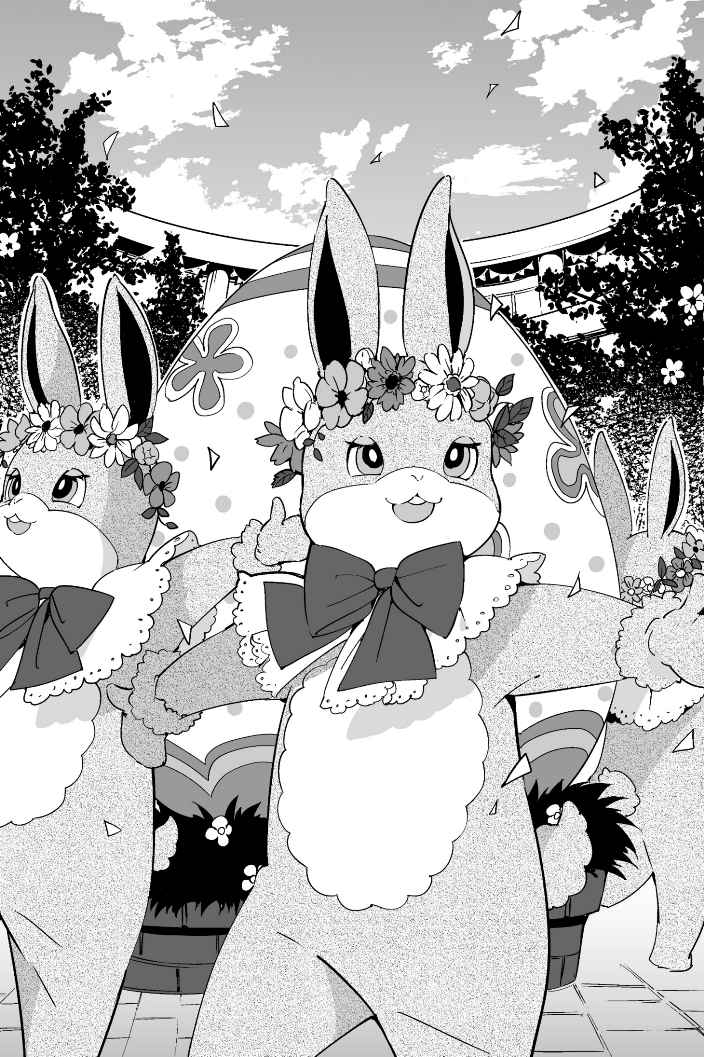
Among the little shops selling snacks and beverages lining the side of the campus, I saw the long line for the Literature Club’s cakes. I stood next to my sculpture and admired how wonderful Easter was in Japan. Our guests were allowed to color and doodle on the sculpture however they liked. I gave crayons to the children that came by and wished them a happy Easter.
My leg started to hurt from standing for too long, so I headed towards the school building to rest. Just then, I spotted a pink bunny escorting Itsumi to the back of the gymnasium. They were just about to announce the winner of the egg-hunt, so no one had noticed that Itsumi and the bunny weren’t there.
Feeling somewhat uneasy, I pushed through the crowd and hurried towards the gymnasium. I heard a deranged voice as I got closer.
“I know what you’re up to. You’re really just making fun of me. Laughing behind my back, calling me talentless!”
“That’s not true. Please calm down, I beg you,” Itsumi implored.
“You’ve always looked down on me. I’ll never forgive you. I’ll kill you.”
When I rushed to the back of the building, I saw a bunny that had a friendly smile plastered on its face choking Itsumi. That contrast was incredibly disturbing. Itsumi’s eyes flew open and her body writhed in pain. I screamed. The bunny, startled by my scream, let go of her neck and ran off.
I rushed over to where Itsumi had collapsed and held her as I sat her up on the ground. She coughed violently.
“Itsumi, are you okay?” I frantically rubbed her back. When she had finally caught her breath, she looked up at my face and slowly nodded in relief.
“What was that? Who was that just now?”
“It’s nothing.”
“But…”
“It’s fine. Seriously, it was nothing. It was just a misunderstanding. Please forget it ever happened.” She started coughing violently again. There were red finger marks clearly imprinted on the base of her neck. Then, I remembered that the bunny had taken its glove off before it left…and that the girl in the suit had been wearing green nail polish.
Even though Itsumi had told me to forget about it, I needed to know who the culprit was. There was no mistaking it. It was clear that that bunny had intended to hurt…or maybe even murder Itsumi.
I went to the Event Planning Committee office to put away my statue after the festival ended. Then I checked the schedule on the wall to see who had been assigned to wear the bunny suits. As I had expected, Shiyo Takaoka’s name was on the list.
I went to the salon. Everyone was totaling up the cake sales at the marble table. I wasn’t surprised to see Shiyo counting the coins on the table with her pastel green nails. Itsumi wore a scarf as if trying to hide her neck.
“Oh, Itsumi. Why are you wearing that scarf?” I asked loudly enough for Shiyo to hear. But she continued counting and pretended not to notice. She had some nerve sitting in front of Itsumi, cool as a cucumber.
“Yeah, my neck is a little cold,” Itsumi said, winking at me.
She was bent on protecting Shiyo. I felt a sudden burst of jealousy. Shiyo didn’t deserve to be close to Itsumi, and yet Itsumi would have done anything for Shiyo just because she wrote some stupid novel. While Itsumi always forgave Shiyo’s selfishness and hostile ways, there I was, finally standing by Itsumi’s side, holding back my feelings.
“…I’ll never forgive you. I’ll kill you.” Shiyo’s voice echoed in my head. I wanted to say that to her, myself.
As I faced Itsumi, I whispered in Bulgarian, “Itsumi, I’ll protect you. I won’t forgive anyone who tries to hurt you.”
The last syllable rang sharp with emotion. Itsumi looked up at me and tilted her head in confusion.
“What was that, Diana? What did you say?”
“It’s nothing. Just a spell for good luck. I hope you’ll always be happy.”
“Aww, thank you.” She smiled cheerfully. That ephemeral grin might have been a premonition of the future. Itsumi died just a few weeks later.
It’s been hard for me to breathe since Itsumi passed away. I didn’t come all the way to Japan to watch Itsumi die. Why did this have to happen to someone as happy and lovely as she was?
I didn’t see Itsumi’s death; I only saw her lying in the flowerbed with the lilies-of-the-valleys in her hand. I know I shouldn’t say things I don’t know are true, but it is clear that Itsumi was murdered…and it is also clear who the murderer is.
“…I’ll never forgive you. I’ll kill you.”
The scream I heard at the Easter festival won’t leave my ears.
Shiyo hated Itsumi with a passion. The work of a writer, who weaves words out of nothing, breathing life into fictional people and forcing them to fall in love, to despair, and to hate, must be too grueling for an ordinary person like me to even imagine. It isn’t unnatural that Shiyo couldn’t stop until she killed someone she thought had negated her work.
Itsumi told me who the culprit is. Kimikageso is a traditional way to say “lily-of-the-valley” in Japanese. She had said so herself.
I would have rather jumped off the terrace with her than lose her like this. If we had tied our hair together, held hands, and took that leap of faith, I know God would have gracefully turned us to stone. We would have spent an eternity huddled next to each other, like the sisters at the Kaleto. Ahh, my dear, sweet Itsumi…
I will never forgive Shiyo Takaoka.
And I also cannot forgive myself. I cannot forgive my foolishness and my inability to protect her. I will regret this for as long as I live. I regret that I failed to protect the only person I’ve ever loved. I regret that I could only watch her die as I stood by her side.
(End)
Thank you, Diana.
You’re the only international student in the Literature Club. Since you’re only going to be here for a year, I expected that your story would be the most objective of all.
And it was just what I had hoped. The tension that only exists at an all-girls school…I’ve never consciously felt something like that before. You used “hirihiri” to describe how you felt and then asked if it was the appropriate word, but I don’t think you could have chosen a more fitting one than that. It’s not “pain” you’re describing; as you said, it’s more like your heart is being sanded down to nothing. You’ve really become proficient in Japanese in the three months you’ve been here.
And within that short period of time, Itsumi has passed away. I learned a lot by listening to your side of the story. But all of the readings, including yours, claim something different. What in the world is going on?
Your reading was truly music to my ears. That Bulgarian accent makes your Japanese sounds very sexy. Your voice also has a lovely depth to it. And the hometown you described with that lovely voice—the towering, gallant mountains, the historical buildings and landmarks, the Rose Valley, the vibrant sea—vividly appeared right before my eyes.
Your reading was very charming. Thank you very much. Let’s all give her a round of applause.
Is everyone eating enough? Let’s add a few things to the stew. Please feel free to come take another drink if you’d like.
My goodness, what’s all the fuss about?
—What, a watch? Someone brought another watch this year. Who’s the lucky girl who has it?…Oh, Akane Kominami. I’m terribly jealous of you. But it doesn’t mean that it’s as high-quality as last year’s, you know. It was probably cheap. Though we won’t know until the meeting ends and we turn on the lights. Perhaps we will envy you. Or perhaps we’ll see it’s a toy and everyone will laugh at you. This is one of the things that make our mystery stew so exciting. Let’s let our imaginations run wild until the very end.
Could the next reader prepare while I add some things to the stew? Let’s see, was it Sonoko who was next? Ah, yes. Sonoko, please head to the reading corner.