5. Short Story Reading — “Lamia’s Feast”

Reader:
Third-year Class B
Sonoko Koga
| WHEN: | The month of July, after school |
| WHERE: | St. Mary’s Academy for Girls |
| WHO: | Third-year student, Itsumi Shiraishi |
| WHAT: | Itsumi’s bloodied corpse |
| WHY: | Unknown |
| HOW: | A fall from the terrace |
This is a rough breakdown of the basic facts surrounding the Itsumi Shiraishi incident. I always try to organize things using the “5W1H” technique my father taught me, no matter what the topic is. Depending on the situation, you can add “WHOM” to make 6W1H, and then “HOW MUCH” for 6W2H.
As you can see, the “WHY” in this case is unknown. Speculations are being tossed around…Was it an accident? Was it suicide? Was it murder?
I will relate my account of the incident. My story may be of value to you—because I know how it really happened.
Now, before I write about Itsumi Shiraishi’s death, I must first tell you about my relationship with her.
Itsumi Shiraishi and I were in the same grade and shared a science class. We both dreamed of becoming doctors. We rooted for—and sometimes competed against—each other for better grades. We each aimed to get into a university with a top-ranked medical program. Itsumi Shiraishi was a worthy rival, as it were.
My father, who passed away two years ago, originally inspired me to become a doctor.
He was fantastic at his job. He used to work at a teaching hospital, and later opened his own small clinic to work as a family physician in our region. While he may not have had the newest medical equipment, he would peruse monthly academic magazines, attend scientific conferences and study sessions, and did everything else that he could to stay current with the latest medical knowledge and techniques. Knowing patients know their own symptoms best, he would diligently listen to his patients as they described their symptoms, then find the cause of their illness and search for a cure. My father never stopped believing in “learning from your patients.”
Masses of people attended my father’s funeral. I sat with my family and watched the long line of attendees offer incense—like an elderly man who’d been my father’s patient since his clinic first opened, a woman who’d been his patient since she was in kindergarten and who brought her own toddler there, or three generations of a family who all went to him for primary care—and I was surprised to see how many patients he had actually taken care of and healed. My heart swelled with pride every time I heard someone softly whisper, “Thank you, doctor,” through their tears.
That day, I vowed: I will be a great doctor like my father. I will take the clinic that shut down with his death and reopen it with my own two hands.
The only possessions my father left me were the encyclopedias that filled his bookshelves, back issues of the American Journal of Medicine, and a worn-out stethoscope. It was so characteristic of him that I was moved to tears.
Since then, I’ve dedicated more time to my studies. Sometimes the stress is too much and I feel like giving up, but at those times I visit hospitals to lighten my mood. I hop on random buses and trains until I find a hospital I’d like to visit. When I arrive, I see people suffering from illnesses. Health care providers offering their sincere support. Smiling patients leaving the hospital. Every one of those people rekindles the fire of my motivation. You may find it strange that I take hospital tours to feel refreshed, but I think that all scientific girls are a little eccentric to begin with.
Itsumi Shiraishi was more balanced in that sense. I assumed that she was a liberal arts type because she ran the Literature Club, so I was surprised when we ended up in the same science class in our second year. I am confident that I will not lose to anyone in mathematics and science, but know I don’t do well in classical literature, kanji, and English. But Itsumi Shiraishi was unbeatable in those subjects, too. How irritating. She must have been right and left-brained.
There are many bright students at this school, of course. However, Itsumi Shiraishi was my personal rival. I spent half of each day studying just so I wouldn’t lose to her. Just when I felt like I couldn’t keep up this exhausting routine any longer, Itsumi Shiraishi invited me to the Literature Club in my second year of high school.
Sayuri Sumikawa, another student in my grade, warmly welcomed me into the club. At the time, the only other members included Akane Kominami and first-year student Shiyo Takaoka. (I know she’s billed as a “high school author” and all, but I didn’t finish her book. My head started to hurt just from reading the first page. Is that style the trend now? Honestly, I’m not into it. But of course, I told Shiyo that I read the whole thing).
The book discussions were excruciating at first. Even if I did do the readings, I was terrible at answering questions like “What is the theme of the piece?” or “How do you feel about it?” or “What is the story trying to say about modern society?” and voicing my opinion about the novels.
“You can’t just say ‘It was interesting,’ Sonoko,” Itsumi often said, disconcerted.
“But that’s really all I felt,” I would reply.
“That can’t be. Every story has a theme and a question for the audience,” she would retort. This was a plausible argument.
“Okay, then what about the legend of Momotaro?” I asked jokingly.
To my surprise, Itsumi launched into a rapid-fire discourse on Momotaro’s “relevance to today’s aging society, pregnancy over the age of forty, and the declining birth rate,” and “the absurdity of the violent resolve to exterminate the Oni.”
At first, I got Itsumi to give me easy assignments, such as medical works of literature by Robin Cook and Michael Crichton. I was so fascinated with their stories of heart transplants and rare bacteria, I could read them from dawn until dusk. Shiyo and Akane didn’t seem to enjoy them nearly as much as I did (as was clear after Akane exploded, saying that “These books are so boring that they’ll ruin teatime!”).
Nevertheless, human beings are, above all, creatures that can learn. Despite my apathy towards the book discussions, I gradually learned how to understand literature after reading more and listening to the members’ thoughts and analyses. The trick to lengthy novels is to extract 6W1H or 6W2H instead of 5W1H, and then compare the book to modern trends and events. Once I got the hang of this, the discussions weren’t so painful for me anymore.
Take Stendhal’s The Red and the Black, for example:
WHEN: 19th Century, the Restoration period
WHERE: France
WHO: Julien Sorel, a man born into poverty
WHAT: Sentenced to death at 23 years old
WHY: Shoots his past lover to death, thinking he had been betrayed
HOW: Julien’s failed plots to gain power and love cause his downfall
Humans still tend to be controlled by power and money in the contemporary era. However, modern Japanese people have lost the nobility or heroism that Julien displays when he accepts the death penalty in exchange for true love.
Here is another example for The Great Gatsby by F. Scott Fitzgerald:
WHEN: The 1920’s, Post-WWI
WHERE: New York suburbs, Long Island
WHO: Mysterious millionaire, Jay Gatsby
WHAT: Falsely accused of a crime, shot to death
WHY: Attempts to reclaim his former lover from her current husband
HOW: After Gatsby goes to war, his lover marries a millionaire. He becomes obsessed with vindication, and dedicates his life to the acquisition of social status, wealth, and success.
Whether it be affection, power, or social status, people yearn for what they can’t have. While it is foolish to single-mindedly pursue these things, it is also, in a way, endearing. We keep searching for an innocent man like Gatsby because we know that there is no one actually like him—that he is just an illusion.
Itsumi was glad to see that I was proactive in the discussions. “You look at things in an interesting way. How do you analyze what you read?” Itsumi asked me one day. I then showed her my logical 5W1H analyses.
“This is so you. You read with your head rather than your heart.” She laughed loudly.
I may not have a full understanding of literature, but I believe I made the right decision by joining the club. First, there are no downsides to enhancing my reading abilities. Second, I can eat Akane’s handmade sweets whenever I want. And third, I get to participate in the unique mystery stew meetings.
Itsumi Shiraishi reopened the Literature Club, which had been shut down after all of its previous members quit, when she entered high school. At that time, Mr. Hojo, our adviser, gave Itsumi the “Literature Club handbook.” The handbook has been passed down for generations and provides instructions for the book discussions, procedures for the debates, and rules for the mystery stew:
The mystery stew must take place in complete darkness.
The club president must act as the facilitator, AKA the “pot bearer.”
Items do not have to be edible, but must be sanitary.
The club president must make delicious desserts as a palate cleanser.
A member must stand in the reading corner when reading aloud.
Members must eat as they listen to the readings.
I was initially appalled trying to imagine what kind of sick individual would think up such peculiar rules, but once I actually joined in on one, I found the meetings exhilarating. You nervously pick up a mystery item with chopsticks and bring it to your mouth. The texture feels revolting against your lips. You get an awful rush of chills when it doesn’t taste as you expected. I never thought I’d be able to focus on the members’ stories with all this going on, but I was surprised to find that I remembered them even better than stories I had read in a well-lit room. Your imagination sparks, and the stories appear to you as if on a scroll rolled out at your feet. Brain activity increases in the dark and helps you see things more vividly.
You also feel mischievous. I know it’s against the rules to say this, but I was the one who brought the strawberry rice cake, macadamia nuts, and the Chanel watch last year. The strawberry rice cake melted into the soup, boiling the meat, fish, and vegetables in a sweet goo, which made for a terrible stew. I have to say, I was snickering myself the whole time listening to the other members nearly shriek while they ate. Then, when I brought the macadamia nuts, someone yelled “There’s rocks in it!” and I sat there thinking “Fooled you!” I also chose the Chanel watch because I knew it would take everyone by surprise. When I saw how envious everyone looked when they saw what Itsumi blissfully held in her hand, I wanted to boast and say, “It was me! I brought the watch!” But I had to follow the rules and keep it a secret. I still regret not having said anything.
Book discussions and mystery stew meetings weren’t our only club activities; the Easter & Pentecost bazaar was also a huge task. But this year, I was chosen to be the head of the executive committee and I didn’t really get to participate in the bazaar.
Last year, when I was just a regular committee member, I helped out the head of the committee because I saw how busy she was and felt sorry for her. Then this year, it was my turn to fill that position.
I was incredibly busy. I discussed poster designs with the art club, made pamphlets to hand out to our neighbors, had meetings with the chorus club, and ordered eggs for the egg hunt. I had to write an easy-to-understand description of Easter on a pamphlet for children and others unfamiliar with the holiday. In the end, I came up with:
Easter is a festival that celebrates the resurrection of Jesus Christ. The first fifty days of the Easter season is called “Eastertide,” and the fiftieth day is called “Pentecost,” which is the day that the Holy Spirit descends onto earth. Our academy celebrates these important events by holding a charity bazaar every year in June.
We paint eggs, a symbol of life, and hide them in the courtyard. Then, there will be an egg hunt for all children to participate in.
Please visit our bazaar and café corner at your leisure.
There will also be a donation box. Donations will be given to the Red Cross, retirement homes, and others who desperately need these funds.
Jesus Christ lives.
He is of eternal life.
I emailed parents asking for their assistance and donations, arranged the stage rental for the courtyard, and completed many other arduous tasks all for one reason: to thank Mr. Shiraishi, the chairman of our school.
Mr. Shiraishi is Itsumi’s father. He runs a general hospital, a commercial building, and all other sorts of businesses in addition to this academy. In other schools, most students normally don’t know their school chairman by face, but Mr. Shiraishi is different. He regularly comes to school to talk with the students and visits every semester to check on our grades. He even allows good students to undergo special training, letting them sit in on other classes, and makes sure the professors are performing at their best.
Mr. Shiraishi’s motto is that “school administration is the ultimate service industry.” He believes that it is his obligation to elevate students’ moral consciousness and academic abilities.
Mr. Shiraishi also actively participated in school functions. Out of all the school events, the one he helped out with the most was the Easter bazaar. In fact, he planned every detail of the event himself. “This is our chance to teach our neighbors about Christ’s love and spirit, and to give back to the community,” he said.
And I myself am personally indebted to Mr. Shiraishi. For a long time, I had wanted to sit in on a human dissection. My father couldn’t perform dissections or surgeries in his tiny clinic. But since I decided to become a doctor, I thought I should watch a dissection at least once. Last year, when I became a member of the executive committee, I volunteered to report directly to Mr. Shiraishi. The first time we ever met face-to-face, I requested to sit in on a dissection. I figured he would say that “this isn’t child’s play,” and prepared myself for a curt rejection.
“Understood. I’ll let the chief of surgery know. Please contact my hospital any time you’d like,” Mr. Shiraishi said instead, consenting immediately.
That next week, I was standing in front of an operating table with the professor and interns of an anatomy class. I wasn’t holding a scalpel, of course; I simply watched from the side. But I learned so much more from studying the organs in person than just looking at a diagram or picture. The brain, heart, lungs, liver, kidneys, and arteries were silently removed and cut open. I was worried that I’d feel sick or go into a state of shock, but I was surprisingly calm. Perhaps my brain didn’t connect the body in front of me with the concept of death. The tissue wasn’t something grotesque, but a precious material critical for making advancements in the medical field.
When the dissection ended, I was sure of only one thing.
Souls do not dwell in the human body.
I looked at the body from head to toe, in the spaces between brain cells, in every chamber of the heart. There is no space for the soul to exist. Joy, sorrow, anger, and jealousy are emotions that occur in the small organ we know as the “brain” and are predominantly controlled by the amygdala, limbic system, and the neocortex. Humans do not exist because they have souls. They live because breathing causes oxygen to travel throughout the body, secrete physiologically active substances, create blood flow, and maintain their metabolisms. The dissection made me realize that life is nothing more than a simple physiological function.
Even though I am enrolled in a missionary school, I was never a Christian. I don’t believe in a “God” or any other unscientific being, nor do I assign meaning to the Holy Spirit or Eternal Life. I only believe what I see. However, if people find solace in the existence of God or souls—especially those who are ill and rely on these entities for hope—I feel I must seriously try and understand these things for my future patients.
I changed drastically after the dissection. It made me contemplate life—what it is, how one should die, what is God, what a doctor should do—and reconfirmed my decision to seriously pursue my path.
I decided to head the executive committee to try and repay Mr. Shiraishi for giving me that precious experience last year.
We started preparing for the Easter bazaar at the beginning of the new academic year.
Most missionary schools and churches have events in April, when Easter Sabbath typically falls. However, our academy celebrates Easter and Pentecost in the middle of June in order to avoid the chaos of the new school year.
Last year, I only visited Mr. Shiraishi at his residence a few times to report on committee activities, but, after I became head of the committee, our meetings became more frequent. I would ask for his opinion on my rough draft of the Easter poster, and gave him price quotations for and a final list of the tentative shops for the bazaar.
Even though Mr. Shiraishi surely knows “time is money,” he spent his time on his students, instead of on hobbies or vacations, and I was grateful for that. He inspired me to dedicate all of my time to studying and perfecting the festival preparations, no matter what it took. I became more enthusiastic with every conversation and often found us talking in his library for three hours at a time.
Since most of these meetings and preparations took place after school, I wasn’t able to attend most of the Literature Club meetings. I’m sure they also had daily meetings about the Easter festival arrangements. I couldn’t assist them like I did last year, when we baked two hundred cakes, so I imagine that they were much busier obtaining the ingredients and cooking utensils than they had been before. Maybe that’s why I never ran into Itsumi when I visited her father. She must have been constantly running around like crazy. At any rate, Itsumi was, like her father, hot-blooded and persistent.
“What would you think of a bunny dance?” Mr. Shiraishi suggested one day, with a twinkle in his eye.
“Bunnies…?” I asked.
“You know, Easter Bunnies. We’ll have the students wear bunny costumes and do a little dance as they walk around. Like they’re in a make-believe land. Don’t you feel excited just thinking about it?”
He had a point. It certainly would feel like a fairytale if we had Easter Bunnies dancing in front of the academy’s European Middle-Age style architecture. It was hard to picture that this man—a cold rationalist whom many fear, who expands his businesses by aggressively acquiring other companies—would have such an innocent idea. “It sounds great,” I replied, holding back laughter, trying my best to show that I agreed. Despite his silly idea, I really did enjoy talking to him and listening to his various suggestions.
So I borrowed the laptop in his library and started searching for costume rental companies.
There is a logical explanation as to why Mr. Shiraishi let me borrow his laptop. Last year, when I visited Mr. Shiraishi to talk about my progress report, I walked in on a telephone conversation between him and his secretary. He was trying to send urgent instructions to his branch office when his computer suddenly shut down and wouldn’t restart. As a child, I used to disassemble and reassemble computers for fun, so I am actually quite the tech-whiz. He ordered his secretary to have his computer repaired immediately and then angrily hung up. That is when I asked if he’d like me to take a look at it. Even if I wasn’t able to fix his computer, I figured I’d be able to extract some data out of it.
My hypothesis was correct. I was able to restart the computer in safe mode and put the necessary information onto a flash memory stick before the repairman rushed in with a replacement computer. Mr. Shiraishi thanked me for loading the data onto his computer, and for doing it so quickly he didn’t have to waste time waiting for his files. He was so profuse in his thanks I started to feel embarrassed. From that point on, Mr. Shiraishi put his trust in me.
I am not only confident with computers; I also know that I’m good at getting things done. I ran as many errands as I could while Mr. Shiraishi dealt with the incessant calls he’d receive during our meetings. On this occasion, I had finished negotiating prices with the costume rental company and ordered ten bunny suits by the time he had hung up the phone.
“That’s incredible, Sonoko. Listen, how would you like to be my assistant when you graduate?” he suggested then.
I could only take this as the highest compliment. I was delighted. If only my father were still alive. If only I had a father like Mr. Shiraishi, I thought—and yes—I felt jealous of Itsumi.
“It would be an honor,” I said.
“I’m serious. I mean, you’re better than my secretary. I hate when people mess with my things. I’ve never even let my secretary enter my library. In fact, you’re the first person I’ve ever allowed to handle the library computer,” Mr. Shiraishi admitted. When he grinned, his eyes crinkled. “But I know you want to be a doctor. Well, after you get your degree, I’d like you to work at my hospital,” he offered.
“I’d love to!”
“Here, take this. It’s a small reward for your hard work,” said Mr. Shiraishi. He opened his desk drawer and took out a box wrapped in decorative paper. “I went to Paris on business last week. This is a souvenir.”
“Oh, you shouldn’t have…”
“Please, take it. It’s a thank-you gift for your diligent work as head of the executive committee.”
“Are you sure?”
“Of course. Open it.”
I opened the chic wrapping paper to reveal a box of Guerlain, my favorite perfume. It’s an exclusive perfume sold every spring.
“I love it! I buy Guerlain every year.”
“I’m glad you like it. But please, don’t tell Itsumi. I could only get one bottle,” Mr. Shiraishi confessed, scratching his head.
“Thank you so much,” I said.
Aware that I’d never receive gifts from my own father again, Mr. Shiraishi must have surreptitiously taken on that role for me.
“I’ll cherish it always…” Dad, I almost said. I panicked and swallowed my words.
Classes, tests, Easter preparations, Literature Club, independent studies.
With all the pressure, I nearly combusted with stress. I found it hard to keep going. I tried reading my textbooks at home, but the information wouldn’t stick in my head.
This is no good, I thought.
Finally, I set my study materials aside and decided to go on a hospital tour. It was a Saturday afternoon. I figured the hospital would inevitably be crowded. I quickly switched from one train to the next until I arrived at a general hospital in the suburbs.
Sure enough, there were people everywhere. The lobby, information desk, emergency exit, cafeteria, café, shops, internal medicine, radiology department…I took it all in. I saw doctors and nurses who’d do anything to heal their fearful patients of their pain and suffering. Right, I thought. I have to try much, much harder for my future patients. Someday, I need to be able to save them.
Mission to rejuvenate: complete. Feeling recharged, I walked back down the stairs to the lobby. It was there that I noticed an unusual presence.
Itsumi Shiraishi.
Her beauty stood out in the crowded hospital. Maybe she had also come to mentally recharge. After all, she’d come all the way to the suburbs instead of going to her father’s prominent hospital. Perhaps, like me, she was also burnt out.
“Itsumi…” I was about to say, but stopped myself.
Her expression was so vacant it seemed like she was unconscious. Her skin was sickly pale, and she had lost the sparkle in her eyes. She stumbled around the lobby as if sleepwalking.
When she came back to school, Itsumi didn’t seem like herself.
She was morose and hardly ever smiled. She wasn’t her cheerful, lively self.
“Itsumi?” I called to her between classes the following week.
“Whaat?” she answered lethargically.
Her gaze was incredibly listless.
“…It’s nothing,” I found myself saying.
“You’re a strange one, Sonoko.” She smiled, but it was weak. Itsumi was starting to look more like a patient than the doctor she aspired to be. I wanted to tell her I had seen her the previous Saturday, but decided not to.
Even at the salon, Itsumi drooped languidly on the sofa. She was normally inseparable from her books, but now just closed her eyes and listened to a piano piece by Chopin.
“Itsumi, do you feel sick?” Diana, the international student, inquired, sounding worried.
“Yeah, a little. My body feels sluggish.”
“You’re tired. I’ll give you a massage with rose oil. Go change into a robe and come back when you’re done,” Diana said. Once Itsumi came back, she had Itsumi lay face-down. Diana started rubbing the sweet-smelling Bulgarian rose oil onto her arms and back, and then lightly began massaging her.
“How’s that?”
“Really good.” Itsumi started to doze off. I thought she was probably just sleep-deprived. Even if she’d been sleeping well, we still had to deal with the difficult homework assignments we received every day in science class. Perhaps Itsumi was feeling the stress that came with being the chairman’s daughter.
But…
I felt like there was something else at work.
I watched Diana diligently massaging Itsumi. Looking back, I felt like Itsumi had been slowly changing since the spring.
Spring—yes, right around the time that Diana Decheva came to Japan.
It had been the first morning assembly of the semester. The auditorium was enveloped with a strange excitement while the principal introduced Diana at the altar, in front of the entire student body. She had translucent white skin. Long, ebony-black hair. Her large, dark eyes were as lustrous as the waves of the Dead Sea that crash on the shore of her homeland. She had a rigid-looking nose and well-proportioned lips.
Diana was stunning. She had a mysterious Southern Slavic allure—unlike the blond-haired, blue-eyed inhabitants of the West or black hair and black eyes of the East. Our school uniform looked surprisingly nice on her. Until then, I thought no one as lovely as Itsumi could exist. But I had to say, Diana’s unique beauty may have been on Itsumi’s level.
The students weren’t just making a fuss because they were impressed by her beauty; Diana was also identical to the painting of the girl in the new church. The painting’s title is Jesus Christ and The Devil who Fears Christ with His Servant. The Devil’s female servant looked eerily like Diana.
“My name is Diana Decheva. I’m from Levagrad, a village in Bulgaria. It’s nice to meet you,” she announced in Japanese with astonishing fluency. She demurely pinched the hem of her skirt, put one leg behind her, and bowed her head as she curtsied. It certainly wasn’t an elegant gesture; it looked more like the folk dance of a village girl, but it had its own rough charm. This gesture assuaged the students’ initial dark impression, and they welcomed her to our school with a friendly round of applause. But even with all the students clapping, I still felt that there was something dark lurking within her.
It isn’t like me to think this way, I know. The resemblance between Diana and the girl in the painting had made me uneasy. Then, when I saw her dragging her leg after stepping down from the altar, I was only more disturbed. The painting of the Devil’s servant used to hang in another convent, which was destroyed in a fire. The fire had also burned off the portion of the picture with the servant’s leg. Itsumi and Diana were close from day one.
Itsumi said that she had stayed at Diana’s house when she studied abroad. She must be a good person if Itsumi likes her, I thought. I felt relieved.
I tried speaking with her and found her extremely easy to talk to, which made me feel embarrassed for pegging her as some menacing character. Plus, she also spoke almost perfect Japanese. She knew quite a bit about our culture. I heard that Diana’s twin sister was originally supposed to study abroad at our school, but I had a funny feeling that Diana would have a more fulfilling experience than her sister ever could.
Diana’s village was so filled with flowers that it wouldn’t be wrong to call it “Flower Village.”
“That’s why I just love flowers,” Diana explained, decorating the academy with them. On top of the obvious places like the classrooms, she also decorated the faculty room, sunroom, bathrooms, entrances, and the hallway windows—surrounding students in a sweet aroma wherever they’d go. Seeing such delicate scenery, one couldn’t help but feel that prior to Diana’s arrival, life at the academy had been regrettably dreary.
“I want to give the school flowers from my village to thank them for letting me study abroad and to commemorate my stay,” Diana remarked as she planted seeds in the flower bed next to the new church. I anticipated that the flower of Diana’s hometown was the rose, but I was mistaken.
“Everyone thinks of roses when they think of Bulgaria, but the lily-of-the-valley is what my hometown is famous for. The village is blanketed in white during the first days of summer. It’s very lovely,” the Bulgarian girl mentioned.
“You got lily seeds all the way from your village?” Itsumi asked Diana.
“Yes. It took some time for my parents to send them to me, but I luckily got them in time to plant,” Diana replied, assiduously piling soil onto the seeds she had placed in the ground.
“When will they bloom?”
“I think around May. These lilies are resistant to warm weather. This garden will stay cool in the shade, so they might even make it through the summer.”
“Ah. I can’t wait,” Sayuri said, looking entranced.
Itsumi invited Diana to join the club, and of course she joined.
Since I had assumed that Diana couldn’t read Japanese, I was astonished to see her read through all of Yukio Mishima’s Confessions of a Mask and comment on it in Japanese, without even having to pause, at her very first meeting. She often put herself down for her “clumsy Japanese,” but I thought it was unbelievable that she was so fluent with just one or two years of study.
Diana was already acquainted with Shiyo, and they frequently reminisced about their memories in Bulgaria. It seemed like Shiyo had had a great time in Bulgaria, as she flaunted the pictures she took with her single-lens reflex camera, her prized possession, and told us about the history and legends of all the places she had visited.
Every one of Shiyo’s photos—which captured the naïve, lovable faces of the wild foxes and rabbits, the mountaintops enshrouded in billows of white clouds, the lush green river banks—teemed with life. The pictures filled you with joy just from looking at them. But in the midst of these brilliantly-colored photos was one painted over in black.
I was startled.
Seeing it was as ominous as seeing the words of an obituary.
“Hey, what do we have here?” Sayuri asked innocently, picking up the photo.
“Ohh, that…” Shiyo started to say.
“That was taken at Lamia’s Feast,” Diana broke in.
Upon further examination, I realized that it hadn’t been painted over; the lighting of the photo was just so dark that it just looked that way.
“I wanna see,” Akane said. Sayuri handed her the photo and she looked at it.
“Oh, everyone’s dressed in black,” she remarked.
The photo was passed to me. Itsumi was sandwiched between Diana and a girl who looked like her (I assume her twin). All three of them had their hair down, and wore black feathers and bright red lipstick.
“What’s Lamia?” Sayuri inquired.
“Lamia is a witch. A vampire. Diana says there are a lot of legends about vampires in Bulgaria,” Itsumi answered. “Lamia’s Feast is a festival. It’s kind of like the American ‘Halloween.’ ”
Goosebumps spread over my body the moment I saw the photo. Diana was smiling creepily at the camera. The blazing flames reflected a terrifying spirit within her eyes. Diana looked like her twin, but her energy wasn’t kind and warm like her sister’s. What was that feeling? That menacing, unsettling feeling. It was almost as if…she wasn’t human.
I looked up and accidentally met eyes with Diana. Her gaze was abnormally sharp. As if a criminal were threatening a witness. As if she were warning me. As if she were preying upon me.
We stared at each other for a moment, neither of us looking away.
Just so you know, I don’t believe in what cannot be explained by science. Which is why I am hesitant to write about what I witnessed. I still can’t believe I saw it with my own eyes. Was it real? Was I half-asleep? No…but I know what happened best. It was not a hallucination, but reality.
Therefore, I must write it down. This is my account of that peculiar incident.
Diana always carried something wrapped in a cloth that seemed very important to her. She never revealed what it was or let it go. She held it tight against her chest during class. The girls around her were naturally very curious about it. Many of them asked her what it was, but she only smiled in response. Finally, one girl suggested that it might be a charm from her hometown, and everyone took that for the truth and eventually lost interest in the item in the cloth.
I only found out what it was by chance.
One day, I’d been so focused on studying I hardly realized it was morning. If I fell asleep then, I’d be late for class. I thought I should catch the earliest train to school and then rest in the nurse’s office until the morning assembly. A janitor opened the school gates for me when I arrived. When I went inside, I noticed a shadow under a tree in the courtyard.
Who would be here at this hour?
I stealthily edged towards the shadow in the morning fog. A shadow slowly and stiffly—indeed, dragged its leg as it moved. That’s right, it would make sense for Diana to be here since she’s staying in the convent, I thought. I was just about to turn back and head towards the nurse’s office.
Then, I saw Diana unravel the cloth. It was a doll.
Intrigued by the thought that Diana had been carrying a doll around all this time, I quietly tiptoed to a place where I could get a better view.
Diana held the doll against the trunk of the tree. She then took out a knife and with a powerful thrust, stabbed it into the doll’s chest.
Terrified, I stretched my neck out so I could see just a little bit more—and gasped.
The doll looked exactly like Itsumi Shiraishi.
The doll was attached to a cross. Diana had pinned it against the tree. She started to mumble. It sounded like Bulgarian. The dark, melancholy intonation of her voice trembled eerily in the air. She repeated the same words over and over again. Although I didn’t know the meaning of that phrase, which ended in a sharp syllable, I felt like it had torn into my heart. I was deeply uncomfortable. I took shallow breaths as I watched Diana continue to recite what sounded like an incantation. I wondered how much time had passed. Finally, Diana smirked with satisfaction and slowly pulled the knife out from the doll’s chest. She wrapped the doll in the cloth, held it close to her chest, and slowly made her way back to the convent.
After she left, I couldn’t move. I couldn’t understand what I’d just seen.
A few hours later, Itsumi Shiraishi came in late for the morning assembly, looking pale.
“You’re never late. Is something wrong?” I asked.
“I don’t know, I was in a lot of pain,” Itsumi answered. “My chest suddenly started hurting this morning.”
…What did she say? For a moment, I doubted my ears.
“I panicked and rushed over to my father’s hospital to have it checked out. But they couldn’t find anything,” Itsumi explained.
The image of the blade that stabbed the doll’s chest floated into my mind. I looked back at Diana’s seat. She sat there stroking the doll from over the cloth with a mysterious grin on her face.
She was mumbling something. It was the phrase that finished with the harsh syllable, the one she had just been reciting before.
My eyes met with Diana’s. She looked frighteningly beautiful and far more alive than Itsumi.
That was when Itsumi’s health started gradually deteriorating.
I had always sneered at the idea of fortune tellers and curses, and yet found myself worrying about Diana and her doll. According to my research, there is something called a “voodoo doll” that is used in black magic. If you cause pain to a doll that looks like your enemy, the actual person will feel the pain you inflict upon the doll. The more they look alike, the more effective it will be.
Why would Diana do this if Itsumi was her friend? After trying to wrap my brain around it, I finally came to a conclusion.
Diana did it because Itsumi had spoken with the principal and her father, the academy chairman, and recommended that this be the last year they invited a student from Levagrad to the academy.
Diana’s stay was incredibly beneficial to our school. The other students were able to meet a foreigner and learn about the lifestyle and culture of a country which is hardly ever covered in the media, and this was an immensely valuable experience for the students. So Itsumi suggested that rather than continuing to bring students from Bulgaria, the academy should invite students from a different small country each year instead.
Since Mr. Shiraishi and the principal basically left the matter in Itsumi’s hands, she began researching the Middle East, Asia, and Africa, and contacted their respective embassies to figure out how to make her idea a reality. If Itsumi had succeeded, Diana would’ve been our first and last international student from Bulgaria.
We Japanese are from a country far wealthier than Bulgaria, so it is hard for us to understand Diana’s situation.
Levagrad is a tiny, poor village in a small Eastern European country. Left behind even by tourism, it has no large manufacturers and offers a low standard of living. An invitation to Japan means a lot in a village like Levagrad. Diana’s sister, who works part-time at a travel agency to save her family from debt, coordinated all the travel arrangements for the study abroad program. Diana joyfully mentioned that, despite the fact that her sister is currently hospitalized, her sister’s company plans to keep her employed long-term and give her a huge bonus because they anticipate invitations to Japan in the future. In other words, without an invitation from our academy, Diana’s sister would lose her job and their family wouldn’t be able to survive financially.
Diana put in serious efforts to have this program continue, which is why Itsumi’s idea must have seemed like an unforgivable betrayal of trust. If Itsumi was weak, she wouldn’t have the strength to keep up her negotiations. If there weren’t any negotiations, the academy would keep inviting students from Levagrad—this must have been Diana’s thought process.
The fresh green spring outside bloomed as Itsumi continued to wilt.
Her once rosy-colored cheeks became gaunt, and it seemed like breathing was painful. I often found her lying on the sofa in the salon. Itsumi’s life was being drained away—yes, that’s the perfect way to describe it. Concerned about her condition, I started taking her pulse, temperature, and blood pressure every day.
One day, when I picked up her wrist to take her pulse, her nail accidentally caught my arm.
“Ouch!”
I let go of her hand and saw a single line of blood trickling down my arm.
“Goodness, I’m sorry, Sonoko,” Itsumi apologized, rubbing my arm. “I didn’t notice how long my nails were. It’s strange, I cut them just a few days ago.”
Her nails were long and sharp, indeed. I knew Itsumi trimmed them regularly, so this was unusual.
“I’ll visit the nail salon today. I’m so sorry,” she apologized.
But the same thing happened just a few days later.
“Ughh, this is so annoying. I just went to the salon a couple of days ago,” Itsumi sighed, staring perplexedly at her nails. “It’s so weird. Why are they growing so fast? I’m sorry, Sonoko.”
“Don’t worry about it,” I replied.
While I figured that Itsumi had simply forgotten to go to the nail salon, this incident bothered me. Carefully observing her, I realized that her nails really were growing unusually fast.
It can’t be. I must be mistaken.
But even though Itsumi had just cut her nails, they had grown enough to break skin in just a few days. Once I started observing her more closely, I also noticed that her hair was growing at a rapid pace. One day her hair was at her shoulders, and just a couple days later it was almost hanging down to her waist.
Something was off. Something strange was happening to Itsumi’s body…
I was going to broach my worries with Itsumi. Then I saw something happen.
It was after school. We had finished our tasks for the Easter festival early and didn’t have a Literature Club meeting that day. After leisurely packing up and exiting the building, I saw Itsumi leave the salon.
“Itsumi, let’s walk home together,” I called to her. But she didn’t respond. I thought the noise from the sports clubs had probably drowned out my voice. Itsumi continued walking and entered Building 2.
“Itsumi?”
Itsumi didn’t turn back. She proceeded forward, and I followed her.
Building 2 has very little access to sunlight and its hallways are always dark in the evening. The dim, green glow of the emergency exit is the only light in the building. Students hardly ever go to Building 2, since the only classrooms there are for science experiments, home economics, and other courses that only meet infrequently. It’s usually quiet. But the real reason students don’t go to Building 2 is because of the rumors about the mirror.
The mirror…There is a massive mirror at the end of the hallway. It’s not just an ordinary mirror. Our academy received it as a gift from English nuns after the end of the war. It is enormous: 8 feet in height, 5 feet in width, and etched with Corinthians 1, Chapter 13, Verse 12:
For now we see only a reflection as in a mirror;
Then we shall see face to face.
Now I know in part;
Then I shall know fully, even as I am fully known.
Every school has their “seven wonders,” or seven interesting aspects, but most of the rumors about our academy have something to do with this mirror. The Bible verse etched in the mirror has inspired whispers such as, you can see who you were in your past life in the mirror, or that it will show you your true self, or that it will tell you when you’ll die.
Some students fear it, and plenty of others want to stand in front of it as if it were some sort of Ouija board. It’s gotten to the point where I’ve heard someone go around the school bragging that she was “a nun in the Sengoku Period.” I figured Itsumi was curious about the mirror and was finally going to see it for herself.
Itsumi turned in the hallway. The sound of her shoes squeaking against the linoleum floor became distant. I turned the hallway and followed after her.
However.
Itsumi had vanished.
I stood there with a dumbfounded expression on my face as I gazed at my reflection in the mirror. A dead-end. I could only leave from where I’d come in. But Itsumi was gone. It was as if the mirror had swallowed her up.
I wasn’t just seeing things. It wasn’t a dream. I’d seen her with my own two eyes and heard her with my ears, and I had followed her right to the mirror.
I don’t believe in unscientific or supernatural things. However, I know Itsumi disappeared. This is an indisputable fact.
I had no choice but to accept it. Something was happening to Itsumi, and Diana and her mystical dark powers had something to do with it.
Shortly after that, Itsumi was checked into a hospital. She had come down with pneumonia…an illness that affects the chest.
Itsumi seemed to have regained her energy after she was released from the hospital. But her face looked gloomy and somewhat bitter.
It wasn’t the same Itsumi as before.
When it came time for the Easter festival, I still felt like something was off. I ran around the school that morning, finishing my final preparations. I had to find a way to hide all of the Easter eggs, give the children baskets, and announce the start of the egg hunt. I was only able to take a break when I saw the guests filing in through the gates.
At that point, I was ready to call the bazaar a success. I let out a sigh of relief. Itsumi was supposed to read the Bible aloud in the church after the egg hunt was over, so I started looking for her.
I found Itsumi sitting next to the flower bed, staring out into space. “Itsumi, could you come test the microphones?” I asked. A white lily-of-the-valley gently swung in the breeze with the other flowers.
“What, a mic test? What was that for again?”
“The Bible reading. You do it every year.”
“Oh…yes, that’s right.”
Itsumi unsteadily rose to her feet. Her face stiffened, and her steps grew heavier with every step she took towards the church.
“…I can’t do this,” Itsumi finally said, her voice shaking.
“What?”
“I won’t go to the church. I’m frightened.”
“Itsumi, what are you talking about?” I pulled on her hand, thinking that she was joking.
“Stop it!” She twisted her body and forced her hand free. She held her head in her hands and started to shake.
“I…I can’t go. I don’t want to read the Bible!”
“But why? Every year you read the Bible in front of the cross.”
“Oh, the cross!” Itsumi’s cheeks turned white right before my eyes. “I don’t want to look at a cross. I’m sorry, but you’ll just have to find someone else to do it.”
Without giving me a chance to stop her, Itsumi ran off.
Why was she scared of the church, the Bible, the cross?
I entered the church alone, unsure of what had happened.
The painting hung directly in front of me. God and The Devil who Fears God with His Servant. The servant…the beautiful woman identical to Diana.
I felt uneasy and ran out of the church. Itsumi wasn’t there. I ran through the school grounds and searched for her. The area was packed; it was almost time to announce the winner of the egg hunt. I pushed my way through the crowds and searched the classrooms, the salon, and the courtyard. She wasn’t anywhere. The only place left was the gymnasium. Just as I headed over, Diana came from behind the gymnasium holding Itsumi in her arms.
“Itsumi!” I screamed in a panic, dashing over to her. Her body was limp.
“Wh-What did you do to Itsumi!”
“Who, me? I didn’t do anything,” Diana answered calmly.
“Well, then why is Itsumi…” Then I noticed a faint red mark on Itsumi’s neck.
Was it blood? Lamia. Witch. Vampire. Servant of the Devil…Those horrifying words swirled around in my head. Diana covered Itsumi’s neck with her cardigan as if trying to hide it from me.
“She seems sick. I’ll take her to the salon so she can get some rest. Come on, Itsumi, it’s going to be all right,” Diana cooed. She started walking back towards the salon, Itsumi in her arms.
It was as if the servant of the Devil was bringing a corpse down into Hell.
Just a few weeks later, Itsumi was dead.
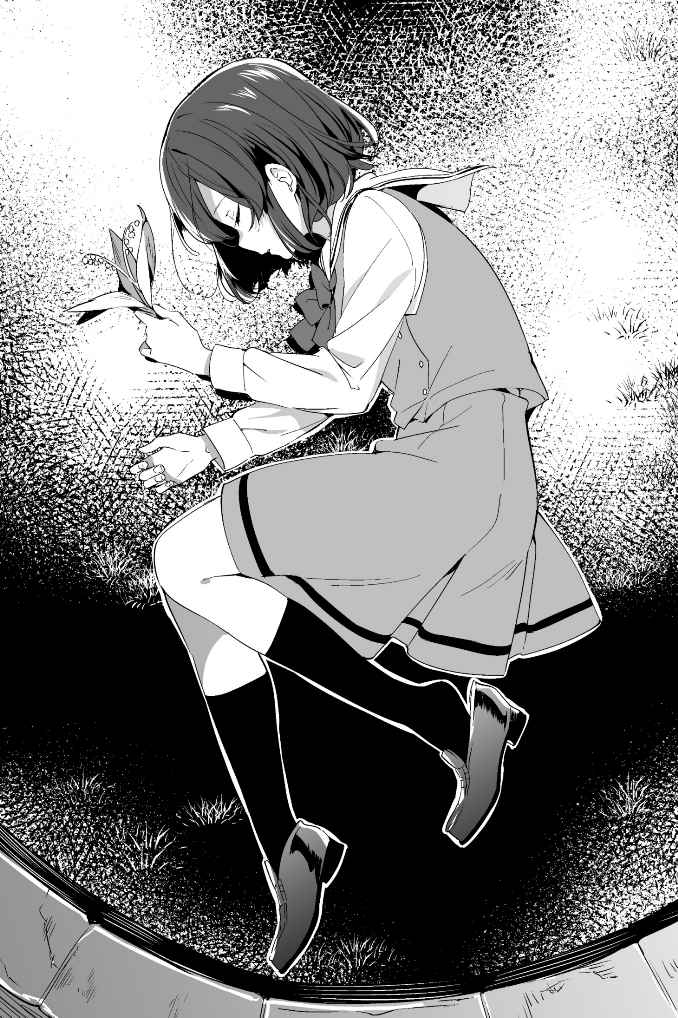
At the sight of the body, I went into shock. Screams filled the air, but I was fully convinced. It all made sense to me now. Diana controlled Itsumi with her sorcery and used her as she pleased, until she finally drove Itsumi to commit suicide. I gazed at the lily-of-the-valley in Itsumi’s hand, then at the Eastern European beauty who came from where they bloom. Masses of schoolgirls broke down in tears. But only one girl stood with a satisfied grin.
That was the chain of events that I personally witnessed. I am fully aware that my story may seem unrealistic. But I swear that these are the facts.
In summary:
| WHEN: | The month of July, after school |
| WHO: | Diana Decheva, the international student |
| WHOM: | Itsumi Shiraishi |
| WHERE: | St. Mary’s Academy for Girls, the annex terrace |
| WHAT: | Induced Itsumi to jump to her death |
| HOW: | Sorcery |
| WHY: | To protect her family and hometown |
It may be hard to believe. However, this is the undisputable truth behind the Itsumi Shiraishi incident.
(The End)
Sonoko, thank you for reading.
Up until today, you stuck to reading and criticism and never wrote short stories or poems. We must commemorate this as Sonoko Koga’s debut work. It was logical and coherent, just like you. Yes, I do mean that in a good way, of course.
But I was shocked.
Did Itsumi’s hair and fingernails really grow as quickly as you said? Is it true that she disappeared in the hallway? Are you sure you weren’t just seeing things?
I also noticed that Itsumi would often stand in front of that mirror. It’s so striking and large and we received it from an English convent over half a century ago, so it only makes sense that people will spread all sorts of rumors about it and say that it is one of the “seven wonders” of our school—but you say Itsumi was swallowed by the mirror. Is that even possible?
I was surprised to hear someone as logical as you say such irrational things.
Sonoko. You know I was looking for a short story, not a fairy tale, right? I just wanted to make sure.
All right. So, you’re telling me that you actually saw Itsumi’s hair and nails grow quickly, that she was scared of the cross and the Bible, and then suddenly disappeared…This is what you are claiming, correct? Even though you used to scoff even at horoscopes.
How very interesting.
No, no, I’m not doubting you. I’m just a bit confused. But you say that you saw it…so it must be the truth.
Oh my, it looks like the thunder is even closer. It’s unsettling. I hope the downpour doesn’t trap us in here.
Now, this will be the final reading from this group. Shiyo Takaoka. Please make your way to the reading corner.