Chapter 2: A Hand to Protect You
“Hurry, hurry!” a girl urged her father. “Papa, if you don’t hurry, it’ll leave without us! Hurry, hurry!”
“You shouldn’t rush so much; it’s dangerous.” Her father’s voice came from behind her. His young daughter’s high spirits exasperated him, but he smiled drily, as if secretly enjoying himself.
The girl stamped her foot and waited impatiently for her father as he followed leisurely behind her, but soon she couldn’t take it any longer and started to run. The aisle was narrow enough to begin with, but now it was jammed with people coming and going, holding large bags. She weaved her way through them, ran up the iron stairs, her light footsteps ringing, and flew to the bright patch of outside light framed by a rectangle cut in the wall.
“Waah…!” Kieli and the girl flew onto the deck at almost the exact same time, and both cried out in excitement simultaneously.
The sand-colored sky opened out as far as the eye could see, and a flock of white birds spread their wings and flew comfortably along. The dry, sandy wind brushed through the girls’ hair as it blew past.
Kieli exchanged smiles with the girl who had, strangely, acted exactly the same way she had, and waved her hand lightly in farewell. The girl’s father arrived late up the stairs; she pulled him by the hand and ran toward the edge of the main deck overlooking the harbor.
Feeling a bit envious as she watched her go, Kieli peered through the entrance to the stairs, wondering what had become of her own companion. Despite all her beckoning, Harvey showed absolutely no sign of coming behind her. “Damn old geezer…,” the radio cursed quietly as it hung from her neck.
Fh-fhooo…
The steam whistle rang out long and low to announce their departure, and a vibration rose through her feet and reverberated in her belly. The thick smoke of fossil fuels spouted from the giant exhaust pipe in the rear of the ship, painting over the color of the sky.
Kieli turned and ran to the edge of the main deck, wove through gaps in the passengers who stood waving at the wharf, and leaned over the handrail.
Mechanics from the harbor and people watching friends and family leave lined up on the pier below, waving their arms. The sailors formed a line on the deck and responded with a salute. In a gesture said to have been passed down by the space sailors from the same pioneering age as the card game, they touched their right fists to their chests and thrust them forward—she remembered the dolls in the triangle hats from the night before and felt a prickling pain in her chest. Far, far down the barrier lining the coast, the promontory of tetrapods where she found the dolls the previous night looked like a small, white hill.
“Maaaster! Be careful! Maaaster!”
A shrill voice ringing out over the murmuring of the crowd broke Kieli’s concentration, and when she looked back, she caught sight of a plump woman wearing what appeared to be a maid’s uniform. She stood on the tip of the pier, waving a white handkerchief, tearfully shouting, “Master, Maaaster!”
The woman seemed so frantic that Kieli’s eyes were automatically drawn to the place the woman was looking, where she saw a boy standing at the edge of the deck close to the boat’s bow. Dressed from head to toe in formal clothes that must have just arrived from the tailor that morning, he was the very image of the son of a well-to-do family; she had no doubt that this was the boy the woman in the maid outfit was waving to.
The woman cared not a whit for appearances as she cried out to the boy, and he responded with curt whispers like, “Whatever, just go home,” and made gestures to shoo her away, but his voice wasn’t loud enough to reach the woman, so he was probably only trying to hide his embarrassment from the surrounding passengers. Kieli giggled and studied the boy’s profile. He looked like he was a few years younger than she was—a little over ten. His well-kept, light brown hair looked silky and soft; Kieli put a hand to her own short black hair and thought, Come to think of it, I haven’t given it a decent combing in a while. On top of that, it was all dry from being exposed to the wind in the wilderness.
When the pier was far enough away that no one could make out the faces of the onlookers, the passengers gradually started retreating to their rooms.
The last voice she heard was the maid woman’s piercing shriek echoing out, and, regardless of what the boy said, he seemed reluctant to leave the main deck. Once her calls, too, faded, though, he left the handrail and turned away. A woman in a high-quality, but not flashy, dress walked very close beside him. She was a beautiful woman, with hair the same light brown as the boy’s done up in a bun; she must have been his mother.
Just in time to replace the boy and the woman, Harvey finally came up onto the main deck. He passed by them at the entrance to the stairs and did a double take for a second, turning to look at the mother’s back, but immediately returned to his usual blank expression and approached Kieli.
“You’re late! We can’t see the harbor anymore,” she said, frowning. Harvey dismissed it with, “Whatever. I don’t need to see it,” and grimaced in annoyance at the sandy wind that blew through his hair, ruffling it playfully. But then he looked up at the sand-colored sky spreading above his head and—it was so subtle she couldn’t have made it out without looking very carefully—narrowed his eyes as if he was enjoying himself.
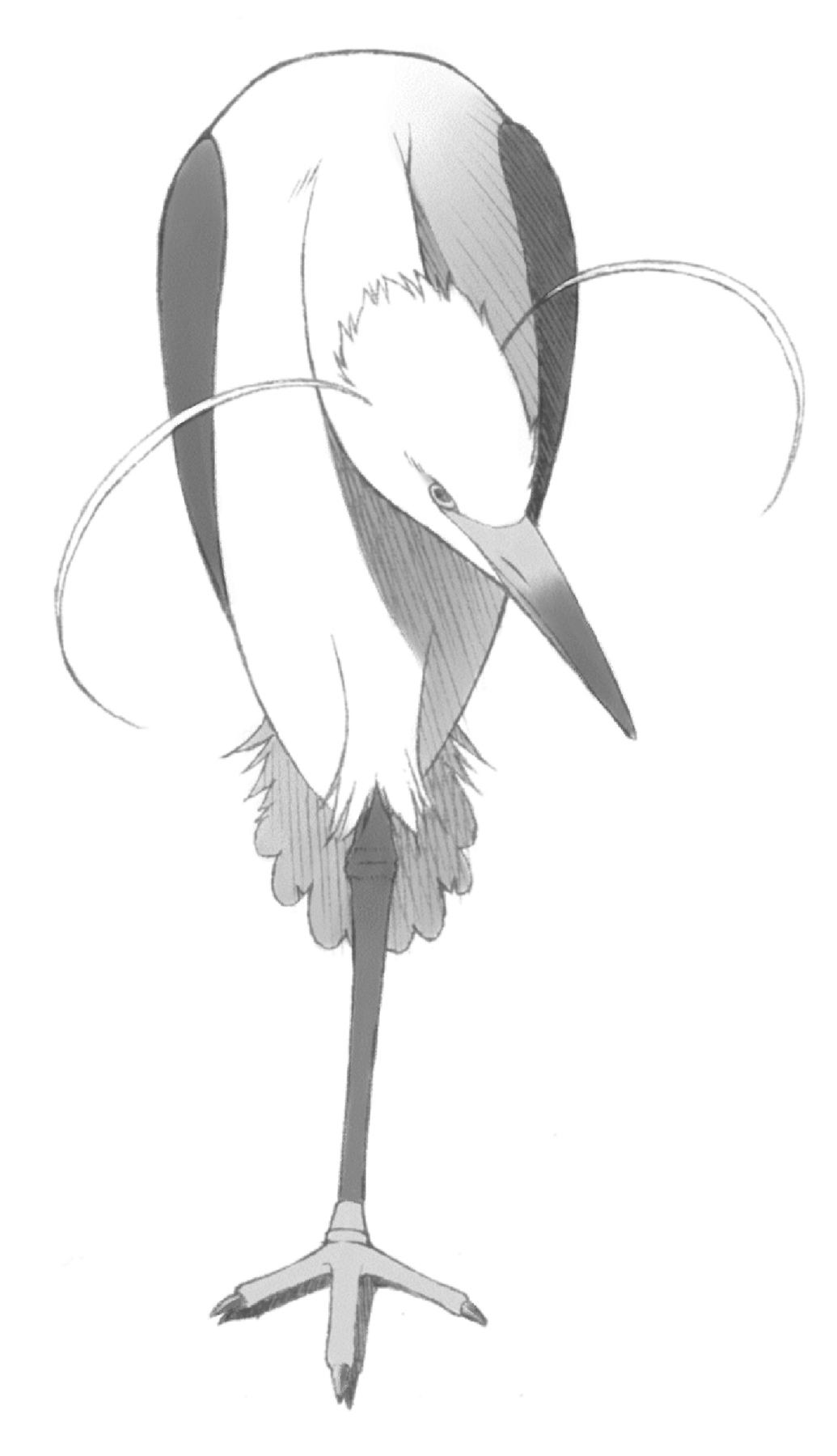
“Those birds only have one leg,” he murmured, his face still raised. Kieli blinked for a second then followed Harvey’s gaze up to the air above. A flock of about ten sandy white birds flew above them, almost blending in with the color of the sky.
Harvey didn’t say anything else, and just as she was wondering, puzzled, whether or not he was going to continue the topic he raised, the radio, determining that there were no people around, piped up: “I heard once, a long time ago. Something about their genes mutating while they were being carried to this planet on the colonization ship so they got to be one-legged.” In the corner of her mind, Kieli wondered if by “a long time ago,” the Corporal meant when he was still alive.
“They’re migrating birds that wander all over the planet, all year long. In the winter, they go south; in the summer, they go north. Apparently the birds rest their wings for a bit on the tip of a tetrapod or the edge of a sail, then go right back to flying. They almost never sleep.”
“They keep flying without sleeping? Don’t they get tired…?”
“Dunno. ’Sprobably just how they are.”
“Hmm…”
He could say that, but she still thought that flying all the time without stopping would be hard. They looked so calm in flight, but maybe they were really exhausted and wished they could fall fast asleep somewhere.
His expression erased, Harvey’s gaze stayed fixed on the sky above; he didn’t show signs of moving from that spot for a while, so Kieli took just half a step closer and looked at the sky with him.

“Well? How do you feel about your first day on a boat?”
“It’s the worst,” Kieli answered Harvey’s spiteful question shortly and shoved her face in her pillow.
“It’s because you get so excited and jump around so much.” Even the radio at her pillow sounded exasperated. She turned her face away, pouting that even the Corporal was against her, and for a second, her eyes met those of the passenger lying in bed a little way away.
The third-class quarters on the ship weren’t individual rooms like the first- and second-class rooms, but group rooms, situated on the lower levels of the boat. Bunk beds lined either side of the center aisle; there were sixteen divisions in all, and a mix of about twenty people and mountains of luggage, which took up more room than each person, were shoved into each division. They were divided into upper and lower levels, so the ceilings were extremely low, and even Kieli had to duck a little in order to stand up, which meant that of course Harvey had no trouble hitting his head—actually, when he first came in, he hit it very spectacularly, raising a pretty murderous sound.
Harvey crept at random into a corner of the lower lever of the fourth division by the wall where they could see the ocean through a round porthole, so that officially became the sleeping place for Kieli and company for their ten-day ocean voyage. It was a small space, just big enough for the two of them to lie down in the cramped group sleeping room, and on top of that, the pillows and blankets provided were certainly not good quality. Even so, compared to their travels in the boxed seats of a train, it should have been a relatively pleasant journey, in that they could sleep normally.
It should have been. When she thought that these circumstances would go on for ten days before they reached the harbor on the opposite shore, even Kieli’s high spirits from when they set sail turned to utter exhaustion.
Because they were half forcing their way against the waves of flowing sand, the ship swayed irregularly, vertically and horizontally, throwing them in confused semicircles. Adding insult to injury, the low sound of the engine came from under the floor, incessantly echoing under her belly. She didn’t think she was especially prone to motion sickness, but she felt absolutely terrible from right about the time she’d eaten lunch in the ship’s cafeteria.
“Don’t puke over there. I’m begging you.”
“…I know.”
Still lying down, she sent a hateful stare at Harvey and his heartless, unsympathetic comments. She wondered what Harvey had been doing, sitting by the round window—he tried to light a cigarette but couldn’t control his right arm very well yet and ended up battling with it. The metal framework fingers that peered out of the end of his coat sleeve were holding the lighter just like human fingers would, but they would not move at all how he wanted them to, and only seemed to be trying to burn their master’s bangs.
“Why aren’t you cooperating?” Harvey asked, glaring narrow-eyed at his right arm, and, instead of answering, the arm threw the lighter away. “Now look, you!”
“If I were to guess, I’d say he’s trying to tell you that Kieli’s got a hard enough time as it is—don’t make the air any worse,” the radio explained knowingly, and, in perfect timing, a playful tune came from its speaker.
“Oh, be quiet!” Kieli murmured, unable to take any more, and crawled out of bed. “I’m going to get some fresh air…”
It was the middle of winter, but the wind from the south was just cold enough to feel good and stroked coolly against Kieli’s flushed cheeks. As she leaned on the deck’s handrail and breathed the outside air, she began to feel much better.
The scenery that spread out on the other side of the rail was an endless ocean of flowing sand and a partly cloudy sky of the same color. At the far end of her vision, the two blurred into each other, forming a fuzzy horizon.
The steamship that was taking her to South-hairo in the southeast was called The Sand Mole’s Seventh Son. Apparently a sand mole was a creature that represented good luck in the Sand Ocean. The boat was ridiculously big, but the fuel tanks containing the extremely inefficient fossil fuels took up much of the ship’s bottom, so despite its enormous size, it didn’t have much usable space.
She could hear the sound of the screw propellers turning in the back of the ship, kicking up sand. A giant lump of metal, spewing billows of smoke as it dashed across the sand—that was the impression Kieli had of sand ships. Making full use of the main screw and several subscrews installed in the stern, it brushed aside the resistance from the flowing sand and forced its way over the surface of the ocean.
Near the bow on the opposite end, she could see a few of the crew in work overalls cleaning the deck. She casually focused her attention on them and watched them work, when…
Fwump…!
A familiar, vague sound flew to her ears. She only heard it faintly over the noise of the rotating screws, but that chilling blast, like something compressing the air heavily and releasing it all at once…
A carbonization gun…
The scene at the winch tower at the abandoned mines, when the Church Soldiers in their white armor blew Harvey’s leg off, revived in her brain, and Kieli froze automatically, searching only with her eyes for the direction of the sound.
She heard another gunshot and turned her gaze in its direction to see a small person standing at the edge of the deck near the stern—when she recognized who it was, she doubted her eyes for a second. It was the boy she had seen when the ship set sail, the one the woman in the maid clothes had watched go. Using the deck’s handrail for support, he had the uniquely shaped gun, with its fat, stocky barrel, trained toward the ocean.
She looked at where the gun was pointed and saw a flock of those one-legged migrating birds, flying low above the ocean.
“No!” Kieli shouted out of reflex and ran toward him. “Stop, don’t shoot!”
She tried to capture the gun from behind but missed and ended up shoving the boy away. “Aah!”
“Waah!” The boy came dangerously close to going over the rail and falling into the ocean; she grabbed his clothes and hurried to pull him back up.
The two landed on the deck in a heap on their rear ends, and the gun flew away and clattered across the floor.
“What are you doing!?” The boy pulled himself up immediately and tried to pick up the carbonization gun.
“You shouldn’t have things like this!” Kieli slid across the deck, positioning herself between him and the gun, and grabbed the gun in both hands—it was strangely light for its weighty appearance, and when she blinked and looked down at it, she sensed that it was smaller around than the carbonization guns she remembered. On careful inspection, she could tell it was made of plastic.
“…huh?”
“Don’t act so confused! It’s a toy gun!” the boy spat in irritation at Kieli and snatched the gun out of her hands. Kieli remained where she sat and gaped up at the boy with a stupefied look on her face.
“A toy…?”
“Yeah, a toy. They’re really popular in the capital right now. Don’t you know anything?” The boy laughed through his nose, clearly mocking her for being a country bumpkin. “Isn’t it cool? It’s the weapon the special squad of Church Soldiers uses. They used these to kill all the ‘Demons of War’ and end the War.”
Kieli didn’t think it was cool, nor did she envy him for having one. She thought his notion of history was pretty messed up, but when she learned it wasn’t the real thing, the energy drained out of her body all at once, and she lost the willpower to say anything about it.
“That scared me…”
She slumped and took a deep breath. The boy looked questioningly down at her, insulted her—“Weirdo”—and set his toy gun back toward the ocean.
As the plastic bullet burst into the air with a fwump, it startled the flock of birds, who scattered and flew away. She was relieved for a minute, but after she thought about it, she realized that, while it might be a toy gun, it still seemed to have enough power to hurt and kill small animals.
“Hey, they’ll be in trouble if you hit them. They might die.”
“Of course; that’s what I’m going for,” the boy answered simply, looking sideways at her as he propped the gun’s barrel up vertically, just like a real one, and loaded the next charge. He said it so smoothly that Kieli couldn’t counter right away. Before she could say anything, he aimed at the flock of birds that had fluttered back into place and pulled the trigger again.
Half a second after the shot rang out, at the same time that the flock scattered, there was a light fwip, and one of the birds fell into the sea, drawing a white line.
“Ah!” Kieli crawled to the edge of the deck, stuck her face through the rail, and squinted at the ocean’s surface. Sand the same color as the fallen bird swallowed it up, and it was out of sight in the blink of an eye.
“Yesss, I got him!” the boy cheered, swinging his gun over his head.
Beside him, Kieli stared down at the sea in terror, then snapped her face up and looked accusingly at the boy. “Why would you do that?!”
“One or two birds is no big deal. Look, there’s still so many left.”
“There aren’t!”
She raised her voice in spite of herself, and the boy blinked in surprise. “Why are you so mad…?” It was like he really didn’t understand the meaning of what he had done.
Kieli calmed herself a little and said, “You see, the bird you just shot was the only one of that bird, and of all the birds there, that one is gone now.” As she softened her tone and tried to explain, she sensed something at the edge of her consciousness.
She cut herself off and looked back at the ocean and saw a black shadow jump up, stretching out of the surface of the ocean exactly where the bird had fallen. Like a big black bird…
She thought she saw the shadow turn an abrupt right angle in midair; it faced their direction and charged at them, like a sudden gust of wind. She watched the giant black bird, with its slanting, almond-shaped eyes and sharp beak, open its bright red mouth and rush straight at them…!
“…!” Kieli cried a voiceless scream and ducked.
Its enormous mouth was about to swallow Kieli’s head whole…but just then, the shadow vanished and a strange wind—it was warm but came with a chill that made her hair stand on end—blew through her body.
“…wha…huh…?”
She froze solid, sitting on her rear, her face pale. “What the heck? What is it this time?” the boy’s dubious voice rained on her from overhead. “Just now…!” She regained her senses and ran her gaze over her surroundings, but the giant bird’s shadow was nowhere to be seen.
“Ugh. Here,” the boy said curtly and offered her his hand. As Kieli stared blankly at the boy’s hand, which wasn’t much different in size than her own, he breathed a grown-up sigh and said, “You can’t stand, right? You’re so much trouble, ugh.”
“I can stand.” Kieli flatly refused his favor and, though she staggered a little, stood up by herself.
The boy frowned, unamused, and went on to ask, “Where’s your room?”
“…The fourth division in third class,” she answered suspiciously, and the boy blurted out, “Oh. You’re poor,” unapologetically, then hung the toy gun’s strap from his shoulder and started to walk away. He stopped at the deck’s exit, turned to look at Kieli, still standing there speechless, and said in irritation, “Aren’t you coming? I’m taking you to your room.”
“Whaa—?” Kieli’s jaw dropped, and she let out a deflated gasp in spite of herself. How was she supposed to interpret that from his attitude?
The boy betrayed no sign of being bothered by her reaction and simply ordered, “Hurry up.” He slipped through the crack in the thick, half-open door and went down the stairs that led inside the ship.
After a pause, Kieli, still unable to comprehend what was going on, trotted after him.
“Hey, promise me. Don’t shoot any more birds with that gun, okay?” She addressed his back as he went ahead of her down the gloomy stairwell. The boy didn’t stop but only half turned his face back toward her. He squinted at the bright outside light behind her, nodded with a scowl, and said, “…Okay. I won’t shoot any more birds.”
Kieli skipped down the stairs to walk beside the boy.
The two small figures just barely fit next to each other on the stairway; their footsteps echoed rhythmically as they descended to the lower decks where the third-class rooms were. Standing next to her, the boy was somewhat shorter than she was, and she thought that, while he acted all high and mighty, he really was younger than she was, and she felt a small sense of kinship with him.
“Are you in first class?”
“I’m in special class.”
“Wow.”
“Special class” designated the rooms used by the especially rich. She had walked around looking at the ship for a while after departure, but there was a limit to how many places a third-class passenger could go. Of course she couldn’t even get close to the special-class rooms. (Naturally, Harvey was completely indifferent and stayed shut up in their room, so she took the Corporal, and they explored, just the two of them.)
The boy seemed to cheer up a bit to see her sincerely impressed, and his attitude softened a little.
“Come play with me later. I can give you some chocolate.”
“But isn’t your mother with you?”
“I’m alone. Someone’s going to pick me up when I get to the other port.”
“Hmm, so you’re traveling alone.” Kieli started to nod in ordinary agreement, then gasped and stopped. The boy looked back at her wonderingly, so she hurried to catch up with him, remembering the beautiful woman that walked with the boy when they set sail. That woman…
“Kieli,” a voice called to her.
It certainly wasn’t a loud voice, but it reached Kieli’s ears easily; she blinked and looked up. Down the left-hand side of the squalid aisle, lined on either side with third-class rooms, she could see a tall, redheaded figure at the entrance to the fourth division. The heel of his shoe was just coming down on the outside of the division’s door.
“You’re late. I thought you really were puki—” Harvey started to say but cut himself off and shifted his gaze to the boy standing next to her. “Who’s that?” he asked, in a tone that wasn’t particularly friendly or particularly the opposite.
“Um, well, we were just on the main deck, and…,” Kieli tried to answer, but an expression of caution suddenly flickered across Harvey’s normally near-expressionless copper eyes.
“C’mere, Kieli.”
“Wh-what?”
His low voice intimidated her, giving her no room to argue, and she ran a few steps toward him; he grabbed her arm, and hurled her behind him. “What are you doing?!” She immediately turned around to protest, but it would seem Harvey no longer had her in mind; his back was to her, and he confronted the boy head-on.
“Go back to your room right now, pull your blanket over your head, and stay quiet,” he flung a sharp voice at the boy, apparently unconcerned about things like “going easy on children.” Kieli got scared in spite of herself and gulped. The boy faltered for a second himself, but, not to be outdone, he flared up and glared at his tall opponent.
“What’s with you, all of a sudden? Do you know who you’re talking to?”
“I don’t know, and I don’t care. Get out of here.”
“Wha…?!” Harvey’s words disarmed him; the boy opened and closed his mouth a few times, speechless with rage. “What?! You’ll regret this!” was all he finally managed, spitting the none-too-creative line over his shoulder as he turned his back to Harvey.
“Ah, wait!”
“Never mind, don’t follow him. Leave him alone.”
Kieli tried to go after him, but a metal-framed right arm blocked her way. Kieli turned accusing eyes on its owner.
“What’s wrong? Why are you so…,” she started to say before the shrill sound of breaking glass rang through the aisle, as if it were running through the walls.
Instinctively, she ducked her head and cast a glance past Harvey toward the end of the aisle. Passengers in the third-class rooms were sticking their heads through doors on either side, looking around to see what happened.
One of the bare lightbulbs hanging from the ceiling had shattered—the filament itself had blown away and gone out, as if it had exploded from the inside.
Directly underneath it, in the center of the glass shards strewn across the aisle, the boy had sunk to the ground in terror.
“It’s okay, I’ll go. You stay here. Get inside.”
“Eh?! Just a…”
Harvey made the first move and ran off before she could do anything, so Kieli just stood there, defeated before she could even get started. She could only gape and watch, helpless, like the other passengers who watched questioningly as Harvey helped the boy up and took him away (although it was close to picking him up and carrying him like a piece of luggage).
She didn’t know where it had appeared from, but she could see a black shadow with birdlike wings flying after them over their heads.

“What’s your problem?! Put me down!”
Oh, I’ll put you down, he muttered inwardly, his substitute right arm moving accordingly and flinging the boy onto the bed. (It might be a little funny if the prosthetic arm was always good and carried out what he wanted it to like this, but it frequently acted on its own, so he was a little fed up with it.)
The special-class rooms were for passengers who received special treatment; these suites occupied more than half of the available space on the second-level deck—each one had a living room and bedrooms roughly the size of an entire division of third-class rooms, with all kinds of small rooms attached. Apparently the boy was using his ridiculously wide suite, which looked smaller than it was with its walls crowded with so many tacky decorations, that Harvey had to wonder if he really needed so many all to himself.
In all likelihood, he was the son of a very wealthy merchant, or else a family of high social standing—in other words, a family of high-ranking clergymen in the Church. That would make him the sort of person that Harvey wanted to avoid as much as possible.
Damn, now she’s involved with somebody even more trouble than usual…
“Whoa!”
The boy kicked off of the bed toward him, so his conditioned response was to take half a step back and dodge him. The boy screamed and toppled over without Harvey doing a thing. “Dang it…” He struggled under the blanket he himself had kicked out of place and sent a hateful glare in Harvey’s direction. (Like that was my fault?)
“I can tell my dad and have you put in jail, you know!”
“Yeah, they’d probably kill me before they took me in,” he replied; his tone, at least, was casual, but inwardly, he seriously tightened his guard. So the father really was with Church leaders, and if he had the right to arrest people, he must be involved with Church Soldiers. In other words, the kind of person Harvey was least likely to get along with.
From Harvey’s point of view, this was no laughing matter, but the boy seemed to think that Harvey wasn’t taking him seriously and became even more furious. “You don’t belive me?! It’s tru—”
That instant, a shadow ran across the light cast by a chandelier on the ceiling. “Get down!” He instinctively sensed danger before he could tell what was overhead. He thrust the boy onto the bed and lay over him, in a kind of embrace.
Bang, bang, bang. He heard small, explosive sounds one after another, like the firing of a handgun, and glass shards fell on top of them, like a sprinkling of rain. He felt pain near his ear for a second, but he cut off the feeling immediately. In his arms, the boy let out a muffled scream.
The explosive sounds and the downpour of glass continued to fall for what felt like a few minutes, but in actuality, it was probably only a few dozen seconds—finally, he heard the last piercing sound of glass bursting, and bigger shards scattered across his back.
That signaled the end, and the room fell silent again.
“Making a big damn show…,” he cursed under his breath. When he finally picked himself up, the glass that had piled up on his back slipped off and fell onto the bed and carpet. It didn’t look too different from a bunch of sugar candy strewn all over the floor. Though it literally wasn’t anything so sweet.
The small bulbs of the unnecessarily extravagant decorative lights that had been strung together like beads were all completely smashed, and the bedside room light and the twilight that came through the round porthole in the wall were all that dimly illuminated the room. The chandelier’s frame, now resembling an animal’s bleached skeleton, remained alone in the center of the ceiling.
A small, pitch-black bird perched on the edge of that frame. As it stood there, folding its wings, it blended almost perfectly with the darkness enveloping the ceiling, and only its slanted, gold-colored eyes glinted with a sharp light as it stared in their direction.
Harvey’s eyes met the piercing, golden gaze, and he glared back for a few seconds, then looked down at the boy on the bed, who was still cowering and gaping at the glass scattered around him, his face pale. His hands trembled slightly as they clutched the blanket, and he muttered something; his voice was hoarse, and Harvey couldn’t make it out, but he figured it was probably something along the lines of, “What was that?”
Harvey breathed a light sigh and knelt beside the bed.
“Just three days. Don’t leave your room, keep that over your head, and stay quiet. And whatever you do, don’t get near anything that’ll break. Got it?” he said, looking the boy in the eye and softening his tone, though only a little. The boy sluggishly met Harvey’s gaze.
And an apologetic expression suddenly rose to his face. He hung his head and whispered, “…I got it. I’m sorry…”
“Huh?” Harvey couldn’t help asking; he wasn’t sure he’d really heard the boy’s unexpectedly complicit reaction.
Maybe a crew member had come and cleaned up before he got back to the third-class rooms on the third-level deck, because the pieces of glass were out of the way. (Though Harvey couldn’t say it had been a thorough job; the shards were just swept off to the side.) There was no replacement bulb hanging from the ceiling, though, and that one area of the aisle, which already felt closed in between its walls on either side and the low ceiling, sunk into an even deeper darkness, creating a dreary atmosphere that hung about the whole area.
The passengers who had looked on dubiously before had all either gone back into their rooms or gone out to the main deck for a walk or something, and there was no sign of anyone in the aisle.
Except for Kieli, waiting at the entrance to the fourth division.
“You got cut?” Kieli said as soon as she saw Harvey’s face, standing on tiptoe and reaching out a hand.
“What?” he replied out of habit, then touched his face and realized that it was bleeding. He had completely forgotten the pain, but apparently a shard from that chandelier had indeed cut him. Now he understood why the boy suddenly apologized so eagerly. Harvey’s cheek had been sliced all the way to his left ear. Had he been a normal person, the wound might have caused a big commotion.
“Are you okay?”
“Leave it alone; it’ll heal.”
He blocked Kieli’s hand as she tried to touch the wound and made do by wiping the blood off with the sleeve of his coat. Looking carefully, he saw he had a similar laceration on the back of his hand, and his coat was torn in places, primarily on the left side. (If only it had concentrated on his prosthetic right arm instead, it wouldn’t have cut his hand.) He swore under his breath and took his coat off as he ducked down through the door of their room.
Maybe a lot of passengers had gone outside—the number of occupied bunks was relatively low. Discarded bedding cluttered the floor. Harvey could deal with the squalid, cramped space and the ceiling that was so low it might as well have been taunting him, but it was annoying always having other people nearby, so he felt a little relieved.
He burrowed, half crawling, to their space by the window, and the radio, who was apparently bored after being abandoned beside Kieli’s pillow, was the first to speak. “You’re causing trouble again, aren’t you?”
“Try telling me where that ‘again’ comes from. She’s the one always causing trouble, not me.”
He glanced sideways at Kieli, who took off her shoes and crawled in after him. She frowned and retorted, “So explain to me what’s so much trouble in a way that I can understand. You come back with all that blood pouring out, look at me like nothing happened, and you won’t tell me anything…!”
“Oh, uh…” Harvey winced inwardly, sensing a faint hint that she was about to cry mixed in with her accusatory tone. “This really is fine, so don’t worry about it.” He sighed and sat down on his bed; then, lighting a cigarette with his left hand because he wouldn’t be able to stand it if his right hand tried to stop him again, asked: “Corporal, you know about curse birds, right?”
Harvey handed off the conversation to him, and the radio spat in disgust, “You really just aren’t gonna explain it yourself, are you?”
“Curse birds?” Kieli sat down next to him and brought her face, full of interest, close to the radio, so the Corporal continued, figuring there was no helping it.
“They’re cursed birds that bring bad luck by breaking glass and lights and things. Sometimes they haunt people who kill animals for no reason. They don’t have that much power, so if you stay somewhere that doesn’t have anything breakable, they’re not that dangerous.”
“…That boy shot a bird. It was with a toy gun, though,” Kieli interjected, a meek look on her face. Harvey remembered that the boy was holding a toy gun, then understood why the bird appeared, and huffed in annoyance, “Good-for-nothing kid…,” along with some smoke. If he’d known that before, he would have popped him one before coming back.
“I wonder if he’ll be okay.”
“He brought it on himself. Leave him alone,” Harvey retorted emotionlessly to Kieli’s concerned murmur. There was another reason, standpoint-wise, he didn’t want to have anything more to do with the kid. “Well, it’s okay for him to get hurt a little. It’ll leave in two or three days.” For once, the radio’s opinion matched Harvey’s.
With her companions casting the matter aside, Kieli faltered, but still unable to come to terms with it, she persisted. “But he said he wouldn’t do it anymore. I think he just didn’t understand.”
“It’s not something you can forgive just because he didn’t understand. Just leave him alone. Don’t you dare go check on him.”
“…You’re like that boy in some ways, too, Harvey,” she added innocently.
Harvey didn’t like that; he lay down, cigarette still in his mouth, and looked away.

The aisle on the second-level deck had a completely different atmosphere than the aisle on the third-level deck, which resembled the inside of a giant metal pipe. A chandelier elegantly illuminated the long corridor, and a carpet so thick it was actually harder to walk on lay over the floor. Intricate knockers worked into the shape of sand lions adorned the otherwise uncouth thick iron doors.
Kieli stood on her toes and lightly tapped the knocker.
There was no answer, so she knocked again, a little more forcefully, and after a while came a muffled voice: “Who is it?”
“It’s me,” Kieli replied, about to name herself, but now that she thought about it, she hadn’t given him her name to begin with.
It was the morning of their second day at sea—one night had passed since she’d heard about the curse bird, and Kieli had sneaked onto the second-level deck where the special-class rooms were.
“It’s me, remember? We met yesterday.”
“…It’s open.”
Once she got an answer, Kieli turned the heavy handle in both hands and pushed the door open. “I’m coming in. Hi ther—” She peered into the dismal room and couldn’t help swallowing her voice.
The chandelier on the ceiling, the room light by the wall, the glass door of the cabinet, the decorative plates on top of it—every type of ceramic in the room had been smashed to powder. Fine glass crystals lay thick on the floor; it was almost pretty.
There was no sign of anyone in the living room, so she very carefully stepped over the glass shards and went farther inside to peer into the bedroom.
The boy was on top of the king-size bed, clutching his knees, his blanket over his head. Only his eyes peeked out from the shadows of the blanket and acknowledged her presence. A black bird perched on the top of his head, but as she entered, it spread its wings and flew up to the broken chandelier on the ceiling.
Kieli checked to make sure there wasn’t anything breakable around anymore and slowly walked toward the bed.
“You’re not hurt?”
The boy’s face was pale, but he shook his head and asked, “What about him?”
Kieli thought for a minute about what he was talking about, then answered vaguely, “Harvey’s fine. There was a lot of blood, but it wasn’t deep.” Actually, if it had been a few millimeters deeper, half of his ear would have been cut off, but it seemed that, to him, his torn coat was a bigger problem. Acting very grumpy as he wore just the one light shirt, he had taken care of the blood by sticking his head in a washbasin and roughly scrubbing it away. The metal framework of his prosthetic arm had understandably drawn a lot of attention, so he seemed to want to wear layers as much as possible.
“Oh, that man’s name is Harvey. He doesn’t have much of a personality, but he’s really very…” There were so many things she could finish “really very” with that she couldn’t choose one right away and so stopped there. “I’m Kieli.” In the end, she settled on just giving her own name.
The boy stayed silent and gazed at her from under his blanket, but apparently he cheered up a little, and his stiff expression softened. “I’m Julius. You can call me Juli. Juli and Kieli, it’s perfect. But only my mom calls me that…” His voice started off bright but trailed off, and his face sank again. Kieli sat down on the corner of the bed that didn’t have glass shards piled on top of it.
“When did you lose your mother?”
“How did you know that? Did I tell you?”
“Oh…I guess you did?” She ended up giving another vague response. She sighed inwardly at herself and for no reason looked up at the ceiling, where her eyes met the black bird, standing there like a tiny statue in the darkness. It was a small animal, but its unblinking golden eyes bore a sense of intimidation that seemed to multiply as they weighed down on her.
“Last year.” Julius, who had been silent for a little while, opened his mouth in a whisper. He went on in a voice that was no more than a murmur, still hugging his knees under his blanket.
“We buried her in her hometown in South-hairo. It was a year ago. But Dad only ever thinks about work; he doesn’t think about going to visit her grave, and when I told him, fine, I’ll go by myself, he tried to send me with seven maids. I’m not a kid anymore. I can ride a boat by myself.”
As Kieli listened, she imagined seven of the woman in the maid outfit who saw him off at the pier when they departed, swarming around the boy, burning to take care of him. She almost couldn’t stop herself from laughing, but as he wasn’t telling a funny story, she kept a straight face and glanced over at Julius. Actually, his expression was no longer serious, as if telling someone had made him feel better.
“I’m hungry! I haven’t eaten anything since yesterday; I’ll go ask them to bring me something,” he suddenly shouted, and threw his blanket off. “I’ll ask for something for you, too, Kieli. I bet they don’t have anything good in the third-class cafeteria.”
Perfectly cheered up, he took Kieli’s hand, stood up, and started to walk toward the door. Kieli panicked. “You can’t, there’s still—” she said, trying to stop him, but just then, she sensed something moving above her head.
She gasped and raised her face; the black bird that had been so still until then had alighted from the chandelier and started to fly in circles around the ceiling.
“Wait, you shouldn’t go outside yet!” She hurriedly pulled Julius’s hand back, but the boy was singing “I’m hungry!” to himself. He tugged at her hand and dashed out into the hall.
“We’d better go back. This is dangerous.”
“It’s fine. See, nothing’s going to happen. It’s creepier staying in that room.”
“But…”
As Kieli trotted after the boy pulling her hand, she kept glancing back, watching for the bird. Every time she did, she almost tripped and fell on the thick carpet; she started to get the feeling it had been put there to torment her.
Fortunately, as they passed through the hall on the second-level deck, none of the chandeliers broke, and no glass rained down on them. But that seemed to completely dispel Julius’s fears, and when they got up the stairs to the first-level deck, the boy didn’t hesitate to run toward the dining hall. It wasn’t meal time, so no one was around using the hall; he went right through it and strode boldly to the adjoining kitchen.
The kitchen! Kieli’s heart almost stopped as she considered just how many breakables there would be in such a place.
“You can’t go in there!”
“Chef!”
She grabbed Julius’s arm and this time was determined to stop him no matter what it took, but by then, Julius had already peered in through the kitchen door and was calling out haughtily to the head chef. A young person who seemed to be an apprentice stopped working and looked up. When he recognized the boy, he seemed to panic and threw the same line—“Chef!”—toward the back.
Flap, flap, flap…Kieli heard the sound of wings flapping loudly overhead.
Immediately she jumped and looked up. The ceramics piled on the first shelf in the cupboard along the wall burst in a straight, horizontal line, as if strafed by gunfire.
“Uwaah!” Julius and the young apprentice screamed in simultaneous shock. As if to interrupt their cries, the tableware on the second shelf and then the third shelf shattered into powder. Kieli instantly bent over Julius’s head to protect him.
The shards poured down like a white rain, filling her vision; the sound of the ceramic downpour struck hard against the floor. She gritted her teeth, preparing herself for the impact of shrapnel hitting her back.
But the deluge of glass she’d braced herself for didn’t strike, and after a bit, the sounds of shattering and raindrops stopped.
“……?”
Before she realized it, the kitchen became intensely quiet.
From the neck down, she maintained her tight hold of Julius as she cautiously raised her head to look up.
A woman with long, light brown hair was shielding both of them, protecting them.
When Kieli’s eyes met hers, a smile rose in the woman’s gentle eyes, and she murmured something. I’m sorry my son causes so much trouble. Thank you…That’s what it sounded like.
The instant she melted into the air and disappeared, the pieces of pottery that had outlined the contours of her back slid to the floor in a gentle rustling sound.
“Kieli, are you okay?!” Julius asked, pushing Kieli’s hand aside, standing up, and grabbing her shoulders in a panic. Kieli had been staring at the empty space where the woman had been; she slowly fixated on the boy in front of her, caught his gaze, and smiled.
“I’m fine. I’m not hurt anywhere.”
“Oh, good…” Julius sank to the ground, apparently relieved with all his heart. “I didn’t know what I would do if you got hurt protecting me…”
Kieli let out a wry smile, seeing him so drained of energy; he must have been very worried. He does have a bit of a troublesome side, but he really is a very honest, kind boy; don’t worry. She wished she could have told the woman, but she was probably still by his side, watching over him, so she might have already known.
“Wh-what on earth…? Master! Y-y-you’re not hurt, are you, Julius, sir?!”
A man wearing white clothes whose buttons looked like they were about to pop over his potbelly—he must have been the head chef—came toward them, moaning. Along the way, he delivered a magnificent kick with his knee to the young apprentice cowering on the floor, sending him head-first into the plastic garbage bucket. Watching this confusion from the sidelines, Kieli and Julius looked each other in the face and simultaneously burst out laughing.

“The one thing I just can’t understand,” Harvey cursed, disgruntled, as he leaned on the deck rail with his cheek in his hand watching the flock of migrating birds flying over the ocean, “is why didn’t the mother’s spirit appear when it happened with me? She doesn’t care if I’m the one getting hurt taking hits for that kid?”
“There’s no one less worth protecting than you. You won’t die even if we kill you, after all.”
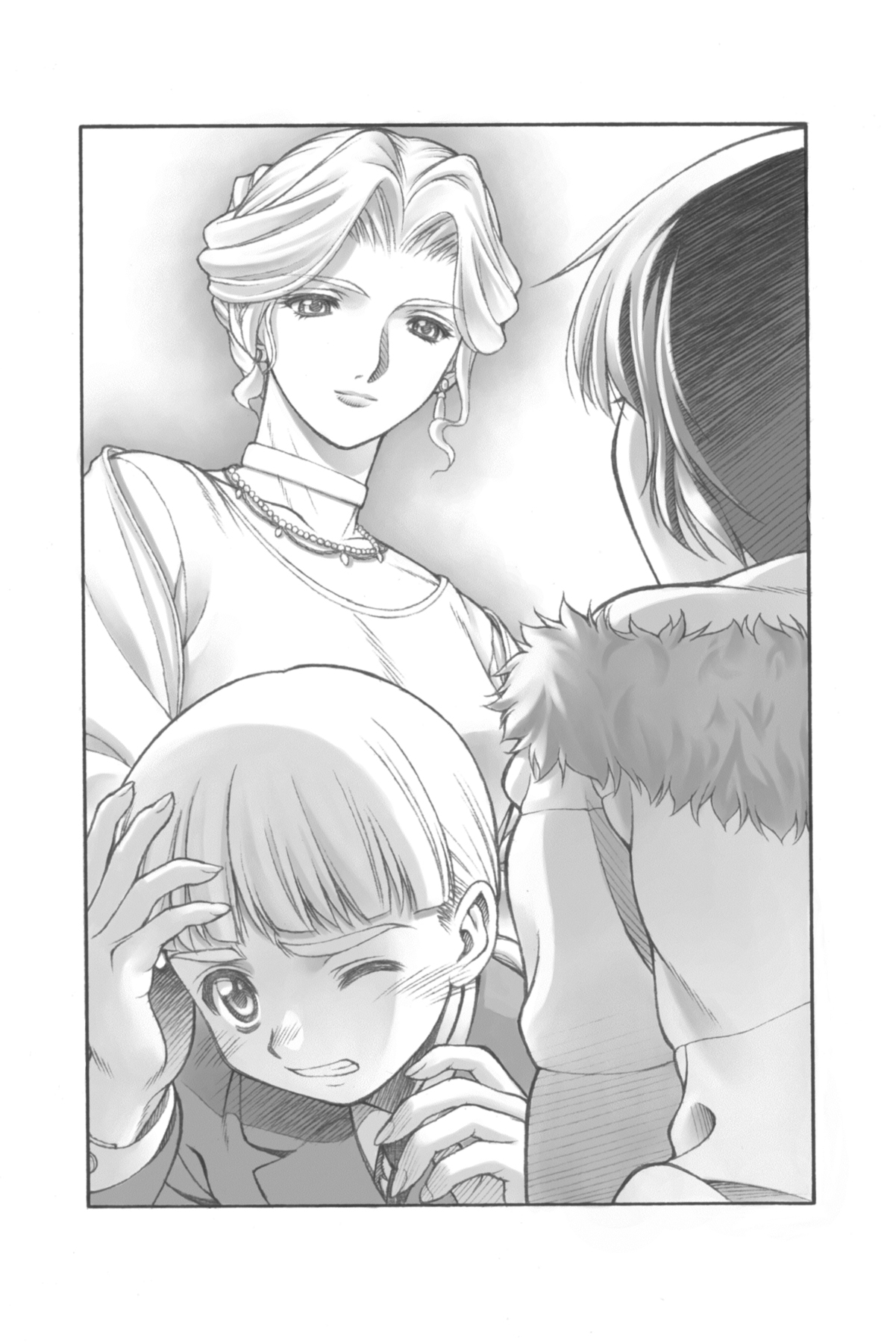
“Not like I care…” Harvey looked diagonally up at the sky and sighed, then shifted his eyes to look to his left. Kieli hung limply over the rail, as if thrusting both of her arms into the ocean. The cord of the radio hanging from her neck dangled down toward the sea.
“Kieli, I’m begging you; do not vomit on me,” the radio emphasized, swinging at the end of the cord.
Kieli’s head drooped as she muttered spitefully, “Even you’re being mean to me today, Corporal…”
“Don’t be a baby. You’re the one who blatantly ignored people’s warnings, you meddler.”
“But!” She raised her head and started to respond, but when she did, she felt the urge to vomit. She covered her mouth and bent down. “Hey, you okay? You look pretty bad.” Understandably, a smattering of worry was interwoven in the radio’s voice.
“I feel sick…”
“Argh, you’re such a pain,” Harvey spat in annoyance, kneeling beside her and lightly rubbing her back. “I didn’t think you’d have such a problem on boats…” His true feelings surfaced despite himself. She had so looked forward to getting to ride a boat, and to be honest, he felt sorry that it turned out like this. Still, it wasn’t as if he could trade places with her.
“He’s lucky…,” Kieli suddenly murmured, crouching and burying her face in her knees.
“Why?” Harvey asked, still rubbing her back.
“I wish my mom would turn into a ghost and come see me…,” she continued under her breath, almost to herself, after a few seconds of silence.
Harvey’s hand stopped automatically. Kieli went quiet after that and turned a downcast gaze toward the deck at her feet.
Harvey let his eyes wander around the area, but it wasn’t as if there was a script posted for him anywhere, so he scowled as if he’d swallowed a dozen bitter bugs. In the end all he could think to do was ruffle her hair.
“Kieli!” a cheerful voice and the sound of light footsteps jumping up the stairs cut in, and Harvey looked back to see, as expected, the very boy in question flying through the deck’s entrance. Kieli raised her face, too, and acknowledged the boy’s presence. She smiled a little and tried to stand up. As he took her arm to help her, Harvey threw a sidelong glance at the boy running toward them.
He couldn’t make out the shadow of a bird following him. Apparently it disappeared faster than predicted.
“I got you some seasickness medicine,” the boy panted, stopping in front of Kieli and thrusting out his hand triumphantly. Harvey saw that the boy was clutching a bag of pills and yelled inwardly at himself, Oh, medicine! You should’ve thought of that. He never had any use for stuff like that, so it never occurred to him.
“Come to my room. If you take that and have some warm chocolate, then take it easy, you’ll get much better.”
“Yeah, but…”
Kieli looked troubled and checked Harvey’s mood, but his existence didn’t seem to register with the boy; he took Kieli’s hand and whined, “Let’s go. Come on, why not?”
Harvey couldn’t help feeling irked. Even so, he really didn’t intend to do anything about it. It was times like these, though, when his right arm moved of its own volition, and it grabbed the boy by his collar. “Wah, what the heck?!” the boy cried out in protest, hanging in the air like a kitten.
“Harvey?”
“It’s not me; it’s doing it on its own,” he excused himself, indicating his right arm with his eyes when Kieli turned blankly back at him. “Ohh…?” the radio murmured from above Kieli’s chest. What did he mean, “Ohh…?” “I’m telling you, it wasn’t me!” Harvey grimaced and averted his gaze, looking at the migrating birds overhead, but the boy was throwing a fit under his chin—this was not a good time to be quietly admiring the scenery.
“Ow!” He took a surprise kick to the shin and regretted yelping before cutting off the pain.