Chapter 2: Ghost and Writer
A pickpocket girl and a wage-stealing miner, riding on a cart, set out on a big mining adventure. Will they escape the clutches of the rock monsters that come after them, make it to the deepest part of the mine, and find the legendary jewel?
An old miner tells his friends of the adventures of his youth in the second chapter of this popular series!
The line of publicity caught her eye, and Kieli rested her hand a bit from wiping the counter and peered at the wrinkled newspaper someone had left there.
When she was in Easterbury, “newspaper” had meant the thoroughly boring periodical published by the branch of the Church there, but here it meant the biweekly paper put out by a miners’ association in South-hairo that mainly published the state of the mining industry and news of miners’ deaths.
“It’s a serial novel,” came a whisper from the speaker of the radio sitting on a corner of the counter, blending with low-volume stringed musical instruments. Kieli looked up from the counter and shifted her gaze to the grumpy profile of the large man washing pots in the kitchen.
It was an old newspaper that had been wrapped around the pasta she’d brought out from the back of the cupboard. Kieli was about to throw it away when Buzz suddenly noticed it and took it from her. He would take a look at it in the evening when he had a little free time.
He didn’t seem at all the type to read novels (although that was an unfair assumption), but thinking she had an excuse to talk to the normally silent Buzz, Kieli asked over the counter, “Is this any good?”
“No. It’s third-rate.”
Kieli was left without a response. His answer was brief and discouraged further conversation. Dealing with Buzz, she could almost convince herself that maybe Harvey was not gruff or untalkative at all but actually normal and easy to talk to.
“Oh, that? One of our old regulars wrote it,” Suzie offered, looking up from her bookkeeping at the table in the corner. “But there were complaints from the association about the main characters or something, and it got discontinued after just two chapters. He was depressed for a while, and he would cry when he came here for dinner.”
According to Suzie, Buzz had groveled, begging her to marry him, but no matter how hard she tried, Kieli could not imagine that Buzz ever doing anything of the sort. Suzie often told this story to customers, but Kieli didn’t think a single one of them believed it.
“But I hear that lately he was able to sell an article to a magazine. It’s one of those ideological magazines that’s hard to read, so I don’t know a thing about it, but rumor has it, he has quite an influence.”
“That’s incredible.”
“It does sound incredible, doesn’t it? But he suddenly stopped coming after that…,” Suzie said, sounding a little lonely, as she closed her books and put everything in order.
“Hmm, I see…” was about all Kieli could muster in reaction, and Suzie turned a soft smile toward her.
“Business is slow today. Let’s close early. Will you go clean up outside?”
“Yes, ma’am.”
Kieli nodded and left the counter, heading for the door at a trot. Today was Sunday, and with no miners coming and going, it had been relatively empty all day. Around sunset, the customers stopped coming altogether. It didn’t bother Suzie. She was of the opinion that it was nice to have days like this—they made life easier.
When Kieli pushed open the glass door, she heard the dry jingling of a bell overhead. The sun had set, and she huddled her shoulders a little in the outdoor air as she looked casually at the passersby dotting the street while the lamps started coming on when she noticed a tall young man walking down the slope across the road.
“Ah, Harvey!” she called out hurriedly. If he was passing by the diner, he could have stopped in…or anyway, he certainly didn’t have to walk on the other side of the street as if he was specifically avoiding it.
The youth stopped in his tracks in the middle of the slope and turned her way. For a second, he wore a strange look, as if maybe he hadn’t wanted her to call out to him. But he immediately returned to his usual deadpan expression and meandered her way, his hands shoved in the pockets of his work pants.
The streets were still chilly these early spring nights, but Harvey didn’t seem to care—he dressed haphazardly, with a long-sleeved shirt thrown artlessly over his tank top. His copper hair looked just a little blue as it caught the color of the night sky and the dull lamplight.
“Where are you going?”
“Just had some stuff to do.” As usual, that was no answer whatsoever. Recently, his unfriendly treatment didn’t irk Kieli so much as it made her sad. Maybe her feelings showed on her face. It was really only a little bit, but Harvey looked as though he regretted it and added, “I won’t be out that late tonight.”
“Would you like to eat dinner together before you go? I was just about to invite Kieli,” interjected Suzie, appearing at the glass door, cane in hand, but by then, Harvey had erased his aspect again, as if it was a reflex.
He sent an emotionless glance Suzie’s way and didn’t say a word to her.
“See you later,” he said to Kieli, then turned ninety degrees and walked off.
“Ah! Wait, Harvey.…” Kieli immediately started after him, but stopped after one step. She glanced back at Suzie, then at Harvey’s back as he walked indifferently away, then back at Suzie again.
Suzie shrugged jokingly, but with a hint of loneliness.
“Maybe he hates me.”
“I’m sorry; he doesn’t. No, he’s always been like that, but he’s been through a lot, so he’s been even more like that lately. Usually he’s a little better, but he is basically like that, but…”
Kieli tried incoherently to smooth things over, but Suzie managed a smile and said, “It’s all right. It doesn’t bother me. I can tell he’s not a bad person, since you try so hard to cover for him.”
“I’m sorry.…”
She felt even worse having Suzie provide this escape for her, and Kieli bowed her head again, throwing a glance down the slope by which Harvey had departed. His tall frame had already disappeared past a turn in the road, and the lights that dotted the street cast their dull light onto the asphalt.
She was sure that Harvey hadn’t avoided people so blatantly before. He may have been a little (a lot) gruff, but he used to talk to people pretty normally and had never had bad manners.
The slight change came after the incident.
The faces of the Sandwalker’s sailors, whom she’d met on the Sand Ocean, and of their leader floated into her mind. She figured that said leader, Ol Han, was one of the people Harvey had put in the “pretty good” category, one of Harvey’s few friends. And he had tried to sell Harvey to the Church.
Since then, something—something that was very weak inside Harvey to begin with—snapped. That’s the feeling she got. As for what that “something” was, it was so vague she couldn’t really describe it, but it might have been something like his connection to the world.
“Kieli, let’s get this cleaned up,” Suzie said brightly as Kieli gazed down the twilit hill road, somehow getting more depressed. She pulled herself together and chased after Suzie, who was going back into the diner. It occurred to Kieli to ask Buzz to teach her how to make pound cake sometime. At her birthday party (not that it was big enough to call it that), Harvey had actually eaten all of his share for once, so he probably liked it pretty well.
“Oh yeah,” Suzie said, stopping suddenly in the doorway. Kieli followed suit, and Suzie turned back toward her.
“This isn’t for the diner, but can I ask you a favor?”
“Yes,” Kieli replied, nodding.
“Seeing Harvey just now reminded me of another person I’m worried out of my mind about. I’d like you to bring him something on your way home.”
Suzie went through the glass door at a rather light, happy gait, despite all her muttering about how she couldn’t stand watching young people these days for all the worry they caused. Kieli quietly let out a dry laugh and started after her, when someone said, “Huh? You’re done for the day?”
She turned toward the voice and saw two men who appeared to be miners standing under the streetlights. She didn’t know one of them, but the other was a regular customer who came for lunch almost every day, so she had spoken with him a few times.
“I’m sorry. We’re closed for…”
“Huh?” The man Kieli didn’t know suddenly let out a yelp. “I come back after a while, and here Giena’s back!”
“That’s not Giena; she’s a part-timer here. Kieli, right?”
“Er, um, yes.” Kieli gaped at the regular customer but nodded all the same.
“Not Giena, huh? Now that you mention it, Giena would be bigger now, wouldn’t she?” the other man said, blinking in surprise. Kieli blinked, too, unable to grasp what was going on, and looked up at the regular customer questioningly.
“Oh, Giena’s the daughter here.” The man mumbled something to himself like, “Come to think of it, their names are kinda similar,” then continued in a cheerful tone. “But she left. That’s why the missus always wants to take care of whatever young kid she sees.”
“Left…?”
“My, my, if you’re going to talk behind someone’s back, do it when they can’t hear you,” a voice broke in, causing Kieli to swallow the question she was about to ask.
Suzie was leaning against the glass door, her arms crossed with a bit of an angry look on her face. When Suzie made that face, she was very intimidating.
“H-hey there, Suzie. Good evening.”
The two men ducked their heads in shame, but Suzie immediately chuckled and softened her attitude. “We were about to close, but I guess there’s no helping it. You’re hungry, aren’t you?” She urged them inside with her usual bright voice, then looked at Kieli, who stood frozen in place, and smiled wryly as if to say, “Such bothers.”
“I’m sorry, but can you help here a little longer?”
“Ah, yes, ma’am,” Kieli answered, a little flustered, and ran back inside. This was the first time she’d heard anything about a daughter, and she wondered why the girl had left. She wanted to ask but thought better of it. Just like Kieli had her own problems to deal with, Suzie and Buzz must have had theirs, and she figured that, either way, her knowing about it wouldn’t change anything.
She gazed at Suzie’s back as she herded the men into the diner and thought about something else instead. Suzie didn’t meddle exclusively with young people: Whether they were big old miners or anyone else, in Suzie’s mind, maybe most people were “troublesome children.”

When she finished work and went back to the apartment, Kieli didn’t go directly to the third floor but stopped one floor below, on the second story.
Thinking about it, she had learned the faces of the diner’s regular customers pretty well, but on the other hand, she’d had hardly any interaction with the other residents of her apartment building after having been there an entire month. The most she had done was to either pass by silently or exchange nods with the people she met on the outside stairs.
That’s why she only learned about the young man who supposedly lived in the apartment on the far end of the second floor for the first time when Suzie told her about him.
She stood in front of the door and rang the bell, and heard a cracked “beeeep” on the other side.
She waited a little while, but there was no sign of anyone coming to the door. She tilted her head and murmured, “Maybe he’s not home.”
“The light was on in the window,” came the voice from the radio around her neck, reminding her that she had indeed seen the light on when she looked up at the second floor as she passed by out front.
She rang the bell once more and waited again, but, as expected, there was no response.
She looked down at the cloth package she carried and sighed, “Oh, dear.” She could still feel the warmth of the little pot of stew through the wrapping. The care package Suzie had charged her with contained a small pot of Buzz & Suzie’s Café’s famous poultry, egg, and chickpea parent-and-child stew and three rolls of Buzz’s own special onion-and-corn bread.
Kieli looked up at the door that no one answered and found herself at a loss.
“I can’t not give it to him.…”
“Can’t you just eat it yourself?”
“No, I can’t. She asked me to give it to him.” She puffed out her cheeks a little as she chided the radio for his irresponsible suggestion and tried the knob, figuring it wouldn’t hurt to give it a shot. “Huh…?” It was unlocked.
She realized that she could just leave it in the entrance and go home, but even so, she got the feeling that she really shouldn’t open the door without permission. Inwardly apologizing with, “I’m not anyone suspicious,” she quietly opened the door and peered inside.
A light spilled in from the door to the room she saw at the other end of the gloomy hallway. She heard a faint, dry, crinkling sound, as if someone was tapping something.
Kieli relaxed. “So he is home.” After a moment, though, she thought it might be a thief or something and got scared. She looked down at the radio and convinced herself that she would be fine because the Corporal was with her, then entered the hall with silent footsteps; it was then that she suddenly realized what she was doing.
Erk, why did I come inside…?
She’d meant to leave the package in the entryway and go home, but once she sensed people, she’d found herself venturing in.
By the time the thought occurred to her, Kieli was already peeking inside the room within from the doorway.
The ceiling light wasn’t on, but a lamp from a desk stand lit the area around it under the window, creating one area of dim illumination in the center of the gloom. Kieli noticed someone sitting at the desk with his back to her and breathed a sigh of relief. Thieves probably wouldn’t sit at desks, so it must be the person who lived here.
That thought was a little comforting, but then, wasn’t that sure to put her in the position of thief now?
“Um, good evening,” she said, realizing she really would be suspect if she stayed quiet.
The shadow at the desk twitched his shoulders a bit—she thought, but it may have only been her imagination. Just as she’d gotten no response from ringing the bell, he showed no sign of acknowledgment even after she waited a bit. Either he was so immersed in the work at his desk that he didn’t notice her, or he did notice and was purposely ignoring her.
She looked over his shoulder to see what he was doing. He faced a typewriter on the desk and appeared to be giving his full attention to typing on it. Papers he had started typing on littered the floor around him.
After coming up with the absentminded impression, “He’s like a writer!” she remembered that he really was a writer.
According to Suzie, the person living in this apartment was a young novelist and the author of the mining adventure story that was in the newspaper. She thought it might be kind of cool living in the same apartment building as someone who wrote stories for newspapers and magazines.
I guess I shouldn’t bother him.…Kieli pondered for a moment, looking down at the parcel with the stew. She thought about putting it down and leaving without a word, but she also got the feeling that, since he was here, it would be better for him to eat it while it was still warm.
“That’s right.” She nodded to herself, then approached the desk, taking care not to step on the papers strewn about the floor. She stopped behind the young man, took a breath, and called out in a louder voice than before, “Excuse me, hello!” This time she got a reaction—too much of a reaction.
The man suddenly lifted his head and turned around, abruptly shouting “Quiet!” But more than the outburst, his features startled Kieli, and she instinctively leapt backward. She landed on a piece of paper on the floor, and her heel slipped. She let out a little scream and fell on her rear end, kicking papers up as she went, and realized a second too late that she had let go of the parcel she had been holding. The package was flung to the floor, and its wrapping came undone; the stewpot flipped over, and the bread tumbled out.
She stared in terror at the milky stain spreading across the floor and automatically let out a sigh. She might have looked very much like she was about to cry.
Kieli timidly lifted her gaze to check the man’s expression. He stood frozen, half out of his chair, looking, as she was, down at the disaster on the floor; but when his eyes met Kieli’s, he panicked, jumped out of his chair, and ran to her.
“I-I’m sorry for yelling. Are you okay?”
He crouched down and picked up the small pot, then looked around hurriedly, as if at a loss for how to deal with the spilled liquid.
“Ah, I’m all right.…”
She gaped up at the youth’s features, and felt just a little disappointed. His face had been unbelievably terrifying and twisted a second before, but maybe she had imagined it. There was nothing scary about him anymore. He did seem somewhat jumpy, but overall, the slender-faced young man appeared mild-mannered. She could kind of understand why seeing Harvey would remind Suzie of him. They both appeared slender and delicate—but while Harvey was just really thin, the man before her looked emaciated. He had hollow cheeks and sunken eyes, and his complexion was ashen—the picture of poor health.
“Is this stew from Buzz & Suzie’s Café?” the man asked in a listless, tired voice as he started to wipe the mess with a nearby shirt that had been abandoned on the floor after it was taken off. Thinking it would be better not to use such a thing to mop the floor, Kieli picked up the bread that had rolled across it.
“Yes. I’m working there now. And Suzie asked me to bring this to you, but no one came to the door, so…” I just came in.
“Suzie still remembers me. I appreciate that.”
“She was worried because you haven’t been to the diner lately. Um, are you getting enough to eat?” When she saw how obviously worn out the young man was, even Kieli started to worry about him, and she had never met him before.
“Oh, that’s not important. I’m really on a roll in my writing right now,” the man answered with a broad smile, turning back to his desk.
That instant, Kieli felt a chill and backed away in spite of herself.
Deep in his haggard eye sockets, the youth’s eyes glinted oddly as he gazed at the typewriter on his desk. She thought he meant to smile, but the corners of his mouth twisted strangely.
“That’s right, I have to write.…”
He staggered up and returned to his desk, stretching his hands in front of him as if trying to grab something invisible in the air. He practically crawled back into his chair and faced his typewriter, then started pounding the keys again.
“Um, what should I do with this…?” Kieli asked the youth’s back, confused that he’d abandoned her in the middle of the cleanup. They had just been conversing a minute ago, but now the man clung to the typewriter and battered away at the keys, as if he’d forgotten all about Kieli in the blink of an eye.
“Um…”
“Kieli, get outside,” she suddenly heard the radio whisper. “Get out of here. Now.”
She looked blankly down at the radio, and when she returned her gaze to the young man, something long and thin was sticking out of the typewriter.
It was a human arm.
“……!”
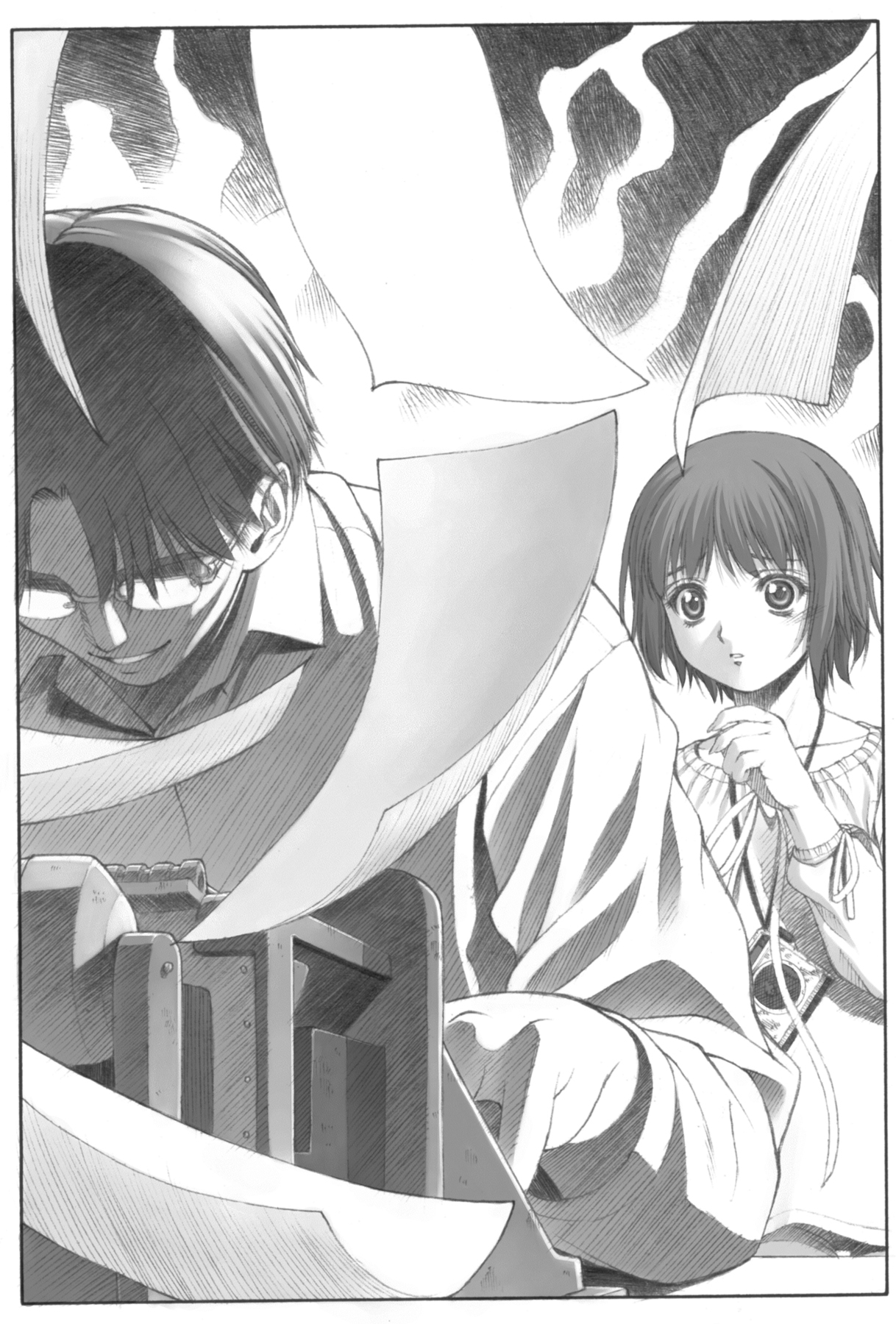
Kieli groped at the floor behind her and jumped half a meter backward. Two arms wrapped around the man’s back, followed by the arms’ owner, crawling out onto the desk—a thin man, enveloped in a black shadow. The youth didn’t even blink as he kept hitting the keys.
Once he had sluggishly pulled the top half of his body out of the typewriter, the shadow’s gaze swiveled toward Kieli. Under the dull light from the desk stand, a twisted grin, just like the one the youth had smiled a moment ago, rose to his cheeks. As if in response, the scattered papers on the floor danced up and started to swirl in the air.
“Kieli, get up! Get out of here!”
With the sharp command, Kieli felt a forceful impact against her abdomen, and at the same time a mass of air flew from the radio’s speaker. The shock wave dispersed the paper vortex, and white papers danced all over the room, blocking her field of vision.
Kieli gasped and flipped over, then dashed out of the room, practically on all fours. She sprinted down the hall, tripping over her feet and nearly falling as she went, and turned the doorknob, clinging to it with both hands, then burst through the door and rushed into the outside hall. Immediately afterward, the door slammed shut behind her.
“Wha…!?”
She sank to the ground in the hall outside and timidly turned her head behind her, out of breath.
“What was that…?”
She felt as though she could still hear the dry sound of typing on the other side of the door. The image of the youth’s back as he pounded away at the keys under the light of the desk lamp, drifting like a solitary island in the gloom, stuck to her retinas for a while and wouldn’t go away.

“Forget about him.”
When she told Harvey (who ended up not coming back until after midnight despite having said he wouldn’t be out late that night) about the young man on the second floor, he answered with the line she had predicted would be his most likely response.
Although she had anticipated it, Kieli still faltered unhappily; Harvey sat down at his usual post on the sofa, pulled out a cigarette, and said, “If it’s like the Corporal’s telling me, he’s big trouble.”
“This isn’t just a little spirit possession. This is a nasty, evil spirit that pulls in people’s hearts and controls them,” the radio added, sitting next to the sofa, and Harvey nodded.
“This isn’t something you can do anything about just because you kind of feel like it.”
“But…that’s why I’m talking to you, Harvey.”
“Huh?” Harvey asked and looked up, his lighter still lit in front of his cigarette. His face was honestly, genuinely blank. “Why should I have to do anything for him?” he demanded bluntly, his voice a little muffled because of the cigarette in his mouth.
“Why? Because…” Kieli couldn’t come up with a continuation for the sentence.
“…Kieli.”
Harvey breathed a short sigh as he looked down and went back to lighting his cigarette.
“I’m serious. Stop sticking your nose where it doesn’t belong because you’re curious or because you like to meddle.”
“I don’t just ‘kind of feel like it.…’” Kieli pouted and tried to argue.
“Shut up and listen,” he commanded in an unexpectedly sharp tone, so she closed her mouth.
After a minute of silence, Harvey slowly exhaled the smoke he had inhaled. “Look. I’m not talking about you; I don’t like it. I would really hate it if you got in trouble and I didn’t know about it,” he said in a low voice, and didn’t say another word for the rest of the day.

Still, Harvey thought he was a pretty appallingly softhearted guy, himself. After living so many years, it was only recently that he’d finally realized that.
“I may not look it, but I’m busy with stuff, you know.”
“What kind of ‘stuff’?”
“…Stuff,” he answered vaguely, then averted his eyes from the radio hanging from his hand and looked up at the flock of laundry swaying overhead. Laundry lines straddled the path from the windows of the buildings lining either side of the narrow hill road just off Mine Street, and white shirts and sheets fluttered peacefully in the breeze (although they’d probably turn gray the minute a three-wheeled bike rode through).
It was a warm afternoon in early spring, with a relatively low concentration of the umber-colored gas covering the sky. He descended the slanting road, slightly avoiding the occasional passerby. He did get the feeling there was something off about two men’s voices talking in whispers under such a pleasant sky.
“I’ve been keeping quiet because Kieli doesn’t want to bug you about it, but seriously, what are you doing?”
“Something personal. I’ll tell her about it soon enough.”
“Damn it, what’s that supposed to mean!?”
“Quiet. Don’t talk so loud,” Harvey ordered the radio, which had started to raise its voice, and looked around instinctively, but that wasn’t necessarily the action that helped him find the sign he had been looking for down the road.
“Oh, there it is.”
He stopped walking in front of a single shop standing in the middle of the slope. A rusty sign hung from a door so low it appeared half sunken into the ground. The street was bright and sunny in the spring weather, but a strangely heavy, shady atmosphere wafted around that door.
Apparently this was the one and only antique store in town that dealt with typewriters—in this day and age, antique shops were the only place you could get typewriters to begin with. In cities with communications technology, information terminals were used for dealing with the written word.
The knob had some kind of engraving on it that was so worn it was impossible to tell what it was anymore. Harvey grabbed it and pulled. As he winced at the clatter made by the ill-fitting door, he was accosted by a sudden shout.
“Go away!”
He automatically turned and almost left, but it seemed that the conversation in the back of the shop was not directed at him.
It was a small, gloomy store, permeated with the smell of dust. Miscellaneous objects crammed the shelves on either side in a jumbled mess, and in the very back, there was a counter similarly packed with things, to the point where it hardly fulfilled its proper function at all.
He saw a man who appeared to be the shopkeeper on the far side of the counter, and on the near side of the counter, a small man stood facing him. They seemed to be having a heated discussion, but the shopkeeper noticed Harvey and turned his way.
“Ah, a customer, is it!? Come in!”
He plastered a businesslike smile to his cheeks and leaned over the counter, shoving the first customer aside.
“No, I’m not really a customer.”
“Hey, I’m not done talking to—”
“You just go home already.” The conversation jumbled together in the already cluttered shop, muddling the air even further, and Harvey was seriously starting to want to leave.
“Oh! Could that be—” the shopkeeper suddenly shouted excitedly. He addressed Harvey with a friendly smile, but still watched him as if appraising him. Then his grin broadened to a point where it was actually creepy.
“I know what you’re here for, sir. Please, please, come inside.”
“……?”
He put his guard up just in case and accepted the invitation to go inside. The shopkeeper leaned so far over the counter that he looked as if he would fall over it and peered at the radio.
“Oh, I knew it. This…I’m surprised anyone would have such a thing.…”
He sighed dreamily, took a pen out of his breast pocket, and started writing numbers on a notepad.
“Three hundred…four hundred, no, I’ll give you four-fifty. What do you think? If it weren’t so beat up, I wouldn’t go under seven hundred, but, well, there are some buyers who like them beat up; say it gives them more flavor.”
“Er, uh. Wait a second.”
At last Harvey figured out there was some kind of a misunderstanding. “I’m not here to sell this.” Just as he thought for a fleeting moment that if the price was right he might consider it, the other customer who had been pushed aside came to stare at the radio with a fascination not to be outdone by the shopkeeper’s.
When Harvey saw the customer, his jaw dropped a little. He was a small man whose age was hard to guess—the white mixed with his hair and the deep wrinkles at the corners of his eyes made him look old, but his facial features made him look young. The patron created an impression that was difficult to explain, but the most unusual thing of all was the black monocle placed over his left eye, as if it was eating into the socket. It wasn’t a small one like they use at watch shops, but half of a pair of night-vision goggles from the War era, cut off and stuck onto his eye.
Harvey looked down at the grotesque monocle and unconsciously froze. With no warning gesture, the man stuck out his hands and grabbed hold of the radio.
“Ack, what the hell?” Harvey immediately brushed him away, but the man remained undaunted.
“Hey, let me have it. Let me have it.”
“Erk.…” Maybe having this strange man caress him shook the Corporal up. A voice leaked out of the speaker. Harvey winced a little himself and gulped. What the hell…?
And then the man looked up from the radio and now, suddenly, turned his eyes on Harvey. He let out a sigh of some unknown meaning, then the lens of his monocle moved from the top of Harvey’s head to the tip of his toes, as if lapping him up.
“You!”
He suddenly grabbed Harvey’s arm.
“Uwah!” Harvey cried out automatically and pulled away.
“Cut it out! Don’t do weird things to my customers!” The shopkeeper picked up a duster and started brandishing it wildly. “I thought I told you to go away! Go on, go home!” The duster drove the monocled man off, and he fled the shop, wailing.
“Hmph! Damn your shop to bankruptcy!” he spat nonsensically before turning around and escaping, followed by the shopkeeper’s jeers of: “Don’t you ever come back. The next time I see you here, I’m turning you over to the Watch!” He yanked the door violently open and slammed it shut. The consequent wind sent dust dancing through the air.
When the bizarre customer had gone and the dust had settled back to the floor, a strangely awkward silence fell over the shop.
“Honestly. Sorry about that weird guy.” The shopkeeper came back after tossing the duster to its place by the wall. “He’s a freak who’s taken up residence in the ruins outside town. He doesn’t have any money, but he used to come all the time, wanting the typewriter I had here until a little while ago. I chased him out every time he showed up. I told him I sold it to someone else, but he keeps hanging around, trying to find out who I sold it to.”
“Actually, I came here to talk about that typewriter. Do you know anything about it at all, like who it used to belong to?” Harvey asked, placing his elbow on the counter. It was convenient that the topic he wanted to discuss had just come up.
“Don’t tell me you’re in league with that freak, sir.…”
The shopkeeper furrowed his brow suspiciously. Harvey hurriedly shook his head, and, while he was at it, switched the elbow he was leaning on from his right to his left and shoved his right hand in his pocket. He didn’t like to admit it, but he was in the same category as the monocled man, in the sense that they both had unusual machines stuck to them.
On the other side of the counter, the shopkeeper also put his elbow on the counter and leaned forward.
“It’s a ludicrous story, but, well, think of it as a good conversation starter,” he prefaced, then deliberately lowered his voice and began. “Its previous owner and the one before that both wore themselves out and died. The typewriter’s first owner was a celebrated author, but apparently he wrote works that profaned the Church, and they had him executed. They say that ever since then, the author has possessed the typewriter and is moving around the South-hairo continent, sacrificing one owner after another, so he can complete the masterpiece he was never able to finish.…”
He broke off there and peered into Harvey’s eyes as if he wanted to say something.
“What?”
“You’re not scared?”
“Not really,” Harvey replied indifferently.
The shopkeeper pulled his face away, as if his fun had suddenly been spoiled. “But everyone pretty much believes it.”
“What? You made it up?” It wasn’t as if Harvey didn’t believe him.
“Well, I didn’t make it up. I mean, it’s stupid, isn’t it? A vengeful spirit possessing a typewriter,” he said flatly, unaware that there was a possessed radio right in front of his eyes.
Doesn’t look like hearing any more of this will help, Harvey determined and quickly left the counter.
“Sorry to bother you. Bye.”
“Sir, are you sure you don’t want to sell that radio? I’ll give you five hundred for it.” The man’s voice followed him, as if reluctant to see him go, so Harvey stopped for a moment. He looked down at the radio and thought for a bit, then turned to the shopkeeper, a serious look on his face, and said, “Five-fifty.”
“Done.”
Immediately afterward, a shock wave flew from the radio, destroying a shelf and creating an avalanche of the piles of goods it had been carrying, and Harvey ended up having to flee the shop at lightning speed while the shopkeeper fell into a panic.

Buzz & Suzie’s Café was busy on Mondays. There were a lot of customers, and lots of foodstuffs arrived from the market, so Buzz and Suzie had to prepare and put away ingredients, keeping an eye on the diner all the while. As a result, they spent the entire day on their feet.
So it wasn’t until late in the afternoon, when the customers had finally started to thin out, that Suzie asked, “How did it go yesterday?”
He looked fine. He ate the food and said it was delicious. That’s what Kieli wanted to say, but while there were a lot of things that she couldn’t say, she didn’t want to lie to Suzie. Instead, she spoke honestly about the part where she’d flipped over the pot of stew. The look of dejection on Suzie’s face hurt her chest.
After that, Suzie took on all of Kieli’s work herself, thus managing to let Kieli off half an hour early, and sent her off with another care package, as well as an order to collect the pot from the day before.
And that’s why Kieli was once again standing in front of the door at the far end of the hall on the second floor, holding another package.
She had been standing stock-still for five minutes, at a complete and total loss.
Kieli was worried about the young man from yesterday, too, and she wanted to help Suzie. But she didn’t want to make Harvey unhappy.
After fretting over it, she prioritized what was most important to her, and the solution came relatively easily.
…I’m not going to do this.
She had better not do anything reckless on her own, at least until Harvey got back. The Corporal had given Harvey a hard time, saying that even if he told Kieli to leave it alone, in the end, she wouldn’t be able to anyway. So he had gone off to investigate the typewriter.
Yeah, I’m going home.
When she spun around and started to leave the door behind, she heard a sound from inside.
She stopped and turned back to the door. She thought about how she shouldn’t worry about it—she had decided to go home. She could just ask Harvey and get him to come with her to check it out later. She got the feeling that the noise she heard was the sound of something big falling over. It wasn’t as if she heard anything else after that; the sound just stopped completely. What happened? But I’m not going to worry about it; I’m going home.
…What if he’s dead?
The thought floated to her head, and she opened the door.
Just like yesterday, the desk lamp leaked out of the room at the end of the gloomy hall. She fixed her gaze on it, crouched down, and left the package at the entrance. Then she stepped inside and peered into the room from the doorway.
“A-are you all right!?”
She immediately saw the young man lying facedown on the floor, as if he’d slipped out of his chair.
She ran over to help him up. When she looked into his face, her jaw dropped. He was much more emaciated than he had been the day before. It was hard to believe only a day had passed.
“Oh, you’re the girl from yesterday. I’m all right…,” came a weak voice that sounded far from all right. The youth ran his glazed yellow eyes unsteadily around the room, stopping when they found the typewriter on top of the desk. He clung to the chair and tried to force himself up.
“No! You have to rest a little.…”
“Leave me alone!”
He pushed her away roughly, and Kieli staggered once but immediately stood up, moved in front of the young man, and reached out to the typewriter. That instant, the youth’s cheeks twisted in rage. “Don’t touch it!”
“If you keep going like this, you’ll die!”
“Give it back!” They each grabbed hold of the typewriter and struggled to take it from the other.
At this point, Kieli had more physical strength. The young man tottered and fell. She took the opportunity to snatch the typewriter away—
The window. Her first thought was to open the window.
“Stop! What are you doing!?”
She held it over her head and was about to throw it out the window, but the youth grabbed her clothes and pulled her to the floor. Even so, she tried to reach out to the typewriter as it rolled across the floor when she let out a gasp of pain.
She didn’t know what had happened, but her breath stopped for a second. It was after she had rolled to the wall that she realized he had kicked her in the side, and she doubled over and coughed as she regained her breath.
She caught the youth’s figure at the edge of her vision. He embraced the typewriter in both hands, held it to his cheek, and stroked the casing lovingly. Watching the scene of madness with her cheek still on the floor, Kieli shuddered and stiffened. Just then, the shadow of a man crawled out of the typewriter like it had done the day before.
The shadow glared at her, wearing the same features—twisted and full of insanity—as the young man. At the same time, the papers littering the floor rustled and danced upward. As Kieli watched, they formed a white tornado and started swirling around her.
She felt a twinge of pain on the back of her hand and looked at it in surprise; a thin line of blood rose out of it. There was a sharp fwip and another line of blood.…
“No…!” She covered her head with both arms and huddled on the floor, when—
Crash!
She heard a spectacular breaking sound, and the wind stirring up the papers suddenly vanished.
As she crouched on the ground, white sheets fluttered at the edge of her vision, floating down like giant confetti. She looked up, still holding her head, and saw long legs in familiar work pants standing a little ahead of her.
The typewriter fell out of the small dent it had made in the room’s opposite wall, along with some pieces of the wall itself. It came apart and its pieces scattered onto the floor. Apparently he had kicked it across the room.
“Ah…aaauughh…” A strangled, anguished cry came from the young man’s mouth. He crawled along the floor and tried to snuggle up to the typewriter, but Harvey’s shoe trampled his side.
“Huh…?”
Kieli looked up in surprise, then immediately swallowed her voice. As Harvey looked down at the youth, his profile was so perfectly void of expression that it made her shudder. No emotion on his face, but rage burning in his copper eyes, he kicked the young man again and again. The youth curled up and let out a weak scream.
“Harvey, stop! What are you doing? Stop it!”
She couldn’t quite stand up, so Kieli practically crawled as she rushed over. “You can’t! He’s just a human being! He’ll die!” she begged frantically, clinging to his torso. Harvey looked as if he suddenly came to his senses and stopped immediately.
“Ah…”
After standing frozen in that position for a time, he turned to face her, his movements somehow sluggish. “…Well, but—” He started to make excuses as he returned his attention to the young man trembling and cowering on the floor. “He…kicked you,” Harvey murmured in a slightly dazed voice, as if he didn’t quite understand it himself.

After that, the youth ate all of Suzie’s care package, crying and apologizing all the while. He got a good night’s sleep, and the next morning, he packed up a few things and headed for the station. When Kieli asked him if he was sure he wasn’t going to go see Suzie, he answered that he would leave without seeing her, because if she saw him like this, it would only worry her more.
Looking at him, Kieli didn’t see a single trace of the previous night’s insanity. It had been only a day, so of course he was still haggard and emaciated, but a smile rose to his mild-mannered, slender face.
“I haven’t been back home in a long while. I’ll recuperate a little while I think of what I’m going to do next.” He looked a little sad even as he said it.
Apparently he’d left his parents in his hometown and come to this city when his first story was published in a newspaper, but he was soon out of work and couldn’t even go back home. That’s when he got the typewriter. It was a mysterious appliance—all he had to do was hit the keys, and eloquent writing flowed out of it. He kept writing as if possessed, thinking that this time he would succeed, but when he thought about it rationally, the young man realized that that story definitely did not come from inside himself.
“I liked that mining story. I hope I can read the rest someday,” said Kieli. She had taken the old newspaper home out of curiosity and found herself unexpectedly hooked. When she gave him her honest opinion, the youth smiled happily.
“Would you like to have an adventure like that?” he asked, making small talk. Kieli thought for a bit, then dodged the question with a vague nod.
She saw the young man off and left the station, then climbed the hill on the three-wheeled bike she’d borrowed from the diner.
“Well, it is a little late for that. Your life story is already pretty unique,” the radio said sarcastically, hanging from her neck. Kieli looked down at it and pouted.
“I do think it’s because I hang out with you and Harvey, Corporal.”
“Well, excuse me for being unique,” a careless voice jumped in from the backseat. She glanced over her shoulder to see Harvey’s profile, cigarette in his mouth.
Since the three-wheeled bike had a fuel tank that was extremely large for the vehicle’s size in the back, the backseat on top of it was inevitably large as well. Still, she thought it might be pretty dangerous to crouch on top of it, facing sideways and smoking. Kieli wouldn’t have minded sitting in the back herself, but apparently Harvey had no desire to drive.
I don’t like it—Harvey didn’t say a word about how she’d completely trampled over his statement from two nights before and ended up going to the neighbor’s room alone after all. He didn’t seem mad; he just looked down at the light cuts on Kieli’s hand and made a face that she couldn’t really interpret. It might have been his “I don’t like it” face.
Anyway, the one thing that Kieli thought emphatically was that she couldn’t let him make that face again.
The front of Buzz & Suzie’s Café came into view at the top of the slope. It was a relief to confirm from far off that there were no customers at the outside tables. When she’d explained the situation to Suzie, she’d gotten permission to go see the youth off, and she was glad to get back before the diner got busy.
Getting close to her destination, she slowed down and pulled over to the side of the road.
“So what happened to the typewriter?”
“He told me it was broken, so he threw it away,” she answered, focusing on her driving.
“It wasn’t there,” Harvey interjected simply from behind her.
“What?” She found herself slamming on the brakes. The bike screeched against the asphalt as it came to a sudden stop, and Harvey, almost thrown off the backseat, yelped and clung to Kieli.
“That freaked me out. Watch it!”
“It’s because you were sitting like that,” Kieli argued, her heart skipping a beat at the closeness of his voice and the feeling of his arms around her torso. “What do you mean it wasn’t there?”
She hurried to get back on the subject, thinking he might feel her heartbeat in his arms. For his part, it didn’t seem to bother Harvey, who said in his usual tone, “It wasn’t in the trash heap. I went to check it out this morning, but the typewriter wasn’t there. Maybe somebody picked it up.”
“What would they do with it?”
“Hell if I know. Probably use it, or fix it and sell it.”
“But if it possesses someone again…”
“I don’t care,” Harvey said shortly, then let go of her and got off the bike. He stretched a little on the curb, and mused, “What’s wrong with having a few pieces of junk like that out in the world? There’s one right there.”
“Don’t treat me like junk! You almost sold me for five-fifty!” the radio growled accusingly, then Kieli heard a smart little jingle up the road, and a small woman appeared by the glass door to Buzz & Suzie’s Café.
“Welcome back. Thanks for seeing him off.”
Suzie worked her cane busily as she hurried toward them. Apparently it bothered her that she couldn’t go see the young man off herself. “I’ll be at home,” Harvey whispered and started to leave. Suzie didn’t fail to notice.
“Wait, wait. Today you will be eating before you leave!”
“Why are you so damn persistent…?” he muttered in a voice Suzie couldn’t hear, but his annoyance showed clearly in his attitude as he stopped walking. Suzie didn’t care in the slightest and grabbed his arm as if to say she wouldn’t let him escape this time. That instant, her eyes and mouth opened wide.
“You really are thin! Are you eating? You aren’t, are you? You have to eat properly!”
“It’s none of your business.…” Harvey shook off her hand, halfway between furious and polite, as though it was a little too much for him.
“Ah!”
“Ah—” Kieli cried out automatically, her voice overlapping Suzie’s. Suzie’s cane missed the ground, and she staggered forward.
Kieli already had her hands out, but before they could reach Suzie, Harvey’s arm caught the woman.
Immediately after, he let go and looked away, apparently inwardly cursing his mistake, but Suzie, still wrapping her arms around Harvey’s, smiled happily. “I knew you were a good person. Right, Kieli?”
Kieli answered with a shy smile and a nod in the affirmative.