Chapter 2: The Station Chief and the Dog Wait in Vain
She woke up from a dream.
Half-sitting up from her seat in alarm, she cast her eyes about. She was in a long, narrow train car that shook rhythmically. From the speaker of the radio placed by the window, she could hear up-tempo music playing at low volume, and outside the window, the vast, boring scenery of sand-colored afternoon sky and wilderness streamed gently by.
When she looked diagonally across from her spot in their set of facing seats, a young man with copper-colored hair and sloppily crossed legs was smoking and watching her suspiciously. “What’s that for?”
He probably meant something like, What’s that weird behavior for? but he’d completely abbreviated his sentence. It was his usual curt way of talking.
“Oh…I had a scary dream…” she began, and then choked up. Everything was like it always was, but for some reason she was horribly relieved, and the words stopped up in her throat came tumbling out all at once. “I woke up from a nap and our seats were full of people I didn’t know, and the radio was gone, too. I thought that was weird, so I looked in the other seats around us and even in the other train cars, but I couldn’t find anybody anywhere, so when I saw the conductor from behind I tried to ask him, but when he turned around he was a faceless white doll, and then I realized all the other passengers were smooth, featureless dolls, and they all stood up with jerky, creaking joints and swarmed off the train. They pressed me into the line, too, and I got herded off the train, but there was no platform there and I fell into a deep pool wrapped in cloudy white mist—”
He listened with a bored expression as Kieli explained as much of her dream as she could remember, and then he quirked the corner of his mouth with the cigarette still between his lips to give her an equally bored response. “Huh? What’s with that?”
“Hey, I was scared!”
“Okay, okay.” He obviously wasn’t taking her seriously, and Kieli pouted. Recrossing his legs with a long-suffering look, he blew out his smoke in a different direction and mumbled grudgingly, “I’m right here, aren’t I?”
She woke up from a dream.
Half-sitting up from her seat in alarm, she cast her eyes about. She was in a long, narrow train car, the radio was placed by the window, and outside the afternoon wilderness streamed by.
When she looked across from her spot in their set of facing seats, a beautiful woman with long, braided golden hair was watching her suspiciously. “What’s that weird behavior for?”
“Oh…,” Kieli began, and then cut herself off. “Ahaha, I was just daydreaming…” She plunked back down on her seat with a weak laugh. Beatrix blinked; she seemed to have been in the process of lighting a cigarette, but for some reason she abandoned the project.
A man’s voice could be heard from the radio’s speaker, blending in with the faint, staticky music. “This was our first long trip in a while. We’ll get there by tomorrow, right?”
“Yeah,” answered Beatrix unenthusiastically.
“What will we do when we get there?”
“We’ll make contact with the informant. Everything else depends on what he says.”
“You’re sure a slapdash planner.”
“Now that’s just rude. I’ve thought this through plenty. The first thing I’m doing is selling you off to get money for the trip back.”
Kieli had been leaning against the window letting their conversation wash over her, but she couldn’t let that one pass. “You can’t do that,” she broke in, lifting her head.
“Why not?” Beatrix shot back, pouting. She ought to know very well why not, but apparently she’d been pretty serious. “You’d better make some more money at cards, then.”
“There’s no guarantee I can win every time, you know. Besides, weren’t you the one who told me people should earn their keep themselves?” she argued with a scowl.
Beatrix puffed out her chest with bizarre self-importance. “That’s not it; this is a legitimate information fee.” The reply made no sense to Kieli.
“Information fee?”
“You found a clue about your mother thanks to me, right? So as repayment for the information, you’ll bear my travel expenses. It’s only natural that information be provided at a cost. Nothing in this world is free, you know. That’s what the adult world is like. And you’re fifteen now, so get used to it.”
“I’m sixteen,” Kieli corrected, deciding to let the first part of Beatrix’s reasoning slide. The other woman looked startled, as if she was just now realizing this.
“When did you turn sixteen?”
That reaction was just too much. At a loss for words, she merely gazed back at her companion in silence.
My sixteenth birthday was half a year ago already…Kieli hadn’t said anything about it at the time, and it wasn’t as if she particularly wanted Beatrix to remember her birthday, but they’d met right after she’d turned fifteen and it had been more than a year since then, so even the slightest consideration should’ve told her that Kieli was a year older.
Then, gazing at this woman who looked exactly the same as she had a year and a half ago except for her ever-changing hairstyle, she thought maybe she shouldn’t have expected anything else. To an Undying whose life was basically eternal, at the most a year and a half must seem the same as a month and a half seemed to Kieli.
“Kieliiii, are you mad at me?” Maybe Kieli’s sudden silence had made Beatrix uncomfortable; now she was peering at Kieli and speaking in a cajoling voice, as if to gauge her mood. “Come on. I promise I’ll celebrate your birthday next year, okay?”
“Whatever; I know you’ll just forget.”
“I won’t forget this time! I swear! Do you want anything?”
“No, I don’t want anything, so stop buying yourself stuff, too…”
If she had to pick, she’d actually rather Beatrix do something about her sense of finance than her sense of time. When she glaringly explained this, Beatrix responded in tones of wounded shock. “Why should I? I’m not causing you any trouble.”
“You’re causing her LOTS of trouble!” interjected the radio.
Silently agreeing, Kieli glanced overhead. A giant trunk that was probably seriously pushing its weight capacity had been forcibly stuffed onto the shelf there, causing it to creak along with the movements of the train.
And one trunk’s worth of impulse buys was comparatively tame. There had been an occasion when she’d returned from work and found Beatrix at home for once, only to behold that their entire apartment had basically been turned into a walk-in closet. With scarcely a sidelong glance at Kieli’s shock-frozen form in the doorway, Beatrix stood gaily holding up different outfits in front of herself in the mirror—but she always grew sick of clothes soon after she bought them and sent them off to a charity, saying she’d never wear them again; so maybe she was actually performing a useful service for society after all.
However, when she’d made this comment to Beatrix herself, Beatrix had flown into a rage and the whole thing had turned into a serious incident: she’d shipped off the radio along with the clothes, and Kieli’d had a devil of a time getting it back. Come to think of it, that had been right around her birthday.
Something occurred to Kieli. “Don’t you have a birthday, Beatrix?”
“You just blithely ask the most unpleasant questions…” The woman had given her an earful about birthdays before, and sure enough, her cheek twitched in sudden irritation. “I have no idea. Maybe I did once, but it’s long forgotten now.”
“Then let’s make it a day in the middle of summer,” Kieli continued lightly, unruffled. Beatrix blinked dubiously.
“Why?”
“Just go with it. I’ll celebrate your birthday next year, too.” Even if she didn’t visibly age, she could at least have a birthday. And after all, Kieli’s birthday wasn’t an exact birth date, either.
Beatrix froze momentarily, cheek still slightly tense, and then jerked her gaze to the side. “Don’t go deciding these things on your own. It’s a nuisance.”
“Oh ho, you’re a little happy, aren’t you?” the radio piped up teasingly. Beatrix glared.
“If you want an anniversary to celebrate, too, I’ll make today that glorious day.”
“What?”
“The anniversary of your death.” At which point she grabbed the radio in one hand, stood up, and began to open the window with a clatter.
“Stop it, you idiot!”
“That’s what a radio gets for talking all high and mighty to a person.”
“Hey, I’m a person, too!”
Watching the horseplay of woman and machine from her detached position, Kieli let a wry little laugh slip out of her throat.
Next year, and the year after that, Beatrix was sure to be the same beautiful, impulsive, catlike woman. And the radio might be a little more beat up, but he’d still be the same short-tempered, nagging, rock-loving Corporal.
There was a part of her that simply accepted that on her next birthday, and the birthday after that, she’d probably still be living this same life with Beatrix and the radio as if it were the natural thing to do. She leaned her head against the window and let her gaze return outside, thinking perhaps that would be okay.
“…Huh?”
At some point the train had decelerated, and the scenery was flowing more gently. As Kieli cocked her head in confusion, it slowed down even more, to the point where someone walking could probably catch up with it. Eventually the train came to a slightly jerky halt right there in the middle of nowhere.
Kieli exchanged glances with Beatrix (who was dangling the radio like a punching bag and knocking it around). “We stopped. I wonder what’s wrong?”
“Don’t ask me.”
She could hear commotion coming from the other seats in the car, too. But of course they couldn’t very well get off the train, so they just sat there waiting. After a while the conductor appeared from the rear door of the car. Facing the passengers’ suspicious gazes all alone, he flinched a little, and then apologized for the inconvenience and began explaining the situation.

“Is it okay if I go outside for a little while?”
After being emphatically warned not to miss the train’s departure, Kieli obtained permission to go. She jumped lightly down from the step onto the track.
When she’d walked along the train a ways crunching the rail bed gravel underfoot, she found a weather-beaten platform up ahead, on one corner of which she could see a shabby station house. The train had come to a stop just past the tip of the platform, and a little in front of the engine car the conductor and engineers in their railway uniforms, plus a few passengers who had come to help, were outside working to clear rubble from the track.
It didn’t look as if there was much she could do to help, so watching them work out of the corner of her eye, she scrambled up a pile of broken concrete onto the side of the platform.
She’d heard that it had been a long time since this station fell into disuse. There had once been a town behind it, but since it was an inconvenient distance from the city centers of Westerbury and North-hairo and had no industry to speak of, it had increasingly lost population, and apparently now there was no one living there anymore. Because part of the crumbling platform had broken off onto the track and blocked their way, the train was stopped temporarily while they worked to clear it.
The winds of the continent’s interior wilderness blew past the ruined platform, feeling frozen on skin used to the South-hairo climate. Kieli shoved both hands into her coat and pattered a little farther along its deserted surface.
Her fingers brushed the lighter, and she gripped it tightly inside her pocket, as had become her constant habit. When she’d awoken alone in the bed of the three-wheeled truck that day a year and a half ago, she’d found it lying in a corner. It certainly wasn’t an expensive one; in fact, to be frank it was totally cheap, the kind of thing he probably hadn’t even cared that he’d lost. But it had been waiting in Kieli’s pocket ever since for the day it would be returned to its owner.
…The day to return it might never come.
Lately she’d started to think that way. She could easily imagine that just like the lighter, he’d soon stopped caring that she wasn’t with him anymore either. To him a year and a half probably wasn’t much, but to Kieli it had been more than enough time to begin having those thoughts.
A much stronger gust of wind sent her hair and the hem of her coat flapping. Her hair was annoying her these days, and she was thinking of cutting it once this business with her mother was over. It was about time to throw away the lighter, too. After all, it’s just a cheap thing, she griped internally to no one in particular.
When she shook her head lightly to get the hair out of her eyes, she caught sight of something brownish standing stock-still at the edge of the gray-white platform. “Huh?”
At first it looked like something someone had left lying around, but no, it wasn’t “lying” there; it was sitting there.
A medium-sized dog with a shaggy red-brown coat.
He was sitting next to the remains of the ticket gate and facing straight ahead at the tracks, but perhaps he noticed Kieli; he turned his head toward her and gave a single audible wag of his tail.
She was pleased at receiving what seemed to be a greeting, but then he immediately turned away and faced forward again with an uninterested expression.
“Sorry, he’s not a very friendly dog. He’s only affectionate with his master,” a voice behind her said abruptly. When she turned to look, an old man was standing in the ticket gate. She had no idea how long he’d been there. His deep green coat and cap were the uniform of the Westerbury area railroad employees. Fitted on his right arm was an armband trimmed with gold. Though his age and the color of his uniform were different, somehow his air reminded Kieli of a certain conductor she’d met on an Easterbury train.
“Thank you for traveling with us today. I am the station manager here,” he intoned, putting a hand to the brim of his cap. It was a rather formal greeting, but then he quickly adopted a casual attitude and continued with an embarrassed smile and a self-conscious slant to his white eyebrows, “Though really, I just became the station manager automatically because I’m the only employee.”
“Nice to meet you…” Kieli responded without thinking. She stood there for a while without saying anything else before finally wandering over to the ticket gate, hands still in her pockets. “Is that your dog?”
“No, no. He just comes here every weekend to meet his owner, who works in the city during the week. Most people in this town go to work in the Westerbury commercial district.”
“Oh, I see,” Kieli answered vaguely, turning her gaze to the red-haired dog who sat small and quiet by the gate. The dog looked back at her for just an instant and gave another wag of its tail, then faced forward again. She drew up to it with a light smile and crouched down next to it, her back against the wall. Squatting like this with her arms around her knees, her eyes were almost on the same level as the dog’s. She let her eyes wander around the station. Surely she was seeing the same scenery as he was.
There was the meager platform with its single railroad track. Beyond the rusty, broken-down iron-wire fence spread a wilderness dotted with the occasional shrub.
I wonder how long it’s been since workers stopped coming back to this town.
The autumn wind began to sting, and she wrapped the hem of her coat around her legs where they were bare underneath her shorts, propping her chin on her folded knees. It looked as though it would be a while before they finished clearing the tracks.
Suddenly she heard the station manager’s laugh above her. When she turned around to look at the ticket gate, he coughed uncomfortably and said, “I’m sorry, I hope you won’t take offense. You see, it just looked as if there were two dogs there now.”
Kieli blinked at this and turned to examine the dog’s profile next to her. His dark brown eyes, half-hidden by his shaggy hair, were still trained on the platform as if nothing had happened. It was rude to think of him like this, but with his grubby red-brown hair and his thin frame, he was a very scruffy-looking dog—and yet his attitude was so strangely aloof that she couldn’t help laughing a little.
This time, the dog flapped his tail twice against the ground as if in small protest.
“Sorry,” she apologized seriously, stifling her laughter. Then, after thinking for a moment, she shifted her crouched body a half-step and leaned her side against him.
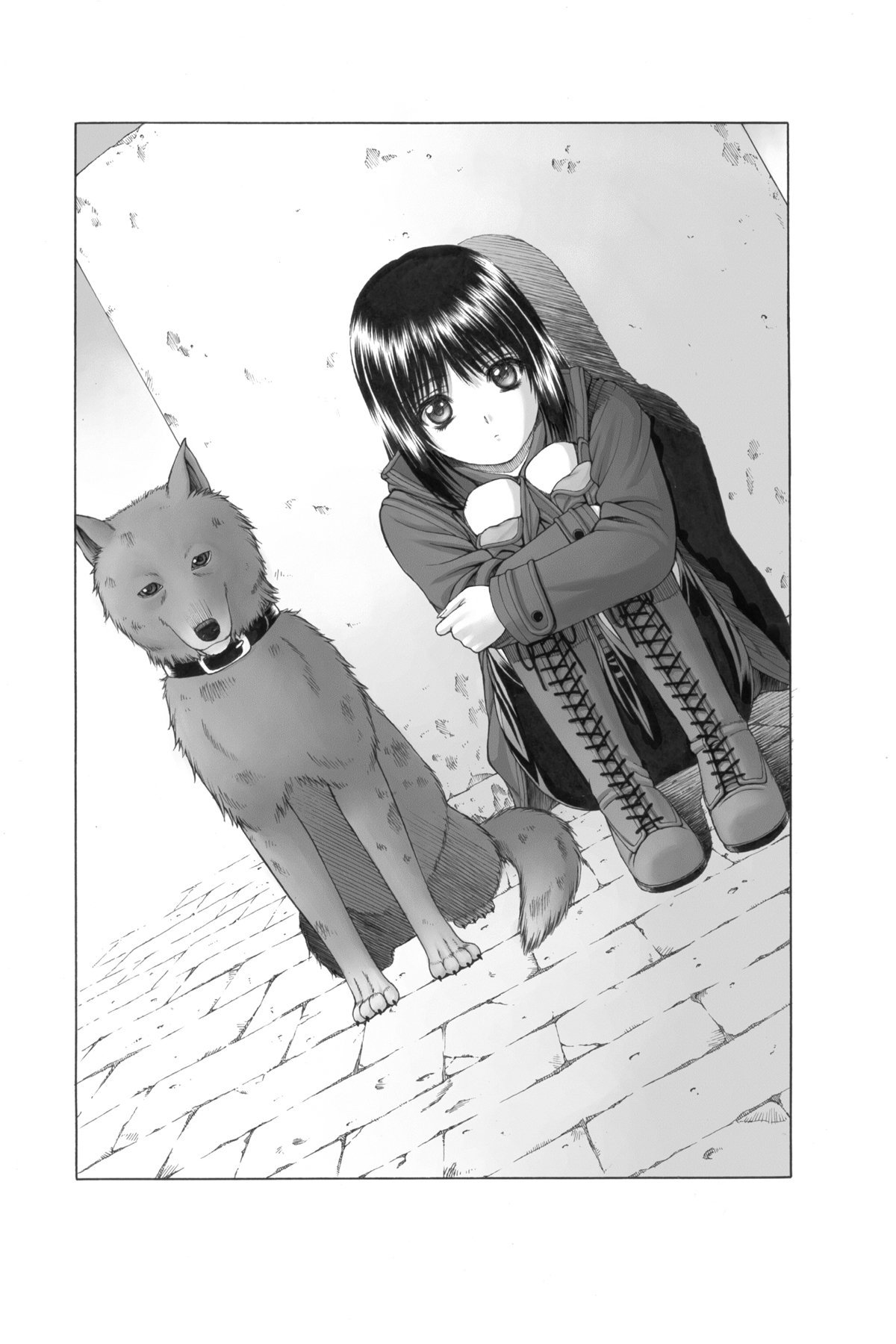
There was dust and sand and the stink of dog, and somehow she felt as if she could also feel the warmth of his red-brown fur through the sleeve of her coat. She found herself inexplicably growing a little warmer. Letting the sounds of the wind whistling across the deserted platform and the shouts of encouragement between the railroad workers wash over her, she closed her eyes for a little while.
In a corner of the hushed gray-white platform, a lone black-haired girl in a black coat sat all by herself hugging her knees. (Well, it wasn’t that Beatrix couldn’t see the scruffy redheaded dog sitting next to her, but she had no interest in getting involved with it, so she deliberately blocked it out—honestly, why did that girl meet some such thing every single place they went?)
Beatrix had been gazing at the platform in front of the train with her cheek plastered to the window, but now she returned her gaze to the interior of the car. “She says she’s sixteen,” she whispered, scowling. “She’s got some nerve. When did that happen?”
“I knew all about it. I couldn’t say anything, though, because she didn’t say anything herself.”
“Oh, come on. It’s just petty of you, acting like you’re the only one who understands things. You’re a radio.” She glared at the machine by the window and pouted. They spoke in low tones, since most of the other passengers remained in their seats while they waited for the train to start up again.
“Actually, it might not sound like it, but I’m pretty grateful to you. You’re doing lots of things to take real good care of Kieli.”
“Stop that. Are you trying to annoy me? I just figured I could spend a few years with her to kill time, that’s all.”
“I’m saying even if a few years aren’t much more than a ‘killing time’ type of thing for you or me or that idiot, they’re more than that to her. A year and a half is no small beans when it’s only coming out of sixteen years total.”
“…I guess not. She was an ugly-faced brat up until just a while ago, and now suddenly she’s sixteen? She’s got some nerve.” Repeating her earlier comment in a half-impressed, half-verbally-abusing sort of way, she let her gaze slide to the girl sitting on the platform, and thought, No wonder she gets hit on sometimes, again in a half-impressed, half-verbally-abusing sort of way.
Sixteen or not, she was still just a kid. But looking at her again with this new information, Beatrix did notice that her limbs had grown long and slender, and her childish look was fading away (though as to whether the girl had turned into a beauty, it was Beatrix’s opinion that there was still nothing particularly special about her). It also rather seemed as though she’d been wearing a more mature, calmer expression lately—though perhaps “cold” was more accurate than “mature.”
“Maybe I shouldn’t have taken her away from South-hairo. She seemed about as cheerful as ever while we were there, but ever since we started traveling, she’s been getting that look on her face more.”
“Since we’re traveling, she probably can’t help remembering stuff. Especially on trains.”
“…Well, you know,” Beatrix sighed, propping her chin on her arm in the windowsill so that her breath made the glass momentarily fog up, “even I didn’t think that idiot would drop so completely out of contact for so long after he left her with me.”
“He sent you word once.”
“Only once.”
“Even so, Kieli’d probably be relieved if you told her. Are you sure you shouldn’t say anything?”
“It’s not that I won’t say anything; it’s that I can’t say anything!” she replied, wailing a little without meaning to. Her chin had jerked up from her hand as she spoke. She returned it and sighed again.
Beatrix hadn’t told Kieli, but the truth was that the person who’d sent her the clue about Kieli’s mother had been the very man for whom that idiot was steadily being established as a second name between herself and the radio. When they’d parted a year and a half ago, they’d set up a route of contact through the post office at East South-hairo Port. They’d never decided on a means of contacting each other before, but this time she could use the pretext that she was “looking after” Kieli, so she’d forced him to agree to the plan so that he wouldn’t drop completely off the radar. There had been exactly one piece of mail from him via that route.
However, for a combination of unfortunate reasons, it was now difficult for her to honestly tell Kieli about it.
Reason 1: In the beginning she’d gone to check the post office about once a month, but there hadn’t been any word from him at all, and eventually Beatrix herself had completely forgotten about it.
Reason 2: When she’d been near the port at the beginning of the summer to go shopping for summer clothes, she’d remembered and finally dropped by the post office again, and a single envelope had arrived for her. The date on its postmark was from the autumn half a year ago, and the place was the border of North-hairo parish. Even assuming it had taken a month or two to deliver because of problems in the postal system, that would still mean she’d left it lying there for several months, and it seemed as if that would make Kieli angry, so Beatrix hadn’t been able to tell her.
Reason 3: She knew nothing of what had become of the sender after he’d mailed it. Given his personality, she could safely assume there was no chance he was still in the place he’d mailed it from, and it was also unlikely he’d left any clues about where he’d gone afterward. She thought it would depress Kieli even more to get her hopes up and then not be able to see him.
And Reason 4 was an even bigger problem…
The contents of the envelope in question were a memo with the scribbled phrase “Kieli’s mother” and the address of the informant (though there were as many towns on this planet as stars in the sky, he had completely omitted which town the address was in and started right off with the street name; fortunately, she’d been able to deduce the town from the postmark, but the man’s ability to communicate his intentions was hopelessly inadequate) and a single bill of a type of money that was no longer in use. Presumably this all meant that if Beatrix showed the informant the money as a sort of pass, she’d be able to get some kind of information about Kieli’s mother—at least, that’s the way Beatrix translated it. It was only just barely comprehensible to her and would have been unintelligible to anyone else.
That was all. He was the type of person who couldn’t write a single considerate word explaining where he was and what he was up to, or asking whether Kieli was doing okay.
“…Do you really think anyone could be relieved after seeing something like that?”
“No. I guess it would just make her more dejected…”
“See?”
“That idiot,” they cursed simultaneously, after which Beatrix glared at the radio with a look of heartfelt displeasure.
“And anyway, it pisses me off how we’re weirdly compatible talking about him like this. You’re just a radio.”
“Well, excuse me. It pisses me off, too.”
“This is partly your responsibility for not stopping him, you know!”
“How could I help it? A man has his own circumstances.”
“You’re not a man! You’re a radio!” she cried, unintentionally loudly. The passengers in the next seats over darted suspicious sidelong glances at her, and she hastily pretended to be listening to the radio, averting her gaze out the window.
Watching the girl on the platform in the distance, she recalled that morning a year and a half ago.
“I thought she would cry…”
“That is just the kind of girl she is.”
“There you go acting like you understand it all again,” she began, voice starting to rise again before she forced it back into a soft grumble. “You’re just a radio.”
“You underestimate her about that stuff, but so does that idiot. She’s not the type of girl who cries at times like those.”
“Hmph.” Beatrix moved her eyes from the platform to glare grumpily out at the wilderness filling the train window. It hardly changed even when the train was running, and now that they were just sitting still, it was boring enough to drive her crazy.
That morning she’d explained the situation to Kieli, whose face showed her worry at waking up in the bed of the three-wheeled truck to find the man who’d been there up until the previous night suddenly gone. Her “explanation” hadn’t actually amounted to more than a rapid stream of words along the lines of Ephraim went to the capital to look for word on Jude; you’d drag him down, so he left you here; I’m going to be taking care of you for a while since there’s really no choice, okay? Afterward she was inwardly anxious as she waited for the reply—Kieli had been listening with her mouth tightly drawn—but after she’d silently digested the situation, the girl merely asked if he would come back once he was finished.
Beatrix had answered, “Probably,” with what even she recognized to be a pained expression, and a few moments later, Kieli appeared to accept it all surprisingly readily. “Okay. Then I’ll stay with you, if it’s not too much trouble.” And after that, Kieli had never mentioned the topic again. She was so anticlimactically mature about it that Beatrix had let herself be reassured, figuring it must be okay, but…
Even so, she supposed it had been a year and a half. That man was just too…too…
Too stupid.
Her temples actually started to throb. She frowned and sighed for the umpteenth time.
If there’s such a thing as a God on this planet, could He please do something about that idiot and the way his sensitivity is so radically lacking that somehow, even though he means no harm, he can walk out on a girl just turned fifteen and leave her hanging until she’s past sixteen and a half?

Whoo-oo…
Hearing a faint whistle on the wind that whipped her hair, Kieli opened her eyes. When she squinted and peered through the sand-colored gas over the tracks, she saw another train pulling up behind their own stopped one.
“Oh, no!”
She was alarmed for a moment, but the workers clearing away the rubble in front of the train didn’t seem to notice the new arrival at all, so before long she realized what was happening. The second train ultimately passed harmlessly through the first and slid up to the platform. With an almost unreal screech of friction, as if there were a thin film hanging between Kieli and the noise, the wheels slowly stopped turning, and the train came to a stop right in front of her.
Woof!
The dog beside her barked for the first time, standing up and beginning to wag its tail at the train. Passengers clattered down from the vestibules of each car and walked with slightly tired footsteps past Kieli as she crouched next to the ticket gate and looked up at them. As they cleared the gate, the old station manager saw them off individually with mild-voiced greetings. “Welcome back, good work this week. How’s business in Westerbury? Have a good weekend.”
After they passed through the gate and out of the train station’s rectangular exit, one by one they disappeared from her sight as if melting into the milky-white light outside.
When at last a lone man in his overalls got off the train, the dog leapt up and bounded away from Kieli.
She automatically stood to watch it go, but it didn’t cast a single backward glance her way. It danced around its master’s legs, winding around them and then pulling away, and when its master bent down to scratch under its chin, it let its ears flop blissfully and stretched its neck as far as it could, trying to bring its nose to his face. When the man began walking, the dog started off with him, running in circles around him. And so the man and the dog filed through the gate and vanished outside the station like all the other passengers.
Fssssshhhhh…
Its passengers safely disembarked, the train slid away from the platform again in a hiss of steam.
All that remained were Kieli, the crumbling platform, the ticket gate, and the station manager in his dark green uniform. The sounds of the wilderness wind and the faint conversation of the workers returned to her ears. Still gazing at the station exit where the passengers and the red-haired dog had disappeared, Kieli stood unmoving by the gate for a while.
“They’re lucky…,” she whispered without conscious thought, and then averted her eyes and shoved her hands into her pockets, distracting herself. In place of the slight warmth she’d been feeling on one side, she felt the cold sting of the northern autumn wind cut through her coat.
“Are you waiting for someone, too?” The station manager prepared to close up the ticket gate as he asked, his day’s work finished.
Kieli answered with a wry smile. Her feelings were complicated. “I guess so…But lately, I’ve started thinking maybe he won’t come back.”
“So you can just go see him, then.”
“But I don’t even know where he is.”
“Then you can just go look for him.”
He said this casually, as if it was obvious; gazing dazedly at his profile as he worked, she made a vague sort of “I guess so” reply and let her gaze escape to her feet.
She took a few steps backward and leaned her back against the concrete wall of the station.
She’d thought of searching for him so many times.
But then she’d thought that if he had left her behind because she’d drag him down, he might think of her as more of a burden if she found him. Also, if he really wasn’t intending to ever come back, it would be scary to seek him out only to confirm that. And, more than anything else, she’d been angry with him this whole time for leaving without saying a single word to her. So if she went to look for him, wouldn’t it be kind of like giving in and letting him win?
…And yet even as Kieli told herself this, she was heading toward the capital. What am I doing?
She was used to being patient and enduring. She’d done it since she was little. It shouldn’t have been so hard for her to just wait until he got back…
Whoo!
This time, the sharp whistle that rang in her eardrums felt very real.
When she looked up, they had finished clearing the tracks without her noticing, and the train was slowly beginning to move. “Oh, no!”
“Kieli! What are you waiting for?!” Beatrix shouted, leaning out of the open window of their passenger car. She pointed to the end of the train and then immediately pulled her head back inside. The train gradually built up speed, pulling past the platform.
“Whoa, this is bad…”
As Kieli broke into a panicked run, the station manager’s voice spoke up from behind her. “Miss—I’m glad I got to talk to you. Just eternally waiting all alone for the train like this is boring, you see.”
“It was nothing,” she said as she ran, only half-turning her head. “Good-bye. Take care.” She thought maybe it was weird to say that, but she couldn’t think of any other parting words.
“Good-bye. Have a nice trip.” The station manager lifted the brim of his dark green cap to her in farewell, and continued with a smile, “I envy you for being able to go on a trip. You aren’t like me or that dog; waiting here isn’t the only thing you can do.”
At those words, Kieli unthinkingly slowed to a stop after a running a few more steps with her head turned, and looked back into the face of the man seeing her off from the ticket gate.
“Kieli, are you planning to stay here?!” called Beatrix.
Startled, she faced front again and chased after the moving train. “Oh! I’m coming!” Beatrix, who had appeared at the rear vestibule, clung to the guardrail and screamed at her.
“If you want to live here forever, I’ll gladly leave you behind! You’ll have the run of all the empty houses!”
“I said I was coming!” Even as she scolded, Beatrix had reached out a hand, and now she hauled Kieli up as the girl leapt onto the train. When Kieli turned back to look over the guardrail, the train was picking up speed, and the cozy little ticket gate at the corner of the platform was left behind in no time.
Now she could see that the ticket gate had fallen into complete disrepair and was closed off by an iron railing. The faded dark green jacket and cap were merely hung on one wall as if long forgotten, and there was no sign of the station manager there.
I wonder how long he’s been waiting there for the train that in the real world won’t ever come back. I wonder how long he’ll keep on waiting…
The urban district on the other side of the station filled the sky behind the train at first, then faded gradually from view. From a distance, the scattered rooftops of the ruined buildings looked like a thick cluster of gray tombstones.
An abandoned station, and an abandoned town where nobody lived anymore.
Kieli’s eyes lit on two figures, one small and one large, standing a ways apart from the town. She gasped. Holding back the hair that flapped in the wind, she squinted at the disappearing townscape.
The larger figure was a man in overalls. The smaller one was the red-haired dog. It sat erect next to its master, seeing off the train by his side.
Kieli leaned over the railing and waved a little. Bye-bye…
Looking as aloof from the world as ever, the dog wagged its tail twice as if saying good-bye.
