Chapter 3: A Hard Girl Who Doesn’t Cry
“…He died?”
Her voice as she whispered the words was more blank than anything else. She certainly wasn’t upset by the news; she was taking it calmly, but, well, it was just that the idea hadn’t occurred to her, so she couldn’t quite think how to respond. Or something.
After a moment, she resumed: “Where did you get the info?”
“There’s someone in Gate Town who was in contact with him. It was this past winter.”
“And?”
“He was carted off by Church Soldiers.”
“How do you know he’s dead?”
“He was already dead at the time.”
“I see,” Beatrix responded neutrally, fiddling with the newly bought pack of cigarettes in her hand.
Night had fallen on the shopping district. She leaned against a streetlamp next to the small tobacco stand at the end of the street and absently let her eyes roam the stream of passersby. Travelers with large bags walked quickly by her, probably searching for a place to spend the night.
They were in a border town on the southwest end of North-hairo parish, on the line between it and Westerbury parish; it was also an inn town that housed pilgrims on their way to Gate Town, the literal gateway to the capital at the northern end of North-hairo. “If we go to Gate Town, can we meet with this person who was supposedly in contact with him?” she pursued. Her gaze was still on the road; to an outside observer it would seem as if she were talking to herself.
The man operating the tobacco stand responded in the same manner, eyes resting on his newspaper with an expression of boredom. “If you want to meet with him, I can try getting in touch with someone who knows where he is…but everything from here on out is gonna cost a separate fee from what your friend paid me.”
“…That’s fine.” Beatrix nodded, glaring at him out of the corner of her eye in silent irritation. The man could have just told her himself without bothering to bring another person into it, but the more well-developed an information peddler’s network of allies, the more he tried to give you the runaround between them all and increase his profit margin as much as possible. These informants were shrewd operators.
“I appreciate your business. Okay, come back here in three days. You can pay me then—I’m treating you special ’cause you’re such a beautiful lady.”
“Thanks,” Beatrix replied, wholly unmoved. She pushed up off of the lamppost and melted into the crowd without a backward glance at the tobacco vendor. Lighting a cigarette as she walked, she shoved the rest of the packet into the pocket of her trench coat, then turned up her collar to shut out the cold air of the deepening northern autumn.
North-hairo parish was the turf of the Church headquarters in the capital, and as soon as you entered it, the towns took on a somehow solemn atmosphere; even though Church doctrines didn’t technically forbid smoking, there weren’t many people here who brazenly walked around doing it on public streets. Some of the people walking by openly frowned at her, but she ignored them as she cut quickly through the crowd.
She eased off the smoking around Kieli, so she should at least be able to do what she wanted when she was walking around alone. I mean, I can’t do it in front of her; we smoke the same brand. Damn it…
It was true. She hadn’t intentionally set out to match that idiot Ephraim, but she coincidentally happened to prefer the same brand of cigarettes he did. Over time, she’d stopped smoking much while Kieli was watching, not because she was being sensitive to the girl’s feelings, but because she didn’t want to be sensitive about something so stupid.
He…can’t actually be dead, right…?
Putting her hands in her pockets, she idly looked through the trail of smoke at the nighttime cityscape and the backs of the people walking in front of her, turning over the information she’d just received in her mind. Apparently it had been last fall when Ephraim had gotten information on Kieli’s mother in this town, left a memo with the informant, and sent that envelope to her in East South-hairo. That jibed with the date on the postmark. And according to the rumors, there had been a fuss that same winter about an intruder in a certain secret facility in the capital. Whatever it was, it had been serious enough to send a large number of security guards into action. Even the informant network didn’t seem to have any details about the place other than that it had been constructed with Church funds on the site of an old power plant from the era of the high-level energy civilization and that they were doing something really big there. She assumed it must be the same facility she’d heard about from Ephraim (he hadn’t wanted to tell her the details, so she’d forced them out of him), where the man from the ruined spaceship had worked.
From what Beatrix understood, for a while all the informant network could talk about was what the intruder might have found, and a lot of people had gone looking for him in order to buy the information. However, said intruder had dropped off the face of the planet that same day, and no one knew where he was. A while later word spread that a corpse thought to be his had been found in Gate Town bearing a horrible gunshot wound and had been carted off by Church Soldiers. The whole thing had left the information peddlers with the feeling they’d been given the slip, but talk of the whole thing had naturally died down over time.
He’d left this border town for the capital last fall, sneaked into some top-secret facility or whatever there that winter, and then been discovered as a corpse in the town that formed the gateway to the capital—there was no conflict between the course of action she could imagine Ephraim taking and the eyewitness accounts of this person who was supposedly him. It did seem highly probable that the information was trustworthy, but…
She heaved a smoky sigh.
Of course it had always been conceivable that someday one of them would be killed or captured before the other (in fact, it had been so conceivable she hadn’t even bothered to specifically imagine it), and she’d never before supposed that she’d feel particularly strongly about his loss even if she did miss him a little, but circumstances were a little different now.
I swear, if you’re really dead, I’m going to put a curse on you…
No way in hell did she want to be stuck taking care of Kieli for the rest of her life. The deal was that she’d do it for “a while,” so he’d better get his ass back here to pick the girl up.
The information seemed trustworthy…and that was precisely why she wanted it to be wrong.

After looking up at the metal plate attached to the lamppost for a while, Kieli dropped her gaze to the old matches in her palm. She compared the lot number on the plate to the address on the matchbook. “Maybe it’s behind here…?”
Right now she was at number 13, 4th Street. The address she was looking for was number 47, 4th Street. A little while ago she’d passed this place and gone all the way to the end of the road, but the building numbers facing this main street only went up to the thirties, and after number 31 they apparently doubled back onto a small backstreet on the other side of an alley before continuing.
The matchbook was a baffling little object. It looked as if it came from a bar or something of that sort, but the logo was scratched and it was hard to make out either the business name or the address—however, the address alone had been traced over by hand with a pen.
They’d pulled into the border station they were headed for before sunset, and Kieli had stuck close to Beatrix, who had grown quiet for some reason since their arrival, as they visited a tobacco stand on a street in the shopping district. It was a perfectly ordinary little stand, and the man running it was both unremarkable and unsociable. Beatrix had handed him an unusual piece of paper money, said a few words, and finally pointed to a particular brand of cigarettes from among the ones on display. The man had given her a pack of them along with an old matchbook that didn’t look like something for sale there.
After a quick glance at the back of the matchbook, Beatrix had passed it to her and told her, “I have a little more business here, so you go on ahead to this address.”
Kieli didn’t get what was going on.
When she stepped into the alley next to number 31 4th Street there were no longer people around her, so she experimentally whispered to the radio. “It’s pretty hard to tell what Beatrix is thinking, huh?” Beatrix was usually talkative to the point of being boring, but when it came to this trip she was strangely close-mouthed. Kieli could admit that she was probably a part of the problem for not pursuing the matter too deeply; thanks to a certain someone, she’d gotten used to people who hated explaining things.
“Well, I imagine she’s got her reasons.”
Kieli sulked a little. It wasn’t precisely that she’d expected him to agree with her, but it was a shock to hear him take Beatrix’s side like that. Walking with eyes fixed on the exit of the alley, she pouted. “You’ve been acting kind of weird, too, Corporal. Lately you come to her rescue all the time.”
“What kind of immature thing is that to say?”
“That’s not what I mean,” she shot back angrily. Then she modulated her tone so that she wouldn’t sound so immature, and continued, “Are you hiding something from me?”
“Wh-What would I be hiding from you?”
“Okay, then, so it’s because Beatrix is pretty.”
“Well, she is pretty, but…hey, wait a second!” Kieli didn’t say anything, but the radio went right on, interrupting himself sharply in a flustered tone. “That’s not it! I was just voicing popular opinion, and it’s got nothing to do with what I personally think!”
She kind of wanted to ask what he did think, but she set that aside for now and glared at him with half-veiled eyes. “So are you hiding something from me, then?” she repeated. The speaker only leaked a queer, dry static, and no answer was immediately forthcoming.
“…Corporal, I’m not a kid anymore,” she pressed impatiently. “If something’s going on—” But then she came out of the alley into the backstreet, and a homeless man by the side of the road shot her a funny look, so she was forced to shut her mouth.
Business on the tobacco stand’s street in front of the station had been as booming as you’d expect in an inn town. As she’d moved farther away from the train station, though, the crowd had thinned out so much that the bustle from before seemed like a dream; even the buildings lining the street became deserted-looking, and the distance between the streetlights grew larger and larger. This neighborhood was quite a ways from the station and bore no resemblance whatsoever to the image of an inn town bustling with pilgrims. In the corners of the dim patches of light created by the streetlamps stood piles of garbage, and she could see homeless people burrowed into them to protect themselves from the cold.
Kieli looked up at the address plates on the lampposts and found number 47. She transferred her gaze to the building there. The naked bulb hanging in front of it dully illuminated a small sign: LIVE MUSIC BAR—ADOLPH SAX.
“Live Music Bar…”
Kieli’s eyes dropped to the matchbook in her hand. It was too scratched to read the name of the bar, but now that she’d encountered the phrase “live music bar,” she could sort of almost make it out.
When she pushed open the heavy metal door, faint warmth, the smell of alcohol, and the strains of some sort of musical instrument leaked out from within. She wondered whether it was a wind instrument. Opening the door a little wider and peeking inside, she saw dim yellowish lights in a room on the other side of a dark, cramped entryway.
It wasn’t a very big place. There were some tables set up in a dance-hall-style room with appropriately restrained lighting, but very few customers sat at those tables. Beyond their heads was a small stage that was lit somewhat more brightly than the rest of the room; a sturdy man stuffed into in a dark three-piece suit stood there playing a wind instrument, body hunched over. It was a strangely shaped instrument that she had never seen in her music class at the boarding school.
“Oh, ho, a sax, eh?” the radio whispered, impressed, and Kieli realized that was what it was called.
As she was craning her neck to look around, her eyes met those of a man polishing glasses at the counter on one side of the room. He was in the prime of life and wore a crisp shirt with a stand-up collar and a black vest—he was such a classic bartender that it was actually hard to find any distinguishing traits.
Kieli stiffened, but the bartender’s face showed no change in expression; he merely said “Welcome” in a flat voice and looked back down, resuming his polishing of the glasses. The radio beneath her chin derided him for his unfriendliness.
The sax performance onstage went steadily on. Watching it out of the corner of her eye past the heads of the patrons at the tables, she advanced inside with somewhat fearful steps. When she finally stood at the bar, the bartender glanced at her and murmured, polite but distant, “Would you like some soda water or something?”
“Oh, no, it’s about this.” Kieli hastily drew her left fist out of her coat pocket and uncurled it on the counter. When she showed him the matchbook she’d been clutching, she thought she saw his narrow eyes widen just for an instant. “I was told to take this and come here…”
But the very next moment, he was flatly dismissing her. “That’s not one of our matchbooks.” Not expecting this sort of response, Kieli fell silent, perplexed. She’d only been instructed to come to this address; she had no idea what to do next.
When she looked down to the radio at her chest for help, a glass was placed on the counter in front of her. Inside the long, thin glass was an amber liquid. Kieli stared in surprise at the long series of tiny bubbles that rose up from the bottom to burst open at the surface of the drink.
“Go ahead,” said the bartender’s voice above her.
“Um, I don’t drink alcohol…”
“It’s ginger ale. Try it.” As his words became friendlier, his voice seemed to soften as well. At his urging, Kieli sat down on the high bar stool and took the glass with its little rising bubbles in her hand. “Just wait there. It’ll start before too long.”
And without another word, he silently went back to his polishing.
It’ll start? What is “it”? She cocked her head in confusion and looked down at the radio, but it merely released a questioning burst of static as if to express the same thought. Kieli rotated her bar stool forty-five degrees and cast a sidelong look at the room behind her.
A man and woman were chatting pleasantly at a table in the middle of the room, and a little distance away a single man was tilting his glass quietly to his lips; finally, when she turned her eyes to the corner of the hall, there was a lone customer slumped over his table asleep, surrounded by countless empty glasses. Even if she included herself, she could count the bar’s patrons on one hand. And considering it was supposed to be a “live music bar,” nobody seemed to be paying any particular attention to the performance onstage. The tone of the stooping musician’s saxophone was lonely as it echoed through the hall.
It really ought to be more livelier, considering the time of day, but this place was so deserted it looked as though it might go out of business at any moment.
I wonder what Beatrix is doing…Unable to contain her discomfort, she shifted on her stool and faced back toward the counter. When she brought her glass lightly to her mouth, ice cubes clinked against her lips, and a complex taste, sweet and slightly bitter, spread across her tongue along with the faint tingling of the carbonation just beginning to flatten out.
Having nothing else to do, Kieli took her time savoring the glass of soda. Other than the lone instance he poured another round for the couple at the table, the bartender merely polished glasses without a word. The monotonous, medium-tempo sound of the saxophone droned on like a record stuck on repeat, bathing the bar in a languid atmosphere.
She realized something was strange after the couple paid their tab and opened the door to leave, when the man complained to his companion, “‘Live music bar,’ my butt! They never have a single performance here!”
It felt as if it was coming up on closing time, but Beatrix still hadn’t shown up, and Kieli was finally well and truly bored. She was thinking about leaving herself when she heard the man’s statement and whirled around in surprise.
The man who’d come alone had already left his money on the table and left, and the only other person in the now-even-darker bar was the drunk snoozing away in his corner. The sax player had vanished from the stage along with the ever-present sound of his instrument.
No, it wasn’t that he’d vanished; he’d been invisible to the other customers to begin with.
“It’s almost time,” said the bartender from behind her. When she turned back to look at him, he was still polishing glasses, even though it looked to Kieli as if there were plenty of other things he could be cleaning up. She blinked and looked back at the rest of the room again.
“Huh…?”
The whole bar looked entirely different than it had just seconds ago, and Kieli doubted her own eyes.
There were suddenly so many people gathered there she could hardly believe it was the same place that had been so deserted before. They were all chatting happily, pleasantly tipsy, and watching the stage bathed in flickering spotlights. It was as if they were waiting for something to begin.
Who are these people…?
The whine of stringed instruments being tuned sounded through the hall, and as if on cue a hush fell over the crowd. Little by little, the stage was gradually illuminated by a blurry light. At first the sounds were nothing a person could call music—just each player in his own world tuning his own instrument. But eventually, even though they didn’t seem to give each other any kind of particular signal, the sounds naturally blended together and a medium-tempo performance began.
Half-sitting on her bar stool, Kieli gaped in amazement at the stage over the heads of the enraptured listeners at the tables. There were four people in the band. It was a somewhat unusual combination: two stringed instruments, a drummer, and a saxophone, with one of the instrumentalists doing vocals. All of the musicians were men in their forties wearing dark suits, but they wore their clothes sloppily, their shirts and ties and suspenders slanting at rakish angles, and it looked sort of cool.
Applause rang out from the audience when their short introduction ended. Before that applause was over, they switched to a faster-paced, rollicking number, as if to say “Now the real thing starts.” Kieli felt a sense of déjà vu, or more accurately déjà entendu: it was a melody she remembered—and a moment’s thought told her exactly why.
“Ah…” breathed the radio around her neck in wonder. Yes; this was the radio’s favorite music, and Kieli had heard it enough times to be able to hum some of the tunes herself. It was that genre called “rock,” banned by the Church and played on unofficial guerrilla stations.
The Corporal’s voice was overcome by emotion, and he whispered, enthralled: “Hey, this is like a dream, being able to hear a live performance by a band like this…I’m so glad to be alive—no, I mean, so glad to be dead…”
“You’re so funny,” Kieli giggled quietly. She softly closed her eyes and listened to instruments and the voice filling the hall.
The first song ended, and the listeners applauded again. As Kieli clapped with them hesitantly from the very back of the room (the Corporal only whispered “Bravo,” but she was sure he was clapping from within the radio, too), a voice called her by a completely unexpected name.
“Setsuri!”
She halted her hands in surprise and shifted her gaze from the stage across the room to the space in front of her. One of the customers sitting at the tables stood up so quickly he kicked his chair over, staring at her with wide eyes. The people around him turned around at the sound of his voice, too, and Kieli automatically straightened on her stool.
“Setsuri! So you’re safe—thank goodness!”
“Where have you been?!”
Before she knew it, not only the man who’d first shouted, but also a whole crowd of people who appeared to be regulars had swarmed around the counter and were peppering her with questions and comments. Kieli shrank in on herself, hugging the radio to her chest, and looked up through her eyelashes at the faces of the people surrounding her.
She spoke up timidly. “Um, Setsuri was my mom…she’s dead.” It was only after the words had escaped her mouth that she realized maybe she shouldn’t have put it so bluntly. A chill immediately fell over the excited crowd of people. Yeah, I guess that makes sense, someone murmured in a horribly dejected voice.
After an interval in which Kieli tried to make herself as small as possible on the bar stool, feeling somehow responsible for the mood, she heard a calm male voice say from behind the crowd, “Hey, you guys, shut up and welcome her here. This is the girl Setsuri left behind.” The bar’s patrons parted a little to make space, and Kieli saw the man who’d just been playing the sax onstage. He looked somewhat older and more dignified than the other band members. She imagined he was their leader. “You’re Kieli, right?”
“…Yes,” she said with a nod, still shrinking back, and another round of cheers rose up from the crowd.
“Wait, Kieli, as in that little squirt? Seriously?”
“Whoa, you’ve sure grown! You look just like Setsuri! Do you remember me?”
“Hey, what about me?”
“Idiot, of course she doesn’t remember you, she was too young. How old was she, again?”
A rapid-fire barrage of questions rained down on her, but Kieli could only open and close her mouth silently, unable to answer a single one. “U-Um…”
Behind the swarm of people seething with innocent excitement, the bandmaster quirked the corner of his mouth up in a smile. “Have a good time tonight. We’ll make this a concert to remember.” Then he went back to the stage, where the rest of the band was standing by for the next number.
The second song was a slower tempo, but it was a catchy, almost funny tune. As the performance began and the bar filled with lively sound again, Kieli succumbed to the fervent invitations of the people around her, and found herself led to a seat at a table in the middle of the front row next to the stage.
Frozen with discomfort at being the focus of discussion, she watched the crowd as its sounds of merriment shot back and forth over her head. People listening to the music and tapping their fingers or heels to the rhythm, people animatedly telling stories about old times with steins or glasses in one hand—when she realized that the words “Setsuri” and “Jude” were appearing frequently in their conversations, Kieli dropped her gaze and whispered “Corporal…”
But the radio appeared completely absorbed in the band’s performance, and displayed no reaction whatsoever to the conversation. With a wry mental laugh that was half exasperation, she removed it from where it hung around her neck and placed it on the front edge of the table, so that it could be that much closer to the stage.
“Setsuri worked here for a while. She blew into town one day towing you along with her,” said a friendly voice. She turned to look at the customer sitting next to her. It was the man who had first noticed Kieli and raised his voice to greet her. He was chubby and affable-looking. “You don’t remember?”
She shook her head, and he nodded as if that was only to be expected. “I wonder how long ago that was? My sense of time has gotten pretty fuzzy…how old are you now?”
“Sixteen and a half.”
“Oh, then I guess that was maybe fifteen years ago. Man, it’s really been a long time.”
The man, currently squinting his eyes as if to remember some long-distant past, was still young; he looked to be in his early twenties at most. He gave a little self-deprecating laugh. “I had a crush on Setsuri, actually. I mean, sure, she had a kid with her, but she was beautiful and she never put on airs, and all us regulars loved her. But then before we knew it, she up and got all friendly with Jude! I don’t know what she saw in a straitlaced guy like that. I mean, he was a good guy, but I was much more—”
Somehow the conversation was turning more and more into the complaining of the brokenhearted, and Kieli, who’d been watching his profile as she listened, couldn’t help laughing a little.
“I-I’m sorry.”
“That’s okay,” Kieli giggled, then quickly stifled her laughter. But then the man let out an embarrassed chuckle of his own.
“Right, it doesn’t matter about me. I’m glad I got to meet you. You really are the spitting image of Setsuri.”
“Are we really that alike?” she asked, remembering the image of the mother she’d met on the Sand Ocean. Black hair and black eyes, with a face even Kieli thought was on the plain side. Their physical characteristics might have been similar, but she was pretty sure that she still bore no trace of her mother’s most memorable feature: the sort of deep, calm aura she’d projected. What’s more, Kieli doubted she’d ever have it.
“Yes, you’re just like her.” The man beside her grinned and then turned back toward the room, pointing at the counter where Kieli had been sitting not too long ago. “See?”
There was a woman at the bar.
She walked briskly around carrying drinks and food, exchanging friendly conversation with the regulars, sometimes pausing to catch her breath and bend an ear to the band’s performance. Her long black hair hung behind her in a braid. Her white blouse and simple black apron suited her.
“Mom…”
Body twisted, Kieli half-rose from her chair and then froze in that position, staring at the scene playing out against a background of dimness and accompanied by faint noise.
Her apron-clad mother glanced to the end of the bar and smiled tenderly. Sitting there in the shadows of the already dark bar was a lone regular. His stubbly cheeks and large frame were straight out of her memories from the Sand Ocean. And there was one other person there—sitting quietly and stiffly between the large man’s knees, looking bored, was a girl so very, very small and young she could hardly be self-aware yet. But when her mother came close, the girl lifted her face and offered a slightly shy smile.
That’s me…
The scene of the happy-looking trio played in the corner of the hall like a faded, scratchy film. With a live band for background music—
“You really seemed like family.” The man next to her was watching it, too, with his elbow propped on the backrest of his chair and his cheek in his hand. He gave a nostalgic smile and continued, “Jude was an unsociable guy, but you were real fond of him. Though you sure couldn’t tell just from looking at the pair of you…but when me or one of the other guys would try to hold you, you would shake free like all the hounds of hell were after you and run away.”
Kieli gave an embarrassed laugh. She could easily believe him. Forcing back the warmth welling up in her eyes, she bit her lip firmly and clenched her fists in the shadow of her coat.
She wouldn’t cry yet.
She’d decided. Not yet.
The movielike image steadily faded under the weak lights of the bar, and scraps of the afterimage fizzled apart into particles of noise, eventually melting into the darkness.
Had those images been the memories of the people who once gathered here, memories now burned into the very air…? There was no film playing in that corner of the bar now, but somehow Kieli still felt as if she might be able to see something there, and she stood stock-still beside the table for a while, unable to tear her eyes away.
Behind her, the band had switched to a slow ballad, a little dark but with a subtle warmth to it.
“How long were my mom and I here…?” she asked the man beside her without moving her eyes, still somewhat dazed.
The response was hesitant and unhappy. “Ah, well, you weren’t able to stay that long…”
Slowly she shifted her gaze, and swept her eyes over the hall with its crowd of excited concertgoers. There were the regulars happily drunk on music and alcohol. And the four members of the band, continuing to play proudly on that shabby stage under the lights.
What she saw was a lively and peaceful bar. But that stuffy atmosphere and smell unique to bars, the suffocating combination of alcohol stink and cigarette smoke and body heat, and the overflowing raw human energy—those things didn’t exist here.
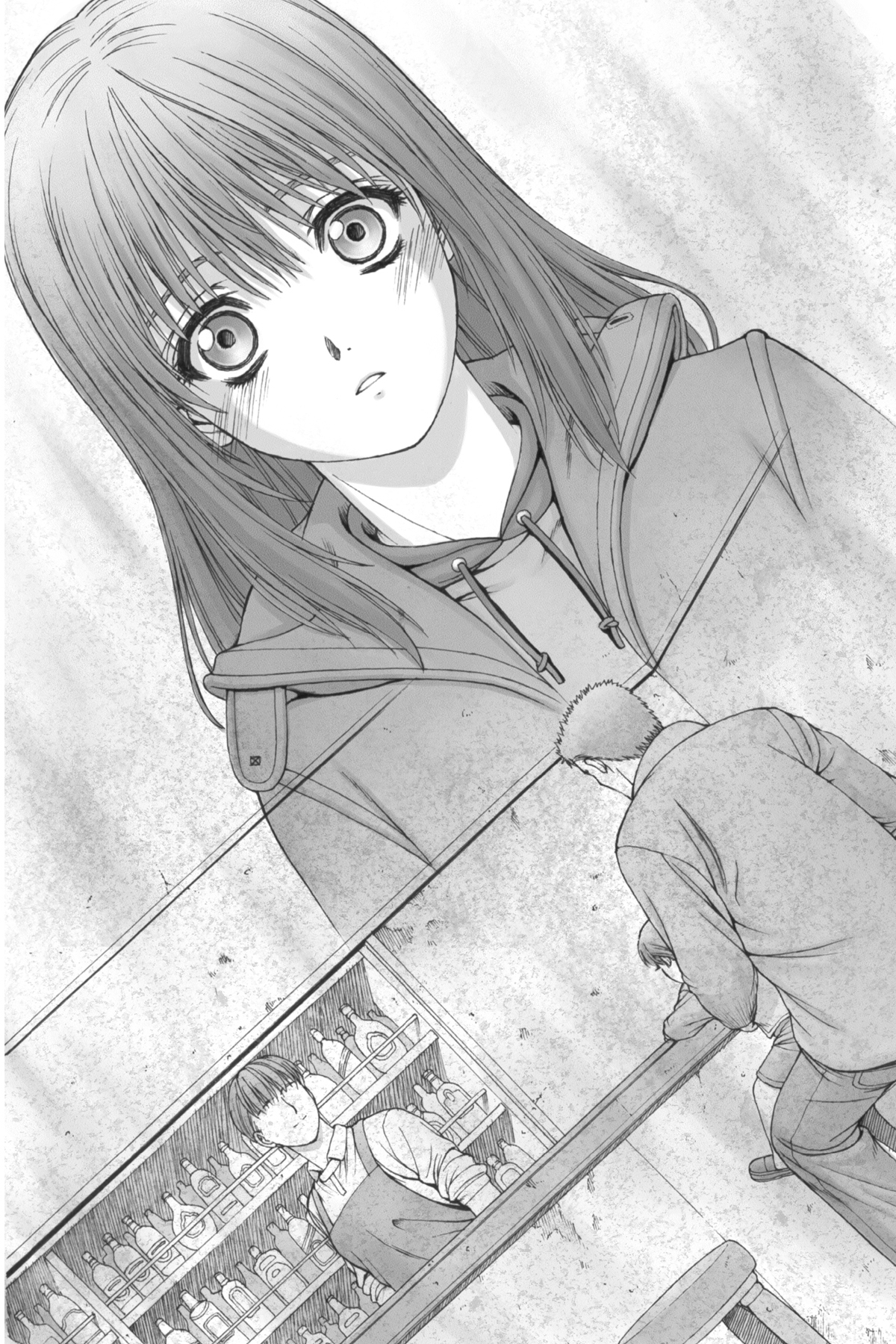
Kieli turned to the man at her side. “You and all these other people…” She hesitated a little, and then finished the question. “How did you die?”

About eighty years ago after the War, when the Church embarked on its campaign of “relief for our impoverished society” and took over the whole planet, acting like rulers as if it were only natural, several forms of music were banned. The variety called “rock,” with its lyrics that were vulgar, violent, and impious by Church standards and its venal, noisy twang built around four- and six-stringed instruments and drums, was one of them.
From the Church’s point of view, a live music bar where that barbaric music was openly performed was like a guerrilla radio station: a gathering place for heretics who might well plan acts of violence. So naturally as soon as such a place was discovered, Church Soldiers would rush there and thoroughly stamp it out.
It was fifteen years ago now that they had invaded this place.
“The raid was so merciless and thorough it was almost unbelievable. They must’ve made an example of us to the other bars. They didn’t just arrest the employees and the band; they rounded up all of the regular customers, too, and anyone who resisted was killed on the spot.”
It was late that night at the Adolph Sax, and the house lights had been turned off. Under the yellowish bar lights that just barely illuminated the counter area, the bartender in the black vest quietly told the story as he polished glasses.
Beatrix murmured a listless sound in response to this reminiscing, watching the thin trail of smoke from the end of her cigarette and leaning on the counter with her chin propped on one hand.
She’d arrived at the bar a bit before closing, but the secret late-night concert had started while she was still trying to think of what to say to Kieli, so she’d stayed leaning against the entranceway listening to the band. It wasn’t a type of music she particularly liked, but it had a nostalgic air to it somehow.
By the time the concert had ended at well past midnight and the audience had vanished one by one, returning the place to the deserted quiet of reality, the only humans left in the bar were the bartender, one dead-drunk patron, and a girl sleeping in the corner.
“In the confusion of the raid, we pushed Setsuri and Kieli onto Jude and made him get them out of here. They were our first priority. Jude was hard to convince, but Kieli was so small; someone had to make sure she escaped safely, and besides, if he were arrested and they found out who he was, this would turn into more than just a raid on an illegal music house. We’d be charged with a serious crime, harboring an Undying, and everyone would get killed, even those who otherwise could’ve lived. The bartender convinced him—half threatened him, really—by telling him ‘There are plenty of people here who have no idea about you. Do you want to get them mixed up in this, too?’”
Every so often in his story, the bartender used the word “bartender” referring to someone else. The bartender of this place at the time had been executed along with the bandleader and a few others as the principal offenders. This man running the place now had been one of the band members, and according to him, he’d been released a few years after the incident, come back to the then-deserted building, and quietly opened a new bar under a new name. “See, I was at the bottom of the food chain, just filling in for somebody,” he explained self-deprecatingly, “so they didn’t prosecute me as a principal offender.” His wry smile was somehow wistful, as if he would rather have been executed along with them.
“A little while after I opened up shop, I started to sense people’s presences here after closing time. It got livelier as the days went by, and eventually I started hearing familiar music, and I realized my friends had come back. Maybe this is why I survived. To create a place where my friends could live it up again.”
“You’ve got some spiritual sensitivity, huh, Chief?”
The bartender nodded with lowered eyes. “Only a little, though.”
Moving her cigarette up and down with her lips, Beatrix studied his face interestedly. It wasn’t as if Kieli was the only person with strong spiritual sensitivity that she’d ever met, but it was certainly rare.
“From what I understand, Setsuri had some, too. It showed up even stronger in her daughter, and apparently that’s why she took Kieli and left home. She didn’t tell us who she was or where she was from, though, so I don’t know the details.”
“So we still don’t know anything about the dad, huh…,” Beatrix muttered to herself. She racked her brains trying to come up with an idea. A woman named Setsuri from God only knew where had rolled into this bar with a little kid in tow and started working here, had met a regular customer named Jude (whom the bartender said had also appeared out of nowhere, and was helping out the town’s firefighters), had run away when the Church Soldiers raided the place, and had never been heard from again. Putting that together with what she’d heard from Ephraim about the events on the Sand Ocean, she imagined they’d probably failed in their attempt to escape directly to Westerbury, and were trying to sneak into that city by taking a detour and going from the far-east port through Easterbury.
At any rate, it was clear now that Jude wasn’t Kieli’s father. Beatrix and Ephraim had both figured he probably wasn’t when they’d had their conversation about it. According to Ephraim, that one-hundred-percent ascetic, super-straitlaced man wasn’t fool enough to forget the position he was in and irresponsibly father some child. (When she’d half-teasingly replied that he was a fool, so he might be capable of it, he’d regarded her with a meek look that might have been a joke or might have been serious. What a total idiot.)
So who the hell was Kieli’s father?
At this point, a part of her felt as if that might not really matter anymore. The girl must have more important things to her right now than her origins or her past.
When she removed her chin from her hand and turned her head to survey the room, the blind stinking drunk patron was drooling all over his corner table in his sleep. Beatrix wondered how long he’d been there. Ignoring him, she shifted her gaze to the depths of the room.
A single light remained on in the darkness, illuminating the deserted stage and the profile of the girl breathing softly in her sleep in front of it, cheek pressed to the table. The stage was buried in dust and showed no sign of having been used in recent memory. There was also no trace of the applauding audience that had filled the room only a short time ago.
In place of the band’s live music, the radio on the table enveloped the girl’s immediate vicinity with the faint, staticky sounds of stringed instruments.
A sigh escaped Beatrix. Sheesh, now what?
She’d thought that if they came to this town, maybe they could get a line on Ephraim’s whereabouts. Then she could show Kieli the memo, explain the circumstances, and make her decide on their next course of action. But now…
The only information she could claim to have found out was the worst possible kind: the news that he might be dead.
Beatrix was starting to get seriously pissed off, somehow. When you really thought about it, why should she have to strain her nerves so much over Kieli and that idiot? Whether he was alive or dead, it was a sure bet that it had never occurred to a single neuron in his tiny little brain how much she was fretting.
She turned back to the counter and abruptly said, “Give me a drink, Chief. Something really strong.” The bartender, polishing his glasses as always, gave her an annoyed frown.
“We closed a long time ago.”
“Come on, don’t be such a square. Booze!” She screwed the butt of her cigarette into the ashtray, grumbling about her misfortunes. As soon as the glass of amber liquid was placed in front of her, she grabbed it and tossed it down straight.
“Hey, take the time to actually savor that stuff; it’s expensive!” the bartender grumbled with a sigh, still holding the ice he’d had no time to put in her glass.

He showed his face to the guard outside the detention center and was waved through the gate. “Master Julius,” said the warden of the solitary confinement unit, who had come to the entrance to greet him as he came inside.
He gave a brief grunt in reply and followed the warden down the hallway lined with iron-barred communal cells. Hearing the two sets of footsteps echoing eerily off the bleak concrete walls and ceiling, a few of the prisoners lying lifelessly in the corners of the cells turned annoyed stares at them, but before long they looked away as if it was all just too much work, and flipped over to face the walls.
Glancing out of the corner of his eye at their display of slovenliness—these prisoners almost seemed to suck the will to live out of him as well—Julius wrinkled his face at the smell of rust and filth permeating the building. No matter how many times he visited this place, he couldn’t get used to the stench. Not that it mattered, since it certainly wasn’t something he wanted to get used to.
“Still, you didn’t have to take the trouble to come here all the way from the capital…”
“It’s fine; school just let out for the post-finals vacation. You say he can talk now?”
“Yes, for what it’s worth.”
They left the communal cell area, passed through a bolted door with a grated window on the other side of the hallway, went down a steep, narrow staircase, and came out into the area where the solitary cells stood with their iron doors with the tiny barred windows. Because not as many of them were occupied, meaning fewer people, the stink of filth was less oppressive, and Julius breathed a sigh of relief. However, the smell of rust was horribly accentuated here. The cold damp that soaked through the walls and flooring clung to his skin, and he turned up the collar of the greatcoat he wore over his priest’s clothing.
The warden stopped in front of one particular cell at the most remote end of the hallway, checking its interior through the little window before turning back to him. “He can speak, but I don’t know if you’ll be able to get an actual conversation out of him.”
“That’s fine. I’ll try talking to him. Open up.”
“But wouldn’t that be dangerous?” the man asked timidly.
Julius frowned and turned to look at him. “Can he move that much already?”
“Well, no, I don’t think he can move yet…,” said the warden evasively, seemingly trying to judge Julius’s mood before continuing. Then he stated the obvious. “But you know, he is an Undying.”
“So?”
“You never know when he might go berserk and try to bite you.”
Julius was silent. Does he think Undyings are a kind of wild animal or something?
Maybe the warden noticed his mounting irritation, because he began mumbling excuses under his breath and grabbed the bunch of keys hanging at his hip, applying them to each of the keyholes in turn. The door had been carefully supplied with a full four locks. Finally he removed the bar and pushed the door open with a rusty creak. Obviously getting cold feet, he only let it crack open just wide enough for a person to slip through. “Um, if something happens, I don’t want to be held resp—”
“I know. I’ll talk to him alone. Close the door once I’m inside.”
“Right…” With this halfhearted answer, the warden stepped back a few paces and cleared his way to the door. The very instant Julius walked past him and set foot in the cell, he heard the door shut behind him with a heavy sound, and then heard the bar being pushed firmly in place. You sure closed that faster than you opened it, he thought contemptuously.
A single bare bulb hung from the low ceiling, illuminating the cell with a rusty glow. The room was small. You could walk across it with five steps. Since Julius had already walked one of those five, he was now less than three steps away from the form lying curled in a ball in one corner of the cell.
“Hey. You alive?” he asked, and then waited a bit. After a few seconds, the form twitched in response, lifting his cheek from the floor and looking up at Julius, but then his eye closed again as if uninterested.
Julius sighed and gave up on conversation for the time being. He observed the prisoner from his three-step distance.
Apparently the man had not yet recovered his energy, and he looked horribly weak. But other than the giant patch of gauze covering his right cheek and eye, his major external injuries had mostly disappeared; for lack of a better way of expressing it, he finally looked as though he wasn’t dead.
When Julius had visited the previous month, the majority of his face was still unbearable to look at, covered with such gruesome wounds he looked as if he had been run over by a train. He hadn’t even been able to move his mouth, though, since his throat had been crushed as well, Julius doubted he would’ve been able to speak anyway. Even so, the man seemed to be conscious and had glared at Julius sharply with his single copper-colored eye on each of his roughly monthly visits, so Julius was fairly certain his prisoner at least recognized him. Undying though he might be, apparently his prosthetic right arm wouldn’t heal on its own—when you thought about it, it was only obvious—so a useless, tangled mass of warped metal frame and cables dangled lifelessly from his upper arm onto the floor.
Julius remembered when he’d first collected the man last winter. True, over a year had passed, but that day he’d been barely breathing, and now he’d healed this far without any treatment at all. Seeing the reality of an Undying before his very eyes like this, he felt a fresh sense of horror.
…But at the same time, he also thought it maybe made the man more pitiful to watch than a normal human. A normal person would die from those wounds and that would be the end of it, but he was never carried off to his heavenly peace; his body knit itself back together little by little as he lay in utter, excruciating pain. That’s what it looked like to Julius.
“…What do you…want…?”
Maybe the man sensed Julius staring down fixedly at him and grew uncomfortable; he actually spoke up with an annoyed frown. His voice was still horribly scratchy and his speech was garbled, but still, this was the first time Julius had heard him speak since finding him. “Why did you sneak into the capital?” Julius demanded.
The man completely ignored him. It had actually looked as if they’d successfully have a conversation, but now silence descended on the room again. Left with no choice, Julius softened his tone somewhat and switched his line of questioning to something more personal. And after all, this was what he’d most wanted to ask about anyway. “Did you come to the capital alone? Where’s Kieli?”
After another period of blankness that was less as though Harvey was ignoring him and more as though he’d frozen up, the moody, grouchy answer came. “…I don’t need to tell you.”
“Hey.” Julius sighed briefly. “I saved your life, you know. If it hadn’t been for me, you’d definitely be dead right now.”
“You should’ve butted out. Damn brat.”
“I’m not a brat anymore.”
“Brat,” repeated Harvey with a cluck of his tongue, and Julius fell silent with a feeling of half exasperation and half discontent. Your attitude is way brattier than mine.
It had been almost two years now since the winter he’d met the two of them on the Sand Ocean ship. He’d looked much younger than his age at the time, and in truth he might’ve been a little immature, but he’d learned a lot since then, and gotten taller, too. Lately he’d even started martial arts training out of personal interest in addition to his studies at seminary and his job.
Julius remembered having to crane his neck quite a bit to look up at this man, but now he was the one looking down at Harvey. Sure, it was because the man was lying on the floor, and it seemed as if there was still a decent difference in their heights, but in a few years his height and age would catch up for real. Kieli wouldn’t treat him like a child anymore, either.
“What’s Kieli up to? Is she doing okay? She doesn’t know you’re here, right?”
“…Shut up. Why should you care?”
Managing to control his irritation at this characteristically harsh response, Julius doggedly countered, “No, I mean, isn’t she worried about you?” He didn’t know how this guy had wound up coming to the capital alone, or where Kieli was and what she was doing, but at the very least, Harvey wouldn’t have been able to contact her for the more than six months since Julius had picked him up. “Don’t you want to see her, too? If you know where she is, I can contact her—”
“I said shut up.”
When Julius clammed up after his attempt to pursue his questioning was thus completely shut down, the other man’s cheek remained slightly raised from the floor, and his left eye cracked open. The copper orb, whose color in a way reminded him of rusty-red blood, glared sharply up at him. “Just try saying another word about her. I’ll kill you.”
Harvey’s voice was lowered in tone, and Julius actually heard a threatening growl behind it. He reflexively gulped in surprise. You never know when he might try to bite you. The warden’s words, which he’d swept aside minutes ago, abruptly sprang up in his mind with a new immediacy; he had the illusion that the three-step distance had suddenly shrunk until they were nose to nose.
But the murderous rage that had swelled up from Harvey in that moment was quickly swept away by a lazy weariness, and he spat in his usual tones, “Go home. I’m tired.” Then he laid his cheek back down on the floor and closed his eye again. It looked as if speech was using up the last reserves of his strength.
Surreptitiously letting out the breath he didn’t realize he’d been holding, Julius answered with forced calm, “Okay. I’m in town all this week, so I’ll come again.” Then he turned on his heel. When he signaled through the tiny window, the warden released the bar and opened the door.
“Are you all right?” whispered the warden in his ear.
“Why shouldn’t I be?” he bit back crossly. It wasn’t until after the words left his mouth that he realized his expression had frozen in place.
When he moved to step through the door, feeling bitterly frustrated somehow, a voice called out behind him. “Julius.” He turned, internally somewhat afraid. The owner of the voice was still lying in the corner of the dim cell like a rag doll; he parted his thin lips a fraction and started to say something, but in the end all that came out was, “Never mind. I’m tired. Next time.” Then he broke off and lay still as a corpse.
Next time. Maybe Harvey wasn’t particularly rejecting the idea that he’d come again? Bewildered, he nodded with a short “Sure” and left the cell.
Come to think of it, he had a feeling that might have been the first time the man had actually called him by his name.

She found a mop and bucket in the locker in the corner of the room. She put all the chairs in the bar up on the tables and mopped every centimeter of the floor. Then she took the chairs back down, thoroughly polishing each one as she went. Next, she tidied up as much as seemed appropriate all the parts of the counter and kitchen she figured it was okay for her to touch, and polished the sink. She’d been at this since first thing in the morning, so even with all of that work, when she was finished there was still a fair amount of time before the bar opened for business in the evening.
“You’re going overboard,” said the radio in exasperation from its place at the end of the counter.
“But I’m bored.” Her eyes roamed the bar, and settled on the stage; she began to clean it. It wasn’t that she particularly liked cleaning, but once she got started she was always compelled to do a thorough job of it.
The stage looked as if it hadn’t been used in years. Both the floor and the sound equipment were covered with dust, and it was pretty satisfying to clean them off. As she wrung out a washcloth over the bucket, sweating even though it was deep into autumn now, she felt someone’s presence behind her.
She turned around, crouched over the bucket, and saw the black-vested bartender standing at the bottom of the stairs to the second floor and gaping at her.
Kieli shot to her feet with a gasp, unthinkingly shifting the washcloth behind her back. “I’m sorry for doing this without asking. I mean, I owe you so much…”
“No, no, that’s not it,” said the bartender quickly. He seemed just as flustered as she was. Passing his eyes over the bar that was now sparkling clean (if she did say so herself), he walked up to her. “You didn’t have to do this. Thanks.”
“It’s no problem. I worked in a place like this once, and so I guess I just got fired up.”
As she’d cleaned, she’d been thinking back with fondness to the month she’d worked at Buzz & Suzie’s Café in West South-hairo. And even while she and Beatrix had been drifting around East South-hairo, Beatrix had always pulled her “capricious woman” act, coming and going with no warning, telling her to earn her own keep; it made paying rent on an apartment seem like a waste, so for a period of time Kieli had worked in a restaurant that gave her room and board.
It was the third day since she’d first visited this live music bar on the parish border. She hadn’t had the time for a proper talk with Beatrix, who kept wandering out into the city, and she didn’t know what they were doing next, so without really planning it Kieli had ended up sleeping in a bedroom on the second floor above the shop. She’d wanted to help out with the bar in return for the free room, but frankly it was practically out of business, and with so few customers there wasn’t much she could help with during open hours. So today she’d decided to use the time before opening to clean the place up.
“I’m almost done,” she said. As she picked up the bucket, thinking she’d change the water before continuing, a single drop of water splashed down in front of the bartender’s shoe. She looked down in surprise at the tiny stain on the floor, and then lifted her head.
“It’s nothing,” he said, covering his surprised face with one hand and wiping away the tear track there with his palm. “It just felt like Setsuri had come back. Lots of times she’d be cleaning like that when I came here early for practice…I’m sorry, I’m being childish.”
“No, I don’t think you’re childish at all…” Kieli couldn’t think of anything else to say; she ducked her head down, bucket still hanging from both hands. An uncomfortable silence fell on the desolate bar as the two of them stood there all alone.
The bartender coughed as if to cover up the awkwardness, and opened his mouth again. “If you want to, you can stay here forever.”
“Um…” Kieli was silent a few more moments, searching for the right way to answer. “…I’m sorry.” She bowed, bucket bobbing with her. “I can’t stay forever. I’m thinking of going to look for someone.”
“Oh, right, the redhead—” The bartender broke off his automatic answer at almost the same moment as Kieli’s head jerked up to stare at him. Water splashed out of the bucket and soaked her feet.
“Redhead…? Wait, do you know Harvey?!” The sound of her voice shaping that name was horribly rare and strange to her own ears somehow, and it felt unnatural on her lips. It was a name she’d automatically avoided saying or even thinking about up until now.
Swallowing once, in a dry voice she said it again. “Did Harvey come here?”
“Well, I didn’t catch his name. And I promised not to say anything…” The bartender mumbled this last sentence with a stricken look on his face.
Nobody told me anything about this! Kieli thought, gazing at him flabbergasted. “Who did you promise not to say anything?!”
On top of the counter, the radio let out a strangled groan whose meaning she couldn’t decipher.
Beatrix visited the tobacco stand three days later as promised and received the name and address of the cleaner who was supposed to have seen Ephraim in Gate Town, but as she pushed open the door of the Adolph Sax, she still couldn’t decide what to do next.
She thought it was about time for the sun to set and business to start up, but of course this bar didn’t have the kind of praiseworthy regular customers that showed up right away at opening time. When she walked unceremoniously into the hall, the black-haired girl at the counter turned to look at her.
“Welcome back, Beatrix.”
“Uh, right…” Much as she hated to admit it, her answer was exactly the kind of unsatisfactory one Ephraim might give. Behind the counter the bartender’s face twitched oddly, and the radio spewed a burst of obnoxious static in her direction for some reason. Kieli turned around her entire bar stool in order to face Beatrix.
“Did you find out anything about where Harvey went?”
She said it in such an ordinary voice that Beatrix responded without thinking. “Well, I do have a sort of clue, for what it’s worth…” she answered, making a face and playing with her hair. Then her heart did a somersault in her chest. She immediately tried to talk her way out of it, but she completely failed, and wound up incoherent. “I mean—wait—wh-wh-what do you mean?”
Kieli looked calmly up at her through her eyelashes. When Beatrix cast her eyes around the room for help, the bartender behind the counter twitched his face apologetically at her, and the radio spouted static that seemed to say Crap, that’s done it. She squeaked, opening and closing her mouth silently a few times before releasing a long, groaning sigh and hanging her head in defeat.
“What’s this all about? Were you in contact with Harvey without telling me?” Kieli’s quiet but relentless voice hit the top of her bowed head like an arrow. Beatrix shot a glance up and saw the girl sitting straight up on her barstool, hands on her knees, eyes glued straight on Beatrix’s face.
It felt as if the girl had gotten the drop on her, and she lost the energy to bull her way through it. Letting her shoulders drop, she answered.
“It wasn’t what you’d call ‘being in contact’…”
“Is it true you got a letter?”
Beatrix glared at the radio out of the corner of her eye. You told her that, too, you old fool?! But at Kieli’s urgent “Beatrix,” she snapped her eyes back to the girl, sighed in defeat, and reached a hand into the inner pocket of her trench coat.
She practically shoved the beat-up envelope at Kieli. Kieli stood up from her stool to take it, and after flipping it over to examine both sides, she opened it and drew out that memo that might as well have been the dictionary definition of “curt.”
“Er, so you see, when I said I had an informant who’d dug up a lead on your mother, that informant was Ephraim. But he dropped off the face of the planet after that, and I don’t even know whether he’s alive or dead, and that letter is just awful, you know? So I couldn’t tell you. So in other words, it’s all his fault. Right. Yes…” The memo was short enough to read in less than a second, but Kieli was just staring at it unmoving, so Beatrix began nervously rattling off excuses. However, doing that didn’t help her nervousness in the slightest, so in the end she tapered off awkwardly.
Still staring at the letter in her hand, Kieli quietly opened her mouth. “You knew too, didn’t you, Corporal? You teamed up to keep it from me.”
“Uh, um, it wasn’t that we were KEEPING it from you,” acknowledged her accomplice feebly.
Kieli merely said “Hmm,” and raised her gaze to Beatrix again. “And? Where is Harvey now?”
“That’s what I’m telling you: I don’t know…”
“You just said you found a clue.”
She gulped and slid her gaze to the radio, but no help seemed forthcoming from that quarter.
“Beatrix,” Kieli prompted again.
“…Oh, for goodness’ sake.” Evading the issue was becoming a pain anyway. Beatrix decided on total surrender. “Okay, fine. I’ll tell you. That’s what you want, right?” But as soon as she’d made this decision, she suddenly started to feel defiant; when she considered that the whole reason she’d never said anything before was out of consideration for this troublesome girl and that insensitive man, it seemed unfair that she should be criticized. Illogically angry, she puffed out her chest and put her hands on her hips as she said, “You’re the one who wanted to know, so don’t blame me. Listen up, then: the ‘clue’ is that he might be dead.”
Kieli listened without a single change of expression, eyes angled downward, as she went on to report everything she’d learned from the information peddler at the tobacco stand: about the supposed disturbance at the secret facility at the capital, the cleaner who’d witnessed him in Gate Town, everything.
Beatrix concluded by explaining that the information might be false, of course, but if he really had been taken away by Church Soldiers, there wasn’t much chance he was still alive, twisting her lips in a frown and thinking for no reason she could clearly explain, There, did that teach you a lesson?
There was a silent pause. She was inwardly anxious as she waited for the girl’s response.
When it eventually came, it wasn’t tears or anger; Kieli merely murmured in a flat voice so expressionless it was actively scary, “I see. So I’m the only one who didn’t know those important things all this time.” Then a customer saved the day, choosing that moment to come into the normally deserted bar, and so the conversation was set aside unfinished, abandoned until the following morning.
The issue was nowhere close to being resolved, but Beatrix was relieved they’d been able to let the matter drop for the moment…
“She got us,” Beatrix muttered blankly.
It was the next morning. She was standing in the doorway of Kieli’s now-empty room.
This bedroom in a corner of the bar’s second floor had apparently once belonged to Setsuri and her little daughter, and that grown-up daughter had been sleeping here up until last night, but now there was no sign of her. Her luggage had all been cleaned away as well, and her bag and coat were gone. The only thing left was the battered little radio sitting on the bed made neatly as if in thanks for the hospitality.
When she ran up to the bed and seized the radio, Beatrix found its power off. She violently switched it on. “Hey!”
“Hey, Kieli, wait!”
“She’s long gone!”
“What?!”
They simultaneously let out little squawks, wordlessly traded glares for a while, then calmed down somewhat and resumed the conversation.
“What’s going on? When did she leave?”
“She was sleeping like normal. Just like normal! Then all of a sudden she shot out of bed real early in the morning and started packing her bags, so I tried to stop her, and then just like that she turned me off!”
“Damn it, she looked like she’d sort of accepted it, but that was just a feint?! How dare she—”
When she grabbed the radio’s cord and dived out into the hallway, the bartender was just coming out the door kitty-corner to Kieli’s room, still in his nightclothes. His job must have turned him nocturnal; he stared at them with sleep-hazed eyes and muttered something like What the hell is this racket so early in the morning, and half-filled with misplaced rage, Beatrix grabbed him by the collar and yanked him to her.
“What time is the train to Gate Town?! Can we still make it?!”

Whoo! Whoo-oo-oo—The whistle of the train about to depart had been sounding for some time, but now it cut off with a halfhearted echo, and the bustle of the passengers became oddly tentative, too, for some reason. A strange quiet briefly enveloped the platform.
“Wait! I’m getting on!” Kieli dashed up the step into the vestibule just as the railroad employee who’d been looking up and down the train to make sure everything was in order was about to give the sign that they were clear for departure. She dived into the passenger car through the connecting door.
The passengers in their seats all looked at her oddly as she leaned on the door panting for air, so she quickly found an empty seat and slid into it. When she’d seated herself and placed her sports bag next to her, there was a clattering vibration as if the train had caught on something, and the scenery out the window began to slide slowly by. While she took soft, deep breaths and tried to catch her breath, she watched the platform disappearing from view.
Unbidden, words sprang into her head. I’m sorry, Mom…
This was the town she’d lived in as a very small child with her mom. She was sure it was filled with memories of the two of them together—Setsuri and Jude, the man she had wanted to protect even if it meant making enemies of the whole rest of the world. The bartender had been kind enough to tell Kieli he wanted her to stay forever, but right now there was something else she absolutely had to do.
She had been hesitating, but the words of that station manager she’d met in the ruined station had given her the push she needed. Then you can just go look for him. Waiting here isn’t the only thing you can do.
What had she been waiting for all this time? She should have gone looking for him right away, and not decided to wait. No matter what, she would find him, and meet him, and see his face—
—And tell him off.
Kieli took her right hand out of her pocket together with the objects it clutched, opening her fist. A cheap lighter and a crumpled envelope. She gripped the lighter and took a memo, also crumpled, out of the envelope.
The prose was dry as dust, and the handwriting was crude in a way that went beyond the simple issue of skill or lack thereof; she imagined this message that so failed to meet even the most minimal requirements of real communication had been jotted quickly with his left hand. She couldn’t recall ever seeing him writing anything except for signing his name at the various inns they’d stayed at, plus the time Kieli had written the introduction to her Church history report on a momentary whim and he’d made unsolicited spelling corrections (and yet, she would like to point out, he’d completely forgotten how to write several easy words). Still, the handwriting of this letter definitely matched the handwriting in her memory.
As she gazed at it, anger welled up from deep inside her.
What the heck did he mean by just scribbling down his business and nothing else? He could’ve at least added one more sentence. One more sentence about anything.
He’d left without saying a thing, and sent her no word for a year and a half, and what had he been doing while she’d been wondering whether he meant to stay away forever? Investigating her mother! How could he be considerate enough to do a thing like that without her even asking, and yet not give a single thought to how she must feel waiting for him? On some fundamental level, the man was a born airhead. I swear, I’m going to tell him off so bad…
You’d better say your prayers, she vowed silently, and clenched the lighter and memo in both hands. Closing her eyes, she pressed her forehead firmly to her clasped hands as if in prayer. I’m going to tell you off. I’m going to tell you off, so…
“You have to be alive…”
There was nobody there to respond to her whisper. She’d left the radio that had been her constant and unfailing companion on her travels back at the bar. The rhythmic vibrations coming from below her seat and the subdued conversations of the other passengers shrouded the four-person box where she sat alone in a sort of only-faintly-real static cloud.
I’ve never traveled alone before…
Carrying solitude and unease and restlessness and a faint, precarious hope, the train sped due north to Gate Town, the gateway to the capital.