Chapter 2: As the Toy Soldier Weeps
The young arms clutching the doll were nothing but skin and bones, and the skin was yellowing with jaundice. The air around them was thick with the stench of bile and shit. “Captain, we’re the only survivors…from our unit now…Our food and water supplies…are exhausted…” The scratchy voice mumbling to the doll carried feebly to his ears along the yellow sand piled on the ground. The captain being addressed was a tin soldier in uniform.
The monologue abruptly ceased, and hollow eyes rolled slowly up to meet his.
“Do you have any water?” The child lifted one hand a little from the ground and reached weakly toward him. He didn’t think the kid could have been even ten years old yet, but those eyes were the cloudy yellow of an old man’s.
He thought for a moment, then drew a metal flask out of his practically empty backpack. He started to toss it over before realizing that the kid probably didn’t even have the strength left to open the lid. So instead he opened the lid himself and pressed it into the child’s hand. Giving the water felt kind of hypocritical, considering it would probably only buy the kid a few more hours of life. But when the boy’s tiny hands brought the flask up to his face, and he put his mouth to it and drank in audible gulps, he looked as if he were savoring a small taste of happiness. Water spilled over, dribbling over his cracked lips and down his cheeks to form a dark gray patch on the parched ground. The thirsty ground seemed almost like a part of the thirsty boy.
When he took his mouth away from the flask, his speaking voice was closer to normal, as if he’d come back to himself.
“You’re not one of the charity people, huh?…I mean, even they don’t come here anymore. If you stay here you’ll get infected and die. Didn’t you know that…?”
“I know,” he said, accepting the flask back and sitting down next to the kid. He leaned back against the crumbling wall of blocks. They were on a perfectly ordinary roadside on the edge of town. Still, when he looked at the cityscape he couldn’t sense any of the vitality of the people living their desperate lives there. A thick, putrid smell had settled onto the piles of sand and dust around them.
Looking without much thought at the corpses lying along the other side of the road, he brought the flask to his own lips. The kid squeaked in surprise. He drank from the same place the boy had, unconcerned. Now the boy was watching him with something like wonder, dull eyes open wide, but eventually he murmured, “You’re weird…” and let his cheek fall limply back to the ground again.
“Aren’t you scared to die? I am…Hey—I’m going to die soon, huh?”
False comfort wouldn’t do the kid any good, so he just nodded. “Yeah.”
“Huh. You don’t talk like the charity people.”
“……?” He shot the kid a questioning look. The kid turned back to the doll in the soldier’s uniform without raising his cheek from the ground. He began casually moving its tin arms around, speaking as if to the toy and not to him at all.
“They all say, ‘There’s nothing to be afraid of. God is calling you to be with him.’ But you know what? I think it’s a lie that God’s world is a world of happiness…I mean, it’s full of people who hurt real bad and died looking all nasty, right? Sick people, people who died in the War. That’s who lives there. Mom died of the sickness too, but I know even if I go to God’s place I won’t be able to find her. See, before she died she got so skinny, and she was such a funny color, you could hardly tell her apart from the others…That’s why I’m really scared to go someplace where everybody is like that…”
The words broke off for a moment, as if the boy was exhausted from all the talking, and he heaved a dispassionate, resigned sigh that didn’t suit his age at all. Then he finished in a voice that was almost a sigh itself:
“But I’ll be just the same as them soon…”
The wind blowing in from the city stirred up the yellow sand at his feet just slightly, leaving in its place a new rotten smell. He drank another sip of water to try to wash down the smell where it stuck in his throat. It tasted just like the air: yellow sand and rot.
“…Want me to tell you how to not die?” he whispered softly, casting a sidelong glance at the doll in the kid’s arms, and at the time, he didn’t feel particularly interested or think particularly deeply about it.
That was a long time ago now. Still, looking back on it, it wasn’t so long ago at all.

“Kieli, hurry up.”
The bell signaling the train’s departure echoed up and down the platform. People seeing their loved ones off and people who’d been reluctant to say good-bye all started picking up bags and hurrying them onto the train. Gazing out the window, he could see a girl running up from the direction of the station and dashing into the train car at the very end of the line of passengers. The clamor of the bell cut abruptly off, and after a beat the scenery out the window began sliding gently by, leaving the platform and the station behind.
Around the time they made it past the platform completely, the somewhat flushed girl entered the car through the connecting door.
“H-here are your cigarettes,” she said, panting. “These are the right kind, right?”
Harvey accepted the pack with a simple “Thanks.” He didn’t really think he’d ever explicitly told her his brand, but she’d gotten the exact one he always smoked.
“Sheesh, I can’t believe you didn’t notice you were out until the last minute! Next time buy them yourself.”
“Yeah, sor—”
“You just need to be thoughtful enough to buy him spare packs. Problem solved,” cut in the radio coldly before he could finish. Kieli made a miffed noise, glaring sidelong at it where it sat by the window and looking steadily more displeased. And then when she began to lower herself into her usual spot in their set of facing seats, the radio said in a scathing voice, “Know your place, girl. A servant never sits down without the master’s permission.”
“What?!”
“Okay, okay, you can sit down. Just sit down,” Harvey interceded tiredly. Kieli pulled a sour face and plopped down violently into her seat. As he was searching his pocket for something to light the freshly bought cigarette in his mouth, thinking things had finally quieted down, the radio burst out with another ridiculous criticism. “Hey, give him a light. Honestly, you’re completely thoughtless.”
“…Harveeyyyy, do something!” Kieli entreated, giving him a reproachful glare. Harvey couldn’t muster the will to keep playing peacekeeper, though. He looked away from her and lit his cigarette for himself. I’m not making him say that stuff, you know!
He leaned his head against the windowpane, sick of it all. When he gazed outside, relying on his good left eye, the crisscrossing rock ledges marking the fault line that cut through northwestern North-hairo towered in the distance.
They’d fixed their destination as the northwestern mining district that supplied the capital. This was the second day of their journey along the railroad stretching out of North-hairo to the west. The mining district they were heading for was on the other side of that fault line to the north, but coming from North-hairo the rock ledges were in the way, and they had to travel far west to get around them. There was actually a direct route there from the capital, but going through the capital was a no-go for obvious reasons, so their only option was to go the long way.
Harvey’d told his information broker to keep looking for clues about Beatrix before they left the border town, just in case, and given instructions to contact the bar if he found anything. Their departure had been pretty sudden, sure, but he’d been getting tired of staying in one place (and he wasn’t keen on getting in the way of any newlyweds, either), so he’d intended to leave anyway. This had actually been good timing, in a sense.
There was no guarantee that they’d be able to fix the radio in the northwestern mining district. He hadn’t decided on his next step after that yet, but he could figure it out a little at a time during the trip…
What was really pushing his limits right now was this situation.
“What’s the matter, Master? You keep sighing,” asked the radio, puzzled, after yet another smoke-filled sigh of displeasure. In stark contrast to the verbal abuse it heaped on Kieli, the radio addressed him with ridiculous politeness. Shuddering at the chill crawling up his spine, Harvey said, “Cut that out. The ‘Master’ thing.”
“What? But why?”
“Because I said so. Just call me by my name.”
“Your name…So, ‘Mr. Harvey’?”
Harvey swallowed his drag of smoke the wrong way and almost choked himself to death. Wait a second, you can say ‘vey’!
At first he’d thought its bad wiring had blocked off all access to its memories of the past—but thanks to God only knew what kind of memory mix-up, out of nowhere the partial-amnesiac radio had started treating him as its master. Considering that it meant he wouldn’t get nagged all the time, he initially thought this might not be so bad. That naive idea was gone in one minute flat. Getting chewed out would be a hundred times better than this disgusting feeling as if a pack of centipedes were crawling around in his stomach.
“Corporal, are you sure you’re not doing this on purpose?”
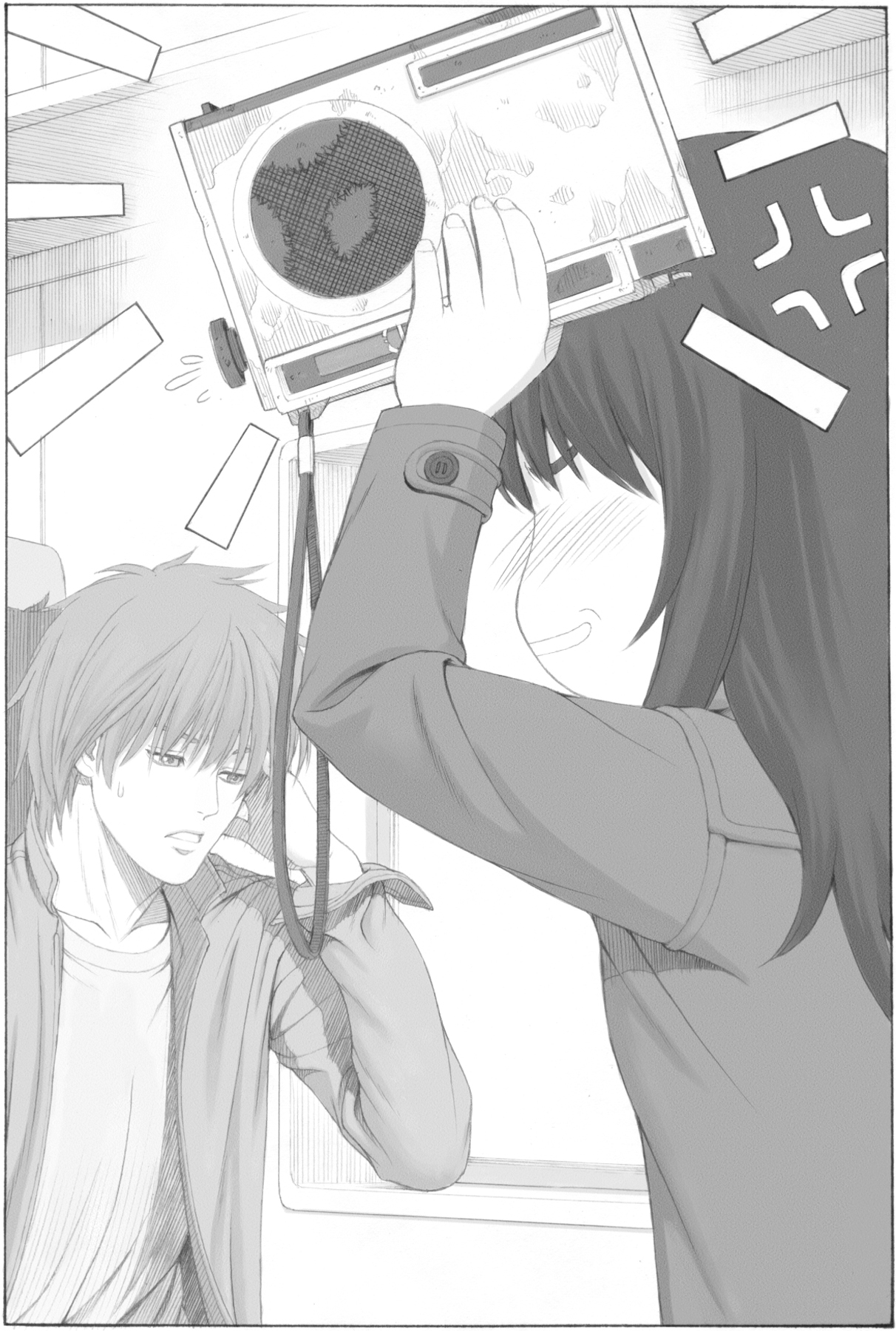
Right: meanwhile, Kieli was fed up for a very different reason. Glaring at the radio with an enormous scowl on her face, she added, “If you’re not, maybe another shock will bring you back to normal. Maybe I should try dropping you.” The dangerous look on her face as she grabbed it and lifted it overhead made Harvey think she might actually be serious. The radio screamed.
“Cut that out! Cut it out, you stupid girl!”
“What did you just call me?!”
“…Kieli. Cut it out. It’ll be hell if he gets any weirder,” Harvey intervened, simultaneous headache and chill and heart-burn making him listless. Kieli pouted and said “He started it!” before grudgingly putting down the radio.
Yes: as for how Kieli was being treated…the radio seemed to think she was some sort of handmaid. The radio’s normal attitudes toward Kieli and himself had flipped 180 degrees. Their loudly arguing voices pierced his temples, and he bent his head away from them, unthinkingly crushing the end of his cigarette between his teeth. Given the situation, you’d have thought the atmosphere on their journey would be more somber. What the hell was with this surprise turn for the ridiculous?
“Where did this whole ‘Harvey is our master’ thing come from, anyway?”
“Where did it come from? What, do you want to hear the story of how the master and I met? It’s a touching tale that leaves both the listener and the teller in tears, believe you me. It all started years ago, when a scoundrel of the blackest dye captured me and brought me to the gambling house to bet me on a card game. Now, during this game there were some accusations of cheating, and a brawl broke out. The man who lent me his aid in my hour of need was none other than our master.”
That never happened, Harvey mentally shot back, but he didn’t have the energy to say so out loud, so he pointedly ignored the whole thing. But then the next thing he heard was, “He made a dashing entrance, shot a card at the villain that lodged itself in the dead center of his forehead, and then—”
“Stop making up lies! I don’t have any embarrassing moves like that,” Harvey denied immediately. There was no way he was letting that go. He was pretty sure one of the radio plays the Corporal was so into—probably one of the hard-boiled private-eye ones—had gotten mixed up with the truth in the ghost’s mind. The part about how they’d first met at a gambling house was weirdly on target, so apparently he didn’t have complete amnesia; his mind was just scrambled to high hell because his wires were shot.
The radio yammered on at Kieli about his logic-leaping delusion. Glancing at it with his eyes at half-mast (there was so much wrong with their conversation that he didn’t even know where to begin anymore, so he just left them to it), Harvey abruptly realized something.
I get it…so that’s why I remembered that kid out of the blue after all this time. That was the town where I met the Corporal. Although “encountered” is probably more accurate than “met”…
It was a town completely saturated with the stench of death.
All the places to house the sick were full to capacity or beyond, and the dead had littered the roadsides like trash.

He didn’t remember exactly when he’d developed it, but at any rate, by that time he’d definitely been in the habit of visiting a gambling house when he was feeling down. Normally he hated noisy places. Mysteriously, though, he felt no aversion to the clamor of gambling houses. Maybe it was because the crowd noise and the low lighting hazed with tobacco smoke built a wall around him and concealed him more than they did anything else.
It figures I wouldn’t get infected…
Holding his cards in both hands, Harvey sighed dejectedly. The other men circling the table grinned at his expression. At the dealer’s signal, each player spread his hand out on the table. A “free city” flush, a bishop’s staff and cruiser full house, and four swords—as the men showed their cards, the various onlookers cried out in excitement or disappointment. The man with the four swords gave Harvey a demanding look. He was the only one left to show his cards.
“…Five judges,” he announced, setting them down. Four-swords Man immediately turned purple and started shouting, and before he knew it the others had joined in.
“Hey, what’s with that?!”
“What’s unfair about it?” Harvey asked calmly as he collected his winnings.
At that, his opponents all started bitching under their breaths, looking sour. “Don’t pull that gloomy face for no reason, dammit!” “God, I’m going home. Nothing left in my pockets tonight.” One by one, they got up from their seats. It wasn’t until then that Harvey even realized his expression had been that gloomy.
But I went all the way out to that “quarantine area” or whatever, and just look at me…
He watched the other men walking away from the table out of the corner of his eye, leaving him all alone to sulk as he stuffed his collection of banknotes into his pocket. He’d been playing without really thinking, and now he’d won a little too much and there was no one left to play with. Oh, well. He’d made enough cash to get him to the next town, and although he’d only just gotten to this one, he’d already finished his business here. Might as well just leave today.
Harvey’d half-stood up from his chair when something was plunked down on the table in front of him.
He blinked and looked down. It was a small, extremely shabby-looking radio with a round speaker—a short groan escaped Harvey’s mouth before he could think to stop it. He couldn’t tell exactly what it was at first glance, but there was a strange presence bound to that radio. Blinking one more time, he raised his eyes to see a thinnish man he didn’t recognize standing across the table from him with a stiff, fake smile on his face.
“Would you play a round with me? With this as the stakes.”
“Huh? I don’t want it,” said Harvey, eyebrows drawing together.
But the man stubbornly kept pushing: “Come on, please? I know it doesn’t look like much, but it’s antique. Worth more than you’d think. If you win it, you can just sell it off right away. I think you’ll get a pretty sweet price for it.”
It sounded to Harvey as though the game was just an excuse. Obviously what he wanted was to foist the radio off on him. He glared suspiciously. “…What is it you want?”
The man paled, looking frightened, and darted a glance at the radio. “Well, the truth is he asked me to do it. He said he wanted me to give it to you.”
He asked you to? “Who did?”
“Um, well…p-please! Please take it! Think of it as a favor to me!” he babbled rapidly, not even attempting a pretense about gambling or whatever anymore. Then he shoved the radio forcibly into Harvey’s hands and disappeared into the noisy crowd.
…What the hell was that all about?
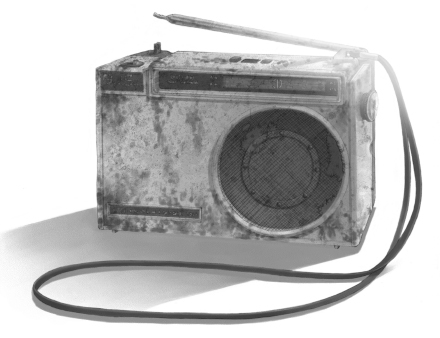
The man’s behavior had been blatantly suspicious, but it’d be a pain in the ass to chase him down and make him take the damn thing back. Harvey looked warily down at the radio that had been forced on him. It was old and very old-fashioned-looking; he could see signs that the round speaker had broken off and been reattached at least once. A leather strap was fastened to the right end of its rusty lead-gray body. It looked like the transistor kind, but most likely it wasn’t the same technology people used now. No sound was coming from it even though it was switched on, so maybe it was broken, but he’d definitely been right: he could feel some sort of presence from it. Memories? Lingering sentiments?…No, it’s something with a little stronger of a will. A ghost possessing the machinery? Can’t tell whether it’s dangerous or not, though…
Harvey hesitated a bit, but in the end he only sighed. Oh, well, whatever. He stood up from his chair, the radio dangling from one hand.
At the time, “danger” was a matter of indifference to him anyway.
There was known to be an epidemic in this town. An area on the outskirts of town had been designated as the quarantine area, and the sick as well as those suspected of infection were kept isolated there. There was an asylum, technically, but it was well past capacity; the patients stricken with high fever and jaundice overflowed into the streets, and most of them died in a few days without ever receiving any treatment.
Or at least, he’d heard that he could find such a place there, and so even though he hadn’t been actively wishing to get infected, a sort of vague interest in whether he would had made him visit…
But apparently he couldn’t die from infectious diseases.
He didn’t think he longed to die, exactly, but he found himself feeling pretty disappointed for someone who didn’t. Without realizing it, somewhere in the back of his mind he must have been looking for a way to die via convenient “force majeure.”
The main street that led to the train station had a decent amount of foot traffic, along with the attendant commotion. The quarantine area had been downright gruesome, but the urban area removed from it was operating more or less normally. Not prospering, no, but at least doing well enough for him to make his travel expenses at the gambling house.
A sudden thought made him stop on his way to the station and change direction, abandoning the main street for a back alley lined with comparatively sketchy-looking shops. It was too early for the sun to set, but there was no one out and about on this street. It was dotted here and there with open stores, but about half of the businesses had gone under, and their buildings had fallen into disrepair.
Harvey was just setting out in search of a secondhand shop where he could sell off the radio when he sensed someone behind him.
Using his peripheral vision to look around, he found a figure watching him from one street corner. Something that looked an awful lot like a military cap caught his eye. Even though he knew there wasn’t a single army left on the planet anymore, reflex set him on instant alert. But—
A kid?
No, the head was tiny; too small even for a child.
He wondered about it, but he didn’t change his pace. The presence behind him kept following him at the same pace as well, not too close and not too far away. And there was something else: a strange sound trailed behind Harvey’s follower. A sound like something dragging along the dusty pavement.
What to do?
Harvey pondered a little bit as he walked, and then abruptly changed directions to slip into a nearby alley. He ran straight through it at a sprint, came out into the street at the end, and promptly veered down a different alley. Down that alley by way of the fire escapes on an abandoned apartment building and out the other side—then around another random corner, and then one more again—and then he stopped in his tracks and leaned against the wall of the nearest building, watching the alley entrance he’d come through. There was no sign of anyone following him.
I guess they gave up?
That was good enough for him. He didn’t actually care why he was being tailed. As long as they were gone he saw no reason to put any further effort into it. Whatever’s going on here, it’s going to be a headache for someone. The best bet is to get out of town on the first train. He’d been planning to sell the radio, but it looked as though he’d just have to keep it until he got to the next town.
But just as he was about to start walking again, he heard a faint crackle of static from right nearby.
A short burst, then silence for a moment, and then a steady stream of it, accompanied by what sounded like some sort of rhythmic music. A little startled, Harvey lifted the radio dangling from his hand up to eye level. Sure enough, the choppy, static-filled sound of string instruments was coming from its round speaker. What surprised him, though, was that the radio could play at all, not the fact that it had started playing by itself.
The air around him swirled toward the radio and condensed, and in the very moment he sensed potential danger an invisible blade shot out of the speaker straight toward him.
He managed to jump back just in time to dodge the brunt of the surprise attack, but the chunk it tore out of his cheek as it flew by was no laughing matter. The blast of air crashed into the oil shop behind him hard enough to knock down the wall. Hunks of concrete and scraps of iron frame rained down on the narrow alleyway, blocking the entrance and his only escape route. Keeping his back to the wrecked wall, Harvey cursed under his breath and put some distance between himself and the radio before they squared off for their fight.
The radio had fallen near the alley entrance; now dark green particles of noise were swarming like flies in the air above it. Each little blip moved along its own orbit, painting a blurry, monochrome picture he could nonetheless recognize as a human form. It was a painfully thin man wearing what seemed to be a soldier’s uniform. While the rest of the noise-filled image just looked like a dark shadow, two points of sharp green light gleamed where the man’s eyes should have been beneath the brimmed cap pulled low over his forehead.
“That’s some way to greet a guy you’ve never met before,” Harvey said as he wiped his bloody cheek on his sleeve. If anything, he felt a little impressed. He got it now: when the terrified-looking guy at the gambling house said “he” had said to give the radio to Harvey, that “he” had been referring to the man himself. Harvey didn’t remember doing anything to make the soldier bear him a grudge, but the soldier obviously had some business with him. He must have just grabbed some random guy and threatened him to get him to fob off the radio on Harvey.
“‘Never met’?!” growled the soldier in a low, staticky voice—which came from the radio’s speaker in time with the movements of the noise-cloud’s mouth. They were the first words he’d spoken. Evidently Harvey was dealing with a ghost that was using the radio as a medium to anchor itself in the living world. In response to the growl, the hunks of concrete scattered around them began to shake, and then to rise off the ground as if pulled up by strings.
“Ah, so that’s how it is. Yeah, I guess that makes sense…Guess you’ve killed hundreds, maybe thousands of people in cold blood, after all. Guess you wouldn’t remember the face of every single foot soldier you wiped out. Me, on the other hand…” Static filled his voice until it was almost unintelligible, and the radio’s pitches started to warp in resonance with the rise and fall of his emotions. First they surged up high, and then they tumbled low again.
…Wait a second.
Harvey’s vision swam violently.
What’s he talking about? What’s he trying to say to—
“I’ve never forgotten your face for a single day!”
At the soldier’s roar, all the concrete pieces suspended in the air flew at him like an artillery barrage. He couldn’t even react. He took a direct hit, and slammed back against the rubble that used to be a wall with the concrete right on his heels. To top that off, the impact brought a shower of iron—the skeleton of the roof?—down on his head.
Harvey crawled out from under the rubble, coughing, but a chest-crushing pain shot through him and knocked him over. On the next cough he spit up a black glob of blood. He immediately shut out the pain, but until the wounded parts of his body started regenerating themselves, he wouldn’t be able to stand up. “What’s the matter, Undying? Don’t tell me peace has made you soft?” a scratchy voice jeered somewhere beyond the veil that seemed to lie over his senses. “So, with the War over you let yourself get cocky, and you’ve been living a nice comfortable life for the last eighty years, eh? Ha ha, must be nice to be you.” The little laugh was spat scornfully, and accompanied by another flying hunk of concrete that hit Harvey in the shoulder and knocked him over onto one side.
Did he just say that I…wiped him out…? Harvey wondered, cheek still glued to the ground.
A reel of all the images Harvey could remember began to unroll in the back of his mind, each scene flashing by fast enough to make him dizzy. With an abstractedness that was kind of odd, considering, he wondered which one this was. There’s the ones I shot to death, the ones whose throats I cut with sabers, and the ones I stabbed in the back with bayonet guns…and then there’s the ones we mowed down with armored trucks or whatever, and there’s no way I could remember their faces, plus I was never the one driving. Was the noise-cloud’s face really somewhere in there? He had the feeling none of them had been this soldier, but then again, now that he thought about it, he also got the feeling all of them had worn this soldier’s face. And the more he thought about that, the more the faces of all the ones he’d shot and the ones whose throats he’d cut and the ones he’d stabbed in the back really did all look the same in his memory.
When he blinked the past out of his eyes, he realized that at some point the rubble had stopped attacking him. Harvey had been letting his gaze roam vacantly along the ground; he lifted it a fraction to see the noise-cloud soldier floating above the radio giving him a look that made him almost expect to hear teeth grinding.
“Why aren’t you dodging?” he asked in a low, furious voice, as if it pissed him off that Harvey wasn’t putting up any resistance.
They glared at each other for several seconds in silence.
…And then for some reason Harvey found himself laughing. His own laughter struck him as even funnier, and then he couldn’t stop—he pressed his forehead into the pavement, shoulders heaving, and tried to bite back the guffaws, but they still vibrated in his throat.
He was in luck. He hadn’t managed to die from disease, but here was another chance, right here in the same town. Maybe it hadn’t been the epidemic that had made him wander this way. Maybe he’d really been drawn by this. Apparently his trip here hasn’t been wasted after all.
After the laughing spell passed, Harvey gave a drained sigh.
“Go ahead. I won’t dodge. Do it.”
Instantly, an aura of powerful malice swelled up around the radio. “Don’t you make a fool of me, you bastard!” The radio’s speaker had ballooned outward into a dome shape, and the high-powered shock wave shot toward him right along with the soldier’s roar. The warping of the air made the scene before Harvey’s eyes ripple like water. He didn’t think or feel anything in particular as he waited for the wave of air barreling toward him to hit.
“Hey, Mister,” he heard a voice say. A young child’s voice.
And then something very small popped out of the shadow cast by the mountain of debris. A tin doll in an army cap…a tin doll—
—gripping a child’s emaciated corpse by the hands and dragging it along the ground.
It approached Harvey casually, unguarded, and got blown away by the shock wave. It crashed into the rubble, corpse and all, with an incongruously mild cry of surprise.
After a brief, dumbfounded moment, Harvey tried to jump to his feet. “Wait—just wait a second—” He couldn’t quite stand up, though, so he crawled over to pile of rubble on all fours, intent on rescue—and then found himself momentarily confused about which one to rescue. Doll and corpse alike lay with their limbs splayed every which way, looking so literally like broken dolls he could hardly tell which one was the real doll anymore, but on second look the corpse’s skin had been torn to ribbons like an old rag by its trip along the pavement; if anything, it looked less human than the doll.
“Mister…Mister…”
At first Harvey couldn’t tell where the voice was coming from, but a tug on his arm made him look down. The tin soldier’s hand, not the kid’s, was gripping his sleeve. As the doll called mister in a somewhat clumsy child’s voice, its tiny hand tugged again and again at his sleeve.
“Look, I did just like you taught me, and it worked! I really didn’t die, just like you said. See, isn’t it great?” the uniform-clad doll with the grim expression said, laughing innocently.
Like I taught you…?
What did I—he only had to start the thought before he realized what he’d done.
That’s right; he had said that. He’d said, Want me to tell you how to not die? He hadn’t been serious, in particular. He’d just been talking; he’d never thought the kid could really do it, but he remembered saying it, then, to that child: All you have to do is possess something when you do die.
I wonder if I can do it right.
Beats me…It’d probably work better to use something you know really well. Like that doll.
That was all Harvey’d “taught” him; then he’d left the quarantine area without even sticking around for the kid’s last moments.
A “way to not die”? That wasn’t any way to not die. Your own tattered body is lying there right in front of you. Did the mind of the child, who’d walked here dragging his own corpse behind him like a substitute doll, just not grasp what was happening?
“Hey, Mister, will you take me with you? I told you my mom died of the sickness, right? So I don’t have anybody now. I’m glad I didn’t die, but I don’t have a home to go back to.” The doll’s hand on his sleeve yanked his shirt down with unnatural strength, strength he couldn’t have imagined from its small size. An innocent smile was plastered on its tin face, but something almost reproachful flickered in the wide toy eyes.
“You’re the one who taught me. It’s your responsibility. So you’ll take me with you, right…?”
Harvey could see the child’s face overlapping the doll’s. The child’s face in death, wasted away and jaundiced, both eyes fallen out. Harvey shuddered. Just as he tried to pull his hand free, a chunk of concrete hit the doll full in the face with a dull clunk.
“Huh?” said the doll, in a bizarrely cheerful voice for someone whose tin neck was snapping in half until its head hung upside down. Harvey thought he saw its eyeballs roll fully around.
“That hurt…” The doll began to cry, goggling upside down at him.
With a start, Harvey turned around to face the radio’s noise-cloud, careful to shield the doll. “No! Stop. Wait a second!”
“You’re saying that now?!” it raged. The shock waves kept coming, slamming into the wall until the entire thing collapsed and began to bury everything around it. His vision was cut off by rubble and dust, but he could hear the doll’s voice— no, the child’s?—no, the doll’s?—sobbing in his arms that it hurt.
“Sto—” Still ducking on the ground with his arms protectively encircling the two small bodies, doll’s and dead child’s, Harvey raised his voice and addressed the wall of rubble still crumbling over them. It was all he could think to do. “Stop, please! Please!”
He hadn’t screamed for all he was worth like this in a long time. He hadn’t pleaded with anyone like this ever, as far as he could remember. He couldn’t say himself why he was this desperate when it was meaningless to protect the already dead anyway. Was it his guilt for having told the kid something irresponsible? Maybe that was part of it, and maybe logic had nothing to do with it, really; probably he was just doing this because he saw a kid in front of him hurting and crying.
After a little while, he noticed that the shock waves and the rain of debris had stopped. The angry shouts and rumbling static he’d heard from across the debris were gone, too. It was eerily quiet, except for the occasional dry sound of shifting rubble around him.
Slowly, Harvey lifted his head. The pile of iron framing and concrete on his back slid off to either side of him.
“It hurts…it hurts…”
He looked down at the crying doll in his arms and started to lift it up—but its neck had wrenched right apart, and the second he moved it, its head rolled off and hit the ground. “It hurts…! Am I gonna die after all, Mister? I got out of dying before, and now I’m gonna die after all?” The half-crushed tin head looked up at him imploringly. Maybe the headless tin body still had some kind of power left; its arms reached un-steadily into the air and tried to grab at his clothes.
“Hey, are there any more ways not to die? You know another one, don’t you, Mister? I bet I can do it right again. Tell me…please tell me…”
Harvey swallowed, grinding his molars hard. He couldn’t even bring himself to grasp the small hands trying to cling to him.
After some hesitation, he said, “I’m sorry…”
That short apology was all that came to him. He couldn’t think of anything else. No soothing white lies, no excuses, no consolation; nothing.
“Aw, there’s nothing else?” murmured the doll, sounding disappointed. Its hands plopped back down to the ground as though they had no strength left. They sent up tiny, really tiny, little clouds of dust. Harvey couldn’t confirm it or deny it. He’d never known any ways to begin with. He’d rather the doll rail at him, ask Why did you lie to me like that in the first place?!, but it only gave a dispassionate, resigned, very un-doll-like sigh.
“Oh…I guess that’s that, then…But I’m really scared to go to God’s world…”
The scratchy voice faded steadily into air white with mineral dust.
After that the tin head just stared empty-eyed into the sky, and didn’t say anything else.
He dug a grave for the child and the doll in the quarantine area’s public graveyard. They called it a “graveyard,” but there were no neat lines of gravestones; it was only a place for crude, rough-and-ready interment of the epidemic’s many victims. Harvey buried the small body and the even smaller body together in one corner of it. There was no shovel or anything, so he used a random piece of broken glass he’d found nearby.
Afterward he bent his knees in front of the pile of dirt. He didn’t offer any prayers to anything, but he did offer a brief moment of silence. He’d clenched his right hand hard around the piece of glass without realizing it. When he opened his fist, the tip had cut deep into his palm. He pulled it out and stood it in the ground in place of a tombstone. The wound on his palm started to close after not too long.
“Okay.” Harvey stood up from the grave site and addressed the radio he carried. “Thanks for waiting for me. Want to restart the fight?”
The radio gave a snort. “No way,” it turned him down flatly.
Well, he hadn’t seen that coming. “Huh? Why not?” he asked, baffled.
Spewing a few dark green particles of noise from its speaker, a low voice answered, “A guy with no will to live isn’t worth killing.”
He heard himself give a deeply frustrated “Aw…,” but he was at a loss for real words, and nothing else followed. Somehow he felt as though his entire existence had just been rejected, or more that he’d been denied the right to even breathe, and yet apparently that wasn’t enough, and the radio wasn’t even going to kill him. “What should I do now, then?”
“Like I care. Figure it out for yourself.” Remorselessly dismissed, just like that.
Harvey was silent for a while, nonplussed. He heard a train whistle off in the distance. The wind blowing in from the wilderness ruffled his hair and brought with it the smell of dry sand to replace the thick stench of rot that hung along the ground.
“…I have a grave in Easterbury,” a disgruntled voice said from the speaker after quite some time had passed. Harvey greeted this abrupt change of subject with a listless “Huh,” and there was another period of silence.
“You’ve got time on your hands, don’t you?”
“Yeah, I do.”
More silence.
As Harvey wondered vaguely whether that train from before was going east or west, the radio started spitting out progressively more irritable static. Tilting his head a little, he said, “Where in Easterbury?”
He started walking, the radio dangling from his hand.
How many decades has it been since I’ve gone back to Easter-bury? he pondered in one corner of his mind as he walked. It would be a pretty long trip from here. By train, or on foot? There wasn’t any particular need to hurry, but it seemed that his brand-new partner had a pretty short fuse.
You’re not gonna take me with you, Mister…?
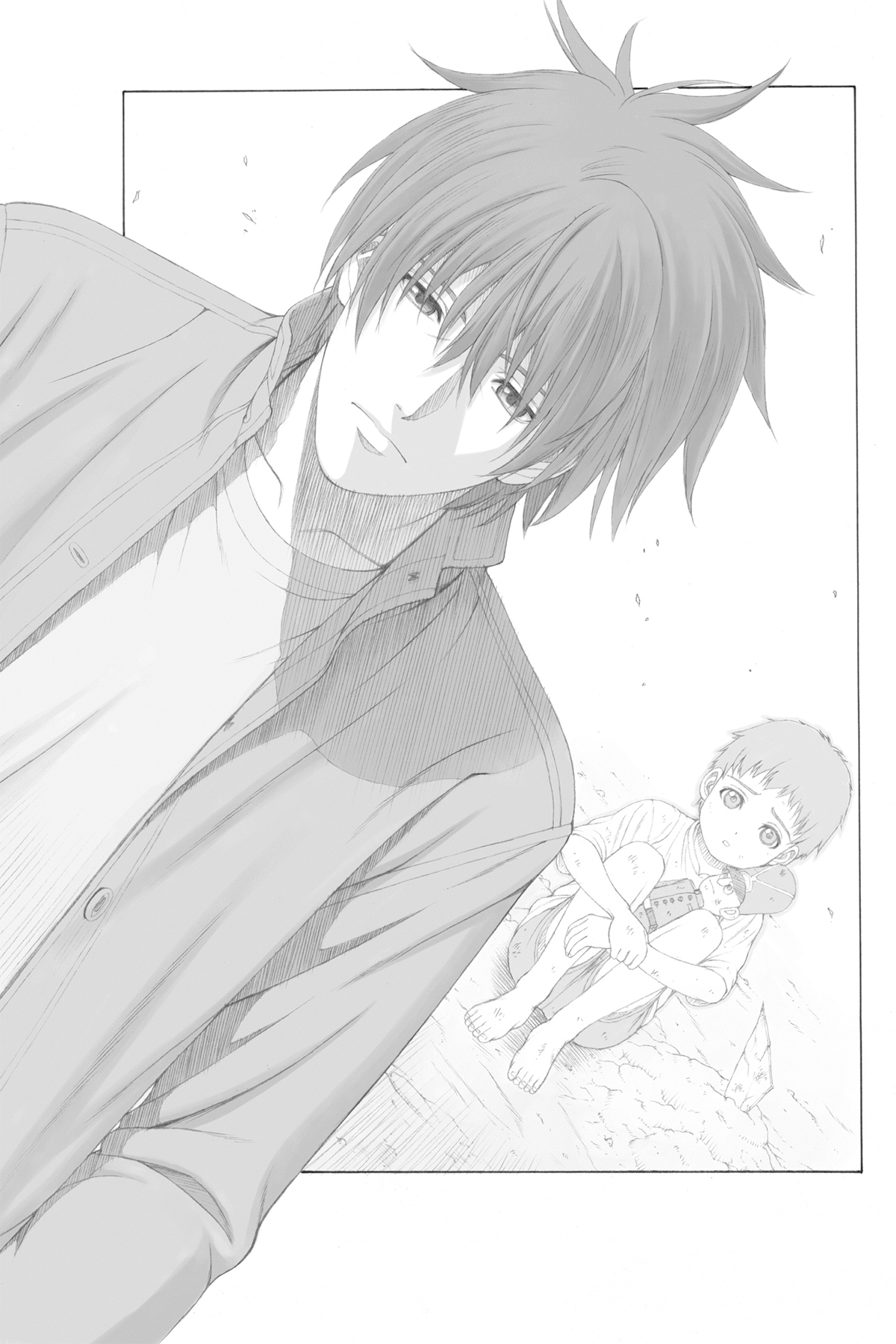
Harvey felt as if someone was calling out to him, and he turned back, just once. A skinny kid was sitting with his knees pulled up to his chest next to a bloodstained glass grave marker, hugging a tin soldier. He gazed reproachfully at Harvey for a time, but then:
Oh…I guess that’s that, then… And he heaved a dispassionate, resigned, very unchildlike sigh, and faded slowly away as if becoming one with the glass.
…I’m sorry, Harvey apologized silently as he left the meager glass-shard grave marker behind.

The rhythmic clacks of the train wheels and the thin smoke from his cigarette streamed away behind him on the wind. The noise of the train was loud when there was nothing between it and his ears, sure, but it struck Harvey as a peaceful noise, and he didn’t find it unpleasant. Come to think of it, for some reason he’d never had a problem with ambient noises like the rumbling of a train or the clamor of a gambling house.
Eventually being treated as the master had gotten too creepy to stand, and he’d escaped to the deck. Now he was leaning against the guardrail, enjoying the wind and having a smoke. When he was all by himself like this, letting his mind wander and puffing on a cigarette, he could almost believe that the world had always been a peaceful, problem-free place.
His bangs had gotten a little long; they tickled his nose as the wind blew them about. My hair’s getting annoying… In the act of shaking his head to get rid of the offending strands, he accidentally lost his cigarette in the wind. “Ah—” He gave a plaintive cry and turned around, but after a moment’s dance on the wind like a flower petal, the white stick disappeared into the distance. There’d still been a lot of it left, too.
Harvey gave up on smoking and let his gaze roam the slowly unrolling scenery of the wilderness in the distance. The cloudy right half of his vision lightly overlaid the left. It was still rough enough to focus on things at close range that it gave him motion sickness, but if he looked into the distance it didn’t feel so wrong, even if his vision itself wasn’t that good.
He idly wondered which way was east.
I still haven’t managed to keep that promise, have I…? They should have parted two years ago at the mine in Easterbury, but instead Harvey’d ended up dragging him from one corner of the world to the other ever since, making him worry all the time…and now here he was breaking down, and he couldn’t even leave the radio anymore. Harvey thought if he’d tried a little sooner, he could’ve separated the Corporal from the radio and let him rest in peace.
Oh.
In that moment he realized: now that things had come this far, did they really need to force the radio back into working order? Dead people were supposed to fade away, weren’t they? It hadn’t occurred to Harvey to take that kid with him, and he still didn’t think he’d been mistaken not to. And he thought it was only right that the ghosts at the bar had disappeared after seeing the bartender off down his new path in life. And yet—How long do we intend to keep the Corporal pinned to this world?
“Ugh…”
He sighed disgustedly at himself. Talk about a shitty thing to realize. If I hadn’t had that thought, I wouldn’t have to worry about this stuff…for that matter, I just lumped Kieli and me together as “we,” but maybe I’m really the only one who needs to get his act together here.
“Harvey?” broke in the girl’s voice all of a sudden, catching him with his expression totally unguarded. His face abruptly froze. When he schooled his expression and turned around, Kieli’s face was peeking out from around the connecting door.
“You were gone so long I got worried. What are you doing?”
“Nothing, just looking around outside, letting my vision adjust,” he answered, just as he had once before. He looked away from her. Inside, he thought with a little contempt, You’ve got a nice convenient excuse whenever you want to be alone now, don’t you? Not that she won’t see through it right away. Kieli looked every bit as unconvinced as he’d expected, but he pretended not to notice. She didn’t press him any further; she merely closed the door and came out onto the deck with him.
“Where’s the Corporal?”
“I left him sitting on the shelf. He was being way too bossy.”
Kieli’s pout as she grumbled this was so entertaining that Harvey couldn’t help laughing a little. He wondered if that was what he always looked like when he was fed up with the Corporal’s lectures. “Sheesh, you act like it’s not your problem. You’re enjoying being ‘Master’ a little bit, aren’t you, Harvey?” Kieli said, looking even more cross.
“No, no, of course not. I hope he goes back to normal soon. Yeah.” He recited this speech in a deliberately unconvincing monotone, and then since he was already distracting her, he went ahead and got himself another cigarette. The blatantly suspicious glare she gave him hurt as though it was physically boring into his cheek.
Kieli sulked at him for a while, but eventually she just clucked her tongue in annoyance and looked away, coming up to stand next to him and lean on the guardrail, too.
“I hope he gets better soon…” she murmured quietly to the ground below them, her voice carried away behind them in no time by the same wind stirring her long hair.
“…Hey, Kieli,” he began, pretending to gaze off into the distance even though he couldn’t really see that much. Kieli looked up at him and blinked. He started to go on, but then he hesitated with his mouth half-open around his cigarette.
After a little thought, he ended up saying something completely different. “I need a light.”
He glanced at Kieli out of the corner of his eye. She looked confused, as if she was trying to work out what that meant. After a beat she seemed to get it, and fell speechless. Then:
“See, you really are enjoying it!” she accused him indignantly. He started to smile and take it back, but before he got the words out he realized he was about to lose his cigarette in the wind again. “Ah—” He was going to seriously grieve if he lost this one. He hadn’t even lit it yet!
Luckily he managed to reach out and grab it at the last moment. Somehow after that he ended up staying in that position with half his body leaning out over the railing, just letting his gaze wander the horizon.
“I wonder if Easterbury’s that way,” he said, half to himself. Gripping the back of his coat, Kieli craned her neck to peer up at his face.
“Harvey…what’s wrong?”
“Mm. Ah, it’s nothing.”
She looked worried, so Harvey shrugged it off with a casual “I guess that was a weird thing to say.”
He guessed maybe it was far behind them, a long, long way southeast of here. There was no way he’d see even a shadow of it from here, obviously; there were only the gently rolling hills of the wilderness on the horizon. The gradually curving train tracks stretched out beyond that horizon. So, these tracks go all the way to Easterbury, huh?
I want to ask you a favor—
The radio’s words echoed in the back of his mind. —When I break down and stop working for real, take me to Easterbury. To that grave at the mine.
Would he end up going to Easterbury before too long? He didn’t know whether that was the right thing or not, though. Which choice came the closest to the right answer—?
Harvey’s conclusion was postponed for another day, and only the sounds of the wind and the train’s wheels made it to the distant east, left behind as the train itself headed ever westward.