Chapter 4: “I’m Home.”
CHAPTER 4
“I’M HOME.”
Kieli could feel the cold of the concrete against her back through her coat. She shivered and pulled the collar of her coat closed, looking up at the rusty orange sky through an opening in the alley.
Tonight would be another cold one. Once the Colonization Days vacation ended, it would already be winter.
Still, the school-designated coat suited this situation very well, Kieli thought in a bit of self-derision as she considered her black clothes and her current position. Now if only she put on a pair of sunglasses, it would be perfect. She remembered a children’s detective novel that she had borrowed from the library in her boredom during the previous year’s Colonization Days, which only increased her boredom (and real detectives probably didn’t wear such obvious clothing).
“Corporal, can’t we go back now? It’s bad taste to follow people around,” she suggested for the umpteenth time, looking up at the sky as she plastered herself against the wall, but the small radio hanging from the cord around her neck replied with the villainous line, “Shut up and follow him,” immediately dismissing the idea.
Kieli sighed in exasperation but nevertheless did as she was told and peered stealthily into the opposite street from the shadows of the alley. Some way off, she could see the back of a tall man walking the rather empty old streets. The twilight sky dyed his copper-colored hair an even rustier dark orange.
His back looked as if it would turn this way for a second, and, “Wah! He’ll spot us. Hide!” she drew her head back, as if pulled by the radio’s voice.
She waited a while, her heart pounding, then moved her head to look one more time as Harvey veered onto a side street a little ways ahead.
“He’s turning. Hurry!” the radio urged, swinging at the end of its cord.
“…It’s bad taste to follow people around,” Kieli said, justifying herself with a grumble, as she ran out into the alley and went after the vanishing back at a trot.
How did I end up playing detective in the first place?
They stayed one night in the town with the carnival, then boarded the train that had started running again that morning, and arrived at their destination a little before dusk. It was a big transfer station on the eastern outskirts of the Easterbury parish, where the railroads met from all four directions. They had come from the central region of western Easterbury. If they kept going east, they would reach the Sand Ocean in the far east; if they went north, they would pass into the North-hairo parish, where the Church Capital and the mechanized capital were.
The last railroad, to the south, had been abolished and was no longer in use, but the abandoned mines that Kieli and Harvey headed for lay at the end of that deserted track. Harvey said it wasn’t that far, so she figured it was quite far, and sure enough, it would take them from morning to night to walk the distance; Kieli whined, and they scheduled their departure for the next morning.
And so they found an inn near the station where they could stay the night, at which point Harvey said there was a place he wanted to stop by, and he’d set out on his own.
“It bothers me, that heartless bastard having a place he’d go to the trouble of visiting,” the radio said, feigning all seriousness, and ordered Kieli to follow him. She grumbled — again — that it was bad taste to follow people, but in the end, Kieli did as she was told. Because it wasn’t as if she wasn’t secretly curious herself.
She stopped for a moment at the corner of the alley Harvey had gone down and peered across the way to see the narrow path winding its way uphill. Block-concrete walls sandwiched the path on either side so she couldn’t see much, and on top of that, narrow side streets and stairways branched out like a maze. Looking far up the slope, she saw a towering stone wall and zigzagging steps crawling up it. It looked like there were even more villages on top of the wall.
She had heard that the old town around the transfer station had once been a military base in the Easterbury region. It was a fort city, surrounded by sturdy walls (though now they were old and crumbling in places), and even inside, it was divided by several layers of inner walls, which stood vertically, complicating the structure terribly. If someone who had never been there before entered the city and actually made it to their destination, there would be no doubt that it was pure coincidence.
Apparently Harvey had been there before. He did stop and look around a few times as if matching the streets with his memory, but he cut through several of the complex hill roads automatically and finally started down a single narrow path.
Old houses lined the run-down area. It looked as if hardly anyone lived there anymore; most of the houses within the crumbling concrete walls had fallen to ruin, and the yellow sand that had blown in from the wilderness lay thick on the streets.
Harvey stopped in front of one of the houses deep in the complex, and after gazing at it from the outside for a short while, he disappeared inside its concrete fence.
“He went inside.”
At the radio’s prompting, Kieli ran in his direction and, ducking low, stuck half her face out from behind the wall.
On the other side of the simple but well-maintained front yard, an old, steel-framed house stood under the evening sky. It was somewhat bigger than the other houses around it and had a stone stairway and double doors at its front.
Kieli was a little surprised to see potted herbs of various sizes lined up on the balcony directly above the front entrance. She had thought that the only people who could devote themselves to hobbies like raising plants these days were rich ladies in mansions who had a lot of free time because their servants did all the housework.
She saw the top half of a man on the balcony, watering the plants with a tin watering can. He was a white-haired old man who scowled grumpily, and at first glance, he certainly didn’t look like someone who loved plants.
When he noticed Harvey looking up at him from outside the entrance, for a second he put a warning look on his face, then his eyes, buried in deep wrinkles, opened wide.
“You’ve come back.…” The minute the words reached his mouth, every trace of his previous stern expression melted away.
Kieli heard Harvey murmur, “I’m home.” His voice was so faint that she didn’t know if it reached the old man’s ears or not.
“Don’t just stand there; come in. It’s your house,” the old man called to Harvey and disappeared from the balcony, perhaps going to greet him. Accepting the invitation, Harvey started to climb the entrance steps but suddenly stopped and turned around.
“Ah,” Kieli cried involuntarily as his copper-colored eyes met hers. Under her chin, the radio made the same sound. Harvey squinted at Kieli, who had frozen with her head still sticking out of the concrete’s shadow, and sighed, an incredulous look on his face.
“I don’t know what you’re doing, or why you’ve even got the Corporal with you.”
Kieli made the excuse in her mind — “It was the Corporal’s idea” — but it stayed there.
“How long did you know?”
“The way Kieli tails people, I couldn’t help but noticing. Kieli.”
A little late, Kieli was trying to sneak her head back behind the wall; she cringed when he called her sharply by name. She looked up to check his expression, but Harvey simply said, “How about coming in?” He turned on his heels and pushed the double glass door open. The door creaked, terribly rusted.
Kieli’s mouth dropped open. After looking down at the radio, she hurried out of the concrete’s shadow and followed the tall man disappearing through the entrance.
She trotted up the steps but then, feeling as if something was off, she stopped. She looked up at the balcony above her and tilted her head. The terra-cotta pots were still there, but the herbs and their green leaves had all disappeared, as if perhaps someone had picked them all in an instant.
“Hey, this house…” she muttered, moving her gaze from the balcony across the entire house. The radio said only, “I know,” in a deadpan voice, as if he had realized long before.
The inside of the house was all done in whites, and it was old, but clean. Inside, a hall surrounded by white walls stretched out in either direction. Harvey stuck his head out of one of the doors, said, “This way,” and disappeared inside once again.
When she stood in front of the room Harvey beckoned her to, Kieli realized that this place was a facility like a clinic. In the center of the plain, undecorated room stood a simple bed and a medical cart, and the glass-doored cabinet that occupied one of the walls contained a variety of medicines.
There was a clumsy steel desk at the window, and the old man from earlier sat in front of it, looking her way.
“This is Kieli,” Harvey said, introducing Kieli, who was standing in the doorway, then pulled a round chair from beside the bed, and sat casually in it. The crooked three-legged chair sank with a creak.
Kieli bowed her head slightly in acknowledgment, and the radio that hung from her neck introduced himself: “I’m here, too.” The old man opened his eyes just a little wider in surprise, but soon looked pleased and smiled.
“Welcome. You seem to be pleasant companions. Are you happy?”
He directed the last question at Harvey, and Harvey, stuck for an answer, turned his glance toward Kieli. But it wasn’t as if the answer would be written on her face. Kieli looked back at him silently, and eventually he smiled wryly and responded, “Well, things aren’t so bad right now.”
“Aren’t so bad.” It seemed to Kieli that when Harvey said it, it could fall into the category of “pretty good,” and that was enough for her.

“Be careful. It looks like they’ll give out any second.”
“Yeah, I know.” The radio didn’t need to warn Kieli; she was already taking great care with each step up the staircase. The house seemed to be pretty old, and even her smallest steps made the floor creak.
While Harvey and the old man absorbed themselves in stories of the past, Kieli left the examination room and took a look around the clinic.
On the second floor, the balcony she saw from the gate was directly ahead of her, and a white hall lined with doors stretched out to her right and left, like on the first floor. Staring out of the corner of her eye at the green leaves that had returned to the pots on the balcony, she wandered down the hall to the right and peered through a few of the doors. One room after another was plain but clean-looking with one or two beds under the windows. The rooms were probably for inpatients.
“This is a nice place,” the radio said quietly, and Kieli smiled and said, “Yeah.”
There was no sign of extravagance, and while she couldn’t deny its old age, a sense of cleanliness and a humble warmth filled every place she looked, and she could see what kind of a person ran the clinic. It was a quiet home, befitting someone who had the heart to care lovingly for potted plants on this world where there was nothing but rocky wilderness, oceans of quicksand, and exhausted coal mines.
She walked down the hall, feeling somehow that this place had healed even her, but she soon stopped in surprise.
Someone was at the hall’s intersection. He was in front of the door farthest down the hall, clinging to the wall, and peering into the room. He looked like a little boy, even smaller than Kieli.
“Um…?”
The minute she spoke to him, Kieli’s consciousness was drawn inside the boy, and before she knew it, she was looking into the room from the boy’s point of view.
It was a room with clean white walls, just like the others. A potted plant, different from the ones on the balcony, decorated the windowsill with its gentle green leaves.
There was a patient on the bed by the window. He was a young man Kieli knew well, with copper-colored hair. His hair was a little longer than now, and hopelessly unkempt. He sat up with his back against a pillow, but he leaned heavily to the left, apparently unable to use the right side of his body — or rather, half of it wasn’t there. There was nothing filling his white shirt from the right shoulder down — only an empty sleeve dangled beside his body, and there was nothing under the sheet where his right leg should have been. He gazed at the half-done room with a vacant expression that suggested that half of his brain had fallen out as well, and he would blink only occasionally in response to the sounds outdoors that sometimes came through the window.
Kieli, overlapping the boy, observed him very cautiously from the door’s shadow.
Be friends with him, Tadai.
Suddenly hearing a voice from behind her, she turned around and saw a man that looked much like the old man from earlier, but a little younger. Father, came to Kieli’s lips. Then she felt a light push on her back and timidly went into the room. The youth on the bed moved very sluggishly and turned a somewhat unfocused gaze in her direction. Urged from behind by the father, she extended a hand — starting with her right but then switching to the left — to the young man. After a little time, he tried to raise his left hand, too, and that instant, he lost his balance and sank to the left. He kept going and fell off the bed.
She panicked and rushed to help him up, but she couldn’t help laughing at such a magnificent fall; and then she got the feeling that the youth, whose empty expression hadn’t shifted an inch until then, showed just a little smile. It was a really, really faint smile, but it was a smile.
When a sudden crash brought Kieli back to herself, she was standing alone inside the room. The boy and his father were both gone, and the bed was empty except for a white sheet.
“Corporal, did you see that…?” she murmured, looking around the room. Under her chin, the radio answered simply, “Yeah.”
She heard another violent clatter from downstairs. Still a little dazed, she went to the window and looked outside to see Harvey unceremoniously kick open the ill-fitted glass doors at the entrance and come out into the front yard.
“Are you going somewhere?” She tried to open the window, but there was no glass there to begin with, so Kieli just leaned out of it and called down to him. She’d be in trouble if he left her here.
The sky was gradually changing from the orange of dusk to the blue-gray of night, and the air had grown chill. The last rays of the sun cast long shadows on the yard, stretching Harvey’s already-tall figure.
Harvey turned around to look up at her, and, a cigarette in his mouth, said, “For a smoke,” in an unfriendly voice. It took Kieli a few seconds to figure out that he was going out into the yard to smoke a cigarette. “I’ll get in trouble if I smoke inside. Smoking is strictly prohibited in the clinic,” he added in explanation, responding to her blank stare. He smirked and ducked his head a little.
“Eh? But this house isn’t…” Kieli started to protest, tilting her head in confusion. Then, “He’s conscientious about strange things,” a voice came from behind her. She turned to see the old man smiling wryly in the doorway. She stood rooted to her spot at the windowsill, at a loss for how to react. The old man took on a kind tone and said, “Would you like to see some old photographs?”
“I would!” Kieli immediately nodded vigorously. He smiled at her and disappeared into the hall, as if to say, “Follow me.”
Before going after him, Kieli looked down from the window one more time. Harvey sat crouched on the steps outside the entrance, staring absently into the distant sky and puffing his cigarette. After making sure he was there, Kieli left the window.
By the time she went into the hall, the old man had already gone past the balcony and was standing on the opposite side of the hall, waiting in front of the door at the far end. Taking the utmost care not to make the floor creak, she ran after him, and the old man went inside the room, stood aside, and beckoned to Kieli.
This room felt more lived-in than the hospital rooms she had been looking at; it was packed with a disarray of furniture and seemed smaller. Unlike beds in the patients’ rooms, with their tight white sheets, this bed was properly made up with a well-used brown blanket. It probably belonged to the old man himself.
A rusty picture frame decorated the end table beside the bed. Kieli hesitated a bit but then walked forward and gently picked it up. She felt the weight of the metallic frame in her hand.
The picture inside the frame showed three men: a middle-aged man and a young man with similar eyes who appeared to be father and son, and a youth with copper hair. She didn’t know how many decades ago the faded photo had been taken, but in any case, it was old, and a Harvey completely unchanged from the one Kieli knew stood inside it.
She showed it to the radio that hung from its cord, near her stomach. “The bastard really doesn’t age,” it muttered in exasperation. She thought Harvey wouldn’t appreciate someone being exasperated about him.
Kieli felt a bit differently about it. The background in the photo looked a lot like the scene at the carnival they had visited the day before. She didn’t know if it was the same town or another venue, but either way, they were in the middle of a festival, and Harvey was smiling innocently as he and the other young man had their arms around each other’s shoulders, like best friends or brothers joking together.
She thought, So Harvey can smile like this. The Harvey Kieli knew was generally eighty percent expressionless and twenty percent either annoyed or bored. At the very most, she had seen him smile only wryly or faintly. When he smiled like this, he looked surprisingly childlike and seemed pretty warm.
After holding the frame tenderly and gazing down at the picture for a time, Kieli turned to look at the old man standing behind her.
“Is this you?” she asked, pointing at the middle-aged man who stood in the back, smiling gently as if watching over the two young men. The old man laughed and shook his head.
“That’s my father. The one in front is me when I was younger,” he said, pointing to the young man next to Harvey.
“Dad used to be a military doctor. He opened this clinic when the War ended and cared for people who were injured in the War. He was a hopeless philanthropist — he didn’t just look after the injured but also worked with a charitable group that buried the heaps of corpses that were left behind on all of the ancient battlefields in Easterbury. He picked him up on his way back.” He smirked as if to say, “literally picked him up.” “He had been buried under a mountain of dead soldiers. At the time, I was very young, so when my dad told me to be friends with that half-dead corpse that he practically dug out of a grave, it was quite the shock.”
The old man spoke in a mild voice that was easy to listen to, then narrowed his eyes, buried in wrinkles, as if in fond memory.
Oh, so that boy really was this old man. As she looked from the old man to the picture in her hand and back again, a warm feeling filled Kieli. That youth’s face looked as if a big hole had opened up in his heart, but thanks to the boy and his father, he learned to smile like this.
“That was the last photograph. He left a little after it was taken.” The old man’s remark brought Kieli back to reality. Now that he mentioned it, Harvey said he had traveled all over the planet, so he couldn’t have lived in this house forever.
She looked up from the picture and turned a questioning gaze to the old man. He closed his eyes and didn’t answer immediately.
“If he was here long enough for that little boy to get as old as he is in this picture, he was already here plenty too long. It would be weird for the people around him not to get suspicious. The Church has a crazy reward out for the Undying; if you reported an Undying to the Church soldiers, you’d get enough money to buy a ship.”
Kieli glanced down at the radio, then silently returned her gaze to the old man. He nodded, his eyes still closed.
“Dad died not long after that picture was taken. The direct cause was an old war wound that had gotten worse, but apparently he had been suffering a lot since Mom had gone before her time. After the funeral, he disappeared. And he never came back.”
“Not even once?”
“Actually, we had been fighting,” the old man said, laughing with a hint of self-contempt. Kieli stared at his face, a little surprised. Here he seemed like such a kind, gentle man, much like his father in the picture. It must have been Harvey’s fault. Kieli started imagining a scene that, to Harvey, would be a baseless and false accusation.
“So you’re saying that you may have owed my dad, but you don’t owe me anything, and now that Dad’s gone, there’s no reason for you to stay, is that it?” This different voice suddenly interjected behind the old man.
She looked past the old man in surprise, and saw a tall shadow leaning against the door frame. For the first time, she noticed that her surroundings had gone completely dark, the faint bluish light from outside dimly illuminating the room’s miscellaneous furniture.
“He yelled, and hit me as hard as he could. That sweet little old man was pretty hotheaded when he was young. Well, I appreciated that he had the guts to hit an Undying, so I didn’t hit him back,” Harvey said casually in the gloom. He raised one side of his mouth in a smirk, showing not an iota of the innocence of the smile in the picture.
Kieli threw him a supsicious glare, wondering where he’d picked up his current personality, and Harvey, ducking his head to let the glare pass, pointed toward the hall and downward.
“Kieli, do you mind if we stay here tonight? It’s a little dusty, but I found a room on the first floor that I think you could sleep in.”
Of course Kieli had no objections, so she nodded in assent. It was a shame not to stay at the inn they had already reserved in front of the station, but the only things she had were the shoulder bag she always carried with her and the radio (the radio technically belonged to Harvey, but somewhere along the way it had become the preferred style for Kieli to wear it around her neck).
“Then let’s go. There’s no electricity here, so we won’t be able to see anything soon,” Harvey urged her, disappearing from the doorway. Kieli glanced up at the old man next to her. He smiled bitterly and, nodding, stood up and left the room.
The last to leave, Kieli could see the backs of Harvey and the old man as they walked down the hall ahead of her, side by side. They argued about something as they went. The old man was half a head shorter than Harvey, but he was a match for him in attitude. “That was because you suddenly said you were leaving without giving any decent explanation. And Dad had just died; anybody would make that mistake.”
“You shouldn’t have needed an explanation to figure it out.”
“Don’t you get defiant on me! You’ve always been one extreme or the other — either you don’t say enough or you say way too much. You need to learn a little consideration for who you’re talking to.”
“Augh, don’t lecture me. I wasn’t asking, damn it.”
Walking behind them and staring at their backs, Kieli desperately tried to contain her laughter. “What, are they little kids…?” the radio muttered in exasperation, but the Corporal had no right to talk about age or foul language, which made it even funnier, and Kieli giggled in the back of her throat.
The two of them are like best friends and brothers, just like the two joking around in the picture. I’m really glad they were able to talk again, she thought.

The next morning, when Kieli opened her eyes she was lying on a sofa with broken springs in the waiting room, wrapped in her coat and a dusty old blanket.
The clinic had completely fallen to ruin. Yellow sand and dust had settled below the crisp, clear, cold morning air, and the once clean, white paint on the walls had faded to yellow and peeled off in places, showing the concrete wall underneath.
Kieli spent a while walking through the deserted house, looking for Harvey, the floor creaking with every step she made. When she went up to the second floor, the plants that decorated the balcony had withered to nothing, and only the cracked pots remained under the nebulous morning light.
She stopped in front of the old man’s room. There was no bedding on his mattress, and most of the furniture had been either broken or carried off, leaving the room empty. She walked to the end table and carefully picked up the photo frame that had been left facedown on top of it.
The photograph inside the rusted metallic frame had turned a milky white, and she could no longer make out anything except that there were three people in it.
“I’m sorry about dragging you along yesterday,” a quiet voice addressed her from behind, and Kieli looked up from the photo. Harvey leaned in the door frame, just as he had done the night before. “Oh, no…” Kieli answered, shaking her head. Harvey smiled just a little more softly than usual.
“I’m going to visit his grave. Wanna come?”
There was an abandoned Church school in a corner of the upper level of the vertical inner wall that made the old city so complex, and the open lot next to it had become a public cemetery for the poor. The concrete walls that surrounded it were half-crumbled, and a cold but gentle morning breeze blew between the rows of stone grave markers.
In the farthest corner of the cemetery lay a simple tombstone belonging to the old man Kieli had met last night. It was covered in a layer of red dust that had come in from the wilderness, and it appeared that it had been there for at least a few years. Thinking about it, those memories in which the old man was a boy were right after the War ended, and that was almost eighty years ago.
Immediately next to his grave marker stood another that was a little older. Engraved on it was a modest epitaph, fitting of such a plain marker. “Here lies Tadius, beloved father of Harvey, Tadai, and many potted plants.”
There was no inscription on the old man’s grave; perhaps he had no family or close friends to care for him. There was another tombstone beside the father’s grave. It was much more weathered than the other two, but she could just barely make out the words carved in it — “Here lies Harvey, most beloved son of Tadius, and Tadai’s older brother.”
Openmouthed, Kieli couldn’t help staring at the letters on the tombstone.
“There was an elder son in that family,” Harvey informed her in a smooth tone. “Apparently he died in battle six months before the war ended.”
At a loss for words, Kieli looked up at Harvey, standing beside her. Harvey’s profile wore no expression as he looked down at the grave, and he stood completely motionless for a while as he sometimes did, his eyes fixed downward. After waiting quietly for a while as Kieli hesitated to speak to him, he finally blinked once and turned his usual indifferent gaze toward her.
“I’m going to stay here a little longer. Would you go eat breakfast or something with the Corporal to kill time?”
“Can’t I wait here…?”
“No. Sorry, b…” Harvey started to say, then broke off as if the words were stuck in his throat. He showed a vague smile and averted his eyes. “But I want to be alone for a little while.…”
Kieli stood still for a time, looking at his face. She felt the inside of her throat tighten. She bit her lip and swallowed. “Kieli, let’s go,” the radio’s voice pressed her on, and she took two or three steps backward.
“…Then I’ll be off,” she somehow managed to choke out, then turned on her heels and fled.
At the cemetery exit, she looked back and saw Harvey crouched on his knees in front of the grave. She faced forward again and ran at full speed, not looking back again. As she ran the inner wall’s steps in one bound, the radio and her bag thudded against her.

An awkward, three-wheeled taxi with its cylindrical fuel tank on top drove sluggishly into the plaza in front of the station. It passed in front of the bench Kieli and the Corporal sat on, the fat muffler in the back spitting out black smoke that showed a severe lack of fuel efficiency, and Kieli, who was trying to take her first bite of breakfast, couldn’t help choking.
“Kahah…”
As she coughed, she glared at the three-wheeled taxi as it continued into the rotary, caring not a bit that it had bothered her. A wealthy-looking couple with large bags stepped out of the taxi. The eastbound morning train would be arriving from the north soon, and from the bench in front of the plaza, she could watch as the station sucked up all the people who were ready to travel.
She didn’t have much of an appetite, but she pulled herself together and started to eat again; her lunch was a bean sandwich she had bought at a junk-food stand in front of the station; it had sauteed beans and smashed vegetables pressed between hard bread. They would be walking a lot today, so she had resolved to make sure to eat. As she mused, something suddenly occurred to her, and she turned to the radio sitting next to her on the bench with her bag and asked, “Corporal, Harvey doesn’t eat, does he?”
“He eats,” the radio answered readily, but in this case, Kieli’s “eat” and the Corporal’s “eat” didn’t have quite the same flavor.
As of this morning, Kieli had been traveling with Harvey for four days, but she had never seen Harvey have a meal in all that time. No, like the radio said, she had seen him put things in his mouth, but it was always something like dried meat that seemed inedible to Kieli, or hardtack that was like rocks, and he gave the impression that he was thinking about something completely unrelated — just putting the food inside his mouth, chewing it up, and sending it down to his stomach — and when he got tired of it, he would stop. It was like he had no attachment whatsoever to the act of eating.
When she thought about it, as far as Kieli knew, she had never seen him sleeping, either. He would close his eyes, but if she talked to him, he’d immediately open them and answer her. He would just seem extremely annoyed about it.
I wonder if the Undying don’t need to eat or sleep. Kieli had a hard time picturing what it would be like not to have to eat or sleep. Not sleeping meant that the world never pauses; there’s no sense that today will end or tomorrow will come. She wondered what it would feel like to live in that monotonous routine for decades.
“All life functions for Undying are maintained by their hearts’ unlimited power source, so they don’t need to take any thought for how they live. That’s how they get to be failures at life, like him.” “Failure at life” was a really harsh way to put it, but it wasn’t far off the mark. “On top of that, their hearts give them blood with abnormal cell-regenerating powers that make them immortal. Convenient bastards.”
Kieli listened, fascinated, to the radio’s half-ranting explanation as her molars ground up the hard-to-chew smashed vegetables from her bean sandwich.
She wondered if that strange coal-tar-like liquid that gathered around his wounds like a living thing contained something — something Kieli couldn’t even imagine — that rapidly healed even fatal wounds. And it was the power source in his heart that sent it out — even Kieli could imagine this one. To be more precise, she could remember something she had seen with her own eyes. That rough black stone that was like a machine but also somehow not unlike a living thing.
“Those stones — the hearts of the Undyings — what in the world are they made of?”
“They say they’re a crystallization of ultrapure energy sources. Before the War, they mined everywhere, getting a hell of a lot more highly pure fossil fuels than they can now, and built up an energy civilization on the planet. They gathered the essence of all that technology and made the Undyings’ ‘cores.’ But they lost both the resources and the technology in the long War, and all that’s left now is the scrap coal that moves those top-heavy clunkers.”
She took in the radio’s cynical comment and cast a glance at the rotary, where she could see a few three-wheeled taxis parked in a line, with huge fuel tanks sitting on their roofs, practically crushing them. She had learned some of the history of fossil fuels in school. An ugly war broke out over those resources, enveloping the entire planet, and when the resources dried up, the war naturally died out, too. Not only was it meaningless, but it wasted all kinds of labor on efforts that did nothing but harm and brought destruction over the entire planet.
The area surrounding the station’s entrance suddenly got very busy. Apparently the train had arrived, and flocks of people came flowing outside as if pushed along. The taxi drivers, who were camping out around the ashtrays in the rotary, smoking, instantly exchanged their bored expressions for courteous smiles and started hunting for customers.
Kieli gazed emotionlessly at the activity in front of the station and kept chewing her breakfast; by the time she finished, both the arriving and departing passengers had settled down and the flow of people had thinned. The lucky taxis that had apprehended passengers with deep pockets passed in front of her, spewing black smoke and noise as usual.
She scowled at the exhaust fumes as she swallowed the last bite of her bean sandwich, and just then, she happened to catch sight of a three-wheeled taxi coming her way.
That instant, the taxi’s front wheel suddenly changed direction and charged toward the bench Kieli and the Corporal were sitting on.
“Waah!” Kieli screamed, reflexively pulling her legs up onto the bench. Fortunately, the front wheel swerved in the opposite direction in the nick of time, and after tottering from side to side for a while as if the driver was drunk, the taxi came to a sudden stop a little ways off. The driver leapt out, his face pale, and looked around at his car and its surroundings, then got back inside, shaking his head in confusion.
“There was something on top of it…” Kieli muttered, still a little dazed and clinging to the back of the bench she had scrambled onto as she gazed at the black smoke coming from the taxi as it left the station. For just a second, she had seen a fuzzy black shadow riding on the fuel tank on the roof and blocking the windshield.
“A nasty evil spirit making mischief. Best not to get involved,” the radio replied, not particularly concerned. But in a somewhat stiffer voice, he added, “We’d better get going, just in case. Let’s go back to Herbie.”
“Yeah…” Kieli nodded tentatively, but still followed the direction the taxi had taken with her eyes as she slowly lowered her feet from the bench to the ground. She hoped there wouldn’t be any big accidents.
“Kieli. Yo, let’s go. I’m the one who’ll get smashed to pieces if you get hurt while Herbie’s not around.”
“Yeah…” she responded halfheartedly to the voice that sounded annoyed as it urged her on. Then, “Eh? What do you mean?” she asked, stunned, before the spectacular noise of a fossil-fueled engine jumped to her ears.
She looked up in surprise; a different taxi, the same model as the one from before, drove up the street in front of her, then made a ninety-degree turn and entered the station’s front area. As expected, the same black shadow possessed the fuel tank and was hanging upside down from the roof, peering through the windshield. The taxi veered right and left, but for some reason, no one hit the brakes as it charged ahead at breakneck speed.
At the end of its projected path, she saw a traveler walking along absentmindedly and carrying a large bag, as if he had just come out of the station.
“Look out!” Kieli yelled, at the same time kicking off from the bench in a run. She caught the traveler’s clothes and barely managed to pull him to the curb in time, but he lost his balance and fell into her, and they both tumbled onto the ground. His travel bag flew out of his hands, clattering loudly as it hit the pavement. The taxi spouted exhaust menacingly, as if yelling at them to get out of the way, as it immediately sped off down the road.
Still on her rear end on the asphalt, Kieli watched, appalled, as the taxi broke the speed limit. It stopped suddenly in front of the station, and a fat, self-important-looking man jumped out, shouting self-importantly, but that wouldn’t help him catch his train. Ugh, that was close. Serves you right.
She shifted her hateful gaze upward and saw the evil spirit floating in the air above the runaway taxi, looking over the rotary with a faint smile on its shadowy face. It had only the top half of a body, with abnormally long arms dangling at its sides. The lower half of its body trailed off into the air and vanished.
When Kieli then turned to look at the traveler who had fallen onto the curb beside her, her jaw dropped and she stared at his profile. She got the feeling that the traveler was directing his eyes at the evil spirit floating in the air, too.
“Um…” she started to address him, but his gaze quickly moved, as if he hadn’t been looking at anything in particular. He stood up, brushed the dust off his clothes with one hand, and offered her the other. Kieli froze, dumbfounded, so he took her arm himself and helped her up.
“Thank you.”
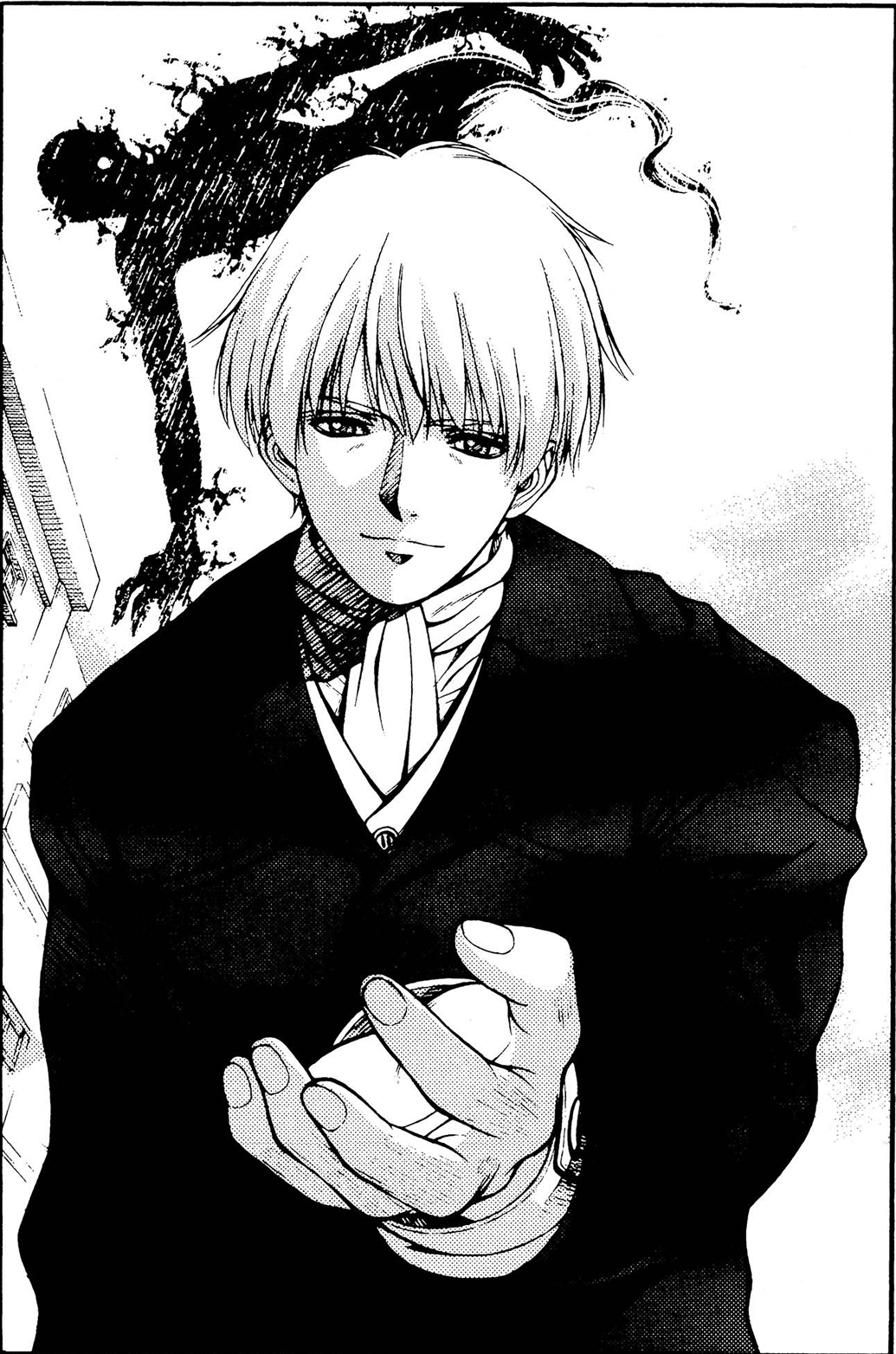
“No, I should be thanking you.” The traveler expressed his gratitude in a soft tone and smiled sweetly. Standing next to him, Kieli saw that he was a young man about the same height as Harvey, and her heart skipped a beat when she got the feeling that he resembled Harvey somehow. In an effort to hide her reaction, she brushed the dust off her skirt, turning her eyes upward to look at the traveler. That was when she first realized that he was no ordinary traveler. He wore pitch-black priest’s garb of fine quality — the clothes of a priest on pilgrimage.
She wondered why she had thought he resembled Harvey for a second: now that she looked at him, other than his apparent age and height, he wasn’t really like Harvey at all. He was an honest-looking young man, whose blue-gray eyes radiated a gentle aura.
“From your uniform, I’d say you’re a student at the Easterbury boarding school.” Apparently while Kieli inspected the priest, he had been inspecting her. He looked down at Kieli’s black garments and asked in surprise, “Traveling alone in uniform?”
“Uh, it’s a research trip. And I’m not alone…” Kieli answered automatically (until she said it, she had completely forgotten about the report herself) and glanced over at her companion on the bench. Then she almost cried out.
She hadn’t seen the half-bodied evil spirit approach, but suddenly it was floating in the air above the radio, a mischievous smile showing faintly on its face. Static particles spewed out of the radio, forming a fuzzy soldier’s face, which looked overhead and opened its mouth menacingly.
Waah, Corporal! Kieli screamed inside her head. “I’m sorry, I’m in a hurry! Good-bye!” She bid farewell to the priest without giving him a chance to respond, ran back to the bench, snatched up her bag and the radio, and raced away from the station without giving the evil spirit or the priest another look.

“There — done…” Harvey muttered to himself, lowering the knife in his hand. He rested his chin on his bent knee and gazed at his handiwork for a while, rather pleased with himself.
The blank tombstone now had letters engraved on it, though not particularly well. “Here lies Tadai, son of Tadius; younger brother, older brother, and first friend of Harvey.”
“Well, you’ll just have to make do with this,” Harvey told the grave, then smiled wryly at the ridiculousness of his own action. But there was a little more he wanted to make sure to say out loud.
“Right now, my life’s generally not so bad, so don’t worry about me. I enjoy what I can wherever I am, and I have someone who’s making life good. But…” As he spoke, he crossed his arms over his knee and buried his face.
“I’m fed up with it already. Just imagine, every single person I meet up with dies, leaving me behind. Even you. You don’t even care how the hell I feel. You’re satisfied, so you just go and die.”
His brother under the grave marker would no longer respond like he had the night before. Even so, he waited, hoping somewhere in his heart for something, but all he could hear was the dry sound of the wind carrying the dust and yellow sand that piled up on the ground.
“Hmph, so no one’s coming to take me away after all?” he spat, with a short sigh, then brushed away the dust and stood up. He looked down once more at the newly engraved tombstone, offered a short prayer, then lifted his eyes and turned away. If they didn’t leave soon, they wouldn’t make it to the ruins before sunset. He felt hesitant about making Kieli camp out.
“…Well, I guess it’s still all right…” he muttered before leaving the grave. It was more to himself than to his brother sleeping there.

“Kieli! Hey, Kieli, stop! I’m gonna fall apart! I’m rickety enough as it is!” The radio’s protests were close to screams. Kieli finally stopped running. The radio had been flailing at the end of the cord in her hand as she raced at full speed.
Catching her breath, she took a look at her surroundings. She had escaped the plaza in front of the station, and the next thing she knew, she was already inside the old city.
It was already pretty late in the morning, but there were very few passersby. Even the trash strewn across the streets looked weathered, as if the town had given up on the idea of cleaning long ago, and a somehow resigned mood hung in the air. Thanks to the nature of transfer stations, the new town around the station flourished regardless of its remote location, but just a little way away, the place became an old, abandoned ghost town, like the neighborhood around Easterbury’s old station.
“Oh, that scared me. It would have been big trouble if you had gone on a rampage back there,” Kieli whispered in a subdued voice as she returned the radio and her bag to their normal positions and walked resolutely toward the public cemetery.
“I was just threatening him a little to get him to go away. Besides, he came up to me first.”
“You’re the one that said it’s best not to get involved with spirits like that, Corporal,” she responded, pursing her lips. The radio groaned and said vaguely, “Never mind that,” forcing the conversation in another direction.
“It’s good that it got you away from that guy. Of course I feel the same about that evil spirit, but something about that guy just really bugs me. It’s best not to get involved with him either.”
“Why?” His sudden warning shocked Kieli, and she looked down at the radio as it swung against her stomach in time with her footsteps.
“Something felt weird about him.”
“What did?”
“Just something. I was trying to get a better idea when that annoying spirit came up to me.”
“So basically there’s no reason. I thought he was nice.”
She tried to remember the priest’s face, but he hadn’t really left an impression on her except that he had pretty blue-gray eyes that matched the night sky, and that for some reason, he reminded her of Harvey for a second. But she at least didn’t get the impression that he was a bad man.
The radio seemed to want to say more, but convinced himself, “Oh well, we’ll never see him again. We’re leaving this town,” bringing the conversation to a close.
“Yeah,” Kieli replied only briefly, and shut her mouth for a while.
If they walked all day, they would reach the ruins that evening. Before she knew it, their destination was right in front of them. Kieli became aware of that fact and suddenly started to worry about what would happen after they got there. It had seemed so far off, she didn’t have much of a sense that the time would come — no, maybe, unconsciously, she was trying not to think about it.
There wasn’t much left of the Colonization Days vacation. When they returned from the ruins, Kieli would have to go back to the boarding school, although not even Becca would be there anymore when she got back. What would Harvey do after returning the Corporal to his grave…?
“Um, hey. When we get to the ruins, we’ll have to say good-bye, won’t we?” she asked hesitantly as she turned down a side street in the direction of the public cemetery. After a short silence, the radio answered, “Yeah.” She couldn’t tell him she didn’t want to. Not if it was what the Corporal wanted and if it was natural for dead people, like it was for Becca.
She left the narrow, paved byroad and started up the staircase that zigzagged up the inner wall. At the top was the abandoned Church school, and the lot next to that was the old city’s public cemetery.
“Wha?”
Right as she passed the landing on the highest level, something suddenly yanked her neck from behind, and she automatically let out a cry as the air rushed out of her throat. Surprised that she had stopped breathing for a moment, she turned her head behind her.
Two long arms appeared impossibly in the air and were trying to take the radio that hung from her neck — to be more accurate, they were trying to drag out the spirit that was possessing the radio.
“Let go, damn it!” the soldier yelled, the top half of his body having been pulled out of the floating radio. Kieli’s legs swam in the air as she was pulled backward with the radio. Before she could react, her back hit the concrete stairs, and she slid backward down a few steps to the landing below.
“Kgh…” she cried wincing at the pain in her back, then sat up and looked to her left and right. The radio had come off her neck, and she could see it banging against the pavement as it rolled down the stairs.
“Corporal!” Despite the pain, Kieli stood up and hurried after the radio. She got impatient and started skipping steps, running with such force that it seemed any wrong step would send her tumbling down the stairs, too; but anyway, she ran.
The radio bounced high with a dull thud. Kieli reached out with all her might to grab its cord, but there was no stair for her foot to land on.
“Ahhh — !”
She curled up instinctively, but this time she fell past the landing and all the way to the bottom, stopping when she crashed onto the pavement in the alley below. “…gh!” A moment later, an intense pain attacked her shoulder joints, and she let out a scream that had no voice.
“Kieli!” the radio’s call hit the back of her head as she cringed, unable to move from the pain. Its voice immediately changed into a furious roar. She managed to look up to see the half-bodied spirit floating above the radio on the ground in front of her. Its long arms wrapped around the Corporal’s spirit body as it tried to pull him out of the radio.
“What do you think you’re you doing? Let go!” When the Corporal bellowed, the radio’s speaker swelled to a dome shape and started shooting out shock waves that looked like condensed air. The evil spirit floated out of the way to a higher elevation, and the air-splitting shock wave crashed into the alley wall, crumbling the concrete.
Drifting in the air, the evil spirit curled its mouth into a half-moon, clearly laughing at them. Pieces of broken concrete shook noisily, as if laughing with it; they rose up to the evil spirit’s eye level, forming a rough circle. “Corporal, run!” Kieli cried in spite of herself, knowing that she was saying the impossible, when she saw the projectiles aimed at the radio on the ground.
The evil spirit glared at her in irritation; as it did, the projectiles changed the target of their attack toward her, and when the evil spirit gave the signal with its eerily long fingers, they all commenced their assault.
Kieli couldn’t react right away; her eyes widened and stared above her, still sitting on the ground. Pieces of concrete as big as her head formed groups that plunged toward her.
A moment too late, she closed her eyes tight, and the second she had half-resigned herself to her fate, someone’s arm scooped her up from the side, and her feet floated in the air. Surprised, she opened her eyes again. Peripherally, she saw pieces of concrete piercing the ground where she lay seconds before as she was gently released a few meters away.
“Harve…” Unable to grasp the situation, she looked up at the owner of the arm that had rescued her, still a little dazed. Harvey only said shortly, “You okay?” in her ear, then turned his neck and cast his eyes toward the air above them. The evil spirit twisted its face in annoyance and spun around as if to tell them they’d spoiled its mood by getting in the way of its fun.
“Stay here. I’ll be right back,” Harvey said in a low voice, still glaring overhead. He shook off Kieli’s hand and stood up. “Herbie!” the radio yelled, lying on the ground a little ways off. Harvey snatched up the radio’s cord as he ran past and went after the retreating spirit.
Running down the sloping alley, Harvey fixed his gaze on the half-bodied ghost’s back as it drifted away. Around the radio, the Corporal’s staticky face howled. The speaker produced a shock wave that went after the spirit, but it just barely missed its target and dispersed in the air.
The spirit turned and disappeared through a wall; by the time Harvey jumped out of the alley after it, it was already gone. “Corporal, stop,” he commanded the radio in a low voice, as it was all set to release another shock wave, and stopped where he stood.
They had come out into the old city’s main street, and people were walking about.
“What the hell was that? Coming at me for no reason,” the radio spat, peeved, as it dangled from Harvey’s hand.
“You probably had him intrigued, Corporal,” Harvey answered vaguely, keeping his guard up for a while as he watched for any signs of the spirit from the corner of the alley, but apparently it was no longer in the neighborhood.
“It got away…”
“Damn it, another spectacular failure. Even I’m amazed I’ve lasted this long. Anything else happens, and I’ll be scrap for sure.”
The radio continued his endless complaints, but Harvey responded casually, “You only need that body for today anyway. Just in case, let’s get out of here now,” and turned on his heels, inwardly muttering, “He likes that body more than he lets on.”
As he started back toward the road they had come from, he thought he felt eyes on them and stopped for a moment. He turned around and directed his gaze at the sparse traffic on the main street, but there were only residents of the old town walking listlessly by, and nothing really caught his eye. Apparently he had imagined it.
Harvey jogged up the sloping alley; when he got halfway up, he saw a girl walking slowly down the slope, using the wall for support. “I thought I told you to wait,” he hurried up to her.
“You okay, Kieli? Sorry about that,” the radio asked, concerned.
“I’m fine. It wasn’t your fault, Corporal,” Kieli replied with a smile, but scratches showed here and there on her slender hands and legs, which appeared even whiter against her black uniform. Her bruises were probably even worse. The bag she wore had slipped a little from her recently injured shoulder.
“Give me that,” Harvey said shortly, holding his hand out to Kieli. Kieli just stared up at him blankly, so he breathed a small sigh and took the bag off her shoulder.
“So you can be a gentleman when you try.”
“Shut up. I’m always a gentleman,” Harvey snarled in response to the radio’s quip, holding it up to his eyes and glaring at it as he hung Kieli’s bag from his own shoulder with his other hand. “Damn it, and you were with her. Anything happens again, and I’ll be the one to turn you into scrap.”
“Heh. Too bad for you, I’m only in this body for today anyway,” the radio replied, not to be outdone. Harvey glowered at it as if to say, “That was my line,” and then noticed Kieli staring at him.
“What? Are you hurt? Want me to carry you?” he asked, wincing somewhat; when she gazed at him with her honest, black eyes, he felt an inexplicable sense of guilt. Kieli hung her head and shook it back and forth, and after a moment muttered hesitantly, “It’s not that. Are you okay, Harvey?”
“Me?” Harvey repeated automatically, then, “…Oh, am I okay? That’s stupid. Don’t worry about me.” He almost made a face resembling a bashful smile, then panicked and went back to his normal scowl. “If you can walk, then let’s go,” he said over his shoulder as he turned and walked away in an effort to hide his display of emotion.
Walking at a slower pace than usual, matching the footsteps of the girl following behind, he groaned inwardly. He had thought he was the one looking after her, but before he knew it, it was her existence that was rescuing him.

The first order he heard was to go to Easterbury because a cat had been hit by a train and the body was nowhere to be found. After asking what on earth the problem was, he was forced to listen to a few meaningless complaints (as if he gave a damn about their grandkids’ future schooling problems). He finally reached the heart of the matter — he was to go investigate the black tarlike bloodstains found at the scene of the accident. Why didn’t they just say so? Clearly they had things all out of order.
“What? You’re still at the transfer station? What are you wasting time there for? Get to Easterbury and go after that Undying.”
“I’m terribly sorry. I wasn’t feeling very well, so I got a late start. I don’t have any pleasant memories of the area around Easterbury.”
“Huh. I can’t imagine you’d have pleasant memories of anywhere.”
Inwardly sneering, “I don’t need your commentary,” he outwardly answered very politely, “Oh, please don’t say that. Thanks to my delay, I have some good news to report. I’ve already found him without having to go all the way there.”
“What’s that?”
“The Undying was at the transfer station. Considering the time elapsed and the distance traveled, he’s probably the same one who was in Easterbury. He’s an acquaintance of mine, though I never thought I would find him here.”
“Oh? Who is he? Where is he headed?”
“A detestable man named Ephraim. He’s completely unfriendly.” He could feel the vomit rise to his throat just from speaking the name. “He went south along the abandoned railroad. The only thing in that direction is the abandoned mine.”
“Understood. Finish the job there. I’ll send some cars for backup,” he said and hung up, not waiting for an answer.
“…Yeah, yeah,” he said derisively to the man on the other end, who could no longer hear him. He turned off the transmission from his end and cursed as he rudely knocked the six-inch blacked-out monitor to the ground. He composed himself a bit and thought, Idiot Church leaders; I pretend to be a little submissive, and they get carried the hell away. I could kill them any time, as he bent down in his priest robes and picked up the transmitter. It might be broken, but it didn’t matter; he could just get a new one.
It would seem that chance encounters sometimes bring with them wonderful good luck. Accident-causing evil spirits weren’t all that uncommon, but girls carrying possessed radios weren’t something he saw every day. He watched her for a while, intrigued, and then who should appear but that Ephraim. Hmm. So he was still alive. That color — his eyes are as disgusting as ever.
His nausea returned and he spat at his feet, but suddenly, a faint smirk came to his lips. He had an idea.
To think that that girl is traveling with Ephraim. Well then, when I finish this job, he won’t mind if I take her.