Prologue — New Year’s Celebrations in Capua
Table of Contents
Prologue — New Year’s Celebrations in Capua
The calendar used across the Southern Continent, including Capua, defined its months by the waxing and waning of the moon, adjusting via intercalary months to create a lunisolar calendar.
Such a calendar did not have 365 days in its year—it usually had around 350 days, while years with an intercalary month (once every four years) had more than 380.
The system was bizarre to Zenjirou, used to Earth’s solar calendar as he was. After all, depending on the year, there could be a whole month’s difference. However, even lunar calendars had the concept of years and had both the end and beginning of the year, which was naturally a customary celebration.
Capuan celebrations had a lot in common with Japan’s New Year’s Day. Obviously, that didn’t mean the temple bells rang on its eve, and there wasn’t a custom of eating soba or celebrating the first sunrise, nor was there a first shrine visit of the year.
Taking each detail into account in that way perhaps makes the comparison between them seem rather exaggerated. However, the generalities of a quiet cleanup at the end of the year followed by three days of celebration as the new year began were common features.
The final day of the year was spent quickly and quietly tidying up. Then the first day of the new year was usually spent at home. Things grew lively inside but didn’t spill outside the home much.
The second day held the first big event. There was a belief that things bought on the second day of the year were long-lasting, so people flocked to do their shopping. The savvy merchants could not let such an opportunity for earnings pass, so it had become their busiest day, and they did anything they could to drive up business.
As a result, this second day of the year was one where—even in the capital—every merchant could obtain permission to set up stalls in the parks and main streets, leading to those streets being packed with shoppers.
“New tableware! If you need it, this is the one for you! Take a look at the tightness of that grain, and the oil’s right through it! It’s a little pricey, but it’ll last as long as you will!”
“You over there, ma’am! If you’re looking for cloth, then take a look here! Just take this cloth! It’s so sturdy, but it’s soft on the skin too. Make some pants or a shirt out of this and it’ll last for an eternity!”
“Cleavers, knives, pots! If you’re buying iron goods, don’t miss your chance! After all, the spirits of space and time bless our citizens on this day! If you’re not buying today, when will you?”
This behavior was a matter of course for ill-mannered stall managers, but even the big stores that usually had their pick of customers had assistants outside, calling potential patrons over.
As the sales talk claimed, Capua’s traditions held that this second day of the year was one where the spirits of space and time—who usually only smiled on the royal family itself—now gave their blessings to the country as a whole. That was what formed the basis of the idea regarding the longevity of goods bought on that day.
Of course, there was no truth to it, but after hundreds of years, it was more of a tradition than a superstition. In recent years, the concept had even developed to claim that because the spirits were connected with the royal family, their home—the capital—would receive the strongest blessings.
It sounded plausible, so despite there being no factual basis for the rumors, plenty of people came to do business in the capital. The city profited from the influx, but there was a commensurate burden on the soldiers maintaining order there during this time.
“Hey! No fighting in the streets! Do you really wanna spend the new year in the cells?!”
“You’re blocking the street. Quit haggling for the new year! The spirits won’t have anything to do with you cheapskates!”
“Don’t push, don’t push... I said don’t push! Quit it or we’ll have you!”
Similar cries were roared out by the leather-armor-clad soldiers as sweat ran down them. The grimacing men were using wooden staves to corral the crowd. Ordinarily, they were equipped with metal-tipped short spears, but today they used the bladeless weapons. Their usual armament was great for threats, but their weapons today would be actually used.
A small division of soldiers would be unable to keep the throng under control with words alone. There were many occasions where they would need to hold out the wooden staves to push against the mass of people. That was the nicer way of doing things, but there were also circumstances where they had to actually strike someone.
Buyers and sellers alike would work themselves into a fervor, or perhaps two buyers would start an argument over the same item, each claiming they had touched it first. Also, the day was one of celebration, so people were often already drunk once noon had passed.
Warning, threatening, and eventually striking the sources of those arguments were the soldiers’ jobs. If they had been equipped with their usual metal-tipped spears, things would by no means end peacefully. If the people standing against them were enemy soldiers or beasts, that would have been fine, but they couldn’t bear metal against their own drunken countrymen.
Thus, with it being certain that they would need to strike someone eventually, they used relatively harmless staves as their weapons. Of course, relatively harmless though they might have been, the staves were still weapons. A full-powered strike could easily break bones or even kill, depending on where it hit.
However, the capital was filled with such clamor and arguments that being afraid of such accidents would result in the loss of even a semblance of order.
“Good work, we’re your relief.”
“Whoa, you two are steaming. Here, have a towel.”
The two soldiers looked back in response to the calls from their relief crew.
“Huh, didn’t realize it was so late.”
“Thank goodness, I’m done in...”
The first man looked to be in his twenties and was well-built. However, they were all drenched in so much sweat that they seemed to be practically steaming. The first seemed to still have some energy left. His teenaged partner, however, looked like he was practically on the verge of death. The youth didn’t quite have all the muscle that would be expected for a soldier, and he tottered like a fawn to swap with his replacement.
“I leave...the rest to you...”
“Sure thing.”
“You all right there? Guess that’s your last wish? Take a bath ’fore you rest. Best to get the sweat off.”
The youth couldn’t even muster a response to his comrade’s chatter. He just nodded with unfocused eyes and a half-open mouth, taking the offered towel and wiping his neck before weaving off like a ghost along with his partner.
“Ahh...”
“So that’ll be us after our shift...”
The two replacements could imagine themselves superimposed over the image of their soulless-looking brother-in-arms as their faces paled.
As the two previous guards walked down a path off from the city center, temporarily relieved from the hardest work they had, the older one checked in with the youth.
“Are you good? Have some water.”
“Thanks... Sorry...”
With the population concentrated within the business district, the city as a whole was practically a ghost town once they got away from the merchants. While watching over the mass of people in the business district was part of their job, patrolling almost deserted areas like this one was no less important. Given the current uproar from the merchants, the residential areas were ripe for trouble as the population moved away from them. Depressing as it was, there were always the dregs of society who would see the empty homes as a good opportunity while everyone was focused on their shopping.
“Feeling better?” the older soldier asked.
“I am. Thanks. Man, I thought I was ready for this, but I really wasn’t.”
The youth had finally managed to get himself back to walking straight and was now blaming himself in the face of his colleague’s consideration. The other man grinned mockingly at his drooping compatriot.
“No surprise there. You didn’t grow up around here, did you? You don’t ‘get ready’ for all that mess. Guess you know that now, though. The capital guard ain’t a cushy post.”
“I feel it in my bones now...” the younger soldier agreed, using his staff to hold himself up.
The capital guards were less likely to suffer casualties than those in other areas. After all, their duty was to guard the capital, so they wouldn’t be on the front line, even in war. They were never given tasks like drake subjugations as the men working in the crownlands were. They were the division most removed from actual action.
Yet, considering they would inevitably be placed into this particular scene of carnage, it wasn’t a blessing either. With the capital’s larger population, it was also more likely that they would be dragged into interpersonal conflicts than other troops. Although they wouldn’t need to face external enemies, the sheer number of citizens they were charged with protecting made their job significantly more difficult.
In any case, the two soldiers patrolled the residential area, their staves clacking loudly on the stone paving. The loud sound, and indeed their conversation, was purposeful. It made it obvious that guards were patrolling the area and would hopefully ensure that any potential criminals would contain themselves.
With their reasoning in place, the soldiers continued their discussion.
“At least it’s cooler over here. It was as hot as it ever gets back there,” the younger man opined, taking advantage of the lack of suffocating body heat from the business district to draw a deep breath without the smell of body odor overcoming him.
“We’re in the middle of the active season. I’d die if it was still hot,” the older soldier replied with a shrug.
Unlike Japan, Capua had three seasons that its year was split into: the rainy season, blazing season, and active season. If one were to compare them to the four seasons in Japan, the rainy season would be spring, the blazing season would be summer, and the active season would be both autumn and winter. In other words, half of the year was the active season. The earliest part of that season, which corresponded with autumn, was “a little hot but no detriment to work,” while the latter part, which was equivalent to winter, was cool in the mornings and mild during the day, making it the most comfortable part of the year.
“Well, you’re right, but try saying that when we’re over there,” the younger complained.
“I suppose. It’s like the blaze came calling again back there,” his companion admitted, a sarcastic grin on his face.
Even Capuans, used to the heat from the blazing season, were overwhelmed by the heat from a jostling crowd.
“I guess it is the opening sale of the year. Not like we can tell them to hold it in,” the older man continued.
“True. I wouldn’t have minded joining in either, so I can understand where they’re coming from.”
“Oh? You’ve got your eye on something?”
“Ah, well.”
The question was casual, but the young soldier’s cheeks reddened slightly as he let his gaze wander. When the other man realized what he meant, a slightly teasing smile made its way onto his lips once again.
“Oh, I see. A present for a lady friend, right? I’m right, aren’t I?” He elbowed his partner as he spoke.
Realizing there would be no escape, the younger man’s head dropped, his cheeks still red. “Yeah. She’s waiting for me in the village, and I want to get her a ring. Um...a bronze one, if I can,” he admitted.
Bronze was an alloy of copper and tin. Depending on the ratios of those two metals, it could end up brown, gold, or silver in color. It was a cheaper metal than gold or silver, so it was fairly well-liked by commoners for accessories like rings and bangles. Despite that, it was still rather expensive for a young soldier. It wouldn’t be something he bought to sound someone out. It would be a gift for a person he was pledging his life to.
Sensing that, the older man continued his questioning. “And would it possibly be one of a pair? You know, like those wedding rings that are in at the moment?”
The custom of wedding rings, which Zenjirou had begun with his gift to Aura, had spread throughout Capua almost unnaturally quickly over the past two years. The royal merchants who were allowed into the inner palace had actively shared word of the tradition. They could hardly call themselves first-class merchants if something so potentially profitable didn’t pique their interest.
The custom had recently begun permeating not only the ranks of the nobility but also commoners with a little slack in their budgets. The young soldier must have been one of those who were proactively accepting the new custom.
“It is. I can’t get anything amazing with my savings, but I should be able to get two rings if I work hard for them. Besides, they add so much passion to a proposal.”
The other nodded decisively at his counterpart’s words, even as the younger man’s dark skin flushed bright red. “You’re not wrong there. Would have been much easier if they’d been around back when I did it.”
He must have already been married, and a rueful smile came over his face as he thought back to when he proposed. It probably would have felt much better to have a pair of rings in hand when proposing rather than going to one’s partner empty-handed. From that perspective, wedding rings were a reliable weapon for the man, and the woman wouldn’t dislike being given a gift either. Naturally, the merchants selling such rings were all for it, so everyone won.
“Well, the idea’s reached my village already, so if I ask her to accept half a pair of rings, she’ll understand what I’m trying to say. ‘Please accept this,’ is much easier than ‘Please marry me.’”
“Make sure she doesn’t mistake it as a regular gift,” the older man cautioned his ardent junior. Even as he did, though, it was obvious that the custom of wedding rings had well and truly taken root in Capua.
◇◆◇◆◇◆◇◆
If the sales on the second day were akin to a daytime festival, the closing night of the third day was a nighttime festival.
The citizens made the streets as bright as possible, each person carrying light as if to support the sliver of the crescent moon. The business district being packed as it always was for the new year’s sales was a given. However, the residential districts, the craftsmen’s quarters, and even the slums—rarely set foot in by anyone but the residents—were all ablaze with light, driving off the night. If one could look at the city from above, it would look like an overly decked-out Christmas tree, its entirety shining with light.
The brightest area was the royal palace’s courtyard. It was—for this one night each year—open to the general public, and many of the citizens had crowded inside.
Of course, even open to them, it was still the royal palace, so the usual chaos was not allowed, and the crowds there were quite docile under the guard’s supervision.
The lighting used by Capuans was normally created from liquid oil lamps and lanterns, but the people within the courtyard were holding candles instead. Candles were far more expensive than the vegetable oil used in the lamps and lanterns, but the solid nature of them meant they were safer. Therefore, citizens celebrating the Night of Flames were required to buy one at the entrance.
Even though it was a luxury taken only once a year, such an expense was only possible for families with some level of leeway in their budgets, so those gathered were, unsurprisingly, relatively affluent citizens.
The courtyard was filled with both an uncountable crowd and an uncountable number of flames throwing color across it. Zenjirou and his wife, Aura, were looking out on that scene from a balcony on the second floor of the palace.
“Whoa...”
Aura’s lips parted in a smile at her husband’s wonder—the result of his otherworldly upbringing.
“Wonderful, is it not?” she asked proudly. “The very land becomes the starry sky. This is the sight I most look forward to each year.”
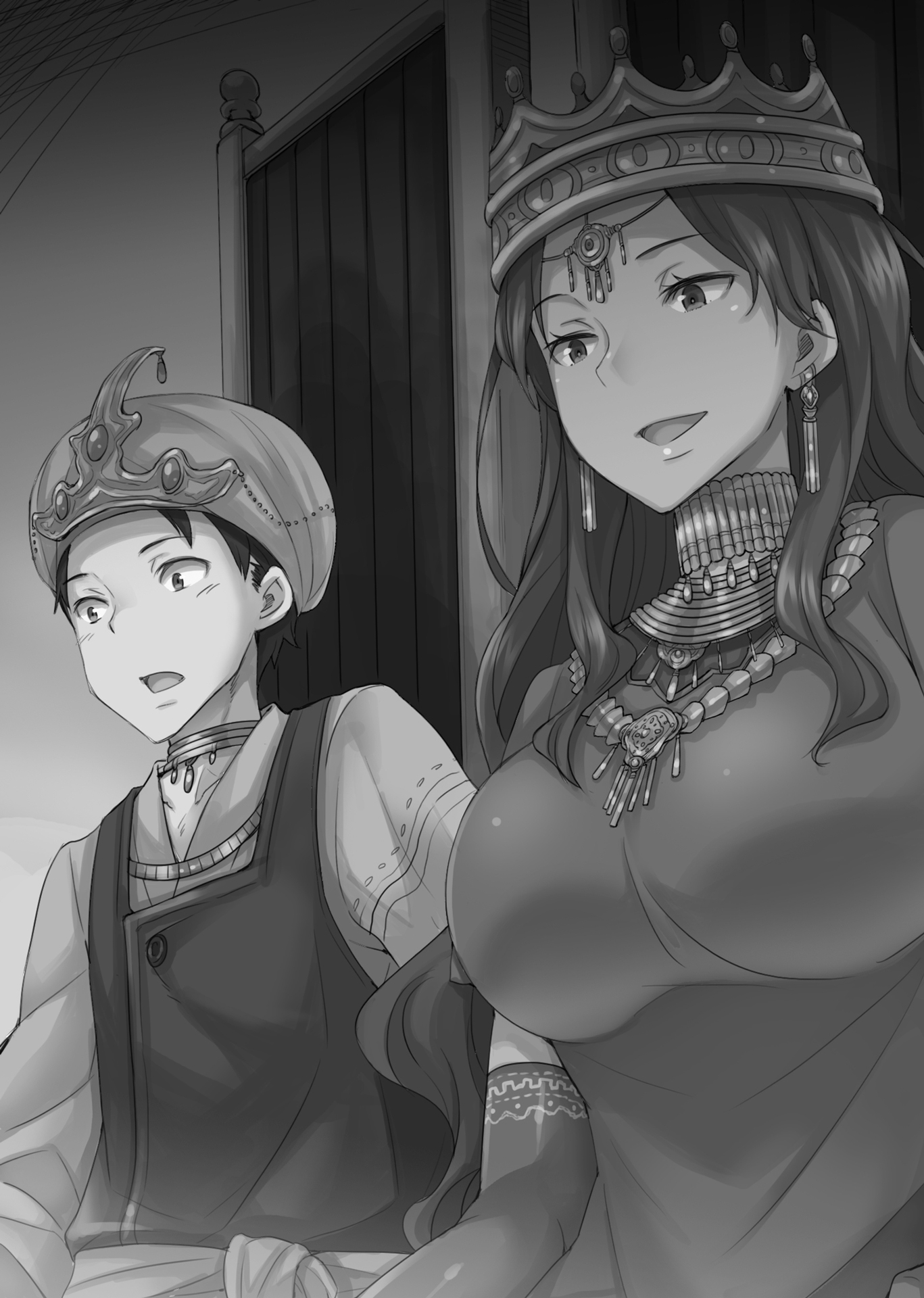
There was a multitude of people and a matching multitude of flames. They weren’t evenly arranged, so the points of light were irregular. Aura was quite right; there was a certain free beauty to it that brought the stars in the night sky to mind.
“Indeed. Most wonderful,” Zenjirou said, his tone that of a retainer in deference to his surroundings. “A right of the royals, I suppose.”
Despite his tone, Zenjirou’s gaze was glued to the “starry sky” below. His words were neither lip service nor flattery. He had been taken in entirely by the sight below them.
The phrase “right of the royals” was perfect for the situation. There was no law stating that one could not look at the festival from a great height, but such a thing was essentially only possible from this balcony over the courtyard of the royal palace. He could imagine a real risk that having a specially arranged chair next to the queen’s as he did, and looking down on these countless flames, could make him feel like the citizens were here to pay their respects to him.
Those many flames drove the night away, lighting up the capital. The Night of Flames was making a statement that the days of the year would be just as long, while the nights would be shorter.
However, the “day” and “night” in that statement didn’t simply refer to when the sun was in the sky or had set. They were metaphors. The day was a time of fortune, while the night was a time of misfortune. Fighting off the symbol of the darkness meant they would greet the morning in victory and invite fortune in for the coming year.
I must have seen this before. I just can’t remember it from last year... Zenjirou thought to himself, what with this being the second new year’s festival he had been around for. However, he soon remembered the reason. Oh, right. I was so stressed out last year, I couldn’t even recognize it was so beautiful.
The Night of Flames was a cornerstone, an event that royalty absolutely had to attend unless something extreme prevented it. But last year, Aura had been pregnant with their first child. Zenjirou had attended the event out of consideration for his pregnant wife, but it was no surprise he hadn’t managed to enjoy it.
His outfit was not the now somewhat familiar third formal dress he owned, but the first, and he could count the number of times he’d worn it on a single hand. His head was wrapped tightly in a turban held in place by something more than a mere brooch, and it was both heavy and extravagant, more like a crown.
The outfit was replete with jewels and golden thread, so it caught the light from the nearby candles and sparkled. A beautiful woman like Aura was one thing, but Zenjirou’s feelings that dressing a plain man like himself up in jewels and finery was nothing more than a bad joke were likely due to his lingering sense of values as an ordinary man in Japan.
He turned his gaze to his wife next to him, and she seemed to sense it, turning and smiling at him. Aura herself was in the queen’s equivalent of the first formal dress. She usually wore outfits derived from the Northern Continent’s fashions, but for formal occasions, she would wear the country’s native dress, which brought to mind traditional Southeast Asian clothing.
A deep crimson cloth was wrapped elegantly around her, and she wore even more jewelry than Zenjirou, so she sparkled as well. Her beauty and majesty almost made the glittering from the flames seem to come directly from her. She was practically the embodiment of the concept of a queen.
Realizing that her husband’s expression had relaxed as he looked at her, her smile deepened in happiness. Her steady effort against her drastically increased weight since Carlos’s birth had shown its worth, and she was back to the size she had been before. It was a refreshing feeling to not have the harsh shock of Zenjirou’s gaze upon her and instead be able to straighten up proudly in front of him.
While the main reason they were not immediately trying for a second child was the political slowdown that pregnancy caused, Aura couldn’t deny that at least a small part of it was due to not wanting to completely expose her wider frame.
My body is back to normal and Carlos is two now. Perhaps it would be best to seriously consider a second child, she thought as she moved her gaze from her husband to the sea of light below.
Carlos Zenkichi was, of course, absent. By Capua’s counting system he might already be two, but he hadn’t lived a full year yet and wasn’t even one year of age by the system used on the Northern Continent. More accurately, he was zero years and six or seven months old. There was a big difference between a baby being considered “one year old” when they were born, with their age increasing each new year rather than on their birthday, and being viewed as “zero years old” upon birth (as was done on Earth), with the age increasing on the anniversary of the birth.
This difference in methods caused the most issues when a child was young. When it was a difference between someone being twenty-seven or twenty-nine, there wasn’t a huge disparity. However, when the difference was two years old versus not even one, it could lead to real confusion.
Regardless, it seemed appropriate to start seriously thinking about a second child. Even if they started trying for a child right away, he or she wouldn’t be born until at least nine months later. In other words, Carlos and the second child would have an age difference of a year and a half by the Northern system—or depending on how quickly the new baby was born, one or two years by the Capuan system.
The timing made sense for a second child. With the number of holders of lineal magic being a direct correlation to a country’s strength, more children was better.
Naturally, however, it could also cause issues in regard to the line of succession.
Noticing that his wife’s smile had taken on a slightly salacious tinge, Zenjirou gave her a curious look. They were in the middle of the Night of Flames. A brief chat was one thing, but they couldn’t afford to neglect their surroundings and get lost in conversation.
Silence reigned between the queen and her consort after that as they quietly watched the gathered lights until the eastern sky started to grow lighter.