Chapter 2

August 4, AD 2092
Okinawa
Naha Airport—Beach House in Seragaki, Onna
Because of the rapid decrease in the planet’s temperature that started in the 2030s, the world’s crop situation had taken a turn for the worse. First World countries, thanks to advances in sunlight plants for agricultural production, saw only limited damage, but in newly developing countries, whose quick economic growth had been accelerating explosions in their populations, the impact had been devastating.
The place that faced the worst predicament had been northern China, where cooling and desertification had been happening at the same time. Those living in that region had tried to overcome the crisis with their own ethnic traditions. They did so through border-crossing emigration—in other words, illegal immigration.
Russia, however, decided not to allow an influx of illegal entrants. Even in the uninhabited wilderness, they aggressively eliminated any illegal immigrants who would have stolen the whole house if they were given any space under the eaves.
They used force, regardless of the blood they shed.
China censured Russia in the name of human rights, and Russia criticized China in the name of international law. Their antagonism didn’t stop at their borders, either; the same situation was repeated elsewhere.
Fuses were being lit all over the world. Its backdrop was the food shortage caused by the climate shift, but nations were scrambling for energy resources as well.
It only took a minor event for the clock to strike midnight. In AD 2045, World War III—the Twenty Years’ Global War Outbreak—began.
The years from 2045 to 2065 were a tumultuous era comprising large-scale national conflicts worldwide. It was a true world war, in which not a single country could remain as a bystander.
By the end of the war, the world’s population had decreased to one-third of what it was at the beginning of the bloodshed in 2045, to three billion people.
Russia reabsorbed the Ukraine and Belarus to become the New Soviet Union (NSU). China seized control of northern Burma, northern Vietnam, northern Laos, and the Korean Peninsula to become the Great Asian Alliance (GAA). India and Iran engulfed the central Asian nations to form the Indo-Persian Federation. The USA absorbed Canada and Mexico to become the United States of North America (USNA). And they all expanded. In contrast, the European Union failed to unite, splitting into an eastern and a western portion. In Africa, half of the countries were destroyed along with their states, while South America, Brazil excluded, had plummeted into a concatenation of microstates governed at the local level.
Thanks to the earnest efforts of an international group of magicians, the Twenty Years’ Global War, which changed the world so completely, didn’t escalate into thermonuclear war.
In AD 2046, the International Magic Association was born. Its goal was to forcibly prevent the usage of weapons with radioactive properties that would damage the planet’s environment beyond recovery.
For the singular purpose of preventing nuclear weapon usage, these magicians were permitted to break free of the shackles binding them to their own nations and intervene in conflicts using force. As soon as the threat of nuclear weapon usage became clear, even the magicians who had been killing one another on the front lines stopped their conflicts and worked together, regardless of nationality, to prevent it.
The prevention of nuclear arms usage was defined as the utmost priority for every magician in the world. The targets stated in the International Magic Association Charter were weapons that polluted the environment via radioactive substances. Strictly speaking, pure nuclear fusion bombs didn’t fall into that category. However, the technological situation during the war required small atomic fission bombs to ignite the nuclear fusion ones, meaning that all thermonuclear weapons were prohibited. Because of this, thermonuclear weapons weren’t used a single time during those turbulent twenty years of warfare.
The International Magic Association was recognized for this achievement and designated an international peace agency, an honorable position even in the postwar world…
Once I heard the announcement to fasten our seat belts, I closed the educational file meant for magicians titled “A Primer on Modern History.” It was a little hard for me to read, because I’d just started middle school, but I liked that; I wasn’t bored.
Someone once told me that it would take more than a few waves from digital devices to cause modern airplanes to have problems flying. But powering them down when the plane took off and landed was a customary show of manners. It wasn’t only me—the other passengers were turning their devices off, too. Nobody here was childishly rebelling against common sense.
Protective, egg-shaped shields came over the seats, displaying real-time images of the southern islands.
As I looked at the vivid greenery and the glittering sea, it made the global cooling seem like a story out of a novel.
But without a doubt, it had happened.
The planet’s climate had begun to warm again by the time we were born, but one could see several remnants from the cooling nearby.
For example, the dress code. The unspoken rule not to show much skin was clearly a remnant from when the cooling had reached its peak.
Well, I wasn’t interested in dresses that showed my shoulders or chest—they wouldn’t look good on me yet anyway—and it wasn’t like people demanded you wore skirts long enough that their hems would drag on the ground. Because I liked Japanese clothing, the rule didn’t restrict me at all personally, so whatever.
As I was thinking through these mundane ideas, the airplane made its approach to Naha Airport. There was almost no turbulence as we landed.
I unbuckled my seat belt—it didn’t mean anything; it was just there to be there—and opened up the shield on my capsule seat.
The normal seats farther back in the plane were packed in rows so tight that people’s elbows would bump together. I wouldn’t be able to tolerate an hour sitting so close to someone I’ve never even met.
After waiting for Mother to come out of her seat, we went to the exit together.
We were on a private family vacation during summer break. You might think family vacations were naturally private affairs, but for us, most of them weren’t, so I was in an uncharacteristically excited mood.
It wasn’t just me and my mother, though. If there was one fly in the ointment, it was that he was with us, too.

When we entered the members’ tea lounge in the arrival lobby, my brother was there, having brought our things.
We hadn’t made him do something else by himself to upset him or anything.
They let the passengers in executive class off the plane first. We would have priority in having our luggage returned as well, but we would still need to wait a short while. Because our luggage wasn’t ready immediately, having my brother, who was in normal class, go get the suitcases for us wouldn’t waste any time.
And there was a good reason he was in a normal seat by himself, too. The executive class seating was watched over by not only the normal cabin attendants but also security officers trained in de-escalation. If a crime were to happen, like a hijacking or a suicide bomber, it would be in normal class, where security was lighter. My brother had been given a normal seat as a precaution should the worst come to pass.
Nevertheless, even I understood that this wasn’t how normal families did things.
As I walked with my mother, I spared a glance over my shoulder. He was pushing the cart with our luggage on it with a natural air, accompanying us silently, without a grimace.
Just like always.
It wasn’t as though I hated him.
I just found him difficult to deal with.
I never knew what he was thinking.
Why was he okay with accepting the duties of a servant—no, being an actual servant—when he was part of the family?
I knew it was because this was the role he’d been given. And I knew our family was unique, too.
But he was still only in his first year of middle school, like me. He was born in April, and I was born in March. Born within a year of each other, our being in the same grade had been a coincidence thanks to the months, but it didn’t change that until this March, he’d been in elementary school like me.
Why was he okay with his little sister bossing him around—?
Our eyes met.
He must have started to wonder why I kept looking back at him.
“…What is it?” he asked.
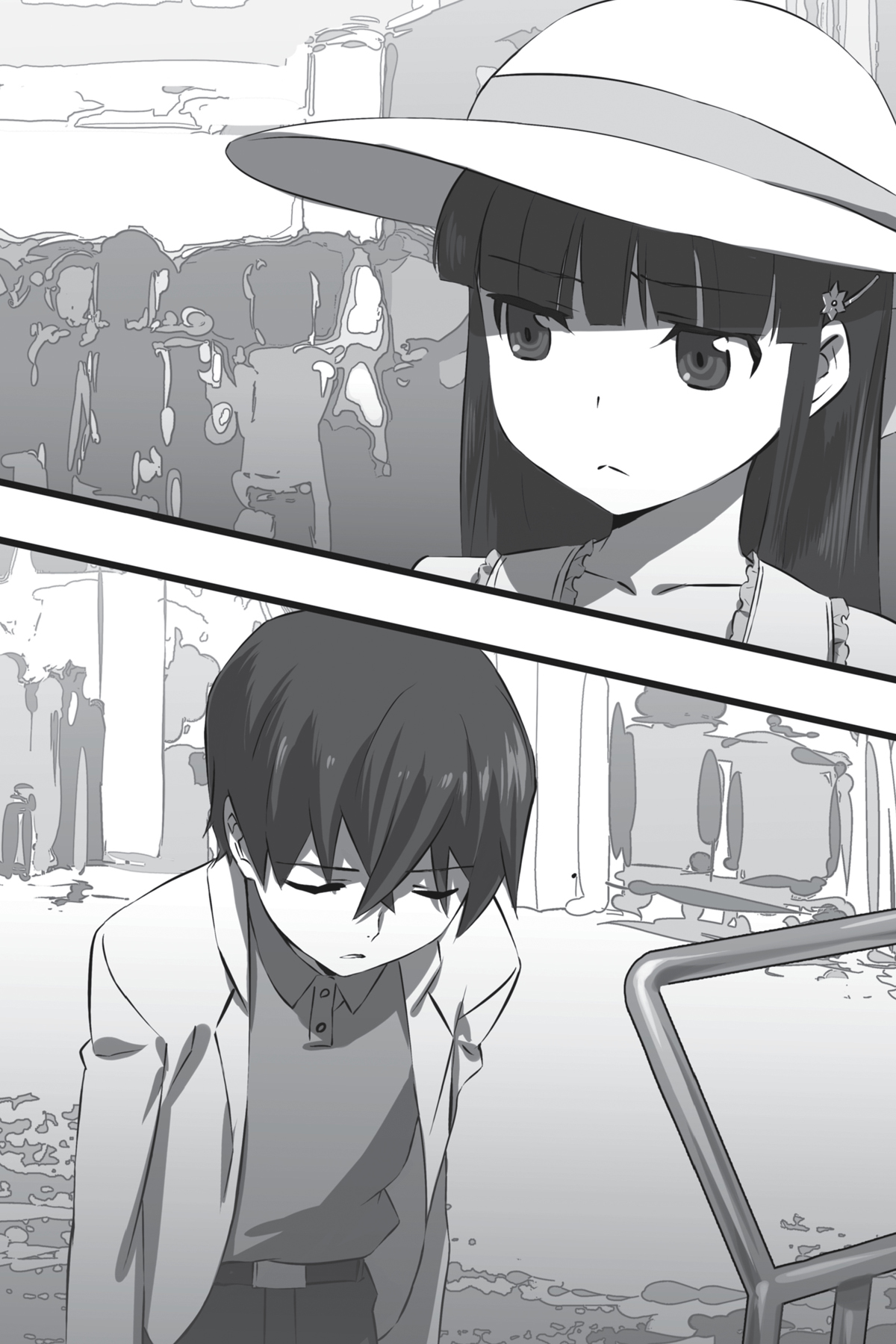
Logically, I knew that he’d looked at me because I’d been glancing at him. But the only thing that came out of my mouth was displeasure.
“It’s nothing.”
He had responded to me in a polite way, like a butler employed by a housemistress. No kindness or disgust, no fraternal love or familial animosity. Not one emotion a relative might have came to my brother’s face.
“Please don’t stare at me. It’s unpleasant!”
I knew I was being unfair. I was the one treating him like a servant. He hadn’t wanted me to do this. And yet, I used him as an outlet for my self-centered irritation.
“My apologies,” he said, stopping and bowing his head to me.
Then he continued to follow us, with slightly more distance than before.
Why? I thought. I was being selfish. I probably seem like a mean girl.
…I really didn’t know how to deal with him.

For this vacation, we’d be staying at a beach house in Seragaki, Onna, that we’d just bought. I would have been fine with a hotel, but Mother gets jittery when a lot of people are around, so my father arranged it in a hurry.
As always, that man seems to think he can buy love with money—even though he acquired that wealth by marrying Mother.
That man, I hear, was extraordinary when he was young, too. Even as a magician—because of his nonstandard psion capacity, people rated his potential abilities highly… But under the current magic skill system, psion capacity didn’t affect your magical talent anymore. In the end, he couldn’t make his potential ability into anything real, so he gave up on establishing himself as a magician. Now he’s an executive in the company Mother’s family made.
Because of all that, I understood why he felt a sense of inferiority when it came to Mother, but as his daughter, I wish he’d show a little more paternal reliability.
…I shook my head, driving the boring ideas from it. We’d come all this way on vacation, and I realized it would be foolish to let unpleasant thoughts bother me.
“Welcome, my lady. And Miyuki and Tatsuya as well—it’s good to see you.”
When we got to the beach house, Honami Sakurai was there to greet us, having come slightly earlier to do the cleaning and shopping.
She was Mother’s Guardian. Until five years ago, Miss Sakurai had been in the Security Police unit of the Metropolitan Police Department. They resisted her retirement quite strongly, but my family had decided before she started working there that she would be Mother’s Guardian. Going into the MPD was so she could learn the ins and outs of the escort business.
She was part of the first generation of the Sakura series of physically adjusted magicians, whose magic faculties had been strengthened through genetic engineering. She was created as a magician at a lab near the end of the Twenty Years’ Global War, and she was bought by the Yotsuba before she was born.
However, she was so bright and openhearted that you wouldn’t be able to guess she had an upbringing like that. Aside from her main duties as Mother’s Guardian, she also took care of many smaller tasks for her. In her words, the role of maidservant suited her better.
Normally, Guardians never left the ones they protected. She had because she’d come to the beach house in advance to gather local information, and my brother and I were with Mother anyway. Still, I wished the roles of Miss Sakurai and my brother had been reversed—but that wouldn’t have worked, since my brother couldn’t prepare a living space like that.
“Come in, all of you. I’ve already chilled the barley tea. Or shall I put on some hot tea instead?”
“Thank you. I’ll have the barley tea, since you’ve already made it.”
“Of course, my lady. Miyuki, Tatsuya, would you like some as well?”
“Yes. Thank you very much.”
“Thank you for going out of your way for me.”
If there was one thing I didn’t like about Miss Sakurai, it was that she treated my brother as Mother’s son—and as my brother.
And really, that was only natural.
But I couldn’t…do the natural thing.
At the time, I felt chagrined for no reason I could discern.
“Mother, I’m going out for a short walk.”
I wasn’t in such a hurry that I wanted to go swimming right after arriving, but it felt like a waste to stay cooped up in the beach house, so I decided to go for a walk. Manzamou was a little far to go to on foot, but I was sure it would feel good to take a nice, relaxing walk along the promenade on the beach.
“Miyuki, make sure to take Tatsuya with you.”
But after hearing Mother’s reply, it felt like my nice stroll had been spoiled before it could begin.
I would have greatly liked to say that I’d be fine on my own, but I didn’t want to cause her any needless worry.
“…I will.” It took everything I had to keep the edge out of my voice. I pulled a wide-brimmed straw hat over my head and walked out into the setting sunlight without looking back.
The sea breeze fluttering against the hem of my summer dress felt better than I thought it would. I had Miss Sakurai help me put sunscreen on all over, from my toes to my eyelids, so I could feel the wind on my arms and legs without worrying about the sunlight. My skin, covered in the brown cream, made me look almost the same as the local girls. Or so I thought anyway. Thanks to that, I suppose, people didn’t stare at me every time I passed, which put me in a good mood.
My skin had never been sunburned, and—not to brag—whenever I was at the beach or somewhere similar, it drew the wrong kind of attention.
…That honestly wasn’t a brag.
I still remember the shock I felt when I went with my elementary school friends to the pool, and they said I looked like a ghost. It was a casual remark, certainly not some kind of bullying or talking behind my back, which made it even more of a shock to me.
I was pretty sure it wasn’t because I didn’t have enough pigment in my skin. My hair color was very dark black, after all.
Maybe it was genetic? I was fairly sure there’d been no Caucasian blood in our family for the last five generations… Still, I didn’t know anything further back than that, so it could have been a really regressive gene, I suppose. But Mother got tan in the summer, too, and he was so tanned, you can’t tell if his skin was naturally brown or if he had bronzed or what. I didn’t think I could put it all down to bloodline.
“…”
I was actively trying to avoid thinking about it, but I thought about it anyway. I fixed my gaze ahead, overly purposeful in not looking behind me… Though as for what that purpose was, exactly—that question almost sent me into confusion.
I couldn’t hear his footsteps, even when listening hard. I couldn’t sense him, either—though, of course, sensing others’ presences was a feat and not one I was able to accomplish to begin with.
But I had no doubt that if I turned around, my brother would be there, a few steps back.
Because he was my Guardian.
I don’t really understand why they’re called Guardians with a capital G instead of just bodyguards. But even back then, I understood how the Yotsuba Guardians were different.
Bodyguard is a job—Guardian is a role.
Bodyguards risked their lives to protect someone and got money in exchange. Sometimes they did it as a full-time job, like in the Security Police, but of course that meant they received salaries in accordance with their duties. So I think, in a broad sense, it’s anyone who escorts other people to make money.
Guardians, in contrast, didn’t receive any monetary reward. The Yotsuba provided for all their needs, and if they needed money for something, the Yotsuba would supply it on a case-by-case basis. It wasn’t payment but a cost paid to keep the level of care high.
To put it simply, bodyguards worked in order to eat, and Guardians ate in order to work.
Guardians had no personal life. All the men and women who were Guardians were entirely dedicated to their escort, whom they called master or mistress.
My—our—clan considered that normal. If you couldn’t consider it as such, in the Yotsuba, you would have to drop out—though if it meant being called something embarrassing like mistress, getting thrown out might be easier. Fortunately for me, the names master and mistress weren’t as commonly used these days as the term Guardian.
He had become my Guardian when I was six. He was my first Guardian, and it probably wouldn’t ever change. He would live his entire life as the Guardian of the family’s main heiress, rather than as the son of the Yotsuba leader’s sister, and if and when I became the leader, he would live as my shadow.
As long as I didn’t release him from his duty as a Guardian.
Yes—in that one specific case in which a Guardian could be released from their escort, they could abandon their duties and live as a normal person.
He was following me.
He was chasing me from behind.
I couldn’t get away from him.
He couldn’t run away from me.
I was the one preventing his escape.
The one who couldn’t get away was him.
Even though I was the only one who could give him back a normal middle school life.
That person… He couldn’t be a normal middle school student because I couldn’t force him to quit.
I don’t know how to deal with my brother.
It’s not like I hate him.
Then, why was I tying him to this life of horrible treatment? I couldn’t find the answer. When I tried to think about it, my brain stopped working for some reason.
My eyes firmly fixed at my feet, I sped up the pace.
Since I was walking quickly with my head down, when someone grabbed my arm, I almost fell backward. A moment later, I felt a thud from in front of me and fell into his chest.
He didn’t complain.
I was the one at fault for not looking at anything—and the reason for my reflexive anger was a secret I didn’t have any intention of spilling.
The problem was that after my brother stopped me, I felt an impact in front of me. I hadn’t bumped into anyone—someone had clearly run into me. This was probably one of those cases where I had a right to be angry.
I looked up, indignation in my eyes. But all I saw was a thick wall of flesh. I raised my eyes farther. Finally, I saw the person who had collided with me.
A big man with black skin wearing a military uniform in a slovenly way—a Leftover Blood.
When the Twenty Years’ Global War escalated and the American soldiers (at the time, the country was still called the USA) stationed in Okinawa withdrew to Hawaii, they left children behind. Most of them had fathers who had died in battle, rather than being abandoned by their parents, but I believe many of them were taken into the JDF facilities we’d inherited from the U.S. military bases and ended up as soldiers.
They were lionhearts who carried out their border defense duties magnificently, and many of their own children became soldiers as well. However, warnings about those children—the second generation—were on private sites regarding Okinawan tourism, saying that many of them had bad behavior and to take caution around them.
Behind the big man were two other young men of about the same build, also wearing their uniforms loosely, grinning in an incredibly creepy way.
Reflexive anger gave way to instinctual fear. My mind cowered to such an extent that I couldn’t even come up with the obvious solution of using magic if I needed to.
…That is, until his back blocked my vision.
A child’s slender back.
But it was still bigger than my own.
Before I knew it, he’d hidden me behind him.
“What’s this? We got no use for little runts.”
The big man peered into my brother’s face, a completely condescending and derisive smile on his lips.
My brother didn’t reply.
“So scared you can’t even talk, eh?”
“Ha, what a chicken. Quit tryin’ to act cool!”
The two people in the rear smirked and tried to intimidate him.
Anger rose again in my heart. But this time in a much clearer form. I regretted not having brought my CAD with me. I wasn’t good at holding back without a tool to assist me. If I badly hurt people like them, I’d be in trouble in a few different ways.
But if only I had my CAD, these jerks wouldn’t babble on however they wanted!
Without actually knowing what I was getting so passionate about, I turned a sharp glare on the big man standing in my brother’s way.
The man looked at me and narrowed his eyes coolly.
His lips moved.
I wouldn’t learn whether it was to smile or to talk.
“I’m not looking for an apology, so turn around and walk away. For all our sakes.”
His tone was rather calm for a young man, and his words were completely unexpected from a child. The big man’s face hardened.
“…What was that?”
A low, rumbling, whispered question.
“I believe you heard me.”
An impassive retort, almost a monologue.
A dangerous light came into the man’s eyes. “Rub your head against the ground and beg our forgiveness. If you do, we’ll let you off with a few bruises.”
“You touch your forehead to the ground when you grovel, not your whole head.”
A moment later:
Without any signal or warning, the man threw a punch at my brother.
Despite having a large frame compared to others his age, my brother was still in his first year of middle school. They were like a giant and a dwarf.
I shut my eyes.
There came a psh.
I finally realized that if he punched my brother, I’d be hit, too, since I was right behind him—so I was mystified when that didn’t happen.
I nervously opened my eyes.
The first thing I saw was a frozen expression of disbelief on the big man’s face. I didn’t need to worry about what was making him do that. His right arm was half-extended.
He had stopped the oncoming fist in his hands.
It was two hands against one, but that shouldn’t have made a difference considering their weight classes.
The attacker must have been at least twice that boy’s weight. And yet, my brother had stayed firmly in place, not turning aside the man’s punch but stopping it outright.
Did he use magic? …No, there was no sign of it.
Leaving aside academic ability, physical strength, and movement ability, I was better than my brother when it came to magic. I couldn’t have missed him using it.
“Now, that’s something… I was just fooling around before, but now…”
The big man smirked, drew in his arm, and put his fists in front of his chest.
Boxing?
Karate?
I was a complete amateur about combat sports and martial arts, so I couldn’t tell the difference. But I did glean that the man, mostly joking before, was now serious.
The thought of escape slipping from my mind, I watched the big man from behind my brother’s shoulder. As I held my breath in silence, I heard something from him I never thought I’d hear:
“You sure about this? Any more and you might get hurt.”
Why was he provoking them?! He would never win in a normal fight. He should be running away.
No, it didn’t matter what he was thinking. I should be running away—by myself, if I had to.
…But despite thinking as much, my body wouldn’t leave its space behind him.
“For a runt, you can sure talk the talk!”
My eyes couldn’t follow what happened after that.
All I saw was the result; I could only guess what took place before it.
The man had stepped forward with his left foot.
So had my brother, his foot thrust between the man’s two.
The adult’s right hand was drawn back near his shoulder, as if he was about to throw his punch.
Then my brother’s left fist was in the middle of the man’s chest.
The slight gap in the man’s defenses wasn’t because he was about to throw a punch—his attack must have bounced back like that.
The drumlike pounding noise had probably been my brother’s fist. When he pulled his front foot back, the man, as if they’d arranged it this way, sank to his knees on the road with a painful-sounding crack.
My brother looked down at the fallen attacker as he coughed in pain, then slowly moved his gaze to the two in back.
They stood there, motionless.
My brother turned his back to them.
“Let’s go back.”
He put a hand on my arm.
It was only then that I realized he’d been talking to me.
“Miyuki, has something happened?”
When we came back from my interrupted walk, Miss Sakurai’s face paled and she hurried over to us at a trot. I didn’t think my face was that bad, but I knew it was a little white, so I gave up right away on trying to deceive her.
“Just…um, there was a man, and…”
“My…!”
That seemed to be all Miss Sakurai needed to figure most of it out. She casually looked me up and down, probably checking to see if my clothing was disheveled.
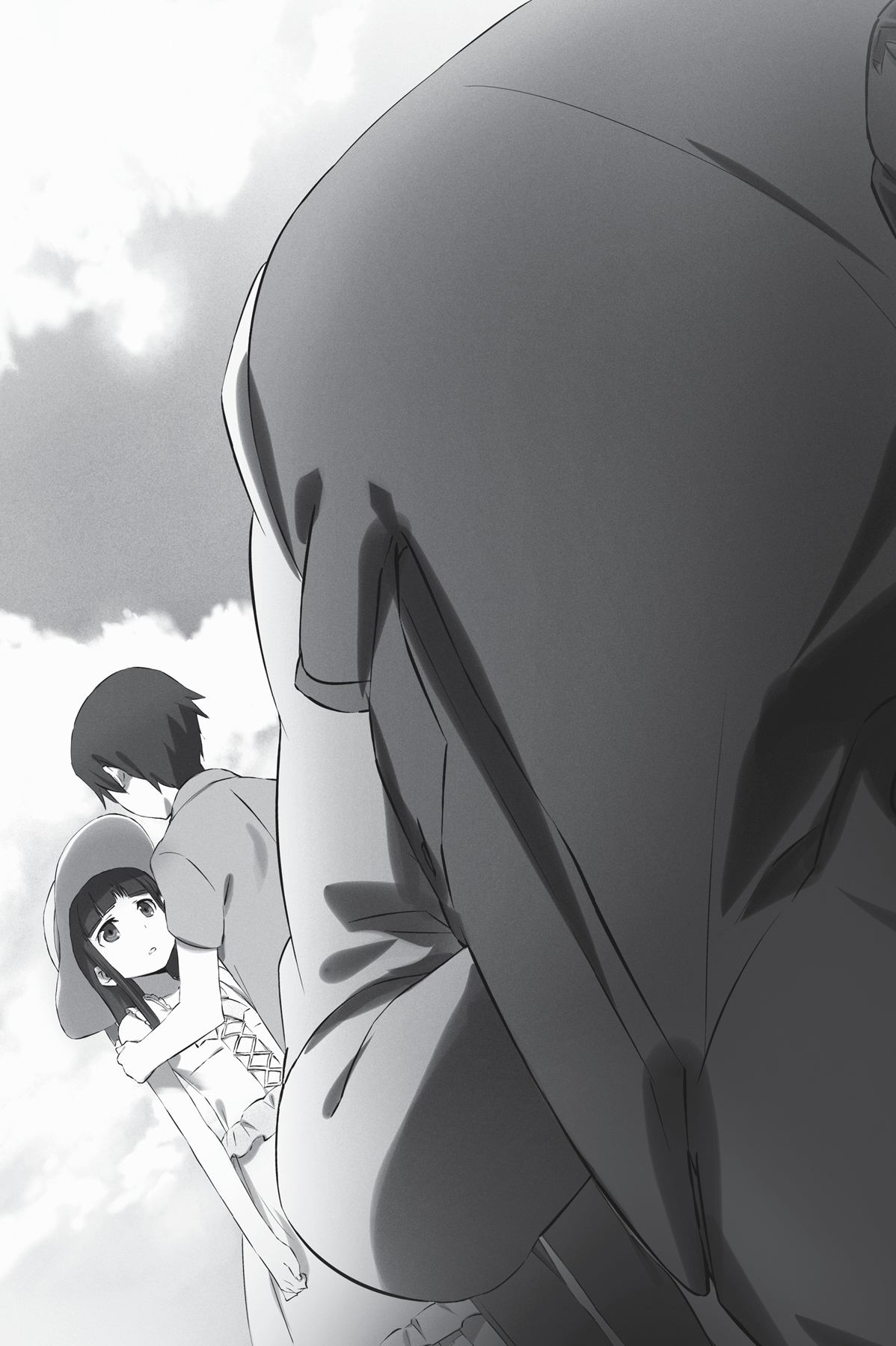
“Everything’s okay.”
I had to force it, but I attempted a smile. When Miss Sakurai saw it, she smiled back at me in relief.
But my forced smile didn’t last long.
…Because my brother saved me.
Those words never made it out of my mouth.
I glanced at him, meaning to say it, but he was feigning ignorance, his face as impassive as always. He bowed lightly to Miss Sakurai, and then, never even sparing a glance in my direction, he retreated into a room.
The smile I’d struggled to make was on the verge of breaking down.
“…I’m going to take a shower to wash off my sweat.”
I wasn’t sweating very much, but with that as my excuse, I fled into the shower room.
The hot shower water sprang off my skin.
I didn’t even bother to get the sunscreen off. I only felt the water’s heat, trying to warm my body, which seemed about to start shivering.
“Why…?”
I put my head under the stream. The hot water ran down my face, mixing with other drops when they got to the corners of my eyes.
“Why am I crying…?”
A confused voice came to my ears. Not a crying voice—almost like a complete stranger’s.
“Why do I have to be crying?” I shouted hysterically but got no answer. I was the only one here.
“Why…? Just why…?”
All I could hear was the shower. Nobody would answer my question for me.