Chapter 13
Tuesday, April 24. On the day of Tatsuya’s birthday celebrations with Miyuki, Takuma Shippou had just returned from a tête-à-tête with Maki Sawamura, his ally in aiming for a new order.
The time was already 11:00 PM. He’d eaten out so that he wouldn’t bother those in the house (including the servants), and he’d given advance notice of it so that they wouldn’t worry about him. Most of the live-in servants would already be asleep in their chambers, so he entered the house quietly through the back door so that he wouldn’t wake them up.
“Takuma?”
But as soon as he’d removed his shoes, a man slightly older than he addressed him. He’d been waiting.
“The professor is waiting in the study.”
“The professor” was the head of the Shippou, Takumi Shippou. This young man before him now was his father’s aide, probably ordered to wait for the son’s return. What a pain, he thought, but he couldn’t ignore it. With an “All right” to the servant, he headed for the study.
Publicly, the Shippou family business was investment advising, and they specialized in the field of weather derivatives especially. More and more agricultural work was being done in factories, diminishing the role of weather derivatives in the food industry, but on the other hand, sunlight-based energy had finally achieved the status of most-used power supply in advanced nations, and daylight prediction had now been established as a major factor in corporate earnings programs. Another reason Takumi Shippou was called professor was that he was acknowledged as the leading expert in annual weather forecasting in Japan.
But right now, the Takumi Shippou whom Takuma was facing was the leader of one of the Eighteen Support Clans and a magician with magical faculties rivaling those of the members of the Ten Master Clans.
“Take a seat,” came the voice as soon as he entered the study.
Takuma sat down on the lounge-suite sofa, positioned apart from the imposing desk his father used, which was part of the same set.
Takumi stood up from his desk and sat directly across from his son.
“Takuma, how is school going? Are you having fun?”
He called me at a time like this to make small talk? Takuma wondered. He understood this was a preface, but his irritation won out over logic.
“Dad, I keep telling you that high school isn’t a place to have fun for me.”
His father looked like he wanted to sigh. “You’re so obstinate. You don’t need to try and look big and tough about it.”
“No, you’re just too carefree about it!” Takuma’s irritation erupted. “The next Ten Master Clans Selection Conference is in only a year. At this rate, those opportunistic Saegusa will snatch away our position among the Clans again, and the Shippou will have to put up with being subordinate to them!”
“The Selection Conference is to choose ten families from the Twenty-Eight.” A feeling of vain effort seeped through Takumi’s voice in spots. “I know you understand there’s really no point in being obsessed with just the Saegusa, Takuma.”
This wasn’t the first time Takumi had told him this. In fact, excluding days where he didn’t see his son at all, he realized he’d been telling him something similar every day for the last year.
“There is a point.” And yet Takuma had never accepted what he had to say.
“The Saegusa are only one family out of the Twenty-Eight.”
“They’re different.” His attitude was just as stubborn today.
“Takuma!”
“They’re not the same. The Saegusa are different.”
Takumi let a tired sigh drift into the air. “Who on earth planted this mistaken obsession in you?”
“It doesn’t matter who! Anyway, the Saegusa betrayed the three and stole the results of the seven in order to gain their current position!”
“Takuma…the Saegusa’s number changed from Three to Seven before the Ten Master Clans system was put into place. By the time the Old Master put forward the new system, they were already the seven grasses Saegusa, not the three branches Saegusa. And their abilities at the time outclassed everyone else in the Twenty-Eight.”
“Outclassed? But their abilities are just from stealing research from Labs Three and Seven. They were Lab Three’s best and final test subjects, but they broke out. The Shippou were involved in the colony control development ever since its basic, theoretical stages—but then the Saegusa came in right before it was complete, and even though they only contributed a little bit, they took advantage of it and acted like they owned the place. It’s not just the Shippou family—it’s the Mitsuya, the Mikazuki, the Tanabata, and the Nanase, too! The Saegusa are making fools out of all of us! How can you possibly be okay with that?!”
“Takuma, Saegusa’s magicians were test subjects just like we were,” asserted Takumi bitterly, causing his outraged son to be at a loss for words for once. “Created beings, just like us. But even though they had to put up with being guinea pigs, they chose their own path, unlike the other twenty-seven—no, twenty-six. That isn’t something they should be criticized for. It’s something they should be praised for.”
“…Are you saying that betrayal and clever plots are praiseworthy acts?” managed Takuma in reply.
“Aren’t you trying to outwit the current Ten Master Clans, too?”
“But that’s…!”
But his argument came right back to him like a boomerang that had missed its target.
As his son fell silent in frustration, Takumi exhaled slightly. “Well, fine. No matter what I say, I know it’s not going to convince you.”
Takuma’s denunciations and Takumi’s persuasions hadn’t just begun today. As already mentioned, this same sort of conversation between the father and son had repeated itself dozens of times in the past. But they couldn’t resist arguing about it—a paradoxical indication that their father-son bond couldn’t be severed.
“I called you for something else today.”
“…In the middle of the night?” said Takuma, mustering the strength to roll his eyes.
“I needed to tell you today. Look, the next time you stay out this late, let me know your plans beforehand. I would have told you right when you got back from school.”
But that, too, was a self-destructive act on Takuma’s part. “…Sorry.”
“You don’t need to apologize to me, but go say sorry to your mother. She should still be up.”
Crap, thought Takuma, his eyes wandering.
His father ignored him and got to the point. “Takuma, I want you to stay home from school tomorrow.”
“Dad? What are you talking about?” His dubious look wasn’t affected. He was actually suspicious now.
“Mr. Kanda, a Diet member from the opposition party, is visiting First High tomorrow to observe.”
Takumi, predicting that his son would question this, revealed his reasoning without putting on airs.
“Kanda—the humanist, anti-magician activist?”
“Yes. Along with his entourage of reporters.”
“Why?” asked Takuma, but he actually did have a guess. Considering Kanda’s words and actions that had been stirring up the media recently, he had a good idea of what he wanted to do by coming to First High. Takuma’s question had been for confirmation alone.
“He probably wants to put on a performance to make it look like he’s protecting the human rights of young boys and girls being forced to do magic.”
“Human rights?!”
Takuma might have known, but he couldn’t help blurting out like that. The words He should mind his own business were written all over his face.
“I know what you want to say, but he is a Diet member. We shouldn’t cause problems.”
Takuma’s face grew irritated again at this, but in a different way from last time. “I might not like him a whole lot, but I wouldn’t pick a fight with him without thinking about the consequences. I’m more grown-up than that.”
“Even if he were to pick a fight with you?”
“…Of course not. I’d never get riled up that easily.”
Tatsumi relaxed and leaned more deeply into the back of the sofa. “Then fine. You’re adamant about this, so you get to take responsibility.”
“I know that! Are we done?”
Considering how he recoiled at every word meant to warn him, anyone, not just Takumi, would have doubted that Takuma really wouldn’t get riled up.
“Takuma, Master Saegusa will deal with this matter. I don’t want you getting involved when you don’t need to.”
But Takumi’s words weren’t caused by his unease at his son’s attitude—they’d been specifically timed.
“Saegusa?!”
As usual, Takuma gave a violent rejection.
“Don’t get involved. You’re responsible for what you say.”
But the promise had already been made.
“The Shippou family will not interfere in this matter. Understand, Takuma? This is final.”
He had no way to go back on his previous statement at this point.
“…All right, fine!”
He had no other answer available to him.

For most First High students, the guest was unplanned for, and probably to almost everyone related to First High, he was unwelcome.
Ten men and women had intruded in three pretentious black-painted vehicles.
The group included Diet member Kanda and his secretary, his entourage of journalists, and his bodyguards.
It was the middle of fourth period, the first class of the afternoon, when they suddenly asked for a meeting with the principal. Without any appointment, of course. Normally the staff might have politely declined and asked him to leave, but with his Diet member badge on, he could force the issue anyway. This was no different from how it had been in the previous century.
Yaosaka, vice principal of First High, met Kanda with a bitter look as the Diet member ignored manners and demanded a meeting.
“Mr. Kanda, as I’ve already explained, Principal Momoyama is on a business trip to Kyoto today and is absent. Would you be able to come back again once the principal is in?”
“Ho. You would tell me, Kanda, to come back later as if I were some child?”
“I never implied anything of the sort.”
“Then you’ll do just fine, Vice Principal. I would like to observe some of the classes going on at your school.”
“I cannot admit you on my own authority. I will still have to directly request this of the principal.”
Kanda and Yaosaka were both in their early fifties. At just a glance, Kanda would appear younger, having special makeup professionals and stylists on hand for his television appearances. But when you got up close and really looked, you would see an age-appropriate fatigue in him as well. Of the two men, one argued vehemently from his high horse, and the other, sweat forming on his brow, endured it without arguing. It was a common sight in society, but this iteration seemed somehow comedic.
Also, Kanda had known from the start the principal was away. It would be more correct to say he’d made his intrusion for that precise reason.
First High’s principal, Azuma Momoyama, was currently seventy-one years old. This was his eleventh year as the school’s principal. Along with his fame for great contributions to higher education curricula for magicians, on the flip side, he was also criticized for leaving the discriminatory treatment of Course 2 alone, and even having provoked the emotional antagonism between the two courses. Of course, the only voices accusing him of such provocation were those of backbiters. Azuma Momoyama was an authority in not only magic education but higher education in general, and he had widespread contacts in both worlds. He was someone even Diet member Kanda wouldn’t want to take on directly.
Kanda had aimed for when Momoyama would be absent, wanting to make his performance a success, and Yaosaka wanted to stop the media from gathering info using the principal’s absence as a shield. Their quarrel continued, time drifting onward with Kanda’s position of superiority never changing. If they ran out of time like this, the result would be just what Vice Principal Yaosaka was planning for. From Kanda’s point of view, he would have won the battle, but lost the war. Just as he began to grow impatient and tried to force his way through, a bell whose sound was modeled after a carillon’s began to blare through the principal’s office.
At the same time the sudden bell rang, the wall-mounted display projecting a famous Impressionist landscape painting blacked out. Immediately, the screen switched over to a clear, real-time video feed.
“Principal?! Is the conference over?”
The one who appeared on the screen of the videophone that could forcibly be switched to a receiving state from the sender’s end was Principal Momoyama, who was supposedly in a conference at the Magic Association.
“I had them make a little time,” he answered shortly to the vice principal’s question.
His eyes swiveled to Kanda. The way the cameras fitted at the four corners of the display calculated positional relationships created for the viewer the illusion that the person on the other end was physically present. Receiving Momoyama’s gaze directly, Kanda shifted uncomfortably.
“And you, Mr. Kanda. What might you be here for?”
Momoyama, in the computer screen, wore his pure-white hair tied back into a knot, and the lower section of his face too was covered by a completely white beard and mustache. The area around his eyes that wasn’t covered by the beard was buried in deep wrinkles, through which one couldn’t pick out subtle facial expressions. Nevertheless, the piercing light coming from within his sunken eye cavities unmistakably displayed anger at the rude visitation.
Kanda’s reply was a withdrawn one, a complete change from when he’d been talking to Yaosaka. “Oh, well. I do apologize for having intruded without clearing my plans with you first—”
“If you understand that, then might I ask you to come back another day?” interrupted Momoyama, keeping the end of his sentence steady as he made his demand: that Kanda go home and come back later.
As he was the one responsible for the entire school, the principal’s request that Kanda come when he was present was certainly logical. Kanda almost accepted out of reflex, but when one of his journalist entourage whispered, “Mr. Kanda, Mr. Kanda!” to him in haste, he barely managed to hold out on the edge of the ring.
“I would heartily agree with what you’re saying, but there’s an idea on my mind as well.”
“Is there?”
Momoyama urged him on with a harsh stare. Despite being separated by a screen, Kanda was clearly on the defensive, but his tongue continued its wily motions.
“As of late, there have been disquieting rumors circulating society regarding the curriculum at magic high schools. They wonder if the nine schools are brainwashing their students into becoming soldiers.”
“That’s absurd,” spat Momoyama, displeasure plain to see.
He was First High’s principal, and not in a position to speak for all nine schools, but the curriculum he’d formulated for magic high schools was being used at the other eight as well. He took great pride as an educator in the magician-fostering programs he’d created.
“Have you not seen the breakdown for advancement for students at our school, Mr. Kanda? Last year, for example, sixty percent of our graduates went on to Magic University. Less than ten percent advanced to the Academy of Defense.”
Momoyama counterattacked by presenting clear-cut numbers. But Kanda gave a hint of a smile to the argument, as though he’d been waiting for it.
“But when you look at National Magic University’s graduation paths from last year, forty-five percent now work in the armed forces or related organizations. If you tally up the students who went straight to the Academy of Defense out of high school, you can see that a majority of students who have studied at a magic high school are now working with the military.”
Kanda’s got you look barely even made Momoyama budge. “And those were paths chosen by the students themselves. They’re fully fledged adults by their final year of university. What effect would purposely trying to sway their decisions even have?”
“Perhaps.” For some reason, Kanda nodded deeply to Momoyama’s reasoned argument. “I think you’re right about that, Principal. And that is precisely why I arrived at the conclusion that I’d like to observe the classes—in order to wipe out the irresponsible impression people have that magic high schools are an agent organization of the JDF.”
Between the lines, Kanda was implying that he’d then spread whatever image he wanted regarding magic high schools. Momoyama was a masterful man, and saw right through his thinly veiled intent.
“It isn’t so easy. Classes where magic is practiced are delicate ones. If you were to suddenly barge in, you would throw the students into confusion.”
“I would never be a nuisance.”
At this point, Kanda’s attitude had turned into a high-handed one. He’d regained his pace—or rather, was growing stubborn, unable to let himself lose to Momoyama in an argument.
“…If you insist, then I will allow it.”
After pretending to think for a moment, Momoyama turned around and said that. As Yaosaka looked on, a look of surprise mixed with doubt on his face, Momoyama continued preemptively.
“However, you may only observe fifth period.”
“I— No, that would be fine.”
The condition was unexpected, and Kanda almost raised an objection out of reflex. But he’d just told the principal he wouldn’t be a nuisance. He couldn’t object now.
“Vice Principal, which classes have an experiment planned for fifth period?”
Pretending not to notice Kanda’s mental conflict, Momoyama posed a question to Yaosaka.
The blend of surprise and doubt within Yaosaka changed to be only 10 percent doubt. He didn’t need to ask—Momoyama was fully aware of all classes for all grade levels at all times.
“There are no classes planning an experiment in fifth period.”
Nevertheless, in his position, he had to answer the question now, not make a suggestion of his own. He answered exactly what he’d been asked.
“However, while it isn’t part of the regular curriculum, students from 2-E plan on conducting an extracurricular experiment, which they’ve put in for, in the schoolyard.”
“There you have it, Mr. Kanda. I believe it would be a good idea to come back another day after all.”
“But that’s—at least allow me to observe the rest of fourth period!”
If he rearranged his schedule to come back at a later date, it would allow Momoyama time to shore up his defenses. The principal had friendly relations with even the top echelons of the Civil Rights party Kanda belonged to. He’d barged in as a surprise attack out of fear of Momoyama’s influence, and if he had to regroup, he’d lose that advantage.
Standing his ground was a calculated move, but he’d already given his word.
“Mr. Kanda, microphones and cameras during practice would ruin the students’ concentration. At worst, that could mean a student experiences a magic failure and suffers irreparable damage. I don’t think you wish for that to happen, either.”
Kanda was, after all, not knowledgeable when it came to magic. He had no grounds on which to reject Momoyama’s words. His pretext was that he was for the students—he couldn’t force his way in now that he’d been told it could bring the students’ future to naught.
“…All right,” he said, frustrated. “Could you let me at least observe this extracurricular experiment, then?”
“I suppose. Vice Principal, call Mrs. Smith and have her show Mr. Kanda where it is, please.”
Without seeming especially proud of the victory, Principal Momoyama gave Vice Principal Yaosaka those instructions and hung up.
Fifth period began, and as they were led to the in-preparation radiation lab by Jennifer, one of Kanda’s group of journalists spoke to him in a hushed tone.
“Doesn’t this seem strange, sir?”
“What?”
What came back from Kanda was a clearly angered, irritated voice, but the journalist continued nevertheless. “The fact that there’s no practice going on. It’s almost like they knew we’d be coming.”
“No…it was a coincidence. They couldn’t have known about what we were doing. We never even reported it to the party, after all.”
“I’m just saying all this has been a little off since the beginning. Usually just planning to do any magic-related reporting gets interference about this or that, but for once nobody’s come to us to say anything.”
Kanda was about to argue that it only made sense, but instead he fell silent. Nobody from the Magic Association had interfered with this little performance because someone had pulled some strings in its upper echelons. They’d kept their name a secret, but Kanda had a decent guess as to who it had been. When he thought about it again, however, there was indeed something about it that didn’t sit well with him.
Kanda was acting as an anti-magic activist, but that didn’t mean he considered magicians inhuman creatures. He truly acknowledged the benefits of magic. He was simply preaching anti-magic sentiments as a political talking point in front of the press. To put it in more blunt terms, he was attacking magicians to please the masses. Whoever had manipulated things behind the scenes to prevent interference into today’s news coverage (which was what they were calling this political propaganda) would have known that, so he’d figured they were giving tacit approval of his play to the crowds so as to not let a politician who actually loathed magicians rise to power.
But was that alone enough to excuse his anti-magic performance? Sure, the person he had in mind might have wanted to take advantage of his carefully calculated political plans. Still, there was no guarantee all the Ten Master Clans thought that way, and this person wasn’t an absolute ruler among them anyway.
As he was mulling things over, leaving the journalists to their unease, the party arrived at the radiation laboratory.
After entering the radiation laboratory, Kanda’s group just stood there, feeling unfriendly gazes on them. The students who had been preparing for the experiment had turned icy stares on them as though they’d known they were coming. But it only lasted for a short moment before they refocused on their work as if they had never noticed the politician and his troupe of journalists, leaving both Kanda and the reporters wondering whether those stares had been an illusion or not.
“Mrs. Smith, who is this?”
The only one who addressed them—the only one who displayed clear interest in them—was Tsuzura, the teacher overseeing the students’ work.
“This is Mr. Kanda and his journalists. They’ve come to our school to observe.”
“An esteemed Diet member is one thing, but why does he have all these journalists with him? They should have needed permission to do news coverage inside a school. I haven’t heard a word of any such thing.”
Hit by an unexpectedly strong stare from someone who appeared at first to be a gentle, scholarly man, Kanda very nearly winced.
“The principal gave them permission.”
Thankfully, he didn’t need to reply to Tsuzura. Jennifer answered his doubts instead.
“I thought the principal was on a business trip.”
“He made time, apparently, and called here.”
“I see.”
Tsuzura seemed easily convinced by the scant explanation, and Kanda and his reporters found themselves taken aback. But convincing himself that this would make his job easier than if Tsuzura had been hostile toward them for no reason, Kanda turned to the teacher. “Please pardon the intrusion during class.”
“Actually, this isn’t my class.”
But suddenly, his start was spoiled. He heard someone snort softly, but when he looked over, all the students were continuing their work with serious looks on their faces, so he couldn’t tell who had laughed. Suppressing the unfocused anger with willpower, he tried talking to Tsuzura again.
“This is extracurricular, right? What is all this, exactly?”
“The students are conducting an independent experiment not in the curriculum.”
Tsuzura’s answer was one of feigned ignorance. (At least that was how Kanda felt.) The politician had to take a deep breath to keep his irritation inside.
“What kind of experiment are they trying to do?”
That question came from one of the journalists. Tsuzura directed a stinging gaze at the reporter, probably because the man hadn’t introduced himself. But neither an answer to the journalist’s question nor an inquiry as to the journalist’s identity were carried out in this place.
“Mr. Tsuzura, we’re finished getting ready. May we start the experimental device?”
Isori, the de facto leader of this experiment, addressed Tsuzura, and the conversation between the journalist and Tsuzura was cut short.
“…Yes, go ahead.”
When Tsuzura gave permission after scanning the checklist Isori had sent him on his A4-sized information terminal, a support member of the robot club flipped a switch on the wall as though he’d been waiting for this moment.
Kanda managed to keep his face straight, but his journalists’ eyes ballooned almost comically.
The radiation laboratory wall silently began to open.
It was just a passage to bring in large equipment, but the way part of the wall in a windowless laboratory opened up made the place seem somehow like a secret base.
Of course, the only ones who felt that way were the outsiders. The students, used to this gimmick, didn’t wait for the wall to open all the way before they began to push in a spherical water container two meters across filled halfway with a mixture of heavy water and light water (the other half was filled with water vapor) and the stand it was on. To be fair, the stand’s casters had motors on them, so they didn’t have to use strength to move it so much as just guide its direction. The students filed into the courtyard, and Tsuzura followed after them.
“We should go as well,” said Jennifer. Diet member Kanda and the journalists hastily followed after her.
“Come to think of it, why are they conducting an experiment that isn’t part of a regular class during class time? Does this happen often?”
“No,” answered Tsuzura indifferently to the question from a journalist who had caught up to him. Still, even he seemed to think that one word was too unkind, so he soon gave additional information. “We originally planned to do this experiment after school. But when the staff learned about it, a lot of them wanted the students they were in charge of to observe it as well, so we stopped all practice during this hour so that the students who wished to could freely come and watch. That’s why we’re doing the experiment in the schoolyard.”
“A student proposed this experiment, right?” asked another journalist, mystified.
“Well, this experiment has a lot of academic significance and practical significance both.”
“When you say practical, do you mean this will relate to weapons development that can bag entire enemy fleets at once like that secret weapon used for the Scorching Halloween?” asked one of the journalists with a snide grin.
Tsuzura turned a cold gaze on him. “This experiment is to challenge one of the Three Great Practical Problems of Weighting Magic,” he replied, walking over to the students gathered around the spherical water tank.
When the journal gathered himself and tried to interrogate Jennifer this time, she spoke first instead. “They’re starting.”
Perhaps because of their occupational awareness as members of the media, their attention was drawn to the experimental device fixed near the center of the schoolyard, slightly closer to the building.
The experimental stellar reactor had a simple construction—a spherical water tank placed on a stand. The pump had already been removed in the radiation laboratory. Around the water tank’s equator was fitted a metal ring fifteen centimeters wide, with four support pillars. The water outlet at its uppermost point was shut with a disk thirty centimeters across, and another disk was attached to the opposite pole.
A crowd of students watched the experimental device from the windows of the school building. Most classrooms weren’t getting through classes normally, and because that had been anticipated, the faculty room had suspended all practice during this hour and switched to classroom learning via terminal.
The students who couldn’t be satisfied just seeing things from the windows came out into the schoolyard. Class 2-E in particular was fully present at the scene, including the students who hadn’t taken part in the experiment. Aside from them, the other members of last year’s Class 1-E and the female representatives of last year’s Nines were all in attendance. It wasn’t only students, either—there was no shortage of teachers here.
“We’re starting the experiment.”
The announcement over the megaphone came from Tatsuya. The students gathered in the schoolyard stopped their conversations and fell deathly silent. As students and teachers alike waited with bated breath, Tatsuya gave the signal to begin.
“Gravity control.”
Miyuki activated the gravity-control spell. A gravitational field, defined only with direction and no range limitation, emerged within the water tank, and the mixed-water solution created a hollow cavern in the middle as it stuck all around the inside of the tank.
“Fourth-phase shift.”
Kasumi and Izumi activated the phase-shift spell—a dispersion-type one. The spell would move the liquid into the fourth state of matter: plasma. Deuterium plasma, hydrogen plasma, and oxygen plasma emerged from the surface of the water facing the cavern Miyuki’s gravity-control spell had created.
“Neutron barrier, gamma-ray filter.”
Minami inserted a neutron barrier between the two spells, the gravity-control spell and the fourth-phase shift spell. The neutron barrier was, as its name implied, a spell for creating an energy field that repelled neutrons.
On top of that, Honoka inserted a gamma-ray filter between the neutron barrier and the fourth-phase shift energy field. The gamma-ray filter was a spell that scattered gamma rays, captured their heat energy, and converted it into visible light rays.
The gamma-ray filter and neutron barrier were both classified as emission-type spells. The definition of emission-type spells included any magic that interfered with the motion and mutual action of elementary particles and composite particles. Spells that manipulated gamma rays were categorized as emission type because they interfered with photons, but in a sense, this categorization was a retroactive one. These two spells had been developed to render fission weapons harmless, and their development had been advanced with high priority at the dawn of modern magic. And because of their properties, they were often researched as a pair. Research convenience had led to the gamma-ray filter and neutron barrier being placed in the same category.
“Gravity control.”
Miyuki activated a second gravity-control spell.
In the center of the spherical water tank, a high-gravity area ten centimeters across appeared. In more precise terms, it reversed the gravity vector from the first gravity-control spell, which had been pointing outside the sphere, generating a field that pointed toward the center. The gravitational force between matter was also increased.
A metal ring fit around the sphere’s equator. This ring was a linked chain of sixty targeting-assistance devices used for specialized CADs. This device converted the mass and distribution state of the matter in the center of the water tank into data that magical targeting could use. The data was fed through the cables inside the pillars supporting the tank to the large fixed-type CAD in front of the operator, who was Miyuki for this experiment.
With this fixed-type CAD, which had far higher calculation power than portable-type CADs, all sixty chunks of targeting data were unified and transmitted to the caster along with an activation sequence. Thanks to this targeting assistance data, Miyuki could build a gravity-control magic program corresponding to the mass within the target region, which was changing by the second, and execute it without too much of a struggle. This, of course, was only possible because of her magic power. However, without the know-how about the consecutive influence of gravity fields gathered from the flight magic, and the precision targeting assistance system combining the sixty data chunks, even Miyuki would have found it impossible to keep the high-gravity field this stable for a prolonged period. This targeting assistance system ring was the very core of the experimental stellar reactor.
“Coulomb repulsion control.”
Isori’s Coulomb repulsion control spell lowered the electromagnetic repulsion force in the high-gravity region to one-ten-thousandth. The electromagnetic forces at play between protons were multiplied by 10360 the force of gravity acting on the heavy hydrogen nuclei. The electromagnetic force was reduced to one-ten-thousandth and the gravity increased one hundred times, but that wouldn’t be enough to induce nuclear fusion by itself. However, the kinetic energy of the heat energy (plasma) required to trigger the nuclear fusion reaction was definitely now much lower. Enough to fulfill the conditions for the reaction through a plasmification-based pressure increase.
A pale light appeared, and a silent stir ran through the observing students. The light increased in brightness, continuing to shine for one minute, then two.
The water inside the spherical tank began to boil. This experimental device drew heat based on the same general principle as a magnetically sealed thermonuclear fusion reactor. It caused accelerator neurons to collide with a moderator, then converted the neutrons’ kinetic energy into heat energy. Because of this mechanism, nuclear fusion reactors of this type caused a large amount of high-speed neutrons to collide with the wall surface of the heat-gathering device, meaning a weakening of the construction materials due to neutron radiation was unavoidable. This neutron radiation embrittlement was the main bottleneck in giving a reactor a practical level of durability. This experimental device, however, used water as a moderator for the neutrons and completely surrounded the reaction source in the sphere’s hollow, created by that water, which resolved the problem of needing to deliver a moderator to the neutron rays through the container itself. The mechanism was useful as a check on erosion of the wall surface as well. And the creation of this hollow water sphere was made possible by gravity-control magic.
The digital thermometer fixed to the side of the spherical tank showed that the mixed-water solution boiling in the tank had exceeded three hundred degrees Celsius. The number meant the average pressure inside the sphere had reached about a hundred atmospheres. As long as the gravity-control spell was maintained, the container would never break—but aside from the reinforcing magical effects, the actual container’s pressure-resistant capacity was nearing its limit.
“The experiment is over.”
Three minutes after the experiment’s start, Tatsuya announced its end. The Coulomb repulsion control spell and the second gravity-control spell ceased, and the light inside the experimental container disappeared.
“Release the gamma-ray filter.”
After verifying that the nuclear fusion reaction had completely stopped, the gamma-ray filter protecting against the neutron capture–induced gamma-ray emission was released.
“Release the gravity control, but keep the neutron barrier up.”
The watery walls covering the inside of the container fell to the bottom with Earth’s gravity.
A mechanical arm operated by the robot club attached a duct to the top of the spherical vessel. It led to a gas composition analyzer. When they opened the valve, the gas inside the vessel rushed quickly into the analyzer because of the pressure difference.
“Gas composition is water vapor, hydrogen, heavy hydrogen, and helium. No readings of any mixtures containing tritium or radioactive matter!”
A simplified version of the measurement results was announced in a shrill voice by Kento, who had taken up position in front of the analyzer. It was only simplified in that the actual ratios hadn’t been calculated; uncontainable excitement rippled through the ring of observers.
“Start injecting the water, please.”
Following Tatsuya’s instruction, a hose was attached to the duct, and the water injection to cool down the vessel’s interior began. A thick haze developed in the spherical tank, but it disappeared soon after, and the tank was filled with clear water.
“Release the neutron barrier.”
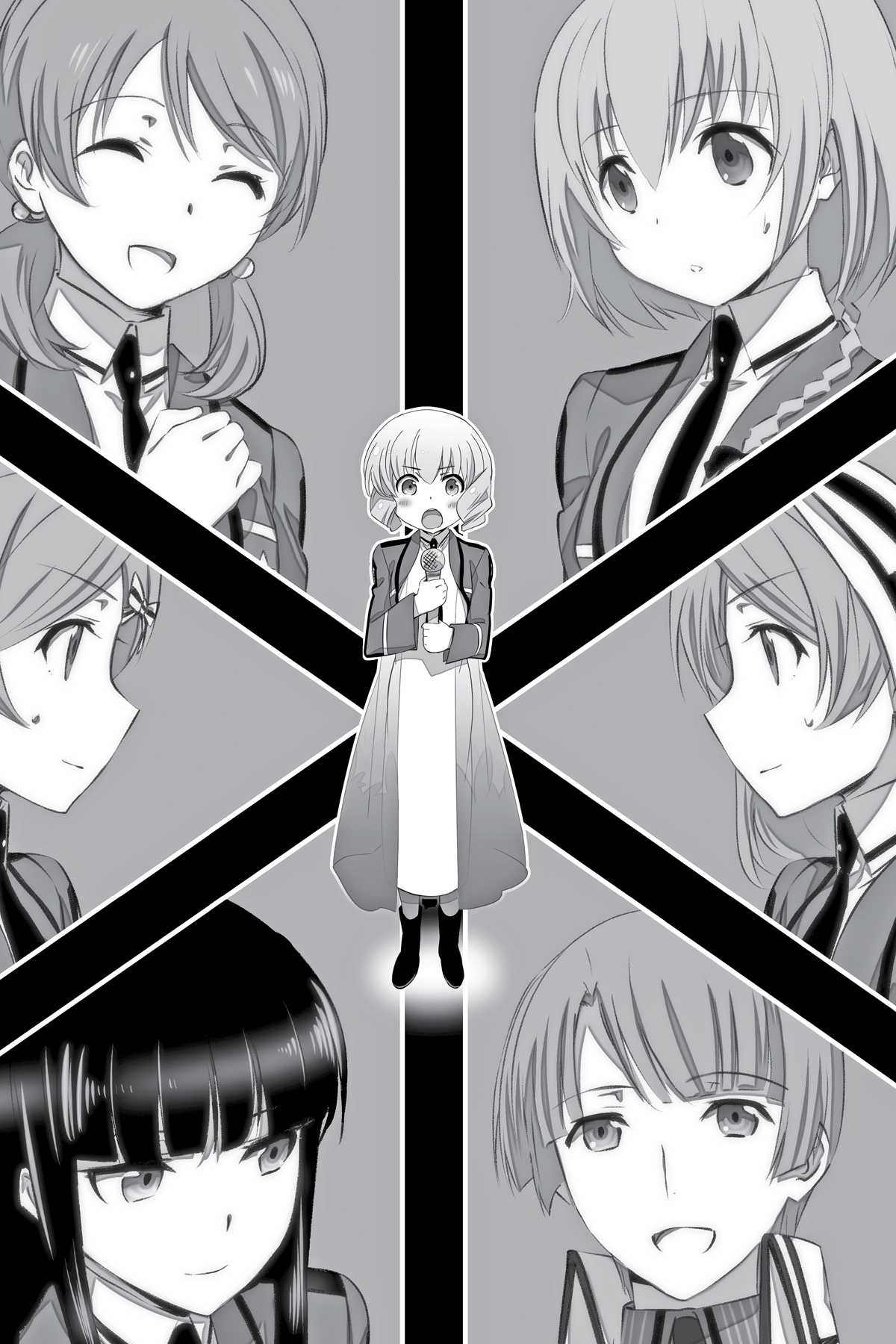
He directed a grateful look at Minami, whose shoulders relaxed in relief, then directed it toward Honoka, Kasumi, Izumi, and Miyuki in turn. Lastly, he and Isori exchanged looks and nods, and Tatsuya handed the microphone to Azusa, who had been busily scanning the multiple measurement devices behind him during the experiment.
Azusa shook her head vehemently, trying to push the microphone back into his hands. But she was unable to oppose the smiling Isori or the pressure from the silently watching Tatsuya, and when she took the microphone, she looked like she was about to cry.
After several deep breaths, Azusa brought the microphone to her mouth. Her face sharply stiffened with determination—though it also looked like an expression of desperation—before she announced to all the students who were present there:
“The continuous thermonuclear fusion experiment using a resident gravity-control spell as its central technology has achieved its expected objective. The stellar reactor experiment is a success.”
In the schoolyard, and in the building, a cheer went up all at once. It was a crazed one, almost violent, almost sounding like a cry to celebrate the possibilities and future of magic.
Overwhelmed by the students’ cheering, Mr. Kanda, frozen in place, and his entourage of journalists only snapped out of it once the spherical tank had been returned to the radiation laboratory and the students in the schoolyard had begun to go back to their classrooms.
“What on earth was that?” one of the journalists asked Tsuzura and Jennifer, who were talking to each other, in a fairly incredulous voice.
“An experiment for a thermonuclear fusion reactor with a resident gravity-controlling magic program.”
But with the way he’d asked, that was the only answer he’d get. The reporter, irritated, tried to raise his voice angrily. Kanda, however, was trained in the world of politics, which was filled with black-hearted individuals, and didn’t lose his temper so easily.
“What sort of thing is it? I thought the idea of a practical nuclear fusion reactor had been abandoned,” he asked.
“Whether or not it has—”
“It certainly hasn’t—”
Tsuzura and Jennifer answered simultaneously. The two whose voices had overlapped made eye contact, and after one of them yielded, Jennifer opened her mouth to speak again.
“It certainly hasn’t been abandoned. Its priority was only lowered because sunlight-based energy systems were completed first. Research using such large experimental devices was stopped because it hit financial issues, but the research itself is still continuing even in nonmagic fields.”
The quiet words “Oh, really” could be heard from Tsuzura’s mouth, but both Kanda and Jennifer ignored him.
“Magic-based nuclear fusion research is one part of the overarching research. Nuclear fusion systems based on electromagnetic control magic were abandoned because of the complexity, meaning those based on the relatively simple gravity-control method have been the ones researched in the world of magicology.”
“Nuclear fusion research—is it to try and create magic-based nuclear fusion explosions?”
“Like the kind used during the Scorching Halloween?”
With questions with malicious intent leveled at her from two reporters one after another, Jennifer scowled.
But she wasn’t able to hurl a thorn-covered argument their way.
“Ha-ha-ha-ha-ha!”
Tsuzura’s arrogant laughter took the poison out of Jennifer and embarrassed the journalists.
“Nuclear fusion explosions? Forgive my rudeness, but what exactly were you watching?”
The request for forgiveness seemed a pretty bold one considering his words. It didn’t take much insight to realize the connotation there was, Are you all blind? This man named Tsuzura seemed to be possessed not only of scholarly insolence but of a mean personality as well.
“You don’t need precise spells like this if all you want to do is cause a little explosion. And you couldn’t use a technique like that to cause a huge one like the one you’re all talking about, either. Besides, the only large-scale nuclear fusion explosion was a report of a success case from a strategic-class spell called Synchroliner Fusion from Miguel Diez of the Brazilian military—and nobody has even come close to replicating his spell. Our school’s students may be talented, but do you think something like that would be possible for them?”
The journalists’ faces twisted in displeasure. They understood that he was an expert and they were nothing more than amateurs. In fact, they had no idea how difficult Synchroliner Fusion was. With someone telling them there had only been one success case in the entire world, they couldn’t obstinately insist it was possible for high school students, even at an experimental level.
But that had all been par for the course. What was unexpected for them, what made them unhappy, was his looking at the journalists as though they were civilians. It wasn’t just Tsuzura doing it, either—it was the vice principal, the principal, the female teacher here, and the students. They felt that not a soul was affording them the respect they deserved as the mouthpiece of society.
“Today’s nuclear fusion experiment was about whether it could be an energy source, an infrastructure for society. There are numerous issues that we still need to work out, but if a stellar reactor was implemented, humanity would be able to use far more abundant energy than what the sunlight cycle provides.”
Tsuzura’s eyes as he spoke were only on Kanda. The journalists realized, willingly or not, that they weren’t even part of Tsuzura’s consideration.
“How did you like it, Mr. Kanda? Our students have a willingness to make peaceful contributions to society, don’t they?”
“Yes…they do. I think it’s admirable that they’re trying to contribute to our society’s prosperity.”
Overwhelmed by Tsuzura’s unabashed coercion—what switch could have been flipped?—Kanda agreed reluctantly.
Tsuzura, with a somewhat shameless smile, bowed to Kanda. “I appreciate that, Mr. Kanda. I’ve taken the liberty of recording your words just now. I’d like to use them to encourage our students—would you mind that at all?”
“Well, I—”
“I wouldn’t think there would be any problem.”
“Ah, no. I would be more than happy to do it for the children’s sake.”
Kanda gave a perfunctory nod, his eyes averted, before leaving with a simple goodbye. Not leaving the schoolyard, but leaving First High. He couldn’t tolerate any more of his statements, which were so far from his actual intent, being recorded, so he’d decided to call it quits for today.
Without a portable shrine on his shoulders, he couldn’t remain in the festival—he had to leave the shrine-carrying procession. The journalists, too, without a choice, wrapped up their coverage and left First High behind.
Jennifer watched the Diet member and his rabble-rousing journalists leave, and as soon as they got out of sight, she turned to Tsuzura, who was next to her. “Tsuzura-sensei,” she said, using sensei in Japanese instead of the loanword mister when referring to her fellow teacher—she was completely familiar with Japanese custom, and aside from her appearance, she was no different from a pure-blooded Japanese person. “Don’t you think you went too far?” she asked.
Of course, if one were to call this kind of consideration also Japanese, it would definitely exhibit a prejudice against Americans.
“Well, this is embarrassing.” Tsuzura really did seem embarrassed. “When they purposely twisted the students’ disposition, I couldn’t help feeling ticked off.”
“Their disposition…?” It wasn’t that she didn’t understand the word. In truth, Jennifer knew Tsuzura from their Magic University days. Jennifer was significantly older than he, but at college they’d been in the same position—research colleagues. Friendly colleagues, if one had to say one way or another.
Jennifer was dubious about what Tsuzura had said because it wasn’t like him. He passed as a weirdo at First High, but that was because of his individualistic rationalism, which discarded everything unneeded. Normally, he’d never have acknowledged the worth of something so based in emotion as “disposition.” Normally, enthusiasm and purposefulness were things to be analyzed, not admired. Jennifer knew all that, which was why she’d let the question slip out.
And Tsuzura himself was aware of it. He was feeling bashful about it because he felt that talking about “disposition” didn’t suit him.
“Well, you know… From a technical standpoint, the experiment leaves a lot to be desired. There’s too much reliance on individual magic ability. It went well because of the group’s members. There are a whole heap of issues we need to solve before this tech can ever come into common use.”
Jennifer nodded at the explanation. That had been her opinion as well.
“But they’re challenging the way society is by using magic and trying to change it. I think that mind-set is worth something, regardless of technological completeness. Their disposition is to try to change what they themselves mean to society, and I just thought that was really valuable.”
Eventually unable to bear the embarrassment, Tsuzura looked away and added, “I know it’s out of character, but still.”