Chapter 2

It was the morning of Tuesday, July 3, one sunset and sunrise after the surprise notification that had thrown all the magic high schools into a vortex of confusion and chaos: In the JGDF 101st Brigade command room, located in Tsuchiura in old Ibaraki Prefecture, the brigade’s leader, Major General Hiromi Saeki, had summoned the chief of the Independent Magic Battalion, Major Harunobu Kazama.
Major General Saeki was a female officer who would be turning fifty-nine this year. She was a genius who had always walked the path of a staff officer, and due to her entirely white hair—which looked silver in certain light—people secretly called her names like the Silver Fox. Despite that moniker, at a glance her features were those of a kind elementary school principal more than anything else.
She was also known for leaning far to the right in her stance toward the Ten Master Clans within the JDF. Even so, she didn’t harbor any emotional aversion or instinctual hatred against magicians. For some time, she had been ringing the warning bells: Their national defense relied heavily on the Ten Master Clans, which were a private entity. Because of that, there was a tendency for people to treat Saeki as a political rival to Retsu Kudou, but she, at least, didn’t feel that way at all.
She and Kazama went all the way back to the Dai Viet conflict.
During that war, which had seen the Great Asian Alliance moving southward with the aim of conquering the Indochinese Peninsula, Kazama had directly intervened in the fighting against the wishes of military command. The guerrilla warfare he’d engaged in stalled the GAA invasion, attracted USNA and New Soviet Union intervention, and ultimately caused the GAA to retreat without accomplishing its objective.
Kazama’s actions at that time earned him the title of global expert on forest warfare. But he had only been able to achieve those results because Saeki, then an intelligence staff officer with the Defense Army General Headquarters, had supported him with both intel and planning when he was almost completely isolated (mostly by allies) during the fighting.
Through his maverick actions during the Dai Viet conflict—Kazama’s assigned mission at the time was to secretly obstruct the GAA’s southward movements, and though he’d disobeyed the “secretly” part, the “maverick” part was probably a false accusation—Kazama would have ordinarily been cut off from the path to promotion. Saeki, however, was not censured for having supported him, either in public or in private. She was too talented for even military command to treat her poorly.
And so, four years later, right after the Defense of Okinawa, they’d adopted her plan to establish the 101st Brigade and instated her as its first commanding officer. Saeki had called up Kazama, who had been stuck at the rank of company officer, and along with promoting him to major, she’d given him command of the Independent Magic Battalion.
In light of that, though the two of them had little time to exchange words since then, their relationship ran deep. They were also compatible in terms of personality, and now they were a tried and true superior and subordinate who could talk about how they really felt. Even if they hadn’t been, the Independent Magic Battalion’s mission was the testing of new magical gear and magical tactics. The 101st Brigade’s founding principle was to form a magical force that didn’t depend on the Ten Master Clans, and the team Kazama was entrusted with were essentially just that. Saeki and Kazama becoming close was something that had happened naturally.
In this command room, the two of them discussed many shady topics that they couldn’t talk about publicly with others.
“Major Kazama, did you know there have been major changes to the events in this year’s National Magic High School Goodwill Magic Competition Tournament—the Nine School Competition?”
And what Saeki wanted to talk about this morning began with that question.
“Yes, ma’am, but only that they were considering them. Have they officially made the decision?”
As he asked his question in return, Kazama felt a sense of surprise. Saeki had minor magical talent, but she wasn’t a magician. She possessed knowledge few others in the JDF had regarding strategic planning that integrated magical factors as well as the implementation of magical combat forces on a tactical level, but he hadn’t thought she had much interest in magic competitions that weren’t directly related to combat.
“I must say you seem rather slow on the uptake, Major. An official notification addressed to the magic high schools went out yesterday.”
Saying that, Saeki, who had remained seated, held out a stack of papers to Kazama, who was standing at ease in front of her desk. She’d taken the time to print them on paper to avoid the possibility of leaking the information through the digital network. It was a peculiarity of hers, one removed from practicality.
For a short while, the only sound in the command room was that of pages turning. After reaching the end of the documents at a fairly high speed, Kazama looked up and asked with his eyes what she needed.
“What are your thoughts?”
But it seemed they hadn’t yet arrived at the main idea. It would be ineffective to rush someone like Saeki, so Kazama decided to patiently go along with her process.
“This is a military training program, ma’am.”
“…I might not have said it so bluntly myself, but my opinion is essentially the same.”
As though she had only just remembered, Saeki pressed a button on the edge of her desk. A folded-up chair emerged from the wall and moved behind Kazama. She gestured for him to sit.
This was a signal that the conversation would take a while. Kazama saluted, then unfolded the seat and sat down facing her.
“These event changes were affected by the Yokohama Incident. A result of the JDF reaffirming the efficacy of magicians as components of combat strength and attempting to draw out the relevant abilities.”
“I believe anyone would interpret it that way, ma’am, even if they didn’t know the truth.”
Nodding once at Kazama’s remark, Saeki added, “The Magic Association only opposed the JDF’s request as a formality.”
Kazama looked dubious. “You mean to say that even he didn’t resist it, ma’am?”
Saeki offered a hint of a smile at that. “His Excellency Kudou did not oppose it.”
But then Saeki’s smile disappeared, and she changed topics suddenly.
“The JGDF General Headquarters wants to know how this brigade would feel about assisting this year’s Nines.”
“They want to know, ma’am? They didn’t order us?”
Kazama’s comment was less of a true request for confirmation and more of a way to keep the conversation going.
“Correct. But we must also consider what it means for them to have come straight to our brigade with this—or more specifically, to me.”
“I follow.”
It was well-known throughout General HQ that Saeki was critical about how the Ten Master Clans dominated the current Japanese magic world. Bringing a request for assistance in this competition to the brigade she headed up was likely a kind of harassment—against both Saeki and the Magic Association, which hosted the event.
“Our superiors do not seem pleased that the Magic Association is gaining leverage with the JDF.”
“At long last, then, ma’am?”
On the surface, Saeki’s remarks sounded like complaints. But Kazama was easily able to understand what she was truly saying: Their superiors, too, had finally begun to perceive a danger in their dependence on the Clans. Saeki directed a satisfied expression at her subordinate, proof he was correct.
“I plan to answer their call,” she said.
Kazama mentally readied himself for the marching orders sure to follow.
“However, I will not use the Independent Magic Battalion. Major, I order you and your battalion to remain on standby for the duration of the Nines.”
Saeki’s command, however, was to hold fast.
“…Understood, ma’am. The Independent Magic Battalion will remain on standby until we receive orders stating otherwise.”
Because the instructions he received were so completely unexpected, Kazama’s response came a moment late. Nevertheless, he repeated his orders quickly enough that it wasn’t considered a breach of discipline.
“As we were discussing earlier…”
Instructing Kazama, who had risen and saluted, to sit back down, Saeki once again changed the topic.
“Not only has His Excellency Kudou refrained from opposing the change in events, he actually seems to have adopted a proactive stance toward them.”
Except it wasn’t really a change in topic as much as it was simply returning to talking about Retsu Kudou’s reaction to the competition’s event revisions.
“Of the new events, the retired general has apparently displayed a strong interest in the Cross-Country Steeplechase. And if word is to be believed, he is the one who proposed the event be changed to allow all athletes to participate. I also hear the course itself was made longer and broader according to his wishes.”
“I find that quite surprising, ma’am.”
The Cross-Country Steeplechase was a harsh training routine that could regularly bring even regular military magicians to their knees. The broader and longer the area, the more difficult it was to complete the course. And it proportionally increased the risk of a magician losing their way of life. Kazama already knew the elder’s true feelings on the matter: He didn’t want to see young magicians sacrificed for the sake of the military. That only made this inside story Saeki was telling all the more surprising.
“As His Excellency Kudou has always urged that we should stop treating magicians as weapons, this incident paints him in a treacherous light. Things are never so simple, however, when it comes to him.”
“You believe he has an ulterior motive, ma’am?”
“You think so yourself, don’t you?”
He’d asked the question without thinking, but a moment of thought revealed the answer to be self-evident. Retsu Kudou didn’t want to make military sacrifices of magicians or treat them as mere weapons—he would never have cooperated so easily.
“I have one more piece of information that may come as bad news to you, Major.”
Kazama’s attention, taken up by his own thoughts, immediately pulled back to the conversation with Saeki’s ominous preface.
“With regards to this Steeplechase incident, the Fujibayashi family appears to be hand in hand with the Kudou family in some plot.”
“Is that why we’re on standby, ma’am?”
Kyouko Fujibayashi, Kazama’s aide, was a Fujibayashi by blood. He didn’t think she was under suspicion, but her extant relationship to them alone was enough reason to keep him out of the incident.
“Correct.”
Saeki made no attempts to deny Kazama’s deduction.
“This might go without saying, but depending on how the situation plays out, I may have your team participate as well. In case that happens, I want you to remain ever attentive to Second Lieutenant Fujibayashi’s movements.”
Not only did she not deny it—she specifically ordered him to keep Fujibayashi under observation.
“Yes, ma’am.”
Kazama’s feathers weren’t ruffled. Trusting in someone’s character and preparing for unanticipated events were different issues—to him, at least.
As Kazama left the command room, he wasn’t thinking about the female officer working as his aide but about the irregular officer who was technically his subordinate, Specialist Ryuuya Ooguro—in other words, Tatsuya.
He was sure to take part in the competition turned experiment. Was it all right not to inform him of this? Saeki hadn’t mentioned anything about dispatching Specialist Ooguro, so maybe he shouldn’t reveal anything just yet. As long as nobody gave him marching orders, the specialist was no more than a civilian.
But his sister would also enter the event in question. If it seemed that the young woman who so blindly adored him might be harmed, even if danger was ultimately averted…
Kazama couldn’t help but feel that considering the tragedy—no, the catastrophe—that would doubtlessly occur, was keeping what he knew to himself not a gravely foolish decision?

As expected, the Nine School Competition event changes threw First High into chaos. After the details were announced on the official competition website, a large number of students from clubs related to the events were either overjoyed or heartbroken.
Even so, it affected the student council the most.
First, they had to visit the clubs with students who had planned to enter the dead events and explain the situation to them. Their current competitor selections were still no more than informal decisions, so they didn’t tell those students about it; but if they’d be going to the competition, they’d need to prioritize it over club practice. Which meant they had to let the clubs the participants belonged to know that in advance. Their head start on previous years had ended up being overeager thanks to the extensive event changes. Azusa felt like bees had come to sting her when she was already crying.
They’d have to start from square one choosing the competitors. They certainly had to rethink the representatives for events that weren’t switched out, too. In some cases, someone they’d assigned before was more suitable for one of the new events. Plus, they had to consider the new rule that participants couldn’t double up on any event except the Steeplechase. Choosing the athletes was left mainly to the student council, but they still couldn’t ignore the opinions of related clubs, and so they’d need to parley both with individual clubs and the club committee just to get that done.
They also had to prepare the necessary items for the new events. This was purely office work, but they’d first have to read over all the competition rules for Rower and Gunner, Shields Down, and the Cross-Country Steeplechase to find out what sort of equipment was needed and what was permitted and what wasn’t. By the time the student council members left the school gates today, their faces were all drooping with exhaustion. Tatsuya and Miyuki were no exception.
Despite their youth, this exhaustion was not something they’d easily recover from. After returning home and finishing dinner, Miyuki was standing in the kitchen, clearly dragging along the lethargy from when they’d left school. But even so, at this time and in this place, she didn’t try to leave this role to Minami. If one was to speak of her unabashed feelings, she considered it her natural right and sacred duty to give up her own relaxation time to Tatsuya. Her mannerisms politer than normal, she made coffee and then, with a smile that didn’t even so much as hint at her fatigue, placed a cup of it in front of him.
“Thanks, Miyuki.”
Tatsuya gave her a smile, looking his sister straight in the eyes, gratitude filling his gaze.
“No, I… You’re welcome.”
Even Miyuki was accustomed to the casual thoughtfulness Tatsuya displayed enough to not blush every single time. No matter how impassive he looked normally, no matter how cold and brutal he looked when facing an enemy, Miyuki thought of her brother as a deeply kind person. Still, the abrupt affection directed at her did cause her eyes to redden slightly, a response—an emotional excitement—she couldn’t avoid.
“You must be tired after today. Come here.”
Tatsuya, sitting not in the usual one-seater armchair but the three-person sofa, patted the place next to him.
“…Okay!”
Miyuki’s eyes widened for a moment, but then she sat down happily next to her brother. Minami stood in front of them, unable to completely conceal her displeasure with having been given the role of waitress, but either Miyuki had forgotten or just didn’t care; she was practically glued to him.
But even if Miyuki didn’t care, Minami had to. She wasn’t that used to this yet, and she was a world away from enlightenment. She wanted to look away from them, even though it would violate maid etiquette. Just as she was unable to resist the desire any longer, the incoming e-mail tone went off.
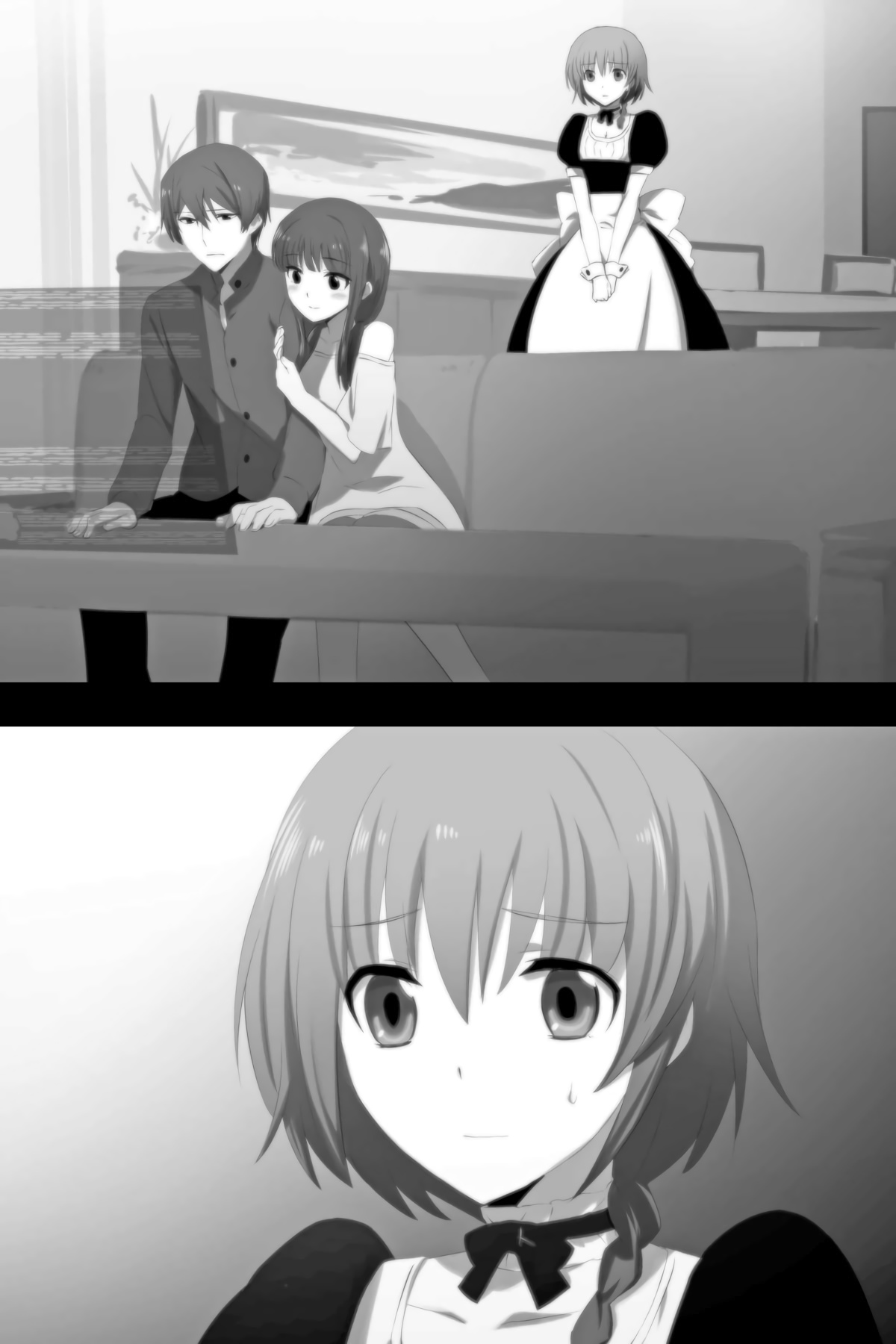
Springing at the chance, Minami headed over to the console. Rather than the main display taking up the living room wall, she peered at the smaller monitor attached to a console.
When she turned back around, her face was brimming with confusion.
“Lord Tatsuya.”
She seemed honestly perturbed—she’d forgotten her promise to call him “Big Brother.”
“An e-mail has arrived. It…doesn’t have a sender.”
Her confusion was well earned.
“It doesn’t?”
Tatsuya’s reply was also filled with uncertainty. Regardless of how things were before the war, modern e-mail systems defined very strict data formats. With advanced network technology, a person may have been able to fake their e-mail’s origin, but having a sender name was essential. Leaving it blank should have been impossible.
Conversely, however, if you did have technology to send data into the network that was defective according to the specifications, it would be easier to disguise your origin. Maybe he could interpret this e-mail as the unknown sender trying to convey their identity by showing off their advanced technology.
If that was true, he could only think of so many people. Out of everyone he knew, it would have to be someone who had a command of networking on an incredibly advanced level…
No, it’s too early to draw conclusions.
Tatsuya denied the convenient idea rearing its head in his mind. The possibility that she had sent this e-mail—or that someone had sent it on her instructions—was not zero. In fact, he considered it to be over 50 percent. But as for the little bit under 50 percent remaining, it could have actually been malware sent by someone who meant him harm.
I’ll have to check what it says first.
On an unconnected console in his hands, rather than open the e-mail he’d considered to be possibly malware, he brought up the raw data right on the screen. Sequences of characters, stripped of their execution privileges, filled his display to the brim. Tatsuya was able to get a sense for their unique structure.
He booted up a decoder and fed the displayed characters into it. The type of encryption was a common one the JGDF used. The 101st Brigade used a different encryption format, but he couldn’t say for sure this electronic message hadn’t been sent from the Independent Magic Battalion.
In modern times, communication technology that only allowed authentication of data when received on specific hardware was in practical use. (In fact, it was to intercept such data that the Echelon system had been upgraded from II to III.) The most important security depended on this, and it was possible the e-mail data itself was purposely using a common encryption.
In any case, he couldn’t determine from the encryption format alone whether it had come from an ally or an enemy. He’d have to read the contents for that. Without a word, he waited for the decoding to finish.
“That can’t be…”
But the contents of the decrypted e-mail were enough to sideline the sender’s identity for now. The information was so awful that Miyuki, who had left a small space between her and Tatsuya, lest she get in the way, murmured in disbelief without meaning to.
“New weapon testing… I’d take it with a grain of salt, but I suppose I can’t deny it outright.”
The suspicious e-mail detailed three things: how this year’s Nine School Competition event changes were due to JDF pressure, that the Kudou family was taking advantage of it to performance test secretly developed weapons, and that the location for the testing would be the Cross-Country Steeplechase.
“The JDF’s involvement is probably true. But the anonymity makes the message shady, and standard practice says to mix in plausible lies with truth…”
As Tatsuya thought about it, Miyuki brought herself close to him again. This time it wasn’t to fawn; she was worried for him.
“Brother… What will you do?”
It bothered Miyuki not to have a single thoughtful comment to offer. It may have been self-satisfaction, but even if listening to what he had to say was all she could do, she wanted to at least be able to share his burden.
But her fears were groundless.
“Hmm. Well, I can ask Master tomorrow morning.”
Tatsuya’s answer was an extremely plain one. While he didn’t want to hand Yakumo the ball and leave, he did seem totally willing to push much of the work onto him. Relieved at her brother’s usual poor attitude, she relaxed.
“Brother, would you like me to bring you some more coffee?”
“Sure, thanks.”
“Right away. Please wait a moment.”
Miyuki, shifting gears—she’d go with him to speak to Yakumo, so she could leave it for tomorrow—disappeared into the kitchen. Because of that, she missed the next thing Tatsuya said.
“Minami, could you forward this e-mail to Hayama?”
“Yes, Lord Tatsuya.”
“Using the strongest encryption.”
“Of course.”

While some people were like Tatsuya and wanted to get involved in as little trouble as possible, others decided they wanted to proactively cause it. Some especially diligent ones would even peel their eyes and strain their ears to goings-on across the sea, constantly searching for seeds of chaos.
Gongjin Zhou’s master was precisely one of those people.
“Gongjin.”
A stuffed human body, moved by a necromantic technique, spoke the kneeling man’s name.
“We’ve learned that in this so-called Nine School Competition taking place in August, the Japanese military will be secretly conducting tests of new weapons.”
The one speaking to him through the corpse’s mouth and from across the Pacific Ocean was one of the Seven Sages, Gide Hague, also known as Gu Jie, a survivor of the Dahanese military’s immortalist unit.
“New weapons, Master?”
As he repeated the phrase respectfully, in his mind he was saying again? Not in regard to the new weapons, however—but that they’d be interfering with that competition again. No-Head Dragon, Hague’s former precious playing piece, had become useless after their sabotage attempts during the last summer’s competition.
He was of the opinion that meddling with a high school competition was mostly risk and little reward. But it seemed his master saw things differently, he thought with a private sigh.
“They’re being referred to with the code name P-Weapon. We haven’t obtained any solid evidence, but based on the situation, there is little doubt they are attempting to seal parasites into automatic dolls and use their power.”
Zhou was honestly impressed after hearing that deduction. Not at Hague’s information network but at the Japanese military’s technological level. He was no expert, but even he, as someone who had studied the Taoist immortalist arts himself, had heard the difficulty of arts for sealing fairies—not the European sort but the mystical energy at the core of supernatural beasts—and utilizing them.
To replicate what the Yellow Turban Strongman did—the Japanese are quite capable…
“Do they think they can control things of that nature? They are not transcendents. And it is truly foolish that they are attempting to test their capabilities using high school students.”
But Hague’s impression differed from Zhou’s. Or maybe he just didn’t want to acknowledge it.
“Should we not simply interfere with their tests?”
“I’ve prepared a spell to drive them mad. It’s a Norman shaman spell, but I’ve adjusted it to be compatible with the immortalist framework, so it should be serviceable as your tool as well.”
“Understood, sir. I will make arrangements to embed this lunacy spell into the P-Weapons.”
Building a process in his head, one that made use of defectors from the GAA, Zhou suddenly thought of something and asked it.
“Would it be fine to only threaten them?”
“We don’t need to hold back from hurting anyone, but we also don’t need to kill them. Stealing the Japanese military’s magic technology is enough to weaken them. It will be more painful to linger on as incompetents than dying now.”
Hague’s plans seemed to involve making them suffer as long as possible. It was a very insidious—and naive—idea.
“At once, Master Hague.”
As he scorned the old man in his mind, Zhou prostrated himself, respectful only in form.

Before going to school the next morning, Tatsuya paid a visit to Yakumo with Miyuki in tow.
Tatsuya was in his usual training wear. Miyuki, in contrast, had a perfectly summery sportswear outfit on, consisting of a short-sleeved T-shirt, anti-UV-ray arm covers, a sun visor, shorts, and UV-blocking tights. She also sported inline skates with detachable wheels on her feet. A belt pouch was tied around her waist, holding her CAD and other small items.
Both of them had come dressed for morning practice, but last night, they’d actually sent a message in advance that they wanted to hold off on this morning’s training because there was something they wanted to talk about. However, the moment they passed through the temple gates, a throng of pupils attacked Tatsuya.
But given Tatsuya’s expression as he fought them off, he wasn’t particularly displeased at the development; in fact, he’d predicted something like this would happen. That was why he’d come dressed the same as he always did. However, it did certainly seem like he was rushing it. The topic he wanted to discuss wasn’t the sort where they’d reach a conclusion very easily. As a result, he beat Yakumo’s disciples down in the shortest time possible—meaning he had no mercy on them.
Yakumo had taken a seat on the staircase to the priests’ quarters to watch them. Attended by Miyuki behind him, Tatsuya walked over in front of him.
“Good morning, Master.”
“Good morning, Sensei.”
Miyuki, too, perhaps in consideration for her brother’s feelings, offered her greeting with grace and didn’t criticize his prank.
“Hey, morning.”
Meanwhile, virtually no sense of guilt could be gleaned from Yakumo’s face, either, despite being the one who had pulled the prank. Maybe he didn’t think of loosing his disciples on Tatsuya as any more than a greeting.
Still, that didn’t matter today, either. Filing the memory of what had just happened away into the corner of his mind as a debt to be repaid one day when the opportunity arose, Tatsuya decided to cut to the chase.
“Shall we talk inside?”
But whether by contrivance or coincidence, Yakumo took the initiative. Getting up from the stair he’d been sitting on, he proceeded into the priests’ quarters. Tatsuya followed, looking slightly disheartened.
When Miyuki entered after Tatsuya, the door automatically closed behind them. Tatsuya couldn’t see any traces of psionic activity, so it must have actually been an automatic door, despite its appearance. Or maybe it ran on human power—like a disciple shutting it outside.
The windows were all shut tightly as well, leading the priests’ quarters to feel more claustrophobic than they’d otherwise thought. In the pitch-black room, the candles along one wall lit up. A strong scent wafted over—the aroma of perfumed oil, likely kneaded into the candles. Neither Tatsuya nor Miyuki was surprised at the flames lighting themselves: Yakumo had used magic; the fact was as clear to them as if they’d physically witnessed it.
Three candles in a candlestick wouldn’t be enough to light the whole room, but with this many, the candles should have provided at least some dim illumination. But to Tatsuya’s eyes, when the candles lit, the priests’ quarters seemed to grow even darker.
But it wasn’t because of the fire, he reasoned…it was because of the scent of the oil filling the room.
What he’d felt was a decrease in psionic light.
“Is this a bounded field?”
Tatsuya knew secondhand that psionic information bodies—spirits, shikigami, and so forth—disliked certain odors; it appeared this scent enveloping them was one of those.
“We wouldn’t want any of this getting out, right?”
Tatsuya’s opinion was that no caster, no spell existed that could infiltrate this temple without Yakumo knowing, including in the Yotsuba family. But the owner considered it a necessary precaution, and as someone who had come to ask for assistance, he had plenty of reason to help him.
“Miyuki, would you mind?”
“Of course, Brother.”
Miyuki immediately picked up on her brother’s idea, constructing a barrier that would completely block all electromagnetic and sound waves.
“Thanks.”
Yakumo gave a somewhat wry grin at this response. It seemed like this bounded barrier was more of a habitual thing whenever he had to talk in private. Still, considering the discussion that Tatsuya was about to have with him, they couldn’t be too cautious. Tatsuya got to the point.
“Master, I apologize for bringing a troubling matter to you today.”
As Tatsuya lowered his head, Miyuki offered a polite bow of her own. It was an apology assuming Yakumo would be providing assistance.
Though this visit had started with a preemptive attack right out of the gate, once Yakumo had heard the general story, even he was keen to help them out. The details weren’t something he could personally ignore.
“I have to give it to Kudou—that’s a pretty dangerous idea he’s got.”
But instead of wasting time with banter like always, Yakumo cut straight to the heart of the issue.
“I’m sure I don’t have to tell you this, but the Steeplechase is already a dangerous event.”
“I see you think so as well, Sensei,” remarked Miyuki politely, though her voice was trembling faintly. Her tone was like magma rumbling deep underground, thick with an intense anger.
Even events chosen in the past, such as Mirage Bat, Monolith Code, and Battle Board, carried a risk of accidents that could lead to participants’ losing their magical capabilities. As with everything, it was a spectrum—but the Steeplechase’s level of danger was incomparably higher than those.
“He wants to use a dangerous event like that to conduct performance testing on new weapons? It’s enough to make me start doubting his sanity.”
Coming from Yakumo’s mouth, that comment held a lot of weight. An ancient magic practitioner who performed rigorous acts of asceticism on a daily basis saying that was a sign it bordered on genuine madness.
“Were you already aware of the tests the Kudou family is planning, Master?”
Tatsuya had called him on the phone last night after eight. He asked because he felt like even Yakumo couldn’t have looked into it that fast.
“Would you happen to know what the new weapons are?”
Eventually, Yakumo said reluctantly, “I only know a code name: P-Weapons. Unfortunately, I’m not clear on any details.”
“Even you don’t know, Sensei?” Miyuki probed, half-doubtful. It was very hard for her to believe Yakumo couldn’t find something out even after investigating… True, he hadn’t ascertained the siblings’ true identities until they’d become his disciples, but Miyuki was oblivious at the time because she and her brother had been unaware of their shortcomings.
“I don’t know yet.”
Yakumo didn’t seem to realize the unintentional irony, either. His mind was probably on something else, on another acquaintance who wasn’t present.
“I think Kazama would know, though.”
“You mean the major is keeping the information to himself?” Tatsuya shot back.
“That’s not quite right. He doesn’t have any responsibility to leak information to us.”
Yakumo was correct and left no room for argument. Tatsuya felt ashamed of his own poorly chosen remark. He belonged to the JDF as a special-duty officer, but this was a matter of convenience at best. He wasn’t yet a soldier in a real sense, and even considering military organizational hierarchy, Kazama outranked him. Superiors weren’t required to convey every last detail to their subordinates.
And Tatsuya was a member of the Yotsuba, too. No matter how many of his relatives refused to acknowledge him as part of the family, he was objectively one of their combat personnel. The 101st Battalion was a potential rival organization to the Ten Master Clans, and Kazama was essentially its leader. With the Yotsuba occupying a leading position among the Ten Master Clans, Kazama keeping secrets from one of its members was the natural thing to do.
“In any case, if we don’t know anything about the tests Kudou is trying to conduct, we can’t put together any countermeasures…”
Yakumo made a show of griping. However, a competitive light had entered his eyes. The light of confidence—he’d get to the bottom of what these P-Weapons were in no time flat.
“You’ll investigate first, then?”
Setting Yakumo’s feelings aside, his comment that they couldn’t decide how to respond without knowing exactly what their targets were trying to do left no room for debate.
“Yes, well.” Yakumo nodded to his disciple’s question, which had mostly just been to keep the conversation going. “I’ll probably have to go to Nara.”
“To old Lab Nine, right?”
“A place we have a deep connection with.”
Tatsuya, too, knew of the discord between ancient magicians with ties to Lab Nine and the Numbers with the character for “nine” in their name. Yakumo’s proactive stance made Tatsuya think, in a twisted way, that perhaps that was why Yakumo seemed more enthusiastic about this than he usually did…

July 5, lunch break, three days after the Nine School Competition’s new-rules notification.
Tatsuya was looking through First High student data in the student council room.
Not to say he didn’t feel like the emergency was more important, but the public preparations for the Nines had become an emergency in and of themselves. Tatsuya had simply decided to leave the covert response in Yakumo’s hands during the weekdays and devote his own efforts to the public arena.
The documents Tatsuya and Hattori, the club committee chairman, were viewing were a summary of practical exam grades they were using to choose participating athletes. They’d utilized them under the assumption that this year’s events would be the same as last year, but the documents contained comprehensive practical testing data, so it would be useful in selecting competitors for the new events as well.
While biting into a sandwich, Tatsuya flipped through one piece of data after another, organized in card format. He was using one hand to work his keyboard, making a list of candidates.
Incidentally, his sandwich was one Pixie had made and passed out to everyone. Miyuki and Honoka would stop working on their consoles every once in a while to eat more politely, but Azusa had a half-eaten sandwich in her mouth as she pounded away at the keys, drawing silent shade from Izumi.
Hattori was the first one to speak up. “I think we can just take the Pillar Break, Mirage Bat, and Monolith Code entries and adjust for the multiple events rule. What do you all think?”
“We probably can, but we’ll need to split them up into solo and pair entries for the main Pillar event,” said Tatsuya.
“For the girls, can’t we have Shiba solo and Chiyoda and Kitayama be a pair?” offered Hattori, catching the ball again.
“What will we do about the boys?”
“There’s not much difference in ability between the three male entrants. We should probably pair them off and decide based on compatibility.”
“I agree.”
“For Rower and Gunner, I’d think we can choose from our candidate reps for Speed Shooting and Battle Board, but…”
“For the pair that should work, but the solo spot would need multicasting ability at a high level. I believe we’ll need to take that into consideration as well.”
“I see. Then which do you think we should treat as more important—shooting skills or boating skills?”
“We can anticipate the boats in Rower and Gunner to be more stable than the boards in Battle Board, so I think we should concentrate on shooting skill while moving.”
“In that case, the corresponding clubs would be the SS board club, the biathlon club, the hunting club, and…”
The reselection of competitors was the goal behind gathering during this lunch break, and the conversation continued to progress in this way, mostly between Hattori and Tatsuya.
After school, Tatsuya paid a visit to small gymnasium number two. Not, however, because he was skipping out on his desk work—this was yet another part of competition prep.
The two smaller gymnasiums were both fitted with cleaning mats in the entrance, which would completely scrub the soles of your shoes just by walking on it, so going inside while wearing outside shoes didn’t present any particular issue. However, Tatsuya purposely removed his shoes, then stepped up into what they called the arena, where the floor switched to plank boarding.
Despite regular exams being right around the corner, the jaunty sounds of club members wearing defensive gear batting their shinai together could be heard. With faces invisible behind their masks, Tatsuya relied on movement quirks to seek out the student he was looking for.
The one he was after was sitting against the wall. She was removing her helmet, as though she’d just been taking a break. Despite clearly intending to relax, she maintained her posture so well that it was fascinating.
“Erika.”
“Is that you, Tatsuya? You almost never come to watch.”
As Tatsuya raised his hand to her and walked over along the wall, Erika displayed slight surprise. As she said, this was the first time since Tatsuya took the seat of vice president that he’d come to watch the kendo club practice.
Incidentally, Erika wasn’t part of the kendo club—she was in the tennis club. Of course, she was more like a ghost member. The tennis club wasn’t very active, so they wouldn’t scold her if she took time off from it.
Erika, considering that convenient, would occasionally come to the kendo club like this to help out—not because she necessarily wanted to but because Sayaka was constantly asking her to.
Tatsuya, too, had a rough understanding of those circumstances. But he hadn’t known today would be one of those helping out days. Tatsuya had gone to the tennis courts before coming to small gym number two. Essentially, he’d wasted time, but it wasn’t Erika’s responsibility, so he didn’t mention it.
“Did you need something?” said Erika in place of a greeting—she didn’t know he’d visited specifically to look for her.
“Yeah. I’ve come to ask you for a great favor.”
When Tatsuya sat down formally and made that proper remark to her, Erika unintentionally gave a blank, defenseless look. It was the type others might have called a dumb face, if not for her beauty—even that expression looked good when she made it.
“Huh? This is sudden. What’s wrong? You never ask me for things…”
There was a hint of caution in her eyes that couldn’t be hidden, doubtless because Erika had grasped a part of Tatsuya’s true character, however small.
“It’s not really me asking—it’s the student council.”
But this time, she’d been overthinking it.
“What did they want?”
Having understood that, the tension disappeared from her eyes, replaced by a strong sense of doubt. The suspicion she had was simple—what were they going to try to make her do?
Of course, Tatsuya didn’t have any reason to keep secrets now, so he gave her the answer straight. “We would like to request for you to serve as a practice partner for the Shields Down event in the upcoming Nines.”
“Oh. That event did look interesting. Wait, are you okay with me being a practice partner?”
Erika realized that her own magical capabilities were remarkably skewed. She doubted she could be of much help as a competitor, of course, but that went for being a practice partner, too.
“Yes, I’d very much appreciate it.”
But Tatsuya didn’t seem to doubt Erika’s suitability one bit. Erika unconsciously averted her gaze from his straightforward gaze—she was embarrassed.
“…If you really insist, then I guess I’ll do it.”
Even when she purposely used a high-handed tone to conceal her embarrassment…
“Thank you.”
…Tatsuya never broke from his completely serious attitude. It felt intentional to Erika. Is he making fun of me? she grumbled to herself… And she knew quite well that it had been no more than a false accusation.
After changing into her school uniform, Erika did as Tatsuya asked and headed to the small conference room on the first floor of the prep building.
“What the heck are you doing here?”
There she saw the unexpected face of a certain classmate—and without meaning to, that was the first thing she said. If it had been just the two of them or among their friends, nobody would have thought anything of it. But there were also several upperclassmen she didn’t know in the room, and she hadn’t even greeted them yet.
Crap… I did that so automatically. Now what do I do?
Looking, it wasn’t just Erika—those upperclassmen were wearing bewilderment on their faces as well.
“Oh, shut up. Tatsuya called me here, too.”
But the awkward mood about to spread through the room dissipated thanks to the mood-blind Leo’s retort. Though one would need to ask him whether he purposely hadn’t paid attention to the mood or if he simply couldn’t.
“Erika, Leo.”
Tatsuya’s gently chiding words, however, were clearly mood specific. Once they’d closed their mouths, Tatsuya introduced Erika to their Shields Down representatives.
“Shiba, you want me to pair up with Saijou to practice, right?”
“I’ll be going with Chiba when I practice, right?”
The first one who asked was their boys’ solo pick, Sawaki. The remark after that came from a senior by the name of Tomoko Chikura, the one chosen as their girls’ solo representative.
“That’s right.”
Shields Down was a competitive event. But they’d only have three boys and three girls, one each solo and the others in pairs, as their representatives. Each of them would be missing one person to practice two-on-two with. That was why Erika and Leo had been selected as practice partners.
“You two will be the solo practice partners as well.”
In addition, the plan was to have a three-person rotation with the two of them.

“Mm. Well, these recommendations came straight from Shiba. Saijou, it’s a pleasure!”
“…Right.”
“Chiba, don’t be too rough on me.”
“Same to you.”
He’d already explained this to the two of them, but Erika aside, Leo—who would be up against Sawaki, whispered to be the finest martially inclined student in First High—had a bit of awkwardness in his polite smile.

It would, perhaps, be disingenuous to call them the conspiracy’s epicenter. Going back chronologically, the Kudou family had done nothing more than avail themselves of the military’s plan to accelerate the usage of magicians in the military. That said, no matter how severe the plan’s substance was, it was none other than the Kudou family who had brought secret weapons intended for military use into the Nine School Competition, a mere high school event. Notoriety was something they would have to accept without complaint.
And the Kudou family had no reason to mind such a thing. They—and in particular Retsu Kudou, who had proposed making the Nines the stage for the performance tests—were fully aware that he was doing something deplorable. It was for that very reason, however, that he was under mental pressure to not, under any circumstances, allow the Parasidoll testing to fail.
Retsu had taken command at Lab Nine again today, from sunrise until sundown. If he hadn’t already made plans for afterward, he might not have left the institute until well into the night. And even then, his dinner engagement was an invitation he’d answered in order to smooth things over with politicians who were formerly in the military and held powerful influence over the competition.
It was after six o’clock. Retsu had left for a restaurant serving Japanese cuisine in Osaka, and Makoto, left in charge of things, had just settled into a seat in front of the desk when the internal line rang, a message from the security guards that a guest had arrived.
“A guest? We weren’t expecting any guests. Who is it?”
“He’s calling himself Gongjin Zhou, from Yokohama Chinatown. He requests to speak to the master directly. How should I proceed?”
Gongjin Zhou from Yokohama Chinatown—Makoto had heard the name. It was a name that couldn’t be ignored by anyone from a family of “nine” originating in Lab Nine, even if the other twenty-eight families would have never heard of him.
“I’ll be there in a moment. Show him to the reception room.”
And as he himself said, Makoto immediately got up to go.
Upon seeing the Yokohama Chinese expat rise from the reception room sofa as he entered the room, the first emotion Makoto felt was envy. To his eyes, Gongjin Zhou was young and dashing. His cool, graceful features emitted an energy old men like himself couldn’t possess.
“Welcome. I am Makoto Kudou, head of the Kudou family.”
Forcing down the dark emotions welling up within him, Makoto offered an outwardly magnanimous smile and held out his hand.
“My name is Gongjin Zhou. Please call me Zhou.”
In response, Zhou, with a polite and—at least visibly—humble attitude, accepted his outstretched hand and shook it.
“I’m very much familiar with your name. You’re a celebrity, Mr. Zhou—at least, in these parts.”
The remark was very deliberately spoken, and Zhou answered with a meaningful smile in lieu of any pointless modesty. Zhou’s calculations had included being known. Besides, the negotiations he was attempting to conduct wouldn’t succeed unless Makoto knew what he was doing in “these parts.” In fact, behind his smile, Zhou was thinking that this saved him time.
“I’m flattered you know of me. I’ve come today with a request regarding our business, hoping that you might be accommodating.”
“When you say our business…?”
“Yes, I believe you have the right idea. I would like to discuss the future course for my comrades who have escaped the iron hand of the GAA.”
In addition to assisting with GAA anti-Japanese schemes, Zhou also provided those who wished to defect from the GAA with various amenities. His main activities were acting as an intermediary to find ultimate destinations for the defectors arriving in Japan and to provide boat passage there, including covering various expenditures. However, he also gave financial support to their post-defection political activities.
The GAA was actually aware of these defection-broker activities. The information wasn’t that widespread and not all governmental officials and high-ranking military officers knew about it, but it was at the very least an open secret among soldiers and those related to government who were connected to anti-Japan outfits.
As for why Zhou was not on any GAA purge lists—the defection dealings were rather convenient for the GAA government as well. Anyone who was willing to defect was another person who was discontented with the government. If they promptly defected, there would be fewer governmentally dissatisfied elements. The GAA had no lack of manpower, and their coffers benefited because those people couldn’t bring all their assets with them when defecting.
The troubling things about people engaging in political activities wherever they defected to were it extending to their nation, it producing negative diplomatic effects, or it being used as an excuse for embargoes.
None of those were a problem for the GAA in its current state, though. The GAA government had established hegemony over the eastern mainland after the internal strife with Dahan. At present, GAA leadership had full control over everything, down to the smallest units of the military. They understood well that without the backing of the military, anti-government movements wouldn’t get very far. And without sympathetic armed forces within the GAA’s borders, foreign plots would never become powerful enough to topple their administration. The GAA government still hadn’t forgotten its history of local forces going out of control, leading to Dahan’s pretended independence—pretended being the GAA’s own perspective on the matter—and to internal warfare.
Diplomatic criticisms weren’t particularly problematic for the current GAA, either. States only needed international backing if they weren’t politically independent, usually because they were militarily or economically reliant on one nation or another.
But with the current state of geopolitics, no military alliance could form and pose a serious threat to the GAA. All four of the world’s superpowers—the USNA, the New Soviet Federation, Indo-Persia, and the GAA itself—all adopted militarily independent policies. The USNA and Indo-Persia possessed allies, but those relationships were superficial. The tight-knit alliances from before the most recent world war no longer existed. If one of the four great powers attempted to expand its territory, the other three would likely not be silent, but none of them would interfere with another’s internal politics.
The GAA was highly self-sufficient economically as well, so embargoes wouldn’t harm or even irritate them. Their energy situation was a source of unease, but other countries were in the same boat. Quite frequently those who defected were the wealthy, and as long as there weren’t too many people defecting, it was actually a net benefit for the government’s pockets.
For those reasons, the GAA administration incentivized Zhou’s defection-broker activities.
Incidentally, Japan currently had a strict limit on the acceptance of defectors (political refugees). This wasn’t restricted only to Japan, either—the very framework of the Refugee Treaty had collapsed because of the outbreak of the Twenty Years’ Global War. But they only limited the entry of defectors—they didn’t prohibit it. And if a person who requested asylum was beneficial to the nation, that was an entirely different story. Talented scientists, for example. Famous artists, for another. And of course—powerful magicians.
“To tell the truth, we are planning on accepting three Taoist immortalists from the mainland next week, but there has been a slight mishap… The destinations where they will settle down have not yet been decided.”
“A mishap?”
“Yes, though it shames me to say. It appears our investigation into the enmity between various sects has been insufficient.”
“I see. I can understand why practitioners of the ancient arts would be concerned about it.”
Makoto was casually intimating that modern magicians didn’t worry about sects or the like. Still, Zhou’s remark, feigning to be a defense, had drawn this appeal out; Makoto had understood that and purposely leaned into it.
“Still, however, they are a sort it would be somewhat inconvenient to have stay with us,” Zhou noted.
“What sort of inconvenience? Ah, excuse me—if you have no objections to telling me, I would like to know.”
“No, not at all. It’s nothing I’d need you to keep to yourself. The luminaries defecting and coming here possess considerable power, and… There is no doubt the mainland administration will silently allow them to escape. Mainly to preserve their own honor.”
Makoto directed a firm stare at Zhou. It made his interest in what Zhou was saying quite clear; in fact, it displayed an intent to become involved in Zhou’s business dealings. On top of that, Makoto wanted Zhou to be the one to broach the main topic himself.
“I would not be able to shelter them alone. That’s what I’d like to request of you, Lord Kudou.”
Zhou, too, had a wealth of tact in this area.
“Would you welcome these Taoist priests as your honored houseguests?”
And as Makoto had ordered, Zhou continued, always the one bowing his head. Makoto’s lips loosened for a moment in satisfaction, but he soon replaced it with a dubious expression.
“Would it be wise to do this, considering your relationship with the Traditionalists?”
That was the heart of the reason why the name Gongjin Zhou was something the Numbers of Nine couldn’t ignore. The Traditionalists was the name of a magic society formed across religious lines by local ancient magicians centered in Kyoto. Dignity or perhaps arrogance could be glimpsed in the fact that they simply named themselves Traditionalists, without hoisting a location or methodology.
The Traditionalists’ goal was to protect the individuality of ancient magic against modern magic. One might otherwise state it as an adherence to identity. Needless to say, that meant they were aligned against Lab Nine. The Traditionalists were a federation of ancient magicians of various styles bound together by their anger and enmity toward Lab Nine, an organization that had betrayed them. The natural course of events led to that hostility being directed at all current Numbers with the character nine in their surnames and especially their leader.
And common custom was for the mainland’s ancient magicians Zhou guided in their defections to temporarily reside with various families in the Traditionalists. After all, Zhou was known to each of the Nine families as someone who bolstered this latent hostile force.
“My role is purely to provide my comrades who have escaped oppression with a place to live peacefully. I do certainly have a responsibility to those in the Traditionalists for cooperating with me so much. That, however, is not something to weigh against my main objective.”
“You say a place to live peacefully, but without very unique circumstances, governments do not allow defectors to naturalize.”
“It can be a temporary respite. For someone who has suffered under despotism, being able to live in peace even for a short time has immeasurable value.”
Zhou appeared to be ever earnest, only concerned about his comrades’ well-being. It wasn’t 100 percent believable, of course, but Makoto didn’t care if it was an act. At the very least, he decided he could believe that Zhou wasn’t solidly allied with the Traditionalists and trying his best to bring down the Kudou family. It was enough for him just to confirm this wasn’t all a Traditionalist conspiracy.
“All right. One of the Ten Master Clans’ principles is to produce humane living situations for magicians. You might say it is a natural obligation of the Ten Master Clans to extend aid to magicians who seek freedom so badly that they would abandon their homeland. However, this is also not a proposal I can accept irresponsibly, so please understand that I can’t give an answer right this moment.”
He couldn’t immediately agree to everything. As the Kudou family patriarch, being treated lightly by someone he had just met was something he needed to avoid, even if he was overthinking it.
“Oh yes, of course.” Zhou showed no offense at Makoto withholding an immediate answer. Probably because he’d realized his conversation partner’s heart had stirred after hearing his proposition. He took a small envelope out of his inside pocket and held it out.
“I’ve prepared profiles on the Taoist priests here. I will await a favorable reply.”
“I will make inquiries, but I’m optimistic about them. You can likely expect an answer by the end of the week,” said Makoto to Zhou as he took the envelope, which had a data card in it.
“I’m much obliged. Would it be permissible if I intruded again on Monday?”
Makoto removed a notebook terminal from his pocket and lowered his eyes to it, then looked up a moment later. “If it’s at four PM, then yes.”
“I’ll come at that time. Thank you very much for seeing me today.”
Zhou gave a bow that was as elegant as the rest of his appearance.
After scanning the data Zhou had given him, Makoto called up the main security guard in the institute and ordered him to keep silent about Gongjin Zhou’s visit.
“My predecessor must not be informed of this, either. Understand?”
Makoto was particularly thorough about including Retsu Kudou among those who had to be kept in the dark about this meeting. After watching the head security guard leave with a dubious look on his face, Makoto summoned an informant he personally used. His agent arrived in a little under an hour, and Makoto requested he do background checks related to Gongjin Zhou’s request.
After completing these arrangements, Makoto leaned back into his chair and breathed a heavy sigh.
“Yellow Turban Strongman…”
He was muttering to himself about a profile description that went over the immortalists’ fields of expertise. According to the document, the three about to defect to Japan were researching Yellow Turban Strongman, a lost art of divine immortalism.
“It’s too convenient.”
A sales pitch from an expert, who had brought it to him as though perfectly timing it with their parasite doll development: that was how Makoto interpreted Zhou’s request despite the Parasidoll development being a top-secret project. Zhou must have obtained intelligence on it.
“If I assume there is an information leak, that would be a worrying state of affairs. However…”
But when it came to techniques to control lifeless dolls from afar—such as puppet magic, soldier-creation arts, or golem magic—ancient magic was one or two steps ahead of modern magic. The technology the Parasidolls required was not magic to manipulate inanimate puppets but a technique to control an evil spirit residing within a mechanical doll. Still, the parallels with ancient magic, which turned spiritual beings into agents to control puppets, were numerous.
Putting it all together, the magicians researching the secret lost art from the mainland, Yellow Turban Strongman, were desirable indeed for the Kudou’s continuing development of the Parasidolls.
“No matter. If they become pests, then I need only crush them in my fingers,” said Makoto, ending his monologue, adding to himself: whether those pests are snakes in the grass or the three worms.