Chapter 4

Raymond S. Clark was a high school junior in Berkeley, California, USNA. He’d been Shizuku’s classmate when she studied abroad.
Unlike the magic high schools of Japan, the high school he attended had not been established specifically for magic education. Instead, magic studies and skills were offered as elective classes within a standard high school. But here, too, the number of schools with magic curriculums were limited, owing to a shortage of teachers. Because the number of applicants far exceeded the teaching capacity, schools had been forced to independently establish entrance examinations and selectively admit new students, and thus the school Raymond attended was for all practical purposes a magic high school like Japan’s, dedicated to the education of magicians.
As such, it went without saying that Raymond was a magician-in-training. His abilities put him among the top of his class. He wasn’t talented enough to get into the Stars, but he certainly had value elsewhere.
The USNA intelligence community referred to the secret society as the Seven Sages. In fact, it was not a single organization but rather seven individuals who had no contact with one another save for a single common point.
That was the hacking system known as Hlidskjalf, which was hidden within Echelon III, the global communications surveillance system funded by the USNA military. There were seven operators with access to the system. That was the common intersection the Seven Sages shared, and using Hlidskjalf, they could capture information from the world’s communications networks with an efficiency and scale that far exceeded what Echelon III’s legitimate operators were capable of.
Among the seven operators of Hlidskjalf, only one used the Seven Sages moniker. It was none other than Raymond himself, when on a whim he’d released information about an anti-governmental organization to the USNA authorities.
Today, Raymond was using Hlidskjalf again, awash in a sea of information. He liked knowing things. He liked investigating things, too, but simply stocking up on information without any particular goal in mind was something of a hobby to him. And Hlidskjalf was his very favorite toy.
That said, the nature of Hlidskjalf was still such that it required search terms. The system was made to answer questions, so it needed a question to work.
Points of light became letters describing the search terms. The Hlidskjalf terminal was a head-mounted VR display that used gestures and brain waves as input. A camera captured the user’s movements and translated them into the operator’s field of view. Using glowing characters projected in an imaginary space, the operator input search terms while a brain wave–assisted interface let them enter more specific commands.
Raymond was currently searching with the very broad term USNA military misconduct. Vast amounts of information were displayed in windows hanging in the virtual space around him. The more distant windows displayed only titles, while closer ones included more content. Some were text with diagrams, others were still images, and some were video. When he looked at a window it drew near, and when his gaze went elsewhere, it receded into the background. The space all around him, above and below, was filled with countless windows.
Raymond was a master of speed-reading and memorization. One after another, he rapidly internalized the contents of dozens of overlapping windows. But today he suddenly stopped. One particular window had caught his attention:
Older generation micro-missiles missing from weapons depot…?
It ought to have been a headline-making scandal. But sadly, it wasn’t uncommon for obsolete weapons scheduled for disposal to go missing.
The missing missiles were man-portable air-defense systems (MANPADS) made for use by infantry soldiers and carried detonating warheads based on CL-20 (cyclotetramethylene tetranitramine) explosive. It was a weapon used during the 2020s and even well into the Global War Outbreak, but advancements in nanotechnology had led to breakthroughs in the power of explosive substances, so the obsolete missiles were now just gathering dust, awaiting disposal.
They’d still be plenty useful in an actual battle, though… I don’t think this is a simple case of mismanagement.
Raymond licked his lips as he caught the scent of a major incident. He’d mastered speed-reading and memorization, but his greatest specialty was a curious ability to sniff out the distinctive odor of a serious mess.
Real-world incidents were the greatest show on earth, to Raymond. The bigger and more serious the incident, the more satisfying it was to discover and therefore the more fun.
He knew perfectly well that he was no superman. His magical talent was first-rate, but it would never reach the pinnacle his most accomplished peers were capable of. He would never be a magician powerful enough to influence world events. He would never be a globe-trotting superhero, no matter how much he wished for it.
Raymond had written off the possibility of that ever happening for him. Instead, he decided that if he could support the real heroes’ activities even a little bit, it would allow him to get a taste of what adventuring with them would be like. And he’d let himself be entertained as the events played out on the world stage. Hlidskjalf made that possible.
It was as though Hlidskjalf had been made just for him.
I’ll start by looking into the depot’s management.
It wasn’t as though a search for the location of the missing missiles was likely to return any hits. Humans were always involved. Someone had to be responsible for the diversion of weapons slated for disposal.
With practiced hands, Raymond began his search.

Before Raymond had noticed the disappearance of the obsolete missiles—to be specific, two days before—the incident had already sparked a commotion within the USNA military. The uproar wasn’t confined to the weapons depot, either, as the Internal Affairs Office of the USNA Joint Chiefs of Staff’s intelligence section had opened an investigation.
The reason Internal Affairs had opened the investigation rather than the military police was because of the suspicion that a terrorist group was involved, with the weapons having either been stolen by such a group or sold on the black market to one. If that were indeed the case, if the weapons’ origin were to be revealed, it would be a huge scandal inviting international condemnation. The Ministry of Defense wanted to avoid that at all costs.
But by January 27, six days after the discovery of the missiles’ disappearance, the investigation had progressed very little. At the office, despite it being a Sunday, the second-in-command of Internal Affairs, Colonel Balance, read the investigation’s report as she harbored certain dark suspicions.
Namely, that there were far too few clues left behind.
She’d known from the beginning that the disappearance had to have happened with inside help. Weapons—even obsolete ones—couldn’t simply be snatched from a military armory. But even if the unit leader responsible for securing the depot had been paid off, it shouldn’t have been possible to take the missiles without leaving any trace.
There were multiple levels of checks involved when matériel entered or left the depot. In addition to all items being tracked with RFID tags, the doors were locked using biometric IDs and required two people to open them. There were multiple other security measures in place, both human and technological. And not a single one of them showed evidence of anything out of the ordinary.
What made Balance so uneasy was the question of why the disappearance had been noticed at all.
The discrepancy had been discovered during a physical inspection of the inventory. But since the theft had involved such complete falsification of the depot’s data records, why hadn’t the processing records also been tampered with? The missiles had been awaiting disposal. If they’d simply been marked as having been disposed of in the data, the discrepancy never would have been discovered at all. It felt to Balance as though whoever was responsible had wanted the fact of the theft—and only that—to be noticed.
But who and for what purpose? And who could pull off something like this in the first place?
There simply wasn’t enough information to draw any solid conclusions. Balance knew as much but couldn’t stop herself from worrying.
A chime announcing the arrival of an e-mail hauled Balance’s mind up from the depths of her rumination. It was no ordinary message, either. It used encryption reserved for high-level intelligence officials.
With practiced, mechanical movements, Balance copied the encrypted message to a piece of specialized media that was unreadable to off-the-shelf, consumer computers, then fed it into an air-gapped decoder. This was to prevent against any potential leaks of the plaintext message. Once the message was decrypted and she saw the name of the sender, Balance’s eyes went wide.
It read: “The Seven Sages.”
The colonel’s eyes turned frantic as she read the message, even forgetting to breathe. Only when she was done did she take several gasping breaths.
“Is this even allowed…?”
The anonymous tip stated that the assistant to the president’s deputy chief of staff had been involved in the missiles’ disappearance. It also explained the reasoning behind this. If what was written there was true, the release of disposal-scheduled weapons was only a small part of a huge plot, the scale of which vastly exceeded anything Balance would have imagined.
Balance reached for her visiphone, but her hand stopped short of touching the number pad.
She hesitated over whom to call, then shortly realized she had no idea.
If she didn’t know who she could trust, then she didn’t know who she should tell.

Angelina Sirius Shields, the commander of the Stars, the magician unit directly attached to the USNA Joint Chiefs of Staff, was enjoying a rare day off by shopping to her heart’s content. She was out and about not as the strategic-class magician Angie Sirius, but rather as a seventeen-year-old girl named Lina.
The reason she had come all the way to Albuquerque instead of the nearer Roswell was because her shopping companion, Silvia Mercury First, call sign Silvie, had strongly insisted on the destination.
Ever since their tour of duty in Japan the previous year, the two often spent off-duty time together. Silvie regarded Lina as something of a troublesome little sister. From Silvie’s perspective, Lina had a variety of deficiencies in her common sense as a woman, and Silvie was possessed by a powerful sense of duty not to let her go astray.
Today, Lina had again played the doll in the game of dress-up that was Silvie’s approach to shopping. Fortunately, Lina herself had also enjoyed it. She hadn’t been blessed with much fashion sense, but she did enjoy wearing nice clothes. Given her natural beauty, she’d probably never felt a pressing need to improve her fashion sense. The lack of someone she wanted to impress was the biggest thing that differentiated her from Miyuki on that count.
Nevertheless, Lina returned to her quarters at the base in high spirits as she carried her spoils of war. It had been a rejuvenating day off. She hadn’t been mobilized as Sirius for a while, and the training that awaited her tomorrow would be intense. She was pleased at having had such a refreshing day.
However, her buoyant mood evaporated as soon as she opened the mail that had reached her quarters’ terminal.
“A special encrypted message?!”
It wasn’t particularly rare for her to receive messages related to her duties at her personal terminal. But this was the first time a message using the special encryption reserved only for Stars captains, staff headquarters’ communication with those captains, and chief commanders had ever come to the terminal in her quarters.
Lina wondered if there was some kind of an emergency. After waiting for the decryption to finish with a mixture of impatience and nervousness, she looked at the message’s plaintext and murmured, astonished, “The Seven Sages…?”
That was the sender’s name.
For a moment, Lina wondered if it was a prank, but she soon dismissed the idea. No bored hacker would be able to use Stars-level encryption. And in any case, the Seven Sages moniker wasn’t widely known outside of sections under the direct control of the Joint Chiefs of Staff.
Lina hastily started reading the message. At a glance, it seemed to contain the particulars of an incident that had nothing to do with her regular duties.
However, as she got closer to the end of the message, facts that were deeply relevant to her began to make their appearance.
“What?! The figure who masterminded the parasite incident?!”
Lina had been dispatched to Japan to identify the strategic-class magician responsible for the use of the Great Bomb (the USNA’s term for Material Burst) off the southern tip of the Korean Peninsula. But when the desertion and subsequent escape into Japan of parasite-possessed members of the Stars was revealed, the order to eliminate them had come to Lina, the Stars high commander.
Lina had been told that the parasites’ emergence was an accident. The incident had been purely accidental and, with the deaths of the individuals involved, was closed. But if the incident had been orchestrated by somebody, that person was also responsible for compelling Lina to kill her own people. It was their fault that on top of everything else, she’d been forced to act as an assassin.
This was not something she would ever forgive.
“The figure behind the parasite incident is planning to use stolen missiles to commit acts of terrorism in Japan?! This has got to be a joke, right?!” Lina yelled in spite of herself, upon reaching the end of the message.
This was information from an unknown source that couldn’t be verified. There was no guarantee whatsoever that it was true.
USNA military profilers had concluded that the Seven Sages’ criminality was motivated primarily by the sheer fun of it. Even if this message genuinely came from them, Lina was well aware that she might simply be caught up in some elaborate prank.
And yet, Lina believed the information was true.
The previous year, near the conclusion of the parasite incident, she’d been e-mailed intelligence from someone identifying themselves as one of the Seven Sages. Then, too, she’d had no reason to trust it. But she had.
Today, it was the same. There was no basis for verification. No reason to believe.
But being tricked, fooled, and made a laughingstock was better than ignoring the information, doing nothing, and living to regret her inaction.
If the intrigue detailed in the message was true and this scenario was playing out in reality, the USNA would end up deeply indebted to Japan. Relations between the two nations were already tense, and if USNA-made weapons were used for terrorist activities in Japan, the USNA would be inescapably suspected of aiding terrorism.
Given the relative power of Japan and the USNA, war was fairly unlikely. But that was only assuming conventional warfare. If the range of the strategic-class magic responsible for the Scorching Halloween could extend across the Pacific Ocean—which should have been impossible, to Lina’s understanding as a strategic-class magician herself—the worst-case scenario could come to pass.
So Lina believed the message.
She had to prevent this terrorism. And not just stop it from happening but put an end to its mastermind by her own hand.
However, according to the message from the Seven Sages, Gide Hague—the mastermind—had already escaped the USNA and was heading for Japan. It was difficult for Lina to take action outside of her own country, let alone in Japan.
She decided to consult the only person she knew who could help her get to Japan.

The visiphone continued to ring as Virginia Balance reached for—and failed to touch—it.
But with effort, she relaxed her posture and calmly pressed the ANSWER CALL button.
There on the screen was Lina, wearing the dark purple uniform of the Stars. “Colonel, my apologies for the interruption.”
Lina’s uniform was meticulously neat, as though she’d just put it on, a thought which Balance found faintly amusing. “Major Sirius. Aren’t you on leave today?”
Lina’s face betrayed surprise. She wasn’t directly under Colonel Balance’s command, so it surprised her that the colonel would know or care about the specifics of her duty schedule. From Balance’s perspective, however, it was obvious why any soldier above a certain rank attached directly to the Joint Chiefs of Staff would follow the movements of one of the strategic-class magicians known as the Thirteen Apostles, the USNA military’s strongest magician, and the high commander of the Stars.
“Ah, sorry, not a relevant question. So what do you have for me?” Balance asked, slipping in an apology for opening with idle chatter.
“Ma’am. I’ve come with some information and a request for assistance,” Lina began at the prompt.
“Continue.”
“Yes, ma’am. While I was out on leave between 0900 and 1632 hours, I received intelligence in an encrypted message from someone calling themself the Seven Sages.”
“As in the Seven Sages?” Balance asked with a perfect poker face, betraying none of the sudden concern she felt.
“That was the name in the message’s sender field. I don’t know if they’re the real thing or not.”
“I see,” said Balance, nodding at the camera for Lina to continue.
“Presuming that the sender is who they say they are, the Seven Sages informed me of a terrorist plot to use stolen USNA weapons that had been slated for disposal. The target is Japan.”
“What type of weapons?”
“MANPADS.”
“…Major, do you actually believe that such a theft occurred?”
“I don’t know the truth. But I have heard rumors that some weapons scheduled for disposal were stolen.”
Balance sighed. Lina was thoroughly sequestered from the common soldier—if even a sheltered officer like her had heard the rumors, it meant that the lax military discipline surrounding the administration of weapon depots had become the rule rather than the exception.
“Colonel?” Lina’s expression was uneasy, seemingly worried that she’d somehow upset Balance.
Balance herself realized as much—although for her part, it was a regrettable situation. “Ah, it’s nothing. Please, continue.”
“Ma’am, there wasn’t any information about their concrete objectives, but I did get the name of the apparent mastermind: Gide Hague. A political refugee after the destruction of Dahan, his Chinese name is Gu Jie. His estimated age is somewhere between sixty and ninety. Black eyes, white hair, and fairly dark skin for someone of East Asian descent. There was special mention made that he might be a survivor of the Kunlun Institute.”
“The Kunlun Institute? As in the magic research facility in Dahan that was wiped out by the Yotsuba?”
“I believe so, ma’am.”
Balance momentarily wondered if they were actually planning retaliation against the Yotsuba specifically using portable missiles but then quickly dismissed the thought as absurd. If the Yotsuba clan could be harmed by anything like that, they wouldn’t be so fearfully regarded as untouchable.
“Also,” continued Lina as Balance turned the thought over in her mind, “the message revealed Gide Hague as the figure behind the parasite incident.”
Balance’s face registered the clarity of her understanding. “So that’s the reason for your call.”
Lina was unworried by the exposure of her primary motive. “Colonel. Even if the intelligence that Gide Hague was behind the parasite incident is true, we don’t know how deeply involved with it he was. But if he was even slightly responsible, I cannot overlook that. I will not be satisfied until I have had my reckoning with him.”
“Are you saying you want to go to Japan, Major Sirius?”
“Affirmative, Colonel.”
Balance scowled as though she had a headache.
It was difficult for Lina to leave the country. Dispatching any magician abroad required careful consideration, but it was an order of magnitude more difficult when the individual in question was the strategic-class magician Sirius. One of the USNA’s other strategic-class magicians, Laurent Barthes, was stationed in the British territory of Gibraltar, but he rarely left the base there. He was recalled home for any leave he took. Lina’s mission to Japan the previous year was an exceptionally rare event.
Balance saw that Lina herself knew this, which was why she’d called. And Balance could also understand Lina’s desire to either capture or liquidate Hague.
“…I can’t give you an immediate answer. Give me a day, Major.”
On the other side of the screen, Lina’s eyes went wide. She had assumed there was a high possibility her request would be denied, so Balance’s answer was unexpectedly promising.
“Ma’am! Thank you very much, Colonel.”
Lina’s salute was still on the visiphone’s screen when Balance ended the call.

Meanwhile, Gide Hague, otherwise known as Gu Jie, was at sea.
Until recently, he had lived on the West Coast of the former United States, but he didn’t have USNA citizenship.
Gu Jie’s homeland was Dahan. A ruined nation. He’d been affiliated with the Kunlun Institute, Dahan’s magic research and development facility. Upon the destruction of Dahan he’d received refugee status from the USNA government, so he was now stateless.
However, when Jie had first crossed over to North America, it was 2054, and the nation was still known as the United States of America. Dahan had fallen in February of 2064, and the destruction of the Kunlun Institute had come just a year before that.
Gu Jie hadn’t left Dahan because of its ruin, nor even because the Kunlun Institute had been destroyed. Rather, he’d escaped from it.
The Kunlun Institute had existed before East Asia had split into Dahan and the Great Asian Alliance and was considered the main East Asian modern magic research facility.
But this was not precisely accurate.
While the Kunlun Institute was an East Asian research facility, it didn’t only research modern magic. It conducted studies into both ancient and modern magic.
However, as in other nations, there was antagonism between the two sides.
Japan’s Lab Nine had originally been established to put ancient magic techniques and expertise to use in the development of modern magic. It wasn’t meant to be a facility for researching both ancient and modern magic as equals, and this had ultimately invited a revolt by the ancient magicians, and that antagonistic structure had been passed on even after the shuttering of Lab Nine.
This was even a problem in organizations where the primary position was thoroughly established. In research institutions dedicated to either, modern and ancient magicians fought bitterly over objectives, budgets, and personnel.
And at the Kunlun Institute, too, there were struggles for hegemony between the modern and ancient magicians.
The conflict continued even after Dahan took over the institute. In fact, conditions worsened and before long, the facility was near collapse. In the end, the modern magicians won the struggle, and the ancient magicians were expelled from the Kunlun Institute. This was in 2054.
It was then that Gu Jie, one of the ancient magicians, fled to the United States with his apprentice Gongjin Zhou. There was originally no reason why Jie would have any grudge against either the Yotsuba clan or Japan’s magicians more generally. As the ones who’d destroyed the Kunlun Institute in his place and eradicated the modern magician faction there, the Yotsuba clan was—or could have been—the enemy of my enemy, as far as Jie was concerned.
But after the destruction of Dahan, he settled on the Yotsuba clan and Japan’s magical community in general as the target for his vengeance. There was no way for anyone to know what psychological process led to that decision, and by now, he himself may no longer have remembered.
Was it patriotism?
Was it resentment over having the proper objects of his revenge stolen from him?
Did he simply need something to maintain control over his followers?
What was known was that Gu Jie had built a criminal network made up of refugees from Dahan and that he carefully steered its activities in order to gather power for his revenge. That was currently all that was certain about the man.
As Zhou had put it while he was still alive, Jie’s long-hardened obsession had made him into nothing less than a vengeful ghost.
It wasn’t a compulsion that came from rational thought and was thus not something that would stop because of a well-reasoned weighing of pros and cons. Upon losing Gongjin Zhou, his last follower and disciple, Gu Jie had finally decided to take matters directly into his own hands.
That said, he had little combat ability. He was a user of ancient magic, and the techniques he’d acquired were of no use in a direct confrontation. Zhou had been the one with the power to face down their enemies, as Jie himself freely admitted.
Gu Jie’s specialties were creating magical tools using other people as components (as in Sorcery Boosters), changing humans into tools (as in Generators), and controlling dead bodies.
It was as though someone had condensed all the most ghoulish facets of magic into a single practitioner. Setting aside the ethical ramifications, he wasn’t the kind of magician normally found fighting on the front lines. And in fact, before now, he’d always devoted himself to pulling the strings behind the scenes.
Gu Jie was now heading for Japan only because he’d been cornered into it.
Blanche, the international anti-magic political group that he’d supported, had found itself considerably weakened owing to mounting pressure and scrutiny from several countries. The international crime syndicate No-Head Dragon, whose boss he’d backed, had been destroyed in a joint operation between Japanese and USNA intelligence agencies (with the tacit approval of the Great Asian Alliance).
And he’d lost Gongjin Zhou, his agent in Japan. Zhou had been Jie’s final pawn, the one person who’d been with him ever since their escape from Dahan forty years earlier. With his death, Jie had no choice left but to act personally.
Zhou had been killed in October of the previous year.
Jie had set out from the port of Los Angeles in the latter half of the following January.
The two-month gap was not because he was sitting on his hands or mourning the death of his disciple. It was the result of his careful planning to secure the most effective stage for his revenge. He would’ve preferred to exact his retribution immediately, but if he failed this time, there would not be another chance. He was certain of it.
He had no magic that gave him any options for attack. His techniques weren’t useless, but he lacked the power to go up against a top-ranking magician. So his first order of business had to be the acquisition of weapons.
If Blanche or No-Head Dragon had been as powerful as they once had been, this would’ve required nothing more than a word from him—but now to assemble a respectable arsenal took him well over a month.
Simultaneously, he had to arrange for passage across the Pacific Ocean, which he also managed himself. More precisely, he accomplished this with a temporarily hired lackey he made into a disposable puppet, but since the puppet required carefully worded orders for every single task it performed, it was hardly less effort than if he’d simply done it himself. Then he’d loaded the puppet onto the boat so it couldn’t be traced to him and disposed of it at sea.
Beneath the photovoltaic panels that covered the entire deck of the cargo ship, Gu Jie looked out over the ocean as the ship’s captain approached him.
“Mr. Gu. We expect to arrive in Yokosuka Port tomorrow morning.”
“So on schedule, then,” said Jie in a steady voice that betrayed no exhaustion.
Gu Jie was currently ninety-seven years old, but he looked like a man in his fifties. His hair had gone completely white, but his unusually dark skin showed minimal wrinkles and no sagging or liver spots.
“Also, sir…about my compensation…”
“Yes, I’m aware. I’ll perform the technique tomorrow morning before dawn, as I promised.”
“Thank you, sir! Even after this voyage ends, you shall have my undying loyalty!”
Gu Jie nodded with a satisfied expression, but behind it, he contemptuously regarded the captain as a fool.
The captain’s hoped-for compensation—it was a halt to aging and an extended life.
It was true that Jie had a magic technique that stopped the aging process. His own external appearance was the proof.
But even though that was an apparent guarantee of delaying the effects of age, it was no promise of lengthened life, much less anything as spurious as immortality.
Jie had developed the technique while at the Kunlun Institute, and it was the reason why ancient magicians had been expelled from that same institute.
As the powerful were wont to do, the leaders of Dahan sought perpetual youth. To that request, the modern magic faction of the Kunlun Institute answered that it was impossible, while the ancient magic faction assured them that it was possible. To the ancient magicians, who had fallen behind the modern faction in the pursuit of the Kunlun Institute’s original goal of weapon development, this was their one chance to recover their status.
In the ancient magic group, it was Jie’s whose magic was the most promising. This, of course, was his antiaging procedure.
It was the year 2049 when he used himself as an experimental subject for the technique.
In order to verify the procedure’s safety, nine of his followers underwent the same procedure in 2050.
Five years later, in 2055, it was confirmed that Gu Jie had stopped aging. His followers likewise showed no sign of aging, and the magic was considered a viable path to perpetual youth and a lengthened life span.
But the technique had a catch. It was true that the antiaging procedure appeared to halt the aging process. But when used on someone without the particular aptitude for it, the subject would die within three to six months, as though the magic were consuming their very life force in the process of preserving youth.
No magic could remain in effect indefinitely. On that point, both modern and ancient magic agreed. The antiaging procedure relied upon the subject itself to continually recast the necessary magic.
The technique was made for ancient magicians who possessed the abilities of Taoist immortals.
What would become of a magician who continued to use magic they had no capacity for?
What would become of a non-magician forced to use magic?
The antiaging procedure provided one answer to those questions.
When the leaders of Dahan offered the fruits of the immortality project to their family members, the resulting access to more human experimental subjects confirmed to Gu Jie the incompleteness of his technique.
The result was the expulsion of the ancient magic group.
Quickly realizing his failure, Gu Jie fled with his followers to the United States.
Twenty years later, he knew that the technique he’d invented also failed to extend life. His followers’ deaths proved it.
In the end, what he’d created was a technique that merely halted the superficial outer effects of aging. The reason Gu Jie himself had lived so long was merely due to his normal, natural longevity.
And it was that incomplete magic that the cargo ship captain wanted.
Gu Jie found this comical.
It was none other than Jie himself who’d told the captain about the antiaging magic. To make the man his pawn, Jie had explained there was a secret technique that would keep you young until you died, and in exchange for the captain’s cooperation, Jie would cast it on him.
He wasn’t lying. The cargo ship’s captain would enjoy his current youth until the day he died. That day would probably come within six months.
And Jie himself did not have much time left. Of that, he was very aware.
“I’ll be very busy starting tomorrow,” he murmured.
“I can be of use to you even after we’ve docked. You have only to say the word, sir!” replied the captain proudly, ignorant of what his passenger’s true intentions were.

Balance had told Lina to let her think the matter over for a day but had taken quick action.
She’d made arrangements for an early excursion from her office, leaving the next morning. The destination: Stars headquarters on the outskirts of Roswell, New Mexico.
Balance quickly wrapped up all the next day’s most urgent paperwork and then went home, where she sent an e-mail using the encryption device hidden there. The unit had been given to her by Ayako Kuroba, and the e-mail she sent was to Maya Yotsuba. In it, she related the report largely as Lina had given it—that there was a terrorist plot brewing to use stolen portable missile launches in Japan, and that its mastermind, Gide Hague, was likely a survivor of the Kunlun Institute.
Balance didn’t include the fact that the source for this intelligence wasn’t actually Lina herself. It concerned a scandal within the USNA government, after all. Balance had secured an alliance with the Yotsuba family, but that didn’t mean she trusted them completely, and she was certain they felt the same way. She had no compunctions about appealing to a colleague, but she couldn’t risk endangering national relations.
As Balance was eating dinner, she received a reply from Maya thanking her for the information. This wasn’t particularly meaningful to Balance, but she also didn’t mind. The purpose of the mail she’d sent was primarily to firmly establish that she was intent on meeting the obligations of their alliance.
Finally, she reconfirmed the schedule of the various Stars commanders, then headed for the showers.

It was Monday, January 28, at 8:00 AM Japan time, when Maya received the e-mail from Balance.
“Hayama, apparently a remnant from the Kunlun Institute is planning a terrorist attack right here in Japan.”
“Good heavens, madam,” said Hayama noncommittally. He of course knew how Maya had been treated at the hands of the Kunlun Institute. Given Maya’s feelings on the matter, it was only reasonable not to offer a more definitive reply, even if her voice in that moment wasn’t particularly angry or embittered.
“Does this merit a good heavens? We’re talking about a stray dog with no place to call home.”
Maya’s voice wasn’t completely expressionless, though; she had donned a distinctly contemptuous demeanor.
“Madam, for there to be a survivor of the Kunlun Institute, this person would have had to elude your predecessor and his predecessor,” said Hayama, chiding Maya for her hubris. “We have no idea what sort of unusual ability this person may possess. I strongly recommend caution.”
“Oh, I’m perfectly aware,” Maya muttered even as her lips were twisted in a cold smile. “But what do they think they can accomplish with a few missiles? Japan isn’t some failed state. Walking around with a missile launcher is practically begging to be caught.”
“During the Yokohama Incident, the guerrillas did in fact use portable missile launchers after they came out of hiding.”
“That’s because they had support from that disguised warship,” Maya shot back reflexively only to quickly retract her objection. “…But no, it’s true there’s no way to guarantee we can prevent any and every possible terrorist act.”
“Even a magician can be killed by a missile strike if they’re caught off guard. And if terror is the goal, they don’t even have to use the missiles as they are. The warheads could be removed and used as explosive devices. During the Global War Outbreak, such suicide attacks were seen all over the world.”
Faced with such scenarios, Maya could not deny the need to act. “Fine. We’ll search for Gide Hague or Gu Jie or whoever he is. But with the Master Clans Council quickly approaching, I doubt we’ll be able to spare many people.”
In early February 2097, the very next month, the impending Master Clans Council awaited. In particular, the selection conference for the Ten Master Clans—an event that happened only once every four years—was scheduled on the council’s second day.
This was a meeting that would decide the Ten Master Clans for the next four years. For the Twenty-Eight Families who were eligible for this status, this time of year was their last chance to assemble anything that would give them an edge in the selection conference. The selection itself was held by mutual vote of the Twenty-Eight Families, and while there wasn’t open campaigning, there was constant faultfinding and glad-handing to garner support behind closed doors.
The Yotsuba family could not afford to ignore the privilege of being one of the Ten Master Clans, either. For the past four years—and before that—they had devoted considerable human resources to scrutinizing the negotiation materials they’d collected.
“Shall we share this information with the other Clans?”
Maya paused for a moment to consider the question of whether to seek the cooperation of the Ten Master Clans and the Eighteen Support Clans. She shook her head. “I don’t want them prying into our source for the intel. But…go ahead and leak the rumor that a foreign terrorist planning violence against magicians has entered the country. Whoever wants to act on that is more than welcome to. Can you start by lunch?”
“Yes, madam. You may expect progress within two hours,” Hayama said with a bow, referring to both the search for the terrorist and the manipulation of the rumor.

On January 28, at 9:00 AM local time, the cargo vessel carrying Gu Jie docked at the Port of Yokosuka.
Upon landfall, he immediately set about gathering the personnel he would need—but the arrangements had already been made before he’d arrived. Though he’d lost his pawns in No-Head Dragon, during his time as its puppet master Jie had cultivated considerable expertise in the broader criminal society. If one didn’t care about quality, it wasn’t hard to recruit people. No matter how prosperous a society, there were always some who fell through the cracks.
He had identified his target before making land. The location of the Master Clans Council was a secret except to its participants, but with the use of Hlidskjalf, discovering it was a simple matter.
Hlidskjalf, the super-hacking tool. Gu Jie wasn’t in the habit of applying superlatives to things, but super was simply the only way to describe the system.
The scope of Hlidskjalf’s information-gathering ability was the entire world. Jie knew he couldn’t access anything that was strictly off-line, but in the modern era, the amount of useful information that had never been uploaded to a network was practically zero. Furthermore, Hlidskjalf could crack even the most hardened encryption. It even overturned and rendered moot the grand promise of quantum encryption systems that were, in principle, impossible to intercept without disturbing the decryption key.
Who had created such a system? Who had delivered to him the terminal that connected to it and for what purpose? Jie had been very suspicious at first. He’d performed searches of no particular value to himself in an attempt to flush out whatever sinister purpose lurked within the system.
The drawback was abruptly clear.
Hlidskjalf kept a record of all searches performed using the system. Other operators could freely view that record.
But crucially, nobody knew who had performed which search. All that was known was what had been searched for.
Jie had been disappointed. He’d imagined all along that whoever had given him access to the system would be able to see what he was searching for. None of the seven Hlidskjalf operators knew the others’ real identities, but Jie wasn’t (he thought) so naive as to consider that sufficient reason to trust them. The system administrator who’d sent him the terminal had to know who was searching for what. As long as Jie kept that fact in mind when he used the system, his search history being visible to the other operators couldn’t be considered harmful.
His hesitation to use Hlidskjalf had vanished in an instant.
Of course, he was always aware that the system could be lying to him. He was careful to externally verify any information he found with it. Frequently, he couldn’t corroborate things he’d learned and was thus unable to use the information. Even so, Hlidskjalf was a convenient and useful tool.
The problem currently facing him was that, having searched for the hotel where the Master Clans Council would be held, it was possible to infer from his search history that someone was planning to attack the council. Gu Jie did not underestimate the Ten Master Clans. If someone with a connection to the Clans—or someone who shared their interests—were a Hlidskjalf operator, they could set a trap for him at the council’s meeting location. Naturally, he’d been as cautious as he always was when specifying his search terms, but just because things had gone smoothly thus far was no guarantee that they would continue to do so.
Taking all this into consideration, he’d gathered enough people to achieve his goal even if he was ambushed.
Gu Jie’s goal was not the assassination of the heads of the Ten Master Clans. His plan was to socially bury the ones responsible for the destruction of the Kunlun Institute—the Yotsuba family.
As he watched the series of freight trucks carrying his many dolls toward Hakone set off, Gu Jie felt a dark pleasure well up within him and smiled. The raw materials for these dolls had come from the good, impoverished citizens of Yokosuka.

Lina was confused by the sudden cancellation of her drills but reported to the base commander’s office as ordered.
Accompanying her was the commander of the Stars’ First Unit, Benjamin Canopus. He was Lina’s second-in-command, and she placed a great deal of trust in him.
“Ben, what do you think this is about?”
Canopus shook his head in response to Lina’s question, which she’d posed in a voice tinged with uncertainty. “If I’m honest, I have no idea. We haven’t broken anything recently, and I don’t think there’s anything else the brass can scold us for.”
The Stars often destroyed things during training. Accessories, vehicles, training facilities—all sorts of things. Given the nature of combat training, this was unavoidable to some degree, but occasionally the Stars—particularly their commanders—went beyond what could be called unavoidable. Thus, Lina was frequently subjected to complaints from the base management.
“Y-yeah, you’re right,” said Lina in a small voice, trying to summon some courage. Canopus smiled encouragingly. He had a daughter only two years younger than Lina, so he couldn’t help but be somewhat protective of her.
Meanwhile, unaware that she was being regarded so warmly, Lina balled up her hands into fists and nodded, trying to steel herself. The childish gesture only made Canopus’s paternal feelings toward her stronger, though she herself had no idea this was happening right beside her.
Having successfully pushed her anxiety down, Lina assumed—she thought—a properly composed, soldierlike expression and knocked on the door of the base commander’s office. A voice inside said, “Come in,” and the door unlocked.
Lina opened the door, and she was so surprised at the unexpected figure that greeted her that she couldn’t help but exclaim out loud, “Colonel Balance?!”
The base commander sat behind his desk and sitting next to him was Colonel Balance.
“Major, what are you doing? Come in,” ordered the base commander, another colonel named Walker.
Lina hastily did so, standing in front of the desk. Canopus calmly joined her.
“At ease, Major Sirius, Major Canopus,” said Walker to the two saluting officers who faced his desk.
“Sir!”
Lina and Canopus simultaneously stood at ease.
“Colonel Balance wants to have a word with you,” Walker said, standing. “They’re all yours, Colonel.”
Balance took Walker’s cue and also stood. “Thank you, Commander Walker. We’ll only need the room for a moment.”
Walker and Balance saluted each other, and Walker left the room.
Balance locked the door via remote control, then finally turned to face Lina. “Major Sirius, I imagine you know why I’m here. It’s about what we discussed yesterday.”
“Ma’am!” As Balance said, Lina had a hunch that this might involve the answer to the request she’d made the previous day.
“Unfortunately, Major, I can’t grant your request.” The answer was just what Lina had expected. “You’re the high commander of Stars and a strategic-class magician. I can’t send you abroad lightly.”
It was reasoning that Lina had gotten used to hearing, but that didn’t mean she could bring herself to agree with it. Last year, when she’d been dispatched to Japan, even though she ended up being the right person for the job, the initial mission had been well outside her specialty, and it made her feel like the personnel selection had been totally random.
The Stars would be the perfect unit to send to a friendly country to deal with a terrorist threat that her own country’s misconduct had exposed it to. If nothing else, Lina was confident it was the right choice as she reflected back on her last trip to Japan—and all the more so because the mastermind seemed very likely to be a magician.
But Lina’s frustration was neatly parried by Balance’s next words.
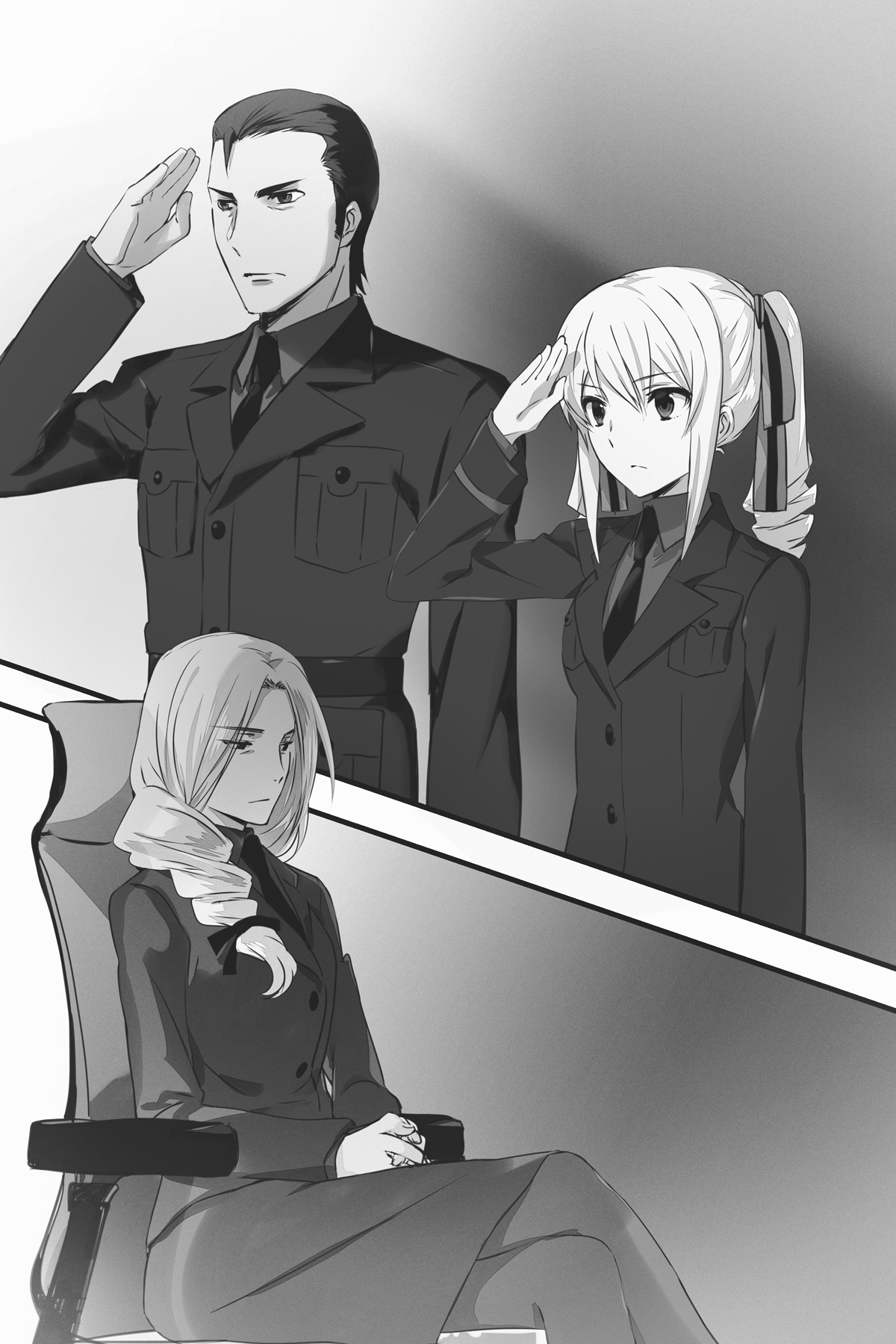
“—That’s the official reasoning. The brass are concerned that you’re too sympathetic to Japan, Major. Some of them are even suspicious that you might defect.”
Lina couldn’t stop herself from objecting. “Wait just a minute! I’ve sworn loyalty to my country!”
“I know,” said Balance, her tone sympathetic. “I don’t doubt your loyalty, Major. But your Japanese ancestry and the fact that you’re only seventeen are enough to inspire concern in others.”
Lina was mortified. Physically, she looked entirely Anglo-Saxon, and she’d never been exposed to any sort of prejudice or racial discrimination before. But that held true only when discussing open bigotry, and the fact that behind the scenes such discrimination was indeed happening made her blood boil.
“I can only call it utter foolishness. But that doesn’t mean you should give fools like that any sort of opening. Major, you are this nation’s trump card.”
Despite a fury that clouded her vision in red, Lina’s training kept her rage from distracting her from her superior officer’s words.
“I cannot dispatch you to Japan, Major Sirius. However, this also isn’t a situation we can afford to ignore.” Balance paused for a breath, then continued, putting some force into her voice. “As such, I will be sending Major Canopus to Japan. I trust that will be acceptable, Major Sirius?”
Lina tamped her frustration down and saluted. “…Understood, ma’am. I will stand by until otherwise ordered.”
“Very good,” said Balance with a nod. “I’ll explain the mission particulars to Major Canopus now. Major Sirius, you’re dismissed.”
“Yes, Colonel.” Lina had wanted to explain the situation directly to Canopus herself, but she had no confidence that doing so wouldn’t renew her burning desire to go to Japan, so she did as she was told and left the room.
“—That is all. Do you have any questions, Major Canopus?” Balance asked, after explaining the circumstances of the missing missiles slated for disposal and the intelligence from the Seven Sages that Lina had provided.
“No, Colonel.”
The only source for the existence of an imminent terrorist threat to Japan was a tip from the mysterious Seven Sages, whose status as an ally and reliable source was questionable at best. The question from the colonel carried the nuance of asking whether Canopus was really not dissatisfied with being sent on this mission based on such nebulous intel, but his answer relayed neither dissatisfaction nor question.
“I see. In that case, Major Canopus, I have a question for you.”
“Yes, Colonel. What is it?”
Balance looked carefully at Canopus’s expression, but there was no agitation to be found in it. Balance found this more a relief than a disappointment as she carefully phrased her question. “Major Canopus—or perhaps in this case I should say Major Benjamin Lowes.”
Canopus’s eyebrows flicked up slightly as Balance corrected herself.
“Are you related to Kane Lowes, the assistant to the president’s deputy chief of staff?”
“Ma’am, as I believe you’re aware, the assistant to the deputy chief of staff’s father and my father are cousins, and his mother and mine are second cousins.”
In other words, there was consanguineous marriage within the Lowes family, but marriages of such distance were not uncommon among aristocracy.
“The truth is, that wasn’t all the information we received from the Seven Sages. I wish I could say it’s a mistake, but…”
Canopus’s expression shifted slightly at Balance’s hesitation. It can’t be, his face seemed to say.
“The assistant to the deputy chief of staff facilitated the release and export of the weapons that were due to be disposed of, as well as the departure of the terrorist himself from the country.”
“…Could the assistant have been bribed?” he asked.
Balance shook her head sadly in response. “I’d feel a little better if that were the case, but…”
“So there are concerns beyond that?”
Balance grimaced, seeming almost reluctant to continue. “There’s a high probability that the assistant to the deputy chief of staff was not bribed, but rather that he and a powerful member of Congress connected to him are attempting to use Gide Hague.”
Canopus’s shock was obvious.
Balance regarded him and posed a question seemingly unrelated to the matter at hand. “Major, what do you think of humanists?”
Humanism was a (heretical) offshoot of Christian religion that paraded the anti-magic ideology that “humans ought to live by only the power they were given.” This, however, was only a fig leaf for their anti-magician activities.
But Canopus’s answer was much more straightforward.
“I think it’s mass hysteria. But I do think we need to be watchful for anyone who would try to manipulate the movement for their own ends.”
“You don’t feel threatened as a magician?”
“If it escalates any further, I do think we’ll need to consider some way to deal with the movement. We magicians have no obligation to stand by while we’re unjustly maligned.”
“…You have rather extreme ideas, Major.”
“Don’t misunderstand me, Colonel. I merely believe that it’s harmful to society for people not to exercise their right to self-defense. We mustn’t take lightly the risk of the national division that could come from humanist discrimination on the part of these people calling themselves victims.”
“I understand your political position. I’ve no intention of making it an issue here.” Despite her lack of objection, her expression was very tense. “Mr. Lowes, the assistant to the deputy chief of staff, seems to share your conclusion, although via a different method. He believes that if the humanists are left alone any longer, they pose a serious threat to national security.”
Balance studied the expression on Canopus’s face carefully, but it remained almost infuriatingly cool and neutral.
“However, ours is a free country. We have to preserve freedom of speech to the greatest possible degree. No matter the principle being espoused, we must not suppress free speech. Or at least, that’s what the politicians think.”
“I quite agree, Colonel.”
“…Which is why the group working with the assistant to the deputy chief of staff is plotting to direct the attention of the humanists abroad.”
“They think having the humanists stage a terrorist attack in Japan will satisfy their hunger for violence?” Canopus’s smirk was cold.
“Don’t be snide, Major. It wasn’t my idea,” objected Balance, looking displeased.
“My apologies, Colonel,” he said sincerely.
Balance continued without pressing the apology, feeling that perhaps she’d been a bit too sensitive herself. “If the information we got from the Seven Sages is good, Lowes’s group’s real goal isn’t the terrorist attack itself.”
“Meaning…?”
“It’s impossible to perfectly limit the targets injured in a terrorist attack that uses explosives. Some of the victims will always be innocent bystanders.”
“You don’t mean…” Canopus’s expression betrayed emotion for the first time.
“The blast from a portable missile launcher won’t be enough to fatally injure a high-level magician unless they’re caught totally off guard. But if they make a few dozen bombs out of the missiles’ warheads and detonate them simultaneously, blocking the resulting explosion would be difficult even for Japan’s Ten Master Clans. A high-level magician could avoid injury using a heat-resistant barrier, but civilian bystanders won’t have that option. And with explosions coming from several directions at once, it won’t be possible for third parties to protect everybody. The result will be casualties among not just magicians but also the general populace. That’s the possible scenario the Seven Sages brought to our attention.”
“And the attention of the humanists would be drawn to these Japanese magicians who let innocent bystanders die. Their energy would be directed toward Japan, and they’d spend less effort on anti-magician activities here. That would in turn decrease the risk of the humanists turning militant and destabilizing society—is that it?”
“Exactly.”
Canopus’s eyes glittered with a keen light. “So my mission is to intercept Gide Hague and prevent the terrorist attack?”
“I wish very much that that were the case,” spat Balance, frustrated. “Ever since the parasite incident last year, the Japanese authorities have been watching us very carefully. It is quite likely that entering Japan and capturing Gide Hague without them knowing is impossible. If our actions are discovered, they would naturally pry into what our reason for capturing him is. And then they would discover in due time that a terrorist was using weapons that our military handed over.”
“But if the attack is successful, won’t they also still trace the weapons back to us? That’s obviously a less desirable situation than preventing the attack, but—”
“There’s a large difference between terrorists having obtained the missing weapons via a broker and the terrorists having stolen the weapons directly from us.”
“…So you’re suggesting we stand back and let the Japanese die?”
“I have already used a private back channel to warn them that a terrorist group headed by Gide Hague is attempting to infiltrate Japan.”
Canopus couldn’t entirely agree with Balance’s position. But he couldn’t deny that the USNA military needed to protect its own position. He was a soldier first and a magician second. That was the greatest difference between himself and the good-natured Lina, who was a magician first and a soldier second.
“Major, your mission is to assassinate Gide Hague, either before or after he executes his plan. Killing Hague may not stop the attack, but that’s not your concern. According to the intel from the Seven Sages, Hague refuses to use air travel. If he’s in international waters, you don’t even have to be particularly discreet. You must not let him be captured by the Japanese.”
“Understood.”
Balance met Canopus’s crisp salute with a guilty look. “I’m sorry, Major. I’m well aware that dirty work like this shouldn’t be your job, but because there’s a high probability that your target is an unusual magician, we need to send one of our best to meet him.”
Canopus relaxed his salute and shook his head with a sad smile. “Your concern is unnecessary, Colonel. In fact, I should be thanking you. When I think about the high commander…about Lina…it makes me want to spare her from such gruesome work.”
Canopus saluted again, then left the base commander’s office.

Canopus arrived at the Yokosuka Joint U.S.-Japan Base on January 29 at 6:00 PM local time.
During the Twenty Years’ Global War Outbreak, all American troops stationed in Japan had been recalled, and ever since then there were no American military bases remaining in the country. However, after the United States became the USNA, the Japanese-American alliance continued on in a different form. Bases that each nation could freely use were mutually established in both nations. Yokosuka Base was one of them. (All this being said, the Japanese armed forces practically never used the joint bases that existed within USNA borders.)
Naturally, the fact that Canopus, commander of the Stars’ First Unit, had arrived in Japan was a secret. He proceeded directly to a USNA Navy destroyer that was about to leave port, which immediately headed offshore.
The destroyer carrying Canopus proceeded south toward Sagaminada and made a close pass by a small, twenty-meter yacht in the water between the Bousou Peninsula and the island of Ooshima. The moment the two vessels were closest to each other, Canopus jumped from the destroyer to the yacht, cloaked in optical camouflage magic that scattered both visible light and infrared. Stratospheric surveillance cameras might have caught this moment, but all they’d see was a vague blur—far from enough to make a positive identification. Thus did Canopus safely smuggle himself into Japan.
The yacht was a pleasure vessel used by upper-level bureaucrats at the USNA embassy, but its engine and outer hull were upgraded for espionage purposes as well. Naturally, it also had a state-of-the-art sensor package. It carried no weapons, but with Canopus aboard that was not remotely a concern.
Canopus directed the yacht around toward Sagaminada, heading south to wrap around the Izu Peninsula, then north into Suruga Bay. Owing to the leisurely cruising speed, it was the middle of the night before Canopus caught sight of the vessel he was looking for.
It was a small cargo ship, its deck completely covered by a roof of photovoltaic panels. To generate additional electricity while underway, arms on both sides of the hull would swing out, unfolding two additional solar panels that were highly reminiscent of the winglike pectoral fins of a flying fish. As an additional power source, the ship also carried a parallel internal photocatalytic hydrogen fuel cell so that it derived nearly all of its motive power from solar energy, and it was a fine example of the low-cost freighters that had come to dominate marine transport in the latter half of the twenty-first century.
Ever since Gide Hague has been suspected of having left the USNA, this ship had been identified as the likeliest choice for transport. But the ship had been expected to arrive in Japan yesterday, so the possibility of raiding the vessel while it was in international waters was abandoned, and Canopus’s superiors instead decided to locate the port where it had anchored.
“Is that the ship, Major?” asked the USNA naval officer serving as captain of Canopus’s yacht in a voice that was a mixture of awe and fear. As a temporary subordinate of Canopus during the mission, he’d been briefed on the major’s background and circumstances. The Stars were already a legendary military unit, and Canopus was a member who’d been given a code name of the highest grade. The officer didn’t seem aware that Canopus was the number two after Sirius, but what he did know was enough to make him obviously nervous. If he’d known Canopus’s real rank, he probably wouldn’t have been able to focus well enough to do his job.
Canopus gave a self-deprecating smile. It was such a disarming, open expression that he could practically feel the captain relax a little upon seeing it. “Unfortunately, ships are outside my expertise. I imagine you all are more used to identifying hull types than I am.”
Beneath the remark was the implicit question: Isn’t a positive ID something your subordinates have already done?
The captain straightened immediately. “Pardon me, sir. Yes, that is the vessel.”
“I trust you, of course,” said Canopus with a serious nod.
The captain breathed a sigh of relief.
“Captain—” Canopus dropped his smile and spoke in a tone befitting his expression.
“Yes, Major?”
“Keep that ship under observation. The fact that it went all the way from Yokosuka to Numazu means that he might be planning to use it again to escape.”
“Understood, sir. I’ll inform our field agents.”
“We’ll keep watch on it from here tonight.”
“You’re not going ashore, Major?”
“The window of opportunity for that has passed. We have to keep our risk of being exposed as low as we possibly can.”
“Yes, sir!”
Canopus nodded wordlessly, then turned his gaze back to the freighter.

Balance had convinced Lina to take the high road and give up on going to Japan. Lina also felt that it wasn’t a mistake to let Canopus handle the mission. He was a veteran combat magician, and Heavy Metal Burst notwithstanding, he was probably stronger than even Sirius. Lina reminded herself that there was almost no chance he’d botch the mission.
And yet, she couldn’t stand sitting around and doing nothing.
“…I’m not getting involved. I’m staying here and behaving myself. So…it shouldn’t be a problem if I contact an acquaintance to warn them. I deserve that much!”
Lina was alone, with nobody around to listen to her talking to herself, but she hastily revised acquaintance to friend nevertheless. She was clearly extremely self-conscious as she glanced back and forth, red-faced.
Realizing that she was acting a bit childishly, Lina cleared her throat—an affectation that itself was very endearing—and turned to face her visiphone’s console.
The local time was 2:00 AM. This meant she’d stayed up until the wee hours agonizing over the problem but also that it was 6:00 PM in Japan. She hadn’t planned it like this, but the timing was just right.
Having made the decision to call when the moment came to actually do it, her hesitation came back with renewed vigor. There, in front of the visiphone console, she resummoned her resolve and punched in Miyuki’s number.
After five rings, the screen lit up. There on the display appeared the image of her rival’s face, whose breathtaking beauty seemed to have only grown in the year since Lina had last seen her.
“Oh! Lina! Goodness, it’s been a while.” Miyuki merely looked at her without any sense of jealousy, fear, flattery, or admiration. Lina felt a strange sensation, as though a layer of ice covering her heart suddenly cracked.
“Hi, Miyuki. Long time no see! How’ve you been?”
“Reasonably well—thank you for asking. Have you lost weight, Lina? Are you okay? Is work keeping you too busy?”
Miyuki unceremoniously lumped both Lina’s position as high commander of the Stars and her duties as Sirius together under the term work. Lina found the honest frankness refreshing.
“If anything, I’ve gotten heavier! Gosh, maybe I put on muscle?”
“Hmm…you must be in great shape. I’m envious.”
“Miyuki…you know when you say things like that, I can’t help but hear it as sarcasm. And anyway, what’s the big idea getting even hotter? Just how much more gorgeous do you have to become before you’re satisfied?”
“Now I think you’re the one being sarcastic… But if I look any better, it must be Tatsuya’s influence.”
Lina was suddenly exhausted. She felt a pang of disappointment: Honestly, if it weren’t for this one thing…
“Speaking of which, I heard you and Tatsuya are engaged. Congratulations.”
“Thank you, Lina. News certainly does travel quickly.”
“I mean, this is the princess of the Yotsuba family we’re talking about here. People are going to be interested.”
“Are they? So is that by any chance why you’re calling—to congratulate me?”
For a moment, Lina was totally wrong-footed by Miyuki’s delighted, happy smile, but then she remembered her real reason for calling. “Um, yeah, no, sorry. That’s not it, actually.”
In response to Lina’s apology, Miyuki cocked her head, her expression turning quizzical rather than displeased. “Goodness, it must be something important.”
Stop looking at me with such an adorable expression! Lina wanted to quip, but she resisted the urge. “Yeah, it’s pretty important.”
“…Should I go get my brother?”
Lina thought about it for less than a second, then nodded at Miyuki’s suggestion. “Yeah, it’d probably be good for Tatsuya to hear this, too.”
“All right, hang on.”
The screen switched to the hold pattern. About thirty seconds later, Miyuki’s lovely form reappeared. Sitting next to her was Tatsuya. To Lina’s surprise, the distance between them was not zero.
“Hello, Lina. It’s been a while,” said Tatsuya.
“Hi, Tatsuya. It has.”
“I’d love to chat, but Miyuki said you have something urgent to tell us. We can catch up another time, so let’s hear the important part now.”
“You haven’t changed, Tatsuya. Always straight to the point—I like that,” Lina blurted out, then inwardly winced. Saying things like I like that to Tatsuya’s face was exactly the sort of phrasing that was like pouring jet fuel onto the flames when she considered Miyuki’s penchant for bouts of jealousy.
But contrary to Lina’s expectations, Miyuki remained calm.
It unnerved Lina.
“Um…Miyuki, you’re not going to get mad?”
“Hmm? Mad at what?” Miyuki responded, her expression honestly befuddled. To her, it was obvious that Tatsuya would be appealing to other women, so there was no need to raise a fuss about such a small comment. But Lina didn’t know that.
“Er, never mind.” If she wasn’t going to get snapped at, that was good enough for Lina. She counted herself lucky and moved on to the actual topic of her call. “Tatsuya, Miyuki—do you remember the Seven Sages?”
Tatsuya and Miyuki shared a look.
“We remember,” answered Tatsuya. “Have you gotten some kind of information from them?” he asked, picturing the face of Raymond S. Clark. He didn’t think Lina knew the Sages’ true identity nor that Raymond was one of them.
“I have, in fact.” Not keen eyed enough to see through his poker face and lacking any telepathic magic, she interpreted his question at face value and answered it as such. “According to my information, a survivor from Dahan is planning a terrorist attack in Japan. The mastermind’s name is Gide Hague. His Chinese name is Gu Jie. He’s a survivor of the Kunlun Institute, and we can surmise that he’s a magician, so… Miyuki, what’s the matter?”
At the mention of Gu Jie’s name, Miyuki had nearly cried out but then stifled herself. Lina didn’t fail to take notice.
The truth was that she’d been shocked to hear the name of someone Raymond had told them last year was another of the Seven Sages, but as Tatsuya had shown no reaction at all, Miyuki quickly said, “The Kunlun Institute is particularly significant to my family…but I apologize for interrupting.”
“Oh, I see…”
Lina knew that the Yotsuba clan had some kind of a connection to the Kunlun Institute. She decided it wasn’t surprising that the successor to the family’s leadership would be dismayed to hear about a survivor from it and harbored no further doubts.
“You may have already guessed this, but I believe there’s a high probability that Hague’s target is the Yotsuba family.”
“I see. I agree, that’s plausible. That’s why you contacted Miyuki?”
“Er—uh, yeah, I suppose it is.” Lina found herself senselessly flustered at the revelation that Tatsuya agreed with her.
“Neither Miyuki nor I can pretend this has nothing to do with us, it’s true. It’s even possible Miyuki’s being directly targeted…”
“Tatsuya…you really don’t think about yourself much, do you? It’s just as likely Hague’s targeting you, you know,” said Lina with an exasperated eye roll.
“If he comes after me, that would be considerably more convenient,” Tatsuya noted, his expression fearless.
“…Yeah, good point. That would move things right along, wouldn’t it?” Lina admitted, quite convinced.
Lina still didn’t know what the nature of Tatsuya’s true power was. She’d once suspected that he was an illusionist specializing in mental interference magic, but ever since they’d fought together against the parasites, she’d gotten the feeling that wasn’t the answer.
In other words, to Lina, Tatsuya was an unknown quantity as a magician. But she had no doubt that he was considerably powerful. She found it difficult to imagine that he was in any danger of being beaten by a magician who had to rely on obsolete missiles to do harm to his enemies.
“Lina, what happened? You look like all your worries just suddenly disappeared,” said Miyuki.
Lina’s heart started racing at Miyuki’s observation. Why did she have to be so relieved at the confirmation that Tatsuya wasn’t in danger? “Uh, well, you know—”
The roar of her pounding heart made it hard to form words.
“I don’t know, actually.”
Lina felt a surge of irritation at Tatsuya’s awkward smile. “C’mon! I mean, you know, with Hague and all, I just—”
—wanted to tell you he was coming, she was about to say but managed to clamp her mouth shut before she blurted it out.
“Oh… You were in a rush because you wanted to tell us about Hague, but now that you’ve done it, you’re relieved.”
“Yes, that!” Lina dramatically reached for the life preserver Tatsuya had thrown her. And then: “Oh, dear…”
Lina turned red right before Tatsuya and Miyuki’s eyes.
“I see. Thanks, Lina,” said Tatsuya, thanking her while ignoring her blush.
“Y-you don’t need to thank me! I just wouldn’t have been able to sleep at night if I stood by and did nothing, that’s all! Anyway, talk to you later, Tatsuya, Miyuki! Good night!” Lina said at a rapid-fire pace before ending the call, completely forgetting about the time difference.
She took off the clothes she’d hastily thrown on and crawled back into bed without even putting on pajamas.