Chapter 1 — The True Strength to Aspire To...
Chapter 1 — The True Strength to Aspire To...
Part 1 — Chance Meeting
“Oh? Whether to make Tahlan your apprentice or your Master’s apprentice? Do as you wish. We’ll leave that to you and your Master.”
“We’re well aware of why you stay with us. We have no desire to force you to do anything against your will. The only thing that keeps you here, given your lack of ambition and desires, is your trust in us. We will do what we can to avoid doing things that go against your wishes.”
“You’re our House’s sword. As long as you remain that, we will protect you.”
“Tahlan will live in Douve’s estate and eventually marry her?!?! PREPARE FOR WAAAAAAAAAAR!”
And that was how we got permission for Tahlan to become an apprentice.
This is why the House Sepaeda and House Batterabbe parties are now heading to the woods my Master calls home via carriage.
“This area is covered by old growth forests because no one considers it worth developing.”
“There are evidently quite a few places like this in the kingdom, but I didn’t expect someone like your Master to live in such a place.”
Happine and Lady Douve are chatting inside the carriage as it clatters along. We departed the morning after His Brothership and His Fathership gave permission, and now we’re approaching the woods a little around sunset.
The woods themselves cover a substantial area, but the edge of that area isn’t that far away from the Academy.
“Hey, Papa. Is this around the place where I met you, Papa?”
“Yep, that’s right.”
We proceed along a pastoral, idyllic little road. Due to the distance between here and the border with the neighboring country of Domino, there’s no sign of the approaching war. By way of contrast, Eckesachs makes no effort to hide her hostility.
“Eckesachs...”
“...Worry not. You are my wielder. There’s no possibility of me switching...an odd notion, that, a sword changing masters.”
Even if he’s the Master I admire, to her he’s the man who abandoned her. She has her own feelings on the matter. I mean, thinking about it, it’s a pretty awful story. She’s the strength my Master threw away, while I’m the successor to the strength my Master cultivated after abandoning her. No wonder she doesn’t like me. And, really, my Master could have been a little more considerate about this. I think he could have spared her a bit more thought, particularly considering they’re both going to be around for a long, long time.
“I myself witnessed the strength he acquired by abandoning me. I’m not so shameless as to demand you challenge the impossible. If his apprentice is this strong, I can’t imagine how powerful Suiboku is now....”
Yeah, that’s understandable. I mean, she had her chosen swordsman beaten by an unarmed opponent. I really do feel bad for her.
“He really has become stronger, hasn’t he...”
“A swordsman who has reached such a height with his craft that he’d even surrender a Sacred Sword...how I look forward to the meeting.”
Unlike Eckesachs, Tahlan is looking forward to his meeting. In terms of sheer swordsmanship, my Master is definitely ahead of me. But he’s not simply a superior version of me. I doubt they’ll end up fighting, but no doubt he’ll be shocked by Master Suiboku’s power.
Separate from these two is someone who fidgets nervously, as though she’s going to meet her future father-in-law. That, of course, is Blois.
“Um...will your Master dislike a woman who dresses like a man?”
“It’s fine. He doesn’t care.”
“Oh, that’s right...well then, how about a smelly woman...? I did put on some perfume, but perhaps I still smell of sweat...?”
“Not to worry. He lives in the woods.”
“Should I have brought some sort of gift?”
“No need. He has no appetite, nor any desire for material possessions.”
She’s nervous about these things, but it’s fine. He lives surrounded by more animals than your average farmer or rancher, so he doesn’t really mind any of it. If anything, he’s the sort who’d mind being handed things. He’s far beyond just a mere ascetic.
“Do you remember when we first met? Back when I first came out of the woods? He’s like that.”
“Oh...in that case, if anything, it makes things trickier...”
“There’s no need to be so tense. My Master is even further removed from the mortal world than I am. If you say you want to marry me, I think he’d just be happy about it.”
“D-don’t say that in front of everyone!”
Thanks to Tahlan’s appearance, the possibility that Lady Douve would end up marrying me has been greatly reduced. If anything, if she lets Tahlan go, she may very well be out of options. She’s someone who can’t compromise, and he’s set the bar far too high.
“Sansui. You mentioned you won’t enter the woods yourself, so how are we to find your Master?”
Lady Douve, who would definitely prefer if I were to lead the way, asks the obvious. There aren’t any roads in the woods, so there definitely needs to be some sort of guide. But, again, there’s no need for concern.
“If you enter the woods, I think my Master will come to you.”
“Alright... Honestly, there’s no reason for me to go see him, but I’m curious. I suppose it’s the mystery of it all.”
The carriage stops near a trail by the woods. Filled with their own kinds of excitement and anxiety, they make their way into the deep woods. The driver and I wait by the carriage and watch them leave. The driver evidently seems to think I should go with the others, and looks over at me for confirmation.
“Are you certain you needn’t visit your Master?”
“Yes, it’s fine. My Master wouldn’t be pleased to see me.”
I haven’t finished raising Lain, and thus I haven’t fulfilled my promise yet.
“Master Sansui... Do you think your Master will approve of the apprenticeship?”
“I do not know. However...he’ll choose an outcome that’s best for everyone.”
“I see. If you say so...”
The woods were deep. It was an old growth forest, one which human hands hadn’t touched in ages. There wasn’t even so much as a path in sight. While the deep woods stimulated their sense of adventure, the party was also being ‘welcomed’ by the woods.
“This scent...it’s an overwhelming smell of greenery...”
“...The bugs...the bugs...”
“My shoes are already covered with mud.”
“Complaining already? Merely about these woods? I doubt women so soft could bear strong children and raise them. Don’t you agree, Saiga? You prefer a strong woman like me, yes?”
Out of the women in the party, only Sunae seems unruffled by the wilderness. However, Saiga himself was in no position to answer, either.
The chokingly dense smell of greenery, the sting of thorns growing on stalks and roots, the lack of solid footing... By stepping foot inside the woods, it becomes immediately apparent that the forest is a different world unto itself. It’s enough to make one realize why, despite being in the Royal Lands, these woods have stayed untouched.
“Well, I now realize why he was so dirty when we first met him...”
“It appears that, if anything, he was on the clean side...”
“Eww, smelly...”
Most of the party, the members of House Sepaeda included, had dressed in long sleeves and shoes suited for the woods, but all those preparations couldn’t do anything about the mud.
While all of them had a change of clothes ready inside the carriage, it didn’t change that they would remain covered in grime until they could return to the carriage.
“Say, Douve. What are we going to do if Sansui’s Master isn’t here? It’s been five years, right? If we keep going, we might get lost...”
“If it comes to that, I’ll just yell out for Sansui. Really, though, I wouldn’t need to. Sansui would come running if he felt that I was in trouble.”
The ability to detect the presence of others... It’s such a vital part of being an Immortal that there’s no formal name for the ability. It’s an ability that allows an Immortal to gather information from their surroundings like a radar, rather than be restricted by senses like sight.
The ability means that, even if Douve is a fair distance away, Sansui can still monitor her status.
“...Hey, Saiga. Why don’t you learn some Immortal Arts, too?”
“Happine, that’s...”
Even Sansui, after five hundred years of training, can only use the basic techniques. Saiga didn’t have the patience to work on such an art. Nor did he have the nerve to try to acquire near-immortality when he had multiple women he loved in his life.
“Pardon me, Lady Douve.”
“What is it, Blois?”
Evidently coming to a realization in the middle of their trek, Blois turns rather apologetically to her Mistress, who is standing behind her, and speaks.
“Sansui’s Master was going to sense our approach and come to us, yes?”
“Mm, that’s right.”
“Which should mean we need only proceed a certain distance and wait...”
The party, which had been making its way deeper into the woods, stops in mid-stride. After having traveled a distance long enough to make returning the way they came difficult, they finally choose to stop.
“...Mm, you’re right.”
“Couldn’t you have mentioned that earlier?!”
In contrast to Douve, who admits her mistake, Happine throws a tantrum. If Eckesachs is to meet with her old master, then Saiga would have to accompany her. Happine joined the party simply out of a desire to follow Saiga, and, as a result, is having quite a fit.
“Calm down, Happine. If you want you can go on back first...”
“I won’t go back! Trying to force me is going to just make me angrier!”
Raised as a sheltered noble daughter, Happine is upset at the dirt and mud. Watching her, Sunae can’t help but look down upon her.
“I see the child is throwing a tantrum again...”
“Sunae, you ought to avoid so casually disparaging another. Particularly when they’ve shown you such hospitality.”
As Sunae looks for any opening to put down Happine, Tahlan, her older brother, immediately scolds her.
“T-Tahlan...”
“Here we are not royals, but mere foreigners. Never forget that, lest you lower yourself to the level of a mere boor.”
The party takes a moment to stop in place. Some take the opportunity to sit on a fallen tree, while the others wait standing for the Immortal. And, perhaps most understandably, Eckesachs, in her form as a young woman, fidgets nervously.
“If you do not mind, Sacred Sword, I would like to ask you a question.”
“What is it, Shadow Wielder?”
“What sort of man is Master Suiboku? I have heard he was considered the greatest swordsman in the world, even prior to parting ways with you,” Tahlan asks Eckesachs, the only one present who has ever met Suiboku.
Based upon the unassuming Sansui, one can guess that his Master isn’t particularly flashy, either, but curiosity is an unavoidable part of being human.
“...He was cheerful and carefree. That didn’t change, even as our parting approached.”
People do change. Ten or twenty years is enough to dramatically change a person’s heart and body. Now, stretch that into a thousand years. It might be accurate to say that Eckesachs is no longer acquainted with Suiboku. The man she knew as Suiboku was a Suiboku that had existed in the distant past.
“He always said he wanted to be stronger, to be the greatest. I loved that part of him. But...he changed. No, he didn’t change. He reached a destination.”
“Which was?”
“He became the greatest. By the time he parted ways with me, he was considered to be without peer. He had arrived at his destination, and could no longer imagine anything greater.”
The words resonate with Saiga and Tahlan. The immortal swordsman who desperately seeks to become the greatest in the world... What was he supposed to do once the world had accepted him as its greatest warrior?
“As he struggled with that realization, he dedicated himself to his training in an attempt to drive away the ennui. In the process, he realized that I was with him. That he had relied upon my presence.”
There were days without end to think. And after spending those days in thought, she had arrived at the truth she didn’t wish to admit.
“The greatest swordsman was the one who possessed the greatest sword and greatest skill. Having achieved that, he let go of the greatest sword. The true greatest swordsman was great regardless of his weapon. Even without a weapon, such a swordsman’s skills could allow them to defeat one who wielded the Sacred Sword. No doubt that was his goal...”
And the embodiment of that goal had arrived in front of Eckesachs after fifteen hundred long years. Sansui, the latest manifestation of the greatness that Suiboku had sought.
“Nay, don’t grant me such credit, dear Eckesachs. No, I have always been irredeemably foolish.”
Quietly, as though he was a tree in the woods that had always been there, stood a young man. Dressed in a rough, hand-sewn kimono, the boy nonetheless gave off the air of someone far beyond the ordinary.
The unaging Immortal, Suiboku. With a wooden sword on his hip, he was similarly dressed as his apprentice.
“Suiboku...”
“It has been a long time, Eckesachs...a long time. I am pleased to see you have found yourself a new master.”
His boyishness reminded the others of Sansui. There was simply an enormous gulf between his appearance and the way he carried himself. The swordsman who had lived through more than fifteen hundred years spoke softly.
“...Forgive me.”
Unexpectedly, it was Eckesachs who offered the apology. Eckesachs, who had long insisted Suiboku had abandoned her.
Tears run down her cheeks as she apologizes to the boy.
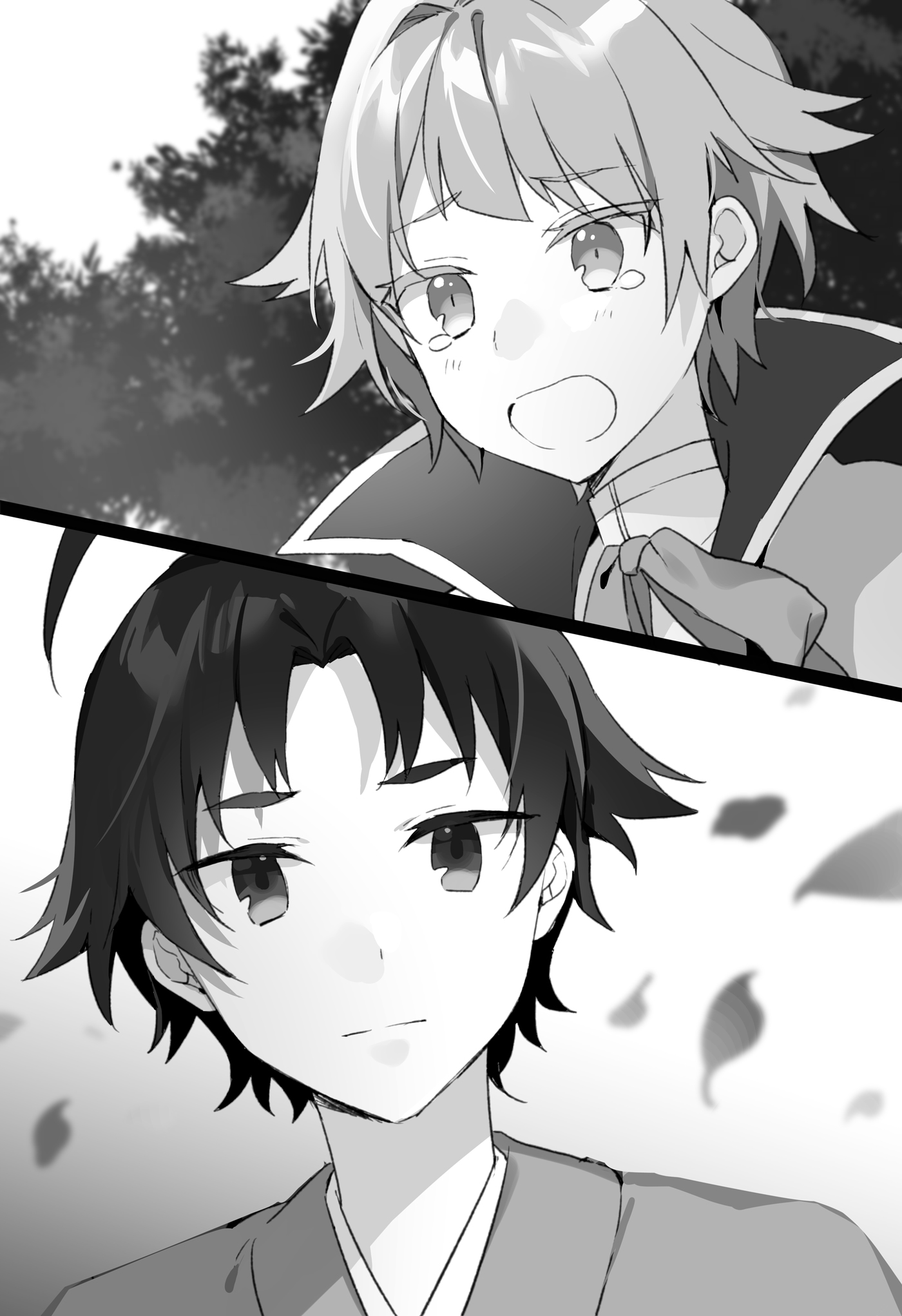
“I...despite feeling the ennui that came from the emptiness of not being able to fulfill my purpose, I never imagined the ennui and emptiness that must have gripped you when you lost your goal, and I did nothing but reject you...”
“Nay, Eckesachs, you’re mistaken. I became so caught up in my own sorrow that I refused to bend in front of you, and didn’t want to expose any weakness to you, the one who acknowledged me as the greatest swordsman in the land... It was I who was unworthy.”
Quietly approaching the crying young woman, the boy apologized, meeting her gaze straight on.
“It may be late, but...forgive me.”
“...”
“Now, not to change the subject, but...I feel the presence of my apprentice Sansui near these woods. Since he led you here, no doubt he owes all of you a debt. I’m afraid I can’t so much as offer you warm water, but allow me to extend my thanks to you. And, in particular...you, Eckesachs’s new master...you have my sincere thanks.”
With a serenity to his tone that no mere boy could hope to project, his thanks is enough to soothe the excitement and irritation of all who hear him.
He is, indeed, the model Immortal that Saiga and Tahlan had pictured.
“I’m Sansui’s employer, Douve Sepaeda. Sansui serves as my bodyguard. He’s a very able swordsman and he’s been extremely useful to me.”
“Oh, indeed?”
“I-I! I have the honor of being in a relationship with Sansui with the eventual goal of marriage! My name is Blois!”
“Oh, so he’s thinking of marriage...I see. Well then, I leave him in your care.”
As though pleasantly surprised, Suiboku responds to the nervous Blois with a smile. Of course, he’s aware that Blois has slightly exaggerated the extent of their relationship.
“Um...”
“Ah, the babe from five years ago. I see you’ve grown.”
“You know who I am?”
“Indeed. I’m the one who told him to raise you. I’m also the one who laid the woman who brought you here to rest.”
“My real mom...”
“She may have been your nursemaid. But she was a strong woman, one who protected you even while being eaten by wolves. Give thanks to her.”
He offers Lain a warm smile, then turns his attention to the man directing a particularly intense gaze at him.
“...A swordsman, I assume?”
“Indeed. A swordsman with a Shadow Presence, one who summons shadows. I am Magyan Tahlan, at your service.”
“A swordsman...I see.”
The swordsman who had spent the past fifteen centuries practicing his swing looks pleased to meet a swordsman born of the mortal world he left behind.
“Good, good...that there are still swordsmen even after fifteen centuries.”
“What...do you mean by that, sir?”
“Well, it’s simple. The mortal world changes so quickly. I thought perhaps that no one would still seek the path of the blade, leaving me a sad relic of the past...to learn there are still those who love the blade is a balm to my heart...”
Fifteen hundred years. It’s been long enough for entire nations to rise and vanish from the pages of history. It wouldn’t be particularly surprising for life to have changed substantially in that time. If anything, it would have been entirely natural to abandon the sword in favor of some new weapon. Yet, still the blade persists. There are people still using the blade like him. The joy is understandable.
“Perhaps you faced Sansui and were beaten?”
“Yes...I was hailed as without peer in my homeland, yet I stood no chance against your apprentice.”
“I see, I see...my apprentice was strong, then.”
“The reason I am here, despite knowing I interrupt your training, is to ask for your instruction.”
Tahlan kneels in respect.
The swordsman offers his heartfelt respect to the Immortal whose skill with the blade goes far beyond his own.
“Tell me, why do you seek my instruction? Why not return to your homeland and take instruction from your own master?”
“That...”
At that query, Tahlan after a moment’s hesitation, begins to answer as though putting something past him.
“I...have fled my homeland.”
The words prove most shocking to Sunae. But all present, knowing Tahlan as a calm, debonair swordsman, are shocked by his confession.
“With a blade in my hand, everyone in my homeland praised me as without peer. I received sincere praise from many, yet...there is a feeling that I, myself, couldn’t avoid.”
His younger sister, blessed with the Royal Presence, had lost to the Academy Regent, likely one of the greatest mages in the kingdom. Then the Regent allowed him a win against her. He couldn’t completely deny that he felt some dark satisfaction in that.
“With my Shadow Summoning, even putting aside the issue of succession, I cannot defeat Spirit Possession. My swordsmanship is nothing against the strength of our homeland’s guardian spirit inhabiting a user of Spirit Possession. It’s something I’ve long realized.”
Simply put, his attacks aren’t enough. No matter how sharp the treasured blade in his hand, Spirit Possession, which raises the very magnitude of the user’s power as a living being, is still superior. Tahlan himself could not defeat many of his younger brothers and sisters, no matter how much they might respect him.
“I learned an ultimate technique, but that was my limit. I think I have been able to achieve a certain level of skill as a swordsman. However, the reason I left my homeland, more than simply wanting to test myself...was driven as much by my desire to run away from the ‘greatness’ represented by Spirit Possession.”
An honest confession from the depths of his soul. Emotions that evoke shame and shouldn’t be so easily bared. Tahlan said all this in front of one who was his superior, his younger sister, and his foreign friends.
“When I lost to your apprentice, I saw the possibility that there were still peaks to climb. But I would be lying if I said that I didn’t wonder if it would allow me to defeat Spirit Possession. I...I have no desire to kill my father or my sister, but as a man, I didn’t want to...I don’t want to admit there is anyone in this world I cannot best.”
“Ah...I see.”
Those present don’t simply respect Sansui’s ability, but rather they place an absolute trust in his strength. The man before them, a swordsman that Sansui claimed is vastly superior to him, smiles as though pleased with Tahlan’s words.
“The greatest...I see, I see. You saw Sansui fight and wished to learn his way of the blade?”
“Yes...”
“Very well. Then how do you define ‘greatest?’”
The question is extremely basic and digs into the roots of the argument.
“You, Eckesachs’s new master...”
“Saiga, sir.”
“Saiga, then. What do you think? The sword you wield is the greatest sword in creation. She can greatly enhance the various gifts of the blood that stir within you. You, who wield her, are certainly enough to be called the greatest.”
Suiboku still refers to the ‘greatest’ he once abandoned as the greatest.
“That’s what I believed...but, I couldn’t defeat your apprentice...”
“I understand, but I believe you could still consider yourself the greatest.”
To the House Batterabbe party, the words feel hollow. Why? Because the man before them goes far beyond that ‘greatest power.’
“How are we to define what is the greatest? To be without peer in a given country? To master the greatest ultimate technique?”
They all understand that, in itself, is difficult. That it takes an individual with talent spending long years in training to achieve.
But seeing Tahlan, who has actually achieved these things, it doesn’t seem to be the right definition.
“Is it one who wields the Sacred Sword and can use countless different Arts?”
“That’s...”
“None of these definitions are wrong. For example, one who wins a particular tournament can be described as the greatest, as can one who takes on one hundred opponents and prevails one hundred times.”
No doubt it’s an answer that he came to after long contemplation, an answer that made him let go of a sword he had at his side for decades. The ‘greatest,’ the ‘strongest,’ the thing that so many yearn for...to state that there are many ways to interpret that status...
“No doubt you believe I am the greatest. You have all witnessed the strength of my apprentice, and after hearing his praise, you don’t have the desire to even test my strength. However...if I, who have spent the last fifteen centuries training in these woods, were to run into one who has trained for two thousand, ten thousand years? What then?”
The words are on a scale beyond understanding. Yet if Immortals have no set lifespan, there are no doubt those who have lived two thousand, even ten thousand years. And there’s no guarantee that none of those have ever focused on the blade. And if those individuals sought to master the blade, it’s possible they have reached heights beyond those attained by Suiboku himself.
“Eckesachs, do you remember Pandora?”
“Of course.”
“If one who can use Pandora appeared in front of me today, even I would have no option but to run. When I had you in my hand, I was, with luck, able to win, but now, the odds are certainly against me, and I certainly can’t expect a guaranteed victory.”
Pandora is an Unholy Armor in House Disaea’s possession. If someone were to wear it, even Suiboku couldn’t be assured of victory.
“The greatest, if considered in the context of simply being the most powerful, has no fixed definition. The greatest is, instead, a goal and an ideal.”
It’s a simple and easy to understand answer. It’s an answer that brooks no debate.
“To desire to become stronger than you are now, to have an idea of how to become stronger, and how to prove that strength... Whether that’s through attaining glory, or an ultimate technique, or approval, or by defeating a powerful enemy, or winning the approval of the masses. The key is to have an ideal or goal that you set as the greatest, and then work to achieve it.”
The man who had reached a height no others in the world could match, who then spent years looking for the next height... He shares his insights without reservation.
“Indeed, if all you want to do is kill someone, being the greatest is only a hindrance. It’s a mistake to become stronger just to kill someone. Instead it would be better to copy the beasts of the wilderness. Conceal your presence, wait for your enemy to relax, and tear out their throat in that moment of weakness. The desire to fight, the desire to prove your strength...they’re inefficient and illogical.”
If simply killing someone is the goal, it’s enough to bash in their head with a rock while they sleep. It’s enough to sneak past their bodyguards and kill them without being noticed. There’s no need for a legendary sword or countless hours of training. To kill, the greatest swordsman says, what’s needed is not the power to fight, but the power to kill without fighting.
“Whether a slash from a magic-wreathed sword or an ultimate technique, from a sword master or a thug, all that happens is that a person dies. Weapons, after all, are created for that purpose.”
It was an argument that was easy to follow, perhaps to be expected of Sansui’s Master.
“To aspire to greatness is to choose that path for yourself. If you end up being inferior to another, or simply end up caught in a bad matchup and lose, there is nothing that can be done about that. The mistake is to believe that the quest to become the greatest, something that serves little productive purpose, can be derailed by a single loss or even a single death.”
Joy in practice. Joy in training. Joy in effort. There is joy in aspiring to be the greatest. Losing is not a reason to complain.
There will be times where you lose utterly whether due to mismatched wits, uneven numbers, or even simple fate. But one who truly aspires to be the greatest isn’t bothered by such things. Why? Because the days spent aspiring to that goal bring fulfillment.
“Which is why I’m overjoyed. For someone to witness my apprentice’s sword and to fall in love with it... It means that you aspire to the greatness that I seek.”
“...Yes, it was love at first sight.”
“I see. You have my thanks.”
That someone admires the art he created... It’s something that brings him more joy than anything. This is why Sansui’s Master so warmly greets those who follow in his footsteps.
“However, I have no intention of teaching you. Ask Sansui for instruction.”
“That...may I ask why?”
With all of that considered, the Immortal tells him to seek instruction not from himself, but from his apprentice.
Tahlan isn’t particularly bothered, nor does he wish to complain. The only reason Sansui refuses to instruct Tahlan is the lack of permission from his master. If that master tells him to teach Tahlan, then there’s no reason for Sansui to refuse. But he was curious about the reasons for the rejection.
“Well...I understand why Sansui doesn’t wish to take an apprentice. He and I have never thought to instruct people with a limited lifespan.”
The reason was something one would expect of an Immortal, for whom time has little meaning.
“However, while it’s perhaps odd for me to note this, if someone with a limited lifespan can’t learn my sword, then it’s questionable if it’s still swordsmanship at all.”
“It goes from the blade to an Immortal Art?”
“Yes. Besides...whatever the Art, whatever the training method, if you spend fifteen centuries in training, no doubt you will become strong. Am I wrong?”
Suiboku points out a fact that both he and his apprentice are faintly embarrassed to admit. And once the founder admits this, the rest of them can’t deny it.
“N-no...but I doubt that training for fifteen hundred years is something most people can even manage...”
“You say that, but while I hate to contradict the previous example, at that point there’s no art to it. At the very least, I’ve put some effort and thought into my own conclusions. Even if someone who appears who’s trained for longer than I have and our blades were to clash, I wouldn’t think that I could lose. After all, at that point, it simply becomes a matter of endurance. One cannot call an Art an Art if the only people you can defeat are those younger than yourself.”
Suiboku is a man who has crafted a definition of greatness through his own struggles. No doubt it wouldn’t be a pleasant feeling for that greatness to be inferior to someone, just because that opponent happened to have lived longer and had spent longer training. Contrasted to the enlightened comments from earlier, it’s an extremely personal comment. There’s no shame or misfortune in dying in battle, but that doesn’t mean he’d be satisfied with that outcome.
“And...Sansui has actually learned rather quickly.”
“No doubt...at the very least, he’s stronger than you were when you abandoned me.”
Eckesachs herself compares Sansui with Suiboku’s past self.
“It’s such a long time ago that the memory may be hazy, but despite only training for a little over five hundred years, he’s equal to where I was when I began training him.”
The scale is just so overwhelming that the mortals present almost abandon any thought of keeping up. To put it simply, even counting that he had Suiboku’s instruction, Sansui had achieved a skill in five hundred years that it had taken Suiboku over a millennium to reach. He reached that same height at over twice the speed. This means that there was some meaning to Suiboku’s instruction. Of course, both were impossible for an ordinary mortal.
“Which means that he’s more than ready to take an apprentice of his own. The whole point of swordsmanship is that it’s achievable by someone with talent and passion, even if they only have a limited lifespan.”
“That is...”
“As an Immortal and as a swordsman, I believe my apprentice is ready to stand on his own. Therefore, I would like my apprentice to try training mortal swordsmen.”
The swordsman who had achieved his skill by ignoring the rules of humanity therefore argues that swordsmanship is only useful if mortal people can achieve it. There is no “greatest” if that greatest is impossible for mortals to reach. It wouldn’t function as an ideal or a goal.
“Which is why I’d like to ask you to study under him. Carry on my apprentice’s sword and pass it on to the next generation. That is the only meaningful way in which an art can be said to live.”
Part 2 — Instruction
The party that had entered the woods to chat with my Master returns looking so disheveled that they look like entirely different people.
After a quick change of clothes, we hop onto the carriage and they tell me what they discussed with my Master.
“I see. To think, Master said that...”
Everyone who went into the woods seems to have had their nerves soothed after speaking to Master Suiboku.
There was plenty for me to learn, as well. Abandoning the man in front of me isn’t particularly virtuous. At a minimum, he’s someone who’s put a lot more thought into his desire to improve than I had when I began learning under my Master. It wouldn’t be right for me to abandon him.
“If my Master has given his blessing, then I will accept you as my apprentice. Of course, it depends on Lady Douve’s approval.”
“...You have it. Make sure he won’t die, even on the worst battlefield.”
“That’s not possible...”
“Do it anyway!”
Lady Douve, you make it sound so easy, but there’s no such thing as an unkillable person. Even my Master and I would probably die under the wrong circumstances.
“Hah! I see that even the great master swordsman has yet to learn how to handle a lady. This is not a time for modesty, but for reassurance with a bit of bravado!”
“I’m afraid I’ve spent most of my time in practice...”
As Tahlan says, talk alone costs nothing. But when it comes to the blade, I can’t simply provide cheap reassurance.
“...Speaking of which, your Master mentioned that he never planned to teach normal people, and you yourself say you’ve only ever spent time in practice. What are you planning to do, specifically?”
“Yes, that’s the issue, isn’t it...”
I can’t very well have him do practice swings from sunrise to sunset without eating or drinking. Even if I had him do it, I doubt he’d learn anything. It’d just end up as an endurance contest culminating in his injury.
“Tch. I mean, on that subject, there’s no way you could get that powerful just by doing practice swings. Just what’s the truth here? Don’t you have some sort of secret method you use to get stronger?”
Happine points out the obvious.
No doubt I would have felt the same way in the past. In fact, I actually thought that a few times in the beginning. But the reality is different. Training for Immortals is predicated on patiently spending time working until the breakthrough happens.
“I don’t want to be the one to say this, but there’s no point to secret training methods for someone who can spend five hundred years training.”
“S-Sure, that’s true, but...your technique to make yourself or others lighter, the teleporting from place to place, the strike technique...they’re not something you can learn just from swinging a wooden sword, are they?”
She seems to be extremely curious about this. I mean, it’s a tantalizing thing to think about. The training method of a great sword master. However, I’ve never done anything as impressive as splitting a boulder with a steel sword.
“Both my Master and I are users of the Immortal Arts, so...that sort of explanation was, well, unnecessary, so to speak...”
“What do you mean?”
“I’ll explain the steps of my training, but it’s not going to be very interesting.”
“That’s fine. Tell me. It won’t take that long to explain, if all you’re doing is talking, right?”
It’s not a question of how long the explanation takes as much as that it’s uninteresting...
“At first my Master instructed me to do practice swings next to him from morning to dusk. We’d wake up together at sunrise, then go to sleep at sunset. On days when it rained we’d sit inside the hut and weave clothes or sandals and maybe chat a little, but we didn’t do much else.”
We continued that way for five hundred years. Okay, so that’s a little too dull, even for me.
I guess I’ll go a bit more into the specifics.
“Practicing sword swings in the great outdoors... It sounds fine, but it’s not a particularly interesting way of spending time. At first, I would practice next to my Master, just wishing for the time to pass as quickly as possible. However, by the time my hands were covered with blisters, I began to realize that I couldn’t keep doing things the same way — I wasn’t learning anything.”
I think this is a normal reaction. At the very least, I notice Saiga nodding along in agreement.
“I began to think about just how much time I spent in practice, how many times I would swing in a day. I started carving marks into rocks just to keep track of it.”
The days since I started training. The number of times I practiced my swing. I thought to convert the knowledge of how much time I spent into confidence in my efforts.
“At a certain point, I then realized that I’d become caught up in those numbers and hadn’t actually made any progress.”
“What was your Master doing all this time?”
“He had been practicing next to me.”
Everyone’s gone completely quiet.
Well, everyone but Tahlan, it seems. He seems to know that excessive instruction can hamper rather than help, at least.
“Feeling a bit of panic at that realization, I began to pay attention to my swings, trying to confirm that I was doing them properly. Which then...leads to the realization that my swings up to that point had been wrong. That everything I’d done was wrong. With that recognition, I started relearning how to swing a sword.”
Everyone except Tahlan seems a bit exasperated at that explanation. Well, sure, it means my Master really didn’t teach me much of anything.
“And it’s at that point where I finally began to watch my Master’s movements. That helps me figure out what I’m doing wrong by comparing my motions to my Master’s motions. It allows me to realize that a sword swing isn’t about arm strength or muscle mass, but how I use my entire body.”
It goes without saying, but practicing sword swings doesn’t involve just standing up straight and using just your shoulders and arms to move your blade. When you do it, you start to notice things like your positioning and center of gravity.
“That is where I began to correct things like my weak-kneed stance and the like. But once I focused on correcting my overall posture, I began to neglect my arms. So I then began focusing on parts that I’d neglected. Once that happens, I started neglecting other parts of my form, and as I’m correcting each part...the sun goes down.”
It’s at around this stage where it finally stops being a struggle to practice from sunrise to sunset. It’s replaced by an understanding that time passes quickly while practicing. Before bed each night, your thoughts go automatically to what you can improve the next day.
“With repetition, I then gained an understanding of just how each of my joints function during a swing. And with that understanding, I could distribute my awareness over my entire body. Once that became a natural part of my movements and I stopped thinking about doing it...I became aware of my muscles again.”
After understanding your own skeletal structure and how your joints move, you return to an awareness of how your muscles move in response. There’s still an awkwardness in me, when compared to my Master’s movements. Since the issue isn’t in the joints, the problem is in my muscles.
“I then notice that each time I take a practice swing, there are sections where I apply too much strength, or parts where I don’t apply enough strength. Focusing too much on how my muscles move then throws my joint alignment out of order again. Once that happens, things fall apart for a bit, until I manage to unify them once more through intense focus. Then, I manage finally to get closer to my Master.”
Lain looks sleepy. As the level of dullness goes beyond even what she had imagined possible, Lady Douve just looks sick of the explanation.
“Once I realized that, I also realized that I can grasp my Master’s movement despite not being able to see him. Turning my attention to my own body’s movements, I then notice that I also have a heightened awareness of what’s going on around me. As I grasp my own body’s state, I also grasp the state of my Master standing next to me. Which then...reveals just how large the gap is between me and my Master. So I begin correcting my movements to get closer to his.”
This is a sense that only Immortals with the Immortal Presence can achieve, which means it’s something that Tahlan, with his Shadow Presence, can’t hope to grasp.
“Focusing on one part, then being able to focus on the whole, and eventually learning to do that naturally... With enough repetition, that awareness extends into the blade, forming an awareness of the length, the shape, how best to swing to obtain blade speed, and how to land the heaviest blow. The understanding expands with time.”
Without ever leaving the basics, this expands into wider and wider applications. Which is why the transition from one phase to another was gradual, almost excessively so.
“Continuing with that practice, I then realized that my own Immortal Presence connects to the nature in the woods around me. Like how a mage grasps the flow of mana, I gained an understanding of my Immortal Presence through my blade. This took about a hundred years.”
“...I can’t find a single thing to admire about your Master...”
“The Immortal Arts aren’t something that can be taught through books or lectures. It requires a connection to nature, and from there nature takes its own course.”
I mean, I don’t even remember when I became an Immortal. The Immortal Arts are something you just sort of end up grasping.
“Still, once I could read the Immortal Presence in my Master, I began to understand how he’d manipulate it to do things like the Cloud Step when he was gathering the materials to make his clothes and sandals, so it’s not wrong to say I learned those techniques from my Master.”
“I have heard that Immortals meditate to get closer to nature, but it appears Master Suiboku uses practice swings in lieu of meditation...”
Tahlan is the only one listening seriously.
“I have never met another Immortal other than my Master, but I believe you’re correct.”
The others have started wandering into escapism because of the sheer scale of the explanation. To top it off, Lain’s already gone to sleep.
“Once I learned to use the techniques, I started to gain a certain confidence, an overconfidence, even. ‘I’m pretty strong now,’ that sort of thing. Or, ‘I’ve put so much effort into this, I’ve gotten strong;’ the sort of cockiness that comes from immaturity.”
“...Are you sure that’s immaturity?” Lady Douve asks, exasperated.
“Yes, it unsettles the heart and leads to unnecessary tension. Training then consists of making those adjustments.”
“Oh, really...”
“Immortals recognize the imperfections in themselves. So we can also see the problems that come from overconfidence. Still, it’s hard to hold back a sense of superiority that comes from your own ability or a desire to look down on others. The thing that I relied upon at those times was nature itself. By spreading my awareness into the vastness of nature around me and watching the progress of life, I was able to come to a conclusion of just how small and insignificant I was, at least, eventually...that took about two hundred years.”
“Alright, never mind. You shouldn’t teach Tahlan.”
Lady Douve states the obvious.
It’s true that Immortals don’t look to acquire their skills in a short span of time. There’s no desire to allow others to pick up those skills quickly. They can’t have that outlook. That’s because they have no set lifespan. Of course, there’s no such thing as a life that can’t end tomorrow, but if the discussion goes that far, then if it ends tomorrow, that’s all there was to that life. Immortals can only look at the world in a way that doesn’t go against the natural order and simply accepts whatever happens. Any discontent or anger can’t be acted upon to resist fate. That’s what it means to cut yourself off from the mortal world. Which means we don’t bother setting goals like where you want to be in a hundred years, or two hundred years, and the very act of thinking that way is a sign of immaturity.
“Hah! No need to be so prickly, Lady Douve. As a warrior, all of those lessons are things I could grasp and understand.”
“Yes, Lady Douve. Not to put it the wrong way, but Prince Tahlan has already reached a certain level of skill. As I’m not teaching him the Immortal Arts, there’s no need for him to spend a hundred years in practice.”
A prince of a kingdom, taught by first-class masters, having achieved a level of skill that made him the greatest in his kingdom... There wouldn’t be any weird habits or things that I need to correct. He’s an elite Shadow Summoner and an elite swordsman. This is why both my Master and I took a liking to Tahlan. Of course, I’m sure my Master also took a liking to Eckesachs’s new master, who decided to split a boulder with a steel sword, for a different reason.
“If anything, the main reason I was hesitant to teach Prince Tahlan is because he is already well trained. If I’m to teach Prince Tahlan, I would have to teach him that our style of swordplay relies, to a large extent, upon the senses unique to Immortals.”
I’m not sure it’s something I should be saying myself, but I suppose that’s part of why my Master also describes our swordsmanship as being an extension of the Immortal Arts...it’s extremely hard to teach to people other than Immortals. Of course, that’s not to say we can neglect the steps before that, but...
“Very well. Once we return to the estate, I’ll begin by explaining the step before that.”
Tahlan appears to be looking forward to it, but it’s not going to be easy to teach, nor is it going to be particularly revolutionary.
It’s just that we do the things that he already knows how to do at a much higher level.
Part 3 — Demonstration
It’s the day after everyone had gone off to Master Suiboku’s, and I’m preparing to begin my first practical instruction session with a demonstration. We’re on the front lawn of Lady Douve’s estate near the Academy. I’m about to instruct the parties from House Batterabbe and Sepaeda on the practical applications of the final stage of my Master’s Art.
“Ah, I understand about Your Lordships being here, but why are the cavalry troopers here as well?”
“You, this kingdom’s greatest swordsman, are going to be instructing a foreign swordsman. Surely there’s no problem for your employers, the men of House Sepaeda, to sit in on the lesson?”
“It’s instruction from one who has mastered the art of swordplay. It’s natural that we would be interested, is it not?”
Oh dear, this seems to have gotten a little out of hand. His Brothership, His Fathership, the cavalry troopers under their command have all disarmed, to some extent, and have taken up positions to observe the lesson.
“Well, I certainly don’t mind...”
“So you need me to serve as the opponent?”
It’s times like these that the near-amateur Saiga comes in handy.
“Yes, thank you.”
After all, I need to teach not just Tahlan, but also Lady Douve. Lady Douve is a complete amateur, so I’ll probably have to start with the basics.
“First, I’ll begin with space — that is, the distance between yourself and your opponent...”
With that, I hand Saiga a practice spear. For obvious reasons, it doesn’t have a metal tip. It’s a wooden stick with the tip wrapped in cloth, a standard practice spear in use by House Sepaeda.
“Lord Saiga. Go ahead and stab at me with this spear.”
“A-Alright...like this?”
“Yes, that’s fine.”
Saiga’s a complete beginner when it comes to spears, but it appears that he can at least make it look a little convincing, mostly thanks to his practice with the sword. Of course, it’s just that he looks like he’s taking the right steps and making the right attack. He’s got high physical abilities, so I’m sure he can hold his own, but his skills are those of a complete beginner.
“A thrusting attack from a spear is easy to understand. Alright, please pause after you’ve finished your thrust. This should make it easier to grasp, but...this is the limit of Lord Saiga’s range with a spear.”
I tap the tip of the practice spear with my finger. Then, I move right in front of the spear tip.
“It may be obvious, but no matter how many times he repeats his thrusting attacks, he’ll never be able to reach me if I’m standing here. Of course, since Lord Saiga is an amateur with a spear, there will be some variation in distance, but if he wishes to hit with any impact, this is the limit of his range.”
With that understood, I have him drop back into a ready stance. It’s essentially a middle stance, a neutral stance. He’s grasping the spear with arms that are slightly bent at the elbows, and he can lunge in any direction at any time.
“Now, let’s say I step inside next to the prepared spear. While he can certainly perform a counterattack with the right technique, if he wishes to actually lunge at me with the spear, Lord Saiga would have to take a step or two back. Therefore, I’m currently beyond the inner arc of his effective range.”
I approach Saiga as he stands in his ready stance. I’m now standing inside the point of the spear tip. In this sort of situation, a polearm is at a disadvantage, which is why spearmen are trained to feint to keep opponents out of this range, or to kill them before they can get this close.
“Which is why the effective range of a spear is a bit inside of where I was standing, to a bit behind where I’m standing now, by the spear tip.”
“W-Well, sure.”
“Now, as a basic point, there’s a greater advantage to being able to attack from a longer distance than not. The reason most weapons are better than unarmed attacks comes from the combination of greater lethality and the ability to attack from long range.”
‘Obviously,’ it seems Lady Douve wants to say, looking rather bored. The same can be said of Happine and Zuger. It’s such an obvious thing that they don’t understand just how hard it is to accurately gauge.
“Getting inside someone’s effective range is a relatively easy concept to understand. After all, you simply have to get closer to that weapon than it can attack. However, it’s extremely difficult to gauge the limits of a weapon’s range. As an example, I’m going to step outside your range and slowly close the distance... Try attacking when you think I’m back in range.”
“O-Okay...”
Seems Saiga understands what I’m trying to demonstrate, and avoids using his divination.
After I open up some distance, I steadily approach him at a walk. His spear point wavers as he struggles to figure out the exact timing. The anxiety about the right time to attack shows pretty clearly in his expression. And the moment I get just inside his range, by my reckoning, he attacks. I easily avoid the lunge.
“Lady Douve. How did it appear to you? Did he wait until I was within range?”
“Yes, it looked like he had it right.”
“It’s relatively easy to see as a third party. If the opponent is also armed with a spear and is in the same stance, you can get some sense of the range once the spears overlap, but it’s actually rather hard to grasp if someone approaches unarmed. Still, it’s possible to gauge the range using the spear tip, the distance between it, what’s in front of it. However, that also means that it tells me his effective distance, as well. Further, he’s so focused on his spear tip that he loses sight of everything around him.”
The fighters present are nodding along to the explanation. It’s one thing to misjudge range in unarmed combat, but misjudging range with weapons leads straight to death. Outside the effective range is safety, and inside the effective range is a constant threat.
“The space where an attack can connect, think of that as the ‘effective range,’ and from there consider that ‘space.’ Next, let’s talk about ‘opening’ — that is, ‘opportunity.’ Lord Saiga, have you ever played baseball?”
“Huh? Well, yeah...”
“Then let’s play a bit. I’ll be the pitcher.”
We’re suddenly about to play baseball, but Saiga doesn’t seem too bothered. Well sure, it’s much simpler to play baseball than to try to stab someone with a spear.
“My wooden sword should be fine as a bat. We’ll use a random rock as the ball...”
“Y-You sure that’s okay?”
“You don’t have to hit the stuffing out of it. Just make contact.”
It’s the first time in five hundred years I’ve played baseball. You know, I’m probably the only one who’s ever had five hundred years between one baseball game and another. But I suppose that if I start thinking about it, I’d be the only one doing all sorts of things five hundred years apart.
At any rate, I grab a rock about the size of my fist and throw it at a pretty good speed. Of course, I wind up before throwing, like an ordinary pitcher in baseball. Saiga hits the rock with his bat. It’s not like I threw it fast enough for him to lose sight of it, so there’s nothing odd about him hitting it. Additionally, we weren’t using a baseball bat and ball, so it doesn’t fly off as a home run. The rock, hitting the wooden sword, just rolls a little bit after contact.
“Well done. Next, I’ll throw it a bit slower.”
“O-Okay...”
Saiga shows confusion about exactly what I’m trying to get at, but drops into a batting stance anyway.
I pick up another fist-sized rock and, without a wind-up, I toss it at him. Thrown without any wind-up, it’s slower than the last rock, but as he’s caught off guard, Saiga can’t make contact with it using the wooden sword. Yes, he just swings and misses.
“Seems you missed...”
“T-That came out of nowhere...! What was that for?”
“Just having a little fun, it’s nothing that profound. Anyway, why is it you missed a rock that was slower than the one you hit earlier?”
“Well...that’s because you threw it without warning...”
He’s half right.
“It’s because I threw it without a wind-up, isn’t it?”
“Y-Yeah...”
“No matter how fast it might be, if there’s a big warning before the attack comes, you’ll be able to respond to it somehow. However, if there’s no warning at all, it’s easier to catch the opponent off guard. More importantly, they don’t have time to mentally prepare themselves. Essentially, they can’t read the ‘opening.’”
When the attack is going to start, when the attack does start... If you can avoid showing those to your opponent, the attacker is at a substantial advantage. To put it another way, knowing when the attack begins is the ‘opening’ and trying to find your opponent’s opening is what we call ‘seeking an opening.’
“No matter how fast the attack, if you tip off your opponent beforehand, even attacks that can hit won’t hit. Of course, that’s only if the opponent has the presence of mind to notice.”
If you’re intimidated, there’s no such thing as an ‘opening’ to find. If you don’t have the courage to face off against an opponent that’s showing hostility and who intends to kill you, it doesn’t matter if you’re wearing armor or armed with a blade, you’ll still just die. That’s an obvious truth, whether we’re talking about the wilderness or the battlefield.
“Now, let me demonstrate what it means to master that. Lord Saiga, use that wooden sword to attack me with a high downward slash.”
“With a large wind-up?”
“Yes. However...do it very slowly. As though you’re a lumbering cow.”
Despite a touch of confusion, Saiga approaches within striking range from the batter-pitcher distance we had been at a moment before. He’s in the stance of the slash he’s best at, the slash he used to split a boulder. It’s a powerful stroke that can kill an enemy by putting his entire weight behind the attack, but he attacks at a glacial pace.
“Sloooooowly.”
“Yes. Like that.”
It’s at a speed a child could avoid, so I’m sure even Lady Douve and the others could manage to dodge it. With that factored in, I avoid it. Obviously, no one’s surprised.
“What does this tell us, exactly?”
“Lord Saiga, when did you realize that your attack missed? That you swung through air?”
“Well...I can tell just by looking.”
That’s right. If both sides are moving slowly, then it’s obvious the moment that one side moves. That goes without saying. But if both sides are moving quickly, it’s much harder to grasp.
“Then attack me slowly again. I’ll also move slowly, so just try to hit me.”
“R-Right.”
He repeats the slow attack. As he does, I make a very obvious motion to avoid it, slowly circling around Saiga as the attack is in the middle of coming down.
Of course, Saiga is also watching my movements, so he shifts the trajectory of his attack equally slowly, confirming my movements with his eyes, moving the sword so that it hits me...and makes contact.
“Nicely done.”
“...So, what’s the point?”
“Alright, next. Miss Eckesachs, could you come over here?”
I take back my wooden sword and call Eckesachs over. The ultimate sword, once wielded by my Master. She amplifies magic abilities, but she’s also really, really sharp.
I have Saiga pick up Eckesachs in sword form, and we repeat the same actions.
“Lord Saiga, take a practice swing with Eckesachs.”
“Right...this okay?”
“Yes, that’s fine. Now, try to rapidly adjust the trajectory of your swing like you just did.”
“Huh? O-Okay, I’ll give it a shot.”
Because it’s a practice swing, he’s able to change the angle of the swing 90 degrees mid-swing. However, it doesn’t have the speed of the swing that could split a boulder. The change in direction killed the swing’s momentum. It was an unnatural movement, and Saiga himself doesn’t seem satisfied with the result.
“Swords are heavy, particularly steel combat blades. If you wish to stop a swing with such a heavy blade in mid-swing and alter the direction of the blow, it takes an enormous amount of strength. Further, it would reduce your blade speed and impact. Because it’s a strike that you’ve thrown your entire body and spirit behind, it’s impossible to fully change mid-swing.”
“Ah, I see...yes, that’s true.”
“Which is why you do feints and attempt to take your opponent off balance before that strike...”
This is the logic behind the ultimate Shadow Summoning technique, ‘Sword Dance of Shadows,’ a technique that uses summoned duplicates as a way to maneuver the opponent into your full-strength strike.
It’s a move that requires precise control of both the summoned shadows and one’s swordsmanship, worthy of the name ‘ultimate technique.’
“Now, on an ordinary battlefield, there’s almost no time to do any of this. Nor is there any need to.”
“Huh?”
“On a battlefield, while there may be a difference in extent, you’re almost always fully equipped, including with armor. Further, there’s a certain concentration of people, meaning it’s next to impossible to elegantly avoid attacks. Hence, the use of weapons that are so heavy as to be unblockable, the strength to swing such weapons, or the use of magic...the armored combat arts. That is, combat arts predicated on both sides being fully armed and armored.”
It’s a style of combat where strength, size, and weaponry are what determines victory. There’s nothing wrong with that logic. In fact, it’s the proper logic when talking about survival of the fittest. It’s also not as easy to do as it is to describe. There’s nothing easy about fighting in armor so heavy that it saps your strength just by wearing it. From the training to actual fighting, there’s nothing simple or easy about it.
“However, the height that my Master sought was not armored swordsmanship, but unarmored swordsmanship. A form of the blade that assumes the wielder wears no armor and is not fighting on a battlefield, but rather to protect. Put another way, a blade form that puts the emphasis on technique.”
I place my wooden sword back into my sash. Then I stand in front of Saiga.
I’m so far into his effective range that it’s obvious at a glance.
“Try your full-strength strike.”
“...You’re sure?”
“Yes, of course.”
Even if I were to block it with my wooden sword, Eckesachs would go through it and me like we were butter. For the sake of argument, if Saiga’s sword was a normal steel sword, it’s possible I wouldn’t be able to stop his strike with my arm strength. No, even with a wooden sword instead of a steel one, if it hit my head, it could be more than enough to kill me.
“Alright...yaaah!”
It may not be much to me, but it’s a strike that can cut through stone, backed by training and effort. A strike that has all of Saiga’s body and soul behind it. Even facing that, my heart is calm.
Without using my Immortal Arts, I step forward and to the right, lightly smacking Saiga’s face with my palm. The blow, unleashed with the intention of splitting me in two, cuts nothing but air and carries Saiga forward with it.
“Well done. A proper strike that could split even stone. It was a strike worthy of the heir to the martial House Batterabbe.”
“...You mocking me?”
“No, not at all. I was able to see your ‘blade.’ I’m pleased.”
Sure, in terms of actual skill he’s nowhere near me, Tahlan, or Blois. But it was still a good strike. A perfect strike for him, one can defend himself with his mystic arts.
“Now, Lord Saiga. When did you realize that you missed?”
“...Well...”
“Earlier you noticed when it missed...that is, when I moved out of the way. But this time, I believe you didn’t realize it until your blade almost hit the ground.”
“Well, yeah...”
“This is the parry that my Master sought to perfect.”
Trying to explain it in text shows just how ridiculous the idea is. In a sense it’s an ideal for unarmored swordplay, but what my Master sought was to be able to always do it, whatever the circumstances.
“Wait until the opponent has started to attack, avoid the attack once they can no longer alter the trajectory, then attack before the opponent’s realized their attack has missed. In our school, this is what we call gaining the ‘post-initiative.’”
Let’s say the opponent attacks with lightning magic. The lightning itself isn’t something a human being can parry. For the person being attacked by the lightning, the spell has already hit by the time they can see the flash. There’s no way to respond to that. But that also means that the opponent who unleashed the lightning can’t know if the spell made contact or not until after the moment of contact. The key is to control not the lightning, but the person wielding it.
“Or take the ‘pre-initiative’ and hit the opponent between the moment they decide to attack and the moment they begin to move. This is what my Master, Suiboku, sought to achieve.”
“Lightning Slasher...” one of the cavalry troopers murmurs, as though aware of what I was thinking.
“If we’re both moving slowly, like we were earlier, then no matter how the opponent moves, there’s no way to catch the other side by surprise. However, because both sides are moving quickly, it’s possible to attack them before they notice our movement.”
“Don’t think that’s possible...” Saiga says in shock. Everyone else is also silent from the surprise.
If anything, Saiga is more aware of the difficulty than most, thanks to his precognition. Taking time to ‘think’ to respond to an opponent... The time to ‘focus’ on the opponent... That would make this sort of swordplay impossible. That’s because your brain and body wouldn’t react as you wanted them to. It’s a height that can only be achieved if everything happens completely naturally, without conscious thought.
“A fully equipped opponent will try to block attacks against them using their shield or weapon. That is why the response is to train the body, to create a weapon too heavy to guard against, and then bring it down against them. Alternately, you wear armor and carry shields heavy enough to withstand the enemy’s full might...this means that you turn yourself into a harder stone for your opponent, the softer stone, to break themselves against.”
If one has a strength of ten, one can easily defeat an opponent with a strength of five. However, that still imposes a cost on yourself. No matter how strong you might become, you’ll still tire against a weaker opponent. Which means that, so long as the enemy prepares sufficient numbers, you’ll eventually wear yourself out against them.
That’s not the ‘greatest strength.’ If that’s the height that the strongest individual, with the strongest weapon and the greatest amount of training can achieve, then that’s meaningless. It’s tragic.
“The height, the ‘greatest strength’ that my Master sought to achieve, was the ability to attack one-sidedly. It’s not about attacking the opponent with a strength that they can’t defend against, or to attack from a range that the enemy can’t reach, or to attack at a speed the opponent can’t catch. It’s to claim the ‘opening’ that the opponent doesn’t notice. If that’s possible, then no matter how many thousands, how many tens of thousands of opponents you face, you can do so without getting a scratch.”
Eckesachs, returning to her human form, takes another look at me. She understands the logic behind the ‘sword’ that my Master has bestowed upon me.
“At those heights, there’s no need for feints or unbalancing. All attacks become single strike kills. No, there’s no need for them to kill. That’s the Suiboku School of Swordsmanship.”
Taking all those practice swings means achieving a deep understanding of one’s own body. It means understanding how you move your body, how a human will moves a human body. It means an understanding of where your center of gravity is and when you should put your strength into your movements. It means a complete understanding of your center of gravity, your posture, and the changes in your muscles as you move, all at the same time.
Those are the basics and they form the foundation.
Regardless of what weapon the opponent wields, whether they are human or beast, you grasp their movements from their posture and breathing. After spending a long time understanding yourself, you’re able to understand others.
“To fully master this, my Master spent a thousand years in training. Even copying my Master, it took me five hundred years to learn.”
To go from being able to do it when you’re lucky, to being able to do it when in the right state, to doing it almost entirely without fail, to always being able to do it, and finally being able to do it naturally.
To make that possible, that’s the amount of time it takes.
“And my Master is still looking far beyond this. However, that’s the realm of Immortals. Prince Tahlan, with your talent, if you build up the experience and spend several years in training with the right mindset, you will reach a certain height.”
“It sounds impossible, honestly...”
Lady Douve, there’s no end if you start saying that.
“I see...that’s the mastery he attained.”
Eckesachs, who had been abandoned by my Master, seems to have come to a certain amount of understanding after hearing my explanation.
Really, the things I just described are things first-rate swordsmen do naturally as part of having their trained senses. It’s just that my Master and I have taken that mastery to its natural conclusion.
That means that my Master should have been able to do it to some extent in the past, albeit not whenever he wished.
“For an Immortal, five hundred years is an eyeblink in terms of training. I thought you skilled for that small amount of time, but that’s because you focused upon mastering your swordsmanship rather than learning Immortal Arts techniques. Still, you’ll probably struggle against particularly tough enemies or large numbers of them.”
“It is as you say.”
In my third battle with Saiga, his defenses were already more than my attacks could penetrate.
I was able to overcome them because I knew Eckesachs had strengthened his magic, and because I could take Eckesachs from him, due to Eckesachs being a ‘sword’ rather than ‘armor.’
Had he genuinely mastered that level of mystic armor on his own, or if his magic had been amplified by something that wasn’t easy to remove, like a breastplate, gauntlet, or helmet, then I wouldn’t have been able to use that same tactic.
I mean, the Immortal Arts, unlike magic, don’t have much in the way of attack abilities.
“Which is why...your personal greatness isn’t designed with the possibility of fighting the Unholy Armor, Pandora, in mind.”
“Pandora, the legendary armor said to be owned by House Disaea... If I have to fight its wearer, then at that point it’ll be Saiga, not Sansui, fighting them.”
The ultimate Sacred Sword says this as she tries to cheer up her new wielder.
Part 4 — Opposing Sides
“I admit, I struggle to comprehend your decision.”
“I fully understand what you wish to say, Your Highness.”
Setenve Arcana, Eldest Daughter of House Arcana, First Princess of the Kingdom.
With a harsh expression, she fixes a glare upon Paulette Caputo.
There is no angry shouting, simply a continuous, merciless litany of arguments that drive the opponent into the corner. Setenve, a skilled debater, is most comfortable with this method, but Paulette responds with a calm serenity.
“There is currently an enemy army gathering upon our territory’s border. The forces of the Neo-Domino Empire...or, rather, the forces of the Domino Republic. Our knights, led by House Caputo’s paladins, are already in position.”
“...I have never doubted your House’s knights or their ability. Your paladins, while small in number, with their combat-oriented Mystic Arts, their high level of training, and their high morale, are extremely effective. Further, this war will be a defensive battle, primarily holding fortresses in siege warfare. I suppose you believe the Republic, with their lack of war materiel, are no threat?”
“...I imagine you suspect me, and House Caputo, of not wanting to allow the armies of the other Great Houses, or the Royal Family, into our territory.”
There is, at least on paper, a gap between the Royal Family and the Four Great Houses. At least, that’s the public understanding of the power relationship.
Further, because the Four Great Houses have a certain level of wealth and power, they have little incentive to try for greater power and risk conflict with the Royal Family and the other noble houses. At least, not in terms of armed conflict. They are, however, not above competing with one another for influence, so long as it doesn’t rise to the level of civil war.
At the very least, they are not likely to call for reinforcements from the other houses when faced with an invasion. The preference would be to defend their lands without help from the outside, and all four of the Great Houses possess sufficient forces to actually do so.
“Yes, it’s foolish vanity. At the very least, I am not so sanguine about this situation.”
Economic problems... That doesn’t simply mean a lack of money. It’s a much more serious issue. With economic problems come a shortage of food, a shortage of craftsmen, a shortage of labor...so much so that even damaged buildings are just left as they are. A bad economy spurs an increase in crime, and both show no signs of improvement. This is what’s meant by economic problems for the Domino Republic.
By way of contrast, the Arcana Kingdom is relatively prosperous. Its armies are well-equipped, well-trained, well-paid and have good morale.
If an impoverished country, with nothing left to lose, makes a desperate push for plunder with an ill-equipped and ill-trained army...it is, perhaps, not much of a threat.
“Certainly, siege warfare favors the defender. Particularly if the attacker has no reliable source of supply. The fortress cities that are the keystones of your border defenses are well-supplied. They’re essentially impregnable.”
“Yes, I suppose so...”
“If you were facing an ordinary army, that is. This enemy, however, is nothing close to ordinary.”
It may be an obvious point, but it’s not as though the Arcana Kingdom simply sat on its hands until the Domino Empire lost to its rebels. They had sent intelligence agents to discover why the rebellion had been successful.
“You are aware, I believe, of the human-shaped tools created by the gods.”
“You refer to examples such as the Sacred Sword Eckesachs that House Batterabbe recently obtained, or the Unholy Armor Pandora, owned by House Disaea...”
“Yes, the Eight Sacred Treasures. They’re not merely things of legend. They exist, and we know their abilities.”
“Yes, I’m aware.”
“The enemy leader has four of the eight. That is, all of them, other than the two in our kingdom, Noah the Ark, and Danua the Plentiful.”
Of course, it’s not the case that there’s nothing to do against an individual who possesses half of the Sacred Treasures. However, one of them is extremely troublesome.
“Ungaikyo, the Mirror of Truth...no doubt you know of it.”
“...Domino is in possession of that treasure?”
“Yes. They used its power to topple the old regime.”
Hearing the name, Paulette suddenly has an expression of deep sadness. Yes, knowledge of the mirror’s abilities was enough to remove any optimism.
“Wow, this stuff is impressive. The weapons our new ‘leader’ has provided us, that is...”
“With weapons like these, this war will be a piece of cake!”
They don’t plan to massacre the enemy’s subjects, of course, but at the bare minimum they plan to attack the territories at their destination, pillage their foodstuffs, and, during the peace settlement, force them to pay up in coin. Their actions go far beyond armed robbery, but as it’s a question of life or death, morale is high among the former rebels.
These soldiers, who had defeated the Empire’s armies and experienced victory, weren’t originally trained soldiers. They’re an army of revolutionaries who had suffered under the yoke of oppression and rose up when a leader appeared to guide them. To put it baldly, most had carried farming implements instead of weapons until recently, and there were a number of women scattered throughout their ranks.
Most haven’t received any formal training. They don’t show much discipline on the march, with plenty of chattering between soldiers. Indeed, their procession was barely worthy of the name of a march. Even the most partial observer would note that they don’t look anything close to properly organized. As for numbers making up for their lack of discipline, they weren’t plentiful enough for that. It’s hard to consider this force sufficient for doing something as difficult as sustained siege warfare.
However, there’s good cause for their optimism: their equipment.
Despite the fact that they are peasant soldiers, all of them wore magically enchanted armor. Their weapons, too, were magic swords and magic spears. There was more. Many of them carried scrolls, disposable items that, when unfurled, would unleash a single spell at the enemy. They were expensive, but effective. Rows of horse-drawn carts filled with healing magic-infused scrolls accompanied the ranks, more than enough to make up for their lack of training.
“Yep, so long as we have these scrolls, we’re all mages!”
“And these magic helmets, shields, and suits of armor used to be national treasures in our country!”
“With all this stuff, there’s no way we can lose!”
The scrolls were crammed with spells powerful enough to substitute for siege weaponry. All of the soldiers were equipped with such scrolls. It would be strange if this army lost. No matter how many mystics the enemy might prepare, they can’t possibly have more than a thousand or so. But this army... Several tens of thousands of soldiers, all capable of casting spells that can bring down castles. And thanks to the nearly endless supply of scrolls, none of them would ever tire.
No matter how powerful the fortress, it was but a candle in the wind before this army.
“Long live the new supreme leader!”
“We’ll secure what we need for winter, for sure!”
“Ungaikyo, the Mirror of Truth. That treasure’s ability is to duplicate equipment. While the duplicates disappear after a year, and might be slightly less powerful than the originals, it’s capable of creating an infinite number of these replicas. A single prototype, created without regard for mass production, can spawn equipment for an entire army.”
“...Which is how they overthrew the old regime...”
“Yes. And the mass-produced magic items are provided to all of their soldiers. They’ve created so many copies of magic scrolls and equipment, worthy of being called national treasures, that they can equip every single one of their soldiers and yet have many left in reserve.”
Of course, the mirror can’t duplicate food. If it could, the neighboring country would have no need to invade. And while it was certainly possible to duplicate currency, a country can’t afford to counterfeit disappearing coins at the government level and still sustain an economy. Finally, creating building equipment was pointless, as the supplies would vanish after a year...
All of this meant that the true value of the Ungaikyo was as a way to manufacture consumable items, such as weapons, en masse.
“They won’t last a night! Not even your border fortresses!”
At Setenve’s words, Paulette bent her head in prayer. A prayer for the countless people who were going to die on the battlefield, despite being in the middle of a conversation, the sheer tragedy of the situation left her unable to do otherwise.
“...Your Highness.”
“What is it?”
“I am told you studied at the Royal Academy.”
After her prayer, Paulette switches to an apparently unrelated conversation. However, it doesn’t appear to be a joke. Setenve nods, her motions hesitant due to suspicion.
“Is the Regent still doing well?”
“Yes. She has her moments of oddness, but she is still an excellent servant to the Crown.”
The woman who serves as the Regent is one of the kingdom’s greatest mages. Due to her age, a single day’s exertion might require several days of bed rest afterward, but she remains one of the kingdom’s most powerful spellcasters.
“I hear that her lectures are extremely popular.”
“Quite. They’re extremely entertaining, while also being thoroughly educational. There are plenty of people who participate because they find it entertaining, but that is what’s so impressive about her teaching. Further, the content is very important.”
“Yes. To learn not simply from the successes of our forebears, but from their failures. It’s a wonderful thing.”
Paulette then sighs, without an effort to disguise it. It’s an extremely rude gesture, bordering on lese majeste in front of the princess. The gesture is so out of character for someone as proper and polite as Paulette that Setenve is confused, rather than angry.
“I beg your pardon...at any rate, there is an example in that lesson of using earth magic to attack from the sky.”
“Yes, the idea was interesting, but it could never work in practice. Still, it was not like he tested it in combat. He did his test under proper, safe conditions. I have no intention of mocking his attempt.”
To fly overhead using wind magic, then create a large stone with earth magic, and drop it from the air... The intent was to use not simply the power from the spell, but also include the acceleration from freefall, to do substantially greater damage. The reasoning behind it, at least, wasn’t particularly ridiculous.
“However. The effective range of your average mage is about a hundred meters. Beyond that the accuracy plummets, as does the power. A powerful mage might be able to double that range, but two hundred meters is still in visual range, and it’s all over if you take an enemy’s counterattack.”
“Indeed, that’s right. It’s difficult to fly, and staying afloat in a single spot is severely taxing from a mana consumption point of view. It’s completely unrealistic to attempt that sort of attack.”
“...So, what’s the point?”
“Are you aware that there was an experiment to produce hot water with magic?”
A common defensive tactic in castle defense is to throw boiling water onto the enemy. Simply throwing rocks might be simpler, but unlike rocks, boiling water can’t be blocked by shields or armor. It may not sound like much, but boiling water is extremely dangerous. Death from massive burns as a result of being covered in boiling water isn’t rare.
“Yes. If I recall it was a combination attack that relied upon the cooperation of a fire mage and a water mage. However, the result was that it was more efficient to have two fire mages attack on their own, I believe?”
“Yes. This was the same for fire and earth magic. There’s far too much waste. Fire and wind were well matched, but it was still more efficient to have the mages attack separately.”
“...What are you getting at?”
When creating boiling water, it’s said that the best method is to heat ordinary water with fire magic. Because magic has an effective duration, if you substitute the ordinary water with magically created water, the water vanishes before it finishes boiling. In which case, it takes less time to just blast people with standard water spells.
“Fusion magic, compared to ordinary magic or higher-order magic like lightning, has its own unique effects. It is, however, extremely inefficient, which prevented its widespread adoption.”
“...And your point?”
“I will finish with this question, but...you recall, Your Highness, when the Apostle of the Blade faced the Royal Guard?”
Paulette mentions this forbidden subject without a hint of unease.
“...Of course. I have never forgotten that day.”
“A host in himself, a man worth a legion. In some ways these appellations are false. At the very least, the Royal Guard, who are the finest of the elite knights of this kingdom, are still not enough to form the core of an army on their own.”
“Correct...there are things that only elite units are capable of doing, but quantity has a quality all its own. At least, I believed that until that day...”
The Sword and Shield Companies... They are the symbols of the Royal House’s authority and a presence to be reckoned with. Further, if they were to fight in equal numbers, the Royal Guard could easily defeat the elites of any of the Four Great Houses.
At least within the Arcana Kingdom, no one believed there was a force capable of besting them.
“Lightning Slasher...!”
“In that match, I learned that there are individuals who are beyond compare. Individuals who can even overwhelm armies.”
Even elite units can’t win against superior numbers. That’s simple common sense. But that common sense doesn’t apply to the man named Sansui Shirokuro. If he wished to do so, he could kill anyone, even the leader of a country, and no one could do anything about it.
“I cannot forgive Sepaeda, or that man...that is what I feel, in truth.”
“In him, I saw an ideal. No doubt you felt the same. You wished for a ‘greatest’ like him.”
“Fine, yes...I once thought ‘the greatest swordsman’ was a ridiculous appellation. Until I saw it in the flesh.”
Truly someone who is worth a host, enough to be worth ten thousand soldiers.
“Yes...and we, the Royal Family, sought a man like that...and we continue to do so.”
“...Allow me to get to the point.”
A short time after witnessing House Sepaeda’s ace, Caputo had secured a certain individual. They had secured, without anyone’s knowledge, an individual who, while a complete contrast to Sansui, could also be considered an absolute force.
“Hypothetically, if you could choose between one hundred fully-trained mages, and a single mage with one hundred times the mana of an ordinary mage, which would you choose?”
“If I had to choose one or the other, I would choose one hundred fully-trained mages.”
“Yes, I agree. If given a choice, one hundred fully-trained mages is a better one.”
When using the term ‘mage,’ what is meant here isn’t just someone who can cast spells. What is meant is an individual like the Regent, who is so skilled with magic that they need no other combat skills.
“A single mage with the mana of a hundred mages... They can only be in one place at a time. There is no one to relieve them so that they can rest. More importantly, they only have one life. A precious life that could be snuffed by a single errant arrow.”
Given that they’d be deployed to a battlefield, there always exists the possibility that they’d be caught off-guard and die.
With the exception of the Magyan royal family’s Spirit Summoning, even the greatest user of the Rare Arts is still, in the end, human. They die as easily as any other human being.
“Even if they can cast spells with one hundred times the magical power, no doubt a hundred mages could counter that. No doubt they would be powerful, but they would be difficult to use in battle. If you were to try to deploy such a mage in battle, you would have to guard them quite heavily.”
“...Get to the point.”
“However, just as you cannot defeat Master Sansui by assembling a thousand other swordsmen, there is something a mage with one hundred times the magic can do that the other mages cannot.”
The conversation returns to its beginnings.
“Effective range. A mage with one hundred times the magic would have a range to match.”
“...You don’t mean...”
“Even if you assemble one hundred fully-trained mages, they cannot match the range of a mage with the mana of a hundred mages. Their spells simply wouldn’t reach the single mage.”
“Wait...”
“Still, even if they might have one hundred times the range, so long as they are on the same ground, no doubt one could still stab them from behind. Unless, of course, they’re flying.”
The failed experiment of magical attacks from the sky. What caused the failure was the fact that it was impossible to attack from beyond the enemy’s range, because being at that distance meant they were out of the attacker’s range as well. But the experiment, a mere theoretical curiosity, would become the ideal method of attack if the attacker had one hundred times the effective range of their enemy.
“House Caputo possesses one? A mage with the mana of a hundred mages?!”
There are many people in this world who have the mana necessary to cast magic spells. Because the potential population is so large, it’s relatively easy to find talented users. However, even in that population, the chances of finding one with a hundred times the mana of the average mage is next to impossible.
“No, we do not.”
Caputo’s ace, Shouzo Kyoube... His nicknames are the “Scarred Fool” or the “Cursed Farmer.” The possessor of the greatest amount of mana in the world, and wielder of all elements... The greatest ‘mage’ in this world.
“The mage we have assigned to defend our border fortress, Shouzo Kyoube, has the mana of over ten thousand fully trained mages.”
Paulette offers a prayer.
The militia that had been trying to secure the lives of their families... It’s not that they are without sin. They have taken a grave sin upon themselves when they chose to resort to conquering and pillaging their neighbors. But is that such a terrible crime? Does their sin, the sin of wanting to feed their starving families, mean they deserve whatever death now approaches them?
As they’re tilled across the entire landscape, there will be nothing left of them to bury or mourn.