Chapter 1 - Along for the Ride
Along for the Ride
Chapter 1
I
Though the midday sunlight on this late autumn day was relatively tranquil for the Frontier as it colored the homes and people, the face of every single person staring at the stagecoach parked in the station lot showed the most horrible loathing. They didn’t even make such faces on seeing the most evil villain who was sure to hang. It resembled the look someone got when they saw a dead body. Indeed, they seemed even more horrified, as if they looked upon the living dead.
Though the black coach parked in the lot already had a team of six cyborg horses hitched to it and the folks in the office had finished selling tickets, the travelers were in no hurry to board the cramped vehicle, so they remained sitting in the break room in the station enjoying cigarettes, consulting maps, or bidding a farewell to the peace and safety of their daily lives.
A commotion, carrying a tinge of horror, rolled down the street.
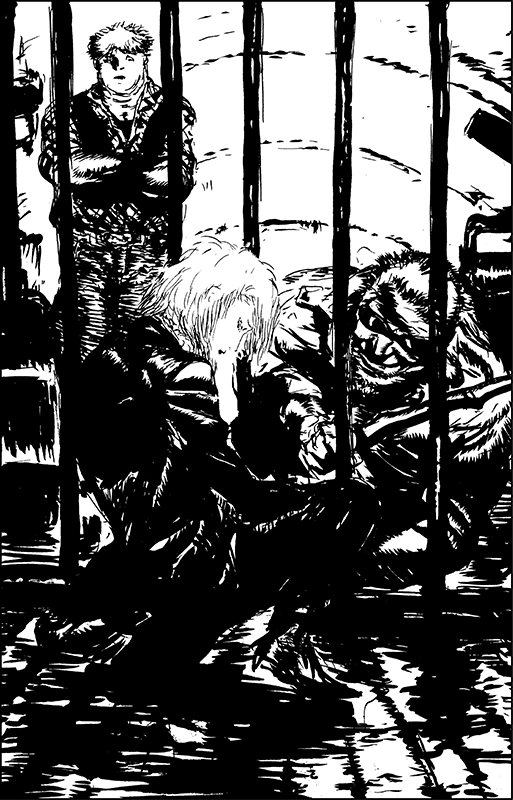
The sheriff’s office was only about thirty feet from the station, and beside it was a vacant lot that measured about twenty feet square, but when the door facing that lot opened, what was shoved outside was something all too common on the Frontier. Locked within the ten-by-ten-foot iron cage was a young man dressed in a black servant’s outfit, seated on an iron chair bolted to the floor.
As the people saw his face, the expressions of loathing swiftly faded from their own. It was as if, for the first time in a thousand years, a gust of fresh air pushed its way through a miasma. Anyone among the spectators would have just sighed and accepted the inevitability of the change. The face of the young captive was that beautiful.
“He’s Duke Sinistre’s valet.”
“His name’s Dorleac.”
“Can you imagine devoting yourself to the Nobility body and soul for more than a decade when you’ve got a face like that?”
The station quickly became the spot for townspeople to swap information.
“For whatever reason,” one woman began, “he was wandering around outside the castle two days back when a security patrol passed by and nabbed him—but aren’t they supposed to execute any human who’s been with the Nobility that long, whether they’ve been bitten or not?”
“It’s like this, lady: since there hasn’t been a servant of the Nobility who could walk in broad daylight for decades, they got orders directly from the government in the Capital that they really wanted to examine him, and that they were to have him transported.”
“Oh, that lucky bastard,” the woman remarked.
“Sure is good-looking, though, ain’t he? You think maybe the muckety-mucks in the Capital used the cameras in their surveillance satellites to sneak a look at him?”
“Damn near sure of it. You’re right on the button. But I don’t care how much anyone goes on about him being able to walk in the light of day; he’s a servant of the Nobility. No telling what kind of dark power he might have. That goes with the territory for the sheriff and her deputies, but it’s a real headache for the other passengers. They’ll be risking their lives on this trip. A real ride into hell.”
Laughter continued for a little while, but then it stopped as if cut short. A black cage, gleaming in the sunlight, had just passed right in front of the gossip swappers. The cage had small wheels attached to the bottom, rolling as it was pushed by a pair of sheriff’s deputies. The sheriff went ahead of the cage, entering the station building—the office of the stagecoach company. When the employees glimpsed her face and the sheriff’s badge pinned to her ample chest, their expressions were a sight to see. The sheriff was a beautiful woman with brunette hair spilling from her wide-brimmed hat.
“Well, Louise—I mean, Sheriff, we’ve got the coach all ready to go,” said a man in a suit and bow tie, standing behind his desk, extending his hand to shake. He was the manager.
“No passengers but us, right, Mr. Platt?” Sheriff Louise said rather insistently.
The manager shifted his eyes and replied, “I’m sorry, but there are three customers who positively insisted on going.”
“Did I or did I not absolutely forbid you from selling any tickets?!” the sheriff snarled, her eyes flashing angrily. Their trip was going to take roughly a week, during which they would be risking not only their lives but their very souls. They were truly journeying into death.
“Yes, I know you did,” the manager replied, “but consider our situation. The trail from here to the airfield runs right through Duke Sinistre’s domain. Do you think that fiend’s just going to sit idly by and let his servant be whisked away right under his nose? Even if you were to return this Dorleac person to him now, we wouldn’t be able to run our coaches until his anger subsided. How long do you reckon that’ll be? A month? Six? A year? No, let’s say half a century at the very least! For fifty years we’d be shit out of luck. This is a serious impediment to travel. And, it’s safe to say, a fatal blow to our business. At this point, we need every last passenger we can get. Hell, we’d sell tickets to monsters, or even the duke himself. The fare to the Capital for ten people puts this company in the black for a month.”
The manager’s expression and tone were part of a technique he’d mastered during two straight decades running an office for the stagecoach company. Over the last twenty years, everyone who’d ever heard a similar explanation had envisioned the company’s imminent bankruptcy, as well as the employees and their families taking their own lives in the aftermath.
The sheriff sighed and said, “You’ve explained the situation to your customers, I take it?”
“Of course. And even knowing the danger that awaits, they’re all okay with it. I find their courage exemplary.”
“I think you’re less interested in courage than revenue,” the sheriff remarked. After drawing a breath, she continued, “Give me some background on them.”
Out of the corner of her eye she glanced over at the lounge. If she could always get this information on short notice, there’d be no need to worry about trouble. Perhaps the sheriff had a hunch about how things would go, because she’d asked the coach service manager to check people’s identities despite having told him not to let anyone else ride with them.
“This way,” the manager said, leading the sheriff to his private room at the end of the hall, where he explained about the passengers.
Claire Scherzen (twenty-seven years old, saloon girl)
Harman Briggs (fifty-one years old, blacksmith)
JJ (thirty-six years old, Hunter of Nobility)
The manager continued, “Add to that the lunkhead you brought along.”
“Al Zemeckis—twenty-one years old, a farmer. And if I ever hear you call him a lunkhead again, there’ll be hell to pay. Plus there’s me and my two deputies—so, a total of seven, right?”
“And what business brought you to our stagecoach company, Sheriff?” the manager ventured.
Suddenly reminded, Louise corrected herself, saying, “Eight,including Dorleac.”
“Our coach, the Belvedere, normally seats twenty, and with the additional fold-down seating can accommodate up to thirty. Yes, you’d be hard pressed to find such a comfortable ride these days.”
“That’s great to hear—now, could you let everybody onboard?”
The manager looked at the clock on the wall, then compared that to the time on his pocket watch before nodding. “Two minutes and four seconds difference—and I don’t know which of them is the correct one. Well, then, you’d best let everyone know.”
Without a backward glance at the employee hollering, “Everybody, the coach is heading out!” the sheriff left the office.
Looking over at the stagecoach, Louise found two of her deputies looking back at her, apparently having finished loading the cage onboard. The passengers filed between the two men as they boarded the coach. The saloon girl, the blacksmith, the Hunter—but the fourth one halted and gave the sheriff a look as if he were trying to read her mood.
In a heavy flannel shirt and jeans, the man wore a leather vest in typical farmer fashion. Though his shirt was wrinkled now, it’d once been well laundered and ironed. He probably had a woman looking out for him. The repeating rifle he carried in his right hand was unusual, even for a lawman. An ordinary handgun was about a thousand dalas, a bolt-action rifle two thousand, and a repeater more than five thousand. Considering that living expenses out on the Frontier were said to average about a thousand dalas a month, it was a rather extravagant weapon for a farmer to have. Given the age of the rifle, it’d probably been purchased quite some time ago for keeping monsters in line.
“What should I do?” the man asked in the tone of a lost traveler.
You’re really not cut out for this work, Al, Louise thought to herself. I know your situation, but you never should’ve taken this job.
“Work with us,” the sheriff replied. “You’ve got to follow my orders to the letter, Al, but everything else I’m leaving to your judgment as a deputy. Raise your right hand.”
“Sure.”
The farmer raised a heavy right hand, and the sheriff followed suit, saying, “Al Zemeckis, do you swear to discharge your duties as a deputy of the town of Happy Gringo’s sheriff’s department, western Frontier district, until discharged from that position?”
No matter how many times Louise did this, she never could get used to the ceremony, but she couldn’t very well let him onto the coach without deputizing him and releasing him from personal liability.
“I do,” the farmer replied, his tone and expression equally serious.
“Good. Climb onboard. For the time being, it’s your job to watch our friend the valet.”
Following Al, the sheriff was just about to plant a foot on the coach steps when she turned and looked around. In addition to the station manager and his staff, nearly a dozen townspeople were staring at her. They gave doleful looks to the stagecoach and its passengers.
Though the sheriff had made no announcements, the speed with which rumors spread in a rustic town was frightening. Someone had been apprehended near a Noble’s castle—with that much to go on, it’d take less than two days to learn who it was and what they’d been doing. No doubt the gossips could clearly see the purpose of this journey, the hopes of Louise and her men, and a denouement quite at odds with those hopes.
When Louise turned right around, only the manager offered a stiff smile, only to have the door slammed in his face.
Though stagecoach drivers were employees of the coachcompany, this time one after another had declined the job, so a sheriff’s deputy named Lantz who’d had some experience in that field ended up climbing into the driver’s seat. A coach employee on the sidewalk rang a tin bell and shouted, “Moving out!” With a single crack of the whip, the cyborg horse–drawn coach rolled forward, wheels creaking. If not for a buffering device, the wheels of the coach would have left ruts in the ground three timesas deep.
Even after the coach had faded from sight, those who had seen it off showed no signs of moving on for the longest time. The sun was high and clouds dotted the blue sky that autumn day—and the townspeople had just watched a stagecoach ride off toward aterrible fate.
II
Seating in the coach consisted of five rows of forward-facing benches to either side of a narrow aisle, with each bench seating two passengers. To the aft were shelves for baggage and a space that could hold up to a thousand pounds of cargo, as this type of coach also doubled as a shipping service. Currently, that space was occupied by the prisoner and his iron cage. Al and a deputy named Belbo, the latter armed with a buckshot bow, were sitting on the floor to either side of the cage and well out of arm’s reach, while Louise was seated in the very last row. Immediately after boarding the coach, the sheriff and Belbo had donned sunglasses.
As the coach left town and was entering the surrounding farmlands, the sheriff stood up and called out for everyone’s attention. All seated separately, the three passengers twisted around for a look. They all wore the same annoyed expressions. People on the Frontier had a fundamental dislike of authority, after all.
“My name is Louise Kirk, and I’m sheriff of Happy Gringo. Although you’re probably already aware of what I’m going to tell you, I must give you fair warning.”
Before she’d even finished speaking, all but Harman the blacksmith—who was in the second row from the back on the right-hand side—turned away in disgust.
“From here on out,” the sheriff continued, “we’re going to be crossing some extremely dangerous territory. Without a doubt, your lives will be in jeopardy. In such a situation, my three deputies and I will endeavor to do our best to keep all of you safe, but our real mission is transporting the prisoner locked up in back. If there’s any concern that rescuing you might jeopardize our mission, we’ll have no choice but to give the completion of our mission primary attention. We ask for your understanding in that regard.”
“Yeah, we know!” someone promptly responded. It was the saloon girl, Claire Scherzen, seated in the second row from the front on the right side. Raising her right hand, gripping a bottle of booze, she continued, “Normally, you’d die to keep the peace for us. But when the time rolls around, the job comes first—hell, every public official is the same way. Okay, okay. We’re used to it by now.”
“Another thing—” Louise said, putting strength into her stomach muscles. “In the course of dispatching our duty, there may be some need to restrict your actions. I hope you’ll understand.”
She was fully prepared for someone to jump down her throat over that.
“You’ve gotta be fucking kidding!” Claire exploded, and her reaction was natural enough.
Even Harman’s mouth went wide as he bellowed, “What exactly is that supposed to mean? First you tell us you’ll leave us for dead if the situation calls for it, and now you’re asking for our help with your work? Hey, just because you’re wearing that badge, don’t go thinking that makes you Nobility or something!”
Louise’s interest was focused on the third passenger—the man seated in the middle row on the left-hand side. The Hunter. She’d never met him before. He elected to remain silent. That irritated Louise.
“The floor’s open for grievances,” she said to him. “Something eating you? I’d like to hear about it now.”
After the span of a breath, he replied in a gloomy tone, “Not particularly. I wasn’t counting on anyone else from the get-go. This is the Frontier.”
“You’re exactly right,” she said, and she was relieved to hear that.
Louise was relatively satisfied with the results. A war of words with drifters could easily escalate into an exchange of bullets or blades. Things had gone pretty well.
“At any rate, we’ve stated our position. We’d appreciate your cooperation,” said the sheriff.
“Like hell I’m helping you,” Claire replied spitefully.
All Harman did was spit loudly.
Louise, on the other hand, had a weight off her chest. If she did have to leave the two of them to fend for themselves, now it wouldn’t bother her conscience any. Besides, what she really needed to focus on was what was behind her.
The young man seated on the chair in the cage had a weary look on his face as it was turned toward the floor. Whatever had happened when he was with the Nobility, it seemed that slipping the yoke of fate had left him drained of both strength and will.
However, Louise turned to Al and said sternly, “I thought I gave you a pair of sunglasses yesterday. Put them on.”
“Oh, is it a problem that I haven’t got ’em on yet?” the young farmer asked, frantically reaching for the chest pocket of his shirt.
“They might not seem any different than us, but that’s no reason to underestimate a human who’s lived with the Nobility a long time,” Louise said firmly. “The Nobility took a liking to him. Such being the case, it’d only be natural to want to reward him for his long and loyal service. In his case, that might’ve been by not feeding on him. But what if the reward was magic powers? What if he could pass right through the wall and escape if we took our eyes off him for a minute? We’ve had reports from the northern Frontier of cases where someone turned into mist or bats, just like the legends. Even if it wasn’t something as big as all that, even you must know what happens to people when they look into a Noble’s eyes. There are more cases than you could shake a stick at of people like that turning their own parents over to the Nobility so they could feed.”
“I see. Sorry ’bout that,” Al said, donning the protective charm with stiff, nervous motions.
But there was still someone else who should feel Louise’s wrath.
“Belbo,” she said, “you’re the one with seniority here! What are we supposed to do if you won’t even tell him the basics?”
“Hey, that one was just plain ol’ common sense. Why do I gotta hold his hand for everything?”
“And what’ll you say when he goes and gets possessed?”
The sturdy deputy fell silent.
“How about an answer?”
“Point taken, ma’am.”
If this gig didn’t pay so well and give me the right to push folks around, I’d quit here and now and kill you dead, bitch, before I skipped town, Belbo thought to himself venomously, but he saluted the woman. He thought about giving the shitty little dirt farmer a piece of his mind, but since the prospect of getting chewed out by the sheriff didn’t appeal to him, he decided to hold his tongue.
In a manner of speaking, the servants of the Nobility who were found from time to time could be more trouble to deal with than victims who’d been bitten. Their appearance didn’t differ at all from that of regular people, nor did their daily routine. They could walk around in the light of day or cross running water without any difficulty. When they ate, they washed their meals down with water. After a year or two of this, even those who had suspicions about them would grow complacent. And the next thing anyone knew, they were using the magic powers their masters had granted them to lead innocent victims off to their employers.
While there were almost no written records of these magic powers, from the compiled eyewitness accounts they seemed to be a sort of powerful gaze—hypnotism, which was probably the easiest power for the Nobility to grant. In the southern Frontier, when one of these “servants” was found, there were cases of them having both eyes burned out without a moment’s discussion, though in many cases it was said the accused was killed before they could say a word in their own defense.
In this case, Dorleac’s safety was guaranteed by the fact that the security patrol that captured him happened to be accompanied by a roving reporter from a regional news outlet. His report was delivered at Mach speed by a mutant pigeon, and it took less than two days for the regional news outlet to make the situation clear to the Capital. The Noble Research Committee in the Capital received no more information about the servants than common rumors and the details of their deaths, but another group—in other words, the government—ordered the Autonomous Frontier Government to ensure Dorleac was kept safe and in custody, and requested that he be escorted to the Capital posthaste.
However, there was one factor the Capital didn’t comprehend. The Nobility were quite attached to their servants. A renowned poet who traveled the southern Frontier several millennia earlier had declared, “It can be nothing save love.” This was juxtaposed with the deluded desires humans who wished to be ageless and indestructible felt toward the Nobility, which were taken up in regional folk songs, ballads, and poems.
The Nobility felt what could only be termed a partiality toward a certain kind of human (though at present the criteria for that had yet to be established). And when Nobles lost such an individual or had one snatched away, their feelings changed to a crazed desire to get them back. Needless to say, their madness included a wish for vengeance on those who’d snatched their favorite.
When the Nobility’s power was at its gleaming zenith, it was perfectly normal for the entire hometown of an abductee to be banished to another dimension or targeted for a meteorite strike. Now, even with their hegemony far in decline, it didn’t stand to reason that a human stagecoach would be able to pass unharmed through Noble territory immediately after an incident such as this. Especially when the servant that’d been taken from them was riding in that coach. Nevertheless, while there had been an urgent request from the Capital, it was said the stagecoach had set out mainly due to fears that the Noble—Duke Sinistre—might strike against the town of Happy Gringo.
Before noon on the third day, they would reach the relay station and inn in Gasburke, where an escort brigade dispatched by the Capital would join up with them. The brigade was armed with the very latest weapons based on the Nobility’s own technology, and they would guide the coach to the town of Canaluda, where the airfield was located. Their lives would be on the line for only two days of the journey. That thought was all the stagecoach’s passengers had to cling to, as if it were the very hands of God.
“I’m going to go up with Lantz for a while. I’m counting on you guys down here,” the sheriff told her deputies about an hour after they’d left town.
After Louise mounted the forward staircase and disappeared outside through the hatch, the atmosphere in the vehicle became much more tranquil.
“Hey, Al, from here on out we’ll be in the Nobility’s domain. If you don’t pull your head outta your ass, you’ll be the first one killed!” Belbo teased, as if he’d been waiting for this moment.
When Al ignored him, he just redoubled his efforts, as if that were what anyone would do. “I hear tell you took this gig on account of your wife and kids wanting to buy one of them automatic cleaning machines from the Capital. It’s a nice thought, but it ain’t gonna do you much good if you lose your life in the bargain. Hell, if something happens, we’ve gotta be more concerned with protecting this piece of shit than saving our own skins!”
Belbo rapped his heavy bow against the iron bars of the cage. A shrill sound reverberated, and the young man—who’d been looking down at the floor—suddenly raised his head in surprise.
“Oh, did I wake the Noble’s precious little page? Okay, you take a good look at my buddy and me. Until they cut you up and study you in the Capital, we get to play nursemaid to you. So tell me, did the Nobility feed on you, fucker?”
The air congealed. This was a reasonable enough question on the Frontier—but because of the effect it might have, asking it in front of other people was taboo. A horrible insult, it often escalated into an infringement of human rights that led to blood being spilled—it was said that such cases were on the order of a hundred thousand at the very least.
“No, I . . . I never . . .” the young man babbled after a while. Though he sounded exhausted, his voice was just as lovely as his face.
“You’re trying to tell me you lived with the Nobility for more than a decade, and they didn’t do nothing to you? Who’d buy that? Well, you are a looker. Bet there’s a pretty good chance that instead of blood, they were sucking something else.”
“Please, just stop,” the young man said, shaking his head violently. “I don’t want to think about it anymore. I escaped from the duke. I couldn’t stand it any longer.”
“Sure, that’s what all you ‘servants’ say,” Belbo replied with a mocking grin. He’d finally found someone on whom he could take out all his fear, tension, and irritation. “But then, after a couple of years playing it safe, you spring out them fangs you’ve been hiding once everybody around you lets their guard down. I know what you’re plotting, you little bastard!”
Belbo raised his bow. He was going to bang the cage again.
“Don’t, Belbo,” Al said, getting to his feet. At six foot two, he was pretty much on par with Belbo in the height department, but he looked to weigh about three times as much. His naturally big bones had been sheathed in an armor of muscles through strenuous physical labor.
Belbo found a sole means of escape in his seniority, saying, “What the hell, shit-kicker? You presuming to tell an ol’ hand how to dohis job?”
“That wasn’t my aim. It’s just, you’re probably gonna rattle the passengers.”
“You’ve got a smart mouth for a goddamn rookie,” Belbo said, and he also got to his feet.
There was no turning back now.
But another voice came between them.
III
“Stop screwing around, Deputy. That badge give you the right to bully anyone weaker than you? The other deputy’s setting a lot better example than you,” Claire said, giving Belbo a sharp look.
“What’s that, slut?” Belbo snapped, twice as set on looking tough now that he had a new foe—actually, just an ally for Al. “Who the hell you think’s gonna defend the lot of you on this trip when—”
“Earlier, the sheriff said you wouldn’t be defending us, remember? That sure is a lot of tough talk from a guy who takes orders from a woman.”
Belbo fell silent. He was just about to explode. But it was Al who stopped him.
“Belbo, remember this,” the farmer said, tapping a finger against the tin star that gleamed on his own chest.
For a while, Belbo was frozen in place. He knew that no matter what he did, he couldn’t win. It felt as if an eternity passed before he let out a sharp little breath, then went back to his original location and sat back down.
“Oh, don’t have anything to say now?” Claire said to him, needling him with laughter.
“Knock it off already,” Harman the blacksmith told her. “What are we supposed to do when we’re not out of town for more than an hour, and already everybody’s at each other’s throat? We’ve got two days through Noble territory ahead of us. If we don’t cooperate, then everybody who needs saving might not get saved if anything happens. I wanna get where I’m going safe and sound. So do the rest of you, right? If so, let’s show a little more consideration for the other folks.”
“Yeah, yeah, you’re right about that,” Claire said, backing down easily. Perhaps it was just her nature to be surprisingly quick to take advantage of a situation.
Al grinned and said, “Thanks, Mr., er—”
“Harman. I’m a blacksmith.”
“I’m Al. This is Belbo. Nice to meet you.”
“Likewise. Let’s hope we both live to a ripe old age.”
The plain-faced blacksmith gave the deputies a little nod, and then faced forward again. Pulling a pint bottle of whiskey out of his bag, Harman asked the taciturn passenger across the aisle, “Care for a drink, bud?”
“No, thanks,” the man replied, his low voice trembling with absolute refusal.
“Pardon me. So, you a Hunter?” Harman continued, his voice also dropping to a murmur. It wasn’t that he was trying to match the other man’s tone, but rather that this was another question it was practically forbidden to ask in front of others.
“What makes you think that?” the man replied with unexpected speed.
“Well, in more than fifty years of living, I’ve run into all types. I can tell from the atmosphere. Just by being there, you make your surroundings sort of quiet—I don’t know, like this.”
“You mean I give you the creeps?”
Deep in Harman’s chest, his ticker thumped hard.
“Ha ha!” the blacksmith said, trying to laugh it off, but apparently the other man wasn’t buying it.
“Do I give you the creeps?”
The blacksmith felt as if a tremendous weight were driving him back against the wall. “No, not at all. Just forget I mentioned it.”
Turning forward, Harman focused his attention on the woman two rows ahead of him, saying, “How about a drink, missy? You’re young, but I bet you can hold your liquor, eh?”
Mindful of those behind him, he took the red bandanna from around his neck and wiped the mouth of the bottle, then leaned forward over one row of seats and reached his arm over a second to offer it to the woman.
“Thanks. Don’t mind if I do,” Claire replied, turning around and reaching back to take the liquor bottle. She clutched her own bottle close to herself.
Taking a swig, she remarked, “This is good stuff. You blacksmiths make pretty good money, do you?”
“Spare me. God might just get so disgusted by that question he’ll shut the gates of Heaven on me. I barely squeak by, but I figure the least I can do is spring for decent booze for myself.”
“You don’t say.”
On seeing the woman down about three mouthfuls with the next swig, Harman bugged his eyes.
“Really can handle your liquor, can’t you? Missy, you wouldn’t happen to be—”
“I work in watering holes. Only I went a little too far and got run out of Happy Gringo. They had the nerve to tell me they’d put me on trial if I wasn’t out of town by the end of today. What’s a dinky little burg like that doing with a public morals committee anyway?” she grumbled, taking another belt from the bottle.
“You said it. I was just thinking the same—”
“You look like a nice, respectable blacksmith, so what are you doing riding on this dangerous coach?”
“Just because I’m a blacksmith, that doesn’t mean I’ve got a set residence. See, I’m a traveling smith. It was just time to move on from that town.”
“Really? You know, now that you mention traveling smiths, I hear you guys do more than just make horseshoes and fix farm equipment. I’ve heard talk about iron dolls that can move on their own and wagons that run without engines, but is that stuff really true?” the woman inquired, then took another swig.
“Hey—I mean, yeah, I’ve heard those stories, too, but that stuff’s beyond me. That’s the kind of stuff the Nobility’s gotta teachyou.”
“Oh, now that’s disappointing.”
“Sorry. By the way, could I have my—”
“Oh, this? Gee, I’m sorry—I seem to have drunk the whole thing, haven’t I?”
“‘Seem to,’ my ass! You went and drank the whole thing,” Harman said, but he managed to rein in his anger. After all,he was the one who’d said they had to work together. Taking the bottle without another word, he held it upside down and sighedsadly.
“This is good booze, but it’s pretty strong,” he said. “You could light your breath on fire about now. Downing half a bottle of that—you sure your stomach and liver can take it?”
“From the time I was seven, I’ve been going from bar to bar, so I’ve got twenty years’ experience at this. If I couldn’t handle it, I’d have checked out of this life a long time ago. God must have a pretty good sense of humor.”
Claire’s cheeks were flushed, but then they’d been that way when she climbed onboard. And she’d been drinking ever since—more to the point, there hadn’t been a single day in the last two decades that she hadn’t had a drink. God have pity on her.
As soon as the sun went down, foot traffic died out in the town of Happy Gringo. Due to being just outside Duke Sinistre’s domain, the town hadn’t suffered any significant damage since its inception, yet fear of the beings who’d ruled over them for ten millennia remained indelibly imprinted not only on the townspeople but on the subconscious of every human being.
Funeral services for the late Fredrick Nahathela had been concluded that day without incident, but his wife Verik’s anger only continued to swell. Yes, it certainly could be said that her husband was wrong to get involved with that woman. But if that tramp hadn’t been around to begin with, Verik knew her husband wouldn’t have had those strange urges and wouldn’t have ended up meeting the fate he did.
What a horrible way to die.
Verik had intended to cut the woman in two with a razor-sharp sword from the Nobility that’d been handed down in the family for centuries. She’d been stopped by the woman’s employer—the saloonkeeper.
When the saloonkeeper delivered her husband’s lifeless remains, Verik lost her mind and was about to leave the house with the keen blade in one hand, but he told the woman her husband Fredrick had tried to have his way with one of the saloon’s employees. He conceded that it was, indeed, terrible the way she’d done it, but his girl had acted in self-defense. Therefore, the widow was asked to let bygones be bygones if the girl left town that very day. What’s more, he informed her that her Fredrick had been in the habit of sharing the details of some very unsavory dealings with the girl at his saloon. Were those facts to become public knowledge, Verik and the rest of her family would be the next ones forced to leave town. He mentioned how people who live in glass houses shouldn’t throw stones. And after the saloonkeeper gave her a small sampling of the contents of her husband’s stories, Verik accepted his deal without further debate.
However, as much as Verik’s head could accept it, her heart only burned hotter with malice with each passing minute.
I’ll go out to Duke Sinistre’s castle and offer him my blood in exchange for ripping that girl limb from limb, she thought. No, I’ll have him do it the same way she did my husband, so it takes a good, long time—
The woman’s hate-addled brain clearly made out the sound of footsteps.
Someone’s coming down the street in the residential district. A traveler, perhaps? No, the gates would already be closed by now, so they’d have no choice but to wait outside the walls until dawn. And none of the townspeople would be prowling around outside all alone at this hour. Who, then?
Mixed with the footfalls, she could hear voices. Exactly the kind of voices you didn’t want to hear at night. Screams. Though her hearing was by no means exceptional, Verik could tell that the cries were coming from the same direction the footsteps had come. So many voices. And such weird screams. They came from behind the footsteps—and were spreading across the town. Anyone and everyone was screaming.
What happened?
Clearly it was the work of whomever the footfalls belonged to. But where were those footsteps taking them? If they went clear across town, there was nothing beyond that but Joseph Gashuk’s ranch and Stefan Hubuff’s fields. Not them too! Destroying the town and killing everyone—and for what?
A feeling of desperation won out over her fear. Verik ran to the window.
Where were those footsteps?
The door opened. Darkness choked the doorway.
The footsteps were directly in front of her house.
The darkness came inside.