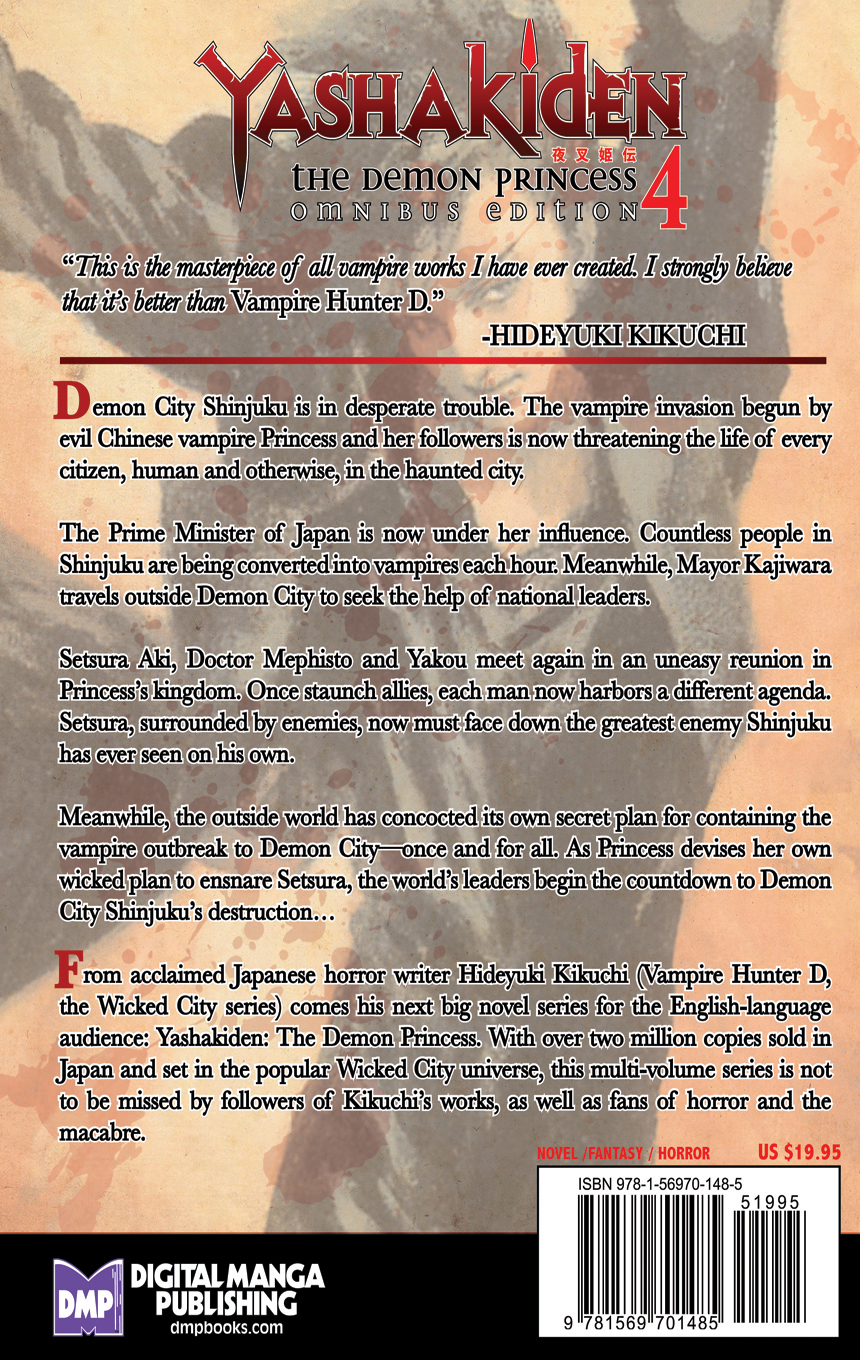
The Gleeful Joy in Kikuchi's Horror
The Gleeful Joy in Kikuchi's Horror
Why do the books of Hideyuki Kikuchi brim with so much vim and vigor? Horror novels aren’t supposed to be a source of spirited good cheer. Fear and trembling and other similar emotions surely spring to mind. But no.
Read any other horror novel—from Kadokawa or elsewhere—and I feel like I’m sinking to the bottom of the earth. Kikuchi’s alone possess that unusually energetic spark. (And to be sure, the worlds he creates rarely confine themselves to the narrow frame of genre horror.)
There are several reasons for this, I think. I’ll try to summarize my thoughts about them here.
The first book I encountered of his was Vampire Hunter D. It came highly recommended by the shojo manga artist Meruhen Meka-san and her younger sister, the writer Yufuko Seno. Kikuchi gained great popularity with the creation of this strikingly handsome superhero. But what struck me the most was his powers of description.
D crosses swords with a rival. Their paths intersect in the air and fly apart. The action advances frame by frame as he lays out the scene with a detailed and dynamic eye. No more than five seconds would have elapsed in real time, but reading to the end may take a minute. The visual imagery is so clearly created that it should be savored slowly.
“So this is what it means to be a writer,” I remember sighing.
His subsequent fame and prodigious output is well known. He concludes his afterwords with the title of a horror film he happened to be watching at the time. That tells me he is a movie fan with strong visual senses. This “camera eye” seems first of all to be at the foundation of Kikuchi’s writerly verve.
Rhythmically shifting points of view, the camera peers up from below, zooms in, elevates, pulls back, unsparingly delineating Setsura Aki’s profile. Or not just his profile, but his whole comely appearance.
The nimbleness of the author’s footwork, the obvious delight he takes in moving the camera around captures the imagination of the reader as well. The text very much becomes a literary feast for the eyes.
In Kikuchi’s world, beauty spills from every page. It’s almost as if he is peeking into the secret desires of his (female) readers. This is true to an extent of all his series, but Demon City Blues in particular boasts of two great Adonises, Setsura Aki and Doctor Mephisto. When the two of them mount the stage together, the radiant combination—as if scattering golden pixie dust with every step—is enough to make a girl swoon.
Since appearing in paperback, I can’t help noticing pages where, if three adjectives make for company, then the word “beauty” becomes a crowd.
So that’s what it’s come down to, eh? Heh. I can’t keep myself from grinning. The fact is, when Setsura Aki’s name is on the page, my reading pace slows to a third of normal.
This is a bit off-subject, but clear and compelling descriptions of a handsome leading man do not by themselves constitute the source of high-spirited prose.
A man shot from behind, his chest exploding outwards—a big raven split neatly in two—a body landing heavily on a strand of devil wire—a vampire hanging upside down with his feet planted on the ceiling—bloody clay oozing out of the floor and coagulating into a porcelain doll—
Herein are the pleasures of an unstoppable vision, gliding easily from one vivid description to the next, while we mere mortals remained trapped inside the frame of the physical world and its unalterable laws.
In that world, the hammer splits the rock—the ax cuts down the tree—water always finds its own level—and the dead stay dead—the world of the commonplace and the mundane, it could be said.
In Demon City, however, people can rise from the dead over and over, be smashed into walls, be cut in two, propagate and divide, adhere themselves to others, stretch and contract, dissolve and go up in flames, lose their heads and grow them back again.
The will to live of such beings can’t help but infuse the reader as well.
And—for lack of a better word—the freedom it represents. In volume two, the giant mollusk slumbering beneath Shinjuku awakens. Its nightmares gush forth. The tentacles sprouting from Setsura’s back threaten to remake the world. The intense feeling of déjà vu this scene imparts almost makes me believe that the author himself is the true seer, and his novels are composed while in a phantasmal state.
The dream world is infinitely pliable, the freedom to mold and shape matter and substance unconstrained. A man can sink his fingers into the flesh of another. A lover turned to dust can flitter around the beloved.
Kikuchi’s world—and especially the world of Demon City Blues—arouses that sense of the self and the world that comes alive when dwelling in an embryonic dream.
The knack of watching horror movies is to maintain an awareness of the frame in which the screen is set. Rather than drowning in the center of the screen, always being conscious of the frame keeps the fear at a distance. And often does more than keep it at a distance, but fosters the ability to take these monsters and ghosts anything but seriously.
I don’t think anybody has pointed this out before, but one of the things I enjoy most about Kikuchi’s novels is the sense of humor permeating them. In volume one, the shop girl at Aki teases him:
“It’s the middle of summer and all, so why are you wearing that black slicker?”
“I was born wearing it.”
And at a bar, after draining a shot glass:
“How was it?”
“Not to my taste.”
“Eh?”
“At least I wouldn’t serve up chocolate corn nuts as a side. Senbei is the only way to really enjoy a whiskey.”
A long silence followed.
And then there’s this description:
His head sat several inches away from his stretched-out arms, like a football player who’d leapt forward to make a catch and missed. The mouth opened and closed silently, mimicking a stranded fish.
With a mixture of metaphors like this—that you should hope never to see illustrated in the real world—clearly seeing the “frame” of the picture allows Kikuchi’s readers to revel in the ghastly delights of the imagery, in stories of hell as crisp and clear as the blue sky above.
Such is the power of the terrifying beauty that no matter how heartless the slaughter or cruel the betrayal, we condone them like the acts of a mighty destroying angel.
In Kikuchi’s world, demons don’t win with their superpowers and their brute willingness to kill and maim alone—which is not to say that such attributes don’t come in handy—but here nothing trumps the power of beauty. Like Medusa, view it for five minutes and you can’t pull away, even as it sears your eyeballs.
And the otherworldly countenance of Doctor Mephisto—in less than half that time, it caused the face-like tumors covering the body of a certain actress to disappear. The tumors must have died entranced and enthralled.
This is not the beauty of a superficial aesthetic. This is the power of a beauty that controls, seduces, intoxicates, enervates, and makes of its followers obedient slaves.
Speaking of power, let’s finish up the discussion with that. The biggest reason for the sheer audacity communicated by the Kikuchi oeuvre is the sense of verisimilitude created by things like devil wire and qi. Though appearing preposterous, the wires wielded by Setsura Aki give him command of any given space down to the nooks and crannies, twining them around an opponent’s body and severing at will.
The invisible threads stretched around a space make it an extension of his mind, that can be activated by a mere thought. The same as the qi that expands from the body and penetrates the surrounding area. As for the latter, Kikuchi has long integrated material from the martial arts into his books.
Among them, the Nishino Breathing Method. The way Takako Kanan controls her own mind and spirit in the first volume rings a clear bell. A far, far cry from the qi that Ryuuki and Yakou battle with. But these glimpses of qi and its effects, and the descriptions of the power projected by its users, these hints of their true natures are deeply moving.
I come away feeling that these are not simply arbitrary inventions of the author’s creative mind, but in fact real things. Not that such things actually exist in the world. Rather, that it is possible to grasp the true essence of otherwise abstract things like space and gravity.
I should like to feel the outrushing of that beautiful binary star, Setsura Aki’s devil wires, to see the tendrils of a person’s spirit as it scampers through space, and feel the thrill in the body as well as the soul.
I did not get around to explaining the essentials of the story. In fact, though I have read all of Kikuchi’s books, they all have disturbed and fascinated my mind such that I find it difficult to pull apart and separate the elements of each. Not to mention that I can utterly lose myself within a single series.
Simply reading the story-so-far prefaces in volumes two through eight of the original paperback series is enough to convince me the editor must be a genius just to keep track of the whole thing. That scene, that description, involving Setsura or Mephisto or Nuvenberg—where and how did it come up in the story again?
No need to wonder. Thanks to this assignment, I’ve reread Maoden and Demon City Blues and more, inspiring me to once again contemplate the talents of the exemplary writer of fantasy literature that is Hideyuki Kikuchi.
Akemi Itsuji